Ontdek de Fascinerende Wereld van UFO's en UAP's: Jouw Bron voor Onthullende Informatie!
Ben jij ook gefascineerd door het onbekende? Wil je meer weten over UFO's en UAP's, niet alleen in België, maar over de hele wereld? Dan ben je op de juiste plek!
België: Het Kloppend Hart van UFO-onderzoek
In België is BUFON (Belgisch UFO-Netwerk) dé autoriteit op het gebied van UFO-onderzoek. Voor betrouwbare en objectieve informatie over deze intrigerende fenomenen, bezoek je zeker onze Facebook-pagina en deze blog. Maar dat is nog niet alles! Ontdek ook het Belgisch UFO-meldpunt en Caelestia, twee organisaties die diepgaand onderzoek verrichten, al zijn ze soms kritisch of sceptisch.
Nederland: Een Schat aan Informatie
Voor onze Nederlandse buren is er de schitterende website www.ufowijzer.nl, beheerd door Paul Harmans. Deze site biedt een schat aan informatie en artikelen die je niet wilt missen!
Internationaal: MUFON - De Wereldwijde Autoriteit
Neem ook een kijkje bij MUFON (Mutual UFO Network Inc.), een gerenommeerde Amerikaanse UFO-vereniging met afdelingen in de VS en wereldwijd. MUFON is toegewijd aan de wetenschappelijke en analytische studie van het UFO-fenomeen, en hun maandelijkse tijdschrift, The MUFON UFO-Journal, is een must-read voor elke UFO-enthousiasteling. Bezoek hun website op www.mufon.com voor meer informatie.
Samenwerking en Toekomstvisie
Sinds 1 februari 2020 is Pieter niet alleen ex-president van BUFON, maar ook de voormalige nationale directeur van MUFON in Vlaanderen en Nederland. Dit creëert een sterke samenwerking met de Franse MUFON Reseau MUFON/EUROP, wat ons in staat stelt om nog meer waardevolle inzichten te delen.
Let op: Nepprofielen en Nieuwe Groeperingen
Pas op voor een nieuwe groepering die zich ook BUFON noemt, maar geen enkele connectie heeft met onze gevestigde organisatie. Hoewel zij de naam geregistreerd hebben, kunnen ze het rijke verleden en de expertise van onze groep niet evenaren. We wensen hen veel succes, maar we blijven de autoriteit in UFO-onderzoek!
Blijf Op De Hoogte!
Wil jij de laatste nieuwtjes over UFO's, ruimtevaart, archeologie, en meer? Volg ons dan en duik samen met ons in de fascinerende wereld van het onbekende! Sluit je aan bij de gemeenschap van nieuwsgierige geesten die net als jij verlangen naar antwoorden en avonturen in de sterren!
Heb je vragen of wil je meer weten? Aarzel dan niet om contact met ons op te nemen! Samen ontrafelen we het mysterie van de lucht en daarbuiten.
For years now, scientists have been raising ethical concerns about the creation and use of lab-grown mini brains.
At the same time, other scientists are plowing full steam ahead, creating these brain organoids and trying to find ways to put them to good use.
Now, a group of scientists that fall into the latter category are trying to develop something called “organoid intelligence.”
They shared their research in a recent edition of the journalFrontiers in Science.
Essentially, they want to use these lab-grown mini brains as biological hardware for new biocomputers, LiveScience reports.
“While silicon-based computers are certainly better with numbers, brains are better at learning,” said one of the scientists, Thomas Hartung of Johns Hopkins University. “For example, AlphaGo [the AI that beat the world’s number one Go player in 2017] was trained on data from 160,000 games. A person would have to play five hours a day for more than 175 years to experience these many games.”
But… brains? In a computer? Why?
Fluorescent images illustrating cell types in brain organoids.
In apress releaseabout their research, the scientists wrote, “Brains are not only superior learners, they are also more energy efficient. For instance, the amount of energy spent training AlphaGo is more than is needed to sustain an active adult for a decade.”
Hartung added. “We’re reaching the physical limits of silicon computers because we cannot pack more transistors into a tiny chip. But the brain is wired completely differently. It has about 100bn neurons linked through over 1015 connection points. It’s an enormous power difference compared to our current technology.”
In parallel, the authors are also developing technologies to communicate with the organoids: in other words, to send them information and read out what they’re ‘thinking’. The authors plan to adapt tools from various scientific disciplines, such as bioengineering and machine learning, as well as engineer new stimulation and recording devices.
“We developed a brain-computer interface device that is a kind of an EEG cap for organoids, which we presented in an article published last August. It is a flexible shell that is densely covered with tiny electrodes that can both pick up signals from the organoid, and transmit signals to it,” said Hartung.
But what about all those sticky ethical questions about creating mini-brains just to do tasks for us humans?
Creating human brain organoids that can learn, remember, and interact with their environment raises complex ethical questions. For example, could they develop consciousness, even in a rudimentary form? Could they experience pain or suffering? And what rights would people have concerning brain organoids made from their cells?
The authors are acutely aware of these issues.
“A key part of our vision is to develop OI in an ethical and socially responsible manner,” Hartung said. “For this reason, we have partnered with ethicists from the very beginning to establish an ‘embedded ethics’ approach. All ethical issues will be continuously assessed by teams made up of scientists, ethicists, and the public, as the research evolves.”
A couple of years prior to that, scientists worried that the mini brains they grew in a lab may be sentient and feel pain.
Is hooking these mini brains up to a computer really a great idea? What if they get access to the internet and start secretly communicating with self-healingsuperhuman robots?
ALL RELATED VIDEOS, selected and posted by peter2011
What are 'minibrains'? Everything to know about brain organoids
Nicoletta Lanese
In the past decade, lab-grown blobs of human brain tissue began making news headlines, as they ushered in a new era of scientific discovery and raised a slew of ethical questions.
These blobs — scientifically known as brain organoids, but often called "minibrains" in the news — serve as miniature, simplified models of full-size human brains. These organoids can potentially be useful in basic research, drug development and even computer science.
However, as scientists make these models more sophisticated, there's a question as to whether they could ever become too similar to human brains and thus gain consciousness, in some form or another.
How are minibrains made?
Scientists grow brain organoids from stem cells, a type of immature cell that can give rise to any cell type, whether blood, skin, bowel or brain.
The stem cells used to grow organoids can either come from adult human cells, or more rarely, human embryonic tissue, according to a 2021 review in the Journal of Biomedical Science. In the former case, scientists collect adult cells and then expose them to chemicals in order to revert them into a stem cell-like state. The resulting stem cells are called "induced pluripotent stem cells" (iPSC), which can be made to grow into any kind of tissue.
To give rise to a minibrain, scientists embed these stem cells in a protein-rich matrix, a substance that supports the cells as they divide and form a 3D shape. Alternatively, the cells may be grown atop a physical, 3D scaffold, according to a 2020 review in the journal Frontiers in Cell and Developmental Biology.
To coax the stem cells to form different tissues, scientists introduce specific molecules and growth factors — substances that spur cell growth and replication — into the cell culture system at precise points in their development. In addition, scientists often place the stem cells in spinning bioreactors as they grow into minibrains. These devices keep the growing organoids suspended, rather than smooshed against a flat surface; this helps the organoids absorb nutrients and oxygen from the well-stirred solution surrounding them.
Brain organoids grow more complex as they develop, similar to how human embryos grow more and more complex in the womb. Over time, the organoids come to contain multiple kinds of cells found in full-size human brains; mimic specific functions of human brain tissue; and show similar spatial organization to isolated regions of the brain, though both their structure and function are simpler than that of a real human brain, according to the Journal of Biomedical Science review.
Why are scientists growing minibrains?
Minibrains can be used in a variety of applications. For example, scientists are using the blobs of tissue to study early human development.
To this end, scientists have grown brain organoids with a set of eye-like structures called "optic cups;" in human embryos in the womb, the optic cup eventually gives rise to the light-sensitive retina at the back of the eye. Another group grew organoids that generate brain waves similar to those seen in preterm babies, and another used minibrains to help explain why a common drug can cause birth defects and developmental disorders if taken during pregnancy. Models like these allow researchers to glimpse the brain as it appears in early pregnancy, a feat that would be both difficult and unethical in humans.
Minibrains can also be used to model conditions that affect adults, including infectious diseases that affect the brain, brain tumors and neurodegenerative disorders like Alzheimer's and Parkinson's disease, according to the Frontiers in Cell and Developmental Biology review. In addition, some groups are developing minibrains for drug screening, to see if a given medication could be toxic to human patients' brains, according to a 2021 review in the journal Frontiers in Genetics.
Such models could complement or eventually replace research conducted with cells in lab dishes and in animals; even studies in primates, whose brains closely resemble humans', can't reliably capture exactly what happens in human disease. For now, though, experts agree that brain organoids are not advanced enough to partially or fully replace established cell and animal models of disease. But someday, scientists hope these models will lead to the development of new drugs and reduce the need for animal research; some researchers are even testing whether it could be feasible to repair the brain by "plugging" injuries with lab-grown human minibrains.
histological image shows a cross section of a rat's brain, depicted in red, with a glowing green blob on the top right side; the blob is a clump of cells called an organoid that's been derived from human stem cells and transplanted into the rat's brain
Beyond medicine and the study of human development, minibrains can also be used to study human evolution. Recently, scientists used brain organoids to study which genes allowed the human brain to grow so large, and others have used organoids to study how human brains differ from those of apes and Neanderthals.
Finally, some scientists want to use brain organoids to power computer systems. In an early test of this technology, one group recently crafted a minibrain out of human and mouse brain cells that successfully played "Pong" after being hooked up to a computer-controlled electrode array.
And in a recent proposal published in the journal Frontiers in Science, scientists announced their plans to grow large brain organoids, containing tens of thousands to millions of cells, and link them together to create complex networks that can serve as the basis for future biocomputers.
Could minibrains ever be sentient?
Although sometimes called "minibrains," brain organoids aren't truly miniaturized human brains. Rather, they are roughly spherical balls of brain tissue that mimic some features of the full-size human brain. For example, cerebral organoids, which contain cell types found in the cerebral cortex, the wrinkled outer surface of the brain, contain several layers of tissue, as a real cortex would.
Similarly, brain organoids can generate chemical messages and brain waves similar to what's seen in a full-size brain, but that doesn't mean they can "think," experts say. That said, one sticking point in this discussion is the fact that neuroscientists don't have an agreed-upon definition of consciousness, nor do they have standardized ways to measure the phenomenon, Nature reported in 2020.
The National Academies of Sciences, Engineering, and Medicine assembled a committee to tackle these quandaries and released a report in 2021, outlining some of the potential ethical issues of working with brain organoids.
At the time, the authors concluded that "In the foreseeable future, it is extremely unlikely that [brain organoids] would possess capabilities that, given current understanding, would be recognized as awareness, consciousness, emotion, or the experience of pain. From a moral perspective, neural organoids do not differ at present from other in vitro human neural tissues or cultures. However, as scientists develop significantly more complex organoids, the possible need to make this distinction should be revisited regularly."
One of the mysteries that refuses to go away in the Yucatan Peninsula of Mexico is the persistent belief of the farmers in “little men” called aluxes (ah-loosh-es) who are said to burrow inside the hills near the ancient ruins, and haunt the forests, farmlands and cenotes. These dwarf beings are generally invisible to us, but they can make their presence known, particularly after sunset, by making whistling noises or by playing tricks on us. They are generally not feared, though, because their personality is like that of a child. They love playing tricks on humans and passers-by, and for most part they are harmless. But, if they are offended they can become vindictive.
During the sowing season, the farmers of the Yucatan make offerings of food to the aluxes, near the hills that dot the farmlands and at specially designated shrines. This ensures that the aluxes will protect the cornfields at night from animals and thieves. But if they are not propitiated in accordance with tradition, thay can throw tantrums. Aluxes are blamed for all kinds of mischief; stealing tools, throwing belongings on the floor of houses, keeping people up all night by screeching, or even sending diseases through a “bad wind”.
An alux shrine below a tree. Local farmers have left offerings. Merida, Mexico. Source: TopYucatan.com
The aluxes seem to have a special affinity for the sacred ruins of the Maya, and have taken it upon themselves the protect the sites from intruders. Judith Storniolo, Professor of Anthropology at Drexel University, who has worked with the Maya for many decades, recalls that the aluxes, “summon strong winds, emit piercing whistling sounds, and propel stones at intruders. The aluxo’b (aluxes) who guard the ruins may also call their dogs to chase looters and archaeologists away if they are at the site at night. I have been told stories of workers being pummeled with stones and bothered by loud noises in the night if they sleep at an archaeological site. A guard at Dzibanche told me that a dwarf and a pack of wild dogs chased him when he fell asleep on night duty.”[1]
I had discussed in an earlier article that the present day aluxes of the Yucatan region are a continuation of the Maya beliefs about the primeval dwarfs who are depicted on the stelae and ceramic vessels. The dwarfs hobnobbed with the Maya kings and nobles, and acted as counselors and protectors of the Maya kings. They were scribes and diviners who were highly esteemed for their prophetic abilities. As per legends, the dwarfs used their magical prowess to miraculously propel massive stone blocks through the air to build the Maya cities. After the collapse of the Maya civilization, they retreated to the rainforests and to their subterannean homes.
Two Maya dwarfs look towards the King playing ball, from their cave. Yaxchilan, Chiapas, Mexico. Credit: Jami Dwyer, Public Domain
It seems that the aluxes are also associated with the UFO phenomenon. Many startling stories of alien contact in Mexico have been documented by Ardy Sixkiller Clarke in her book, Sky People: Untold Stories Of Alien Encounters in Mesoamerica.[2] Dr. Ardy Sixkiller Clarke is Professor Emeritus at Montana State University. Over a period of seven years from 2003 to 2010 she made fourteen trips covering eighty-nine archaeological sites in Mesomerica, with the express purpose of collecting stories about the Sky People and UFO’s from the indigenous people.
One of her interactions took place in a restaurant near Uxmal, where she spoke with a Yucatec Maya waitress called Maria. Maria recounted a weird, and somewhat scary incident, in which she had seen some aluxes. In her opinion, they were not the aluxes who interacted with her Mayan ancestors, but a new bunch. She said that she had gone out looking for wood in the evening, when she saw six aluxes in a clump of tress. “They were standing around this round ball of light,” she said. “It was bluish-white. Very bright. They linked arms and stood very still. Like small monuments.” Maria thought they might have been praying. They wore glowing uniforms and their heads were too big for their bodies. She got scared that they might see her, and ran as fast as she could to the highway.
She found a ride in the truck of a neighbour, but as they were going along, a UFO came out of the trees where she had been standing earlier. It came over the truck and started hovering. Maria was sure it was the same aluxes in that craft. She was scared to her bones that they were going to do something to her. But the craft flew upward and went away. “It was round and big and metal,” she told Ardy. “There was a strange smell and when they flew over us, I felt a mist. The next day I was sick and stayed in bed. For a long time, I was weak. I am stronger now.”
The reason why Maria thought that the aluxes she had seen were not the ones who had interacted with her Maya ancestors is because, the ancient aluxes were supposedly knee-high, while the ones she had seen came upto her waist - which Ardy estimated was 2.5 feet to 3 feet high. However, if we look at the depictions of the dwarfs on Maya ceramic vessels and stelae, it becomes apparent that the aluxes came up to the level of the thighs of the kings and the nobles, which could make them around 2.5 to 3 feet tall. Which means Maria’s assumption was incorrect, and she may have seen the same dwarfs who are depicted in the Maya carvings and murals. However, now they were dressed in “glowing uniforms” while during the time of the Maya they dressed in a manner similar to the Maya.
A Maya Dwarf, standing in the midst of warriors and court nobles. Source: latinamericanstudies.org
One can only wonder what was that round ball of light around which the aluxes stood with their arms linked? Was it some kind of energy source? Were they healing themselves? Or was it one of the aluxes who had transformed into an orb of light? There are stories from Palenque and other ancient Maya sites where the tour guides and security guards had seen the bright orbs of light transform into alien beings. Very stange indeed!
In a village close to Uxmal, Ardy had interacted with a Maya elder named Choc. Choc told her that the Sky People used to come near his house when he was a boy, but they stopped coming in the mid-seventies. “The Sky People don’t like tourists,” he said. He recounted a spacecraft that came many years ago and hovered over his house. “A strange space man, unlike those of long ago days, appeared in my yard and tried to steal one of my hogs. She was my prized mama. I fought him for her. When he released her, he ran underneath the craft and was sucked up. The craft immediately sped away, and I never saw it again.” The next morning, Choc had red spots and blisters on his hands and on the right side of his face. He felt sick for some days after the encounter.
Choc clarified that there were a couple of aliens. “There was the one that tried to steal my hog and there was another one who stood and watched, and when I fought, the other one came forward and motioned through hand signals that the thief should give up and leave my hogs alone. They looked like identical twins. There was no difference in their height, weight, or appearance.” They did not dress in the manner of the Sky People of their ancestors. “They were short and wore strange suits. They were skin-tight and bright and glossy.” Choc could not see any mouth or ears. “Their heads were covered. They covered their eyes with strange, round, black goggles.”
Short aliens wearing glossy clothes and round black goggles! That's not the first time we have heard this. Why do they always cover their eyes with these round black goggles? Do the goggles enhance their vision or protect them from sunlight? If the dwarf aliens are actually coming out of subterranean caverns, then they would need to cover their eyes since their retina will not be used to the harsh glare of the Sun. But there shouldn’t be any need for them to wear the shades at night – unless they are underworld movie stars.
It is a bit of a mystery that some people who see UFO’s or interact with alien beings feel sick afterwards, and sometimes have blisters on their body. It is known that humans can get sick from coming into contact with animals since animals, particularly the wild ones, carry different types of pathogens for which we may not have the necessary immunity. Is the same thing happening in case of human-alien interactions? Or is it possible that the aliens release toxic gases as a byproduct of their natural metabolic activites?
Choc believes that the Sky People may return to his area once the tourists stop coming. That day, he reckons, is not very far away. “It is coming. The day will come when the world is too dangerous for travel, and people will stay home. Cancun will be replaced by jungle again,” he told Ardy. “There will be diseases at first. People will be afraid to leave their homes. Food will become scarce because there will be no one to produce it. Then the wars will come.”
As I read through these words, a sense of déjà vu came over me. Didn’t we just live through a similar situation during the pandemic? Global travel was shut down and diseases were rampant. And now the wars have started again, and food scarcity is growing in many parts of the world. Is this the time Choc was talking about? Or is there more of the same in store for us?
Maya archaeological site of Sayil. Credit: Juan Jose Acevedo Gongora CC BY-SA 2.5
At an ancient site called Sayil, around 30km south of Uxmal, Ardy met an artist named Jorge who made various types of Maya artwork and sold them near the site. He told Ardy of an alien encounter he had, along with his brother, when he was a child. Jorge, at the time, was harvesting corn with his brother. It was a hot sunny day. A round silver object, big enough to block out the sun, landed in the field near them. They hid behind a rock. Jorge said that he does not remember what happened after the craft had landed, but his brother later told him that he saw two men come out of the craft who were around one meter (3.3 feet) tall, and had skin the colour of blue squash.
Jorge said, his brother believed he had been abducted by the aliens. “He was in some strange place that smelled evil. It made him sick instead of feeling good… They stuck needles in his head and belly like they were doctors. But he said they were no doctors. They just acted like doctors.” Jorge’s brother had never been strong since that encounter.
This is not the first time that blue-colored aliens have been reported. It is known that people who have low oxygen levels in their blood tend to have a bluish tinge to their skin – a condition called cyanosis. Perhaps the dwarf aliens live in a place with a low oxygen content? If their home is inside hills and underground chambers, then that would perfectly fit the bill. Oxygen levels within deep mountain caves or subterranean caverns that can be reached by humans can drop to dangerously low levels, close to 11%, as opposed to the 21% oxygen level in the air we breathe.
At the archaeological site of Tonina, Ardy spoke to a maintenance worker of the site, while sitting on top of the Acropolis – the highest pyramid at the site – which reached to a height of almost 300 meters and included seven platforms. When Ardy brought up the topic of the Sky People and UFOs’, the worker told her that he had seen UFOs many times at Tonina when he was a night secutiry officer. “There are many stories told by the elders. Some say the direct descendants of the Sky People, whose blood remains pure live underground. Some say they serve as ambassadors to the Sky People who live in the heavens. That is the reason why the UFOs come back to Toniná. It is to meet with the ambassadors and to learn about the condition of the Earth and its people.”
Figure 5: The Acropolis of Tonina, occupying seven terraces upon a hillside. Credit: Simon Burchell CC BY-SA 3.0
On further questioning, the worker revealed that the descendants of the Sky People who live underground have preserved the knowledge of the earth.
“As I said the people from the sky come back to meet with the ancients who live underground. That is where the knowledge of the Earth is stored. It is protected there in case the people above ground destroy the world; the survivors will not have to start all over again. It happened before. The Earth was destroyed and the survivors had to start over again. This time, when the next world begins, the knowledge will be saved, and the people will not have to begin again.”
The association of the UFO’s with a race of alien being who live in a subterannean world, as well as an impending apocalypse, were themes that kept coming up in course of Ardy’s discussions with the Maya people.
At Chinkultic - a moderate-sized archeological ruin in Chiapas, Mexico – Ardy spoke to a young indigenous boy named Diego, who was giving her a tour of the site. Diego said that UFO’s often visit the site. “Sometimes they are invisible and then appear from nowhere…When my grandfather was a boy, about my age [Diego was twelve], he told me that UFOs often descended into the cenote. This cenote is the only one in the Chiapas,” he said. We need to ask, why UFO’s would descend into cenotes - which are basically natural pools or reservoirs, formed when a limestone bedrock collapses, exposing groundwater underneath – unless they were familiar with the territory under the surface of the Earth, and probably had built bases there?
Diego added that when the Sky People used to interact with the elders, they left grave messages for our time. “My grandfather said they sometimes gave warnings about things to come. They said we are living in a very dangerous time when the Earth will change.”
Bonampak archaeological site in Chiapas, Mexico. Credit: Dbannasch CC BY-SA 4.0
At Bonampak - another Maya archaeological site in Chiapas - Ardy spoke to a Lacandon elder named Canek, who knew the old stories about the Maya. The Lacandon Maya are possibly the only Maya ethnic group which managed to escape Spanish control by living in small isolated settlements in the jugles of Chiapas and Guatemala. As a result, their appearance, dress, rituals and customs still resemble those of their ancient Maya ancestors, as depicted on the murals and carvings. The Lacandon Maya believe that the Maya sites are places where their gods i.e. the Sky People once dwelled, before moving to new domains in the sky and below the earth.
Canek told Ardy that the Sky People and the ancient Maya are the same, for the Sky People were the ancestors of the Maya. “We also believe that when the time comes and the Earth is cleansed, the Sky People will come for us and take us away,” Canek said. Canek clained that he had been taken away by the Sky People in their spacecraft, who gave him these apocalyptic messages. The cleansings, he insisted, are going to happen very soon.
“They tell us to practice our old knowledge and pass our knowledge to those who will listen. They tell us many sad things are about to happen to this Earth. They tell us to be ready with our prayers and the Sky People will remember us and come for us. We need to say our prayers and they will hear.”
These stories of UFOs’ and alient contacts in Mexico collected by Ardy make us wonder about the real nature of this phenomenon, and if there could really be underground bases in various parts of the world from where these dwarf entities operate. As per Maya beliefs, the dwarfs are primeval beings with immeasurably long lives, and are blessed with prophetic abilities. They would know of the past history of our planet and the periodic apocalyptic events that occur in course of the Great Year, which forces humanity to begin from scratch all over again. Are we at the threshold of enormous Earth changes? Do the recent spikes in UFO sightings have anything to do with this? These are questions which need answers very soon.
References
[1] Judith A. Storniolo, "Ancient Mythical Dwarfs in Modern Yucatan", Expedition magazine of Penn Museum, Vol 51 , No 1, www.museum.upenn.edu/expedition 17
[2] Ardy Sixkiller Clarke, Sky People: Untold Stories Of Alien Encounters in Mesoamerica, The Career Press, 2015
Humanity has Never Seen the sky in the Longest Wavelengths. That Could Change With a new Space Telescope
Technological revolutions can bring about dramatic changes in various fields, some of which are only tangentially related to the field being disrupted. Occasionally, a few technological revolutions happen simultaneously, enabling concepts that would have been impossible without any of them. Such revolutions are currently happening in the space industry. With rockets more massive than ever coming online, and mega-constellations of satellites roaming our skies, there is plenty of disruption going on. Now a team from MIT hopes to use those technologies to look at an area of astronomy that has never been seen before – low-frequency radio astronomy.
Giant radio telescopes, such as the now-defunct Arecibo, have one major disadvantage – they are located on Earth. Our ionosphere neatly blocks the very low-frequency radio spectrum, from frequencies of 100 kHz to around 15 MHz. So while those massive telescopes are theoretically capable of detecting those signals, none of them make it through the ionosphere for them to detect.
Alternatively, telescopes in space would be perfectly capable of detecting these low frequencies. But they would have to be absolutely massive to do so – on the order of hundreds of meters in diameter, which is currently far beyond the capability of even the most powerful rockets proposed. So far, building a radio telescope for detecting low-frequency signals in space has been a non-starter.
There are other places in the solar system that could support a interferometer – like the far side of the Moon.
But there may be an alternative. Newer radio telescopes, such as MeerKAT, use a technique called interferometry. Instead of requiring one colossal telescope, interferometry telescopes use a series of small ones bound together by the laws of physics and mathematics to detect low-frequency radio waves that would usually be seen only by giant detectors.
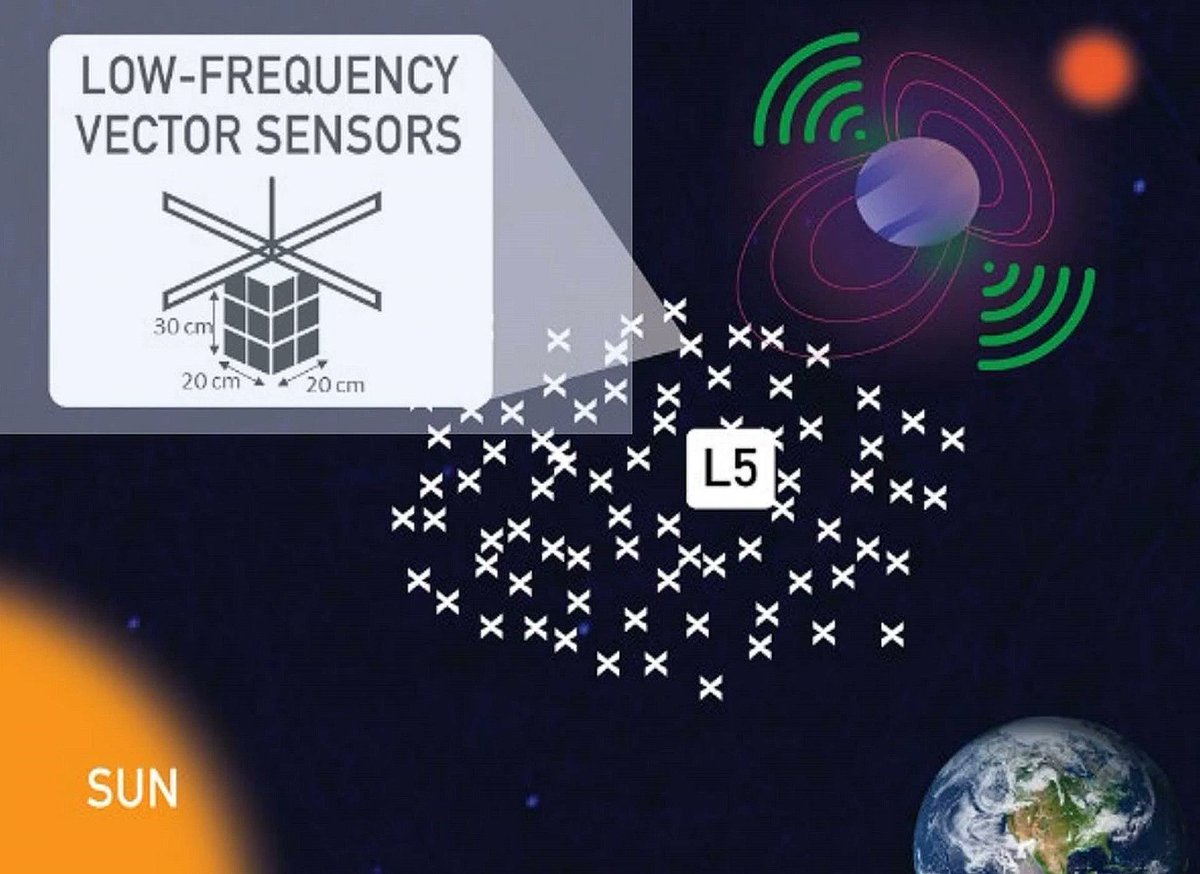
What Mary Krupp and her team at MIT have suggested seems like a logical next step – why not build an interferometric telescope in space? Their project, known as the Great Observatory for Long Wavelengths, or, since astronomers are so fond of acronyms, Go-LoW, was recently funded by NASA’s Institute for Advanced Concepts, and its premise is relatively simple.
Take an interferometric system similar to MeerKAT and launch it to the L5 Lagrange point. The idea takes ideas from a few current technological advances and combines them. The first would be how to make hundreds of thousands of satellites inexpensively.
Discussion of the MeerKAT telescope, a interferometer that is currently in use here on Earth. Credit – CreamerMedia YouTube Channel
For that, they rely on the technologies developed by SpaceX for their Starlink mega constellation. Its 40000+ planned satellites have significantly decreased the cost of small satellite components, making it economically feasible to build that many satellites without breaking the bank.
The second technological development is the advent of heavy-launch rockets. With the power of Starship or the SLS, thousands of satellites can be launched to Earth-Sun L5 Lagrange point about 1.5 million kilometers away. While it might not necessarily be cheap to do so, it certainly wouldn’t be as expensive as it had been in past generations.
Now seems like an ideal time for such an idea, though NIAC is known for backing projects in the very early stages. The MIT team will work on conceptual aspects of the mission in this Phase I grant, which lasts for nine months. Ultimately, they hope to have a road map to making the project a reality in the next 10-20 years. They might just be able to catch that technological wave at the right time and change our understanding of radio astronomy forever.
Russia scrambles fighter jets after UFO entered St. Petersburg
After an unidentified flying object (UFO) was sighted over the Russian city of Saint Petersburg on February 28, Russia scrambled its fighter jets to intercept the unknown mystery object which was allegedly seen flying in the direction of the gulf of Finland.
200 square kilometers of airspace were blocked, and the neighboring Pulkovo Airport stopped admitting flights for landing. According to Russian News agencies, the Kover plan was activated in Saint Petersburg due to an unidentified object in the sky. Aircraft were banned from entering Pulkovo Airport. The limitations were later lifted. (The Kover plan is used in illegal border crossings or imaging.)
Although some Russian media reports suggest that the UFO was possibly a drone in the area, you may wonder whether it was a drone or an unidentified flying object similar to the unknown objects flying over the US.
Passengers Spot Unidentified Objects During Approach to Boston Landing
UFOs filmed from a plane over Boston
A recent UFO sighting has left passengers and aviation enthusiasts alike scratching their heads. On February 9th, 2023, passengers aboard Jet Blue flight B6 178 witnessed a series of strange glowing orbs while approaching Boston for landing. One passenger, who captured the footage on their iPhone 12 Pro Max, shared their experience on Reddit.
The witness reported that they were unsure of the exact location of the flight at the time of the sighting, but believed it occurred approximately 30-45 minutes prior to landing. The video timestamp indicated that it was 7:53 PM, although this was likely in Vegas time as the phone had not yet switched back to east coast time due to being in airplane mode. The orbs were first spotted by the passenger’s friend who was seated in the window seat, and they appeared to be unusually close together, causing concern for the safety of the plane.
Upon reviewing the footage, the orbs appeared to be glowing orange with a yellow or white outer layer. The objects also seemed to change shape, almost like a liquid. The witness noted that they wished they had zoomed in more at the time of filming, but had forgotten about the sighting until they recently stumbled upon the footage on their phone.
The witness was eager for someone to enhance the video to see if more detail could be pulled from the footage. While the format of the video is unknown, the witness offered to send the footage to anyone willing to assist in analyzing it.
UFO sightings are not uncommon, and often there are explanations for what witnesses report as strange objects in the sky. However, in this instance, the orbs’ behavior and the proximity to the plane have raised questions and sparked curiosity among those interested in the possibility of extraterrestrial life.
It’s worth noting that aviation authorities take UFO sightings seriously, and they investigate any sightings that may pose a potential threat to air traffic safety. The Federal Aviation Administration (FAA) even has a protocol for pilots to follow when encountering UFOs, and they encourage pilots to report any sightings they have.
While this particular sighting may remain a mystery, it serves as a reminder that there is still so much we do not understand about our world and the universe beyond it. Perhaps further analysis of the footage will provide some answers, or maybe it will leave us with even more questions. Either way, the curiosity and wonder that comes with sightings like this are part of what makes life on this planet so fascinating.
Fighter Jets Scrambled and Airspace Closed as Unidentified Flying Object Spotted over Russia
Pulkovo Airport, St Petersburg
Russian airspace was closed temporarily after reports of an unidentified flying object spotted in the skies over St. Petersburg. The closure of airspace within a 120-mile radius of Russia’s Pulkovo airport caused several domestic flights headed for St. Petersburg to be diverted or sent back to their original point of departure. The incident saw Russian interceptor jets scrambled to search for the unknown object. According to various media reports, the object could have been a large drone.
The incident happened at a time of heightened tensions between Russia and Ukraine, with Russia building up its military forces near the Ukrainian border. The closure of airspace came just weeks after reports of Russia test-firing a missile, leading to concerns about a possible war between the two countries.
The closure of airspace over Russia highlights the increasing threat posed by drones and other unmanned aerial vehicles to air travel. The proliferation of drones in recent years has led to numerous incidents involving near misses with commercial aircraft. In 2018, Gatwick airport in the UK was closed for 33 hours after drones were spotted flying over the airport, leading to the cancellation of hundreds of flights and disrupting the travel plans of tens of thousands of passengers.
While most drones are used for harmless recreational activities, they can pose a serious threat to air travel if they fly too close to commercial aircraft. As drones become more sophisticated, with longer flight times and higher speeds, the risk to air travel is likely to increase. Air traffic controllers and aviation authorities are taking steps to mitigate the risks posed by drones, including introducing stricter regulations and developing new technology to detect and intercept rogue drones.
It is important to note that while the incident over Russia was initially reported as an unidentified flying object, there is currently no evidence to suggest that it was of extraterrestrial origin. However, the incident has reignited interest in UFOs and aliens, with many people speculating about the possibility of a government cover-up or conspiracy.
Strange, ‘Triangle Shaped’ Flying Object Spotted in Utah Skies!
UFO sightings and alien visitations have captured the imagination of people around the world for decades, if not centuries. From the first modern UFO sighting in 1952 to the recent release of the Pentagon’s 2022 UFO report, we have seen numerous instances of mysterious objects in the sky that defy conventional explanation. However, the question remains: are these sightings evidence of intelligent extraterrestrial life, or merely misidentified natural or human-made phenomena?
The history of UFO sightings is full of interesting anecdotes and controversies. For example, the term “flying saucer” originated from a misinterpretation of a pilot’s description of the motion of UFOs in 1947, and quickly became a popular meme in the media and the public. The famous Roswell incident in 1947, where an alleged crashed UFO and alien bodies were recovered by the military, has been a subject of heated debate and conspiracy theories ever since. The so-called “Men in Black”, mysterious figures who allegedly intimidate or silence UFO witnesses, have become a pop culture icon. These and other stories have contributed to the cultural fascination with UFOs and aliens.
However, the scientific community has generally been skeptical of UFO sightings as evidence of alien visitations. While many scientists acknowledge the possibility of extraterrestrial life in the vast universe, they also emphasize the lack of conclusive evidence that UFOs are of alien origin. Instead, they argue that most UFO sightings can be explained as natural phenomena (such as meteorites, weather balloons, or optical illusions), or human-made technologies (such as experimental aircraft, drones, or hoaxes). Moreover, they note that the burden of proof for extraordinary claims such as alien visitations is very high, and requires rigorous scientific investigation and verification.
Despite the skepticism of the scientific community, UFO sightings continue to occur and attract public attention. The recent release of the Pentagon’s 2022 UFO report, which cataloged hundreds of UAPs (Unidentified Aerial Phenomena) observed by military personnel and surveillance systems, has renewed interest in the subject. The report did not confirm or deny the existence of alien technology behind the UAPs, but called for more research and collaboration among government agencies and scientists. Some experts speculate that the UAPs could be new forms of advanced technology from other countries, or even from non-human sources. Others caution that the UAPs may be misperceived or misinterpreted by human observers or sensors, and that we need more data and analysis to draw any conclusions.
Watch
Strange, ‘Triangle Shaped’ Flying Object Spotted in Utah Skies! Youtube video bellow!
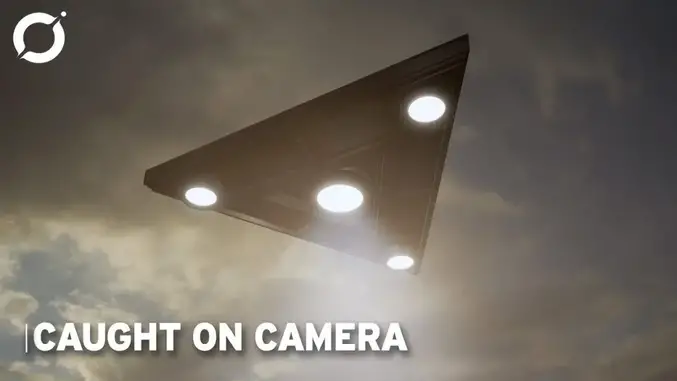
One of the most intriguing recent sightings of a UFO is the “semi-transparent black triangle” spotted over Salt Lake City, Utah, in 2022. The witness recorded several videos of the object, which appeared to be a large and motionless triangular shape hovering in the sky at a high altitude. The object did not resemble any known aircraft or natural phenomenon, and remained a mystery to investigators. While some speculated that it could be a secret military craft or a TR3B, a triangular-shaped aircraft rumored to have been developed by the US Air Force, others dismissed such theories as unlikely or unsupported by evidence. The sighting remains a fascinating example of the ongoing search for extraterrestrial intelligence.
Meteor shower in the night sky over Ben Bulben, Sligo £(Image: Twitter: Corey Whyte - @CoreyWhyte_ and @BestOfSligo)
One of Ireland's UFO hotspots has been revealed with a credible source explaining that Kingsland Observatory in Roscommon has confirmed 40 UFO sightings since 2000.
Dr Eamonn Ansbro runs the Kingsland Observatory and revealed to Dermot and Dave on Today FM and he said that he has recorded around 40 UFO sightings over the last 22 years at the observatory.
Dr Ansbro tells Dermot and Dave that his specific area of interest emerge in the 1990s with widespread reports of 'light ball' activity around Lough Key.
The esteemed astronomer says: "One of the things I have been particularly interested in was light ball activity, specifically in the Lough Key area. So we are set up to study that. We have a camera system composed of 11 cameras pointed towards the sky in two tracking platforms.
"And we have been able to observe and study over the course of two decades this round or cylindrical types of light."
Dermot and Dave point out that these are technically UFOs - in that, they are objects that fly and they haven't been identified. To which the good doctor can't argue.
Dr Ansbro outlines: "If you want to use that definition, it's in the context that it isn't aliens. It's something in our atmosphere that we're trying to understand."
Dr Ansbro says that others have been studying the local phenomenon for the last four or five years as research into 'UAP' intensifies around the globe.
The US government has conducted research into 'Unidentified Aerial Phenomena', a more neutral term for such objects or aberrations while very sober and very credible studies are made as they arise.
Eamonn Ansbro at his observatory in Boyle
Dr Ansbro explains: "The old term everyone used and is aware of is UFOs, it's been common for the last 70 years."
But he elaborates that the new term is more often used because some of their areas of study don't fly - and bear with it us on this one - they use a different 'space-time' to us.
The astronomer blows the hosts minds as he explains: "People often say, 'Well, why don't they have clear photos of UFOs, how come they are always blurry?'
"That's because we are dealing with a new type of phenomena - it's seems we have discovered a new space-time situation within the objects as they are casting their light.
"The whole time dilation is different, the space its in and so forth, that's why we get the fuzzy images."
When asked how long it would take to get to the bottom of this mystery, Dr Ansbro said that for 70 years, research funding into this area was prioritised.
And some of this attitude was down to the stigma of improbably 'little green men' tainting proper research into the field. Something which has only changed, according to Ansbro, in the last three years or so.
Eamonn Ansbro at his observatory in Boyle
Dr Ansbro say the US government has had a sea-change in their attitude to funding the research after years of objects appearing over their skies.
Kingsland Observatory was specifically located at Kingsland near Lough Key and it's 'Dark Skies' national park for its low light pollution and has probed the skies relentlessly since the observatory opened there in 2000.
The telescope lens of Kingsland dates back from 1974 and found its way to north Dublin when the light pollution reduced its effectiveness.
It then moved to north Co Dublin to be used in the Super Schmidt but again needed a move in the 1990s when it found its way to Kingsland.
The group continues to expand and recently relocated some of their high-tech observation equipment to a mountain top in south-eastern Spain as even Lough Key has seen some light leaking in from settlements in the area.
Chris Rutkowski, with Ufology Research in Winnipeg, has been collecting and analyzing Canadian data on unidentified flying objects, or unidentified aerial phenomena as they are being called more recently, for nearly 35 years.
(John Woods/The Canadian Press )
Canada's preeminent UFO researcher has seen an uptick in reported sightings of unidentified flying objects in recent days suggesting more Canadians are turning their eyes to the sky after U.S. fighter jets shot down three objects over the weekend.
Chris Rutkowski, with Ufology Research in Winnipeg, has been collecting and analyzing Canadian data on unidentified flying objects, or unidentified aerial phenomena as it's more recently been referred to as, for nearly 35 years.
Following the U.S. and Canadian governments "unprecedented" decision to take action against the objects, Rutkowski has received a number of sighting descriptions, including one on an Ontario highway near Cambridge where someone said they saw a "black rectangle" move across the highway.
"People are keeping a closer eye to the skies and, thankfully, are reporting them so that we can get some data on what people are seeing," Rutkowski said.
Reported sightings of UFOs reached an all-time high in Canada in the 2010s but have been on a steady decline since then.
Ufology Research's most recent study, released earlier this month, suggests there were 768 UFO sightings in the country last year — an increase of about six per cent from the previous year.
Rutkowski found one person in Quebec reported nearly 40 separate sightings, which accounted for the higher number. The number of reported sightings in Canada last year was the fourth-lowest over the past 20 years.
In this image from a 2015 video provided by the U.S. Department of Defense labelled Gimbal, an unexplained object is seen at centre as it soars high along the clouds, travelling against the wind. “There's a whole fleet of them,” one naval aviator tells another, though only one indistinct object is shown. “It's rotating." (U.S. Department of Defense/The Associated Press)
The study says these numbers likely don't show the full picture as individuals are reluctant to report sightings out of fear of being ridiculed or concern for their reputation.
But Rutkowski stresses times have changed in the field.
While the mere mention of the term UFO used to conjure images of alien invasions, tin hat-wearing conspiracy theorists and pop culture extraterrestrial icons Alf and E.T., research around the phenomenon has evolved in government and academic circles.
Canadians are in "good company" if they believe they've seen a UFO as polls conducted suggest that 10 per cent of people in the country believe they've seen an unidentified object in the sky, Rutkowski says.
"When a person reports seeing a UFO — whether you're a pilot or just an average person on the street — you may be seeing something that is quite significant and potentially of value to researchers," he said.
Chris Styles says it's not uncommon to see an increase in reports when events such as this are in the news, but cautions it doesn't mean there has been an increase in the number of flying objects, only that more people are paying attention.
"Sightings breed sightings," the renowned UFO researcher said from Halifax.
Objects shot down
Recent events might have Canadians changing their tune.
American fighter jets took down an unidentified object over the northern coast of Alaska on Friday, one over central Yukon on Saturday and another over Lake Huron on Sunday.
The flurry of close encounters followed what officials said was a Chinese surveillance balloon that floated across the continent two weeks ago and was shot down off the coast of South Carolina.
The suspected Chinese spy balloon drifts to the ocean after being shot down off the coast of South Carolina on Feb. 4. (Randall Hill/Reuters)
While it's not clear where the more recent objects came from or who might have dispatched them, the prevailing theory at the moment is that they were "benign," posing only a threat to passing civilian aircraft, the White House said this week.
Search efforts are underway in a remote stretch of central Yukon to locate the remnants of the object, which Chief of Defence Staff Gen. Wayne Eyre said is a "suspected balloon" in a tweet Wednesday.
Government officials on both sides of the border have stated there is no indication the objects were the work of aliens or "extraterrestrial activity."
Recent data from Google Trends points to peoples' innate curiosity about interplanetary visitors and the world beyond Earth.
Map shows the locations of unidentified objects shot down during the past two weeks. (Graphic design by Philip Street/CBC)
On Saturday, UFOs were the third most searched topic in Canada with more than 100,000 searches.
The following day it dropped down to 13th place, while the term aliens has been trending steadily in Canada's North since Sunday.
Rutkowski said every year there are well-documented cases from "good observers" that go unexplained, but it would be, "presumptuous to say those are from outer space and extraterrestrials."
"There probably is life out there somewhere, and somewhere out there they might have developed the ability to travel between the stars … we don't have any proof of that, but the probability is never zero."
In academic circles the notion of studying this phenomenon has been taken more seriously after details about the Pentagon's UFO program were discovered in 2017, says Paul Kingsbury, a professor in the department of geography at Simon Fraser University.
While the U.S. has made co-ordinated efforts to document this issue, there is a disconnect on the Canadian side, Kingsbury says.
He says it's important for the Biden administration and Canada to work transparently with the scientific community so that academics can access information and data that will help identify these objects.
"It would allow the public to more fully understand what these objects are, their nature, what is causing them and the consequences of the many reports of these anomalous objects in our skies," he said.
As Canadians continue to navigate global unrest associated with the COVID-19 pandemic, climate disasters and wars overseas, messaging shrouded in "mixed messages and mystery" can leave people feeling anxious.
"Being transparent wherever possible is also important for peoples' peace of mind," Kingsbury said.
The US has been sending mixed signals over UFOs for 75 years
A legacy of hype, hysteria and fraud is undermining legitimate inquiry into strange objects often reported in the skies
By Stephen Mihm / Bloomberg Opinion
The spectacle of the US military shooting down three unidentified objects in the space of a week has opened the door to baseless speculations and conspiracy theories, thanks in part to the government’s contradictory messaging, which has toggled between genuine alarm and casual dismissal.
Sadly, this looks a lot like what happened 75 years ago, when sightings of what became known as unidentified flying objects, or UFOs, led to a media circus that undermined legitimate inquiry into what are now known simply as unidentified aerial phenomena, or UAP.
This legacy of hype and fraud is with us today. That is unfortunate, given that more recent sightings — many recorded by decorated combat pilots — prompted the US Congress to pass legislation that seeks to get to the bottom of the mystery. Doing so must avoid the rank silliness and deliberate obfuscation that defined our first major engagement with the issue.
Although sightings of unexplained aerial phenomena date back centuries, our collective obsession with flying saucers, aliens, “little green men” and other now-familiar tropes arguably began on June 24, 1947, when Kenneth Arnold, a businessman and pilot, spotted nine objects flying at unfathomable speeds near Mount Rainier in Washington state.
Arnold dutifully reported these to aviation officials. When pressed to describe the movement of the curious craft, he likened it to “a saucer skipping across the water.” This initial report went out across the news wires. Bored reporters eager to make something of the story ran with it, inventing details along the way.
In a few days, journalists had turned Arnold’s movement metaphor into something more material — a “flying saucer.” Arnold complained to veteran journalist Edward Murrow that newspapers had “misunderstood and misquoted me,” but to no avail. The idea of a flying saucer immediately captured the nation’s imagination, sparking a flood of alleged sightings.
Popular culture was not far behind. One month later, country singers Chester and Lester Buchanan issued the first song celebrating the phenomenon: (When You See) Those Flying Saucers. Others followed. In Two Little Men in a Flying Saucer, Ella Fitzgerald crooned about aliens with “little green antennas” who find Earth decidedly wanting and conclude: “It’s too peculiar here.”
Hollywood did its part, too, with several films about alien visitors, most of which featured flying saucers. Sometimes their occupants came in peace (Klaatu, the noble protagonist of The Day the Earth Stood Still), but for the most part, alien visitors had a bone to pick with humans — for example, The Thing From Another World and the classic Earth vs. The Flying Saucers.
US government info on “everything” to do with UFO sightings, held by the CIA, was released and published online on January 14, 2021 .
Retailers sold flying saucer wind-up toys, flying saucer kids’ pajamas and other artifacts testifying to our collective obsession with aliens. All of this went hand-in-hand with thousands of alleged sightings of flying saucers, or what the US Air Force increasingly referred to as UFOs.
Government representatives found the collective obsession with UFOs deeply frustrating. In public, they dismissed the reports, arguing that ordinary citizens, their imaginations inflamed, had mistaken weather balloons, jet planes and meteorites for extraterrestrial craft.
Yet in private, high-ranking officials acknowledged that some sightings, particularly those reported by military pilots and radar, could not be so easily dismissed. In the fall of 1947, General Nathan Twining, then head of the US Air Force Materiel Command, authored a memo on the subject. Reviewing classified data, he concluded that “the phenomena is something real and not visionary or fictitious.”
By “phenomena,” Twining was referring to craft that moved at extraordinary speeds and displayed “extreme rates of climb, maneuverability (particularly in roll), and motion.”
These aerial vehicles, he reported, generally left no trail and rarely made any noise. They behaved in ways that defied conventional explanations.
PUBLIC MESSAGING
Twining, who would go on to become chief of staff for the US Air Force and eventually chairman of the Joint Chiefs of Staff, was extremely circumspect in his assessment. Notably, he did not speculate about extraterrestrials and instead worried that a foreign nation could be responsible.
The air force’s “Project Sign,” begun that same year, studied the phenomena more closely. An initial memorandum — known as the “Estimate of the Situation” — seriously entertained the possibility that at least some of the sightings might be interstellar craft, although leaders of the air force did not take kindly to this unsettling conclusion. They remanded the memo and ultimately shut down Project Sign, replacing it with Project Grudge.
The new initiative was not a dispassionate inquiry, but a deliberate attempt to quell public anxiety. One scholarly account has described it as a “a public relations campaign designed to persuade the public that UFOs constituted nothing unusual or extraordinary.”
While it is easy to interpret these initiatives as government cover-ups, the reality is far more complicated and interesting. Their implementation reflected a genuine concern that the task of investigating the torrent of sightings would divert precious time and money from countering the more immediate threat posed by the Soviet Union.
Some strategists even feared that the Soviets might be sowing hysteria about UFOs in order to overload the nation’s air defenses. One CIA analyst said in 1952 that the spate of official and unofficial sightings had overwhelmed the military’s ability to recognize Soviet bombers.
“As tension mounts,” the analyst wrote, “we will run the increasing risk of false alerts and the even greater danger of falsely identifying the real as phantom.”
Still, not everyone got the memo. In 1952, after ground observers and radar picked up fast-moving mysterious objects over the nation’s capital, then-US Air Force intelligence director John Samford held a news conference. He bluntly spoke of “credible observers” reporting “relatively incredible things.”
That same year, a scientific adviser within the CIA warned that “something was going on that must have immediate attention.” He concluded that “sightings of unexplained objects at great altitudes and traveling at high speeds in the vicinity of major US defense installations are of such nature that they are not attributable to natural phenomena or known types of aerial vehicles.”
SUPERPOWER SUSPICIONS
However, such incidents, impossible to explain and posing no obvious threat to the US and its allies, increasingly took a back seat to dealing with the Soviet Union. Through the later 1950s and 1960s, Project Blue Book, the successor to Project Grudge, successfully quelled the nation’s obsession with flying saucers. Increasingly, UFOs became a risible punchline, akin to Bigfoot and the Loch Ness Monster.
Fast forward to the 21st century. In recent years, a growing number of aircraft sightings defying the laws of physics has belatedly prompted a federal effort to collect and analyze data. Meanwhile, the damage done by Grudge and Bluebook — what the US director of national intelligence recently described as “sociocultural stigmas” — has made that task difficult.
So does the fact that our newfound interest in the subject is taking place against the backdrop of a growing conflict with another rival superpower: China. The risk that Chinese espionage could become entangled with the UAP question is high.
Witness, for example, the confused and contradictory messaging around the three objects shot down last week in the wake of the downing of a Chinese spy balloon. A day after the US Air Force general overseeing North American airspace said he was not ruling out extraterrestrial origins for the UAPs, a White House spokesperson said: “There is no, again, no indication of aliens or extra terrestrial activity with these recent takedowns.”
If we are to avoid a repeat of the mistakes of an earlier era, we must avoid both the popular hysteria and hostile indifference that defined our first engagement with the issue. That means the government and the media must adopt a far more nuanced, transparent approach.
One step in that direction is to acknowledge that there might be things out there that cannot yet be explained, but should be studied with an open mind. If we can pursue that inquiry without succumbing to either skepticism or credulousness, we might finally get to the bottom of the mystery.
Stephen Mihm is a professor of history at the University of Georgia
Meer van UFO'S of UAP'S, ASTRONOMIE, RUIMTEVAART, ARCHEOLOGIE, OUDHEIDKUNDE, SF-SNUFJES EN ANDERE ESOTERISCHE WETENSCHAPPEN - DE ALLERLAATSTE NIEUWTJES


 Scientists Are Trying To Use Lab-Grown Mini Brains To Create Powerful Biocomputers