Ontdek de Fascinerende Wereld van UFO's en UAP's: Jouw Bron voor Onthullende Informatie!
Ben jij ook gefascineerd door het onbekende? Wil je meer weten over UFO's en UAP's, niet alleen in België, maar over de hele wereld? Dan ben je op de juiste plek!
België: Het Kloppend Hart van UFO-onderzoek
In België is BUFON (Belgisch UFO-Netwerk) dé autoriteit op het gebied van UFO-onderzoek. Voor betrouwbare en objectieve informatie over deze intrigerende fenomenen, bezoek je zeker onze Facebook-pagina en deze blog. Maar dat is nog niet alles! Ontdek ook het Belgisch UFO-meldpunt en Caelestia, twee organisaties die diepgaand onderzoek verrichten, al zijn ze soms kritisch of sceptisch.
Nederland: Een Schat aan Informatie
Voor onze Nederlandse buren is er de schitterende website www.ufowijzer.nl, beheerd door Paul Harmans. Deze site biedt een schat aan informatie en artikelen die je niet wilt missen!
Internationaal: MUFON - De Wereldwijde Autoriteit
Neem ook een kijkje bij MUFON (Mutual UFO Network Inc.), een gerenommeerde Amerikaanse UFO-vereniging met afdelingen in de VS en wereldwijd. MUFON is toegewijd aan de wetenschappelijke en analytische studie van het UFO-fenomeen, en hun maandelijkse tijdschrift, The MUFON UFO-Journal, is een must-read voor elke UFO-enthousiasteling. Bezoek hun website op www.mufon.com voor meer informatie.
Samenwerking en Toekomstvisie
Sinds 1 februari 2020 is Pieter niet alleen ex-president van BUFON, maar ook de voormalige nationale directeur van MUFON in Vlaanderen en Nederland. Dit creëert een sterke samenwerking met de Franse MUFON Reseau MUFON/EUROP, wat ons in staat stelt om nog meer waardevolle inzichten te delen.
Let op: Nepprofielen en Nieuwe Groeperingen
Pas op voor een nieuwe groepering die zich ook BUFON noemt, maar geen enkele connectie heeft met onze gevestigde organisatie. Hoewel zij de naam geregistreerd hebben, kunnen ze het rijke verleden en de expertise van onze groep niet evenaren. We wensen hen veel succes, maar we blijven de autoriteit in UFO-onderzoek!
Blijf Op De Hoogte!
Wil jij de laatste nieuwtjes over UFO's, ruimtevaart, archeologie, en meer? Volg ons dan en duik samen met ons in de fascinerende wereld van het onbekende! Sluit je aan bij de gemeenschap van nieuwsgierige geesten die net als jij verlangen naar antwoorden en avonturen in de sterren!
Heb je vragen of wil je meer weten? Aarzel dan niet om contact met ons op te nemen! Samen ontrafelen we het mysterie van de lucht en daarbuiten.
Mystery Object Shot Down Over Alaska: US Military Confirms Unidentified Aerial Phenomenon
F22 shots down UAP
According to a statement released by the White House, the US military was able to take down an unidentified object flying over Alaska. The object, which was the size of a small car, was targeted by an F-22 Raptor fighter jet It was brought down using a missile. Although the exact nature of the object and its origin are not known, a salvage effort is currently under way to retrieve its debris.
The US military was alerted to a possible threat to air traffic after a small plane was spotted flying at an altitude of around 40,000 feet, which is about the same as that of a commercial airliner. The object, which was described as a silver-colored orcylindrical plane, did not seem to have propulsion.
This recent UFO sighting and subsequent action by the US military follows the recent shooting down of a suspected Chinese spy balloon off the coast of South Carolina. The US has blacklisted six Chinese companies for their involvement in Beijing’s military modernization efforts and aerospace programs, stating that China’s use of high-altitude balloons poses a threat to US national security.
The downing of these two unidentified objects has raised questions about the militarization of space and the threat of new conflicts in the edge of space. As countries scramble to maintain a strategic advantage in this new frontier, it is important to understand the nature and origin of these objects, as well as the motivations behind their presence. The recent salvage efforts, particularly of the Chinese balloon, will provide valuable information in helping to answer these questions.
REVEALED: Dramatic Top-Secret UFO Sightings That Are Classified
For all the skeptics out there, the NASA, just announced 16 people who will study UFO’s to see what’s natural and what isn’t. Using unclassified data, the team will "lay the groundwork for future study" of UFOs by examining how the data is gathered by the public, local government and other sources. remember the famous tic-tac UFO that the United States government released in 2020? Well, it’s time to move over it, because we have a, wait for it, rubber duck UFO.
The Biggest Military UFO Cover-Up Exposed | Aliens Are Living Amongst Us
The Biggest Military UFO Cover-Up Exposed | Aliens Are Living Amongst Us. A rancher named William Brazel, woke up for a normal day's work in New Mexico, 75 miles north of Roswell, when he made a shocking discovery. There has been another Roswell incident that has been successfully buried by the government before the media could blow it up. And this incident does not just concern a UFO, but also an alien, that tried to run away. Aliens Are Living Amongst Us and The Military UFO Cover-Up That Involved An Entire Town.
UFO Chronicles - What The President Doesn't Know about Aliens and UFOs
Top 4 UFO Sightings AROUND THE WORLD! | The Proof Is Out There
These 4 UFO Sightings will blow your mind, in this compilation from The Proof Is Out There.
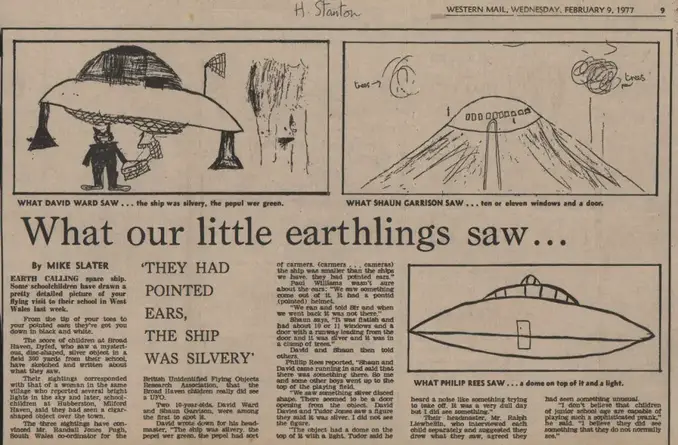
Exploring the Mysteries of the Welsh Skies: Collection of 400+ UFO Newspaper Articles
1977 West Wales UFO Landing
For many years now, the topic of UFO encounters and sightings has been a controversial one. Following the Roswell incident, various theories and speculations have been presented regarding the nature of the object. Isaac Koi has been digitalizing and collecting old newspapers articles and maganizes about this subject for many years and is dedicated to reporting on all of these occurrences in his blog (link).
Isaac has collected newspaper articles about UFOs from Wales from 1954 to 2013. He has meticulously gathered more than 400 cuttings from Welsh newspapers, preserving them for future generations to study and analyze. This is a remarkable feat, and it speaks to Isaac’s passion for the subject and his commitment to documenting the history of UFO sightings and encounters.
Flying Cigar UFO sighting, 1963
The collection of Welsh UFO articles is available for anyone to view as a pdf at this link, provided by Isaac. This is a valuable resource for researchers, journalists, and anyone interested in the history of UFO sightings in Wales. The articles range from reported sightings and encounters to discussions of government policies on the subject, providing a unique and fascinating look into the public’s perception of UFO sightings over the years.
Isaac’s collection of Welsh UFO articles is not only a testament to his passion and dedication but also a valuable resource for anyone interested in the subject. It provides a glimpse into the history of UFO sightings in Wales and offers insights into how the public has perceived and responded to these events over the years. So if you’re interested in learning more about the history of UFO sightings and encounters, be sure to check out Isaac’s collection of Welsh UFO articles.
Wavelengths of light from three space observatories are overlapped to provide a unique view of the Sun in the image at left. The high-energy X-ray light detected by one of those observatories, NASA’s NuSTAR, is seen isolated at right; a grid was added to indicate the Sun’s surface.
Credits: NASA/JPL-Caltech/JAXA
Some of the hottest spots in the Sun’s atmosphere appear in the telescope’s X-ray view.
Even on a sunny day, human eyes can’t see all the light our nearest star gives off. A new image displays some of this hidden light, including the high-energy X-rays emitted by the hottest material in the Sun’s atmosphere, as observed by NASA’s Nuclear Spectroscopic Telescope Array (NuSTAR). While the observatory typically studies objects outside our solar system – like massive black holes and collapsed stars – it has also provided astronomers with insights about ourSun.
In the composite image above (left), NuSTAR data is represented as blue and is overlaid with observations by the X-ray Telescope (XRT) on the Japanese Aerospace Exploration Agency’s Hinode mission, represented as green, and the Atmospheric Imaging Assembly (AIA) on NASA’s Solar Dynamics Observatory (SDO), represented as red. NuSTAR’s relatively small field of view means it can’t see the entire Sun from its position in Earth orbit, so the observatory’s view of the Sun is actually a mosaic of 25 images, taken in June 2022.
The high-energy X-rays observed by NuSTAR appear at only a few locations in the Sun’s atmosphere. By contrast, Hinode’s XRT detects low-energy X-rays, and SDO’s AIA detects ultraviolet light – wavelengths that are emitted across the entire face of the Sun.
The Sun appears different depending on who’s looking. From left, NASA’s NuSTAR sees high-energy X-rays; the Japanese Aerospace Exploration Agency’s Hinode mission sees lower energy X-rays; and NASA’s Solar Dynamics Observatory sees ultraviolet light.
Credits: NASA/JPL-Caltech/JAXA
NuSTAR’s view could help scientists solve one of the biggest mysteries about our nearest star: why the Sun’s outer atmosphere, called the corona, reaches more than a million degrees – at least 100 times hotter than its surface. This has puzzled scientists because the Sun’s heat originates in its core and travels outward. It’s as if the air around a fire were 100 times hotter than the flames.
The source of the corona’s heat could be small eruptions in the Sun’s atmosphere called nanoflares. Flares are large outbursts of heat, light, and particles visible to a wide range of solar observatories. Nanoflares are much smaller events, but both types produce material even hotter than the average temperature of the corona. Regular flares don’t happen often enough to keep the corona at the high temperatures scientists observe, but nanoflares may occur much more frequently – perhaps often enough that they collectively heat the corona.
Although individual nanoflares are too faint to observe amid the Sun’s blazing light, NuSTAR can detect light from the high-temperature material thought to be produced when a large number of nanoflares occur close to one another. This ability enables physicists to investigate how frequently nanoflares occur and how they release energy.
The observations used in these images coincided with the 12th close approach to the Sun, or perihelion, by NASA’s Parker Solar Probe, which is flying closer to the our star than any other spacecraft in history. Taking observations with NuSTAR during one of Parker’s perihelion passes enables scientists to link activity observed remotely in the Sun’s atmosphere with the direct samples of the solar environment taken by the probe.
More About the Mission
NuSTAR launched on June 13, 2012. A Small Explorer mission led by Caltech in Pasadena, California, and managed by JPL for NASA’s Science Mission Directorate in Washington, it was developed in partnership with the Danish Technical University (DTU) and the Italian Space Agency (ASI). The telescope optics were built by Columbia University, NASA’s Goddard Space Flight Center in Greenbelt, Maryland, and DTU. The spacecraft was built by Orbital Sciences Corp. in Dulles, Virginia. NuSTAR’s mission operations center is at the University of California, Berkeley, and the official data archive is at NASA’s High Energy Astrophysics Science Archive Research Center. ASI provides the mission’s ground station and a mirror data archive. Caltech manages JPL for NASA.
NASA’s Curiosity Finds Surprise Clues to Mars’ Watery Past
NASA’s Curiosity used its Mastcam to capture this 360-degree panorama of “Marker Band Valley” on Dec. 16, 2022, the 3,684th Martian day, or sol, of the mission. Rippled rock textures found in this area are the clearest evidence the rover has seen of water and waves from Mars’ ancient past.
Credits: NASA/JPL-Caltech/MSSS
Among other discoveries made by the rover, rippled rock textures suggest lakes existed in a region of ancient Mars that scientists expected to be drier.
When NASA’s Curiosity rover arrived at the “sulfate-bearing unit” last fall, scientists thought they’d seen the last evidence that lakes once covered this region of Mars. That’s because the rock layers here formed in drier settings than regions explored earlier in the mission. The area’s sulfates – salty minerals – are thought to have been left behind when water was drying to a trickle.
So Curiosity’s team was surprised to discover the mission’s clearest evidence yet of ancient water ripples that formed within lakes. Billions of years ago, waves on the surface of a shallow lake stirred up sediment at the lake bottom, over time creating rippled textures left in rock
NASA’s Curiosity rover recently found surprising clues to Mars’ watery past, including while exploring a region called the “Marker Band.”
Credits: NASA/JPL-Caltech/MSSS
“This is the best evidence of water and waves that we’ve seen in the entire mission,” said Ashwin Vasavada, Curiosity’s project scientist at NASA’s Jet Propulsion Laboratory in Southern California. “We climbed through thousands of feet of lake deposits and never saw evidence like this – and now we found it in a place we expected to be dry.”
Layers of History
Since 2014, the rover has been ascending the foothills of Mount Sharp, a 3-mile-tall (5-kilometer-tall) mountain that was once laced with lakes and streams that would have provided a rich environment for microbial life, if any ever formed on the Red Planet.
Billions of years ago, waves on the surface of a shallow lake stirred up sediment at the lake bottom. Over time, the sediment formed into rocks with rippled textures that are the clearest evidence of waves and water that NASA’s Curiosity Mars rover has ever found.
Credits: NASA/JPL-Caltech/MSSS
Mount Sharp is made up of layers, with the oldest at the bottom of the mountain and the youngest at the top. As the rover ascends, it progresses along a Martian timeline, allowing scientists to study how Mars evolved from a planet that was more Earth-like in its ancient past, with a warmer climate and plentiful water, to the freezing desert it is today.
Having climbed nearly a half-mile above the mountain’s base, Curiosity has found these rippled rock textures preserved in what’s nicknamed the “Marker Band” – a thin layer of dark rock that stands out from the rest of Mount Sharp. This rock layer is so hard that Curiosity hasn’t been able to drill a sample from it despite several attempts. It’s not the first time Mars has been unwilling to share a sample: Lower down the mountain, on “Vera Rubin Ridge,” Curiosity had to try three times before finding a spot soft enough to drill.
Scientists will be looking for softer rock in the week ahead. But even if they never get a sample from this unusual strip of rock, there are other sites they’re eager to explore.
At the bottom of this valley, called Gediz Vallis, is a mound of boulders and debris that are believed to have been swept there by wet landslides billions of years ago. The rover team hopes to get a closer look at this evidence for flowing water, which is likely the youngest Curiosity will ever find. Credits: NASA/JPL-Caltech/MSSS
Martian Clues
Far ahead of the Marker Band, scientists can see another clue to the history of Mars’ ancient water in a valley named Gediz Vallis. Wind carved the valley, but a channel running through it that starts higher up on Mount Sharp is thought to have been eroded by a small river. Scientists suspect wet landslides also occurred here, sending car-size boulders and debris to the bottom of the valley.
Because the resulting debris pile sits on top of all the other layers in the valley, it’s clearly one of the youngest features on Mount Sharp. Curiosity got a glimpse of this debris at Gediz Vallis Ridge twice last year but could only survey it from a distance. The rover team hopes to have another chance to view it later this year.
One more clue within the Marker Band that has fascinated the team is an unusual rock texture likely caused by some sort of regular cycle in the weather or climate, such as dust storms. Not far from the rippled textures are rocks made of layers that are regular in their spacing and thickness. This kind of rhythmic pattern in rock layers on Earth often stems from atmospheric events happening at periodic intervals. It’s possible the rhythmic patterns in these Martian rocks resulted from similar events, hinting at changes in the Red Planet’s ancient climate.
“The wave ripples, debris flows, and rhythmic layers all tell us that the story of wet-to-dry on Mars wasn’t simple,” Vasavada said. “Mars’ ancient climate had a wonderful complexity to it, much like Earth’s.”
Curiosity used its ChemCam instrument to view Gediz Vallis Ridge, spotting boulders that are thought to have been washed down in an ancient debris flow. One reason scientists are interested in this ridge is because it includes boulders like these, which originated much higher up on Mount Sharp, where Curiosity won’t be able to reach. Credits: NASA/JPL-Caltech/LANL/CNES/CNRS/IRAP/IAS/LPG
More About the Mission
The Curiosity mission is led by NASA’s Jet Propulsion Laboratory, which is managed by Caltech in Pasadena, California. JPL leads the mission on behalf of NASA’s Science Mission Directorate in Washington. Malin Space Science Systems in San Diego built and operates Mastcam.
The mystery object was about the size of a small car, U.S. officials said.
An F-22 fighter jet in flight off the coast of Virginia in December 2022. A fighter jet took out a small, mysterious object off the coast of Alaska on Feb. 10, 2023, according to Pentagon officials.
(Image credit: U.S. Department of Defense)
For the second time in less than a week, the U.S. military has blasted an intruder out of the nation's skies.
A fighter jet took out a mysterious object just off the coast of northern Alaska at 1:45 p.m. EST (1845 GMT) on Friday (Feb. 10), Department of Defense officials said.
"The object was flying at an altitude of 40,000 feet [12,000 meters] and posed a reasonable threat to the safety of civilian flight," Pentagon Press Secretary Air Force Brig. Gen. Pat Ryder said during a press briefing on Friday.
Friday's high-altitude action comes just six days after an F-22 fighter jet shot down a Chinese spy balloon with a Sidewinder missile off the South Carolina coast. But there may not be a connection between the two downed objects.
The Chinese spy balloon was huge; its inflated envelope was about 200 feet (60 meters) tall, and the (presumably instrument-studded) truss structure that hung beneath it was the size of several school buses.
The object that was shot down over Alaska on Friday was "about the size of a small car, so, not similar in size or shape to the high-altitude surveillance balloon that was taken down off the coast of South Carolina on February 4," Ryder said.
Ground-based radar detected the Alaska intruder on Thursday (Feb. 9), he added. Fighter jets subsequently investigated, confirming the object's presence and altitude. U.S. President Joe Biden ordered the object to be taken out, and the military did so quickly.
"We have no further details about the object at this time, including a description of its capabilities, purpose or origin," Ryder said.
Sailors assigned to Explosive Ordnance Disposal Group 2 recover a high-altitude surveillance balloon off the coast of Myrtle Beach, South Carolina, on Feb. 5, 2023. £(Image credit: U.S. Navy Photo by Mass Communication Specialist 1st Class Tyler Thompson)
Teams have already begun searching for pieces of the destroyed Alaska object, Ryder added. He also gave an update about similar efforts with the Chinese balloon debris, which landed just 6 miles (10 kilometers) offshore in water about 47 feet (14 m) deep.
"Recovery teams have mapped the debris field and are in the process of searching for and identifying debris on the ocean floor," Ryder said, referring to pieces of the Chinese balloon. "Debris that's been recovered so far is being loaded onto vessels, taken ashore, cataloged and then moved onwards to labs for subsequent analysis."
Those teams, he added, "have located a significant amount of debris so far that will prove helpful to our further understanding of this balloon and its surveillance capabilities."
Mike Wall is the author of "Out There(opens in new tab)" (Grand Central Publishing, 2018; illustrated by Karl Tate), a book about the search for alien life. Follow him on Twitter @michaeldwall(opens in new tab). Follow us @Spacedotcom(opens in new tab), or on Facebook(opens in new tab) and Instagram(opens in new tab).
Amper enkele dagen na de Chinese "spionageballon": Verenigde Staten schieten boven Alaska opnieuw "hoogvliegend voorwerp" neer
De Verenigde Staten hebben boven de westelijke staat Alaska een "hoogvliegend voorwerp" neergeschoten. Dat laat het Witte Huis weten. Volgens woordvoerder John Kirby had het voorwerp de grootte van "een kleine auto", en vloog het over dunbevolkt gebied.
Rik Arnoudt, Belga
President Joe Biden besliste het voorwerp, waarvan de oorsprong onbekend is, neer te laten schieten.
Nog maar enkele dagen geleden schoot Washington een Chinese ballon neer die, volgens de VS, gebruikt werd om te spioneren.
Volgens John Kirby is de oppervlakte waar de brokstukken van het object zijn gevallen veel kleiner dan die van de Chinese ballon die de Amerikanen vorige week hebben neergehaald. Een gevechtspiloot heeft vastgesteld dat het vliegend object niet bemand was, vóór hij het heeft neergeschoten.
Voorlopig is het nog onduidelijk over welk soort vliegend object het gaat en of het toestel bedoeld was om te spioneren. Anders dan de vorige week neergeschoten ballon lijkt dit voorwerp geen aandrijving of besturing te hebben. Volgens het Amerikaanse ministerie van Defensie dreef het af in noordoostelijke richting.
BEKIJK
Woordvoerder John Kirby: "Het voorwerp vormde een gevaar voor de veiligheid van de burgerluchtvaart":
Metal robot can melt its way out of tight spaces to escape
A millimetre-sized robot made from a mix of liquid metal and microscopic magnetic pieces can stretch, move or melt. It could be used to fix electronics or remove objects from the body
A miniature, shape-shifting robot can liquefy itself and reform, allowing it to complete tasks in hard-to-access places and even escape cages. It could eventually be used as a hands-free soldering machine or a tool for extracting swallowed toxic items.
Robots that are soft and malleable enough to work in narrow, delicate spaces like those in the human body already exist, but they can’t make themselves sturdier and stronger when under pressure or when they must carry something heavier than themselves. Carmel Majidi at Carnegie Mellon University in Pennsylvania and his colleagues created a robot that can not only shape-shift but also become stronger or weaker by alternating between being a liquid and a solid.
They made the millimetre-sized robot from a mix of the liquid metal gallium and microscopic pieces of a magnetic material made of neodymium, iron and boron. When solid, the material was strong enough to support an object 30 times its own mass. To make it soften, stretch, move or melt into a crawling puddle as needed for different tasks, the researchers put it near magnets. The magnets’ customised magnetic fields exerted forces on the tiny magnetic pieces in the robot, moving them and deforming the surrounding metal in different directions.
For instance, the team stretched a robot by applying a magnetic field that pulled these granules in multiple directions. The researchers also used a stronger field to yank the particles upwards, making the robot jump. When Majidi and his colleagues used an alternating magnetic field – one whose shape changes predictably over time – electrons in the robot’s liquid metal formed electric currents. The coursing of these currents through the robot’s body heated it up and eventually made it melt.
“No other material I know of is this good at changing its stiffness this much,” says Majidi.
Wang and Pan et al.
Exploiting this flexibility, the team made two robots carry and solder a small light bulb onto a circuit board. When they reached their target, the robots simply melted over the light bulb’s edges to fuse it to the board. Electricity could then run through their liquid metal bodies and light the light bulb.
In an experiment inside an artificial stomach, the researchers applied another set of magnetic fields to make the robot approach an object, melt over it and drag it out. Finally, they shaped the robot like a Lego minifigure, then helped it escape from a cage by liquefying it and making it flow out between the bars. Once the robot puddle dribbled into a mould, it set back into its original, solid shape.
Wang and Pan et al.
These melty robots could be used for emergency fixes in situations where human or traditional robotic hands become impractical, says Li Zhang at the Chinese University of Hong Kong. For example, a liquefied robot might replace a lost screw on a spacecraft by flowing into its place and then solidifying, he says. However, to use them inside living stomachs, researchers must first develop methods for precisely tracking the position of the robot at every step of the procedure to ensure the safety of the patient, says Zhang.
James Webb pierces the cold heart of the Chameleon
By observing distant stars through a star-forming cloud of gas and dust, Webb is helping astronomers map out the complex chemicals that could form life.
NASA, ESA, CSA, and M. Zamani (ESA/Webb); Science: F. Sun (Steward Observatory), Z. Smith (Open University), and the Ice Age ERS Team.
Stars form when massive clouds of cold gas and dust fragment, condense, and collapse. As the density in a small part of the cloud grows high enough, the pressure skyrockets until it ignites the fusion process that forms the fiery heart of a new star.
As the nascent star grows, it becomes encircled by a protoplanetary disk made of the same material that formed the star. This disk is what eventually gives birth to the planets, asteroids, and comets around the new sun.
This gorgeous new image from the James Webb Space Telescope (JWST) features the molecular cloud Chameleon I, one of the nearest star-forming regions to Earth, located just 626 light-years away. At upper left is a young protostar called Ced 110 IRS 4, whose light illuminates the dense, bluish cloud at the infrared wavelengths Webb observes. Just visible through the cloud at center are several small, pointlike background stars, mostly obscured by the cold material. But these stars are the cornerstone of a new study, which used JWST to decode the chemical composition of ices within Chameleon I.
Here's how the study worked: As starlight from those background stars filters through the cloud, some of that light gets absorbed by ices. By splitting apart the light that makes it through the cloud — using a technique called spectroscopy — astronomers can look at which specific wavelengths are absorbed. This lets them determine which atoms are responsible for absorbing each specific wavelength.
In the case of Chameleon I, they identified ices inside the cloud such as water, carbonyl sulfide, ammonia, methane, and methanol. Researchers also found hints of even more complex molecules, such as ethanol.
Webb's new view of the Chameleon is the most comprehensive look at ices within such a dense molecular cloud to date. The observations are providing astronomers with important information about the particular molecules that are available to form new planets — and any life that might eventually evolve on them.
The results suggest that planets can essentially “inherit” already chemically complex molecules straight from molecular clouds. They also hint at the possibility that such complex molecules, which are essential to life on Earth, are widespread; they are not unique to the protostellar cloud that formed our Sun and planets.
However, the Chameleon I observations still revealed far fewer available building blocks in the ices than astronomers expected the cloud to contain. This means that in addition to being locked up in ices, elements such as carbon, oxygen, nitrogen, hydrogen, and sulfur also likely exist as sooty or even rocky material within the cloud.
Webb alone was able to do this work, as Chameleon I is so dense and cold that most of the background starlight gets absorbed; only faint infrared wavelengths can pierce through it.
The new observations are part of the Ice Age project, which is using JWST to look for the building blocks of life to help determine how common (or rare) life might be in the universe. So stay tuned, because more surprises are sure to come.
Meer van UFO'S of UAP'S, ASTRONOMIE, RUIMTEVAART, ARCHEOLOGIE, OUDHEIDKUNDE, SF-SNUFJES EN ANDERE ESOTERISCHE WETENSCHAPPEN - DE ALLERLAATSTE NIEUWTJES


 Mystery Object Shot Down Over Alaska: US Military Confirms Unidentified Aerial Phenomenon