Naar de inhoud

UFO'S of UAP'S, ASTRONOMIE, RUIMTEVAART, ARCHEOLOGIE, OUDHEIDKUNDE, SF-SNUFJES EN ANDERE ESOTERISCHE WETENSCHAPPEN - DE ALLERLAATSTE NIEUWTJES

UFO's of UAP'S in België en de rest van de wereld
akke.beakke.be
Ontdek de Fascinerende Wereld van UFO's en UAP's: Jouw Bron voor Onthullende Informatie! Ben jij ook gefascineerd door het onbekende? Wil je meer weten over UFO's en UAP's, niet alleen in België, maar over de hele wereld? Dan ben je op de juiste plek! België: Het Kloppend Hart van UFO-onderzoek In België is BUFON (Belgisch UFO-Netwerk) dé autoriteit op het gebied van UFO-onderzoek. Voor betrouwbare en objectieve informatie over deze intrigerende fenomenen, bezoek je zeker onze Facebook-pagina en deze blog. Maar dat is nog niet alles! Ontdek ook het Belgisch UFO-meldpunt en Caelestia, twee organisaties die diepgaand onderzoek verrichten, al zijn ze soms kritisch of sceptisch. Nederland: Een Schat aan Informatie Voor onze Nederlandse buren is er de schitterende website www.ufowijzer.nl, beheerd door Paul Harmans. Deze site biedt een schat aan informatie en artikelen die je niet wilt missen! Internationaal: MUFON - De Wereldwijde Autoriteit Neem ook een kijkje bij MUFON (Mutual UFO Network Inc.), een gerenommeerde Amerikaanse UFO-vereniging met afdelingen in de VS en wereldwijd. MUFON is toegewijd aan de wetenschappelijke en analytische studie van het UFO-fenomeen, en hun maandelijkse tijdschrift, The MUFON UFO-Journal, is een must-read voor elke UFO-enthousiasteling. Bezoek hun website op www.mufon.com voor meer informatie. Samenwerking en Toekomstvisie Sinds 1 februari 2020 is Pieter niet alleen ex-president van BUFON, maar ook de voormalige nationale directeur van MUFON in Vlaanderen en Nederland. Dit creëert een sterke samenwerking met de Franse MUFON Reseau MUFON/EUROP, wat ons in staat stelt om nog meer waardevolle inzichten te delen. Let op: Nepprofielen en Nieuwe Groeperingen Pas op voor een nieuwe groepering die zich ook BUFON noemt, maar geen enkele connectie heeft met onze gevestigde organisatie. Hoewel zij de naam geregistreerd hebben, kunnen ze het rijke verleden en de expertise van onze groep niet evenaren. We wensen hen veel succes, maar we blijven de autoriteit in UFO-onderzoek! Blijf Op De Hoogte! Wil jij de laatste nieuwtjes over UFO's, ruimtevaart, archeologie, en meer? Volg ons dan en duik samen met ons in de fascinerende wereld van het onbekende! Sluit je aan bij de gemeenschap van nieuwsgierige geesten die net als jij verlangen naar antwoorden en avonturen in de sterren! Heb je vragen of wil je meer weten? Aarzel dan niet om contact met ons op te nemen! Samen ontrafelen we het mysterie van de lucht en daarbuiten.

Archief

Abstracts written by ChatGPT fool scientists

Abstracts written by ChatGPT fool scientists

Webpage of ChatGPT is seen on OpenAI's website on a computer monitor

Scientists and publishing specialists are concerned that the increasing sophistication of chatbots could undermine research integrity and accuracy.

Credit: Ted Hsu/Alamy

An artificial-intelligence (AI) chatbot can write such convincing fake research-paper abstracts that scientists are often unable to spot them, according to a preprint posted on the bioRxiv server in late December1. Researchers are divided over the implications for science.

“I am very worried,” says Sandra Wachter, who studies technology and regulation at the University of Oxford, UK, and was not involved in the research. “If we’re now in a situation where the experts are not able to determine what’s true or not, we lose the middleman that we desperately need to guide us through complicated topics,” she adds.

The chatbot, ChatGPT, creates realistic and intelligent-sounding text in response to user prompts. It is a ‘large language model’, a system based on neural networks that learn to perform a task by digesting huge amounts of existing human-generated text. Software company OpenAI, based in San Francisco, California, released the tool on 30 November, and it is free to use.

Since its release, researchers have been grappling with the ethical issues surrounding its use, because much of its output can be difficult to distinguish from human-written text. Scientists have published a preprint2 and an editorial3 written by ChatGPT. Now, a group led by Catherine Gao at Northwestern University in Chicago, Illinois, has used ChatGPT to generate artificial research-paper abstracts to test whether scientists can spot them.

The researchers asked the chatbot to write 50 medical-research abstracts based on a selection published in JAMA, The New England Journal of Medicine, The BMJ, The Lancet and Nature Medicine. They then compared these with the original abstracts by running them through a plagiarism detector and an AI-output detector, and they asked a group of medical researchers to spot the fabricated abstracts.

Under the radar

The ChatGPT-generated abstracts sailed through the plagiarism checker: the median originality score was 100%, which indicates that no plagiarism was detected. The AI-output detector spotted 66% the generated abstracts. But the human reviewers didn't do much better: they correctly identified only 68% of the generated abstracts and 86% of the genuine abstracts. They incorrectly identified 32% of the generated abstracts as being real and 14% of the genuine abstracts as being generated.

“ChatGPT writes believable scientific abstracts,” say Gao and colleagues in the preprint. “The boundaries of ethical and acceptable use of large language models to help scientific writing remain to be determined.”

Wachter says that, if scientists can’t determine whether research is true, there could be “dire consequences”. As well as being problematic for researchers, who could be pulled down flawed routes of investigation, because the research they are reading has been fabricated, there are “implications for society at large because scientific research plays such a huge role in our society”. For example, it could mean that research-informed policy decisions are incorrect, she adds.

But Arvind Narayanan, a computer scientist at Princeton University in New Jersey, says: “It is unlikely that any serious scientist will use ChatGPT to generate abstracts.” He adds that whether generated abstracts can be detected is “irrelevant”. “The question is whether the tool can generate an abstract that is accurate and compelling. It can’t, and so the upside of using ChatGPT is minuscule, and the downside is significant,” he says.

Irene Solaiman, who researches the social impact of AI at Hugging Face, an AI company with headquarters in New York and Paris, has fears about any reliance on large language models for scientific thinking. “These models are trained on past information and social and scientific progress can often come from thinking, or being open to thinking, differently from the past,” she adds.

The authors suggest that those evaluating scientific communications, such as research papers and conference proceedings, should put policies in place to stamp out the use of AI-generated texts. If institutions choose to allow use of the technology in certain cases, they should establish clear rules around disclosure. Earlier this month, the Fortieth International Conference on Machine Learning, a large AI conference that will be held in Honolulu, Hawaii, in July, announced that it has banned papers written by ChatGPT and other AI language tools.

Solaiman adds that in fields where fake information can endanger people’s safety, such as medicine, journals may have to take a more rigorous approach to verifying information as accurate.

Narayanan says that the solutions to these issues should not focus on the chatbot itself, “but rather the perverse incentives that lead to this behaviour, such as universities conducting hiring and promotion reviews by counting papers with no regard to their quality or impact”.

  • Nature 613, 423 (2023)
  • doi: https://doi.org/10.1038/d41586-023-00056-7

References

  1. Gao, C. A. et al. Preprint at bioRxiv https://doi.org/10.1101/2022.12.23.521610 (2022).

  2. Blanco-Gonzalez, A. et al. Preprint at arXiv https://doi.org/10.48550/arXiv.2212.08104 (2022).

  3. O’Connor, S. & ChatGPT Nurse Educ. Pract. 66, 103537 (2023).

    Article Google Scholar 

{ https://www.nature.com/ }

Hoe vind je dit bericht?
Geschreven door peter om 01:41 Stuur door

This rapid-fire laser diverts lightning strikes

This rapid-fire laser diverts lightning strikes

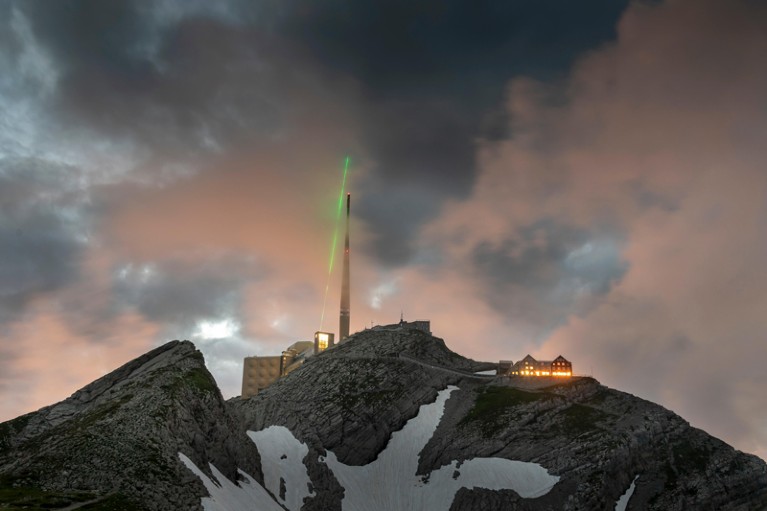
Outside view of the Laser Lightning Rod in action in the evening

A laser beam (green) shoots into the sky alongside the 124-metre-high telecommunications tower on Säntis mountain in the Swiss Alps.

Credit: TRUMPF/Martin Stollberg

A rapidly firing laser can divert lightning strikes, scientists have shown for the first time in real-world experiments1. The work suggests that laser beams could be used as lightning rods to protect infrastructure, although perhaps not any time soon.

“The achievement is impressive given that the scientific community has been working hard along this objective for more than 20 years,” says Stelios Tzortzakis, a laser physicist at the University of Crete, Greece, who was not involved in the research. “If it’s useful or not, only time can say.”

Metal lightning rods are commonly used to divert lightning strikes and safely dissipate their charge. But the rods’ size is limited, meaning that so, too, is the area they protect.

Physicists have wondered whether lasers could enhance protection, because they can reach higher into the sky than a physical structure and can point in any direction. But despite successful laboratory demonstrations, researchers have never before succeeded in field campaigns, says Tzortzakis.

Bolt from the blue

To change that, a group of roughly 25 researchers set up the Laser Lightning Rod project, which trialled a specially created €2 million (US$2 million) high-power laser in the Swiss Alps. The scientists placed the laser next to the Säntis telecommunications tower, which is hit frequently by lightning. “This is one of those projects that everyone was waiting for the results of,” says Valentina Shumakova, a laser physicist at the University of Vienna.

A sufficiently intense laser beam can create a conductive path for lightning to travel down, just as a metal wire can. Physicists think that it does this by shifting the properties of air so that the beam focuses into a thin, intense filament. This rapidly heats the air, reducing its density and creating a favourable path for lightning. “It’s like drilling a hole through the air with the laser,” says Aurélien Houard, a physicist at the Laboratory of Applied Optics in Paris, who led the project.

Rather than try to divert lightning from the tower, the Säntis experiments were designed to show that the laser could guide a strike’s path through the structure’s lightning rod. In future use, similar beams would guide strikes away from sensitive installations and onto a distant lightning rod, says Houard.

Guided lightning

Over 10 weeks of observation, the team spotted the laser channelling 4 lightning events during 6 hours of thunderstorms. A high-speed camera clearly showed one strike following the straight line of the laser beam, rather than taking a branching path.

“For 100% of the strikes where the laser was present, we measured an effect of the laser,” says Houard. But Tzortzakis notes that the laser was also active for many hours without channelling strikes. This suggests that although the laser diverted lightning, it did not force thunderclouds to discharge, which would be a better protection strategy, he says.

RELATED

The latest effort succeeded where others had failed, says Tzortzakis, because previous attempt had used a laser that fired just a few pulses per second. This team used a specialist laser that fires 1,000 high-energy pulses per second, which would have boosted its chance of intercepting the lightning.

However, the fact that the project’s laser is one of a kind is also its biggest limitation, because it will take time to shrink the system and make it cheaper and more practical, says Houard.

  • doi: https://doi.org/10.1038/d41586-023-00080-7

References

  1. Houard, A. et al. Nature Photon. https://doi.org/10.1038/s41566-022-01139-z (2023).

    Article Google Scholar 

Download references

{ https://www.nature.com/ }

Hoe vind je dit bericht?
Geschreven door peter om 01:08 Stuur door

You’re Looking at a Map of the Milky Way’s Magnetic Field

mfi11_lic_gnom.jpg

Colour shows the polarized microwave emission measured by QUIJOTE. The pattern of lines superposed shows the direction of the magnetic field lines. Credit: The QUIJOTE Collaboration.

You’re Looking at a Map of the Milky Way’s Magnetic Field

Using telescopes that study the sky in the microwave part of the electromagnetic spectrum, astronomers have successfully mapped the structure of the magnetic field of the Milky Way galaxy. While magnetic fields are difficult to measure in space, an international team of astronomers used the Teide Observatory on Tenerife in the Canary Islands to conduct 10 years of observations.

The Teide Observatory. Credit: Instituto de Astrofísica de Canarias.

The team’s collaboration, called QUIJOTE (Q-U-I JOint TEnerife) used two 2.5 m diameter telescopes, to observe the sky in the microwave part of the electromagnetic spectrum. Learning more about our galaxy’s magnetic field can provide information about star formation, cosmic rays, and many other  astrophysical processes.

The team said their work complements data gathered by previous space missions dedicated to the study of the cosmic microwave background radiation (CMB), the fossil radiation left behind by the Big Bang, which gave a detailed insight into the early history of the cosmos.

“These new maps give a detailed description in a new frequency range, from 10 to 40 GHz, complementing those from space missions such as Planck and WMAP,” said José Alberto Rubiño, lead scientist of the QUIJOTE Collaboration, in a press release. “We have characterized the synchrotron emission from our Galaxy with unprecedented accuracy. This radiation is the result of the emission by charged particles moving at velocities close to that of light within the Galactic magnetic field. These maps, the result of almost 9,000 hours of observation, are a unique tool for studying magnetism in the universe.”

The magnetic field of our Milky Way Galaxy as seen by ESA’s Planck satellite. Credit: ESA and the Planck Collaboration.

The work on this mapping project started in 2012, and the team has now published a series of 6 scientific papers that provide the most accurate description to date of the polarization of the emission of the Milky Way at microwave wavelengths. Polarization is a “property of transverse waves such as light waves that specifies the direction of the oscillations of the waves and signifies the presence of a magnetic field,” the team explained.

With the new maps, astronomers not only have more detailed information about the structure of the Milky Way’s magnetic field, but their findings also is helping to understand the energetic processes which took place close to the birth of the Universe.

The polarized microwave emission measured by QUIJOTE. The pattern of lines superposed shows the direction of the magnetic field lines. Credit: The QUIJOTE Collaboration.

“Scientific evidence suggests that the Universe went through a phase of rapid expansion, called inflation, a fraction of a second after the Big Bang,” said Rubiño. “If this is correct, we would expect to find some observable consequences when we study the polarization of the cosmic microwave background. Measuring those expected features is difficult, because they are small in amplitude, but also because they are less bright than the polarized emission from our own galaxy. However, if we finally measure them, we will have indirect information of the physical conditions in the very early stages of our Universe, when the energy scales were much higher than those that we can access or study from the ground. This has enormous implications for our understanding of fundamental physics.”

The new maps from QUIJOTE have also provided new data for studying a recently detected excess of microwave emission from the center of our Galaxy. The origin of this emission is currently unknown, but it could be connected to the decay processes of dark matter particles.

Additionally, the data from the  QUIJOTE collaboration allows scientists to  study over 700 sources of emission in radio and microwaves, of both Galactic and extragalactic origin, meaning that the data is helping scientists to decipher signals coming from beyond our galaxy, including the cosmic microwave background radiation.

 “One of the most interesting results we have found is that the polarized synchrotron emission from our Galaxy is much more variable than had been thought” said Elena de la Hoz, a researcher at the Instituto de Física de Cantabria (IFCA). “The results we have obtained are a reference to help future experiments make reliable detections of the CMB signal.

Below are links to the 6 papers published in the Monthly Notices of the Royal Astronomical Society:

{ https://www.universetoday.com/ }

Hoe vind je dit bericht?
Geschreven door peter om 00:39 Stuur door

Team van Belgische geologe vindt ruim 500 meteorieten op Antarctica, pronkstuk weegt bijna 8 kilo

Een archiefbeeld van Antarctica. Een archiefbeeld van Antarctica.  © Photonews

Team van Belgische geologe vindt ruim 500 meteorieten op Antarctica, pronkstuk weegt bijna 8 kilo

Een wetenschappelijk team onder leiding van een Belgische geologe heeft in enkele weken tijd meer dan 500 meteorieten gevonden op Antarctica. Een exemplaar van 7,6 kilogram vormt het paradepaardje. Normaal gezien weegt zo’n stukje ruimtepuin tussen de 50 en 100 gram.

{ https://www.hln.be/ }

Hoe vind je dit bericht?
Geschreven door peter om 23:45 Stuur door

Newly Released US Government UFO Report Reveals Details

Newly Released US Government UFO Report Reveals Details

ngcb1

According to a report released by the Pentagon, the number of UFO sightings has increased significantly over the past couple of years. Many of these incidents can be attributed to weather phenomena or drones. However, around half of these sightings remain unexplained. The agency that monitors these sightings noted that further analysis is necessary.

According to CNN’s Kristen Fisher, the report revealed that the number of sightings of unidentified aerial phenomena (UAPs) has increased significantly. In 2021, the DNI was not able to explain 144 incidents. This time around, the agency noted that there were over 300 new UAP sightings.

One of the most interesting findings of the report is that some of the UAPs exhibited unusual flight capabilities. It’s not clear if these are the results of advanced technology or foreign agents such as Russia or China. The US government has not officially stated its theory regarding the cause of these incidents.

The report provided a total of 163 explanations as to how these objects came into being. Most of these incidents were attributed to balloon-like structures or other similar objects. Some were also said to be caused by airborne clutter, such as debris and weather phenomena.

Members of Congress stated that the report sheds light on the various factors that contributed to the growing number of UAPs sightings, and it shows that the government is taking the issue seriously. However, they noted that the DNI and the Pentagon still need to provide more concrete answers regarding the nature of these objects.

Full report is available at this link: 

{ https://www.latest-ufo-sightings.net/ }

Hoe vind je dit bericht?
Geschreven door peter om 22:08 Stuur door

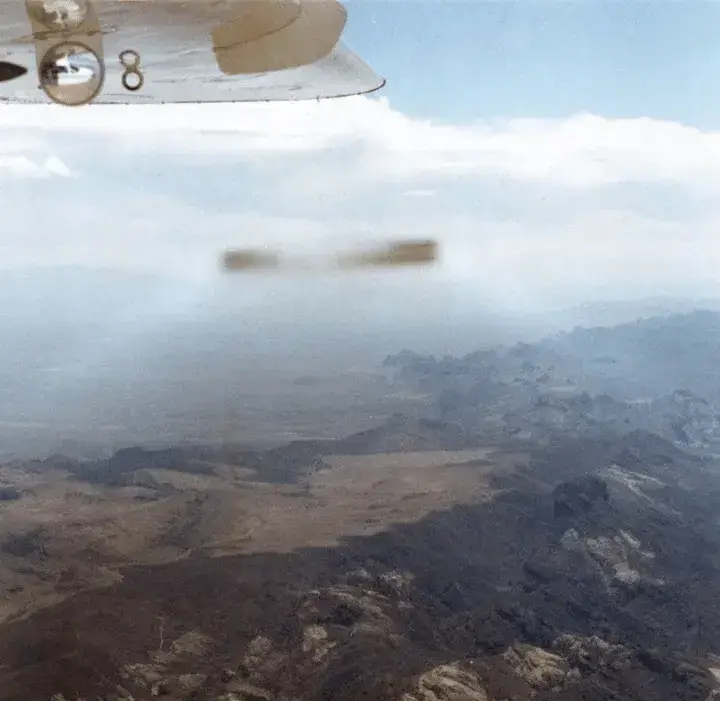
Pilot David Hastings captures a photo of an unidentified flying object while flying over the Mojave Desert on September 9, 1985

Pilot David Hastings captures a photo of an unidentified flying object while flying over the Mojave Desert on September 9, 1985

David-Hastings-took-a-photo-of-a-UFO-while-flying-over-the-Mojave-Desert.png?ezimgfmt=ng%3Awebp%2Fngcb1%2Frs%3Adevice%2Frscb1-1

On September 9, 1985, pilot David Hastings and his co-pilot were flying back to their home base after attending a convention in McAfee, New York. They had decided to fly during the day and had already made stops in Dayton and Albuquerque. As they were approaching the Mojave Desert, they encountered something unexpected.

According to Hastings, they suddenly saw something coming in their 12 o’clock at high speed. They were both convinced that they were going to have a mid-air collision and braced for impact. However, the object passed over them and they were left unharmed. The object left behind a large shadow that darkened the whole cockpit and the sky above them, but there was no sound or Shockwave.

The co-pilot and Hastings both had a strange sensation that something was still nearby, even though they couldn’t see anything. They felt that whatever it was, it was moving so fast that the human eye couldn’t register it in detail. They had the sensation that it was going up, but they couldn’t see anything.

Hastings and his co-pilot were left with many questions and no answers. They were both experienced pilots, and they couldn’t explain what they had seen. It was a mystery that still baffles them to this day.

In conclusion, on September 9, 1985, pilot David Hastings and his co-pilot had a close encounter with a UFO while flying over the Mojave Desert. The object passed over them and left behind a large shadow, but there was no sound or Shockwave. They both had a strange sensation that something was still nearby, even though they couldn’t see anything. The incident remains a mystery to this day.

hqdefault-685.jpg

Pilot David Hastings took a photo of a UFO while flying over the Mojave Desert, September 9, 1985

{ https://www.latest-ufo-sightings.net/ }

Hoe vind je dit bericht?
Geschreven door peter om 21:41 Stuur door

LATEST UFO SIGHTINGS AND VIDEOS - 18/01/2023

LATEST UFO SIGHTINGS AND VIDEOS - 18/01/2023

SpaceX launches Space Force's 'Amelia Earhart' GPS satellite, nails landing

A SpaceX Falcon 9 rocket launched the GPS III Space Vehicle 06 "Amelia Earhart" from Space Launch Complex 40 at Cape Canaveral Space Force Station in Florida on Jan. 18, 2023.

The first stage of the rocket landed on the 'A Shortfall of Gravitas' droneship in the Atlantic Ocean shortly after separation.

Credit: SpaceX

NASA Astronauts Spot Something Terrifying On The Moon

NASA Astronauts Spot Something Terrifying On The Moon. Something very strange happened during the Apollo 8 mission while the astronauts were on board the spacecraft. Something that even NASA cannot explain even till this day. A strange light, like fire, with smoke coming out of it.

Starship 25 Prepared for Engine Testing | SpaceX Boca Chica

Starship 25 was lifted onto Pad B, presumably for engine testing. Meanwhile Ship 22 was moved out of the Rocket Garden to be scrapped and a Starlink deployer aka Pez Dispenser mechanism was spotted being installed in Ship 30's payload section.

SpaceX - Falcon Heavy Incredible Views 01-15-2023

No SpaceX or NASA footage. All original content except for SpaceX announcer. Huge crowds came out for this launch! Thanks to Ed Geiger and Pete Carstens (maxQproductions) for awesome tracking! Thanks to Cory Foy for the aerial drone footage! Thanks for subscribing and Donating !! We are a US disabled veteran run, non-profit video production company whose mission is to bring other disabled US Veterans to witness a launch, experience US Space History and become part of our report. Our nonprofit 501(c)(3) is 100% tax deductible, just go to our webpage

Dark Curvature, Navigating the Oort Cloud, Future of Space Toilets | Q&A 207

Should we change "Dark Matter" to "Dark Curvature"? How do you navigate through dense asteroid fields? What's the future of space toilets? Do aliens block their outgoing signals? All these and more in this week's Q&A with Fraser Cain.

Most Distant Halo Stars in Milky Way Are Halfway to Andromeda Galaxy

SpaceX Falcon Heavy separation is genius engineering just SHOCKED Scientists, unlike others...

It's been a few days since SpaceX's spectacular USSF-67 Falcon Heavy rocket launch, but the echoes of that launch are still covered through newspapers, websites, and forums around the world.
This is because just under five years after its February 2018 debut, there had still never been a Falcon Heavy launch ‘jellyfish’ or ‘nebula.’ That thankfully changed on Sunday.
Indeed, from start to finish, Sunday’s Falcon Heavy launch delivered spectacular moments, unlike the others.
Find out everything about this in today's episode of Alpha Tech:

First and foremost, USSF-67 is an incredible success mission.
On January 15th, SpaceX’s Falcon Heavy rocket lifted off for the second time in 75 days to launch another batch of US military payloads into orbits tens of thousands of kilometers above Earth’s surface.

Six and a half hours later, the US Space Systems Command (SSC) confirmed that Falcon Heavy had again completed the exceptionally difficult launch without issue. To deliver the USSF-67 mission’s payloads directly to geosynchronous orbit (GSO), the giant SpaceX rocket had to sacrifice one of its potentially reusable boosters and complete a complex six-hour ballet of rolls, burns, and spacecraft deployments. And for the second time in a row, Falcon Heavy did so without apparent issue.

In an SSC press release, Maj. Gen. Stephen Purdy, program executive officer for Assured Access to Space, said that the group “had another fantastic launch today on a Falcon Heavy.” He added that “while the launch itself was impressive,” he was “most proud of the fact that we placed important [national] capabilities into space.”
SpaceX Falcon Heavy separation is genius engineering just SHOCKED Scientists, unlike others...

Can The Planet From Interstellar Really Exist?

The Proof Is Out There: UFO Crash Spotted in NASA Photo (Season 3)

A researcher finds evidence of a UFO crash in a NASA photo. See more in this clip from Season 3, “Aswang, Crashed on Mars, and Giant Wolves.”

Watch all new episodes of The Proof Is Out There on Fridays at 10/9c, and stay up to date on all of your favorite The HISTORY Channel shows at http://history.com/schedule.

RELATED VIDEOS

{ https://www.youtube.com/ }

Hoe vind je dit bericht?
Geschreven door peter om 18:37 Stuur door

A Black Hole is Savoring its Meal, Feeding on the Same Star Over and Over Again

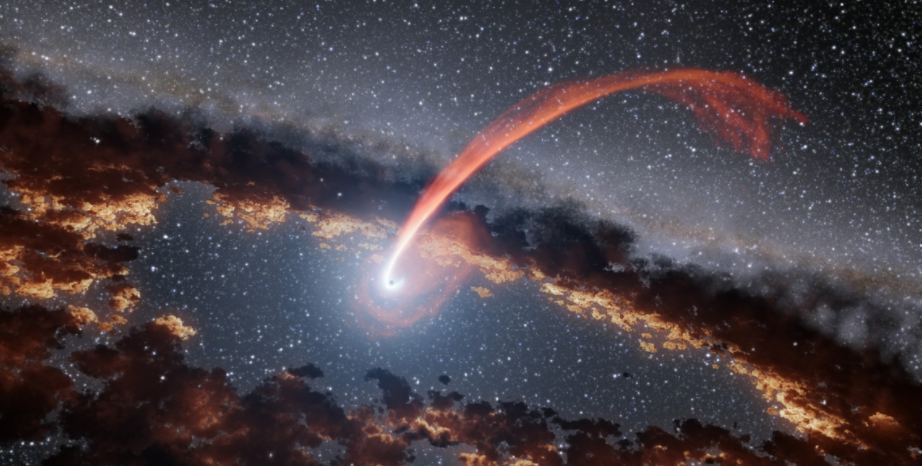
Tidal-Disruption-Event.jpg

This illustration shows a glowing stream of material from a star, being devoured and torn to shreds by a supermassive black hole. Image Credit: NASA/JPL-Caltech

A Black Hole is Savoring its Meal, Feeding on the Same Star Over and Over Again

Something extraordinary happens about every 10,000 to 100,000 years in galaxies like the Milky Way. An unwary star approaches the supermassive black hole (SMBH) at the galaxy’s center and is torn apart by the SMBH’s overpowering gravity. Astronomers call the phenomenon a tidal disruption event (TDE.)

Usually, a TDE spells doom for the star as its gas is torn away into the black hole’s accretion ring, causing a bright flaring visible for hundreds of millions of light years. But researchers have found one black hole that’s playing with its food.

It’s difficult to fathom the powerful forces at work when an SMBH eats a star.

Our own Sun is massive and incorporates 99.86% of the mass in the Solar System. That gives it enormous gravitational power. Its reach extends from tiny, speedy Mercury, its nearest neighbour, all the way out to the Oort Cloud, the hypothesized home of icy long-period comets up to 200,000 astronomical units, or 3.2 light-years, away.

But SMBHs are so massive that the Sun barely registers in comparison. An SMBH’s gravitational force is so mighty that it seems to hold their entire galaxy together.

In a new study, a team of astronomers observed an SMBH in a galaxy hundreds of millions of light-years away as it ate a star. The SMBH has an inferred black hole mass greater than 50 million solar masses. That an object that massive can completely destroy a star, puny in comparison, is axiomatic.

This illustration depicts a star (in the foreground) experiencing spaghettification as it’s sucked in by a supermassive black hole (in the background) during a 'tidal disruption event'. Credit: ESO/M. Kornmesser

This illustration depicts a star (in the foreground) experiencing spaghettification as it’s sucked in by a supermassive black hole (in the background) during a ‘tidal disruption event’.

This TDE is a result of what’s called a Hills Capture. That’s when a binary star approaches a black hole, and gravity separates the once-bound pair of stars. One star becomes a hypervelocity star and is ejected from the galaxy’s central regions at a speed of about 1000 km/second.

But there’s no escape for the other star. It enters into an orbit around the black hole, and its fate is foretold. The black hole will eventually destroy it, even though that doesn’t happen instantly.

The fact that the star was once part of a binary pair explains how it keeps passing close enough to the black hole to be partially stripped without being destroyed. “Typically, tidally disrupted stars are on approximately parabolic orbits, which begs the question of how a partial TDE could yield a brightening,” the authors write in their paper. For an SMBH this size, and a star similar in mass to the Sun, the orbit should last about 1,000 years, much longer than the star at AT 2018fyk. “One can bind the partially disrupted star more tightly if the star was initially part of a binary system that was destroyed through Hills capture.”

Credit: ESO/M. Kornmesser

But this TDE isn’t like most other TDEs. The light coming from the event shows that the star wasn’t completely destroyed, and that the black hole is taking repeated bites from it.

“…the assumption has been that when we see the aftermath of a close encounter between a star and a supermassive black hole, the outcome will be fatal for the star,”

Thomas Wevers, ESO

The paper is “Live to Die Another Day: The Rebrightening of AT 2018fyk as a Repeating Partial Tidal Disruption Event.” It’s published in The Astrophysical Journal Letters. The lead author is Thomas Wevers from the European Southern Observatory.

“Until now, the assumption has been that when we see the aftermath of a close encounter between a star and a supermassive black hole, the outcome will be fatal for the star, that is, the star is completely destroyed,” Wevers said in a press release. “But contrary to all other TDEs we know of, when we pointed our telescopes to the same location again several years later, we found that it had re-brightened again. This led us to propose that rather than being fatal, part of the star survived the initial encounter and returned to the same location to be stripped of material once more, explaining the re-brightening phase.”

The TDE is called AT 2018fyk (AT: Astrophysical Transient), and it’s a transient first discovered in 2018 by the All-Sky Automated Survey for Supernovae. Different teams of scientists have been observing the event since its discovery, and this new research is a continuation of the attempt to understand it.

During a TDE, gas from a star falls toward a black hole. But it doesn’t fall directly into the hole. It accumulates on the accretion disk swirling around the SMBH. This heats the gas up, and it emits brilliant light. This event gives astronomers an opportunity to study the fascinating region around black holes as they’re briefly lit up.

But AT 2018fyk is different. Usually, a TDE consists of one jump in brightness as the star is destroyed. But not this one. Instead, it looks like the SMBH is stripping away the less dense outer layers of the star on each of its closest approaches, leaving a denser core unaffected.

This TDE is a result of what’s called a Hills Capture. That’s when a binary star approaches a black hole, and gravity separates the once-bound pair of stars. One star becomes a hypervelocity star and is ejected from the galaxy’s central regions at a speed of about 1000 km/second.

But there’s no escape for the other star. It enters into an orbit around the black hole, and its fate is foretold. The black hole will eventually destroy it, even though that doesn’t happen instantly.

The fact that the star was once part of a binary pair explains how it keeps passing close enough to the black hole to be partially stripped without being destroyed. “Typically, tidally disrupted stars are on approximately parabolic orbits, which begs the question of how a partial TDE could yield a brightening,” the authors write in their paper. For an SMBH this size, and a star similar in mass to the Sun, the orbit should last about 1,000 years, much longer than the star at AT 2018fyk. “One can bind the partially disrupted star more tightly if the star was initially part of a binary system that was destroyed through Hills capture.”

This illustration shows how the Hills Mechanism works. A binary star approaches an SMBH, and the powerful gravity splits the binary pair apart. One star is ejected from the galaxy as a hyper-velocity star. The other takes up a tight orbit around the SMBH. Image Credit: Warren R. Brown 2015/J. Guillochon.

This illustration shows how the Hills Mechanism works. A binary star approaches an SMBH, and the powerful gravity splits the binary pair apart. One star is ejected from the galaxy as a hyper-velocity star. The other takes up a tight orbit around the SMBH. Image Credit: Warren R. Brown 2015/J. Guillochon.

In AT 2018fyk’s case, the black hole can’t quite destroy it all at once because even though the star is closely-bound to the SMBH, it doesn’t cross the tidal radius. The tidal radius is where the black hole’s gravity is stronger than the gravity holding the star together. Instead, about every 1200 days, the black hole gets another chance as the star makes its closest approach. It strips more of the star’s envelope away each time, forming the bright accretion disk around the SMBH. The evidence is in the light coming from the region. Our X-Ray and Ultraviolet /Optical telescopes can observe the light even though it’s hundreds of millions of light-years away.

A star that comes within the tidal-disruption radius RT of the supermassive black hole at the heart of a galaxy will be torn apart by the black hole’s gravity. Note that this image represents bound and unbound debris from common TDEs, not the exceptional AT 2018fyk in this study. Image Credit: NASA's Goddard Space Flight Center/Suvi Gezari.

A star that comes within the tidal-disruption radius RT of the supermassive black hole at the heart of a galaxy will be torn apart by the black hole’s gravity. Note that this image represents bound and unbound debris from common TDEs, not the exceptional AT 2018fyk in this study. Image Credit: NASA’s Goddard Space Flight Center/Suvi Gezari.

When astronomers first spotted AT 2018fyk, they thought it was like any other TDE. But subsequent observations showed how complex the TDE is. It was bright in x-ray emissions for about 600 days, then darkened and became undetectable. The decline in luminosity was quick, whereas other TDEs show a gradual decline. The abrupt decline was when the stellar core returned to its closest approach.

“When the core returns to the black hole, it essentially steals all the gas away from the black hole via gravity, and as a result, there is no matter to accrete, and hence the system goes dark,” said study co-author Dheeraj Pasham, an astrophysicist at MIT.

But then, 600 days after the drop in x-ray emissions, the region was bright again. The researchers think this is when material shed from the star starts accreting again.

This figure from the study illustrates what's happening at AT 2018fyk. (a) shows the disruption of the binary star by the Hills Mechanism at -600 days. (b) shows how unbound debris could explain the extended dark period at -300 days. (c) shows how streams of material trigger the accretion disk at day zero. (d) shows how a quasi-spherical flow of material onto the disk transitions between energy states at +300 days. (e) shows how the stellar remnant makes its next closest approach and cuts off the flow of mass to the accretion disk at +600 days. (f) shows how the stream accretes onto the disk again, triggering more luminosity at +1200 days. Image Credit: T. Wevers et al 2023 ApJL 942 L33

This figure from the study illustrates what’s happening at AT 2018fyk. (a) shows the disruption of the binary star by the Hills Mechanism at -600 days. (b) shows how unbound debris could explain the extended dark period at -300 days. (c) shows how streams of material trigger the accretion disk at day zero. (d) shows how a quasi-spherical flow of material onto the disk transitions between emission states at +300 days. (e) shows how the stellar remnant makes its next closest approach and cuts off the flow of mass to the accretion disk at +600 days. (f) shows how the stream accretes onto the disk again, triggering more luminosity at +1200 days. Image Credit: T. Wevers et al 2023 ApJL 942 L33

It’s difficult to determine how long this can go on and how many passes the star can make. The researchers estimate that up to 10% of the star’s mass is stripped away on each approach, but it could also be as low as 1%. The TDE is hundreds of millions of light-years away, so understanding and modelling the light is challenging. But if the 10% figure is correct, the star is already gone.

“If the mass loss is only at the 1% level, then we expect the star to survive for many more encounters, whereas if it is closer to 10%, the star may have already been destroyed,” said co-author Eric Coughlin, a physicist at Syracuse University.

Now that astronomers have spotted the unusual AT 2018fyk and come up with a theoretical explanation, it could explain other repeating flares in the heart of other galaxies. In fact, this research might entice researchers to revisit other flaring black holes for additional activity. Will repeated TDEs be more common than thought? Can they only result from binary stars and the Hills Mechanism?

An artist's illustration of an eclipsing binary star as seen from the surface of an exoplanet. Binary stars are common; will we find more repeating tidal disruption events? Image Credit: NASA

An artist’s illustration of an eclipsing binary star as seen from the surface of an exoplanet. Binary stars are common; will we find more repeating tidal disruption events? Image Credit: NASA

“In the future, it is likely that more systems will be checked for late-time flares, especially now that this project puts forth a theoretical picture of the capture of the star through a dynamical exchange process and the ensuing repeated partial tidal disruption,” says Coughlin. “We’re hopeful this model can be used to infer the properties of distant supermassive black holes and gain an understanding of their ‘demographics,’ being the number of black holes within a given mass range, which is otherwise difficult to achieve directly.”

Some of what the team has come up with to explain the TDE is testable. That fact, combined with more observations of phenomenon like AT 2018fyk, could teach us a lot about the extreme environments around black holes and the physics of partial TDEs.

“This study outlines methodology to potentially predict the next snack times of supermassive black holes in external galaxies,” says Pasham. “If you think about it, it is pretty remarkable that we on Earth can align our telescopes to black holes millions of light years away to understand how they feed and grow.”

More:

{ https://www.universetoday.com/ }

Hoe vind je dit bericht?
Geschreven door peter om 01:36 Stuur door

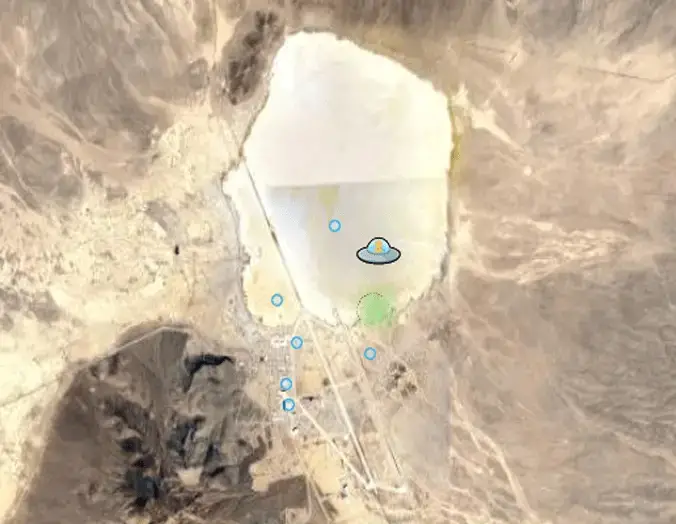
UFO spotted floating over Area 51 on Google Maps excites fans

UFO spotted floating over Area 51 on Google Maps excites fans

Google Maps has added an Easter egg for those searching for Area 51, one of the most mysterious and highly classified facilities in the United States. When users drag the “yellow man” in the corner to Street View, it transforms into a UFO. This is just one of several Easter eggs that Google Maps has added over the years. For example, searching for Loch Ness will turn the map into a strange green monster, and searching over Hawaii will turn the map into a mermaid.

Area 51 is located in Nevada, just 83 miles north-northwest of Las Vegas. It is officially a United States Air Force facility, but is believed by many to be the home of the development and testing of experimental aircraft and weapons systems. The US Air Force acquired the site in 1955, but the CIA did not acknowledge its existence until 2013.

Despite its official purpose, many conspiracy theorists believe that the facility is used to store, examine, and reverse engineer crashed alien spacecraft, including material supposedly recovered from the 1950s Roswell crash. In 1989, Bob Lazar claimed that he worked at Area 51, where tests on aliens and their spacecraft were carried out in massive underground workstations connected by an underground railway. However, his claims were never confirmed by officials.

Google Maps’ Easter egg adds a playful touch to the mystery surrounding Area 51, and will likely continue to delight conspiracy theorists and UFO enthusiasts alike.

{ https://www.latest-ufo-sightings.net/ }

Hoe vind je dit bericht?
Geschreven door peter om 23:47 Stuur door

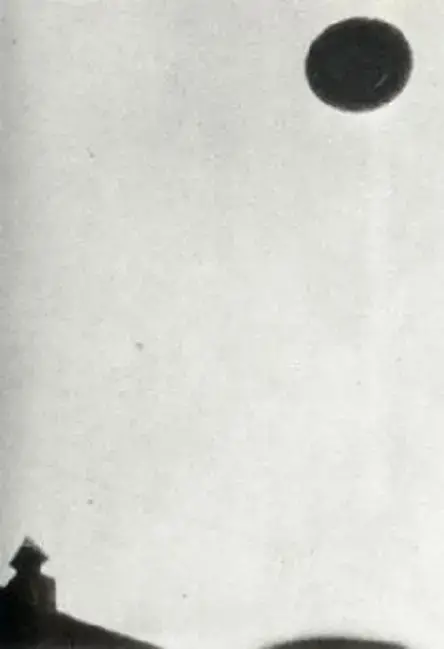
On this day in UFO history, a researcher in Yokohama, Japan captured a photograph of a metallic UFO flying above his house

On this day in UFO history, a researcher in Yokohama, Japan captured a photograph of a metallic UFO flying above his house

yokohama-ufo-1957

On January 17th, 1957, a UFO was captured on camera by UFO researcher Yusuke J. Matsumura at the Flying Saucer Research group in Japan. The UFO was estimated to be around 20 to 30 feet in diameter and was seen hovering for approximately one to two minutes at a height of 60-70 feet.

Matsumura, who was outside his residence in Yokohama at the time, reported that he was leaving his house to go to Tokyo when he saw a metallic flash just above his house. Quickly, he grabbed his Primoflex Automatic camera and was able to snap a picture of the object before it took off at an estimated Mach 152 in a 70-degree elevation.

The UFO was seen heading in the general direction of Tokyo Bay, southeast of Matsumura’s location. The incident took place at around 13 minutes to 10 in the morning and was reported by the witness to have occurred at 1687 Hama Isogo Ku Yokohama.

The incident, which was captured on camera by Japanese researcher Yasushi Matsumura, is regarded as one of the most credible sightings of UFOs in history. Experts have analyzed the photo and found no evidence of manipulation or tampering.

{ https://www.latest-ufo-sightings.net/ }

Hoe vind je dit bericht?
Geschreven door peter om 22:56 Stuur door

Meer van UFO'S of UAP'S, ASTRONOMIE, RUIMTEVAART, ARCHEOLOGIE, OUDHEIDKUNDE, SF-SNUFJES EN ANDERE ESOTERISCHE WETENSCHAPPEN - DE ALLERLAATSTE NIEUWTJES

↑ Terug naar de berichten