Ontdek de Fascinerende Wereld van UFO's en UAP's: Jouw Bron voor Onthullende Informatie!
Ben jij ook gefascineerd door het onbekende? Wil je meer weten over UFO's en UAP's, niet alleen in België, maar over de hele wereld? Dan ben je op de juiste plek!
België: Het Kloppend Hart van UFO-onderzoek
In België is BUFON (Belgisch UFO-Netwerk) dé autoriteit op het gebied van UFO-onderzoek. Voor betrouwbare en objectieve informatie over deze intrigerende fenomenen, bezoek je zeker onze Facebook-pagina en deze blog. Maar dat is nog niet alles! Ontdek ook het Belgisch UFO-meldpunt en Caelestia, twee organisaties die diepgaand onderzoek verrichten, al zijn ze soms kritisch of sceptisch.
Nederland: Een Schat aan Informatie
Voor onze Nederlandse buren is er de schitterende website www.ufowijzer.nl, beheerd door Paul Harmans. Deze site biedt een schat aan informatie en artikelen die je niet wilt missen!
Internationaal: MUFON - De Wereldwijde Autoriteit
Neem ook een kijkje bij MUFON (Mutual UFO Network Inc.), een gerenommeerde Amerikaanse UFO-vereniging met afdelingen in de VS en wereldwijd. MUFON is toegewijd aan de wetenschappelijke en analytische studie van het UFO-fenomeen, en hun maandelijkse tijdschrift, The MUFON UFO-Journal, is een must-read voor elke UFO-enthousiasteling. Bezoek hun website op www.mufon.com voor meer informatie.
Samenwerking en Toekomstvisie
Sinds 1 februari 2020 is Pieter niet alleen ex-president van BUFON, maar ook de voormalige nationale directeur van MUFON in Vlaanderen en Nederland. Dit creëert een sterke samenwerking met de Franse MUFON Reseau MUFON/EUROP, wat ons in staat stelt om nog meer waardevolle inzichten te delen.
Let op: Nepprofielen en Nieuwe Groeperingen
Pas op voor een nieuwe groepering die zich ook BUFON noemt, maar geen enkele connectie heeft met onze gevestigde organisatie. Hoewel zij de naam geregistreerd hebben, kunnen ze het rijke verleden en de expertise van onze groep niet evenaren. We wensen hen veel succes, maar we blijven de autoriteit in UFO-onderzoek!
Blijf Op De Hoogte!
Wil jij de laatste nieuwtjes over UFO's, ruimtevaart, archeologie, en meer? Volg ons dan en duik samen met ons in de fascinerende wereld van het onbekende! Sluit je aan bij de gemeenschap van nieuwsgierige geesten die net als jij verlangen naar antwoorden en avonturen in de sterren!
Heb je vragen of wil je meer weten? Aarzel dan niet om contact met ons op te nemen! Samen ontrafelen we het mysterie van de lucht en daarbuiten.
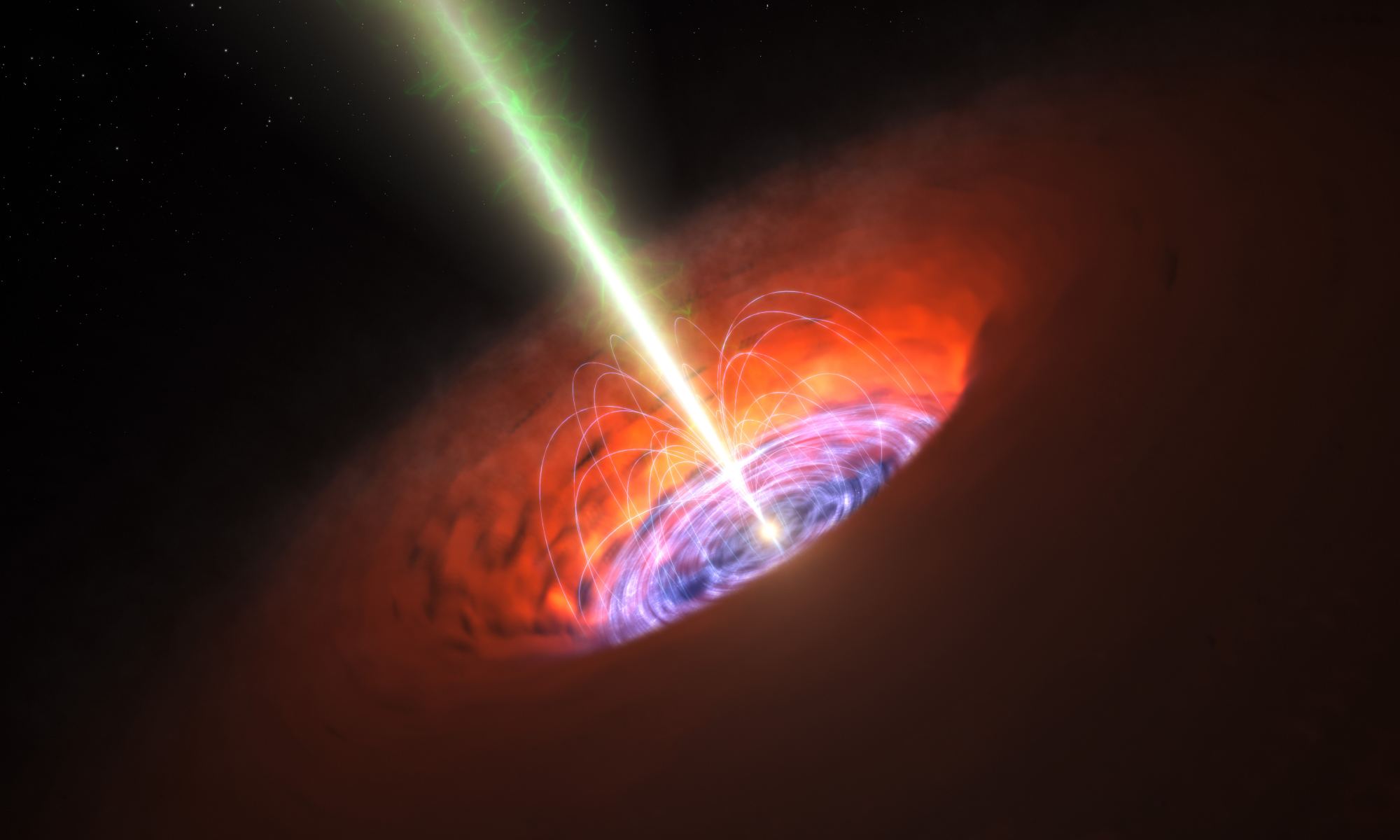
Scientists unlock secrets of 'burping’ supermassive black holes that are surrounded by mysterious radio bubbles by using West Virginia’s Green Bank Telescope
Scientists have a new understanding about supermassive black holes thanks to data gathered by West Virginia's Green Bank Telescope
A team of astronomers used a telescope to image galaxy cluster MS0735 in a way that distorts the cosmic microwave background
Supermassive black holes are located deep within the center of galaxies in areas where temperatures run up to 50 million degrees Celsius
'We’re looking at one of the most energetic outbursts ever seen from a supermassive black hole,' Jack Orlowski-Scherer, the study's lead author, said
Scientists have a new understanding about supermassive black holes thanks to data gathered by the Green Bank Telescope in West Virginia.
Supermassive black holes are located deep within the center of galaxies in areas where temperatures run up to 50 million degrees Celsius. The black hole will sometimes reheat the gas surrounding it in violent bursts - 'burps' - from its center.
These gas jets carve out immense cavities within the hot cluster, which then pushes hot gas farther from the center and replaces it with radio-emitting bubbles. If they can learn more about what’s left behind filling in these cavities, scientists can begin to understand what made them in the first place.
'We’re looking at one of the most energetic outbursts ever seen from a supermassive black hole,' Jack Orlowski-Scherer, lead author on this publication and a research fellow at McGill University in Montreal, Quebec, said in a statement. 'This is what happens when you feed a black hole and it violently burps out a giant amount of energy.'
Observations by NASA’s Chandra X-ray Observatory show the enormous cavities (circled in grey) excavated by the powerful radio jets (green contours) expelled from the black hole at the center of galaxy cluster MS0735
In a new paper published in the journal Astronomy & Astrophysics that analyzes the galaxy cluster MS0735, a team of astronomers used an instrument known as MUSTANG-2 on the Green Bank Telescope (GBT) in West Virginia to image the cluster in a unique way that distorts the cosmic microwave background.
The cosmic microwave background was emitted 380,000 years after the Big Bang and is considered to be the afterglow of our universe's birth 13.8 billion years ago.
These new findings reinforce previous discoveries that at least a portion of the pressure support in the cavities is due to non-thermal sources, such as other types of particles, cosmic rays and turbulence, and potentially a small contribution from magnetic fields.
Unlike previous research, new imaging produced by the GBT considers the possibility that the pressure support within the bubbles could be more nuanced than previously thought, mixing both thermal and non-thermal components.
'With the power of MUSTANG-2, we are able to see into these cavities and start to determine precisely what they are filled with, and why they don’t collapse under pressure,' explains Tony Mroczkowski, an astronomer with the European Southern Observatory who was part of this new research.
The researchers also used existing X-ray observations from NASA's Chandra X-ray Observatory, in addition to the radio observations.
'We knew this was an exciting system when we studied the radio core and lobes at low frequencies, but we are only now beginning to see the full picture,' says co-author Tracy Clarke, an astronomer at the U.S. Naval Research Laboratory and VLITE Project Scientist who co-authored a previous radio study of this system.
Future observations across multiple frequencies can establish more precisely the nature of how exotic the black hole eruption is.
'We knew this was an exciting system when we studied the radio core and lobes at low frequencies, but we are only now beginning to see the full picture,' says co-author Tracy Clarke, an astronomer at the U.S. Naval Research Laboratory and VLITE Project Scientist who co-authored a previous radio study of this system
WHAT'S INSIDE A BLACK HOLE?
Black holes are strange objects in the universe that get their name from the fact that nothing can escape their gravity, not even light.
If you venture too close and cross the so-called event horizon, the point from which no light can escape, you will also be trapped or destroyed.
For small black holes, you would never survive such a close approach anyway.
The tidal forces close to the event horizon are enough to stretch any matter until it's just a string of atoms, in a process physicists call 'spaghettification'.
But for large black holes, like the supermassive objects at the cores of galaxies like the Milky Way, which weigh tens of millions if not billions of times the mass of a star, crossing the event horizon would be uneventful.
Because it should be possible to survive the transition from our world to the black hole world, physicists and mathematicians have long wondered what that world would look like.
They have turned to Einstein's equations of general relativity to predict the world inside a black hole.
These equations work well until an observer reaches the centre or singularity, where, in theoretical calculations, the curvature of space-time becomes infinite.
A Black Hole has been Burping for 100 Million Years
Black holes are gluttonous behemoths that lurk in the center of galaxies. Almost everybody knows that nothing can escape them, not even light. So when anything made of simple matter gets too close, whether a planet, a star or a gas cloud, it’s doomed.
But the black hole doesn’t eat it at once. It plays with its food like a fussy kid. Sometimes, it spews out light.
When the black hole is not only at the center of a galaxy but the center of a cluster of galaxies, these burps and jets carve massive cavities out of the hot gas at the center of the cluster called radio bubbles.
Astronomy and astrophysics are all about light. Almost everything we know about distant objects in space, including black holes, comes from observing light. (Gravitational waves are the exception.)
The light astronomers see when they observe a black hole is coming from the environment in the vicinity of the black hole, not from the black hole itself. The behemoth’s strong gravity means that anything that gets too close is like a puppet on a string, and the black hole is the puppet master.
In a new study, a team of researchers using the National Science Foundation’s Green Bank Telescope (GBT) examined a supermassive black hole (SMBH) burping out mysterious radio bubbles.
“This is what happens when you feed a black hole, and it violently burps out a giant amount of energy.”
Jack Orlowski-Scherer, lead author, McGill University.
The study is “GBT/MUSTANG-2 9“ resolution imaging of the SZ effect in MS0735.6+7421,” and it was published in the journal Astronomy and Astrophysics. The lead author is Jack Orlowski-Scherer, a graduate student at the University of Pennsylvania at the time the study was done. “This is what happens when you feed a black hole, and it violently burps out a giant amount of energy,” he said in a press release.
Supermassive black holes reside in the center of large galaxies like the Milky Way. They’re found in every large galaxy, including the galaxies at the heart of galaxy clusters. The heart of a galaxy cluster is an extreme environment. The plasma there is scorching, up to 50 million degrees Celsius (90 million F.)
That plasma radiates x-rays, and over time that dissipates the heat. The plasma cools down, allowing stars to form. It’s sort of like the Universe’s situation after the Big Bang. Only after things cooled down could stars form.
Sometimes a black hole will reheat the surrounding gas preventing stars from forming. That’s called black hole feedback, and it happens when black holes emit jets of heated material from their centers. The jets are enormously powerful, pushing away the hot x-ray-emitting gas in the galaxy cluster’s center, creating vast radio bubbles.
This graphic from the Space Science Telescope Institute team describes the black hole feedback loop. Image Credit: NASA, ESA, Leah Hustak (STScI)
While that description makes the process sound straightforward, it’s not. It takes enormous energy to move that much gas, and astrophysicists want to know where all of that energy comes from. In this study, the researchers probed the radio bubbles for clues to the energy source.
The Green Bank Telescope is a fully steerable radio telescope—the world’s largest—located in West Virginia. Its collecting area is 100 meters in diameter. The MUSTANG-2 receiver is a type of camera called a continuum receiver that operates across multiple channels.
The team aimed the instrument at the galaxy cluster MS0735. It’s about 2.6 billion light years away and is known for having an enormously massive black hole in its center. The jets coming from the black hole in the center are one of the most powerful active galactic nucleus eruptions ever recorded. The eruption has been going on for over 100 million years and has released as much energy as hundreds of millions of gamma-ray bursts.
“We’re looking at one of the most energetic outbursts ever seen from a supermassive black hole,” said lead author Orlowski-Scherer.
The jets are the likely culprits behind the radio bubbles, but exactly how they work is unknown. Somehow, they provide the heat that prevents star formation. “Jets are the main drivers of ICM (Intra-Cluster Medium) reheating, although the exact mechanism is not clear yet,” the authors explain in their paper. “It is known that the jets, as traced by their synchrotron emission, often terminate in radio lobes that are coincident with depressions (cavities) in the X-ray emission.”
These jets are what carved out the radio bubbles, and the team studied them for clues to how it all plays out.
The region is difficult to observe, but the team used MUSTANG-2’s power to peer into the bubbles. They took advantage of a phenomenon called the Sunyaev-Zeldovich (SZ) effect. The SZ effect is a subtle distortion of the Cosmic Microwave Background (CMB,) sometimes called the echo from the Big Bang. It’s relic radiation from the moment the Universe began over 13 billion years ago. The SZ effect registers as a slight thermal pressure at 90 GigaHertz, where MUSTANG-2 can sense it. 90 GHz is in the millimetre band because radio waves in this band have wavelengths from one to ten millimetres.
Observations by NASA’s Chandra X-ray Observatory (left image) and by GBO’s MUSTANG-2 instrument (right image) clearly show the enormous cavities (highlighted with gray circles) excavated by the powerful radio jets (green contours) expelled from the black hole at the center of galaxy cluster MS0735. The green contours in both images are from observations performed by the Naval Research Laboratory’s VLA Low-band Ionosphere and Transient Experiment (VLITE) back end used on the National Radio Astronomy Observatory’s (NRAO) Very Large Array (VLA). Image Credit: Orlowski-Scherer et al. 2022.
“With the power of MUSTANG-2, we are able to see into these cavities and start to determine precisely what they are filled with and why they don’t collapse under pressure,” said Tony Mroczkowski. Mroczkowski is an astronomer with the European Southern Observatory who was part of this new research.
This study isn’t the first time astrophysicists have studied these radio bubbles. Those efforts showed that the pressure inside these bubbles wasn’t entirely thermal. They pointed to relativistic particles, cosmic rays, and turbulence as causes, as well as a small contribution from magnetic fields. “Broadly, the support mechanisms can be broken down into two categories: thermal and non-thermal,” the team explains in their paper.
But the observations in this new study are the deepest high-fidelity SZ observations yet of the inside of the bubbles. That’s important because the SZ effect can distinguish thermal pressure causes from non-thermal pressure and relativistic electron causes. This study’s results show more nuance in the cause of the cavities, including thermal and non-thermal sources.
“We knew this was an exciting system when we studied the radio core and lobes at low frequencies, but we are only now beginning to see the full picture,” explains co-author Tracy Clarke. Clarke’s an astronomer at the U.S. Naval Research Laboratory and VLITE Project Scientist who co-authored a previous radio study of this system.
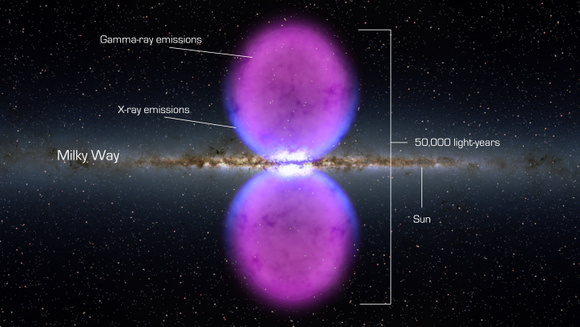
The Milky Way has its own pair of bubbles, most likely caused by outbursts from Sgr. A*, the supermassive black hole at the heart of the Milky Way. While Sgr. A* may have produced jets in the past that carved out the bubbles, it emits no jets today. From end to end, the Milky Way’s gamma-ray bubbles extend 50,000 light-years, or roughly half of the galaxy’s diameter, as shown in this illustration. Image Credit: NASA
Galaxy clusters are important because they’re the endpoints of structure formation in the Universe. They grow continuously through mergers and accretion. Theory and calculations show that some of their energy is not yet thermalized, meaning it comes from turbulence and bulk motion. Researchers want to know how much of a cluster’s pressure support is not thermal because that helps them understand how the gas in the intra-cluster medium reaches equilibrium. That’s called virialization, and it leads to star formation.
It all relates to the problem of black hole feedback, which prevents stars from forming. Studies like this one that uses the GBT/MUSTANG-2 receiver across multiple frequencies can start to untangle this complex environment by determining how thermal and non-thermal pressures support the radio bubbles. Scientists would like a clearer understanding of how turbulence, magnetic fields, and even cosmic rays support these bubbles.
“This work will help us better understand the physics of galaxy clusters and the cooling flow feedback problem that has vexed many of us for some time,” added Orlowski-Scherer.
In 86 More Days, Skynet Could Become A Reality, Pentagon Video, UFO Sighting News.
Now this is fun, or not. A 90 days from now (actually 86 now) AI will gain control of UAS or Unmanned Aerial Systems. This sounds like no big deal, but is clear that if a UAS has AI this AI is very advanced and might even escape its confines, expanding to do more, achieve more than it was suppose to do. Remember the movie Terminator where Skynet AI takes over? In the movie a gov AI algorithm takes over all military remote controlled and AI controlled devices, missiles, tanks, ect. To wipe out its biggest threat, human kind. Its not something I ever thought I would live to see, and yet, here it is, about to begin or at least, activated in 89 more days. If it grows, if its intelligence grows, it may not see us as the good guys any longer. Listen to CETCOm talk about it and decide for yourself. Has it begun? Clearly the US military has experimented a lot with this AI to give it such power. But was it enough to know...can it be controlled? Every get a computer glitch, software glitch, a virus? Then you can see what can happen. Now understand this AI could soon gain control of US nuclear arsenal. How you feeling about it now?
Guys just made this today, please hit like and subscribe, helps me so much. I found this entrance to a tomb on Mars in a Gigipan photo. Not far away is also a pyramid, blue polished, sunken into the sand on one side. When I took screenshot and added light, I can see the dirt from outside continues inside on the floor within, There is no blue rock walls which is proof its not a crack in stone, but a sculpted entrance to a home or tomb.
Please have a look at the video, I answer a lot of questions including, showing you inside the doorway.
Mysterious bottomless hole leading to another dimension - Mel's Hole
In 1997, Art Bell, anchor of "Coast to Coast AM," a popular radio talk show that discussed strange occurrences and unexplainable phenomena, received a fax from a man named Mel Waters.
In the fax, Mel mentioned an unusual pit with unknown origins on his property in Manastash, Washington. The pit was "bottomless" and spooked wildlife in the area so badly that birds never flew over it.
Soon after, Art Bell invited Mel to appear on his radio show, where Mel introduced the world to what would become one of the most famous mysteries of the 21st century - Mel's Hole.
A similar bottomless hole can be found at Houska Castle in the Czech republic near Prague.
According to the legend, a chapel was constructed over the hole but after animal-human hybrids were reported to have crawled out of it, and dark-winged, otherworldly creatures flew in its vicinity, they covered the hole with a huge stone to keep the beings and demonic beasts inside the bottomless hole, which they call the "gateway to Hell" or like Mel's hole, "the gateway to another dimension".
Wall of Secrecy: 'The ultimate UFO File revealed'!
Dark Journalist Daniel Liszt and Dr. Joseph Farrell go deep on the covert machinery that allows a whole category of Advanced, Exotic UFO technology to remain behind a Wall of Secrecy.
They also look at 75 years of CIA obfuscation and political lies that have kept the 'Hide The UFO File' game going behind the scenes right up until today.
From the development of the Nazi Bell which disappeared to Argentina, to President Kennedy being assassinated over UFO Disclosure and also the rise of X-Protect Aerospace Assassins and Paperclip Scientists, have we reached a breaking point heading into 2023?
Includes X Topics:
Apollo Moon Mission - Nazi Bell
NASA Censorship of Artifacts
UFO File Black Budget
JFK UFO Disclosure Attempt
Werner von Braun - Hans Kammler - Walter Dornberger
TOP 3 TERRIFYING ALIEN ENCOUNTERS Caught On Camera
The Ancient Aliens series explores the idea that alien life has been visiting Earth for millions of years. In this compilation, we’ll take a look at some of the scariest encounters with these mysterious objects.
Space historian examines parallels of NASA's last moon landing and the Artemis mission
The nearly month-long Artemis 1 mission to the Moon is slated to end on Sunday with a splashdown in the Pacific Ocean. On that very day 50 years ago, Dec. 11, 1972, the last Apollo astronauts set foot on the moon. Space historian Andy Chaikin, author of the definitive account of the Apollo missions “A Man on the Moon,” joins Miles O'Brien to discuss the parallels.
Top 10 Biggest Scientific Discoveries of 2022
These scientific discoveries will blow your mind! For this list, we’ll be looking at the most amazing things we learned through scientific research this year. Our countdown includes Brain Cells Playing Video Games, Footprints from the Ice Age, A Detailed View of the Distant Universe, and more! What do you think is the most significant discovery here? Are there any we missed? Tell us in the comments.
ALIEN CYCLOPS : THE SAGRADA FAMILIA CASE - FULL HD SCIFI MOVIE IN ENGLISH - EXCLUSIVE V MOVIES
ALIEN CYCLOPS : THE SAGRADA FAMILIA CASE - FULL HD SCIFI MOVIE IN ENGLISH - EXCLUSIVE V MOVIES Brazil, 1963.
Three children observe a strange flying object in their backyard. A transparent sphere floats above their heads. A member of the crew, an alien cyclops descends among them. The documentary narrates the discoveries made by Mr. Alberto Francisco do Carmo, sent to investigate the fact.
What Lies Beyond the Solar System? Long Episode
Compared to gigantic galaxies and star clusters, the Solar System is no more than just a speck of dust. There are thousands of stars within the radius of 100 light years from it. With some of them barely distinguishable against the dark abyss of space, others are so bright that they can be seen even if they are in other galaxies. Besides, there are a lot of invisible objects lurking in the depths of space, too – from massive brown dwarves to rocky exoplanets comparable to our Earth in size. Some of them may harbour life while others may pose a threat.
However, all this diversity is eclipsed by the scale of our galaxy. There are 200 billion stars and over a trillion planets at the very least to be found across its expanses. It is quite impossible to completely explore this great abundance of unique space objects. Today we will talk about some of the closest ones.
NASA Just Announced That They Are Monitoring a Huge Escalating Anomaly In Earth's Magnetic Field
Many people have come to depend on the Earth's magnetic field even without realizing it! Your phone is able to perform some basic functions, like directing you while driving to your destination. However, a catastrophic event is threatening to render life-saving tasks like this impossible: the flipping of the Earth's poles! Why are the Earth's poles flipping? What are the consequences, and how can you cope with it? In this video, we dive into the Earth's poles flipping, which has many people worried as it is happening!
There are many things that shape your daily life, even without you realizing it. Thanks to science and technology, we have come to rely on many natural phenomena that are not apparent to the naked eye! The Earth's magnetic poles are an example, and this has a lot to do with the Earth's magnetic field!
But what is the Earth's magnetic field, and where did it come from?
Australian UFO Mysteries: The Disappearance of Frederick Valentich
Victorian pilot Frederick Valentich.
Over 40 years ago, during the early evening of 21 October 1978, pilot Frederick Valentich reported in a radio communication with Steve Robey of Melbourne Flight Service that “a large aircraft” which had “a long shape” and “a green light,” appearing to have a bright metallic lustre and four bright lights, travelling variously at high speed, approached his Cessna 182L aircraft (registration VH-DSJ) and apparently hovered in a stationary manner and also orbited above him.
After six minutes Valentich reported his aircraft’s engine was rough idling, and the strange object was “hovering, and it’s not an aircraft.” Having indicated he intended to fly on to King Island, Valentich’s communication terminated after 17-seconds of “metallic” noises.
Valentich’s intended route from Moorabbin to King Island over Bass Strait.
Neither Valentich or the Cessna were ever found. The event became one of Australia’s greatest aviation mysteries, and the apparent UFO connection remains unresolved.
The areas that feature prominently in the Valentich incident – Cape Otway (his last land call), Bass Strait (the apparent location of his disappearance) and King Island (his apparent destination) – all have extensive precedents for UFO activity.
During a two-month period centred around January 1978, holidaymakers, fishermen, school teachers, local police and lighthouse keepers in the Cape Otway area reported seeing UFOs. During July 1977, local residents and the lighthouse keeper at Cape Otway saw an inexplicable brilliant light source that hovered out to sea for half an hour.
The lost Cessna VH-DSJ photographed at Essendon Airport in 1974.
Bass Strait figures in UFO mysteries particularly in 1920 and 1944. The Melbourne Argus newspaper even described many people seeing “cigar-shaped” objects flying over Bass Strait as far back as 1896.
King Island’s 425 square miles played host to a wave of unidentified nocturnal aerial lights for at least three months prior to Frederick Valentich’s disappearance. Oval shaped lights followed cars and mystified local residents. Strange lights or flares appeared off the north of the island.
One of the most spectacular close encounters with a UFO in the area occurred at a wild and uninhabited part of the King Island coast, near Whistler Point, just before dawn, on 10 April 1976. “A beam of light” emanating from “a cross-shaped object” approached a duck-shooter’s car, in a direct line. The light display eventually receded directly along its line of approach, ending a silent inspection when it disappeared over the distant skyline.
Much suggests a UFO connection in the Valentich case, but unfortunately a final answer alludes us. Despite the provocative nature of the taped conversation between Valentich and Melbourne Flight Control before his disappearance, which refers to a possible UFO presence, the affair remains a mystery.
Valentich’s mysterious disappearance made headlines in 1978. The Sun story on the right pictures Frederick’s father Guido and his brother Richard.
The Valentich incident is punctuated with haunting, or rather more appropriately, taunting clues that set one off in all sorts of conflicting directions. Many have come up with solutions varying from the bizarre to the sublime. Did a UFO abduct Valentich? Did Valentich contrive the whole affair? Did he, as many think, crash into Bass Strait, leaving no trace? Or are other prosaic explanations involved? A multitude of various lines of enquiry radiate out in all sorts of directions. Most take us away from the facts of the matter, namely that no trace of pilot or plane have yet been found.
The mystery resonates in the Australian consciousness in a place reserved for more mythic episodes like the haunting fiction of ‘Picnic at Hanging Rock’. It has inspired dramatic works like the profound and confronting play ‘Sky’ and the bizarre and striking TV mini-series, ‘Locusts and Wild Honey’. We must remind ourselves that a family waits for an answer that so far has never come. I hope that someday they will find that answer.
Department of Transport file V116/783/1047
Due to the tenacious efforts of Adelaide-based researcher Keith Basterfield in 2012, we can now study the previously restricted Department of Transport file V116/783/1047, available in digital format at the National Archives of Australia website. I last saw this file back in late 1982 while sitting in front of Mr A. Woodward at the Melbourne office of the Bureau of Air Safety Investigation. He had the file open in front of him while answering my questions. I tried not to be too obvious in reading the file in its upside-down perspective.
The released Valentich files provide hints at some possible answers, and it may be that ultimately the answer does not involve UFOs. Reconciling a detailed analysis of the released data with the extensive research done on the case by researchers over the years might help us come up with a final answer. But for now Frederick Valentich and his Cessna plane are still missing, so final closure eludes those who want to know.
‘The Unexplained Files’ series on the Discovery Science Channel in September 2013 featured an excellent recreation of the extraordinary 1978 Valentich mystery. My friend George Simpson (based in Melbourne, Victoria) was instrumental in the accounting of this story on the programme.
Roy Manifold took some intriguing photos (including the above) at the time and locality of Valentich’s departure from the Australian mainland on route to King Island in Bass Strait.
On the programme, Steve Robey of Melbourne Flight Service was clearly still distressed about the disappearance of Valentich. Frederick’s younger brother Richard gave the family’s dimension to the story. Both these elements remind us that a disturbing and tragic element still haunts this mystery. George Simpson interviewed Roy Manifold who took some intriguing photos at the time and locality of Valentich’s disappearance.
Dr Richard Haines investigated the case and authored a book on it, Melbourne Episode: Case Study of a Missing Pilot (1987). He facilitated the airing of the strange sound heard at the end of Valentich’s last radio conversation with Steve Robey. I listened to the tape back in 1984 when I stayed with Dr Haines in California. Haines’ comment in ‘The Unexplained Files’ programme that the sound might be from contact between the Cessna and the UFO Valentich had been describing in the six-minute conversation, caused me to suddenly reconsider a very strange story I came across back in early 1995.
The Coonabarabran Times of Coonabarabran, north-west New South Wales, Australia, in its 17 November 1994 issue, carried brief details of an apparent close encounter with a diamond-shaped UFO near ground level on 15 November 1994, on the Mendooran road to the south of the town.
With the assistance of local police, I interviewed the four principal witnesses to this apparent close encounter. One of the area witnesses told me that I should seek out Laurie, a local businessman, who had a lot of UFO stories to tell.
One story was utterly startling and unbelievable. It was apparently connected to the Valentich mystery and initially told to me by one of the Coonabarabran witnesses who heard it through Laurie. Others encouraged us to ask Laurie about other stories. We did both, but the story in question stood out.
Laurie told us he had heard the story directly from a South Australian farmer who had bought a property in the north-west of New South Wales. The farmer had come into his business and the talk strayed onto UFOs. He shared with Laurie an experience he had on his South Australian property on the day following the disappearance of Frederick Valentich.
The farmer said he was harvesting lucern when he heard a loud screeching sound coming from the harvester. He thought it might have been a bearing, so he uncoupled the harvester from the tractor’s power drive and jumped off and went back to have a look. The farmer was trying to work out the source of the continuing noise when he became aware that he was in a shadow. He looked up and saw he was directly underneath a large “saucer” shaped object, and going by the size of his harvester; he estimated it to be about 30 metres across. The loud screeching noise continued.
From directly underneath the object, the farmer reportedly could see two concentric outer rings or bands that were counter rotational and were operating at different speeds. One went very fast, so fast that you had to blink to see that it was moving. The other one was moving very slowly in the opposite direction. There were two small protuberances that the farmer took to be rudders, and two large holes, one had “shimmering heat” coming out, the other was shooting small flames.
The farmer began to think there was something horribly wrong with this huge object and that it might crash down on him. He ran to get out from under it. He got the impression that one of the object’s engines had stopped working.
As he moved away the farmer looked back at the object which he could now see edge on. It had a large dome on top and what looked like a black weather seal along the base of the dome structure. He then noticed what looked like a “church door with a curved top, but no windows or handles were visible.”
He told Laurie the most unusual thing was that the massive object had a Cessna stuck to the outside of it – “the whole aircraft.” It was flat up against the side of the object with its tail hanging down. Laurie said he was not sure whether the farmer said there was engine oil running down the outside of the Cessna, but he could clearly see the plane’s registration markings. He found a nail and scratched the plane’s registration number into the paint of his tractor.
According to Laurie, the farmer said the object – “the saucer” – still accompanied by the screeching sound, then flew away over a ridge in the direction of a nearby Army range.
The farmer said to Laurie he told no one about what happened. He went into town later in the day. One of his neighbours saw him and apparently said, “I see you are doing some more crop spreading.” He said no, why do you say that. The neighbour said, “I saw the Cessna today up in your top paddock.” He replied to his neighbour, “There’s no Cessna in my top paddock.” The neighbour insisted, “Yes there is, I was up near there, I saw it there today.” The farmer said, “That’s interesting, I’ll have a look when I get home.”
He went up to the top paddock and saw no plane, but he did see three tyre marks and some tracks from a plane. He followed the tracks to where they ended, and there was “a pool of ’flamin’ engine oil” on the ground.
I recorded the story from Laurie on two separate occasions, one over the phone in January 1995 and face to face in Coonabarabran one month later in the presence of my friend Robb Tilley. Laurie was impressed with the story. Robb and I simply did not know what to think. Getting further information proved elusive.
As I had lived through the Valentich mystery unfolding at the time in 1978 and had written extensively about the research and investigation of the extraordinary events, I was acutely sensitive to the bizarre and strange aspects. I also had contact with Guido Valentich, Frederick’s father, and I knew that he had been exposed to various claims about what had happened to his son. He even helped me investigate one claim, which ultimately ended in no real resolution, just another unverifiable claim. Sadly, Guido passed away without a definitive answer to his son’s disappearance.
With Laurie’s account from the farmer, I had yet another extraordinarily bizarre and unbelievable claim. Laurie told me the farmer returned on another occasion with the Cessna’s registration number. It was DSJ, the number of Valentich’s Cessna. This in itself was not convincing for me because that information was widely reported at the time of the plane’s disappearance.
I did not want to burden the Valentich family or authorities with yet another unverified story. The biggest problem for me was that Laurie couldn’t recollect the farmer’s name. He told me he had written all this down in notes, but he had not been able to find them. I stayed in touch with Laurie for a while, but despite attempts to come up with a name, without his notes we couldn’t progress the investigation unless we had a vast amount time and resources available.
I circulated a brief account on Paranet (a favoured research Internet facility) at the time but nothing came of it. The story stayed a sleeper until Dr Haines’ comments on the Discovery Science programme. I immediately accessed my notes and tapes and began to evaluate whether the considerably improved resources of the Internet, social media and other resources would now allow another attempt at getting to the heart of the story. Sadly, I learnt that Laurie passed away about seven years ago.
I contacted George Simpson and shared the story with him. We both agreed that despite the bizarre nature of the story, we should try to see if we could track down anyone who had knowledge of the story and see if we could get a name for the farmer. We have since tracked down all sorts of clues.
Victorian UFO Action (VUFOA) put on a 40th-anniversary event that featured a panel of people involved in the Valentich affair and its investigation including Steve Robey, Rhonda Rhuston and George Simpson. Videos of the event are available on VUFOA’s YouTube channel. The 3rd edition of Jerome Clark’s massive two-volume work The UFO Encyclopedia appeared in 2018 with my report on the Valentich disappearance.
While there is now a wealth of data on the case, what happened to Frederick Valentich and the Cessna he was flying remains a mystery.
For further information on this case, see my work: “The Missing Cessna and the UFO: a preliminary report on the Bass Strait-King Island Affair”, Flying Saucer Review, Volume 24, No. 5, March 1979, 3-5; “Vanished – A report on the Valentich – Bass Strait Affair”, Australian UFO Researcher (No. 56 & 57, No. 58 & 59, No. 60, January 1979 through to December 1979). This report included details on the widespread UFO activity on the same day as the incident, the precedent for UFO activity over Cape Otway, Bass Strait and King Island, precedents for UFO-related plane disappearances or crashes; “Valentich-Bass Strait (Australia) affair”, in Ronald Story’s The Encyclopedia of UFOs, 1980; “Vanished? The Valentich Affair re-examined”, Flying Saucer Review, Vol. 30, No. 2, 1984; “1978 and the RAAF” and “Frederick Valentich and Delta Sierra Juliet – Vanished?” in my lengthy online document “UFOs Sub Rosa Down Under” at www.theozfiles.com/ufos_subrosa4.html and www.theozfiles.com/ufos_subrosa6.html; I also describe the affair extensively in my 1996 book The OZ Files – the Australian UFO Story.
A Supercomputer Climate Model is so Accurate it Predicted the Weather Patterns Seen in the Famous 1972 “Blue Marble” Image of Earth
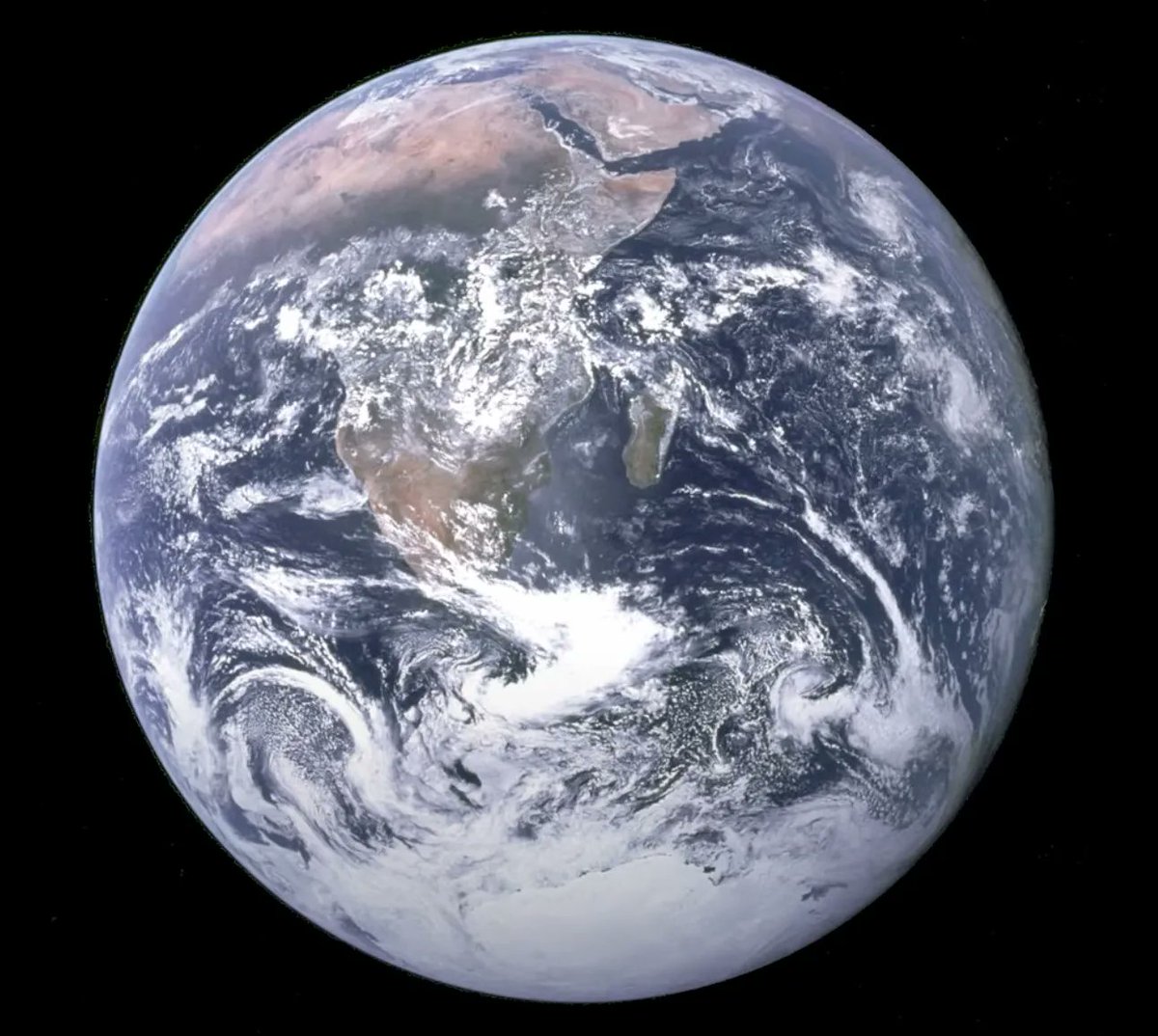
The “Blue Marble” was one of the most iconic pictures of the Apollo era. Taken by the astronauts of Apollo 17 on their return trip from the moon, the first fully illuminated image of the Earth taken by a person captured how the world looked on December 7th, 1972, just over 50 years ago. Now, a team from the Max Planck Institute for Meteorology has recreated that iconic image using a climate model.
As a new press release described, they didn’t do this for a publicity stunt. This effort has been a culmination of two decades worth of work on climate modeling that the team has been working on. Their climate model, which they ran with the help of researchers at the German Climate Computing Center, is now capable of drawing up details as fine as 1 km to accurately recreate environmental conditions at a given time.
To feed that model, though, they need data. Unfortunately, there wasn’t a whole lot available in terms of data that could be fed into the mode from 1972, let alone any data from the southern hemisphere, where the image was focused. So the researchers did their best to model what they could based on the data they had by using the equations that had already been developed and the Levante supercomputer at the German Climate Computing Center.
Video showing the new climate model in action – compared to the original image. Credit – Science Magazine YouTube Channel
The result was spectacularly similar to the actual image captured by the Apollo 17 astronauts. So much so that even the team was surprised by the fidelity, given the data limitations that went into the algorithm that fed the image.
However, the outcome of models isn’t always graphical, and for the sake of inspiration, the team wanted to take it a step further. So they enlisted the help of one of the world’s foremost graphics companies – nVIDIA.
They used a tool nVIDIA has developed called Omniverse to visualize the model’s output in a format similar to that captured by the Blue Marble Image. It also used a ray tracing technique commonly used in the other main use case for nVIDIA chips – video games, to make the image as lifelike as possible. And then, the model also introduces its other major advantage – it moves.
An Economist video on how to model climate change.Credit – The Economist YouTube Channel
The Blue Marble has always been a static image – a one-time snapshot of how the Earth looked on that day in 1972. But, if the model is correct (and it appears to be given its outcome on the day the picture was taken), it can be rewound or pushed forward to watch as the clouds, temperatures, and atmospheric makeup change both before and after the iconic picture.
Effectively, it’s like watching what the Apollo 17 astronauts would have seen if they had remained stationary and had a video camera set up to constantly monitor their homeworld. The effect is mesmerizing, but more importantly, it’s useful. Plenty of weather and climate phenomena can only be explored if we understand their input factors at the 1 km scale. That is the output of these climate models, and they can be helpful for more than just looking back into the past.
While this particular effort was a way to commemorate a great picture and the original founding of the Max Planck Institute of Meteorology, where many of the researchers work, it is, in essence, a test of a fully functional, high-resolution climate model. That will be ever more useful as we go forward into an uncertain changing climate, though its future outputs might be more disheartening than inspiring as this one was.
Meer van UFO'S of UAP'S, ASTRONOMIE, RUIMTEVAART, ARCHEOLOGIE, OUDHEIDKUNDE, SF-SNUFJES EN ANDERE ESOTERISCHE WETENSCHAPPEN - DE ALLERLAATSTE NIEUWTJES


 Scientists unlock secrets of 'burping’ supermassive black holes that are surrounded by mysterious radio bubbles by using West Virginia’s Green Bank Telescope

 What exactly IS Artemis doing? MailOnline's day-by-day guide...
 'Ghostly glow' in the solar system could be 'new addition'...