Ontdek de Fascinerende Wereld van UFO's en UAP's: Jouw Bron voor Onthullende Informatie!
Ben jij ook gefascineerd door het onbekende? Wil je meer weten over UFO's en UAP's, niet alleen in België, maar over de hele wereld? Dan ben je op de juiste plek!
België: Het Kloppend Hart van UFO-onderzoek
In België is BUFON (Belgisch UFO-Netwerk) dé autoriteit op het gebied van UFO-onderzoek. Voor betrouwbare en objectieve informatie over deze intrigerende fenomenen, bezoek je zeker onze Facebook-pagina en deze blog. Maar dat is nog niet alles! Ontdek ook het Belgisch UFO-meldpunt en Caelestia, twee organisaties die diepgaand onderzoek verrichten, al zijn ze soms kritisch of sceptisch.
Nederland: Een Schat aan Informatie
Voor onze Nederlandse buren is er de schitterende website www.ufowijzer.nl, beheerd door Paul Harmans. Deze site biedt een schat aan informatie en artikelen die je niet wilt missen!
Internationaal: MUFON - De Wereldwijde Autoriteit
Neem ook een kijkje bij MUFON (Mutual UFO Network Inc.), een gerenommeerde Amerikaanse UFO-vereniging met afdelingen in de VS en wereldwijd. MUFON is toegewijd aan de wetenschappelijke en analytische studie van het UFO-fenomeen, en hun maandelijkse tijdschrift, The MUFON UFO-Journal, is een must-read voor elke UFO-enthousiasteling. Bezoek hun website op www.mufon.com voor meer informatie.
Samenwerking en Toekomstvisie
Sinds 1 februari 2020 is Pieter niet alleen ex-president van BUFON, maar ook de voormalige nationale directeur van MUFON in Vlaanderen en Nederland. Dit creëert een sterke samenwerking met de Franse MUFON Reseau MUFON/EUROP, wat ons in staat stelt om nog meer waardevolle inzichten te delen.
Let op: Nepprofielen en Nieuwe Groeperingen
Pas op voor een nieuwe groepering die zich ook BUFON noemt, maar geen enkele connectie heeft met onze gevestigde organisatie. Hoewel zij de naam geregistreerd hebben, kunnen ze het rijke verleden en de expertise van onze groep niet evenaren. We wensen hen veel succes, maar we blijven de autoriteit in UFO-onderzoek!
Blijf Op De Hoogte!
Wil jij de laatste nieuwtjes over UFO's, ruimtevaart, archeologie, en meer? Volg ons dan en duik samen met ons in de fascinerende wereld van het onbekende! Sluit je aan bij de gemeenschap van nieuwsgierige geesten die net als jij verlangen naar antwoorden en avonturen in de sterren!
Heb je vragen of wil je meer weten? Aarzel dan niet om contact met ons op te nemen! Samen ontrafelen we het mysterie van de lucht en daarbuiten.
John Lennon Talks About a UFO over New York, Aug 23, 1974, Video, UFO Sighting News.
On August 23rd, 1974 John Lennon walked out on to the balcony of his New York apartment, and witnessed what he later described as a "Flying Saucer" hovering closely, just above his window. Lennon's girlfriend May Pang, also witnessed the event. Aliens do research, knowledge is the one of the most highly valued things for them, and many celebrities, singers, US presidents have had UFO sightings that they describe and were open to talk about on record.
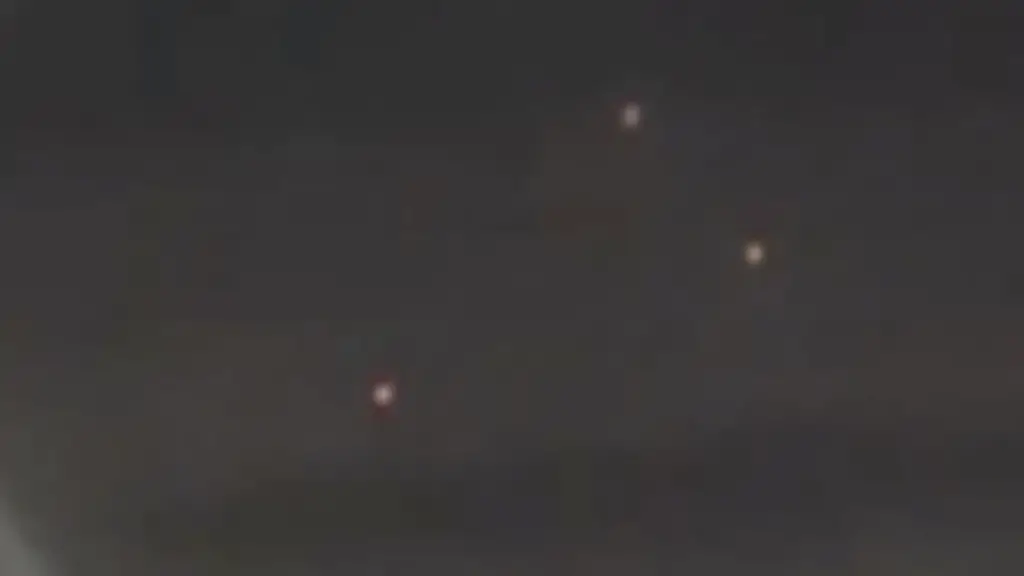
Triangle UFO formation over St Helens, UK 9-Dec-2022
Once again in the last weeks the triangle formation appeared. This time over St Helens, a town in Merseyside, England on 9th December 2022 at 6:06pm.
Witness report:
We saw these 3 orange bright lights moving in the sky in formation as if they was one thing sort of moving in sync, we got out of the car and they’d completely disappeared, we went around the corner to get a better shot and all of a sudden they was gone. I don’t have any explanation for this, I don’t think they are Chinese lanterns because we would of seen them drifting off – they where also stationary and then they moved a little bit in a way I’ve never seen before. Also, they didn’t seem to be flickering or anything like that, more of a light bulb type of light. If you download the Flightradar24 app you can use the playback feature, the video was recorded at 6:06pm today. There is a plane that appears at 6:07pm but it’s in the opposite direction and it’s around 10 miles away.
Apart from that I haven’t seen anything else. I didn’t see any of the usual green flashing lights or anything that you usually see on a passenger airline either so I don’t think this is a plane. this was an unidentified flying object that I seen in the sky. Okay it could’ve been lanterns (I don’t believe they are) but that’s besides the point, if all you guys are going to do is ridicule anyone who posts strange things in the sky (real or not) then we’re going to decrease our chances of getting real footage. Always better to be safe than sorry
SpaceX Ripping It Back Up, Artemis 1 Reentry, ISS Upgrades, Square Kilometre Array (SKA) underway
This has been a difficult week to squeeze down and it looks like that is only going to get more tricky over the next few weeks. It is busy right now. We’ve got very intriguing stuff to talk about at SpaceX’s Starbase. We now have SpaceX Ripping It Back Up. Yes, the 11 Raptor Engine Static Fire caused enough damage for SpaceX to rip that concrete base back out again with diggers this week. An expendable pad vs the reusable Starship now it seems. Artemis 1 is still going strong as it plummets back toward the atmosphere for reentry. Another incredible week of updates there. Action on the International Space Station as astronauts roll out for the iROSA rollout. We have OneWeb and SpaceX becoming more than frenemies! The mind-blowing Square Kilometre Array to be scanning the skies for an alien spaceport near you, and this is getting real exciting too. Let's jump into it.
Artemis 1 mission update - Earth return prep and benefits for humanity
Preparations are underway for the return of NASA's Artemis 1 Orion spacecraft. Also, learn about the benefits of returning to the moon with the Artemis program. Here's how NASA's Artemis 1 Orion spacecraft will splash down to end its moon mission in 8 not-so-easy steps:
Artemis 1 mission going 'phenomenally well' says NASA in exclusive interview
NASA's Nujoud Merancy, Chief of the Exploration Mission Planning Office at NASA’s Johnson Space Center, talks to Space.com's Elizabeth Howell about the ongoing Artemis 1 mission.
Iconic Earthrise By Artemis 1 // Rule-Breaking GRB // SpaceX Launches Starshield
Construction Begins on the Square Kilometer Array. Artemis I’s iconic crescent Earthrise picture. A gamma-ray burst that breaks all the rules. SpaceX launches a new service.
Damaged Concrete Under the Orbital Launch Mount Removed | SpaceX Boca Chica
Damaged concrete was removed from under the Orbital Launch Mount, crews worked on the Mega Bay extension, and work on the Orbital Launch Mount and Tower continued. Video from Nic (@NicAnsuini).
If Dark Matter is Made of Axions, This Could be the Detector That Finds Them
As we’ve noted in plenty of other articles, science also moves forward by constraints. Understanding the limits of a physical phenomenon helps to develop better methods of looking for it, especially in its absence. Dark matter is an archetype of a missing phenomenon, but there are plenty of potential explanations for it. One of them is known as the axion, which was originally developed as a hypothetical particle that could plug a hole in the Standard Model of particle physics but could also solve the problem of dark energy. That is if they actually exist. Now a new experiment from researchers at CERN can help the scientific community better define where to look for those axions.
Part of the problem with searching for axions is how widely varied their properties could potentially be. Both their strength of interaction with other particles and their mass, two of the most fundamental parts of any particle in the standard model, are up for debate at this point. And to cover that many possibilities, physicists must look all over the place for them.
They generally agree on one of the ways to do so, though – axions can turn into photons if they are subjected to a strong enough magnetic field. And photons can be detected. As such, most axion detectors consist of powerful magnets and photodetectors, and one of the most capable is the CERN Axion Solar Telescope (CAST) experiment.
UT video on that most elusive of all substances – dark matter
CAST is basically a giant metal tube with a very strong magnet known as a helioscope and various kinds of light detectors inside of it. It was initially designed to look at axions that could be coming from our own Sun. So far, it has failed to find any, but the scientists working on the experiment came up with a slight modification that allowed them to take a look at even more data.
Their modifications resulted in the magnet being capable of detecting axions that would have developed in the dark matter halo that surrounds the Milky Way. This is another possible source of axions, but one that other experiments hadn’t yet explored. The next experiment, dubbed an axion haloscope, or CAST-CAPP, started collecting data in September 2019.
Another UT video on how we’re searching for it.
Since it is unclear what frequency of photon axions would turn into at the magnetic field strengths provided by CAST-CAPP, the scientific team had to monitor a wide range of possible frequencies, which took almost two full years. The team also had to eliminate potential noise contamination, such as that from 5 GHz wireless signals.
Unfortunately, even after that, there were still no signs of axions. But, as stated at the beginning of the article, even a lack of evidence for something can help move science forward. Researchers can now definitively narrow down the maximum potential strength of an axion’s interaction with photons and tailor their experiments accordingly. CAST, in all its various forms, isn’t done with its mission yet.
Most Exoplanets Suffer Worse Space Weather Than We Do
We have it relatively easy on the Earth. Our Sun is relatively calm. The space weather environment in the solar system is altogether placid. Things are nice. But new research has shown that we may be the exception rather than the rule, and that many exoplanets face much harsher conditions than we do.
Stars are not simple things. They contain within their hearts cores of nuclear fusion powered by the gravitational weight of their own mass. This releases enormous amounts of energy which makes its way to the surface through radiation and giant convective plumes of material.
In addition to their complex interiors, stars are also spinning. The complex movement of all the plasma that makes up the bulk of a star’s mass triggers the formation of incredibly strong and tangled magnetic fields. Those magnetic fields in turn can dredge up material from the stellar surface and launch it into space.
The collective term for all the events that happen outside a star is called stellar weather or space weather. Space weather can take many forms. For example, it can just be the stellar wind, which is a steady drizzle of charged particles that constantly emanate from a star’s surface. It can also include the occasional flare, which happens when the tangled magnetic field lines around a star break. These flares release huge amounts of x-ray radiation. Sometimes those flares even pull up material from the stellar surface and launch it in this space in the form of a coronal mass ejection.
Astronomers around the world constantly monitor our own Sun for space weather. These solar-generated storms can affect orbiting satellites, crewed missions in space, and sometimes even overwhelm our own planet’s magnetic field and atmosphere, leading to dangerous consequences on the surface.
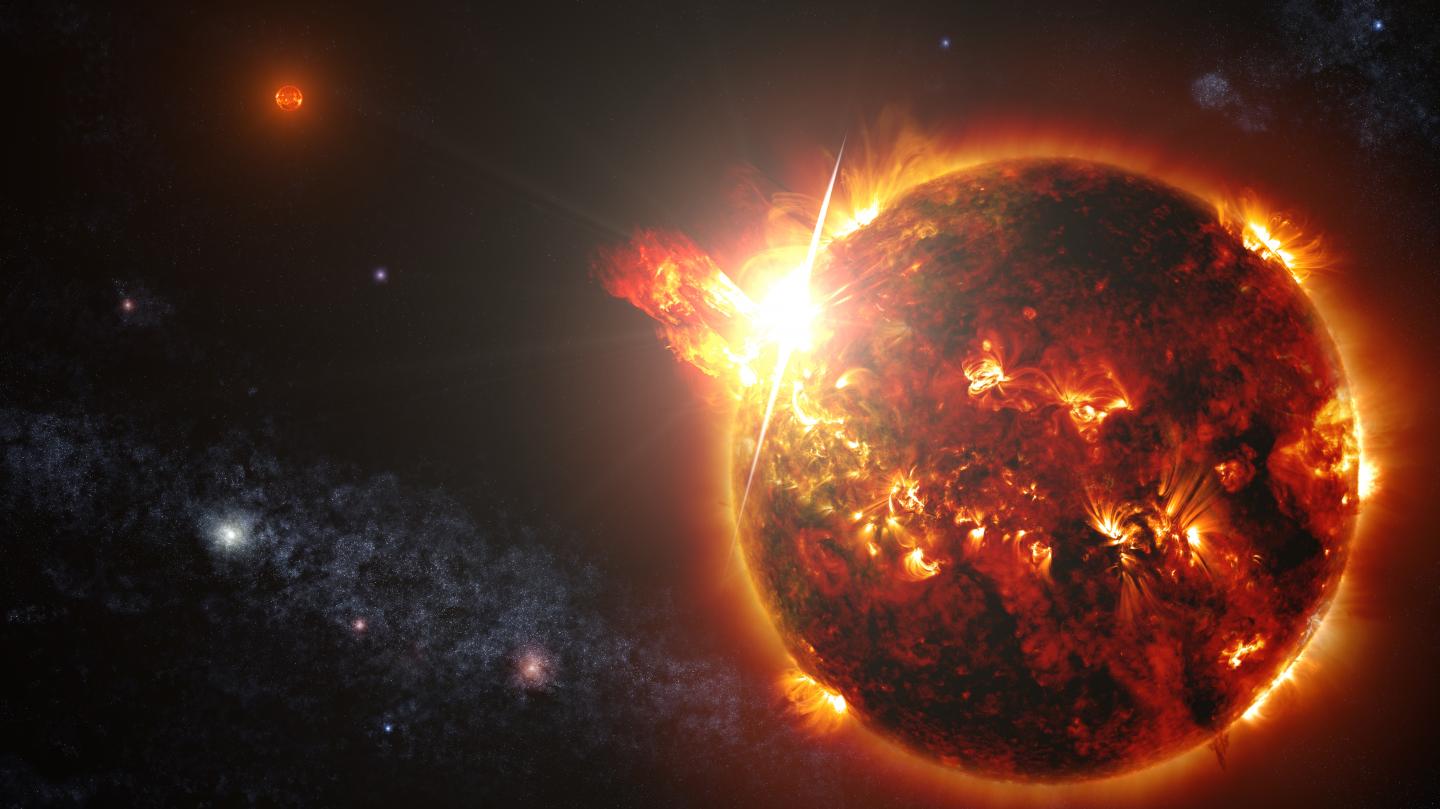
A new study surveying many different kinds of stars in many different stages of their life has shown that overall we have a pretty good. Our Sun is pretty mild with relatively infrequent outbursts. In contrast, the astronomers behind the study found that exoplanets typically suffer much more severe stellar weather than we do. Some of this is just due to random chance, because they happen to lay closer to their parent star than the Earth does around the Sun. And some of it has to do with the kind of star that they orbit. For example, small red dwarfs are much more turbulent and chaotic than our Sun, with some of them capable of suddenly increasing in brightness by over 50%.
In other cases it simply has to do with age. Young stars are much more temperamental than older ones. Planets around younger stars experience much more extreme space weather events then those around more mature systems.
All told, it seems that we should simply count ourselves lucky.
A new 3D map of the Milky Way Uses close to 66,000 Stars and Reveals New Details About the Shape of our Galaxy
In the 17th century, Galileo Galilee aimed his telescope at the stars and demonstrated (for the first time) that the Milky Way was not a nebulous band but a collection of distant stars. This led to the discovery that our Sun was merely one of the countless stars in a much larger structure: the Milky Way Galaxy. By the 18th century, William Herschel became the first astronomer to create a map that attempted to capture the shape of the Milky Way. Even after all that time and discovery, astronomers are still plagued by the problem of perspective.
While we have been able to characterize galaxies we see across the cosmos with relative ease, it is difficult for astronomers to study the size, shape, and population of the Milky Way because of how our Solar System is embedded in its disk. Luckily, there are methods to circumvent this problem of perspective, which have provided astronomers with clues to these questions. In a recent paper, a team from the Astronomical Observatory at the University of Warsaw (AstroUW) used a large collection of variable stars to trace the shape of the Milky Way, which yielded some interesting results!
Patryk Iwanek, an astronomer with AstroUW, led the study team. The paper that describes their findings, titled “A three-dimensional map of the Milky Way using 66,000 Mira variable stars,” recently appeared online. For the sake of their study, the team examined data on 65,981 stars observed by the Optical Gravitational Lensing Experiment (OGLE), a long-term sky survey of variable stars based at the University of Warsaw. Since 1992, OGLE has monitored the brightness of about two billion stars in the Milky Way and the Magellanic Clouds, providing insight into a wide range of astronomical phenomena.
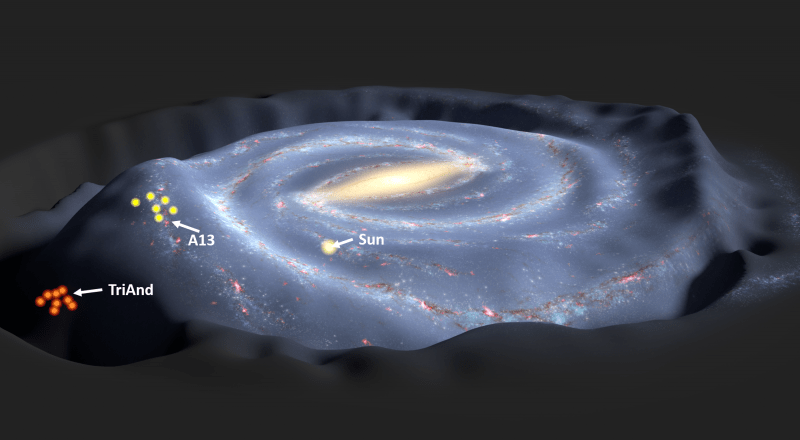
The shape of the Milky Way galaxy is perturbed by tidal interactions with a dwarf galaxy, as predicted by N-body simulations. Credit: T. Mueller/C. Laporte/NASA/JPL-Caletch
The OGLE project, also known as the Optical Gravitational Lensing Experiment, is one of the largest-scale sky surveys worldwide. It is a long-term sky survey that monitors the brightness of about two billion stars in the Milky Way and the Magellanic Clouds. During its long history, the OGLE survey has provided significant contributions to the study of a wide range of astronomical phenomena, including gravitational lensing and microlensing, extrasolar planets, variable stars, cosmic distance scale, and the structure and evolution of the Milky Way and Magellanic Clouds.
As stars approach the end of their main sequence phase, they exhaust their supply of hydrogen fuel and begin consuming helium. This causes them to expand to several times the original size and to become dimmer and cooler than main sequence stars – hence the term Red Giants. Mira variables are a special class of pulsating red giants that have long periods ranging from 80 to more than 1000 days. They are part of the Asymptotic Giant Branch (AGB) of the Hertzsprung–Russell Diagram, which includes all stars with less than 5-8 solar masses.
Their dramatic changes in brightness (like other variable stars) make them very useful to astronomers for measuring distances and the spatial distribution of stars in galaxies. As Iwanek explained Universe Today via email:
“These stars follow a well-defined period-luminosity relation, which means that [by] knowing their pulsation periods, it is possible to calculate their absolute magnitudes and then determine their distances. This feature makes Miras an excellent cosmic distance indicator. Using their precisely measured distances, it is possible to study the three-dimensional distribution of stars in our galaxy.
“Moreover, the high luminosity of Miras, which is orders of magnitude greater than that of the Sun, makes it possible to observe these stars not only in the Milky Way but also in other nearby galaxies (e.g., M31 or the Magellanic Clouds). Studying the Mira variables may help to understand the structure and evolution of galaxies.”
This enhanced image shows the X-shaped distribution around the bulgebased on data from the NASA space telescope WISE. Credit: NASA/JPL-Caltech/D. Lang
For their study, the team used 65,981 stars mapped by OGLE that fall into the category of Mira variables. They also considered the distance uncertainties by implementing the Bayesian Hierarchical Method (BHM), a statistical model where inferences are made about stellar populations based on smaller samples. From this, they were able to create a detailed 3D map of our galaxy composed of young and intermediate-age stellar populations. Their analysis provides (for the first time) independent evidence of an X-shaped bulge component and a flared disk.
“Based on the sample of 66,000 Mira variables, we measured and confirmed the angle of the Galactic bar (equal to ~20° to the Sun-Galactic center line-of-sight),” said Iwanek. “But more importantly, we showed that a [X-shaped] structure in the center of the Galaxy exists. The X-shape is an additional structure in the dense, central part of the Milky Way, the Galactic bulge, formed by two overlapping groups of stars. This structure is thought to be caused by the movements and interactions of stars within the bulge. It could be a common feature of barred spiral galaxies (similar to our Milky Way).”
This study builds on previous work conducted by astronomers from the University of Warsaw, Ohio State University (OSU), and the University of Warwick (of which Iwanek was a co-author). For this study (released in 2019), Iwanek and his colleagues used data on Cepheid variable stars to create a 3D map of the Milky Way. This map revealed the structure of the Milky Way and allowed the team to constrain the warped nature of the Milky Way’s disk.
The 3D map of the Milky Way from this latest study offers new clues about the structure of the Galactic Bulge, which could also help astronomers understand the structure of other barred spiral galaxies. As Iwanek emphasized, all 66,000 Miras variables were selected and classified from the OGLE survey “by hand.” In other words, the light curve of every star was examined by an experienced astronomer to determine if they were variable and what type they were. This, said Iwanek, presents opportunities for future surveys that rely on machine learning:
“Our huge collection of Mira variables, thanks to its purity and completeness, as well as the accurate and long-term OGLE light curves, can be used to train the machine learning algorithms for the automatic classification of variable stars in future sky surveys conducted with larger telescopes.”
Mile High Towers On Moon In Artimis Mission Photo. Video, UFO Sighting News.
Guys I found this last night and though I better make a video of it. Its just really amazing to find one tower that 1-2km tall, but to find two side by side is beyond rare. Aliens love the shadow areas of craters to hide from micrometeorites, with the wall offering some protection for ships and buildings.
It's important to understand, that alien structures wont conform to what humans think they should be, but instead are what they are, and we need to respect the differences in cultural ways that they clearly have. Or in other words, we need to think outside the box if we the public are going to succeed at revealing the truth. Rather than be confined to NASAs tight lipped, scientific discoveries being drop fed to us, and us thrilled by it. Take a stand and begin searching photos with us. We will bring the truth, and we will win this fight. Disclosure will happen because of us uniting in our efforts.
Sun Shoots Out Solar Storm Today! 100X Earths Size, Video, UFO Sighting News.
I made a video of the event so you can see it in real time. The object still has not passed out of sight, meaning, Earth could still be in danger, so give it 1-5 hours and well, we will know then. This material spit out from the sun is over 100X the size of Earth.
See those tiniest little white specks? Thats how big Earth is. Earth is so small the scale in the upper right corner now shows no earth, because its so small. So..lets just wait and see if NASA talks about this, or...if we are toast. Either way, its going to be an interesting day.
Giant Solar Storm Just Misses Earth, But Could Have Turned Us Into The Next Mars Had It Hit, UFO Sighting News
Source: NASA Date of photo: December 8, 2022 21:42
Guys, this is nuts, but there is something that just shot out of Earths sun on the NASA SOHO LASCO C3 viewer that shows a huge solar mass shooting outward. Its already traveled a huge distance in just a short time. Totally must have caught NASA off guard, lucky for us Earth is clearly not in the way of the storm. How do I know, well the atmosphere would be torn off our planet whiping all the air, gasses into space, leaving us nothing. All water would instantly turn to gas and be swept into space, life would not be here and you would not be reading this right now. Thats how I know. Basically, what Mars is today, is what that solar storm would turn Earth into if it had hit us.
So...I guess this is your lucky day. That storm is between 50X earths wide and up to 100X wide. It's like the universe is playing Russian Roulette, and we were invited.
You are not going to hear about NASA talking about this anytime soon. NASA makes it a policy to not make the public panic in any way.
Meer van UFO'S of UAP'S, ASTRONOMIE, RUIMTEVAART, ARCHEOLOGIE, OUDHEIDKUNDE, SF-SNUFJES EN ANDERE ESOTERISCHE WETENSCHAPPEN - DE ALLERLAATSTE NIEUWTJES


 John Lennon Talks About a UFO over New York, Aug 23, 1974, Video, UFO Sighting News.