Ontdek de Fascinerende Wereld van UFO's en UAP's: Jouw Bron voor Onthullende Informatie!
Ben jij ook gefascineerd door het onbekende? Wil je meer weten over UFO's en UAP's, niet alleen in België, maar over de hele wereld? Dan ben je op de juiste plek!
België: Het Kloppend Hart van UFO-onderzoek
In België is BUFON (Belgisch UFO-Netwerk) dé autoriteit op het gebied van UFO-onderzoek. Voor betrouwbare en objectieve informatie over deze intrigerende fenomenen, bezoek je zeker onze Facebook-pagina en deze blog. Maar dat is nog niet alles! Ontdek ook het Belgisch UFO-meldpunt en Caelestia, twee organisaties die diepgaand onderzoek verrichten, al zijn ze soms kritisch of sceptisch.
Nederland: Een Schat aan Informatie
Voor onze Nederlandse buren is er de schitterende website www.ufowijzer.nl, beheerd door Paul Harmans. Deze site biedt een schat aan informatie en artikelen die je niet wilt missen!
Internationaal: MUFON - De Wereldwijde Autoriteit
Neem ook een kijkje bij MUFON (Mutual UFO Network Inc.), een gerenommeerde Amerikaanse UFO-vereniging met afdelingen in de VS en wereldwijd. MUFON is toegewijd aan de wetenschappelijke en analytische studie van het UFO-fenomeen, en hun maandelijkse tijdschrift, The MUFON UFO-Journal, is een must-read voor elke UFO-enthousiasteling. Bezoek hun website op www.mufon.com voor meer informatie.
Samenwerking en Toekomstvisie
Sinds 1 februari 2020 is Pieter niet alleen ex-president van BUFON, maar ook de voormalige nationale directeur van MUFON in Vlaanderen en Nederland. Dit creëert een sterke samenwerking met de Franse MUFON Reseau MUFON/EUROP, wat ons in staat stelt om nog meer waardevolle inzichten te delen.
Let op: Nepprofielen en Nieuwe Groeperingen
Pas op voor een nieuwe groepering die zich ook BUFON noemt, maar geen enkele connectie heeft met onze gevestigde organisatie. Hoewel zij de naam geregistreerd hebben, kunnen ze het rijke verleden en de expertise van onze groep niet evenaren. We wensen hen veel succes, maar we blijven de autoriteit in UFO-onderzoek!
Blijf Op De Hoogte!
Wil jij de laatste nieuwtjes over UFO's, ruimtevaart, archeologie, en meer? Volg ons dan en duik samen met ons in de fascinerende wereld van het onbekende! Sluit je aan bij de gemeenschap van nieuwsgierige geesten die net als jij verlangen naar antwoorden en avonturen in de sterren!
Heb je vragen of wil je meer weten? Aarzel dan niet om contact met ons op te nemen! Samen ontrafelen we het mysterie van de lucht en daarbuiten.
All stars are composed of mostly hydrogen and helium, but most stars also have measurable amounts of heavier elements, which astronomers lump into the category of “metals.” Our Sun has more metals than most stars because the nebula from which it formed was the remnant debris of earlier stars. These were in turn children of even earlier stars, and so on. Generally, each new generation of stars has a bit more metal than the last. The very first stars, those born from the primordial hydrogen and helium of the cosmos, had almost no metal in them. We’ve never seen one of these primordial stars, but with the power of the Webb and a bit of luck, we might catch a glimpse of them soon.
One way to determine the amount of metal a star has is by comparing the ratio of iron in its atmosphere compared to helium, known as [Fe/He]. This metallicity number is usually expressed on a logarithmic scale, where the Sun’s metallicity is set to zero. Stars are then set into populations based on this number. Any star with a metallicity of at least -1 (meaning it has at least 10% of that of the Sun) is a Population I star. Stars with lower metallicity are Population II stars, and the very first stars with no observable metals would be Population III stars.
In the Milky Way, Population I stars are typically found within the galactic plane and spiral arms, while Population II stars are mostly in a more diffuse halo of stars surrounding the galaxy. This makes sense, since stars form within the gas and dust of spiral arms, and can drift away from the galactic plane as they age. Other than the fact that Population II stars are usually billions of years older than the Sun, they are broadly similar to younger stars.
The first generation of stars is thought to have been very different. The more metal a star has the more dense it can be. A star such as the Sun is more compact than a Population III star, and therefore doesn’t need as much mass to shine so brightly. Since the first stars were made only of hydrogen and helium, we think they were massive stars that lived short but very luminous lives. They likely formed during the first few hundred million years of the universe, and died within a few tens of million years or less. The only way we can see their light is by peering into the deepest reaches of space. Even the brightest galaxy of Population III stars would be very dim as seen from Earth. But are they too dim for the almighty Webb to observe?
A Population III star compared to our Sun. Credit: STScI
That’s the question this recent study tried to answer. The team simulated both the intensity and spectrum of first-generation stars to determine how they might appear within an early galaxy, then compared this to the capability of the Webb Space Telescope. They found that if Webb had a direct, unobstructed view of a bright primordial galaxy, it would still be too dim for Webb to see. But if a particularly large primordial galaxy happens to be located behind a large closer galaxy, gravitational lensing could magnify and brighten the distant galaxy’s light to a point where Webb could detect it.
In other words, we are on the frustrating edge of being able to detect first-generation stars. If things are lined up just so, and we can separate the spectra of the first-generation galaxy from the closer galaxy, then we have a chance. That may sound disappointing, but astronomers are skilled and clever, so there’s reason to hope that in time we will see light from the grandmothers of all stars
Extraterrestrial Genetic Engineering of two human genotypes began 400,000 years ago
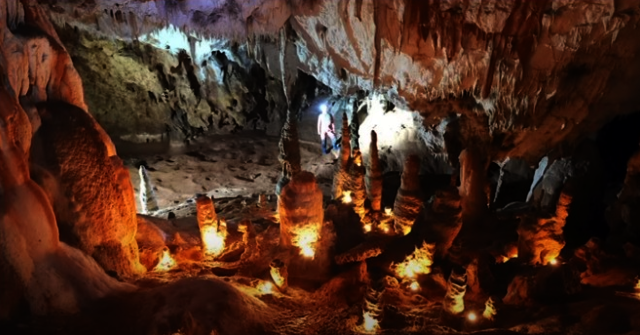
Peter Moon discusses a recent trip to Romania where he conducted research related to the Translyvania Rising book series. In the first part of the interview he focuses on what was discovered at a Cioclovina Cave, which he states has clear evidence of being a powerful time reactor. He believes the cave takes special significance during the 20 year planetary biorythm associated with the Montauk Project, which next occurs on 2023.
In the latter portion of the interview, Moon focuses on Book VI of the series: Forgotten Genesis where humanity's genetic origins is revealed. Moon covers how holographic records are accessed by the series protagonist Radu Cinamar who is helped in understanding humanity's origins by beings associated with an underground civilization called Apellos.
Moon elaborates on Cinamar's information about two human genotypes being created from which Sirians could incarnate on Earth, and a worker race would serve them.
The first genotype called E N L would possess more extraterrestrial genetics and thereby have greater psychic and mental abilities. In contrast, the second genotype, E N K would be more robust and better suited for living in Earth conditions. Moon discusses the Sirian geneticist Tenekau (aka Enki) responsible for creating the two human genotypes, which could be mixed to create a long lived hybrid species as discussed in ancient texts such as the King's List and Manetho's history of Egypt.
This day in UFO history: Travis Walton was abducted by aliens
Travis Walton was abducted on 5th November 1975 and was missing for 5 days. So on these days, 47 years ago, he was on alien’s spaceship.
On November 5, 1975, Travis Walton was supposed to be working his usual shift in Apache-Sitgreaves National Forest in Arizona. Little did he know that he would suddenly experience something that he’ll never forget.
After a long day of work, Travis and his six crew members were on their way home when they suddenly noticed a mysterious glow in the trees. As they continued driving, they eventually saw that the light was coming from a structure.
After seeing an object that he initially thought was a UFO, Travis decided to approach it as it was still hovering in the clearing. However, moments after he made his approach, he was suddenly struck by a bright bluish-green light. He was sent flying backward by the beam of light.
Witnesses claimed that a massive beam of light appeared in the sky and completely lit up the forest. It was compared to a bolt of lightning and a flame.
The crew’s manager, Mike Rogers, immediately left the area as the other members of the group were still stunned by what they saw. The other crew members then went back to the area to try and help Travis. However, they were surprised to see that he was still missing.
After looking for several minutes, the crew could not find Travis. They then contacted the local sheriff. They told him that a flying saucer carried their friend Travis. To prove their case, the sheriff and Mike Rogers, a UFO expert, conducted a search of the area.
The six of his coworkers were then accused of murder. Even though there were no other explanations as to what happened to Travis, Mike Rogers and the others stuck to their story. They claimed that they saw a UFO shoot a beam at Travis before it disappeared.
The exact details of what happened after Travis was hit by the flying saucer remain unclear. However, through a hypnosis session conducted by Dr. James Harder in the 1970s, the rest of the story was revealed. During the session, which was attended by several doctors and psychiatrists, Harder discussed the case with Travis and his psychiatrist. According to Harder, the evidence presented in the case is as valid as it would be in an American court.
According to Travis, he blacked out after he was hit by the beam of light. He claims that he felt a “numbing shock.” The next thing that he could remember was waking up in an oddly shaped room. He said that as he opened his eyes, he saw three creatures standing over him.
According to Walton, he was held down by a device that was placed over his chest. He then tried to scare the creatures by waving an object around. He claims that the creatures were about four to five feet tall and had enlarged heads.
Travis described the alleged beings as having large brown eyes and wearing orange jumpsuits. They were similar to the descriptions given by other witnesses.
After the creatures left, Travis wandered around the room. He soon found himself inside a room that looked like a planetarium. Two more beings then approached him and took him to another location. He believes that he was transported from the scout ship he was in. He recalls these beings putting a mask over his face, which caused him to black out. However, beyond that, he has no recollection of what happened to him.
Initially, the case of Travis Walton was regarded as a missing person. For several days, the authorities in Arizona conducted a search for him using helicopters and scent dogs. The search, which was the most extensive in the state’s history, ended when Walton was found.
On November 10, 1975, Travis was found lying on the side of the road. He said that he woke up to realize that a metallic mirror-like object was flying above him. He immediately ran to get help. He then called his family after he found a phone booth in Heber, Arizona.
The phone booth Travis used to call for help
Upon being found, Travis was taken to a hospital, where he was diagnosed with a wound on his right arm. He also lost a significant amount of weight. Five of the six witnesses who were interviewed during the investigation passed their polygraph tests. One of the witnesses, Alan Dalis, refused to participate in the test after he argued with Travis the morning of the incident.
Medical records indicated that no drugs were found in his system, and he passed a lie detector test. Travis eventually came back with faint memories of being visited by aliens and being accidentally shown a star system from the cockpit of the spaceship. He believes that the beam hit him in the chest and head, and it killed him. He also believes that he was transported to the spaceship to be revived.
It has been widely believed that if Travis had been lost or hiding in the forest, he would have probably died at night. Temperatures at that time reached around 8 degrees Fahrenheit.
Chapter 1 - 0:12 - Glowing Orbs in the Gulf of Mexico?
Chapter 2 - 05:10 - Pyramid-Shaped UFOs over the Pacific Ocean
Chapter 3 - 10:08 - Two Silver Spinning Discs across Montana Sky
Chapter 4 - 15:45 - Unknown Aircraft Flying Over Nevada Test Site
Chapter 5 - 21:15 - Unidentified Submerged Object Spotted by USS Omaha
Chapter 6 - 26:37 - Large Bright Beam in Mongolian Sky
Watch all new episodes of The Proof Is Out There on Fridays at 10/9c, and stay up to date on all of your favorite The HISTORY Channel shows at http://history.com/schedule.
Mysterious Satellite Captured on Camera: The UnXplained (Season 3)
While constructing the international space station, astronauts capture a strange object on camera, which raises suspicions around the world. See more in this clip from Season 3, "The Search For Extraterrestrial Life."
Monstrous "Moth Man" Terrifies West Virginia Town | Ancient Aliens
A young couple encounters a large winged creature that soon ignites terror in a small town, see more in this clip from Season 1, "Aliens and Strange Creatures."
Ancient Aliens: SECRET UNDERWATER ALIEN BASE FOUND (Season 6) | History
Documented eyewitness accounts of strange UFO activity at the Solomon Islands has led to a theory that an underwater alien base is present, in this clip from Season 6, "Aliens and Forbidden Islands."
UFO SPOTTED IN NORWAY *Real Footage* | The Proof Is Out There
After ruling out several ideas, these mysterious lights above Norway have investigators stumped, in this scene from Season 3, Episode 1 of The Proof Is Out There.
TOP 5 UFO SIGHTINGS | The Proof is Out There
These 5 UFO sightings are so out of the ordinary that it's difficult to make sense of them. Check them out in this The Proof Is Out There compilation.
Pilot Shares Videos Of Strange UFO Sightings In Skies Over The US
Pilot Shares Videos Of Strange UFO Sightings In Skies Over The US
Top 10 Creepiest Things Caught on Underwater Cameras
These underwater shots will freak you out! For this list, we’ll be looking at the eeriest and most unsettling visuals that have been recorded in oceans and lakes. Our countdown includes Mystery Creature, Train Graveyard, A Human Skeleton, and more! Which of these creeps you out the most? Let us know in the comments below!
The Pyramid of Djedefre at Abu Rawash: The pyramid of Djedefre is a pyramid built as a burial for the pharaoh Djedefre, in Abu Rawash, 8 kilometers from Giza ( Egypt ), in the 26th century BC.
It the most northerly pyramid in Egypt, and it has been in ruins since ancient times. Other pharaohs of the Fourth Dynasty began the construction of Djedefre but remained unfinished.
It is believed that the pharaoh chose this hill and set his tomb there to be closer to Ra, god of the Sun.
But there is more, because until the end of the 20th century archaeologists did not know if the pyramid was finished or had been unfinished.
In the first case, the top of the pyramid would have been the highest in Egypt (220 meters above sea level, between 8 and 20 meters above the original top of the Great Pyramid of Khufu) and its current state would be fruit of the destruction and reuse of the stones for later constructions from Roman times onwards.
This seems to be the most likely scenario, as the latest excavations found that the funerary complex around the monument was completed and was active until long after the pharaoh’s death, which would not make sense if the pyramid had never been completed.
What is known for sure is that its construction began around the year 2580 BC by order of Pharaoh Djedefre, son and successor of Khufu.
The pyramid is on a hill overlooking the Giza plateau (hence its altitude could have been higher than that of the Great Pyramid, despite its smaller size similar to that of Menkaure).
The reasons why this place was chosen as well as those for the reduction of the size of the building are unknown, although some researchers point to theological reasons, since Djedefre was the first pharaoh to bear the title of son of Ra.
It was first explored in 1840 by John Shae Perring (who between 1837 and 1842 excavated Giza using gunpowder), who would be followed by other researchers such as Flinders Petrie and Émile Gaston Chassinat.
The most extensive excavation of the complex began in 1995 by a Franco-Swiss team led by Michel Valloggia.
The original length of its base was 106.2 meters, which at a 52-degree angle of inclination (similar to the Pyramid of Khufu) would have given the structure a height of 67 meters.
To save material, time and labor, the hill was used, which made up 44 percent of the total volume of the pyramid.
It is significant that the burial chamber is not inside the pyramid as it used to be, but below it, at a depth of 21 meters, and in its lower part it has depressions that indicate that it housed a sarcophagus and a canopic chest, just like the Pyramid of Khafre.
In inscriptions found in the pit the name of the pyramid appeared, which translates as Djedefre covered with stars or as Djedefre belongs to the firmament.
Émile Chassinat, during his excavations between 1901 and 1924, found numerous fragments of statues of Pharaoh Djedefre (including four heads) and of members of his family, his sons Baka, Hernet, Setka, Neferhetepes and Queen Hetepheres II.
Most of these fragments are kept today in the Louvre, the Museum of Egyptian Art in Munich, and the Cairo Museum.
Original measurements of the Pyramid of Djedefre
Remains of the pyramid of Djedefre
Ramp down to the burial chamber, pyramid of Djedefre
Astronomers are captivated by brightest flash ever seen
by Issam AHMED
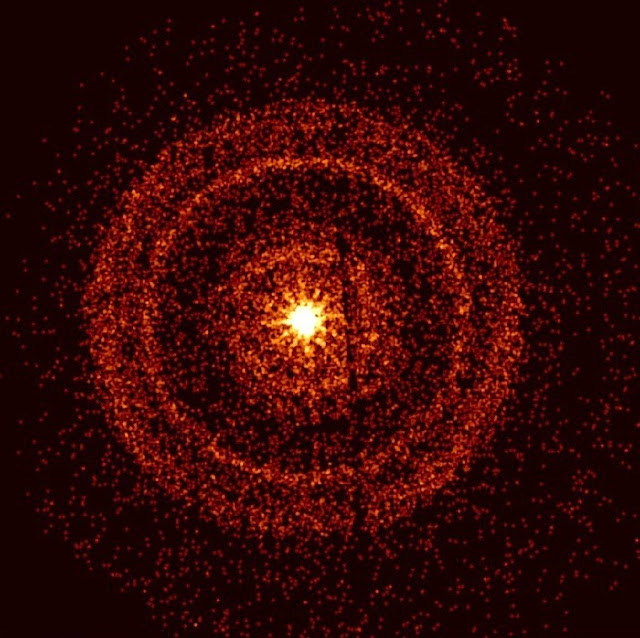
This picture provided by NASA on October 14, 2022 shows the Swift’s X-Ray Telescope capturing the afterglow of GRB 221009A about an hour after it was first detected.
Astronomers have observed the brightest flash of light ever seen, from an event that occurred 2.4 billion light years from Earth and was likely triggered by the formation of a black hole.
The burst of gamma-rays—the most intense form of electromagnetic radiation—was first detected by orbiting telescopes on October 9, and its afterglow is still being watched by scientists across the world.
Astrophysicist Brendan O'Connor told AFP that gamma-ray bursts that last hundreds of seconds, as occurred on Sunday, are thought to be caused by dying massive stars, greater than 30 times bigger than our Sun.
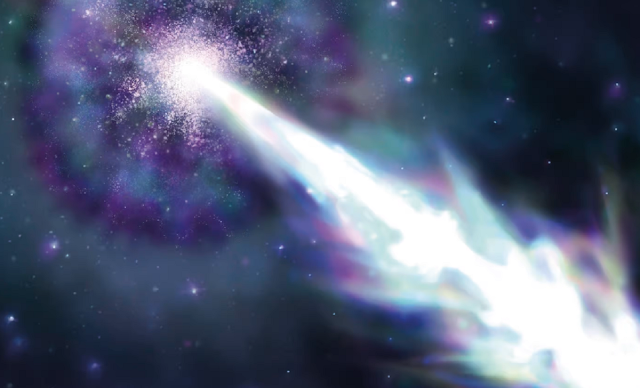
The star explodes in a supernova, collapses into a black hole, then matter forms in a disk around the black hole, falls inside, and is spewed out in a jet of energy that travels at 99.99 percent the speed of light.
The flash released photons carrying a record 18 teraelectronvolts of energy—that's 18 with 12 zeros behind it—and it has impacted long wave radio communications in Earth's ionosphere.
"It's really breaking records, both in the amount of photons, and the energy of the photons that are reaching us," said O'Connor, who used infrared instruments on the Gemini South telescope in Chile to take fresh observations early Friday.
"Something this bright, this nearby, is really a once-in-a-century event," he added.
Gamma-ray research first began in the 1960s when US satellites designed to detect whether the Soviet Union was detonating bombs in space ending up finding such bursts originating from outside the Milky Way.
"Gamma-ray bursts in general release the same amount of energy that our Sun produces over its entire lifetime in the span of a few seconds—and this event is the brightest gamma ray burst," said O'Connor.
This gamma-ray burst, known as GRB 221009A, was first spotted by telescopes including NASA's Fermi Gamma-ray Space Telescope, Neil Gehrels Swift Observatory, and Wind spacecraft on Sunday morning Eastern time.
This picture provided by Noirlab on October 14, 2022 shows record-breaking Gamma-Ray bursting caught with Gemini South in Chile.
1.9 billion-year-old movie
It originated from the direction of the constellation Sagitta, and traveled an estimated 1.9 billion years to reach Earth—less than the current dis$$tance of its starting point, because the universe is expanding.
Observing the event now is like watching a 1.9 billion-year-old recording of those events unfold before us, giving astronomers a rare opportunity to glean new insights into things like black hole formation.
"That's what makes this sort of science so addictive—you get this adrenaline rush when these things happen," said O'Connor, who is affiliated with the University of Maryland and George Washington University.
Over the coming weeks, he and others will continue watching for the signatures of supernovas at optical and infrared wavelengths, to confirm that their hypothesis about the origins of the flash are correct, and that the event conforms to known physics.
Unfortunately, while the initial burst may have been visible to amateur astronomers, it has since faded out of their view.
Supernova explosions are also predicted to be responsible for producing heavy elements—such as gold, platinum, uranium—and astronomers will also be on the hunt for their signatures.
Astrophysicists have written in the past that the sheer power of gamma-ray bursts could cause extinction level events here on Earth.
But O'Connor pointed out that because the jets of energy are very tightly focused, and aren't likely to arise in our galaxy, this scenario is not something we should worry much about.
A group of astronomers has become star-struck at the brightest flash of light that has ever been seen, probably caused by a black hole forming.
On October 9, astronomers’ telescopes detected what is now considered to be the brightest flash of light ever observed.
The Swift’s X-Ray Telescope captured the afterglow of GRB 221009A an hour after it was first detected. NASA published the image.
Researchers say that the flash of light lasted for hundreds of seconds and was a burst of gamma rays likely caused by a collapsing star that transformed into a black hole. Notably, when a star explodes in a supernova, it can collapse into a black hole, and the leftover matter from the explosion then forms an accretion disk around the black hole. This matter eventually falls inside of the black hole and causes a large jet of energy to be shot out at speeds close to the speed of light. Some instances of this gamma-ray jet have reached 99.99% the speed of light.
Furthermore, the flash of light released photons that carried a record 18 teraelectronvolts of energy, which is 18 with 12 zeros behind it. Such power was even felt on Earth, with reports indicating that long-wave radio communications in Earth’s ionosphere have been impacted by the flash. Astrophysicist Brendan O’Connor recently spoke to AFP and explained that he took observations of the event last Friday and found that the event itself occurred 2.4 billion light years away from Earth.
“It’s really breaking records, both in the amount of photons, and the energy of the photons that are reaching us. Something this bright, this nearby, is really a once-in-a-century event.
Gamma-ray bursts in general release the same amount of energy that our Sun produces over its entire lifetime in the span of a few seconds-and this event is the brightest gamma ray burst,” said O’Connor.
For more information on this story, check out this link here.
Nikola Tesla's Terrifying Invention Has Just Been Revealed In Old Documents Nov 2022
We idolize our tech heroes in this era of technological obsession. The leaders of the technology sector are treated like rock stars, and their announcements of cutting-edge technology are heard by billions of people worldwide. The Serbian inventor Nikola Tesla, who held nearly 300 patents and was in charge of such ground-breaking technology as the alternating current, was one of the first tech icons.
Nikola Tesla, a Serbian-American engineer and physicist made numerous advances in the generation, transmission, and use of electric power. He invented the first alternating current motor and pioneered the development of AC generation and transmission technology.
Despite his notoriety and respect, he never succeeded in turning his innumerable inventions into long- term financial success, unlike Thomas Edison, his main rival and former employer. In this video, we’ll tell you about Nikola Tesla’s last message and his prediction to future generations revealed in old documents.
Ever since astronomers first detected ultra high energy neutrinos coming from random directions in space, they have not been able to figure out what generates them. But a new hypothesis suggests an unlikely source: the mergers of black holes.
Neutrinos are extremely ghostly particles. The carry no electric charge and they interact only rarely with normal matter through the weak nuclear force. Trillions of neutrinos pass through every square centimeter of your body every single second. So it takes truly enormous observatories to capture them. The largest of all is the IceCube Neutrino Observatory, which is a series of detectors sunk into the Antarctic ice sheet at the South Pole. Occasionally a neutrino will strike a molecule of water ice and lead to a flash of light that the observatory can detect.
While IceCube has seen countless events over the years, a few stand out. Some neutrinos are exceedingly energetic – so energetic that it’s difficult to come up with plausible scenarios that could generate them.
At the other end of the spectrum, perhaps the most powerful objects in the universe are black holes. Their intense gravity can tear apart stars and even power the formation of jets that can blast tens of thousands of light years into space.
So new research suggests that black holes may be responsible for the highest energy neutrinos. However, this can’t work with black holes in isolation Instead the black holes must be surrounded by an electrically charged plasma. That plasma will swirl around the black hole forming an accretion disk. Incredibly strong magnetic and electric fields in the accretion disk can wind their way around the black hole and send material flowing outwards in the form of a jet.
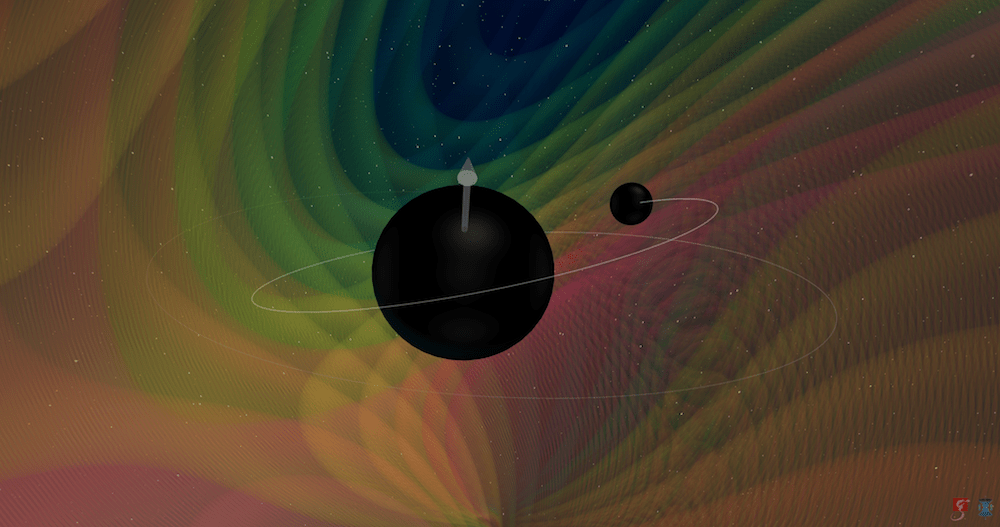
When two black holes merge this changes the direction of the jet, and occasionally the jets can get a boost from the gravitational energy released by the merger.
The authors of the new study suggests that if conditions are just right, the enhancement of the jet during a merger can power insanely high energetic neutrinos.
To match the observed numbers of high-energy neutrinos that IceCube has detected, the authors suggest that these black holes don’t have to merge all that often. If the neutrinos are powered by mergers of supermassive black holes, then they only need to collide between every 100,000 and 10 million years in every cubic gigaparsec of volume. If instead the neutrinos are powered by stellar mass black hole mergers, then they only need to happen 10 to 100 times every year in every cubic gigaparsec of volume.
These are promising numbers because the results sit within the expected range of merger rates of both stellar mass black holes and supermassive black holes. So as mechanisms go, it’s plausible. Only more observations will be able to tell, and hopefully astronomers will be able to pinpoint a source of these extremely energetic exotic particles.
Meer van UFO'S of UAP'S, ASTRONOMIE, RUIMTEVAART, ARCHEOLOGIE, OUDHEIDKUNDE, SF-SNUFJES EN ANDERE ESOTERISCHE WETENSCHAPPEN - DE ALLERLAATSTE NIEUWTJES


 Can JWST see Galaxies Made of Primordial Stars?