Ontdek de Fascinerende Wereld van UFO's en UAP's: Jouw Bron voor Onthullende Informatie!
Ben jij ook gefascineerd door het onbekende? Wil je meer weten over UFO's en UAP's, niet alleen in België, maar over de hele wereld? Dan ben je op de juiste plek!
België: Het Kloppend Hart van UFO-onderzoek
In België is BUFON (Belgisch UFO-Netwerk) dé autoriteit op het gebied van UFO-onderzoek. Voor betrouwbare en objectieve informatie over deze intrigerende fenomenen, bezoek je zeker onze Facebook-pagina en deze blog. Maar dat is nog niet alles! Ontdek ook het Belgisch UFO-meldpunt en Caelestia, twee organisaties die diepgaand onderzoek verrichten, al zijn ze soms kritisch of sceptisch.
Nederland: Een Schat aan Informatie
Voor onze Nederlandse buren is er de schitterende website www.ufowijzer.nl, beheerd door Paul Harmans. Deze site biedt een schat aan informatie en artikelen die je niet wilt missen!
Internationaal: MUFON - De Wereldwijde Autoriteit
Neem ook een kijkje bij MUFON (Mutual UFO Network Inc.), een gerenommeerde Amerikaanse UFO-vereniging met afdelingen in de VS en wereldwijd. MUFON is toegewijd aan de wetenschappelijke en analytische studie van het UFO-fenomeen, en hun maandelijkse tijdschrift, The MUFON UFO-Journal, is een must-read voor elke UFO-enthousiasteling. Bezoek hun website op www.mufon.com voor meer informatie.
Samenwerking en Toekomstvisie
Sinds 1 februari 2020 is Pieter niet alleen ex-president van BUFON, maar ook de voormalige nationale directeur van MUFON in Vlaanderen en Nederland. Dit creëert een sterke samenwerking met de Franse MUFON Reseau MUFON/EUROP, wat ons in staat stelt om nog meer waardevolle inzichten te delen.
Let op: Nepprofielen en Nieuwe Groeperingen
Pas op voor een nieuwe groepering die zich ook BUFON noemt, maar geen enkele connectie heeft met onze gevestigde organisatie. Hoewel zij de naam geregistreerd hebben, kunnen ze het rijke verleden en de expertise van onze groep niet evenaren. We wensen hen veel succes, maar we blijven de autoriteit in UFO-onderzoek!
Blijf Op De Hoogte!
Wil jij de laatste nieuwtjes over UFO's, ruimtevaart, archeologie, en meer? Volg ons dan en duik samen met ons in de fascinerende wereld van het onbekende! Sluit je aan bij de gemeenschap van nieuwsgierige geesten die net als jij verlangen naar antwoorden en avonturen in de sterren!
Heb je vragen of wil je meer weten? Aarzel dan niet om contact met ons op te nemen! Samen ontrafelen we het mysterie van de lucht en daarbuiten.
FIRST-EVER LAB-GROWN BLOOD COULD CHANGE MEDICINE FOREVER
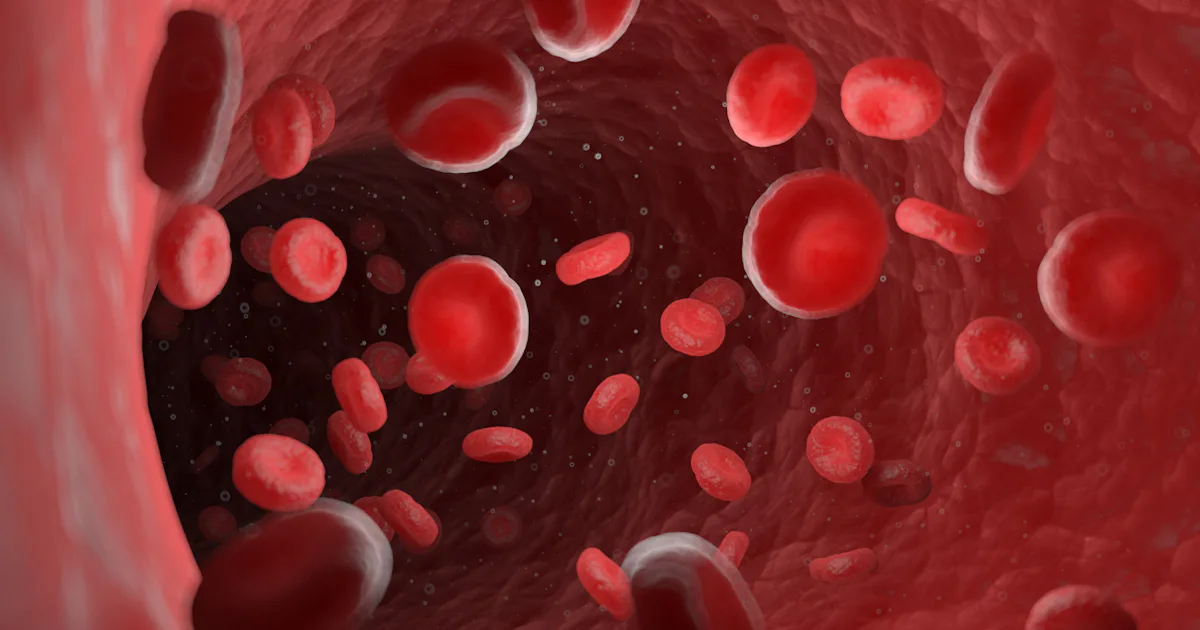
For the first time ever, scientists have given patients red bloodcells that were grown in a lab. This feat is part of a clinical trial in England looking into the safety of the cutting-edge technique, which could help tackle the ongoing blood supply shortage that was worsened by the pandemic.
The trial is a collaboration between institutions including the University of Bristol, the University of Cambridge, and the National Health Service.
Regular transfusions can be life-saving for people with conditions like sickle cell disease, which affects the shape of red blood cells and can block blood flow, and thalassemia, which causes the body to produce too little of a protein called hemoglobin.
Now, these lab-grown red blood cells could stretch sparse donations into larger volumes. The procedure could also help address the need for more blood from Black donors — sickle cell disease is prevalent among Black people, and blood is most compatible when donated from people of the same race or similar ethnicity.
And unlike donor blood, which can contain relatively old cells, these lab-grown cells are guaranteed to be fresh. This means they can last longer and perform better, reducing the need for frequent transfusions. When people receive lots of transfusions, they also run the risk of developing too much iron in their bodies.
HOW TO GROW BLOOD CELLS
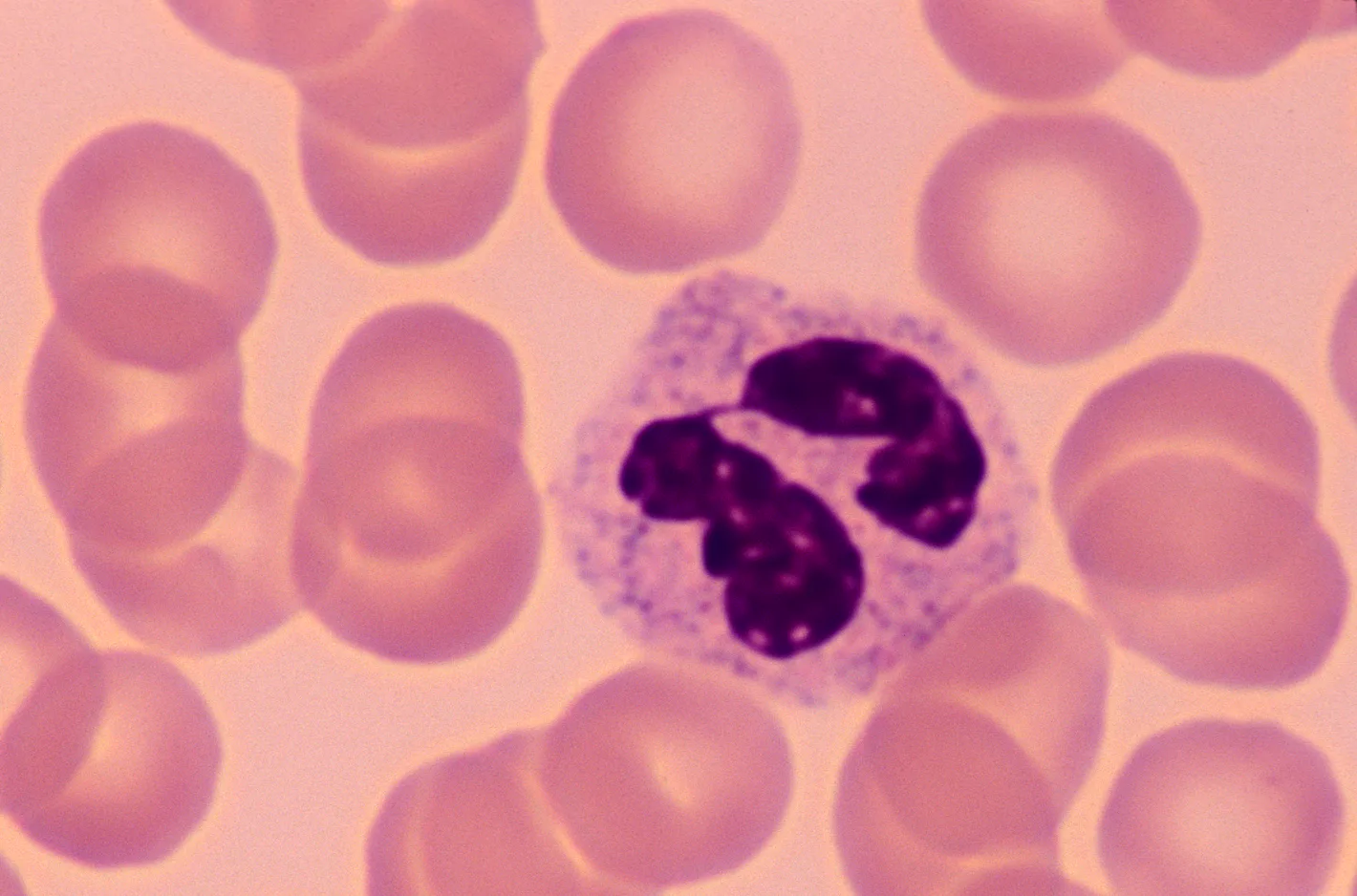
A white blood cell surrounded by red blood cells, which scientists have figured out how to grow in the lab.
Ed Reschke/Photodisc/Getty Images
The scientists started with a regular blood donation and used magnetic beads to pinpoint the flexible stem cells that can morph into red blood cells, CNBC reported.
Then, they put the stem cells in a nutrient solution for 18 to 21 days, which nudges the cells to proliferate and grow into more mature cells, according to The Guardian. Then, they tagged the cells with a radioactive substance to track them in blood samples from trial participants over the six months following the first injection of cells.
So far, two healthy volunteers have received the lab-grown red blood cells, and they haven’t reported any negative side effects. Next up, the team will give a minimum of 10 participants two “mini” transfusions at least four months apart — one consisting of standard donated red blood cells and another composed of lab-grown ones.
The researchers will analyze patient blood samples to determine whether the lab-grown red blood cells will last longer than the ones made in the body. While further research is needed, this marks a major step forward in treating blood disorders.
“The need for normal blood donations to provide the vast majority of blood will remain,” says Farrukh Shah, the medical director of tranfusion at NHS Blood and Transplant. “But the potential for this work to benefit hard-to-transfuse patients is very significant.”
Crab Nebula, probably the most intensely studied bright nebula, in the constellation Taurus, about 6,500 light-years from Earth.
Roughly 10 light-years in diameter, it is assumed to be the remnant of a supernova observed by Chinese and other astronomers first on July 4, 1054.
The supernova was visible in daylight for 23 and at night for almost 2 years.
In 1758 it was the first object listed (M1) in Charles Messier’s catalog of nebulous objects.
It acquired its name, suggested by its form, in the mid-19th century. In 1921 it was discovered to be still expanding; the present rate is about 1,100 km (700 miles) per second.
The Crab is one of the few astronomical objects from which radiation has been detected over the entire measurable spectrum, from radio waves through infrared and visible wavelengths to ultraviolet, X-rays, and gamma rays.
In the late 1960s the Crab pulsar ,thought to be the collapsed remnant of the supernova was discovered near the centre of the nebula.
The pulsar, which flashes in radio, visible, X-ray, and gamma-ray wavelengths at 30 times per second, provides the energy that allows the nebula to glow.
Classes of nebulae
All nebulae observed in the Milky Way Galaxy are forms of interstellar matter—namely, the gas between the stars that is almost always accompanied by solid grains of cosmic dust
Their appearance differs widely, depending not only on the temperature and density of the material observed but also on how the material is spatially situated with respect to the observer.
Their chemical composition, however, is fairly uniform; it corresponds to the composition of the universe in general in that approximately 90 percent of the constituent atoms are hydrogen and nearly all the rest are helium, with oxygen, carbon, neon, nitrogen, and the other elements together making up about two atoms per thousand.
On the basis of appearance, nebulae can be divided into two broad classes: dark nebulae and bright nebulae.
Dark nebulae appear as irregularly shaped black patches in the sky and blot out the light of the stars that lie beyond them.
Bright nebulae appear as faintly luminous glowing surfaces; they either emit their own light or reflect the light of nearby stars.
Dark nebulae are very dense and cold molecular clouds; they contain about half of all interstellar material.
Bright nebulae are comparatively dense clouds of gas within the diffuse interstellar medium. They have several subclasses: (1) reflection nebulae, (2) H II regions, (3) diffuse ionized gas, (4) planetary nebulae, and (5) supernova remnants.
Reflection nebulae reflect the light of a nearby star from their constituent dust grains. The gas of reflection nebulae is cold, and such objects would be seen as dark nebulae if it were not for the nearby light source.H II regions are clouds of hydrogen ionized (separated into positive H+ ions and free electrons) by a neighboring hot star.
Diffuse ionized gas, so pervasive among the nebular clouds, is a major component of the Galaxy.
Planetary nebulae are ejected from stars that are dying but are not massive enough to become supernovae—namely, red giant stars.
Supernova remnants are the clouds of gas expanding at speeds of hundreds or even thousands of kilometres per second from comparatively recent explosions of massive stars.
If a supernova remnant is younger than a few thousand years, it may be assumed that the gas in the nebula was mostly ejected by the exploded star.
Otherwise, the nebula would consist chiefly of interstellar gas that has been swept up by the expanding remnant of older objects.
Meet The Solar Ring: A Proposed Spacecraft That Will Have a Panoramic View of the Sun
The Sun is active, dynamic, and occasionally violent. Unfortunately our view of the Sun is limited to a small handful of orbiting satellites and ground-based observatories. The Solar Ring is new proposal that hopes to radically change that picture by launching a trio of satellites around the Sun to give continuous, 360° panoramic images in real time. The observatory could revolutionize our understanding of our parent star.
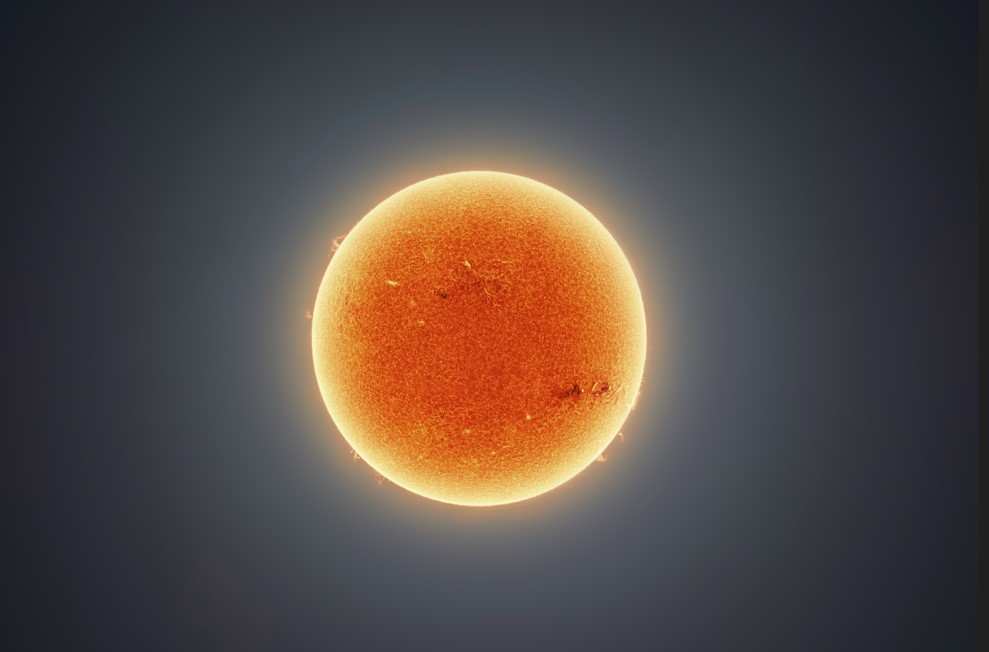
A 300 megapixel photo of our Sun, taken by using a specially modified telescope, compiling over 150,000 individual images.
Credit and copyright: Andrew McCarthy.
Despite being the closest star to us, we still lack an understanding of most of the physics of the Sun. While we understand the general picture – that the Sun is powered by fusion reactions, and the energy circulates its way to the surface and is released in the form of radiation – we don’t know the details. In particular, we do not understand mysteries like the origins of the 11-year sunspot cycle, the incredibly high temperature of the Sun’s corona, or how solar flares and coronal mass ejections take place.
Our information about the Sun is limited because we can only capture snapshots of it here and there with orbiting satellites and ground-based observatories. Oftentimes interesting activities start on the surface of the Sun facing away from any of our observatories, and by the time we catch it hours later we don’t know how it started. And other times we can see a process begin to ramp up but then miss its full evolution as the Sun rotates away from our view.
To solve this a team of astronomers propose the Solar Ring. The Solar Ring is a fleet of three spacecraft that will all orbit around the Sun. They will be separated from each other by 120° and be fitted with identical instruments. This way their overlapping fields of view will make it impossible for us to miss anything happening on the surface.
Among the many kinds of observations that the astronomers behind the Solar Ring hope to perform, one involves a technique called reverberation mapping. By carefully mapping the velocity of gas on the surface of the Sun, they can measure vibrations and pulsations. These kinds of “sunquakes” give astronomers rich information about what is happening within deeper layers, much like how earthquakes tell us about the core and mantle of the Earth.
The Solar Ring will also be able to catch the beginnings of a solar flare or an eruption event no matter where it happens on the Sun, providing even more early warning for space weather. These kinds of plasma storms can disrupt satellites and even affect electrical systems on the Earth’s surface, so the more warning the better.
The astronomers behind the Solar Ring hope that with more complete coverage of the Sun that we will be able to develop a better understanding of the complex nature of its surface, its interior, and its corona.
Video shared by littlespacemochi on reddit, recorded on November 5, 2022 in southern Brazil. Source (video) : www.pordosolguaiba.com.br
RELATED
Scientists Just Dropped A Camera In The Deepest Hole In Antarctica & Found A Terrifying Secret
Our planet is home to millions of old and new species, some of which we have discovered while the rest are yet to be found. Scientists and even common people discover new species every single day, on land and in the vast oceans covering a major part of Earth. Despite the continuous efforts and expeditions, these oceans remain the least explored part of the planet.
Right now, we know very little about what lies in the darkest corners of these immense water bodies. Especially the water that has remained covered by thick ice sheets for hundreds of thousands of years in Antarctica. But in the last few decades, experts have drilled holes in this ice and attempted to get a glimpse of what lies underneath. And what they've found is mind boggling to say the least. The icy continent is home to unique ecosystems that are poorly understood and creatures we have never seen before. But this wasn't always the case, previously researchers thought it was just a lifeless wasteland and only a few micrograms were able to survive in the harsh climate of Antarctica. But now, with powerful drilling methods, researchers have been able to penetrate the icy surface and explore the waters below it. One such exploratory effort conducted by the Ice Cube Observatory brought them face to face with a massive and frightening creature that could be an entirely new species
RELATED
Massive, Unidentified Objects 300 Miles Wide Have Been Detected By NASA
Massive, Unidentified Objects 300 Miles Wide Have Been Detected By NASA. Astronomers have spent decades looking for objects from outside our own solar system. What would essentially be interstellar visitors from an alien star system. To no avail. But it is when all hope seems to be lost, that some of the most marvelous things happen. It was something like that for these astronomers. After decades of finding absolutely nothing, something completely unexpected happened. Two objects arrived, at once.
12 Strangest Mysteries Of The Ancient Egyptian Sphinx
The Sphinx of Egypt is one of the most famous ancient sculptures in the world, but how much do you really know about it? In fact, how much does anybody really know about it? There’s far more to the Sphinx than most people imagine, and you probably won’t even realise how much about it you don’t know until you’ve finished watching this video!
James Webb Telescope's SHOCKING Discovery of City Lights!
NASA researchers had no idea what they were getting into when they launched the cutting-edge James Webb space telescope on December 25, 2021, from the Guiana Space Center. Astronomers had hoped to find signs of extraterrestrial life in the atmospheres of far-off planets and galaxies, but little did they know that the first images from the JWST would completely change how we view the universe.
JWST has just revolutionized our way of exploring the universe. The president Joe Biden has called JWST a new window into the history of our universe.
NASA Administrator Bill Nelson had claimed that humanity would soon have access to a completely new perspective on the universe that is unlike anything we have ever seen. Today, we'll examine the data the James Webb Space Telescope has given us to determine whether the strange light is a sign of life or the possibility of life on a planet orbiting an entirely different star. But before we continue please spare some time to subscribe to the channel and press the bell icon.
From ECETI Ranch to Pentagon – The Most intriguing UFO Cases & Hotspots (Coast to Coast AM)
Craig Campobasso, a filmmaker and UFO expert, discussed some of the most interesting cases and places where people have spotted the mysterious objects. One particular area is the ECETI Ranch in Trout Lake, Washington. According to Campobasso, people have reported seeing multiple UFOs flying in the sky at night.
He also talked about the strange activity that occurred at the Bradshaw Ranch near the town of Sedona, Arizona. The area has been described as a portal for various creatures and entities. He also talked about the legend of an alien named Valiant Thor, who allegedly stayed in the Pentagon’s underground apartment during the 1950s.
He also talked about cases such as the Aurora, Texas, and the Shag Harbour Incident. During the show’s last half-hour, George interviewed Brad Steiger, a paranormal author and investigator.
USS Nimitz Witness Tells His Story For The First Time
The USS Nimitz is known for its infamous “Tic-Tac Incident”. However, ten years prior, Kevin Thomas witnessed an entirely different and more significant event.
This is Probably the Last Picture we’ll see From InSight on Mars
It’s almost time to say goodbye to another Martian friend. Plenty of missions to the Red Planet have gone silent for the last time, some after many successful years of data collection and some after a brief free-fall as a fireball. We will soon add another Martian explorer to that ever-growing list – InSight might have sent its final image home.
The image itself is similar to hundreds of others that the probe has been sending back to Earth for the last four years. In the center of the image is the craft’s seismometer, which has been focusing on collecting data about Marquakes and whose data has been used in dozens of papers. In this image, though, it is noticeably covered in the fine red dust that blankets everything on the Red Planet.
That dust is also covering InSight’s power source. Its solar panels have been getting collectively more covered and, therefore, able to provide less and less power to the lander itself. Unfortunately, InSight also had either the good or bad luck to be located in an area of general calm for Martian dust devils. While they might be difficult for the instruments themselves to handle while they are happening, dust devils also do a remarkably good job at cleaning off solar panels covered in dust.
In another recent image, InSight uses its robotic arms to scratch away some of the regolith surrounding it. Credit – NASA / JPL-Caltech
Another fact in the growing dust accumulation was a design decision the InSight team made back at the project’s inception. Various methods can help remove dust from solar panels. Compressed air and wiper blades similar to those found on cars are two of the most common. But InSight’s engineers decided not to include any such system on their probe.
Making those kinds of decisions is one of the hardest parts of engineering. Dust removal systems add weight, and therefore cost more money, both in their design and also in the cost of getting them to Mars. Launch costs still take up a significant amount of a project’s budget, so every system is scrutinized to see whether it is truly necessary. In the case of Insight, the team determined a dust removal system was not.
There was one crucial factor that led to that decision – the relatively short expected mission duration of Insight as a whole. It was only planned to last one Earth year. It ended up lasting four.
JPL video discussing the accomplishments of InSight. Credit – NASA JPL YouTube Channel
So even without a dust removal system, the mission outperformed its original expectations. And Insight has solidified its standing as one of the most prolific Martian probes up to this point. Its data has been the basis of dozens of papers, and we have come to understand everything from the presence (or lack therefore) of liquid water around the lander to finding some magma in the same area.
Such data would make any scientific team proud, and those involved with Insight have had plenty of time to see the end coming. UT first reported on its power problems back in May. But, while it has continued going strong for the last six months, it might soon be time to say a final goodbye to the Interior Exploration using Seismic Investigations, Geodesy, and Heat Transport mission. It will not be forgotten and might even be brought back to life someday when humans finally tread on the landscape that so far only it has seen.
Want a Sneak Peek From NASA’s Lucy Mission? Here are Some Photos it Took of the Moon During its Flyby
We reported a few weeks ago about an Earth gravity assist flyby for the Lucy mission. Around the same as the spacecraft took a dip closer to Earth than the ISS, it took some fantastic pictures of our nearest neighbor – the Moon. After some processing, those pictures are available for inspection or gawking, as the case may be.
Lucy took three separate pictures, ranging from 6.5 hours to about 8 hours after it flew past the Earth. Each was taken with the Lucy LOng Range Reconnaissance Imager, also called L’LORRI. And they are absolutely breathtaking.
The first covers an area of the Moon known as the Lunar Central Highlands, which is most likely well-known to most lunar observers. Located near the “center of the last quarter of the moon,” according to a NASA press release, there are some prominent craters in the 1200 sq km image, including Arzachel, with its characteristic sub-impacts, near the center of the picture.
“Terminator Mosaic” image captured by Lucy. Credit – NASA/Goddard/SwRI/JHU-APL/Tod R. Lauer (NOIRLab)
L’LORRI next turned its camera to take a composite shot of the whole Moon from top to bottom. Called a “terminator mosaic” in the press release, it shows a combination of the other two main images Lucy took on its journey past. Some craters clearly stand out, such as Copernicus, which shows as much brighter than other craters on the left side of the image.
Finally, Lucy took an image of Mare Imbrium, which includes the Apollo 15 landing site, in the bottom right corner. Other features include the Apennine mountains, named after the famous range in Italy, and Mare Imbrium itself, which is an ancient impact basin. The image covers a total of 1000 sq km.
To create these images, Lucy mission scientists used several compositing techniques, including stitching together multiple images – the terminator image and the Central Highlands image were crafted from five and ten individual images, respectively. The Mare Imbrium image, on the other hand, was captured with only one.
Image of Mare Imbrium on the Moon, as taken by Lucy. Credit – NASA/Goddard/SwRI/JHU-APL/Tod R. Lauer (NOIRLab)
Scaling is essential to understand in the images as well – each pixel of the image constitutes between 1.1 km and 1.3 km of area. Also, each image was taken while Lucy was between 230,000 to 260,000 km away from the Moon.
These images are a testament both to how close Lucy got to the Moon, the sensitivity of its instruments, and the technical aptitude of its science team. Taking pictures of the Moon isn’t Lucy’s first priority, but it will still be a few years before it reaches its final destination – the Trojan asteroids on the outer edges of the Jupiter system. In the meantime, we might be able to see even more amazing pictures, either of Earth or the Moon, as Lucy still has two more close encounter gravity assists in its near future.
The Perfect Tidal Tail Connects These two Galaxies Seen by Hubble
Sometimes it’s tempting to imagine a supernatural hand behind the arrangement of celestial bodies. But the Universe is big, huge even, and nature’s flow presents many fascinations.
So it is with the galactic triplet Arp 248, an arrangement of interacting galaxies that’s both visually and scientifically fascinating.
Arp 248 is a trio of small interacting galaxies around 200 million light-years away in the constellation Virgo. The image shows two of Arp 248’s galaxies flanking another smaller unrelated galaxy in the background. The galaxies are connected by a stream of stars, gas, and dust, created as the galaxies tug on one another gravitationally.
Arp 248 is also known as Wild’s Triplet, after astronomer Paul Wild (1923–2008), who studied the trio in the early 1950s. Image Credit: By Credit Line and Copyright Adam Block/Mount Lemmon SkyCenter/University of Arizona – http://www.caelumobservatory.com/gallery/wilds.shtml, CC BY-SA 3.0 us, https://commons.wikimedia.org/w/index.php?curid=20540032
Astronomers call the streams “tidal tails.” When dusty and gas-rich galaxies like Arp 248 merge, the merger frequently forms tails. The tails are made of material from the outer spiral disks of the merging galaxies, and they host active star formation indicated by blue.
The top image is from an observing project examining two collections of unusual galaxies involving Halton Arp. Arp was an American astronomer who created the Atlas of Peculiar Galaxies in 1966. The Atlas contains 338 galaxies chosen for their unusual shapes. He intended for it to highlight the variety of peculiar structures that galaxies take.
The Universe is full of galaxies whose shape has been altered by interactions and mergers. This is Centaurus A, an elliptical galaxy that merged with a spiral galaxy around 300 million years ago. The merger created the dark dust lane, which is not usually a feature of elliptical galaxies. The merger also formed a spiral of gases in Centaurus A’s core. Image Credit: ESA
We now know these galaxies take such strange shapes because they’re interacting and potentially merging. Arp disagreed with that interpretation and said the unusual forms were due to ejections. But in any case, Arp realized astronomers weren’t very knowledgeable about how galaxies change over time, and he intended that astronomers could use his Atlas to study galaxy evolution.
The second collection of unusual galaxies in the observing project is called A Catalogue of Southern Peculiar Galaxies and Associations. It was published in 1987 by Arp and his colleague Barry Madore. The Catalogue contains 25 different varieties of objects, including galaxies with tails.
Astronomers have expanded their knowledge of interacting galaxies, and galaxy mergers since the Atlas and the Catalogue were published. We know that mergers play an important role in galaxy evolution.
Interacting galaxies are found throughout the Universe, sometimes as dramatic collisions that trigger bursts of star formation, on other occasions as stealthy mergers that result in new galaxies. These images are from a series of 59 images of colliding galaxies released from archived raw images from the NASA/ESA Hubble Space Telescope. Image Credit: NASA/ESA/STScI
As astronomers study interacting galaxies in more detail, they’re uncovering a new class of objects that they call “intergalactic star-forming objects” (ISFOs.) ISFOs are a broad class of objects that capture the different types that form when galaxies interact. ISFOs can form due to tidal interactions and the ram-sweeping of material from interacting galaxies. They can also develop due to the inflow of gas and dust to the tails and through a combination of all these processes. ISFOs can range in mass from super star clusters to what astronomers call “tidal dwarf galaxies” (TDGs.) A 2012 paper based on the Sloan Digital Sky Survey estimated that about 6% of dwarf galaxies could have tidal origins.
This image shows NGC7252, a peculiar galaxy formed from a merger between two galaxies over a billion years ago. The white circles highlight the locations of two tidal dwarf galaxies (TDGs) forming in the tails. Researchers think that about 6% of dwarf galaxies are TDGs. Image Credit: Frederic Bournaud/Pierre-Alain Duc.
ISFOs are often bound gravitationally to the galaxies, but how many stay bound and for how long is still an open question. Sometimes material from the tidal streams will flow back into the galaxies, triggering more star formation. The leftover material from all this interaction enriches the interstellar medium with dust and metals.
Astronomers now think that about 25% of galaxies are currently merging with other galaxies. Even more of them are interacting gravitationally, if not merging, according to the Harvard Center for Astrophysics. Our Milky Way galaxy is evidence of this, as it cannibalized gas and even stars from the Magellanic Clouds and the Sagittarius Dwarf Galaxy. And in several billions of years, the Milky Way and the Andromeda Galaxy will merge. Who knows what behemoth might arise from that event?
This series of photo illustrations shows the predicted merger between our Milky Way galaxy and the neighbouring Andromeda galaxy. Credit: NASA; ESA; Z. Levay and R. van der Marel, STScI; T. Hallas, and A. Mellinger
How supermassive black holes (SMBHs) grow so massive is also an open area of inquiry. Astrophysicists know that mergers are part of SMBH’s growth process, but there’s a lot they don’t know.
The James Webb Space Telescope captured this image of Stephan’s Quintet. It’s a fivesome of galaxies, four interacting, and the fifth is only visually associated. The left-most galaxy is NGC7320 which is well in the foreground of the other four. The image is a composite of almost 1,000 separate images. The four stars and their interactions produce tails, regions of active star formation, glittering regions containing millions of young stars, and shock waves from NGC 7318B as it bullies its way through the cluster. NGC 7318B is the top one in the pair of galaxies closest together. Image Credit: NASA, ESA, CSA, and STScI
The Hubble Space Telescope’s Advanced Camera for Surveys (ACS) scrutinized this assortment of unusual interacting galaxies to lay the groundwork for more detailed study in the future. The Hubble will examine some of these targets with its other instruments, and so will the James Webb Space Telescope and ALMA. Observing time on these telescopes is always in high demand, so this project will help astronomers allocate time better.
Hubble saw Multiple Light Echoes Reflecting off Rings of Dust From a Supernova Explosion
When stars reach the end of their life cycle, they experience gravitational collapse at their centers and explode in a fiery burst (a supernova). This causes them to shed their outer layers and sends an intense burst of light and high-energy short-wavelength radiation (like X-rays and gamma-rays) out in all directions. This process also creates cosmic rays, which consist of protons and atomic nuclei that are accelerated to close to the speed of light. And on rare occasions, supernovae can also create “light echoes,” rings of light that spread out from the site of the original explosion.
These echoes will appear months to years after the supernova occurs as light from the explosion interacts with the layers of dust in the vicinity. Using the Hubble Space Telescope (HST), an international team of astronomers was able to document the emergence and evolution of multiple light echoes (LEs). The team traced these echoes to a stripped-envelope supernova (SN 2016adj) located in the central dust lane of Centaurus A, a galaxy located 10 to 16 million light-years away in the constellation of Centaurus.
The core and subsequent layers of a dying star. Each layer has been left over from millions of years of fusing each subsequent element into the next one. Credit: Wikimedia
The SN 2016adj supernova was first seen in 2016 and took place in the well-studied galaxy of Centaurus A. This type of supernova (stripped-envelop) refers to the fact that the star undergoing collapse has already blown away its outer hydrogen envelope and was surrounded by an outer helium layer before exploding. Despite its relative proximity, there is still considerable debate about this galaxy’s fundamental properties and proper distance. Astronomers are still unsure if it is a lenticular or giant elliptical galaxy and estimate its distance at 10 to 16 billion light-years from Earth.
In the five and a half years since SN2016adj was discovered, astronomers have watched the area around the supernova as it slowly faded. Using images from Hubble, Stritzinger and his colleagues created a short video that shows the supernova fading and the evolution of the light echoes that followed. The gif video (shown below) shows the progression throughout a one-thousand, nine-hundred, and eleven-day period. This includes the light from the original explosion visibly fading, followed by the appearance of an illuminated ring that expands slowly outwards.
The data set is remarkable and enabled us to produce impressive colored images and animations that exhibit the evolution of the light echoes over the five years that followed. It is a rare phenomenon previously documented with only a handful of other supernovae. As Prof. Stritzinger said in a recent UCD Research News release:
“Centaurus A is full of dust lanes, and when the sideways spreading light from the supernova hit these dusty areas over time, they lit up further and further away from the original supernova position, creating a series of expanding rings of emission called light echoes. The variations in these rings during the years of observation enable researchers to probe the layout of the dust lanes in the galaxy near the explosion. The data suggests that they consist of columns of dust with large holes in between, resembling a chunk of Swiss cheese.”
A short gif-video, showing first the supernova explosion at the very centre. Credit: University College Dublin
Gif-video of the HST images acquired of SN 2016adj. Credit: HST/NASA/Caltech-JPL/Stritzinger et al. (2022)
Based on their observations, astronomers estimate that the blast wave created by the explosion moved outwards at over 10,000 km per second (36 million km/h; 22.37 million mph). Ahead of this wave is the intense flash of light released from the supernova, which is absorbed by the clouds of dust and gas thrown off by the supernova explosion, which caused the expanding rings of light captured in these images. These events are particularly interesting to astronomers since they are how the Universe was seeded with heavy elements like carbon, oxygen, and iron.
The abundance of these elements led to the formation of the first planet roughly thirteen billion years ago and the eventual emergence of life. As co-author Dr. Stephen Lawrence of Hofstra University said:
“A good everyday analogy is to imagine the finale of a fireworks show – the bright burst of light from a shell at the end of the show will light up the smoke from earlier shells that is still lingering in the area. By comparing a series of photographs taken over several minutes, you could measure all sorts of information that is not directly related to the most recent explosion that is lighting up the scene, things like how many shells had previously exploded, how opaque is the smoke from a given shell, or how fast and in what direction was the wind blowing.”
These observations were immensely significant since only four distinct light echoes from four different dust sheets have been observed so far. Looking ahead, the team hopes to conduct follow-up observations with Hubble, hoping that more light rings will emerge. They also hope to obtain spectra from the light echoes, which will reveal the dust clouds’ composition and the supernova’s chemical makeup. In the meantime, these results show how the venerable Hubble can still make major discoveries over thirty years later. As co-author Dr. Morgan Fraser of the UCD School of Physics:
“While the James Webb Space Telescope has drawn much attention, its predecessor Hubble continues to provide incredible images of the Universe. HST has now been observing the sky for over three decades, so we can find things like this light echo that evolve slowly over many years.”
Meer van UFO'S of UAP'S, ASTRONOMIE, RUIMTEVAART, ARCHEOLOGIE, OUDHEIDKUNDE, SF-SNUFJES EN ANDERE ESOTERISCHE WETENSCHAPPEN - DE ALLERLAATSTE NIEUWTJES


 FIRST-EVER LAB-GROWN BLOOD COULD CHANGE MEDICINE FOREVER