Naar de inhoud

UFO'S of UAP'S, ASTRONOMIE, RUIMTEVAART, ARCHEOLOGIE, OUDHEIDKUNDE, SF-SNUFJES EN ANDERE ESOTERISCHE WETENSCHAPPEN - DE ALLERLAATSTE NIEUWTJES

UFO's of UAP'S in België en de rest van de wereld
akke.beakke.be
Ontdek de Fascinerende Wereld van UFO's en UAP's: Jouw Bron voor Onthullende Informatie! Ben jij ook gefascineerd door het onbekende? Wil je meer weten over UFO's en UAP's, niet alleen in België, maar over de hele wereld? Dan ben je op de juiste plek! België: Het Kloppend Hart van UFO-onderzoek In België is BUFON (Belgisch UFO-Netwerk) dé autoriteit op het gebied van UFO-onderzoek. Voor betrouwbare en objectieve informatie over deze intrigerende fenomenen, bezoek je zeker onze Facebook-pagina en deze blog. Maar dat is nog niet alles! Ontdek ook het Belgisch UFO-meldpunt en Caelestia, twee organisaties die diepgaand onderzoek verrichten, al zijn ze soms kritisch of sceptisch. Nederland: Een Schat aan Informatie Voor onze Nederlandse buren is er de schitterende website www.ufowijzer.nl, beheerd door Paul Harmans. Deze site biedt een schat aan informatie en artikelen die je niet wilt missen! Internationaal: MUFON - De Wereldwijde Autoriteit Neem ook een kijkje bij MUFON (Mutual UFO Network Inc.), een gerenommeerde Amerikaanse UFO-vereniging met afdelingen in de VS en wereldwijd. MUFON is toegewijd aan de wetenschappelijke en analytische studie van het UFO-fenomeen, en hun maandelijkse tijdschrift, The MUFON UFO-Journal, is een must-read voor elke UFO-enthousiasteling. Bezoek hun website op www.mufon.com voor meer informatie. Samenwerking en Toekomstvisie Sinds 1 februari 2020 is Pieter niet alleen ex-president van BUFON, maar ook de voormalige nationale directeur van MUFON in Vlaanderen en Nederland. Dit creëert een sterke samenwerking met de Franse MUFON Reseau MUFON/EUROP, wat ons in staat stelt om nog meer waardevolle inzichten te delen. Let op: Nepprofielen en Nieuwe Groeperingen Pas op voor een nieuwe groepering die zich ook BUFON noemt, maar geen enkele connectie heeft met onze gevestigde organisatie. Hoewel zij de naam geregistreerd hebben, kunnen ze het rijke verleden en de expertise van onze groep niet evenaren. We wensen hen veel succes, maar we blijven de autoriteit in UFO-onderzoek! Blijf Op De Hoogte! Wil jij de laatste nieuwtjes over UFO's, ruimtevaart, archeologie, en meer? Volg ons dan en duik samen met ons in de fascinerende wereld van het onbekende! Sluit je aan bij de gemeenschap van nieuwsgierige geesten die net als jij verlangen naar antwoorden en avonturen in de sterren! Heb je vragen of wil je meer weten? Aarzel dan niet om contact met ons op te nemen! Samen ontrafelen we het mysterie van de lucht en daarbuiten.

Archief

ZWART GAT LAAT NOG STEEDS BOERTJES JAREN NA OPETEN STER: 'ZOIETS HEBBEN WE NOG NOOIT GEZIEN'

Bronmateriaal:

{ https://scientias.nl/ }

Hoe vind je dit bericht?
Geschreven door peter om 00:58 Stuur door

US Air Force Scientist: “Giant 250 meters alien ships enter our world through the portal”

US Air Force Scientist: “Giant 250 meters alien ships enter our world through the portal”

US Air Force Scientist: “Giant 250 meters alien ships enter our world through the portal”

A world-renowned scientist and former engineer of the United States Air Force and Boeing Company, using a telescope, photographed a UFO with a diameter of 250 meters flying at a speed of 48,000 km / h.

But this is just one of the huge UFOs, of which many more have been recorded. According to Frederick Portigal, this is absolute proof that the aliens are already here.

This data has been confirmed as authentic by the US National Air and Space Intelligence Agency (NASIC).

1-62.jpg

Frederick Portigal, a former US Air Force and Boeing engineer, captured UFO images and data with a hyper-spectral imaging telescope. According to him, he captured very large objects moving at great speed.

Hyperspectral remote sensing, also known as imaging spectroscopy, is a technique being researched by scientists to detect and identify minerals, terrestrial plants, and man-made materials and landscapes.

The technique will be used on the James Webb Space Telescope, which is slated to launch in December, and will provide a peek into the depths of the universe.

Frederic Portigal is a leading world scientist with extensive experience in this technique.

Frederick was responsible for the process flow design for the Fourier Transform Hyperspectral Imager (FTHSI), the first hyperspectral sensor launched into orbit by the US Air Force Research Laboratory / RVBYI. He created a mathematical model to simulate space observations to be conducted using Landsat 7 data.

Portigal led a USDA-sponsored study evaluating hyperspectral imaging for the detection of Pierce’s disease (PD) in California grapes.

Frederic Portugal has previously worked for organizations such as the Air Force Research Laboratory, Boeing, Northrop Grumman, and the National Science Foundation.

Portigal has a message for our world – giant alien ships are entering the Earth through the portal.

According to former Boeing chief engineer, aliens are using wormhole penetration technology to move these plasma-like UFOs near the Earth’s surface at a speed of 48,000 kilometers per hour.

Portigal telescopic footage captured the astonishing appearances of plasma-like objects flying at inconceivable speeds in the vicinity of the Petroglyph National Monument near Albuquerque, New Mexico. His telescope was on Sandia Heights with a field of view of about 15 miles.

Shortly after DNI presented a report to Congress on unidentified aerial events, Portigal wrote on LinkedIn expressing his disappointment at the lack of clarity in the government’s efforts.

“I decided that the recent Congress report on UFOs lacked detail on the extraterrestrial category, given that I provided NASIC and DIA. I have to go directly to the people. They need to know.

“They have all this data, which proves that giant motherships are infiltrating into our world, with smaller ships on board and that leave the motherships and stay here, and the motherships leave and return with new cargo. This has been happening since at least 2008, when we first recorded their appearance.

“The military and the government have all the information and they themselves are now watching the ongoing expansion of aliens on Earth. Why do they transport their ships to us in such quantities? Why is the government silent about this? ”

According to Portigal, the Department of Defense has created a special hyperspectral telescope, which they call “binoculars for hunting aliens”.

The technology is based on Frederick’s personal telescope and was refined with $ 750,000 from the Air Force Research Laboratory.

The video recording begins with a concentration on the white sphere – such luminous balls are very often observed by many eyewitnesses of the appearance of UFOs in our sky, but they do not see what is hidden behind this plasma screen.

ufo-florida.jpg

Simply put, intense energy gathered in one visible location looks like a highly illuminated ball to the naked eye. Once Frederick’s sensor is able to analyze the plasma and estimate the volume of gases, it can build a picture of the object hidden behind the plasma envelope, showing the true outlines of the pyramids and various other shapes of UFOs that were dropped by the large mother ship.

Frederick’s technical report accompanying the video can be viewed here. According to Frederick, this is absolute proof that the aliens are already here.

“You have to understand what this is about – I have developed a technology with which you can see alien ships. I developed this technology officially and the military, with the support of the government, invested in it and improved it to make binoculars for detecting alien ships for themselves.

“I first discovered these mother ships entering our world through wormholes (portals) and dropping their cargo – smaller ships, back in 2008. Why people are not told that alien ships invisible to ordinary people penetrate into our world. What is their purpose? What are they doing? What are they preparing for?

“Perhaps this is evidence of extraterrestrial mining on our planet, but who knows what is in the cargo that materializes and travels through the wormholes after the mother ship departs?

“This is not one ship. These are giant alien ships hidden from our eyes with the help of their camouflage technology, which one after another materialize in our sky and drop other ships.

“The United States has officially recognized the existence of a UFO in our sky. This is good, but they said “A” did not say “B” – they left a shadow of doubt by saying that they did not know whose apparatus it was and the Pentagon did not use the term “extraterrestrial”.

“And this while, since 2008, they have been watching giant alien ships entering our world every day!”

Portigal added another note about extraterrestrial craft:

" They travel through wormholes, and another possibility is a portal between parallel universes.”

  • The information was disseminated to the media by Frederic Portugal on October 29, 2021.

{ https://myth-mystery.zdravljebezdoktora.com/ }

Hoe vind je dit bericht?
Geschreven door peter om 00:37 Stuur door

Not too big and not too small! Astronomers discover a rare 'missing link' black hole in the Milky Way's closest large galactic neighbour

Not too big and not too small! Astronomers discover a rare 'missing link' black hole in the Milky Way's closest large galactic neighbour

  • Scientists say they've found an 'intermediate-mass' black hole 'unlike any other'
  • Intermediate-mass black holes have a mass up to 100,000 times that of our Sun 
  • They're bigger than stellar black holes but tinier than supermassive black holes

A rare 'missing link' black hole has been found in the Milky Way's closest large galactic neighbour, a new study reveals. 

Astronomers say the black hole has an 'intermediate-mass', and is the rare third type of black hole that has only recently come to light. 

Described as 'unlike any other', the black hole was found in a star cluster called B023-G078 in the Andromeda galaxy. 

Otherwise known as Messier 31 or M31, Andromeda is the closest large spiral galaxy to our galaxy, the Milky Way. 

This newly-found black hole has a mass 100,000 times greater than our Sun, making it smaller than black holes found at the centre of galaxies (supermassive black holes), but bigger than black holes born when stars explode (stellar black holes).  

One theory is that intermediate-mass black holes could be the seeds from which supermassive black holes grow.  

The black hole was found hidden within B023-G078, an enormous star cluster in Andromeda with a solar mass of 6.2 million. The left panel shows a wide-field image of M31 with the red box and inset showing the location and image of B023-G78 where the black hole was found

The black hole was found hidden within B023-G078, an enormous star cluster in Andromeda with a solar mass of 6.2 million. The left panel shows a wide-field image of M31 with the red box and inset showing the location and image of B023-G78 where the black hole was found

Andromeda is the nearest major galaxy to our own Milky Way galaxy. The diffuse light from Andromeda is caused by the hundreds of billions of stars that compose it. The several distinct stars that surround Andromeda's image are actually stars in our Galaxy that are well in front of the background object

Andromeda is the nearest major galaxy to our own Milky Way galaxy. The diffuse light from Andromeda is caused by the hundreds of billions of stars that compose it. The several distinct stars that surround Andromeda's image are actually stars in our Galaxy that are well in front of the background object

The three types of black hole 

Stellar: Five to several tens of solar masses 

Intermediate-mass: 100 to 100,000 solar masses

Supermassive: Millions to billions of solar masses

The new study, published in The Astrophysical Journal, was based on data from the near-infrared integral-field spectrograph (NIFS) at the Gemini North telescope in Hawaii. 

Astronomers measure the mass of a black hole by tracing the motion of the gas and dust swirling around it. 

This can be done at many wavelengths, such as by measuring the positions of stars which orbit near a black hole at optical wavelengths. 

Study author Anil Seth, an associate professor of astronomy at the University of Utah, said the finding fills a gap between the very large and the very small black holes known to exist. 

'We have very good detections of the biggest, stellar-mass black holes up to 100 times the size of our sun and supermassive black holes at the centers of galaxies that are millions of times the size of our sun,' he said.

'But there aren't any measurements of black between these – that's a large gap. This discovery fills the gap.'

The study was based on data from the near-infrared integral-field spectrograph (NIFS, pictured) at the Gemini North telescope in Hawaii

The study was based on data from the near-infrared integral-field spectrograph (NIFS, pictured) at the Gemini North telescope in Hawaii

On the right side of this image shows the Gemini Observatorium on the top of the vulcano Mauna Kea. In the background is the Canada France Hawaii Telescope

On the right side of this image shows the Gemini Observatorium on the top of the vulcano Mauna Kea. In the background is the Canada France Hawaii Telescope 

STAR CLUSTERS 

As the name suggests, star clusters are groups of hundreds to millions of stars that share a common origin, all gravitationally bound for as long as several billions of years. 

There are two types of star clusters – open and globular. Globular clusters are dense balls of about one million ancient stars, all bound by gravity. Open clusters are much younger and smaller than globular clusters. 

According to experts at Penn State University, open clusters are usually a few tens of millions or hundreds of millions of years old, while globular clusters are typically about 12 billion to 13 billion years old.  

The black hole was found hidden within B023-G078, an enormous star cluster in Andromeda with a solar mass of 6.2 million.

Long thought to be a globular star cluster, the researchers argue that B023-G078 is instead a stripped nucleus - a remnant of a small galaxy that fell into a bigger one and had its outer stars stripped away by gravitational forces. 

What's left behind is a tiny, dense nucleus orbiting the bigger galaxy and at the centre of that nucleus, a black hole.

'Previously, we've found big black holes within massive, stripped nuclei that are much bigger than B023-G078,' said lead author Renuka Pechetti at Liverpool John Moores University. 

'We knew that there must be smaller black holes in lower mass stripped nuclei, but there's never been direct evidence.

'I think this is a pretty clear case that we have finally found one of these objects.' 

A globular cluster has a signature light profile that has the same shape near the centre as it does in the outer regions.

But B023-G078 is different – the light at the centre is round and then gets flatter moving outwards. 

The chemical makeup of the stars changes too, with more heavy elements in the stars at the centre than those near the object's edge.

'Globular star clusters basically form at the same time,' said Professor Seth. 

'In contrast, these stripped nuclei can have repeated formation episodes, where gas falls into the center of the galaxy, and forms stars. 

'And other star clusters can get dragged into the centre by the gravitational forces of the galaxy. 

'It's kind of the dumping ground for a bunch of different stuff. So, stars in stripped nuclei will be more complicated than in globular clusters. And that's what we saw in B023-G078.'     

The researchers are hoping to observe more stripped nuclei that may hold more intermediate mass black holes.   

In September 2020, researchers in Australia working as part of an international collaboration studying gravitational waves reported the first direct observation of an intermediate-mass black hole. 

Around 150 times heavier than our Sun, it was birthed from the merger of two smaller (yet still very large) black holes 17 billion light years away.  

BLACK HOLES HAVE A GRAVITATIONAL PULL SO STRONG NOT EVEN LIGHT CAN ESCAPE

Black holes are so dense and their gravitational pull is so strong that no form of radiation can escape them - not even light.

They act as intense sources of gravity which hoover up dust and gas around them. Their intense gravitational pull is thought to be what stars in galaxies orbit around.

How they are formed is still poorly understood. Astronomers believe they may form when a large cloud of gas up to 100,000 times bigger than the sun, collapses into a black hole.

Many of these black hole seeds then merge to form much larger supermassive black holes, which are found at the centre of every known massive galaxy.

Alternatively, a supermassive black hole seed could come from a giant star, about 100 times the sun's mass, that ultimately forms into a black hole after it runs out of fuel and collapses.

When these giant stars die, they also go 'supernova', a huge explosion that expels the matter from the outer layers of the star into deep space. 

Hoe vind je dit bericht?
Geschreven door peter om 18:13 Stuur door

BREAKING: Astronomers Just Discovered A Black Hole Unlike Any Other

BREAKING: Astronomers Just Discovered A Black Hole Unlike Any Other

BREAKING: Astronomers Just Discovered A Black Hole Unlike Any Other

Astronomers discovered a black hole concealed inside a huge star cluster, B023-G078, in the Andromeda galaxy, our nearest neighboring galaxy. 

With a mass of one hundred thousand solar masses, this black hole is smaller than any other black hole yet larger than those developed when stars explode.This makes the black hole the only verified black hole with an intermediate-mass.

B023-G078 was regarded as a massive star cluster. However, experts contend that the nucleus is empty. The nucleus of stripped galaxies is the relics of smaller galaxies that collided with larger ones and had their surrounding stars stripped away by gravitational forces.

Senior author Anil Seth, associate professor of astronomy at the University of Utah and co-author of the study, said, “We have very good detections of the biggest, stellar-mass black holes up to 100 times the size of our sun, and supermassive black holes at the centres of galaxies that are millions of times the size of our sun, but there aren’t any measurements of black between these. That’s a large gap. This discovery fills the gap.”

Lead author Renuka Pechetti of Liverpool John Moores University, who started the research while at the U, said, “Previously, we’ve found big black holes within massive, stripped nuclei that are much bigger than B023-G078. We knew that there must be smaller black holes in lower mass stripped nuclei, but there’s never been direct evidence. I think this is a pretty clear case that we have finally found one of these objects.”

Seth said, “I knew that the B023-G078 object was one of the most massive objects in Andromeda and thought it could be a candidate for a stripped nucleus. But we needed data to prove it. We’d been applying to various telescopes to get more observations for many years, and my proposals always failed. When we discovered a supermassive black hole within a stripped nucleus in 2014, the Gemini Observatory gave us the chance to explore the idea.”

The researchers acquired data from the Gemini Observatory and photos from the Hubble Space Telescope for their investigation. Using the data, they modeled the light profile of B023-G078 to determine its mass distribution.

Near the core of a globular cluster, the characteristic light profile has the same form as the outside areas. B023-G078 is different. The light in the center is spherical and becomes flattered as it moves outward. The chemical composition of the stars also varies, with the central stars containing more heavy elements than those towards the object's periphery.

Seth said, “Globular star clusters form at the same time. In contrast, these stripped nuclei can have repeated formation episodes, where gas falls into the centre of the galaxy and forms stars. And other star clusters can get dragged into the centre by the galaxy’s gravitational forces. It’s kind of the dumping ground for a bunch of different stuff. So, stars in stripped nuclei will be more complicated than globular clusters. And that’s what we saw in B023-G078.”

Using the object's mass distribution, the scientists projected the speed at which stars inside the cluster should be travelling at any given position. They then matched it to their own data. They discovered that the fastest-moving stars orbited the center.

When scientists constructed a model without a black hole, the central stars moved too slowly relative to their observations. When the black hole was introduced, the speeds matched the data. The black hole adds to the evidence that this item is a nucleus that has been stripped.

Pechetti said, “The stellar velocities we are getting gives us direct evidence that there’s some dark mass right at the centre. It’s tough for globular clusters to form big black holes. But if it’s in a stripped nucleus, then there must already be a black hole present, left as a remnant from the smaller galaxy that fell into, the bigger one.”

Seth said, “We know big galaxies generally form from the merging of smaller galaxies, but these stripped nuclei allow us to decipher the details of those past interactions.”

Reference(s):

{ https://blog.sci-nature.com/ }

Hoe vind je dit bericht?
Geschreven door peter om 17:52 Stuur door

If we Detect This gas on Other Planets, it’s a Good Sign There’s Life There

If we Detect This gas on Other Planets, it’s a Good Sign There’s Life There

Here is an idea that likely never crossed the mind of most space enthusiasts – a gas emitted from broccoli (and other plants) is one of the most indicative signs of the existence of life on a planet. At least according to a new study from researchers at the University of California Riverside.

That gas, methyl bromide, has long been associated with life on Earth. It occurs naturally from the process of plants defending themselves. Methylation, as the defense process is known, allows plants to expel foreign contaminants, such as bromide, by attaching a series of carbon and hydrogen atoms to it, thereby gasifying it and allowing it to escape into the air.

Methyl bromide, in particular, is interesting from an astrobiological perspective. It was used as a pesticide until the early 2000s and has several important advantages over other potential biosignatures if it shows up in an exoplanet’s atmosphere.

First, it has a relatively short lifespan in a planet’s atmosphere. This is particularly important for exoplanet searches, as it means whatever process produces the gas is most likely still active. Its presence isn’t simply a result of a geological event that happened eons ago.

A second advantage is one that all astrobiologists love to see – there are very few non-biological processes that produce the gas, and even those processes aren’t typically natural. Despite now being considered a hazardous chemical, methyl bromide was produced in large quantities for use as a pesticide before being regulated due to its deleterious health effects.

A third advantage is the spectroscopic wavelength it shares with a “cousin” gas that is also a biosignature – methyl chloride, which also results from the methylation process. Their combined signature would make them much easier to detect from far away, and both are indicative of the existence of a biological process, though being able to distinguish between methyl chloride and methyl bromide, as methyl chloride has already been seen around some stars, which was likely caused by an inorganic process.

UT interview discussing exoplanet atmospheres

Not quite an advantage, but an interesting quirk about the ability to detect methyl bromide, is that it would be relatively difficult to detect in Earth’s atmosphere from far away. Its concentration levels are high enough, but the UV light from the Sun causes water molecules in the atmosphere to split into compounds that eliminate methyl bromide, so it does not exist for very long in Earth’s atmosphere.

UV light is only a problem for Sun-like stars, though. Around stars like M-dwarfs, which are ten times more common in the galaxy than sun-like stars, there would be less UV radiation that would potentially break up the methyl-bromide molecule. Since those M-dwarfs will be some of the first places astrobiologists look, they might be a chance to see a build-up of methyl bromide in their atmospheres.

Any such discovery might have to wait a little while, though. Even the JWST isn’t set up to detect trace elements in an exoplanet’s atmosphere. However, in the next few years, some ground-based telescopes will be up to the task. Hopeful astrobiologists will have to wait until after those come online before they can truly look for this highly interesting biosignature.

Learn More:
UCR – Broccoli gas: a better way to find life in space
Leung et al – Alternative Methylated Biosignatures. I. Methyl Bromide, a Capstone Biosignature 
UT – Researchers Develop a new Framework for Searching for Biosignatures
UT – If Earth Were an Exoplanet, it Would Still be Tricky to Figure Out if There’s Life Here

Lead Image:
Example of an M dwarf planetary system.
Credit – NASA / JPL / Caltech

The post If we Detect This gas on Other Planets, it’s a Good Sign There’s Life There appeared first on Universe Today.


Source: https://www.universetoday.com/158102/if-we-detect-this-gas-on-other-planets-its-a-good-sign-theres-life-there/

{ https://beforeitsnews.com/ }

Hoe vind je dit bericht?
Geschreven door peter om 17:13 Stuur door

Huge DART Success, JWST Sees Weird Rings, Moon’s True Origin

Huge DART Success, JWST Sees Weird Rings, Moon’s True Origin

DART’s results are in and they exceed all expectations. The Moon might just be a big chunk of the Earth that formed in just hours. Webb sees bizarre rings around a star, and SLS gets a new launch date… at night.

As always, if you prefer a video version of space news to accompany your morning coffee or other activities, here’s the latest episode of Space Bites. Delicious space news nuggets.

DART Exceeds NASA’s Expectations

When NASA directed its DART mission to slam into Asteroid Dimorphos, it hoped to shorten its orbital period around Asteroid Didymos. Seventy-three seconds was the bare minimum; 10 minutes would have been excellent. But when they ran the numbers, it looked like DART shortened the asteroid’s orbital time by 32 minutes. Before the impact, Dimorphos took 11 hours and 55 minutes to orbit; now, it’s 11 hours and 23 minutes. This provides a baseline that astronomers can use to calculate how difficult it’ll be to prevent a dangerous asteroid from hitting Earth.

How Did the Moon Form

Where did the Moon come from? The evidence is leaning towards the theory that a Mars-sized object crashed into the Earth billions of years ago, and the rubble collected together into the Moon. This goes partway to explaining the Moon, but there are a few outstanding mysteries, like how to explain the Moon’s orbit, which doesn’t orbit around the Earth’s equator. A new theory suggests that a single large asteroid strike blasted two huge chunks of the Earth into space. One crashed back down, but it gave a boost to the other chunk, leaving it in orbit to become the Moon.

This is Not an Optical Illusion

Take a look at this picture of a star system taken by JWST. There appears to be some chromatic aberration or lens flare, but these concentric rings are really there. They are formed by a binary star system where their gravitational interaction causes one star to release a cloud of dust every eight years. The second star passes through the cloud and drags it along as it orbits. Then the combined light pressure from the two stars pushes the dust out into space, creating these concentric rings.

SLS Has a New Launch Date

We’ve got a new launch date for the upcoming Artemis 1 mission: November 14th. If the rocket blasts off that day, it should be an incredible sight. That’s because it’s scheduled for 12:07 a.m. EST… a night launch! These are always spectacular, with the bright exhaust from the rocket illuminating the landscape. This launch date would allow the uncrewed Orion Capsule to spend 25.5 days in space and at the Moon, splashing down in the Pacific Ocean on December 9th. There are backup windows on November 16th and 19th.

Starship Got Fully Stacked Again

SpaceX has been testing the Super Heavy booster with more and more of its Raptor 2 engines firing simultaneously, but the rocket was always on its own. This week, SpaceX showed off a picture of Super Heavy with the Starship stacked on top, held in place by Mechazilla. Does this mean that Starship is about to make an attempt to fly to orbit? Elon Musk hinted that the rocket was likely to fly in mid-November, similar to the new schedule for SLS. I wonder who’ll launch first?

CAPSTONE is Back

A few weeks ago, NASA announced its CAPSTONE CubeSat mission was tumbling uncontrollably. Fortunately, they maintained a communications link to the spacecraft, attempting to stop its tumble and get it back on track. This week we learned that the recovery efforts were successful, and CAPSTONE is no longer out of control. It’s good timing since it needs to make an orbital insertion maneuver in mid-November. From there, it’ll help chart out a rectilinear lunar halo orbit, the exact orbit the Lunar Gateway will take when it’s constructed at the Moon.

SpinLaunch Performs Its 10th Test

The weight of rockets is mainly made up of fuel. They also generate a lot of greenhouse gases as they blast into orbit. A new startup called Spinlaunch uses an electric catapult that spins up projectiles so fast that they’re thrown into space. At least, that’s the plan. Spinlaunch just completed the 10th test of a prototype launcher that can only hurl payloads on suborbital trajectories, but a future version will send them to orbit. NASA and other partners sent test instruments on the most recent launch to measure the extreme forces.

If Europa Has Lakes, We Will Find Them

Scientists believe there are vast seas of liquid water under an icy shell on Europa; the perfect place to search for life. However, this water could be under dozens of kilometers and almost impossible to reach. It’s believed this water can seep upward through the ice forming subsurface lakes. The upcoming Europa Clipper mission is equipped with an ice-penetrating radar instrument that can peer through the ice and map out any subsurface lakes. It’s due for launch in 2026, arriving at Europa in 2030.

Interviews

Coronographs will soon be in every major telescope. They can block the light from the star and reveal things around it, like exoplanets. There’s so much amazing science behind them. Like, did you know coronographs can be adaptive? We dive into all that with Dr Lucie Leboulleux.

How understanding the Sun can change our view of all the other stars in the Universe. What will current instruments and future mission will bring. And what are the mysteries that are waiting to be solved in this field.

Don’t Miss Out On Space News

If you want to get a curated selection of the most important space and astronomy news every week, subscribe to our Weekly Email Newsletter and get magazine-size ad-free news directly from Fraser Cain.

If you prefer the news to be videoed at you, check out our Space Bites playlist on our YouTube channel.

The post Huge DART Success, JWST Sees Weird Rings, Moon’s True Origin appeared first on Universe Today.

Source: 
{
Hoe vind je dit bericht?
Geschreven door peter om 17:08 Stuur door

Guys Door Cam Catches UFO over Raytown, Missouri on 10-13-2022 -video- UFO Sighting News.

Guys Door Cam Catches UFO over Raytown, Missouri on 10-13-2022 -video- UFO Sighting News.

ovni,%20omni,MUFON,%20%E7%9B%AE%E6%92%83%E3%80%81%E3%82%A8%E3%82%A4%E3%83%AA%E3%82%A2%E3%83%B3,%20%20UFO,%20UFOs,%20sighting,%20sightings,%20alien,%20aliens,%20ET,%20anomaly,%20anomalies,%20ancient,%20waarneming,%20vreemdelinge,%20%20.png
Date of sighting: Oct 13, 2022
Location of sighting: Baytown, Missouri, USA
 
Hey check this out! A persons door cam captured some movement two nights ago and it shows a UFO passing over the neighborhood and moving behind the trees. Also...there is a mysterious figure seen in the video at the 2:18 mark. This person is walking oddly, frantically toward the direction the UFO went. So...I have to wonder, is this person tracking the UFO with more footage for us or was it an alien from the UFO itself?
Scott C. Waring - Taiwan 
 
Eyewitness states: 
Unknown aerial object caught on camera, slow moving and sometimes translucent and sometimes rejecting light.

{ https://www.ufosightingsdaily.com/ }

Hoe vind je dit bericht?
Geschreven door peter om 16:30 Stuur door

LATEST UFO SIGHTINGS AND VIDEOS

 LATEST UFO SIGHTINGS AND VIDEOS

6 Recent UFO Sightings that Prove Aliens are FAR Superior than Us

Twenty-five years ago, thousands of people reported seeing strange bright lights flying over Nevada, Arizona and part of Mexico, for more than 12 hours. This, later, came to be known as the Phoenix Lights, and those who witnessed the bizarre lights, described them as “otherworldly.” And some witnesses, whose stories were shared at the International UFO Congress, reported a sort of temporary amnesia, after seeing the lights.

In today’s video, we will explore some of the most bizarre UFO sightings, that will absolutely blow your mind. 6 Recent UFO Sightings that Prove Aliens are FAR Superior to Us #ufo #alien #aliens

0:00 Phoenix Lights

1:10 Shape-shifting UFO

1:56 Italy UFO Encounter

2:51 Glowing UFO Caught on Camera

3:46 Split Into Two

5:40 UAP Cube

Pilot records Orbs over Colorado, US Sept 2022 - MUFON Case 125796

Video shared on Reddit by emveetu, recorded on September 13, 2022 at 2:10 AM in the area of Denver, Colorado.

RELATED VIDEO

Strange Lights in disc shaped formation spotted in the sky, Oct 2022

Video shared on Reddit by aliventilded, recorded on October 11, 2022.

Bright UFO Spotted in Slovakia, Sept 2022

Video shared on Instagram, filmed in Bratislava, Slovakia, on September 19, 2022.

Video shared on Instagram, filmed in Bratislava, Slovakia, on September 19, 2022.

Video shared on Reddit by MonkeyOnMushrooms, recorded on October 6, 2022, showing cluster of Lights floating in Space filmed by ISS cam.

Luis Elizondo & BOB LAZAR'S FAVORITE TR3B UFO CLIP

What Elon Musk Just Said About Aliens Will Shock You

RELATED VIDEOS

{ https://www.youtube.com/ }

Hoe vind je dit bericht?
Geschreven door peter om 16:07 Stuur door

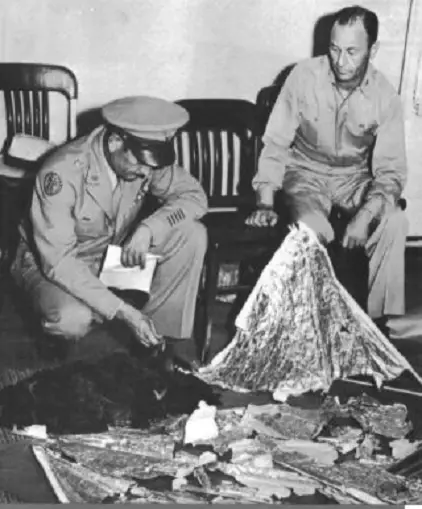
Eyewitnesses talk about observing debris from the 1947 crashed alien craft in Roswell

Eyewitnesses talk about observing debris from the 1947 crashed alien craft in Roswell

Roswell

The incident in Roswell, New Mexico, which happened in 1947, involved the recovery of rubber and metallic debris from a ranch. It sparked conspiracy theories about a flying saucer and the involvement of the US government. The debris was found by officers from the Roswell Army Air Field.

On July 8, 1947, the Roswell Army Air Field released a press release stating that it had recovered a flying saucer. However, it was later revealed that the object was a weather balloon. In 1994, the US Air Force identified the object as a surveillance balloon that was part of a nuclear test project known as Project Mogul.

The incident was not widely discussed during the 1970s. In an interview with Stanton Friedman, Jesse Marcel, a former lieutenant colonel, said that he believed that the debris found in Roswell was extraterrestrial. Ufologists then started promoting various conspiracy theories about the incident. They claimed that the saucer was an alien spacecraft, and that the military had recovered the occupants.

Despite the various conspiracy theories about the incident, the story about the incident continues to be talked about in the media. It has been regarded as the most thoroughly debunked UFO claim ever made.

0:00 Jesse Marcel Sr.

1:07 Jesse Marcel Jr.

3:05 Bill Brazel Jr., son of W.W. “Mac” Brazel

9:09 Marian Strickland, neighbor of W.W. “Mac” Brazel

11:20 Loretta Proctor, neighbor of W.W. “Mac” Brazel

RELATED VIDEOS, selected and posted by peter2011

{ https://www.latest-ufo-sightings.net/ }

Hoe vind je dit bericht?
Geschreven door peter om 15:25 Stuur door

JWST detects carbon dioxide in atmosphere of exoplanet for first time

JWST detects carbon dioxide in atmosphere of exoplanet for first time

The detection marks a new level of detail previously unmatched by other observatories.
Hoe vind je dit bericht?
Geschreven door peter om 21:14 Stuur door

Meer van UFO'S of UAP'S, ASTRONOMIE, RUIMTEVAART, ARCHEOLOGIE, OUDHEIDKUNDE, SF-SNUFJES EN ANDERE ESOTERISCHE WETENSCHAPPEN - DE ALLERLAATSTE NIEUWTJES

↑ Terug naar de berichten