Did Australia Attend AARO’s Secret 2025 UAP Workshop?
Newly released records hint at “Australian Government” involvement in the AARO-sponsored invite-only UAP data summit in August 2025...and an official response only deepens the mystery.
For years, the Australian Department of Defence has maintained a strict public persona regarding Unidentified Anomalous Phenomena (UAP): Move along folks, nothing to see here. Through official statements, parliamentary responses, and media brush-offs, those in positions of leadership in Defences have consistently assured the public that Australia does not track, investigate, or hold any institutional interest in UAP.
However, a newly declassified cache of documents tells a very different story. Behind closed doors, the Australian Government appears to be actively continuing its engagement with its US ally and Five Eyes partner on the UAP issue.
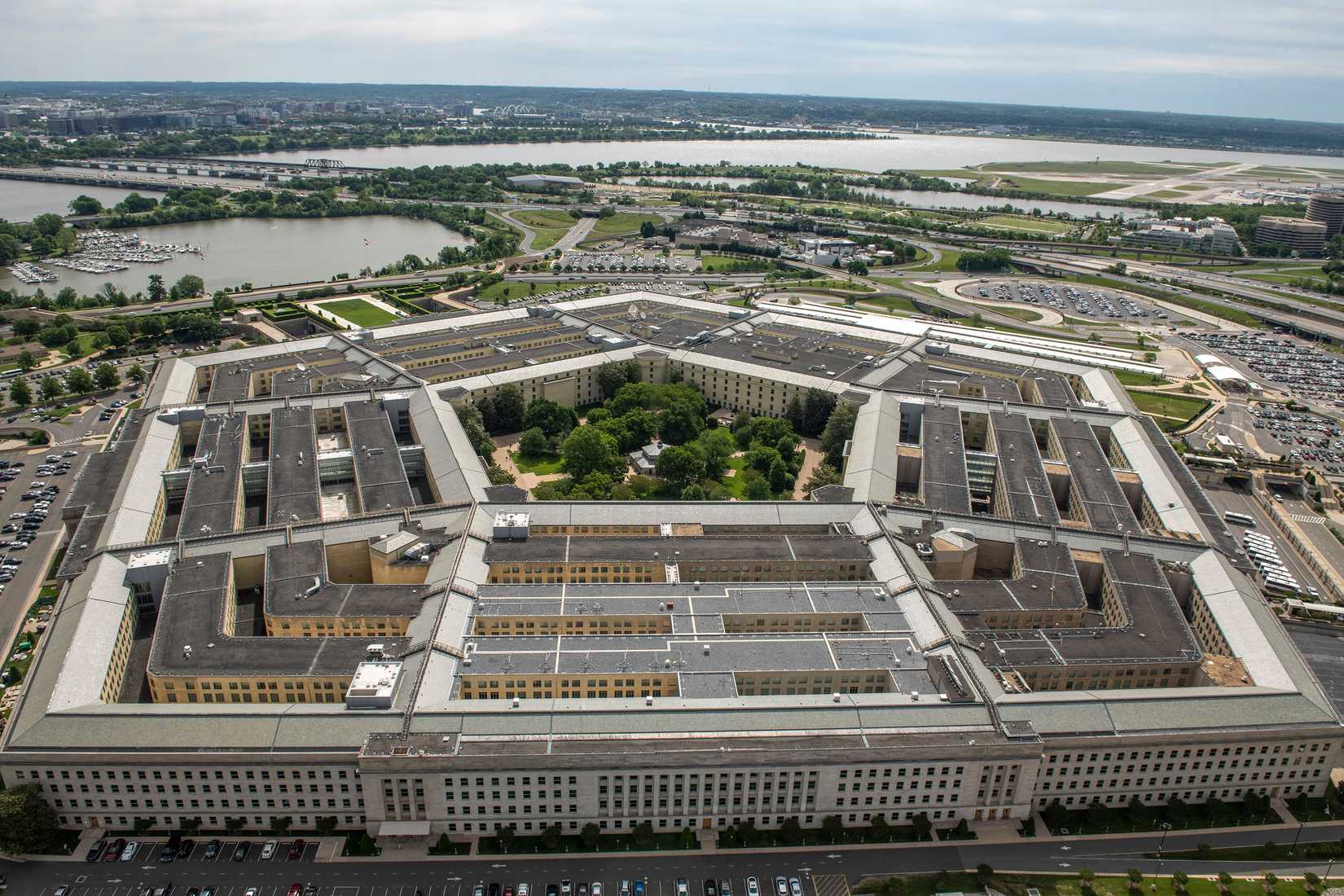
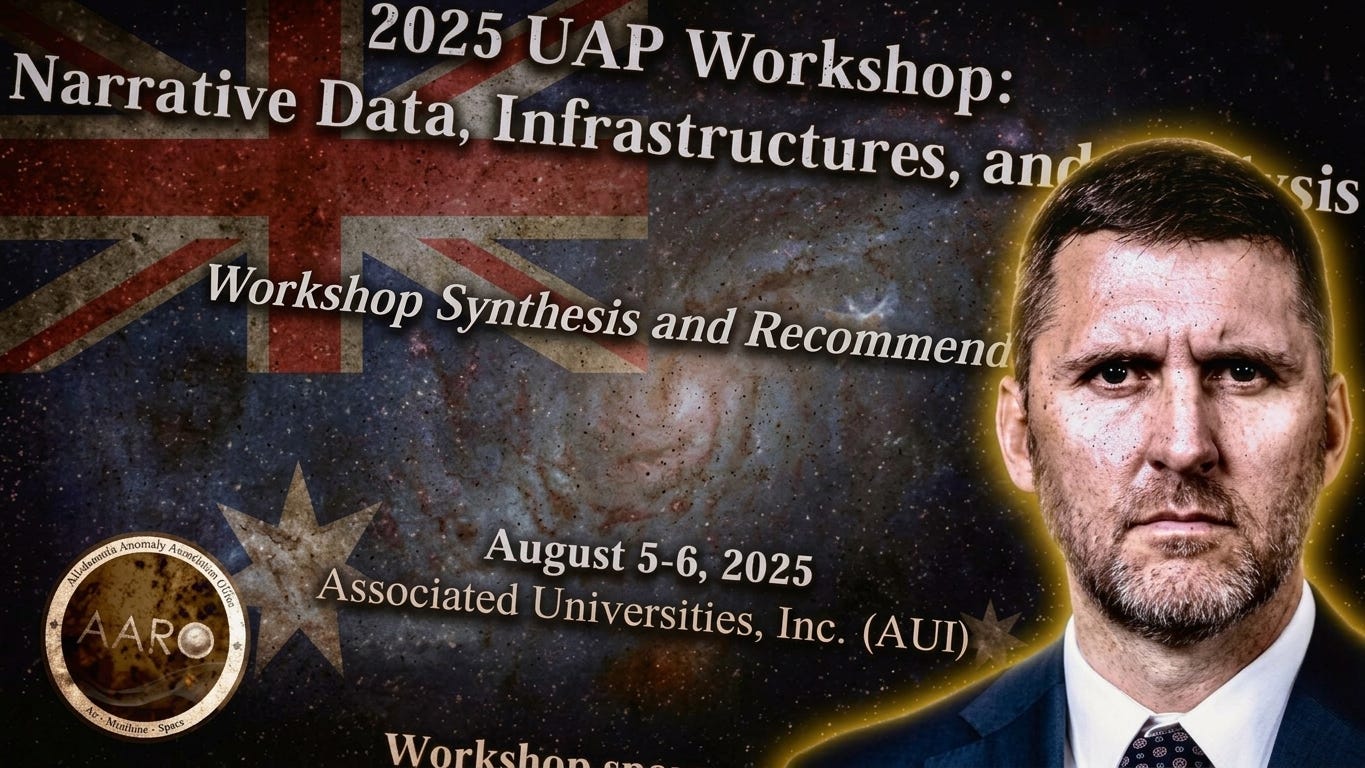
On 14 September 2026, the US Department of War issued a final response to a Freedom of Information Act (FOIA) request filed by John Greenewald of The Black Vault. The request, designated case number 26-F-1773 (available for download via The Black Vault), targeted records surrounding a highly private, invite-only UAP workshop held in early August 2025. Sponsored by the Pentagon’s All-domain Anomaly Resolution Office (AARO) and hosted by Associated Universities, Inc. (AUI) in Vienna, Virginia, the workshop was designed to tackle the complex challenges of UAP data collection, standardisation, and artificial intelligence integration.
The Pentagon identified 89 responsive pages, withholding 19 entirely under Exemption (b)(5) to protect deliberative decision-making processes. But what survived the redactor’s pen in the file is explosive.
Buried on page 39, nestled within an institutional roster that includes Harvard University, the RAND Corporation, and Uruguay’s official UAP commission, is an explicit entry for the “Australian Government”.
Source: The Black Vault (FOIA Case Number: 26-F-1773)
I received absolutely nothing in response. What a shocker.
Not resting on those laurels, I put the question to our friends across the pond. I asked a US Department of War official about the Australian Government’s participation in AARO’s August 2025 UAP Workshop.
The response I received on 3 October 2026 was a masterclass in bureaucratic deflection:
“We refer you to the government of Australia to comment on the activities of their personnel.”
While it is a classic runaround, it is also a tacit confirmation. They did not deny Australian attendance; they simply passed the buck back to a government that refuses to answer the mail.
Crucially, this is not an isolated incident. This is now the second official engagement we know Australia has participated in. Australia previously begrudgingly admitted that it attended AARO’s Five Eyes Inaugural UAP Caucus Working Group meeting back in May 2023 (refer article below):
We are witnessing a clear, established pattern: public denial paired with private, high-level intelligence and scientific engagement.
We know the workshop was unclassified and heavily focused on the academic and scientific hurdles of UAP research. The agenda centred on standardising metadata, natural language processing, deploying AI for pattern recognition, and integrating multi-domain sensor networks. Because of this strict scientific and systems-engineering focus, it is highly unlikely that a representative from the Defence Intelligence Organisation (DIO) was the primary attendee…even though a representative from the DIO attended AARO’s Five Eyes briefing at the Pentagon back in May 2023.
Instead, all signs point to the Defence Science and Technology Group (DSTG), whose role is stated on their website as follows:
DSTG brings together interdisciplinary expertise from across Australia and around the world to address Defence and national security challenges. Our role is to work closely with the Australian science, technology and innovation eco-system to deliver scientific advice and solutions that provide capability enhancement for Defence and the national security community.
According to the September 2024 Senate Estimates brief, the current Chief of Air Force, Air Marshal Stephen Chappell, and the Chief Defence Scientist, Professor Tanya Monro, are listed to lead on discussions and DSTG activities related to UAP. The DSTG provides direct support to the ADF to identify and classify objects detected by sensing technology.
The absurdity of this public posture is laid bare in parliamentary records. Despite the September 2024 brief asserting Professor Monro’s leadership on UAP, Defence explicitly denied any knowledge of AARO’s primary UAP sensor architecture just weeks later in response to Question on Notice no. 844 , answered on 19 December 2024. Defence stated: “The Defence Science and Technology Group (DSTG) are not performing UAP research, and therefore not collaborating with the US Department of Defense on this topic. DSTG have not been briefed on the alleged AARO Gremlin system.”
Source: Questions on Notice (Portfolio Question reference number 844)
The use of the word “alleged” to describe a well-documented Pentagon sensor suite betrays a staggering level of either institutional ignorance or deliberate obfuscation. If DSTG was entirely unaware of AARO’s flagship technology in late 2024, sending their top science attaché to an AARO data integration workshop in August 2025 represents a rapid and highly clandestine pivot.
However, Professor Monro was not likely to fly to Washington for a working-level data integration workshop. The most logical asset to send would be a Washington-based Defence Attaché.
Enter Darren J. Sutton.
Between May 2023 and October 2025, Sutton served as the Minister-Counsellor for the DSTG based at the Australian Embassy in Washington, DC. As the top defence science liaison in the US, he acted as the direct representative for Professor Monro, facilitating joint initiatives between Australia and the Pentagon’s vast research ecosystem.
Sutton is a defence science leader with over 35 years of experience. His portfolio includes deep involvement in US-Australia collaborations focused on artificial intelligence, autonomous uncrewed systems, and sensing capabilities. Functionally, he is the exact right asset for Australia to send to an event focused on building a centralised UAP data machine. While another possibility is Michael Docking - who currently holds the Minister-Counsellor role - the August 2025 timeline aligns perfectly with Sutton’s tenure.
Further supporting this theory is the logistical matrix found on page 41 of the FOIA release. The matrix maps attendee requirements for AUI-provided hotel accommodations. A Washington-based embassy attaché wouldn’t require a hotel in Vienna, Virginia, easily explaining how an Australian representative could seamlessly integrate into the daily sessions without generating a large logistical footprint.
Source: The Black Vault (FOIA Case Number: 26-F-1773)
AARO provided a specific list of topics they wished to discuss with CRIDOVNI, including their analytical methods, how they analyse narrative data for cases with little technical backing, and their scientific partnerships across South America. AARO even admitted they were already planning a “follow-on data workshop in early 2026” and asked for help networking with other South American UAP organisations.
The workshop itself featured heavy hitters from the civilian research world. Robert Powell of the Scientific Coalition for UAP Studies (SCU) co-delivered the keynote address. The SCU’s presentation material highlighted the fragmented state of current UAP databases and the dire need for standardised investigator training and natural language processing to triage the noise. Interestingly, the SCU presentation explicitly cited historical UAP archives maintained by Australia and New Zealand, demonstrating that Australian military records are recognised internationally as essential datasets.
Source: Scientific Coalition for UAP Studies (SCU)
While a DSTG representative was likely sitting in a room in Virginia discussing how to use machine learning to synthesise anomalous sensor data and triage UAP reports, the Royal Australian Air Force (RAAF) was dealing with a massive wave of unidentified drone incursions back home.
Between 11-13 July 2026, multiple incursions of unidentified objects - described officially as “drones” - breached the restricted airspace over RAAF Base Williamtown, Australia’s premier fighter base housing our F-35s:
The official mitigating strategy handed down to the military personnel on base?
Close your window blinds.
Just days ago, on 2 October 2026, DefenseScoop reported that US Secretary of War Pete Hegseth issued a forceful new directive aimed at rapidly accelerating the deployment of counter-drone technologies. In a decisive memorandum, Hegseth declared that “protection against the threat of drones will not be delayed by self-imposed restrictions,” ordering the Pentagon to slash bureaucratic red tape and compress operational approval timelines from months to mere days. The US military’s joint counter-drone task force, JIATF-401, echoed this exact urgency, stating they “will not accept a slow-moving bureaucracy when faced with a fast-moving threat”.
This aggressive American posture stands in blistering contrast to the Australian response. While the Pentagon is fundamentally overhauling its acquisition pathways to defeat the drone threat immediately, the RAAF is literally shutting the curtains. The implications for Australia are severe: it highlights a dangerous domestic complacency and exposes a widening capability gap between the ADF and our primary security ally. If Australia intends to maintain its standing within the AUKUS framework and interoperate seamlessly with US forces, Canberra cannot afford to let procedural sluggishness dictate its response to incursions over sensitive installations. We must adopt the same urgency Hegseth is demanding in Washington, or risk becoming a highly vulnerable link in the allied defence chain.
What makes Australia’s silence even more indefensible is that AARO’s portfolio is no longer confined strictly to the exotic. Under the fiscal 2025 National Defense Authorization Act (NDAA), AARO is explicitly required to liaise and team up with the Pentagon’s new counter-drone (C-UAS) task force. Alongside its core UAP mission, the office is actively assisting the US Department of War in formulating detection, identification, and mitigation strategies for hostile or unauthorised drone incursions across sensitive military airspace. AARO is building the sensor architectures, sensor-fusion algorithms, and rapid-triage pipelines intended to separate benign clutter and foreign surveillance drones from true anomalous craft. If Australia’s Defence Science and Technology Group (DSTG) is quietly liaising with AARO, it strongly suggests Canberra recognises that the Pentagon’s anomaly-resolution framework - now legally intertwined with America’s counter-drone mission - holds the keys to solving our own domestic drone dilemma. Yet rather than leveraging this partnership openly to harden our bases and reform outmoded engagement protocols, Defence leaders continue to bury their heads in the sand - leaving frontline personnel vulnerable while the critical technical solutions remain trapped behind closed doors.
If the RAAF cannot effectively mitigate the risks of known drone technologies, what hope do they have against true UAP? It is a staggering dereliction of duty, and it perfectly encapsulates the absurdity of the current paradigm. Defence leaders tell base personnel to shut their blinds to avoid the problem, while simultaneously sending attachés to secret Pentagon workshops to learn how to track it.
It is time for the Australian public, and our elected representatives, to demand accountability. Defence Minister Richard Marles and the Chief of the Defence Force need to answer basic questions:
Which department authorised attendance at AARO’s August 2025 workshop?
What briefings were provided back to Canberra?
And why is this critical national security collaboration remaining entirely undisclosed to the public?
It’s clear the Australian Government is actively looking for the truth…they just don’t want us to know.
- About Grant Lavac
Grant is a UAP activist, researcher and podcaster residing in Melbourne, Australia. Grant frequently leverages the Freedom of Information Act to better understand Australia’s involvement (or rather, lack thereof) on the UAP issue, and engages both his elected representatives and the legacy media in the hope they’ll take the topic seriously and treat it with the respect it deserves. Grant reports on his FOIA findings and engagement efforts via his podcast, The Unexplained Rundown, which is freely available on Spotify and YouTube. To follow Grant’s ongoing research, visit grantlavac.com.
{ https://substack.com/?utm_content=island-substack-logo }


 David Grusch Says He Never Saw a Reptilian Himself but Claims US Personnel Shot Them After a UFO Crash