Ontdek de Fascinerende Wereld van UFO's en UAP's: Jouw Bron voor Onthullende Informatie!
Ben jij ook gefascineerd door het onbekende? Wil je meer weten over UFO's en UAP's, niet alleen in België, maar over de hele wereld? Dan ben je op de juiste plek!
België: Het Kloppend Hart van UFO-onderzoek
In België is BUFON (Belgisch UFO-Netwerk) dé autoriteit op het gebied van UFO-onderzoek. Voor betrouwbare en objectieve informatie over deze intrigerende fenomenen, bezoek je zeker onze Facebook-pagina en deze blog. Maar dat is nog niet alles! Ontdek ook het Belgisch UFO-meldpunt en Caelestia, twee organisaties die diepgaand onderzoek verrichten, al zijn ze soms kritisch of sceptisch.
Nederland: Een Schat aan Informatie
Voor onze Nederlandse buren is er de schitterende website www.ufowijzer.nl, beheerd door Paul Harmans. Deze site biedt een schat aan informatie en artikelen die je niet wilt missen!
Internationaal: MUFON - De Wereldwijde Autoriteit
Neem ook een kijkje bij MUFON (Mutual UFO Network Inc.), een gerenommeerde Amerikaanse UFO-vereniging met afdelingen in de VS en wereldwijd. MUFON is toegewijd aan de wetenschappelijke en analytische studie van het UFO-fenomeen, en hun maandelijkse tijdschrift, The MUFON UFO-Journal, is een must-read voor elke UFO-enthousiasteling. Bezoek hun website op www.mufon.com voor meer informatie.
Samenwerking en Toekomstvisie
Sinds 1 februari 2020 is Pieter niet alleen ex-president van BUFON, maar ook de voormalige nationale directeur van MUFON in Vlaanderen en Nederland. Dit creëert een sterke samenwerking met de Franse MUFON Reseau MUFON/EUROP, wat ons in staat stelt om nog meer waardevolle inzichten te delen.
Let op: Nepprofielen en Nieuwe Groeperingen
Pas op voor een nieuwe groepering die zich ook BUFON noemt, maar geen enkele connectie heeft met onze gevestigde organisatie. Hoewel zij de naam geregistreerd hebben, kunnen ze het rijke verleden en de expertise van onze groep niet evenaren. We wensen hen veel succes, maar we blijven de autoriteit in UFO-onderzoek!
Blijf Op De Hoogte!
Wil jij de laatste nieuwtjes over UFO's, ruimtevaart, archeologie, en meer? Volg ons dan en duik samen met ons in de fascinerende wereld van het onbekende! Sluit je aan bij de gemeenschap van nieuwsgierige geesten die net als jij verlangen naar antwoorden en avonturen in de sterren!
Heb je vragen of wil je meer weten? Aarzel dan niet om contact met ons op te nemen! Samen ontrafelen we het mysterie van de lucht en daarbuiten.
A team of Ohio State University (OSU) scientists has revealed a cutting-edge process using an electrically powered high-energy laser that can turn ordinary moon dust into several futuristicmaterials that can be fabricated into useful tools and materials.
They also added different base materials, such as stainless steel and aluminum-silica ceramics, to the 3D-printed tools and structures made from laser-converted moon dust to determine which materials offered the greatest benefits in terms of strength, simplicity, and durability.
The OSU researchers said their approach could be used by future lunar colonists to create tools, habitats, and other necessary items and structures with only a small amount of material added to the base lunar regolith.
High-Powered Laser and Moon Dust Fused into Different Objects
As procuring actual lunar regolith was impractical, the OSU team started with a simulated moon dust made to match the authentic regolith’s material and chemical composition. According to a statement announcing the process, the team loaded the simulant into a 3D printer and printed rigid, stackable sheets that could be formed into different tools and objects.
To assess the viability of the printed sheets for various manufacturing and construction applications, the research team used a high-energy laser to melt regolith onto a base material, such as stainless steel. This process fused the simulated moon dust to the base material, resulting in a hybrid compost material with unique properties.
For example, tests using a simulant called LHS-1, which mimics the soil found in the lunar highlands, showed that the material did not adhere to stainless steel. However, the same simulated, dark-covered basalt rock moon dust bonded well with alumina-silicate ceramic. The team said they suspect the silicate and lunar regolith bonded well because both compounds form crystals that “enhance thermal stability and mechanical strength.”
“By combining different feedstocks, like metal and ceramics, in the printing process, we found that the final material is really sensitive to the environment,” explained Sizhe Xu, lead author of the study detailing the process and a graduate research associate in industrial systems engineering at The Ohio State University.
Test Reveal Unique Compositions Under Varying Atmospheric Conditions
Because future moon colonists will operate in hazardous conditions, the team tested their moon dust laser fabrication process under various environmental conditions. According to the team’s statement, these tests revealed that the overall quality of a material produced by their approach “depends greatly on the surface onto which the soil is printed.”
“Different environments lead to different properties, which directly affect the mechanical strength and the thermal shock resistance of certain components.”
Artist’s concept of a future moon base (Credit: ESA – P. Carril)
Along with the material’s manufacture and composition, experiments revealed that environmental factors such as oxygen availability and fabrication factors such as laser power can affect the stability of the final structure made from the hybrid material.
“There are conditions that happen in space that are really hard to emulate in a simulant,” explained Sarah Wolff, senior author of the study and an assistant professor in mechanical and aerospace engineering at Ohio State. “It may work in the lab, but in a resource-scarce environment, you have to try everything to maximize the flexibility of a machine for different scenarios.”
There Are so Many Applications That We’re Working Toward
When discussing potential applications of their high-energy laser-based moon dust fabrication process, the OSU team noted that future lunar colonists will need to be able to build tools and structures using local resources rather than transporting heavy equipment and materials from Earth. They also noted that such tools and structures must be specially engineered to “survive extreme vacuum, dust and thermal environmental conditions.”
“The promise of these technologies would not only save essential mission time but also allow for extended independence as crews travel into deep space,” they explained.
Moving forward, the team is exploring the challenges moon colonists may face when using local resources. For example, their laser uses electric power, which can be generated using solar collectors or other hybrid power architectures.
“There are so many applications that we’re working toward that with new information, the possibilities are endless,” Xu said.
Although the process is designed for future moon colonists, the researchers suggest that their approach could lead to improved, more energy-efficient processes and potentially address material shortages on Earth.
“If we can successfully manufacture things in space using very few resources, that means we can also achieve better sustainability on Earth,” Wolff explained. “To that end, improving the machine’s flexibility for different scenarios is a goal we’re working really hard toward.”
Christopher Plain is a Science Fiction and Fantasy novelist and Head Science Writer at The Debrief. Follow and connect with him onX,learn about his books atplainfiction.com, or email him directly atchristopher@thedebrief.org.
Asteroid impacts may catapult life from one planet to another, as new research from Johns Hopkins University suggests that hardy bacteria can survive both the violent ejection from a planet and the journey through space.
In a recent paper published in PNAS Nexus, the Johns Hopkins team determined that bacteria can survive not only the intense pressure of an asteroid impact but also the harsh conditions of space. This has major implications for the precautions future space missions will need to take to avoid contaminating other planets with foreign life.
Moving Life From Planet to Planet
“Life might actually survive being ejected from one planet and moving to another,” said senior author K.T. Ramesh. “This is a really big deal that changes the way you think about the question of how life begins and how life began on Earth.”
Space is a violent place, as evidenced by the scars covering most bodies in our solar system. Some of the areas researchers are most interested in investigating on Mars with robotic rovers are the result of ancient impacts, such as Jezero Crater. In a dry riverbed within that crater, the Perseverance Mars rover collected a sample of organic material in 2024 that may represent one of the most significant signs yet of possible life on the Red Planet.
The Johns Hopkins team is investigating the possibility that such strikes could transport living organisms into space, riding on material ejected during an impact—a theory known as lithopanspermia. Meteorites originating on Mars have been discovered on Earth, demonstrating that material can travel from one planet to another. The key question, however, is whether any life could survive the journey.
Can Life Survive Impact?
The Johns Hopkins team was not the first to test this hypothesis, but earlier work was inconclusive. Additionally, those tests focused on common Earth organisms rather than extremophiles that would be more likely to survive on less hospitable planets. For a more realistic evaluation of the lithopanspermia hypothesis, the team developed a method to replicate the pressures involved in an ejection event and focused on a single extremophile: Deinococcus radiodurans.
Native to Chile’s high deserts, Deinococcus radiodurans possesses several traits that the team suspected would make it resilient to space travel. Among these are its tolerance for extreme cold and radiation. Additionally, the microorganism is protected by a thick, self-repairing outer structure.
“We do not yet know if there is life on Mars, but if there is, it is likely to have similar abilities,” Ramesh said.
The impact test involved placing the microbe between two metal plates and firing a projectile at it from a gas gun at 300 mph. Pressures experienced during the impact equaled ten to thirty times those at the bottom of the Mariana Trench, the deepest point in Earth’s oceans. The team found the microorganism remarkably resilient, detecting ruptured membranes and internal damage only at the highest impact levels. In fact, the steel plates broke before the bacteria did.
“We expected it to be dead at that first pressure,” said lead author Lily Zhao. “We started shooting it faster and faster. We kept trying to kill it, but it was really hard to kill.”
Comparing the Results
While the microorganism exceeded researchers’ expectations, asteroid impacts on Mars could be even more powerful than the forces simulated in the laboratory tests. Extremely powerful pressures are measured in gigapascals. The projectile striking the steel plates produced pressures ranging from one to three gigapascals. The higher end of that range was previously believed to be too extreme for life to survive. However, fragments ejected during an asteroid impact may experience pressures approaching five gigapascals.
“We have shown that it is possible for life to survive large-scale impact and ejection,” Zhao said. “What that means is that life can potentially move between planets. Maybe we’re Martians!”
The team says their research suggests future space missions will need to be even more cautious than previously estimated to avoid contaminating one planet with life from another, given how resilient extremophiles may be.
“We might need to be very careful about which planets we visit,” Ramesh added.
To follow up on the relationship between life and space impacts, the team is now investigating whether repeated asteroid impacts might produce even hardier bacterial populations, and whether other organisms—such as fungi—may also be able to withstand impact conditions.
Ryan Whalen covers science and technology for The Debrief. He holds an MA in History and a Master of Library and Information Science with a certificate in Data Science. He can be contacted at ryan@thedebrief.org, and follow him on Twitter @mdntwvlf.
This image, taken on January 1, is the clearest view yet of an ancient object in the far reaches of the solar system, which resembles a snowman (Picture: NASA/Johns Hopkins University Applied Physics Laboratory/Southwest Research Institute/Cover Media)
An American student has resolved the longstanding mystery of one our solar system’s strangest objects – cosmic ‘snowmen’ that populate its outer reaches.
Astronomers have long debated why the globular icy objects look the way that they do.
But researchers at Michigan State University now say they have evidence that a surprisingly simple process could explain how these shapes form.
Beyond the turbulent asteroid belt between Mars and Jupiter lies the Kuiper Belt, a vast region past Neptune filled with icy remnants from the birth of the solar system.
These ancient building blocks, known as planetesimals, have remained largely untouched for billions of years.
Around one in ten are “contact binaries” – objects made up of two connected spheres, reminiscent of a snowman.
How they formed without being smashed together by violent collisions has remained an open question.
Now Jackson Barnes, a graduate student at the university, has developed the first computer simulation to show how such two-lobed shapes can arise naturally through gravitational collapse.
This is the process by which matter contracts under its own gravity, overpowering forces that would otherwise pull it apart. The research has been published in Monthly Notices of the Royal Astronomical Society.
An artist’s concept of a Kuiper Belt object, again resembling a snowman (Picture: Cover Media)
Earlier computer models treated colliding objects as fluid-like blobs that quickly merged into single spheres, making it impossible to recreate contact binaries.
But using high-performance computing facilities, Barnes’ simulations instead allow objects to retain their strength and settle gently against one another.
Other theories have suggested that rare events or exotic conditions might be required to produce these shapes, but researchers say such explanations are unlikely to account for their apparent abundance.
‘If we think 10% of planetesimal objects are contact binaries, the process that forms them can’t be rare, said earth and environmental science assistant professor Seth Jacobson, the study’s senior author.
‘Gravitational collapse fits nicely with what we’ve observed.’
Contact binaries were first seen in close detail in January 2019, when NASA’s New Horizons spacecraft flew past a Kuiper Belt object later nicknamed Ultima Thule.
The images prompted scientists to re-examine other distant bodies, revealing that about 10% of planetesimals share the same distinctive shape.
In the sparsely populated Kuiper Belt, these objects drift largely undisturbed and are rarely hit by other debris.
An artist’s impression of NASA’s New Horizons spacecraft encountering 2014 MU69, a Kuiper Belt object that orbits one billion miles beyond Pluto (Picture: Cover Media)
In the early history of the Milky Way, the galaxy consisted of a disc of gas and dust. Remnants of that era persist in the Kuiper Belt today, including dwarf planets such as Pluto, along with comets and planetesimals.
Planetesimals are among the first solid bodies to form as dust and pebble-sized material clumps together under gravity. Much like snowflakes compressed into a snowball, they are loose aggregates pulled from clouds of tiny particles.
Barnes’ simulation shows that as one of these clouds rotates, it can collapse inward and split into two separate bodies that begin orbiting each other.
Such binary planetesimals are commonly observed in the Kuiper Belt. Over time, their orbits spiral closer until the pair gently touch and fuse, preserving their rounded shapes.
The reason these fragile-looking structures survive for billions of years, Barnes explains, is simple chance.
In such a remote region, collisions are rare. Without a major impact, there is little to pull the two bodies apart, and many contact binaries show few, if any, impact craters.
Scientists have long suspected gravitational collapse was responsible, but until now they lacked models capable of testing the idea properly.
‘We’re able to test this hypothesis for the first time in a legitimate way,’ Barnes said. ‘That’s what’s so exciting about this paper.’
He believes the model could also help researchers understand more complex systems involving three or more bodies. The team is already working on simulations that better capture the details of the collapse process.
As future space missions venture deeper into the outer solar system, the researchers say the familiar snowman shape may turn out to be far more common than once thought.
One low-quality image he saw showed a shape, ‘a big straight kind of silvery line… cigar-shaped object… smooth… no lines’, above Earth.
He said the image loaded line by line as his dial-up internet struggled, explaining: ‘There’s like blackness, then there’s like slowly a hemisphere started appearing, and I’m thinking that’s a planet.
‘This thing looked very smooth on the outside. There were no lines… no screws and bolts and stuff.’
The computer expert said there was a list of ‘nonterrestial officers’
(Picture: Jesse Michels)
The hacker in the early 2000s shortly after his arrest (Picture: Jesse Michels)
While scrolling, he alleged that his mouse was suddenly hijacked, saying: ‘They right-clicked, disconnected and boom, that was it. I was cut out.’
He also found a spreadsheet labelled ‘nonterrestrial officers’, referring to something that does not originate from Earth, McKinnon claimed.
He added: ‘It had ship names… and… fleet-to-fleet transfers.’
McKinnon also claimed found testimony from former NASA contractor Donna Hare saying she was shown an image of a disc over Earth.
Such anomalies are scrubbed clean from any images released to the public, Hare said, according to McKinnon.
McKinnon quoted one of her colleagues saying: ‘Well, we always have to airbrush them out before we sell them to the public.’
Nasa has been approached for comment.
Hacking, McKinnon said, isn’t quite being hunched over a computer in a hoodie.
‘I was in my dressing gown up till like four in the morning, smoking weed, drinking beer, just like ride of my life really,’ he said, adding he used a 56k dial-up modem.
McKinnon had spent years interested in UFOs and other space-age tech, like pollution free energy, after seeing an ‘orange light’ in the sky as a child.
Inspired by the Disclosure Project book by Steven Greer, he decided to try to pry open secretive government systems for evidence in March 2001.
McKinnon was arrested by police at his flat in Wood Green, north London, in March 2002, with investigators acting on allegations from the US.
Officials released footage taken in 2004 of Navy pilot tracking a UFO (Picture: Sharilyn Neidhardt)
American authorities said that McKinnon hacked into US army, navy, air force, Department of Defense and Nasa computers 16.
This caused £487,000 worth of damage to computers in 2001 and 2002, officials said.
If he was convicted, McKinnon could have spent 70 years behind bars only for an extradition order to be blocked by then-prime minister, Theresa May, on human rights grounds.
McKinnon, known as ‘Solo’ online, stressed he never acted with malicious intent and positioned himself as a truth-seeker. He admitted to obtaining unauthorised access to US government computer systems.
Asked by Michels why he did this, McKinnon said: ‘I wanted it from the horse’s mouth. I didn’t want to just believe.
NASA’s Curiosity Mars rover captured a series of black and white panoramas at two times of day which were then merged together. Colour was added to help different details stand out in the landscape (Picture: NASA/JPL-Caltech/MSSS/Cover Images)
Nasa’s Curiosity rover has been investigating the spider-web-like rock formations found on Mars – and found mysterious egg-like structures.
Newly issued images show giant zig-zagging ridges, known as ‘boxwork’, spread across the slopes of Mount Sharp inside Gale Crater.
Some of the close-up photographs reveal small, rounded spheroids scattered across the formations, features not previously seen on Mars.
Over the past eight months, Curiosity has been closely examining these interconnected rocky ridges, which stretch across an area up to 12 miles (20km) wide.
Scientists believe the structures formed billions of years ago, when groundwater flowed beneath the Martian surface, depositing minerals that later hardened into ridges as surrounding rock was eroded by wind.
From orbit, the formations resemble enormous spiderwebs etched into the landscape.
Nasa’s Curiosity Mars rover captured this panorama of boxwork formations — the low ridges seen here with hollows in between them — using its Mastcam on September 26 (Picture: NASA/JPL-Caltech/MSSS/Cover Media)
Although they were first identified by spacecraft in 2006, their remote location meant they remained largely unexplored until Curiosity arrived.
For about six months, the rover has been driving across the low ridges, which stand roughly three to six feet (one to two metres) tall, with sandy hollows in between.
The patterns suggest groundwater was present in this region later in Mars’ history than scientists had previously thought, raising fresh questions about how long microbial life might have survived on the planet.
To explain the shapes, researchers believe water once flowed through fractures in the bedrock, leaving minerals behind. These minerals strengthened certain areas, forming ridges, while the surrounding rock without this reinforcement was gradually worn away.
Until Curiosity reached the site, scientists were unsure what the formations would look like at ground level or how difficult they would be to traverse.
As the rover climbed higher up Mount Sharp, which rises about 3 miles (5km) above the crater floor, the layers of rock show evidence of Mars’ changing climate. Higher layers suggest increasingly dry conditions, interrupted by occasional wet periods when rivers and lakes may have returned.
Scientists think that ancient groundwater formed this weblike pattern of ridges, called boxwork, that were captured by NASA’s Mars Reconnaissance Orbiter in 2006 (Picture NASA/Cover Media)
Tina Seeger, of Rice University, is one of the scientists leading the investigation.
‘Seeing boxwork this far up the mountain suggests the groundwater table had to be pretty high,’ she said.
‘And that means the water needed for sustaining life could have lasted much longer than we thought looking from orbit.’
Previous orbital images had shown dark lines running through the spiderweb-like patterns. Scientists had suggested these might be fractures where groundwater once flowed.
Curiosity’s close-up investigations have now confirmed that these lines are indeed fractures.
The rover has also identified small, bumpy egg-like features known as nodules, which are considered clear signs of past groundwater activity.
However, scientists were surprised to find that the nodules were located along the sides of ridges and in the hollows, rather than near the central fractures.
‘We can’t quite explain yet why the nodules appear where they do,’ Seeger said. ‘Maybe the ridges were cemented by minerals first, and later episodes of groundwater left nodules around them.’
These bumpy nodules were formed by minerals left behind as groundwater was drying out on Mars billions of years ago. NASA’s Curiosity rover captured images of these pea-size features while exploring boxwork formations last August (Picture: NASA/JPL-Caltech/MSSS/Cover Media)
Curiosity has drilled several rock samples from the region, analysing the powdered material using X-rays and high-temperature ovens inside the rover. The results have revealed clay minerals in the ridges and carbonate minerals in the hollows, offering further clues to how the formations developed.
A more recent sample was analysed using a specialised wet-chemistry technique designed to help detect organic compounds, carbon-based molecules considered important to the origins of life.
The rover is expected to leave the boxwork region in March and continue exploring a wider sulfate-rich layer of Mount Sharp.
Scientists hope the ongoing mission will provide further insight into how Mars’ climate evolved billions of years ago, transforming the planet from one with flowing water into the cold, dry world seen today.
Declassified documents from over three decades ago have revealed how an encounter with a suspectedUFO at the south pole was covered up.
The records unsealed this year by Argentina's Ministry of Foreign Affairs have confirmed an eyewitness account from 1991, when military personnel and civilian researchers in Antarctica detected and then saw a large flying saucer over their base.
Miguel Amaya, a retired Argentine Air Force non-commissioned officer, told UFO investigators in the early 2000s that he was stationed at General San Martín Base, a small scientific and military station on a tiny island in Antarctica in April of that year.
At the start of the polar night, when the sun stays down for months, an alarm went off on the station's riometer, a machine that measures changes in the upper atmosphere.
Despite the three needle pens measuring different heights of the ionosphere, the part of the atmosphere where solar radiation ionizes atoms, all of the needles began drawing the same pattern, which is scientifically impossible.
According to Amaya, outpost personnel claimed that the strange readings could only have been caused by something producing the same energy as a nuclear aircraft carrier or a large city floating over Antarctica.
Hours later, another base member was walking outside during a snowstorm when they allegedly saw 'a huge circle of light' moving slowly and silently right over the building.
The 1991 incident has finally come to light after Amaya claimed he and the other members at General San Martín Base were told never to talk about what they had seen by their superiors.
General San Martín Base, a small scientific and military station in Antarctica used by Argentina
Over 120 feet of paper was reportedly used during the four-and-a-half hour incident at General San Martín Base, with Amaya revealing that the needles were moving so violently they went off the paper multiple times.
'This equipment started registering normally, but after five minutes, the three indicator needles began to make the same marks, which the engineer explained was impossible,' Amaya said in his CEFORA interview, translated to English.
'At times, these "signals" would cut out, and everything would continue as normal. Then, for periods of ten or fifteen minutes, it would start again, sometimes with such force that the needles would jump off the belt.'
The incredible readings started around 1am local time and carried on through the night. Roughly 16 hours later at 10pm, Amaya said a radio operator from the Argentine Army saw the mysterious craft as he left the base on a walk.
'He noticed a huge circle of light, very dim due to the cloud cover, passing above the base, but still visible, and moving very slowly and silently towards the sea,' Amaya claimed in his testimony.
The meteorological observer noted that by the time the man who saw the UFO could call for the rest of the base to come out and view it, the craft had disappeared.
The three needles on the riometer's graphic recorder were supposed to show independent readings because they measured different aspects of radio wave absorption in the ionosphere, which sits 30 to 600 miles above the surface.
Normally, natural events like solar flares or auroras cause different patterns on each needle, since absorption varies by frequency, with lower frequencies getting absorbed more or at different altitudes than higher ones.
Riometer papers from General San Martín Base in 1991 which recorded a strange atmospheric disturbance over Antarctica
Argentina's Ministry of Foreign Affairs revealed that nine rolls of records from the 1991 incident still exist and have been stored in the Argentine Antarctic Institute
This means the needles should have been drawing distinct patterns on the night the UFO was allegedly spotted. For example, one might have shown stronger spikes while another showed milder changes if this had been a normal phenomenon.
This synchronization could only have taken place if a massive, external energy source was directly overhead, overriding the separate signals of the riometer.
An Argentine civilian UFO research group known as CEFORA pushed for the records to be released under the nation’s public information law.
The Ministry of Foreign Affairs confirmed that the original paper rolls, which recorded the strange readings over Antarctica, still exist and have been stored at the Argentine Antarctic Institute.
CEFORA interviewed Amaya about the incident prior to going public with his story on a Spanish radio program in 2009.
CEFORA's director, Andrea Simondini, had been fighting to have the official records of that UFO encounter and others released for more than 15 years.
Now that the records have been unsealed, images proving something unexplainable interfered with the base's riometer have been shared for the first time.
'This is just the first test case we can verify under this method, and it raises expectations for the continued declassification of other files,' she stressed in a statement translated to English.
In the US, UFO disclosure has also reached a fever pitch, with President Trump ordering Secretary of War Pete Hegseth and the Pentagon to release all documents related to government investigations on the UFOs and extraterrestrial life.
To this point, however, the US has maintained that there has never been any physical evidence found proving that aliens or non-human spacecraft exist.
On the penultimate day of winter, NASA decided to revise the route of its Artemis program space expedition to the Moon. The revised plans no longer mention landing on the surface of our natural satellite.
Illustration of the Starship spacecraft docked with NASA’s Orion orbital module. Credit: Space.com
The most significant change affected the Artemis III mission, which was planned as humanity’s triumphant return to the Moon since Apollo. Previously, it was assumed that this crew would use SpaceX’s giant Starship spacecraft as a landing vehicle.
Starship HLS spacecraft on the Moon. Illustration: SpaceX
According to the updated plans, the Artemis III flight will take place in 2027, but the astronauts will remain in Earth orbit. Instead of landing, the mission will turn into a grand technological experiment: the Orion capsule is to dock with commercial landing modules. And here lies the intrigue — these will be spacecraft not only from SpaceX, but possibly also from competitors at Blue Origin.
Starship loses priority
The main reason for this decision lies in SpaceX’s hangars. Despite 11 test launches, Starship has not yet reached Earth’s orbit. The pace of development of the mega-rocket does not suit NASA management, which is accustomed to working to a tight schedule.
The SpaceX Starship refueler pumps fuel into another Starship in low Earth orbit (top), as well as the Orion docking with Starship HLS before landing on the Moon. Illustration: SpaceX
Experts believe that the problem lies not only in technology, but also in strategy. “NASA no longer wants to depend on a single contractor,” explains Don Platt, professor at the Florida Institute of Technology. That is why the space agency is deliberately pitting two giants against each other: SpaceX and Blue Origin, creating healthy competition for a place in history.
New strategy: slow but steady
Blue Origin, founded by Amazon owner Jeff Bezos, unexpectedly got a chance to take center stage earlier than planned. Their Blue Moon landing vehicle was being prepared for the Artemis V mission as early as 2030. But now, everything seems to show that NASA wants to test it during Artemis III.
Blue Moon MK1 spacecraft (concept). Source: Blue Origin
The company itself senses victory. In January, Blue Origin suspended its suborbital tourist flights, devoting all its resources to accelerating the development of a lunar module. The company states that this is a deliberate step toward the “national goal of returning to the Moon.”
So now, the first actual landing of astronauts on the Moon has been postponed until at least 2028, when it will be carried out by the Artemis IV mission. Another launch may take place in the same year as part of Artemis V.
NASA has decided to proceed cautiously. The agency plans to increase the frequency of flights, but at the same time standardize the rockets. The more powerful but unproven versions of the Space Launch System (SLS) rockets were temporarily abandoned in favor of the proven Block I configuration.
Get ahead of China
There is a third player in the unfolding race that is making even NASA rush. China plans to land its taikonauts by 2030.
NASA administrator Jared Isaacman makes no secret of his true motives: “Competition from our biggest geopolitical rival is getting tougher every day. We need to move faster.” He compares the new strategy to the approach taken during the Apollo program: gradual increase in flight frequency, logic, and standardization. This, in his opinion, will enable America to once again “achieve the nearly impossible” and not concede primacy to Beijing in the new lunar era.
A bone-chilling document declassified by the CIA has exposed an alleged massacre by aliens from a crashed UFO who turned an entire military unit into stone.
According to the report, Soviet troops shot down a flying saucer hovering over the Soviet military unit in Siberia roughly 35 years ago, and what happened next was truly terrifying.
In the document, summarizing a 250-page top secret file acquired by US intelligence agents, eyewitnesses said five aliens climbed out of their wrecked craft, combined themselves into one creature, exploded in a burst of intense energy, and turned 23 soldiers into solid rock.
One CIA official referred to the shocking battle as 'a horrific picture of revenge on the part of extraterrestrial creatures, a picture that makes one's blood freeze.'
The agency added that the 'extremely menacing case' proved the aliens who visited Earth possessed weapons and technology far beyond the US government's 'assumptions' - suggesting they were already aware of the aliens' existence.
The unearthed document, declassified in 2000, was recently the topic of the AI or Evil podcast, where host Josh Hooper revealed that two of the soldiers at the UFO crash site actually survived the encounter.
However, the 23 'petrified soldiers' could not be saved. Their remains and the debris from the spacecraft were reportedly moved to a secret research base near Moscow.
An even more concerning detail of the CIA file is the description of the aliens reportedly involved in this massacre, who have been mentioned in UFO reports and sightings for nearly 80 years.
A declassified CIA document revealed details of an alleged battle between Soviet forces and an alien spacecraft, which ended with 23 soldiers dead
During a training mission in Siberia, the Soviet military reportedly shot down a low-flying UFO carrying at least 5 aliens who then turned the soldiers into stone
The subject of the document states: 'Paper reports alleged evidence on mishap involving UFO.'
This extraordinary tale was also published in the Ukrainian newspaper Holos Ukrayiny on March 27, 1993.
The incident, which a Canadian newspaper believed took place between 1989 and 1990, was only uncovered by the CIA after the fall of the Soviet Union and its 'secret police' organization, the KGB.
The CIA document explained that the alleged alien craft was flying low and quietly above the Soviet unit while they were engaged in a training mission.
Officials wrote that 'for unknown reasons' the Soviets launched a surface-to-air missile at the UFO, sending it crashing to the Earth near the unit's position.
According to the only two soldiers who survived, when the soldiers approached the craft, the five aliens freed themselves of the debris and came close together near the wreck.
Moments later, the soldiers said the group of aliens 'merged into a single object that acquired a spherical shape.' In simpler language, the aliens beings somehow morphed into a giant ball.
That's when the new ball-like alien began to buzz and hiss before igniting into a brilliant white light.
The description from the CIA report matches the decades-long description of an alleged race of beings UFO researchers call 'the Greys'
With the soldiers still looking on, the ball of light erupted like a giant flare of energy, turning 23 of the 25 Soviets into 'stone poles.'
The report stated that the only reason two of the men survived was because they were standing in a shaded area at the time of the alien energy blast.
Testing of the soldier's bodies showed the alien flare had somehow changed living tissue into a substance that closely resembles limestone.
The CIA document added that 'a source of energy that is still unknown to Earthlings' was responsible for the blast which fatally transformed the Soviets.
Even in 2025, the science behind such a shocking transformation is still difficult to explain medically and technologically.
According to the Journal of Applied Physics, it is possible to use high-energy radiation or electromagnetic pulses to change normal matter into plasma - a form that's not a liquid, solid, or gas.
In the report, the CIA described the aliens as short humanoids with 'large heads and large black eyes.'
The account matches who UFO researchers, alleged alien abductees, and others who believe in alien life refer to as a race called 'the Greys.'
Their features have become the classic image the public thinks of when discussing aliens from outer space - a small, skinny, grey-skinned alien, with an oversized head and large black eyes with no iris.
The Greys would eventually become linked to the infamous Roswell Incident of 1947, as CIA documents would later suggest that alien beings were pulled from the alleged wreck in New Mexico.
These strange creatures would also go on to represent alien life in countless science fiction shows and movies, including Steven Spielberg's Close Encounters of the Third Kind.
Despite their prominent place in extraterrestrial research, this disturbing incident appears to be the first time humans have alleged that these beings could have accomplished such terrifying feats.
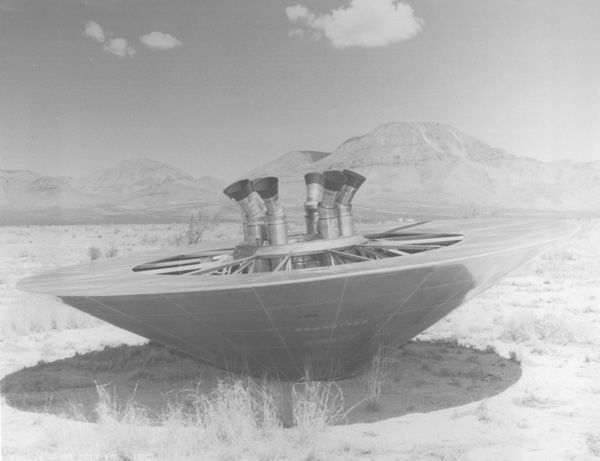
A crashed flying saucer? No, an aeroshell for NASA’s Voyager-Mars program tested in the desert.
(credit: NASA)
All’s well that’s Roswell
by Dwayne A. Day
On February 19, the president stated that he had directed the government to “begin the process of identifying and releasing Government files related to alien and extraterrestrial life, unidentified aerial phenomena (UAP), and unidentified flying objects (UFOs).” In the mid-1990s, political pressure resulted in the release of information and the production of two reports on the so-called “Roswell Incident” of 1947. These reports added substantively to the historical record of Cold War aerospace programs. Hopefully, the new efforts will also be productive in opening up the history.
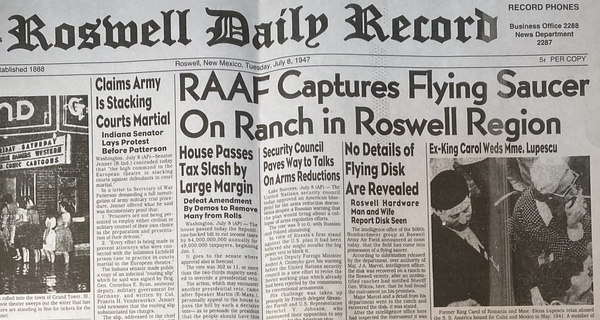
The infamous “flying saucer” headline in the local newspaper in 1947.
The Roswell Incident
In 1947 there was a report of debris found by a rancher near Roswell, New Mexico. It was soon publicly reported that the Air Force had captured a “flying saucer.” Within a day or so, the military stated that the debris was actually from a “weather balloon.”
In 1994, following political pressure from Congress, the Air Force announced that what had crashed at Roswell was not a weather balloon, but a different kind of balloon, from a top secret program.
Despite the fact that Roswell has now been in the public consciousness for decades (there were even two fictionalized TV series about aliens set in Roswell), it was not until 1980 and the publication of the book The Roswell Incident that the event gained a mass audience. The book by Charles Berlitz and William L. Moore alleged that not only had the US government recovered debris from a flying saucer, but it may have recovered “alien bodies.” Sensational paranormal pseudoscientific stories were Berlitz’s bread and butter: he had previously written a book about the Bermuda Triangle (which unfortunately does not exist) and claimed that a US Navy ship had been involved in time travel experiments (which did not happen, but may still have not happened when time travel is invented, or not).
In 1994, following political pressure from Congress, the Air Force announced that what had crashed at Roswell was not a weather balloon, but a different kind of balloon, from a top secret program called Project Mogul. Mogul was an effort to fly microphones to very high altitudes to listen for the sound of nuclear explosions. Scientists believed that the sounds of such explosions could be trapped between layers of the atmosphere and would reverberate over long distances. In the late 1940s, the United States government was concerned that the Soviet Union might develop an A-bomb, and Mogul was designed to listen for the big boom. A big boom eventually happened when the first Soviet A-bomb was detonated in August 1949.
After the initial Air Force revelation about Project Mogul, in 1995 the Air Force published The Roswell Report – Fact vs. Fiction in the New Mexico Desert, a thick book that included documentation supporting the Project Mogul explanation for the Roswell incident. On June 24, 1997, the Air Force published The Roswell Report: Case Closed. This second report addressed the claims that bodies had been recovered in the desert, noting that the Air Force had conducted many tests in the desert involving instrumented dummies dropped from aircraft and later recovered on the ground. It also noted that NASA had performed drop tests of various reentry vehicles over the desert, and some of these had saucer shapes. These activities, conducted over many decades, often at an Air Force base at Roswell, could have contributed to the mythology of Roswell and aliens.
The two reports released by the US Air Force in 1995 and 1997 about what happened in Roswell.
Case closed?
Of course, the tinfoil hat-wearing crowd was not convinced, and the term “case closed” only stirred up their bile. There was already a cottage industry of hucksters and grifters willing to take advantage of the true believers, and they had no interest in Air Force or NASA history that didn’t titillate the masses. They held their UFO conferences and sold energy crystals and fold-up pyramids to the faithful, and denounced the Air Force’s explanation for Roswell.
The report shone a light on obscure areas of aerospace research that had been overlooked by many historians, like high-altitude drop tests.
But setting aside the issue of extraterrestrials, the two Air Force reports of the mid-1990s were important contributions to historical scholarship, revealing new and declassified information and documents. Up to the time of the Air Force revelation about Project Mogul, that program had not been acknowledged or even hinted about. For example, historian Curtis Peebles had written a 1991 book The Moby Dick Project: Reconnaissance Balloons over Russia. Peebles shed considerable light on the subject of reconnaissance balloons but had been unaware of Project Mogul. Other historians had been digging into the history of aerial reconnaissance programs and had not uncovered Mogul. The information on Mogul had been sitting in government archives for decades until it was forced into the open. Certainly a few people in the government still knew about it, and some had probably seen the documents, but there was no reason for them to reveal the truth about what happened at Roswell until a government order to declassify and publish that information.
Similarly, although the information in the Case Closed report did not reveal any highly classified programs, it was revelatory. It shone a light on obscure areas of aerospace research that had been overlooked by many historians, like high-altitude drop tests. The report included photos of NASA Voyager-Mars and Viking aeroshells that had been tested in the desert. It also included photos of other unusual balloon-carried research payloads, including Discoverer satellite reentry vehicles. Very few people had ever paid attention to the history of aeromedical research and testing during the Cold War, but the report demonstrated that many such tests had been performed for decades.
The Air Force reports on Roswell revealed testing NASA did of aeroshells for future Mars missions, like Viking.
(credit: NASA)
Sunshine days
The 1990s was an era of increased openness about Cold War era activities, sometimes resulting from presidential direction, sometimes from congressional direction, and sometimes at the initiative of senior government officials. The existence of the National Reconnaissance Office was revealed in 1992, and following executive order 12951 the CORONA reconnaissance satellite program was declassified in 1995. In a December 1993 press conference, Secretary of Energy Hazel O’Leary announced the largest declassification of information in the Department of Energy’s (DoE’s) history. That included acknowledging many nuclear tests, as well as nuclear weapons accidents during the Cold War. Additional major declassifications were announced at openness press conferences in June 1994 and February 1996. For example, in 1996 DoE released a complete inventory of US production, acquisition, use, and distribution of plutonium from 1944 to 1994.
The CIA began declassifying millions of pages of documents on Cold War operations. These included an official history of the U-2 reconnaissance program as well as (in coordination with the National Security Agency) revealing the Venona communications interceptions of the 1940s. CIA documents revealed details of what the US Intelligence Community knew about Soviet missile and space programs. One example was an early effort to “kidnap” a Soviet spacecraft during an international exhibition in the early 1960s to examine it. This author was the first to discover and report on the CIA operation after uncovering a newly declassified CIA publication in the National Archives. The CIA also created a declassification program that released millions of pages of documents as part of the CIA Records Search Tool (CREST). Much of our current understanding of intelligence collection about Soviet weapons systems is due to the work done for CREST. That effort was highly productive into the early 2000s, when it was curtailed and the number of documents being declassified annually dropped dramatically. As a result, we have very good understanding of many aspects of the Cold War up until the early 1970s, but after that the historical record is much thinner.
The 1990s were the beginning of a new era of revelations about historical American air and space programs. Certainly, much remained classified, but much more was revealed than in previous decades. The September 11, 2001, terrorist attacks were the beginning of the end of this period of openness. Government agencies retrenched, new bureaucracies and layers of secrecy were created, and new politicians and government leaders had far less interest in revealing past secrets. Whereas CORONA was declassified in 1995, the follow-on GAMBIT and HEXAGON reconnaissance satellite programs were considered for declassification in 1997, but this ultimately did not happen until 2011. Today, official government declassification efforts are underfunded, meager, and sporadic.
The truth is out there… and so are the lies
It has long been known that when the U-2 spy plane began flying in the mid-1950s it was regularly being reported as a flying saucer at high altitude, and the government did nothing to dispel those stories. But the government’s involvement goes beyond simply not correcting the false stories to creating its own false stories. In June 2025, The Wall Street Journal reported that the US government had actively used disinformation to conceal highly classified aerospace programs. (See “Pentagon Fueled UFO Mythology, Then Tried Coverup,”The Wall Street Journal, June 7, 2025, print edition.) As the government was investigating reports of unidentified aerial phenomena (the modern euphemism for UFOs), a retired Air Force colonel admitted that in the 1980s he had taken doctored photos of flying saucers to a bar in the Nevada desert and given them to a bartender to put up on the walls. This was to help obscure the fact that the Air Force was testing stealth aircraft nearby. Somebody who saw an F-117 flying in the dark might tell the story to somebody else who would say that it resembled the flying saucer photo in the bar. People would chase aliens instead of secret aircraft.
Somebody who saw an F-117 flying in the dark might tell the story to somebody else who would say that it resembled the flying saucer photo in the bar. People would chase aliens instead of secret aircraft.
Other officers who were assigned to a highly classified program office were shown a photo of what they were told was an alien craft, part of a project called Yankee Blue, and told that it had provided the government with antigravity technology. They were ordered to never mention it again. But this was actually a joke, a long-standing hazing ritual within the secretive community. In spring 2023, the Secretary of Defense sent out a memo ordering the practice to stop immediately, but by this time hundreds of people retired, and in the active duty military, believed the government had inherited technology from aliens. Distrust and misinformation was now firmly embedded into the secretive culture.
The Journal also recounted a disturbing story about a 1967 incident that had been reported as an alien “attack” on an ICBM command post in Montana by a glowing reddish-orange oval. What really occurred was a highly classified test of a system to determine if missile command complexes were vulnerable to Soviet electromagnetic pulse attacks. The test identified significant security vulnerabilities, and that information was so sensitive that it was highly classified for half a century, even though one Air Force officer in that command post believed it was aliens.
Some of my own research has hinted that misinformation was part of the fielding of the first operational near-real-time reconnaissance satellite in December 1976, the KH-11 KENNEN. A cryptic note in a declassified history indicates that the Soviet Union did not realize the satellite was capable of reconnaissance until summer of 1978. But I have also heard that an Air Force officer, possibly without official sanction, was deliberately spreading disinformation about American satellites during this period.
Two years ago, Peter Merlin published Dreamland: The Secret History of Area 51 (see “Review: Dreamland”, The Space Review, December 4, 2023.) It is an exhaustive history of secret projects developed at the Groom Lake airfield. But it also essentially stops by the early 1980s, even though the Groom Lake facilities expanded significantly in the following decade. What went on in those big new hangars? Throughout the 1980s there were rumors of other aircraft being tested there, and one retired test pilot confirmed that he flew something during the 1980s that remains classified. Maybe the story of the “Blackstar” air-launched spaceplane had some basis in truth (although I have my doubts: “Six blind men in a zoo: Aviation Week’s mythical Blackstar,” The Space Review, March 13, 2006). Maybe that colonel giving out photos of flying saucers to protect projects at Groom Lake was seeking to hide something other than the F-117 stealth fighter. Maybe we’ll now learn.
But probably not.
We’ll have to wait and see what, if anything, is declassified from this new order. So keep watching the skies, but don’t hold your breath while doing so.
Meer van UFO'S of UAP'S, ASTRONOMIE, RUIMTEVAART, ARCHEOLOGIE, OUDHEIDKUNDE, SF-SNUFJES EN ANDERE ESOTERISCHE WETENSCHAPPEN - DE ALLERLAATSTE NIEUWTJES


 High-Energy Laser Turns Ordinary Moon Dust into Futuristic Materials for Lunar Colonists