Naar de inhoud

UFO'S of UAP'S, ASTRONOMIE, RUIMTEVAART, ARCHEOLOGIE, OUDHEIDKUNDE, SF-SNUFJES EN ANDERE ESOTERISCHE WETENSCHAPPEN - DE ALLERLAATSTE NIEUWTJES

UFO's of UAP'S in België en de rest van de wereld
akke.beakke.be
Ontdek de Fascinerende Wereld van UFO's en UAP's: Jouw Bron voor Onthullende Informatie! Ben jij ook gefascineerd door het onbekende? Wil je meer weten over UFO's en UAP's, niet alleen in België, maar over de hele wereld? Dan ben je op de juiste plek! België: Het Kloppend Hart van UFO-onderzoek In België is BUFON (Belgisch UFO-Netwerk) dé autoriteit op het gebied van UFO-onderzoek. Voor betrouwbare en objectieve informatie over deze intrigerende fenomenen, bezoek je zeker onze Facebook-pagina en deze blog. Maar dat is nog niet alles! Ontdek ook het Belgisch UFO-meldpunt en Caelestia, twee organisaties die diepgaand onderzoek verrichten, al zijn ze soms kritisch of sceptisch. Nederland: Een Schat aan Informatie Voor onze Nederlandse buren is er de schitterende website www.ufowijzer.nl, beheerd door Paul Harmans. Deze site biedt een schat aan informatie en artikelen die je niet wilt missen! Internationaal: MUFON - De Wereldwijde Autoriteit Neem ook een kijkje bij MUFON (Mutual UFO Network Inc.), een gerenommeerde Amerikaanse UFO-vereniging met afdelingen in de VS en wereldwijd. MUFON is toegewijd aan de wetenschappelijke en analytische studie van het UFO-fenomeen, en hun maandelijkse tijdschrift, The MUFON UFO-Journal, is een must-read voor elke UFO-enthousiasteling. Bezoek hun website op www.mufon.com voor meer informatie. Samenwerking en Toekomstvisie Sinds 1 februari 2020 is Pieter niet alleen ex-president van BUFON, maar ook de voormalige nationale directeur van MUFON in Vlaanderen en Nederland. Dit creëert een sterke samenwerking met de Franse MUFON Reseau MUFON/EUROP, wat ons in staat stelt om nog meer waardevolle inzichten te delen. Let op: Nepprofielen en Nieuwe Groeperingen Pas op voor een nieuwe groepering die zich ook BUFON noemt, maar geen enkele connectie heeft met onze gevestigde organisatie. Hoewel zij de naam geregistreerd hebben, kunnen ze het rijke verleden en de expertise van onze groep niet evenaren. We wensen hen veel succes, maar we blijven de autoriteit in UFO-onderzoek! Blijf Op De Hoogte! Wil jij de laatste nieuwtjes over UFO's, ruimtevaart, archeologie, en meer? Volg ons dan en duik samen met ons in de fascinerende wereld van het onbekende! Sluit je aan bij de gemeenschap van nieuwsgierige geesten die net als jij verlangen naar antwoorden en avonturen in de sterren! Heb je vragen of wil je meer weten? Aarzel dan niet om contact met ons op te nemen! Samen ontrafelen we het mysterie van de lucht en daarbuiten.

Archief

SYRIA UAP 2021: Military-Filmed Footage
SYRIA UAP 2021: Military-Filmed Footage

Overview

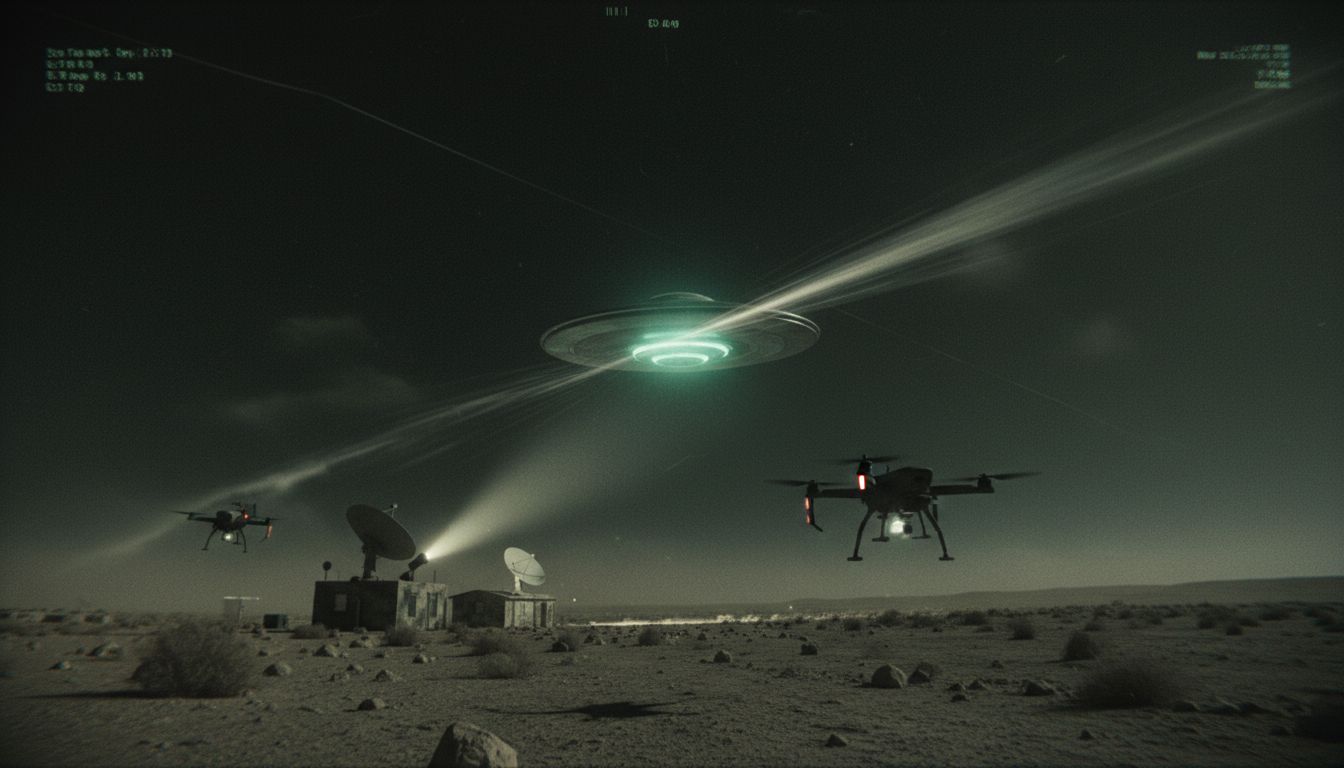
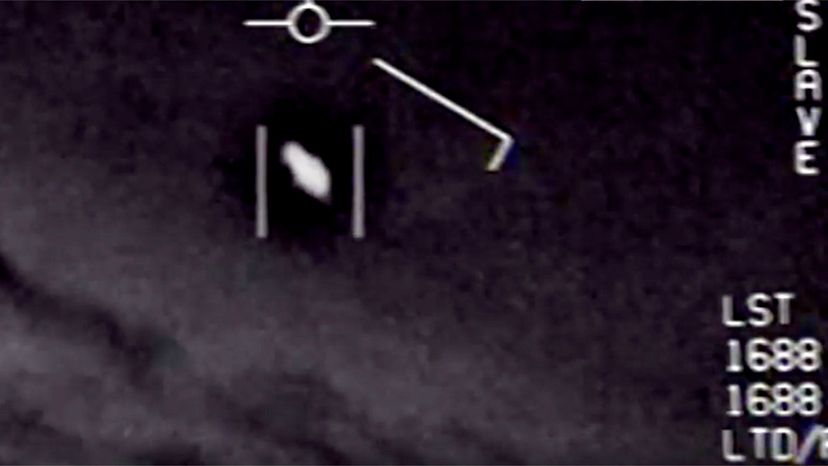
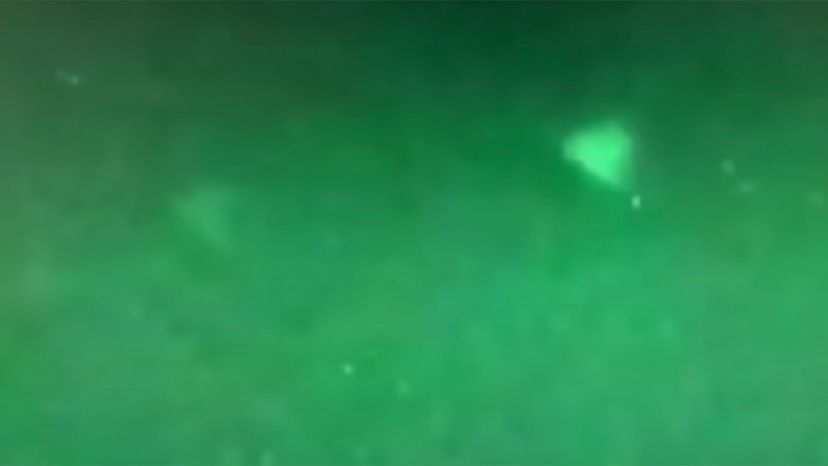
In July 2024, investigative filmmaker Jeremy Corbell released a clip he describes as “military‑filmed footage of a UAP over Syria in 2021.” The video, originally captured by a thermal‑imaging sensor on a high‑altitude reconnaissance platform, shows a small, bright object moving across the frame before disappearing at what appears to be an abrupt, high‑speed acceleration. Corbell, who has previously publicized the Pentagon’s “Gimbal” and “GoFast” videos, presented the material alongside longtime journalist George Knapp, framing it as a case study of the “instantaneous acceleration” observable that has become a focal point of recent UAP analysis.

Key Observations

The central claim of the footage is that the object exhibits instantaneous acceleration—a rapid change in velocity that cannot be reconciled with conventional aircraft propulsion. In the unedited segment, the object drifts steadily for several seconds, then vanishes from the sensor’s field of view within a fraction of a second. Corbell’s commentary emphasizes that “the sensor data shows a spike in speed that would require a thrust capability far beyond any known engine,” a statement echoed by Knapp, who noted that “the visual evidence aligns with the telemetry, suggesting something truly anomalous.”

Technical Details

The video includes multiple playback speeds (100 %, 50 %, 25 %, 5 % and 1 %) and visual enhancements such as black‑and‑white inversion, zoom, and edge‑threshold filtering to clarify the object’s shape. On‑screen telemetry indicates the recording aircraft was operating at roughly 17,000 feet altitude, with coordinates near 32° N, 36° E—a region in southern Syria bordering Jordan and Iraq. The sensor interface resembles that used on U.S. MQ‑9 Reaper drones, though no official agency identification is provided. Independent analysts who have examined the publicly released frames note that the thermal signature is consistent with a compact heat source, but the rapid loss of lock raises questions about the object’s maneuverability and possible propulsion method.

Context and Credibility

Syria’s airspace in 2021 was heavily monitored by a mosaic of U.S., Russian, Turkish, and regional forces, creating a dense radar and sensor environment. This operational backdrop lends weight to the claim that the recording device was a legitimate military platform rather than a civilian hobbyist setup. However, the lack of an official chain of custody and the absence of corroborating radar data have prompted caution among mainstream aerospace experts. Dr. Sean Kirkpatrick, former director of the Pentagon’s Unidentified Aerial Phenomena Task Force, has repeatedly warned that “visual footage alone, even when paired with sensor read‑outs, must be corroborated with multiple data sources before drawing conclusions about advanced technology.”

The release arrives amid heightened congressional interest in UAPs, following the 2023 Office of the Director of National Intelligence (ODNI) report that identified “unexplained aerial observations” as a national security concern. The “five observables” outlined in that report—speed, maneuverability, altitude, emission signatures, and acceleration—are directly referenced in Corbell’s presentation, positioning the Syria clip as a potential illustration of the acceleration metric.

Reactions and Next Steps

Since the video’s debut, the UAP research community has been divided. Advocates, including Corbell and Knapp, argue that the footage adds a rare, high‑quality visual record of a phenomenon that defies known physics. Skeptics, such as aerospace analyst Mark Boslough, contend that “without raw sensor logs, flight path data, or independent verification, the clip remains an intriguing but inconclusive piece of the puzzle.”

The Department of Defense has not issued an official statement confirming the source or authenticity of the material. In the meantime, several independent labs have offered to perform forensic analysis of the video file, and a Freedom of Information Act request
{ https://usubjects.com/  }

Hoe vind je dit bericht?
Geschreven door peter om 22:12 Stuur door

UAP Meaning: Understanding Unidentified Aerial Phenomena

UAP Meaning: Understanding Unidentified Aerial Phenomena

UAP
U.S. Navy pilots tracked and photographed what appeared to be a fast-moving object off the Florida coast in 2015. Department of Defense

As you gaze up at the vast night sky, spotting flying objects and flashing lights, you might wonder if you're witnessing evidence of extraterrestrial visitors or simply natural phenomena. Historically, most people would label these mysterious objects as UFOs or Unidentified Flying Objects.

But did you know that there's a more modern terminology now in play? Enter "UAP" or Unidentified Aerial Phenomena. So, what exactly is the UAP meaning?

1. The Evolution from UFO to UAP

Throughout history, from ancient Greece to present times, people have reported sightings of unidentified objects in the sky. These events, often linked with extraterrestrial origin, have been the focus of many enthusiasts and government agencies alike.

But the term UFO isn't without its issues.

When we hear "UFO", our minds often jump straight to alien spacecraft. Blame it on pop culture or the association the term has built over the years.

A Brief History of UFOs

The term "UFO" came into our lexicon after a significant event on June 24, 1947. Pilot Kenneth Arnold reported nine bright, flying discs moving at high speeds near Mount Rainer.

This report birthed the terms "flying saucer" and "flying disc," laying the groundwork for what we commonly refer to as UFOs. Following Arnold's report, government officials and military units started establishing UFO investigation task forces.

Over the past decades, UFO sightings became synonymous with aliens. Reports from pilots, military personnel, and civilians alike about flying saucers, hovering lights and objects moving at high speeds always seemed to suggest visitors from outer space.

2. The UAP Era Begins

UAP This screenshot of a leaked video of a flashing, triangle-shaped object that flew over a U.S. warship was confirmed by the Pentagon as real, though it declined to label it a UAP.  SETI

The shift from "UFO" to "UAP" was subtle but significant. UAPs encompass a broader definition, including any unidentified anomalous phenomena in the sky. This change in terminology was partly due to recent years of data collected by national security departments and civilian star gazers.

In 2021, the Office of the Director of National Intelligence (ODNI) released a comprehensive report on Unidentified Aerial Phenomena called Preliminary Assessment: Unidentified Aerial Phenomena.

This report mentioned the rigorous scientific methods applied to UAP research, using advanced technologies like radar. It was no longer just about eyewitness accounts. The focus had shifted to hard evidence and understanding the nature of these events.

In a leap towards understanding these phenomena better, NASA has now commissioned an independent team of 16 scientists and astrophysicists. They aim to analyze unclassified UAP data and work towards ensuring aircraft safety.

3. UFOs, UAPs and the Quest for Answers

Whether it's UFOs or UAPs, the essence remains the same: unidentified flying objects in the sky. Both terms, while carrying different connotations, point towards humanity's eternal exploration and desire to understand the unknown.

While UAPs might be the preferred term in government circles, it doesn't exclude the possibility of extraterrestrial origins. The UAP terminology might just be the scientific community's way of embracing these unidentified objects without fear of, well, sounding a bit out of this world.

The change in terminology represents a more data-driven, scientific approach to understanding mysterious flying objects in our sky. As the stars twinkle and mysterious objects continue to whizz by, our search for answers continues, regardless of what we call them.

This article was updated in conjunction with AI technology, then fact-checked and edited by a HowStuffWorks editor.

Hoe vind je dit bericht?
Geschreven door peter om 21:59 Stuur door

How Do You Become a Ufologist?

How Do You Become a Ufologist?

By: Dave Roos

UFO

Lots of people claim to have seen UFOs. Does that make them ufologists?  tombud/Pixabay/CC0 Creative Commons

Key Takeaways

  • There is no standardized path to becoming a ufologist, given its classification as a pseudoscience, but enthusiasts often engage through self-education, writing or lecturing.
  • No traditional academic institutions offer degrees in ufology, but online courses and certifications are available for those interested in pursuing this field more formally.
  • Practical involvement can include joining organizations like MUFON in the U.S. or BUFORA in the U.K. to become a field investigator.

Nick Pope was a career civil servant with the U.K. Ministry of Defence (MoD) when he got an odd assignment. It was 1991, two years before the premier episode of "The X-Files," but Pope was about to take on a job that would earn him the nickname "the real Fox Mulder." He was to investigate each and every UFO sighting reported to the British government.

Amazing Info About How To Become A Ufologist - Dancelocation19

More than 25 years later, Pope is one of the world's leading UFO experts and a fixture at UFO conferences like Contact in the Desert and the International UFO Congress, where he lectures on government-sponsored UFO investigations, conspiracy theories and the disclosure of classified government documents. But he wasn't always a UFO-head.

"I really started from a baseline of zero," says Pope, explaining that his four-year assignment to the "UFO desk" at MoD was one of many different posts at the agency, and was not based on any prior knowledge or personal interest in UFOs.

His office received between 200 and 300 sighting reports a year. His job was to call up witnesses, gather as much information as possible about the appearance of the mystery objects, as well as the precise locations and times of the sightings, and then get to work checking those facts against "the usual suspects."

In 95 percent of cases, there was a simple earthly explanation for what the witnesses had seen -- maybe aircraft lights or weather balloons. But even in those rare cases where a sighting couldn't be rationally explained, Pope's job was to downplay its significance to the public, the media and British lawmakers. The message: "Move along, folks. Nothing to see here."

Pope felt it was his duty to read everything he could get his hands on about the history of UFO sightings and leading theories about their origins, including fanciful conspiracies. After he left the UFO desk in 1994, but while still at the MoD, he co-authored a book with some of the key witnesses in the Rendelsham Forest incident, known as England's Roswell.

The success of the book led to calls from TV and movie producers looking for insight from a real UFO investigator. Pope retired from the MoD and moved to America in 2012 to become a full-time UFO expert. In addition to writing and lecturing at conferences, he's a popular talking head on TV shows like "Ancient Aliens."

Pope would not call himself a ufologist, rather a UFO investigator. He admits that he came about his UFO expertise in an unconventional way. Most of his fellow UFO panelists, authors and TV commentators were either inspired by their own life-altering UFO sighting or drawn to the topic as lifelong fans of the paranormal.

"I'm an awkward fit at some of these [UFO] events, I have to say," Pope admits. "Some people, I suspect, think that I'm the bad guy, and I've heard a lot of people in the conspiracy theory community say that I'm still secretly working for the government, that I'm part of some disinformation campaign or whatever the theory is."

Becoming a Ufologist

No accurate figures exist on how many ufologists there are in the world. Ufology (the study of UFOs or unidentified flying objects) is considered a pseudoscience, though national governments have been involved in investigating UFOs. (The MoD UFO project closed down in 2009. The U.S. government is apparently still tracking them, according to the New York Times.)

As such, no traditional colleges or universities offer degree programs in ufology, but there are some online options. International Metaphysical University offers six courses in Ufology Studies, including Introduction to Ufology taught by Richard Dolan, a well-known expert who also has a history degree from Alfred University. The 12-lecture online course covers topics such as "What are UFOs?," "Theories of Ancient Visitation," and "The Early Cover-Up." Courses cost between $200 and $400 each.

Under a "Career Options" tab, the university website notes ufologists can seek work as lecturers, writers, movie consultants or even political activists "working toward disclosure or working in the political and government arena on the area of UFOs in preparation for contact or landings." Furthermore, "You can also set up a career as a life coach or hypnotist working directly with contactees and abductees." Whether these careers turn out to lucrative will no doubt depend on the circles you move in.

Two other online universities -- the Centre of Excellence in the U.K. and the IMHS Metaphysical Institute -- offer full degree programs in ufology. It's hard to imagine a better conversation-starter than, "I recently got my Ph.D. in Ufology with a specialization in abduction research." Cost for that "advanced" degree is under $2,000.

Another approach is to get out there and do some Fox Mulder-ing of your own as a trained UFO investigator. In the U.S., the Mutual UFO Network (MUFON) is actively recruiting field investigators to look into the dozen or more sightings reported to the organization every day. You must be 18 or older and pass a certification examination based on the field investigator manual. The British UFO Research Organization (BUFORA) offers a similar course for folks in the U.K.

Pope is a little skeptical of these training and certification programs, because he knows that most participants are true UFO believers who could let their biases get in the way of a clear-eyed investigation. Not that Pope himself wouldn't be psyched to find definitive proof that ETs exist.

"My view is the world would be more interesting with aliens in it than without, but that doesn't mean I'm going to try to prove that," says Pope. "I'm just going to go where the data take me."


{ https://science.howstuffworks.com/space/aliens-ufos }

Hoe vind je dit bericht?
Geschreven door peter om 21:29 Stuur door

Alien Abduction Theories: A Scientific Search for Evidence

Alien Abduction Theories: A Scientific Search for Evidence

eyJidWNrZXQiOiJjb250ZW50Lmhzd3N0YXRpYy5jb20iLCJrZXkiOiJnaWZcL2dldHR5aW1hZ2VzLTExNjA0NTgxMjQuanBnIiwiZWRpdHMiOnsicmVzaXplIjp7IndpZHRoIjo4Mjh9fX0=

People who claim to have been abducted by aliens typically describe their abductors as little, gray humanoids with oversize heads, slanted eyes, two holes for a nose and a slit for a mouth.  David Wall / Getty Images

Alien abduction stories have spread widely over the last hundred years, though a large proportion did not truly hit their stride until the 1961 Barney and Betty Hill abduction. After the Hill abduction, investigators collected more and more accounts, usually, though not always, elicited through hypnosis.

Some abductees report their abductions as warm, pleasant experiences with intense psychic contact. Other abductees have reported that aliens conducted scientific experiments or operations on their unwilling patients. How can these vastly different experiences be explained?

1. Long-term Tracking in Alien Abduction Stories

In most cases, witnesses told of seeing a UFO (now called UAPs) or even humanoid beings, then experienced either an altered state of consciousness or amnesia for a period of anywhere from a few minutes to a few hours. Some witnesses claimed repeated experiences that started when they were children.

The clear implication was that UFO beings (typically described in these instances as little, gray humanoids with oversize heads, slanted eyes, two holes for a nose and a slit for a mouth) had a long-term interest in certain human beings. Some abductees even reported that the abductors had put small implants — usually said to be tiny balls inserted through the nose and (apparently) into the brain via a long needle — inside their bodies.

In time, new and even more unsettling dimensions to the abduction experience came to light. Some female abductees reported sexual experiences followed by pregnancies that would be terminated in a follow-up abduction some months later. During later abductions, the UFO entities would show the women strange-looking children, apparently human-alien hybrids, whom they would sense were their own.

This phenomenon prompted a question that continues to perplex both ufologists and modern scientists alike: Why would an otherworldly entity take interest in some humans over others?

2. The Hypnosis Theory

Not surprisingly, scientific reports that offered alternative explanations for these experiences have been met with pushback from believers. Even some abduction researchers rejected them, preferring — in common with UFO skeptics — to believe "abductions" were fantasies generated by the process of hypnosis itself.

Contrary to popular understanding, hypnosis is no royal road to the truth. Hypnotic subjects are in a highly suggestible state and may seek to please the hypnotist. Thus, if the hypnotist asks leading questions, the subject could be led to provide the desired answers.

The link between false memories and hypnosis lies in the susceptibility of individuals under hypnosis to generate or accept memories that did not actually occur. Hypnosis can lead to the creation of vivid and convincing but inaccurate recollections. Purely imaginary events can seem real under hypnosis (confabulation), as testified to in the phenomenon of "past lives" recounted while in a hypnotic state.

Testing the Theory

To test the confabulation hypothesis, folklorist Thomas E. Bullard collected all available abduction accounts. He found that as many as 1/3 of the informants had full conscious recall of their experiences and had never resorted to hypnosis to elicit the details. These non-hypnotic reports proved identical in all significant particulars to those told under hypnosis.

Bullard also learned that the identity of the individual hypnotist made no difference. The stories remained consistent down to details that even those most familiar with the phenomenon had failed to notice.

In short, Bullard concluded, whatever its ultimate cause, the abduction phenomenon was not the product of hypnosis. "The skeptical argument needs rebuilding from the ground up," he wrote. However, some members of the scientific community still believe that false memories are one of the many reasons behind the alien abduction phenomenon.

3. Investigating Abduction Claims

Mental health experts and researchers have been exploring the abduction phenomenon for decades. In the early 1980s, a study involving psychological assessments of a limited set of abductees in New York suggested that they were grappling with post-traumatic stress disorder (PTSD). Other studies since then have come to similar conclusions.

In a 2022 study, researchers investigated the emotional responses of individuals who claimed to have experienced alien abductions, aiming to offer alternative explanations aside from severe psychopathology. The study involved 19 individuals who reported being abducted by aliens, compared to a control group of 32 participants.

Using various tests, including assessments of post-traumatic stress disorder(PTSD), suggestibility and dissociation, researchers found that the abductee group exhibited higher scores in PTSD and dissociation, while scoring lower in suggestibility. However, only the differences in suggestibility were statistically significant.

The study suggested that emotional reactions to memories of implausible experiences can mirror those of genuinely traumatic events, and dissociation might play a role in understanding some cases.

4. Trauma Responses and Alien Abductions

In an article published in the Journal of Experimental Psychopathology, psychologist Richard McNally and a team of Harvard researchers examined whether people who recall false traumatic events, like UFO abductions, display physiological responses akin to those who genuinely experienced trauma.

The investigation focused on individuals with obviously fictitious memories, particularly memories of alien abductions. Researchers crafted brief audio narratives based on the volunteers' abduction accounts to assess the responses of the small group of male and female subjects who agreed to participate in the study.

While the volunteers listened, researchers monitored indicators like heart rate, perspiration and facial muscle tension. Remarkably, these physiological measures surged as the abductees recollected their supposed experiences of being kidnapped by space aliens.

Abduction or Sleep Paralysis?

Ultimately, researchers chalked these recollections up to two possible reasons. One, the abductees had actually experienced alien encounters. Or two, they possessed a handful of "ingredients" that researchers had compiled to form "a recipe" for the type of person who is likely to experience an encounter or abduction.

These ingredients include:

  1. New Age beliefs (e.g., high scores on measures of magical ideation)
  2. episodes of isolated sleep paralysis accompanied by hypnopompic hallucinations
  3. hypnotic memory recovery sessions
  4. high scores on a measure of absorption
  5. familiarity with the cultural narrative of alien abduction.

But researchers were unsure if their recipe could also apply to people outside of the study who claim to have been abducted. Also, it was unclear whether an individual needed to possess all of the ingredients.

In other words, just because a person loves extraterrestrial movies or the "X-Files" and is easily influenced doesn't mean they're necessarily more — or less — likely to say that space aliens scooped them up for experiments in the middle of the night.

  • This article was updated in conjunction with AI technology, then fact-checked and edited by a HowStuffWorks editor.

Notable UFO Reports

Take a look at these notable UFO stories:

{ https://science.howstuffworks.com/space/aliens-ufos }

Hoe vind je dit bericht?
Geschreven door peter om 21:00 Stuur door

The UAP Truth Finally Comes Out with Dan Farah

The UAP Truth Finally Comes Out with Dan Farah

Overview

Filmmaker Dan Farrah, known for his work on Steven Spielberg’s Ready Player One, has shifted his career toward investigating Unidentified Aerial Phenomena (UAP). In a recent episode of the Trying Not to Die podcast, hosts Jack Osbourne and Ryan Drexler explored Farrah’s motivations and the findings of his documentary The Age of Disclosure. Farrah described a lifelong fascination with the UFO subject, sparked by 1980s sci‑fi classics, and a professional frustration with the lack of credible, high‑level testimony in existing media. “I spent two decades in Hollywood and still felt there was no serious documentary that could bring government insiders to the table,” he told the hosts.

Key Claims of The Age of Disclosure

The film presents interviews with 34 senior military, intelligence and scientific officials and makes three central assertions. First, Farrah argues that an “80‑year cover‑up” has concealed evidence of non‑human intelligence and recovered craft from the public. Second, he warns of a secret technology race among the United States, China and Russia to reverse‑engineer alleged alien propulsion systems, noting that “the U.S. could be leap‑frogged if an adversary cracks the physics first.” Third, the documentary describes a highly compartmentalized “Legacy Program” run by defense contractors and career bureaucrats, allegedly hidden even from sitting presidents because of its long‑term secrecy.

Sources and Credibility

Farrah emphasizes that many interviewees risked professional reputation to appear on camera. Among the most prominent figures are Senator Marco Rubio, Vice Chairman of the Senate Intelligence Committee, who has championed bipartisan UAP disclosure legislation; former Director of National Intelligence General Jim Clapper, who, according to the film, confirmed “UAP activity over Area 51 is real”; and Jay Stratton, former head of the U.S. government’s UAP Task Force. Academic voices include Stanford professor Gary Nolan, who has studied potential biological effects of UAP exposure, and physicist Hal Puthoff, who discusses the hypothesis that UAPs generate a “warp bubble” allowing instantaneous acceleration. The documentary also cites former White House National Security Council aviation security chief Bret Feddersen and lists major defense contractors—Lockheed Martin, Northrop Grumman, Raytheon, Aerospace Corporation and Battelle—as allegedly involved in reverse‑engineering efforts.

Legislative and Historical Context

The conversation highlighted concrete policy milestones. In 2021, Senator Rubio succeeded in inserting UAP disclosure language into the Coronavirus Relief Bill, a move that compelled the release of the first major public UAP report. Farrah also referenced historic incidents, such as the 1975 Travis Walton abduction, which an unnamed intelligence official described as a case where “non‑human beings accidentally injured him and then took him to heal before his return.” Area 51 was mentioned not as myth but as a site of documented, ongoing UAP activity, according to the film’s sources.

Implications and Public Call‑to‑Action

Concluding the interview, Farrah framed disclosure as a bipartisan imperative for both technological advancement and humanitarian welfare. He argued that secrecy persists not merely to avoid public panic, but to protect the commercial interests of defense contractors and to preserve strategic advantages from rival nations. “The public needs to pressure elected officials for transparency,” Farrah urged, positioning The Age of Disclosure—available on Prime Video—as a “serious vehicle for bringing these hard truths to light.” While the documentary’s claims remain contested, its reliance on senior officials and newly released congressional language marks a notable shift in the mainstream discussion of UAPs.

{ https://usubjects.com/  }

Hoe vind je dit bericht?
Geschreven door peter om 17:36 Stuur door

Nuclear strike on an asteroid: Hollywood scenario finds scientific confirmation

Nuclear strike on an asteroid: Hollywood scenario finds scientific confirmation

Is it possible to save Earth from a deadly asteroid by blowing it up, as in Hollywood blockbusters? Earlier calculations showed that such a scenario would lead to the formation of debris that would only exacerbate the impending catastrophe. But a revolutionary new simulation conducted by an international team of scientists provides an unexpected answer: yes, a nuclear explosion could be a viable plan, and even better than we thought. The scientists described this optimistic future in a publication in Nature Communications.

A nuclear strike near the asteroid proved to be a more successful solution than a kinetic collision with it. Illustration generated by Grok AI

The key discovery is that space bodies are much more resistant to extreme impact loads than laboratory tests have shown. This is good news for planetary defense. If a nuclear strike is directed at an asteroid, it will most likely remain intact rather than disintegrate into a deadly shower of thousands of fragments that will still fall on the planet.

How to test a meteorite without destroying it

Researchers from Oxford University and Outer Solar System (OuSoCo) have solved a fundamental problem: the inability to observe the reaction of asteroid material in real time under impact. They used a particle accelerator at CERN to irradiate a sample of the Campo del Cielo iron meteorite with high-energy protons.

An experimental setup in which a laser was used to irradiate a cylindrical sample cut from a meteorite. Credit: Bochmann et al., Nat. Commun.

“This is the first time we have been able to safely observe, in real time, how a real meteorite sample deforms and adapts in extreme conditions without being destroyed,” explains physicist Gianluca Gregori.

The sensors recorded surprising dynamics. Under the influence of a powerful impulse, the meteorite first softened and bent, and then — unexpectedly — hardened again. It also demonstrated the ability to dissipate impact energy more effectively than the stronger the impact itself. This explains why previous estimates of asteroid strength were incorrect.

Consequences for planetary defense

This research is critical for choosing a strategy. Missions such as DART, which deflect asteroids with a kinetic impact, are effective but require high precision. The nuclear option, as simulations have shown, may be safer. 

“The world must be able to execute a nuclear deflection mission with high confidence, yet cannot conduct a real-world test in advance. This places extraordinary demands on material and physics data,” notes Karl-Georg Schlesinger of OuSoCo.

In real life, it’s not like in the movies

In reality, no one is planning to drill into an asteroid and place a bomb inside it. Physicists are proposing a different scenario: conducting a nuclear explosion at a certain distance from the celestial body. The mass vaporized by radiation will create a reactive thrust that will gradually change the asteroid’s orbit, directing it away from Earth.

Thus, humanity’s last argument in the fight against cosmic threats is scientifically justified. Fortunately, in reality, it will not be as dramatic, but much more reliable than in the movies.

{ https://universemagazine.com/en/articles-en/ }

Hoe vind je dit bericht?
Geschreven door peter om 17:27 Stuur door

US military footage captures multiple 'orb' UFOs flying in formation over Persian Gulf

New video from a US military drone has captured what UFO investigators are calling a formation of mysterious orbs flying over one of the most contentious regions in the world. 

Jeremy Corbell, investigative journalist, documentary filmmaker, and co-host of the WEAPONIZED Podcast, revealed footage this week allegedly obtained from intelligence sources that captured three objects flying over the Persian Gulf on August 23, 2012.

The minute-long recording was taken by an MQ-9 Reaper drone being operated by the US Air Force while it was using its infrared sensors just after 6pm local time. 

According to Corbell and podcast co-host George Knapp, the Pentagon described these three lights as 'orbs' flying in formation instead of coming from one triangular-shaped object.

In the video, one of the lights could be seen suddenly dropping back behind the other two, before seemingly being slingshot forward to lead the group.

Corbell added that the orbs appeared to be flying in an almost 'playful' manner and were intelligently coordinated, maintaining equal distances without any visible wings, tails, fins, or engine exhaust of any kind.

He pointed out that the leaked recording clearly showed unidentified flying objects displaying one of the 'five observable' behaviors often linked to UFOs - unusual flight movements that defy basic physics.

In this case, the one orb moving between the other two exhibited clear signs of instant acceleration without any visible thrust, something human aircraft haven't publicly shown an ability to do.

Leaked military video from 2012 revealed three orbs captured flying over the Persian Gulf

Leaked military video from 2012 revealed three orbs captured flying over the Persian Gulf

In a breakdown of the sighting, Corbell noted that the US Department of War officially designated the orbs as 'UAP,' which stands for Unidentified Anomalous Phenomena and is the new term for UFOs.

The video was reportedly placed in a separate archive specifically for evidence of non-human craft or objects that clearly weren't birds, balloons, or other explainable items.

The WEAPONIZED Podcast hosts added that the credibility of the sighting was indisputable, since the footage was taken by the military, using technology that accumulates more data than a standard camera or an everyday person's smartphone.

'This is a military recorded sensor-generated image of what looks like a triangular UFO, like one big triangular craft with dots on each of the three ends. And clearly, you watch this, and that's not what it is,' Knapp said in the January 30 episode.

'Your government has labeled this UAP, and you were never supposed to see this footage,' Corbell added.

The two men noted that the area where this recording was made, between Saudi Arabia and Iran, has become a hotspot for UAP activity in recent years, with personnel on US Navy vessels in the region reporting multiple encounters with bright objects in the sky.

In one incident allegedly recounted to Corbell, an unknown object flooded the bridge of a Navy ship with extremely intense light, so bright that a commanding officer claimed she raised her hand to shield her eyes, but she couldn't see her own hand in front of her face.

In another incident recently revealed during a bombshell hearing in Washington, military drone footage captured the moment a Hellfire missile struck and merely bounced off the hull of a UFO flying over the nearby country of Yemen.

The video of the orbs was taken by a US Air Force Reaper drone between Saudi Arabia and Iran

The video of the orbs was taken by a US Air Force Reaper drone between Saudi Arabia and Iran

Congressman Eric Burlison of Missouri revealed video of a US military drone striking an orb-shaped UFO with a missile, which bounced off and did not stop the craft

Congressman Eric Burlison of Missouri revealed video of a US military drone striking an orb-shaped UFO with a missile, which bounced off and did not stop the craft

article image

Congressman Eric Burlison of Missouri produced the shocking, never-before-seen footage from October 30, 2024 during the congressional UAP hearing with a group of military whistleblowers last year.

The black-and-white video captured the 100-pound class air-to-ground precision weapon bouncing off the mysterious orb, which continued traveling at extreme speed off the coast of Yemen, roughly 1,000 miles away from the Persian Gulf.

Witness Jeffrey Nuccetelli, a former Air Force military police officer for 16 years, called the Hellfire video 'exceptional evidence' of the existence of UFOs.

'I imagine there are members of Congress that would like to see it, who I don't even know if they've asked to see the repository of UAP videos that we've mentioned to them in the past,' Knapp said.

'But it must be frustrating for them to know that this kind of stuff exists and they're not allowed to poke into it or get a glimpse of it at all.'

Officially, the US government and the Pentagon have declared that there has never been any physical evidence recovered that proves UFOs or extraterrestrial beings exist.

The podcast hosts noted that ARRO, the Pentagon department in charge of reviewing all UAP incidents, has released very few videos showing clear UFO sightings, despite whistleblower footage continuing to be leaked to the public.

RELATED VIDEOS

{ https://www.dailymail.co.uk/sciencetech/index.html }

Hoe vind je dit bericht?
Geschreven door peter om 17:06 Stuur door

Scientists are baffled by a black hole that's spewing out 100 TRILLION times more energy than the Star Wars Death Star

Scientists are baffled by a black hole that's spewing out 100 TRILLION times more energy than the Star Wars Death Star

A supermassive black hole with a case of 'cosmic indigestion' has been burping out the remains of a shredded star for four years, experts have discovered.

Astronomers say the radio wave jet shooting out of the black hole is a contender for one of the brightest, most energetic things ever detected in the universe.

Calculations suggest the current energy outflow is up to 100 trillion times that of the infamous super–powerful Death Star, from the Star Wars universe.

Astrophysicists have documented plenty of incidents where a star gets too close to a black hole and is shredded by its gravitational field.

But a black hole emitting this much energy so many years after chewing up a star is unprecedented.

The team even predict the stream of radio waves belching from the cosmic entity will keep increasing exponentially before peaking next year.

'This is really unusual', said Yvette Cendes, an astrophysicist at the University of Oregon, who led the work.

'I'd be hard–pressed to think of anything rising like this over such a long period of time.'

An artistic representation of the tidal disruption event, or a black hole shredding a star in a process known as 'spaghettification'

An artistic representation of the tidal disruption event, or a black hole shredding a star in a process known as 'spaghettification'

Calculations suggest the current energy outflow is up to 100 trillion times that of the infamous super–powerful Death Star, from the Star Wars universe

The process began in 2018, when a small star was ripped to shreds when it wandered too close to a black hole in a galaxy located 665 million light years from Earth.

The 'tidal disruption event' (TDE) did not come as a surprise to astronomers, who occasionally witness these violent incidents while scanning the night sky.

In this case, the gravitational tug of the black hole shredded the nearby star in a process called 'spaghettification'.

This is the extreme vertical stretching and horizontal compression of objects into long, thin shapes.

But nearly three years after the massacre the black hole began lighting up the skies, emitting large amounts of energy in the form of radio waves.

In the latest paper, Dr Cendes and her colleagues show that the energy emitted from the black hole has continued to rise sharply over the last few years – and it is now 50 times brighter than it was when originally detected.

The celestial event is officially called AT2018hyz, but the team prefer the nickname 'Jetty McJetface'.

They calculated the current energy outflow of the black hole and came up with an astounding number, putting it on a par with a gamma ray burst and potentially placing it among the most powerful single events ever detected in the universe.

The scientists found that energy outflow has increased exponentially over the last few years, as shown by this graph

The scientists found that energy outflow has increased exponentially over the last few years, as shown by this graph


Death Star, the fictional, moon-sized superweapon and space station from Star Wars, is capable of destroying planets with its kyber crystal-powered laser

Death Star, the fictional, moon–sized superweapon and space station from Star Wars, is capable of destroying planets with its kyber crystal–powered laser

What is spaghettification?

In astrophysics, spaghettification is the tidal effect caused by strong gravitational fields. 

When falling towards a black hole, for example, an object is stretched in the direction of the black hole (and compressed perpendicular to it as it falls). 

In effect, the object can be distorted into a long, thin version of its undistorted shape, as though being stretched like spaghetti.

Source: Astronomer Dr Ed Bloomer 

To put it in sci fi terms, they worked out that the black hole is emitting at least a trillion – possibly closer to 100 trillion – times the amount of energy the Death Star would emit.

This fictional, moon–sized superweapon and space station from Star Wars is capable of destroying planets with its kyber crystal–powered laser.

The team plan to continue to track the object to see how it continues to behave in the coming years.

Back in 2022, when the team first announced something unusual was happening, co–author Edo Berger, professor of astronomy at Harvard University, said: 'We have been studying TDEs with radio telescopes for more than a decade.

'We sometimes find they shine in radio waves as they spew out material while the star is first being consumed by the black hole.

'But in AT2018hyz there was radio silence for the first three years, and now it's dramatically lit up to become one of the most radio luminous TDEs ever observed.'

Astronomers often describe black holes as 'messy eaters', as some material occasionally gets flung back out into space.

But the emission this creates, known as an outflow, normally develops quickly.

Dr Cendes at the Very Large Array, a large radio telescope facility in New Mexico that detected the phenomenon

Dr Cendes at the Very Large Array, a large radio telescope facility in New Mexico that detected the phenomenon

'It's as if this black hole started abruptly burping out a bunch of material from the star it ate years ago,' Dr Cendes said.

'This caught us completely by surprise — no one has ever seen anything like this before.'

READ MORE

article image

Last month, astronomers captured the moment a 'reborn' supermassive black hole awakened after 100 million years of silence.

Incredible images show the black hole erupting like a 'cosmic volcano', with enough force to reshape its entire host galaxy.

The new findings were published in the Astrophysical Journal.  

BLACK HOLES HAVE A GRAVITATIONAL PULL SO STRONG NOT EVEN LIGHT CAN ESCAPE

Black holes are so dense and their gravitational pull is so strong that no form of radiation can escape them - not even light.

They act as intense sources of gravity which hoover up dust and gas around them. Their intense gravitational pull is thought to be what stars in galaxies orbit around.

How they are formed is still poorly understood. Astronomers believe they may form when a large cloud of gas up to 100,000 times bigger than the sun, collapses into a black hole.

Many of these black hole seeds then merge to form much larger supermassive black holes, which are found at the centre of every known massive galaxy.

Alternatively, a supermassive black hole seed could come from a giant star, about 100 times the sun's mass, that ultimately forms into a black hole after it runs out of fuel and collapses.

When these giant stars die, they also go 'supernova', a huge explosion that expels the matter from the outer layers of the star into deep space. 

{ https://www.dailymail.co.uk/sciencetech/index.html }

Hoe vind je dit bericht?
Geschreven door peter om 16:43 Stuur door

The secret beneath Mount Nemrut: Ancient tomb or alien craft?

The secret beneath Mount Nemrut: Ancient tomb or alien craft?

Mount Nemrut in southeastern Turkey, featuring 1st-century BC colossal heads built by King Antiochus I, is often discussed in alternative history circles for its "cosmic" connections. While not officially tied to extraterrestrials, the site’s mysterious, 50-meter-high artificial tumulus and the "sky-facing" statues lead to speculation regarding ancient connections to the heavens and UFOs. 
Mount%20Nemrut%20alien%20craft%20(1).jpg

But what's really buried under Mount Nemrut? Ground-penetrating radar detected chambers sealed for 2,000 years and the same Leo-Orion pattern from Giza appears here too. 
A UFO contactee with validated footage claims beings told him an ancient spacecraft lies beneath. 
About UFOs eventually connected to Mount Nemrut; between 2007 and 2009, Turkish night security guard Yalcin Yalman filmed multiple disc-shaped objects over the Sea of Marmara that appeared to show humanoid beings inside a cockpit-like structure. 
Mount%20Nemrut%20alien%20craft%20(2).jpg
Detailed images of the alleged beings. 
For case 
In this investigation, Lehto Files connect ancient archaeology, modern UAP phenomena, and the scanning technology that could reveal the truth. 
  • 2012 GPR findings detecting underground anomalies 

  • Yalçin Yalman's claim about Mount Nemrut (Turkey's most famous UFO case) Below a new improved quality version of the 2009 Turkey UFO sighting.

  • The Leo-Orion "Gate of Heaven" pattern linking Giza and Nemrut 

  • SAR and Muon scanning technology (interview with Dr. Filippo Biondi)  
This isn't ancient aliens speculation. This is documented evidence, peer-reviewed research, and validated UFO footage - all pointing to one mysterious mountain in Turkey.
  
RELATED VIDEOS

{ http://ufosightingshotspot.blogspot.com/ }

Hoe vind je dit bericht?
Geschreven door peter om 16:11 Stuur door

Space junk disaster spirals after Russian satellite shatters in orbit

Space junk disaster spirals after Russian satellite shatters in orbit

Story by Cassian Holt
 
Space junk disaster spirals after Russian satellite shatters in orbit

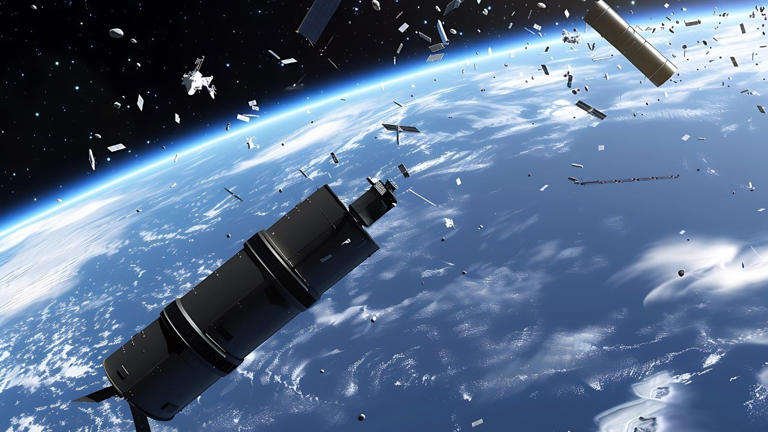
When a Russian satellite shattered in orbit, the fragments did not simply drift away into the void. They spread into busy traffic lanes of low Earth orbit, forcing astronauts to scramble for shelter and tracking networks to light up with new warnings. The incident turned a long‑running concern about space junk into an immediate operational crisis, underscoring how fragile the infrastructure above our heads has become.

The breakups of multiple Russian spacecraft, from imaging platforms to a high‑profile spy satellite, now form a chain of events that looks less like bad luck and more like a systemic failure to manage aging hardware. I see in this pattern a preview of a more chaotic orbital environment, where every uncontrolled explosion or collision multiplies the risk for the International Space Station, commercial constellations, and future missions.

The Russian satellite that triggered an orbital scare

The most visible shock came when a decommissioned Russian satellite suddenly fragmented, sending a cloud of debris across the paths of crewed spacecraft. U.S. tracking networks reported that the Russian spacecraft broke apart into at least 100 trackable fragments, a number that only counts objects large enough for ground radars to see. Earlier coverage of the same event described nearly 200 pieces, a reminder that the true population of shards, including those too small to track but still lethal at orbital speeds, is almost certainly higher. For the crew of the International Space Station, the numbers were not abstract: astronauts were ordered to shelter in their return vehicle as the swarm passed through their neighborhood.

Behind those radar plots sits a formal military apparatus that now treats orbital debris as a strategic concern. U.S. Space Command oversees a global network of sensors that catalog tens of thousands of objects, and it was this system that first confirmed the Russian breakup and began issuing conjunction warnings. In public statements, the same command has stressed that the debris field came from a Russian‑owned object and that analysts are still working to understand the cause, a point echoed in a separate press release from PETERSON AIR FORCE BASE, Colo that identified the spacecraft as RESURS‑P1 and Russia as the satellite owner. That combination of operational urgency and diplomatic sensitivity is now standard whenever a major spacefaring nation loses control of hardware in orbit.

satellite, spacecraft, space

A satellite in space.

Photo by WikiImages on Pixabay

Resurs‑P1 and the summer the ISS took cover

The RESURS‑P1 episode over the summer showed how even retired satellites can come back to haunt the orbital ecosystem. The imaging platform, known in Russian sources as Resurs, had been removed from service after exceeding its primary mission by 3.5 years, according to Russian outlet TASS, but it remained in a relatively crowded orbit. When it finally broke apart, U.S. Space Debris tracking indicated that fragments from the Russian Satellite Breakup Forces ISS Astronauts to Take Cover, prompting controllers to move the station into a safer orientation and direct the crew to close hatches. The cause of the RESURS‑P1 breakup remains unclear, but the operational impact was unmistakable.

On the ground, Mission Control teams worked through the night to refine trajectories and assess whether any fragments posed an immediate collision threat. Space Command officials emphasized on Thursday that they observed no immediate danger to the ISS or other spacecraft, even as they acknowledged that the cloud would need to be monitored for years as it slowly dispersed and decayed. For me, that is the most sobering part of the story: a single failure of an aging Russian satellite can create a long‑lived hazard that forces every other operator, from weather agencies to broadband providers, to spend fuel and attention dodging fragments they did not create.

690b40b3c94985001e0fe356.png

From inspector to wreckage: the Luch / Olymp disaster

The Russian reconnaissance satellite Luch, also known as Olymp, illustrates how the debris problem is no longer confined to low Earth orbit. The Russian spacecraft, identified in tracking catalogs as NORAD 40258, operated in a so‑called graveyard orbit where retired satellites are supposed to pose less risk to active constellations. Yet The Russian Luch, or Olymp, was reported to be completely destroyed after a collision with space debris while still tasked with reconnaissance and signal interception. That outcome turns the very concept of a safe graveyard orbit on its head, showing that even regions set aside for retired hardware are now contaminated by high‑speed shrapnel.

Analysts have tied the Luch incident to a broader pattern of Russian satellites suffering catastrophic failures in under‑monitored orbital regimes. A detailed assessment titled Russian Spy Satellite by Suspected Debris Strike in Graveyard Orbit, By SOFX, argues that the destruction of the platform highlights the contested character of space operations, even in orbits once considered quiet backwaters. A companion report, credited to Feb, SWJ, Staff, notes that The Soyuz MS spacecraft docked to the ISS (Photo Courtesy NASA) was part of the broader context in which Russian assets are increasingly entangled with debris fields. I read these accounts as a warning that the line between active and retired orbits is blurring, and that operators can no longer assume that moving a satellite higher is enough to guarantee safety.

A Russian ‘inspector’ satellite and the mystery of silent breakups

Not all debris‑creating events are as dramatic as a collision in graveyard orbit. In Jan, observers noticed that a Russian spacecraft described as an “inspector” satellite had quietly begun to shed pieces, with no obvious trigger such as a launch failure or anti‑satellite test. Ground‑based observations suggested the Russian vehicle was breaking apart in orbit, raising debris concerns among analysts who track unusual maneuvers and proximity operations. The fact that this satellite was designed to approach and inspect other spacecraft only heightens the unease, since any uncontrolled fragments from such a platform could threaten the very assets it was meant to observe.

From my perspective, the most troubling aspect of the inspector breakup is how little is publicly known about its cause or the exact number of fragments. A follow‑on analysis of the same Jan event, based on Ground observations, underscored that the satellite’s behavior deviated from its previous pattern without any official explanation from Moscow. In an environment where even small fragments can puncture a pressure hull or shred solar arrays, that opacity is not just a diplomatic problem, it is a direct operational risk for every operator sharing the same orbital band.

Tracking the fragments and the race to contain the crisis

As Russian satellites continue to fail in ways that generate debris, the burden of tracking and mitigating the fallout increasingly falls on a mix of military and commercial networks. U.S. Space Command remains the backbone of global surveillance, but it is now joined by private firms that specialize in high‑fidelity mapping of orbital traffic. One of the most prominent, LeoLabs, operates phased‑array radars that can detect small debris in low Earth orbit and provide conjunction warnings to satellite operators who lack their own tracking infrastructure. In the wake of the Russian breakups, such services have become essential for companies flying large constellations of small satellites, which are particularly vulnerable to untracked fragments.

At the same time, scientific and policy communities are sounding louder alarms about the cumulative effect of these incidents. A detailed overview titled Russian Satellite Explosion frames the Luch / Olymp disaster as part of a broader trend in which Space Debris Is Growing Out of Control, and highlights The Rise of Space Debris and How The Luch, Olymp event illustrates the feedback loop between collisions and new fragments. Broadcast coverage has reinforced that message for a wider audience, with one Jun segment noting that a Russian satellite had broken up into more than 100 pieces of debris in orbit, forcing astronauts on the International Space Station, sometimes referred to as the International Space, to take shelter. For me, the throughline is clear: without stricter end‑of‑life rules, active debris removal, and more transparency from operators like Russia, each new breakup will not be an isolated mishap but another turn in a spiraling crisis that affects every nation and every mission that depends on the space above Earth.

Hoe vind je dit bericht?
Geschreven door peter om 15:27 Stuur door

Meer van UFO'S of UAP'S, ASTRONOMIE, RUIMTEVAART, ARCHEOLOGIE, OUDHEIDKUNDE, SF-SNUFJES EN ANDERE ESOTERISCHE WETENSCHAPPEN - DE ALLERLAATSTE NIEUWTJES

↑ Terug naar de berichten