Naar de inhoud

UFO'S of UAP'S, ASTRONOMIE, RUIMTEVAART, ARCHEOLOGIE, OUDHEIDKUNDE, SF-SNUFJES EN ANDERE ESOTERISCHE WETENSCHAPPEN - DE ALLERLAATSTE NIEUWTJES

UFO's of UAP'S in België en de rest van de wereld
akke.beakke.be
Ontdek de Fascinerende Wereld van UFO's en UAP's: Jouw Bron voor Onthullende Informatie! Ben jij ook gefascineerd door het onbekende? Wil je meer weten over UFO's en UAP's, niet alleen in België, maar over de hele wereld? Dan ben je op de juiste plek! België: Het Kloppend Hart van UFO-onderzoek In België is BUFON (Belgisch UFO-Netwerk) dé autoriteit op het gebied van UFO-onderzoek. Voor betrouwbare en objectieve informatie over deze intrigerende fenomenen, bezoek je zeker onze Facebook-pagina en deze blog. Maar dat is nog niet alles! Ontdek ook het Belgisch UFO-meldpunt en Caelestia, twee organisaties die diepgaand onderzoek verrichten, al zijn ze soms kritisch of sceptisch. Nederland: Een Schat aan Informatie Voor onze Nederlandse buren is er de schitterende website www.ufowijzer.nl, beheerd door Paul Harmans. Deze site biedt een schat aan informatie en artikelen die je niet wilt missen! Internationaal: MUFON - De Wereldwijde Autoriteit Neem ook een kijkje bij MUFON (Mutual UFO Network Inc.), een gerenommeerde Amerikaanse UFO-vereniging met afdelingen in de VS en wereldwijd. MUFON is toegewijd aan de wetenschappelijke en analytische studie van het UFO-fenomeen, en hun maandelijkse tijdschrift, The MUFON UFO-Journal, is een must-read voor elke UFO-enthousiasteling. Bezoek hun website op www.mufon.com voor meer informatie. Samenwerking en Toekomstvisie Sinds 1 februari 2020 is Pieter niet alleen ex-president van BUFON, maar ook de voormalige nationale directeur van MUFON in Vlaanderen en Nederland. Dit creëert een sterke samenwerking met de Franse MUFON Reseau MUFON/EUROP, wat ons in staat stelt om nog meer waardevolle inzichten te delen. Let op: Nepprofielen en Nieuwe Groeperingen Pas op voor een nieuwe groepering die zich ook BUFON noemt, maar geen enkele connectie heeft met onze gevestigde organisatie. Hoewel zij de naam geregistreerd hebben, kunnen ze het rijke verleden en de expertise van onze groep niet evenaren. We wensen hen veel succes, maar we blijven de autoriteit in UFO-onderzoek! Blijf Op De Hoogte! Wil jij de laatste nieuwtjes over UFO's, ruimtevaart, archeologie, en meer? Volg ons dan en duik samen met ons in de fascinerende wereld van het onbekende! Sluit je aan bij de gemeenschap van nieuwsgierige geesten die net als jij verlangen naar antwoorden en avonturen in de sterren! Heb je vragen of wil je meer weten? Aarzel dan niet om contact met ons op te nemen! Samen ontrafelen we het mysterie van de lucht en daarbuiten.

Archief

Hundreds of Anomalous Celestial Objects Hidden in Hubble Space Telescope Data Have Been Revealed with Help from AI

Small cutout from the Hubble Legacy Archive revealed strange anomalies when analyzed by AnomalyMatch.
Credit: NASA, ESA, David O'Ryan (ESA), Pablo Gómez (ESA), Mahdi Zamani (ESA/Hubble)

Hundreds of Anomalous Celestial Objects Hidden in Hubble Space Telescope Data Have Been Revealed with Help from AI

NASA’s Hubble Space Telescope continues to reveal the secrets of the universe, three and a half decades after its launch, as a new AI technique from the European Space Agency (ESA) identifies more than 800 previously unreported space objects.

Launched in 1990 and still in operation, the Hubble Space Telescope has amassed a vast archive of data over its decades spent scanning the universe. Now, a recent paper in Astronomy & Astrophysics reports the identification of 1,300 unusual objects by AI in just two and a half days, many of which have never appeared in the astronomical literature.

Hubble Image Analysis

The astronomers behind the new research fed their AI neural network 100 million image cutouts from the Hubble Legacy Archive. These cutouts are tiny—only dozens of pixels wide—yet the AI was able to meaningfully determine what they contained.

Galaxies accounted for most of the anomalous cutouts, typically undergoing mergers or other unusual interactions that distorted their morphologies or left them trailing long streams of stars and gas. Other cutouts were identified as spacetime distortions that bent light from distant galaxies into arcs or rings before it reached Hubble.

Hubble anomalies

Small image cutouts from the Hubble Legacy Archive revealed strange anomalies when analyzed by AnomalyMatch.

Credit: NASA, ESA, David O’Ryan (ESA), Pablo Gómez (ESA), Mahdi Zamani (ESA/Hubble)

More unusual cosmic features were also identified, including galaxies resembling jellyfish with strange tentacle-like streams of gas, and edge-on planet-forming disks that appear like hamburgers in the images (several of which can be seen above).

Perhaps most notably, dozens of the objects were so bizarre that they did not fit any existing classification.

Developing AnomalyMatch

The sheer scale of data amassed in the continually expanding archives of Hubble and other telescopes has become so large that it defies traditional human-led analysis. These advanced space observatories generate data at a rate far exceeding that of earlier eras in astronomy. Prior attempts to open the data to citizen scientists have met with some success, but the backlog has grown too large for those initiatives to fully address. Until now, astronomers have relied on manual analysis and the occasional fortunate discovery made while examining specific targets.

While Hubble was constructed by NASA, ESA researchers David O’Ryan and Pablo Gómez developed the solution leveraged by the team for its analysis of this torrent of data. Specifically, the pair created a neural network called AnomalyMatch, which is designed to examine collections of imagery far more quickly than humans can. Still, AnomalyMatch was trained to perform pattern recognition similar to that of humans, allowing it to “learn” to identify rare and unusual objects hidden in the data.

“Archival observations from the Hubble Space Telescope now span 35 years, offering a rich dataset in which astrophysical anomalies may be hidden,” said lead author David O’Ryan.

Image-1-Full-Res-JPG-300x300.jpg

Among the objects discovered was a collision ring galaxy, a type of disrupted or bent ring-shaped galaxy.

Credit: NASA, ESA, David O’Ryan (ESA), Pablo Gómez (ESA), Mahdi Zamani (ESA/Hubble)

Exploring Hubble and Other Telescopes

Although the team’s initial paper focuses on data retrieved using the Hubble Space Telescope, the technique can be applied more broadly as well. Other platforms, such as ESA’s Euclid mission, are generating vast amounts of data that AnomalyMatch could help process. Crucially, O’Ryan and Gómez’s neural network results have been manually reviewed by astronomers, who have so far confirmed 1,300 of the anomalies flagged by AnomalyMatch.

“This is a powerful demonstration of how AI can enhance the scientific return of archival datasets,” co-author Pablo Gómez said. “The discovery of so many previously undocumented anomalies in Hubble data underscores the tool’s potential for future surveys.”

Future advanced space observatories will also benefit from the implementation of AnomalyMatch. For instance, NASA’s upcoming Nancy Grace Roman Space Telescope will provide a wider field of view than the James Webb Space Telescope, offering yet another enormous data set for astronomers to search through in the years ahead.

The paper, “Identifying Astrophysical Anomalies in 99.6 Million Source Cutouts from the Hubble Legacy Archive using AnomalyMatch,” appeared in Astronomy & Astrophysics on December 16, 2025.

  • Ryan Whalen covers science and technology for The Debrief. He holds an MA in History and a Master of Library and Information Science with a certificate in Data Science. He can be contacted at ryan@thedebrief.org, and follow him on Twitter @mdntwvlf.

Exploring the new anomalies: Gravitational lenses and more

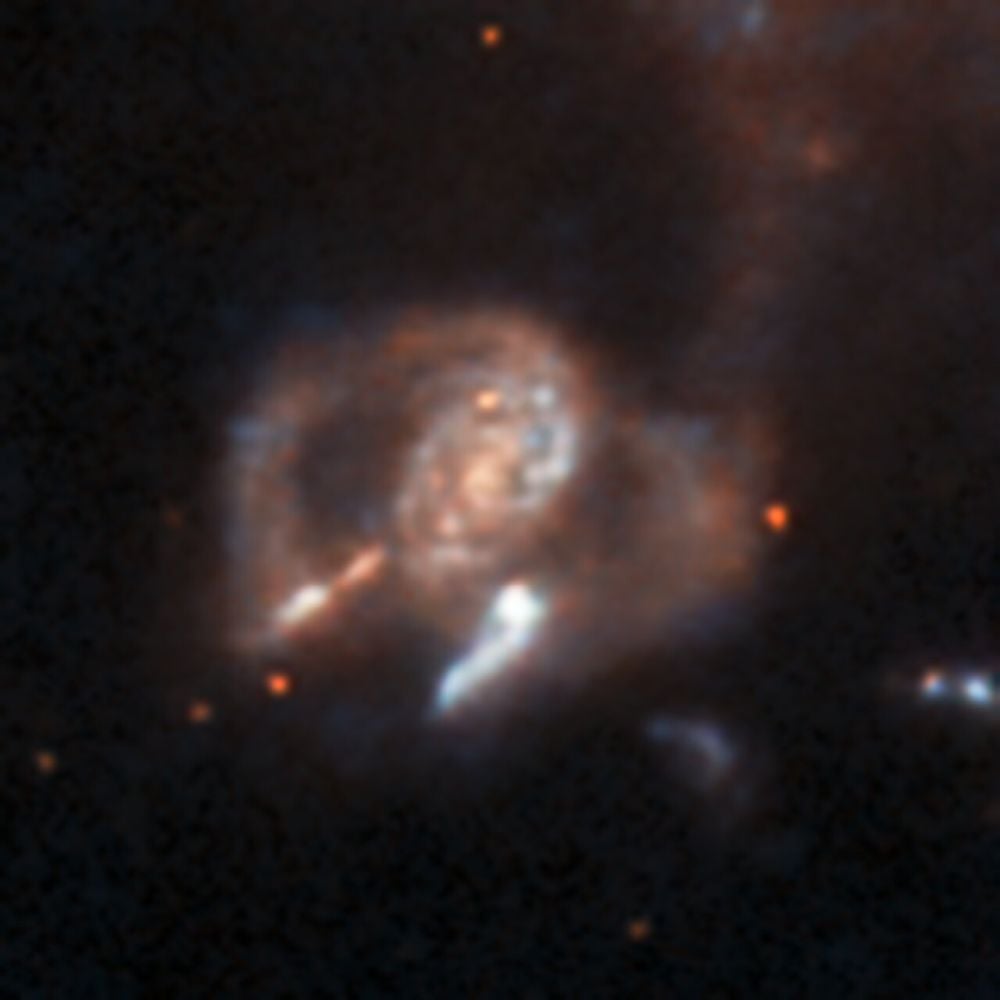
Among the anomalies found by AI, gravitational lenses stand out for both their scientific value and visual intrigue. These occur when a massive galaxy or cluster bends and magnifies the light of a more distant background object. In one such example recently uncovered, a compact, reddish elliptical galaxy bends light from a blue spiral galaxy behind it into a graceful arc. The blue arc curve clearly shows how spacetime itself has bent the light.

Another lens shows a striking arc wrapped around the core of a massive foreground galaxy. The background galaxy’s light is stretched into a shape that almost encircles the lensing galaxy. In each case, the warped appearance is a cosmic fingerprint of gravity at work.

These lensing systems help astronomers do more than make pretty pictures. They provide natural magnification that reveals very distant galaxies otherwise too faint to see. They also allow researchers to map the distribution of dark matter, a mysterious substance that does not emit light but exerts gravitational influence on visible matter.

This image depicts a gravitational lens, where the enormous mass of one galaxy distorts, bends and magnifies light from another galaxy behind it, resulting in a warped image of the background galaxy. Credit: ESA/Hubble & NASA, D. O’Ryan, P. Gómez (European Space Agency), M. Zamani (ESA/Hubble)

This image depicts a gravitational lens, where the enormous mass of one galaxy distorts, bends and magnifies light from another galaxy behind it, resulting in a warped image of the background galaxy.

Credit: ESA/Hubble & NASA, D. O’Ryan, P. Gómez (European Space Agency), M. Zamani (ESA/Hubble)

{ https://thedebrief.org/category/space/ }

Hoe vind je dit bericht?
Geschreven door peter om 23:24 Stuur door

EXCLUSIVE - I've seen possessed children scream like beasts and strung up like puppets... these chilling exorcism cases PROVE hell is real

EXCLUSIVE - I've seen possessed children scream like beasts and strung up like puppets... these chilling exorcism cases PROVE hell is real

There is a hidden battlefield within our world, where forces of light and darkness collide, believers say, in a conflict that sometimes spills into everyday life. 

In its most extreme form, the clash is described as possession: a person seemingly seized by demonic beings, their body overtaken, their voice and movements warped into something not quite human. 

For Anglican reverend Chris Lee, 43, this is not a theological abstraction but a reality he has lived with for nearly two decades. 

Speaking to the Daily Mail, Lee said he first began witnessing exorcisms after moving to rural Tanzania aged 24 for mission work while training to become a priest. 

It was there, he said, that he encountered what he described as 'profound things, miracles and movements of darkness and light' that convinced him he was being called into ministry. 

Within just a month of arriving, Lee said he received an urgent call about a student who was violently ill, screaming, vomiting and convulsing in a way he believed went far beyond any normal sickness. 

Other encounters followed, as Lee recalled a teenage boy inside a church who suddenly 'leapt up into the sky,' screamed like a beast, and bolted into the woods, his body moving in a 'puppet-like' way, as if controlled by an unseen force. 

In another case, one that left a deep impression on him, Lee said a girl from a Muslim family began convulsing and speaking in a male voice, declaring, 'I'm one of nine here… this is my house,' as pastors struggled to drive out what they believed was an entity. 

Reverend Chris Lee shared chilling exorcism causes, detailing how the experiences gave him a purpose since giving his life to God at the age of 24

Despite the intensity of these encounters, Lee said he does not feel afraid. Instead, he described feeling purposeful, and at times angry, at what he sees as an invasion of something sacred. 

'It's like a burglar in a house,' he said. 'Get out. You don't have this right.' 

For Lee, prayer and faith are not symbolic gestures but sources of authority, and he believes he is standing on the side of Christ in a spiritual battle he says is as real as any physical one.

His early spiritual awakening began after he abandoned a conventional life at age 21 and moved to Tanzania. 

'I was 24 when I was ordained, so I was one of the youngest in the Church of England at the time,' Lee said, explaining how quickly his calling took root. 

He left a career in property development, sold his house and moved into a remote Maasai region without electricity or running water. 

While his new home was far from a lap of luxury, it was where he knew he wanted to dedicate his life to the ministry. 

'It was there that I was able to ask big, profound questions of life, and it was there that I discovered my love for God, and felt His presence so much more in my life,' said Lee. 

He moved from England to Tanzania for mission work and within only a month, he performed his first exorcism (stock)

He moved from England to Tanzania for mission work and within only a month, he performed his first exorcism (stock) 

When he asked his bishop if he could begin theological training, he was told to start almost immediately. 'He said, yes, you can start on Thursday,' Lee recalled, noting this moment marked the beginning of a long ministry in which he repeatedly confronted spiritual forces he believes are very real.

His first encounter came when he was in charge of students in Tanzania, and was called to see a student who was very ill. 

'I came into the room of this person, and I was expecting them to be lying down and being sick, but the person was screaming around the room and vomiting at the same time,' he said. 

The sight caught Lee completely off guard, as he was not witnessing a normal sickness. 

'I didn't have a spectrum of understanding of what was going on,' the reverend admitted. 'So in that moment I just prayed, "Lord, give me what I need to help this girl."'

After praying in the room, Lee contacted a German missionary who was in the area, hoping to get assistance. 

'When he arrived, just before we went in, I said, "Be aware, it's very disturbing. She's screaming, moving around the room, and vomiting,"' said Lee. 

'He said, "Okay, fine." We walked in, and she was suddenly completely normal. She was sitting up and talking. I was actually quite embarrassed. I thought, "What is going on?"'

He believes possession come after some kind of trauma that opens a dark door into the person's life, allowing demonic beings to take over 

The German missionary asked other students about the girl, who said she was someone afflicted by the demonic. 

Lee believes this was his first encounter with evil, but by no means his last. 

He recalled another chilling case that occurred while he was traveling to another church in the area, a church made of sticks. 

The bishop at the time was performing baptisms for the children, laying his hands on their heads for a blessing. 

'He was going along the line, laying his hands to bless the children,' said Lee. 'It was a teenage boy who suddenly leapt up into the sky just before the bishop was about to lay his hands on him.

'He started screaming, like a beast, like a lion, and then he ran into the wall.'

The boy was taken out of the church and placed on the ground with a blanket pulled over his head. 

As Lee and others approached quietly across the sand to pray, he said the boy began to tremble. Lee said the shaking intensified the closer they came, which he interpreted as a sign that whatever was afflicting the child was aware of their presence and reacting to it. 

'He picked up and ran away from us, screaming, into the woods. As he was running, it was very strange, because the way he moved was not like a normal person,' Lee said.

'It was as if he were one of those puppets on strings, his limbs were being used, but not in the correct way. 

'It was a very surreal experience, watching him flee in this almost puppeteered way, as if something inside him was controlling him, but not the way a normal human being would be controlled.'

The boy was brought back to the church, where the crowd surrounded him in prayer.

'I remember his eyes burning, with a real blackness, a darkness in his eyes, and we were commanding the spirit in him to leave, and he was growling, and barking at us,' the reverend recalled. 

Lee and the bishop laid their hands on the boy, commanding the demonic entity leave his small body, and in a moment, the child fell to the ground and began hyperventilating.

Then there was his experience with the young Muslim girl who would stay at his church.

 One day, the girl mysteriously fell to the floor and began shaking and screaming. 'What was interesting was that voices were speaking out of her,' Lee said. 

'The main voice was a male voice speaking in Swahili to the pastor who was leading the deliverance at that moment. 

'It said, "I'm one of nine here, and she's let us in." The language the demon used was, "This is my house. You have no claim over her. She's ours." 'We were saying, "No, in the name of Jesus, you need to get out."'

Another pastor came, telling Lee and the others to stop the exorcism. 

'He said she hadn't yet accepted Christ in her heart, and if we delivered her now, it could be made worse,' said Lee. 

'Biblically, he explained, if you clear the house, seven more can come back in unless the person has received Christ. His concern was that we might clear space for more to enter her. 

'So it was stopped in that moment. Her parents were informed, and they collected her. 

'My understanding is that she returned to school a few weeks later, which suggests her parents took her to a deliverance expert in Dar es Salaam or Morogoro, where I believe she was delivered. 

'She was an interesting case because she would come off the ground in violent surges, then stand up and contort, speaking in a male voice. That was one of the more severe cases.'

Lee suggested that these children may have suffered some kind of trauma in their lives, which opened a dark door for the demonic entities. 

'These experiences have made the realities of what I read in the Bible more real to me, the realities of the spiritual realm and the fact that we aren't just physical beings,' he explained. 

'We are spiritual beings, and our spirit is wrapped up in the physical. We are both of these things held as one.'

'The realities of darkness and light became more pronounced. In a world where we're struggling to seek and find truth, and where people say 'my truth' and 'your truth,' this cuts through that. It's quite clear: there is evil, there is good, there is truth, and there are lies.'

'I think it wakes you up to that reality, and it makes my faith more pronounced in myself. In a way, it strengthened my faith rather than wounded it.'

RELATED VIDEOS

10 Real Life Cases of Exorcism and Demon Possession

Scary Exorcism and Real Demonic Possession! (Top 5)

{ https://www.dailymail.co.uk/sciencetech/index.html }

Hoe vind je dit bericht?
Geschreven door peter om 23:00 Stuur door

Lost tomb of the mysterious 'cloud people' unearthed after 1,400 years in 'discovery of the decade'

Lost tomb of the mysterious 'cloud people' unearthed after 1,400 years in 'discovery of the decade'

It has been hailed as 'the most significant archaeological discovery in a decade.'

Archaeologists in Mexico have uncovered a 1,400-year-old tomb in the Central Valleys of Oaxaca that had been lost to history.

The stone structure, built by the Zapotec culture, known as Be'ena'a, or 'The Cloud People', is adorned with sculptures, murals and carved symbols that suggest ritual significance.

The Zapotec believed their ancestors descended from the clouds and that, in death, their souls returned to the heavens as spirits.

At the entrance sits a massive carved owl, its open beak revealing the face of a Zapotec lord, a symbol the National Institute of Anthropology and History said represented death and power.

The doorway is framed by a stone threshold and lintel, above which a frieze of engraved slabs displays ancient calendrical names.

Flanking the entrance are carved figures of a man and woman wearing headdresses and holding ritual objects, likely guardians of the tomb.

Inside the burial chamber, preserved sections of a vibrant mural remain intact, showing a procession of figures carrying bundles of copal as they move toward the tomb's entrance.

Archaeologists in Mexicohave uncovered a 1,400-year-old tomb in the Central Valleys of Oaxaca that had been lost to history

Archaeologists in Mexicohave uncovered a 1,400-year-old tomb in the Central Valleys of Oaxaca that had been lost to history

At the entrance sits a massive carved owl, its open beak revealing the face of a Zapotec lord

At the entrance sits a massive carved owl, its open beak revealing the face of a Zapotec lord

Mexico's president, Claudia Sheinbaum Pardo, said: 'It is the most important archaeological discovery of the last decade in Mexico due to its level of preservation and the information it provides.'

The Zapotecs have a history spanning over 2,500 years. 

They established a major pre-Columbian civilization centered at Monte Albán, which featured advanced agriculture and writing.

The Zapotec civilization mysteriously declined in the area around 900 AD.

However, the people did not completely disappear, as there are at least 400,000 living today.

Mexico's Secretary of Culture, Claudia Curiel de Icaza, said the 'exceptional discovery' of the tomb was due to its preservation. 

She added that it reveals how the Zapotec culture was a social organization with funerary rituals.

'It is a compelling example of Mexico's ancient grandeur, which is now being researched, protected, and shared with society,' she continued.  

The stone structure, built by the Zapotec culture, known as Be'ena'a, or 'The Cloud People', is adorned with sculptures, murals and carved symbols that suggest ritual significance

The stone structure, built by the Zapotec culture, known as Be'ena'a, or 'The Cloud People', is adorned with sculptures, murals and carved symbols that suggest ritual significance

Pictured is the giant owl above the tomb's entrance

Pictured is the giant owl above the tomb's entrance

An interdisciplinary team from the INAH Oaxaca Center is currently working to conserve and protect the tomb, focusing on stabilizing the fragile mural painting. Experts say the mural’s condition is delicate due to root growth, insect activity, and sudden shifts in temperature and humidity.

At the same time, researchers are conducting ceramic, iconographic and epigraphic studies, along with physical anthropology analyses, to better understand the rituals, symbols and funerary practices connected to the tomb.

In 2024, archaeologists announced the discovery of tunnels that the ancient Zapotec civilization believed to be the 'entrance to the underworld' had been found beneath a centuries-old church.

Mitla, meaning place of the dead, was a city in southern Mexico known for its association with Pitao Bezelao, the Zapotec god of death.

But the Spanish arrived in the 16th Century and razed the city, building a church on the ruins of its most important temple.

A priest later wrote that 'the back door of hell' lay under the city – huge caverns believed to be the entrance to the Zapotec underworld.

But they were walled up, he said, and later excavations failed to find anything matching the scale of his description – until now.

Using non-invasive techniques, archaeologists recently revealed a series of chambers and tunnels beneath the city.

Five different sets of ruins were probed: the church group, the arroyo group, the adobe group, the south group, and the group of the columns.

Pictured is the face of the Zapotec god inside the owl's mouth

Pictured is the face of the Zapotec god inside the owl's mouth

In 2024, archaeologists announced the discovery of tunnels that the ancient Zapotec civilization believed to be the 'entrance to the underworld' had been found beneath a centuries-old church

In 2024, archaeologists announced the discovery of tunnels that the ancient Zapotec civilization believed to be the 'entrance to the underworld' had been found beneath a centuries-old church 

Using non-invasive techniques, archaeologists recently revealed a series of chambers and tunnels beneath the city

Using non-invasive techniques, archaeologists recently revealed a series of chambers and tunnels beneath the city

Marco Vigato, founder of the ARX Project, which is leading the search, said: 'Some of the tunnels and chambers extend to a considerable depth, in excess of 50 feet.

The underground tunnels were revealed using a combination of ground penetrating radar, electric resistivity tomography, and seismic noise tomography. 

The first method uses radar waves to model the subsurface, while the second detects buried structures by measuring the flow of electricity through the earth.

Instead of electricity, the final method measures the speed at which seismic waves move through the ground.

Just how old the tunnels are is yet to be established.

'Natural caves in the area of Mitla have been occupied and partially modified by humans for thousands of years,' Vigato said:

'The earliest evidence of crop domestication in the area of Mitla dates back almost 10,000 years.

'There is no indication at the moment as to the possible age of the tunnels under the church or the other groups of structures at Mitla.

'They may have been created by the Zapotecs, or they could be much older.'

He added: 'The findings from the geophysical scans will have to be confirmed with archaeological methods.

'This could determine the nature of the cavities identified under the site and whether they contain any artifacts of archaeological significance.'

 RELATED VIDEOS


The Greatest Archaeological Discoveries and Artefacts of Recent Years | Full Series

Inside Ancient Mexican Tombs | Zapotec Funerary Urns in Mesoamerica

{ https://www.dailymail.co.uk/sciencetech/index.html }

Hoe vind je dit bericht?
Geschreven door peter om 22:13 Stuur door

Battlefield 'voice of God' sonic weapon used in warzones unleashed on Minneapolis protesters

A military‑grade device capable of projecting a deafening, focused sound was deployed during a tense anti‑ICE protest in Minnesota Monday night.

State patrol troopers faced off with activists outside the SpringHill Suites in Maple Grove, where demonstrators believed federal immigration agents were staying.

Officers threatened to engage a long‑range acoustic device (LRAD), giving the crowd a countdown before deployment. 

The system, a highly directional loudspeaker, can emit piercing deterrent tones or amplified voice commands over long distances and was originally developed for military and crowd‑control use.

Experts warn that exposure to the device at close range can cause permanent hearing loss, ruptured eardrums, constant ringing in the ears, migraines, nausea, balance problems and even panic responses.

Marine Colonel Mark Cancian, a senior adviser for the Center for Strategic and International Studies, said, 'We used it in Iraq … if you're in the cone, it sounds like the voice of God is speaking to you.'

State patrol officials said they checked the device's volume, issued dispersal notices and did not actually use tones or sirens, despite reports circulating on social media.

The night ended with 26 arrests, whom the police said were allegedly taking part in 'unlawful assembly and riotous conduct.'

Minnesota police threatened protesters on Monday with a long‑range acoustic device (LRAD), giving the crowd a countdown before deployment

Minnesota police threatened protesters on Monday with a long‑range acoustic device (LRAD), giving the crowd a countdown before deployment

Monday's demonstration came on the heels of a shooting on Saturday.

Alex Pretti, 37, was killed shortly after 9am local time after an altercation involving multiple federal officers. 

The protest in the Minneapolis suburb came as federal law enforcement leadership in the state was in flux, with Border Patrol Commander Gregory Bovino and some agents expected to soon leave Minnesota after intense public scrutiny of recent actions by immigration authorities.

It was not immediately clear whether Bovino or other federal agents were staying at the hotel where demonstrators gathered. 

The department issued a statement saying: 'While we respect First Amendment rights, we will not tolerate property damage or violence in our community.'

The protest was declared unlawful after demonstrators caused property damage and engaged in violent behavior, which is not protected under the First Amendment. Officers deployed the LRAD after the crowd failed to comply with a dispersal order.

The military-grade loudspeaker can project spoken commands at intense volumes or emit piercing tones designed to get attention and deter movement. 

Even when only issuing voice commands, the device can be overwhelming.

Join the debate

Should police use military-grade sonic weapons to control protests?

Comment now
State patrol troopers faced off with protesters outside the SpringHill Suites in Maple Grove, where demonstrators believed federal immigration agents were staying

State patrol troopers faced off with protesters outside the SpringHill Suites in Maple Grove, where demonstrators believed federal immigration agents were staying

'I think we saw that in the video there of the system, because it's so loud, I mean, it pushes you back,' Cancian told CBS News.

The system was developed as a non-lethal alternative to traditional crowd-control methods such as pepper spray, tear gas, and rubber bullets. 

'In some situations where you might end up using force, kinetic force, or even lethal force, you know this can avoid that and avoid permanent damage to people,' said Cancian. 

LRAD uses an array of high-frequency speakers to produce highly directional sound, concentrating audio into a narrow beam rather than dispersing it broadly.

This technology allows sound to travel long distances while maintaining clarity, so spoken messages or warning tones can be heard over ambient noise.

The LRAD system can switch between voice communication and a high-decibel deterrent tone, with volume and frequency precisely controlled by the operator.

The device is portable and can be mounted on vehicles, tripods or handheld platforms, and operators can adjust range, angle, and intensity depending on the situation.

It has been suggested that this is the same 'secret sonic' weapon President Donald Trump said US special forces used during the daring capture of the Venezuelan President Nicolas Maduro earlier this month.

Police did not active the system but used voice commands to deter the crowd

Police did not active the system but used voice commands to deter the crowd

The night ended with 26 arrests, whom the police said were allegedly taking part in 'unlawful assembly and riotous conduct'

The night ended with 26 arrests, whom the police said were allegedly taking part in 'unlawful assembly and riotous conduct'

Trump bragged last week that 'nobody else' has it, while glorifying the capabilities of the US military.

The exact nature of the weapon and how it was used is unknown. Trump was coy when giving details during an interview with NewsNation anchor Katie Pavlich.

Pavlich asked Trump whether Americans should be 'afraid' of these sonic devices.

'Well, yeah,' Trump responded.

He then added that only the US military has access to the sonic weapons by noting, 'It's something I don't wanna… nobody else has it.'

'But we have weapons nobody else knows about.' Trump continued. 'And, I say it's probably good not to talk about it, but we have some amazing weapons.'

Following the capture of Maduro, reports surfaced that special forces used unknown sonic weapons to disable the Cuban bodyguards assigned to protect the Venezuelan dictator.

Press Secretary Karoline Leavitt took to X to share an interview with an unnamed security guard who claimed to be working the night the US struck Venezuela and took Maduro on drug trafficking charges.

'Stop what you are doing and read this,' she wrote, alongside five American flag emojis.

The interview saw the security guard reveal the terrifying capabilities of the mysterious new US military weapon, which he described as a 'very intense sound wave' that disabled Venezuelan forces. 

'Suddenly I felt like my head was exploding from the inside,' the security guard reportedly said. 'We all started bleeding from the nose. Some were vomiting blood. We fell to the ground, unable to move. 

'We couldn't even stand up after that sonic weapon or whatever it was.' 

The security guard claimed moments before the raid that snatched Maduro, 'all our radar systems shut down without any explanation.' Then eight helicopters arrived and around 20 soldiers descended.

'They didn't look like anything we've fought against before,' the guard claimed.


Terrifying moment police allegedly use a banned sonic weapon on protesters

{ https://www.dailymail.co.uk/sciencetech/index.html }

Hoe vind je dit bericht?
Geschreven door peter om 21:36 Stuur door

10 core truths the Bible teaches about Adam and Eve

10 core truths the Bible teaches about Adam and Eve

Story by Mitchelle Abrams
10 core truths the Bible teaches about Adam and Eve
©Image Credit: cottonbro studio/pexels
The first humans created by God
Genesis begins with the creation of Adam from dust and Eve from Adam’s rib, providing the biblical account of the origin of humanity. This divine creation is a clear departure from other creation myths, as it stresses that human beings were the only beings created by God. Moreover, this lesson on Adam and Eve presents a unique perspective on human origins, emphasizing a divine meaning.

Many scholars, as cited in the Journal of Creation and The Bible and Science Journal, argue that this narrative suggests that humans were created with inherent dignity and a unique purpose that sets them apart from other creatures.

Although the evolution and scientific findings on the human genome have painted a new picture of how human beings developed biologically, the religious interpretation has maintained that the creation story holds the ultimate truth about how we developed spiritually and about our relation with the divine.
The first humans created by God
©Image Credit: cottonbro studio/pexels
The first humans created by God
Genesis begins with the creation of Adam from dust and Eve from Adam’s rib, providing the biblical account of the origin of humanity. This divine creation is a clear departure from other creation myths, as it stresses that human beings were the only beings created by God. Moreover, this lesson on Adam and Eve presents a unique perspective on human origins, emphasizing a divine meaning.

Many scholars, as cited in the Journal of Creation and The Bible and Science Journal, argue that this narrative suggests that humans were created with inherent dignity and a unique purpose that sets them apart from other creatures.

Although the evolution and scientific findings on the human genome have painted a new picture of how human beings developed biologically, the religious interpretation has maintained that the creation story holds the ultimate truth about how we developed spiritually and about our relation with the divine.
Made in God's image
©Image Credit: Chalo Garcia/pexels
Made in God's image
According to Gen 1:27, human beings are created in the image of God, a reality with far-reaching consequences. This verse means that Adam and Eve, and by extension everyone in the world, have something in common with God- they possess qualities like reason, creativity, and the ability to make moral judgments. The idea of creating in the image of God is still central to the equality and dignity of the entire human race in the modern world.

This lesson addresses contemporary challenges in human rights, social justice, and equality. According to theologians like Alister McGrath and articles in Psychology Today, it is these divine attributes that place humans in a special position in the created world and identify them as bearers of moral responsibility and ethical consciousness.
Placed in Eden
©Image Credit: icon0com/pexels
Placed in Eden
Adam and Eve began their lives in the Garden of Eden, a paradise described in Genesis 2:8 as full of beauty and abundance. The garden was a physical place, but above all, it represented harmony between man and creation. It is this ideal environment that gives the impression of how the world should have been as a harmonious, peaceful, and communicative place with God.

Nowadays, this biblical story can be heard in terms of environmental and sustainability conversations. The fact that humanity was initially put in a garden to enjoy the fruit and take care of it is consistent with contemporary ecological stewardship programs. Indeed, environmental groups, such as the World Wildlife Fund, state that biblical ideas of stewardship can serve as a helpful guide for current conservation efforts.
Given responsibility
©Image Credit: Helenalopes/pexels
Given responsibility
God assigned Adam the duty of taking care of the earth by giving him the responsibility to work and maintain the Garden of Eden (Genesis 2:15). This notion is not limited to physical work. Still, it extends to the greater duty that human beings have to the creation and to one another. This concept of stewardship in a modern context can be applied to preserving the environment and conducting ethical business.

ResearchGate reports that society is increasingly aware of the importance of living obligingly, in which responsibility and ethical conduct are essential to the well-being of future generations. The religious appeal to human beings to defend and care for the earth is a timeless call that still resonates in the new debates over sustainable practices, urban planning, and social responsibility.
Marriage covenant
©Image Credit: Onder Ceneviz/pexels
Marriage covenant
The Bible mentions in Genesis 2:22-24 the story of the creation of Eve from Adam’s rib, and this was always understood as a representation of equality and unity in marriage. The text emphasizes the value of companionship, implying that human relationships should be defined by mutual respect, partnership, and love. Even today, marriage is considered one of the most important social institutions, but attitudes toward it have shifted.

A Pew Research Center study found that half of U.S. adults believe that marriage is a vital social institution. Still, website trends indicate that a significant segment of the population is delaying marriage or choosing other forms of cohabitation. Nevertheless, even with the changes to these values, the biblical concept of marriage as the unity and equality still serves as a reference point in religious circles and affects the modern debate concerning gender roles and family units.
Command of obedience
©Image Credit: Pavel Danilyuk/pexels
Command of obedience
God commanded Adam and Eve not to eat the fruit of the tree of the knowledge of good and evil, but they disobeyed. This is a turning point (Genesis 2:17) when the concept of free will and moral decision-making in human existence was introduced. The order to obey was not a limitation but a challenge to have faith in God’s wisdom. The tension between individual responsibility and societal responsibility is discussed in modern ethical discourse, including law and psychology.

According to The Atlantic, the desire and duty conflict, and being in this situation is not new; the case of Adam and Eve is when they chose to listen to their desire rather than God’s order. This motif of obedience remains prominent in the human experience, particularly in moral decision-making today.
Temptation and fall
©Image Credit: Andres Ayrton/pexels
Temptation and fall
The temptation of Eve by the serpent and her consequent decision to taste the forbidden fruit and the involvement of Adam is what is popularly known as the Fall of Man (Genesis 3:1-6). This is a fundamental incident in Christian theology: the introduction of sin into the world. It has been viewed as an allegory of human nature: being tempted to choose something that results in something not so good.

This is corroborated by studies in behavioral science, such as those conducted by psychologist Roy Baumeister, who demonstrate that human beings are generally prone to temptation, particularly when it comes to short-term gratification rather than long-term rewards.
Consequences of sin
©Image Credit: Ron Lach/pexels
Consequences of sin
After being disobedient, Adam and Eve were severely punished with pain and suffering, and they were later sent to their deaths (Genesis 3:16-19). The effects of these repercussions brought a new reality to humankind, in which work, pain, and death became part of the human condition. Theologically, this is usually regarded as the cause of human suffering.

Recent sociological research, including that published in The Journal of Pain and Symptom Management, indicates that suffering is a global experience that prompts us to question the meaning of life and its purpose. The Bible insists that this was not the end of the world; even in light of the dismal outcomes of their deeds, the human race could still be redeemed.
Promise of redemption
©Image Credit: serezniy/123rf
Promise of redemption
Although this was already anticipated in the Fall, Genesis 3:15 outlined the promise of redemption, stating that God would triumph over evil in the future. The verse has been believed to be the first prophecy of the messiah coming to bring back the lost. The Christians view this promise as fulfilled in the life, death, and resurrection of Jesus Christ.

The issue of redemption remains one of the principal themes of contemporary Christian theology and has been applied to numerous cultural stories concerning how to triumph over evil. According to The Gospel Coalition, the idea of redemption resonates with individuals seeking meaning in their difficulties, which explains its continued relevance today.
Parents of humanity
©Image Credit: cottonbro studio/pexels
Parents of humanity
Adam and Eve were the parents of all humanity, and Eve is also referred to as the mother of all living (Genesis 3:20). The concept emphasizes the interconnectedness of all individuals, regardless of background or race. The similarity in the origin of all humans is supported by scientific research in genetics and anthropology, thus providing a scientific basis for this biblical fact.

Scientists, such as those at National Geographic, have discussed the idea of the most recent common matrilineal ancestor of all modern humans, known as mitochondrial Eve, which highlights the relationship between the Bible’s stories and scientific discoveries.
Key takeaways
©Image credit: bangoland via 123r
Key takeawayf
The Adam and Eve narrative offers profound insights into the human condition, the creation of humanity, the fall, and the promise of redemption. These biblical realities are still applicable in the modern world and help us understand what it means to be responsible human beings, to build relationships, and to make moral decisions that define our humanity.

The story of Adam and Eve still reverberates, whether in environmental stewardship, marriage, or the repercussions of sin. Through these facts, we are reminded of the common cause we share and of our ability to be redeemed and renewed.

Disclosure: This article was developed with the assistance of AI and was subsequently reviewed, revised, and approved by our editorial team.

Disclaimer – This list is solely the author’s opinion based on research and publicly available information. It is not intended to be professional advice.
TRLATED VIDEOS

The Shocking Truth About Adam & Eve

ADAM and EVE Bible Story | The Creation and The Fall

The Shocking Truth About Adam & Eve That No One Told You
Hoe vind je dit bericht?
Geschreven door peter om 20:46 Stuur door

Ancient Martian beach discovered, providing new clues to red planet's habitability

Ancient Martian beach discovered, providing new clues to red planet's habitability

Story by Gege L
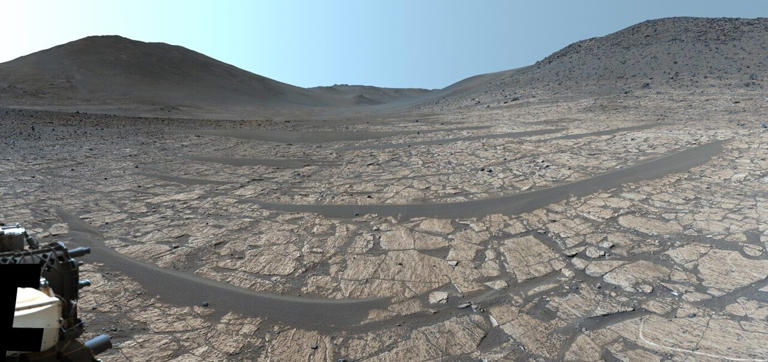
Perseverance looks upstream along Neretva Vallis, the ancient river valley which once fed water into Jezero crater, over 3.5 billion years ago. The light-toned rocks in the foreground comprise fine-grained mudstones of the Bright Angel formation. Credit: NASA/JPL-Caltech/ASU/MSSS
Perseverance looks upstream along Neretva Vallis, the ancient river valley which once fed water into Jezero crater, over 3.5 billion years ago. The light-toned rocks in the foreground comprise fine-grained mudstones of the Bright Angel formation.
Credit: NASA/JPL-Caltech/ASU/MSSS

New findings from NASA's Perseverance rover have revealed evidence of wave-formed beaches and rocks altered by subsurface water in a Martian crater that once held a vast lake—considerably expanding the timeline for potential habitability at this ancient site. In an international study led by Imperial College London, researchers uncovered that the so-called "Margin unit" in Mars's Jezero crater preserves evidence of extensive underground interactions between rock and water, as well as the first definitive traces of an ancient shoreline.

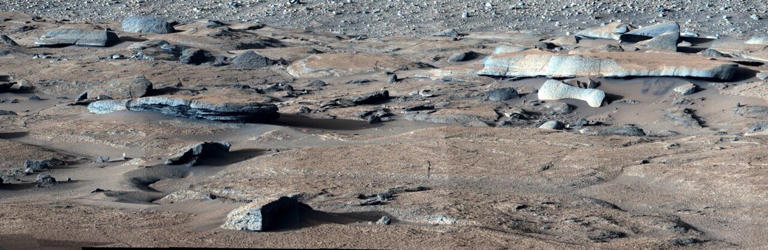
Perseverance views potential shoreline deposits in the Eastern Margin Unit with Mastcam-Z on Sol 934. Credit: NASA/JPL-Caltech/ASU/MSSS
Perseverance views potential shoreline deposits in the Eastern Margin Unit with Mastcam-Z on Sol 934.
Credit: NASA/JPL-Caltech/ASU/MSSS

These are compelling indicators that habitable, surface water conditions persisted in the crater (home to a large lake around 3.5 billion years ago) further back in time than previously thought. "Shorelines are habitable environments on Earth, and the carbonate minerals that form here can naturally seal in and preserve information about the ancient environment," said lead author Alex Jones, a Ph.D. researcher in the Department of Earth Science and Engineering (ESE) at Imperial.

"Our findings therefore have exciting implications for Mars's past climate and habitability, while providing new insights into a geologic unit which has long had a debated origin." The work is published in the Journal of Geophysical Research: Planets.

From rock to beach

Deployed on Mars since 2021 to search for signs of past life, NASA's Perseverance rover spent nearly a year extensively exploring the "Margin unit," a geologic unit lining the inner rim of Jezero crater between 2023 and 2024. The unit was a critical target for exploration since it is rich in carbonate minerals; these precipitate from liquid water and often trap organic molecules on Earth, making them excellent at preserving any potential biosignatures that are present in the environment.

Before Perseverance's arrival, the origin of the unit was contested—some scientists proposed that it formed as a sedimentary deposit along the edge of the ancient Jezero lake, while others argued it was an igneous rock later altered by water.

The study analyzed a multitude of high-resolution outcrop and grain-scale images captured by Perseverance's cameras to confirm that both hypotheses are in fact true to some degree.

It showed that much of the unit's structure and grain-scale texture is consistent with an altered igneous rock, likely formed from a large magma chamber or lava lake in the crater. After it cooled and solidified, crystals of olivine within the unit were heavily altered by circulating carbon dioxide-rich subsurface water, transforming into iron- and magnesium-carbonates. These findings therefore offer exciting evidence of sustained water-rock activity deep beneath the surface.

"This transformation, which builds on recently published work we also contributed to, indicates that water circulated below the surface of the Margin unit, altering the rock over vast timescales," said study author Professor Sanjeev Gupta of Imperial's Department of Earth Science and Engineering. "On Earth, this kind of subsurface hydrothermal environment is known to support microbial life."

Revealing the shoreline

Perhaps the most intriguing discovery lay in the lower-elevation regions of the Margin unit. Here, the team identified clearly layered sandstones containing rounded, sand-sized grains of olivine and carbonate. These sedimentary rocks have structures that are textbook indicators of waves acting in a shoreline environment.

"We are looking at what was once a beach," said Jones, who carried out the work during the first year of his Ph.D., with Professor Gupta and Dr. Rob Barnes, a Research Associate in the Department. "The waves of the Jezero lake eroded and reworked the local, igneous bedrock, rounding the grains and depositing them as a sandy layer along the shore."

He added, "The fact that this ancient beach sits underneath the Jezero river delta also tells us that the calm lake conditions that are hospitable for life existed here even earlier than we previously thought."

Extending the habitability window at Jezero

The evidence of water-rich conditions extending further back into the history of Jezero crater builds on Jones's recent work which found evidence of a comparatively young, perched lake at Jezero crater.

The international study, led by the group at ESE, investigated a series of rocks (called the "Bright Angel" formation) in the upstream reaches of the dried-up river valley which once fed water into the former Jezero lake.

Surprisingly, rather than the sandy or gravelly deposits typically left behind by rivers, the team found thick layers of mudstone: evidence that this part of the valley was once underwater. Their work suggests that billions of years ago, the valley was blocked, forming a dammed lake upstream.

Both these studies drew on crucial skills that Jones first gained from his undergraduate degree in the Department, including geologic mapping, sedimentology, stratigraphy and igneous petrology. "This fittingly showcases how our core teaching is exploited on real space missions that are striving to answer some of life's most fundamental and pertinent questions," said Professor Gupta.

Return to Earth

Now, three core samples collected by Perseverance from the Margin unit, and one from the Bright Angel formation, are awaiting return to Earth by the forthcoming Mars Sample Return mission. Laboratory analyses of these samples will allow scientists to precisely date igneous and sedimentary events at the crater, decode the climate conditions from carbonate chemistry, and search for signs of any potential biosignatures preserved in the samples.

"These findings show that the history of water in Jezero crater was far more complex in both time and space than we imagined," said Jones, who is also a student collaborator on NASA's Mars 2020 mission. "Jezero crater continues to prove it is the ideal place to investigate past habitability on Mars, and to help answer the question of whether life ever emerged."

More information: 

  • Alexander J. Jones et al, Stratigraphy of Carbonate‐Bearing Rocks at the Margin of Jezero Crater, Mars: Evidence for Shoreline Processes?, Journal of Geophysical Research: Planets (2026). DOI: 10.1029/2025je009111


Hoe vind je dit bericht?
Geschreven door peter om 18:44 Stuur door

Researchers Use AI To Find Astronomical Anomalies Buried In Archives

Researchers Use AI To Find Astronomical Anomalies Buried In Archives

These six galaxies were among the almost 1,400 anomalous objects buried in the Hubble Legacy Archive. Researchers used AI tools to comb through the vast archive and detect anomalous objects. The discovered objects include a ring-shaped galaxy, a bipolar galaxy, a group of merging galaxies, and three galaxies with warped arcs created by gravitational lensing. Image Credit: ESA/Hubble & NASA, D. O’Ryan, P. Gómez (European Space Agency), M. Zamani (ESA/Hubble) These six galaxies were among the almost 1,400 anomalous objects buried in the Hubble Legacy Archive. Researchers used AI tools to comb through the vast archive and detect anomalous objects. The discovered objects include a ring-shaped galaxy, a bipolar galaxy, a group of merging galaxies, and three galaxies with warped arcs created by gravitational lensing. Image Credit: ESA/Hubble & NASA, D. O’Ryan, P. Gómez (European Space Agency), M. Zamani (ESA/Hubble)

AI faces daily criticism from people worried about its ill-effects. But the type of AI that draws this ire are Large Language Models (LLMs). There are other types of AI with specialized functions that don't make it onto the front pages. Combing through vast troves of astronomical data is a perfect task for AI that is unlikely to be replicated by human minds.

A case in point is in new research published in Astronomy and Astrophysics. It's titled "Identifying astrophysical anomalies in 99.6 million source cutouts from the Hubble legacy archive using AnomalyMatch," and the authors are David O'Ryan and Pablo Gomez. O'Ryan and Gomez are both from the ESA's European Space Astronomy Centre (ESAC) in Madrid, Spain.

Our powerful collection of astronomical telescopes are creating a mass of data. The JWST contributes about 57 GB of data every day, depending on what observations are scheduled. The Vera Rubin Observatory, with the largest digital camera ever built, will vastly outpace that. It will generate about 20 terabytes of raw data each night and requires special infrastructure just to handle it. With powerful new telescopes like the Giant Magellan Telescope and Extremely Large Telescope coming online soon, the amount of astronomical data needing scientific scrutiny is growing into a deluge.

These vast quantities of data are bound to hold many hidden surprises. Our technology has outpaced the capacity of organic brains to process it all. But technological AI is catching up to astronomy's mass data-generation capability.

“Archival observations from the Hubble Space Telescope now stretch back 35 years, providing a treasure trove of data in which astrophysical anomalies might be found,” said co-lead author O’Ryan.

"Astronomical archives contain vast quantities of unexplored data that potentially harbour rare and scientifically valuable cosmic phenomena," the authors write. "We leverage new semi-supervised methods to extract such objects from the Hubble Legacy Archive."

Astrophyscial anomalies are important because they can be outliers that present a different side of nature. A trained scientist might be attuned to them and find them relatively easy. But there's just too much data.

The researchers used a recently-developed anomaly detection framework named AnomalyMatch to rapidly search through almost 100 million image cutouts from the Hubble Legacy Archive. The archive contains images going back aboutt 35 years.

AnomalyMatch is different AI than the type the techno-oligarchs are trying to cram into every piece of consumer software. It's a neural network, a machine learning tool inspired by the human brain. "AnomalyMatch is tailored for large-scale applications, efficiently processing predictions for ≈100 million images within three days on a single GPU," the authors wrote in a previous paper that presented the AnomalyMatch tool.

It took AnomalyMatch only 2 to 3 days to process this much data, a fraction of the time it would take human minds. It's the first time the Hubble Legacy Archive has undergone such a systematic search for anomalies. AnomalyMatch generated a list of likely anomalies. That list contained almost 1,400 anomalous objects, a number that's handled much more easily by human minds. O'Ryan and Gomez went through these 1,400 objects manually and determined that 1,300 of them were in fact anomalies, and that more than 800 of them have never been documented.

Merging and interacting galaxies were the most common type of anomaly detected in the Archive. There were 417 of them.

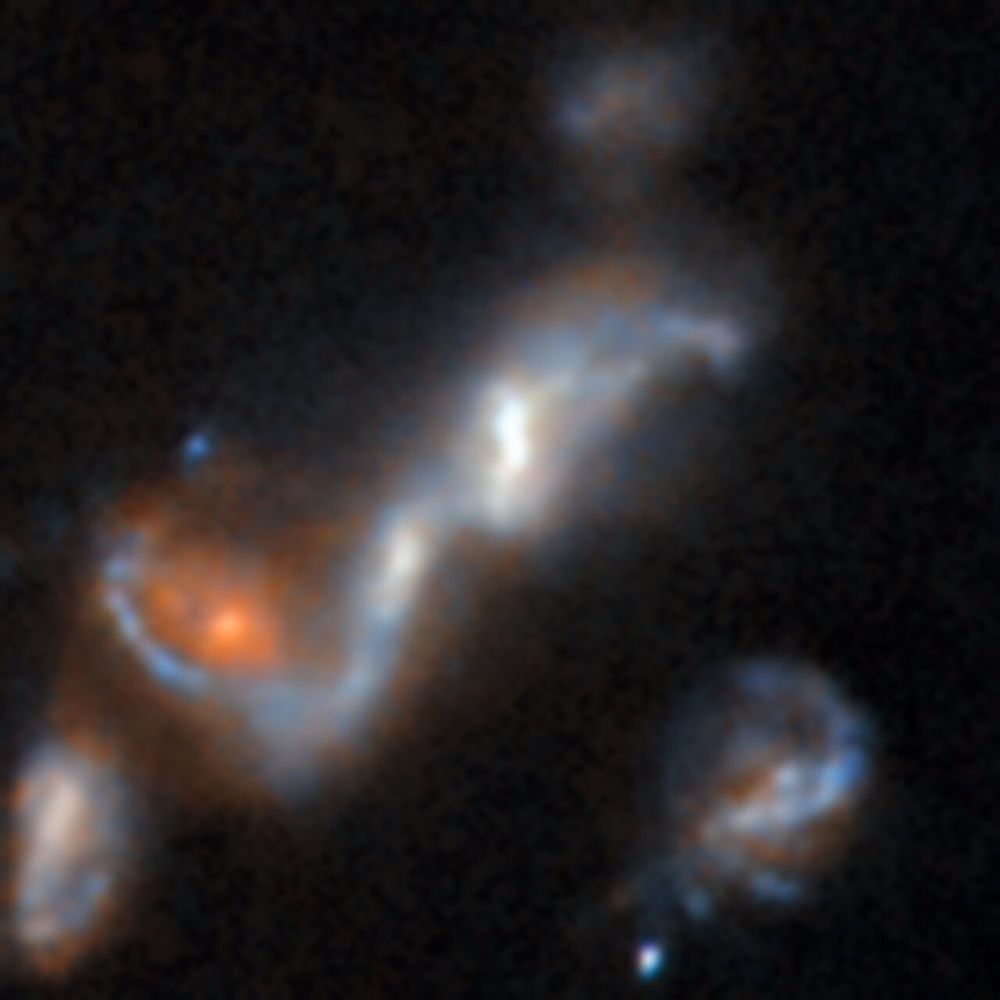
This group of gravitationally interacting galaxies is one of the anomalous the researchers found in the Hubble Legacy Archive. The distorted shapes and tidal tails illustrate the gravitational effects. Image Credit: ESA/Hubble & NASA, D. O’Ryan, P. Gómez (European Space Agency), M. Zamani (ESA/Hubble)

This group of gravitationally interacting galaxies is one of the anomalous the researchers found in the Hubble Legacy Archive. The distorted shapes and tidal tails illustrate the gravitational effects.

Image Credit: ESA/Hubble & NASA, D. O’Ryan, P. Gómez (European Space Agency), M. Zamani (ESA/Hubble)

The researchers also found 86 new potential gravitational lenses. These are important because they bring objects that are otherwise too distant to observe into reach. They also help scientists study the distribution of dark matter in the Universe, measure distances and cosmic expansion, and test general relativity. "We identify many gravitational lenses that are already identified in the literature – but many candidate new lenses," the authors write.

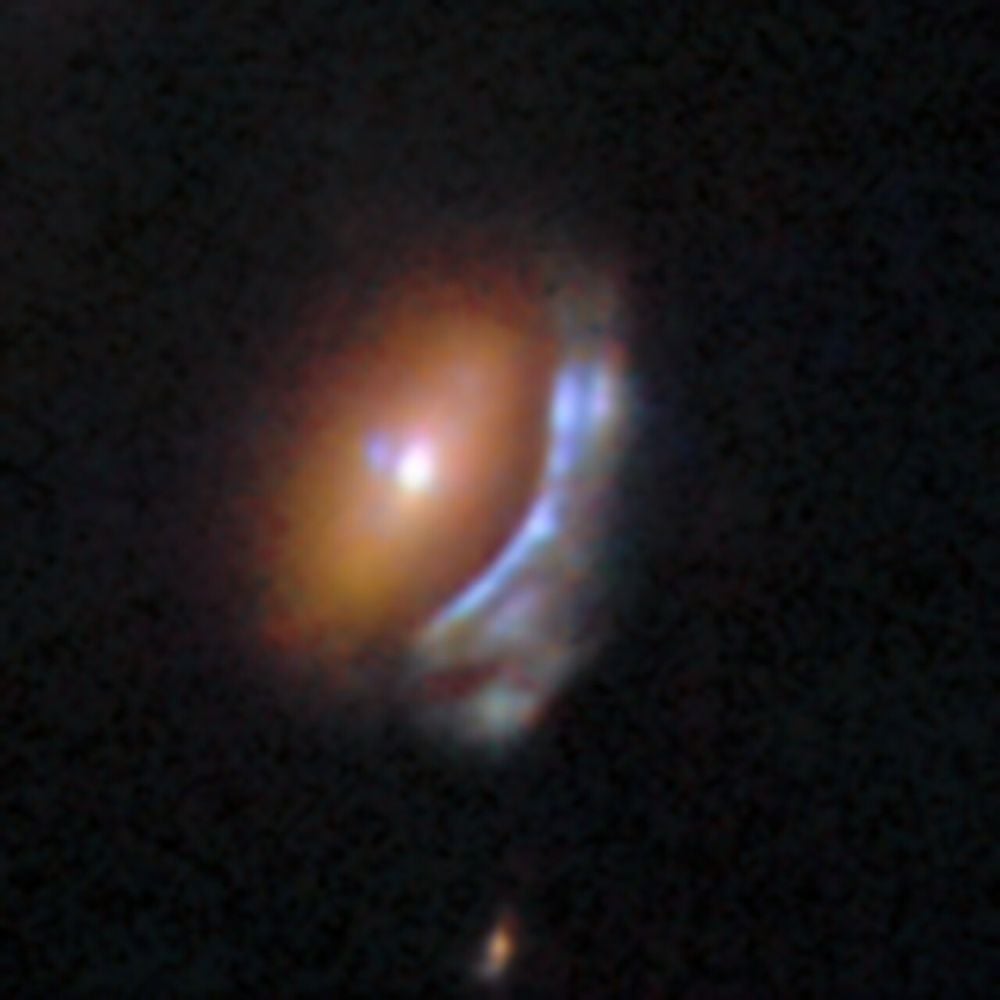
This is one of the gravitational lenses found in the Hubble Legacy Archive. The reddish elliptical galaxy is the foreground lens and a blue spiral galaxy in the background is magnified and distorted by the elliptical galaxy. These types of alignments bring distant objects into observational reach. Image Credit: ESA/Hubble & NASA, D. O’Ryan, P. Gómez (European Space Agency), M. Zamani (ESA/Hubble)

This is one of the gravitational lenses found in the Hubble Legacy Archive. The reddish elliptical galaxy is the foreground lens and a blue spiral galaxy in the background is magnified and distorted by the elliptical galaxy. These types of alignments bring distant objects into observational reach.

Image Credit: ESA/Hubble & NASA, D. O’Ryan, P. Gómez (European Space Agency), M. Zamani (ESA/Hubble)

There were other anomalies in the Archive, too. AnomalyMatch found other rare objects like jellyfish galaxies. These are found in galaxy clusters where ram pressure is stripping gas from the galaxy, leaving a long tail lit up with star formation. There were 35 of them found in the Archive.

The research also turned up some anomalies with uncertain natures. One of them is a strange sight, a galaxy with a swirling core and open lobes.

This galaxy highlights the anomalous nature of some difficult-to-categorize objects. It's a bi-polar galaxy with a compact swirling core and an open lobe at each side. This object was newly-discovered and previously unknown. It's not clear what type of galaxy it is, and if it's strange morphology is related to a merger. Its discovery highlights the utility of AI tools to search through astronomical archives. Image Credit: ESA/Hubble & NASA, D. O’Ryan, P. Gómez (European Space Agency), M. Zamani (ESA/Hubble)

This galaxy highlights the anomalous nature of some difficult-to-categorize objects. It's a bi-polar galaxy with a compact swirling core and an open lobe at each side. This object was newly-discovered and previously unknown. It's not clear what type of galaxy it is, and if it's strange morphology is related to a merger. Its discovery highlights the utility of AI tools to search through astronomical archives.

Image Credit: ESA/Hubble & NASA, D. O’Ryan, P. Gómez (European Space Agency), M. Zamani (ESA/Hubble)

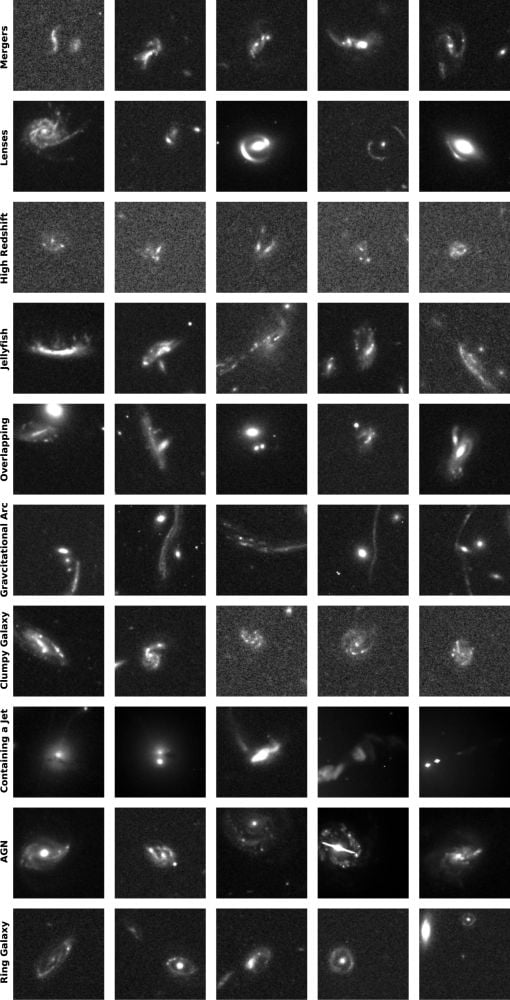
Finding hidden surprises in vast quantities of astronomical data is an admirable use of AI. Along with the previously mentioned anomalies, the researchers also uncovered overlapping galaxies, clumpy galaxies, ring galaxies, and even high-redshift galaxies so close to detection limits they're difficult to discern. They also found jetted galaxies and AGN-hosting galaxies.

This figure from the research shows five examples of every anomaly sub-class for which we found at least five objects, not including lensed quasars. These were selected as representative of each sub-class. Image Credit: O'Ryan and Gomez 2026. A&A

*This figure from the research shows five examples of every anomaly sub-class for which we found at least five objects, not including lensed quasars. These were selected as representative of each sub-class.

Image Credit: O'Ryan and Gomez 2026. A&A*

If all astronomical observations stopped tomorrow, the discoveries wouldn't stop. Capable AI tools are destined to become more and more powerful. Massive existing datasets from the Hubble and from other missions like the ESA's Gaia are feeding grounds for future tools.

Who knows what's waiting to be discovered in all that data?

“This is a powerful demonstration of how AI can enhance the scientific return of archival datasets,” Gómez said. “The discovery of so many previously undocumented anomalies in Hubble data underscores the tool’s potential for future surveys.”

{ https://www.universetoday.com/ }

Hoe vind je dit bericht?
Geschreven door peter om 23:56 Stuur door

Asteroid 2024 YR4 Has a 4% Chance of Hitting the Moon. Here’s Why That’s a Scientific Goldmine.

Asteroid 2024 YR4 Has a 4% Chance of Hitting the Moon. Here’s Why That’s a Scientific Goldmine.

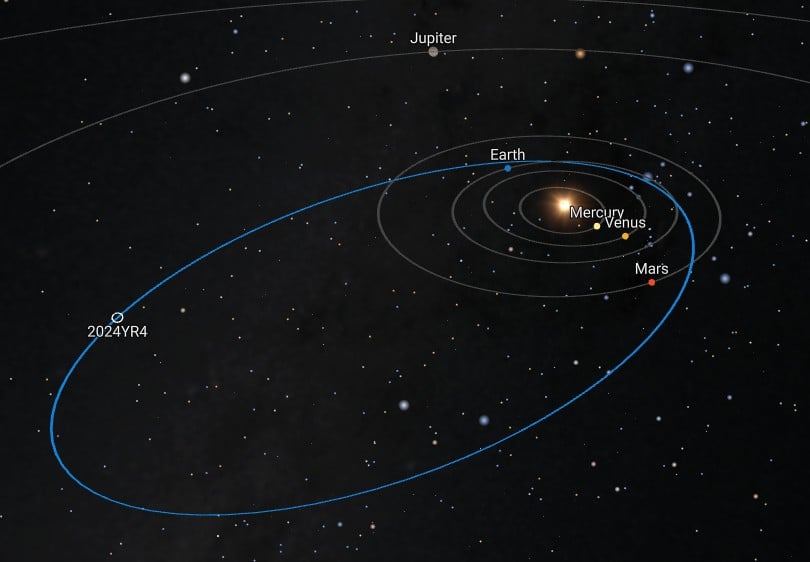
Oribtal path of Asteroid 2024 YR4. Credit - ESA Orbit Visualization Tool Oribtal path of Asteroid 2024 YR4. Credit - ESA Orbit Visualization Tool

There’s a bright side to every situation. In 2032, the Moon itself might have a particularly bright side if it is blasted by a 60-meter-wide asteroid. The chances of such an event are still relatively small (only around 4%), but non-negligible. And scientists are starting to prepare both for the bad (massive risks to satellites and huge meteors raining down on a large portion of the planet) and the good (a once in a lifetime chance to study the geology, seismology, and chemical makeup of our nearest neighbor). A new paper from Yifan He of Tsinghua University and co-authors, released in pre-print form on arXiv, looks at the bright side of all of the potential interesting science we can do if a collision does, indeed, happen.

On December 22nd, 2032, Asteroid 2024 YR4 has a 4% chance of actually striking the Moon. If it does, it will release enough energy to be the equivalent of smacking our nearest neighbor with a medium-sized thermonuclear weapon. It would be 6 orders of magnitude more powerful than the last major impact on the Moon, which happened back in 2013 and was caused by a much smaller meteoroid.

If it does hit the Moon, it will prove a serendipitous event for physicists who study high energy impacts. While they can simulate models of how the impact will go all they want, monitoring it as it happens will provide them with never-before collected actual data that is infeasible to get any other way. The impact will vaporize rock and plasma, and clearly be visible from the Pacific region, where it will be night during the impact.

Fraser discusses whether we should simply destroy Asteroid 2024 YR4.

Even days after the impact, the melt pool of the impacted material will still be cooling, allowing infrared observers like the James Webb Space Telescope to capture plenty of data on how that cooling process works, as well as how craters are actually formed on the Moon. It should form a crater roughly 1 km wide and 150-260 m deep, with a 100m pool of molten rock at the center. Comparing it in size to other craters scattered around the Moon will help us understand its bombardment history.

The impact will also set off a global “moonquake” of magnitude 5.0. That would be the strongest moonquake yet detected by any seismometer on the Moon, and there expected to be plenty more before that impact timeline as space agencies rush back to the Moon and begin to cover it with scientific equipment. Watching the propagation of the moonquake caused by the impact will shine a light on the Moon’s interior and help researchers understand its composition without having to blast it with anything artificial.

A final piece of the scientific puzzle will be the debris field created by the blast. Up to 400kg of it is expected to survive reentry to Earth, creating essentially a free “large scale” lunar sample return mission for astronomers. Despite the fact that the samples would be charred to a crisp by their atmospheric reentry. But if you’ve ever seen the episode The Eye in the show Andor or read the book Seveneves by Neal Stephenson, then you know how spectacular such a display can be. At its peak right around Christmas of 2032, simulations expect up to 20 millions meteors per hour to hit our atmosphere, and least on the “leading edge” of the planet - most of them with naked-eye visibility. Those would include some 100-400 fireballs (i.e. larger pieces) per hour.

VideofromSpace video showing the orbits of Asteroid 2024 YR4.
Credit - VideofromSpace YouTube Channel

But there is a downside to all of this. That 400kg of meteors have to land somewhere, and it looks like the cross-hairs fall squarely on South American, North Africa, and the Arabian peninsula. Not exactly the most built up areas of the world, but a few kg of space rock falling on Dubai could certainly cause some damage. But perhaps more dangerous is the risk to the satellite mega-constellations that plan such an important role in our modern-day navigation and internet systems. Such an event could trigger “Kessler Syndrome” and bring the entire network down over the span of a few short years, while also locking us out from being able to get anything else safely into orbit for much longer.

Due to the risks, some space agencies are already considering a deflection mission that would bump Asteroid 2024 YR4 out of the way of a potential lunar collision, but that has not been set in stone yet. Neither, for that matter, has the actual impact itself. It will only have a 4% chance of happening - not the same astronomical odds as winning the lottery, but not as high as a chance of rolling a Nat 20 in a D&D game. If the odds of that increase over the coming years, eventually we as a species will have to decide whether it's worth the effort to deflect it or not. And if we do, we might miss out on a whole bunch of cool science - but we almost might save our entire orbital infrastructure and a few lives directly to boot.

Learn More:

{ https://www.universetoday.com/ }

Hoe vind je dit bericht?
Geschreven door peter om 23:44 Stuur door

UAP Disclosure Act Receives Pushback From Lawmakers on Capitol Hill, as Bipartisan Fight for Transparency Continues

UAP Disclosure Act Receives Pushback From Lawmakers on Capitol Hill, as Bipartisan Fight for Transparency Continues

A bipartisan measure aiming to disclose U.S. government records related to UFOs has come under fire from top politicians in Washington, as advocates continue working against time to save the imperiled transparency effort, The Debrief has learned.

Earlier this year, Senate Majority Leader Chuck Schumer (D-NY) united with Senator Mike Rounds (R-SD) to introduce a 64-page proposal to bring about the disclosure of official information on what the U.S. government now calls unidentified anomalous phenomena (UAP). Dubbed the Unidentified Anomalous Phenomena Disclosure Act of 2023 (UAPDA), the proposal was cut from the same mold of an earlier law in 1992, which outlined the disclosure of records related to the JFK assassination in 1963.

The act was introduced as part of the National Defense Authorization Act (NDAA), an annual piece of legislation that authorizes funding for the U.S. Armed Forces and outlines the budget and operations for the Department of Defense in accordance with Article 1 Section 8 of the U.S. Constitution. Among the key components included in the legislation is a provision concerning eminent domain, whereby the U.S. government could effectively confiscate and appropriate any UAP technologies that are revealed to exist, as well as the creation of a presidential records review board similar to the one outlined in the 1992 law.

UAP Disclosure Act

Senate Majority Leader Charles Schumer, who co-sponsored the UAP Disclosure Act

(Credit: Perisha Gates/Wikimedia Commons CC 2.0).

In July, the Senate version of the bill, which included the UAP legislation, was approved in an 86-11 vote, following a House vote that approved its version by a 219-210 vote. After each version of the bill was passed, the two chambers entered a formal conference process to negotiate between the two versions of the bill.

However, late last week, it was learned that Representatives Mike Turner (R-OH) and Mike Rogers (R-AL) were ramping up efforts to eliminate or significantly change the wording in the UAP Disclosure Act during negotiations in the NDAA conference.

The new developments, first reported by the Liberation Times last week, indicated that Turner, Chair of the House Permanent Select Committee on Intelligence, and Rogers, Chair of the House Armed Services Committee, had leveraged support from Senate Minority Leader Mitch McConnell (R-KY) and Speaker of the House Mike Johnson (R-LA), a move which cast significant doubts over whether the UAP Disclosure Act would make its way into the final version of the NDAA signed into law by President Biden.

Despite the grim forecast that emerged over the weekend, concerted efforts by a bipartisan coalition of advocates in recent days have resulted in a final push to leverage pressure against lawmakers to save the UAP Disclosure Act. The result has been a uniting of forces between players on opposite ends of the political spectrum, who are now fighting for a common goal: ending decades of U.S. government stonewalling on the issue of UAP.

The UAP Disclosure Act: ‘Must-Pass Legislation’

“The Schumer-Rounds UAPDA is must-pass legislation,” says Kevin Wright, Founder of Solve Advocacy, a Washington-area public relations and issue advocacy consulting firm. For more than two decades, Wright has worked in public relations involving everything from national issue campaigns and nonprofit statewide ballot initiatives to Presidential Super PACs.

However, with the introduction of the UAP Disclosure Act earlier this year, Wright, who also works as a volunteer with the Scientific Coalition for UAP Studies (SCU), a nonprofit group of scientists and other professionals devoted to the scientific investigation of UAP, has devoted most of his time to advocacy related to aerial mysteries.
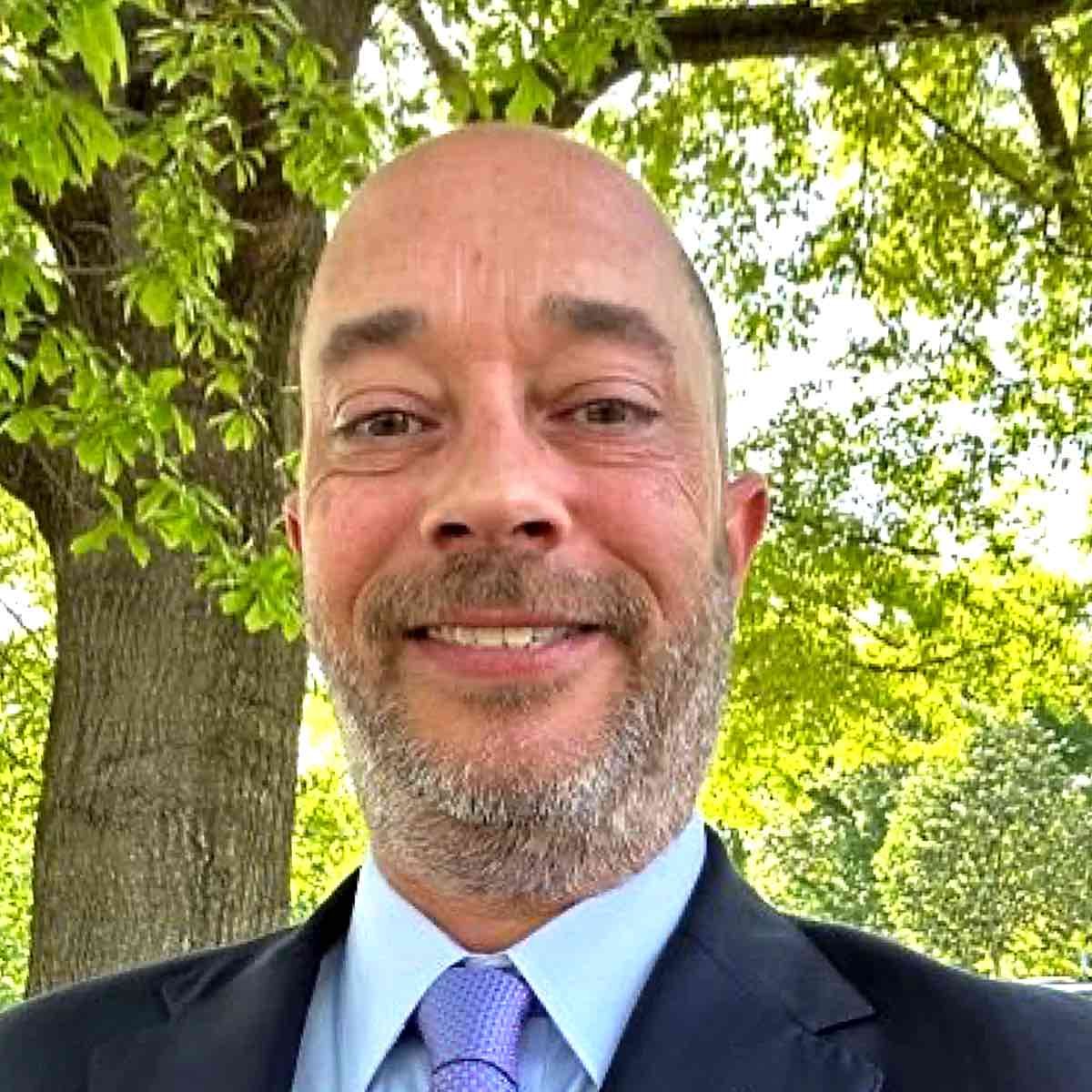
UAP Disclosure Act

Kevin Wright, founder of Solve Advocacy

(Credit: K. Wright/X).

“The UAPDA provides a pathway for the government to finally free itself of what it has discovered over the past 80 or more years,” Wright told The Debrief. “It is a win for the public, thirsty for an honest and transparent government, and it is a win for a return to Constitutional constraints, providing elected officials and authorities delegated through public law to regain control of the government, including appropriate Congressional oversight.”

However, for Wright and the like-minded advocates he works with, the UAP Disclosure Act, if it were to pass, would not represent the end of the transparency campaign.

“As with any legislation, there are several foreseeable problems. We will all have to continue to advocate for greater transparency,” Wright says, no matter the outcome of the current battle, which many believe could significantly impact the Senate’s UAP provision if not halt it altogether.

The circumstances involving the embattled UAP Disclosure Act have led Wright, who in his professional career has worked mainly for Republican candidates, to join forces with colleagues on the opposite end of the political spectrum in their efforts to push for recognition among lawmakers of the significance of UAP transparency.

Fortunately for Wright, he finds himself in very good company.

Constitutional Law and UAP

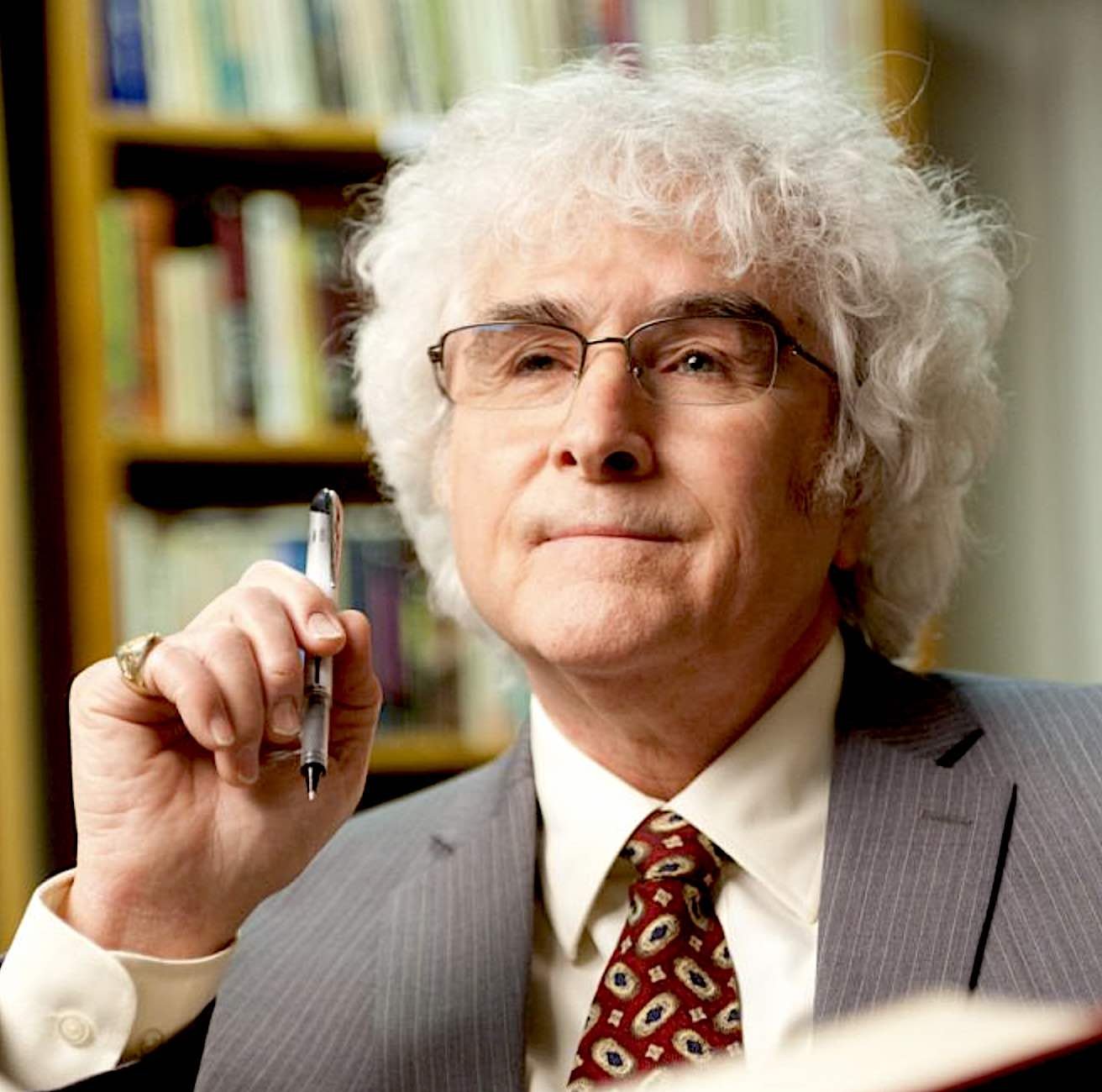
A Harvard College, Harvard Law School, and Harvard Divinity School–trained Constitutional Litigation and Appellate Attorney, the events spanning Daniel Sheehan’s five decades as a constitutional and public interest lawyer read almost like a textbook on U.S. history, if not a Hollywood screenplay.

From the Pentagon Papers and Watergate to the Karen Silkwood case, the La Penca bombing, and the Iran Contra affair, Sheehan has litigated several of the 20th century’s landmark American legal cases. However, Sheehan’s advocacy involving what the U.S. government now calls unidentified anomalous phenomena has been his primary focus in recent years.
UAP Disclosure Act

Attorney Daniel P. Sheehan is one of the leading advocates fighting for the UAP Disclosure Act and its inclusion in the 2024 National Defense Authorization Act

(Credit: www.danielsheehan.com).

Arguably, tat unwavering focus on applying constitutional law toward resolving mysteries in the skies also may never have been quite so significant as it has become in 2023, a year of similar landmarks in the effort to advance government transparency on UAP, all of which now appear to hang in the balance.

Sheehan’s professional journey began in 1968 when he co-founded the Harvard Civil Rights Law Review. Early in his career, alongside co-founder Mark Greene, Sheehan also initiated a case that would have significant ramifications for the way journalists report on government issues.

“One of the first cases that we actually did was the case that ended up establishing the rights of journalists to protect their confidential sources,” Sheehan told The Debrief. “This went all the way to the United States Supreme Court while we were still in law school. And because of that, I was retained by one of the top Wall Street corporate litigation law firms.”

That firm represented NBC News, a development that helped cement Sheehan’s role in several pivotal moments in U.S. legal history, including the 1971 leak of the Pentagon Papers and the Watergate scandal.

“We ended up being the ones that got called when The New York Times got the Pentagon Papers,” Sheehan remembers. “We had all the meetings and discussions with the New York Times board of editors about how we would go about publicly revealing what had been registered as top secret by the government, and over the top of the active resistance on the part of the Nixon administration, to stop us from getting the right to publish this.”

“Because of that, I developed a very positive relationship with a lot of investigative journalists,” Sheehan said. “And they began to reveal things to me.”

It was through his involvement with the Pentagon Papers and Watergate that Sheehan was exposed to the darker side of operations within the U.S. government, primarily the use of government authority to wage covert wars and maintain access to strategic raw materials for American corporations, often in violation of constitutional and ethical principles.

Seeking to address these systemic issues, he leveraged his background in foreign policy and comparative social ethics, ultimately becoming General Counsel at the U.S. Jesuit Headquarters. This role put him at the center of policy development in response to major government departments and agencies. His work also led to involvement with the Carter administration. At that time, Sheehan says he was tasked with working on classified UFO studies for the President, whose interest in the subject stemmed from a sighting of an unusual light one evening near Leary, Georgia, in 1969.

“I was contacted by the head of the Science and Technology Division of the Congressional Research Service, Dr. Marsha Smith, who had been asked by President Carter to prepare two originally classified reports to him,” Sheehan said. “One was on the potential likelihood of there being an extraterrestrial civilization, and the second one was whether or not any of at least some of these UFO encounters in sightings might actually be a vehicle from an extraterrestrial civilization.”

Sheehan said it had been in that context that he was given access to classified portions of Project Blue Book, the United States Air Force’s investigation into UFOs during the 1950s and 1960s.

“It was there that I saw actual photographs of a crash retrieval project that was underway,” Sheehan says.

Although the images would be the most compelling thing he observed during his time working with the Carter Administration, it was only the beginning of Sheehan’s professional involvement with UFOs. He would go on to represent the late Dr. John Mack at Harvard University, who, prior to his untimely death in 2004, had been one of the most prominent proponents of human encounters with the unexplained. Sheehan also became counsel for the Disclosure Project, the Citizens Hearings on UFO Disclosure, and more recently, he has represented individuals like Lue Elizondo, who came forward with information about the U.S. government’s secret UFO programs and faced retaliation.

For Sheehan, the efforts to bring transparency and constitutional oversight to the issue of UFOs and the possible existence of extraterrestrial life have benefited greatly from the involvement of figures like Senator Marco Rubio (R-Fl) and Senator Kirsten Gillibrand (D-NY), two of the more prominent elected officials within a bipartisan coalition aiming to protect whistleblowers and, more fundamentally, help to broaden our view of the world around us.

“What we’re experiencing right now is a coalition of true patriots and true Americans who are trying to resuscitate and reestablish the constitutional oversight authority of our government over this extraordinary issue of whether or not we actually exist in the midst of a much larger interstellar culture,” Sheehan told The Debrief.

From civil rights advocacy and challenging covert government operations to the question of whether the U.S. government is withholding significantly more about its involvement with UFOs than has been publicly acknowledged, the common threads running throughout all of Sheehan’s work are a dedication to constitutional governance, ethical transparency, and the pursuit of a more informed and expansive human perspective.

“This is an extraordinary subject, which requires the development of a new human worldview,” Sheehan says. “That’s why our New Paradigm Institute is been designated as one of the groups that is to recommend nominees for a presidential panel to be appointed to oversee this process.”

“And that’s where we find ourselves today.”

Trouble on Capitol Hill

Despite the efforts of advocates like Sheehan, Wright, and countless others on the issue of UAP transparency, the fate of the UAP Disclosure Act currently remains in question.

During a recent appearance on The Joe Rogan Experience, David Grusch, a former intelligence officer turned whistleblower who alleges the U.S. has recovered craft of non-human origin and illegally withheld that information from Congress, as first reported by The Debrief in June, addressed the current pushback from House lawmakers on the UAP Disclosure Act.
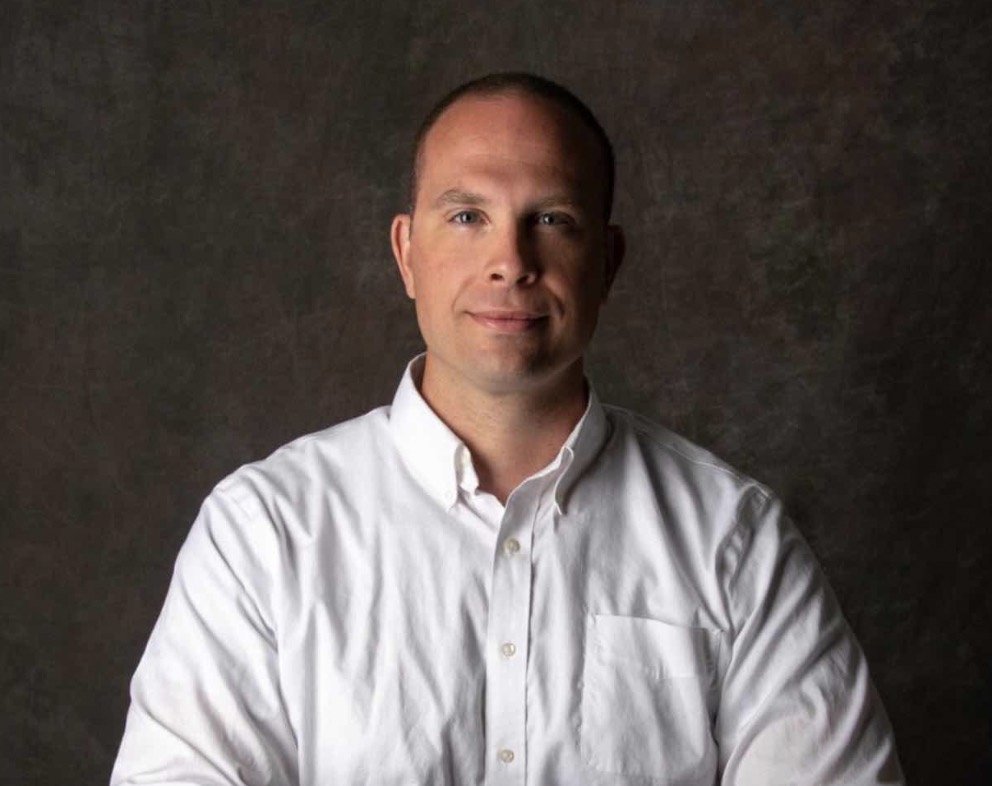
David Grusch

Former U.S. intelligence official David Grusch came forward with allegations about U.S. involvement in the retrieval of a craft of unknown origin in June 2023

(Credit: David Grusch).

“For one, they’re saying it duplicates the DoD AARO’s activities,” Grusch told Rogan during the podcast, naming Representatives Mike Rogers and Mike Turner among those who are blocking the UAP Disclosure Act. Grusch also emphasized  Turner’s proximity to Wright Patterson Air Force Base, the headquarters of the Air Force Materiel Command with a deep history in aerospace innovation in Dayton, Ohio. Notably, Wright Patterson had also been the home of Project Bluebook, the Air Force’s official investigation into UFOs throughout the 1950s and 1960s.

According to data made available by OpenSecrets.org, the website of the Center for Responsive Politics, a non-profit, non-partisan research group that tracks money in U.S. politics, Rep. Mike Turner’s largest 2023-2024 campaign contributors are listed as “Misc Defense” at $62,350, followed by “Defense Aerospace” at $46,300.

During the 2022 election cycle, Rep. Mike Rogers was the largest recipient of funding from the defense sector by a wide margin, according to data made available by OpenSecrets.org (see below). Similarly, listed among the largest contributions to Rep. Rogers in 2023-2024 were “Misc Defense” at $121,200, down significantly from the $282,350 he received in the previous election cycle, during which the largest contribution from a single contributor had been $60,750 from Lockheed Martin.

“So, I have a problem with Mike and Mike right now,” Grusch told Rogan on the podcast. Grusch also specifically named Lockheed Martin as a possible recipient of portions of the exotic technologies that he learned of during his tenure as an intelligence officer, further describing visits with the late Nevada Senator Harry Reid, who had expressed similar views in the past.

“I was told for decades that Lockheed had some of these retrieved materials,” Reid told The New Yorker in April 2021. “And I tried to get, as I recall, a classified approval by the Pentagon to have me go look at the stuff. They would not approve that.” Reid, speaking with journalist Gideon Lewis Krauss, said he was repeatedly denied clearance to view these materials. Attempts by The New Yorker to obtain a statement from Lockheed Martin about the alleged issue at that time were declined.

In July, following a Congressional hearing where Grusch testified alongside former U.S. Navy pilots David Fravor and Ryan Graves about U.S. government issues related to UAP, Rep. Turner expressed doubts when asked by Fox News host Maria Bartiromo to comment on testimony Grush provided about biologics he said were recovered along with alleged past acquisitions of exotic craft.

“Maria, I always love it when you have somebody who comes forward and testifies about things that they don’t know anything about,” Turner told Bartiromo on July 30, 2023. “I mean… the most striking aspect of all the testimony was, repeatedly over and over again, the whistleblowers had to say, actually, I don’t have any knowledge of this. Somebody else told me that.”

Rep. Mike Turner

Rep. Mike Turner during a visit to Ukraine in April

(Public Domain).

“I mean, really, this would take thousands and thousands of people for such an unbelievable coverup to be occurring, and for people to speak with such, um, you know, confidence over something that they do not know is, I think, something that certainly everybody needs to be concerned about,” Turner added.

“I certainly can’t tell you that there are no aliens here,” Turner told Bartiromo. “I can tell you that, certainly, there’s no evidence that what the gentleman is testifying about he has, he said himself personally, he has no direct knowledge of.”

Rep. Turner has consistently downplayed the UAP issue in interviews and, in some instances, appears to have refused to respond to questions about the subject altogether. However, while insinuations that pressure from defense contractors could be motivating lawmakers like Turner and Rogers to work against the current UAP legislation, it is noteworthy that several other House Republicans have continued to demand funding cuts to portions of the bill that are unlikely to pass the Senate, which include items unrelated to UAP such as climate, environment and nuclear energy programs.

Whatever the true motivations of lawmakers who are currently working to block the UAP disclosure provisions in the Senate version of the bill might be, Sheehan argues that the recent allegations made by whistleblowers like David Grusch nonetheless point to the existence of a bureaucratic element within the U.S. government, which has effectively worked to conceal the full extent of the U.S.’s involvement with the acquisition of UAP materials over the decades.

If the UAPDA were to pass, Sheehan says the nine-person panel it would establish would “have the power to extract this information from the deep state elements that have it and bring it into the hands of the United States Congress.”

“There appears to be solid and believable evidence that somehow this technology has been secretly and unlawfully turned over to private industry,” Sheehan told The Debrief. “[It] has been turned over to the high-tech aerospace industries, such as Lockheed Martin and Raytheon.”

“This is an extraordinarily important issue that our American people need to weigh in on, about whether or not we believe that that’s an appropriate use of this information,” Sheehan says.

Sheehan also says that two specific provisions within the UAPDA—those involving eminent domain and subpoena power—were key targets for those in the House who have recently opposed the amendment.

“Mike Turner first attacked those two elements,” Sheehan told The Debrief. “[He said] we want the eminent domain provision out of here, and we want the subpoena power out of here. And when our people that were working on this responded to the statute by saying, ‘Why would you be so worried about the eminent domain provision if you don’t have any of the technology, as you keep on insisting?’ At which point they retreated to an abstract argument on behalf of libertarian values of not having to state, you know, overreach, and to be able to seize private property.”

“Our response was, how many other issues have you raised on this on, you know, being opposed to the entire concept of eminent domain?”

“None. Just this one,” Sheehan told The Debrief. “Then they retreated and said, ‘Okay, well, then we’re going to take a position to oppose completely allowing anything in this bill to be put into the National Defense Authorization Act.’”

“What we’ve got to do is concentrate on not only all of the other members of the House Intelligence Committee, virtually all of whom support this bill other than the chairman, who comes from the Wright Patterson Air Force Base, basically. And then there’s one other person who is Michael Rogers, the head of the House Armed Services Committee. And he’s from the second congressional district down in Alabama, right next door to the Redstone Arsenal.”
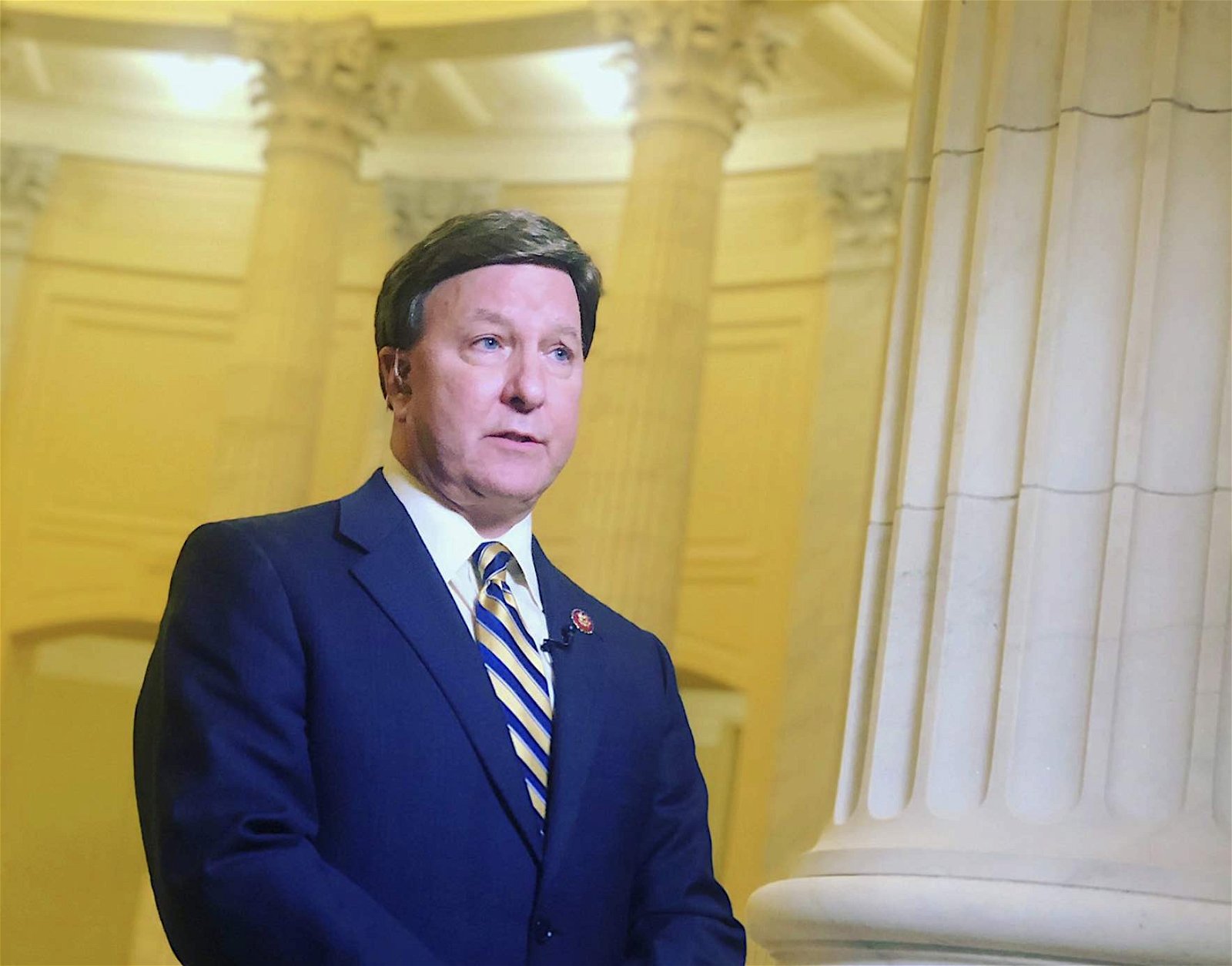
Rep. Mike Rogers

Rep. Mike Rogers of Alabama

(Public Domain).

“People in both of those districts, the 10th Congressional District in Ohio, and the Second Congressional District down in Alabama, need to write to them, send cables to them, send emails to them… go sit in their office to talk to them, you know, to get them to back off this,” Sheehan told The Debrief.

“They have a constitutional duty, as the chairs of those committees in the Congress, to get this information, and they are absolutely placing their own personal financial campaign contributions above getting this information into the hands of the Congress, which is constitutionally mandated to exercise oversight over this program.”

“So that’s where the bill is right now.”

The UAP Disclosure Act: An Unprecedented Bipartisan Issue

For UAP advocates like Sheehan and Wright, as well as several members of Congress and others in Washington, efforts toward achieving broader government transparency on the UAP issue have helped to unite individuals from opposing political backgrounds in an unprecedented way, bringing them together to focus on a common cause.

“Government transparency is an issue that cuts across party lines,” Wright told The Debrief. “Regardless of political persuasion, people expect their government to be honest and transparent.”

“That is also true for lawmakers,” Wright says. “In fact, it might be even more important for them, regardless of party, when they find out they are being lied to and denied proper oversight. The UAP angle makes it even more compelling given the subject matter of possible non-human intelligence (NHI), [of] which polls show a heightened level of interest and a high level of distrust when it comes to the government.”

“What difference does it make if you are a Republican or a Democrat, if the government knows more than it has admitted, and if there is an NHI involved? People simply want, and have a right, to know,” Wright says.

Wright admitted that his work with Sheehan might never have occurred if had not been for their mutual advocacy of UAP, given the usual partisanship that occurs in Washington; a divisiveness in American politics that now could well prevent the UAP Disclosure Act from ever becoming law.

“There would likely never be an issue or cause that would find Danny and me working together,” Wright tol The Debrief.

“We stand at different ends of the political spectrum in most instances, except for government transparency, and believing the people have a right to know the truth about UAP and NHI.”

“And this issue is too important to let political affiliations get in the way.”

Hoe vind je dit bericht?
Geschreven door peter om 23:32 Stuur door

Doomsday Clock ticks forward... moving humanity closer to annihilation than ever before

The Doomsday Clock, which has been ticking down to the end of the world for decades, is now officially closer to annihilation than ever before. 

On Tuesday, scientists with the Bulletin of Atomic Scientists moved the symbolic clock four seconds forward to 85 seconds to midnight.

It's also the closest the clock has ever been to midnight in its 79-year history, meaning experts believe humanity has never faced a more dire threat of a world-ending catastrophe than it does in 2026.

The group, which decides where the hands are set annually, cited multiple threats to global stability, including nuclear weapons, climate change, disruptive technologies like AI, and the creation of synthetic biological substances called 'mirror life.'

Alexandra Bell, president and CEO of the Bulletin of Atomic Scientists, said: 'Every second counts and we are running out of time. It is a hard truth that this is our reality. This is the closest our world has ever been to midnight.'

The Chicago-based nonprofit created the Doomsday Clock in 1947 during the Cold War as tensions between the US and the Soviet Union brought the constant fear of a nuclear apocalypse.

This is the second year in a row that the Doomsday Clock has moved closer to midnight - the hypothetical point where the world will end. Until 2020, the clock had never been closer than two minutes to midnight.

Daniel Holz, chair of the Bulletin's Science and Security Board, said: 'Last year, we warned that the world was perilously close to catastrophe and that countries needed to change course towards international cooperation and action on the most critical and existential risks. Unfortunately, the opposite has happened.' 

The Bulletin of Atomic Scientists moved the 'Doomsday Clock' four seconds closer to midnight - the theoretical point of world annihilation

The Bulletin of Atomic Scientists moved the 'Doomsday Clock' four seconds closer to midnight - the theoretical point of world annihilation

The US, Israel, Iran, and Russia all warned in 2025 that a catastrophic global war could be nearing as the crisis in the Middle East and Ukraine reached a breaking point

The US, Israel, Iran, and Russia all warned in 2025 that a catastrophic global war could be nearing as the crisis in the Middle East and Ukraine reached a breaking point 

Holz added that nuclear-armed nations became even more adversarial and nationalistic in 2025 and influenced the four-second jump, the largest move forward since 2023 when scientists cut it from 100 to 90 seconds to midnight.

'The latest remaining treaty governing nuclear weapon stockpiles between the US and Russia expires next week. For the first time in over half a century, there will be nothing preventing a runaway nuclear arms race,' Holz revealed. 

Any time the Doomsday Clock has moved forward has been said to signify humanity's failures to make progress in solving the global threats of the past 12 months.

Every year, the Doomsday Clock has been updated based on how close humanity theoretically is to total annihilation.

If the clock goes forward and gets a few minutes or seconds closer to midnight (compared with where it was set the previous year), it suggests humanity has moved closer to self-destruction.

If it moves further away from midnight, it suggests humanity has lowered the risks of global catastrophe since the same point last year.

In some years, the hands of the clock don't move at all, suggesting global tensions and threats worldwide haven't changed for better or worse.

It has been moving steadily closer to the predicted end of the world since 2011, when it was still six minutes from midnight. 

In 2025, the US, Iran, and Israel were involved in a deadly conflict in the Middle East, with the US sending a precision bombing mission to attack Iran's nuclear facilities

In 2025, the US, Iran, and Israel were involved in a deadly conflict in the Middle East, with the US sending a precision bombing mission to attack Iran's nuclear facilities

Rhe Bulletin's Science and Security Board added that climate change has also escalated over the last year, with global sea levels reaching record highs.

'Droughts, floods, fires, and storms continue to intensify and become more erratic, and this will only get worse,' Holz predicted.

READ MORE

EXCLUSIVE

article image

Additionally, the expert warned of 'mirror life,' which are synthetic organisms built completely backwards compared to normal DNA, which scientists believe could help develop advanced medicines.

However, many scientists fear the threat posed by these lab-made substances, as they are totally incompatible with normal DNA, raising the threat of an unstoppable pandemic.

'Despite repeated warnings from scientists worldwide, the international community has no coordinated plan and the world remains unprepared for potentially devastating biological threats,' Holz said. 

As for so-called 'disruptive technologies,' the security board's chair singled out artificial intelligence (AI) for 'supercharging mis- and disinformation.' 

Dr Leonard Rieser, Chairman of the Board of the Bulletin of the Atomic Scientists, moves the hand of the Doomsday Clock back to 17 minutes before midnight at offices near the University of Chicago on November 26, 1991

Dr Leonard Rieser, Chairman of the Board of the Bulletin of the Atomic Scientists, moves the hand of the Doomsday Clock back to 17 minutes before midnight at offices near the University of Chicago on November 26, 1991

Last year, the Bulletin moved the clock to 89 seconds to midnight, citing the ongoing Russia-Ukraine war, conflicts in the Middle East, the threat of nuclear war, climate change, a potential bird flu pandemic, and the so-called 'arms race' to develop AI.

Russia's 2022 invasion of Ukraine has led to Europe's bloodiest conflict since World War II, with unconfirmed estimates estimating the death toll reaching one million people in 2026.

Meanwhile, multiple conflicts involving the US broke out in the last year, as the Trump Administration launched a bombing of Iran's nuclear facilities and arrested Venezuelan leader Nicolás Maduro and his wife during a covert raid in Caracas.

Tensions have even flared between the US and its allies in NATO, as President Trump vies to take control of Greenland, a current territory of Denmark, citing its importance to national security against Russia and China.

'If the world splinters into an "us versus them" zero-sum approach, it increases the likelihood that we all lose,' Holz warned. 

Although symbolic and not an actual clock, the Bulletin of the Atomic Scientists unveiled a physical 'quarter clock' model at an event on Tuesday when they delivered the news of their estimate for 2026.

After the unveiling, the model can be found located at the Bulletin offices in the Keller Center, home to the University of Chicago Harris School of Public Policy. 

The Doomsday Clock goes back to June 1947, when US artist Martyl Langsdorf was hired to design a new cover for the Bulletin of the Atomic Scientists journal

The Doomsday Clock goes back to June 1947, when US artist Martyl Langsdorf was hired to design a new cover for the Bulletin of the Atomic Scientists journal 

Every January, the Bulletin of Atomic Scientists reveals its annual update to the Doomsday Clock – even if the hands are not moved.

The Doomsday Clock officially came into existence in June 1947, when US artist Martyl Langsdorf was hired to design a new cover for the Bulletin of the Atomic Scientists journal.

With a striking image on the cover, the organization hoped to 'frighten men into rationality' as the Cold War seemed destined to go nuclear, according to Eugene Rabinowitch, the first editor of the journal.

The clock was initially set at seven minutes to midnight because 'it looked good to my eye,' Langsdorf later said.

On the cover of later issues, the hands of the clock were adjusted based on how close civilization was estimated to be to catastrophe.

After the Soviet Union successfully tested its first atomic bomb in 1949, Rabinowitch reset the clock from seven minutes to midnight to three minutes to midnight.

Since then, it has continued to move forward and backwards, now moving within a minute and a half of total destruction.

In 2009, the Bulletin ceased its print edition, but the clock has still been updated once a year on its website and is now a much-anticipated highlight of the scientific community.

{ https://www.dailymail.co.uk/sciencetech/index.html }

Hoe vind je dit bericht?
Geschreven door peter om 20:57 Stuur door

Meer van UFO'S of UAP'S, ASTRONOMIE, RUIMTEVAART, ARCHEOLOGIE, OUDHEIDKUNDE, SF-SNUFJES EN ANDERE ESOTERISCHE WETENSCHAPPEN - DE ALLERLAATSTE NIEUWTJES

↑ Terug naar de berichten