Naar de inhoud

UFO'S of UAP'S, ASTRONOMIE, RUIMTEVAART, ARCHEOLOGIE, OUDHEIDKUNDE, SF-SNUFJES EN ANDERE ESOTERISCHE WETENSCHAPPEN - DE ALLERLAATSTE NIEUWTJES

UFO's of UAP'S in België en de rest van de wereld
akke.beakke.be
Ontdek de Fascinerende Wereld van UFO's en UAP's: Jouw Bron voor Onthullende Informatie! Ben jij ook gefascineerd door het onbekende? Wil je meer weten over UFO's en UAP's, niet alleen in België, maar over de hele wereld? Dan ben je op de juiste plek! België: Het Kloppend Hart van UFO-onderzoek In België is BUFON (Belgisch UFO-Netwerk) dé autoriteit op het gebied van UFO-onderzoek. Voor betrouwbare en objectieve informatie over deze intrigerende fenomenen, bezoek je zeker onze Facebook-pagina en deze blog. Maar dat is nog niet alles! Ontdek ook het Belgisch UFO-meldpunt en Caelestia, twee organisaties die diepgaand onderzoek verrichten, al zijn ze soms kritisch of sceptisch. Nederland: Een Schat aan Informatie Voor onze Nederlandse buren is er de schitterende website www.ufowijzer.nl, beheerd door Paul Harmans. Deze site biedt een schat aan informatie en artikelen die je niet wilt missen! Internationaal: MUFON - De Wereldwijde Autoriteit Neem ook een kijkje bij MUFON (Mutual UFO Network Inc.), een gerenommeerde Amerikaanse UFO-vereniging met afdelingen in de VS en wereldwijd. MUFON is toegewijd aan de wetenschappelijke en analytische studie van het UFO-fenomeen, en hun maandelijkse tijdschrift, The MUFON UFO-Journal, is een must-read voor elke UFO-enthousiasteling. Bezoek hun website op www.mufon.com voor meer informatie. Samenwerking en Toekomstvisie Sinds 1 februari 2020 is Pieter niet alleen ex-president van BUFON, maar ook de voormalige nationale directeur van MUFON in Vlaanderen en Nederland. Dit creëert een sterke samenwerking met de Franse MUFON Reseau MUFON/EUROP, wat ons in staat stelt om nog meer waardevolle inzichten te delen. Let op: Nepprofielen en Nieuwe Groeperingen Pas op voor een nieuwe groepering die zich ook BUFON noemt, maar geen enkele connectie heeft met onze gevestigde organisatie. Hoewel zij de naam geregistreerd hebben, kunnen ze het rijke verleden en de expertise van onze groep niet evenaren. We wensen hen veel succes, maar we blijven de autoriteit in UFO-onderzoek! Blijf Op De Hoogte! Wil jij de laatste nieuwtjes over UFO's, ruimtevaart, archeologie, en meer? Volg ons dan en duik samen met ons in de fascinerende wereld van het onbekende! Sluit je aan bij de gemeenschap van nieuwsgierige geesten die net als jij verlangen naar antwoorden en avonturen in de sterren! Heb je vragen of wil je meer weten? Aarzel dan niet om contact met ons op te nemen! Samen ontrafelen we het mysterie van de lucht en daarbuiten.

Archief

Fly over the 'Grand Canyon' of Mars in high-resolution orbiter imagery

Fly over the 'Grand Canyon' of Mars in high-resolution orbiter imagery

See the 2,500 mile-long (4000 km) Valles Marineris in imagery captured the Mars Reconnaissance Orbiter. Global topography: NASA/GSFC CTX global mosaic: NASA/MSSS/Caltech/ CTX topography: NASA/MSSS/USGS HiRISE: NASA/U.Arizona/USGS/Amazon

{ https://www.msn.comid=nl_articl/ }

Hoe vind je dit bericht?
Geschreven door peter om 16:15 Stuur door

Moses & the Feathered Serpent: Did the Hebrew Lawgiver Secretly Inspire a Mexican Myth?

Moses & the Feathered Serpent: Did the Hebrew Lawgiver Secretly Inspire a Mexican Myth?

Montage (by author) of Akhenaten, Moses, and the Feathered Serpent, first priest-king of ancient Mexico.

Moses, the ancient Hebrew Lawgiver, is certainly never associated with Mexico in any traditional texts, either religious or not, in either the Old or New Worlds. So when a Vermont pastor named Ethan Smith proposed in an 1825 book that Moses may have provided the basis for the Mexican legends of Quetzalcóatl, the famous “Feathered Serpent”, it seemed a radical theory to say the least. 

He writes: “Though their ancient ‘legislator’ is called by a name importing the serpent of green feathers; yet he was an ancient man, a white man and bearded; called by Montezuma, a saint, who led them to this country, and taught them many things … Who could this be but Moses, the ancient legislator in Israel?”

The following is an excerpt from the new book Moses in Mexico, which explores this hypothesis.

The Aguada Fénix Connection

Hundreds of previously-unknown ancient settlements have been discovered recently in Mexico, and their apparent antiquity has forced archaeologists to rethink how civilization evolved in the New World. Hiding under a dense jungle canopy, the ruins of once-massive monumental stone constructions were detected using a sophisticated new survey technique called LiDAR. Who had built these structures, and when? The largest and most mysterious was called Aguada Fénix, the “Reservoir of the Phoenix”. It appeared to be oriented towards the rising sun on certain days of the year in February and October.
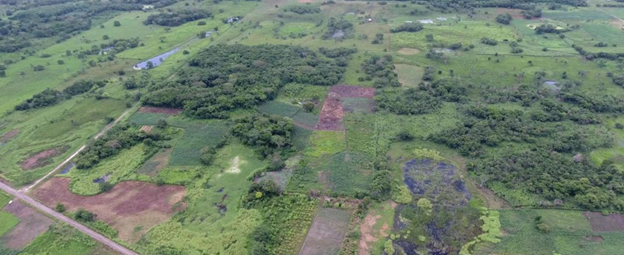
Aguada Fénix, 2009

Aguada Fénix, 2009, by Takeshi Inomata.

(Takeshi Inomata/CC BY-SA 4.0)

In a 2020 Nature article, Takeshi Inomata and his team explain how they found these sites:

“We describe an airborne LiDAR survey and excavations of the previously unknown site of Aguada Fénix (Tabasco, Mexico) with an artificial plateau, which measures 1,400 m in length and 10 to 15 m in height and has 9 causeways radiating out from it. We dated this construction to between 1000 and 800 BCE, while charcoal samples from the earliest deposits yielded dates of 1250–1050 BCE. To our knowledge, this is the oldest monumental construction ever found in the Maya area and the largest in the entire pre-Hispanic history of the region.”
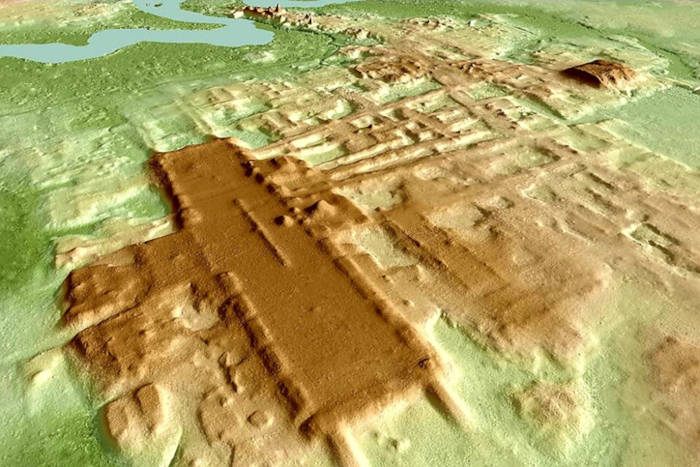
LiDAR image of the ancient Maya site of Aguada Fénix

LiDAR image of the ancient Maya site of Aguada Fénix, ~1000 BCE. The sprawling platform stands between 33 and 50 feet tall and measures almost a mile long.

(Takeshi Inomata)

Meanwhile, a 2023 study of the settlements’ solar alignments revealed:

“the distribution pattern of dates marked by solar alignments indicates their subsistence-related ritual significance … and represent the earliest evidence of the use of the 260-day calendar.”

These discoveries have forced a rethinking of the history of the New World. Where and when did civilization truly begin? At what point do we see the most accelerated cultural development? Was there a linear trajectory of development, or did it experience any burst of particular magnitude at any point that cannot be explained via standard cultural mechanisms? 

There is yet another peculiarity about Aguada Fénix, the largest and earliest Maya structure: its orientation is skewed slightly south of east. While this does not immediately appear to connect with any obvious astronomical occurrence, such as the equinoxes, solstices, or minor or major lunar standstills - it is the same angle of orientation as observed at Tell-El Amarna, the ancient city of Pharaoh Akhenaten in Egypt (specifically between the Small Aten Temple and the Royal Wadi east of the city). Along this angle for twice a year in February and October the king could watch the Aten sun disk rise directly through the Royal Wadi, forming a symbol for the akhet (a hieroglyph that represented the sun rising between two mountains).

We therefore have not only massive stone buildings, which would have required a substantial amount of organized labor to complete, dating from the very earliest years of Mesoamerica culture, but they seem to share specific solar alignments that were used by Akhenaten in Egypt. What is going on here? What inspired a group of hunters and gatherers to suddenly construct the largest religious structures in the region’s history, oriented towards sunrises along the same angle as Akhenaten’s architecture in Egypt, and dating from not long after his historical period? Could it be that Akhenaten-Moses once visited Mesoamerica in the distant past? Could Moses have come to Mexico?

Sunrise over the jungles of Mexico, at the Maya site of Yaxuna, Yucatan

Sunrise over the jungles of Mexico, at the Maya site of Yaxuna, Yucatan. Observing sunrises on certain days in February and October were key aspects of the early 260-day calendar, which may have originated at the Egyptian site of Amarna.

(By author.)

Akhenaten was Moses … And Quetzalcóatl?

My first book Moses Restored (2017) argued how the Egyptian Pharaoh Akhenaten became the Hebrew Lawgiver Moses. It was the first complete biography of this astounding human being. It aimed to show how he continued his religious revolution, by taking the Israelites out of Egypt to Canaan, and laying the foundation for what would become the Judaism we know today. 

The history of his kingship was concealed in the early chapters of the Book of Exodus, creating a “Moses mystery” that cried out for a solution. Fitting Moses to Akhenaten solves this mystery, along with so many others, and perhaps only one glaring enigma remains: his death. The Torah ends, as does Moses Restored, with the death of its central character Moses, just outside the boundaries of the Promised Land of Israel, as narrated in the book of Deuteronomy 34: 5-7:

“And Moses the servant of the Lord died there in Moab, as the Lord had said. He (the Lord) buried him in Moab, in the valley opposite Beth Peor, but to this day no one knows where his grave is. Moses was a hundred and twenty years old when he died, yet his eyes were not weak nor his strength gone.”
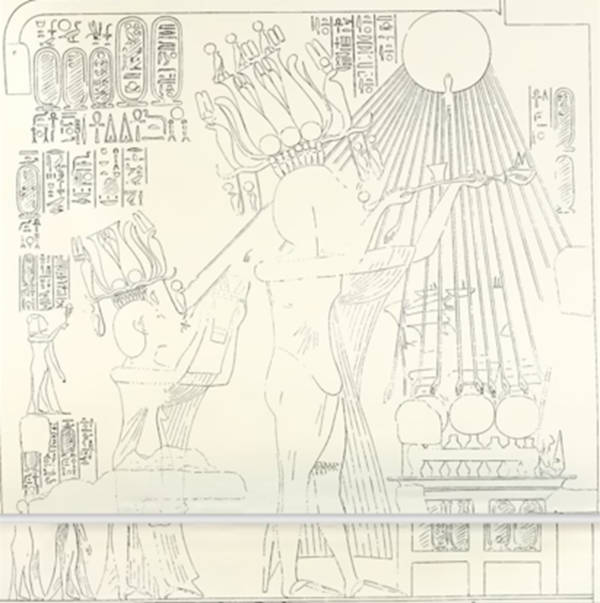
Akhenaten wears a crown he developed himself, based on the Atef crown of Osiris in stone relief representation.

Akhenaten wears a crown he developed himself, based on the Atef crown of Osiris. It is festooned with sun discs and protective uraei cobras wearing ostrich feathers, literal feathered serpents! Could these motifs have prefigured the Feathered Serpent of Mexico? He burns incense before the sunrise, similar to some Maya priests today. (Plate VIII, Davies, N. de G., The Rock Tombs of El Amarna: Part II, The Tombs of Panehesy and Meryra II, London, Egypt Exploration Fund, 1905).

The book Moses in Mexico continues the amazing story of Moses. What, you ask? Continues the story? Didn’t Moses die? What’s going on?  How can his story continue? Well, as will soon become apparent, the death of Moses is as mysterious as his origins. First, as the verse above makes clear, no human buried Moses, but the Lord himself did it. Second, no human knows the location of his grave. Third, despite Moses being of advanced years, his eyes were not weak nor was his strength gone. This seems to suggest that he was not ready to die.

View from the Small Aten Temple at Amarna,

View from the Small Aten Temple at Amarna, the ancient city built by Akhenaten around 1350 BCE, looking east towards the desert cliffs and the distinctive opening to the Royal Wadi, which archaeologists theorize represented the first half of the akhet symbol, the glyph for mountain, djw. Twice a year in February and October the sun appears to rise through the valley opening, completing the akhet symbol and forming a solar hierophany.

(By author. ADDED: The akhet hieroglyph, 2023. By Mazapan3210.)

We therefore have three aspects of the supposed “death” of Moses that immediately seem to cast doubt upon it. These unusual aspects have not gone unnoticed, and several scholars have brought into question whether Moses died as depicted in the Bible or if he actually lived on. Could the Bible be hiding yet another Moses mystery for us to rediscover? I believe the answer is yes, and Moses in Mexico represents the explanation for that answer. It chronicles the final stage of Moses’ life, which I believe brought him to the shores of the New World, specifically Mexico.

It was there, I believe, that he became the mythical hero remembered so fondly across Mesoamerica: the Feathered Serpent, Quetzalcóatl. It was there that his two previous lives, that of a rebellious Pharaoh of Egypt and a renegade Israelite leader and judge, collided to create a new manifestation of his previous likes and interests. It was there that his presence over three millennia ago created such an impact that memories of it rippled out across time and space, creating a strange Pan-Mesoamerican cultural form that retained its basic shape across thousands of miles and years, and has continued to baffle scholars to this day.

AI-generated image of a hypothetical Pharaoh Akhenaten in Mexican graffiti style

AI-generated image of a hypothetical Pharaoh Akhenaten in Mexican graffiti style.

(By author.)

What initiated this sweeping and bold new cultural program in Mexico after 1250 BCE, a program which saw the origins of so many of its diagnostic features, such as: intricate creation cosmologies, urban plans, monumental stone architecture oriented towards sunrises, the priesthood, writing, divine kingship, and even acts of revolution such as the mutilation and decapitation of idols and statues? I believe that it was Moses, who lived in the decades before 1250 BCE.

I believe that by understanding that Akhenaten became Moses, we can understand how Moses became Quetzalcóatl. Without understanding his youth and kingship, obscured in the Bible but nevertheless manifested in hundreds of tiny clues, we cannot understand how or why Moses would have desired to become the Feathered Serpent. 

Ultimately, the idea of the historical Moses becoming the historical Quetzalcóatl has never been properly scrutinized because the character of Moses himself has never been properly scrutinized. Scholars have yet to paint in the details of his youth and adult life, before he became the desert exile in Midian. These details are infuriatingly sparse in the Bible. However, if we understand that the Bible was trying to conceal the fact that Moses had once been a King of Egypt (to avoid unwanted future questions), and that Akhenaten had lived on to become Moses, then we can begin to clearly see how he may have carried on to become Quetzalcóatl, bringer of civilization to the New World.

For instance, Quetzalcóatl has been called the Lord of Dawn, he combined serpent imagery with that of birds, feathers and flight, and was remembered as a lawgiver and bringer of civilization to the New World. Comparing this to Moses certainly yields interesting connections, since Moses was associated with giving the Law as well as serpent imagery, most famously regarding the Bronze Serpent he set up in the desert. But was Moses called the Lord of the Dawn? No. Was he associated with bird imagery? Not particularly.
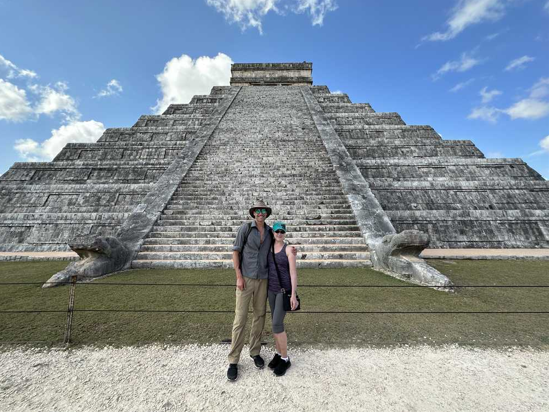
The author and his sister Jennifer Stephenson in front of the Maya Pyramid of the Feathered Serpent at Chichén Itzá,

The author and his sister Jennifer Stephenson in front of the Maya Pyramid of the Feathered Serpent at Chichén Itzá, Mexico. Mexican architecture is replete with depictions of feathered serpents, as well as solar hierophanies.

(By author.)

However, if Moses is connected to his former life as Akhenaten, then these aspects all assume powerful meanings. First, Akhenaten worshiped one lord called the Aten, the sun disk, called the “Lord of the Dawn”. Second, Akhenaten was strongly associated with bird imagery, as I have chronicled in a previous article called “Akhenaten the Bird King”. Third, I suggested in another article that Akhenaten was attempting to portray himself as a “new Osiris”, having discarded and outlawed the worship of the god of the dead. 

Osiris, in Egyptian mythology, was Egypt’s first king, who once travelled the world bringing its peoples civilization and knowledge. He taught agriculture and law, arts and crafts, stone architecture, writing and religion. He was murdered by his jealous brother Set, resurrected by his sister and wife Isis as Egypt’s first mummy, and finally became the god of the Dead. It is therefore not surprising that Akhenaten, who once considered himself a “new Osiris” would have ultimately wished to travel across the ocean, to the west, to parts unknown, bringing and teaching knowledge and the civilizing arts to whomever he encountered.

It will be difficult at times to clearly see the trajectories of ideas from Akhenaten to Moses to Quetzalcóatl. The attributes of Quetzalcóatl in particular are difficult to quantify and classify because they have been much distorted through history, and there are no ancient written sources from Mesoamerica that clearly outline his life and to which we may turn for a single, unbiased account. 

Rather, the information concerning Quetzalcóatl comes to us as fragments of memories and shards of stories, from Spanish-influenced codices and enigmatic stone architecture devoid of writing and lacking exact context or meaning. While these challenges appear daunting, they are not insurmountable. The fact that I have already connected Akhenaten to Moses will only help to bolster my argument that he ultimately became Quetzalcóatl. 

By understanding that he was, at heart, a man of change, who constantly shifted and evolved his ideas of God, we can better understand how he could have adopted the persona of the Feathered Serpent. Just as the snake sheds its skin, so too did Akhenaten shed his many guises. First, as a youth when he shed his given name of Amenhotep IV, adopting a strange name that he seems to have invented himself: Akhenaten, “Shining Spirit of the Aten”. During his reign, he shed several older names of the Aten, becoming more and more abstract in his naming of his one God.

Six AI-generated images of the same person, Pharaoh Akhenaten, at six distinct stages of his life.

Six AI-generated images of the same person, Pharaoh Akhenaten, at six distinct stages of his life.

(By author.)

When he disappeared from Egypt after seventeen years on the throne, I believe he did not die as is popularly assumed, but shed his Egyptian past all together to become a new persona, Moses. Finally, decades later, when he had succeeded in bringing the Israelites to the Promised Land, I suggest he shed his persona once again, and adopted yet another new guise. 

This one fused his beloved uraeus cobra, protective serpent that sat above the brow of every Egyptian king, with the feathers of his three favorite birds: the bennu bird of immortality (the Phoenix to later Greeks), the hawk of Ra-Horakhty, and the akh northern bald ibis. By combining serpents with birds, an idea already being developed in Egypt at that time (for example, in the tomb of Tutankhamun), I believe he created a powerful new image which would have left an indelible mark in the consciousness of New World populations for millennia: the Feathered Serpent.
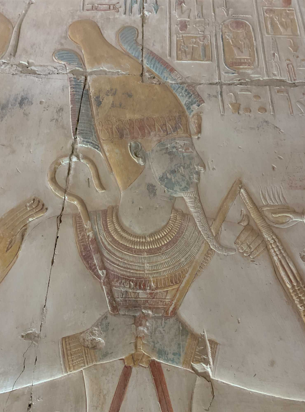
Relief of Osiris from the Temple of Seti I, Abydos, Egypt.

Relief of Osiris from the Temple of Seti I, Abydos, Egypt. According to Egyptian mythology, Egypt’s first king Osiris sailed around the world spreading knowledge, exactly like the Feathered Serpent was believed to have later done.

(By author)

Possible Origin of the Feathered Serpent Myth:

In the guise of the Feathered Serpent, Moses could attempt to teach the peoples of the New World everything he knew, finally becoming the New Osiris he had always dreamt of becoming in his youth. By piecing together the vague and distant memories of Quetzalcóatl discernible from the Spanish codices along with physical clues from the archaeological record, we can begin to form a picture of what the historical Quetzalcóatl may have once been like when he arrived on the shores of Mexico from a distant land to the East. 

Remarkably, he comes across exactly like how I would expect Akhenaten-Moses to come across: as a focused, intense religious leader, a king, a high priest, who was chaste, moral, ethical, just and wise, who taught reading, writing, the calendar, and how to live a holy and respectful life following divine laws. He also likely had a paradoxical dark side that called for periodic capital punishment and sacrifice when his religious edicts were not obeyed.

EFT: Detail of the side of Tutankhamun’s golden throne showing the winged cobra motif common in royal New Kingdom art of the time. By Yveke, 2009. RIGHT: The image of the uraeus (i.e. protective cobra of the king)

LEFT: Detail of the side of Tutankhamun’s golden throne showing the winged cobra motif common in royal New Kingdom art of the time. By Yveke, 2009. RIGHT: The image of the uraeus (i.e. protective cobra of the king) was common at Amarna, where they were often shown wearing sun disks and ostrich feathers, making them quite literally feathered serpents. They demonstrate that Akhenaten loved this blended magical motif for many years before he used it in Mexico.

(Left; Yveke/CC BY-SA 2.0, RIGHT: (Plate X, ‘Panehesy decorated by the King’, Davies, N. de G., The Rock Tombs of El Amarna: Part II, The Tombs of Panehesy and Meryra II, (London, Egypt Exploration Fund, 1905).

Moving beyond simple parallelism, connecting Akhenaten to Moses and ultimately to Quetzalcóatl requires an understanding of their temporal contexts. For example, Elliot Smith, the pastor who connected Moses to Quetzalcóatl two centuries ago, exclusively used parallelism. He argued that Native Americans were descendants of the Lost Tribes of Israel, who migrated to North America circa 720 BCE, after their defeat by the Assyrian Empire. This contradicted his argument that Moses was actually Quetzalcóatl, because Moses lived centuries before the Assyrian defeat. Smith was forced to conclude that only the memories of Moses were transferred to the Feathered Serpent myth encountered by the migrating Israelites, as it could not have been based on the historical Moses.

Conversely, I argue that yes, it actually was the historical Moses who traveled to the New World and became the Feathered Serpent, in the decades before 1250 BCE. No one has yet put forward any cogent argument that explains how Moses could have become Quetzalcóatl, and more importantly, why he would have wanted to become the Feathered Serpent. I believe it is only by understanding his past as Akhenaten - the “Bird King” who was protected by fiery serpents and wings and who cast himself as a “New Osiris” - that we can truly understand his final stage of life: the bearded Feathered Serpent who sailed across the Ocean.

Moses in Mexico argues that Moses in the Torah and the Bible did not die as depicted, but lived on, unbeknownst to the Israelites, who had assumed he had died. He lived on to bring ethics, rules, and religion to the peoples of the New World, creating yet another entirely unique and astounding new persona. These clues lie scattered across Mesoamerican jungles and ruins, throughout Spanish codices and Maya records, and within the deep memories of the people who still call that wonderful land home. Others lie buried in the sands of Amarna, or even hiding in plain sight in church stained glass windows, which so often feature Moses’ bizarre “feathered” serpent.

Who was this most inexplicable creature of myth and history, an aged prophet with a monstrous visage that needed concealment, a sage wizard and magician associated with the dawning sun and the wind, bringer of culture and religion, writing and law, who was wiser and more wonderful than any person in memory? Does a historical seed lie buried at the heart of the strange and twisted tree that is Quetzalcóatl mythology? Could a real human being have journeyed from “across the sea” (ch’aqa palow), as the Maya legends claim, bestowed culture upon the people, and then returned to the east, to “his father the Sun”, over three thousand years ago?

AI-generated image of King Quetzalcóatl

AI-generated image of King Quetzalcóatl in 13th century BCE Mexico.

(By author.)

If so, then he must have been an intellectually-towering individual, a man of immense insight and wisdom, ambition and drive, religious passion and devotional zeal. Placing a headdress of resplendent green quetzal feathers upon his head, incense smoke curling around his head, there can be no better candidate for the original Quetzalcóatl than Moses himself, Pharaoh Akhenaten.

  • This article is an an excerpt from the new book Moses in Mexico)
  • Top image: Montage (by author) of Akhenaten, Moses, and the Feathered Serpent, first priest-king of ancient Mexico. LEFT: Statue of Akhenaten from Karnak, 1355 BCE (By José-Manuel Benito Álvarez/CC BY-SA 2.5), CENTER: Moses Showing the Ten Commandments (By Gustave Doré, 1865/Public Domain), RIGHT: an AI-generated image of Moses as Quetzalcóatl in Mexico in the 13th-century BCE.

By Jonathon Perrin

Jonathon Perrin is the author of five books on Amazon.  His newest is Moses in Mexico (2025). A sequel to Moses Restored (2017), it examines the provocative theory that Moses sailed to the New World over three thousand years ago to become the Feathered Serpent of myth and legend. Visit www.jonathonperrin.com for more.

RELATED VIDEOS

The Legend of Quetzalcoatl: The Feathered Serpent God

The Secret of the Serpent in Genesis: What the Hebrew Text Reveals Will Shock You!

{ https://www.ancient-origins.net/news-history-archaeology }

Hoe vind je dit bericht?
Geschreven door peter om 23:39 Stuur door

What interesting phenomena did the New Horizons spacecraft encounter on its way to Pluto?

What interesting phenomena did the New Horizons spacecraft encounter on its way to Pluto?

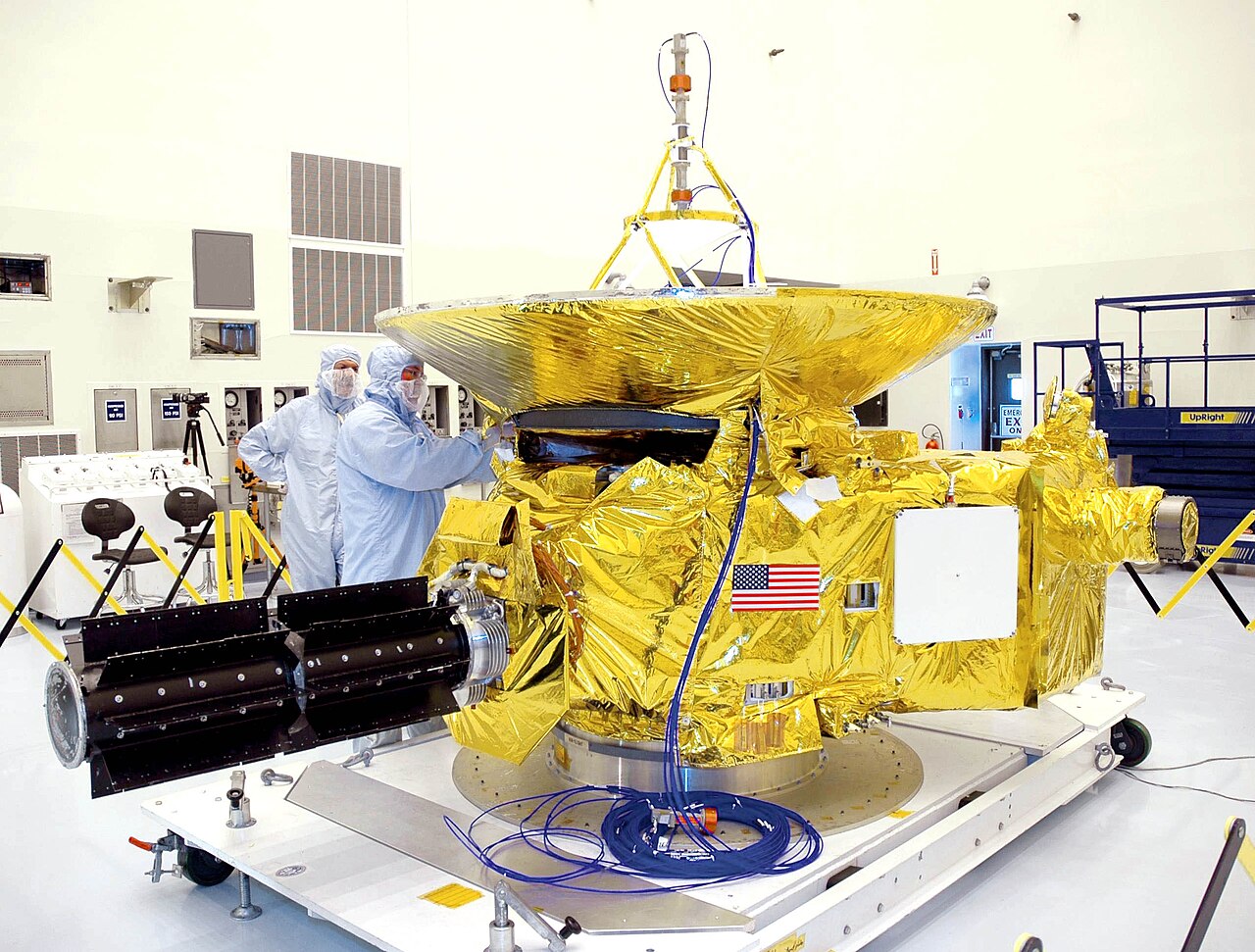
Tweny years ago, the New Horizons spacecraft launched from Cape Canaveral. Eight and a half years later, the whole world was talking about it when it transmitted the first-ever close-up images of Pluto’s surface back to Earth. However, its adventures actually began much earlier.

New Horizons spacecraft. Source: www.space.com

Who is interested in Pluto?

January 19 marks the 20th anniversary of the launch of the Atlas 5 rocket from the US Space Force base, which carried the New Horizons spacecraft beyond Earth’s gravitational sphere. Nowadays, it is mainly talked about in connection with the discoveries it made during its brief flyby of Pluto.

However, in reality, the interesting adventures of the probe designed to explore Pluto began long before the summer of 2015 and even long before its launch, although these adventures were a little unusual.

First, it should be noted that the first spacecraft could have reached Pluto several decades earlier. Voyager 1 could well have been that spacecraft. At least in the 1970s, during the mission planning stage, there was an idea to perform a gravitational maneuver during the flyby of Saturn, which would allow the probe to be directed towards the object that was then considered the ninth planet of the Solar System in a few years.

Voyager-1 could have been the first spacecraft to fly by Pluto. Source: www.planetary.org

However, at that time, Pluto was considered too distant and uninteresting, so preference was given to a trajectory that allowed for better exploration of Saturn’s largest moon, Titan. However, over the next 15 years, everything changed dramatically. In 1978, Pluto’s moon Charon was discovered, unusually large and close to the planet, and in 1985, its atmosphere was discovered. All this was already worth launching a spacecraft to what seemed at the time to be the most distant body in the Solar System.

In 1989-90, NASA established a working group that developed a project called Pluto 350. It was supposed to be a truly epic mission, designed to last 15 years. Initially, the spacecraft was to head for Venus and Mercury to gain speed, then perform another gravitational maneuver near Jupiter, and only then head for Pluto.

Such a cunning plan was necessary because the speed that can be achieved by the spacecraft during launch is quite limited, and the entire time it flies to Pluto, the Sun’s gravitational pull will slow it down. It will reach its destination, but it will take several decades.

 of Trajectorythe New Horizons spacecraft

That is why, without an intermediate point in the form of Jupiter, which, with the right calculations, can be turned into acceleration, it is impossible to do without. But 15 years was still too long, so NASA’s Jet Propulsion Laboratory developed another plan called Pluto Fast Flyby. It involved flying two small spacecraft for a total of seven years and performing a gravitational maneuver near Jupiter. In fact, this plan was later implemented during the New Horizons mission.

Is the flight to Pluto justified?

However, at that very moment, in 1993, after the loss of Mars Observer, the number of people willing to pay $1 billion – the estimated cost of the mission to Pluto at the time – dropped sharply. Instead, scientists’ interest only grew. The fact is that in 1987, the planet passed its equinox, and in 1989, it passed its perihelion, i.e., the point in its orbit closest to the Sun.

In addition, Pluto’s orbit is not only highly elongated but also significantly inclined to the ecliptic. This means that the most favorable moment for launching a spacecraft from Earth was in the second half of the 1980s. This crazy celestial body completes a full revolution around the Sun in 247 years.

Pluto’s orbit. Source: astrobites.org

This means that with each passing year, the spacecraft’s flight path would become longer and higher above the plane in which the rest of the planets in the Solar System revolve. This would mean higher costs and less equipment that could be delivered to the target.

In an attempt to save the mission, a desperate option was proposed: it would be launched by a Russian rocket, and Germany would provide funding in exchange for the opportunity to place its own sub-probe on board. The plan was to drop it onto one of Jupiter’s moons as the spacecraft flew through the gas giant’s system.

So, in discussions about the flight to Pluto, the topic arose that on its way there, the spacecraft should not only “sleep” but also explore something interesting as it flew past. But the plan did not work out, and in the mid-1990s, the project was abandoned.

Pluto Kuiper Express. Source: Wikipedia

But not for long, because at that very moment, more and more new objects began to be discovered beyond Neptune’s orbit. The flight plan to Pluto was taken out of the drawer again and supplemented with a section in which, after exploring the planet, the probe was to fly further and take a closer look at one of the newly discovered asteroids.

The mission was renamed Pluto Kuiper Express, and only one of the two previously planned spacecraft remained, but this did not help the project. In 1999, it was rejected again. But this time, the public was on the side of the scientists, and soon NASA had to announce a new competition, which the New Horizons won: the Shedding Light on Frontier Worlds project from the Johns Hopkins University Applied Physics Laboratory. It was this project that was implemented.

New Horizons design

Ready for launch, the spacecraft weighed 478 kg, of which 77 kg was fuel, and was about the size of a small car. It was propelled by four main rocket engines and 12 orientation engines. All of them ran on hydrazine as a single fuel.

The payload consisted of a whole set of scientific instruments. The Alice camera provided observation of objects and spectroscopy in the ultraviolet range, Ralph performed similar studies in the infrared part of the spectrum, and the main LORRI telescope was responsible for the visible range.

NewHorizons collection. Source: Wikipedia

Also on board were the SWAP solar wind analyzer and PEPSSI. These two instruments captured all the high-energy particles that New Horizons encountered during its flight. They were designed to answer the question of how strongly solar radiation affects objects at such a distance from the sun.

The VBSDC device was responsible for studying much larger particles that the spacecraft might encounter. Also on board was the REX radio spectrometer, designed to study Pluto’s atmosphere by measuring the signal from Earth as it passed through it.

All of this was controlled by the onboard computer. Signals were sent to it from Earth via a communication system. Inside New Horizons, the temperature was maintained between 10 and 30°C.

All this required a lot of energy. Solar batteries could not be used due to Pluto’s considerable distance from the Sun. Therefore, a radioisotope thermoelectric generator with 72 plutonium “pills” was used to power New Horizons. It provided 245 watts of power.4

New Horizons radioisotope thermoelectric generator. Source: Wikipedia

Flight to Pluto

When New Horizons finally launched into space on January 19, 2006, it was launched using the most powerful modification of Atlas 5, called 551. It has five solid-fuel boosters. Thanks to this, the spacecraft was able to accelerate to 12.4 km/s. Then the acceleration unit kicked in, bringing the speed up to 16.207 km/s.

New Horizons headed for Jupiter, but only reached it a year later, in February 2007. A lot happened during that time. Back in February 2006, engineers tested the spacecraft’s cameras and used them to photograph an asteroid that at the time was known only by its number, 132524. The distance to it was then 102,000 km. Thus, at the beginning of its mission, the spacecraft enriched our collection of celestial bodies photographed from close range.

However, on August 24 of the same year, an event occurred that was significantly less pleasant for the spacecraft team. The 26th General Assembly of the International Astronomical Union adopted a new classification of bodies in the Solar System. The reason for this was the discovery of new bodies beyond Neptune’s orbit, which gave new impetus to the study of Pluto.

Lava fountain above Io. Source: Wikipedia

Ironically, under the new classification, Pluto was classified not as a large planet but as a dwarf planet. Eris’s discoverer, Michael Brown, was openly delighted about this. However, New Horizons team leader Alan Stern called the new classification complete nonsense.

This assessment is not surprising. If the new classification had been adopted a few years earlier, it would have been difficult for the New Horizons team to prove the importance of the project. However, the spacecraft was already flying in space and in September 2007 even began observing Jupiter.

The flyby itself, with its gravitational maneuver, took place in February 2007, and it was an extremely successful moment in terms of raising the mission’s prestige. Some spacecraft had already completed their exploration of the largest planet in the Solar System at that time, while others were still on their way to it. New Horizons turned out to be its main explorer.

Arrokoth. Source: Wikipedia

The probe took numerous photographs of the planet itself and its moons. The images of the four largest moons were particularly interesting, as it photographed a lava fountain on Io shooting hundreds of kilometers into space. Jupiter’s atmosphere and magnetosphere were also studied.

The mission continues

After flying past Jupiter, New Horizons went into “sleep” mode. Every two to three months, engineers would wake it up and check the systems. This continued until it approached Pluto. Then the whole world started talking about the probe, and this lasted for several weeks. And then, like any sensation, it disappeared from the public eye again.

But the spacecraft’s scientific mission did not end there. It continued to explore trans-Neptunian objects and on January 1, 2019, flew past the asteroid Arrokoth, photographing and studying it. This is the first study of such a body, and it is thanks to it that we know what the outskirts of the Solar System look like.

And the New Horizons mission continues. The radioisotope generator is expected to operate until at least 2035. We can expect that it will make many more discoveries before then.

RELATED VIDEOS

{ https://universemagazine.com/en/articles-en/ }

Hoe vind je dit bericht?
Geschreven door peter om 23:10 Stuur door

The race for reusability and the flight to the Moon: the most anticipated space events of 2026

The race for reusability and the flight to the Moon: the most anticipated space events of 2026

The year 2026 should bring us many interesting events that will go down in the annals of world space exploration, from the first manned flight to the Moon in more than half a century to new Starship tests. Here are the main space expectations for the year.

The Artemis II mission

The Artemis II mission will likely be the most high-profile event of 2026. And there is hardly any need to explain why. After all, this will be the first manned flight beyond Earth’s orbit in 54 years, during which humanity will once again touch the Moon.

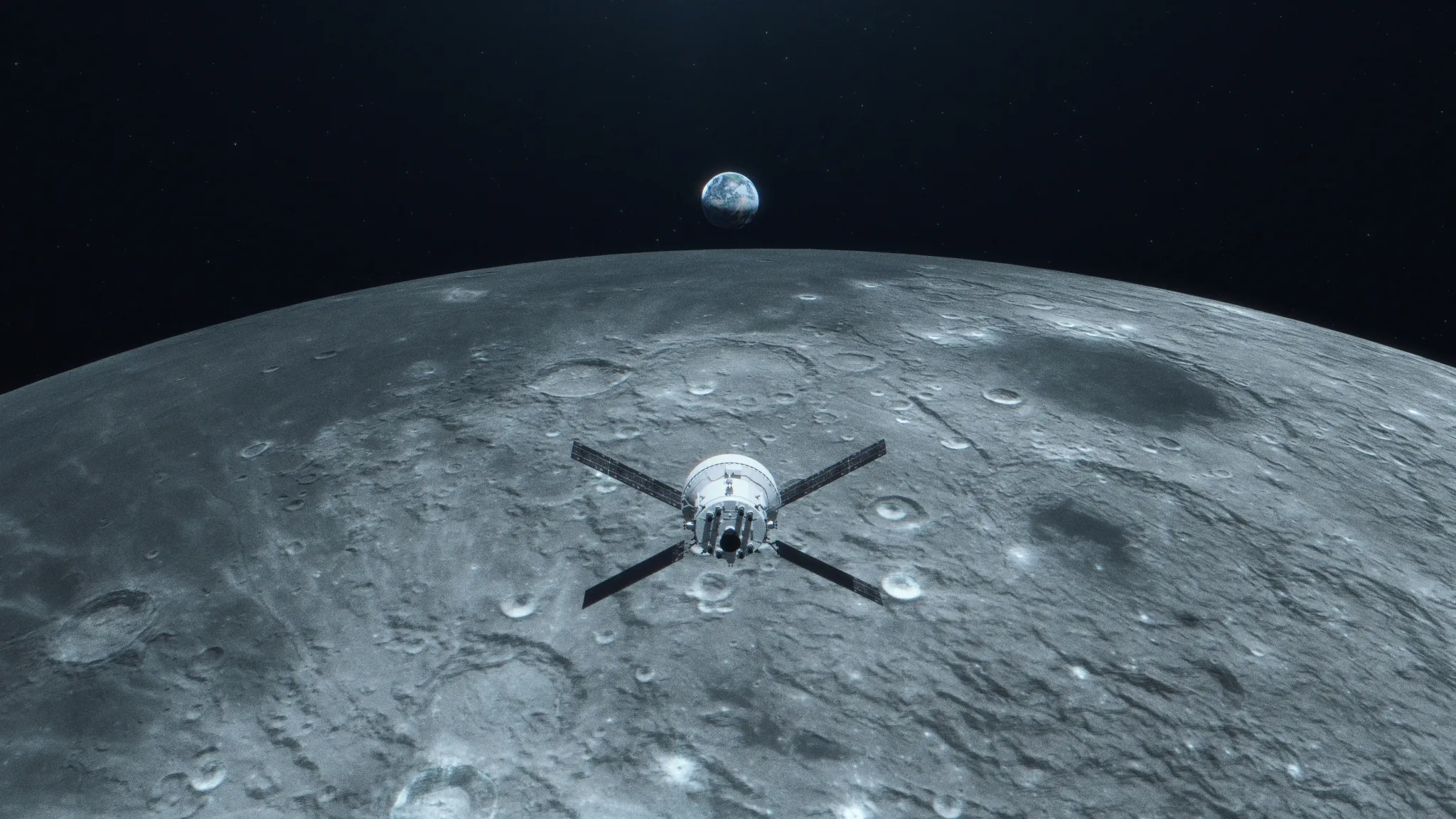
The Artemis II mission (concept). Source: NASA

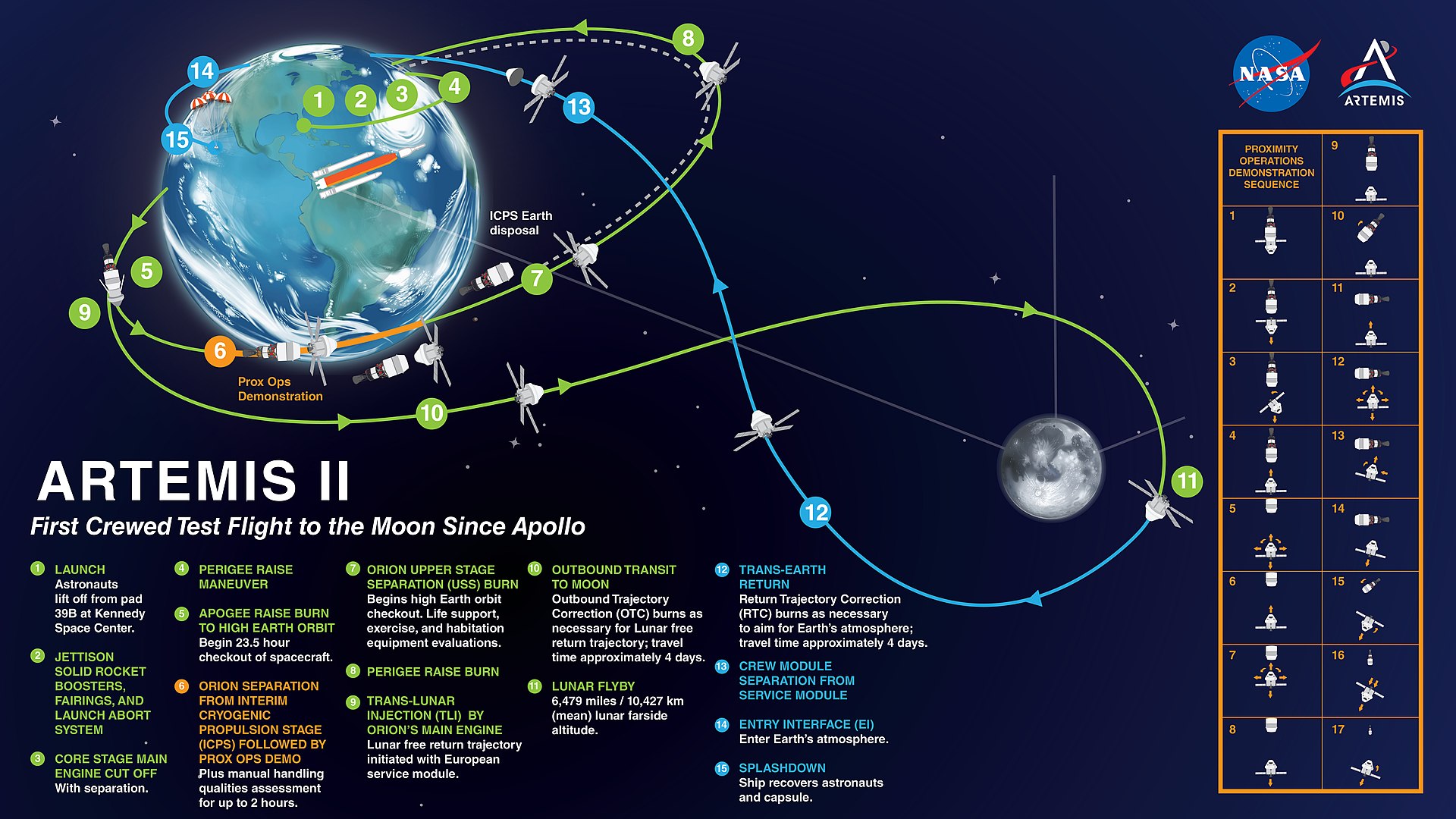
The flight plan is as follows. The super-heavy SLS rocket will launch the Orion spacecraft with four astronauts (three representing NASA and one representing the Canadian Space Agency) into Earth orbit. After making sure that all systems are operating normally, the crew will perform a maneuver that will put the spacecraft on a trajectory for a free flyby of the Moon.

On the sixth day of the flight, Orion will fly around the Moon (the minimum approach distance will be approximately 7,400 km), after which it will turn back toward Earth under the influence of the Moon’s gravity. This will eliminate the need for the expedition to use engines to change course, which should reduce the risks for the expedition. On the tenth day of the flight, the capsule with four astronauts will enter the Earth’s atmosphere and splash down.

The Artemis II mission flight plan. Source: NASA

Of course, flying around the moon is not the same as landing on it. But still, it is difficult to deny the symbolic significance of this mission. Since the Apollo program, several generations have grown up without seeing humans fly to other celestial bodies. The flight to the Moon will clearly help to raise interest in space exploration and astronautics. Artemis II will also mark the beginning of the next stage in the new lunar race between the US and China. At the moment, the launch of the mission is scheduled for February – March 2026.

The new Starship

As in previous years, the attention of all space enthusiasts will be focused on Starship. This year, SpaceX plans to begin testing a new, even more powerful modification of the super-heavy rocket, designated V3. Its first flight is tentatively scheduled for February. It will follow the same pattern as previous tests.

Transporting Starship to the launch pad. Source: SpaceX

If V3 proves to be a more reliable rocket than its predecessor, SpaceX will begin working on the next key elements needed to transform Starship from an experimental to a working system. These include reaching orbit, landing on land, and orbital refueling.

The last element is critical for the Artemis program. Without a functioning orbital refueling system, SpaceX will not be able to fulfill its obligations to NASA. As a reminder, as part of the Artemis III mission, the Starship HLS lander, which will be refueled in near-Earth orbit by tanker ships, is to land two astronauts at the south pole of the Moon.

Given the complexity and ambition of the project, it is extremely difficult to predict how successful the V3 tests will be. But one thing is certain – they will remain one of the main events of the year.

The race for reusability

For almost ten years, SpaceX was the only company with a partially reusable orbital rocket. This allowed it to take an unprecedented position in the global launch market and start building the Starlink system, which not so long ago seemed like science fiction.

The first stage of the New Glenn rocket after landing on a barge. Source: Blue Origin

But in 2025, the situation began to change. Blue Origin became the second company in history to successfully return a rocket stage from space. The Chinese company LandSpace and the China Aerospace Science and Technology Corporation made their first attempts to land the stages of their Zhuque-3 and Long March 12A rockets. They failed – but it is clear that this is only the beginning. In 2026, they will make new attempts to return to the stages.

New rockets will also join the reusability race. Rocket Lab intends to launch its first medium-class Neutron carrier rocket. It features an interesting “sliding” nose cone design, which allows it to be returned to Earth together with the stage.

Artist’s impression of the Neutron rocket. Source: Rocket Lab

There are also plans to debut several other rockets with reusable first stages. These include Terran-R, Hyperbola-3, Long March 10A… Yes, the launch dates for most of them may subsequently be postponed until next year. And those rockets that do fly are unlikely to be able to return to Earth on their first attempt. Nevertheless, 2026 will likely bring us new reusable launch vehicles.

The first private orbiting station

For many years, discussions about private orbital stations did not go beyond attractive promises and concepts. Bigelow came closest to achieving this goal, even launching an experimental inflatable module that became part of the ISS. However, the company subsequently went bankrupt.

Artist’s impression of the Haven-1 orbital station. Source: Vast

Nevertheless, in 2026, we may witness the launch of the first private orbital station in history. Vast Space is attempting to accomplish this task.

Vast Space first announced its plans to build the Haven-1 orbital station in 2023. Its main difference from similar projects, which never made it past the drawing board, is its relative simplicity. While other companies typically announce complex multi-module orbital stations, Haven-1 will consist of just one 14-ton compartment with an internal volume of 80 m³, not designed for permanent human habitation. The station will rely on the Crew Dragon spacecraft’s life support system and will be able to accommodate four astronauts for 30 days.

Welding of the main body of Haven-1 has been completed. Vast Space is currently actively testing it, as well as various components of the future station, such as solar panels and the docking mechanism.

Haven-1 orbital station on a test bench. Source: Vast

Vast Space hopes to launch its station sometime in the second half of 2026. Of course, given the ambitious nature of the task, the date may change. It cannot be ruled out that the launch of Haven-1 will ultimately be postponed until 2027. But we hope that the wait will not be too long. The first commercial orbital station will clearly be a powerful stimulus for other similar projects and will accelerate their implementation.

Events in deep space

In 2026, we can also expect many interesting events in deep space. Four private missions to the Moon are planned (Blue Moon Pathfinder Mission 1, IM-3, Griffin Mission One, Blue Ghost Mission 2). China will also send its mission to our planet’s satellite. We are talking about Chang’e-7, which has a very complex architecture, including a relay satellite, a lander, a rover, and even a flying drone. It is scheduled to land on the south pole of the Moon at the end of 2026.

Selfie taken by the Tianwen-2 spacecraft. Source: CNSA

During 2026, we will also see several objects in the Solar System up close for the first time. In June, the Chinese Tianwen-2 mission will enter orbit around the asteroid Kamoʻoalewa. It is a quasi-satellite of Earth and is believed to be a fragment of the Moon that was knocked out as a result of some collision.

In June, the Japanese spacecraft Hayabusa2 will fly past the asteroid Torifune. And in December, the European spacecraft Hera will reach the double asteroid Didymos. In 2022, the DART probe crashed into its satellite Dimorph. In this way, NASA tested whether such an impact could change the orbit of a celestial body (in the future, this technology could be used to deflect dangerous objects away from Earth). Hera will carefully study Didymos and Dimorph to gather as much information as possible about how the impact affected the pair.

The Hera mission as imagined by an artist. Source: ESA

The launch of the Japanese MMX mission is also planned for the end of 2026. Its goal will be to deliver a sample of Phobos material to Earth. Along with it, a pair of ESCAPADE probes will travel to Mars, which are currently monitoring space weather at one of the Lagrange points. The European-Japanese BepiColombo mission will finally enter a permanent orbit around Mercury. After that, it will split into two separate spacecraft, which will begin studying the first planet from the Sun.

{ https://universemagazine.com/en/articles-en/ }

Hoe vind je dit bericht?
Geschreven door peter om 22:49 Stuur door

German UFO centre logged record number of sightings in 2025

German UFO centre logged record number of sightings in 2025

UFO reporting office - Hansjuergen Koehler from the Central Research Network for Extraordinary Celestial Phenomena (CENAP) stands with his telescope in a meadow in the Odenwald. The UFO reporting centre CENAP located in western Germany this year recorded more sightings by puzzled citizens than ever before, its director said on Monday.

Photo: Frank Rumpenhorst/dpa

The UFO reporting centre CENAP located in western Germany this year recorded more sightings by puzzled citizens than ever before, its director said on Monday.

The Central Research Network for Extraordinary Sky Phenomena is a point of contact for members of the public seeking a scientific explanation for their spotting of a UFO - the abbreviation for "unidentified flying object."

According to its experts, most of these were planets or stars, rather than anything connected to extra-terrestrial civilizations.

CENAP, based in Lützelbach south of Frankfurt, recorded 1,348 UFO sightings last year from Germany, Austria and Switzerland, as well as a few from other countries, according to its director Hansjürgen Köhler.

Since 2019, reports have risen steadily every year. But even last year, there were no alien spaceships among them, Köhler said.

Sightings have many causes

According to him, bright planets such as Venus, Jupiter and the star Sirius continue to confuse many sky watchers.

In addition, meteors surprised many early risers and casual observers when they burned up with a conspicuous glow.

More than 120 sightings of tech billionaire Elon Musk's Starlink satellite communication systems were reported, including by pilots who were surprised during night flights, according to Köhler.

Other reports were attributed to rocket stage re-starts, when spent fuel is illuminated by the sun and creates bizarre luminous phenomena in the night sky.

In addition, satellites and rocket parts regularly burn up spectacularly in the atmosphere as space debris.

Reports that can be identified as drone flights have been increasing for five years, Köhler said. As well as small private drones, larger industrial drones and police drones are also in use.


{ https://dpa-international.com/ }

Hoe vind je dit bericht?
Geschreven door peter om 22:13 Stuur door

The incredible true story of the Men In Black: Harry saw six aircraft over the bay. Then the suits came out of shadows... and the bodies followed

The incredible true story of the Men In Black: Harry saw six aircraft over the bay. Then the suits came out of shadows... and the bodies followed

Before the movies, before the comic books, and before Tommy Lee Jones and Will Smith brought their suits to the big screen, the Men in Black were known only in whispers.

The legend of these shadowy figures - men in dark suits who threatened people who reported UFO sightings - was born in 1947, when a Washington state logger claimed he saw six flying orbs over Puget Sound.

On June 21, Tacoma resident Harold Dahl was out on the bay with his son, their dog and two crewmembers when he claimed to have spotted six massive, metallic, doughnut-shaped aircraft - each about 100ft across and gliding roughly 2,000ft overhead.

Dahl later described the sighting to an undercover intelligence agent, someone he believed was simply his supervisor.

The very next morning, a man in a black suit appeared at Dahl's home and invited him to breakfast, delivering a warning that would echo through UFO lore for generations.

Dahl's account was printed in the Tacoma Times, and months later, the 29-year-old journalist who covered it was dead under mysterious circumstances.

The story, now known as the Maury Island incident, is detailed in the newly released book Catastrophic Disclosure: The Deep State, Aliens, and the Truth, which argues Dahl's may be one of the first 'modern' UFO sightings.

'This might mark the first appearance of mysterious figures, either from the military or what has become known as the "men in black,"' authors Kent Heckenlively JD and Michael Mazzola wrote. 

A new book has detailed the origins of the legendary Men in Black, which started in 1947 when a man reported seeing six objects flying over Washington state. Pictured is an artist impression of what the man said he saw

A new book has detailed the origins of the legendary Men in Black, which started in 1947 when a man reported seeing six objects flying over Washington state. Pictured is an artist impression of what the man said he saw

On June 21, Tacoma resident Harold Dahl (pictured) was out on the bay with his son, their dog and two crewmembers when he spotted six massive, metallic, doughnut-shaped aircraft - each about 100ft across and gliding roughly 2,000ft overhead

On June 21, Tacoma resident Harold Dahl (pictured) was out on the bay with his son, their dog and two crewmembers when he spotted six massive, metallic, doughnut-shaped aircraft - each about 100ft across and gliding roughly 2,000ft overhead

The summer of 1947 became a landmark period for UFO sightings, from Ken Arnold's mysterious 'flying discs' near Mt Rainier to the infamous Roswell incident in New Mexico. 

Across the nation, Americans were captivated by reports of objects that defied explanation, and the federal government was paying close attention. 

But it was Dahl's encounter with the man in the black suit that cemented one of the most enduring legends in UFO history.

According to Heckenlively and Mazzola, such figures - whether military, intelligence or something altogether stranger - appeared in response to sightings like Dahl's, warning witnesses to keep quiet.

Dahl claimed he first saw five of the objects circling while a sixth appeared to be in distress. The craft made no sound, Dahl said, and he saw no propellers, motors or visible means of propulsion.

'A dull explosion followed, and the troubled craft ejected a stream of light metal that looked like thousands of newspapers, then heavier, darker rock, almost like lava,' the authors wrote.

Dahl reported that the damaged craft drifted out over the Pacific Ocean and vanished. He said the falling debris wrecked his boat, killed his dog and injured his son. 

He relayed everything to his supervisor, Fred Crisman, who, the authors note, was actually a former intelligence agent with the Office of Strategic Services (OSS), precursor to the CIA. It is not known how long Crisman and Dahl had been working at the same company.

Before the movies, before the comic books, and before Tommy Lee Jones and Will Smith brought them to the big screen, the Men in Black were known only in whispers

Before the movies, before the comic books, and before Tommy Lee Jones and Will Smith brought them to the big screen, the Men in Black were known only in whispers

Dahl's story appeared in the Tacoma Times the next day. The reporter, Paul Luntz, was said to have also been visited by two men in black suits who threatened him to stop writing about the incident

Dahl's story appeared in the Tacoma Times the next day. The reporter, Paul Luntz, was said to have also been visited by two men in black suits who threatened him to stop writing about the incident

The next morning, Dahl claimed, a man in a black suit knocked on his door and escorted him to a local diner.

'This was not as unusual as it might seem,' the authors explained. 'Many lumber buyers visited men in Dahl's trade to negotiate for salvaged logs.'

Over breakfast, the mysterious visitor calmly repeated Dahl's entire story back to him, then added: 'I know a great deal more about this experience of yours than you will want to believe.'

According to the book, he leaned in and warned Dahl never to speak of the sighting again, insisting the incident 'never happened' and hinting that if Dahl valued his family's safety, he would remain silent.

The story ran in the Tacoma Times the next day, reported by journalist Paul Lantz, who printed Dahl's description of the objects and confirmed the logger had alerted Crisman. 

Reports have suggested that Crisman shared the story with the news outlet.

Reports later suggested Lantz and his wife were also visited by two men in black suits after he published the article.

In a 2014 book, The Maury Island UFO Incident, authors Charlette LeFevre and Philip Lipson quote Lantz's granddaughter: 'My grandmother went into the kitchen to cook while they talked to Paul in the living room.

'She tried to listen. She said they were basically threatening Paul to stop… but Paul was bold and not afraid of them.'

What is now known as the Maury Island incident happened over Puget Sound (pictured)

What is now known as the Maury Island incident happened over Puget Sound (pictured)

A few months later, in August, Lantz published another startling report suggesting an Army plane crash in Kelso may have been 'sabotage.'

'The mystery of the 'Flying Saucers' soared into prominence again,' he wrote, after an informant claimed the aircraft was destroyed to prevent flying-disc fragments from reaching Hamilton Field for analysis.

eyJidWNrZXQiOiJjb250ZW50Lmhzd3N0YXRpYy5jb20iLCJrZXkiOiJnaWZcL3Vmby1ob2F4LTA5NGIuanBnIiwiZWRpdHMiOnsicmVzaXplIjp7IndpZHRoIjoyODV9fX0=

The informant alleged the debris came from 'one of the mysterious platters' that had fallen near Maury Island. 

Lantz died on January 10, 1948. Some accounts stated his cause of death was 'a short, unspecific illness,' while his death certificate reportedly cited meningitis. 

His death was described by family as sudden and unexpected.

Dahl was later interrogated by the Seattle FBI, which publicly declared the story a hoax, though internal accounts painted a different picture.

Reports claim FBI Director J Edgar Hoover wrote: 'Please be advised that Dahl did not admit… his story was a hoax, but only stated that if questioned by authorities, he was going to say it was a hoax because he did not want further trouble in the matter.'

To this day, no one has definitively explained what Dahl saw on Maury Island, why an intelligence agent posed as his supervisor or why a man in a black suit knew details of the incident before Dahl ever repeated them. 

The FBI closed the case, the debris vanished, and the people closest to the story either recanted under pressure or never spoke about it again.

But in the years that followed, dozens of witnesses across the country reported their own encounters with men in black suits who arrived without warning, knew too much and left no trace.

RELATED
Uncover the Truth | Men in Black: The Real Story | Full Documentary Mystery Movie | Free Movie

The True Story Behind The REAL Men In Black | Unveiled

{ https://www.dailymail.co.uk/sciencetech/index.html }

Hoe vind je dit bericht?
Geschreven door peter om 21:56 Stuur door

Top UFO experts reveal 'whistleblower activity' will finally bring disclosure in 2026: 'The evidence is aligning'

Top UFO experts reveal 'whistleblower activity' will finally bring disclosure in 2026: 'The evidence is aligning'

A surge of whistleblowers, new congressional mandates and mounting political pressure are pushing the US toward what insiders say could be its first true UFO disclosure in 2026. 

Researchers told the Daily Mail that a growing number of insiders from the military and intelligence community are now prepared to testify publicly, making continued secrecy increasingly difficult to maintain.

That pressure intensified after the November 2025 release of The Age of Disclosure, a documentary featuring 34 current and former US government, military, and intelligence officials discussing an alleged decades-long UFO cover-up.

The film's director, Dan Farah, said its revelations have placed the issue directly on President Trump's radar, reinforcing his campaign promise to declassify what the government knows about unexplained aerial phenomena.

At the same time, Congress has moved to force transparency through the 2026 National Defense Authorization Act, which mandates new briefings on UAP encounters dating back to 2004. The legislation also requires a review of whether key UFO-related data has been over-classified or improperly withheld from lawmakers.

Whistleblowers such as David Grusch continue advising congressional caucuses into 2026, adding legal and political weight to calls for disclosure. 

Grusch, a former US Air Force intelligence officer and decorated veteran who became a prominent whistleblower, alleged the US government possesses secret programs for recovering and reverse-engineering crashed extraterrestrial spacecraft, including non-human 'biologics.'

Mark Christopher Lee, director of The Rendlesham UFO: Britain's Roswell, told Daily Mail that 2026 stands out as a pivotal year due to 'escalating congressional momentum, whistleblower activity, and cultural shifts that are building unstoppable pressure on government secrecy.'

Wagering on Polymarket recently skyrocketed, with predictions that the US will declassify documented encounters with UFOs (Pictured) by 2026

Wagering on Polymarket recently skyrocketed, with predictions that the US will declassify documented encounters with UFOs (Pictured) by 2026

It has been suggested that Missouri Congressman Eric Burlison's claims of having a lead on 'new' UFO whistleblowers could be further evidence that disclosure is approaching. 

Burlison previously drew attention after presenting video footage showing a U.S. military drone firing a Hellfire missile at an unidentified object, only for the weapon to appear to bounce off the craft with minimal damage.

Lee said recent legislative action is adding to that pressure. 

'The fiscal year 2026 National Defense Authorization Act includes key provisions mandating the Pentagon's All-Domain Anomaly Resolution Office to brief Congress on UAP intercepts since 2004, review over-classification of related data, and streamline reporting,' he explained.

He added that much now depends on how far the current administration is willing to go in revealing some of the nation's most closely guarded secrets. 

'With ongoing efforts like the proposed UAP Disclosure Act amendments and whistleblowers such as David Grusch continuing to advise congressional caucuses into 2026, the legislative push is intensifying,' Lee said, arguing that secrecy may be nearing a breaking point for the intelligence community.

Alongside official action, speculation has intensified in popular culture. Some conspiracy theorists believe Steven Spielberg's upcoming film Disclosure Day could act as a carefully staged reveal rather than a conventional leak. 

UFO analyst Chris Ramsay claimed on X that Spielberg may have been granted 'unprecedented access to real UAP footage, or even an actual UFO.'

The November 2025 documentary 'The Age of Disclosure' alleged that there's been an 80-year cover-up on UFOs and alien technology

The November 2025 documentary 'The Age of Disclosure' alleged that there's been an 80-year cover-up on UFOs and alien technology

The coming release of Steven Spielberg's 'Disclosure Day' (Pictured) has convinced UFO fans that real disclosure is drawing near

The coming release of Steven Spielberg's 'Disclosure Day' (Pictured) has convinced UFO fans that real disclosure is drawing near

Other observers, including That UFO Podcast, have linked recent congressional hearings, Trump's statements, and Spielberg's project, suggesting the pattern points to a shift in disclosure discussions in 2026. 

Talk-show host Steve Deace predicted that at least one elected official may publicly claim to have communicated directly with non-human intelligence, highlighting what he described as escalating activity around UAPs.

Moving further into speculation, Lee also pointed to ancient prophecies that some interpret as signaling a pivotal moment. 

article image

He cited figures such as Nostradamus and Baba Vanga, whose visions have been linked by believers to extraterrestrial contact, noting that Vanga specifically referenced 2026 as a year marked by a major global event.

This vision by Baba Vanga, a blind Bulgarian mystic and clairvoyant, has previously been interpreted to suggest that alien contact should have been made in 2025, but no major televised event witnessed such an encounter. 

Skeptics cautioned that 'disclosure' is often misunderstood. 

Nigel Watson, author of Portraits of Alien Encounters Revisited, noted that while governments have released thousands of UFO files, none provide definitive proof of extraterrestrial visitors. 

'Media hype and repeated unverified claims have fueled belief,' Watson said. 'Until concrete evidence emerges, what is called disclosure remains largely mythology.'

Despite skepticism, researchers argue the current combination of legislative action, whistleblower testimony, and heightened public attention makes 2026 different. 

Even if the definitive proof some hope for does not appear, Lee said, the year could see major revelations about UAPs and government handling of anomalous phenomena.

{ https://www.dailymail.co.uk/sciencetech/index.html }

Hoe vind je dit bericht?
Geschreven door peter om 21:34 Stuur door

Bodies, craft, and silence: Inside the UFO retrieval pipeline

Bodies, craft, and silence: Inside the UFO retrieval pipeline

Researcher Leonard Stringfield claimed that the UFO crash-retrieval narrative did not begin with the famous Roswell incident. Instead, he traced it back to a series of earlier events that looked remarkably similar, and forward to later cases that suggested a global recovery effort operating in secrecy. 
UFO%20retrieval%20pipeline.jpg

Below are several significant cases and testimonies, from which it can be inferred that UFO crash incidents have been more frequent and widespread than the limited examples listed here.
Early reports before Roswell (1940–1945) 
The 1940s produced multiple stories involving disc-shaped craft and recovered occupants, years before Roswell made headlines. 
1941 – Cape Girardeau (USA): Disc-shaped craft recovers with nonhuman bodies (Charlotte Mann testimony). 
1941 – Carolinas (USA): Army maneuvers interrupted by classified assignment involving metallic disc and bodies. 
1942 – Georgia (USA): Small round craft allegedly retrieved with four small humanoids that later died. 
Roswell and the formation of a retrieval system (1947–1954) 
1947 – Roswell (USA): The Army first confirms the recovery of a “flying disc” before reversing the story. 
1948 – Operational Pattern Identified: Stringfield believed a system was now in place: crash → military lockdown → witness control → transport to Wright-Patterson AFB 
1948 – Laredo/Mexico Border: Disc allegedly recovered with bodies; U.S. military reportedly involved. 
By the early 1950s, Stringfield argued the retrieval program had matured into a highly coordinated operation. 
The 1953 Southwest Cluster. Several 1953 reports appeared connected: 
1953 - Fort Monmouth Film: Radar specialist shown footage of small disc + bodies, later told it was a “hoax.” 
1953: Kingman, Arizona : 30-foot disc, small hatch, 4-foot occupant - eyewitness Arthur Stansel. Blindfolded Metallurgist.
1953: Wright-Patterson expert flown to desert crash; says metal was non-terrestrial. Crates at Wright-Patterson.
1953: Three crates reportedly contained small humanoid bodies. Bodies at Wright-Patterson.
1953–1954: Technician claims thirteen bodies stored at the base. 
The retrieval narrative goes global (1965–Present) 
After the Cold War began, retrieval reports spread beyond U.S. borders: 
1965 – Kecksburg (USA): Acorn-shaped craft; military cordon; rumored transport to Wright-Patterson. 1967 – Shag Harbour (Canada): Underwater UAP tracked by naval units. 
1973 – Coyame (Mexico): Mid-air collision; U.S. team allegedly recovers craft. 
1986 – Dalnegorsk (USSR): Metallic sphere crash; unusual material analysis. 
1996 – Varginha (Brazil): Biological entities reported; military involvement. 
1997 – Needles (USA): Crash near Colorado River; helicopter retrieval observed. 
2002 – Mirny (Russia): Special units rumored to secure craft. 
South African Kalahari/Lesotho crash stories re-emerged throughout the 1990s–2000s, often linked to U.S.–South African cooperation. 
 
From UFOs to UAP: The Disclosure Era (2010s–2020s) 
Recent whistleblower testimony shifted attention away from public crash sites and toward highly classified aerospace programs. 
Eric Davis Notes (surfaced 2020): Mentions historical retrieval efforts and “off-world vehicles not made on Earth.”
David Grusch (2023): Alleges decades-long crash retrieval and reverse-engineering programs involving both craft and nonhuman bodies.
Transmedium Retrieval: Post-2017 UAP focus expands into underwater and multi-domain retrieval attempts. 
Taken as a whole, the timeline suggests a persistent covert infrastructure capable of: locating, securing, transporting, and analyzing exotic craft and nonhuman occupants, while operating outside public view for more than 80 years. 
If true, then the materials and propulsion recovered from these crashes would represent one of the biggest technological windfalls in modern history, yet remain compartmentalized within classified aerospace programs and Special Access Projects. 
The modern disclosure wave suggests that some of that secrecy may now be cracking.
  

{ http://ufosightingshotspot.blogspot.com/ }

Hoe vind je dit bericht?
Geschreven door peter om 18:50 Stuur door

Another Whistleblower Claims Deeper Layers of UFO Secrecy Inside Intelligence Agencies

Another Whistleblower Claims Deeper Layers of UFO Secrecy Inside Intelligence Agencies

Another-Whistleblower-Claims-Deeper-Layers-of-UFO-Secrecy-Inside-Intelligence-Agencies-1024x576.jpg

In recent years, the topic of UFOs and unexplained aerial phenomena has gradually moved from fringe discussions into mainstream media. Alongside official statements and documentaries, anonymous whistleblower accounts continue to surface online, adding new layers to an already complex narrative. One such account, allegedly posted by a former intelligence insider under the pseudonym “Rhea,” offers a detailed perspective on how unexplained aerospace and undersea phenomena may be handled behind closed doors.

The individual claims to have spent years within military and intelligence structures that operate beyond publicly acknowledged agencies. While stressing the importance of skepticism, the account outlines a professional background rooted in electro-optics, laser systems, advanced sensors, and long-range detection technologies. According to the whistleblower, this expertise placed them at the crossroads of physics, intelligence analysis, and anomaly investigation.

From Conventional Intelligence to Anomalies

Initially, the work described appears routine for intelligence professionals: counterterrorism support, signal and human intelligence analysis, foreign missile monitoring, and space domain awareness. Much of this involved tracking known objects—satellites, aircraft, missiles—and determining their origin and intent.

The shift reportedly occurred when the whistleblower was assigned to an inter-agency group focused on what was internally referred to as “anomalous aerospace and undersea systems.” These were not single sensor glitches or isolated radar errors. Instead, they were recurring detections that appeared across different platforms, countries, and decades, often sharing similar behaviors and signatures.

Operators are trained, the whistleblower explains, to assume mundane explanations: calibration errors, software artifacts, atmospheric effects, or human mistake. However, some anomalies resisted these explanations. They persisted despite changes in radar modes, sensor types, and observational conditions.

Patterns That Refuse to Disappear

According to the account, the most troubling aspect was not any single observation, but the emergence of consistent patterns. Certain locations repeatedly produced unexplained detections. Certain movements defied conventional aerospace physics. These events reportedly appeared on independent systems that should not have been capable of producing identical false positives.

At this point, the whistleblower suggests, analysts face a choice: continue forcing anomalies into acceptable explanations, or acknowledge that something genuinely unknown is being observed.

Those who persist in asking uncomfortable questions may eventually be granted access to deeper levels of classification. The author describes this structure as an “onion,” with each layer revealing more information but never the complete picture.

Compartmentalization Beyond Standard Networks

One of the more striking claims involves the level of secrecy. Even highly classified intelligence networks are allegedly excluded from certain discussions. Information is shared verbally, in secure facilities, and only with individuals deemed essential.

This extreme compartmentalization serves two purposes: limiting leaks and preventing any single person or group from fully understanding the scope of the phenomenon. According to the whistleblower, even insiders may only glimpse fragments of a much larger system.

Speculation, Not Certainty

Importantly, the account does not present definitive answers. Instead, it offers hypotheses. One recurring idea is that some phenomena may not represent visiting beings in the traditional sense, but rather automated systems—possibly ancient, non-human, or artificial in nature—designed to monitor or influence planetary development.

The author repeatedly emphasizes uncertainty and urges readers not to treat the account as established fact. The possibility of misinformation, exaggeration, or deliberate narrative manipulation is openly acknowledged.

A Familiar Yet Evolving Narrative

While elements of this account resemble previous anonymous disclosures, it also expands on them by grounding the narrative in sensor physics, intelligence workflows, and long-term data analysis rather than isolated eyewitness testimony. Whether genuine or fictional, the story reflects a growing pattern: unexplained phenomena are increasingly discussed not as single events, but as persistent systems interacting with our environment over extended periods.

As with all anonymous disclosures, the truth remains difficult to verify. What this account ultimately provides is not confirmation, but context—another piece in an ongoing puzzle that continues to challenge assumptions about technology, intelligence, and humanity’s understanding of its surroundings.

{ https://www.latest-ufo-sightings.net/ }

Hoe vind je dit bericht?
Geschreven door peter om 16:24 Stuur door

We Were Told There Is No Scientific Evidence for UFOs. Our Research Says Otherwise

We Were Told There Is No Scientific Evidence for UFOs. Our Research Says Otherwise

Overview

Astronomer Beatriz Villarroel and her research team have published new data that challenges the long‑standing claim that “there is no scientific evidence for UFOs.” Analyzing archival sky‑survey photographs taken before the launch of Sputnik in 1957, the team identified hundreds of thousands of brief, star‑like flashes—phenomena they call “transients.” Their results, detailed in two recent peer‑reviewed papers, suggest that a statistically significant subset of these flashes are solar reflections from non‑natural, flat surfaces orbiting Earth, and that the occurrences line up with historical UFO sightings and atmospheric nuclear tests.

Core Findings

The researchers focused on the distribution of flashes relative to the Earth’s shadow (the umbra). A pronounced deficit of events inside the umbra—measured at 7.6 σ—indicates that the flashes are not random imaging artifacts, dust, or atmospheric phenomena, which would appear uniformly across the sky. Instead, the pattern is consistent with mirror‑like objects reflecting sunlight only when they are illuminated, disappearing when they pass into the shadow. By cross‑referencing the timing and locations of these flashes with documented UFO reports from the 1940s‑1950s, the team found a statistically significant correlation. A secondary correlation emerged with the schedule of above‑ground nuclear detonations, which produced intense ionization layers that could affect orbital debris visibility.

Scientific Context

Historically, the scientific community has treated UFO research with caution, fearing professional stigma. “Engaging with unidentified aerial phenomena has been a career risk for decades,” Villarroel noted in an interview. Her work, however, leverages existing astronomical datasets rather than anecdotal testimony, positioning the study within mainstream methodology. The papers have undergone rigorous peer review and appear in Scientific Reports and Nature Scientific Data, journals that demand reproducibility and statistical robustness. Independent astronomers have begun replicating the analysis, with early feedback highlighting the novel use of pre‑satellite sky surveys as a valuable archival resource.

Reactions and Skepticism

The findings have sparked a mixed response. Proponents argue that the mirror‑like signature is hard to dismiss as a natural occurrence, while skeptics caution that alternative explanations—such as space debris with specular surfaces or unaccounted‑for optical effects—must be exhaustively ruled out. Dr. Liam Chen, a planetary scientist at the University of Colorado, remarked, “The statistical significance is impressive, but we need targeted observations to confirm the nature of these reflectors.” Meanwhile, a statement from the U.S. Office of the Director of National Intelligence reiterated that, despite increased transparency, “no conclusive evidence of extraterrestrial technology has been identified.”

HD|Dec 11, 2025|159184 views|byThe Angry Astronaut

Implications and Next Steps

If a portion of the transients are indeed artificial, non‑natural objects, the discovery would have profound implications for aerospace security, international policy, and our understanding of near‑Earth space. Villarroel’s team plans to collaborate with ground‑based telescopes and space‑based sensors to capture real‑time reflections and obtain spectral data that could differentiate metallic alloys from natural ice or rock. Funding proposals are already underway to integrate these observations into the UAP Task Force’s broader data‑collection effort. Until such follow‑up studies are completed, the research stands as a data‑driven challenge to the “no evidence” narrative, urging the scientific community to reassess the evidentiary standards applied to unidentified aerial phenomena.

{ https://usubjects.com/  }

Hoe vind je dit bericht?
Geschreven door peter om 23:51 Stuur door

Meer van UFO'S of UAP'S, ASTRONOMIE, RUIMTEVAART, ARCHEOLOGIE, OUDHEIDKUNDE, SF-SNUFJES EN ANDERE ESOTERISCHE WETENSCHAPPEN - DE ALLERLAATSTE NIEUWTJES

↑ Terug naar de berichten