Naar de inhoud

UFO'S of UAP'S, ASTRONOMIE, RUIMTEVAART, ARCHEOLOGIE, OUDHEIDKUNDE, SF-SNUFJES EN ANDERE ESOTERISCHE WETENSCHAPPEN - DE ALLERLAATSTE NIEUWTJES

UFO's of UAP'S in België en de rest van de wereld
akke.beakke.be
Ontdek de Fascinerende Wereld van UFO's en UAP's: Jouw Bron voor Onthullende Informatie! Ben jij ook gefascineerd door het onbekende? Wil je meer weten over UFO's en UAP's, niet alleen in België, maar over de hele wereld? Dan ben je op de juiste plek! België: Het Kloppend Hart van UFO-onderzoek In België is BUFON (Belgisch UFO-Netwerk) dé autoriteit op het gebied van UFO-onderzoek. Voor betrouwbare en objectieve informatie over deze intrigerende fenomenen, bezoek je zeker onze Facebook-pagina en deze blog. Maar dat is nog niet alles! Ontdek ook het Belgisch UFO-meldpunt en Caelestia, twee organisaties die diepgaand onderzoek verrichten, al zijn ze soms kritisch of sceptisch. Nederland: Een Schat aan Informatie Voor onze Nederlandse buren is er de schitterende website www.ufowijzer.nl, beheerd door Paul Harmans. Deze site biedt een schat aan informatie en artikelen die je niet wilt missen! Internationaal: MUFON - De Wereldwijde Autoriteit Neem ook een kijkje bij MUFON (Mutual UFO Network Inc.), een gerenommeerde Amerikaanse UFO-vereniging met afdelingen in de VS en wereldwijd. MUFON is toegewijd aan de wetenschappelijke en analytische studie van het UFO-fenomeen, en hun maandelijkse tijdschrift, The MUFON UFO-Journal, is een must-read voor elke UFO-enthousiasteling. Bezoek hun website op www.mufon.com voor meer informatie. Samenwerking en Toekomstvisie Sinds 1 februari 2020 is Pieter niet alleen ex-president van BUFON, maar ook de voormalige nationale directeur van MUFON in Vlaanderen en Nederland. Dit creëert een sterke samenwerking met de Franse MUFON Reseau MUFON/EUROP, wat ons in staat stelt om nog meer waardevolle inzichten te delen. Let op: Nepprofielen en Nieuwe Groeperingen Pas op voor een nieuwe groepering die zich ook BUFON noemt, maar geen enkele connectie heeft met onze gevestigde organisatie. Hoewel zij de naam geregistreerd hebben, kunnen ze het rijke verleden en de expertise van onze groep niet evenaren. We wensen hen veel succes, maar we blijven de autoriteit in UFO-onderzoek! Blijf Op De Hoogte! Wil jij de laatste nieuwtjes over UFO's, ruimtevaart, archeologie, en meer? Volg ons dan en duik samen met ons in de fascinerende wereld van het onbekende! Sluit je aan bij de gemeenschap van nieuwsgierige geesten die net als jij verlangen naar antwoorden en avonturen in de sterren! Heb je vragen of wil je meer weten? Aarzel dan niet om contact met ons op te nemen! Samen ontrafelen we het mysterie van de lucht en daarbuiten.

Archief

What Are UFOs? Select Theories and Shifting Scientific Stances

What Are UFOs? Select Theories and Shifting Scientific Stances

Grainy, black and white photo of a flying saucer over a mostly empty desert highway

For many, the term "UFO" conjures the image of a flying disc soaring through the night sky. But what is a UFO, really?  Joe McBride / Getty Images

You glimpse a light in the night sky. It's not a star or an airplane — but something radically different. It moves with baffling speed, pulsates with radiance beyond anything you've witnessed. Three letters immediately enter your mind: U-F-O. And you likely have Hollywood to thank for this line of thinking.

These mysterious objects have played a prominent role in pop culture, captivating imaginations and fueling speculation. From classic films like "Close Encounters of the Third Kind" to TV shows like "The X-Files," UFOs have become symbols of mystery and the unknown and mainstays in literature, music and art.

We know what Hollywood has to say about these mystery objects, but what are UFOs actually doing up in the sky in real life? And is there a massive government cover-up surrounding their existence? In this article, we'll take a closer look at these airborne objects, their potential link to extraterrestrial life and popular conspiracies about them.

1. What Is a UFO?

Technically, an unidentified flying object (UFO) can be anything when you get right down to it, but the term has become synonymous with spacecraft of extraterrestrial origin.

Alleged sightings became a popular topic of conversation in the mid-20th century and continue to this day. Exact descriptions of alien spacecraft vary with each telling, but witnesses and UFO enthusiasts often describe a lighted object capable of hovering silently and zigzagging in midair.

The technology for such a craft and the ability for a living passenger to survive its g-forces are well beyond humanity's modern technology. Additionally, given the massive distance between habitable star systems, such craft would have to travel at impossible speeds or with patience that staggers the imagination.

2. The Scientific Stance on Unidentified Flying Objects

For decades, scientists didn't have much to say about these unidentified objects. From a scientific standpoint, there was never enough sufficient evidence in UFO records to make a case for alien visitation. Most UFO sightings depend on fallible human accounts, imperfect footage and conspiracy theory.

All of this tends to crumble under the scrutiny of the scientific method, humanity's best sieve for separating reality from fantasy.

In recent years, the field has begun to approach UFOs with a stance of curiosity and skepticism. NASA, guided by administrator Bill Nelson, now aims to play a more prominent role in this research, emphasizing the importance of scientific methodology and instruments to gather data.

This shift signifies a desire to move beyond sensationalism and tabloid speculation, toward a more rigorous scientific approach.

3. Fire in the Sky

This painting by Christian Wilhelm Ernst Dietrich depicts biblical shepherds experiencing an angelic encounter. Imagno/Hulton Archive/Getty Images

The sky has always teemed with sights to stir the imagination: atmospheric anomalies, wildlife, optical illusions, aurora borealis, shooting stars and distant supernovae, just to name a few. Even in our scientifically informed age, countless phenomena escape our understanding.

As Swiss psychiatrist Carl Jung pointed out, these sights have no intrinsic meaning, but even the earliest humans jumped at the chance to project their hopes, dreams and nightmares into the vastness of the sprawling void. They personified the sun and moon as deities and poured their belief systems into the wheeling movements of the stars. And when they glimpsed strange lights, they read them as omens.

Just as the emotional resonance of a UFO sighting falls to the observer, so too does the explanation. Humans have always experienced brushes with the unknown, and they've always fished for explanations in the waters of their cultural worldview. In the absence of science, they turned to their religious beliefs, folktales and myth.

  • Religious Interpretations

Consider the UFO encounter that took place in Fatima, Portugal, in 1917. In what has subsequently been explained as everything from stratospheric dust to mass hallucination, thousands of witnesses in the predominantly Catholic town claimed to see an aerial event brought on by the Virgin Mary.

During this event, known as "the Miracle of the Sun," witnesses say the sun appeared to dance, change colors and spin.

Before the advent of Christianity, the same event would have likely been viewed through the lens of a pagan belief system. How do you think such an event would be interpreted in the entirely different world we know today?

By framing a bizarre occurrence within the context of a belief system or worldview, an individual attributes both a "what" and a "why" to the phenomenon. Such a view also helps sanction the experience and allow the individual to feel like they are both special for having experienced it and normal for sharing such experiences with others. Perform an online search for "UFO support group," and see for yourself.

4. Evaluating UFO Reports and Alien Abductions

Alien abduction experiences are often traumatic. Chip Simons/Taxi/Getty Images

Accounts of alien abduction often factor into UFO sightings, and this is also an area where one's worldview, belief system and culture play a vital role in framing an extraordinary experience.

Fortunately, alien abduction accounts generally provide more room for serious evaluation, typically by medical doctors or psychiatrists.

Doctors believe that sleep paralysis and waking, hypnopompic hallucinations factor into many abduction experiences. This is a kind of temporary paralysis accompanied by visual and auditory hallucinations, which are often charged by the person's sexual fantasies, belief system and pop culture.

Imagine waking in your bed, unable to move and experiencing sexual hallucinations colored by your subconscious. The exact nature of the hallucinations would likely depend, like dreams, on the nature of your belief system and cultural literacy. You might experience the visitation of an angel or ghost. Likewise, you just might experience a transcendent walk through an alien spacecraft or endure uncomfortable probing at the hands of extraterrestrials.

Consider the case of science writer and Skeptic magazine editor Michael Shermer, who himself experienced an alien abduction. Or rather, he collapsed from sleep deprivation and exhaustion following an 83-hour bike ride in a transcontinental race.

As Shermer's support team rushed over to him, the bicyclist saw them through the filter of a waking dream and perceived them as aliens from a 1960s TV series [source: Shermer].

  • Other Potential Causes

Researchers may attribute abduction experiences to a host of additional causes, including schizophrenia, organic brain syndrome, bipolar disorder, delayed post-traumatic stress disorder or even food allergies.

Neuroscientist Michael Persinger points the finger to the brain's temporal lobe. Persinger believes that temporal lobe anomalies, when combined with certain cultural expectations (such as beliefs in aliens or angels) can mislabel imagined experiences as actual experiences.

Even without the aid of neurological misfiring, human memory is a complex and fallible thing. Every day, we experience something new and turn that experience into an imperfect narrative. We can convince ourselves of nearly anything — especially when it fulfills a need.

So why do humans need visiting alien spacecraft and alien encounters? Perhaps Jung put it best in a 1958 interview: "In our world, miracles do not happen anymore, and we feel that something simply must happen which will provide an answer or show the way out. So now these UFOs are appearing in the sky."

In the late 1990s, psychologists Roy F. Baumesiter and Leonard S. Newman furthered this viewpoint by arguing that abduction encounters are essentially subconscious attempts to rid oneself of self-awareness through masochistic fantasy. In lieu of mystic conviction, our minds staff these fantasies with aliens.

In addition, our cultural frame of reference continually changes. Some observers have even equated the recent decline in UFO sightings to the rise of the internet. Cultural critic Ziauddin Sardar suggests that instead of projecting our hopes and fears into space, we project them into cyberspace.

So what are UFOs really? You might not find the answer amid the stars after all, but rather in the labyrinthine chambers of the human mind.

5. Unidentified Aerial Phenomena: A New Term Emerges

Breaking news: The term "UFO" is on its way out. Well, for the U.S. government, that is.

The feds began making the shift from "unidentified flying object" to "unidentified anomalous phenomena" (UAP) in 2020 when the UAP Task Force was established to encourage pilots to report sightings without fear of stigma or career repercussions. The scientific community is actively seeking better data on UAPs to gain a deeper understanding.

NASA also gathered a panel of 16 experts to assess how data on UAPs is collected across government and private sectors. Their final report, released in September 2023, found no evidence of extraterrestrial origins for UAPs but acknowledged that a small subset of encounters defies explanation.

6. UAPs and the Government

During a 2023 congressional hearing on UAPs, three military veterans testified about their experiences and concerns. One former Air Force intelligence officer alleged the existence of a secret government program for decades, involving the reverse engineering of recovered UFOs and the retrieval of non-human biological materials from alleged crash sites.

However, much of the discussion during the hearing focused on improving the reporting process for UAPs. The veterans called for destigmatizing UAP reporting and ensuring government program oversight. The Defense Department stated that it had not found any verifiable information supporting claims of extraterrestrial material possession or reverse engineering.

Retired Maj. David Grusch, a whistleblower who had been part of the Pentagon's UAP Task Force, claimed to know the exact locations of UAPs in U.S. possession but couldn't provide further details publicly. He stated his information came from reliable sources and shared evidence kept secret from Congress.

The hearing also featured testimony from former Navy fighter pilot Ryan Graves, who described encountering unusual aircraft off the coast of Virginia Beach, and retired Cmdr. David Fravor, who witnessed a mysterious "Tic Tac"-shaped flying object in 2004. Both emphasized the need for transparency and acknowledged the superior technology of the encountered objects.

The hearing aimed to pressure intelligence agencies for greater transparency on UAPs, citing potential national security threats. Lawmakers, witnesses and advocates called for a centralized reporting system to encourage reporting and eliminate stigma, emphasizing the importance of understanding these phenomena for both safety and scientific reasons.

  • This article was updated in conjunction with AI technology, then fact-checked and edited by a HowStuffWorks editor.

RELATED


{ https://science.howstuffworks.com/ }

Hoe vind je dit bericht?
Geschreven door peter om 21:58 Stuur door

Tall Whites: The Classic Extraterrestrial Archetype

Tall Whites: The Classic Extraterrestrial Archetype

eyJidWNrZXQiOiJjb250ZW50Lmhzd3N0YXRpYy5jb20iLCJrZXkiOiJnaWZcL3RhbGwtd2hpdGVzLnBuZyIsImVkaXRzIjp7InJlc2l6ZSI6eyJ3aWR0aCI6ODI4fX19

Tall whites are essentially the stereotypical alien from outer space.  Nicole Antonio / DALL-E

Among the more curious entries in alien lore, the tall whites stand out — literally.

These pale, lanky beings are said to be over 7 feet (2.1 meters) tall and were made famous by former military weather observer Charles James Hall, who detailed his alleged encounters during his time at Nellis Air Force Base in Nevada.

According to Hall, he was initially terrified but gradually overcame fears during his two years of working near them. In his writings, he describes walking with the tall beings and adapting to their presence through a mix of caution and curiosity.

1. Who Are the Tall Whites?

The tall whites, as described by Hall, are allegedly humanoid aliens with long limbs, pale skin and glowing blue eyes.

Unlike the little green men of pop culture, they seem more reserved — aloof but not overtly hostile. Hall claimed they had a base on Earth and were here with the government's awareness, if not its full cooperation.

Their behavior was reportedly unpredictable. While some encounters were calm, others were stressful, especially early on when Hall was still claiming sightings without broader belief or support.

2. Public Response and Media

Hall’s story gained attention in UFO circles and was later turned into a documentary film titled "Walking With the Tall Whites" based on his book series "Millennial Hospitality." Clips and videos online show interviews and reenactments, prompting viewers to start watching and debating what they watch.

Photos and evidence remain thin, and skeptics often point out the lack of physical proof. Still, descriptions from Hall and others have kept the story alive in UFO forums and niche media.

3. What Do They Want?

There’s no definitive sign of an agenda. According to Hall, the tall whites seemed more interested in observing humans and exploring Earth than making contact. He even suggested they had families and a structured society.

Whether you believe the tale or not, the story taps into deeper questions about humanity, alien life and the nature of fear. From initial terror to cross-species curiosity, it’s a narrative that challenges how we think about the unknown.

  • We created this article in conjunction with AI technology, then made sure it was fact-checked and edited by a HowStuffWorks editor.

{ https://science.howstuffworks.com/ }

Hoe vind je dit bericht?
Geschreven door peter om 21:36 Stuur door

400 billion times brighter than the Sun: astronomers witness a colossal explosion

400 billion times brighter than the Sun: astronomers witness a colossal explosion

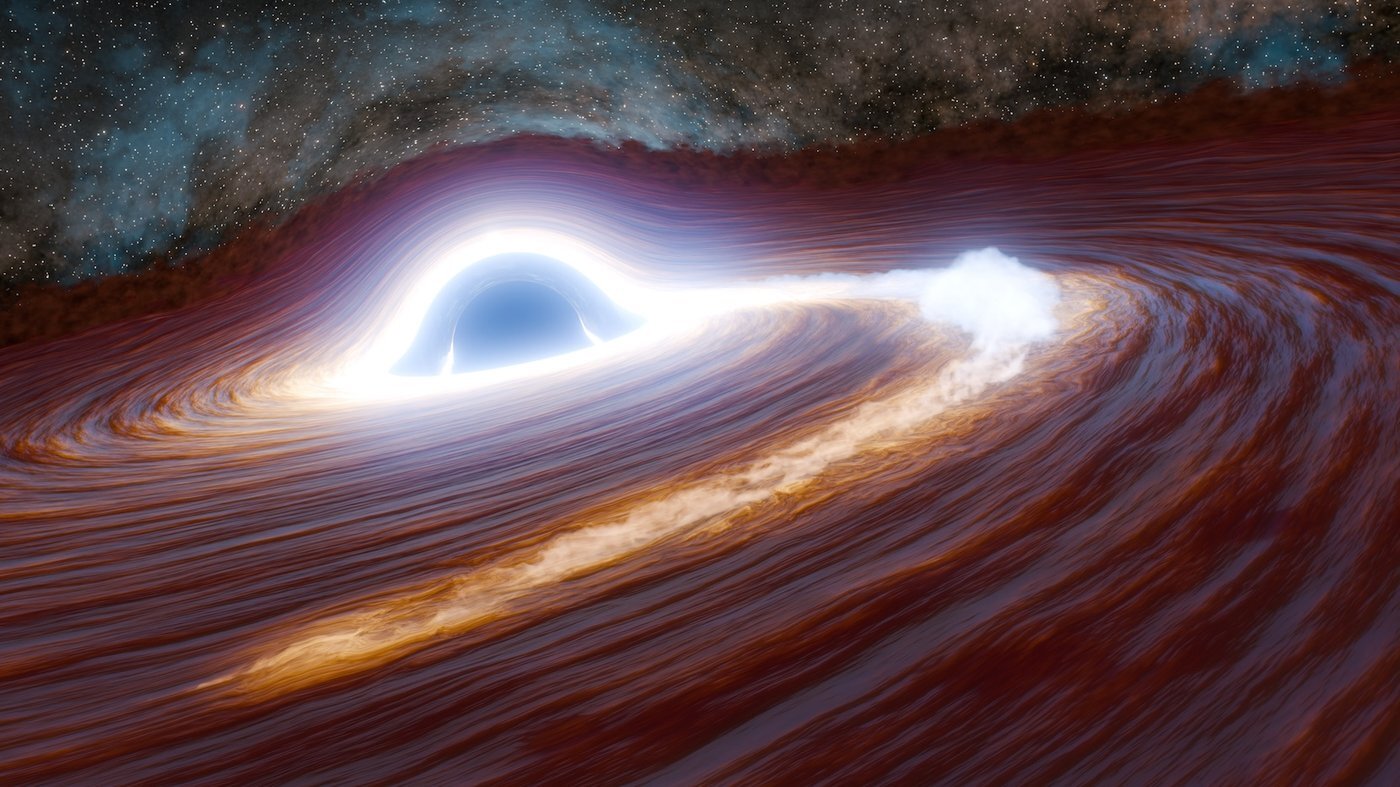
Astronomers witnessed a cosmic explosion that released energy equivalent to 400 billion suns. It was caused by a supermassive star being torn apart by a black hole.

Absorption of a star by a supermassive black hole (concept).
Source: Caltech/R. Hurt (IPAC)

The event, officially designated AT2024wpp (and informally named Whippet), was first discovered by astronomers as part of the Zwicky Transient Facility sky survey. It immediately attracted attention due to its similarity to the cosmic explosion AT 2018cow, which was 10–100 times brighter than an average supernova.

Whippet also resembled another class of objects called “Luminous Fast Blue Optical Transient” (LFBOT). This is an incredibly bright burst of light visible at distances of up to billions of light-years, which usually lasts for several days and emits high-energy radiation ranging from the blue end of the spectrum to ultraviolet and X-rays. Although several dozen such phenomena have been detected, LFBOTs remain poorly understood, although scientists associate them with the destruction of stars.

To solve the mystery of Whippet, researchers observed it using the Liverpool Telescope in the Canary Islands and the Swift spacecraft. They confirmed that its spectrum was shifted toward the blue end of the spectrum and that the object emitted X-rays, as expected from an LFBOT. This, combined with the fact that Whippet had an extremely high temperature, led to the conclusion that the event was caused by a black hole tearing apart a star with its gravity.

Further investigation by Whippet revealed a powerful shock wave propagating from the central source at about 20% of the speed of light, colliding with the surrounding gas. These shock waves dissipated in about six months when they reached the outer gas bubble left over from the destroyed star.

However, scientists have not yet fully understood all the circumstances surrounding Whippet. The team discovered helium moving away from the source at a speed of about 21 million km/h. This suggests that some densely bound structure survived tidal disruption and is moving at a speed of about 2% of the speed of light.

The team believes that this could be a stream of material ejected by the core of a doomed star when it was “spaghettified” by the black hole at the center of Whippet. Another possibility is that this stream of helium was generated by a third body in the system when it was exposed to particles and X-rays ejected by the black hole that had just “devoured” the star.

Earlier, we talked about how the black hole at the center of the Milky Way keeps its explosive past hidden.

RELATED VIDEOS

{ https://universemagazine.com/en/articles-en/ }

Hoe vind je dit bericht?
Geschreven door peter om 21:20 Stuur door

Sunset on Mars: Curiosity on the mountain reveals an impressive landscape

Sunset on Mars: Curiosity on the mountain reveals an impressive landscape

NASA’s Curiosity rover, which has been exploring the Red Planet for more than 13 years, has sent back a stunning new panorama. Taken from the summit of Mount Sharp, the image reveals a stark but breathtaking view of the landscape bathed in the rays of the setting sun.

NASA’s Curiosity rover photographed this panorama from the slopes of Mount Sharp inside Gale Crater, combining images taken on two different Martian days in November 2025 to highlight the change in light. Photo: NASA/JPL-Caltech

Observation point

In November 2025, the rover’s navigation cameras captured black-and-white images over two Martian days (sols). Specialists combined them into a single composite panorama, using blue and yellow tones to highlight changes in lighting. This technique helps to better see the details of the terrain.

Curiosity took this image from the top of a ridge overlooking a unique area known as the Boxwork. This is a maze of mineral ridges created billions of years ago by underground waters flowing through cracks in the rock. Softer rocks eroded over time, leaving behind hard “veins.” Such structures are key evidence of Mars’ wet past.

Image taken by the Curiosity rover on July 25, 2025. Source: NASA/JPL-Caltech/MSSS

The rover recently drilled into this ridge to collect a rock sample for analysis. In the foreground of the panorama, you can see tracks from its wheels and traces of previous drilling. Curiosity’s goal is to study how the planet evolved from a wet environment, potentially suitable for microbial life, to a dry desert.

Maximum efficiency

Despite its age, the Mars rover has gained new autonomous capabilities thanks to software updates. This allows it to plan its research more effectively and collaborate with orbital spacecraft, optimizing the performance of its aging energy system.

The panorama from Mount Sharp is not only an impressive sight, but also a reminder of the persistent work of the research robot. Each new sample and photograph brings science closer to solving the main mystery: whether there was ever life on Mars.

Earlier, we reported on how the Perseverance and Curiosity rovers simultaneously faced severe challenges.

{ https://universemagazine.com/en/articles-en/ }

Hoe vind je dit bericht?
Geschreven door peter om 20:29 Stuur door

What are deep-sea trenches?

What are deep-sea trenches?

Deep-sea trenches are deep depressions at the bottom of the Earth’s oceans, which are unique features of our planet in the Solar System. They were formed as a result of the movement of tectonic plates and can reach depths of 10-11 km, creating one of the most amazing landscapes on our planet – the hadal zone.

What do you know about deep-sea trenches? Source: geographical.co.uk

Space at the bottom

There are places on our planet whose gloomy mystery can rival the darkness of space itself. Usually, these include Antarctic glaciers, where life is almost impossible, or the polar deserts on some islands of the Canadian Arctic Archipelago, which are often compared to Mars.

However, there are places on Earth that are almost as inaccessible to humans as outer space, even though they are as far away from it as possible. These are deep-sea trenches – narrow and long depressions at the bottom of the world’s oceans, whose bottoms are never reached by sunlight. Their landscape resembles that of a celestial body, and their few inhabitants resemble aliens.

However, to truly understand the depth of the trenches, you need to observe what happens when you gradually walk along the seabed, going deeper and deeper.

Littoral zone. Source: Wikipedia

First, they determine the area between the highest point that gets underwater during high tide and the one that remains dry during low tide. This is called the littoral zone, and it is usually a narrow strip along the coast that sometimes gets a few kilometers wide. A great example of a littoral zone is a bunch of Ukrainian estuaries: looking at them, it is clear that the littoral zone is an area that makes any other part of the seabed seem deep.

Next comes the continental shelf – a section of the seabed where the depth slowly decreases to 200 m. The northern part of the Black Sea or the English Channel area, where the depth may not exceed hundreds of meters, tens of kilometers from the coast, are typical example. In essence, the shelf is part of the continental mass submerged by the ocean. Between the sedimentary rocks and basalt, as in much drier places, there is a layer of granite.

If you continue further, you will reach the continental slope, where the bottom descends at a much greater angle and quickly reaches a depth of 2-3 km. The continental slopes are particularly pronounced. For example, off the coast of North America.

The bottom of the World Ocean. Source: Wikipedia

Further down, the angle of the seabed decreases again, and abyssal plains stretch to depths of 4-5 km. These are huge depressions, comparable in size to entire countries, bounded by continental slopes. Sunlight rarely reaches their bottom, and despite the fact that bathyscaphes have repeatedly descended there, we still know less about these areas than we do about the surface of the Moon.

Deep-sea trenches are located even deeper than abyssal plains. The term “hadal zone” is used to describe the fauna of this landscape. There is no need to talk about flora, as it is practically non-existent at depths greater than 5 km. These are truly abysses, where the bottom slopes steeply downward and no light penetrates.

Formation of oceanic trenches

The fact that all the deepest areas of the ocean are shaped like narrow, elongated strips stretching along the coasts of continents or island arcs can be explained by the peculiarities of their formation. As is well known, the Earth’s crust consists of large blocks – tectonic plates. They move along the viscous, relatively plastic outer layer of our planet’s mantle, and it is this movement that causes earthquakes and volcanic eruptions.

Formation of an oceanic trench

The crust of plates can be continental, i.e., contain the aforementioned layer of granite, or oceanic, i.e., consist only of basalt and sedimentary rocks. Some plates consist of both types, while others consist only of oceanic crust.

In most cases, the transition from the continental slope to the ocean depths involves the same tectonic plate. However, sometimes two different lithospheric blocks are encountered here: one with a continental crust and the other with an oceanic crust. In this case, the oceanic plate begins to subduct beneath the continental plate and partially melts. As a result, a deep depression is formed.

Its slopes are always gentler on the side of the subducting oceanic plate and steeper on the continental side. This is the structure we call a deep-sea oceanic trench. At the same time, the plate subducts very slowly, so from the outside it may seem like a completely calm place.

Pacific Ring of Fire. Source: Wikipedia

The way deep-sea trenches are formed determines their extremely uneven distribution across the surface of our planet. They are always located in tectonically active zones, mainly in the so-called Pacific Ring of Fire, which surrounds the largest ocean on our planet.

Mariana Trench

In fact, all ten of the deepest ocean trenches are located in the Pacific Ocean. There are more than thirty of them in total. For comparison, there are only three large trenches in the Indian and Atlantic Oceans, and none at all in the Arctic Ocean.

However, the most famous of the Pacific trenches is the Mariana Trench, which is also considered the deepest in the world. Its depth is estimated differently, but usually the value of 11,022 m is given. It is located in the western part of the Pacific Ocean, near the islands of the same name. Its bottom is so inaccessible that humans first reached it only in 1960, just a year before they first set foot on the surface of the Moon. Until recently, the number of people who had visited the bottom of this trench was smaller than the number who had visited our natural satellite.

Mariana Trench. Source: Wikipedia

The water pressure at this depth is 108.6 MPa, which is 1,072 times greater than normal atmospheric pressure at sea level. However, microorganisms, crustaceans, and even fish have been found there. None of them is found anywhere else except this place, and they have never seen the light of the sun or stars. Their living conditions resemble those in space.

In addition, despite its inaccessibility, the Mariana Trench already bears the negative traces of human activity. Heavy toxic waste settles there and, together with river water, flows into the oceans.

Other trenches

Everyone knows about the Mariana Trench. However, the rest are no less amazing than it. Tonga, Philippine, Kermadec, Izu Ogasawara, Kuril-Kamchatka, North New Hebridean, Bougainville, and Japan – all of them are deep enough to completely submerge Mount Everest.

The landscape of the Puerto Rico Trench. Source: www.wired.com

Although the Mariana Trench is the deepest, the title of the longest on Earth belongs to another Pacific structure – the Peru-Chile Trench. It stretches along the coast of South America for 5,900 km, where the Nazca Plate dives under the South American Plate.

The deepest and largest trench in the Indian Ocean is the Sunda Trench, which stretches for 4-5 thousand km along the coast of Indonesia. Its maximum depth is 7,729 m near the island of Bali.

The ocean trenches of the Atlantic Ocean are generally relatively short in length, as they are formed by small tectonic plates. The deepest of these is the Puerto Rico Trench, with a maximum depth of 8,742 m. This is only slightly less than the height of Mount Everest.

It would seem that ocean trenches have nothing to do with astronomy. However, when considering the planets of the Solar System, among the unique phenomena available only on Earth, along with the biosphere, it is worth mentioning them. After all, nowhere else do lithospheric plates move, and even more so, there are no places where they collide under a layer of liquid.


RELATED VIDEOS

{ https://universemagazine.com/en/articles-en/ }

Hoe vind je dit bericht?
Geschreven door peter om 20:10 Stuur door

To Keep Water Liquid, the Red Planet Needed to Freeze

To Keep Water Liquid, the Red Planet Needed to Freeze

Artist's depiction of an ancient extant lake in Gale Crater. Credit - NASA/JPL-Caltech/MSSS

Mars has a curious past. Rovers have shown unequivocal evidence that liquid water existed on its surface, for probably at least 100 years. But climate models haven’t come up with how exactly that happened with what we currently understand about what the Martian climate was like back then. A new paper, published in the journal AGU Advances by Eleanor Moreland, a graduate student at Rice University, and her co-authors, has a potential explanation for what might have happened - liquid lakes on the Red Planet would have hid under small, seasonal ice sheets similar to the way they do in Antarctica on Earth.

To understand why this finding is significant, it's best to understand the “Faint Young Sun Paradox” in Mars research. According to data collected by the Curiosity Rover in Gale Crater, there was absolutely liquid water pooled on the surface of Mars at some point in its history. There were clear signs of deltas and even river channels carved into the rock, and the best estimates for when this hydrological cycle was active was around 3.5 billion years ago.

However, 3.6 billion years ago, the Sun was 25% dimmer than it is currently - and we already know Mars is frozen even at the Sun’s current output power. So how could liquid water, which must, by definition, exist in environments above freezing, endure on the surface of Mars while it was possibly even colder than it is today.

Water discusses the possibility of water on Mars

There have been two main solutions to this paradox put forward in the literature. One is that there were “bursts” of warming on Mars that were caused by either active volcanoes or asteroid impacts, that allowed liquid water to run freely, but only until the energy from those events dissipated. The other is that Mars was always cold and icy, but that the liquid water existed under permanent ice sheets.

To settle this debate, Ms. Moreland and her co-authors developed a new computer model called the Lake Modeling on Mars for Atmospheric Reconstructions and Simulations (LakeM2ARS). This software package takes inputs like a potential lake’s location, its size, and the atmospheric composition, and predicts how long it could have held onto its liquid water. The results of the model were rather counterintuitive.

In warm scenarios, where the ambient temperature was above freezing for a significant amount of time, evaporation actually made the lakes dry out quickly. Whereas, in cold scenarios, the lake would have developed seasonal ice cover, which would have acted as a barrier to the evaporation. It would have still allowed liquid water to actively exist on the surface during seasonal warm periods though. “Warm” is relative though, with only a small part of the year existing at an average of above 0 ℃. Most of the rest of the year the average temperature would have been closer to -20 to -30 ℃.

We still haven't found existing liquid water on Mars - as Fraser explains.

So how can researchers rule out permanent ice rather than the seasonal variety? If the atmosphere was too thin, that likely would have been the condition on Mars for millions of years. But, it also would have left distinct physical marks, such as dropstones and frost wedges, that weren’t present when Curiosity looked in Gale Crater. Seasonal ice provides a nice middle ground between the two extremes. It stopped the quick evaporation of the “warm and wet” climate model, while also explaining the absence of the features expected if the water was constantly frozen.

This study fits neatly into the ongoing discussion about the early climate on Mars, and what implications it might have had for the existence of life at some point on the planet. Luckily, we have another rover (Perseverance) wandering around different Martian terrain (Jezero Crater) that the LakeM2ARS software can be adapted to model that area, as well as other previously wet areas on Mars. As we continue our exploration of what is now a dry, arid world, the history of water will remain one of its most intriguing mysteries, even as we develop ever more sophisticated computer models to figure it out.

Learn More:

{ https://www.universetoday.com/ }

Hoe vind je dit bericht?
Geschreven door peter om 23:47 Stuur door

NASA's Mars Sample Return Is Dead, Paving The Way For China

NASA's Mars Sample Return Is Dead, Paving The Way For China

This illustration shows NASA's Perseverance rover with sample tubes on the Martian surface. Funding has been cut for the mission, effectively ending it. Image Credit: NASA/JPL-Caltech This illustration shows NASA's Perseverance rover with sample tubes on the Martian surface. Funding has been cut for the mission, effectively ending it. Image Credit: NASA/JPL-Caltech

It looks like NASA's Mars Sample Return (MSR) mission has come to a bureaucratic end. The mission was to be the crowning achievement in the study of Mars and all the questions surrounding its ancient habitability. But the US Congress has drastically cut the mission's funding.

Despite decades of study and technological improvement and innovation, the issue of Martian habitability has been difficult to solve. MSL Curiosity and Perseverance have widened and deepened our understanding of the planet, and have provided tantalizing evidence for warm, wet periods on Mars conducive to life. But the next step was to return Martian rock samples to Earth, where the investigative power of modern labs could be brought to bear on them.

As far back as 2011, returning samples from Mars was recognized as a high priority in NASA's planetary science endeavours. Even today, NASA's webpage for MSR states that "Mars Sample Return (MSR) would be NASA's and ESA’s (European Space Agency) ambitious, multi-mission campaign to bring carefully selected samples to Earth. MSR would fulfill one of the highest priority solar system exploration goals from the science community. Returned samples would revolutionize our understanding of Mars, our solar system and prepare for human explorers to the Red Planet."

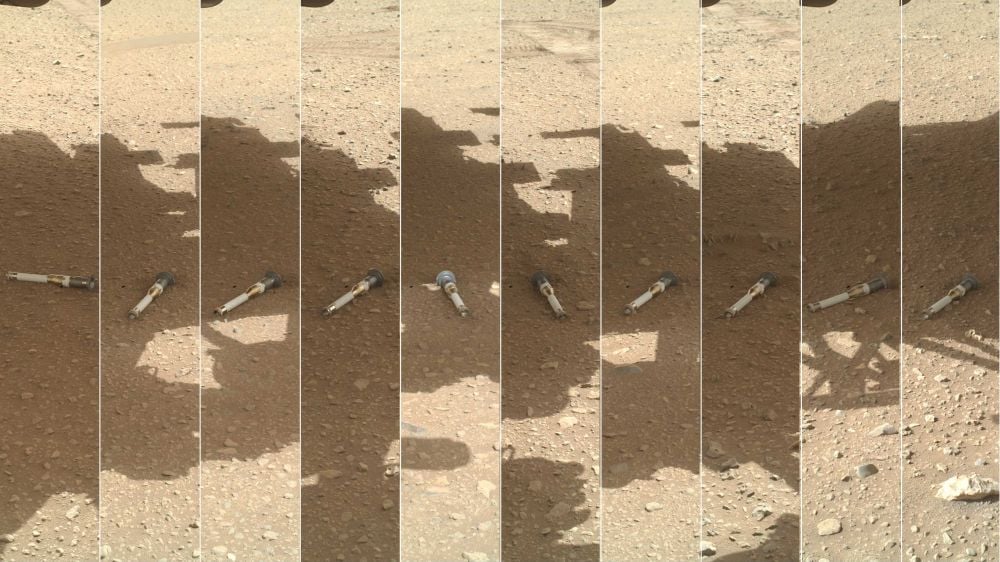
The Perseverance rover was the first stage of the mission, and it has performed exceptionally well. The rover has gathered and cached 33 sample tubes of interesting rocks and dust, ready for retrieval by the MSR. Now, the fate of those samples is unclear.

NASA knew that they were in tough territory. The estimated cost to retrieve the samples ballooned to 11 billion dollars. After working on new mission architectures, they were able to get the estimated cost down to about 7 billion dollars. But those were just estimates, and because it's such an unprecedented mission, there was a clear lack of certainty around those numbers.

The issue is money. There's heavy pressure on NASA to reduce its budget, and although Congress refused to reduce it as severely as the President wanted, something had to give. Since the MSR still required large amounts of money, and since the technology to achieve it still wasn't clear, it was the obvious choice for cancellation. It became a high-profile political football, not just a science mission.

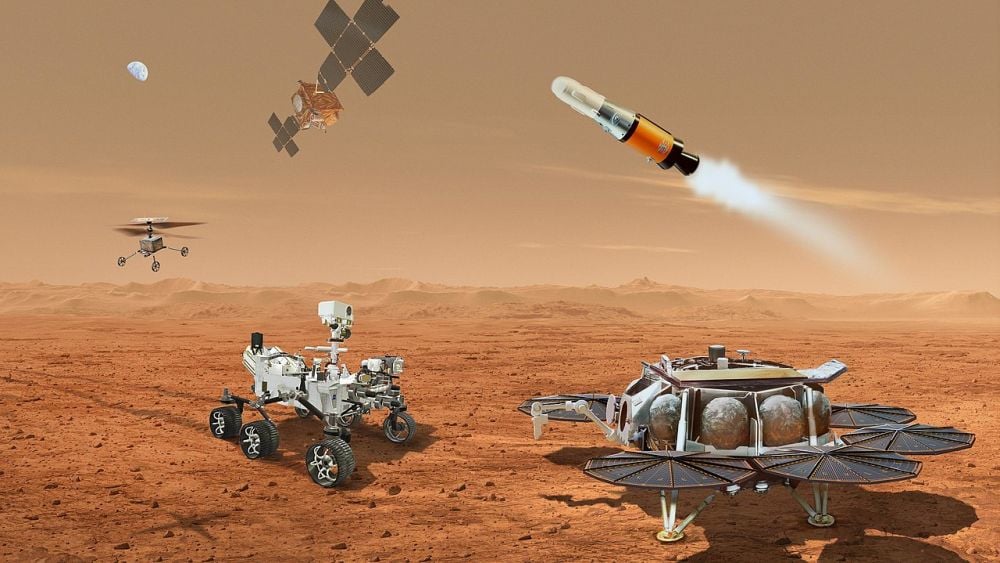
The mission was extremely complex. The current design involved sending a lander to the surface. Perseverance would deliver the sample tubes to the lander, and if that were not possible, a pair of small sample return helicopters would do the job. The lander also had a rocket which would carry the samples to Martian orbit. From there, it would rendezvous with an orbiting spacecraft that would send the samples back to Earth. To say this was a complex undertaking is an understatement.

This artwork from 2022 shows the conceived mission architecture. Image Credit: By NASA/ESA/JPL-Caltech - https://photojournal.jpl.nasa.gov/catalog/PIA25326 (image link), Public Domain, https://commons.wikimedia.org/w/index.php?curid=121171927

*This artwork from 2022 shows the conceived mission architecture. 

Image Credit: By NASA/ESA/JPL-Caltech

- https://photojournal.jpl.nasa.gov/catalog/PIA25326 (image link), Public Domain, https://commons.wikimedia.org/w/index.php?curid=121171927*

But isn't NASA all about American ingenuity and the spirit of exploration and adventure? You can't lead in science without money, and it's hard to argue that President Trump's request to inflate the USA's military budget to an unprecedented degree didn't have something do with NASA's budget cuts. He asked for 1.5 trillion dollars of military spending, a profligate 50% increase.

The budget still provides some money for developing technology related to further exploration of Mars, but only a small amount.

The wording is clear in a document titled DIVISION A - COMMERCE, JUSTICE, SCIENCE, AND RELATED AGENCIES APPROPRIATIONS ACT, 2026.

"As proposed in the budget, the agreement does not support the existing Mars Sample Return (MSR) program. However, the technological capabilities being developed in the MSR program are not only critical to the success of future science missions but also to human exploration of the Moon and Mars."

It continues: "Therefore. the agreement provides the request of $110,000,000 for the Mars Future Missions program, including existing MSR efforts, to support radar, spectroscopy, entry, descent, and landing systems, and translational precursor technologies that will enable science missions for the next decade, including lunar and Mars missions."

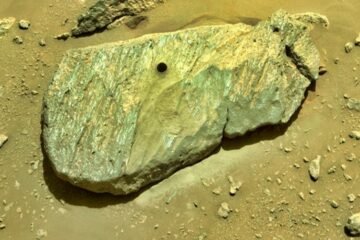
Perseverance's cached samples await retrieval on the Martian surface. Image Credit: NASA/JPL-Caltech/MSSS

*Perseverance's cached samples await retrieval on the Martian surface.

Image Credit: NASA/JPL-Caltech/MSSS*

It's possible that some of that money will lead to new technologies, and a more budget-friendly way of retrieving the cached samples. But that is far from certain. It's also possible that technology will be developed that can study the samples effectively on the surface and returning them to Earth won't be necessary. But the technology in Earthly labs will advance at the same rate. It's difficult to conceive how studying them on Mars will ever be as effective as studying them on Earth.

Politics can't be ignored in this issue. NASA was teaming up with the ESA on this mission. But with the current administration's threats against European countries and the EU, which include using military force to sieze Greenland—otherwise known as war—that cooperation is likely dead. Maybe never to be revived.

The future is always unwritten and unknown. Maybe the MSR will be revived at some point in the future. Maybe the ESA will go it alone. China has plans for a Mars sample return mission, and now the path is clear for them to be the first to return Martian samples to Earth. However, their mission is not as sophisticated as the NASA/ESA mission. While Perseverance's samples are carefully chosen for maximum science benefit, China's mission is more of a grab and go endeavour.

Fortunately, the sample tubes are likely to sit there waiting for a long time, unlikely to be degraded in Mars' cold, dry environment. But for scientists who have put their hearts and minds into this ambitious mission, the news must be crushing.

{ https://www.universetoday.com/ }

Hoe vind je dit bericht?
Geschreven door peter om 23:37 Stuur door

NASA Releases the Long-Awaited Video of Kepler's Supernova Remnant

NASA Releases the Long-Awaited Video of Kepler's Supernova Remnant

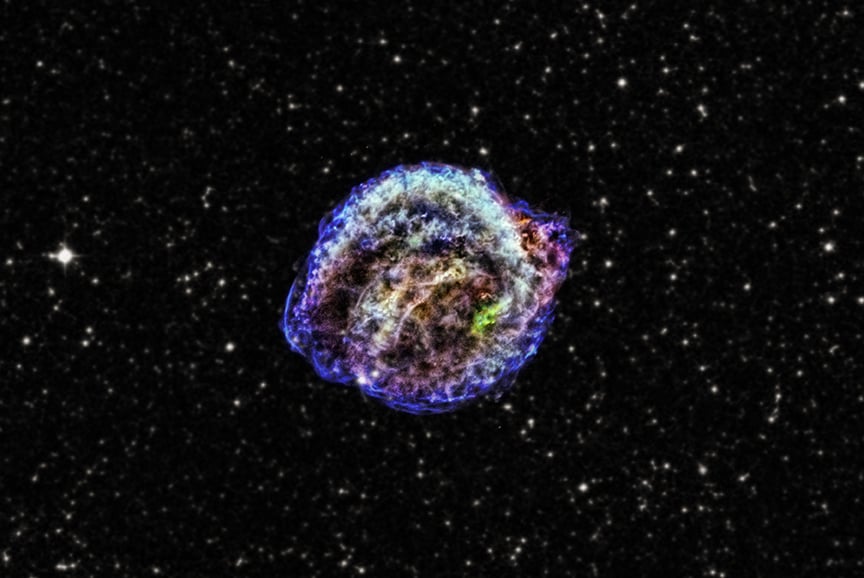
Chandra image of Kepler's Supernova, with colors representing the different levels of X-ray energy in the expelled debris. Credit: NASA Chandra image of Kepler's Supernova, with colors representing the different levels of X-ray energy in the expelled debris. Credit: NASA

In 1604, German astronomer Johannes Kepler spotted a new star in the sky that was so bright it could be seen during the daytime. The discovery, which Kepler described in his book *De Stella Nova*, caused quite a stir in the astronomical community. With this one point of light, astronomers questioned the prevailing dogma that the "firmament" (the background stars in the sky) was not unchanging and permanent. In time, we would come to realize that Kepler's Supernova (as it's come to be known) was a white dwarf that exceeded its critical mass and exploded in a brilliant burst.

Located about 17,000 light-years from Earth in the constellation Ophiuchus, Kepler's Supernova is a prime example of a Type 1a supernova. These occur when a white dwarf in a binary system pulls material from its companion star or merges with another white dwarf. Its proximity to Earth has allowed the Chandra X-ray Observatory to capture detailed images of the supernova remnant, which astronomers have used to monitor its evolution over time. Based on data acquired between 2000 and 2025, the science team has created the longest-spanning video of the debris field left by this supernova.

Supernova remnants, which consist of massive clouds of dust and gas expelled from the star, are heated to millions of degrees by the heat of the explosion. This causes the material to glow brightly in different wavelengths (often in X-ray light), which Chandra has monitored using its advanced X-ray optics. Combined with the longevity of the mission, which has been in operation for a quarter of a century, Chandra has monitored changes in the remnant cloud very closely.

Jessye Gassel, a graduate student at George Mason University in Virginia, led the work on this video. It and the associated research were presented by Gassel at the 247th meeting of the American Astronomical Society in Phoenix. "The plot of Kepler’s story is just now beginning to unfold," he said in a Chandra press release. "It’s remarkable that we can watch as these remains from this shattered star crash into material already thrown out into space."

A particularly interesting part of this video is how it shows different parts of the remnant moving at incredible speeds in different directions. While the fastest parts are traveling at about 2% the speed of light (22.2 billion km/h; 13.8 billion mi/h) downwards, the slowest parts are traveling at 0.5% the speed of light (6.4 billion km/h; 4 billion mi/h) upwards. This difference is due to the gas the remnant is pushing toward the top of the image being denser than the gas it is pushing toward the bottom. This provides scientists with information about the supernova's environment.

Another interesting feature is the widths of the rims forming the blast wave of the supernova, the leading edge of the explosion that encounters material outside the star first. By examining how wide and fast it was, the team gained vital information about the star's explosion and its immediate surroundings before they were disturbed. "Supernova explosions and the elements they hurl into space are the lifeblood of new stars and planets," said Brian Williams, the principal investigator of the new Chandra observations. "Understanding exactly how they behave is crucial to knowing our cosmic history."

Further Reading: 

{ https://www.universetoday.com/ }

Hoe vind je dit bericht?
Geschreven door peter om 23:28 Stuur door

“A Potential Biosignature is Awaiting Return Now”: Congress Abandons Retrieval of Martian Rocks That May Hold Evidence of Extraterrestrial Life

Martian rocks, extraterrestrial life

Image: NASA

“A Potential Biosignature is Awaiting Return Now”: Congress Abandons Retrieval of Martian Rocks That May Hold Evidence of Extraterrestrial Life

After years of delays and debate, the United States Congress has passed a NASA budget that omits any plan to retrieve several rock and soil samples collected and stored by the Perseverance Rover, including Martian rocks that may contain signs of past or present extraterrestrial life on the Red Planet.

According to the new compromise spending bill for the current fiscal year, it appears Congress has given in to the White House’s demands that resources needed to complete the planned Mars Sample Return (MSR) program be explicitly excluded from any approved budget. While the bill still awaits a final vote in Congress and the President’s signature, NASA officials are sending signals that the MSR program is effectively dead.

“The agreement does not support the existing Mars Sample Return program,” the bill states.

Victoria Hamilton, a planetary scientist at the Southwest Research Institute (SwRI) and chair of NASA’s Mars Exploration Program Analysis Group, described the death of MSR as “deeply disappointing” while also questioning the veracity of the current administration’s stated goals.

“When we’ve got memos coming out saying we want to be the dominant power in space, I wonder how we leave something this ambitious behind,” Hamilton said.

Escalating Cost of Retrieving Martian Rocks has Haunted the MSR Program

Before NASA launched Perseverance in July 2020, mission planners had struggled with the concept of retrieving the samples the rover was tasked with collecting through its mission. Since then, the interplanetary explorer has collected dozens of samples and stored them for the planned future return.

Mars, the mystery of water and life on ancient Mars

Artist’s concept of the Mars ascent rocket, one component of the effort to collect and send samples of Martian rock back to Earth

(NASA/Public Domain).

During that time, the cost for MSR has continued to rise, with 2024 estimates reaching $11 billion. Regardless of the potential scientific value, the extraordinarily large share of NASA’s science budget that the single mission was projected to consume left planetary scientists working on other stalled or underfunded projects wondering whether the MSR was worth the broader scientific cost.

Repeated threats from Congress to scrap the ambitious yet costly program altogether resulted in a new, stripped-down plan released in January 2025 that came closer to the original $7 billion estimate. Now, it appears even that plan was still too rich for the current administration’s taste, resulting in its explicit exclusion from the new bill.

Funding Could Aid Other Missions and Keep Hopes of MSR Alive

As advocates of the MSR program try to regroup and seek other alternatives to bring the Martian rocks back to Earth to study, NASA’s proposed $7.25 billion science budget offers some hope that a future mission may not be completely off the table.

For example, the bill, which cuts roughly 1% from the 2025 budget, allocates $110 million for a “Mars Future Missions” program to continue developing the key technologies needed for any future sample-return mission. These include further development of landing systems that can survive the thin atmosphere during descent, which has proven challenging and costly for previous missions.

europa lander prototype Europa Lander prototype. (Credit: NASA/JPL-Caltech)

Assuming the bill is signed into law, other missions that have waited patiently for MSR to run its course may see new signs of life. For example, recent discoveries on the moons of Jupiter and Saturn and in the atmosphere of Venus have led to plans for missions to further explore those tantalizing findings. These include plans to explore potential subsurface oceans on Enceladus and Europa for extraterrestrial life.

Is the Search for Extraterrestrial Life on Mars Dead?

Although the newly proposed NASA science budget adds hope to the search for life on other moons and planets, proponents of MSR note the tantalizing cache of samples already collected by the rover since its 2021 arrival.

In 2024, mission operators spotted a surface feature containing mineral deposits called “leopard spots” in a dry riverbed that leads to Jezero crater. NASA scientists note that on Earth, these types of leopard spots are often left by microbial organisms interacting with the rock, making the Chevaya Falls sample arguably the best candidate for containing signs of past life on Mars.

Bethany Ehlmann, a planetary scientist at the University of Colorado Boulder, said scientists eagerly await the opportunity to examine these samples in Earth labs equipped to determine if they do hold signs of extraterrestrial life. Elhman also pointed to the potential for other scientific discoveries that the dozens of samples gathered by Perseverance may hold.

“A rock with a potential biosignature is awaiting return now, and other rocks hold breakthrough discoveries,” the UC Boulder scientist explained.

Unless Congress has an unexpected last-minute change of heart, the new budget has left mission planners wondering about the fate of the samples, as the rover has nearly finished filling its collection tubes.

“We’d really like to hear from NASA sooner than later that they will work with the community on a plan to get these samples,” Hamilton said.

  • Christopher Plain is a Science Fiction and Fantasy novelist and Head Science Writer at The Debrief. Follow and connect with him on X, learn about his books at plainfiction.com, or email him directly at christopher@thedebrief.org.

RELATED VIDEOS

{ https://thedebrief.org/category/space/ }

Hoe vind je dit bericht?
Geschreven door peter om 21:58 Stuur door

“A New Type of Astronomical Object”: Hubble Telescope Confirms First Detection of a “Relic” Unlike Anything Astronomers Have Seen

Hubble RELHIC Cloud-9

Image Credit: NASA, ESA, VLA, G. Anand (STScI), A. Benitez-Llambay (University of Milano-Bicocca); Image Processing: J. DePasquale (STScI)

“A New Type of Astronomical Object”: Hubble Telescope Confirms First Detection of a “Relic” Unlike Anything Astronomers Have Seen

NASA’s Hubble Space Telescope has spotted an astronomical object unlike any previously observed, revealing an unusual remnant of the cosmic past.

The object, which astronomers say is a dark matter cloud void of any stars, but billowing with cosmic gases, has been dubbed “Cloud-9” and represents the first confirmed detection of such an unusual object.

The object’s unique appearance offers astronomers a unique look at the evolution of galaxies early in their formation process and could provide new insights into the mysterious nature of nonluminous dark matter.

“A Tale of a Failed Galaxy”

The absence of stars within Cloud-9 served as a key observation, according to principal investigator Alejandro Benitez-Llambay of the Milano-Bicocca University in Milan, Italy.

“In science, we usually learn more from the failures than from the successes,” Benitez-Llambay said in a statement. “In this case, seeing no stars is what proves the theory right.”

Characterizing Cloud-9 as the cosmic remnant that conveys “a tale of a failed galaxy,” Benitez-Llambay said the discovery offers astronomers a rare glimpse of “a primordial building block of a galaxy that hasn’t formed.”

Cloud-9 Above: An annotated “compass” view of Cloud-9, which astronomers categorize as a Reionization-Limited H I Cloud (RELHIC), as captured by the Hubble Space Telescope’s ACS (Advanced Camera for Surveys) and the ground-based Very Large Array (VLA) radio telescope (Image Credit: Science: NASA, ESA, VLA, Gagandeep Anand (STScI), Alejandro Benitez-Llambay (University of Milano-Bicocca); Image Processing: Joseph DePasquale (STScI)).

A Cosmic “RELHIC”

Cloud-9 represents a new class of objects known as Reionization-Limited H I Clouds (RELHICs), where “H I” represents neutral hydrogen. Combined, the term was devised by astronomers to convey the presence of a hydrogen cloud that formed early in the universe, and which had not yet produced any stars.

Like cosmic phantoms, these kinds of objects were long hypothesized, but had never been directly observed until now. Before the recent Hubble observations, astronomers may have mistaken Cloud-9 for a faint dwarf galaxy invisible to telescopes on Earth, as they lack the sensitivity required to detect any stars that might have been lurking in its gaseous body.

“With Hubble’s Advanced Camera for Surveys, we’re able to nail down that there’s nothing there,” said Gagandeep Anand of STScI, the lead author of a new study detailing the discovery.

A Window to the Dark Side

“We know from theory that most of the mass in the universe is expected to be dark matter, but it’s difficult to detect this dark material because it doesn’t emit light,” according to Andrew Fox, a member of the discovery team with the European Space Agency’s Association of Universities for Research in Astronomy/Space Telescope Science Institute (AURA/STScI).

Comparing the cosmic relic to “a window into the dark universe,” Fox said that Cloud-9 has offered he and his international colleagues behind the discovery “a rare look at a dark-matter-dominated cloud.”

A New Theory Emerges

According to current theories, RELHICs may represent clouds composed of dark matter that have failed to accumulate the amount of gas required to form stars. Based on its presence alone, astronomers now hypothesize that Cloud-9 may be the first detection of a variety of small, dark matter-rich failed galaxies that are likely found throughout the universe.

These unique structures have likely evaded detection in the past because traditional observation methods make them very difficult to spot, as they are void of bright objects like stars.

Another unique feature about Cloud-9 is that the clouds it possesses are smaller and more uniform when compared to hydrogen cloud formations observed closer to the Milky Way. Cloud-9 is also closer to possessing a perfect spherical shape, which also contributes to its unique appearance.

With a neutral hydrogen core approximately 4,900 light-years in diameter, based on radio signals emanating from the object. This leads astronomers to conclude that Cloud-9 has a mass roughly one million times greater than that of our Sun. If this estimate is correct, that would mean that the dark matter the object possesses would be equivalent to five billion solar masses.

RELHICS in the Dark

Failed galaxies like Cloud-9 are unique, as they represent structures that are quite unlike most astronomers observe in our universe. Their study lends themselves to the study of dark matter, as well as the mysteries surrounding unusual region that are void of stars—a characteristic that makes them difficult to observe due to the presence of more luminous objects nearby.

Although Cloud-9’s discovery first occurred three years ago during the radio survey of the Five-hundred-meter Aperture Spherical Telescope (FAST) in Guizhou, China, the discovery was later confirmed by observations made by the Green Bank Telescope and the Very Large Array facilities in the United States.

Still, Hubble’s keen eye, made possible from its position in space, was required to conclusively rule out the presence of any stars that would have been too faint for even the most powerful telescops on Earth to detect.

Cloud-9’s confirmation marks an astronomical first, and although such objects had been hypothesized to exist, the discovery was still surprising, according to team member Rachael Beaton of STScI, who compared the unique celestial object to an empty cosmic home, of sorts.

“Among our galactic neighbors, there might be a few abandoned houses out there,” Beaton said.

The discovery, revealed in a new paper that appeared in The Astrophysical Journal Letters, was unveiled this at the 247th meeting of the American Astronomical Society in Phoenix, Arizona.

  • Micah Hanks is the Editor-in-Chief and Co-Founder of The Debrief. A longtime reporter on science, defense, and technology with a focus on space and astronomy, he can be reached at micah@thedebrief.org. Follow him on X @MicahHanks, and at micahhanks.com.

RELATED VIDEOS

{ https://thedebrief.org/category/astronomy/ }

Hoe vind je dit bericht?
Geschreven door peter om 21:37 Stuur door

Meer van UFO'S of UAP'S, ASTRONOMIE, RUIMTEVAART, ARCHEOLOGIE, OUDHEIDKUNDE, SF-SNUFJES EN ANDERE ESOTERISCHE WETENSCHAPPEN - DE ALLERLAATSTE NIEUWTJES

↑ Terug naar de berichten