Ontdek de Fascinerende Wereld van UFO's en UAP's: Jouw Bron voor Onthullende Informatie!
Ben jij ook gefascineerd door het onbekende? Wil je meer weten over UFO's en UAP's, niet alleen in België, maar over de hele wereld? Dan ben je op de juiste plek!
België: Het Kloppend Hart van UFO-onderzoek
In België is BUFON (Belgisch UFO-Netwerk) dé autoriteit op het gebied van UFO-onderzoek. Voor betrouwbare en objectieve informatie over deze intrigerende fenomenen, bezoek je zeker onze Facebook-pagina en deze blog. Maar dat is nog niet alles! Ontdek ook het Belgisch UFO-meldpunt en Caelestia, twee organisaties die diepgaand onderzoek verrichten, al zijn ze soms kritisch of sceptisch.
Nederland: Een Schat aan Informatie
Voor onze Nederlandse buren is er de schitterende website www.ufowijzer.nl, beheerd door Paul Harmans. Deze site biedt een schat aan informatie en artikelen die je niet wilt missen!
Internationaal: MUFON - De Wereldwijde Autoriteit
Neem ook een kijkje bij MUFON (Mutual UFO Network Inc.), een gerenommeerde Amerikaanse UFO-vereniging met afdelingen in de VS en wereldwijd. MUFON is toegewijd aan de wetenschappelijke en analytische studie van het UFO-fenomeen, en hun maandelijkse tijdschrift, The MUFON UFO-Journal, is een must-read voor elke UFO-enthousiasteling. Bezoek hun website op www.mufon.com voor meer informatie.
Samenwerking en Toekomstvisie
Sinds 1 februari 2020 is Pieter niet alleen ex-president van BUFON, maar ook de voormalige nationale directeur van MUFON in Vlaanderen en Nederland. Dit creëert een sterke samenwerking met de Franse MUFON Reseau MUFON/EUROP, wat ons in staat stelt om nog meer waardevolle inzichten te delen.
Let op: Nepprofielen en Nieuwe Groeperingen
Pas op voor een nieuwe groepering die zich ook BUFON noemt, maar geen enkele connectie heeft met onze gevestigde organisatie. Hoewel zij de naam geregistreerd hebben, kunnen ze het rijke verleden en de expertise van onze groep niet evenaren. We wensen hen veel succes, maar we blijven de autoriteit in UFO-onderzoek!
Blijf Op De Hoogte!
Wil jij de laatste nieuwtjes over UFO's, ruimtevaart, archeologie, en meer? Volg ons dan en duik samen met ons in de fascinerende wereld van het onbekende! Sluit je aan bij de gemeenschap van nieuwsgierige geesten die net als jij verlangen naar antwoorden en avonturen in de sterren!
Heb je vragen of wil je meer weten? Aarzel dan niet om contact met ons op te nemen! Samen ontrafelen we het mysterie van de lucht en daarbuiten.
Visitors descending into the depths beneath the Great Pyramid encounter what appears to be an abandoned, roughly-hewn cavern, dismissed by scholars as an unfinished burial chamber that ancient builders left behind. But what if this crude appearance was intentional? What if the so-called "subterranean chamber" holds the key to understanding the entire pyramid's purpose? New geometric analysis reveals that this neglected space, 30 meters below the desert surface, contains sophisticated mathematical proportions that connect the physical world to the divine - a stone testament to the earth god Geb and the first rung on King Khufu's ladder to the heavens. The ancient Egyptians, it seems, were far more deliberate in their designs than modern archaeology has given them credit for.
Pythagorean Pyramid
It is well-known that Pythagoras’ ancient Greek equation for right triangles: a2+ b2= c2 , is older than ancient Greece. We also know that in Khufu’s pyramid the height equals the radius of a circle that has the circumference of the sum of the pyramid’s four sides added. That is, if we use the value 22/7 for p (pi), usually ascribed to Archimedes.
The much neglected subterranean chamber in Khufu’s pyramid reveals more ancient geometry.
It is quite understandable why the subterranean chamber in Khufu’s pyramid was thought to be unfinished and abandoned as burial chamber. (John & Morton Edgar photo from: Great Pyramid Passages and Chambers, Vol. I, 1910.)
In the interpretation of this author, the subterranean “unfinished cave” was neither unfinished nor abandoned; on the contrary, it was designed to fit perfectly into a system in which the vertically arranged chambers are meant to be rungs of a ladder to the sky for the deceased King Khufu’s spirit.
Each chamber can be seen as representing, or honoring, one of the five famous nature element gods from nearby Heliopolis. Earth, ‘water’ (rain & mist), and air gods define the three known chambers. The subterranean chamber likely honors the earth god Geb and his most massive material - stone. Naturally it would be good to find evidence that points to this.
In this respect, the chamber’s form, dimensions and connection with the upper chambers are truly fascinating to study.
This old photoof the cleared chambershows the flat elevated plateauin the west end and its sloping front. (John and Morton Edgar: Great Pyramid Passages and Chambers, Vol. I,1910.)
‘Earth’ in the Subterranean Chamber The drawing below shows how a short square wooden pipe, placed vertically in the well, with water hoisted up and poured onto the chamber floor, would create a scenery matching what the Greek historian Herodotus was told when he visited Egypt two thousand years after Khufu lived: that the king lay buried under his pyramid, on an island surrounded by water coming from a canal. Suddenly it all gives meaning - the blind canal, the water well and the “island”. It was a staged symbolic tableau.
A short wooden pipe is all that is needed to turn the chamber into a burial chamber reflecting Herodotus’ description. (Author provided)
Square In later ages and cultures the quadrangle, especially the quadrat (square), and the number four have been earth element symbols. Since the Heliopolitan nature elements and the later Greek elements appear to be rather similar, perhaps it is not impossible that the Egyptian Earth-god Geb’s element predates the later earth element in square/quadrat and number 4 symbolism. It is worth checking.
A hexagon inscribed in the Queen’s chamber – which I believe was Tefnut’s rain and mist (water) chamber, constructed with the depressed floor as a low basin for water. (Author provided)
Queen’s Chamber and “6” A hexagon can be inscribed vertically in the Queen’s chamber (likewise traditionally regarded as unfinished), the middle of which is exactly in 1/6 of the pyramid’s altitude. The side walls have six layers. Apparently they took that form and number serious. I refer to my earlier Ancient Origins article “A Watery Solution to the Enigmas of Khufu Pyramid’s Queen’s Chamber”for details.
The elevated – most ‘earth’ filled - part of the chamber is near-to quadratic. This and following illustrations are based on Maragioglio & Rinaldi’s fine survey drawings. (Maragioglio & Rinaldi: L’architettura delle Piramidi Menfite, parte IV, tavole, 1965) (Author provided)
Quadrat The Maragioglio & Rinaldi fine survey drawing (with my indication of a sarcophagus) depicts the most ‘Earth filled’ – western part of the chamber as a square, just a little too short to the eastern side to be a perfect quadrat. Photos like the ones in the start of this article reveal that the plateau’s side slopes slightly outwards-downwards, so its difficult to define bottom ‘edge’ must be a little longer to the east than the top edge. The whole mass of bedrock should be included in our 3D vision of the block of Earth in this chamber’s west end. It is all inside the quadrat.
Once you spot the square it is almost impossible to ignore it again, accurate quadrat or not.
The Number 4 Maragioglio and Rinaldi measured the chamber width to be 8.36 m at the west wall. In the ancient Egyptian unit the royal cubit (=0.5236 meter) this distance is very close to 16 cubit = 8.3776 meter. Less than 2 centimeter difference. The Edgar brothers mentioned (1910) that the rough surfaces in this chamber made precise measuring difficult.
Presuming 16 cubit was the intended size, you may reflect on that 16 is a square number (4x4). 4 is even a square number itself (2x2) as well as the number of sides in a square. Furthermore, in the vertical section 4x4 cubit squares – four of them – strongly indicate that the king’s built-in sarcophagus was placed on a flat plateau a quarter of the chamber width (4 cubit) below the ceiling.
In comparison to the nice quadrate 16 cubit width the Queen’s chamber measures precisely 10x11 cubit and the King’s chamber precisely 10x20 cubit.
The length of the subterrber is close toanean cham 27 cubit (north and south walls measured to be 14.06 and 14.08 meter – c. 2617/20 cubit).
In the vertical section squares 4x4 cubit seem to define the plateau’s level. (Author provided).
Diagonal: not ‘the divine proportion’, but a ‘half-divine’ one
Let us for a moment visualize this burial chamber split into two sections. The earth square part, and the rest. The diagonally turned well may hint to an interesting explanation to the size of the chamber’s eastern part. Namely the diagonal understood with the symbolism we know from later ages. So perhaps this symbolism originated in ancient Egypt?
Left: An old tarot card showing how the compass is the architect’s tool for transforming heavenly circle-wisdom into square buildings. Jacques Viéville tarot deck, c. 1650 (By the way: notice the building has five floors!).Right:Square and compass freemason’s logo from the Copenhagen loge building.
Much later the Italian renaissance architect Andrea Palladio (1508-1580) listed in his Quattro Libri dell’ Archittura several especially beautiful proportions for rectangles - among them the rectangle with one side length the size of the square’s diagonal. This new side length is easily drawn on paper with the help of a compass. Or constructed on a building site with a rope. Thinking about why he found it beautiful, the circle was regarded heavenly and the quadrat material, so the combination symbolically expressed divine-human collaboration (which was to become an ideal for freemasonry, reflected in their square-compass logo).
Today the format is used in A-format paper: A1, A2, A3, A4…
A square with sides 5.93 m has a diagonal as long as the chamber’s north-south width. Notice the diagonally turned well that almost urges us to think in diagonals. The square that defines this eastern part of the chamber has side lengths that combines square/earth and circle/heaven – extremely well-planned If it was intended to be a symbolic platform for the king’s spirit to ascent from.
Now take the chamber width and turn it with the help of a compass to become diagonal of a smaller square. This new square is near to fittting the space between the chamber’s western part and the east wall. Not exactly, it is a little bit larger, but look at the drawing with two such squares to fill the A-format space and all diagonals drawn: the diagonals seem to rather precisely define the well’s sides. This can hardly be a coincidence.
Might we then actually have a confirmation from the diagonally turned well that the ancient Egyptians saw the diagonal-defined square as a combination of both earth and sky, or earth and sun?
A symbolic explanation for the two different square formats combined in the subterranean chamber - quadrat in west, A-format in east - is that the chamber held two functions: 1) the west part containing the whole quarry-resembling mass of bedrock was meant to be caring for the king’s physical corpse, and 2) the east part had the purpose of servicing his spirit’s coming and going.
Here I have tried to separate the two square formats that seem to be intersecting a bit.
(Author provided).
The circle-section I have drawn shows how the 16 cubit long diagonal matches a quadrat width of 5.93 meter, or c. 11⅓ cubit (a quadrat’s diagonal is = 1.4142 times bigger than its sides). It seems however that they planned the east part square with whole-digit measures, 11 cubit. If you look at the pyramid chambers from above in a transparent view, such a whole number quadrate drawn in the middle is near to coincide with the subterranean west-part quadrate’s east side, and it coincides exactly with the King’s chamber’s north wall and the Queen’s chamber’s south wall. Suddenly there is a visual connection between the waterfilled east part of the subterranean chamber and the likewise watercovered floor of the Queen’s chamber. They have the same 11 cubit length. Somehow a whole-number 11 cubit quadrate seems to have been central for the planning of how the three chambers were distributed around the central well.
What is the explanation for why the central quadrate does not have the exact size we had figured out? I do not know. Maybe, in Egyptian understanding, squares created with the help of heaverly circles does not even have to be exact A-formats. Or is it because they did not calculate in decimals but in fractions, and probably did not know square roots? The assumption seems right, however, that the eastern part of the subterranean chamber is central for helping the king’s spirit to move from one level to the next on his ascent to heaven and back.
The well is placed in the middle of the three known chambers. Notice how the Queens chamber (Tefnut’s watery chamber) has the same east-west length as the area in the subterranean chamber that was covered with water.
From Underworld to Sky All in all it is satisfying that the search for earth square and number 4 symbolism in the subterranean chamber was succesfull. It even gave us the diagonal A-format in the eastern part, and the thereby defined square was apparently central for the layout of all the known chambers. This quadrate layout seems to have facilitated the king’s spirit’s ascent to the other chambers, and further to the sky. Perhaps the well was even seen as a portal to the sun barque’s nightly journey through the underworld. It is all connected!
Top image: The Great Pyramid, Inset; The restored Subterranean Chamber.
Swiss author Erich von Däniken, whose groundbreaking 1968 book Chariots of the Gods? spawned the modern ancient astronaut movement and sold over 70 million copies worldwide, has died at age 90. His representatives announced his death on his website, stating that he passed away on Saturday, January 11, 2026, in a hospital in central Switzerland. Von Däniken's radical theories about extraterrestrial visitors shaping human civilization brought him both fame and fierce criticism, but his influence on popular culture remains undeniable.
Revolutionary Book Challenged Scientific Orthodoxy
Born in Schaffhausen, Switzerland, in 1935, von Däniken rose to prominence when he published Chariots of the Gods? while working as a hotel manager in Davos. The book posed a provocative question that would define his career: "Was God an astronaut?" According to The New York Times, von Däniken argued that ancient civilizations like the Maya and Egyptians were visited by alien astronauts who provided them with advanced technology to construct monumental structures. His theories suggested that the Egyptian pyramids could only have been built with extraterrestrial assistance, pointing to mathematical relationships and engineering feats that seemed beyond ancient capabilities.
The book arrived at a pivotal moment in 1968, when humanity was on the cusp of landing on the Moon and counterculture movements questioned established authority. Von Däniken's blend of biblical interpretation, ancient mythology, and speculative archaeology resonated with readers seeking alternative explanations for human history. He reinterpreted religious texts, suggesting that Ezekiel's vision of "fiery wheels in the sky" was actually a description of alien spacecraft, and argued that the Nazca Lines in Peru served as landing strips for extraterrestrial visitors.
Von Däniken's theories faced much criticism from the scientific establishment. Renowned astrophysicist Carl Sagan dismissed his work, stating that von Däniken attributed everything he couldn't understand to extraterrestrial intelligence”. Anthropologists and archaeologists accused him of misrepresenting evidence, selective quotation, and promoting pseudoarchaeology that undermined legitimate scholarship.
In 1991, von Däniken became the first recipient of the Ig Nobel Prize for literature "for raising the public awareness of science through questionable experiments or claims." When confronted with fabricated evidence in a British television documentary, he refused to recant, insisting that minor discrepancies aside, his fundamental theories remained sound. His critics pointed to his criminal past - he served time in prison twice for fraud and embezzlement related to falsifying hotel financial records - as evidence of a broader pattern of deception.
However, raise public awareness he did, of the fact that what you read in the mainstream academic accounts is far from the whole story in many areas.
Lasting Cultural Impact Despite Academic Rejection
Despite scholarly disdain, von Däniken's influence permeated popular culture. He published more than 40 books over five decades, translated into 32 languages, establishing himself as one of Switzerland's most widely read authors. His ancient astronaut hypothesis prompted a whole new area of investigation, opening people’s eyes to the possibility of alternatives to the mainstream theories that were largely accepted as difinitive.
His work inspired Marvel Comics' The Eternals series, influenced Ridley Scott's Prometheus, and provided conceptual foundations for the Indiana Jones franchise. Most significantly, his work directly led to the creation of the History Channel's long-running series Ancient Aliens, which debuted in 2009 and featured von Däniken as a frequent commentator.
According to the AP News report, von Däniken traveled over 100,000 miles annually at the peak of his fame, surveying archaeological sites worldwide and lecturing to devoted followers. In 2003, he opened Mystery Park near Interlaken, Switzerland, a theme park based on his theories featuring replica pyramids and exhibition spaces. The venture struggled financially and was later renamed JungfrauPark, symbolizing the complex relationship between von Däniken's popular appeal and commercial sustainability.
The Giza pyramid complex in Egypt, which von Däniken claimed could only have been built with alien assistance.
Controversial Legacy Shapes Modern Mystery Culture
A 2018 Chapman University poll revealed that more than 40 percent of Americans believed aliens visited Earth in prehistory, testament to von Däniken's enduring impact on public consciousness. While mainstream archaeologists and historians continue to reject his theories as scientifically baseless, his work fundamentally changed how millions of people think about ancient civilizations and humanity's place in the cosmos. He remained active into his final years, refusing to retire and expressing unwavering confidence in his beliefs.
In the foreword to the 50th anniversary edition of Chariots of the Gods?, von Däniken wrote:
"Today, I know definitively that Earth, our home, has been visited by extraterrestrials in the distant past. I also know that those visitors promised our forebears they will return to Earth."
Von Däniken is survived by his wife of 65 years, Elisabeth Skaja, his daughter Cornelia, and two grandchildren. His son Peter died in 1962 at age two.
Von Däniken's groundbreaking 1968 book that launched the ancient astronaut movement, available from Amazon.com
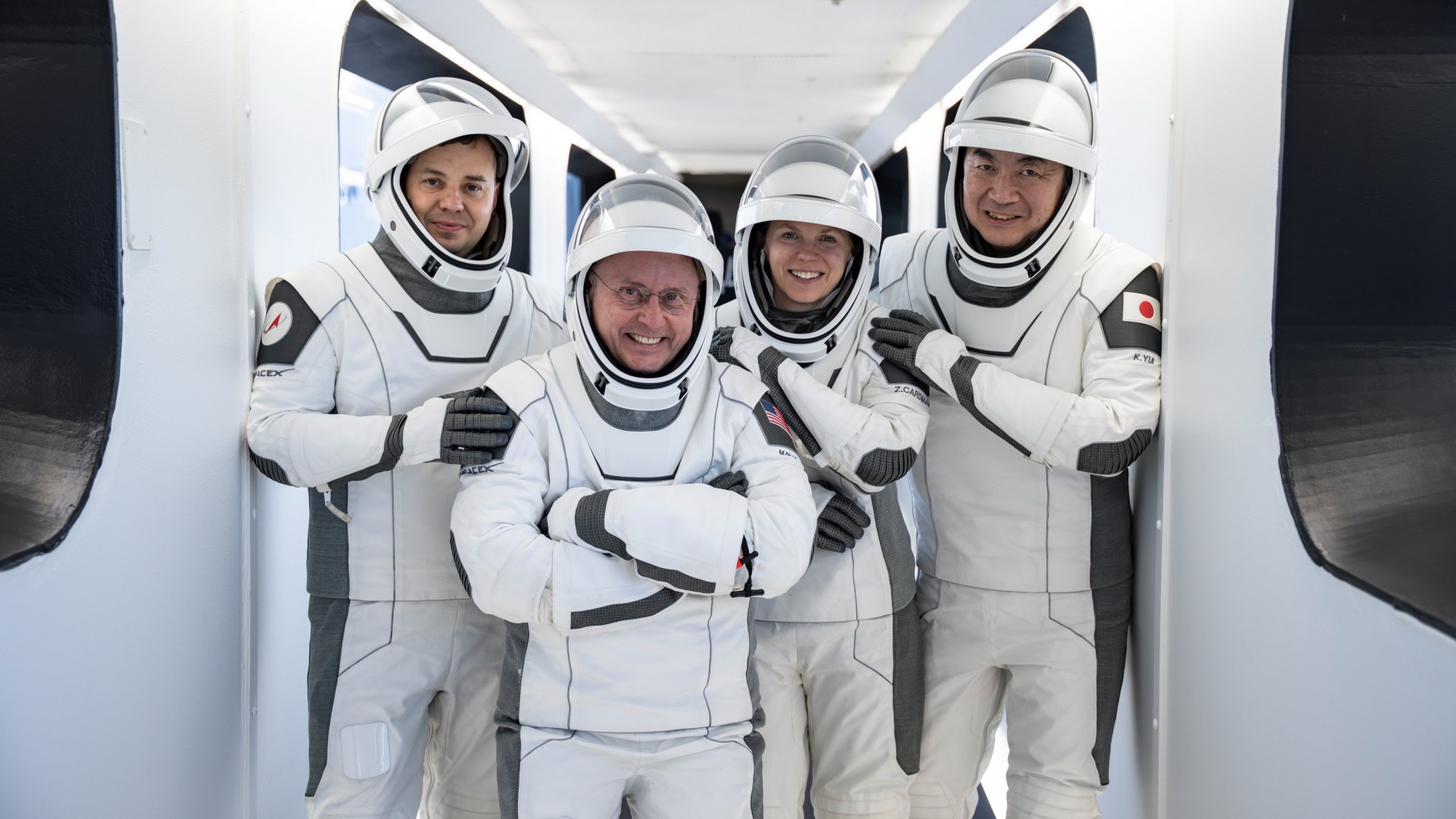
NASA has announced the date of the world’s first medical evacuation from the ISS. The Dragon spacecraft with the Crew-11 mission team will undock from the station on January 14.
Crew-11 mission members. Source: NASA
The medical issue aboard the ISS became known on January 7, when NASA canceled a spacewalk scheduled for the following day. Astronauts Mike Fincke and Zena Cardman were supposed to participate in the spacewalk.
Shortly thereafter, the aerospace administration announced that it would bring the Crew-11 mission team home early in order to better diagnose and treat this medical issue. NASA did not disclose which astronaut had fallen ill or what the problem was, citing privacy concerns. According to unofficial reports, it is 58-year-old Mike Fincke. This is his fourth flight into space and his third long-term assignment to the ISS.
At a subsequent press conference, NASA Chief Medical Officer James Polk declined to name the astronaut or disclose his diagnosis. However, he provided the following general description of the situation:
“This is not an operational issue. This was not an injury that occurred in the pursuit of operations,” Polk said. “It’s mostly having a medical issue in the difficult areas of microgravity, and with the suite of hardware that we have at our avail to complete a diagnosis.”
According to NASA’s plan, Crew-11 will leave the ISS on the evening of January 14. The next day, the spacecraft will splash down in the Pacific Ocean, where it will be picked up by the Shannon ship. Overloads during re-entry into the atmosphere can create additional risks for the astronaut — but NASA has well-developed scenarios for this case and instructions for ground crews.
After the departure of Crew-11, for the first time in many years, the ISS crew will be reduced to just three people. NASA astronaut Christopher Williams and Roscosmos cosmonauts Sergei Kud-Sverchkov and Sergei Mikayev will remain on board the station.
The launch of the next manned spacecraft to the ISS (Crew-12 mission) is currently scheduled for February 15. However, NASA is considering the possibility of postponing the date if possible.
If you find brushing your teeth an annoying chore but still want sparkling clean pearly whites, Japanese inventors might have the perfect solution.
The 'g.eN' is the world's first fully automatic robotic toothbrush that can scrub your teeth without any assistance.
While it might sound like something out of Wallace & Gromit, this very real quirky science project is now available for sale.
And its creators say that the robotic device is even better for you than a manual toothbrush.
Developed using technology from the Waseda University Robotics Laboratory, the g.eN consists of 16 tiny brushes driven by a small but powerful motor.
Simply bite down on the mouthpiece and the machine automatically drives the brushes up, down, left, and right to brush your teeth completely in about a minute.
Its creators say that the device is the first oral care robot that can 'make tooth brushing less stressful and more reliable.'
Japanese inventors have released an automatic toothbrushing machine that can scrub your teeth in less than a minute
The machine uses eight pairs of brushes to clean your teeth from all sides simultaneously for the most even results
Genics, the company behind the strange device, says that its goal is to combine over a decade of robotics research with dentistry.
Their robotic toothbrush claims to clean your teeth faster and more thoroughly than a conventional brush by cleaning both sides at once.
Pairs of brushes simultaneously scrub the inner and outer faces of the tooth in a process that, according to Genics, reduces uneven brushing.
A study published in 2022 by the Japan Society of Healthcare Dentistry found that the g.eN achieved an average plaque retention of 22.4 per cent.
This meets industry-approved standards for 'good oral hygiene', and shows that the robot performs as well, if not better than, a standard brush.
Genics says that this is the first time a device has been shown to 'brush automatically and quickly without moving your hands'.
The latest version of g.eN is significantly lighter than previous versions, weighing just 220 grams, and features USB-C charging.
The device also includes four distinct brushing modes: Easy, Careful, Special Care, and Children.
The 'g.eN' is the world's first fully automatic robotic toothbrush that can scrub your teeth without any assistance.
On social media, some tech fans welcomed the innovation, with one writing: 'I'm tired of brushing my teeth so I'll buy some right away.'
'It might be good for busy mornings,' another commenter mused.
While another added: 'I don't think I can use it every day, but I'd like to use it occasionally when I'm feeling lazy.'
But not every social media user was convinced that the g.eN would be practical, and many were worried about the difficulty of replacing the brush heads.
One sceptical commenter wrote: 'It seems like cleaning this brush is harder than cleaning your teeth.'
While another complained that they would 'definitely vomit' if they tried to use the bulky brushing machine.
Although Genics is now making the g.eN available to the public, the main audience for the toothbrushing machine isn't just people who are short on time.
The company believes that its devices will be particularly useful for people with disabilities and nurses working in social care.
The company behind the brush says that its invention achieves results that are as good or better than a standard brush in a fraction of the time
The company believes that its devices will be particularly useful for people with disabilities and nurses working in social care, as well as people who are just short on time in the mornings
Genics claims that more than 200 'limited edition nursing care' brushing machines are already in daily use in care settings across Japan.
The company adds: 'The belief that "our robotics technology can be of greater use to society" is what is driving our technological development forward.'
Top dentists reveal how trendy fads can wreak havoc with people's teeth.
Despite the likes of Gisele Bündchen and the Hemsley sisters swearing by starting every morning with a refreshing glass of hot water and lemon, Dr Ben Atkins, a dentist based in Manchester and Trustee of the Oral Health Foundation, warns the drink effectively dissolves teeth and could even make them darker.
While critics link fluoride to everything from dementia to diabetes, experts argue numerous studies show the mineral does not harm people's health, with free-from varieties missing out on 'the main protective ingredient'.
Dr Atkins also describes the ancient Ayurvedic practice of oil pulling, which involves swishing coconut oil around the mouth, as a 'waste of time', with Dr Rhona Eskander, Best Young Dentist Winner 2016, adding it will not give you a Hollywood smile.
In terms of brushing your teeth with charcoal or apple cider vinegar, both Dr Atkins and Dr Eskander add the 'natural remedies' could do more harm than good as while their acidic, abrasive consistencies may remove surface stains, they could also permanently damage enamel.
Botched haircuts and dodgy fades might become a thing of the past, as a startup unveils its artificial intelligence (AI) powered clippers.
Unveiled at the Consumer Electronics Show (CES) inLas Vegas, GLYDE claims to be the 'world's first smart hair clipper'.
The bizarre device uses an AI 'cutting coach' and 'auto fade' technology to let even the most inexperienced barber give a trim like a pro.
As long as you are willing to trust your hair to an algorithm, GLYDE says it can give a full cut in under 10 minutes.
To get a new haircut, users first select their chosen style from the app on their phone.
Then, someone can simply run the clippers over their head as the device automatically adjusts the depth of the cut.
The blades move automatically so that complex cuts like a fade can be done in a single pass, without any experience or skill.
GLYDE is so confident in its technology that it boasts the clippers can deliver a cut with 'zero mistakes', but would you trust AI to cut your hair?
A startup has unveiled the 'world's first smart clipper', named GLYDE, which uses an AI 'cutting coach' and 'auto fade' technology to let even the most inexperienced barber give a trim like a pro
According to GLYDE, the clipper features built-in sensors that track your motion and the angle of the blade.
Onboard motors compare this motion to the design for the haircut, and automatically shift the blades.
In theory, this means that your hair should end up at the exact right length, no matter how the clipper is held.
To prevent wonky cuts, the user first needs to put on a mask-like headband.
This 'fade band' provides a constant reference point for the clippers so that they know exactly where the fade should begin.
For nervous first-time barbers, the GLYDE also includes several features that should, in theory, make it impossible to mess up.
If you suddenly change the speed or angle of the cut, the blades will retract and prevent any further cutting.
Likewise, if GLYDE detects that you are holding it at the wrong angle or starting the cut from the wrong position, the blades won't deploy in the first place.
The AI-powered clipper automatically adjusts the blades as you cut, to deliver a smooth and consistent haircut without any skill or experience
Users simply select a haircut from the app and follow the on-screen instructions, while the clipper automatically moves the blades to perform the cut
To make things even easier, the clippers themselves feature a screen that shows information like cutting zone and blade depth.
They also include a small spirit-level display, so that you can be sure to hold them straight and level.
Currently, users can only choose their trim from a library of pre-made styles, which GLYDE says have been 'tested across different head shapes'.
However, in the future, the company plans to allow users to upload their own templates and take inspiration from other users' results.
If you are particularly brave, GLYDE even says that it may add options for 'beard and body trimming' in a future update.
As reported by The Verge, the company also plans to add voice controls for the AI.
Eventually, the onboard AI will be able to recommend specific hairstyles to the users and send them straight to the clippers.
The company has not yet provided an official release date, but the GLYDE clippers are expected to start shipping in the summer this year and cost around £110 ($150).
Currently, users can only choose from a set of pre-made haircut options on the GLYDE app. However, in the future, the company will add options to upload your own templates
GLYDE have not yet responded to the Daily Mail's request for additional information.
The clippers will be available directly from GLYDE's website or from selected online retailers.
However, AI-powered clippers weren't the only strange gadgets revealed at CES this year.
Beauty company L'Oreal unveiled a strange, flexible LED face mask that combats visible signs of ageing through 'targeted red light and near-infrared light'.
Meanwhile, the health startup Vivoo launched its hormone-sensing menstrual pads that can detect signs of fertility issues or conditions like polycystic ovary syndrome.
Kai-Fu Lee, the author of AI Superpowers: China, Silicon Valley, and the New World Order, told Dailymail.com the world of employments was facing a crisis 'akin to that faced by farmers during the industrial revolution.'
Half of current jobs will be taken over by AI within 15 years, one of China's leading AI experts has warned.
Kai-Fu Lee, the author of bestselling book AI Superpowers: China, Silicon Valley, and the New World Order, told Dailymail.com the world of employments was facing a crisis 'akin to that faced by farmers during the industrial revolution.'
'People aren't really fully aware of the effect AI will have on their jobs,' he said.
Lee, who is a VC in China and once headed up Google in the region, has over 30 years of experience in AI.
He believes it is imperative to 'warn people there is displacement coming, and to tell them how they can start retraining.'
Luckily, he said all is not lost for humanity.
'AI is powerful and adaptable, but it can't do everything that humans do.'
Lee believe AI cannot create, conceptualize, or do complex strategic planning, or undertake complex work that requires precise hand-eye coordination.
He also says it is poor at dealing with unknown and unstructured spaces.
Crucially, he says AI cannot interact with humans 'exactly like humans', with empathy, human-human connection, and compassion.
Black-Eyed kids, phantom calls and transplant memory: What’s going on?
Strange cases are surfacing worldwide, reports of black-eyed children, mysterious phone calls from the dead, and transplant patients inheriting memories. Skeptics dismiss them as urban legends or coincidences, yet the stories refuse to disappear.
So what’s really going on?
Case 1 - Two children tap on a car window at night, asking for a ride home. Their eyes are solid black, no whites, no color. Witnesses say they cannot enter unless invited. Those who let them in rarely talk about what happened afterward.
But those who encounter the Black-Eyed Children (BEK) describe pale, emotionless kids between 6 and 16 and report sudden terror, panic, and an overwhelming sense that something supernatural is at play.
So what are they? Paranormal entities? Interdimensional beings? Or simply a myth.
Meanwhile, researchers point to similar unexplained events that blur the line between science and the paranormal.
For example: Other strange cases that make no logical sense.
Case 2 — Phantom Phone Calls: A dead man’s mobile phone reportedly dialed rescuers 35 times over 12 hours, guiding them to his body. The battery should have been dead. The phone was never recovered.
Case 3 — Transplant Memory Transfer: A heart transplant patient developed the donor’s cravings, handwriting, and even married the donor’s widow. Thirteen years later, he died the same way, in the same place, as the donor before him.
Three cases and No scientific explanation that survives scrutiny. From the Black-Eyed Children phenomenon to phantom calls and organ memory, these cases raise a larger question: Are we looking at mere coincidence and internet fueled folklore, or at consciousness based models not yet recognized by science or could this be evidence of a genuine paranormal phenomenon involving unknown intelligences?
A group of Australian scientists have revealed how we may be able to learn to speak with aliens, and the answer is found right here on Earth.
If we do make contact with extraterrestrial life, it will likely require sending messages across vast distances of interstellar space.
The question for astronomers looking out for distant civilisations is how this communication would even be possible if we don't share a language.
Now, scientists say we might be able to develop a 'universal language' with an unlikely inspiration: The humble honeybee.
With six legs, five eyes, and a radically different social structure, scientists say that bees are among the closest things we have to aliens here on Earth.
Although humans and bees have wildly different brains, we have both evolved complex methods of communication and cooperation.
More importantly, new research shows that bees also have another very important thing in common with humans, which is the ability to do maths.
Scientists say we might learn how to communicate with aliens by studying the concepts that we share with honey bees
One of the big problems for communicating with aliens is the enormous distances involved.
Given that the nearest star to the sun is 4.4 light-years away, it would take an absolute minimum of 10 years to send a message and get a reply.
This makes it impractical to try to learn an alien's language from scratch, like in the sci-fi movie Arrival.
Instead, scientists want to develop a universal language that can be understood by any species, regardless of how they communicate.
To find a solution to this puzzle, the researchers asked how we might communicate with one of the most alien-like species on Earth.
Co-author Dr Adrian Dyer, of Monash University, told the Daily Mail: 'Because bees and humans are separated by about 600 million years in evolutionary time, we developed very different physiology, brain size, culture.'
However, despite these enormous differences, both humans and bees seem to have a similar basic understanding of mathematics.
Scientists have found that bees can learn to add and subtract in specialised tests, giving credence to the idea that mathematics might be a universal language
The researchers set up experiments in which bees could participate in maths tests to receive a reward of sugar water.
Incredibly, bees even demonstrated an ability to link abstract symbols with numbers, in a very simple version of how humans learn the Arabic numerals.
The fact that such a different organism shares mathematical concepts with humans lends evidence to the theory that mathematics could be a universal language.
The idea that mathematics could be the basis of alien communication is not a new theory.
In fact, the covers of the Golden Records, which accompanied the Voyager 1 and Voyager 2 space probes launched into deep space in 1977, were carved with mathematical and physical quantities.
Likewise, when researchers broadcast the Arecibo radio message into space in 1974, it contained 1,679 zeros and ones, ordered to communicate the numbers 1 to ten and the atomic numbers of the elements that make up DNA.
However, scientists weren't sure whether aliens would have similar enough mathematical concepts to understand these messages.
If bees can understand maths, then aliens might share those same universal concepts. That means attempts to communicate with mathematics, such as the cover of the golden disks on Voyager One and Two, could be successful
In their new paper, the researchers argue that their evidence from bees suggests that maths really is universal.
Dr Dyer says: 'When we tested bees on mathematical type problems, and they could build an understanding to solve the questions we posed, it was very interesting, and convincing that an alien species could share similar capabilities.'
'Now we know maths can be solved by bees, we have a solid basis to think about how to try to communicate with alien intelligence.'
As to what that language might look like, Dr Dyer says it may be very similar to the mathematics most of us use every day.
'Mathematics, which was first developed by philosophers to communicate complex problems more efficiently, is already a language we humans use every day.
'At a simple level, binary coded information would be a start, then, like we humans learn language through many "baby steps", we learn with another species to build a commonly understood language framework.'
The Drake Equation is a seven-variable way of finding the chance of active civilizations existing beyond Earth.
It takes into account factors like the rate of star formation, the amount of stars that could form planetary systems, the number potentially habitable planets in those systems.
The equation includes recent data from Nasa's Kepler satellite on the number of exoplanets that could harbor life.
Researchers also adapted the equation from being about the number of civilizations that exist now, to being about the probability of civilization being the only one that has ever existed.
Researchers found the odds of an advanced civilization developing need to be less than one in 10 billion trillion for humans to be the only intelligent life in the universe.
Unless the odds of advanced life evolving on a habitable planet are astonishingly low, then humankind is not the only advanced civilization to have lived.
But Kepler data places those odds much higher, which means technologically advanced aliens are likely to have existed at some point.
A 10-second signal from one of the most distant points in the universe has been detected by humanity, and scientists are still trying to understand its origins.
Two Earth satellites have confirmed that the mysterious signal came from a point 13billion light-years away from Earth, likely coming from an exploding supernova when the universe was only 730million years old.
The farther away something is in space, the longer its light (or signal) takes to reach us, so when humans see a very distant explosion or star, we're actually looking at what happened there billions of years ago, like a time machine showing us the past.
In this case, scientists believe this high-energy gamma-ray burst, which they've named GRB 250314A, came from the earliest supernova ever recorded from the dawn of time.
Gamma rays are invisible and ultra-powerful forms of light. They are the most energetic source of radiation known in the universe, which is produced by massive stellar explosions, appearing as super-bright flashes from our planet.
Scientists are still unsure why this ancient supernova from the early universe looks almost exactly like the exploding stars seen in our nearby modern universe today.
If this explosion is the true source of the signal, researchers from NASA and the European Space Agency (ESA) expect early stars to be bigger, hotter, and produce much more volatile explosions than the mysterious signal suggested.
Andrew Levan, lead author of a new study on the signal from Radboud University in the Netherlands, said: 'There are only a handful of gamma-ray bursts in the last 50 years that have been detected in the first billion years of the universe. This particular event is very rare and very exciting.'
A gamma-ray burst named GRB 250314A (Pictured) is believed to the be the source of a mysterious signal received from 13billion light-years away
An artist's impression of the supernova GRB 250314A as it was exploding during the first billion years after the Big Bang
The signal was first discovered on March 14, 2025, when the Space Variable Objects Monitor (SVOM) satellite picked it up as a sudden flash of high-energy light from deep space.
However, two studies on the possible source of this distant signal have just been released.
The probe is a joint project between scientists in France and China designed to spot these kinds of bursts throughout the cosmos.
The signal scientists recorded was a short, powerful burst of gamma rays, which are invisible waves of energy stronger than X-rays and capable of passing straight through the human body, damaging cells, DNA, and tissues.
Since this burst likely came from an exploding star 13billion light-years from Earth, however, the gamma rays that reached Earth were far too weak to pose any danger to people.
This burst lasted only about 10 seconds because gamma-ray bursts are like quick fireworks in space, releasing a huge amount of energy in a very short time before fading away.
Unlike random noise or background static in space, which is constant and weak, these gamma-ray bursts stand out as super-bright, focused beams with a unique pattern that human satellites have been built to recognize.
NASA's James Webb Space Telescope (JWST) confirmed the discovery about three and a half months later, during the summer of 2025, by taking detailed pictures and measurements of the fading glow of the explosion, which could still be seen in space.
The 10-second signal was recorded in 2025 by the Space Variable Objects Monitor (SVOM) satellite, operated by France and China
'Only Webb could directly show that this light is from a supernova — a collapsing massive star,' Professor Levan added in a statement from NASA.
Other sources of mysterious space noise like this might include solar flares or cosmic rays, but gamma-ray bursts are much rarer and come from massive events like star explosions that scientists are able to track down billions of years after they take place.
Levan added that JWST is so advanced that scientists believe it'll be able to find more signals from when the universe was only five percent of its current age, which is roughly 14billion years old now.
To this point, scientists know very little about the first billion years of the universe, what was happening in space during this time, or how stars behaved and died throughout the cosmos.
Until now, it was thought that following the Big Bang, the massive explosion believed to have kickstarted everything in existence, early stars lived much shorter lives and contained fewer elements than stars like our sun do today.
However, in December 2025, the new studies published in the journal Astronomy & Astrophysics analyzed detailed observations from the Webb Telescope and found that this supernova from 730 million years after the Big Bang had the same brightness and radiation signature as exploding stars billions of years later.
Nial Tanvir, a professor at the University of Leicester in the UK, added: 'Webb showed that this supernova looks exactly like modern supernovae.'
The raid that ended former Venezuelan president Nicolás Maduro’s rule has been praised as a tightly coordinated display of modern military power: a predawn strike synchronized with electronic warfare, communications suddenly failing, and a head of state removed alive and flown to the United States to face charges.
Now, in the fog that follows any high-profile covert-style operation, a new claim has begun spreading across social media and tabloid headlines, that U.S. forces allegedly used a “sonic weapon” so powerful it made Venezuelan troops bleed from the nose and vomit blood.
In an era when anyone can post anything on social media—and misinformation often travels faster than facts—claims like these would normally be easy to dismiss. However, this one gained unusual visibility after White House Press Secretary Karoline Leavitt shared the purported eyewitness interview on X, urging followers to “stop what you are doing and read this.”
Though it came from her official government account, Leavitt’s repost is not equivalent to a formal statement from the White House or the Department of Defense (DoD), and it does not verify the accuracy of the account the witness provided. Nevertheless, when the White House’s public-facing spokesperson amplifies a story like this, it provides a veneer of legitimacy even as key details remain unverified.
The claim also taps into a real, fast-evolving corner of military technology—directed energy, electronic warfare, and “less-lethal” systems—where the line between science fact, classified capability, and science fiction can easily blur.
An “intense sound wave” that dropped soldiers
The story apparently originates from a Spanish audio recording shared on WhatsApp, from a purported eyewitness and Venezuelan security guard loyal to Maduro.
“We were on guard, but suddenly all our radar systems shut down without any explanation,” an English translation of the reported eyewitness reads. “The next thing we saw were drones, a lot of drones, flying over our positions. We didn’t know how to react.”
The alleged security guard goes on to describe U.S. forces deploying some type of sonic weapon that left the defenders suddenly incapacitated.
“At one point, they launched something—I don’t know how to describe it… it was like a very intense sound wave,” the witness says. “Suddenly, I felt like my head was exploding from the inside. We all started bleeding from the nose. Some were vomiting blood. We fell to the ground, unable to move.”
Presently, the U.S. has not publicly confirmed the use of any acoustic or directed-energy weapon in the operation. Moreover, the claim seems to trace back to the same viral WhatsApp message rather than independently corroborated reporting.
Ultimately, while that doesn’t mean the claims are automatically false, it does mean the evidence supporting them is tenuous, at best.
Ultimately, while that doesn’t mean the claims are automatically false, it does mean the evidence supporting them is tenuous, at best.
What we know about the raid’s technology—without invoking a mystery weapon
Plenty is known about the U.S. operation to capture Maduro, including scale and the role of non-mysterious, well-documented capabilities.
In other words, there’s already a strong, technology-driven explanation for how a relatively small force could create the perception of overwhelming power—without needing top-secret sonic weapons. Electronic warfare can suddenly leave defenders feeling isolated and deaf, with radios failing, radar degraded, and coordination collapsing in minutes.
What is a “sonic weapon,” exactly?
The phrase “sonic weapon” is a catch-all that can refer to everything from a high-powered directional loudspeaker used for crowd control (like LRAD systems) to speculative concepts involving infrasound or ultrasound.
Documented acoustic technologies can indeed cause harm in a variety of ways. Human rights and medical discussions involving acoustic weapons and high-intensity sound note risks that include pain, disorientation, nausea, tinnitus, and potentially long-term hearing damage at sufficiently high sound pressure levels. LRAD-type systems, for example, are sometimes described as “sound cannons” and have drawn legal and public scrutiny when used in civilian contexts.
However, the symptoms at the center of the Maduro-raid rumor—nosebleeds and “vomiting blood”—are where the physics and physiology begin throwing up red flags.
The plausibility gap: sound that injures vs. sound that makes you bleed
High-intensity sound can not only be debilitating, but at extreme levels, it can damage the ear. Biomedical literature also recognizes the presence of secondary “extra-auditory” effects, or responses within the body that aren’t limited to hearing.
Noise can act as a nonspecific physiological stressor, with research describing downstream impacts on endocrine, cardiovascular, and neurologic function, especially with prolonged or intense exposure. And at very high sound pressure levels—particularly in the low-frequency and infrasonic ranges—sound can be felt as vibration, not just heard.
The UK’s Advisory Group on Non-ionising Radiation noted that high levels of low-frequency noise and infrasound can produce vestibular excitation, though it emphasized that the levels required are well above typical hearing thresholds.
Separate reviews of vestibular research also point to evidence that sufficiently intense noise exposure can affect peripheral and central vestibular structures—one reason loud environments can be associated with dizziness, imbalance, and other inner-ear symptoms.
There’s also published evidence—though often messy and context-dependent—linking intense acoustic exposure to changes in sensation and bodily function. Occupational and experimental reports have described shifts in vibrotactile sensitivity and reflex-like reactions; symptoms involving balance and nausea; and, in some settings, physiologic changes consistent with stress responses (including cardiovascular measures).
A lot of the strongest, best-characterized non-auditory bioeffects in modern medicine come from ultrasound—but typically in coupled or focused contexts (through tissue or water/gel interfaces), where energy delivery is controlled and measurable. Reviews of ultrasound bioeffects indeed describe mechanical and thermal mechanisms and note that at sufficiently high intensities, ultrasound can affect sensitive organs and tissues.
So the idea of an “organ-affecting” sonic weapon is theoretically possible. However, producing the kind of internal bleeding described by the alleged eyewitness—at a distance, and outdoors—would require an extraordinary amount of energy, because sound dissipates rapidly with distance and is strongly shaped by barriers, wind, and terrain.
This is one reason why credible open literature has long treated sensational claims about “infrasound weapons” with skepticism, emphasizing how quickly the required power levels become impractical outside very specific conditions.
If the U.S. had indeed used a secret “sonic weapon” generating pressures sufficient to cause widespread bleeding and blood vomiting, you would expect a broader signature of blast-like trauma—severe ear injury, disorientation at minimum, and potential lung injury in extreme cases—along with unmistakable medical documentation.
Publicly, at least, we do not have that documentation, and the viral account alone doesn’t provide verifiable clinical details in support of this idea.
A more mundane possibility for the “sound wave” described by the purported eyewitness could be explosions, flashbangs, concussion grenades, or even the sensory overload of a coordinated strike in which communications fail, and the environment becomes violently chaotic.
Multiple reports describe the raid unfolding amid intense combat, with significant Venezuelan casualties—conditions that could easily produce severe traumatic injuries without invoking any novel weapon.
Directed-Energy Weapons: could this be something other than sound?
Some of the speculation around the viral claim argues that, instead of a “sonic weapon,” the U.S. used a secret “directed-energy weapon” (DEW). This is a broad umbrella term that can include everything from lasers to high-power microwaves to millimeter-wave systems.
Directed-energy weapons are indeed a major area of U.S. defense research and development right now. However, the overwhelming focus isn’t on weapons meant to target people. Rather, it is on countering hardware—shooting down drones, disabling sensors, degrading communications, or damaging equipment.
The U.S. has openly acknowledged the development of non-lethal directed-energy weapons, including “Active Denial System” capabilities. Also described as a “heat ray,” this technology uses millimeter waves to rapidly heat the skin’s surface, producing an intolerable burning sensation intended to drive people away.
“Active Denial Technology systems produce reversible effects at distances up to and beyond small arms range, providing U.S. forces with additional decision time and space to validate that a perceived hostile intent/act is, in fact, hostile,” a fact sheet published by the U.S. Joint Intermediate Force Capabilities Office (JIFCO) reads.
Significantly, ADS doesn’t match the viral rumor’s description. It’s built to push people back and clear an area—not to quietly drop troops in place or produce bleeding. The symptoms at the center of the allegation—nosebleeds and vomiting blood—don’t align with the system’s capabilities, which are designed around temporary, surface-level pain compliance.
High-power microwave theories often surface in these discussions because of the long-running “Havana Syndrome” controversy—an unresolved, politically charged debate that has included claims of directed-energy weapons being covertly used against U.S. personnel overseas.
Early on, some researchers floated the possibility that at least some Havana Syndrome cases could involve directed, pulsed radio-frequency energy. In a 2020 report, the National Academies said it was plausible that some type of radio-frequency weapon was used on U.S. government employees and their families overseas based on the symptom pattern.
However, subsequent U.S. intelligence assessments have pushed back on the idea that a foreign adversary deployed a secret microwave or “energy” weapon. A 2023 intelligence community assessment concluded that there was no credible evidence that a foreign adversary had a weapon or device causing the incidents, and judged adversary involvement “very unlikely.”
An updated unclassified assessment released in January 2025 maintained that position—while noting that a small minority of components left open a limited number of cases in which a foreign actor might have played a role.
None of that, of course, proves that some ultra-secret directed-energy capability couldn’t exist behind closed doors. Militaries routinely classify emerging systems, and history is full of programs that only became public many years later.
However, as of now, there’s no hard, independently verifiable evidence that a deployable DEW can produce the specific, dramatic injury patterns described in these stories under real-world conditions. Without this evidence, the claims run ahead of the publicly demonstrated technology and what the basic physics of projecting energy through open environments suggests is feasible.
Why is this Sonic Weapon rumor spreading now?
The post-raid information environment has been messy. Fact-checkers and outlets have warned about misleading or AI-generated imagery circulating after Maduro’s capture—an indicator of how quickly sensational content can fill gaps when official details are limited.
It’s also worth noting that there’s a narrative incentive baked into the current claim of U.S. forces using a secret sonic weapon in their capture of Maduro.
“I’m sending a warning to anyone who thinks they can fight the United States. They have no idea what they’re capable of,” the alleged eye-witness said. “After what I saw, I never want to be on the other side of that again. They’re not to be messed with.”
This account portrays the U.S. as possessing a near-magical capability that can end fights without losses, while portraying Venezuelan forces as helpless against “technology.” That’s an emotionally powerful story—whether or not it’s true.
What would it take to confirm or debunk the “sonic weapon” claim?
In scientific and technical terms, the story remains an allegation until it is supported by independent, verifiable evidence. This includes medical records with consistent injury patterns, multiple witnesses with corroborating timelines, forensic evidence tied to a specific device, or credible on-the-record confirmation from officials with direct knowledge.
The best-supported “high-tech” aspect of the Maduro operation isn’t a mystery sonic weapon. It’s electronic warfare, surveillance, and large-scale multi-domain coordination, all of which are well-documented capabilities. This in itself is a remarkable demonstration of modern military power.
So, despite being amplified by the White House press secretary, the “secret sonic weapon” narrative, for now, sits in the uncomfortable space between plausible-sounding buzzwords and a lack of verifiable proof.
Tim McMillan is a retired law enforcement executive, investigative reporter and co-founder of The Debrief. His writing typically focuses on defense, national security, the Intelligence Community and topics related to psychology. You can follow Tim on Twitter:@LtTimMcMillan. Tim can be reached by email: tim@thedebrief.org or through encrypted email:LtTimMcMillan@protonmail.com
Do the Pentagon and U.S. Department of Defense have proof we aren't alone? Sherri Lynn Herrmann/EyeEm/Getty Images
"Keep watching the skies!" That's the last line uttered in "The Thing from Another World," a 1951 sci-fi classic. Released by RKO Radio Pictures, the movie is about an Unidentified Flying Object — or UFO — that turns out to be an alien spacecraft.
The Pentagon was not clear about whether the UFO program continues to exist within the vast universe of the US Defense establishment.
(AP: Charles Pharapak)
Flying saucers were constantly making headlines in those days. During the late 1940s and early 1950s, postwar America went through a surge of reported UFO sightings. In response, the U.S. Air Force created a couple of short-lived programs called "Project SIGN" and "Project GRUDGE" to look into the phenomenon. These were followed up by "Project Blue Book," a large-scale government study that lasted from 1952 to 1969.
Ordered into existence by Major General Charles P. Cabell (a former director of intelligence at the Air Force), Project Blue Book painstakingly gathered 12,618 reports about UFOs. After it was determined that the overwhelming majority of these had natural explanations — and there wasn't enough data to evaluate the others properly — support for the effort dwindled.
Officially, Project Blue Book was terminated in December 1969. But did the U.S. government's interest in aerial aberrations die with it? Evidently not. Because we learned in mid-December 2017 that the Pentagon launched yet another UFO research program in the late 2000s.
The story was broken on Saturday, Dec. 14, 2017 by near-simultaneous reports that appeared in Politico magazine and The New York Times. According to unclassified documents obtained by the press, a total of almost $22 million was quietly spent over a four-year period on a project dubbed The Advanced Aviation Threat Identification Program (AATIP).
Who was the major driving force behind its creation? That would be the now-retired Senator Harry Reid, a Democrat from Nevada. One of Reid's repeat campaign contributors was businessman Bob Bigelow, a fellow Nevadan who owns the Budget Suites of America hotel chain — as well as a startup called Bigelow Aerospace, which develops space station modules. He's also a huge UFO enthusiast. In a "60 Minutes" interview in May 2016, Bigelow said that he believes extraterrestrial visitors have maintained a "presence" on planet Earth.
Reid himself has a fascination with cosmic mysteries; according to one of his former spokeswomen, this fact is obvious to anyone who's ever talked to the retired senator "for [over] 60 seconds."
At some point in 2007, Bigelow was reportedly visited by a Defense Intelligence Agency official who expressed an interest in his UFO research. As an anonymous ex-congressional staffer told Politico, there was some concern at the time that the Chinese or Russians might be developing experimental new aircraft that could conceivably pose a threat to America's national security.
Bigelow later told Reid about the visit, prompting the senator to contact the DIA. When Reid learned the agency was interested in setting up a new, government-funded UFO program, he decided to lend a hand. To get the project started, Reid approached the late senators Daniel Inouye, a Democrat from Hawaii, and Ted Stevens, a Republican from Alaska. It was an easy sell; Stevens was particularly enthusiastic about the idea because he claimed to have once been tailed by some unrecognizable aircraft during his service as an Air Force pilot in World War II.
Using the Pentagon's classified programs budget, Reid, Inouye and Stevens secretly set some money aside for the upstart AATIP. The bulk of the cash went to Bigelow Aerospace, which used it to finance research and hire subcontractors on the government's behalf. With the company's guidance, a few buildings in Las Vegas were converted into storage facilities for objects with alleged ties to UFO-related incidents.
This infrared footage from the Mexican Air Force purportedly shows a close encounter with UFOs.
(Reuters)
The job of heading AATIP fell to one Luiz Elizondo, an intelligence officer with the Department of Defense. Although many aspects of the program remain classified, we do know that its staffers and contractors put together an as-yet unreleased 490-page report chronicling several decades' worth of UFO sightings in the United States and elsewhere. What's more, the initiative rounded up "video and audio recordings" from supposed encounters between human onlookers and mysterious airborne objects.
AATIP started receiving taxpayer funds late in 2008. The following year, Senator Reid attempted to upgrade the program's level of security, but his efforts failed. Then, in 2012, the Pentagon cut off AATIP's cash supply altogether. According to Pentagon spokeswoman Dana White, "It was determined that there were other, higher priority issues that merited funding and it was in the best interest of the [Department of Defense] to make a change."
Yet some sources claim that the Pentagon is still quietly investigating new UFO reports made by those in the armed forces. If this is true, then AATIP may continue to exist in some form, despite its current lack of financial support.
For his part, Elizondo felt the initiative wasn't getting enough respect within the DOD. After 22 years of service, he resigned from the Pentagon in October 2017. Before he left, however, Elizondo persuaded his colleagues to release three formerly secret videos to the public. These were raw footage taken by cockpit cameras in U.S. fighter jets and appear to show strange objects traveling through the atmosphere at high rates of speed.
To Elizondo, the evidence suggests that, in his own words, "we may not be alone, whatever that means."
Meanwhile, a number of scientists have given more skeptical assessments. Astrophysicist Johnathan McDowell says the object in one of these newly released videos is probably some sort of reflection. Despite Elizondo's cryptic statements, Sara Seager of M.I.T. was quick to remind The New York Times that unidentified shapes in the sky aren't necessarily extraterrestrial vessels. And furthermore, astronomer Seth Shostak believes the decision to include Bigelow — someone with firm, pre-existing views on alien visitations — raises doubts about the program's objectivity.
Earlybirds along Australia's east coast were startled by a bright spiral moving across the sky in June, 2010.
(Craig Boyce: User submitted)
Are we alone in the universe or not? Humanity doesn't have nearly enough data to answer that question. All we can do right now is keep our minds sharp and our eyes skyward.
A north Queensland man said he and his son watched these two points of light hover in the night sky above Cardwell for 15 minutes.
(Audience submitted: Greg Smith)
This image shows an unidentified object above southern Tasmania in February, 2017.
(Supplied)
Not That's Interesting
Roswell, New Mexico is mainly associated with a UFO crash-landing that supposedly took place there in 1947. But did you know that this city was also the longtime home of legendary scientist Robert Hutchings Goddard, who had previously launched the world's first liquid-fueled rocket?
Meer van UFO'S of UAP'S, ASTRONOMIE, RUIMTEVAART, ARCHEOLOGIE, OUDHEIDKUNDE, SF-SNUFJES EN ANDERE ESOTERISCHE WETENSCHAPPEN - DE ALLERLAATSTE NIEUWTJES


 Hidden Geometry in Khufu’s Subterranean Chamber: What Was Its True Significance?


 Crew-11 mission members.
Source: NASA