Naar de inhoud

UFO'S of UAP'S, ASTRONOMIE, RUIMTEVAART, ARCHEOLOGIE, OUDHEIDKUNDE, SF-SNUFJES EN ANDERE ESOTERISCHE WETENSCHAPPEN - DE ALLERLAATSTE NIEUWTJES

UFO's of UAP'S in België en de rest van de wereld
akke.beakke.be
Ontdek de Fascinerende Wereld van UFO's en UAP's: Jouw Bron voor Onthullende Informatie! Ben jij ook gefascineerd door het onbekende? Wil je meer weten over UFO's en UAP's, niet alleen in België, maar over de hele wereld? Dan ben je op de juiste plek! België: Het Kloppend Hart van UFO-onderzoek In België is BUFON (Belgisch UFO-Netwerk) dé autoriteit op het gebied van UFO-onderzoek. Voor betrouwbare en objectieve informatie over deze intrigerende fenomenen, bezoek je zeker onze Facebook-pagina en deze blog. Maar dat is nog niet alles! Ontdek ook het Belgisch UFO-meldpunt en Caelestia, twee organisaties die diepgaand onderzoek verrichten, al zijn ze soms kritisch of sceptisch. Nederland: Een Schat aan Informatie Voor onze Nederlandse buren is er de schitterende website www.ufowijzer.nl, beheerd door Paul Harmans. Deze site biedt een schat aan informatie en artikelen die je niet wilt missen! Internationaal: MUFON - De Wereldwijde Autoriteit Neem ook een kijkje bij MUFON (Mutual UFO Network Inc.), een gerenommeerde Amerikaanse UFO-vereniging met afdelingen in de VS en wereldwijd. MUFON is toegewijd aan de wetenschappelijke en analytische studie van het UFO-fenomeen, en hun maandelijkse tijdschrift, The MUFON UFO-Journal, is een must-read voor elke UFO-enthousiasteling. Bezoek hun website op www.mufon.com voor meer informatie. Samenwerking en Toekomstvisie Sinds 1 februari 2020 is Pieter niet alleen ex-president van BUFON, maar ook de voormalige nationale directeur van MUFON in Vlaanderen en Nederland. Dit creëert een sterke samenwerking met de Franse MUFON Reseau MUFON/EUROP, wat ons in staat stelt om nog meer waardevolle inzichten te delen. Let op: Nepprofielen en Nieuwe Groeperingen Pas op voor een nieuwe groepering die zich ook BUFON noemt, maar geen enkele connectie heeft met onze gevestigde organisatie. Hoewel zij de naam geregistreerd hebben, kunnen ze het rijke verleden en de expertise van onze groep niet evenaren. We wensen hen veel succes, maar we blijven de autoriteit in UFO-onderzoek! Blijf Op De Hoogte! Wil jij de laatste nieuwtjes over UFO's, ruimtevaart, archeologie, en meer? Volg ons dan en duik samen met ons in de fascinerende wereld van het onbekende! Sluit je aan bij de gemeenschap van nieuwsgierige geesten die net als jij verlangen naar antwoorden en avonturen in de sterren! Heb je vragen of wil je meer weten? Aarzel dan niet om contact met ons op te nemen! Samen ontrafelen we het mysterie van de lucht en daarbuiten.

Archief

Earthquakes and mysterious light beams: Has the UK got its own Bermuda Triangle?

Earthquakes and mysterious light beams: Has the UK got its own Bermuda Triangle?

Hoe vind je dit bericht?
Geschreven door peter om 22:05 Stuur door

Schadelijke effecten van microplastics op bodemleven bevestigd door nieuw onderzoek

planting-strawberry-plants-in-the-field-organic-g-2025-10-16-08-56-40-utc-954x637_1.jpg

Schadelijke effecten van microplastics op bodemleven bevestigd door nieuw onderzoek

Lasse Arwert - Redacteur

Het gebruik van landbouwplastic kan een schadelijk effect hebben op het bodemleven doordat er microplastics achterblijven.

Er wordt steeds meer landbouwplastic gebruikt. Een goed voorbeeld daarvan is mulchfolie, waarmee de bodem wordt afgedekt om het gebruik van bestrijdingsmiddelen, water en meststoffen te verminderen. Inmiddels wordt er elk jaar wereldwijd genoeg mulchfolie gebruikt om heel Nederland tien keer te bedekken.

Een deel van deze plastics blijft in de bodem achter en valt dan uit elkaar in microplastics. Dit zijn deeltjes van tussen de 5 millimeter en een duizendste van een millimeter groot. Ecotoxicoloog Sam van Loon onderzocht wat de effecten van deze microplastics zijn op het bodemleven.

Methode

Voor het onderzoek voerde Van Loon experimenten uit in het laboratorium, waar hij springstaarten blootstelde aan microplastics in natuurlijke grond. Springstaarten zijn kleine zespotige insecten die in de bovenste lagen van de bodem leven. Ze voeden zich daar voornamelijk met rottend organisch materiaal en schimmels en spelen daarmee een grote rol bij de omzetting van natuurlijk materiaal.

Meerdere soorten springstaarten kregen korter of langer verschillende concentraties microplastics te verduren. Hierbij keek de onderzoeker naar de overleving en voortplanting van de dieren. Daarnaast deed hij tests met gesimuleerde ecosystemen, waarbij niet alleen springstaarten, maar ook regenwormen en planten werden blootgesteld aan microplastics.

Geen direct risico voor springstaarten, wel voor het brede bodemleven

Het onderzoek laat zien dat de microplastics niet direct giftig zijn voor sommige bodemdieren, zoals springstaarten, zelfs bij langdurige blootstelling aan hoge concentraties. De microplastics lijken echter wel schadelijk te zijn voor het bodemleven in de bredere zin.

Bij hogere concentraties zijn er effecten te zien op de zuurgraad, het waterhoudend vermogen en de dichtheid van de bodem. Van Loon en zijn medeonderzoekers zien veranderingen in de microbiële soortensamenstelling en activiteit. Ook lage concentraties hebben al schadelijke effecten op planten en er zijn verschuivingen in hoe het ecosysteem zich als geheel gedraagt.

De concentraties waarbij de onderzoekers de effecten van de microplastics op het bodemleven en de bodemeigenschappen vonden, worden momenteel al gemeten in landbouwgrond in Europa. Dit betekent dat er een risico is voor het bodemleven en daarmee voor de productiviteit van de grond. Dit risico wordt mogelijk nog beïnvloed doordat de bodem ook andere giftige stoffen kan bevatten, zoals bestrijdingsmiddelen en PFAS. In het onderzoek is namelijk vastgesteld dat de microplastics ook invloed kunnen hebben op de giftigheid van die stoffen.

Update 3 december: Wat is ‘erger?’

Dan is de volgende grote vraag: wat is er een groter probleem? Het mulchfolie wordt gebruikt bij het afdekken van de grond, waardoor minder bestrijdingsmiddelen, water en meststoffen nodig zijn. Wegen deze goede effecten dan op tegen de slechte effecten van microplastics in de bodem?

We legden dit voor aan hoofdonderzoeker Van Loon, die de vraag goed begrijpt. “De complexiteit van het vraagstuk is echter heel groot en kan helaas enkel beantwoord worden met een uitgebreid vervolgonderzoek, bijvoorbeeld in de vorm van een zogenaamde levenscyclusanalyse”, vertelt hij aan Scientias.nl. “Hiermee zouden dan alle voor en nadelen van het gebruik van pesticiden tegenover alle voor en nadelen van mulchfolie moeten worden gezet. Dit lag helaas buiten het bereik van mijn onderzoek. “

Hij benadrukt dan ook het belang van een vervolgonderzoek. “Het zou wel heel waardevol zijn om die vraag te beantwoorden en hopelijk wordt dit in de nabije toekomst ook mogelijk, naarmate we een steeds beter beeld krijgen van de effecten van het gebruik van mulchfolies.”

Alternatieven voor het gebruikte mulchfolie

Toch is er hoop. “Er zijn uiteraard alternatieven, het gebruik van mulch gebeurt volgens sommige bronnen immers al voor 2500 jaar. Toen gebruikte men bijvoorbeeld stenen, vulkanisch as of stro”, vervolgt Van Loon. “Het zou interessant kunnen zijn om de technieken van vroeger mee te nemen in zo’n levenscyclusanalyse, om te kijken hoe die opwegen tegen moderne alternatieven.”

Van Loon benadrukt ook dat dit onderzocht moet worden. Het gebruik van bijvoorbeeld stro klinkt een stuk duurzamer dan het gebruik van plastic mulchfolie, “maar stro zal tegenwoordig niet alleen duurder zijn dan een plastic mulchfolie en maar bijvoorbeeld ook minder lang te bewaren zijn.”

We schreven vaker over deze onderwerpen, lees bijvoorbeeld ook 

Of lees dit artikel: 

Bronmateriaal

{ https://scientias.nl/nieuws/natuur-klimaat/ }

Hoe vind je dit bericht?
Geschreven door peter om 21:29 Stuur door

Skeptic to Believer - The US is Ready for UAP and UFO Disclosure

Skeptic to Believer - The US is Ready for UAP and UFO Disclosure

{ https://www.youtube.com/ }

Hoe vind je dit bericht?
Geschreven door peter om 21:03 Stuur door

Roswell footage uploaded to National Archives shows crashed 'UFO debris and alien bodies'

A nearly 22-minute video titled 'The Roswell Incident' has been quietly uploaded to the National Archives, reigniting interest in the infamous 1947 crash.

The footage combines still images and motion-control camera shots sourced from the published Roswell Report, as well as various magazines and books about UFOs. 

It opens with a shot of the book 'The Roswell Report: Fact Versus Fiction in the New Mexico Desert' and ends with a stark black-and-white image that appears to show a crash site, with debris scattered across a massive crater in the ground.

The video has flooded the internet, with users claiming the crater bears a striking resemblance to eyewitness reports, suggesting it could be 'the first pictures of the 1947 UFO crash site.'

Major Jesse Marcel, who recovered debris from the crash, described the scene as 'a large area heavily scattered with metallic debris from a single impact point that scarred the earth.' 

Some viewers have also pointed to a dark formation on the right side of the image, claiming it resembles an alien body. 

UFO expert Mark Lee told the Daily Mail that the crater image was likely included to add intrigue. 

'In my opinion, it's either a hoax,' he said. 'Just because it's been added to the National Archives doesn't give it scientific validation. If it came out as a release from the military or Congress, I would take it a lot more seriously.'

Lee also noted that the 'alien' in the photo is nothing more than a case of pareidolia, a psychological response to seeing faces and other significant and everyday items in random stimuli.

A video titled 'The Roswell Incident' was uploaded to the National Archives. Social media users claim an image in the footage shows UFO debris (left) and an alien body (right)

A video titled 'The Roswell Incident' was uploaded to the National Archives. Social media users claim an image in the footage shows UFO debris (left) and an alien body (right)

The newly uploaded video appears to focus on 'The Roswell Report: Fact Versus Fiction in the New Mexico Desert,' a 1995 book that attributes the crashed 'UFO' debris to Project Mogul.

Project Mogul was a top-secret US military program from 1947 to 1949 that used high-altitude balloons equipped with microphones to detect sound waves from Soviet atomic bomb tests. 

A 1994 military investigation concluded that the debris found at the Roswell site was likely pieces of a high-altitude balloon from Project Mogul, not an extraterrestrial spacecraft. 

Despite this official explanation, the newly uploaded video has sparked debate online, with viewers offering widely differing interpretations.

'National Archives and Records Administration (NARA) has uploaded a video of the Roswell 1947 UAP Crash site,' one user shared.

Another user posted on X: 'Like noted UFO researcher Grant Cameron has stated plenty of times, sometimes the disclosure of the real deal is a purposefully placed needle in the haystack. Roswell: slow drip…drip, drip, drip.'

In addition to the debris spotted in the footage, one user shared: 'Grey alien in the official video from the Roswell crash site.'

However, some social media suggested the footage 'is B-roll for the Roswell Report, and the images being posted do not show the Roswell debris site, nor does it even claim it's the actual debris site.'

Major Jesse Marcel, who recovered debris from the crash, described the scene as 'a large area heavily scattered with metallic debris from a single impact point that scarred the earth.' He said the debris could not melt or heat up and could not be punctured

Major Jesse Marcel, who recovered debris from the crash, described the scene as 'a large area heavily scattered with metallic debris from a single impact point that scarred the earth.' He said the debris could not melt or heat up and could not be punctured

One user posted: 'It’s clearly B-roll for that Roswell presentation the government put together in 1996. Someone must have found this and uploaded it in the last couple of days.'

Others have suggested a dead alien can be seen in the image, pointing to what Marcle said following the Roswell incident.

'I later found out that the pilot of the aircraft was a Captain Henderson, who apparently saw far more than just the debris from the impact site... he may in fact have seen the remains of a crew,' the now deceased major said. 

In July 1947, a rancher reported pieces of debris scattered over his land.

Authorities were called to the scene and, after investigating the wreckage, determined the pieces were from a flying saucer.

The local paper's front page story reported that the Roswell Army field recovered a flying saucer on a New Mexico Ranch after metallic-looking, light but strong material was scattered across the land

The lal paper's front page story reported that the Roswell Army field recovered a flying saucer on a New Mexico Ranch after metallic-looking, light but strong material was scattered across the land

The local paper's front page story reported that the Roswell Army Field recovered a flying saucer on a New Mexico Ranch after metallic-looking, light but strong material was scattered across the land.

article image

'The intelligence office of the 509th Bombardment Group at Roswell Army Air Field announced at noon today that the field has come into the possession of a Flying Saucer,' Roswell Daily Record reported on July 8, 1947.

The statement was given by Marcel, who was the first on the scene and led the investigation, which he determined were pieces from an extraterrestrial vehicle. 

He also said that the material spread out from this point into a triangular-shaped area 200 to 300 feet wide at the end of the field, and 3/4 of a mile long.

Shortly after the 'UFO' discovery made headlines, the War Department in Washington released a statement claiming the debris was the remains of a weather balloon.

The US Air Force stated the weather balloon was part of Project Mogul's airborne system invented by Columbia University, New York University and the Woods Hole Oceanographic Institution.

It was designed to search the atmosphere for weak reverberations from nuclear-test blasts.

RELATED VIDEOS


{ https://www.dailymail.co.uk/sciencetech/index.html }

Hoe vind je dit bericht?
Geschreven door peter om 20:49 Stuur door

Mysterious fire erupts at Roswell site linked to 1947 UFO crash

Mysterious fire erupts at Roswell site linked to 1947 UFO crash

A major fire broke out late Thursday at the Roswell Air Center, just south of the legendary Hangar 84, a site long tied to the infamous 1947 UFO crash. 

Fire crews rushed to the scene after the blaze was reported around 7:55pm local time on East Earl Cummings Loop.

Authorities initially feared the fire could trigger a dangerous explosion due to hazardous materials and oxygen bottles stored nearby, prompting an expanded safety perimeter and rapid evacuation of nearby facilities.

Roswell firefighters worked quickly to contain the flames, declaring the fire under control by 9:45pm Thursday. What caused the fire is currently unknown.

At this time, no injuries have been reported, and officials have not confirmed the cause of the fire or whether any historically significant objects were affected.

The incident has already sparked speculation among UFO enthusiasts, who have long linked Hangar 84 to alien lore and the mysterious 1947 Roswell crash. 

As investigators comb the site for answers, the fire raises fresh questions about what secrets might still be hidden at the heart of this legendary location.

As news of the fire spread, the internet erupted with theories about the mysterious event.

A major fire broke out late Thursday at the Roswell Air Center near Hangar 84 that is linked to the 1947 UFO crash

A major fire broke out late Thursday at the Roswell Air Center near Hangar 84 that is linked to the 1947 UFO crash

On Reddit, one user posted: 'They are destroying the evidence.' Another shared: 'Chances are they were storing alien bodies in this hangar for over 80 years, but then when a documentary came out, they were like 'alright boys, they all know now. Time to light it up and skedaddle.''

One person shared on X: 'Well, isn't that super interesting and an oddly timed 'coincidence'.. that right as the public starts getting all curious about our past… weird fire breaks out for no reason right next to Hangar 84.'

Authorities have yet to share more updates about Thursday's fire.

The Roswell incident captured imaginations worldwide when the US Air Force issued a press release stating that it had recovered debris from a 'flying disc.'

In July 1947, a rancher reported pieces of debris scattered over his land.

Authorities were called to the scene and, after investigating the wreckage, determined the pieces were from a flying saucer.

The local paper's front page story reported that the Roswell Army Field recovered a flying saucer on a New Mexico Ranch after metallic-looking, light but strong material was scattered across the land.

Major Jesse Marcel, who recovered debris from the crash, described the scene as 'a large area heavily scattered with metallic debris from a single impact point that scarred the earth.'

Authorities do not know the cause of the fire, but are conducting an investigation

Authorities do not know the cause of the fire, but are conducting an investigation

Major Jesse Marcel, who recovered debris from the crash, described the scene as 'a large area heavily scattered with metallic debris from a single impact point that scarred the earth.' He said the debris could not melt or heat up and could not be punctured

Major Jesse Marcel, who recovered debris from the crash, described the scene as 'a large area heavily scattered with metallic debris from a single impact point that scarred the earth.' He said the debris could not melt or heat up and could not be punctured

The local paper's front page story reported that the Roswell Army field recovered a flying saucer on a New Mexico Ranch after metallic-looking, light but strong material was scattered across the land

The local paper's front page story reported that the Roswell Army field recovered a flying saucer on a New Mexico Ranch after metallic-looking, light but strong material was scattered across the land

'The intelligence office of the 509th Bombardment Group at Roswell Army Air Field announced at noon today that the field has come into the possession of a Flying Saucer,' read Marcel's statement in the Roswell Daily Record on July 8, 1947. 

He also said that the material spread out from this point into a triangular-shaped area 200 to 300 feet wide at the end of the field, and 3/4 of a mile long. 

But less than 24 hours later, military officials reversed course, announcing that the debris had only come from a crashed weather balloon, sparking America's fascination with UFOs and allegations of a government cover-up ever since. 

The US Air Force stated the weather balloon was part of Project Mogul's airborne system invented by Columbia University, New York University and the Woods Hole Oceanographic Institution.

It was designed to search the atmosphere for weak reverberations from nuclear-test blasts.

Project Mogul was a top-secret US military program from 1947 to 1949 that used high-altitude balloons equipped with microphones to detect sound waves from Soviet atomic bomb tests.

A 1994 military investigation concluded that the debris found at the Roswell site was likely pieces of a high-altitude balloon from Project Mogul, not an extraterrestrial spacecraft.

{ https://www.dailymail.co.uk/sciencetech/index.html }

Hoe vind je dit bericht?
Geschreven door peter om 20:29 Stuur door

Is life out there? NASA finds essential sugars on ancient asteroid Bennu more than 200 million miles away

Is life out there? NASA finds essential sugars on ancient asteroid Bennu more than 200 million miles away

How life began on Earth is one of the biggest remaining questions in science. 

Now, NASA has taken a major step towards answering this query. 

The US space agency has discovered essential sugars on Bennu – an ancient asteroid 200 million miles away from Earth. 

The five–carbon sugar ribose was found on the asteroid, as well as six–carbon glucose. 

This marks the first time this sugar has been found in an extraterrestrial sample.

The researchers, led by a team at Tohoku University in Japan, emphasise that these sugars are not evidence of aliens. 

Instead, they could provide key clues to the origins of life here on Earth. 

'Although these sugars are not evidence of life, their detection, along with of amino acids, nucleobases, and carboxylic acids in Bennu samples, show building blocks of biological molecules were widespread throughout the solar system,' the team explained. 

How life began on Earth is one of the biggest remaining questions in science. Now, NASA has taken a major step towards answering this query. The US space agency has discovered essential sugars on Bennu – an ancient asteroid 200 million miles away from Earth

How life began on Earth is one of the biggest remaining questions in science. Now, NASA has taken a major step towards answering this query. The US space agency has discovered essential sugars on Bennu – an ancient asteroid 200 million miles away from Earth

Bennu is an asteroid made from rocks that formed nearly 4.6 billion years ago. 

Every six years, the asteroid – which is around 500 metres wide – passes close to Earth, coming within 186,000 miles of our planet.  

In 2020, NASA's OSIRIS–REx mission seized upon a close flyby, collecting samples from Bennu and returning them to Earth three years later, on 24 September 2023. 

Since then, scientists have been analysing the samples to learn more about the conditions in our solar system billions of years ago. 

In the latest study, the Tohoku University team set out to understand whether or not Bennu contains the building blocks of life. 

Here on Earth, the sugars deoxyribose and ribose are key building blocks of DNA and RNA, respectively.

DNA is the primary carrier of genetic information in cells, while RNA performs numerous essential functions. 

'All five nucleobases used to construct both DNA and RNA, along with phosphates, have already been found in the Bennu samples brought to Earth by OSIRIS–REx,' said Dr Yoshihiro Furukawa, who led the new study. 

The five–carbon sugar ribose was found on the asteroid, as well as six–carbon glucose. This marks the first time this sugar has been found in an extraterrestrial sample.

The five–carbon sugar ribose was found on the asteroid, as well as six–carbon glucose. This marks the first time this sugar has been found in an extraterrestrial sample.

In 2020, NASA's OSIRIS–REx mission seized upon a close flyby, collecting samples from Bennu and returning them to Earth three years later, on 24 September 2023

In 2020, NASA's OSIRIS–REx mission seized upon a close flyby, collecting samples from Bennu and returning them to Earth three years later, on 24 September 2023

Asteroid Bennu

Size: 500 metres wide 

Age: Formed from rocks dating back 4.5 billion years

Orbit and rotation: Makes one orbit around the sun every 1.2 years, and one full rotation every 4.3 hours 

Formation: Likely formed in the Main Asteroid Belt between Mars and Jupiter

The new discovery of ribose means that all of the components to form the molecule RNA are present in Bennu.'

This isn't the first time ribose has been found on an extraterrestrial object. 

In fact, the sugar has previously been found in two meteorites recovered on Earth. 

However, the key difference in the Bennu sample is that deoxyribose – the key building block of DNA – was not found.    

'If Bennu is any indication, this means ribose may have been more common than deoxyribose in environments of the early solar system,' the researchers explained. 

According to the researchers, the findings support the 'RNA world' hypothesis. 

This suggests that the first forms of life relied on RNA as the primary molecule to store information and to drive chemical reactions necessary for survival. 

'Present day life is based on a complex system organized primarily by three types of functional biopolymers: DNA, RNA, and proteins,' explained Dr Furukawa. 

article image

'However, early life may have been simpler.'

The researchers also found evidence of glucose on Bennu.

This marks the first evidence that an important energy source for life as we know it was also present in the early solar system. 

While Bennu provides key clues about life on Earth, it also poses a threat to our planet. 

A recent study found that there is a one-in-2,700 chance of a collision with Earth in September 2182. 

WHAT COULD WE DO TO STOP AN ASTEROID COLLIDING WITH EARTH?

Currently, NASA would not be able to deflect an asteroid if it were heading for Earth but it could mitigate the impact and take measures that would protect lives and property.

This would include evacuating the impact area and moving key infrastructure.

Finding out about the orbit trajectory, size, shape, mass, composition and rotational dynamics would help experts determine the severity of a potential impact.

However, the key to mitigating damage is to find any potential threat as early as possible.

NASA and the European Space Agency completed a test which slammed a refrigerator-sized spacecraft into the asteroid Dimorphos.

The test is to see whether small satellites are capable of preventing asteroids from colliding with Earth.

The Double Asteroid Redirection Test (DART) used what is known as a kinetic impactor technique—striking the asteroid to shift its orbit.

The impact could change the speed of a threatening asteroid by a small fraction of its total velocity, but by doing so well before the predicted impact, this small nudge will add up over time to a big shift of the asteroid's path away from Earth.

This was the first-ever mission to demonstrate an asteroid deflection technique for planetary defence.

The results of the trial are expected to be confirmed by the Hera mission in December 2026.

{ https://www.dailymail.co.uk/sciencetech/index.html }

Hoe vind je dit bericht?
Geschreven door peter om 12:35 Stuur door

Black hole mystery is SOLVED: Terrifying simulation reveals how voids generate intense light that can be detected from billions of light-years away

Astrophysicists have created terrifying simulations that reveal how black holes naturally create dazzling displays detected from billions of light-years away. 

In the stunning imagery, the black holes appear in the centre as a dark, blank space – simply because no light can be reflected from them. 

But blossoming around these 'destructive monsters' are colourful, vibrant patterns of richly-textured purple, pink and orange. 

These amazing light shows are generated by material emitting energy as it falls into the black hole, whether it's gas, dust or matter. 

The experts at Simons Foundation in New York managed to observe these unforgiving regions of space using light spectrum data fed to powerful computers. 

'The colour represents how dense the gas is,' study author Lizhong Zhang told the Daily Mail. 'The more bright the colour, the more dense the gas around the black hole.'

Black holes are intense sources of gravity that hoover up surrounding dust and gas, as well as planets and even other black holes.

If a human fell into one of these cosmic monsters, the forces of gravity would be so strong that they would undergo 'spagettification'. 

Astrophysicists have created terrifying simulations of how black holes naturally create dazzling displays. Near this black hole (shown in the centre), a 'highly turbulent' accretion flow forms a dense, thin thermal disk that remains remarkably stable

Astrophysicists have created terrifying simulations of how black holes naturally create dazzling displays. Near this black hole (shown in the centre), a 'highly turbulent' accretion flow forms a dense, thin thermal disk that remains remarkably stable

The simulations reveal how material flowing around and into stellar mass black holes creates intense light shows of pink, purple and orange

The simulations reveal how material flowing around and into stellar mass black holes creates intense light shows of pink, purple and orange 

Due to their intense gravitational pull, black holes draw material such as gas, plasma and dust into a swirling, orbiting bright orange disc called an 'accretion disk'. 

This hot disk orbiting the black hole is its main source of light – and is why we're able to detect black holes in other galaxies billions of light-years away. 

Already, high-resolution images have been produced of 'supermassive' black holes – those that have masses hundreds of millions to billions of times that of our sun.

Supermassive black holes evolve over years or even centuries and drive the evolution of galaxies.  

However, the comparatively smaller 'stellar' black holes cannot be observed in the same way, appearing only as pinpoints of light, the team say. 

To model stellar black hole accretion, the team used two of the world’s most powerful supercomputers, Frontier and Aurora, at Oak Ridge National Laboratory and Argonne National Laboratory, in Tennessee and Illionois respectively.

These 'exascale' computers are capable of performing a quintillion operations per second – a billion billion calculations, or 1 followed by 18 zeroes.

Using the supercomputers, the researchers calculated the behaviour of material swirling and zipping around stellar black holes. 

The study focused on stellar black holes which form from the gravitational collapse of a massive star at the end of its life cycle

The study focused on stellar black holes which form from the gravitational collapse of a massive star at the end of its life cycle

As scorching gas and dust flow around and into a black hole, they glow with fierce intensity across the light spectrum

As scorching gas and dust flow around and into a black hole, they glow with fierce intensity across the light spectrum

What are stellar black holes? 

A stellar mass black hole is a type of black hole that forms from the gravitational collapse of a massive star at the end of its life cycle. 

They have masses ranging from about 5 to several tens of solar masses (that means five to several tens the mass of our sun). 

In contrast, supermassive black holes have masses hundreds of millions to billions of times that of our sun. 

Even with the computational power, the researchers still required complex mathematics and algorithm optimised for exascale computing to get accurate results. 

Through their simulations, the research team showed how matter behaves as it spirals toward stellar mass black holes.

The matter forms 'highly turbulent' radiation-dominated disks, launching chaotic winds and sometimes even producing powerful jets. 

Near the black hole, the 'dense but thin' accretion disk 'remains remarkably stable' despite the turbulent flow of material fuelling it, the team report. 

The disk is embedded within a 'magnetically dominated' envelope that helps stabilise the whole system.    

The findings, published in The Astrophysical Journal, marks the first time physical processes in stellar black hole accretion have been calculated and presented accurately.

Previous simulations took shortcuts by simplifying the calculations of radiation and treating radiation as a sort of fluid, which does not reflect its actual behaviour. 

Scientists lifted the veil on the first images ever captured of a black hole in April 2019. The glowing orange ring shows the event horizon of M87, in the Virgo galaxy cluster

Scientists lifted the veil on the first images ever captured of a black hole in April 2019. The glowing orange ring shows the event horizon of M87, in the Virgo galaxy cluster

In the future, the team want to determine if their computer method applies to all types of black holes, such as supermassive black holes, which exist in the centers of most large galaxies. 

article image

Sagittarius A*, the supermassive black hole at the center of our galaxy, has a mass more than 4 million times that of our sun. 

Black holes are so far away that getting an image of one was only managed in 2019, using a massive network of Earth telescopes. 

However, we have a very good chance of seeing a black hole explosion by 2035. 

Another team of scientists recently reported there's a 90 per cent chance of at least one black hole exploding in the next 10 years. 

If and when it happens, telescopes positioned in space and here on Earth should be able to capture the event.

What would happen if you fell into a black hole?

A black hole is a point of matter so dense that not even light can escape its gravitational pull.

If a human fell into one of these cosmic monsters, the forces of gravity would be so strong that they would undergo 'spagettification'.

Since a black hole's gravity is so strong, there is an extremely steep 'gravitational gradient'.

This means the forces affecting your feet nearer the black hole would be much more powerful than those affecting your head.

That means your body would be yanked into a long line like a piece of spaghetti being sucked up by a black hole.

At the same time, the intense radiation from orbiting material in the 'accretion disk' would blast you with incredibly powerful X–rays.

Strangely, as your elongated body approaches the black hole, your perception of time would start to radically diverge from anyone observing from outside.

Due to a process called time dilation, your passage through time would halt to a crawl. 

While you experience time passing normally, you would slow down from the perspective of anyone outside. 

Once you hit the event horizon, the point of no return, you would slip past the point where conventional physics can make sense of your situation.

From your view, all directions would lead towards the centre of the black hole as you are compressed to an infinitely dense point.

However, from the perspective of anyone watching from afar, you would essentially cease to exist.  

{ https://www.dailymail.co.uk/sciencetech/index.html }

Hoe vind je dit bericht?
Geschreven door peter om 12:22 Stuur door

Why Some Species Evolved Consciousness While Others Remained Unaware

Why Some Species Evolved Consciousness While Others Remained Unaware

AI Generated representation of a woman and her consciousness.

Scientists at Ruhr University Bochum have uncovered compelling evidence about one of evolution's greatest mysteries: why consciousness developed in some species but not others. Their groundbreaking research examines the evolutionary advantages of conscious experience and reveals that birds may have solved the puzzle of awareness through a completely different brain architecture than mammals Phys.org.

The question of consciousness has puzzled scientists for decades, but new research suggests the answer lies not in what consciousness is, but rather in what purpose it serves. According to Professors Albert Newen and Onur Güntürkün, understanding the function of consciousness is essential to explaining why oak trees remained non-conscious while crows developed sophisticated awareness. The research, published in the journal Philosophical Transactions of the Royal Society B: Biological Sciences, challenges long-held assumptions about brain structure and conscious experience, demonstrating that evolution can achieve similar solutions through remarkably different pathways.

Three Levels of Consciousness Serve Different Survival Purposes

Newen and Carlos Montemayor have identified three distinct types of consciousness, each serving unique evolutionary functions. The first and most primitive is basic arousal, which developed to trigger alarm responses in life-threatening situations. This fundamental form enables organisms to recognize bodily damage through pain - an extraordinarily efficient mechanism for detecting threats to survival. When an animal feels pain from an injury, this conscious experience immediately signals danger and triggers defensive responses like fleeing or freezing.

The second evolutionary stage brought general alertness, allowing organisms to focus selectively on important stimuli while filtering out less relevant information. This capability enables a creature to notice smoke during a conversation and immediately shift attention to search for fire. Beyond simple cause-and-effect learning, targeted alertness permits the identification of complex correlations and scientific relationships in the environment. This advancement represents a crucial step in cognitive evolution, enabling more sophisticated interactions with the world.

The third and most advanced form is reflexive self-consciousness, which allows organisms to reflect on themselves, their past experiences, and potential futures. Humans develop this ability around 18 months of age, as demonstrated by the classic mirror test where toddlers recognize their own reflection. Some animals, including chimpanzees, dolphins, and remarkably, magpies, have also passed this test. This form of consciousness enables better social integration and coordination with others, suggesting that awareness evolved partly to facilitate complex social behaviors.

Infographic demonstrating the 'mirror-audience test" used.

The researchers used the experimental of the "mirror-audience test" in roosters to measure their self-consciousness. The tested rooster was placed in an arena divided by a transparent glass (A,C) or a mirror (B,D).

(Maldarelli & Gunturkun/Philosophical Transactions of the Royal Society B: Biological Sciences)

Birds Achieved Consciousness Without a Cerebral Cortex

Perhaps the most surprising discovery involves avian consciousness. Gianmarco Maldarelli and Onur Güntürkün demonstrate that birds possess fundamental forms of conscious perception despite lacking the cerebral cortex that mammals rely upon for awareness. When pigeons encounter ambiguous visual stimuli, they shift between different interpretations just as humans do. More remarkably, crows display nerve signals that correspond to their subjective perception rather than the physical stimulus itself - a hallmark of conscious experience.

The avian brain contains functional structures that meet theoretical requirements for conscious processing through entirely different architecture. The NCL (nidopallium caudolaterale), which serves as the bird equivalent to the mammalian prefrontal cortex, enables highly integrated and flexible information processing. The connectome of the avian forebrain—mapping all information flows between brain regions—shares striking similarities with mammalian brains, meeting many criteria of established consciousness theories like the Global Neuronal Workspace theory.

Recent experiments reveal different types of self-perception in birds beyond the traditional mirror test. While some corvid species pass the mirror test, other ecologically relevant experiments have shown additional forms of self-consciousness in different bird species. Pigeons and chickens can differentiate between their mirror reflections and actual conspecifics, adjusting their behavior according to context - evidence of situational, basic self-consciousness that mirrors capacities previously thought exclusive to mammals.

Infographic on old and new theories of brain development.

Ancient brain structure evolution theory of Scala Naturae showing brain development proceeding from simple to more complicated with the addition of new brain regions as evolution progressed. This erroneous view is compared with a modern understanding of brain structure evolution that reveals a basic common structure evolved in the vertebrate brain and various regions expanded to accommodate each specific animal's needs.

(Pablo Carlos Budassi/CC BY-SA 4.0)

Consciousness Emerged Earlier and More Widely Than Previously Believed

The implications of this research extend far beyond understanding birds. These findings suggest that consciousness represents a much older and more widespread evolutionary phenomenon than scientists previously assumed. The fact that birds developed conscious processing without a cerebral cortex demonstrates that different brain structures can achieve similar functional solutions - a principle that fundamentally reshapes our understanding of how awareness evolves.

This discovery also raises profound questions about consciousness in other species. If birds with their radically different brain architecture can achieve awareness, what other animals might possess forms of consciousness that we have failed to recognize? The research team suggests that scientists may need to look beyond traditional markers of consciousness, such as specific brain structures, and instead focus on functional capabilities and behavioral indicators. This shift in perspective could revolutionize how we assess consciousness across the animal kingdom, potentially revealing awareness in species previously dismissed as simple automatons operating purely on instinct.

The research ultimately tries to answer a crucial question of the evolution of consciousness as follows: consciousness evolved not as a single solution to a universal problem, but as multiple adaptive responses to various environmental and social challenges. Species that developed consciousness gained significant survival advantages through improved threat detection, flexible learning capabilities, and enhanced social coordination. Meanwhile, organisms like oak trees, which solved survival challenges through entirely different strategies such as chemical signaling and structural adaptations, never required conscious awareness.

  • Top image: AI Generated representation of a woman and her consciousness.
  • Source: AI Visual Vault/Adobe Stock

By Gary Manners

References

{ https://www.ancient-origins.net/ }

Hoe vind je dit bericht?
Geschreven door peter om 23:59 Stuur door

Paleo Diet Myth: Humans Were Mass Processing Plants 170,000 Years Ago

Paleo Diet Myth: Humans Were Mass Processing Plants 170,000 Years Ago

Tribe of Prehistoric people Grilling and Eating Meat of what was once claimed to be the paleolithic diet.
Hoe vind je dit bericht?
Geschreven door peter om 23:46 Stuur door

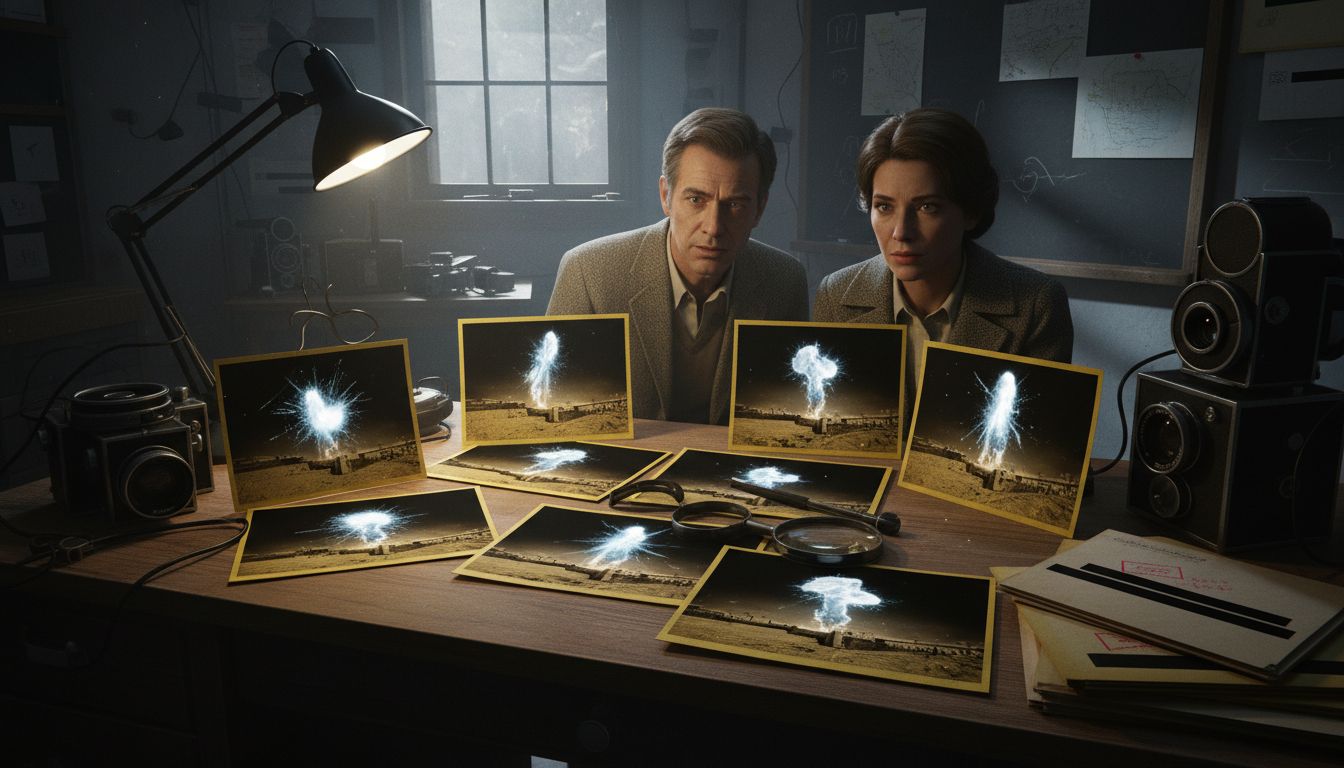
UFO clues emerge in decades-old images showing strange bursts over nuclear testing sites: report - Fox News

UFO clues emerge in decades-old images showing strange bursts over nuclear testing sites: report - Fox News

Overview

A set of previously classified photographs taken during the 1960s and 1970s has been released by the National Archives, showing brief, intense luminous bursts above several U.S. nuclear testing sites. The images, captured by high‑speed cameras that were originally installed to document underground detonations at the Nevada Test Site, the Pacific Proving Grounds, and the Johnston Island range, have reignited scientific interest in the long‑standing correlation between unidentified aerial phenomena (UAP) and nuclear facilities. While the Department of Energy (DOE) has not offered an official explanation, researchers say the newly available visual data could provide fresh clues about the nature of these unexplained events.

The Declassified Images

The photographs, spanning roughly 1963 to 1975, depict momentary flashes of light appearing seconds after a scheduled test blast, often hovering above the cloud tops before dissipating. In one frame taken on July 12, 1966, over the Nevada Test Site, a bright, disc‑shaped illumination rises to an altitude of about 12 kilometers and lingers for less than a second. A second image from the Pacific Proving Grounds on March 4, 1972 shows a similar burst occurring at night, producing a “star‑like” flare that was not recorded by any of the test’s instrumentation.

“The clarity of these frames is remarkable,” said Dr. Emily Carter, senior researcher at the Center for Unidentified Aerial Phenomena Studies. “Because the cameras were calibrated for nuclear‑explosion monitoring, we have precise timestamps, exposure settings, and geographic coordinates, which are rarely available for UAP sightings.” The agency responsible for the original footage, the Defense Nuclear Agency (DNA), declassified the material as part of a broader 2024 release of Cold‑War era surveillance records.

Scientific Analysis

A multidisciplinary team led by Dr. Carter has begun a forensic review of the images, comparing them against known atmospheric and optical phenomena such as meteors, auroras, and electrical discharges. Preliminary findings suggest the bursts differ in several key respects: they occur directly above the test sites, appear at consistent altitudes, and exhibit a luminous intensity that exceeds typical meteoric events of comparable size. Moreover, the flashes are not synchronized with the detonations themselves, ruling out direct nuclear‑induced plasma effects.

“We have consulted with atmospheric physicists and aerospace engineers, and the data does not fit conventional explanations,” noted Dr. Luis Ortega, an atmospheric scientist at the University of Nevada, Reno. “The bursts lack the spectral signatures of lightning or re‑entry debris, and they do not correspond to any known satellite or aircraft activity recorded at the time.” The team plans to employ spectral analysis on the original negatives, a technique that could reveal the composition of the light source and help determine whether the phenomena are natural, man‑made, or something else entirely.


Historical Context

The association between UAP and nuclear sites is not new. Since the 1950s, pilots and ground personnel have reported unexplained lights and objects near test facilities, prompting investigations such as Project Blue Book and the 1979 “Project Condign” study in the United Kingdom. In 2020, the U.S. Office of the Director of National Intelligence released a preliminary assessment acknowledging that UAP incidents are “more frequent near high‑value assets, including nuclear weapons installations.” The newly declassified images add visual documentation to a body of anecdotal reports that have long been dismissed as folklore or instrumentation error.

Implications and Next Steps

While the photographs do not constitute definitive proof of extraterrestrial technology, they underscore a persistent gap in the scientific record regarding aerial anomalies near critical national security installations. The DOE has indicated it will cooperate with independent researchers, and a joint task force comprising the Department of Defense, the National Aeronautics and Space Administration, and civilian scientific bodies is slated to convene later this year to evaluate the findings.

“The responsible path forward is rigorous, transparent analysis,” emphasized Senator Maria Delgado (D‑NV), a member of the Senate Armed Services Committee. “If there is a genuine unknown phenomenon affecting our nuclear infrastructure, we owe it to the American people to understand it fully.” As the investigation proceeds, the declassified images stand as a rare, high‑resolution glimpse into a mystery that has lingered for decades, offering the scientific community a concrete dataset on which to build future research.

RELATED VIDEOS

{ https://usubjects.com/ }

Hoe vind je dit bericht?
Geschreven door peter om 23:30 Stuur door

Meer van UFO'S of UAP'S, ASTRONOMIE, RUIMTEVAART, ARCHEOLOGIE, OUDHEIDKUNDE, SF-SNUFJES EN ANDERE ESOTERISCHE WETENSCHAPPEN - DE ALLERLAATSTE NIEUWTJES

↑ Terug naar de berichten