Ontdek de Fascinerende Wereld van UFO's en UAP's: Jouw Bron voor Onthullende Informatie!
Ben jij ook gefascineerd door het onbekende? Wil je meer weten over UFO's en UAP's, niet alleen in België, maar over de hele wereld? Dan ben je op de juiste plek!
België: Het Kloppend Hart van UFO-onderzoek
In België is BUFON (Belgisch UFO-Netwerk) dé autoriteit op het gebied van UFO-onderzoek. Voor betrouwbare en objectieve informatie over deze intrigerende fenomenen, bezoek je zeker onze Facebook-pagina en deze blog. Maar dat is nog niet alles! Ontdek ook het Belgisch UFO-meldpunt en Caelestia, twee organisaties die diepgaand onderzoek verrichten, al zijn ze soms kritisch of sceptisch.
Nederland: Een Schat aan Informatie
Voor onze Nederlandse buren is er de schitterende website www.ufowijzer.nl, beheerd door Paul Harmans. Deze site biedt een schat aan informatie en artikelen die je niet wilt missen!
Internationaal: MUFON - De Wereldwijde Autoriteit
Neem ook een kijkje bij MUFON (Mutual UFO Network Inc.), een gerenommeerde Amerikaanse UFO-vereniging met afdelingen in de VS en wereldwijd. MUFON is toegewijd aan de wetenschappelijke en analytische studie van het UFO-fenomeen, en hun maandelijkse tijdschrift, The MUFON UFO-Journal, is een must-read voor elke UFO-enthousiasteling. Bezoek hun website op www.mufon.com voor meer informatie.
Samenwerking en Toekomstvisie
Sinds 1 februari 2020 is Pieter niet alleen ex-president van BUFON, maar ook de voormalige nationale directeur van MUFON in Vlaanderen en Nederland. Dit creëert een sterke samenwerking met de Franse MUFON Reseau MUFON/EUROP, wat ons in staat stelt om nog meer waardevolle inzichten te delen.
Let op: Nepprofielen en Nieuwe Groeperingen
Pas op voor een nieuwe groepering die zich ook BUFON noemt, maar geen enkele connectie heeft met onze gevestigde organisatie. Hoewel zij de naam geregistreerd hebben, kunnen ze het rijke verleden en de expertise van onze groep niet evenaren. We wensen hen veel succes, maar we blijven de autoriteit in UFO-onderzoek!
Blijf Op De Hoogte!
Wil jij de laatste nieuwtjes over UFO's, ruimtevaart, archeologie, en meer? Volg ons dan en duik samen met ons in de fascinerende wereld van het onbekende! Sluit je aan bij de gemeenschap van nieuwsgierige geesten die net als jij verlangen naar antwoorden en avonturen in de sterren!
Heb je vragen of wil je meer weten? Aarzel dan niet om contact met ons op te nemen! Samen ontrafelen we het mysterie van de lucht en daarbuiten.
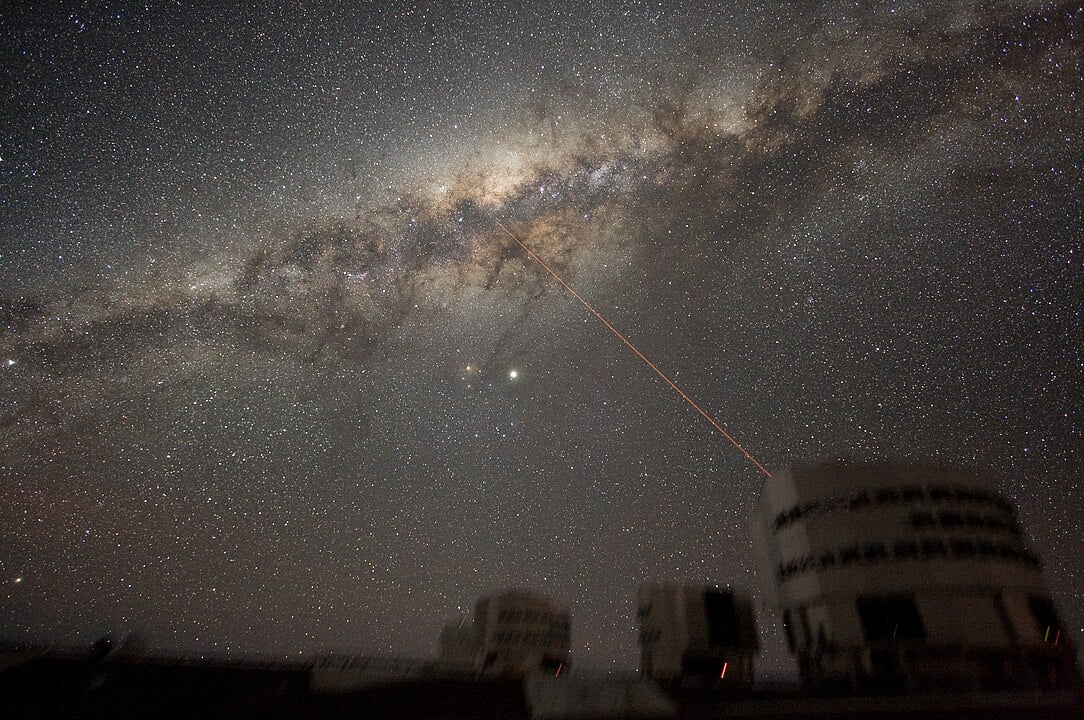
Image of the night sky above Paranal, Chile on 21 July 2007, taken by ESO astronomer Yuri Beletsky. The Milky Way can be seen clearly in the skies overhead (Credit : ESO/Y. Beletsky)
The Milky Way contains more than 100 billion stars, each following its own evolutionary path through birth, life, and sometimes violent death. For decades, astrophysicists have dreamed of creating a complete simulation of our Galaxy, a digital twin that could test theories about how galaxies form and evolve. That dream has always crashed against an impossible computational wall.
Until now.
Researchers led by Keiya Hirashima at RIKEN's Center for Interdisciplinary Theoretical and Mathematical Sciences have achieved what seemed beyond reach, a simulation representing every single one of those 100 billion stars over 10,000 years of galactic time. The breakthrough came from an unexpected marriage of artificial intelligence and traditional physics simulations, presented at this year's Supercomputing Conference.
The problem wasn't merely one of scale, though the numbers are staggering. Previous state of the art galaxy simulations could handle roughly one billion solar masses, meaning their smallest "particle" represented a cluster of about 100 stars. Individual stellar events got averaged away, lost in the noise. To capture what happens to single stars requires taking tiny time steps through the simulation, short enough to catch rapid changes like supernova explosions.
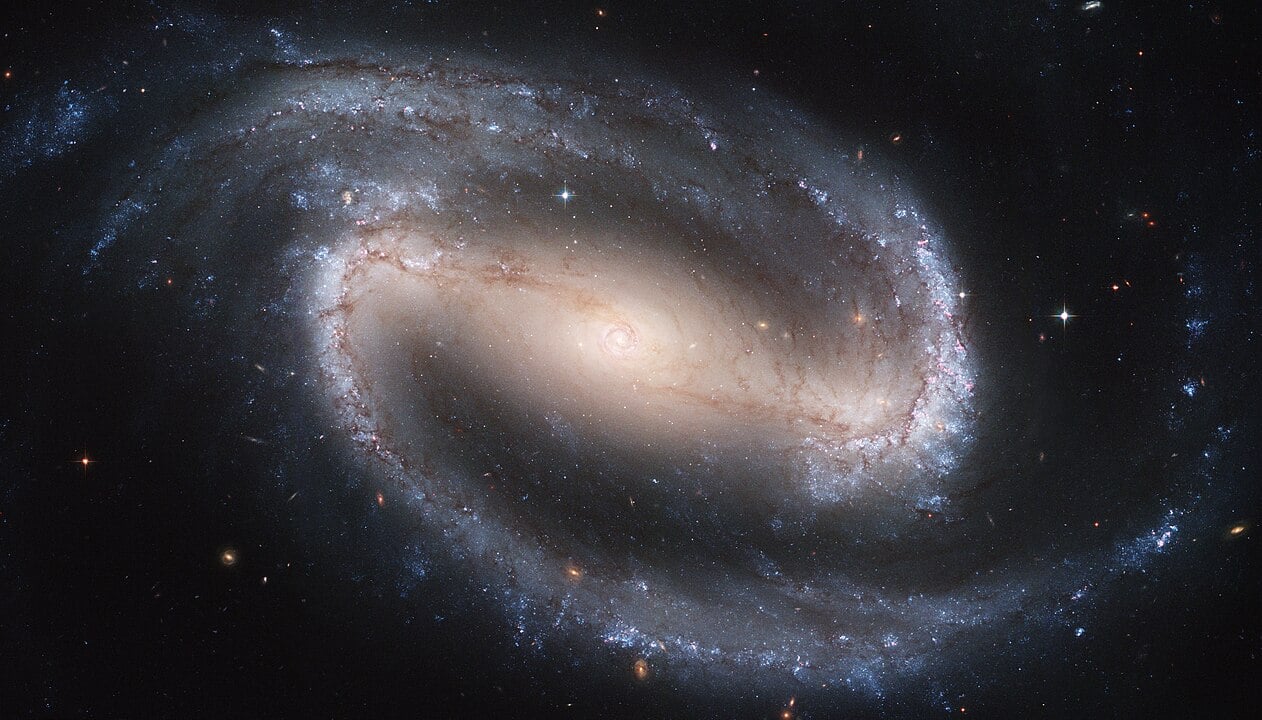
Barred spiral galaxy known as NGC 1300 viewed nearly face-on. Its thought the Milky Way is a barred spiral like this
(Credit : NASA, ESA, and The Hubble Heritage)
But smaller time steps demand exponentially more computing power. Using conventional methods to simulate the Milky Way at individual star resolution would require 315 hours of supercomputer time for every million years of galactic evolution. Modelling even one billion years would consume 36 years of real time. Adding more processor cores doesn't solve the problem either since beyond a certain point, efficiency plummets while energy consumption skyrockets.
Hirashima's team found their solution in a deep learning surrogate model. They trained an AI on high resolution simulations of supernovae, teaching it to predict how gas expands during the 100,000 years following an explosion. This AI shortcut handles the rapid small scale physics without dragging down the rest of the model, allowing the simulation to simultaneously track both galaxy wide dynamics and individual stellar catastrophes.
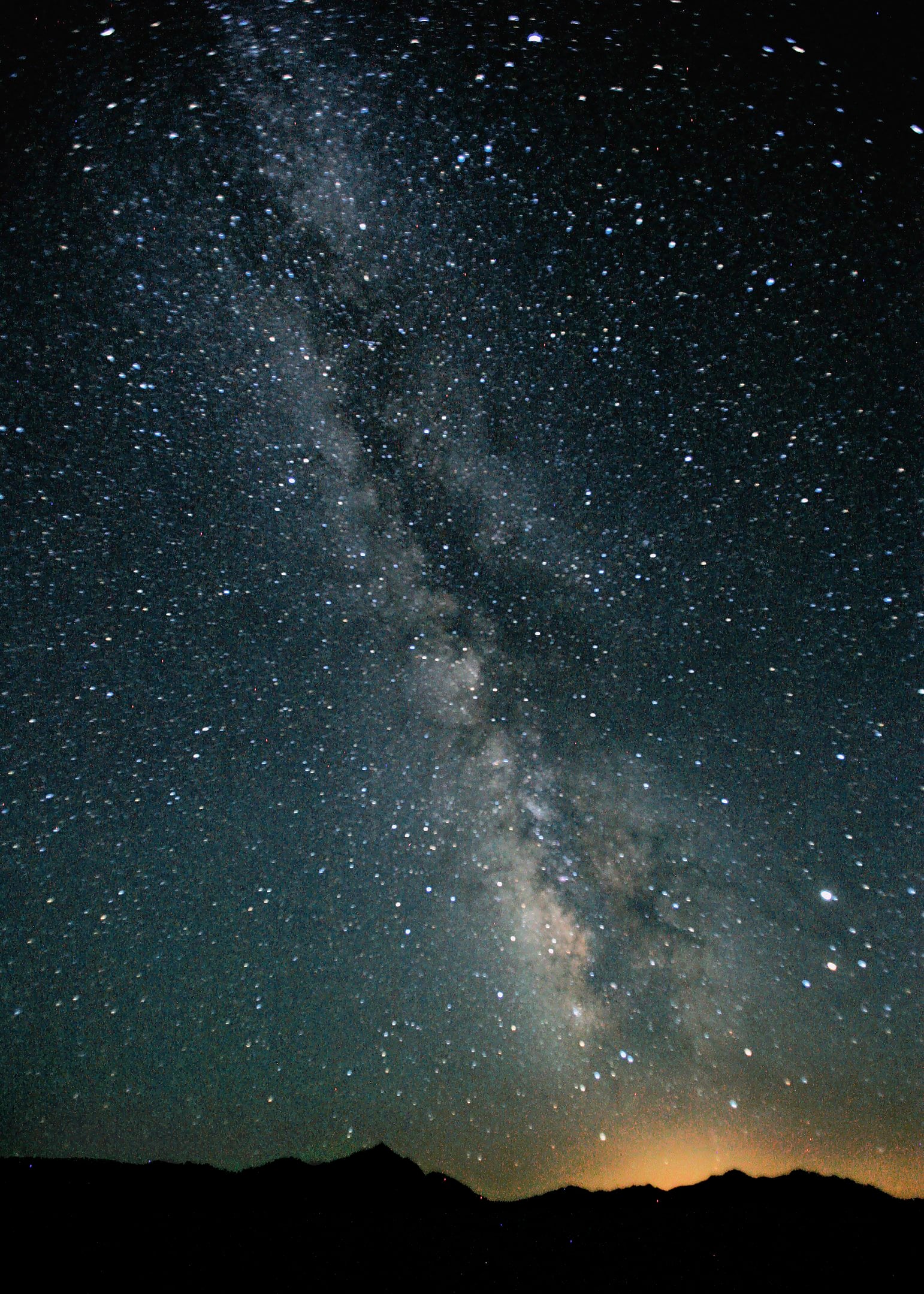
The AI simulation has modelled all the stars in our Galaxy. The stars of the Milky Way are pictured here above a dark site with little light pollution
(Credit : Steve Jurvetson)
The performance gains are remarkable. What would have taken 36 years now requires just 115 days. The team verified their results against large scale tests on RIKEN's Fugaku supercomputer and The University of Tokyo's Miyabi system, confirming the AI enhanced simulation produces accurate results at unprecedented scale.
This approach could transform how we model any system involving vastly different scales of space and time. Climate science, weather prediction, and ocean dynamics all face similar challenges, needing to link processes that range from molecular to planetary scales.
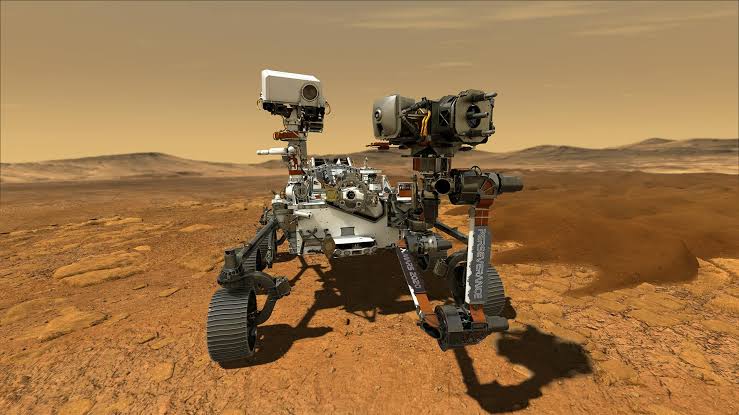
NASA's Curiosity rover on Mars. Credit: NASA/JPL-Caltech
It is a scientific consensus that water once flowed on Mars, that it had a denser atmosphere, meaning that it was once habitable. Unfortunately, roughly 4.2 to 3.7 billion years ago, Mars' rivers, lake, and global ocean began to disappear as solar wind slowly stripped its atmosphere away. For scientists, the question of how long it remained habitable has been the subject of ongoing inquiry. Whereas some scientists maintain that Mars ceased being habitable billions of years ago, recent research suggests that it experienced periods of habitability that lasted for eons.
This includes recent findings by NASA's Curiosity rover, which has been exploring the Gale Crater on Mars to learn more about the planet's past. According to new research by scientists at New York University Abu Dhabi (NYUAD), there is evidence that billions of years ago, ancient sand dunes within the crater gradually turned into rock by interacting with underground water. Their findings, which were published in the Journal of Geophysical Research – Planets, indicate that Mars may have been habitable much longer than expected.
The research was led by Dimitra Atri, the Principal Investigator of NYUAD’s Center for Astrophysics and Space Science (CASS) with assistance by fellow CASS researcher Vignesh Krishnamoorthy. They were joined by Research Instrumentation Scientist James Weston of NYUAD's Core Technology Platforms, Postdoctoral Associate Marieh B. Al-Handawi of NYUAD's Smart Materials Lab, and Professor Panče Naumov of NYUAD's Center for Smart Engineering Materials, the Research Center for Environment and Materials, and NYU's Molecular Design Institute.
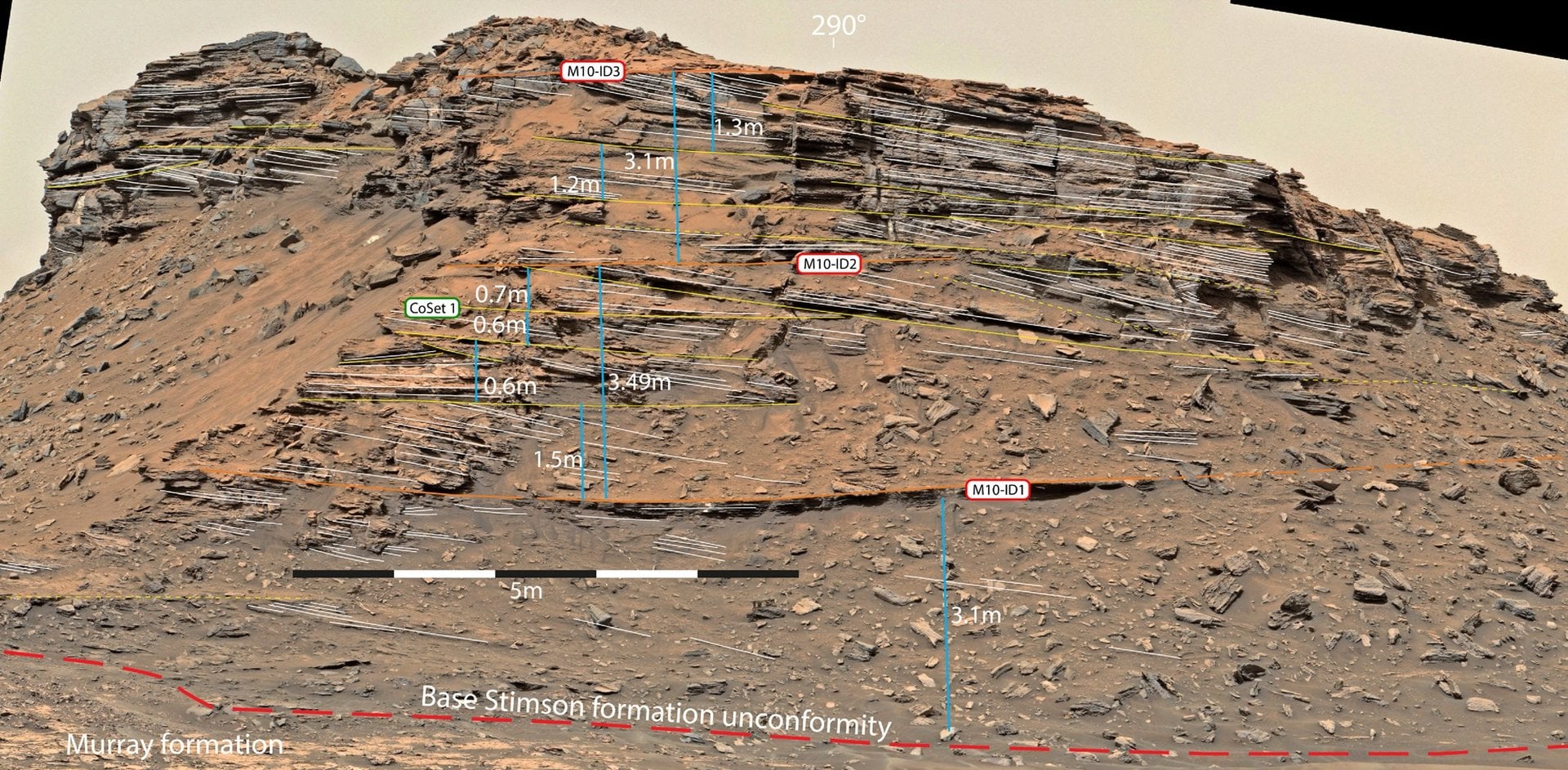
*Mastcam mosaic of the Stimson Formation, which formed through interaction with underground water.
Credit: MSL/NASA/JPL-Caltech*
For their study, the team examined dunes in the Stimson Formation (SF), a system of wind-blown (aeolian) sand and sedimentary rock in the Gale Crater. The Curiosity rover has observed evidence of these "lithified" formations (i.e. sediments that hardened into stone) at this location on several occasions. Given the pervasive dry conditions in the Gale Crater, these formations likely formed during the Noachian Period (ca. 4.1 to 3.7 billion years ago) when extensive flooding is believed to have taken place, which included rivers that flowed into the Gale Crater.
The team accessed this data through the Mars Science Laboratory's (MSL) Curiosity Notebook, which provides access to information gathered by Curiosity's instruments. They then compared this data to field studies of rock formations in the desert environment of the United Arab Emirates (UAE), which are also known to have formed in the presence of water. They determined that the SF was the product of late-stage aqueous activity, meaning they formed from interaction with groundwater from the nearby mountain.
They further found that this interaction left behind minerals such as gypsum, soft sulfate mineral composed of calcium sulfate dihydrate (CaSO4) that is also found in Earth's deserts. This latest research echoes similar findings presented by Krishnamoorthi and Atri last year at the Tenth International Conference on Mars, which took place from July 22nd to 25th at Caltech in Pasadena, California. In that study, they examined data collected on the Greenheugh Pediments (GP), a nearby dune formation with similarly lithified rock deposits.
In both cases, the researchers believe that these dunes and their systems of underground water led to the creation of these curious formations, which could have significant implications in the search for past (and present) life on Mars. On Earth, sandstone deposits contain some of the oldest evidence of life on Earth, including communities of microorganisms that bind sediment and cause minerals to precipitate. Based on these terrestrial analogues, Atri and Krishnamoorthi's team believe that lithified deposits in the Gale Crater could contain the preserved remains of ancient bacteria.
This latest research not only provides new insight into how Mars evolved and transitioned to the extremely cold and dry environment we see there today. It also suggests that these sites would be good candidates for future missions that will continue the search for life on Mars.
Let’s start out with something that we can say for certain: we live in an expanding universe. Every single day, the universe gets a little bit bigger than it was the day before. But right away, when we say something like “we live in an expanding universe” certain questions start to pop up, and they’re far and away the most common kinds of questions that I get asked. If the universe is expanding, then what is it expanding into? And what is it expanding from? Where’s the edge of the universe, and where is it’s center?
I’m going to be honest with you. I dread this kind of question, especially when I give public talks. Not because I know what the answer is, but because I know how totally unsatisfying that answer feels. It’s like sneaking into your kid’s candy bag the night after Halloween and eating half their chocolates (don’t judge me, I know you’ve done it too): it feels good in the moment, but you instantly have regrets.
Here's the answer: the big bang has no center, and it has no edge. That’s it. That’s the answer. No more, no less.
And that doesn’t really feel good because it doesn’t make a lot of sense.
It’s easy to imagine an expanding universe, and there are plenty of analogies out there to help guide our thinking. We can imagine drawing little galaxies on the surface of a balloon, and inflating that balloon to see the galaxies getting farther apart. We can imagine baking a load of bread with raisins in it (why it’s always raisins, and not chocolate chips, is an enduring mystery) and seeing how as the bread rises the raisins get farther apart.
Yay, expanding universe! But the balloon has a center, and it has an edge. And the bread has a center, and a crust. So…where’s the center of the universe, and where is its edge?
This is why we can’t rely on analogies too much when dealing with many concepts in fundamental physics and cosmology. In both the subatomic and cosmological realms, we’re grappling with structures and concepts and physics that is far and above what our puny human brains can imagine. That’s why we have mathematics. Mathematics is a tool that we can use to understanding the universe around us, even when we can’t envision what’s going on. That’s right kids: imagination is important, but mathematics can be even more powerful.
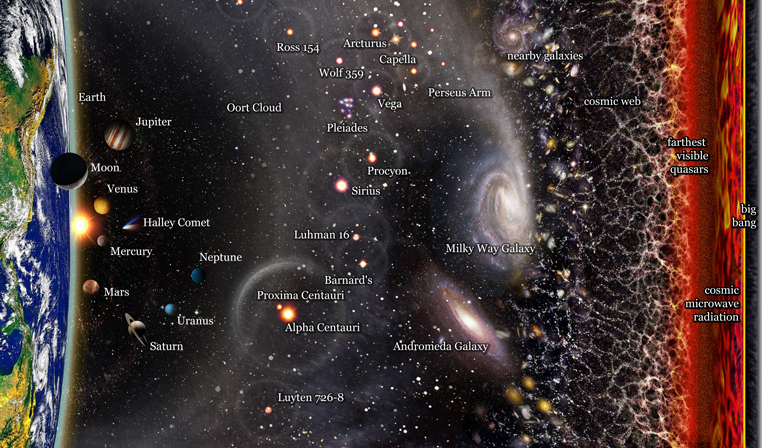
Let’s start with the center. Where did the big bang start? Right here. And right there. And right over there. And in the next room over. The big bang happened everywhere, all at once. The big bang was an event that the entire universe participated in. The big bang was NOT an explosion that happened somewhere in space, it was an explosion OF space – it was when the expansion of the universe first got started. It was not a place we can point to, it was a TIME that we can point to.
The big bang was a singular event that happened in the past of every single object in the universe. If you take any particle, any bit of energy, and trace its path backwards through time, you’ll end up at the big bang, where that particle, that bit of energy, gets all mushed together with every other particle and bit of energy in a singularity.
Think about it. Let’s say the big bang happened over there, say, in the Andromeda galaxy. Well then, where were we, in the Milky Way, when that happened? If we traveled back in time 13 and change billion years, would we be watching the big bang unfold? But…aren’t we a part of the universe? How can we be a part of the universe but somehow outside of the event the created it?
The big bang had to happen everywhere, because everywhere is by definition part of the universe. You can’t have a universe, especially an expanding one, without a big bang. So no matter where you are, your point in space had, at one time, to participate in the big bang.
Now what about the other side of the coin? If the universe is expanding, what is it expanding into? Where’s the crust in our expanding loaf of bread, and what’s the oven that we’re sitting in?
Go ahead, have another piece of chocolate, because this is going to get weird. There is no edge. The universe has no edge. I don’t even want to say something like “the universe isn’t expanding into anything” because that still conjures up the wrong mental image. It’s too tempting to imagine a wall, or boundary, with galaxies and stuff on one side and nothingness on the other, with the universe expanding to fill up that nothingness with somethingness.
But that’s wrong. Even the vacuum of space is something. There are still point, locations, and existence. There’s no “outside” to the universe because “outside” implies existence, even an empty one. But the universe is, by definition, all there is. There is nothing to physical reality except the universe. Walls separate one region from another, but the universe is all the regions simultaneously.
If there were an edge, you could imagine working hard enough to get outside that edge. But that’s not possible. There is no outside. There is no…side. There just is, us, the universe. All there is.
Like I said, it feels a little thrilling at first, but then the stomach aches kick in.
Director Dan Farah grew up with aliens. As a child of the 80s and 90s, pop culture was awash with extra-terrestrial sightings. “How can you be a kid watching movies like ET and Close Encounters, TV shows like The X Files, and not end up curious about whether or not we’re alone in the universe?” he said in an interview with the Guardian. “And whether or not the US government does, in fact, hold secrets from the public.”
'I think it is only a matter of time before a sitting US president steps to the podium, and tells the world that we are not the only intelligent life in the universe.’
Farah’s exposure to otherworldly beings in fiction kickstarted an interest that’s now morphed into a professional quest, and the subject of his documentary debut The Age of Disclosure. Here, Farah makes the case that the United States has been hiding, for decades, a fount of information related to UAP (unidentified anomalous phenomena) – the acronym rebrand of the stigma-ridden UFO.
It would be easy to assume this is the stuff of tin-foil hats and Reddit forums, and in some ways the documentary’s pseudo-narrator, Luis Elizondo, could come across as a type of conspiracy theorist at first glance. He’s armed with a blackboard and piece of chalk, working to sell the viewer, running through a lot of overwhelming military and intelligence jargon, like “hypersonic velocity” and “trans medium travel” with undeniable passion.
But there’s a reason why Farah gravitated towards Elizondo (who also serves as an executive producer on the film). He’s got genuine credentials. A former Pentagon official, who helped lead the Advanced Aerospace Threat Identification Program (AATIP), Elizondo eventually left his role in 2017, claiming the department was hiding vital information from the public. He also claims there was a “powerful disinformation campaign” from the Department of Defense to discredit his work.
Making a point to “only interview people who have direct knowledge” of these programs from working within the US government was a north star for Farah – who has served as a producer on several films, including Steven Spielberg’s Ready Player One. While filming The Age of Disclosure, as more former officials and experts got on board, it helped to convince others to take part.
But Farah ran a tight ship over the three years it took to make the film. “Everyone’s names would be kept silent until it was done,” he said, noting that he only told documentary subjects about who had agreed to take part in order to make them comfortable. “We would make the movie in secrecy, so this information of who’s in it would not get out there until we were done with this film, and these people I was approaching would have safety in numbers.”
Farah also opted to make the film independently, unattached from a studio or streamer. “None of them would ever want to participate in a big commercial documentary,” Farah explained. “They would be afraid of it being sensationalized. They would be afraid of being intercut with someone who was not on their level, who would undermine them.”
His first big commitment came from Jay Stratton, one of the defense officials who started AATIP. He had an established career investigating UAP and non-human intelligence life on behalf of the government, and was responsible for briefing senior lawmakers in Congress and the White House. “I have seen with my own eyes non-human craft and non-human beings,” Stratton says plainly at the beginning of the film.
After Stratton agreed to “break his silence” it had tremendous “ripple effects” on the rest of the film, and convinced others to come forward. When the current secretary of state, Marco Rubio, agreed to take part, that escalated things. “Then next thing you know, general Jim Clapper was participating,” Farah said of the former director of national intelligence under Barack Obama, who sat for an interview.
The sheer wealth of contributions, 34 to be exact, from members of Congress across the political spectrum, as well as people with rich national security experience – many of whom might balk at the prospect of a cable news hit let-alone an independent documentary – certainly lends a veneer of credibility. Off the bat you’re confronted with a propulsive string score, and a supercut of former military and intelligence officials ensconced in armchairs. They all offer brief summaries of their CVs, spell out that we are not alone, and why the American public ought to know more about it.
Dan Farah.Photograph: Dia Dipasupil/Getty Images
“This [UAP] technology does stuff that we can’t do, and if we can’t figure out what it is or what it wants, or what it’s being used for,” says a former director of aviation security at the National Security Council. The former chief scientist for AATIP claims that those who are tasked with ensuring information about UAPs doesn’t leak “will use whatever tool they can find to try to convince people they shouldn’t come forward”. Meanwhile a former defense official notes that if we’re able to understand the technology that we’re observing, it opens the door to so many “potentially beneficial impacts, including clean energy”.
In many ways, Rubio offers one of the more convincing arguments. He says that much of the research and intelligence about UAPs is on a need-to-know basis, with incoming administrations being left out of the loop on the details. “But that begins to ramp out of control,” he notes, leading to a lack of transparency that might give US adversaries a head start by analyzing UAP technology. It’s a theory that sounds all the more convincing coming from the noted foreign policy hawk, who spent time in the senate spearheading a bipartisan effort to understand more about UAPs.
The geopolitical arms race to reverse engineer UAP technology is, what Farah came to see, one of the biggest reasons behind the alleged cover-up. “You can’t tell your friends without telling your enemies,” Farah says in our interview, reciting one of Stratton’s lines in the documentary. He traces a line from the debunked 1947 Roswell “alien crash retrieval” (generally considered the genesis of modern UAP conspiracies) to what he sees as the ongoing effort to withhold information – for fear of enemies getting wind of how much the US knows about extraterrestrial life.
“Put yourself in the shoes of US government and military officials in the 40s,” Farah said, explaining that, fresh off a second world war victory, the Truman administration couldn’t tell the American people that “we’re in another conflict that we can’t protect anyone from, because we don’t even know anything about it”.
He says this race escalated when the US found out that other countries, like Russia, were capturing and retrieving UAP technology. “Here we are now where the people who run our country are not aware of the facts,” he added. “Those people are supposed to be aware of significant information like this that has high stakes for us. And at a base level, the public deserves to know the truth about fundamental facts, like we’re not alone in the universe.”
In The Age of Disclosure, it’s clear that there is little room for pushback or skepticism, particularly since there’s not a single detractor in the film to serve as a foil to the plethora of resolute interviewees. And Farah, for his part, doesn’t see the need for those voices to cloud the documentary’s throughline. “I think when people watch this movie, one of the realizations will be that the stigma around this topic is completely illogical and makes no sense and is not good for humanity,” he said. “We need the scientific community, not only in the United States, but in every nation, accepting the fact that this is a real situation, this is a valid area of inquiry, and that they should put their brain power towards learning about this and answering a lot of the big questions that remain.”
Testimony is ultimately what film hinges on, and it’s really the only “proof” it can offer. This, for Farah, is more compelling. He believes that “the strongest evidence” is “credible people putting their name and reputation on the line to tell you what they know at great risk”. When it comes to video and photos, the director notes that it would do little to quieten claims that it’s all a hoax. “You could put a picture or a video of the most extraordinary thing on the cover of a major news publication or on major plants on TV, and half the human population would tell you they think it’s AI or they think it’s visual effects,” he said.
As more people, like Elizondo and Stratton, speak out about their experiences, Farah hopes it will encourage more people who have been silenced in the past to attempt to reveal the truth. “For way too long, the public has been lied to, kept in the dark, completely misled by a heavily financed and very sophisticated disinformation campaign,” Farah said.
“I think it is only a matter of time before a sitting US president steps to the podium, and tells the world that we are not the only intelligent life in the universe, and that the United States government intends to lead in this new chapter by ending the era of secrecy and beginning the era of transparency.”
Among UFO doc's revelations: Russia recovered nonhuman 'Tic Tac' craft | Elizabeth Vargas Reports
Overview
A new documentary, The Age of Disclosure, has ignited fresh debate over the global race to recover and reverse-engineer unidentified anomalous phenomena (UAP), commonly known as UFOs. The film, which features interviews with high-ranking officials from the United States and abroad, presents claims of an international arms race to unlock the technology behind non-human craft—allegedly including a “Tic Tac”-shaped vehicle recovered by Russia in 1989. The revelations are part of an 80-year narrative of secrecy, cover-ups, and intense competition among world powers.
Global Arms Race for Alien Technology
According to the documentary’s director, Dan Farah, the U.S. is not alone in deploying specialized teams to recover downed extraterrestrial craft. “We’re in a secret arms race,” Farah told host Elizabeth Vargas, describing ongoing efforts by the United States, Russia, and China to retrieve and study non-human technology. The documentary cites U.S. intelligence officials who assert that “China and Russia both have retrieved alien spacecraft,” with Russia’s 1989 recovery of a large Tic Tac-shaped craft highlighted as a pivotal event. This craft was reportedly even larger than the now-famous object encountered by the U.S. Navy’s Nimitz Carrier Strike Group in 2004.
Officials interviewed in the film argue that the first country to successfully reverse-engineer such technology would secure “the leader[ship] for years to come,” likening the stakes to a new Manhattan Project—“the atomic weapon on steroids.” The documentary suggests the technology could include directed-energy weapons and propulsion systems capable of changing the balance of global power.
High-Level Testimony and Secrecy
What sets The Age of Disclosure apart is its roster of interviewees: former secretaries of state, sitting senators, former directors of national intelligence, Pentagon brass, and senior officials from the CIA, Air Force, and Navy. Farah underscores the credibility of these sources, stating, “These are 34 extremely high-level military, government, and intelligence officials… people who have been entrusted with very high-level security clearances.” The documentary details how, for decades, “legacy crash retrieval programs” operated in secrecy, with multi-agency teams tasked to recover and analyze non-human technology.
Farah reveals that these programs were designed to be even more secretive than the Manhattan Project, responding to earlier security leaks by imposing stricter controls. He asserts that the U.S. Air Force, CIA, Department of Energy, and military contractors all played roles in these covert efforts, with similar units active in Russia and China.
Extraordinary Claims: Non-Human Beings and Government Deliberations
Among the most startling claims in the documentary are testimonies from two astrophysicists and intelligence officials stating that the U.S. government has recovered “at least two different alien species.” One official recounts an incident where “not human beings exited a craft and interacted with members of the Air Force and the CIA” at a U.S. military base. While the film acknowledges the extraordinary nature of these accounts, it emphasizes their source: figures with decades of experience at the highest levels of government.
The documentary also reveals a little-known episode from the administration of President George W. Bush, where cabinet officials reportedly “convened a meeting and debated for days” whether to disclose the existence of these programs and technologies to the public. Ultimately, the decision was made to maintain secrecy, continuing a legacy of non-disclosure that, according to the film, spans more than eight decades.
A Unified but Controversial Assertion
Despite the political and ideological diversity of the documentary’s sources, Farah notes a rare consensus: “They’re aligned on this—such 34 senior officials sharing one truth.” While the claims remain controversial and, for many, difficult to accept, The Age of Disclosure raises profound questions about transparency, global security, and humanity’s place in the universe. As lawmakers from both parties call for greater openness on UAPs, the documentary’s revelations are likely to fuel ongoing debate in Washington and beyond.
A popular UFO-reporting app has recorded thousands of sightings of Unidentified Submersible Objects (USOs) near US waterways — phenomena which high-ranking US Navy officials warn could pose a threat to national security.
A video accompanying one of the reports sent to UFO logging app Enigma showed mysterious green lights moving beneath the surface of the ocean.
Enigma
Enigma, which touts itself as the “largest queryable historical sighting database for global UFO sightings,” claims it has received reports on over 30,000 Unidentified Flying Objects and Unidentified Anomalous Phenomena since launching in late 2022.
But the sightings haven’t been limited to the skies, with reports also coming in about strange objects rising from the depths of the sea, or plunging into the water without so much as a splash.
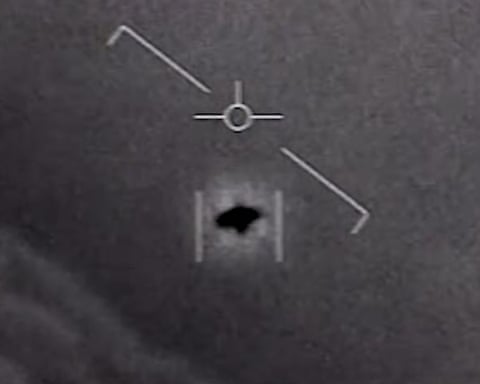
Pentagon-reviewed footage has documented instances of unidentified craft diving into or emerging from the water without damaging the vessel or even making a splash, prompting alarm from some officials.
Jeremy Corbell/Weaponized Podcast
As of August, Enigma has also logged more than 9,000 mysterious sightings within 10 miles of US shorelines or major bodies of water — 500 of them within 5 miles — with more than 150 of the reports describing objects hovering above or descending into waterways, according to Marine Technology News.
The US states with the most reported USO sightings were California (389) and Florida (306) — both among the top three US states with the most ocean coastline. One of the most bizarre reports includes phone camera video of unexplained green lights traveling beneath the surface of the ocean.
Thousands of reports of Unidentified Submersible Objects (USOs) — the aquatic equivalent of a UFO — have been logged along US shorelines in recent years.Enigma
The app has released maps plotting out the reported sightings, represented as clusters of orange dots running up and down the east and west coasts.
UFO sightings are nothing new, and are often dismissed as crackpottery by much of the scientific community or relegated to the stuff of science fiction, but retired Navy Rear Admiral Tim Gallaudet warns UFOs with the ability to go from air to sea without crashing or even creating a splash could have “world-changing” ramifications.
“The fact that unidentified objects with unexplainable characteristics are entering US water space and the DOD is not raising a giant red flag is a sign that the government is not sharing all it knows about all-domain anomalous phenomena,” Gallaudet wrote in a March 2024 report.
Alarm bells were raised in July 2019, when the USS Omaha recorded a UFO/UAP that vanished into the ocean without a trace after buzzing a Navy fleet off the coast of San Diego. Video of the incident was verified by the Pentagon, displaying capabilities Gallaudet said “jeopardizes U.S. maritime security, which is already weakened by our relative ignorance about the global ocean.”
In his 29-page report for UFO-focused think tank the Sol Foundation, Gallaudet said there’s a documented pattern of similar phenomena being reported.
“Pilots, credible observers and calibrated military instrumentation have recorded objects accelerating at rates and crossing the air–sea interface in ways not possible for anything made by humans,” he wrote.
Pentagon Reveals 400 UFO Sightings Following Leaked Videos
Overview
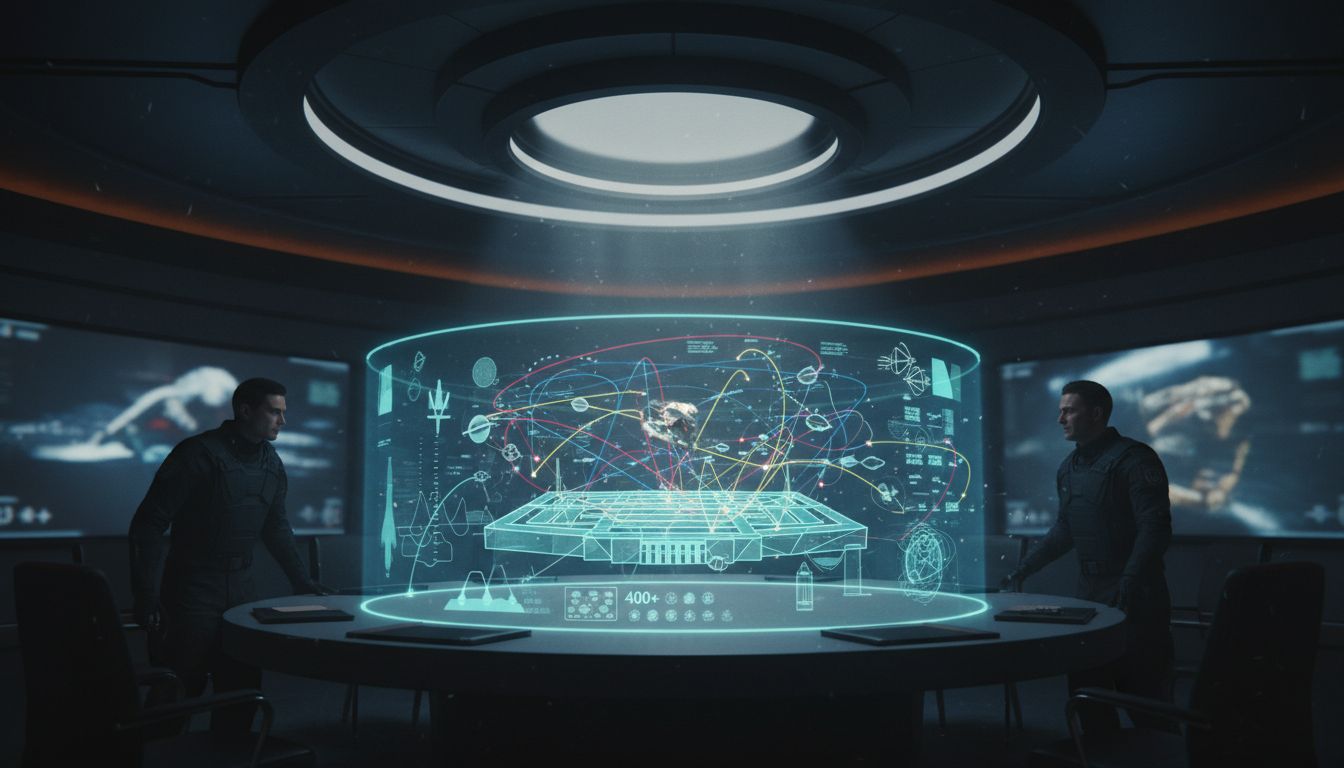
The Department of Defense announced this week that more than 400 unidentified aerial phenomenon (UAP) sightings have been logged by Navy and Air Force personnel since the release of the agency’s 2021 report and the subsequent leak of three Navy videos. The new data, presented at a House Intelligence subcommittee hearing, expands the known inventory of anomalous objects that have been observed near military installations, training ranges, and operational airspace. While the Pentagon stopped short of attributing any sighting to extraterrestrial technology, analysts noted recurring patterns—high‑speed maneuvers, sudden acceleration, and flight paths that appear to violate known aerodynamic limits—that suggest “advanced, possibly non‑human, capabilities.”
Key Details
The 400‑plus reports were gathered through the UAP Task Force’s standardized reporting system, a process introduced in 2022 to reduce the stigma that previously discouraged pilots from filing entries. Among the most striking cases are three incidents recorded in the past six months near the Atlantic Fleet’s training area off the coast of Virginia, where infrared sensors captured objects executing instantaneous 180‑degree turns at speeds exceeding 15,000 km/h. Another cluster involved “tic‑tac‑shaped” craft observed over the Nevada Test and Training Range, displaying rapid altitude changes without visible propulsion. None of the sightings have been conclusively linked to known aircraft, drones, or atmospheric phenomena, prompting the Defense Department to label them “unexplained” rather than “aliens.”
Government Response
Under Secretary of Defense for Intelligence and Security Ronald Moultrie emphasized the administration’s commitment to “eliminate the stigma” surrounding UAP reporting. “Our goal is to bring operators into a standardized data‑gathering process,” he told lawmakers, adding that consistent documentation is essential for national‑security assessments. The hearing, the first public UAP briefing in nearly five decades, also featured testimony from Deputy Assistant Secretary of Defense for Intelligence, Dr. Sean Kirkpatrick, who outlined ongoing collaborations with the Federal Aviation Administration and the National Geospatial‑Intelligence Agency to cross‑reference civilian sightings and satellite data. The Pentagon’s newly created Office of UAP Investigation now reports directly to the Secretary of Defense, a structural change aimed at improving inter‑agency coordination.
Implications for Security and Policy
Congressional members expressed a mix of curiosity and concern. Representative Andre Carson, chair of the subcommittee, warned that “persistent gaps in our situational awareness could be exploited by adversarial nations,” underscoring the need to determine whether the phenomena represent foreign hypersonic platforms or something entirely novel. The November 2025 update to the UAP database, which added high‑resolution sensor logs from the Space Force’s Space Surveillance Network, intensified calls for a comprehensive disclosure bill. While senior officials maintain that no definitive evidence of extraterrestrial origin exists, the sheer volume of unexplained encounters has prompted the National Security Council to allocate additional funding for advanced sensor development and AI‑driven pattern analysis.
Next Steps
The Pentagon plans to release a supplemental report by early 2026, summarizing the 400 sightings and outlining a roadmap for enhanced detection capabilities. In parallel, the House Intelligence Committee is slated to hold a follow‑up hearing in March, where lawmakers will review the newly declassified data and assess the adequacy of current reporting mechanisms. Defense analysts suggest that a transparent, science‑based approach—combined with international cooperation on air‑space monitoring—could both mitigate security risks and address public demand for clarity. Until more conclusive evidence emerges, the UAP phenomenon remains a high‑priority intelligence challenge, prompting continued scrutiny across the defense and aerospace communities.
A long-forgotten book, left out of the Bible and written nearly 1,900 years ago, reveals secret stories of Jesus' childhood that the early church kept under wraps for centuries.
Known as the Infancy Gospel of Thomas, the text tells of Jesus performing miraculous feats, bringing clay birds to life, drawing water from a broken pitcher and healing a boy whose leg was injured by an axe.
But it also portrays a darker side, depicting Jesus as vengeful, even cursing a child to death for striking him on the shoulder.
After Jesus kills the child for accidentally bumping into him, the villagers become upset and complain to Joseph and Mary. In response to their accusations, Jesus strikes the accusers with blindness.
The omitted book begins when Jesus is just five years old, while the traditional Bible's first mention is of him at 12 years old.
In another episode, Joseph takes Jesus to a teacher to learn the alphabet, and the teacher becomes irritated when Jesus laughs at his instructions.
The Infancy Gospel of Thomas was rejected by the early Church because it portrayed Jesus as a violent, petulant child and conflicted with orthodox Christian teachings.
Its late composition date and association with Gnostic literature further led leaders to deem it inauthentic and heretical.
The omitted book begins when Jesus is just five years old, while the traditional Bible's first mention is of him at 12 years old
The Gospels of Matthew, Mark, Luke and John have long been accepted by the Church as accurate accounts of Jesus' life and teachings, written either by apostles or those closely connected to them.
Matthew and John were original disciples, Mark drew from Peter's preaching, and Luke partnered with Paul while also interviewing eyewitnesses.
By contrast, the Infancy Gospel of Thomas claims authorship by 'Thomas the Israelite,' though the writer is otherwise unknown and not identified as the apostle Thomas.
This text is a collection of stories about Jesus' childhood and should not be confused with the modern Gospel of Thomas, which early references to the Gospel of Thomas almost certainly point to the Infancy Gospel.
The passages tell stories about Jesus' first miracles, from bringing dried fish back to life, resurrecting a child who died of illness and raising a man back to from the dead after an accident.
However, it seems that early church leaders were more concerned about the text describing Jesus as a violent child.
In one incident, after Jesus blinds the parents of a boy he struck dead, Joseph, his earthly and adoptive father, reprimands Him: 'When Joseph saw that Jesus had done such a thing, he got angry and grabbed his ear and pulled very hard.
'The boy became infuriated with him and replied, 'It's one thing for you to seek and not find; it's quite another for you to act this unwisely. Don't you know that I don't really belong to you? Don't make me upset.'
The earliest known manuscript fragment was only discovered in 2024, discussing one of Jesus' early miracles
The text describes how Joseph took Jesus to his teacher, asking the child to be taught 'his letters.'
The teacher says, 'Hand him over to me, brother, and I shall teach him the Scripture; and I shall persuade him to bless all, and not to curse.
'And Jesus, hearing, laughed, and said to them: You say what you know; but I know more than you, for I am before the ages. And I know when your fathers' fathers were born; and I know how many years of your life.'
Jesus then astonished the teacher with his knowledge of the Hebrew alphabet. Amazed and unnerved, the teacher tells Joseph that the child clearly does not belong to this world and asks him to take Jesus away.
In Chapter 3, when the son of Annas, the high priest, destroys the water Jesus had gathered on the Sabbath, Jesus curses him, declaring that his fruit will wither like a scorched branch.
Immediately, the boy withers, showing the child Jesus’ power to punish those who oppose him.
The Infancy Gospel of Thomas also depicts the young Jesus performing numerous miracles to help others.
He heals a woodcutter who accidentally chops the sole of his foot, instantly restoring him and instructing him to continue his work.
When a water jug breaks while he is fetching water, Jesus fills his cloak with water and carries it back to his mother.
He miraculously multiplies a single grain of wheat into a hundred measures and distributes it to the poor, widows, and orphans.
Jesus even stretches a short piece of wood so Joseph, his father, can complete a carpentry job for a wealthy client. In one story, he heals his brother James from a snakebite by breathing on the wound, destroying the snake and ending the pain.
On another occasion, he resurrects a child who had died, bringing the child back to life and returning him safely to his mother.
These vivid episodes show that the text portrays a child Jesus who is not only powerful but also compassionate, using his extraordinary abilities to aid and protect those around him.
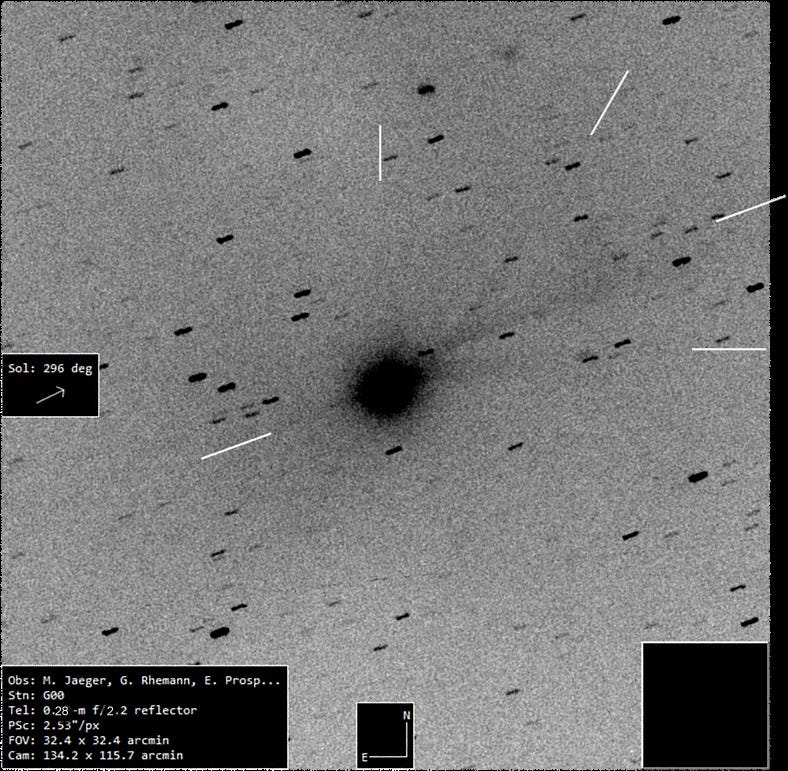
Stacked images of 3I/ATLAS on November 8, 2025. The sunward direction (opposite to the arrow) is pointing towards the bottom left corner. (Credit: M. Jäger, G. Rhemann, E. Prosperi)
Press enter or click to view image in full size
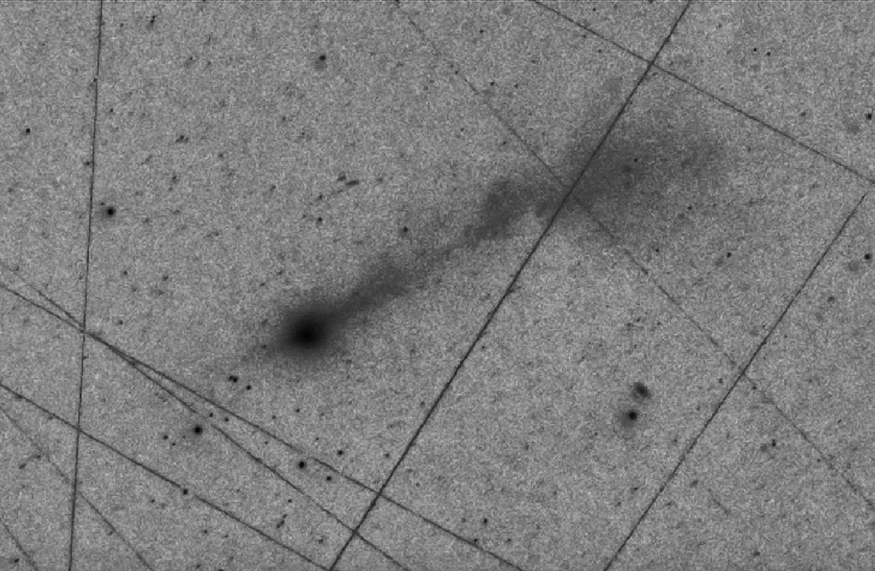
A stacked deep image of 3I/ATLAS, taken on November 9, 2025, through a combination of 5 exposures, each lasting 3 minutes, with two telescopes. The sunward direction is towards the lower left corner. (Credit: Frank Niebling and Michael Buechner, posted here)
Back in July and August of 2025, the interstellar object 3I/ATLASwas inferred to rotate with a period of 16.16 (+/-0.01) hours (as derived here).
Last week, preliminary images revealed a network of jets around 3I/ATLAS (as discussed here and here). These observed jets from 3I/ATLAS should have been smeared by the rotation. Instead, the image taken by F. Niebling and M. Buechner on November 9, 2025, shows tightly-collimated jets extending to distances larger than a million kilometers. At the expected thermal speed of sublimated volatiles from a natural comet, 400 meters per second, it takes about a month for the material to traverse a million kilometers.
How could these jets maintain their orientation if 3I/ATLAS is rotating every 16.16 hours?
The possibility that outflows slowed down the rotation since July is unlikely because asymmetries in outgassing typically enhance rotation (as discussed here). There is no recent measurement of the rotation period of 3I/ATLAS, but we expect related data in the coming weeks.
Another possibility is that illumination by the Sun induces outgassing only at specific angles relative to the Sun, which are dictated by the orientation of the pockets of ice and the surface topography of the nucleus. For example, ice pockets in deep valleys surrounded by mountains that shadow them will be exposed to direct sunlight and sublimate only when the Sun is at the right angle. This would lead to pulsating outflows from that spot with a period of 16.16 hours, resulting in a jet which looks like peas in a pod separated by a spatial scale of 400 meters per second times 16.16 hours which is 23,270 kilometers. There should be 43 peas on a pod of a million kilometers length and these puffs of gas should all be in the general direction of the Sun as the ice quickly cools when it is not illuminated by sunlight. This sunward orientation effect could not account for jets pointing away from the Sun, as evident in the image of 3I/ATLAS taken by M. Jäger, G. Rhemann and E. Prosperi on November 8, 2025.
Alternatively, the apparent features might represent the evaporated trail of fragments that were ejected from the main nucleus. This would imply that the nucleus exploded near the Sun, in contrast to the single object inference from the image obtained by D. Jewitt and J. Luu on November 11, 2025.
A more speculative possibility is that the jets maintain their directionality because they are produced by technological thrusters which preserve global orientation for navigation purposes.
At any event, the post-perihelion images add a new anomaly to the list, which by now includes 12 mysteries concerning 3I/ATLAS:
1. Its retrograde trajectory is aligned to within 5 degrees with the ecliptic plane of the planets around the Sun, with a likelihood of 0.2% (see here).
2. During July and August as well as in early November of 2025, it displayed a sunward jet (anti-tail) that is not an optical illusion from geometric perspective, unlike familiar comets (see here).
3. Its nucleus is about a million times more massive than 1I/`Oumuamua and a thousand times more massive than 2I/Borisov, while moving faster than both, altogether with a likelihood of less than 0.1% (see here and here).
4. Its arrival time was fine-tuned to bring it within tens of millions of kilometers from Mars, Venus and Jupiter and be unobservable from Earth at perihelion, with a likelihood of 0.005% (see here).
5. Its gas plume contains much more nickel than iron (as found in industrially-produced nickel alloys) and a nickel to cyanide ratio that is orders of magnitude larger than that of all known comets, including 2I/Borisov, with a likelihood below 1% (see here).
6. Its gas plume contains only 4% water by mass, a primary constituent of familiar comets (see here).
7. It shows extreme negative polarization, unprecedented for all known comets, including 2I/Borisov, with a likelihood below 1% (seehere).
8. It arrived from a direction coincident with the radio “Wow! Signal” to within 9 degrees, with a likelihood of 0.6% (seehere).
9. Near perihelion, it brightened fter than any known comet and was bluer than the Sun (see here).
10. It exhibits sunward and anti-solar jets which require an unreasonably large surface area in order to absorb enough sunlight needed to sublimate enough ice to feed the mass flux of these jets (as calculated here).
11. Near perihelion it exhibits non-gravitational acceleration which requires massive evaporation of at least 13% of its mass (as calculated here), whereas preliminary images indicate that the object maintained its integrity and did not break up (as discussed here).
12. Its tightly-collimated jets maintain orientation across a million kilometers in multiple directions relative to the Sun despite its measured rotation.
So far, I have not updated my rank for 3I/ATLAS on the (defined here and quantified Loeb Scale here), since we expect a flood of new data in the coming weeks. If the measured speed, composition and mass flux of the jets are consistent with sublimation of volatiles from pockets of ice on the surface of a natural comet, I will reduce my Loeb Scale rank. On the other hand, if the speed and mass flux are inconsistent with warming by sunlight of a natural comet, then I will raise the Loeb Scale rank to a higher value than 4. The rank will reach a value of 10 if there is evidence for new objects near Earth or Mars that are related to 3I/ATLAS.
Is NASA hiding the truth nature of 3I/ATLAS by showing blurry images?
Is NASA hiding the true nature of interstellar visitor 3I/ATLAS? Low-resolution images and vague explanations are raising serious questions.
NASA has finally released its long-awaited images of 3I/ATLAS and for many, the results were a major disappointment. The space agency once again repeated its narrative that the object is a “normal” comet, all while presenting extremely low-grade, fuzzy images that raised more questions than answers.
The newest photos of the interstellar visitor, taken by a variety of spacecraft, satellites, and telescopes, were unveiled on November 19, 2025, during a NASA press conference, the first since the U.S. government shutdown. NASA highlighted that eight different observatories contributed to the dataset.
Among the most anticipated images were those from the HiRISE camera aboard the Mars Reconnaissance Orbiter, (see image above) which had a rare vantage point only 19 million miles from 3I/ATLAS. Yet the final product shown to the public was a blurry black-and-white smudge devoid of meaningful detail. NASA insisted the object is simply a large space rock and pushed back on claims that 3I/ATLAS is performing any maneuvers or showing any behavior inconsistent with a typical comet.
Online, NASA’s “big reveal” was mocked as a joke. Many argued the agency was withholding clearer images and downplaying the object’s anomalies. Photos now circulating from amateur astronomers, taken with $5,000 to $10,000 telescopes, appear far sharper and more informative than anything shown by NASA, despite the agency’s billions-of-dollars worth of equipment, spacecraft, staff, and infrastructure.
As geophysicist Stefan Burns noted in a comparison review, the agency’s best image of 3I/ATLAS looks like a street lamp on a foggy day.
Meanwhile, Harvard astrophysicist Avi Loeb has identified at least 12 unexplained anomalies linked to 3I/ATLAS, further fueling speculation. NASA’s quick dismissal of all alternative interpretations only intensified online theories that the agency is trying to bury any discussion of extraterrestrial possibilities.
In the end, NASA’s long-delayed reveal of 3I/ATLAS left many observers unimpressed and, honestly, what else did we expect? The low-resolution images only fuel the growing sense that something about this interstellar visitor isn’t being fully explained or fully shown. In other words, it feels like NASA is once again keeping the object’s true nature out of view.
Anyway, we don’t need NASA for answers. By the time 3I/ATLAS makes its closest approach to Earth on December 19, 2025, there will be far more reliable sources ready to confirm whether it’s just a bizarre interstellar comet or something of extraterrestrial origin on a true renaissance mission.
Meer van UFO'S of UAP'S, ASTRONOMIE, RUIMTEVAART, ARCHEOLOGIE, OUDHEIDKUNDE, SF-SNUFJES EN ANDERE ESOTERISCHE WETENSCHAPPEN - DE ALLERLAATSTE NIEUWTJES


 AI Cracks Galaxy Simulation