Naar de inhoud

UFO'S of UAP'S, ASTRONOMIE, RUIMTEVAART, ARCHEOLOGIE, OUDHEIDKUNDE, SF-SNUFJES EN ANDERE ESOTERISCHE WETENSCHAPPEN - DE ALLERLAATSTE NIEUWTJES

UFO's of UAP'S in België en de rest van de wereld
akke.beakke.be
Ontdek de Fascinerende Wereld van UFO's en UAP's: Jouw Bron voor Onthullende Informatie! Ben jij ook gefascineerd door het onbekende? Wil je meer weten over UFO's en UAP's, niet alleen in België, maar over de hele wereld? Dan ben je op de juiste plek! België: Het Kloppend Hart van UFO-onderzoek In België is BUFON (Belgisch UFO-Netwerk) dé autoriteit op het gebied van UFO-onderzoek. Voor betrouwbare en objectieve informatie over deze intrigerende fenomenen, bezoek je zeker onze Facebook-pagina en deze blog. Maar dat is nog niet alles! Ontdek ook het Belgisch UFO-meldpunt en Caelestia, twee organisaties die diepgaand onderzoek verrichten, al zijn ze soms kritisch of sceptisch. Nederland: Een Schat aan Informatie Voor onze Nederlandse buren is er de schitterende website www.ufowijzer.nl, beheerd door Paul Harmans. Deze site biedt een schat aan informatie en artikelen die je niet wilt missen! Internationaal: MUFON - De Wereldwijde Autoriteit Neem ook een kijkje bij MUFON (Mutual UFO Network Inc.), een gerenommeerde Amerikaanse UFO-vereniging met afdelingen in de VS en wereldwijd. MUFON is toegewijd aan de wetenschappelijke en analytische studie van het UFO-fenomeen, en hun maandelijkse tijdschrift, The MUFON UFO-Journal, is een must-read voor elke UFO-enthousiasteling. Bezoek hun website op www.mufon.com voor meer informatie. Samenwerking en Toekomstvisie Sinds 1 februari 2020 is Pieter niet alleen ex-president van BUFON, maar ook de voormalige nationale directeur van MUFON in Vlaanderen en Nederland. Dit creëert een sterke samenwerking met de Franse MUFON Reseau MUFON/EUROP, wat ons in staat stelt om nog meer waardevolle inzichten te delen. Let op: Nepprofielen en Nieuwe Groeperingen Pas op voor een nieuwe groepering die zich ook BUFON noemt, maar geen enkele connectie heeft met onze gevestigde organisatie. Hoewel zij de naam geregistreerd hebben, kunnen ze het rijke verleden en de expertise van onze groep niet evenaren. We wensen hen veel succes, maar we blijven de autoriteit in UFO-onderzoek! Blijf Op De Hoogte! Wil jij de laatste nieuwtjes over UFO's, ruimtevaart, archeologie, en meer? Volg ons dan en duik samen met ons in de fascinerende wereld van het onbekende! Sluit je aan bij de gemeenschap van nieuwsgierige geesten die net als jij verlangen naar antwoorden en avonturen in de sterren! Heb je vragen of wil je meer weten? Aarzel dan niet om contact met ons op te nemen! Samen ontrafelen we het mysterie van de lucht en daarbuiten.

Archief

Mysterious “String” Spotted by Mars Rover Suddenly Disappears

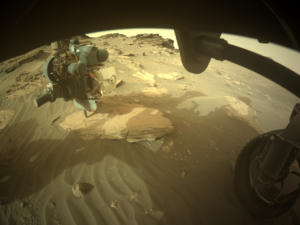
Mars rover onboard Front Right Hazard Avoidance Camera A image

NASA's Mars Perseverance rover acquired this image of the area in front of it using its onboard Front Right Hazard Avoidance Camera A. The image was acquired on July 12, 2022 (Sol 495), at the local mean solar time of 16:56:25.

 (Image Credit: NASA/JPL-Caltech)

Mysterious “String” Spotted by Mars Rover Suddenly Disappears

A piece of string-like material photographed on Mars by the Perseverance Rover just last week has suddenly disappeared, according to recent NASA photos obtained by its rover on the Red Planet.

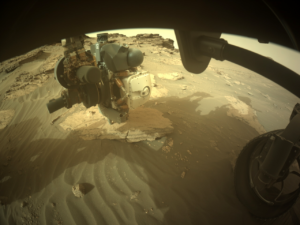
The wiry-looking substance many likened to a piece of string or thin pasta first appeared in photographs taken by the rover on July 12th, photos that were shared by NASA earlier this week. However, a photo taken four days later shows the string has somehow disappeared.

Mars String

Photo taken by Perseverance on July 12 shows Martian “string”

Image Credit NASA/JPL-CalTech

Mars String

Photo taken by Perseverance on July 16 reveals the “string” has disappeared.

Image Credit NASA/JPL-CalTech

Since landing on the red planet, humanity’s various rovers have made a habit of taking odd, unusual, often perplexing photos. In some cases, like the “flower” or recently discussed “door” on Mars, the photos ultimately proved to be natural formations instead of foreign objects.

Of course, Martian rovers bring their own junk with them. And many of the more infamous photos sent back from those rovers are of their own pieces of human-made debris.

NASA’s experts told the media the recent photograph is likely something artificial and not a natural formation masquerading as a manufactured object. However, rather than a remnant of a kite flown by E.T. on his Martian holiday, the same experts say this string was also probably a piece of material from the rover’s landing rocket.

“The string could be from the rover or its descent stage, a component similar to a rocket-powered jet pack used to lower the rover to the planet’s surface safely,” a Perseverance mission spokesperson at NASA’s Jet Propulsion Laboratory told CNN.

The same spokesperson concedes that the string was photographed in an area not previously visited by Perseverance but guessed that the string likely blew there on its own.

Either that. Or it has a completely different origin.

Adding more mystery to the mystery, when the rover passed over the same spot on July 16th, the string had magically disappeared. Once again, most suggest that the string left the same way it arrived, on a gust of wind.

Still, given the incredibly thin Martian atmosphere and the great lengths designers had to go through just to get the Ingenuity helicopter to grasp that atmosphere and take flight, it would take some mighty gusts of wind to send that string into and out of the same spot within a four day period. So, for now, at least, the mystery of the Martian string remains.

  • Follow and Connect with Author Christopher Plain on Twitter @plain_fiction

{ https://thedebrief.org/category/space/ }

Hoe vind je dit bericht?
Geschreven door peter om 21:54 Stuur door

U.S. Congressman Says UFOs May Be Machines of a Hidden ‘Ancient Earth Civilization’

U.S. Congressman Mike Gallagher UFOs

U.S. Congressman Says UFOs May Be Machines of a Hidden ‘Ancient Earth Civilization’

BY Vicky Verma

For over 90 years, the UFO enigma has captivated people’s minds worldwide, sparking curiosity, debates, and countless investigations into the phenomenon. The wait is over, as David Grusch, David Fravor & Ryan Graves are set to testify before the US Congress during the congressional meetings scheduled for July 26, 2023.

Meanwhile, various theories were postulated by United States Representative Mike Gallagher on the possible origin of UFOs while he appeared on Pat McAfee’s show on June 27, 2023. The former Marine suggested that unidentified flying objects (UFOs) might possibly represent an enigmatic “ancient civilization” that had remained hidden on Earth until recently when they began to surface.

“This should be an opportunity for the government to be transparent,” he said. “If we have information that disconfirms the extraterrestrial hypothesis, or all these other ones, at least it shows the government doing something competent and being forward-leaning by declassifying information to the public.”

Rep. Gallagher made this statement in response to the wild interview of David Grusch with Ross Coutlhart that hit the media. Mr. Grusch, who is confirmed to testify before Congress in the upcoming hearings, claimed that the US government has proof of alien life and that there are spacecraft from another species. He mentions that there is a significant number of these spacecraft, some of which have landed while others have crashed.

When asked about the duration of the cover-up, Grusch mentions that the first recovery of a UAP occurred in 1933 in Magenta, Italy, during the regime of Benito Mussolini. He explains that the Italian government moved the recovered craft to a secure air base until 1944-1945 when the Vatican informed the Americans about it

Appearing on the sports talk show, Gallagher suggested that one possible explanation of supposed UFO sightings was the so-called “Terminator” theory — derived from the film of the same name — that aliens were actually human beings from the future. Gallagher further put forth another theory, suggesting the following: “Instead of us from the future, it might indeed be an ancient civilization that has been lurking here, and suddenly it’s making its presence known.” Ancient Aliens, does it ring a bell?

A similar theory was also proposed by Tim Peake, one of Britain’s famous astronauts. He said that the UFOs filmed by the US military over 100 times could either time traveling humans or aliens from other civilizations. During an interview with Good Morning Britain in June 2022, Briton astronaut Tim Peake, who spent more than six months on the International Space Station, was asked about the UAP videos, which the Pentagon recently declassified.

Peake said: “I heard one theory where a pilot was talking about that potentially in the future, they’ve developed time travel – is it something that’s come back from the future?” He did not exactly say what the UFOs are but shared some theories that have long been discussed by UFOlogists.

“I don’t think it’s a development of any state nation or non-state organization at all. I think it’s quite remarkable when you see the video footage. It does seem extraordinary as to what these machines are capable of.”

Read also:

There is a huge buried UFO hidden outside the US, and Ross Coulthart claimed that he knows the location of this immovable craft. There is no confirmation from Coulthart about the nature of this craft if it was retrieved. However, some have speculated this could be an archeological dig. Could this particular craft potentially be a remnant of a bygone civilization?

Considering Rep. Gallagher’s theory, scientists have explored the possibility of detecting ancient civilizations in Earth’s geological record. A recent paper called “The Silurian Hypothesis” discusses how traces of industrial civilizations could be found. While fossils and artifacts are unlikely to survive over millions of years, anomalous changes in chemical compositions could serve as clues. By studying geological anomalies and applying models to other planets, scientists hope to understand if civilizations existed in the distant past.

NASA has spent many years seeking the truth regarding extraterrestrial life. Furthermore, the space agency has never denied the existence of non-human life beyond Earth in any form. This is sufficient to discuss the idea of non-human life existing beyond Earth in any form, from the microscopic to the macroscopic. Avi Loeb, a professor at Harvard, has supported the idea that there may have been earlier civilizations on both Earth and Mars, and that these civilizations may have been the origin of UAPs. (Click here to read the full article)

Mr. Loeb writes: “Planets like Mars or Earth could have given multiple births to technological civilizations that were a billion years apart and hence were not aware of each other. Like stable parents, the planets recovered from the environmental impact of these civilizations over time. We may have been separated in time from siblings that we never had the opportunity to meet and so we are unaware of their existence.”

Former Pentagon UFO official, Lue Elizondo, shared intriguing insights in an interview about crash retrievals and materials related to UFOs/UAPs. He believes the US government possesses exotic materials but lacks transparency on the matter. (Click here to read the full article)

Elizondo used an analogy of finding an out-of-place object in King Tut’s tomb to emphasize the significance of finding advanced materials before our known technology existed. Some interpreted this analogy as a hint that UFOs could be considered archaeological findings, possibly ancient rather than just old.

Interestingly, Bob Lazar, on the Joe Rogan Experience, mentioned hearing that at least one recovered UFO was found during an archaeological dig, suggesting its ancient origin. Astronomer Avi Loeb suggested that some advanced devices made by early inhabitants of Mars and Earth might still be operational elsewhere in the Solar System, potentially accounting for some Unidentified Aerial Phenomena reports.

Physicist John E. Brandenburg’s 2015 study speculated about a massive thermonuclear explosion that destroyed Mars’ once-Earthlike atmosphere, considering the Cydonian Hypothesis and Fermi’s Paradox. These ideas explore the possibility of ancient advanced civilizations in our solar system.


{ https://howandwhys.com/ }

Hoe vind je dit bericht?
Geschreven door peter om 21:41 Stuur door

Belief in alien visits to Earth is spiralling out of control – here’s why that’s so dangerous

DanieleGay/Shutterstock

Belief in alien visits to Earth is spiralling out of control – here’s why that’s so dangerous

The idea that aliens may have visited the Earth is becoming increasingly popular. Around a fifth of UK citizens believe Earth has been visited by extraterrestrials, and an estimated 7% believe that they have seen a UFO.

The figures are even higher in the US – and rising. The number of people who believe UFO sightings offer likely proof of alien life increased from 20% in 1996 to 34% in 2022. Some 24% of Americans say they’ve seen a UFO.

This belief is slightly paradoxical as we have zero evidence that aliens even exist. What’s more, given the vast distances between star systems, it seems odd we’d only learn about them from a visit. Evidence for aliens is more likely to come from signals from faraway planets.

In a paper accepted for publication in the Proceedings of the International Astronomical Union, I argue that the belief in alien visitors is no longer a quirk, but a widespread societal problem.

The belief is now rising to the extent that politicians, at least in the US, feel they have to respond. The disclosure of information about claimed Unidentified Anomalous Phenomena (UAPs rather than UFOs) from the Pentagon has got a lot of bi-partisan attention in the country.

Much of it plays upon familiar anti-elite tropes that both parties have been ready to use, such as the idea that the military and a secretive cabal of private commercial interests are keeping the deep truth about alien visitation hidden. That truth is believed to involve sightings, abductions and reverse-engineered alien technology.

Belief in a cover-up is even higher than belief in alien visitation. In 2019, a Gallop poll found that a staggering 68% of Americans believed that “the US government knows more about UFOs than it is telling”.

This political trend has been decades in the making. Jimmy Carter promised document disclosure during his presidential campaign in 1976, several years after his own reported UFO sighting. Like so many other sightings, the simplest explanation is that he saw Venus. (That happens a lot.)

Hillary Clinton also suggested she wanted to “open [Pentagon] files as much as I can” during her presidential campaign against Donald Trump. As seen in the video below, Trump suggested he’d need to “think about” whether it was possible to declassify the so-called Roswell documentation (relating to the notorious claimed crash of a UFO and the recovery of alien bodies).

Former president Bill Clinton claimed to have sent his chief of staff, John Podesta, down to Area 51, a highly classified US Air Force facility, just in case any of the rumours about alien technology at the site were true. It is worth nothing that Podesta is a long-time enthusiast for all things to do with UFOs.

The most prominent current advocate of document disclosure is the Democratic Senate leader Chuck Schumer. His stripped back 2023 UAP disclosure bill for revealing some UAP records was co-sponsored by three Republican senators.

Pentagon disclosure finally began during the early stages of Joe Biden’s term of office, but so far there has been nothing to see. Nothing looks like an encounter. Nothing looks close.

Still, the background noise does not go away.

Problems for society

All this is ultimately encouraging conspiracy theories, which could undermine trust in democratic institutions. There have been humorous calls to storm Area 51. And after the storming of the Capitol in 2021, this now looks like an increasingly dangerous possibility.

Too much background noise about UFOs and UAPs can also get in the way of legitimate science communication about the possibility of finding microbial extraterrestrial life. Astrobiology, the science dealing with such matters, has a far less effective publicity machine than UFOlogy.

History, a YouTube channel part owned by Disney, regularly delivers shows about “ancient aliens”. The show is now in its 20th season and the channel has 13.8 million subscribers. The Nasa astrobiology channel has a hard won 20,000 subscribers. Actual science finds itself badly outnumbered by entertainment repackaged as factual.

Alien visitation narratives have also repeatedly tried to hijack and overwrite the history and mythology of indigenous people.

The first steps in this direction go back to Alexander Kazantsev’s science fiction tale Explosion: The Story of a Hypothesis (1946). It presents the 1908 Tunguska meteorite impact event as a Nagasaki-like explosion of an alien spacecraft engine. In Kazantsev’s tale, a single giant black female survivor has been left stranded, equipped with special healing powers. This lead to her adoption as a shaman by the indigenous Evenki people.

Nasa and the space science community do support efforts such as the Native Skywatchers initiative set up by the indigenous Ojibwe and Lakota communities to ensure the survival of storytelling about the stars. There is a real and extensive network of indigenous scholarship about these matters.

But UFOlogists promise a far higher profile for indigenous history in return for the mashing together of genuine indigenous stories about life arriving from the skies with fictional tales about UFOs, repackaged as suppressed history.

The modern alien visitation narrative has not, after all, emerged out of indigenous communities. Quite the opposite. It emerged in part as a way for conspiracy-minded thinkers in a Europe torn apart by racism to “explain” how complex urban civilisations in places like South America could have existed prior to European settlement.

Squeezed through a new age filter of 1960s counterculture, the narrative was flipped to value indigenous people as having once possessed advanced technology. Once upon a time, according to this view, every indigenous civilisation was Wakanda, a fictional country appearing in American comic books published by Marvel Comics.

If all of this stayed in its own box, as entertaining fiction, then matters would be fine. But it doesn’t, and they aren’t. Visitation narratives tend to overwrite indigenous storytelling about sky and ground.

This is a problem for everyone, not just indigenous peoples struggling to continue authentic traditions. It threatens our grasp of the past. When it comes to insight into our remote ancestors, the remnants of prehistoric storytelling are few and precious, such as within indigenous storytelling about the stars.

Take the tales of the Pleiades, which date back in standard forms to at least 50,000 years ago.

This may be why these tales in particular are heavily targeted by alien visitation enthusiasts, some of whom even claim to be “Pleiadeans”. No surprises, Pleiadeans do not look like the Lakota or Ojibwe, but are strikingly blond, blue-eyed and Nordic.

It is increasingly clear that belief in alien visitation is no longer just a fun speculation, but something that has real and damaging consequences.

RELATED VIDEOS

{ https://theconversation.com/europe/newsletters/ }

Hoe vind je dit bericht?
Geschreven door peter om 18:26 Stuur door

Alien life is no joke

Alien life is no joke

Not long ago the search for extraterrestrials was considered laughable nonsense. Today, it’s serious and scientific

A hazy trail of pink gas is expelled from a bright light representing black hole M87 in the darkness of space with the words "JWST NIRCAM" on the bottom of the image

JWST captures clearest-ever image of M87 galaxy's supermassive black hole jet

Adam Frank,

Suddenly, everyone is talking about aliens. After decades on the cultural margins, the question of life in the Universe beyond Earth is having its day in the sun. The next big multibillion-dollar space telescope (the successor to the James Webb) will be tuned to search for signatures of alien life on alien planets and NASA has a robust, well-funded programme in astrobiology. Meanwhile, from breathless newspaper articles about unexplained navy pilot sightings to United States congressional testimony with wild claims of government programmes hiding crashed saucers, UFOs and UAPs (unidentified anomalous phenomena) seem to be making their own journey from the fringes.

What are we to make of these twin movements, the scientific search for life on one hand, and the endlessly murky waters of UFO/UAP claims on the other? Looking at history shows that these two very different approaches to the question of extraterrestrial life are, in fact, linked, but not in a good way. For decades, scientists wanting to think seriously about life in the Universe faced what’s been called the ‘giggle factor’, which was directly related to UFOs and their culture. More than once, the giggle factor came close to killing off the field known as SETI (the search for extraterrestrial intelligence). Now, with new discoveries and new technologies making astrobiology a mainstream frontier of astrophysics, understanding this history has become important for anyone trying to understand what comes next. But for me, as a researcher in the field of technosignatures (signs of advanced alien tech) – the new face of SETI – getting past the giggle factor poses an existential challenge.

I am the principal investigator of NASA’s first ever grant to study signatures of intelligent life from distant exoplanets. My colleagues and I are tasked with developing a library of technosignatures or evidence of technology-wielding life forms on distant planets. Taking on that role has been the culmination of a lifetime fascination with the question of life and the Universe, a fascination that formed when I was a kid in the 1970s, drinking deep from the well of science fiction novels, UFO documentaries and Star Trek reruns. Early on, as a teenager reading both Carl Sagan and Erich von Däniken (the author of Chariots of the Gods), I had to figure out how to separate the wheat from the chaff. This served as a kind of training ground for dealing with questions facing me and my colleagues about proper standards of evidence in astrobiology. It’s also why, as a public-facing scientist, I must work to understand how people not trained in science come to questions surrounding UFOs as aliens. That is what drove me, writing a recent popular-level account of astrobiology’s frontiers called The Little Book of Aliens (2023), to stare hard into the entangled history of UFOs, the scientific search for life beyond Earth, and the all-important question of standards of evidence.

The question of what constitutes evidence for an extraordinary claim made its appearance in the very first major UFO story. It was 24 June 1947, a good day for flying in the Pacific Northwest. The skies were clear and bright over Mineral, Washington. It was the middle of the day as the amateur pilot Kenneth Arnold found himself navigating his small single-engine plane past the towering peak of Mount Rainier toward an air show in Oregon. But he’d heard that a US Marine Corps transport plane had gone missing, and a reward was being offered for anyone who found its wreckage. Arnold decided to make a few circuits and have a look. He didn’t know it at the time, but he was flying straight into UFO history.

As Arnold surveyed the terrain below him, he saw a flash of light with a blue tinge. A DC-4 was flying off in the distance, but there were no flashing lights coming from it. Then the flashes appeared again. This time he saw exactly where they were coming from: nine objects flying in a diagonal formation, ‘like the tail of a Chinese kite’. Arnold watched as the objects banked and turned in ways that made him think he was watching some kind of advanced military aircraft, until they finally disappeared. The entire incident didn’t last long, but it left Arnold with ‘an eerie feeling’. After landing to refuel, he shared his story with friends at the airfield. What happened next would echo down history, shaping everything we think about UFOs and their connection to aliens from outer space.

Arnold’s tale spread quickly, and reporters from the East Oregonian asked him to come in and give more details. To the newspapermen, Arnold seemed like a credible witness and a careful observer. Laying out the timeline of what he saw, Arnold described both the craft and their motions. Exactly what happened next remains controversial, but when Arnold described the objects as moving like ‘a saucer if you skip it across the water’ he triggered a chain of events leading to one of the most outrageous misquotes in the history of journalism.

The story in the East Oregonian, a small paper, ran with the words ‘saucer-like aircraft’. But, when the Associated Press picked up the story, the description got even more garbled. What Arnold said he’d seen were flying craft shaped like a crescent with ‘wings’ that swept back in an arc. Somehow the AP wire story misinterpreted Arnold’s description, leading The Chicago Sun to run a story with a spectacular frontpage headline: ‘Supersonic Flying Saucers Sighted By Idaho Pilot.’

The Chicago Sun piece triggered an avalanche. Within six months, the flying saucer story ran in more than 140 newspapers across the US. Even more remarkable, an epidemic of flying-saucer sightings began to sweep the nation. By the end of summer in 1947, ‘flying saucers’ were officially a thing.

What’s important about the Roswell story is how loose even the idea of evidence becomes

One of the most important lessons I learned from the Arnold affair is the power of a story. Arnold saw the first flying saucer, and his sighting begins a critical thread in the public’s willingness to go along on evidence-free rides of thinking about aliens and UFOs. It was where the idea of technologically advanced, interstellar life here on Earth right now enters the public consciousness as a major phenomenon. But almost as quickly as UFOs appear, so does a UFO culture that tilts towards the incredulous and the paranoid, marked by a willingness to take anything as evidence. Of course, one could find many individuals taking an interest in UFOs while keeping their sceptical sensibilities, who just genuinely wanted to know what was going on. But, as a cultural phenomenon, public discussion of UFOs would come to be dominated by questionable evidence, conspiracy theories and outright hoaxes.

The Roswell affair embodies the most questionable evidence axis of UFO culture. The actual Roswell case involves a rancher who, just a few weeks after the Arnold sighting and its media craze, found some debris on his land made of sticks, wire and foil. While a short, initial hubbub ensued when a story in the local paper claimed the discovery of a flying saucer (what else), that claim was walked back the next day.

The brief affair was then forgotten for 30 years. It was only after that prolonged period that the Roswell story was resurrected in a series of bestselling books and TV ‘documentaries’ claiming a crashed saucer had been found on the ranch. But with each new book, the Roswell story became more complex and convoluted. Each new book added more so-called witnesses and more details, including the account of the mortician Glenn Dennis getting a chance to view the dead aliens. Some books said there were more saucers and more aliens, some dead and some not. Some even said alien bodies were viewed by none other than president Dwight Eisenhower.

What’s important about the Roswell story is how loose even the idea of evidence becomes. Anyone with a vague connection to the events and a story to tell gets added to the list of witnesses. New books pile on old books and theories multiply until even those claiming to be serious UFO researchers can’t sort out which version with how many saucers and bodies is the one they’re supposed to investigate; garden-variety enthusiasts are beyond confused.

While this might have seemed amusing to those on the sidelines at the time, it established a pattern of ‘anything goes’ in the public’s perception of UFOs and, by association, the question of alien life that continues to this day.

That loose relationship between extraordinary claims and the evidence for such claims also had a profound effect on me as a teenager interested in astronomy and the possibilities of extraterrestrial life.

At the time, I was reading both hard-science books (Sagan) and speculative works about UFO-related topics. For a time, I’d become enamoured of von Däniken’s book Chariots of the Gods (1968) and its claims that many archaeological mysteries could best be explained by ancient aliens who had once come to visit Earth. That time ended when, one evening, I chanced upon a PBS documentary called The Case of the Ancient Astronauts (1977). It presented interviews with scientists who had actually spent their lives studying the subjects of von Däniken’s ancient alien speculations. The simplicity with which hard-won archaeological evidence trumped von Däniken’s claims left me both angry (I felt duped by his book) and exhilarated. The establishment of proper standards for what counts as evidence is what set the archaeologists apart from von Däniken’s wishful fantasies. The experience of that stark difference ended my own interest in UFOs and visiting aliens of any historical epoch.

If it hadn’t made me so angry, it might have made me laugh – and it’s that giggle factor that has been so harmful to the establishment of the true scientific study of astrobiology that I work in now. When it comes to SETI, at least, UFOs made the nascent field an easy target for scorn. The first true SETI project occurred in 1960, when a young astronomer named Frank Drake used a radio telescope to search for ‘non-natural’ signals from two Sun-like stars. While Drake was looking for an intelligent life that could build technologies like radio transmitters, his project, in attempting to establish evidence for life beyond Earth, was the first true astrobiological experiment ever attempted.

Recognising Drake’s effort as the starting point for modern astrobiology is a rarely discussed but critical point. It’s also essential to understanding the remarkable moment the field stands in now because Drake’s search took that critical idea of standards of evidence seriously. In the design and application of his experiment, Drake and his colleagues paid close attention to questions of signals, noise and, most of all, false positives. They understood that they could be fooled into thinking they’d made a discovery by the data they gathered, and they attempted to prepare and protect themselves from that possibility. Drake’s SETI project and those that followed always attracted enormous popular attention. But building the field into a coherent, sustained scientific enterprise proved difficult, and it is here that UFOs got in the way.

In SETI’s heady first decades, a number of government science agencies had a healthy interest in the search for life, intelligent or otherwise. It was the US National Academy of Sciences that hosted an Interstellar Communications meeting where the Drake equation was born. And NASA was keen to go microbe hunting on the other planets in our solar system if they could be reached. As the 1960s turned into the ’70s, SETI scientists also worked with NASA in ways that went beyond radio astronomy, helping plan new telescope technologies for hunting exoplanets. There was even consideration of Project Cyclops, a massive array of a thousand radio telescopes sensitive enough to find unprecedentedly faint signals of intelligent life among the stars.

In all these projects, the scientists involved had to face the challenging task of understanding how to gather and evaluate evidence while simultaneously facing profound uncertainties concerning the target of that evidence. Researchers were well aware that, while we must begin with life as we know it (that is, Earth life), nature might have other ideas. Life, intelligent or otherwise, originating on a different world could follow entirely different trajectories. Though the field was nascent, astrobiology researchers made slow but steady progress in mapping out how to rigorously gather and evaluate data that would be relevant to the very open question of how life beyond our world might make its appearance.

The public political flogging of SETI as wasteful kookiness, with an implicit link to UFO kookiness, had begun

Then the politics and the UFOs showed up.

William Proxmire was a senator from Wisconsin who liked to think of himself as a fiscal hawk. He took it upon himself to bestow his Golden Fleece Award on anything he considered a waste of US tax dollars. Since the science projects he targeted got only meagre amounts of funding, Proxmire’s award was basically clever politics aimed at targets who couldn’t fight back. In 1978, NASA’s small portfolio of SETI funding fell into Proxmire’s crosshairs. He gave SETI the Golden Fleece Award and, being a powerful and influential senator, got his colleagues to keep the agency from providing any new funding. Proxmire only relented after Sagan, by then a well-respected public scientist, publicly intervened, meeting personally with the senator to discuss the issue. While the ban on SETI funding was eventually lifted in 1983, the public political flogging of SETI as wasteful kookiness, with an implicit link to UFO kookiness, had begun.

NASA’s SETI funding remained minuscule in the post-Proxmire period, but it was still a target. In 1990, NASA tried to ramp up its SETI funding, from $4 million to $12 million, for a new search in the microwave region of the electromagnetic spectrum. While this is less than chump change in the federal budget, some politicians once again smelled blood. Making the link to UFOs explicit, the congressman Silvio Conte of Massachusetts tried to kill the funding, claiming ‘we don’t need to spend $6 million this year to find evidence of these rascally creatures. We only need 75 cents to buy a tabloid at the local supermarket.’

The same game played out again a few years later. In 1993, those $12 million were finally allocated for the new search. Not wanting to attract more congressional attention, the project was stealthily called the High Resolution Microwave Survey. Unfortunately, the senator Richard Bryan from Nevada caught wind of the effort and saw it as an easy chance to make some headlines. He sponsored an amendment killing the project, announcing that would be ‘the end of Martian hunting season at the taxpayer’s expense’. Of course, Bryan knew NASA wasn’t planning on turning their telescopes towards Mars, but who cared? His quip made for great copy and linked SETI to the cultural fringes where UFO enthusiasm lived. What became known as the ‘giggle factor’ had killed the search for life in the Universe again.

In the wake of these very public whippings, NASA learned the lesson that SETI was political poison. While SETI scientists such as Drake and the unstoppable Jill Tarter did their best to show that the field lived within those necessary scientific standards of evidence, the damage was done. While the agency did what it could in the decades that followed, it became an accepted truth among researchers that federal support was going to be hard to come by. SETI scientists soldiered on, raising private money where they could. But, for all intents and purposes, it was running on fumes. The giggle factor had won.

Choking off SETI funding had important consequences for the search for life in the Universe because, basically, it meant there was no search for life in the Universe. Using big telescopes costs big money. If there was no funding for SETI, then no telescope time would be granted for SETI. The political temperament that held sway for so long means our sky has effectively remained unexplored. We simply have not looked.

It’s impossible to deny the role UFOs had in the development of this history. As the historian Stephen Garber put it in an article about SETI and NASA, the field ‘had always suffered from a “giggle factor” that derived from its association in the popular press with searchers for “little green men” and unidentified flying objects’. Because of this association, astronomers never got the chance to get a real search started.

In the early 1990s, it did seem that no one was very interested in the scientific possibilities for life beyond Earth. NASA’s 1976 Viking landers conducted biology experiments on Mars that appeared to close the door on the Red Planet as a home for even microbial life. The trail for life of any kind seemed to have gone cold.

Then, in the mid-1990s, everything changed.

In 1995, scientists announced that they had discovered the first planet orbiting another star – an exoplanet. It was an epoch-making moment. After 2,500 years of arguing about the existence of other worlds, we’d finally proven that the planets in our solar system were not a rarity. Soon, exoplanets were being discovered across the sky. Now we know that pretty much every star you see at night hosts a family of worlds. The next big change came when scientists found a chunk of Mars in Antarctica. The meteorite blown off the red planet (from an ancient asteroid impact) appeared to have signs of fossil life. While that conclusion is no longer accepted, at the time it drove president Bill Clinton to direct NASA to go back to Mars and look for life. Between the discovery of exoplanets and the possibilities of ancient life on Mars, NASA got into astrobiology in a big way. Funding for new research opened up, allowing new and exciting ideas to be proposed and pursued.

Remarkably, when it comes to exoplanets, we are now also able to see exactly which planets are in their star’s habitable zone, where liquid water (the key, we believe, for life) can exist. That means we know exactly where to look in our search for life (something Drake could only dream of).

Even more remarkably, astronomers have learned how to look for alien life on alien worlds using starlight that’s traversed the world’s atmosphere and is then absorbed by a variety of chemicals on the surface. This means we can search for biosignatures – signatures of chemicals that could be in a planets’ atmosphere only because life has put it there.

An open investigation of UAPs could offer a masterclass in how science goes about its business of knowing

Spectacular advances in the hunt for biosignatures have meant a profound refinement in the all-important standards of evidence. The earliest version of a biosignature was the presence of oxygen in an alien atmosphere. On Earth, oxygen is a significant atmospheric constituent only because photosynthetic organisms keep it there. Over the past decade, however, astronomers have discovered key mechanisms through which planets without life might generate oxygen-rich air. This was a crucial step in developing methods for evaluating false positives – the ways we think we’ve gained evidence for life but are, in fact, being fooled. Sophisticated statistical methods for evaluating false positives, as well as other challenges astrobiological evidence will present, are now a robust part of biosignature science.

All these new discoveries and new methods are transforming what we think of as SETI too. A new research field is rising that scientists are calling technosignatures, which embraces the ‘classic’ efforts of SETI while taking the search for intelligent life into new forms and new directions. (Some scientists still use SETI to refer to the field and that’s OK. But for many, including myself, ‘technosignatures’ correctly captures all that is changing in the field.) Rather than planning for someone to set up a beacon announcing their presence (one premise of the first generation of SETI), we can now look directly at the planets where those civilisations might be just going about their business of ‘civilisation-ing’. By searching for signatures of an alien society’s day-to-day activities (a technosignature), we’re building entirely new toolkits to find intelligent, civilisation-building life.

It was in 2019 that NASA awarded me and my colleagues the first grant to study atmospheric technosignatures. While there are still only a handful of technosignature grants compared with biosignature studies, it was the first indication that the giggle factor was finally waning. Since then, our group has worked hard to provide new examples of possible technosignatures including some that might be searched for with the James Webb Space Telescope. We’ve also demonstrated that there is no reason to suppose that biosignatures will be more common than technosignatures. Since the exact same techniques are required to search for both bio- and technosignatures, there’s every reason to carry out both kinds of search at the same time.

And those standards of evidence developed for biosignature searches will be just as relevant for technosignature work. Our group, led by the astrophysicist Manasvi Lingam from the Florida Institute of Technology, recently published the first work attempting to lay out a framework for evaluating false positives in technosignatures. While there is enormous work ahead of us, it’s projects like these that will allow us to fully understand the confidence we can ascribe to any claim of an intelligent-life detection.

With the giggle factor receding for the scientific search for life, where does that leave UFOs and UAPs? There, the waters remain muddied. It is a good thing that pilots feel they can report sightings without fear of reprisal as a matter of air safety and national defence. And an open, transparent and agnostic investigation of UAPs could offer a masterclass in how science goes about its business of knowing rather than just believing. In The Little Book of Aliens, I even explained how such an investigation might be conducted (the recent NASA UAP panel and the Galileo Project are exploring these kinds of options). But if my colleagues and I claimed we’d found life on another world, we’d be required to provide evidence that meets the highest scientific standards. While we should let future studies lead us where they may, there is simply no such evidence surrounding UFOs and UAPs that meets these standards today. In fact, at a recent hearing conducted by NASA’s UAP panel, it was revealed that government studies show only a small percentage of reported sightings failed to find a reasonable explanation. Many of the remaining cases did not have enough data to even begin an attempt at identification. The sky is simply not awash in unexplained phenomena.

In the end, what matters is that, after thousands of years of arguing over opinions about life in the Universe, our collective scientific efforts have taken us to the point where we can finally begin a true scientific study of the question. The next big space telescope NASA is planning will be called the Habitable Worlds Observatory. The name tells you all you need to know. We’re going all in on the search for life in the Universe because we finally have the capabilities to search for life in the Universe. The giggle factor is finally history.

{ https://aeon.co/ }

Hoe vind je dit bericht?
Geschreven door peter om 18:08 Stuur door

October MUFON eNewsletter- with the Monthly Sighting Statistics!

October MUFON eNewsletter- with the Monthly Sighting Statistics!

COUNTRIES OF THE WORLD

UNITED STATES 373

CANADA 30

UNITED KINGDOM 18

FRANCE 10

AUSTRALIA 7

GERMANY 4

SWITZERLAND 4

PORTUGAL 3

BRAZIL 3

AUSTRIA 3

SPAIN 3

HUNGARY 3

MOROCCO 2

NETHERLANDS 2

TURKEY 2

FINLAND 2

ITALY 2

POLAND 2

CHINA 2

IRELAND 2

NORWAY 2

KOREA, (South) 1

INDIA 1

THAILAND 1

AFGHANISTAN 1

CYPRUS 1

ISRAEL 1

PERU 1

KUWAIT 1

IRAQ 1

ARGENTINA 1

BELGIUM 1

LEBANON 1  

TOTAL: 491

SHAPE

Sphere 75

Circle 60

Other 50

Unknown 38

Triangle 34

Star-like 33

Oval 30

Disc 16

Cylinder 14

Boomerang 13

Fireball 11

N/A 11

Cigar 9

Square/Rectangular 9

Egg 8

Tic Tac 8

Flash 5

Chevron 5

Teardrop 4

Bullet/Missile 3

Saturn-like 2

Diamond 2

Cross 2

Blimp 1

Cone 1

ALL STATES OF THE U.S.A.

California 44

Michigan 24

Florida 19

Texas 18

New York 16

Washington 14

Arizona 12

Missouri 11

Ohio 11

Pennsylvania 11

Tennessee 10

Indiana 10

Georgia 9

Arkansas 9

Oklahoma 9

Colorado 9

North Carolina 8

New Jersey 8

Connecticut t7

Minnesota 7

New Mexico 7

South Carolina 7

Alabama 6

Utah 6

Idaho 6

Maryland 6

Kansas 5

Nevada 5

Massachusetts 5

Delaware 4

Wisconsin 4

Louisiana 4

Maine 4

Oregon 4

Virginia 4

Iowa 3

Rhode Island 3

West Virginia 3

Mississippi 3

North Dakota 3

Nebraska 3

Vermont 3

Illinois 3

New Hampshire 2

Kentucky 1

Alaska 1

Montana 1

Hawaii 1

DISTANCE

< 100 ft 61

101-500 ft 55

501 ft - 1 Mile 72

Over 1 Mile 99

Unknown 61

NO VALUE 32

ERT

Most impressively there were 17 Landings, Hovering, or Takeoffs reported, and 38 Entities observed.

{ MUFON }

Hoe vind je dit bericht?
Geschreven door peter om 17:34 Stuur door

The Hellfire UAP Strike Video: A MUFON Analysis of the evidence presented at the September 2025 Congressional Hearing

The Hellfire UAP Strike Video: A MUFON Analysis of the evidence presented at the September 2025 Congressional Hearing

by Seth H. Feinstein, Colorado State Director, Photo Analysis Team

On September 9, 2025, the most recent UAP congressional hearing on Capitol Hill featured four firsthand witnesses, investigative journalist George Knapp, and a newly declassified video. For purposes of discussion, this video has been informally titled “The Hellfire UAP Strike.” The symbol appearing on the video itself—LRD LASE DES— this is a normal Hellfire target acronym.

This was the sixth in a series of congressional hearings on UAPs. Previous hearings—supported by videos, testimonies from military personnel, and intelligence whistleblowers—were intended to foster transparency, accountability, and public education on the UAP topic. All videos shown publicly had to be declassified beforehand, a process managed by the former Department of War (DOW) formerly the (DOD). Within the DOW, the All-Domain Anomaly Resolution Office (AARO) holds the authority to declassify analyzed UAP data. AARO declassified and released the Hellfire UAP Strike video for public viewing.

Context of UAP Video Releases

The public release of UAP footage has coincided with congressional hearings dating back to 2017. In December of that year, The New York Times played a pivotal role in publicizing the “Tic Tac, “Gimbal,” and “Go-Fast” videos, with support from To the Stars Academy of Arts and Science (TTSA). This raised enduring questions: Did the DOW strategically use media outlets and TTSA to promote disclosure, or were the videos leaked without the department’s full knowledge?

Key examples of UAP-related video evidence include:

  • Tic Tac (2004) – Declassified in 2017; widely discussed during the 2022 House Intelligence Committee and 2023 House Oversight Committee hearings.
  • Gimbal (2015) and Go-Fast (2015) – Both declassified and released in 2017.
  • Pyramid-shaped UAP (2022) – Shown in closed sessions; not declassified.
  • Hellfire UAP Strike (2024) – Declassified and released in September 2025; reportedly filmed off the coast of Yemen on October 30, 2024.

Expert Reactions to the Hellfire UAP Strike Video

Members of the MUFON Photo Analysis Team, including Marc Dantonio, Dennis Freyermuth, and Greg Cisko, have offered preliminary assessments.

  • Marc Dantonio highlighted three major observations:

1. The object appeared to be struck by a missile without triggering an explosion—suggesting a “soft” target.

2. The object fragmented into several smaller pieces that began to fall.

3. The apparent speed of the object could not be determined without knowing the aircraft’s velocity.

Dantonio theorized that the target could have been a balloon rather than a UAP. According to him, the missile’s pass-through without detonation, the breakup pattern, and the background-motion illusion caused by the aircraft’s speed all support this interpretation.

  • Dennis Freyermuth expressed skepticism about the video’s authenticity, noting that it appears cropped and edited. He raised the possibility of a classified military test or a deliberate misdirection. Freyermuth also speculated that the missile might be the AGM-114 R9X “Ninja” variant, which deploys blades instead of explosives for precision strikes.
  • Greg Cisko produced two YouTube analyses of the event. His frame-by-frame review concluded that the missile hit the object, which then released three secondary objects. Cisko also noted an apparent “energy surge” in the UAP as it rotated to face the incoming missile—behavior reminiscent of Cmdr. David Fravor’s 2004 “Tic Tac” encounter, where the object reportedly mirrored his aircraft’s movements. Cisko referenced reports of distressed UAPs ejecting pods, including parallels drawn to Roswell.

Technical Background

The tracking drone was reportedly an MQ-9 Reaper, widely used for surveillance, reconnaissance, and precision strikes. With a wingspan of 66 feet, a top speed of 300 mph, and an operational ceiling of 50,000 feet, it can carry Hellfire missiles. Because of the Reaper’s speed limit, the object it was tracking was likely moving below 300 mph—far slower than what is typically considered a UAP “observable” (no abrupt maneuvers, trans-medium travel, or extreme acceleration other accepted observables were evident).

Some have speculated the orb had impact-resistant coatings or continued its flight after the missile strike, but these claims remain unverified. The video released by AARO ends before any follow-up footage is shown, preventing full analysis.

Balloon Hypothesis

Research into high-altitude balloons reveals that many can reach speeds between 60–125 mph, depending on altitude and wind layers. Advanced balloons can exploit wind currents to adjust speed and direction. NASA’s experimental “rockoon” (rocket-balloon hybrid) systems also exist. These balloons are used in military experiments.

The orb in the Hellfire video resembles a balloon in shape and behavior. After impact, theprimary object appears deflated. Wind drag, tethering, or structural tilts could explain its movements. This supports Marc Dantonio’s balloon theory.

Competing Theories

  • Balloon Hypothesis (Dantonio): The orb was likely a balloon, making the missile strike a misallocation of resources.
  • Classified Military Test (Freyermuth): The event may have been a covert field test or military training exercise released under the guise of a UAP.
  • Hybrid Theory: Combining both arguments suggests the Hellfire video might depict a rockoon military training event rather than a genuine UAP encounter.
  • UAP Theory (Cisko): As with the well-documented 2004 Nimitz encounter, where Commander David Fravor witnessed a "Tic Tac" UAP align itself with his aircraft. This UAP theory then suggests a historical precedent for entity retrieval, referencing accounts from the Roswell incident where three pods containing occupants were allegedly ejected from a UAP following a targeted attack.

Conclusion: A Call for Transparency

The released Hellfire UAP Strike video is cropped, edited, and unverifiable. Its narrative relies heavily on anecdotal interpretation, and without the complete, unaltered footage, analysts cannot confirm its authenticity. AARO’s release fails to meet the standards of genuine disclosure.

Until the original, unaltered video is released for independent analysis by groups like MUFON, the public is left with speculation rather than evidence. As it stands, the Hellfire UAP Strike video represents a “nothing burger”—a heavily mediated artifact presented as disclosure but offering no verifiable proof of non-terrestrial technology.

Most importantly, this video analysis and assessment deals with a controversial subject. The conclusion presented here is not the only possible interpretation; however, it is based on available supporting facts and evidence revealed with this declassified release. The assessments and conclusion reported are subject to an update should future evidence suggest such a change.”

View the MUFON Analysis video on YouTube at: https://youtu.be/PAKeje-LuKQ

c0d4f65d-1cde-490e-aeb2-a844c267a788.png?rdr=true

c0d4f65d-1cde-490e-aeb2-a844c267a788.png?rdr=true

c25966fb-28cb-4fc0-a37e-da22618e76c4.png?rdr=true

RELATED VIDEOS

{ MUFON }

Hoe vind je dit bericht?
Geschreven door peter om 17:29 Stuur door

China’s humanoid robot head startles viewers with lifelike facial expressions

China’s humanoid robot head startles viewers with lifelike facial expressions

The company aims to improve how humans and robots interact.

Hoe vind je dit bericht?
Geschreven door peter om 16:03 Stuur door

Microbes trapped in permafrost AWAKEN after 40,000 years – as scientists warn they could spark the next pandemic

Microbes trapped in permafrost AWAKEN after 40,000 years – as scientists warn they could spark the next pandemic

It may sound like the start of a horror film, but ancient infectious lifeforms are being brought back to life. 

Scientists at the University of Colorado Boulder have deliberately resurrected microorganisms that have been frozen in Alaska for around 40,000 years. 

These tiny bugs, invisible to the naked eye, have been trapped in 'permafrost' – frozen earth material containing soil, rock and ice. 

In controlled experiments, the scientists discovered that if you thaw out permafrost, the microbes don't immediately become active. 

But after a few months, like waking up after a long nap, they begin to form flourishing colonies.

Worryingly, the microbes have the potential to unleash dangerous pathogens that could spark the next pandemic.

'These are not dead samples by any means,' warned study author Dr Tristan Caro, a geological scientist at University of Colorado Boulder. 

What's more, as they reawaken, the microorganisms release carbon dioxide (CO2), a greenhouse gas that fuels global warming. 

Back in 2022, an ancient virus called Pandoravirus that had lain frozen in Siberian permafrost for 48,500 years was revived. Pictured, digital rendering of Pandoravirus

Back in 2022, an ancient virus called Pandoravirus that had lain frozen in Siberian permafrost for 48,500 years was revived. Pictured, digital rendering of Pandoravirus

For their experiments, the team travelled to Alaska's Permafrost Research Tunnel - an underground passage dug through permafrost in the 1960s

For their experiments, the team travelled to Alaska's Permafrost Research Tunnel – an underground passage dug through permafrost in the 1960s

For their experiments, the team travelled from Colorado to the Permafrost Research Tunnel near Fairbanks in Alaska, just south of the Arctic Circle. 

This spooky underground passage was dug through permafrost in the 1960s for the purpose of facilitating scientific research into climate change. 

Described as an 'icy graveyard', permafrost is a frozen mix of soil, ice and rocks that underlies nearly a quarter of the land in the northern hemisphere.

The team collected samples of permafrost that was a few thousand to tens of thousands of years old from the walls of the tunnel. 

They then added water to the samples and incubated them at temperatures of 3°C (39°F) and 12°C (54°F) – which is chilly for humans but warm for the Arctic. 

'We wanted to simulate what happens in an Alaskan summer, under future climate conditions where these temperatures reach deeper areas of the permafrost,' Dr Caro said.

Although the microbes 'likely couldn't infect people', the team kept them in sealed chambers regardless. 

In the first few months, the colonies grew gradually, in some cases replacing only about one in every 100,000 cells per day – described as a 'slow reawakening'. 

Robyn Barbato of the Cold Regions Research and Engineering Laboratory drills a sample from the walls of the Permafrost Research Tunnel

Robyn Barbato of the Cold Regions Research and Engineering Laboratory drills a sample from the walls of the Permafrost Research Tunnel

Permafrost is ground that remains permanently frozen even during summer months. Pictured, melting ice in the Arctic in spring

Permafrost is ground that remains permanently frozen even during summer months. Pictured, melting ice in the Arctic in spring

What is permafrost?

Permafrost is ground that’s remained frozen for at least two consecutive years – and in some regions of the Arctic, it’s been frozen for tens of thousands.

It stretches across vast expanses of Siberia, Alaska, northern Canada, and Greenland, acting as a natural deep freezer for ancient organic material. 

As global temperatures rise, this permafrost is thawing faster and deeper than expected, revealing microbes, biological matter, animal bones, plants and more.

However, within six months, microbial communities underwent 'dramatic changes', forming strong communities distinct from the surrounding surfaces. 

Some had formed 'biofilms' – slimy layers made from a thriving community of micro–organisms that are hard to remove. 

Overall, the results suggest it could take a few months for microbes to become active enough that they begin to emit greenhouse gases into the air in large volumes following a hot spell. 

But this suggests that the longer Arctic summers last, the more likely microbes will become thawed and reawaken.

'You might have a single hot day in the Alaskan summer, but what matters much more is the lengthening of the summer season to where these warm temperatures extend into the autumn and spring,' Dr Caro said. 

Thawing could lead to the release of the permafrost’s enormous reserves of greenhouse gases CO2 and methane, an even more potent greenhouse gas. 

The study, published in Journal of Geophysical Research: Biogeosciences, also notes that microbes in permafrost rely on different kinds of fatty lipids to construct their cell membranes.

These compounds may have helped them survive freezing, dark conditions for millenia.

The ability of the microbes to survive for so long before reawakening is triggering concerns that the melting Arctic could release a deadly disease, new to humanity. 

One possible defence is that permafrost–based microbes need to find a host in order to survive and spread, like an animal. 

Fortunately, permafrost is remote by nature because it is found in high–latitude and high–altitude regions. 

article image

Still, it may only take a single unfortunate infection scenario for such a microbe to make the initial jump to a wild mammal or human. 

Back in 2022, an ancient virus called Pandoravirus that had lain frozen in Siberian permafrost for 48,500 years was revived.

Although the viruses are not considered a risk to humans, scientists warned that other viruses exposed by melted ice could be 'disastrous' and lead to new pandemics. 

Dr Brigitta Evengård, an infectious disease specialist from Sweden, thinks there could be possible pandemics from the Arctic that are caused by bacteria highly resistant to antibiotics. 

'The two that we know could come out of the permafrost are anthrax and pox viruses, other than that it’s pandora's box,' she told Greenpeace. 

KILLER VIRUSES COULD BE RELEASED FROM MELTING ICE IN THE ARCTIC, STUDY WARNS 

Glaciers that are melting amid rising global temperatures could be the cause of the next deathly pandemic, a study said. 

Scientists investigated how climate change may affect the risk of 'spillover' – a virus jumping to another species – by examining samples from Lake Hazen in the Arctic. 

Lake Hazen, seen from above in this NASA image, is the largest High Arctic freshwater lake in the world

Lake Hazen, seen from above in this NASA image, is the largest High Arctic freshwater lake in the world

They found that the chance of a spillover event increases with the melting of glaciers, as the meltwater can transport pathogens to new hosts. 

A warming climate could bring viruses in the Arctic into contact with new environments and hosts, increasing the risk of this 'viral spillover', the experts warn. 

'Spillover risk increases with runoff from glacier melt, a proxy for climate change,' say the researchers in their paper, published in Proceedings of the Royal Society B. 

'Should climate change also shift species range of potential viral vectors and reservoirs northwards, the High Arctic could become fertile ground for emerging pandemics.' 

RELATED VIDEOS

{ https://www.dailymail.co.uk/sciencetech/index.html }

Hoe vind je dit bericht?
Geschreven door peter om 15:39 Stuur door

Interstellar comet 3I/ATLAS encounters Mars: NASA and ESA conduct observations

Interstellar comet 3I/ATLAS encounters Mars: NASA and ESA conduct observations

On October 3, interstellar comet 3I/ATLAS flew past Mars. This encounter was monitored by a fleet of spacecraft studying the Red Planet.

Interstellar comet 3I/ATLAS in a photograph taken by the Gemini South Observatory. Source: International Gemini Observatory/NOIRLab/NSF/AURA/Shadow the Scientist

Comet 3I/ATLAS was discovered in early July. It became the third confirmed object of interstellar origin found in our Solar System. At the same time, it differs significantly from its predecessors in many of its characteristics. 3I/ATLAS is larger than Borisov’s interstellar comet and the asteroid Oumuamua, moves at a higher speed, and is most likely several billion years older than the Solar System.

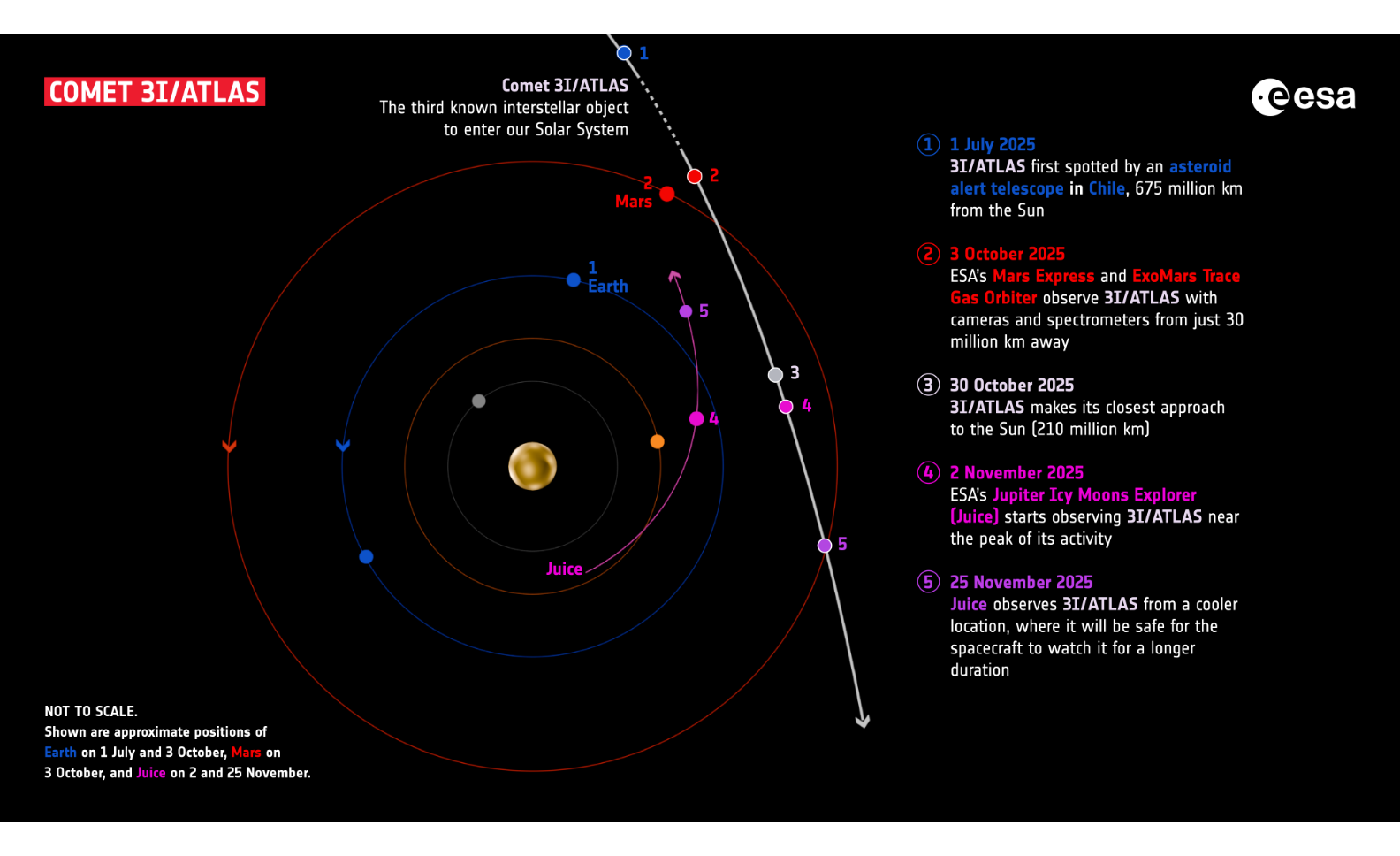
On its journey through the Solar System, 3I/ATLAS will make several relatively close flybys of planets. One of them took place on October 3. On that day, 3I/ATLAS passed 30 million km from Mars.

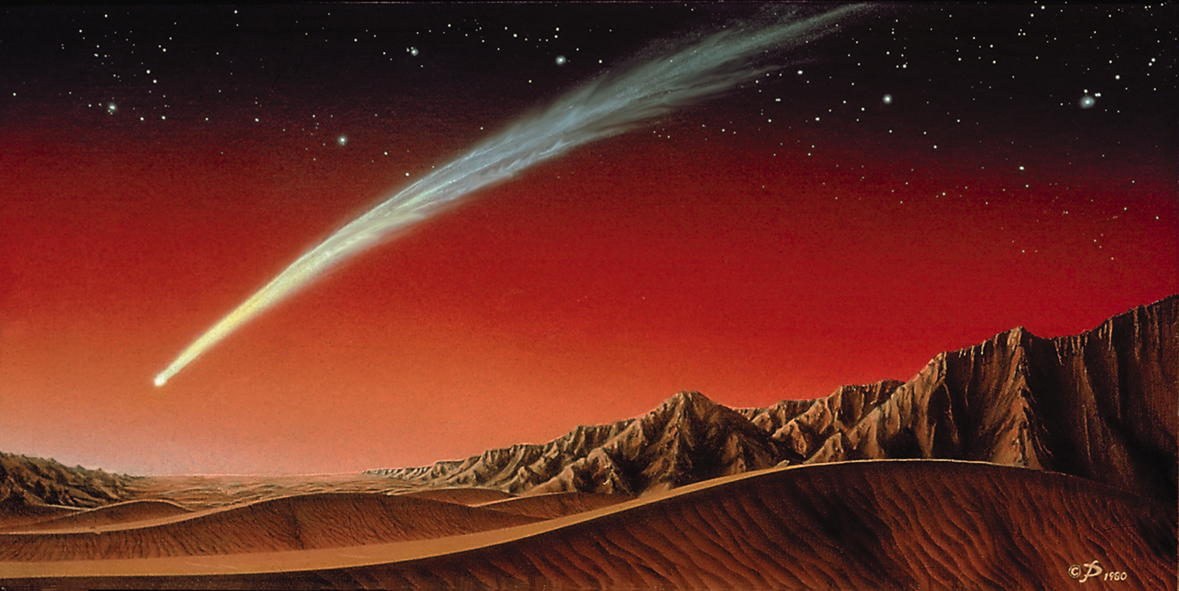
A comet in the Martian sky in an artist’s impression. Source: Kim Poor

Space agencies decided to take advantage of this unique opportunity to learn more about the visitor from another star system. In its statement, ESA reported that between October 1 and 7, the Mars Express and TGO spacecraft orbiting Mars would monitor the comet using their cameras and spectrometers. On NASA’s side, the LRO spacecraft will participate in tracking the interstellar visitor, as well as the Psyche mission, which is heading towards the asteroid Psyche.

Current observations are very important, as 3I/ATLAS is rapidly approaching the Sun. In the coming days, this will make it impossible to track it using ground-based observatories, and astronomers will have no choice but to rely on spacecraft.

ESA observation plan for interstellar comet. Source: ESA

On October 29, 3I/ATLAS will reach the perihelion of its orbit, approaching the Sun at a distance of 203 million km. At this point, the comet will reach its peak activity. By studying the composition of the gases evaporating from its nucleus, scientists will be able to learn about the structure of other star systems. At this point, the comet will still be inaccessible to ground-based telescopes, but fortunately, one spacecraft will be in a suitable position to make observations. It is about the European JUICE mission. It will monitor the comet between November 2 and 25.

By December, 3I/ATLAS will once again be visible to Earth-based telescopes. The comet will not approach our planet. The minimum approach distance will be 269 million km, which is almost twice the distance between the Earth and the Sun. 

In March 2026, 3I/ATLAS will fly by Jupiter at a distance of 53 million km. In theory, the Juno spacecraft, which is exploring the gas giant, could participate in its observations. After that, 3I/ATLAS will head off into deep space and never come back to the Solar System.

RELATED VIDEOS

{ https://universemagazine.com/en/news-en/science-en/ }

Hoe vind je dit bericht?
Geschreven door peter om 12:43 Stuur door

Basis of life: complex chemical reactions occur in Enceladus’ ocean

Basis of life: complex chemical reactions occur in Enceladus’ ocean

Scientists analyzing archived data from the Cassini mission have discovered new complex organic molecules being ejected from Saturn’s moon Enceladus. This is a clear sign that complex chemical reactions are taking place in its underground ocean. Some of them may be part of chains leading to the formation of even more complex molecules that are potentially biologically significant.

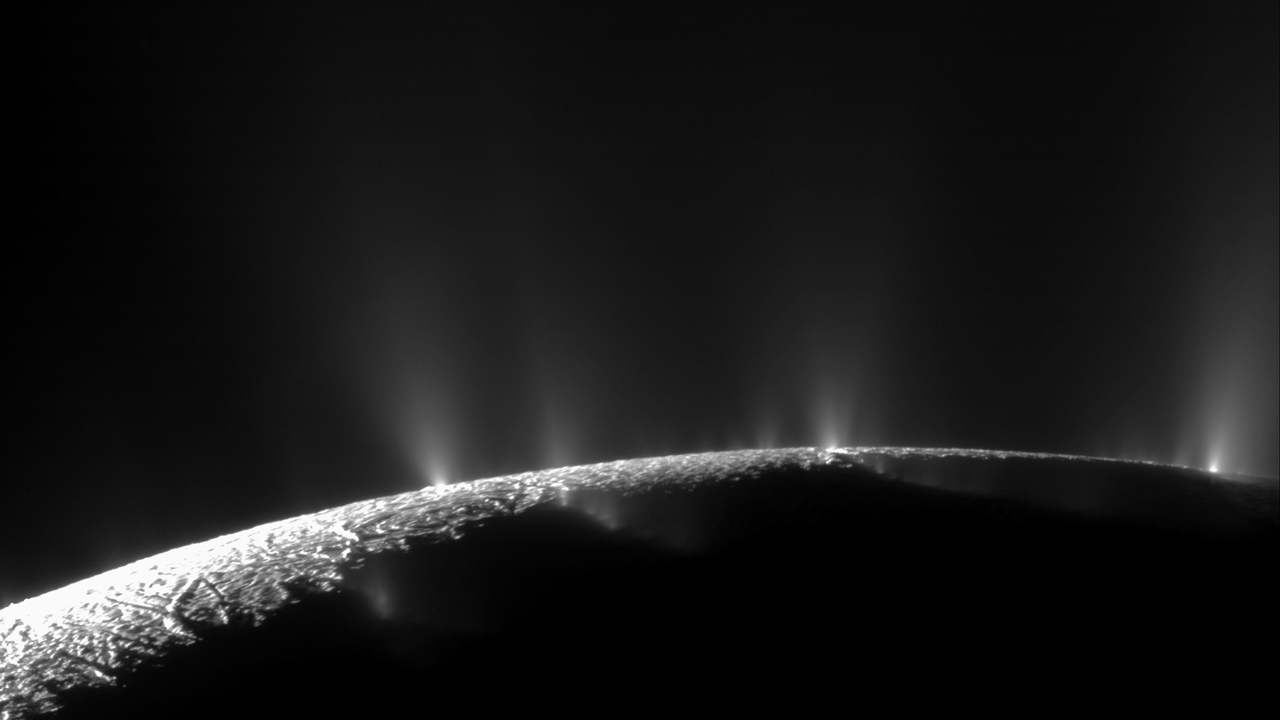
Enceladus geyser eruptions. Source: NASA/JPL/Space Science Institute

In 2005, Cassini discovered the first evidence that an ocean lies beneath Enceladus’ icy surface. Water sprays out of cracks near the moon’s south pole, ejecting ice particles into space. Some of these tiny pieces of ice, smaller than grains of sand, fall back onto the surface of the moon, while others fly away and form the E ring around Saturn.

During its mission, Cassini flew through this ring several times and analyzed it using its instruments. In particular, the vehicle detected many organic molecules in its ice grains, including amino acid precursors.

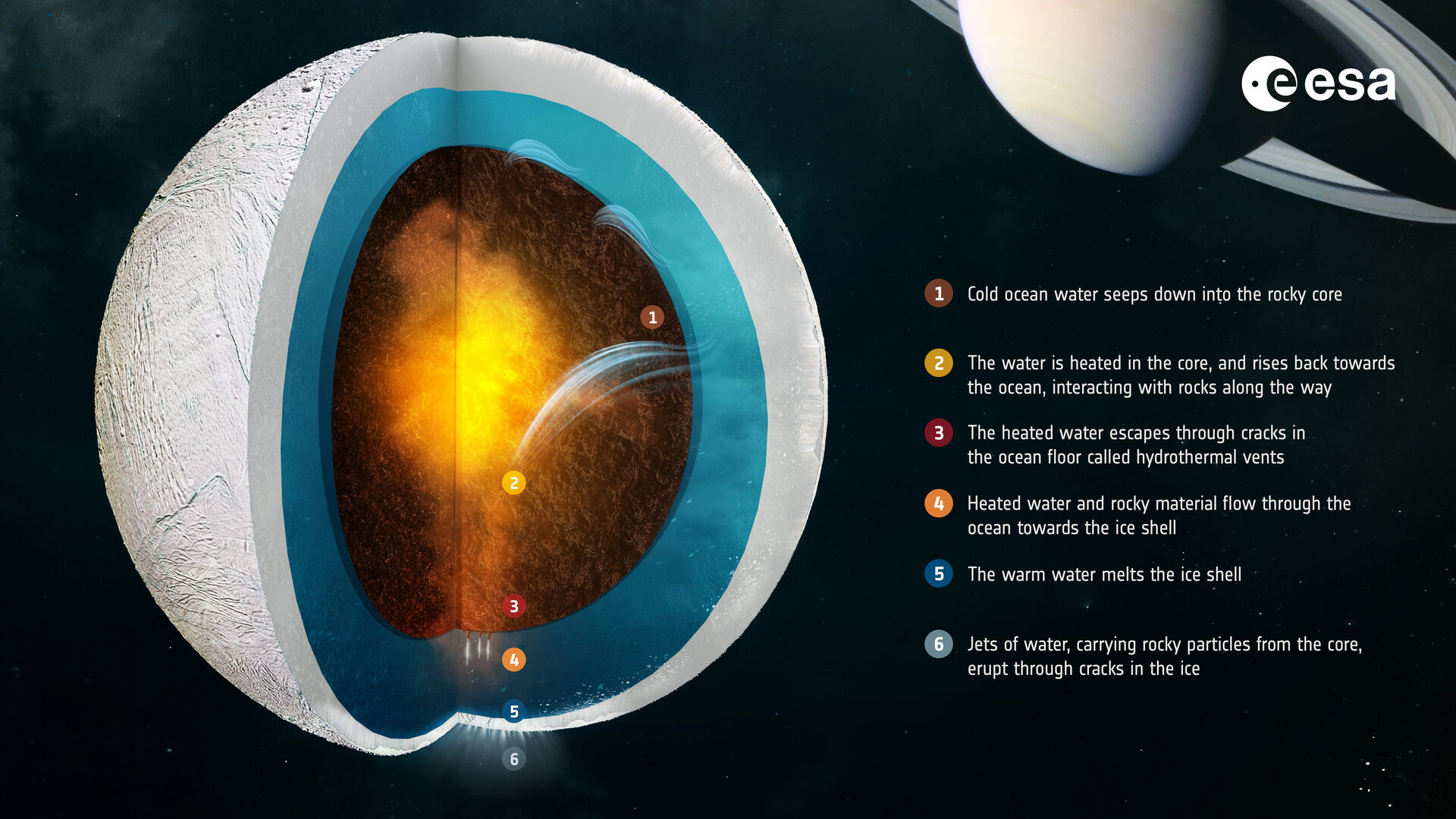
Internal structure of Enceladus. Source: Graphic composition: ESA; Surface: NASA/JPL-Caltech/Space Science Institute/Lunar and Planetary Institute

The problem was that the ice grains in the ring could be hundreds of years old. As they aged, they could have been subject to “weathering” and changed under the influence of intense cosmic radiation. Scientists wanted to study fresh grains ejected much later to better understand what exactly was going on in Enceladus’ ocean.

Fortunately, researchers already had this data. Back in 2008, Cassini flew right through a fresh plume from Enceladus. Uncontaminated ice grains struck the CDA dust analyzer at a speed of approximately 18 km/s. These were not only the freshest ice grains Cassini had ever detected, but also the fastest.

Speed was of the essence. At lower impact speeds, the ice breaks up, and the signal from clusters of water molecules can mask the signal from certain organic molecules. But when ice grains hit the CDA quickly, water molecules don’t stick together, which has made it possible to see signals previously hidden.

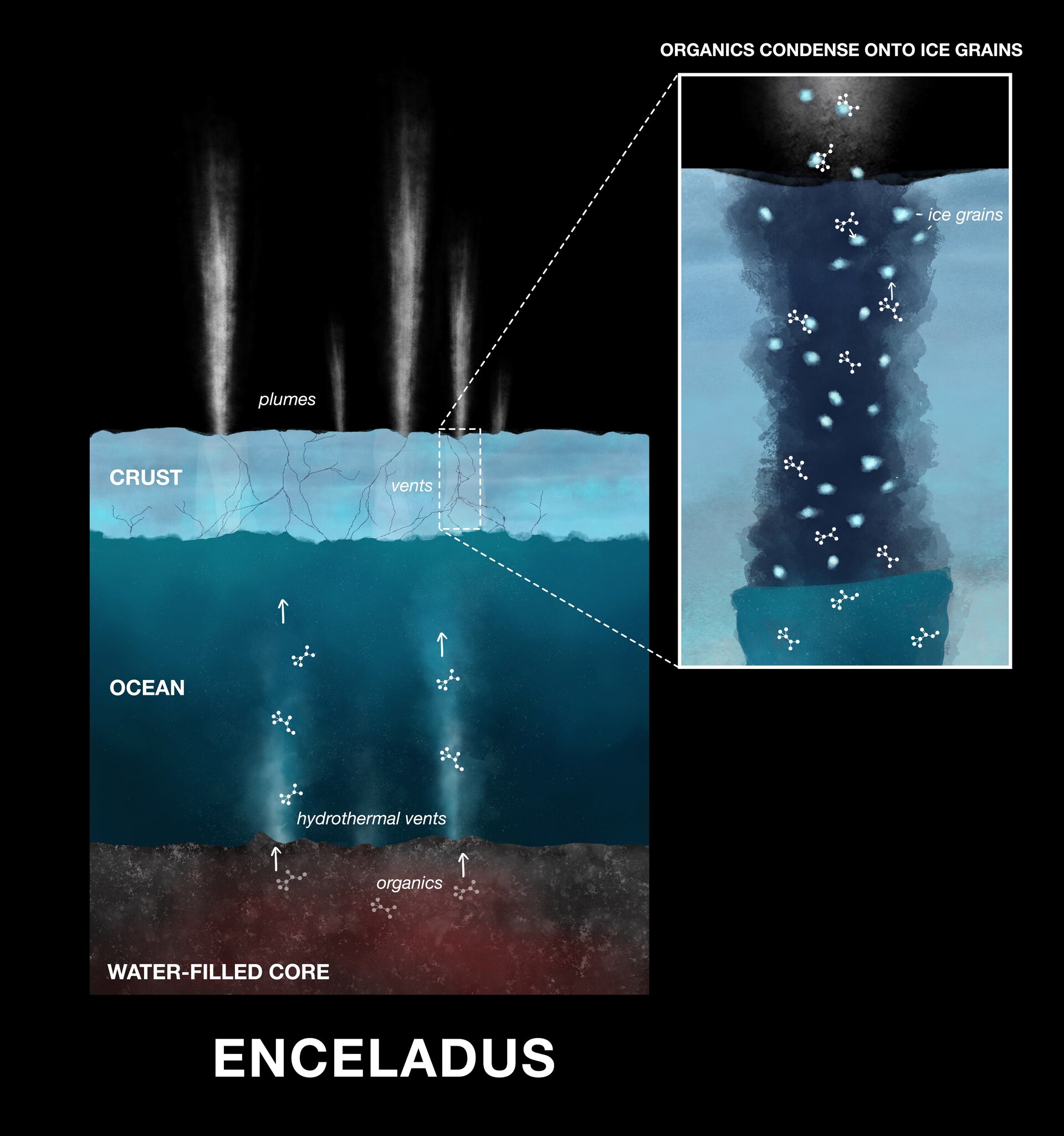
Organic molecules in Enceladus’ ocean. Source: NASA/JPL-Caltech

After analyzing all the available data, scientists were able to determine which molecules were present inside the fresh ice grains. Some of them had previously been detected in the E ring, confirming that they originate from Enceladus’ ocean.

Completely new molecules were also found that had never before been encountered in Enceladus’ ice grains. These included aliphatic, (hetero) cyclic esters/alkynes, esters/ethyls, and presumably compounds containing nitrogen and oxygen. On Earth, these molecules participate in chains of chemical reactions that ultimately lead to the formation of more complex molecules necessary for life.

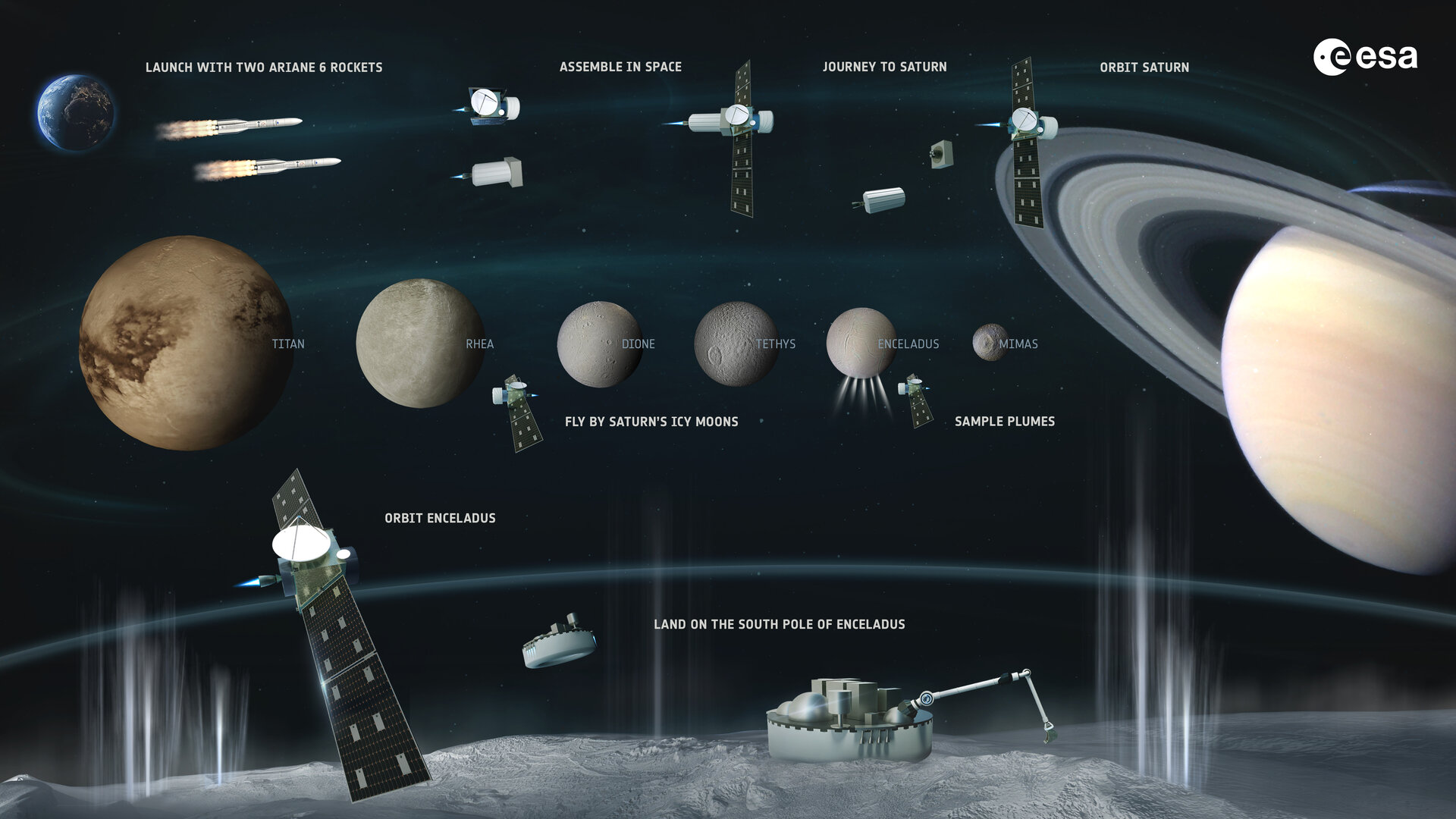
ESA mission concept to Enceladus. Source: ESA

This discovery is important for future missions that will study Enceladus and search for life in its ocean. ESA recently began preliminary design work on such a mission, which could be launched in the early 2040s.

  • According to ESA

{ https://universemagazine.com/en/news-en/science-en/ }

Hoe vind je dit bericht?
Geschreven door peter om 12:33 Stuur door

Meer van UFO'S of UAP'S, ASTRONOMIE, RUIMTEVAART, ARCHEOLOGIE, OUDHEIDKUNDE, SF-SNUFJES EN ANDERE ESOTERISCHE WETENSCHAPPEN - DE ALLERLAATSTE NIEUWTJES

↑ Terug naar de berichten