Ontdek de Fascinerende Wereld van UFO's en UAP's: Jouw Bron voor Onthullende Informatie!
Ben jij ook gefascineerd door het onbekende? Wil je meer weten over UFO's en UAP's, niet alleen in België, maar over de hele wereld? Dan ben je op de juiste plek!
België: Het Kloppend Hart van UFO-onderzoek
In België is BUFON (Belgisch UFO-Netwerk) dé autoriteit op het gebied van UFO-onderzoek. Voor betrouwbare en objectieve informatie over deze intrigerende fenomenen, bezoek je zeker onze Facebook-pagina en deze blog. Maar dat is nog niet alles! Ontdek ook het Belgisch UFO-meldpunt en Caelestia, twee organisaties die diepgaand onderzoek verrichten, al zijn ze soms kritisch of sceptisch.
Nederland: Een Schat aan Informatie
Voor onze Nederlandse buren is er de schitterende website www.ufowijzer.nl, beheerd door Paul Harmans. Deze site biedt een schat aan informatie en artikelen die je niet wilt missen!
Internationaal: MUFON - De Wereldwijde Autoriteit
Neem ook een kijkje bij MUFON (Mutual UFO Network Inc.), een gerenommeerde Amerikaanse UFO-vereniging met afdelingen in de VS en wereldwijd. MUFON is toegewijd aan de wetenschappelijke en analytische studie van het UFO-fenomeen, en hun maandelijkse tijdschrift, The MUFON UFO-Journal, is een must-read voor elke UFO-enthousiasteling. Bezoek hun website op www.mufon.com voor meer informatie.
Samenwerking en Toekomstvisie
Sinds 1 februari 2020 is Pieter niet alleen ex-president van BUFON, maar ook de voormalige nationale directeur van MUFON in Vlaanderen en Nederland. Dit creëert een sterke samenwerking met de Franse MUFON Reseau MUFON/EUROP, wat ons in staat stelt om nog meer waardevolle inzichten te delen.
Let op: Nepprofielen en Nieuwe Groeperingen
Pas op voor een nieuwe groepering die zich ook BUFON noemt, maar geen enkele connectie heeft met onze gevestigde organisatie. Hoewel zij de naam geregistreerd hebben, kunnen ze het rijke verleden en de expertise van onze groep niet evenaren. We wensen hen veel succes, maar we blijven de autoriteit in UFO-onderzoek!
Blijf Op De Hoogte!
Wil jij de laatste nieuwtjes over UFO's, ruimtevaart, archeologie, en meer? Volg ons dan en duik samen met ons in de fascinerende wereld van het onbekende! Sluit je aan bij de gemeenschap van nieuwsgierige geesten die net als jij verlangen naar antwoorden en avonturen in de sterren!
Heb je vragen of wil je meer weten? Aarzel dan niet om contact met ons op te nemen! Samen ontrafelen we het mysterie van de lucht en daarbuiten.
Before Stonehenge: One of Europe's Oldest Monuments Emerges in Austria
Archaeological teams in southeastern Austria have made an extraordinary discovery that pushes back our understanding of European monumental architecture by thousands of years.
Imagine standing in a vast circular arena, its earthen walls rising around you under ancient skies. Now imagine that this monument was already ancient when the first stones of Stonehenge were being dragged across the English countryside, and older still than when Egyptian pharaohs first dreamed of pyramids. In the rolling hills of southeastern Austria, archaeologists have uncovered exactly such a place: a complex of three massive circular enclosures that hosted mysterious gatherings over 6,500 years ago, making them among humanity's earliest experiments in monumental architecture.
At Rechnitz, near the Hungarian border in Burgenland province, excavations have revealed traces of three massive circular enclosures dating back over 6,500 years. These Neolithic structures represent some of Central Europe's earliest examples of organized communal construction, predating both Stonehenge and the Egyptian pyramids by millennia.
The discoveries form part of preparations for constructing a new Archaeological Visitor Center and open-air Stone Age Village in Rechnitz. This ambitious project, integrated within Burgenland's Masterplan Archaeology initiative, aims to transform how the public experiences prehistoric heritage through interactive exhibitions and reconstructed Neolithic settlements. Regional governor Hans Peter Doskozil emphasized that thorough documentation must precede construction, ensuring no archaeological evidence is lost records a Land Burgenland report.
Kreisgrabenanlagen: Europe's First Monumental Architecture
The centerpiece of Rechnitz's archaeological significance lies in its circular enclosures, known in German as Kreisgrabenanlagen. These monumental ditch-and-bank structures, some exceeding 100 meters in diameter, were constructed by Neolithic societies across Central Europe between approximately 4800 and 4600 BC. Their purpose remains one of archaeology's most debated mysteries, with theories ranging from astronomical observatories to ritual centers or defensive fortifications.
Rechnitz stands out because three separate circular enclosures were discovered here between 2011 and 2017 - an unusual concentration suggesting the area served as a significant regional center during the Middle Neolithic period. These structures are part of a broader network of similar monuments stretching from Austria and Hungary through Germany to the Czech Republic, indicating shared architectural traditions among early European farming communities.
The current excavations, led by Nikolaus Franz, head of Archaeology Burgenland, follow years of non-invasive archaeological surveying. Advanced geomagnetic surveys conducted by GeoSphere Austria first revealed the presence of postholes, ceramic fragments, storage pits, and ditches beneath the surface. These techniques allowed archaeologists to map the ancient settlements before physically excavating them.
The excavation trench follows the planned walkway path from the visitor pavilion to the circular enclosure, based on geomagnetic soil surveys by GeoSphere Austria. (Land Burgenland)
Franz describes the site as "a window into the Stone Age," emphasizing that the Neolithic period marked humanity's revolutionary transition from hunting and gathering to organized agriculture and permanent settlement. Bioarchaeological analysis of soil samples is underway, while the University of Vienna conducts specialized research on soil formation and geology to understand how agricultural landscapes developed in the region thousands of years ago.
Astronomical Alignments and Ritual Significance
Some researchers interpret these circular enclosures as proto-observatories, noting that many feature entrances aligned with sunrise or sunset during key agricultural seasons. This theory connects Rechnitz to other famous Neolithic astronomical sites like the Goseck Circle in Germany, considered the world's oldest solar observatory. Such alignments would have been crucial for early farming communities tracking seasonal changes essential for crop cultivation.
The monumental scale and communal effort required to construct these enclosures suggests they held profound social and possibly religious significance. Unlike earlier hunter-gatherer societies, these Neolithic communities invested tremendous resources in permanent structures designed to endure generations, symbolizing their commitment to sedentary agricultural life.
Cultural Heritage and Tourism Potential
The planned Archaeological Visitor Center represents Burgenland's commitment to making prehistoric heritage accessible to contemporary audiences. Until recently, these ancient earthworks were barely visible to the naked eye, detectable only through aerial photography and magnetometric surveys. The new facility will use reconstructions, interactive exhibitions, and educational programs to bring 6,500-year-old Neolithic life vividly to life for visitors from around the world.
This project positions Rechnitz within Austria's growing cultural tourism sector while contributing invaluable scientific data to ongoing debates about early European civilization. As construction approaches, archaeologists race against time to complete documentation, ensuring that future generations can study these remarkable testimonies to humanity's earliest monumental achievements.
The discoveries at Rechnitz confirm the town's importance within a vast prehistoric network of circular monuments that demonstrate sophisticated architectural knowledge and social organization among Central Europe's first farming communities. These findings continue to reshape our understanding of the Neolithic revolution and its lasting impact on European civilization.
Top image: Aerial view of the archaeological excavation site showing the project area for the Circular Enclosure & Stone Age Village in Rechnitz, Austria
UFO Moves Across Sky Over Minneapolis, Minnesota on Aug 24, 2025, UAP Sighting News. VIDEO!
Date of sighting: Aug 24, 2025
Location of sighting: Minneapolis, Minnesota, USA
Source: NUFORC
Now hold on a second, if you look at the video at first it looks like balloons, but when I take a screenshot and enlarge it, this is a single craft. This is odd for sure and I have to admit, its glowing parts or flashes are baffling to me. This is one extraordinary UFO! It moves with the wind across the sky, but it's not balloons because there are no strings, it's not a weather balloon because they have transponder boxes required by law hanging below. This is a real UFO and it seems to be interested in the people watching it, as if it were deliberately trying to be seen.
Scott C. Waring - UFO Sightings Daily
Eyewitness states:
Noticed in air, took video. Morphing multiple spheres like bunch of grapes. Shimmering/reflecting sun. Two observers were on a hill overlooking a sunset. The object was gray in color but also shimmered or was made of reflective material. The side facing the sunset was the side of the object that was shimmering. It was composed of multiple spheres that kept moving to create different formations. The spheres all seemed to be a part of a singular object. It was flying fast, silently and straight, heading roughly southeast. I looked at a flight radar and there were no planes in the vicinity. It was flying lower than a typical airplane. One observer is an electrician and artist (weaving) . The other observer is an artist (multi-disciplinary).
UFO Caught During Sunset Over New York, New York, Aug 25, 2025, UAP Sighting News.
Date of sighting:Aug 25, 2025
Location of sighting: New York, New York, USA
Source: NUFORC
This report is fascinating. The eyewitness was on the top of a building recording the sunset and accidentally caught a UFO. Now maybe it was shooting past at high speed, uncloaked or just was revealed by the digital eye of the camera...is unknown...but one thing is for sure...UFOs get revealed during sunsets. So that leads me to conclude that the suns angle combined with the right digital lens...causes UFOs that are cloaked to be revealed for anywhere between 15 seconds to a few minutes. Sunsets are the most common time of the day to catch a UFO due to these things. Was it a UFO? Oh yeah...it sure was.
Scott C. Waring - UFO Sightings Daily
Eyewitness states:
I was filming and taking photographs from E137th street in the Bronx on a rooftop facing east.Viewing sunrise from the east, behind Throgsneck, I continuously shot a plane crossing the horizon into Laguardia Airport.
When I processed the Cr2 files, i noticed in a single frame, an object was captured. Disc like with a rounded top and flat bottom. It did not appear in any frame but one. I checked my camera, the lens, the sensor. Nothing suggests that the object was dust or anything ordinary.
Appearing in one frame suggests it was in transit at high speed and I was lucky to capture it by matching the frame rate. That’s my best guess.
Bizarre flying objectsare usually considered a stateside phenomena.
But a remarkable shot shows one brazenly flying though the hills in the north of England – and experts are baffled.
The mysterious aerial entity was snapped outside of Shipton in Yorkshire by photographer and local man John Tunnah.
Eerily, the Yorkshire resident took about 10 or 12 photographs from his vantage point but the object only appeared in one of them.
Mr Tunnah said they were the 'first photos on an unfamiliar camera' that he had only just purchased.
He described the phenomenon as a probable 'UFO' – an unidentified flying object.
And it's remarkably similar to the classic UFO saucer shape depicted in popular culture, with a distinctive round and elongated shape.
'Why it was manoeuvring at low level over West Yorkshire was a mystery,' Mr Tunnah told the Daily Mail.
The bizarre saucer-shaped object was snapped with a Pentax Optio SVi camera by Yorkshire photographer John Tunnah
The photo, shared exclusively with the Daily Mail, was taken with a Pentax Optio SVi camera one Saturday morning, according to Mr Tunnah.
The photo, shared exclusively with the Daily Mail, was taken with a Pentax Optio SVi camera one Saturday morning, according to Mr Tunnah.
'I was travelling home with it when I noticed, behind the hills beyond Silsden, a perfectly formed arch of cloud – like a cloudy rainbow,' he said.
'I pulled in, intending to take photos. By the time I'd sorted the camera out the arch had broken up as per the photo, but I took a few shots anyway.
'That evening, I was playing with the camera and deleting shots I'd taken when I came across this one showing something on the far left.
'It didn't appear on any of the other photos I'd taken at the time.
'I'm not a "flying-saucer", or "alien visitation" freak, but whatever it was deserves the term UFO.'
Mr Tunnah, originally from Scotland, then showed the perplexing snap to some of his friends 'just out of interest'.
'They all tended to agree that it was "real", "solid" and appeared to be travelling at speed from the dissipating "arch" on the horizon,' he said.
The Yorkshireman's attention was drawn by a perfectly formed arch of cloud over the trees (centre) - and only later did he notice the saucer-shaped object on the left
What is the mystery object?
The object is remarkably similar to the classic UFO saucer shape depicted in popular culture, with a distinctive round and elongated shape.
John Tunnah, who took the picture, speculated that it could be a Skunk Works-type aircraft close to the horizon.
Alternatively, it could be a fast-moving animal nearer the camera lens.
'Various theories were put forward – such as "flying saucer" and very short lived cloud.'
The resident speculated that it could also be be a 'Skunk Works-type aircraft of previously unknown design'.
Skunk Works is the official pseudonym for Lockheed Martin's Advanced Development Programs (ADP), responsible for developing highly classified experimental aircraft.
Nick Pope, a UFO expert formerly with the UK's Ministry of Defence, offered a number of explanations for Mr Tunnah's photo.
'When photos show an anomaly that wasn't seen at the time, I suspect either a glitch with the camera, or a fast-moving object like a bird or an insect, close to the lens,' he told the Daily Mail.
But the US Department of Defense – otherwise known as the Pentagon – declined to comment on the image.
UFO stands for 'unidentified flying object' and so the term doesn't necessarily describe an object with an extraterrestrial origin.
But some of its characteristics adhere to common descriptions of what UFOs look like.
Most UFOs have been described as ‘orb’, ‘round’ or ‘sphere’, but other reported shapes include polygon, triangle and 'Tic Tac', says the Pentagon
A Pentagon document published in 2023 revealed that the typical UFO has a round shape, usually spherical or an orb, with a white or silver colour.
Based on what it knows from reported sightings between 1996 and 2023, other UFO shapes include rectangle, oval, triangle, disk, cylinder, square and even polygon.
Meanwhile, 16 per cent have been described as having lights, although in many cases this may have been due to their reflective qualities.
Pentagon baffled by 8,000 mysterious UFO orbs hovering over US military bases
An invasion of small metallic orbs has been spotted hovering over the US in recent years, leaving the Pentagon scrambling to identify these mysterious UFOs.
Among these, 422 reports specifically describe metallic orbs, with the majority observed between 1am and 4am near military installations in New York, California, and Arizona.
Eyewitnesses, including civilians, pilots, and military personnel, reported seeing the spheres hover silently before moving at extreme speeds, leaving no trace of their departure.
Some of the sightings have been captured on video or radar, though many remain unexplained.
Ancient Jesus Cup Discovered in Egypt May Contain World's First Christ Reference
A remarkable ceramic vessel discovered beneath the waters off Alexandria, Egypt, may represent the earliest known reference to Jesus Christ outside of Christian scripture. The so-called "Jesus Cup" was unearthed in 2008 by French marine archaeologist Franck Goddio during extensive underwater excavations of Alexandria's ancient harbor. The ceramic bowl, remarkably well-preserved except for a missing handle, bears a compelling Greek inscription that has sparked intense scholarly debate about early Christian influence in ancient Egypt.
The inscription, written in Greek capitals as "DIA CHRSTOU O GOISTAIS," translates to "Through Christ the chanter" or "Through Christ the magician." Dr. Jeremiah Johnston, a respected New Testament scholar, explained during a recent Trinity Broadcasting Network segment that this artifact dates to the first century AD, the precise era when Jesus was crucified, reports the Daily Mail. This timing positions the cup as potentially the earliest physical evidence of Christ's recognition outside Judea, suggesting his reputation as a powerful wonder-worker had spread across the Mediterranean world within decades of his ministry.
The cup was discovered at a submerged site that included the ancient island of Antirhodos, where Cleopatra's palace may have been located. Goddio and his team from the European Institute for Underwater Archaeology have been systematically exploring Alexandria's sunken harbor since 1992, uncovering remarkable artifacts that illuminate the cosmopolitan nature of this ancient city. Alexandria in the first century was a melting pot where paganism, Judaism, and early Christianity intersected, creating unique religious practices that incorporated elements from multiple traditions.
The bowl's design closely resembles vessels depicted on early Egyptian statuettes showing fortune-telling ceremonies. Ancient magical manuals describe how practitioners would pour oil into water and enter ecstatic trances, seeking visions of mystical beings who could answer questions about the future. According to Goddio, invoking Christ's name may have been intended to legitimize these soothsaying rituals, drawing on his already established reputation as a miracle worker.
Not all experts agree on the inscription's interpretation, highlighting the challenges of deciphering ancient texts with religious significance. Bert Smith, professor of classical archaeology at Oxford University, proposes that the engraving may reference a person named "Chrestos" who belonged to a religious group called the "Ogoistais" rather than Jesus Christ. Klaus Hallof, director of the Institute of Greek Inscriptions at the Berlin-Brandenburg Academy, supports this alternative reading, noting that historians from the bowl's era, including Strabo and Pausanias, mention deities called "Osogo" or "Ogoa."
Scholar Steve Singleton offers yet another interpretation, arguing that "chrstos" simply means "good" or "kind," translating the inscription as "[Given] through kindness for the magicians." György Németh of Eötvös Loránd University proposes a practical explanation: the bowl may have been used for preparing ointments, with "Chrstos" or "DIACHRISTOS" referring to an anointing salve rather than the biblical figure. These diverse interpretations reflect the complexity of ancient religious practices in Alexandria, where magical traditions freely incorporated names and concepts from various spiritual traditions.
Historical Implications and Significance
If the inscription truly refers to Jesus Christ, it would represent unprecedented material evidence of his existence and influence dating to the first century AD. This discovery would significantly advance the historical timeline of Christian awareness in Egypt, demonstrating that knowledge of Jesus's life and miracles had reached Alexandria within decades of his crucifixion. Such evidence would challenge historians to reconsider both the geographic spread and the speed of early Christian influence throughout the Roman Empire.
The artifact's discovery in Alexandria holds particular significance given the city's role as a center of learning and religious innovation. The famous Library of Alexandria and the city's diverse population created an environment where ideas from different cultures and faiths could merge and evolve. Early Christian communities in Alexandria were known for their theological sophistication and their ability to engage with Greek philosophy and Egyptian religious traditions, making it a logical place for Christ's reputation to have taken root quickly.
Top image: Ancient ceramic bowl discovered off Alexandria coast showing Greek inscription that may reference Christ.
Source: Jeremiah J. Johnston, Prestonwood/ Daily Mail
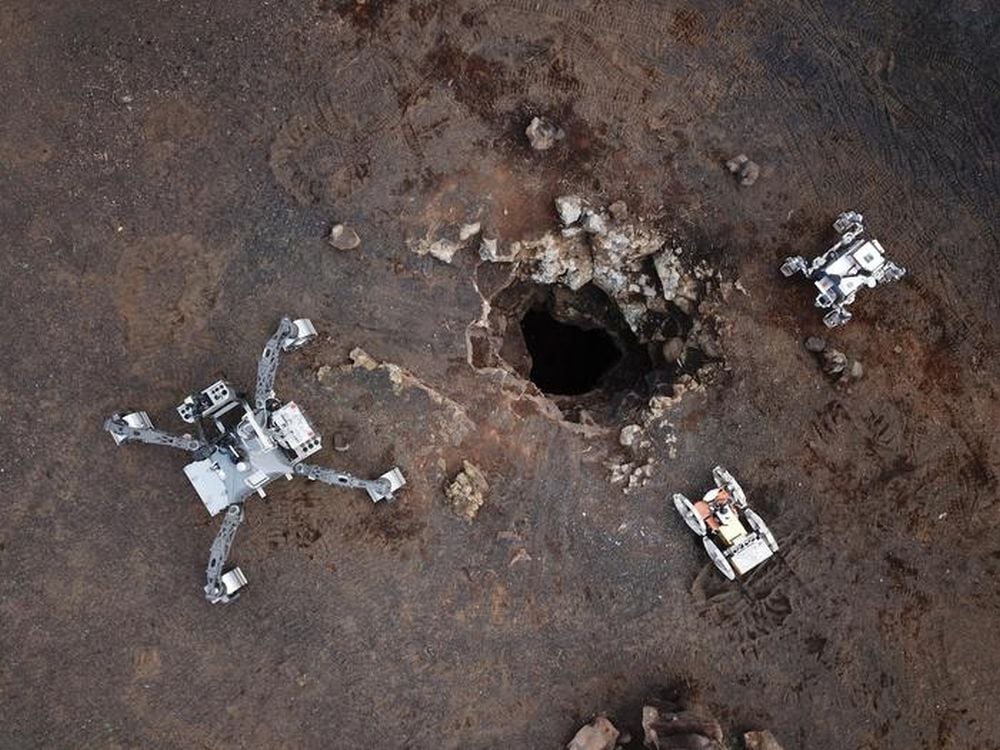
European researchers are developing a three-member team of robots that can cooperatively explore lunar caves. In this image, the robots are being tested on the Spanish volcanic island of Lanzarote. Image Credit: Aerial Skylight Robots/ University of Malaga
Protecting astronauts and equipment during missions outside of Earth's protective sphere is critical to successful space exploration. The Moon is a malign environment where powerful solar radiation bombards the surface unimpeded.
The Moon's temperature swings, the wildest in the Solar System, reach highs of 121 Celsius and lows of -146 Celsius. Some polar locations are in a permanent -240 Celsius deep freeze.
There are also micrometeorites. With no atmosphere to stop them, micrometeorites pummel the surface at extremely high velocities up to 70 km/second (157,000 mph.) Some research shows that up to 10,000 kg of micrometeorites strike the Moon every day.
Astronauts need protection from all of these hazards. Orbital images of the Moon show that there are numerous lava tubes on the Moon that could keep astronauts safe. These were formed during ancient lava eruptions. When part of a lava tube ceiling collapses it leaves an opening called a skylight that shows up in images.
This image from NASA's Lunar Reconnaissance Orbiter shows a section of collapsed ceiling in a lava tube in Mare Tranquillitatus. Rocky debris from the collapse is seen at the bottom of the pit. The pit is about 100 meters deep, but only further exploration can determine how long or large the lava tube is.
Image Credit: By NASA/GSFC/Arizona State University - http://photojournal.jpl.nasa.gov/catalog/PIA13518, Public Domain.
There are also visible sinuous rilles on the surface indicating the path and length of some tubes. While many have collapsed almost completely, others have not. Some rilles reach great lengths. Rima Sharp, a rille on the lunar near side, is up to 566 km long, though some researchers say it is actually two separate rilles.
Rima Sharp may be the longest lunar rille at 566 km in length, though some consider it to be a pair of separate rilles.
Image Credit: NASA/GSFC/Arizona State University.
There's been a lot of research into the idea of using these caves for protection. There are concepts for bases constructed inside of them where astronauts could live and work. But they need to be explored before those plans can take any concrete steps. The collapsed skylights are seen as possible entrances into some of these caves, and scientists have thought hard about how they could be used to access the caves and explore them.
A team of European researchers have designed a trio of robots with different capabilities that could work together to explore lunar caves and assess their potential. The researchers have tested them on Lanzarote, a volcanic island in Spain's Canary Islands. The team's work is presented in a new research letter published in Science Robotics titled "Cooperative robotic exploration of a planetary skylight surface and lava cave." The lead author is Raul Dominguez from the Robotics Innovation Center at the German Research Center for Artificial Intelligence.
While the Moon is the next place where astronauts will get their boots on the ground, Mars is part of this work, too. Mars also has lava tubes with collapsed skylights, and astronauts visiting the planet could also benefit from their protection. Additionally, Mars has astrobiological importance that the Moon lacks.
"Exploration of lava caves on the surface of planetary bodies near Earth is of high importance for scientific research and space exploration," the authors write. "The natural shielding that these caves offer against radiation and small meteorites makes them well suited for preserving exobiological signatures and protecting human-made facilities. The use of a robot team arises as the safest and most cost-efficient way to explore extraterrestrial lava caves because they are difficult to access."
The team are working on a three-member team of heterogeneous robots that work together autonomously to explore lava tubes in four phases.
SherpaTT is a hybrid wheeled and legged robot that performs surface exploration and acts as a surface anchor to lower another robot, Coyote III, into the lava tube. Coyote III is a small, lightweight, highly-mobile wheeled rover. LUVMI-X is the third rover. It's lightweight and cost effective, and performs mapping along with SherpaTT.
The three robots and their capabilities.
Image Credit: Dominguez et al. 2025 SciRob
In phase 1, the entrance area around the lava tunnel is mapped by SherpaTT and LUVMI-X. In phase 2, a sensorized payload cube with high-speed cameras is ejected into the cave from LUVMI-X to collect initial data about the entrance and the cave floor. In phase 3, the Coyote III scout rover rappels into the cave while being anchored to SherpaTT. In phase 4, the scout rover explores and maps the cave in 3d.
This image shows the three members of the robotic team tested on Lanzarote in the Canary Islands.
Image Credit: Dominguez et al. 2025. SciRob
The team tested the operation on Lanzarote Island in February 2023.
The researchers aimed to test each phase of the mission several times in order to gauge effectiveness and understand what improvements are needed. They were unable to test each phase as many times as they desired due to weather and other constraints, but still achieved good results.
"In MP-1, SherpaTT and LUVMI-X collaborated to generate a DEM with enough accuracy to identify the skylight and place the rovers in the correct position during the following phases," the authors write.
"During MP-2, the skylight was explored using the payload cube, which demonstrated its capacity to recreate the skylight in 3D by emulating a free fall under lunar gravity through a pulley system," the authors explain.
MP 3 was also successful. Coyote III was autonomously lowered into the cave without damage.
MP4, the cave-mapping portion of the test, was also validated. "Coyote III was suitable for traversing the harsh terrain and collecting point clouds through remote control, therefore validating the locomotion and data acquisition approach," the authors write. Coyote III successfully traversed different terrains in the cave, but was unable to execute point turns "in consolidated irregular rocky surfaces because of high friction," the authors explain.
These panels show some of the results of the testing for mission phase 4. The testing validated the cave reconstruction and the mobility and effectiveness of Coyote III. A shows the skylight mesh image produced by Coyote III. B shows the skylight Time of Flight data visualization. C shows the rovers travelling through a narrow corridor. D shows the passage Time of Flight visualization. E shows the Coyote III cave reconstruction. F shows ground-truth rover cave reconstruction for F(i) the skylight area and F(ii) the narrow corridor area.
Image Credit: Dominguez et al. 2025 SciRob
The researchers say that a "heterogeneous autonomous robot team is a promising approach" for the exploration of lunar and Martian lava caves. "The presented analog field test showed reliable and efficient performances in most of the defined MPs," they write. " However, the mission concept needs further research to be extrapolated to a real planetary exploration scenario."
3-4 billion years ago, Mars’ volcanoes spewed large amounts of sulfur-containing gases. And it was not sulfur oxide, as previously thought, but hydrogen sulfide and sulfur hexafluoride. These are much stronger greenhouse gases and could well have created a climate on the planet conducive to life.
Sulfur crystals on Martian rock. Source: phys.org
Sulfur-containing gases and the early climate of Mars
Although the early climate of Mars remains an open question, new research suggests that its atmosphere may have been hospitable to life thanks to volcanic activity that released sulfur gases that contributed to the greenhouse effect.
Using data from the composition of Martian meteorites, researchers conducted more than 40 computer simulations with different temperatures, concentrations, and chemistry to estimate how much carbon, nitrogen, and sulfur gases could have been released on early Mars.
Instead of the high concentrations of sulfur dioxide (SO₂) predicted by previous climate models of Mars, their research shows that volcanic activity on Mars approximately 3-4 billion years ago could have led to high concentrations of several chemically “reduced” forms of sulfur, which are extremely reactive. These include hydrogen sulfide (H2S), disulfur (S2), and possibly sulfur hexafluoride (SF6), an extremely potent greenhouse gas.
According to lead author Lucia Bellino, a graduate student at the University of Texas at Jackson School of Geosciences, this could have led to a unique environment on Mars – one that could have been hospitable to certain forms of life. This means that the presence of “reduced sulfur” could have caused a foggy environment, leading to the formation of greenhouse gases such as SF6, which trap heat and liquid water. This could have created hydrothermal systems that support diverse microbial life.
The role of sulfur in the chemical processes of ancient Mars
Previous studies of Mars have examined how the release of gases on the surface, often as a result of volcanic eruptions, could have affected the planet’s atmosphere. This study, in turn, simulated how sulfur changed during geological processes, including how it separated from other minerals when incorporated into magma layers beneath the planet’s surface. This is important because it provides a more realistic picture of the chemical state of the gas before it was released onto the surface, where it could have shaped the early climate conditions on Mars.
The study also showed that sulfur may have frequently changed its form. While Martian meteorites have high concentrations of reduced sulfur, the Martian surface contains sulfur that is chemically bound to oxygen. “This suggests that sulfur cycling – the transition of sulfur into different forms – may have been a dominant process on early Mars,” Bellino said.
Last year, while the team was conducting its research, NASA made a discovery that seemed to confirm their findings. NASA’s Curiosity rover turned over and cracked a rock, revealing elemental sulfur. Although Mars is known for its abundance of sulfur minerals, this was the first time the mineral had been found in its pure form, unbound to oxygen. This was one of the confirmations of the research team’s hypotheses.
Further climate modeling
As the team continues its work, it will use its computer simulations to investigate other processes that would have been necessary to support life on Mars, including sources of water on early Mars and whether volcanic activity could have provided a large reservoir of water on the planet’s surface. They also seek to understand whether reduced forms of sulfur could have served as a food source for microbes in an early climate that resembled Earth’s hydrothermal systems.
Mars is far from the Sun, and today its temperature is typically cold, averaging -80°F. Bellino hopes that climate modeling experts will be able to use her team’s research to predict how warm the early Martian climate might have been, and if microbes were present, how long they could have survived in a warmer atmosphere.
In 1977, scientists discovered a mysterious signal beaming from space that was so powerful it prompted astronomer Jerry Ehman to write 'Wow!' on the telescope's readout.
Now, a team of experts has re-examined the signal's data with modern techniques and found that it could be even stranger than previously thought.
According to the new analysis, the Wow! signal was more than four times stronger than earlier estimates suggested.
The scientists were also able to definitively dismiss a number of natural or human explanations.
There were no known TV stations at that time which could have created the signal, nor were there any satellites passing overhead.
And although scientists believe that the Wow! signal is likely to have a natural cause, they say alien sources can't yet be ruled out.
Co–author Dr Hector Socas-Navarro, director of the European Solar Telescope Foundation, told Daily Mail: 'While aliens aren’t completely off the table, it seems that the signal may have originated by a natural astrophysical source. Our goal now is to find that source.'
For decades, scientists have struggled to find any natural process capable of producing the 72–second burst which prompted astronomer Jerry Ehman to write 'WOW!' on the telescope's readout
Using new data, the scientists also refined the area of the sky from which the signal emerged. This map shows the new refined regions (yellow) compared to the previous estimates (grey)
The Wow! signal was detected by astronomers at the Big Ear Observatory in Delaware, Ohio, back in 1977.
Scientists at the observatory were scanning the sky for radio waves as part of a hunt for extra-terrestrials when the telescope picked up an extraordinary signal.
The sudden burst of radio waves was not only exceptionally powerful, but it was also abnormally long-lasting – continuing for a full 72 seconds.
Additionally, scientists noted that the signal's frequency was in the so-called hydrogen line, which is a band of frequencies emitted by atomic hydrogen.
Since hydrogen is so abundant in the universe, some suggested that advanced civilisations might be using its frequency as a calling card for signalling to other intelligent species.
Strangely, the signal never repeated, and scientists haven't yet found another burst in the same frequency that is nearly as intense.
However, further study of the Wow! signal has been made difficult by the fact that all the data from the Big Ear Observatory is on paper printouts.
In this new paper, a team of researchers and volunteers painstakingly digitised over 75,000 pages of data from the observatory.
Researchers and volunteers analysed over 750,000 pages of data from the Big Ear Radio Observatory in Ohio, where the Wow! Signal was spotted
What are the theories to explain the signal?
There have been many theories over the years for what could have been the source of the short-lived, narrow-band radio signal that became known as the Wow! signal.
At the time, it was seen as having all the traits of having come from a distant planet, but the inability to pick it up again has frustrated astronomers.
While some have taken it to be a radio message broadcast by an alien beacon into space, others have looked for other astronomical sources.
Theories have included collisions between asteroids and stars, flares from stars, merging white dwarfs and colliding neutron stars.
Now, experts suggest that it could have been caused by energy from a neutron star triggering a cloud of atomic hydrogen gas to release a laser burst.
For the first time ever, this allowed for the computational analysis of data about the Wow! signal.
Dr Hector Socas-Navarro says: 'The paper basically rewrites the basic stats of the Wow! signal.'
In addition to showing that the signal had been stronger than previously thought, the researchers have been able to characterise the burst much more accurately.
They narrowed the part of the sky that the signal came from to two small regions, each of which produced a different component of the signal.
The researchers were also able to determine this location with two-thirds greater statistical certainty.
Additionally, this new data slightly revises the signal's frequency – putting it at 1420.726 MHz rather than 1420.4556 MHz.
That keeps the signal solidly within the hydrogen line, but that small change suggests that whatever produced the signal must have been spinning a lot faster than previously thought.
This means the source must be moving at about 46 miles per second (74 km/s), over double the previous estimate of 18 miles per second (30 km/s/).
The researchers say that the most likely cause of the Wow! signal is an intense beam of energy from a dying star hitting a cloud of cold hydrogen, causing it to produce a laser-like burst which hit Earth
'This means that when we look for candidates, the ones moving at that speed will stand out, like a very tall person in a large crowd, and it will be easier to identify the emitting source,' says Dr Socas-Navarro.
Importantly, this research also rules out some natural phenomena that had been suggested as possible explanations.
It had been proposed that a man-made signal could have bounced off the moon and been mistakenly picked up by the observatory.
However, this new analysis clearly shows that the moon would have been on the wrong side of the planet at this time, so nothing could have bounced off it.
Likewise, the sun was not active enough during the year 1977 to produce anything close to the Wow! signal's intensity.
That means the Wow! signal really must have come from somewhere outside our solar system.
However, there are still many questions remaining about the origins of this mysterious radio beam.
Lead author Professor Abel Mendez, of the University of Puerto Rico at Arecibo, told Daily Mail: 'We can’t rule out an extraterrestrial communication signal explanation for the Wow! Signal yet, but the evidence points to a natural origin.'
The dying star could have been a magnetar, which produce the most powerful magnetic fields in the Universe and are rare, explaining why the Wow! Signal has not been repeated
Previous research has spotted several signals which appeared to be extremely similar to the Wow! signal, albeit considerably fainter.
Four of those originated from the tiny red dwarf star, Teegarden's Star, which is just 12.5 light-years from Earth, and is surrounded by clouds of pure hydrogen.
Professor Méndez says: 'The most likely origin of the Wow! Signal is a maser flare or superradiance emission from a neutral hydrogen cloud.
'Small clouds emit consistent narrowband signals similar to the Wow! Signal but much weaker, so a cloud became temporarily much brighter due to any of these processes.'
The Fermi Paradox questions why, given the estimated 200-400 billion stars and at least 100 billion planets in our galaxy, there have been no signs of alien life.
The contradiction is named after its creator, Italian physicist Enrico Fermi.
He first posed the question back in 1950.
Fermi believed it was too extraordinary that a single extra-terrestrial signal or engineering project has yet to be detected in the universe — despite its immense vastness.
Fermi concluded there must a barrier that limits the rise of intelligent, self-aware, technologically advanced space-colonising civilisations.
This barrier is sometimes referred to as the 'Great Filter'.
Italian physicist Enrico Fermi devised the so-called Fermi Paradox in the 1950s, which explores why there is no sign of alien life, despite the 100 billion planets in our galaxy
If the main obstacle preventing the colonisation of other planets is not in our past, then the barrier that will stop humanity's prospects of reaching other worlds must lie in our future, scientists have theorised.
Professor Brian Cox believes the advances in science and engineering required by a civilisation to start conquering the stars will ultimately lead to its destruction.
He said: 'One solution to the Fermi Paradox is that it is not possible to run a world that has the power to destroy itself.
‘It may be that the growth of science and engineering inevitably outstrips the development of political expertise, leading to disaster.'
Other possible explanations for the Fermi Paradox include that intelligent alien species are out there, but lack the necessary technology to communicate with Earth.
Some believe that the distances between intelligent civilisations are too great to allow any kind of two-way communication.
If two worlds are separated by several thousand light years, it's possible that one or both civilisations would become extinct before a dialogue can be established.
The so-called Zoo hypothesis claims intelligent alien life is out there, but deliberately avoids any contact with life on Earth to allow its natural evolution.
Although the exact reason is still a mystery, there could be several causes, such as changes in the atmosphere, the melting of glaciers, motion in the Earth's core, and a weakening magnetic field.
While the loss of a few milliseconds is not a cause for too much concern, a frightening new book imagines a world literally 'spinning out of control'.
In 'Circular Motion' by Alex Foster, days on Earth last 23 hours, then 20 hours, and then eventually two hours.
Like a supercharged spinning top, the planet spins so fast that even gravity loses its grip, as the sun rises and sets ever faster.
Now, experts reveal the real implications of such a terrifying scenario, from large-scale disasters, floods and earthquakes.
A new novel called 'Circular Motion' by Alex Foster imagines a world literally spinning out of control, until a day last just two hours
In Foster's new novel, Earth's rotation speeds up due to a network of massive aircraft that orbit the Earth at 30,000 feet, revolutionising global transportation.
The acceleration of Earth’s spin begins gradually, and days are just a few seconds shorter than normal, so nobody initially notices.
However, Earth’s spin progressively gets faster and faster until a day lasts just two hours – triggering a global catastrophe.
If Earth's spin really did get faster, experts say it cause a 'centrifugal effect' where the things start to swing away from the planet's axis, much like the hanging chairs on a spinning carousel ride.
Earth's oceans would start to bulge around the equator, giving the planet more of a diamond shape, with sloping northern and southern hemispheres.
Water pulled from the polar regions (where centrifugal force is low) would cause the Arctic Ocean to become shallower and send the equatorial region underwater.
Even land around the equator that's not underwater could have a greatly increased chance of tsunamis and flooding.
Duncan Agnew, professor of geophysics at the University of California San Diego, said the 'largest changes would be in the ocean tides'.
This long-exposure photo of the northern night sky above the Nepali Himalayas shows the apparent paths of the stars as Earth rotates. If Earth spun fast enough, is this what we would see?
According to scientists, July 9, July 22 and August 5 this year were between 1.3 and 1.51 milliseconds shorter than the standard 24-hour day . Although the exact reason is still a mystery, there could be several causes, such as changes in the atmosphere, the melting of glaciers, motion in the Earth's core, and a weakening magnetic field (stock image)
Could the world keep going faster?
It is unlikely that the world will start to spin faster. In fact, the world is actually slowing down over time.
About 4.4 billion years ago, the planet was spinning so fast that days lasted four minutes. But this slowed down after a large object hit Earth and created the moon.
The only way Earth could speed up is if a large object hits at just the right angle. But this would likely liquify the planet's crust, so no humans would survive to see the results.
The daily rotation of the Earth produces two high tides and two low tides every 24 hours and 50 minutes.
'Change that by 10 per cent and the tides in some places would get larger and in others smaller,' Professor Agnew told the Daily Mail.
Also, the faster the Earth's spin, the faster tectonic plates would move, would could add to more geological stress and 'a lot of earthquakes', the academic added.
It’s worth remembering that the equator (where Earth’s circumference is the widest) spins faster than elsewhere, such as the tropics or the poles.
The equator spins at about 1,025 miles (1,650km) per hour, while the poles spin barely above zero miles per hour.
As Earth spins and we go around with it, we are held into place by gravity, but if the Earth spun fast enough, centrifugal force would overcome gravity, causing objects to be flung into space.
'The faster Earth turns, the more gravity will be canceled out and the lighter you’ll feel,' said Foster in a piece for New Scientist.
Hurricanes will spin faster and carry more energy if the world's spin greatly increases, researchers claim. In this picture from space, a swirling hurricane forms
The faster Earth's spin, the faster tectonic plates would move, would could add to more geological stress and 'a lot of earthquakes'. Pictured, damage from Afghanistan earthquake, September 4, 2025
NASA astronomer Dr Sten Odenwald also warned that weather phenomena would become more extreme, capable of causing more damage.
As the planet spins faster, an apparent force known as the Coriolis effect, which gives hurricanes their spin, intensifies.
'Hurricanes will spin faster and carry more energy,' Dr Odenwald said.
If Earth’s spin increased, there would of course also be both less sunlight in the day and less time to sleep at night, which might make humans less productive.
People would have keep putting their clocks back as the days shortened, or come up with a whole new time-keeping system.
Humans have a 'circadian rhythm' – an internal clock that is closely attuned to the 24-hour day – which can cause physical and mental issues if disrupted (by factors like plane travel).
Additionally, many satellites would no longer be positioned correctly, which could disrupt satellite communications, internet, TV broadcasting and more.
Luckily, Professor Agnew said the idea of Earth's rotation speeding up to the extent portrayed in the new novel is a 'particularly absurd premise'.
Each day on Earth contains 86,400 seconds, but the rotation isn't uniform, which means over the course of a year, each day has a fraction of a second more or less
'This cannot happen and nothing like it has ever been observed for any planet or star,' Professor Agnew told the Daily Mail.
In actual fact, the Earth has been rotating more and more slowly over the long-term, but this change has been very gradual.
'A billion years ago the day was maybe 19 hours long,' he told the Daily Mail.
'If you went back to when there were dinosaurs and didn't have a clock you wouldn't probably notice that the day was 30 minutes shorter.'
Dr Judah Levine, Fellow of the US government's National Institute of Standards and Technology (NIST) in Maryland, also questioned how close the book's premise is to 'real physics'.
'If the story is loosely connected to reality, then the speed-up of Earth had to be accompanied by something else losing angular momentum, maybe the orbit of the moon,' he told the Daily Mail.
'This is a fundamental principle.'
Maybe the orbit of the moon losing angular momentum could cause the speed-up of Earth, he added.
'If that is what happens, the moon gets a lot closer, and the tidal effects become much stronger and more frequent because the periods are driven by the length of the day.'
Is Earth's rotation really speeding up?
Earth normally takes 24 hours, or exactly 86,400 seconds, to complete one full rotation, which is called a solar day.
The fastest day recorded so far was one year ago on July 5, 2024, when Earth spun 1.66 milliseconds faster than the standard 24 hours.
According to scientists, July 9, July 22 and August 5 this year were between 1.3 and 1.51 milliseconds shorter than the standard 24-hour day.
Earth's rotation has never been perfect, as it shifts by tiny amounts throughout time, getting a few milliseconds faster or slower.
However, scientists didn't start keeping exact records of these changes until the 1970s.
Scientists observe the phenomenon on atomic clocks - incredibly accurate machines that keep time by measuring the vibrations of atoms.
Natural forces like climate change may be playing a role in the planet's spin.
Weather patterns like El Niño and the accelerated melting of glaciers in summer may literally be throwing the planet out of balance by a tiny degree.
Another reason for this sudden change could be shifting molten layers in the core. Earth is not solid all the way through. Its core is made of hot, swirling liquid metal.
As that molten metal moves, it can change the planet's shape and balance.
Scientists are looking at all these pieces together, the moon's orbit, core activity, ocean flow, and wind patterns, to figure out what's going on.
Meer van UFO'S of UAP'S, ASTRONOMIE, RUIMTEVAART, ARCHEOLOGIE, OUDHEIDKUNDE, SF-SNUFJES EN ANDERE ESOTERISCHE WETENSCHAPPEN - DE ALLERLAATSTE NIEUWTJES


 Before Stonehenge: One of Europe's Oldest Monuments Emerges in Austria