Naar de inhoud

UFO'S of UAP'S, ASTRONOMIE, RUIMTEVAART, ARCHEOLOGIE, OUDHEIDKUNDE, SF-SNUFJES EN ANDERE ESOTERISCHE WETENSCHAPPEN - DE ALLERLAATSTE NIEUWTJES

UFO's of UAP'S in België en de rest van de wereld
akke.beakke.be
Ontdek de Fascinerende Wereld van UFO's en UAP's: Jouw Bron voor Onthullende Informatie! Ben jij ook gefascineerd door het onbekende? Wil je meer weten over UFO's en UAP's, niet alleen in België, maar over de hele wereld? Dan ben je op de juiste plek! België: Het Kloppend Hart van UFO-onderzoek In België is BUFON (Belgisch UFO-Netwerk) dé autoriteit op het gebied van UFO-onderzoek. Voor betrouwbare en objectieve informatie over deze intrigerende fenomenen, bezoek je zeker onze Facebook-pagina en deze blog. Maar dat is nog niet alles! Ontdek ook het Belgisch UFO-meldpunt en Caelestia, twee organisaties die diepgaand onderzoek verrichten, al zijn ze soms kritisch of sceptisch. Nederland: Een Schat aan Informatie Voor onze Nederlandse buren is er de schitterende website www.ufowijzer.nl, beheerd door Paul Harmans. Deze site biedt een schat aan informatie en artikelen die je niet wilt missen! Internationaal: MUFON - De Wereldwijde Autoriteit Neem ook een kijkje bij MUFON (Mutual UFO Network Inc.), een gerenommeerde Amerikaanse UFO-vereniging met afdelingen in de VS en wereldwijd. MUFON is toegewijd aan de wetenschappelijke en analytische studie van het UFO-fenomeen, en hun maandelijkse tijdschrift, The MUFON UFO-Journal, is een must-read voor elke UFO-enthousiasteling. Bezoek hun website op www.mufon.com voor meer informatie. Samenwerking en Toekomstvisie Sinds 1 februari 2020 is Pieter niet alleen ex-president van BUFON, maar ook de voormalige nationale directeur van MUFON in Vlaanderen en Nederland. Dit creëert een sterke samenwerking met de Franse MUFON Reseau MUFON/EUROP, wat ons in staat stelt om nog meer waardevolle inzichten te delen. Let op: Nepprofielen en Nieuwe Groeperingen Pas op voor een nieuwe groepering die zich ook BUFON noemt, maar geen enkele connectie heeft met onze gevestigde organisatie. Hoewel zij de naam geregistreerd hebben, kunnen ze het rijke verleden en de expertise van onze groep niet evenaren. We wensen hen veel succes, maar we blijven de autoriteit in UFO-onderzoek! Blijf Op De Hoogte! Wil jij de laatste nieuwtjes over UFO's, ruimtevaart, archeologie, en meer? Volg ons dan en duik samen met ons in de fascinerende wereld van het onbekende! Sluit je aan bij de gemeenschap van nieuwsgierige geesten die net als jij verlangen naar antwoorden en avonturen in de sterren! Heb je vragen of wil je meer weten? Aarzel dan niet om contact met ons op te nemen! Samen ontrafelen we het mysterie van de lucht en daarbuiten.

Archief

From the Dark to the Bizarre: Crazy and Unsettling Conspiracies of the Vatican

From the Dark to the Bizarre: Crazy and Unsettling Conspiracies of the Vatican

From the Dark to the Bizarre: Crazy and Unsettling Conspiracies of the Vatican

Marcus Lowth

There is little doubt that some of the most intriguing and thought-provoking conspiracies that permeate our existence swirl around the Vatican, both the Vatican Church and Vatican City. And while we should treat some, if not all, of these with a pinch of salt, they are, nonetheless, very much worthy of our examination. Indeed, outside of the world’s intelligence agencies, the Vatican arguably has more conspiracies and wild claims connected to it than any other organization.

The Vatican Archives, for example, have been the center of multiple conspiracies for decades, perhaps even centuries, with much speculation as to just what is contained there, and what else might be hidden away even more in secret underground locations. While a full exploration of the realities of just some of the conspiracies of the Vatican Archives would take an article in its own right, it is worth touching on some of them here.

Perhaps the most captivating of these claims is that somewhere deep within these archives (once more, perhaps hidden away from the archives that are “publicly” on display), there are ancient writings of interaction between humanity and non-human intelligences in antiquity. Not only that, but these interactions have been twisted and repurposed as Biblical writings – essentially, they form the basis of many Western religions. A good example might be stigmata, which some researchers have suggested is simply wounds from interactions with these non-human intelligences, or even with UFOs.

There are, of course, many more Biblical accounts that we could suggest are, in fact, twisted accounts of interactions with otherworldly entities in the distant past. The Jacob’s Ladder account, for example, or the guiding light and column of smoke that guided the Exodus, are just two examples. We could even look at the account of Adam and Eve and the Garden of Eden and theorize it was actually documentation of genetic experiments in a controlled, perhaps bio-dome-type environment. The fact is, though, as intriguing as these suggestions are, without proof, they remain exactly that. Could the proof reside within the Vatican Archives?

We might also consider the many alleged appearances of such figures as the Virgin Mary that have been deemed miraculous by the Church. However, when some of these encounters are more closely examined, it appears they, too, have been twisted from encounters with otherworldly figures, some of which appear to be far from friendly, to encounters with divine intelligences. We might ask why they would choose to do this. Is it simply to accrue miraculous legends as their own to bolster their position on the world stage, or might it be to cover up the nature of our reality and protect their status amid the ever-changing collective understanding of our reality?

It is also worth highlighting some of the research of Leonardo da Vinci, who conducted much of his work within the walls of the Vatican, particularly his autopsies and dissections, which were highly illegal at the time, to study human anatomy. We might ask if this research was not known by the Church, or if they simply turned a blind eye, perhaps in exchange for access to that research. I should stress, this is just speculation on my part, but when we consider how closely the Vatican treats space research, even owning several observatories around the world, it is perhaps not unreasonable speculation.

da-vinci.jpg

It is clear, then, that the conspiracies surrounding the Vatican have been swirling around the Church for hundreds of years, arguably since the very beginning of its official foundation. Indeed, for centuries, the Church controlled multiple countries through the royal families of Europe, while also maintaining control of the respective populations of those countries through the dreaded Inquisition, which claimed the lives of millions of people over hundreds of years.

In more recent times, as we will explore in a little more detail later, the Vatican has become involved in several questionable financial investments, with some accusations of misuse of funds. Moreover, many of these claims appear to be much closer to the mark than the Church would perhaps like. However, before we explore these grittier and decidedly darker conspiracies of the Vatican, we will turn our attention to one of the more thought-provoking, if bizarre, conspiracies of the Church.

Although it is a conspiracy that we should most certainly treat with caution, the claims of a high-tech device that allows those who use it to see into the past, as well as into the “near future”, are of interest to us here. The device in question is known as the Chronovisor, claims of which first began circulating in conspiracy circles following the release of the 2002 book The Vatican’s New Mystery (Le Nouveau Mystere de Vatican) by Father Francois Brune, who, incidentally, is an authority of sorts on paranormal encounters and religion. However, perhaps lending a little more credence to the claims, an account of the Chronovisor can be found in a 1972 Italian newspaper article titled A Machine That Photographs The Past Has Finally Been Invented!

According to the article, the Chronovisor project began in the 1950s, when Father Ernetti, who was an Italian physicist before he joined the priesthood, was tasked with leading the program and creating the device. The device itself was rather small, and was “composed entirely of precious alloys” and utilized a screen that was connected to various tubes and tuning dials. Interestingly, Ernetti had several people working closely with him as advisors, including Nobel prize-winning physicist Enrico Fermi, and one-time member of the Third Reich and Operation Paperclip transplant, Wernher von Braun, who, essentially, guided NASA to the Moon. With von Barun’s involvement in particular, it is interesting to note the similarities of the Chronovisor to the alleged secret device of the Third Reich, Die Glocke (The Bell), which was said to also show visions of the past, as well as the future. Moreover, in the early years of the regime, the Catholic Church supported the Third Reich, so there was certainly some crossover previously between those involved.

According to the reports, the Chronovisor works by utilizing “residual electromagnetic radiation left over by numerous processes!” The energy released from these processes allowed the device to “detect” certain frequencies and energies in space and time and then process and present them as “moving images like a film!” Unfortunately, the processes themselves are not detailed, so we have little understanding of how the device actually works. Nor was the location of the Chronovisor ever revealed, with Ernetti, perhaps understandably, stating that he feared if it fell into the wrong hands, it could result in the “scariest dictatorship the world has ever seen!”

Ernetti did offer some details on the places and events from the past he had seen, however, including the founding of Rome in 753 BC, as well as the destruction of Sodom and Gomorrah. However, it was his claims of witnessing “the crucifixion of Christ” that drew most interest, and criticism, not least as he also offered a clearly faked photograph as proof. While it might be easy to dismiss Ernetti as a fraudster and the claims of the Chronovisor as nothing but nonsense, the Vatican itself had some very interesting things to say on the matter.

Ernetti eventually admitted the photograph was a fake, but insisted that the device itself was very real, and that it worked. He then stated rather matter-of-factly that “Pope Pius XII forbade us to disclose details about this device because the machine was very dangerous!” What makes Ernetti’s claims all the more intriguing is a decree issued by the Vatican on the subject that stated, “anyone using an instrument of such characteristics (as the Chronovisor) would be excommunicated!” Make of that what you will. There are, though, further twists in the tale of the Chronovisor.

chronovisor.jpg

On September 24th, 1953, on the other side of the Atlantic in Los Angeles, California, publisher Douglas K. DeVross was shot dead at point-blank range in his office. The man who pulled the trigger claimed DeVross was having an affair with his wife (something, incidentally, that she denied), and he was ultimately imprisoned for second-degree murder.

It was, though, the publishing project he was working on at the time of his death that is of most interest to us here – the life’s work of Baird T. Spalding, Life and Teachings of the Masters of the Far East. Spalding, who had passed away several months previously at the age of 95, was a controversial figure who made some interesting claims during his life, some of which were now within the pages of his multi-volume work. According to Spalding, from 1894 to 1897, he had toured India, Tibet, China, and Persia (now Iran) with a “party of 12”, soaking up the “wisdom of elder brothers” as he did so. It was this wisdom that resulted in his life’s work, and it has to be said, they are remarkably insightful and thought-provoking. However, it appeared, at least to some, that all was not quite as Spalding was offering.

It was noted that he was absolutely “penniless” at the time of his death. Moreover, there were no records of him ever accruing any type of moderate wealth, certainly not enough to have funded such an extensive multi-year trip that he claimed to have embarked on. As we might imagine, this led many people to question if Spalding was nothing more than a fraud. However, despite this, many people were equally insistent that the authenticity of his writings shone through, and certainly didn’t appear to have been written by a fraudster. It was, though, some of Spalding’s other claims that some eagle-eyed researchers picked up on.

He claimed that after returning from his extensive travels, he became involved in a project with an engineer, Charles Steinmetz. This project eventually resulted in the invention of a “camera of past events” that could “peer back in time”. We might ask if this project, if indeed it took place, was an early version of the Chronovisor, and if this device assisted Spalding in attaining the knowledge and wisdom he seemingly undoubtedly had. We also might consider whether the plans or blueprints for this device found their way to DeVross when he got the four-volume work he was publishing at the time of his death. Could it really be possible that he was murdered for what he had suddenly discovered? It is only wild speculation, but it is certainly speculation worth considering.

Of course, if there is any truth in the notion that DeVross was murdered due to his discovery of knowledge of a device that could view the past, then we might consider what became of that information. Did it somehow find its way across the Atlantic Ocean and to the Vatican? And if so, does that mean the Vatican, or organizations sympathetic to the Vatican, were behind DeVross’ murder? Or might the intelligence agencies of the United States have been involved, and did they then “farm out” the technology to the safety of the Vatican? We might consider that the agency involved would have simply advanced the technology themselves behind closed doors, but claims that surfaced in the late 2010s perhaps make the claims that the Vatican ended up with Spalding’s technology a little more credible.

In early 2017, author and researcher Alfred Lambermont Webre claimed that as far back as the 1960s, the Vatican granted access to the CIA to “quantum access technology”. Moreover, he stated that proof of this could be found in the WikiLeaks files. Webre continued that the CIA and the Vatican were very “close organizations” and that the Vatican was instrumental in the intelligence agency’s beginnings. He continued that the Vatican had “subcontracted out” the Chronovisor, not only to the United States, but to other countries, including the United Kingdom, which were “sympathetic” to the Vatican’s ideology. We should note that many people, even in the conspiracy community, are skeptical of Webre’s claims, considering him eccentric and unpredictable. Perhaps in his defense, we should also state that he holds a law degree from Yale University.  

There can be little doubt that there are no darker conspiracies than those surrounding the sudden death of Pope John Paul I on September 28th, 1978. Although Pope John Paul I’s – real name, Albino Luciani – death was from a sudden heart attack, there are genuine reasons to be suspicious, not least when Masonic connections were highlighted, as well as the fact that he died on the 33rd day after becoming pope.

This was documented masterfully in the book In God’s Name: An Investigation into the Murder of Pope John Paul I by David Yallop. In fact, in the introduction to the book, Yallop issued a challenge of sorts: if anyone was able to disprove his evidence, particularly about a key piece of paper allegedly discovered in the dead Pope’s hand and who discovered his body, he would happily give all the royalties from the book to a charity of the Vatican’s choice. It is a challenge that was never undertaken.

Perhaps as good a place as any to start when exploring the death of Pope John Paul I is with the man himself, or more specifically, his political and religious ideology, which was, at best, a little at odds with the inner workings of the Catholic church and the Vatican. His views on birth control, for example, often put him at loggerheads with the official stance of the Vatican, as was the amount of wealth the Church itself seemed to keep hold of. And these were just two of such niggling disagreements. Perhaps of much more consequence to the events that would result in his (to some) untimely demise is his interest in the inner workings of the Vatican, particularly the financial workings, as well as outside forces that seemingly had vast influence within the Church.

As a good example of these inner workings, Pope John Paul I was seemingly immediately frustrated by the amount of control that these shadowy “lifetime residents” of the Vatican had over his daily life and routine. Everything from where he had his morning coffee to which “secret stairways” he could use and which room even he was forbidden to enter was made clear to him. However, it was quickly clear to the cardinals, bishops, and high priests who were more than happy with the perks of life in the Vatican that the new pope had little liking for “pomp and ceremony” and was unlikely to toe the line.

John-PAul-I.jpg Pope John Paul I

Bizarrely, although perhaps not so when we consider the Cold War climate, the pope’s apparent openness to the ideology of communism also made him a target of several organizations, including, according to some, the CIA. In fact, so concerned were the CIA that, at least according to some researchers, “elements” of the agency provided funding to the Masonic P2 Lodge, which held great sway in almost all aspects of Italian life, including the Vatican. In fact, while we could spend an entire article on it, it is worth also highlighting that this connection between the powerful lodge and intelligence agency, including the connection to the Vatican Bank (in Vatican City – a state within a state that was answerable only to itself), provided excellent cover for drugs and weapons smuggling, as well as money laundering.  

As this was unfolding, the P2 Lodge was under investigation for various terrorist acts, as well as various charges such as money laundering. Moreover, after Mussolini (like Hitler) had banned secret societies in Italy, their formation was legalized once more following the end of the Second World War. However, they had to make all of their details public, including their members. This was something that P2 pushed the absolute limits of these rules, which only put their activities even more under scrutiny. Furthermore, although it was frowned upon, rumors had swirled around Vatican City for years that many high-ranking members of the Church were members of the Masonic lodge, which only made the alleged connections between P2, the CIA, and the Vatican even stronger.

Of further interest, all the members of P2 had one thing above all else that united them – their hatred for communism. Indeed, many of the terrorist acts they were being investigated for had been against communist leaning politicians and persons of influence. The Grand Master of the lodge at the time was Licio Gelli, who had power and influence in all directions, including, it would seem, in the Vatican. It is also worth noting that one-time Italian Prime Minister, Silvio Berlusconi, one of the most powerful and influential people in recent Italian politics, was also a P2 member.

Without a doubt, though, what, if anything, put him in the speculative firing line more than anything else was his genuine desire to have a “poor church for the poor!” Of course, this meant not only would that mean an end to the needless perks of Vatican life, but a complete overhaul of the Church’s finances, and it is there, where the Vatican’s most deadly outside influence seemingly resided. The Church had multiple financial interests that made the Vatican Bank an abundance of tax-free money, money that, if they so chose, they could move around at will and without scrutiny.

The person largely responsible for this at the time was Bishop Paul Marcinkus, who, essentially, held the Vatican’s purse strings, and whose nickname, due to his imposing build, was The Gorilla. Marcinkus was seemingly at the center of all the questionable financial affairs of the Vatican, and was perhaps the ultimate target, at least internally, of Pope John Paul I’s overhaul of the inner workings of the Church. It is also worth mentioning that of all the people accused of having some kind of connection to the Pope’s death, all were either dead, in prison, or on the run in the years that followed, apart from Marcinkus.

With Marcinkus in mind, it is also worth mentioning Cardinal Cody of Chicago, who just happened to be Marcinkus’ hometown. While there is no evidence or suggestion that Cody had any direct connection to the death of Pope John Paul I, he was well versed in moving church funds around for his own ends, and was almost certainly going to be removed from his position by the Pope, after years of attempts to do so due to his overly lavish lifestyle, as well as claims of racism. In short, it certainly wouldn’t have done him any harm whatsoever if something were to happen to the new pope.

Marcinkus also had two other connections to the underworld, both of which were P2 Lodge members, and both of which perhaps stood to lose a lot off the back of the Pope’s desire to rid the Vatican of its wealth and the secrecy of how it conducted its financial affairs – Roberto Calvi (referred to as God’s Banker) and Michele Sindona (known as The Shark). Both had connections to crime syndicates and Masonic lodges, and both were experts at “playing” stock markets and banking sectors. Moreover, following respective investigations into their activities, several “gangland-style assassinations” of prosecutors and witnesses took place throughout the country. Whatever the truth and whatever involvement they might not have had in the death of Pope John Paul I, both men met harrowing ends.

Sindona was eventually arrested and imprisoned for 25 years for murder. While incarcerated, he was poisoned and died. Calvi’s fate was much darker and much more public. In July 1982, his body was found hanging from a bridge under Blackfriars Lodge. Rather than being a suicide, many believed his death was made to look like he had taken his own life. The location, some suggested, was a symbol of the Black Friars, or the Frati Neri, a name that members of the P2 Lodge used for themselves, and that Calvi had been murdered to keep him from speaking of what he knew about the death of Pope John Paul I. Even more interesting, at the same time that her boss seemingly decided to take his own life, Calvi’s secretary decided to “throw herself” from the window of their headquarters. Make of that what you will, of course.

Whether any of those mentioned above were involved, directly or indirectly, with the death of Pope John Paul I or not remains unknown. There are, though, many inconsistencies with the death itself, including just who found the body.

Initial reports of the Pope’s demise came via Vatican Radio, which announced his passing before the official time of death was officially recorded by the Vatican authorities. While some people dismiss this as nothing more than an administrative error, given the weight of the situation, others point this out as a glaring hole in the story of just what happened in the aftermath of the Pope’s death.

There was also, according to sources Yallop spoke with inside the Vatican, an urgent “desire to wrap everything up quickly” following the Pope’s death, and while it is perfectly within Vatican protocol that no autopsy takes place, many people highlighted this as an area of concern. Moreover, even though the Pope had complained of chest pains earlier that evening, these pains eased greatly as the evening progressed, so much so that it was decided there was no need to call the doctor. It was highlighted by some that the nuns close to the Pope, who had travelled with him from Venice to Rome and were fiercely loyal to him, would have insisted a doctor be called, even if the pains had eased. In fact, according to some researchers, including Yallop, it was one of these nuns, Pope John Paul I’s most loyal members of his inner circle, Sister Vencelza, who found the body, something the Vatican denied.

There was also an alleged piece of paper that, according to Yallop’s research, was found in the Pope’s hand when his body was discovered, a piece of paper that was said to contain the names of those inside the Vatican who had connections to P2, as well as to criminal activity involving the Vatican’s finances. Despite inside sources offering that this paper did indeed exist, official Vatican sources have always denied it.

The fact is, given that almost half a century has passed since the death of Pope John Paul I, barring some kind of smoking gun or a confession, it is unlikely we will ever know if there was anything untimely or unsavory about his demise. On the one hand, his desire to rid the Vatican of what he saw as unsavory characters, combined with such symbolism as his death occurring on the 33rd day of his papacy, makes it all the more believable that something untoward did take place. However, despite the Vatican’s obvious power on the world stage, we might suspect that if Pope John Paul I had been murdered, more evidence might have surfaced by now. Ultimately, his death, at least to some, will remain suspicious and unexplained for the foreseeable future.

What is perhaps more apparent is that while some of the claims and conspiracies surrounding the Vatican are wide of the mark in terms of accuracy and credibility, there is little doubt that the Church has, at times, found itself in questionable and/or secretive situations. Indeed, we might wonder just what is contained within the Vatican Archives, and what it might tell us about our collective history, and perhaps even about our reality.  

The fact is, the Vatican has influence and sway across the planet in various aspects of our society. That influence, though, could be more far-reaching and dominant than many people might realize. Indeed, the Vatican could be the public face – albeit a discreet and unofficial one – of the alleged secret society of world elites who hold the world on puppet strings. After all, they have been wielding power over most of Europe and through great parts of South America for centuries, with a foothold in almost every country on the planet. That is not to say that we should consider the Vatican, or indeed Catholicism, to be some kind of threat or ominous force, but we should most definitely be aware of the influence they have, and where that influence can be applied.


RELATED VIDEOS


{ https://mysteriousuniverse.org/ }

Hoe vind je dit bericht?
Geschreven door peter om 20:56 Stuur door

China plans to send a mission to the asteroid Apophis

China plans to send a mission to the asteroid Apophis

Chinese scientists have developed a comprehensive mission to study asteroids. One of its targets could be the asteroid Apophis.

Asteroid Apophis in an artist’s impression. Source: ESA Science Office

The asteroid Apophis has a diameter of 375 meters. On April 13, 2029, it will make a close flyby of Earth, passing at a distance of 32,000 km from its surface (i.e., inside the orbits of geostationary satellites). At that moment, the asteroid will be visible to the naked eye across most of Europe and Africa, as well as in some parts of Asia. The encounter with Earth is expected to affect the asteroid and cause landslides and shifts on it.

According to scientists’ estimates, such large objects approach Earth on average once every 5,000 to 10,000 years. It is not surprising that Apophis’ visit has attracted increased attention, and a number of countries and space agencies are considering options for sending missions to it. Currently, ESA and JAXA are working on the Ramses spacecraft, while NASA is focusing on the OSIRIS-APEX mission, which previously studied the asteroid Bennu.

Chinese scientists do not intend to miss such a rare opportunity and are also working on their own mission. It has been named CROWN/Apophis and is part of a larger project called CROWN, which aims to launch six different probes to study near-Earth objects in heliocentric orbits similar to those of Venus. 

The main task of CROWN/Apophis will be to measure the fundamental properties of this potentially dangerous asteroid and the consequences of its approach to Earth. The goal of the project is to observe the processes that will occur on the surface of Apophis and how it interacts with Earth’s magnetosphere.

CROWN/Apophis will consist of two spacecraft. The larger one, weighing 44 kg, will use a combined chemical and ion propulsion system and will be equipped with cameras, a microwave rangefinder/Doppler system, and low-frequency radar. The 8 kg CubeSat will be equipped with some of the same systems as the main spacecraft.

The devices are proposed to be launched as accompanying cargo as part of a mission that has not yet been determined. After that, they will fly to the L1 Lagrange point of the Sun-Earth system, where they will wait for Apophis to arrive. They will make a close flyby of the asteroid shortly after it visits the vicinity of our planet. This will happen on April 13, 2029.

RELATED VIDEOS

{ https://universemagazine.com/en/articles-en/ }

Hoe vind je dit bericht?
Geschreven door peter om 20:42 Stuur door

Target: Titan. NASA specialists test components of the Dragonfly drone

Target: Titan. NASA specialists test components of the Dragonfly drone

NASA specialists conducted a series of key tests on components of the Dragonfly drone. These tests were successful, allowing them to move on to the next stage of mission development.

Dragonfly drone in an artist’s impression. Source: NASA/Johns Hopkins APL/Steve Gribben

Development of the Dragonfly mission began in 2019. As part of this mission, NASA plans to send a rotary-wing aircraft with a total mass of about 450 kg to Titan. It will be equipped with four twin propellers, allowing it to travel at speeds of around 36 km/h and rise to an altitude of up to 8 km. The drone will use a radioisotope generator as its power source.

Dragonfly’s primary mission is to search for complex organic molecules and assess the overall suitability of this celestial body for past and present life. The drone will be able to collect samples from the Titanian surface and conduct chemical analysis on them. Dragonfly will also study the moon’s terrain, atmosphere, and hydrocarbon reservoirs. The spacecraft is designed to operate on Titan for at least three years.

To date, the mission has already gone far beyond computer concepts. In April, its design underwent critical review. This allowed engineers to begin manufacturing and testing the drone’s components. One of the most important tests was conducted in a wind tunnel. For a month, engineers from NASA and the Applied Physics Laboratory (APL) immersed a sensor-equipped drone model in a stream of heavy gas simulating Titan’s dense atmosphere. The collected data helped to understand the kind of loads that the device, its rotary system, and blades would be subjected to. This will enable the preparation of the software necessary for drone flights.

Dragonfly drone blades in a wind tunnel. Source: NASA

APL engineers also completed structural and thermal testing of the foam insulation for the Dragonfly lander, confirming that it will retain its shape and protect the internal components from the environment, which reaches temperatures of approximately -185 °C on Titan. The landing module body will be covered with a 7.6 cm thick layer of solimide-based foam.

In addition, APL engineers have completed the development of onboard radio stations that will serve as receivers and transmitters during Dragonfly’s flight to Titan and its work on the surface. Employees at the Goddard Space Flight Center have completed work on the DraMS mass spectrometer in search of biosignatures. And Lockheed Martin specialists conducted the first series of tests on the aerodynamic fairing that would protect Dragonfly during its re-entry into the moon’s atmosphere.

The DraMS mass spectrometer, which Dragonfly will use to search for signs of life on Titan. Source: NASA

The success of all these tests made it possible to move on to the next stage of mission development. In January, engineers will begin assembling the device components and conducting comprehensive testing. The launch of Dragonfly is scheduled for July 2028, with landing on Titan planned for 2034.

  • According to NASA

{ https://universemagazine.com/en/articles-en/ }

Hoe vind je dit bericht?
Geschreven door peter om 20:32 Stuur door

Birth of a star on the edge of the Galaxy: Bright jets show how new stars appear in space

Birth of a star on the edge of the Galaxy: Bright jets show how new stars appear in space

Scientists investigated the source of radiation Sh 2-283-1a SMM1. It is a stream of matter emitted by a newborn star located at the very edge of the Galaxy. Its chemical composition shows that it contains far fewer heavy elements than similar objects observed to date, but the general patterns of physical processes remain the same.

Newborn star Sh 2-283-1a SMM1. Source: Ikeda et al. (Niigata University), background: R. Hurt / NASA / JPL-Caltech / ESO

Jets from a newborn star

Research conducted using the Atacama Large Millimeter/submillimeter Array (ALMA) may help us better understand the processes of star formation. This giant radio telescope observed the radiation source Sh2-283-1a SMM1. It is located 26,000 light-years away from us and 51,000 light-years from the center of the Galaxy.

In fact, it consists of jets of matter emitted by a newborn star. This phenomenon is not new and has been observed more than once. A large amount of matter falls onto the newly formed star, and part of it is ejected back into space due to the large angular momentum.

What makes Sh 2-283-1a SMM1 unusual is the star’s location. Not only is it far away from us, but it is also at the very edge of the Galaxy. Scientists have not yet observed such a phenomenon so far from the center of the Galaxy, and this should be an interesting region, because even compared to the vicinity of the Sun, it is poor in metals, i.e., elements heavier than hydrogen and helium.

Research results

Observations made with ALMA have provided insight into the chemical composition of the jets. It has been confirmed that it is much poorer in heavy elements than similar structures that have been observed previously. In particular, the ratio of silicon oxide to carbon oxide was significantly lower than in jets emanating from young stars near the Sun.

At the same time, this object is a “hot core” — a hot structure rich in chemical elements. They are quite common in star-forming regions closer to the center of the galaxy, but this is only the second time such an object has been observed at its edge. 

The luminosity of the core is 6,700 times greater than that of the Sun, which suggests that the star, when fully formed, will be of average or large mass. The jets are not emitted continuously, but at intervals of 900–1400 years.

ALMA also detected increased activity in four other young stars on the outskirts of the Galaxy. This indicates that the processes of star formation here are quite intense and, in general, follow the same patterns as in the center of the Galaxy.


{ https://universemagazine.com/en/articles-en/ }

Hoe vind je dit bericht?
Geschreven door peter om 20:19 Stuur door

September MUFON eNewsletter- with the Monthly Sighting Statistics!

September MUFON eNewsletter- with the Monthly Sighting Statistics!

COUNTRIES OF THE WORLD

UNITED STATES 379

UNITED KINGDOM 24

CANADA 21

GERMANY 11

FRANCE 10

AUSTRALIA 10

MEXICO 5

BRAZIL 3

SWITZERLAND 3

ITALY 3

PORTUGAL 3

NETHERLANDS 2

POLAND 2

DOMINICAN REPUBLIC 2

RUSSIAN FEDERATION 2

NEW ZEALAND 2

CYPRUS 2

HUNGARY 2

IRAN 2

DENMARK 2

ROMANIA 2

EGYPT 1

ISRAEL 1

ARGENTINA 1

CROATIA 1

GREECE 1

MACEDONIA 1

BELGIUM 1

INDIA 1

TURKEY 1

MADAGASCAR 1

VENEZUELA 1

BOLIVIA 1

ECUADOR 1

MOROCCO 1

SOUTH AFRICA 1

CHINA 1

JAPAN 1

PERU 1

BANGLADESH 1

ICELAND 1

MARTINIQUE 1  

TOTAL: 513

SHAPE

Circle 65

Sphere 58

Other 56

Unknown 53

Disc 42

Triangle 34

Oval 25

Star-like 22

Cigar 19

Cylinder 13

Square/Rectangular 10

Fireball 8

Diamond 7

Boomerang 6

Flash 6

Egg 6

Tic Tac 5

Chevron 4

Blimp 4

N/A 4

Cross 2

Teardrop 2

Bullet/Missile 2

Dumbbell 1

Saturn-like 1

Cone 1

STATES OF THE U.S.A.

California 40

New York 21

Pennsylvania 20

Florida 16

Arkansas 15

Colorado 15

Ohio 14

Washington 13

Michigan 13

North Carolina 12

Tennessee 12

Oregon 12

Texas 11

Indiana 11

New Jersey 11

Missouri 10

Arizona 10

Oklahoma 9

South Carolina 8

Connecticut 8

Illinois 7

Utah 6

Minnesota 6

Alabama 5

Georgia 5

Louisiana 5

Maine 5

Maryland 5

West Virginia 5

New Mexico 5

Wisconsin 5

Idaho 4

Virginia 4

Massachusetts 4

South Dakota 4

Kentucky 3

Nevada 3

Kansas 3

Mississippi 3

Alaska 2

Iowa 2

District of Columbia 1

Montana 1

North Dakota 1

Hawaii 1

Nebraska 1

New Hampshire 1

Wyoming 1

DISTANCE

< 100 ft 70

101-500 ft 61

501 ft - 1 Mile 74

Over 1 Mile 86

Unknown 78

NO VALUE 24

ERT

Most impressively there were 15 Landings, Hovering, or Takeoffs reported, and 33 Entities observed.

{ MUFON Mutual UFO Network }

Hoe vind je dit bericht?
Geschreven door peter om 22:28 Stuur door

MUFON CMS Statistics for 2025: The First Seven Months

MUFON CMS Statistics for 2025: The First Seven Months

by Rob Swiatek

Generally, statistics speak best for themselves when seen in graphs, so herewith I’m presenting graphically two select categories of UFO numbers for 2025. We’re more than halfway through 2025, and inquiring minds need to know what’s happening in the skies. Has the phenomenon markedly diminished? Or does it continue apace, as it has for at least the last 78 years? Well, no suspense as to the latter: The phenomenon continues to be seen and to mystify.

The stats collected by MUFON are amenable to illustrating any of several trends. For example, one could compile the number of U.S. unknowns for each day of the week for a certain time period or note how specific UFO shapes vary per day or month over a year. For this article, however, and as I typically do, I’ve chosen to show MUFON’s incoming U.S. cases and unknowns for the first seven months of 2025. Basic as it is, this remains an important graph, in my opinion. And then I went a bit outside the box: the two pie charts that follow illustrate how a subset of the 24 shapes (which include the category “Other”) set forth in CMS vary between U.S. and non-U.S. cases

8afceb6a-0515-4d58-9cdb-0d07e38fdc3c.png?rdr=true

Unusual for a Winter month, January, with its cold weather and short daylight periods, is currently the high-water month for 2025 sightings—both incoming and unknown. Happily gone, one will note, are the three dispiriting months of 2024 when the CMS was shut down, resulting in the loss of hundreds of sightings that were never reported. Still, despite the robust number of 2025 cases, MUFON was outdone by the National UFO Reporting Center, which had 2,565 events—U.S. and international—versus MUFON’s 1,959 (U.S. and international) for the same time span and tabulation date. The difference is 606 events. (NUFORC sighting totals acquired from the nuforc.org website.

126969d7-c382-4b91-8ae9-13519a19734a.png?rdr=true

Turning to the pie charts, it’s an understatement to note the MUFON international total of UFO events is dominated by the U.S. numbers. For example, as of 31 August 2025, the CMS had 13 reports from India, the most populous country in the world at 1.45 billion, for the period 1 January 2025 through 31 July 2025; the corresponding number for China—with a population of 1.41 billion—is zero. Not one has yet come in! Nevertheless, with that understatement in mind, it’s almost eerie how cylindrical unknown UFOs are 8% of both U.S. and non-U.S. cases and star-like unknowns hover around 6.8%. Sometimes the statistics of UFOs can evince the phenomenon’s anomalous nature as much as an unknown trace sample held in the hand

87495d11-67d6-4aba-8f18-1687d48ffb50.png?rdr=true

The unknown percentages for discoidal and spherical objects are also close, considering that both spheres and discs are sometimes reported as circular UFOs, which occupy a separate slice of the chart. Combined, the latter three shape categories account for 42.4% and 56.3%, respectively, of the U.S. and non-U.S. unknowns.

I was a bit surprised the non-U.S. slate of unknowns didn’t include a single square or rectangular UFO, a category normally boasting a small, yet persistent number of U.S. entrants year after year. But the 3.2% of U.S. square/rectangular cases reflects only eight cases out of 250 unknowns, however, so they’re not common sights by any means. On the other hand, use of the trademark “Tic Tac” to refer to UFOs having the peculiar shape of the iconic mint seems to be confined to the U.S., thanks to David Fravor’s use of this term to describe the object he saw in 2004 over the Paci‹ c. Since 2017, when his case received nationwide publicity, U.S. witnesses routinely pronounce stubby-cylindrical or tablet-shaped UFOs as tic tacs. In the world outside the U.S., however, they’re still cylinders.

821f35a9-8f23-45ae-ac07-23af5ae2719d.png?rdr=true

{ MUFON Mutual UFO Network }

Hoe vind je dit bericht?
Geschreven door peter om 22:19 Stuur door

'Oumuamua: Did an alien probe visit our solar system in 2017?

'Oumuamua comet, interstellar object passing through the Solar System, unusual shaped asteroid (3d space rendering)

Oumuamua comet, interstellar object passing through the Solar System, unusual shaped asteroid

(3d space rendering) | Shutterstock

'Oumuamua: Did an alien probe visit our solar system in 2017?

On October 19 2017, Robert Weryk, a Canadian astronomer working at the University of Hawaii, discovered the first-ever known interstellar object in our solar system. If that sounds a bit strange, what with all the relatively regular sightings of asteroids and comets popping up in the news, it’s important to understand the significance of the phrase ‘in our solar system’.

Unlike previous interstellar objects, ‘Oumuamua which means ‘a message from afar arriving first’ in Hawaiian) had entered the zone controlled by the sun’s gravity. What’s potentially more alarming is that ‘Oumuamua had come closer to Earth than any other known interstellar object, and we still don't know much about it.

So what do we know? 'Oumuamua, a shining object that measured approximately 400-800 metres in length, entered our Solar System travelling 57,000 miles per hour (that's 16 miles per second). It sped straight down towards the Sun but curled underneath due to the star's gravitational pull. This sent the object off on a new trajectory, which was once again altered slightly as it passed Mercury. At its closest point, 'Oumuamua was 15 million miles away from the Earth, which may seem like a lot, but can be classed as a near-miss in the grand scheme of things. The whole process lasted forty days.

But no-one knows what 'Oumuamua really was. An asteroid comprised of metal and rocks, a comet made up of rocks, dust and ice, or a spinning, intensely bright, cigar-shaped (or 'prolate ellipsoid' to give it the technical description) alien probe?

The popular conclusion that ‘Oumuamua was most probably a cosmic iceberg, a mass of frozen hydrogen, is based upon observed findings that ‘Oumuamua couldn’t have contained any water, carbon monoxide or carbon dioxide, as found in asteroids and comets, because they would have been visible phenomena.

Perhaps more contentiously, astronomers also discovered that the object was accelerating as it left the solar system, yet it had no antitail as one might expect to find on a comet. The theory was that tails on comets and asteroids (though less common) act like rocket engines, but a frozen lump of hydrogen could have rocket-engine like propulsion, while the tail remained invisible from the gaze of the telescope.

Based on this, the general conclusion is that ‘Oumuamua was a highly luminescent, half-billion old chunk of planet from outside the Solar System., However, the theory is in a perpetual case of dispute. There are also a growing number of high-profile voices, such as Harvard astrophysicist Professor Avi Loeb, that claim ‘Oumuamua might have been an alien spacecraft from the far reaches of space.

His theory that ‘Oumuamua was a fully operational probe sent intentionally to the Earth’s vicinity by an alien civilization, was based on exactly the same observations that deemed it a cosmic iceberg.

In the series finale of Craig Charles: UFO Conspiracies, Craig Charles and astrophysicist Sarah Cruddas investigate ‘Oumuamua in an attempt to get one step closer to the answer. They speak to Professor Loeb who warns that the object could be a ‘message in a bottle telling us we’re not alone’. Sarah and Craig also speak with members of the SETI Institute who offer their hypotheses about the event and ponder the existence of intelligent life outside of Earth.

Is Oumuamua an alien probe sent from another galaxy, as Professor Loeb believes or a cosmic glacier? We’ll probably never know for sure, but let's leave you with this: the Drake Formula. Formulated in 1961 by Dr Frank Drake, this provides the formula for a probabilistic argument to estimate the number of communicative extraterrestrial civilizations in our galaxy. The answer is 12,600, and that’s just in the Milky Way. The Hubble Telescope has revealed an estimated 100 billion galaxies in the universe and the James Webb Telescope will probably double that…

RELATED VIDEOS


{ https://www.history.co.uk/articles }

Hoe vind je dit bericht?
Geschreven door peter om 22:09 Stuur door

Two Sides of History: Are UFOs really as extraordinary as they seem?

Two Sides of History: Are UFOs really as extraordinary as they seem?

In the new Sky HISTORY series Two Sides of History, believer Jonathan Davies and sceptic Deborah Hyde debate UFOs.


Image: Believer Jonathan Davies and sceptic Deborah Hyde debate UFOs | Two Sides of History

In recent decades, the UK and US have released intelligence reports acknowledging the existence of UFOs. Such revelations are not surprising to MUFOG.co.uk founder Jonathan Davies, who attests to seeing UFOs landing near his homes.

Deborah, a former editor of The Skeptic magazine, is more cautious. While not denying UFOs’ existence, she suggests they could be attributed to 'atmospheric junk' like balloons and satellites, or 'lights or interference from the ground'.

What do UFO sightings really tell us? Do they say more about the wider universe or instead simply humans’ overeager willingness to believe? In Sky HISTORY’s Two Sides of History, Jonathan and Deborah present contrasting views.

Is a new tech ‘arms race’ underway?

In a Sky HISTORY survey, about 47% of respondents expressed their belief that Earth had been visited by aliens. Nonetheless, Jonathan doesn’t jump to the conclusion that UFOs are necessarily extraterrestrial spacecraft.

He posits that many of these UFOs are craft incorporating advanced technologies not yet known to the public. 'There’s currently a race going on between the West and Russia and China to develop these technologies.'

However, Deborah isn’t convinced when Jonathan implies that they include time travel. 'You are aware, I’m sure, that our present understanding of physics is that time travel isn’t possible. So that would be a quantum leap ahead of what we generally know.'

The 2004 ‘Tic Tac’ UFO incident

In November 2004, US Naval aviators had been undertaking training exercises off the Californian coast when they were alerted to the presence of nearby UFOs.

Upon closer inspection, an oblong UFO appeared to be moving erratically above the Pacific Ocean. The UFO’s performance characteristics are said to have far exceeded the capabilities of human-made aviation technology from both then and now.

One of the fighter pilots even captured footage of the ‘Tic Tac’ UFO — so-called due to its similar shape to a breath mint. This video has since been released to the public, and Jonathan sees it as evidence of futuristic aliens.

Has Mick West refuted the ‘alien craft’ theory?

Sceptical investigator Mick West has his own take on the ‘Tic Tac’ footage — and as far as he’s concerned, no aliens are involved. Deborah brings up West’s explanation that the UFO had actually 'been a similar naval plane from a good distance away, probably 30 miles'.

The Tic Tac seemingly lacked obvious protrusions of a human-made aircraft, such as wings. However, Deborah relays West’s view that, on radar, 'the heat haze had sort of taken the rough edges off the shape.'

'I prefer to believe the actual US Navy that came out with the report on the Tic Tac,' Jonathan replies. 'Mick West develops video games, I believe — he’s not really an expert.'

The US Navy, on the other hand, 'even said themselves that there were objects under the water as well as above the water. The Tic Tac moved at 70,000 miles an hour. It was tracked. There were three different pilots that saw it, and they’ve all given testimonies.'

Could UFO sightings be a trick of the light?

Deborah is thinking along these lines. She opines that 'there’s likely to be a psychological and neurological and sociocultural reason for all of these things.'

Deborah wonders if people who encounter UFOs 'have a cluster of specific neurological traits that predisposes them to it.' She believes that sleep paralysis could help to explain Jonathan’s own experiences.

'I’ve heard interviews with you where you describe sleep paralysis to a tee. If you didn’t know the neurological basis, you would totally buy into what you saw in front of you. I’d like to emphasise that none of this stuff means you’re weird.'

Some surprising common ground emerges

As the debate goes on, there’s a surprising amount of overlap between Jonathan’s and Deborah’s opinions.

According to Jonathan, studies indicate that between 5% and 8% of sighted UFOs are 'anomalous', while 'everything else can be identified.'

He acknowledges endeavouring to consult 'the people that are rational, are credible, that are not looking for any type of publicity.' He tries to 'avoid people that say they know. Nobody knows at this point.'

Deborah observes: 'I think we probably agree on quite a lot. We know that there’s unidentified aerial phenomena. I think we would agree there’s stuff that we don’t understand yet, we’d just disagree on how certain we were on what it was.'

{ https://www.history.co.uk/articles }

Hoe vind je dit bericht?
Geschreven door peter om 21:44 Stuur door

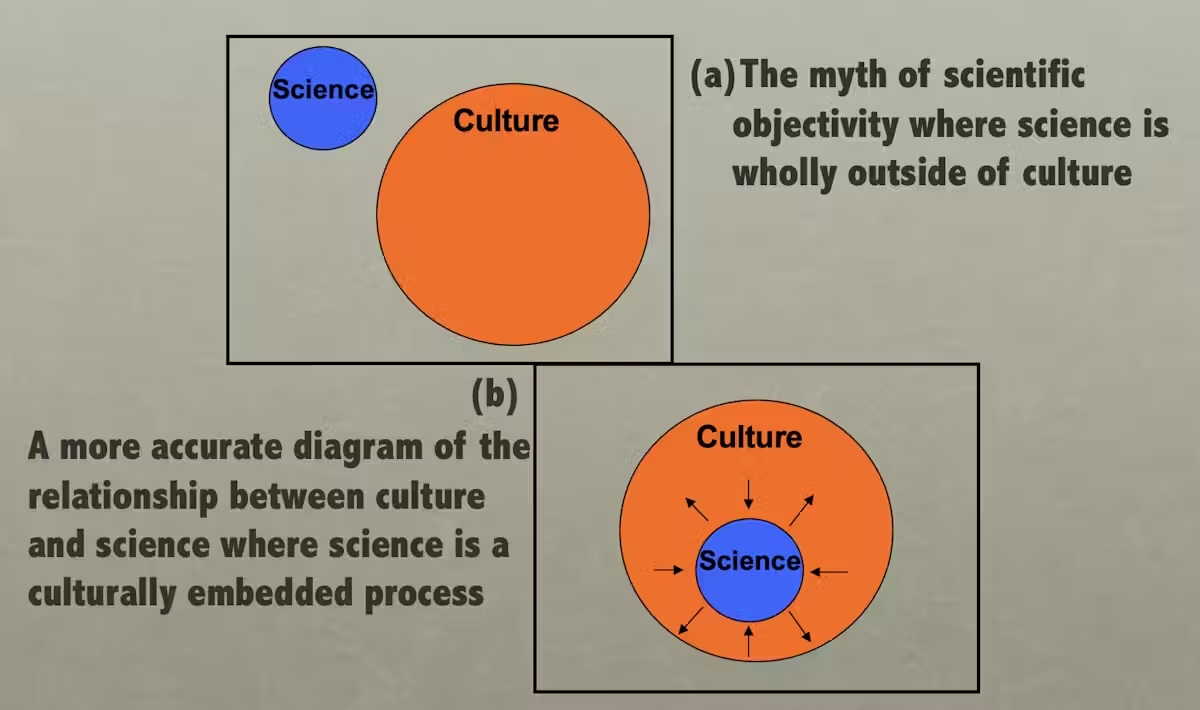
Scientific objectivity is a myth — here's why

Scientific objectivity is a myth — here's why

an illustration of small people climbing around scientific lab equipment
People are at the heart of the scientific enterprise.  
(Image credit: Matteo Farinella, CC BY-NC)

Even if you don't recall many facts from high school biology, you likely remember the cells required for making babies: egg and sperm. Maybe you can picture a swarm of sperm cells battling each other in a race to be the first to penetrate the egg.

For decades, scientific literature described human conception this way, with the cells mirroring the perceived roles of women and men in society. The egg was thought to be passive while the sperm was active.

Over time, scientists realized that sperm are too weak to penetrate the egg and that the union is more mutual, with the two cells working together. It's no coincidence that these findings were made in the same era when new cultural ideas of more egalitarian gender roles were taking hold.

You may like
  • View of an unidentified chemist as she works with various flaks in a laboratory, May 23, 1958.

'The first author was a woman. She should be in the kitchen, not writing papers': Bias in STEM publishing still punishes women

  • an illustration of many sperm swimming towards an egg at the center of the image

The choice of sperm is 'entirely up to the egg' — so why does the myth of 'racing sperm' persist?

  • a digitally-manipulated image showing the back of a businessman&#039;s head with a power cable in his neck

Would outsourcing everything to AI cost us our ability to think for ourselves?

Scientist Ludwik Fleck is credited with first describing science as a cultural practice in the 1930s. Since then, understanding has continued to build that scientific knowledge is always consistent with the cultural norms of its time.

Despite these insights, across political differences, people strive for and continue to demand scientific objectivity: the idea that science should be unbiased, rational and separable from cultural values and beliefs.

When I entered my Ph.D. program in neuroscience in 2001, I felt the same way. But reading a book by biologist Anne Fausto-Sterling called "Sexing the Body" set me down a different path. It systematically debunked the idea of scientific objectivity, showing how cultural ideas about sex, gender and sexuality were inseparable from the scientific findings. By the time I earned my Ph.D., I began to look more holistically at my research, integrating the social, historical and political context.

From the questions scientists begin with, to the beliefs of the people who conduct the research, to choices in research design, to interpretation of the final results, cultural ideas constantly inform "the science." What if an unbiased science is impossible?

Emergence of idea of scientific objectivity

Science grew to be synonymous with objectivity in the Western university system only over the past few hundred years.

In the 15th and 16th centuries, some Europeans gained traction in challenging the religiously ordained royal order. Consolidation of the university system led to shifts from trust in religious leaders interpreting the word of "god," to trust in "man" making one's own rational decisions, to trust in scientists interpreting "nature." The university system became an important site for legitimizing claims through theories and studies.

Previously, people created knowledge about their world, but there were not strict boundaries between what are now called the humanities, such as history, English and philosophy, and the sciences, including biology, chemistry and physics. Over time, as questions arose about how to trust political decisions, people split the disciplines into categories: subjective versus objective. The splitting came with the creation of other binary oppositions, including the closely related emotionality/rationality divide. These categories were not simply seen as opposite, but in a hierarchy with objectivity and rationality as superior.

A closer look shows that these binary systems are arbitrary and self-reinforcing.

a diagram showing how different people conceive the influence between science and culture

Alternative views on the relationship between science and culture.  (Image credit: Sara Giordano)

Science is a human endeavor

The sciences are fields of study conducted by humans. These people, called scientists, are part of cultural systems just like everyone else. We scientists are part of families and have political viewpoints. We watch the same movies and TV shows and listen to the same music as nonscientists. We read the same newspapers, cheer for the same sports teams and enjoy the same hobbies as others.

All of these obviously "cultural" parts of our lives are going to affect how scientists approach our jobs and what we consider "common sense" that does not get questioned when we do our experiments.

Beyond individual scientists, the kinds of studies that get conducted are based on what questions are deemed relevant or not by dominant societal norms.

For example, in my Ph.D. work in neuroscience, I saw how different assumptions about hierarchy could influence specific experiments and even the entire field. Neuroscience focuses on what is called the central nervous system. The name itself describes a hierarchical model, with one part of the body "in charge" of the rest. Even within the central nervous system, there was a conceptual hierarchy with the brain controlling the spinal cord.

My research looked more at what happened peripherally in muscles, but the predominant model had the brain at the top. The taken-for-granted idea that a system needs a boss mirrors cultural assumptions. But I realized we could have analyzed the system differently and asked different questions. Instead of the brain being at the top, a different model could focus on how the entire system communicates and works together at coordination.

Every experiment also has assumptions baked in — things that are taken for granted, including definitions. Scientific experiments can become self-fulfilling prophecies.

For example, billions of dollars have been spent on trying to delineate sex differences. However, the definition of male and female is almost never stated in these research papers. At the same time, evidence mounts that these binary categories are a modern invention not based on clear physical differences.

Related: 

But the categories are tested so many times that eventually some differences are discovered without putting these results into a statistical model together. Oftentimes, so-called negative findings that don't identify a significant difference are not even reported. Sometimes, meta-analyses based on multiple studies that investigated the same question reveal these statistical errors, as in the search for sex-related brain differences. Similar patterns of slippery definitions that end up reinforcing taken-for-granted assumptions happen with race, sexuality and other socially created categories of difference.

Finally, the end results of experiments can be interpreted in many different ways, adding another point where cultural values are injected into the final scientific conclusions.

Settling on science when there's no objectivity

Vaccines. Abortion. Climate change. Sex categories. Science is at the center of most of today's hottest political debates. While there is much disagreement, the desire to separate politics and science seems to be shared. On both sides of the political divide, there are accusations that the other side's scientists cannot be trusted because of political bias.

US Secretary of Health and Human Services Robert F. Kennedy Jr., US President Donald Trump and Medicare and Medicaid Administrator Mehmet Oz participate in an event on &quot;Making Health Technology Great Again,&quot; in the East Room of the White House in Washington, DC

It can be easier to spot built-in bias in scientific perspectives that conflict with your own values.  (Image credit: JIM WATSON via Getty Images)

Consider the recent controversy over the U.S. Centers for Disease Control and Prevention's vaccine advisory panel. Secretary of Health and Human Services Robert F. Kennedy Jr. fired all members of the Advisory Committee on Immunization Practices, saying they were biased, while some Democratic lawmakers argued back that his move put in place those who would be biased in pushing his vaccine-skeptical agenda.

If removing all bias is impossible, then, how do people create knowledge that can be trusted?

The understanding that all knowledge is created through cultural processes does allow for two or more differing truths to coexist. You see this reality in action around many of today's most controversial subjects. However, this does not mean you must believe all truths equally — that's called total cultural relativism. This perspective ignores the need for people to come to decisions together about truth and reality.

Instead, critical scholars offer democratic processes for people to determine which values are important and for what purposes knowledge should be developed. For example, some of my work has focused on expanding a 1970s Dutch model of the science shop, where community groups come to university settings to share their concerns and needs to help determine research agendas. Other researchers have documented other collaborative practices between scientists and marginalized communities or policy changes, including processes for more interdisciplinary or democratic input, or both.

I argue a more accurate view of science is that pure objectivity is impossible. Once you leave the myth of objectivity behind, though, the way forward is not simple. Instead of a belief in an all-knowing science, we are faced with the reality that humans are responsible for what is researched, how it is researched and what conclusions are drawn from such research.

With this knowledge, we have the opportunity to intentionally set societal values that inform scientific investigations. This requires decisions about how people come to agreements about these values. These agreements need not always be universal but instead can be dependent on the context of who and what a given study might affect. While not simple, using these insights, gained over decades of studying science from both within and outside, may force a more honest conversation between political positions.

Hoe vind je dit bericht?
Geschreven door peter om 21:16 Stuur door

Earth 2.0: Is it possible to make Mars resemble our planet?

Earth 2.0: Is it possible to make Mars resemble our planet?

Humanity is advancing into space rather slowly – astronauts landed on the moon 55 years ago, and since then, we have not been able to boast of any achievements of a similar scale. But our journey through the Solar System will continue, and its next destination will obviously be Mars.

While some scientists are trying to figure out how colonists can protect themselves and adapt to Martian conditions, others are proposing to change the planet itself. Is it possible to make the Martian environment more suitable for future colonists, and is it worth doing? Let’s try to figure it out.

The greenhouse effect: enemy of Earth, friend of Mars?

The technology for creating conditions on the surface of a celestial body that are as close as possible to those on Earth is called “terraforming”. The term was first used by American science fiction writer Jack Williamson in his 1942 novel Collision Course.

In 1971, astronomer and science popularizer Carl Sagan became the first scientist to propose terraforming Mars, which currently has a thin atmosphere consisting almost entirely of carbon dioxide with small amounts of nitrogen, oxygen, and other gases. He suggested that by releasing gases from various sources on the Red Planet, it would be possible to artificially thicken its gas envelope and increase the chances of liquid water appearing on the surface due to the greenhouse effect.

NASA took an interest in the concept. Carbon dioxide and water vapor are the only greenhouse gases present in the atmosphere and ice deposits on Mars and beneath the planet’s surface. Carbon dioxide molecules are excellent at trapping the Sun’s infrared rays. So if enough of this substance is released by melting the ice caps and filling the atmosphere with it, it will create a greenhouse effect that will raise the average temperature and thus “warm” the cold planet. This is literally the same effect that is currently causing climate change on our planet.

For its part, increased pressure will contribute to the appearance of water bodies on the surface of Mars. And although it will not be possible to breathe fresh Martian air for a long time, at least it will be possible to do without airtight compression suits there.

However, in 2018, after a series of studies, NASA scientists abandoned the project. It turned out that there was not enough carbon dioxide on the Red Planet. Based on data from the MAVEN, Mars Express, Mars Reconnaissance Orbiter, and Mars Odyssey missions, experts calculated that even if all Martian carbon dioxide were completely evaporated, the atmospheric pressure would only rise to 15 mbar (for comparison: the average pressure at the Earth’s surface is 987 mbar). The project was closed with the conclusion: “Terraforming Mars is impossible with current technology. Any such plans are only possible in the very distant future”.

Regional terraforming

Of course, they decided not to stop there. Researchers from Harvard University, the Jet Propulsion Laboratory (JPL NASA), and the University of Edinburgh came up with the idea that it is not necessary to change the climate of the entire planet – it is enough to influence only certain regions where the colonists will live. The scientists proposed using silica aerogel, one of the best insulating materials that mimics the greenhouse effect in the Earth’s atmosphere. These aerogels are currently used in several engineering projects, including the Mars Exploration Rovers mission probes. Through modeling and experiments, scientists have shown that a two- to three-centimeter-thick aerogel shield without any internal heat source can transmit enough visible light for photosynthesis, block dangerous ultraviolet radiation, and raise and maintain the surface temperature above the melting point of water ice. This material can be used to build dwellings or even autonomous biospheres on Mars.

Artistic illustration of the stages of terraforming Mars.

Source: Daein Ballard

Controlled heating of limited areas would not require large amounts of energy or maintenance of modular settlements to keep the area warm for a long time. The results of studies simulating the Martian surface showed that a thin layer of aerogel generally increased surface temperatures in the mid-latitudes of Mars to those found on Earth. However, further research is needed to build such “greenhouses”. In addition, this miracle material does not solve the problem of the harsh climate of the entire planet, and it is also quite fragile and requires large-scale production.

Nuclear bombing, or Musk’s method

Even the eccentric billionaire Elon Musk has become fascinated with the seductive idea of terraforming Mars, in his own style, through nuclear bombing. Musk is the most famous contemporary proponent of colonizing the fourth planet from the Sun. He has repeatedly shared his plans to populate it by 2050 with more than a million colonists who will live under the glass domes of Martian cities. However, he also has a long-term goal – to make Mars more like Earth.

Source: TechInsider

Musk also proposes to use the greenhouse effect. First, it is necessary to heat the frozen carbon dioxide reserves at the Martian poles, which can be accomplished by detonating nuclear bombs above them. In response to comments about the insufficient amount of carbon dioxide in frozen deposits, the billionaire emphasized that Martian soil may also contain a “huge amount” of this substance. Its release will help warm the planet, melt frozen glaciers, and further thicken the atmosphere, causing warming.

Therefore, scientists point out the shortcomings of this method of transforming Mars into a blooming oasis. Even if there were enough frozen CO2, such a strategy would require the use of an almost unattainable amount of nuclear weapons. According to some estimates, 3,500 half-megaton nuclear warheads would need to be detonated every day for seven weeks straight. And even at that rate, the subsequent terraforming process would take several millennia.

Giant orbital mirrors

Another popular method of terraforming Mars is to build giant mirrors in orbit around the planet, which will reflect and direct more sunlight and heat its surface. Among the most prominent proponents of this method are Christopher McCain, a planetary scientist and researcher at NASA, and Robert Zubrin, an American aerospace engineer, writer, and founder of the Mars Society.

Source: nextbigfuture.com

The idea is to build orbital mirrors with a radius of about 100 km from thin aluminized thermoplastic film (a similar material is used to make solar sails). Such mirrors would weigh about 200,000 tons! If they were manufactured in space using resources from the Moon or asteroids, the production of the necessary aluminum would require a huge amount of energy, not to mention time.

According to Zubrin, we do not have enough data to claim that there are insufficient carbon dioxide deposits on Mars. Until now, experts have relied on data from the MAVEN satellite and several Mars rovers, which have only penetrated a few centimeters into the Martian soil. There may be more deposits of volatile substances deeper underground. Further research involves drilling several hundred meters deep in various locations on the planet.

Asteroid bombardments

Another way to raise the temperature is to direct small asteroids or comets toward the surface of Mars. For decades, humanity has been developing programs to track potentially hazardous objects and creating systems to protect Earth from collisions. Therefore, one or more of these methods could be used to arrange for such objects to collide with Mars. The energy from the crash would then serve as a source of heat.

Source: Science Photo Library

Asteroids can be selected based on their “usefulness” – for example, based on their ammonia content, which, when released into the Martian atmosphere, will further enhance the greenhouse effect, or based on the presence of water, which will turn into water vapor.

However, NASA believes that thousands of such asteroids will be needed, and there is currently no ready-made technology for their targeted transportation to Mars.

The hardest part is still ahead

There are other methods of bringing conditions on Mars closer to those on Earth by importing ammonia, hydrogen, or bacteria capable of living and serving as a nutrient substrate for plants in Martian regolith. However, scientists believe that instead of fighting the consequences, we should look at the root of the problem. More precisely, at the core. After all, any attempts to create an atmosphere on the Red Planet will be futile without a magnetosphere to hold it in place. A terraformed Mars will need a reinforced magnetosphere, similar to the one that protects Earth from the flow of charged particles from the Sun.

It is believed that about 4 billion years ago, Mars lost its magnetic field due to the cessation of core rotation. Without a magnetosphere to serve as a shield, solar winds began to bombard and destroy the atmosphere. Leading NASA scientist James Green, who has worked at the agency for 40 years, proposes creating a huge magnetic shield to prevent our star from destroying the future Martian atmosphere. As a result, the planet will be able to retain heat near the surface, pressure will increase, and the climate will improve and become suitable for life. According to the scientist, this method will entail the least amount of interference and destruction, and then Mars will begin to terraform on its own. However, he does not provide estimates of the cost of the project, the necessary technological capabilities, or the time required for such long-term processes.

Ethical issues and the benefits of concepts and research for the Earth

Although humanity is still quite far from realizing its plans to terraform Mars, we must nevertheless consider the ethical and appropriateness of such projects. Similar to protected wilderness areas on Earth, Mars has extreme, historically important, and aesthetically valuable regions. Any interference with the planet’s natural development will lead to irreversible changes. Mars will forever lose its unique historical and research value for future generations.

Source: DETLEV VAN RAVENSWAAY/SCIENCE PHOTO LIBRARY

Another problem with terraforming Mars is the high cost of such missions. And if, say, humanity had such resources, wouldn’t it be more expedient to use them for the benefit of Earth? Scientists around the world are already sounding the alarm about climate change, the destruction of fertile land, the depletion of fresh water and mineral resources, and the lack of preparedness for possible epidemics.

We should not forget the history of colonization, which has always been accompanied by tragedy. Even today, destructive wars continue over territory, resources, religious beliefs, and so on. So, have we reached the point of moral development where we can become wise guests in the Universe, rather than destructive invaders?

We will have to find answers to these and other questions in the future. However, similar research, such as improving soil quality or developing protection against asteroids, can also be used on our planet. Like many other technologies that are part of our everyday life, thanks to space developments. And in the event of an inevitable catastrophe, Mars would become “plan B” for the salvation of the human race.

  • Author: Anastasiia Bernatska, journalist
  • This article was published in issue No. 1 (190) of Universe Space Tech magazine in 2024. You can purchase this issue in print or electronic format from our store.

RELATED VIDEOS


{ https://universemagazine.com/en/articles-en/ }

Hoe vind je dit bericht?
Geschreven door peter om 20:53 Stuur door

Meer van UFO'S of UAP'S, ASTRONOMIE, RUIMTEVAART, ARCHEOLOGIE, OUDHEIDKUNDE, SF-SNUFJES EN ANDERE ESOTERISCHE WETENSCHAPPEN - DE ALLERLAATSTE NIEUWTJES

↑ Terug naar de berichten