Ontdek de Fascinerende Wereld van UFO's en UAP's: Jouw Bron voor Onthullende Informatie!
Ben jij ook gefascineerd door het onbekende? Wil je meer weten over UFO's en UAP's, niet alleen in België, maar over de hele wereld? Dan ben je op de juiste plek!
België: Het Kloppend Hart van UFO-onderzoek
In België is BUFON (Belgisch UFO-Netwerk) dé autoriteit op het gebied van UFO-onderzoek. Voor betrouwbare en objectieve informatie over deze intrigerende fenomenen, bezoek je zeker onze Facebook-pagina en deze blog. Maar dat is nog niet alles! Ontdek ook het Belgisch UFO-meldpunt en Caelestia, twee organisaties die diepgaand onderzoek verrichten, al zijn ze soms kritisch of sceptisch.
Nederland: Een Schat aan Informatie
Voor onze Nederlandse buren is er de schitterende website www.ufowijzer.nl, beheerd door Paul Harmans. Deze site biedt een schat aan informatie en artikelen die je niet wilt missen!
Internationaal: MUFON - De Wereldwijde Autoriteit
Neem ook een kijkje bij MUFON (Mutual UFO Network Inc.), een gerenommeerde Amerikaanse UFO-vereniging met afdelingen in de VS en wereldwijd. MUFON is toegewijd aan de wetenschappelijke en analytische studie van het UFO-fenomeen, en hun maandelijkse tijdschrift, The MUFON UFO-Journal, is een must-read voor elke UFO-enthousiasteling. Bezoek hun website op www.mufon.com voor meer informatie.
Samenwerking en Toekomstvisie
Sinds 1 februari 2020 is Pieter niet alleen ex-president van BUFON, maar ook de voormalige nationale directeur van MUFON in Vlaanderen en Nederland. Dit creëert een sterke samenwerking met de Franse MUFON Reseau MUFON/EUROP, wat ons in staat stelt om nog meer waardevolle inzichten te delen.
Let op: Nepprofielen en Nieuwe Groeperingen
Pas op voor een nieuwe groepering die zich ook BUFON noemt, maar geen enkele connectie heeft met onze gevestigde organisatie. Hoewel zij de naam geregistreerd hebben, kunnen ze het rijke verleden en de expertise van onze groep niet evenaren. We wensen hen veel succes, maar we blijven de autoriteit in UFO-onderzoek!
Blijf Op De Hoogte!
Wil jij de laatste nieuwtjes over UFO's, ruimtevaart, archeologie, en meer? Volg ons dan en duik samen met ons in de fascinerende wereld van het onbekende! Sluit je aan bij de gemeenschap van nieuwsgierige geesten die net als jij verlangen naar antwoorden en avonturen in de sterren!
Heb je vragen of wil je meer weten? Aarzel dan niet om contact met ons op te nemen! Samen ontrafelen we het mysterie van de lucht en daarbuiten.
UFO over houses in Marion, Iowa on Aug 9, 2025, UAP sighting news 📰👽 ancient aliens are watching. Wow!
Date of sighting: Aug 9, 2025
Location of sighting: Marion, Iowa, USA
Source: NUFORC website
Watch this short video and you will see a huge glowing sphere with a black hole in it. The hole...is a dome window in the UFO. This UFO is carefully watching the homes below, monitoring the humans reaction that is recording them and its discovering...humans are no longer afraid of the truth. That aliens exist.
Scott C. Waring - UFO Sightings Daily
Eyewitness states:
Thought it was a comet, but it brightened, moved. So I thought it was a comet orbiting into our atmosphere, but when I googled lens it it said it was a ufo and then I started to see it get brighter and it started moving around so I started to record. The video is only 13 seconds. In the first 3 seconds of the video stop zoom in to the bottom right hand corner boom, mothership and spaceship leaving or going into the mothership.
De Anunnaki: Oude Goden of Buitenaardse Bezoekers die de Mensheid Heeft gevormd?
Inleiding
Al duizenden jaren vertellen oude beschavingen verhalen over machtige goden die de wereld en de mensheid bestuuren. Een van de meest intrigerende en mysterieuze figuren uit deze verhalen zijn de Anunnaki, een term die vooral uit de Mesopotamische mythologie bekend is. Deze oude goden worden vaak afgebeeld als machtige wezens die een grote invloed zouden hebben gehad op de ontwikkeling van de menselijke beschaving. Maar wat als deze mythes niet slechts symbolisch of allegorisch bedoeld zijn, maar daadwerkelijk gebaseerd op ontmoetingen met buitenaardse bezoekers? In deze tekst wordt de vraag onderzocht of de Anunnaki mogelijk geen mythische figuren zijn, maar buitenaardse wezens die de mensheid hebben geholpen, beïnvloed of zelfs gecreëerd. Door een brede kijk op oude verhalen, archeologische vondsten en alternatieve theorieën wordt geprobeerd te achterhalen wat de ware aard van de Anunnaki kan zijn.
De oorsprong van de Anunnaki in de Mesopotamische mythologie
De verhalen over de Anunnaki stammen uit de oude beschavingen van Mesopotamië, waaronder Sumer, Akkad, Babylonië en Assyrië. Deze mythologieën vormen een van de oudste schriftelijke bronnen die inzicht geven in de opvattingen en religieuze overtuigingen van de mensen die duizenden jaren geleden in deze regio leefden. Volgens de mythen waren de Anunnaki de kinderen van de oppergod Anu en de aardgodin Ki, en werden zij beschouwd als machtige ondergoddelijke wezens die een centrale rol speelden in het beheer van de kosmos en de menselijke samenleving.
In de oude teksten worden de Anunnaki vaak afgebeeld als wijze en verheven entiteiten, maar ook als streng en soms wraakzuchtig. Ze worden beschreven als zijnde betrokken bij de schepping van de mens, het bepalen van het lot van de mensheid, en het begeleiden van de natuurlijke en maatschappelijke orde. Volgens sommige verhalen kwamen de Anunnaki uit de hemel neer op aarde en vestigden zich in tempels en steden, vaak in de vorm van goddelijke leiders of koningen die zichzelf als vertegenwoordigers van de goden zagen. Ze waren aanwezig in belangrijke mythologische verhalen over de schepping, oorlogen tussen goden en de strijd om macht en invloed binnen het goddelijke pantheon.
De mythes over de Anunnaki bevatten elementen van macht, geheimzinnigheid en transcendentie. Ze schetsen een kosmos waarin goden en mensen nauw met elkaar verweven zijn, en waarin de rol van de goden niet altijd volledig duidelijk of begrijpelijk is voor de menselijke wereld. Sommige onderzoekers interpreteren deze verhalen als een manier om natuurlijke krachten en het onbekende te verklaren, zoals het ontstaan van de aarde, de hemel en de natuurlijke gebeurtenissen die de oude Mesopotamiërs observeerden. Anderen vermoeden dat de verhalen een diepere, verborgen werkelijkheid kunnen bevatten, die mogelijk verwijst naar buitenaardse invloeden of oude technologische kennis.
Door de eeuwen heen hebben de Anunnaki een mysterieuze en invloedrijke plaats ingenomen in de geschiedenis van de mensheid. Ze symboliseren niet alleen de goddelijke macht en de scheppingsmythen, maar ook de menselijke zoektocht naar begrip van het onbekende en het hogere. De verhalen over de Anunnaki blijven tot op heden een fascinerend onderwerp voor onderzoekers en liefhebbers van oude mythologie, omdat ze een venster bieden op de denkwereld van onze voorouders en hun zoektocht naar zingeving en orde in een complexe wereld.
Verschillende interpretaties: mythologie versus oude astronautentheorie.
De interpretatie van de verhalen over de Anunnaki roept al eeuwenlang veel vragen en discussies op. Traditioneel worden deze verhalen uit de oude Mesopotamische mythologie beschouwd als symbolische vertellingen die de menselijke ervaring en de kosmische orde willen uitdrukken. In deze context worden de Anunnaki vaak gezien als goddelijke wezens, die de schepping en het functioneren van de wereld op hun eigen wijze beïnvloedden. Voor de meeste historici en archeologen vormen de oude teksten en artefacten geen concreet bewijs voor buitenaards bezoek. Zij interpreteren deze verhalen vooral als culturele uitingen van een samenleving die probeerde haar wereldbeeld en religieuze overtuigingen te structureren, zonder daarin noodzakelijk een verwijzing te zien naar buitenaardse bezoekers.
Echter bestaan er alternatieve theorieën die deze traditionele interpretaties uitdagen en een heel andere blik op de oude verhalen bieden. Een van de meest bekende en controversiële is de zogenaamde oude astronautentheorie. Volgens deze theorie waren de Anunnaki niet slechts mythologische figuren, maar in werkelijkheid buitenaardse bezoekers die al duizenden jaren geleden de aarde bezochten. Voorstanders van deze theorie geloven dat deze wezens technologisch veel geavanceerder waren dan de mens en dat ze zich achter de mythologische verhalen verstoppen om hun aanwezigheid en invloed te verbergen.
De oude astronautentheorie stelt dat de Anunnaki betrokken waren bij genetische manipulatie en de schepping van de mens. Volgens deze visie zouden zij de mens niet uit het niets hebben geschapen, maar genetisch hebben gemodificeerd om een slavenras te creëren die voor hen werkte. Deze theorie suggereert dat de menselijke evolutie niet volledig natuurlijk was, maar sterk beïnvloed door extraterrestrische interventies. Op die manier zouden de verhalen over goden die afdaalden uit de hemel en de mens machtigen, symbolisch kunnen verwijzen naar werkelijke ontmoetingen met buitenaardse wezens.
Ondersteuners van deze theorie wijzen vaak op archeologische vondsten en monumenten die mogelijk aanwijzingen bevatten voor dergelijke contacten. Zo worden onder andere de ziggurats, grote tempeltorens uit de oude Mesopotamische beschaving, vaak genoemd. Zij zouden niet alleen religieuze centra zijn geweest, maar mogelijk ook dienen als landingsplaatsen of technologische faciliteiten voor buitenaardse bezoekers. Sommige onderzoekers geloven dat de complexe bouwtechnieken en de nauwkeurige astronomische uitlijningen van deze structuren niet geheel verklaard kunnen worden door de toenmalige technologie, en dat ze mogelijk gebruik maakten van geavanceerde kennis die afkomstig zou kunnen zijn van buitenaardse bronnen.
Daarnaast worden er ook andere oude constructies en kunstwerken aangehaald die volgens aanhangers van de oude astronautentheorie mogelijk technologische overblijfselen of sporen van buitenaardse activiteit zouden kunnen zijn. Zo wordt bijvoorbeeld de piramide van Chéops en bepaalde rotstekeningen en kunstvoorwerpen geïnterpreteerd als bewijs voor een buitenaardse invloed op de oude beschavingen. Hoewel deze ideeën door de mainstream wetenschap niet worden erkend en vaak als speculatief worden beschouwd, blijven ze een fascinerende alternatieve interpretatie van onze geschiedenis.
Kortom, de discussie over de aard van de Anunnaki en de interpretatie van oude verhalen blijft complex en controversieel. Of men ze nu ziet als mythologische symbolen of als bewijzen van buitenaardse ontmoetingen, het raakt aan fundamentele vragen over de oorsprong van de mens en onze geschiedenis. De oude astronautentheorie biedt een intrigerend perspectief dat de grenzen tussen mythologie, archeologie en sciencefiction doet vervagen, en daagt ons uit om verder te kijken dan de traditionele verklaringen voor onze oude beschavingen.
Het verhaal van de Anunnaki op aarde: mijnbouw, genetische manipulatie en de schepping van de mens
Volgens oude teksten, epische mythes en de populaire oude astronautentheorie is de aanwezigheid van de Anunnaki op aarde geen toeval, maar eerder een gevolg van bewuste interventie door buitenaardse wezens. Deze wezens zouden actief betrokken zijn geweest bij de mijnbouw van waardevolle mineralen, met name goud, dat essentieel was voor hun technologische en misschien spirituele doeleinden. Volgens de verhalen arriveerden de Anunnaki op aarde om de rijkdommen uit de aardbodem te halen, maar al snel ontwikkelden ze een complexere relatie met de mensheid.
Een van de meest intrigerende aspecten van deze theorieën is de bewering dat de Anunnaki genetische manipulatie hebben toegepast om de mens te creëren. Ze zouden menselijke en dierlijke DNA-sequenties gecombineerd hebben om een hybride ras te vormen dat voor hen arbeid kon verrichten. Deze hybride mensen waren mogelijk bedoeld als een soort slaven, die de zware arbeid in de mijnen konden verrichten zonder dat de Anunnaki zelf voortdurend aanwezig hoefden te zijn. Volgens sommige bronnen zouden deze genetische experimenten mogelijk ook bedoeld zijn geweest om de menselijke capaciteit voor kennis, bewustzijn en spiritualiteit te vergroten, of juist te beperken, afhankelijk van de intenties van de buitenaardse makers.
De schepping van de mens wordt in veel oude verhalen beschreven als een soort experiment of project van de goden, waarin niet alleen de genetische code wordt aangepast, maar ook menselijke eigenschappen en kennis worden overgedragen. Sommige interpretaties suggereren dat de verhalen over de schepping uit klei en het ontstaan van hybriden symbolisch kunnen zijn voor technologische ingrepen die veel verder gaan dan de menselijke wetenschap van vandaag. Deze mythes zouden bijvoorbeeld verwijzen naar geavanceerde genetische technieken die lang geleden door de Anunnaki werden gebruikt.
Daarnaast worden de verhalen over de Nephilim, reusachtige en machtige wezens die in de Bijbel worden genoemd, vaak gekoppeld aan deze mythes. Sommige theorieën stellen dat deze wezens mogelijk afstammelingen waren van de hybride mens-dier creaties of dat ze een andere vorm van buitenaardse aanwezigheid vertegenwoordigen. Het idee dat buitenaardse wezens in het verleden onder de mensen hebben geleefd en invloed hebben uitgeoefend, wordt door deze verhalen versterkt en blijft een intrigerend onderwerp binnen de oude astronautentheorie. Al deze elementen samen schetsen een complex beeld van een mogelijk verborgen geschiedenis waarin de mens niet zomaar is ontstaan, maar het resultaat zou kunnen zijn van een eeuwenoud buitenaards experiment.
De rivaliteit tussen Enki en Enlil en de gevolgen voor de mensheid
In de oude Mesopotamische mythologie spelen de goden Enki en Enlil een centrale en invloedrijke rol. Deze goden vertegenwoordigen niet alleen belangrijke natuurlijke krachten, maar symboliseren ook tegengestelde krachten binnen de kosmos en de menselijke samenleving. Enki, de god van water, wijsheid, schepping en magie, wordt vaak afgebeeld als een welwillende en behulpzame figuur die de mensheid steunt en beschermt. Hij wordt gezien als een voorvechter van de mens, iemand die innovatie en kennis bevordert en zich inzet voor het welzijn van de menselijke soort. Aan de andere kant staat Enlil, de luchtgod en oppergod, die wordt gekenmerkt door zijn autoritaire en strenge aard. Hij vertegenwoordigt orde, macht en soms ook hardheid, en hanteert zijn invloed om de natuurlijke en sociale orde te handhaven, vaak met een zekere mate van onbuigzaamheid.
De rivaliteit tussen deze twee goden weerspiegelt een diepere strijd tussen verschillende kosmische en aardse krachten. Volgens de mythologische verhalen veroorzaken hun conflicten vaak chaos en onrust, wat zich vertaalt in de menselijke geschiedenis als conflicten, natuurrampen en maatschappelijke upheavingen. Sommige interpretaties suggereren dat deze goden misschien niet louter mythologisch zijn, maar symbolische representaties van verschillende buitenaardse facties of oude technologische en culturele groepen die betrokken waren bij de ontwikkeling en het ontstaan van de mensheid. In deze visie zouden Enki en Enlil niet zomaar mythologische figuren zijn, maar vertegenwoordigers van verschillende belangen en ideologieën die in de loop der tijden met elkaar botsten.
De strijd tussen Enki en Enlil zou kunnen duiden op conflicten tussen uiteenlopende technologische of culturele groepen die betrokken waren bij het evolutionaire proces van de mens. Bijvoorbeeld, Enki wordt vaak geassocieerd met kennis, innovatie en het aanwenden van technologie, terwijl Enlil mogelijk symbool staat voor behoud, controle en de strengheid van de natuurlijke orde. Deze tegenstelling zou kunnen wijzen op een voortdurende spanning tussen vooruitgang en behoud, tussen het experimenteren met nieuwe kennis en het beschermen van bestaande structuren. Dergelijke conflicten zouden niet alleen mythologisch zijn, maar ook een diepere verklaring bieden voor de grote veranderingen en catastrofes die de menselijke geschiedenis hebben gekenmerkt.
Een van de bekendste verhalen uit de mythologie die mogelijk verband houdt met deze rivaliteit is dat van de Grote Overstroming. Dit verhaal, dat in veel oude culturen terugkeert – van het Bijbelse verhaal van Noach tot de Gilgamesh-epos – wordt vaak geïnterpreteerd als een herinnering aan een grote natuurramp die de mensheid op de rand van uitsterven bracht. Sommige theorieën stellen dat deze ramp niet louter natuurlijk was, maar mogelijk het gevolg van ingrijpende acties door buitenaardse wezens of technologische krachten die de natuurlijke balans verstoorden. Het idee is dat de overstroming een soort reset was, een manier om de chaos te beheersen en de mens opnieuw te laten beginnen.
Deze ramp zou de mens hebben gedwongen om zich opnieuw te ontwikkelen, kennis te vergaren en zich aan te passen aan een veranderde wereld. Het verhaal van de overstroming symboliseert wellicht niet alleen een natuurcatastrofe, maar ook de voortdurende strijd tussen verschillende machten die de koers van de menselijke geschiedenis bepalen. Door deze mythologieën en verhalen te interpreteren, krijgen we mogelijk inzicht in de complexe relatie tussen mythologie, geschiedenis en de ontwikkeling van de mensheid, waarbij oude verhalen een diepere laag van betekenis onthullen over de conflicten en samenwerkingen die onze wereld hebben gevormd.
Legendes over hybriden, de Nephilim en de Grote Overstroming
Door de eeuwen heen hebben verschillende culturen over de hele wereld verhalen verteld over mysterieuze hybride wezens, zoals de Nephilim, en overeenkomsten in overstromingsmythen die vaak de basis vormen van religieuze en mythologische tradities. Deze verhalen hebben velen geïntrigeerd en leiden tot talloze theorieën en speculaties over hun ware aard en oorsprong.
De Nephilim worden vaak beschreven als reuzen of halfgoddelijke wezens die een bijzondere rol speelden in de oude beschavingen. In de Bijbel, met name in het boek Genesis, worden ze als de nakomelingen van de 'kinderen van God' en de 'dochters van de mens' beschreven. Deze wezens worden soms afgebeeld als reuzen die een enorme kracht en invloed hadden op de toenmalige samenlevingen. Sommige interpretaties suggereren dat de Nephilim mogelijk buitenaardse oorsprong hadden, of dat ze genetisch gemanipuleerde hybriden waren, ontstaan uit een samensmelting van menselijke en buitenaardse DNA. Alternatief wordt gedacht dat deze verhalen symbolisch zijn en een mythisch beeld vormen van machtige leiders of mythologische helden.
Interessant is dat vergelijkbare verhalen over hybride wezens en reuzen ook in andere oude beschavingen voorkomen. In Mesopotamië bijvoorbeeld, vertelt het Gilgamesj-epos over een reusachtige koning die bijna onsterfelijk leek. In Griekse mythologie bestaan de titanen en de giganten, die eveneens grote kracht en invloed hadden. Deze overeenkomsten leiden tot de suggestie dat deze verhalen mogelijk een gemeenschappelijke oorsprong hebben of dat ze reflecties zijn van universele angsten en aspiraties van oude volkeren.
Daarnaast speelt de mythe van de Grote Overstroming een centrale rol in vele religieuze en culturele tradities. In de Bijbel wordt het verhaal van Noach en de Ark beschreven, waarin een wereldwijde vloed alles vernietigt en slechts een klein aantal mensen en dieren overleeft. Ook in het Mesopotamische Gilgamesj-epos wordt een soortgelijke overstromingsmythe verteld met Utnapishtim, die door de goden werd gewaarschuwd om een ark te bouwen en de mensheid te redden. Andere culturen, zoals de Hindoeïstische traditie met het verhaal van Manu, de Maya’s en de oude volkeren van de Pacific Islands, vertellen over catastrofale overstromingen die de wereld verwoestten.
Sommige onderzoekers geloven dat deze verhalen gebaseerd zijn op een echte gebeurtenis, een grote natuurlijke ramp zoals een enorme vloedgolf of een klimaatverandering die de oude wereld heeft getroffen. Anderen denken dat deze overstromingsmythen symbolisch zijn en een dieper spiritueel of sociaal verhaal vertellen over vernietiging en vernieuwing. Binnen de theorieën over buitenaardse invloeden wordt gesuggereerd dat de overstroming misschien wel het resultaat was van een door buitenaardse wezens geleide gebeurtenis, mogelijk een experiment of een ramp die de oude beschavingen heeft uitgemoord en de menselijke samenleving heeft getransformeerd.
Kortom, de legendes over hybriden, de Nephilim en de Grote Overstroming blijven fascinerend en vormen een rijke bron van mythologie, geschiedenis en speculatie. Of ze nu gebaseerd zijn op feitelijke gebeurtenissen, mythologische verhalen, of buitenaardse invloeden, ze blijven de menselijke verbeelding prikkelen en bieden inzicht in hoe oude volkeren probeerden te begrijpen wat er achter hun wereld gebeurde. Door deze verhalen te bestuderen, krijgen we niet alleen een blik op de mythes van het verleden, maar ook op de universele vragen over het bestaan, de kracht van de natuur en de mysteries van het universum.
Archeologische en monumentale traceringen
Verschillende archeologische vondsten worden door voorstanders van de oude astronautentheorie geïnterpreteerd als mogelijke bewijzen van buitenaardse aanwezigheid op aarde in het verre verleden. Deze theorie, populair onder een bepaalde groep onderzoekers en enthousiastelingen, stelt dat niet alle oude beschavingen enkel door menselijke kennis en inspanning tot stand gekomen zijn, maar dat ze mogelijk contact hadden met geavanceerde buitenaardse wezens, de zogenaamde “oude astronauten”. Een van de meest genoemde voorbeelden hierbij zijn de indrukwekkende structuren zoals ziggurats en piramides, die volgens deze theorie niet enkel religieuze of ceremoniële functies hadden, maar ook dienden als landingsplatforms of technologische uitvindingen van de vermeende buitenaardse bezoekers, de Anunnaki.
Ziggurats en piramides als technologische monumenten
De Ziggurat van Ur en de indrukwekkende piramides van Egypte worden vaak aangehaald als bewijs dat oude beschavingen over technische kennis beschikten die volgens sommige onderzoekers niet te verklaren is door de beschikbare technologie van die tijd. De bouw van de Ziggurat van Ur bijvoorbeeld, een immense trapvormige tempel gebouwd uit klei en steen, toont een uitzonderlijke precisie en complexiteit. Sommige aanhangers van de theorie stellen dat zulke structuren niet enkel religieuze doelen dienden, maar ook functioneerden als landingsplatforms voor vliegende wezens of als communicatie-instrumenten.
De piramides van Egypte, vooral de Grote Piramide van Gizeh, worden vaak aangehaald als een bewijs voor een geavanceerde kennis van astronomische oriëntatie en geometrie. De piramides zijn zo uitgelijnd dat ze precies overeenkomen met de vier hoeken van de wereld en met belangrijke sterrenconstellaties zoals Orion. Volgens de oude astronautentheorie zou dit niet mogelijk zijn geweest zonder buitenaardse hulp, omdat de oude Egyptenaren volgens deze theorie niet over zulke geavanceerde kennis beschikten. Voorstanders wijzen er ook op dat de precisie waarmee de piramide is gebouwd, nog altijd verbazing wekt en dat veel details nog niet volledig verklaard kunnen worden met de technieken uit die tijd.
Astronomische uitlijningen en bouwtechnieken
Daarnaast worden de astronomische uitlijningen van bepaalde structuren vaak gezien als bewijs dat oude beschavingen contact hadden met buitenaardse wezens. Zo zou de piramide van Cheops zich bijvoorbeeld richten op de ster Sirius, een belangrijke ster in de oude Egyptische mythologie. Ook de ziggurats vertonen astronomische oriëntaties die volgens sommigen niet te verklaren zijn door menselijke kennis uit die periode. De precisie waarmee deze structuren zijn uitgelijnd, zou kunnen wijzen op kennis die van buitenaardse bronnen afkomstig is.
Verder worden de bouwtechnieken van deze monumenten vaak als uitzonderlijk beschouwd. De manier waarop enorme stenen blokken werden verplaatst en gestapeld zonder moderne machines, roept vragen op. Sommigen suggereren dat buitenaardse technologie of kennis hierbij een rol heeft gespeeld, zoals bijvoorbeeld antizwaartekrachtechnieken of geavanceerde gereedschappen die niet zijn ontdekt of gereproduceerd.
Artefacten en symboliek
Naast de grote structuren worden ook bepaalde inscripties en artefacten geïnterpreteerd als aanwijzingen voor buitenaardse contacten. Bijvoorbeeld, mysterieuze symbolen en afbeeldingen die niet passen binnen de bekende culturele contexten van de oude beschavingen. Sommige symbolen lijken bijvoorbeeld te verwijzen naar vliegende objecten of technologische apparaten, wat volgens de theorie wijst op een oude geschiedenis van contact met buitenaardse wezens.
Een bekend voorbeeld is het zogenaamde “Vogel-symbool” dat op verschillende oude artefacten verschijnt, waarvan sommigen beweren dat het een afbeelding is van een vliegend object of een ruimteschip. Ook de zogenaamde “Alien-goden” die in sommige mythologieën voorkomen, worden door voorstanders geïnterpreteerd als verwijzingen naar buitenaardse bezoekers. Of deze interpretaties correct zijn, blijft onderwerp van discussie onder archeologen en historici, omdat ze vaak gebaseerd zijn op subjectieve interpretaties van symboliek en artefacten.
Concluderend
Hoewel veel van deze theorieën en interpretaties niet algemeen worden erkend in de academische wereld, dragen ze bij aan de fascinerende vraag of de oude beschavingen mogelijk contact hadden met geavanceerde buitenaardse wezens. Ze zetten ons aan tot nadenken over de grenzen van menselijke kennis in het verleden en de mogelijkheid dat onze voorouders niet alles zelf konden hebben bereikt. Of deze theorieën ooit definitief bewezen kunnen worden, blijft voorlopig onduidelijk, maar ze blijven een intrigerend onderdeel van de populaire archeologie en pseudowetenschap.
Conclusie: wetenschappelijke mainstream versus alternatieve theorieën
De discussie over de Anunnaki en hun ware aard blijft een complex en vaak omstreden onderwerp binnen zowel de archeologie als de populaire cultuur. Aan de ene kant bevinden zich de mainstream wetenschappers en archeologen, die de oude verhalen en mythes beschouwen als culturele uitingen van de oude beschavingen. Volgens hen weerspiegelen deze vertellingen de wereldbeelden, overtuigingen en psychologische denkwijzen van oude samenlevingen, zonder dat er bewijs is voor een buitenaardse betrokkenheid. Ze benadrukken dat tot nu toe geen archeologisch bewijs is gevonden dat de Anunnaki daadwerkelijk buitenaardse wezens waren, noch dat zij betrokken zouden zijn bij het scheppen van de mensheid. Hun theorieën baseren zich op grondig onderzoek en wetenschappelijke methoden, en zij waarschuwen voor het gevaar van het overhaast interpreteren van oude teksten en artefacten zonder solide bewijs.
Aan de andere kant staan talrijke onderzoekers, ufologen en enthousiastelingen die geloven dat de oude verhalen, monumenten en mysterieuze artefacten aanwijzingen bevatten voor een buitenaardse betrokkenheid bij onze geschiedenis. Zij wijzen op oude teksten zoals de Sumerische kleitabletten, waarin de Anunnaki worden beschreven als goddelijke wezens van een buitenaardse oorsprong die de mensheid zouden hebben geholpen bij het ontstaan van beschavingen. De oude astronautentheorie, die stelt dat buitenaardse wezens onze voorouders hebben bezocht en invloed hebben uitgeoefend op de ontwikkeling van de mens, blijft een populair en controversieel idee. Hoewel er geen sluitend bewijs is dat deze theorie ondersteunt, biedt het een fascinerend alternatief dat de manier waarop wij naar onze geschiedenis kijken, kan veranderen.
Deze alternatieve theorieën brengen de vraag naar de aard van onze voorouders en de oorsprong van onze beschaving opnieuw in het middelpunt van de discussie. Ze roepen op tot een bredere interpretatie van oude teksten en artefacten, en stimuleren onderzoek dat verder gaat dan de conventionele wetenschappelijke kaders. In de kern blijft de vraag of wij alleen het resultaat zijn van natuurlijke evolutie of dat er mogelijk buitenaardse invloeden in het spel zijn geweest, nog altijd onbeantwoord. De zoektocht naar de waarheid brengt ons dichter bij het begrijpen van onze geschiedenis, of het nu door de lens van de mainstream wetenschap of door de alternatieve theorieën wordt benaderd.
Reflectie
De vraag of de Anunnaki slechts mythologische figuren zijn of daadwerkelijke buitenaardse bezoekers die onze geschiedenis hebben beïnvloed, blijft vooralsnog onbeantwoord. Dit onderwerp roept veel vragen op en vormt een fascinerende puzzel voor onderzoekers, historici en geïnteresseerden. Wat duidelijk is, is dat deze verhalen ons aanmoedigen om verder te kijken dan de traditionele wetenschappelijke interpretaties en om open te staan voor nieuwe ideeën en theorieën. Ze herinneren ons eraan dat de menselijke geschiedenis niet altijd zo eenduidig en eenvoudig is als het lijkt, maar dat er vaak verborgen lagen en onopgeloste mysteries zijn die wachten om ontdekt te worden.
De verhalen over de Anunnaki komen vooral voort uit oude Mesopotamische teksten, zoals de Sumerische kleitabletten. In deze verhalen worden de Anunnaki beschreven als machtige goden die de mensheid schiepen en beïnvloedden. Of deze figuren nu symbolisch zijn of gebaseerd op werkelijke ontmoetingen met buitenaardse wezens, ze blijven een bron van inspiratie en verwondering. Voor gelovigen vormen zij een belangrijk onderdeel van hun wereldbeeld, terwijl sceptici ze zien als mythologische verhalen die mogelijk een allegorische betekenis hebben. Toch blijven de verhalen intrigeren omdat ze mogelijk aanwijzingen bevatten over oude beschavingen en hun kennis.
Het onderzoek naar de mogelijke buitenaardse connecties van de Anunnaki is een voortdurende zoektocht die waarschijnlijk nog vele jaren zal duren. Nieuwe archeologische vondsten, technologische ontwikkelingen en wetenschappelijke inzichten kunnen in de toekomst mogelijk meer duidelijkheid scheppen. Misschien zullen toekomstige ontdekkingen ons dichterbij brengen bij het begrijpen van wie de Anunnaki werkelijk waren en wat hun rol was in de menselijke geschiedenis. Het is een zoektocht die ons uitdaagt om onze bestaande aannames te herzien en om onze blik op het verleden te verruimen.
Deze vraagstukken stimuleren ook onze nieuwsgierigheid en kritisch denken. Ze zorgen ervoor dat we niet alles voor waar aannemen, maar dat we blijven zoeken, analyseren en openstaan voor nieuwe theorieën. Het is belangrijk om een gezonde balans te vinden tussen scepsis en openheid, zodat we niet alles zomaar accepteren, maar ook niet vastgeroest raken in dogma’s. De zoektocht naar de waarheid over de Anunnaki herinnert ons eraan dat de menselijke kennis nog lang niet volledig is en dat er altijd ruimte is voor nieuwe ontdekkingen. Kortom, het is een voortdurende reis van nieuwsgierigheid en reflectie, die ons uitdaagt om ons blik op de geschiedenis en onze oorsprong te verruimen en te verdiepen.
The idea that it is the Earth that revolves around the Sun, and not vice versa, was known even to ancient Greek philosophers. And the most interesting thing is that it was based on calculations and observations that anyone can repeat on their own.
How to determine the distance to the Sun and Moon
Aristarchus of Samos
Usually, when talking about the heliocentric system of the world, Nicolaus Copernicus is mentioned. However, the outstanding Polish astronomer, although he did a lot to strengthen the idea of the Earth revolving around the Sun, was not its author.
This idea was well known in ancient times, and it is associated with the name of a completely different scientist, Aristarchus of Samos. He lived in the 3rd century BC and already then defended such a view of the structure of the world. Ancient authors actively discussed it: some supported it, others rejected it. But the fact remains – it was widespread and did not seem implausible.
And the most interesting thing is that it was based not on interpretations of sacred texts or empty speculation, but on observations, measurements, and calculations. Moreover, they were easily accessible for verification both then and now.
Heliocentric model. Source: www.daviddarling.info
It all started with the question of how far away the Moon and Sun are from Earth. It would seem that neither can be reached; they appear to be approximately the same size, and who knows how big they are. However, there is a way to determine this.
However, it requires accepting the fact that the Moon is a sphere that does not emit light itself, but only reflects sunlight. But it is not difficult to come to this conclusion even by simply observing the phases of our satellite. This is especially evident in the first days of the new moon, when a thin crescent and the rest of the sphere are visible, like a ghost. This phenomenon was later named Da Vinci’s glow.
Distances to the Sun and Moon
Assuming that the Moon is a sphere onto which the Sun’s rays fall, it follows that when it is half illuminated, the angle between the lines connecting the Moon and the Sun and the Moon and the Earth is a right angle. Even the ancient Greeks knew how to solve problems involving right-angled triangles.
If we measure the angle between the Moon and the Sun at this moment, its tangent will be the ratio of the distances from the Moon to the Sun and from the Earth to the Moon.
The positions of the Moon and Sun during quadrature. Source: Wikipedia
Aristarchus did not yet know what a tangent was, but he had the mathematical tools to calculate the required value, at least approximately. However, there is one major problem here. It is extremely difficult to determine the exact moment when the Moon is illuminated by the Sun exactly halfway (this configuration is called quadrature).
The angle to be measured is very close to 90°, and it is easy to make a mistake when measuring it. Aristarchus of Samos calculated it to be 87°. According to his calculations, the Sun was located 18 to 20 times farther from Earth than the Moon, whereas in reality the distance to the Sun is approximately 390 times greater.
However, this mistake did not prevent the scientist from coming to the correct conclusion that the Sun is much further away from us than the Moon. And since both appear to be approximately the same size in the sky, the daytime star must be about 19 times larger than the nighttime ornament.
Solar eclipse and the sizes of celestial bodies
But how much larger or smaller than Earth is the Moon itself? Aristarchus of Samos was aided by his observations of lunar eclipses and his understanding that they occur when the Moon passes into Earth’s shadow. The ancient Greek scientist believed that the Earth’s shadow was equal to its diameter, when in fact it is about 25% smaller because the Sun is not a point source of light.
Page from Aristarchus’ work. Source: Wikipedia
However, this error was not so significant. Aristarchus calculated that the duration of a total eclipse is 3.5 hours. He also knew that the period of the Moon’s rotation around the Earth is 27.3 days. Again, he did not know that the speed of its orbital motion is not constant. We can write the equation 2r/t = 2πR/T, where r is the radius of the Earth, t is the duration of the eclipse, R is the distance to the Moon, and T is its orbital period.
From this equation, it is easy to determine that the ratio of the distance to the Moon and the radius of the Earth (R/r) is approximately 59.6 – not far from the actual value. Using this ratio and the angular radius of the Moon, Aristarchus determined that its size is approximately three times smaller than that of Earth, which is quite close to the modern value of 0.273 times the radius of our planet.
Knowing this and the ratio of the distances from Earth to the Sun and from Earth to the Moon, we can calculate how much larger our star is than our planet. Aristarchus of Samos calculated that its radius was more than 19 times that of Earth, but less than 43 times. Of course, this was incorrect due to inaccurate angle measurements during the quadrature; however, it was still obvious that the Sun was much larger than the Earth.
Statue of Aristarchus of Samos near the University of Thessaloniki. Source: Wikipedia
Aristarchus also suggested that smaller bodies usually revolve around larger ones, which seems logical from a common-sense point of view. Modern astrophysicists, of course, could argue about how convincing this argument is.
However, Aristarchus once again came to the correct conclusion: the Earth does indeed revolve around the Sun. In ancient times, astronomers repeatedly measured the distances to the Sun and Moon. For example, in the 1st century BC, Posidonius calculated that it was located at a distance of 9,893 Earth radii from us. This was still half the actual value, but even so, our sun seemed like a real giant compared to our planet, which was an argument in favor of heliocentrism.
But eventually, the ancient Greeks and Romans lost interest in the idea that the Earth revolves around the Sun. Historians still argue about the reasons for this. Perhaps religious issues were the cause, since in those days, belief in the immobility of the Earth was even more important for the authority of priests than it was during the Renaissance.
Another possible reason is purely scientific: the absence of visible annual parallax of stars. If the Earth revolved around the Sun, we would see it shift slightly as the seasons change. But nothing like that happens.
Aristarchus of Samos himself explained this, correctly assuming that the stars are simply very far away, which is why their parallax is small. However, this was only confirmed in the 19th century. Until then, it was a real problem that constantly cast doubt on heliocentrism. Be that as it may, it became dominant in scientific thought many centuries after the end of the classical era.
Space is littered with cosmic wanderers. Some are stars booted from the grip of a companion they once had. Others are rogue comets and asteroids on runaway trajectories with nowhere to go and no one chasing them. We typically call those interstellar objects. Then there are mysterious fragments booted from their solar system by the explosive culmination of their stars’ lives. That’s what Garrett Levine at Yale University is looking for.
"At the end of a star's lifetime, it's losing mass, and everything's going haywire in its system," Levine tells Inverse. "Some stuff might fall onto the star, and some might leave the system, and it's the latter we're looking at."
These fragments are called jurads (named for the late astronomer Michael Jura), and short of using god-like powers to shatter a planet light years away and peer inside, they’re the best way to get even a glimpse of how planets form in distant star systems, and if they’re chemically like any of the planets in our Solar System. To find these jurads, Levine and his colleagues are using one of the most ambitious projects in astronomy: the Legacy Survey of Space and Time (LSST). This program will use the Vera C. Rubin Observatory in Chile (whose potential with the group’s research is what Levine calls the “scientific opportunity of a lifetime”), to image the entire visible sky for an unparalleled survey of what is lurking in and beyond our Solar System. If the researchers can spot a jurad, astronomers around the world can point a telescope at it, and this might reveal the secrets of how planets form beyond our Solar System.
Cosmic Backyard is an Inverse series that explores the cutting-edge research looking into the depths of the cosmos. This work is pushing the boundaries of our understanding of the universe, and our place in it.
Tracing an Interloper
In 2017, a mysterious object swept through our Solar System. Called ‘Oumuamua, its trajectory showed that it came from outside our Solar System, and was on its way back out. While debate After 'Oumuamua's discovery, astronomers speculated about the existence of another kind of object from exoplanetary systems. Researchers call these objects jurads and they are most often icy bodies like comets, but potentially asteroids or fragments of planets pushed to the outskirts of their star’s system. They seem to roam freely around the galaxy after their home stars died and their gravity weakened as they subsequently lost mass.
The comets and asteroids of our Solar System are ancient leftovers of the processes that gave birth to Earth and its sibling worlds, and so can shed light on our Solar System's ancient history. Interstellar objects could similarly shed light on the formation of exoplanets and, "originating from varied environments, can not only reveal how common or unique our Solar System is, but also how comets change over time," Dennis Bodewits, an astrophysicist at Auburn University in Alabama who is not affiliated with Levine’s research, tells Inverse.
Whereas a typical interstellar object could have been flung out of its home star system at any time — comets are flung out of our own Solar System regularly — jurads are fragments that are flung out upon the death of their star.
The Vera C. Rubin Observatory will open its eyes to the night skies in 2024. As data pours in, the telescope could catch a jurad flying in.
"It's a really incredible opportunity to gain crucial information about extrasolar systems," study co-author Aster Taylor, an astrophysicist at the University of Michigan, tells Inverse. "Interstellar objects, including jurads, are basically our only chance to take samples from another stellar system. It's hard to express how exciting that is for me, as an astrophysicist."
All in all, investigating objects from another star helps address the "big and general question that many astronomers would like to answer — whether our Solar System is typical, an outlier, or in-between," Levine says. "There are many ways to attack this question, and our study is one example."
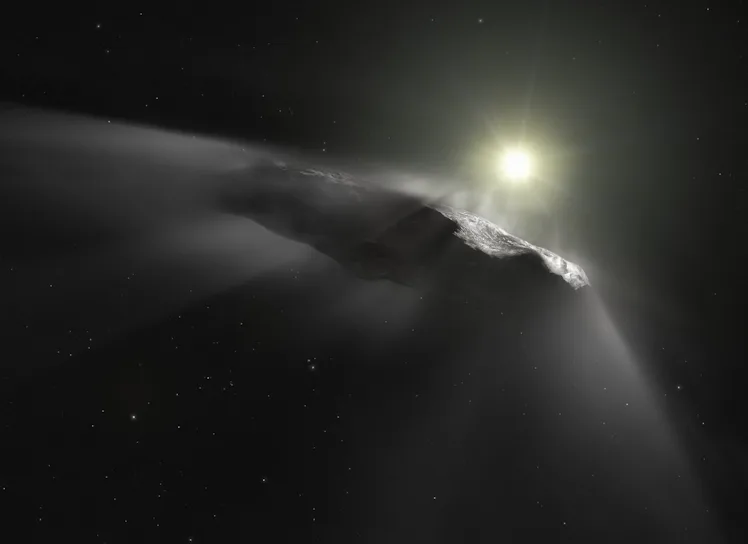
An illustration of ‘Oumuamua.
NASA
It Works On Paper
To figure out if they could find jurads with the Rubin Observatory, Levine and company first modeled Oort Clouds, the giant swarms of icy rocks around stars where comets are usually believed to originate. (The research was outlined in a recent study in the Planetary Science Journal.) They estimated how many objects that Oort Clouds around stars about one to eight times the Sun's mass might release in their end stages. They also modeled if astronomers would be able to tell if an object came from before or after a star’s death.
When our Sun and roughly 97 percent of all stars die, all that will be left is their core, and this leftover object is called a white dwarf. Previous research suggested that each white dwarf is expected to kick out up to an Earth's amount of mass.
They found that it was possible to distinguish jurads from objects kicked out before a star died. As stars reach their ends, they grow bright and blast out gusts of gas. This can drive off hyper-volatile molecules such as carbon monoxide, and stellar winds could deposit dust that covers the entire jurad surface, they say.
However, LSST is currently expected to only discover about 15 interstellar objects over the course of its roughly 10-year observational campaign. As such, given what scientists currently know about exoplanetary systems, Levine and his colleagues say it's not impossible but not likely that LSST will detect a jurad.
Still, Pedro Bernardinelli, an astrophysicist at the University of Washington in Seattle who was not involved in the work, notes there are many uncertainties with analyses of this kind. "This is not a problem with the work — it is rather a problem with our understanding of planetary formation, and how similar or not our own Solar System is to others," he notes. As such, "I would not take as a prophecy that LSST will never find such objects."
"It's a very exciting time to be in astronomy and astrophysics," Levine says. "We're at a point where we've answered a lot of questions, but like all good fields of science, once we've answered a question, usually two or three more pop up."
A former intelligence official turned whistleblower has given Congress and the Intelligence Community Inspector General extensive classified information about deeply covert programs that he says possess retrieved intact and partially intact craft of non-human origin.
The information, he says, has been illegally withheld from Congress, and he filed a complaint alleging that he suffered illegalretaliation for his confidential disclosures, reported here for the first time.
Other intelligence officials, both active and retired, with knowledge of these programs through their work in various agencies, have independently provided similar, corroborating information, both on and off the record.
Thewhistleblower, David Charles Grusch, 36, a decorated former combat officer in Afghanistan, is a veteran of the National Geospatial-Intelligence Agency (NGA) and the National Reconnaissance Office (NRO). He served as the reconnaissance office’s representative to the Unidentified Aerial Phenomena Task Force from 2019-2021. From late 2021 to July 2022, he was the NGA’s co-lead for UAP analysis and its representative to the task force.
The task force was established to investigate what were once called “unidentified flying objects,” or UFOs, and are now officially called “unidentified anomalous phenomena,” or UAP. The task force was led by the Department of the Navy under the Office of the Under Secretary of Defense for Intelligence and Security. It has since been reorganized and expanded into the All-Domain Anomaly Resolution Office to include investigations of objects operating underwater.
Grusch said the recoveries of partial fragments through and up to intact vehicles have been made for decades through the present day by the government, its allies, and defense contractors. Analysis has determined that the objects retrieved are “of exotic origin (non-human intelligence, whether extraterrestrial or unknown origin) based on the vehicle morphologies and material science testing and the possession of unique atomic arrangements and radiological signatures,” he said.
In filing his complaint, Grusch is represented by a lawyer who served as the original Intelligence Community Inspector General (ICIG).
“We are not talking about prosaic origins or identities,” Grusch said, referencing information he provided Congress and the current ICIG. “The material includes intact and partially intact vehicles.”
In accordance with protocols, Grusch provided the Defense Office of Prepublication and Security Review at the Department of Defense with the information he intended to disclose to us. His on-the-record statements were all “cleared for open publication” on April 4 and 6, 2023, in documents provided to us.
Grusch’s disclosures,and those of non-public witnesses, under new protective provisions of the latest defense appropriations bill, signal a growing determination by some in the government to unravel a colossal enigma with national security implications that has bedeviled the military and tantalized the public going back to World War II and beyond. For many decades, the Air Force carried out a disinformation campaign to discredit reported sightings of unexplained objects. Now, with two public hearings and many classified briefings under its belt, Congress is pressing for answers.
Karl E.Nell, a recently retired Army Colonel and current aerospace executive who was the Army’s liaison for the UAP Task Force from 2021 to 2022 and worked with Grusch there, characterizes Grusch as “beyond reproach.”
Karl E. Nell
(Credit: Department of the Army)
Christopher Mellon, who spent nearly twenty years in the U.S. Intelligence Community and served as the Deputy Assistant Secretary of Defense for Intelligence, has worked with Congress for years on unidentified aerial phenomena.
“A number of well-placed current and former officials have shared detailed information with me regarding thisalleged program, including insights into the history, governing documents and the location where a craft was allegedly abandoned and recovered,” Mellon said. “However, it is a delicate matter getting this potentially explosive information into the right hands for validation. This is made harder by the fact that, rightly or wrongly, a number of potential sources do not trust the leadership of the All-Domain Anomaly Resolution Officeestablished by Congress.”
But some insiders are now willing to take the risk of coming forward for the first time with knowledge of these recovery programs.
Jonathan Grey is a generational officer of the United States Intelligence Community with a Top-Secret Clearance who currently works for the National Air and Space Intelligence Center (NASIC), where the analysis of UAP has been his focus. Previously he had experience serving Private Aerospace and Department of Defense Special Directive Task Forces.
“The non-human intelligence phenomenon is real. We are not alone,” Grey said. “Retrievals of this kind are not limited to the United States. This is a global phenomenon, and yet a global solution continues to elude us.”
At the National Geospatial-Intelligence Agency, Grusch served as a Senior Intelligence Capabilities Integration Officer, cleared at the Top Secret/Secret Compartmented Information level, and was the agency’s Senior Technical Advisor for Unidentified Aerial Phenomena analysis/Trans-Medium Issues. From 2016 to 2021, he served with the National Reconnaissance Office as Senior Intelligence Officer and led the production of the NRO director’s daily briefing. Grusch was a GS-15 civilian, the military equivalent of a Colonel.
Grusch has served as an Intelligence Officer for over fourteen years. A veteran of the Air Force, he has numerous awards and decorations for his participation in covert and clandestine operations to advance American security.
According to a 2021 NRO Performance Report, Grusch was an intelligence strategist with multiple responsibilities who “analyzed unidentified aerial phenomena reports” and “boosted congressional leadership Intel gaps [in] understanding.” He was assessed by the reconnaissance office’s Operations Center Deputy Director as an “adept staff officer and strategist” and “total force integrator with innovative solutions and actionable results.”
Grusch prepared many briefs on unidentified aerial phenomena for Congress while in government and helped draft the language on UAP for the FY2023 National Defense Authorization Act, spearheaded by Senators Kirsten Gillibrand and Marco Rubio and signed into law by President Biden in December 2022. The provision states that any person with relevant UAP information can inform Congress without retaliation, regardless of any previous non-disclosure agreements.
In his statements cleared for publication by the Pentagon in April, Grusch asserted that UFO “legacy programs” have long been concealed within “multiple agencies nesting UAP activities in conventional secret access programs without appropriate reporting to various oversight authorities.”
He said he reported to Congress on the existence of a decades-long “publicly unknown Cold War for recovered and exploited physical material – a competition with near-peer adversaries over the years to identify UAP crashes/landings and retrieve the material for exploitation/reverse engineering to garner asymmetric national defense advantages.”
Beginning in 2022, Grusch provided Congresswith hours of recorded classified information transcribed into hundreds of pages which included specific data about the materials recovery program. Congress has not been provided with any physical materials related to wreckage or other non-human objects.
Grusch’s investigation was centered on extensive interviews with high-level intelligence officials, some of whom are directly involved with the program. He says the operation was illegally shielded from proper Congressional oversightand that he was targeted and harassed because of his investigation.
Grusch said that the craft recovery operations are ongoing at various levels of activity and that he knows the specific individuals, current and former, who are involved.
“Individuals on these UAP programs approached me in my official capacity and disclosed their concerns regarding a multitude of wrongdoings, such as illegal contracting against the Federal Acquisition Regulations and other criminality and the suppression of information across a qualified industrial base and academia,” he stated.
Associates who vouched for Grusch said his information was highly sensitive, providing evidence that materials from objects of non-human origin are in the possession of highly secret black programs. Although locations, program names, and other specific data remain classified, the Inspector General and intelligence committee staff were provided with these details. Several current members of the recovery program spoke to the Inspector General’s office and corroborated the information Grusch had provided for the classified complaint.
Grusch left the government on April 7, 2023, in order, he said, to advance government accountability through public awareness. He remains well-supported within intelligence circles, and numerous sources have vouched for his credibility.
“His assertion concerning the existence of a terrestrial arms race occurring sub-rosa over the past eighty years focused on reverse engineering technologies of unknown origin is fundamentally correct, as is the indisputable realization that at least some of these technologies of unknown origin derive from non-human intelligence,” said Karl Nell, the retired Army Colonel who worked with Grusch on the UAP Task Force.
In a 2022 performance evaluation, Laura A. Potter, Deputy Chief of Staff for Intelligence, Headquarters, Department of the Army, described Nell as “an officer with the strongest possible moral compass.”
Grusch is represented by Charles McCullough III, senior partner of the Compass Rose Legal Group in Washington and the original Inspector General of the Intelligence Community, confirmed by the U.S. Senate in 2011. At that time, McCullough reported directly to the then-Director of National Intelligence, James R. Clapper, and oversaw intelligence officers responsible for audits, inspections, and investigations.
In May 2022, McCullough filed a Disclosure of Urgent Concern(s); Complaint of Reprisal on behalf of Grusch with the ICIG about detailed information that Grusch had gathered beginning in 2019 while working for the UAP Task Force.
An unclassified version of the complaint provided to us states that Grusch has direct knowledge that UAP-related classified information has been withheld and/or concealed from Congress by “elements” of the intelligence community “to purposely and intentionally thwart legitimate Congressional oversight of the UAP Program.” All testimony Grusch provided for the classified complaint was provided under oath.
According to the unclassified complaint, in July 2021, Grusch had confidentially provided classified information to the Department of Defense Inspector General concerning the withholding of UAP-related information from Congress. He believed that his identity, and the fact that he had provided testimony, were disclosed “to individuals and/or entities” within the Department of Defense and the Intelligence Community outside the IG’s office. He did not allege that this information was improperly disclosed by any member of that office.
As a result, Grusch suffered months of retaliation and reprisals related to these disclosures beginning in 2021. He asked that details of these reprisals be withheld to protect the integrity of the ongoing investigation.
The Intelligence Community Inspector General found his complaint “credible and urgent” in July 2022. According to Grusch, a summary was immediately submitted to the Director of National Intelligence, Avril Haines; the Senate Select Committee on Intelligence; and the House Permanent Select Committee on Intelligence.
The complaint was drafted and signed by McCullough and his managing partner. It ended with Grusch’s signature attached to his statement that “I do solemnly affirm under the penalties of perjury that the contents of the foregoing paper are true and correct to the best of my knowledge.”
A whistleblower reprisal investigation was launched, and Grusch began his communication with the staff of the Congressional intelligence committees in private closed-door sessions. According to Grusch, certain information which he obtained in his investigation could not be put before Congressional staffers because they did not have the necessary clearances or the appropriate investigative authority.
A representative of the House Permanent Select Committee on Intelligence told us in March that the committee members are not able to comment on the content of a complaint or confirm the identity of a complainant.
“When you have multiple agencies nesting UAP activities in conventional SAP/CAP programs, both as recipients of exploitation-related insights and for operational reasons, without appropriate reporting to various oversight authorities, you have a problem,” Grusch said, referencing the highly secret Special Access Programs and Controlled Access Programs.
Grusch’s willingness to take risks and speak out appears to be emboldening others with similar knowledge who believe in greater transparency.
Jonathan Grey, the intelligence officer specializing in UAP analysis at the National Air and Space Intelligence Center, is speaking publicly for the first time, identified here under the identity he uses inside the agency.
NASIC, headquartered at Wright Patterson Air Force Base, is the Department of Defense’s primary Air Force source for foreign air and space threat analysis. Its mission is to “discover and characterize air, space, missile, and cyber threats,” according to the agency’s website. “The center’s team of trusted subject matter experts deliver unique collection, exploitation, and analytic capabilities not found elsewhere,” the website states.
Grey said that such immense capabilities are not merely relegated to the study of the prosaic. “The existence of complex historical programs involving the coordinated retrieval and study of exotic materials, dating back to the early 20th century, should no longer remain a secret,” he said. “The majority of retrieved, foreign exotic materials have a prosaic terrestrial explanation and origin – but not all, and any number higher than zero in this category represents an undeniably significant statistical percentage.”
National Air and Space Intelligence Center headquarters at Wright Patterson Air Force Base (Image Credit: NASIC/Facebook).
It is unusual for an Air Force insider to come forward, as the Air Forcehas been less forthcomingthan other agencies with regard to UAP.
“A vast array of our most sophisticated sensors, including space-based platforms, have been utilized by different agencies, typically in triplicate, to observe and accurately identify the out-of-this-world nature, performance, and design of these anomalous machines, which are then determined not to be of earthly origin,” Grey said.
Mellon, the former Deputy Assistant Secretary of Defense for Intelligence, has been instrumental in arranging classified briefings for members of Congress and other officials about UAP, which include references to exotic retrieved materials. The first briefing he facilitated on retrievals of unexplained objects was provided to staff members of the Senate Armed Services Committee on Oct. 21, 2019, and to staff members of the Senate Intelligence Committee two days later, asreportedbyThe New York Times.
Former Deputy Assistant Secretary of Defense for Intelligence Christopher Mellon
(Credit: C. Mellon).
Mellonsays that once the members of Congress gain greater awareness of the information provided to their staff and the Inspector General, they will be in a position to quickly determine the truth if they have the will to do so.
“This is an unprecedented oversight challenge for the committees, but I believe we have leaders in Congress who are up to the task,” Mellon said.
Classified briefings are often presented for Jonathan Grey and his team at NASIC. “High-level, classified briefing materials exist in which real-world scenarios involving UAP, as evidenced by historical examples, are made available to Intelligence Personnel on a need-to-know basis,” he told us. “I have been the recipient of such briefings for almost a decade.”
The National Defense Authorization Act for FY2023 tasked the Secretary of Defense, in consultation with the Director of National Intelligence, with establishing for the first time a secure mechanism for the authorized reporting of sensitive information to defense channels.
In addition, the legislation asks for reporting on “material retrieval, material analysis, reverse engineering, research, and development” involving unidentified anomalous phenomena currently and going back decades.
Dr. Garry Nolan, a Professor in the Department of Pathology at Stanford University and a renowned inventor and entrepreneur with more than three hundred published papers, has started over half a dozen companies based on technologies out of his laboratory. Nolan has previously applied some of those technologies to the analysis of exotic materials, publishing the first peer-reviewed paper examining such materials.
Stanford professor Garry Nolan (Credit: Timothy Archibald)
“Human civilization was utterly transformed by something as small as a grain of silicon or germanium—creating the underpinning of the integrated circuits that underly computation and now even artificial intelligence,” Nolan said.
Studying even small samples of purported anomalous material could lead to currently inconceivable benefits for humanity, he said. “What might be represented here could be hundreds of technology revolutions ahead of us. It could be more transformative for humanity than what the microprocessor accomplished. Imagine what we could do with even a grain of knowledge about how they operate.”
To encourage potential witnesses to come forward, the whistleblower legislation forbids any federal employee from retaliating against anyone providing authorized disclosure.
“Whistleblowing is essential to the checks and balances of our government – and no federal employee should feel discouraged from stepping forward due to fear of retaliation,” Rep. Andre Carson told us. In May 2022, Carson presided over the first open Congressional hearing on UAP since 1968.
The case of David Grusch marks a crucial test of these new whistleblower protections and their ability to protect future whistleblowers who decide to come forward.
Jonathan Grey says secrets have been necessary. “Though a tough nut to crack, potential technological advancements may be gleaned from non-human intelligence/UAP retrievals by any sufficiently advanced nation and then used to wage asymmetrical warfare, so, therefore, some secrecy must remain,” he says. “However, it is no longer necessary to continue to deny that these advanced technologies derived from non-human intelligence exist at all or to deny that these technologies have landed, crashed, or fallen into the hands of human beings.”
Grey noted that the hypothesis that the United States alone has bullied the other nations into maintaining this secrecy for nearly a century continues to prevail as the primary consensus amongst the public at large. “My hope is to dissuade the global populace from this archaic and preposterous notion, and to potentially pave the way for a much broader discussion,” he said.
Grusch said it was dangerous for this “eighty-year arms race” to continue in secrecy because it “further inhibits the world populace to be prepared for an unexpected, non-human intelligence contact scenario.”
“I hope this revelation serves as an ontological shock sociologically and provides a generally uniting issue for nations of the world to re-assess their priorities,” Grusch said.
Leslie Kean and Ralph Blumenthal, with Helene Cooper, co-authored the Dec. 17, 2017, front-page article in The New York Times that disclosed the existence of a secret Pentagon program investigating UAP.
Tim McMillan, Micah Hanks, Craig Labadie ,and Sean Munger contributed to this article.
Additional background details on this article, and our investigative process can be found here.
It all had started a few years before the “Space Race” began between the two rival nations: the USA and Soviets. The world was stunned by the daily UFO sightings, and stories of alien contact flushed newspapers. It was the era of two types of people: the first one was groups of like-minded people, for example, engineers, scientists, and inventors who dismissed any alien contact and flying saucers’ stories, while the second ones were the contactees who also claimed to had been in the UFOs. These groups never aligned with each other, but Wilbert Brockhouse Smith (1910-1962), a Canadian engineer was the only line of connection between these two groups.
Mr. Smith worked as a senior radio engineer for the Canadian government’s Department of Transport in the late 1940s and 50s. He was the reason behind the radio communication between Canada and the United States at that time. Very few people know that Mr. Smith convinced the Canadian government to establish a program to monitor the UFOs that eventually detects the strange aerial phenomenon which, according to him, was not earthly. While asking Americans about the existence of UFOs, he received a reply from them that the US government had put this subject at their uppermost concern, and it was even more top secret than the atomic bomb.
“One of the most important things I had to realize was that we are not alone. The human race in the form of man extends throughout the universe and is incredibly ancient. Also, its appearance in physical form is but one of its many manifestations along the path of progress. This planet has been colonized many times by people from elsewhere and our present human race are blood brothers of these people. Is it any wonder that they are interested in us,”
Wilbert Smith said.
Wilbert Brockhouse Smith (1910-1962) Credit: Grant Cameron
Besides, according to researcher Grant Cameron, Mr. Smith played a major role in establishing Radio Ottawa used by Canadian spies and also for tracking secret Soviet communications.
In 1950, the Canadian UFO study program Project Magnet was established by Transport Canada under the supervision of Mr. Smith. The government funded the project for four years, but he received informal funding after. In 1952, he set up an observatory at Shirley’s Bay to study the findings of UFO sightings under Project Magnet. He had a personal interest in geo-magnetism, which made him conclude that the UFOs were of extraterrestrial origin, propelled by magnetic forces, and actually from parallel universes.
Mr. Smith said: “It is my opinion that the people from elsewhere choose all sorts of methods to make contact with us, and their technology and understanding being much better than ours, they can use methods which we find quite incomprehensible.”
Interestingly, he believed that the UFOs were controlled through physic powers, and such statements embarrassed the Department of Transport. In 1952, when the great UFO wave hit the media, Mr. Smith claimed that the United States Air Force shot down a UFO near Washington, D.C, recovered its piece and let him borrow it. When asked if he had returned the piece to the USAF, he replied that it went to a much more highly secret group (It was neither FBI nor CIA), which identity he could not disclose.
Surprisingly, Mr. Smith was also a firm believer in aliens. In 1961, he gave a speech at the Vancouver Area UFO Club, where he claimed to had been in contact with aliens, referring to them as “the boys topside.” Furthermore, he said that the aliens had explained to him that the speed of light is not constant, and time works differently in the universe, not chronological ticking that people can imagine on Earth, but a “field function” that changed throughout the universe, and which could be altered. (Source]
Their ships as he was told, were supported on the Earth’s gravitational field. The fields surrounding their ships, he added, created areas that reduced areas that weakened the strength of objects that came into contact with them, accounting for the destruction of earthly military craft that flew too close to them. This explained, among other phenomena, the May 1956 crash of a military jet into the Villa St. Louis convent in Orleans — the jet, Smith said, flew into a “very strong vortex of reduced binding,” causing it to break apart.
When nuclear explosions happened, he added, similar unstable vortices were formed. His unnamed friend, who had also been in communication with “these people from outside,” claimed to have spoken with one of them, Tyla, a garbage collector whose duty was to clean up the radioactive messes left by such man-made explosions. Tyla, according to Smith, grabbed the stuff, transported it onboard his ship, rendered it inactive, and then dumped it in a remote location on Earth. Tyla reportedly told a friend in 1948 that he would dump his next load near Ottawa at an appropriate moment so that many people could observe it.
On November 21, 1950, Mr. Smith wrote a memo that was classified as “Top Secret” but later, it was recovered from the Archives of the University of Ottawa. According to the memo, the Canadian government was serious about UFOs and had been building a secret technology using oceanic radiation, atmospheric radioactivity, and geo-magnetism. He further wrote that his work in geomagnetic and the energy on which flying saucers operate was connected. (Source)
By summarizing sightings reported in 1952, Mr. Smith reported that UFOs were “a hundred feet or more in diameter; they can travel at speeds of several thousand miles per hour; they can reach altitudes well above those which should support conventional aircraft or balloons, and ample power and force seem to be available for all required maneuvers.”
Project Magnet was discontinued just a few days afterward. Ottawa Journal reported that scientists insist, “there is no proof flying saucers exist but they honorably admit there is no proof that all the strange and wandering objects reported in the sky are freaks of imagination or atmosphere.”
Before his death from cancer, Mr. Smith had asked his wife to hide all his research and sensitive files, as he was afraid that they would get into the wrong hands. “They will be coming to ransack all my work,” Smith proclaimed. He died on December 27, 1962, and as he predicted soon after that, the Soviets, Americans, and Canadians approached his wife. (Source)
Is the remote viewing real? The subject is very controversial for scientists to study but James H. Lee, an award-winning financial advisor suggested that it has the potential to make a meaningful contribution to the professional futurist′s toolbox. This particular technique is well-discussed in the declassified CIA files where psychic abilities were used to spy on Soviet Russia and track down its military activities under Project Stargate.
RV was real, CIA admitted it
The first test of the project was conducted in the 1970s at the US Army base in Maryland. Basically, this highly classified project was about the mind-reading of the enemies, so the CIA started recruiting people who claimed to “have powers of extrasensory perception (ESP) to help uncover military and domestic intelligence secrets.” (Source)
In the CIA declassified file, it was detailed how Uri Geller could replicate things drawn by a researcher in another sealed room. As the US government was getting benefits from this program, they continued funding it.
In one experiment for the CIA, Geller replicate images drawn by a researcher, sitting in another sealed room.
Uri Geller replicated images drawn by a researcher
One of the remote viewers named Angela Dellafiora Ford revealed her physics powers on the CBS News program “48 Hours.” In 1989, she was asked by the army to psychically track down the location of one man. She located the man in Lowell, Wyoming, and then he was arrested 100 miles west of a Wyoming town called Lovell.
In 2021, John Greenewald, Jr.’s Blackvault published approximately 2,700 pages of the declassified documents provided by the CIA, involving UAP/UFO information. One document that staggered ET hunters was about Mars.
The document titled “Mars Exploration May 22, 1984,” basically centers around a subject that made use of astral projection which helped him observe ancient alien life on Mars. In this document, there is a transcript, where a subject named Joseph McMoneagle, a retired US Army veteran was given an envelope prior to the interview and asked not to open it until the interview ended. According to the CIA’s own documents, the unnamed psychic described “The planet Mars. Time of interest approximately 1 million years B.C.” (Source)
He claimed to identify that he saw pyramid-like structures on the Red Planet. The subject also added that he witnessed alien life forms on the Martian surface.
[Subject]: I’m seeing, ah… It’s like a perception of a shadow of people, very tall… thin, it’s only a shadow. It’s as if they were there and they’re not, not there anymore. [Monitor]: Go back to a period of time where they are there. Sub: Um… (mumble) It’s like I get a lot of static on a line and everything, it’s breaking up all the time, very fragmentary pieces. Mon: Just report the data, don’t try to put things together, just report the raw data. Sub: I just keep seeing very large people. They appear thin and tall, but they’re very large. Ah… wearing some kind of strange clothes.
According to the date specified in the “Mars Exploration” memo, it was approved to be published only in 2000 although it was recorded in 1984, and McMoneagle was the only remote viewer to be working at that time. He wrote in his book “Mind Trek” about a similar incident mentioned in that memo.
Jacob Brogan, an assistant editor at the Washington Post tracked down and called McMoneagle. According to Brogan, McMoneagle told him that the request to visit Mars was not made by the CIA but by some unknown army person to him. (Source)
“Neither of us knew what we were working on. Our assumption at the time was that I was working on targets on Earth. I was not familiar with any pyramids on Earth that had such large rooms,” McMoneagle told him.
McMoneagle was confused why he had been asked by the army to explore Mars. He had no clue. He remembered one more incident when he was asked to examine the UFO. “The problem that I have with targeting UFOs and Mars and things like that is that there’s no real way to validate the information,” he said.
In an interview with Richard Thieme, a founder of ThiemeWorks, McMoneagle shared his experience on Project Stargate, UFOs, and ETs. He shared his encounter with the UFO in 1966, in which he got a radiation burn.
Richard Thieme asked him: “Is it all one thing, though? These are complex psychological processes – and you were burned physically in 1966. Is it all one thing? Do scriptural texts of folk documents about people encountering entities – can we connect that experience with an experience of the lights going on at night and you seeing a physical craft?”
McMoneagle replied: “I did a remote viewing in early 1980s, 82 or 83, where a UFO target was mixed in with other targets, so I had no idea it was a UFO target.” Over the years, as McMoneagle said, he was involved in about 450 missions. One of his favorites was in 1980 when CIA personnel captured a suspected KGB agent in South Africa. They wanted to know how the agent was communicating with the Soviet military. They put an envelope on McMoneagle’s desk, and without knowing anything of the man, McMoneagle told the CIA that the man liked to use a small pocket calculator. The calculator turned out to be a disguised short-wave radio. He retired from the Army in 1984 but continued to work as a Stargate consultant.
According to the date specified in the “Mars Exploration” memo, it was approved to be published only in 2000 although it was recorded in 1984, and McMoneagle was the only remote viewer to be working that time. He wrote in his book “Mind Trek” about the similar incident mentioned in that memo.
CIA Interdimensional Experiemnt
Robert Monroe (1915 –1995), another RV that had a striking history of remote viewing was probably the first RV hired by the CIA. One day in 1978, the CIA representatives contacted him. They wanted to implement his mind-expanding practice in attempt of sending soldiers into deep remote viewing sessions. Given Monroe’s extensive background and various patented applications, he was the perfect choice for this trailblazing operation. Hoping to obtain further credibility in the study of paranormal phenomena, he agreed to join them. (Source)
Since those involved were opening portals to other dimensions, researchers aptly named the assignment Gateway Process. According to declassified files, the program is “a training system designed to bring enhanced strength, focus and coherence to the amplitude and frequency of brainwave output between the left and right hemispheres so as to alter consciousness, moving it outside the physical sphere so as to ultimately escape even the restrictions of time and space. (Source)
The participant then gains access to the various levels of intuitive knowledge the universe offers.” Discoveries listed in Commander Wayne M. McDonnell’s final analysis paper included detailed information about the nature of reality. Investigators ascertained we live in a holographic universe and waking life is a projected electromagnetic matrix.
To enter the unearthly realms, headphone-donning voyagers sat in isolated darkness while listening to various tones at specific hertz. The participants had no contact or communication with one another. After their journey was finished, the volunteers would report what they experienced with staff members.
According to Robert, subjects would often encounter interdimensional entities. Most frequently, they witnessed reptilian humanoids. The viewers referred to the uncanny creatures as “the alligators” due to their crocodilian features. Curiously, Monroe was already quite familiar with the unsettling breed. During countless expeditions, he observed identical saurian creatures. For over thirty-five years, the etheric investigator gathered insight about these startling beings.
Could there be another civilization living among us? UFO expertAnna Whittyhas put forth a theory suggesting that aliens have been residing in Earth’s oceans for protection and have always been present on our planet. Whitty’s claims are based on the official statement of Dr. Shirley Wright, who allegedly interviewed the only survivor of the Roswell crash in 1947.
A two-hour documentary called “Roswell 75: The Final Evidence” features Whitty along with other experts, discussing the UFO crash and the potential presence of advanced humanoid aliens on Earth. In the documentary, Dr. Wright mentioned that the aliens inquired about human exploration inside the ocean, they asked “how far into the ocean” the humans traveled.
Dr. Shirley Wright, a former colleague of Albert Einstein stated that she interviewed aliens found at the Roswell crash site in 1947. She noted that aliens are actually just humans, but an advanced form. She claimed to have been present when the US government interviewed an alien survivor from the Roswell crash. According to Dr. Wright, the alien said that not all of them live above the ground and that many reside underground on our planet.
In 1993, an interview with Dr. Shirley Wright was made public where she claims to have witnessed the examination of Roswell UFO crash debris and encountered nine alien bodies. The interview reveals detailed descriptions of the aliens’ physical characteristics, their suits, and their apparent ability to survive in Earth’s atmosphere, while also highlighting the limited information they were willing to disclose about their lifestyle and reproductive methods.
Dr. Shirley Wright was a dedicated teacher and scientist, earning PhDs in Physical Chemistry and Physical Science. She was a chemistry professor at MDCC for over 50 years. She was a student of Dr. Albert Einstein at Princeton. Credit: legacy.com
According to Dr. Wright, while discussing her security clearance, she revealed: “The only reason we could go is that it’s a crack or did they deactivate it… after school, it was immediately deactivated.” This suggests that her access to the Roswell incident was facilitated by her clearance, which was granted specifically for the purpose of examining the extraterrestrial crash.
When asked about her encounter with the alien survivor, Dr. Wright admitted: “I was back at the motel in a city nearby, and I had been told that I would be able to keep the being alive.” This statement raises questions about the nature of her involvement and the significance of her role in handling and studying the extraterrestrial being.
Describing the appearance of the aliens, Dr. Wright vividly recalled: “They were very light, soft, a grayish-green, really. They had a slim, lean physique, no nose but markings where a nose opening would be, prominent eyes, and a mouth. They had no eyebrows, but they had ears and a very forked head.” These detailed descriptions paint a picture of the otherworldly beings she encountered during her extraordinary experience.
Additionally, Dr. Wright noted: “Their eyes were enormous, the most obvious thing you’d see on their face. They were almost brown-black, very dark.” This emphasizes the distinctiveness of the aliens’ eyes and adds to the mystique surrounding their appearance.
Regarding their attire, Dr. Wright observed: “They had suits on, very much like what we call suits. The fabric, however, was unfamiliar to me as a chemist. It didn’t resemble any fabric I recognized.” This intriguing detail raises questions about the technology and materials used by these extraterrestrial visitors.
Dr. Wright also touched upon the aliens’ apparent ability to adapt to Earth’s atmosphere, stating, “They could apparently survive in our atmosphere. They seemed to indicate that the atmosphere was quite similar, although not identical to ours.” This revelation hints at the remarkable adaptability of these beings and their advanced understanding of different planetary conditions.
In the realm of their lifestyle and reproductive methods, Dr. Wright admitted: “We tried to find that out, but we were very cautious not to antagonize them. They didn’t reveal much about it, but they mentioned living underground, in what we would call subterranean conditions.” This suggests a unique aspect of their civilization and their preference for dwelling beneath the surface.
Anna Whitty told the Daily Star that if whatever Wright had documented through her interview is correct, then it is more believable for the aliens to come from under the sea rather than from another planet. “If what Shirley said is right, it is more likely that aliens come from somewhere under the sea or caves or something like that, rather than another planet, it makes sense because there’s a lot of evidence on the planet that there has been a massive cataclysm every few thousand years,” Whitty said.
“If humans on the surface are being reset to the Stone Age every several thousands of years, and these people are somewhere where they are more protected because they are underground, then perhaps their development in technology and intelligence is continuing on an upwards trajectory whereas we’re reset. It’s also possible that maybe they aren’t beings at all, but they can make you think you’re seeing what you’re not seeing,” she added.
Whitty’s theory of aliens being “underwater entities” is supported by several incidents and testimonies. One such incident occurred in July 2019 when footage filmed on the USS Omaha showed a UFO diving into the water off San Diego. No wreckage or recovered craft were found. Retired US Air Force Lt. Col. Richard French, who served as a lead investigator of Project Blue Book in the 1950s, claimed to have witnessed two aliens repairing their ship submerged underwater in Newfoundland.
French testified about his experiences in front of former members of Congress at the Citizen Hearing in 2013, stating that he saw the aliens and their crafts below the water surface. He described clear water that allowed him to observe the beings and their activities. Despite his role as a UFO debunker, French confirmed that it was a UFO sighting involving extraterrestrials.
Other accounts support the idea of extraterrestrial presence in the ocean. Former Gunner’s Mate John Baughman, stationed on the USS Carl Vinson in 2010, reported seeing a Tic Tac-shaped UFO underwater. He described a solid object that rapidly collapsed and disappeared as it descended into the depths.
There have also been encounters with unidentified submerged objects (USOs). The crew of a Soviet submarine witnessed six disc-like objects approaching their vessel at high speeds. Unable to escape, they were forced to surface. Through the periscope, they observed the objects emerging from the water and swiftly departing.
Classic alien abduction cases also involve encounters with underwater bases. Betty Andreasson Luca, a Massachusetts woman, experienced multiple abductions and recalled being taken to a spacecraft flying over the ocean. The craft submerged into the water, entering a tunnel illuminated by light. Filiberto Cardenas claimed to have been taken to a secret underwater hangar witnessed by his friend’s family. He described entering a tunnel at high speed underwater and arriving at a large hangar beneath the sea.
These incidents and testimonies provide evidence for the presence of extraterrestrial activity in the ocean and support Whitty’s theory of aliens as “underwater entities".
The first World Humanoid Robot Games are underway in China, with robots competing against each other in track and field, soccer, kickboxing and other events.
Humanoid robots are racing, fighting and falling over in a first-of-its-kind World Humanoid Robot Games event held inChina.
The Olympics-style competition features more than 500 robots from 16 different countries going head-to-head in sports such as running, soccer and kickboxing. The event also features more niche competitions, including medicine sorting and handling materials for cleaning services, Reuters reported.
An opening ceremony officially kicked off the games in Beijing on Thursday (Aug. 14), featuring robots dancing and playing musical instruments alongside human operators and companions. Robot athletes will now compete until the games come to a close on Sunday (Aug. 17).
Unitree's H1 humanoid robot won gold in the 400m and 1,500m races on Friday (Aug. 15).(Image credit: Photo by Zhang Xiangyi/China News Service/VCG via Getty Images)
Several robot have fallen over in the soccer matches.(Image credit: Kevin Frayer/Stringer via Getty Images)
Robot kickboxing is one of the games' contact sports.(Image credit: Kevin Frayer/Stringer via Getty Images)
Faced with an ageing population and stiff U.S. tech competition, China is investing billions of dollars into robotics. The games are a testament to the strides engineers are making in the field. However, spectators have also seen their fair share of robots moving awkwardly and falling over.
Human biology is very complicated, so building machines that can walk like us — let alone run and play sports — is difficult. For example, in robot soccer, participants didn't pass the ball to each other with Messi-like precision, but rather walked into the ball to clumsily knock it forward, occasionally stumbling over each other and having to be dragged off the pitch.
The robots are also slower than humans. The fastest robot to have ever run 1,500 meters, for example, finished in 6 minutes and 34 seconds, which is almost twice as long as the human record, which stands at 3 minutes and 26 seconds, according to France 24.
We've already seen humanoid robots compete in sporting events. For example, in June, China hosted what was billed as the world's first humanoid robot combat competition, which saw kickboxing robots awkwardly knock seven bells out of each other. Robot aficionados might also be familiar with robots playing soccer and robots running half-marathons.
The new robot games bring together all of these sports and many more for the first time. They also provide engineers with an opportunity to test out their latest tech.
"You can test a lot of interesting new and exciting approaches in this contest," Max Polter, a member of the HTWK Robots football team from Germany, told Reuters. "If we try something and it doesn't work, we lose the game. That's sad but it is better than investing a lot of money into a product which failed."
Epic scene depicting the Hurrians in their mountainous homeland, combining historical and mythological elements including warriors, giants, and dragons that feature prominently in ancient Mesopotamian literature and the traditions about giants.
( Generated using Flux-Pro/Kontext/Pro AI model)
The Mountain Warriors Who Gave Birth to Giants
By Willem McLoud
In the shadowy mountains of ancient Mesopotamia, a land often called the cradle of civilization, lived a people whose very name meant "cave dwellers." These were the Hurrians—fierce mountain warriors and masterful artisans whose influence echoes through millennia of myth and scripture. Though historically overshadowed by more prominent civilizations like the Sumerians and Akkadians, the Hurrians played a crucial role in shaping some of humanity's most enduring legends, especially those involving giants, divine battles, and supernatural beings. Their story is one of mystery, resilience, and myth-making, bridging the worlds of history and legend.
The Historical Emergence of the Hurrians
The first references to the Hurrians appear in the early third millennium BCE, a period when Mesopotamian civilization was blossoming amidst chaos and innovation. During this time, the Akkadian Empire expanded across much of Mesopotamia, and alongside it, the Hurrians made their presence known in the northern regions. While the Sumerians established the earliest city-states and the Akkadians forged a vast empire, the Hurrians inhabited the mountainous and northern terrains, often serving as formidable neighbors, allies, or foes.
Scholars debate the origins of the Hurrians, but archaeological evidence offers some clarity. The city of Urkesh (modern-day Tell Mozan) in northeastern Syria was a prominent Hurrian center, with continuous settlement dating back to approximately 2700 BCE. Excavations reveal a sophisticated civilization: palaces with walls ten meters thick, intricate seals, and a rich tradition of poetry and storytelling. These people excelled not only in warfare—being renowned archers and metalworkers—but also in literature, creating epic cycles that would influence later mythologies.
Map of the Akkadian Empire showing the extent of Mesopotamian control during the third millennium BC, when the Hurrians first appear in historical records.
During the third millennium BCE, Mesopotamia was a melting pot of cultures and peoples. The Sumerians laid the foundation with their city-states and cuneiform writing, while the Akkadians expanded their influence across the region. The Hurrians, living in the northern mountains, interacted with these civilizations through trade, warfare, and cultural exchange. They often served as mercenaries, diplomats, or rivals, but their influence extended beyond mere politics.
Over time, the Hurrians established their own kingdoms and exerted considerable cultural influence. Their language, a non-Semitic tongue, has been preserved on clay tablets and seals, revealing a society rich in myth, religion, and art. Importantly, their mythology—particularly stories involving giants, divine conflicts, and cosmic battles—would leave a lasting mark on the mythic landscape of the ancient Near East.
The Mythological Legacy: Giants and Divine Beings
One of the most intriguing aspects of Hurrian influence is their contribution to mythic archetypes involving giants and divine conflicts. Ancient texts and iconography depict beings with "bodies of cave birds" or "ravens' faces," as described by early scribes. These descriptions evoke images of monstrous entities—sometimes stone giants rising from primordial seas or monstrous bird-like creatures battling gods.
Cylinder seals, small carved amulets used to secure documents or depict stories, often portray gods in fierce combat with monstrous "birdmen" or serpents—creatures that resemble the legendary dragons and giants of later mythologies. These motifs suggest that the Hurrians had a profound conceptual framework for understanding cosmic battles, divine intervention, and the origins of monstrous beings.
The stories of fallen angels, divine seed, and supernatural giants that permeate later cultures—such as Greek myth's Titans or the biblical Nephilim—may have roots in Hurrian mythic traditions. These narratives likely originated from the Hurrians' worldview, shaped by their experiences in mountainous regions where the natural landscape itself seemed alive with divine power and danger.
The Cultural Transmission of Hurrian Mythology
The influence of Hurrian myth did not remain confined to their own culture. As Mesopotamian civilizations interacted, conquered, and integrated one another’s stories, Hurrian legends found their way into the broader mythic tapestry. For instance, the famous "Kish-tribe" myths and the stories of divine battles between gods like Teshub (Hurrian storm god) and other deities echo in later Hittite and Greek mythologies.
The Epic of Kumarbi, a prominent Hurrian myth, recounts the story of a divine conflict in which the primordial god Kumarbi bites off the genitals of the sky god Anu and gives birth to a series of monstrous offspring, including the thunder god Teshub. This myth shares similarities with Greek stories of Cronus and the Titans, suggesting a shared mythic archetype that traversed cultures and centuries.
The Giants Among Men: Why Do Hurrian Myths Matter?
The recurring theme of giants, divine wars, and monstrous beings in Hurrian mythology points to a worldview that saw the natural and supernatural worlds as intertwined battlegrounds. Their mountain strongholds, perched high above the fertile plains, symbolized a place where divine and mortal realms intersected—a liminal space where giants and gods coexisted or clashed.
These stories served multiple purposes: explaining natural phenomena, reinforcing social hierarchies, and providing spiritual explanations for the chaos and order of the universe. The giants embodied primal forces—chaos, violence, and the untamed wilderness—while the gods represented order, civilization, and divine authority. The Hurrians, as mountain warriors, saw themselves as mediators between these worlds, custodians of divine secrets, and architects of mythic giants that would inspire generations.
The Enduring Echoes in Modern Cultures
Remarkably, the mythic motifs introduced by the Hurrians have persisted across cultures and eras. From Persian dragon-slaying myths to the Greek Titans and even biblical giants, their influence is undeniable. The stories of divine conflict, monstrous beings, and heroic warriors echo in countless traditions, suggesting a shared human fascination with the cosmic struggle between chaos and order.
These stories continue to inspire modern fantasy, literature, and art, reflecting a universal appeal rooted in ancient mythic archetypes. The colossal beings and divine battles of the Hurrians remind us that ancient peoples sought to understand the universe through stories—stories that, despite the passage of millennia, still resonate with our collective imagination.
Conclusion: The Giants of the Mountain Realm
The Hurrians, often overshadowed in history, were the true architects of some of the most enduring mythic images of giants, divine conflicts, and monstrous creatures. Their mountain strongholds served as the crucibles where legends were forged—a civilization of warriors, poets, and storytellers who gifted humanity a rich mythic heritage.
Through archaeological discoveries and the study of ancient texts, we can glimpse their worldview—a universe filled with cosmic battles, divine offspring, and primal forces that continue to influence our stories today. The mountain warriors who gave birth to giants remind us that beneath the veneer of history lies a profound, mythic truth: that humans have always looked to the mountains—those high places—as the birthplace of gods, monsters, and legends that transcend time.
By exploring the legacy of the Hurrians, we uncover a vital chapter in the story of human myth-making—a story that links ancient mountain warriors to the giants and divine conflicts that continue to captivate our imagination.
Meer van UFO'S of UAP'S, ASTRONOMIE, RUIMTEVAART, ARCHEOLOGIE, OUDHEIDKUNDE, SF-SNUFJES EN ANDERE ESOTERISCHE WETENSCHAPPEN - DE ALLERLAATSTE NIEUWTJES


 UFO over houses in Marion, Iowa on Aug 9, 2025, UAP sighting news 📰👽 ancient aliens are watching. Wow!