Ontdek de Fascinerende Wereld van UFO's en UAP's: Jouw Bron voor Onthullende Informatie!
Ben jij ook gefascineerd door het onbekende? Wil je meer weten over UFO's en UAP's, niet alleen in België, maar over de hele wereld? Dan ben je op de juiste plek!
België: Het Kloppend Hart van UFO-onderzoek
In België is BUFON (Belgisch UFO-Netwerk) dé autoriteit op het gebied van UFO-onderzoek. Voor betrouwbare en objectieve informatie over deze intrigerende fenomenen, bezoek je zeker onze Facebook-pagina en deze blog. Maar dat is nog niet alles! Ontdek ook het Belgisch UFO-meldpunt en Caelestia, twee organisaties die diepgaand onderzoek verrichten, al zijn ze soms kritisch of sceptisch.
Nederland: Een Schat aan Informatie
Voor onze Nederlandse buren is er de schitterende website www.ufowijzer.nl, beheerd door Paul Harmans. Deze site biedt een schat aan informatie en artikelen die je niet wilt missen!
Internationaal: MUFON - De Wereldwijde Autoriteit
Neem ook een kijkje bij MUFON (Mutual UFO Network Inc.), een gerenommeerde Amerikaanse UFO-vereniging met afdelingen in de VS en wereldwijd. MUFON is toegewijd aan de wetenschappelijke en analytische studie van het UFO-fenomeen, en hun maandelijkse tijdschrift, The MUFON UFO-Journal, is een must-read voor elke UFO-enthousiasteling. Bezoek hun website op www.mufon.com voor meer informatie.
Samenwerking en Toekomstvisie
Sinds 1 februari 2020 is Pieter niet alleen ex-president van BUFON, maar ook de voormalige nationale directeur van MUFON in Vlaanderen en Nederland. Dit creëert een sterke samenwerking met de Franse MUFON Reseau MUFON/EUROP, wat ons in staat stelt om nog meer waardevolle inzichten te delen.
Let op: Nepprofielen en Nieuwe Groeperingen
Pas op voor een nieuwe groepering die zich ook BUFON noemt, maar geen enkele connectie heeft met onze gevestigde organisatie. Hoewel zij de naam geregistreerd hebben, kunnen ze het rijke verleden en de expertise van onze groep niet evenaren. We wensen hen veel succes, maar we blijven de autoriteit in UFO-onderzoek!
Blijf Op De Hoogte!
Wil jij de laatste nieuwtjes over UFO's, ruimtevaart, archeologie, en meer? Volg ons dan en duik samen met ons in de fascinerende wereld van het onbekende! Sluit je aan bij de gemeenschap van nieuwsgierige geesten die net als jij verlangen naar antwoorden en avonturen in de sterren!
Heb je vragen of wil je meer weten? Aarzel dan niet om contact met ons op te nemen! Samen ontrafelen we het mysterie van de lucht en daarbuiten.
The Anunnaki: Ancient Gods or Alien Visitors who shaped Humanity?
The weight of the gods was crushing, their toil beyond endurance. Let the burden pass to humankind! So speak the oldest verses carved into clay, a fragment from the Atrahasis tale of Mesopotamia. Yet what if these divine figures were not simply legends? What if the stories hint at something far older and stranger than we have allowed ourselves to believe? The name Anunnaki comes from the etched symbols of Sumerian records, their lines recounting the deeds of deities who shaped the world and watched over the Earth.
From the cradle of ancient Mesopotamia comes a story older than any empire, etched into clay tablets and whispered through time: the tale of the Anunnaki. Were they gods, symbols, or something far stranger visitors from beyond the stars who shaped human civilization? The myths of Sumer speak of creation, rebellion, giants, and a great flood. But when paired with the ancient astronaut theory, these legends take on a new dimension, one that could rewrite human history.
Who were the Anunnaki? In the ancient Sumerian texts of Mesopotamia, they are described as the offspring of An, the sky god, and Ki, the earth goddess. Their names appear across the Atrahasis epic, the Enuma Elish, the Epic of Gilgamesh, and the Sumerian King List, etched into clay tablets more than 4,000 years ago.
To mainstream historians, the Anunnaki are mythological gods. Yet in the ancient astronaut theory, they were real beings, extraterrestrial visitors who shaped early civilization.
Author Zecharia Sitchin popularized the idea that the Anunnaki came from Nibiru, a hidden “twelfth planet” on a long, elliptical orbit. According to his interpretation of Sumerian records, the Anunnaki faced an environmental crisis. Their planet’s atmosphere was failing, and the solution they sought was gold, which could be ground into particles and suspended as a shield.
This quest for survival brought them to Earth more than 400,000 years ago. They mined resources, altered life, and may even have engineered humanity itself.
The tablets describe how the lesser gods, the Igigi, were forced into back-breaking labor until they rebelled. To replace them, the Anunnaki created humans.
In myth, mankind was formed from clay mixed with divine blood. In Sitchin’s interpretation, this was genetic engineering: the fusion of Anunnaki DNA with Homo erectus. The first prototype was Adamu, a name that echoes the biblical Adam.
The Sumerian “Edin,” later mirrored in the Hebrew Eden, may not have been a paradise garden but an Anunnaki laboratory outpost.
Two Anunnaki brothers shaped humanity’s destiny:
Enki – the god of wisdom and waters, often seen as humanity’s ally, granting knowledge.
Enlil – stern and authoritarian, seeking control and fearing that humans might grow too powerful.
Their rivalry runs through Mesopotamian myth, influencing stories of divine punishment, survival, and human struggle.
Over time, some Anunnaki defied the rules and took human women as partners. Their offspring were the Nephilim, giants and “mighty men of renown.” The Book of Enoch calls their fathers the Watchers, led by Shemyaza.
According to the stories, these hybrids grew violent, corrupted the world, and became uncontrollable. The solution was drastic: a great flood to wipe the Earth clean.
The Atrahasis epic, the story of Utnapishtim in the Epic of Gilgamesh, and the biblical Noah all describe the same event: a chosen man warned by a god, a vessel built to preserve life, animals carried aboard, and birds released to find land. Humanity survived, but weaker, with shorter lifespans, and forever changed.
Supporters of the ancient astronaut theory believe the Anunnaki left traces in stone:
Mesopotamian ziggurats – described as “bonds between heaven and earth,” possibly landing platforms.
The Great Pyramid of Giza – aligned to true north, massive in scale, theorized as a power plant or beacon rather than a tomb.
Megalithic monuments worldwide – stone circles, cyclopean walls, and sacred sites possibly linked to Anunnaki influence.
The Sumerian King List also suggests a divine legacy, describing rulers with lifespans of thousands of years, perhaps evidence of semi-divine hybrids.
Mainstream archaeology sees the Anunnaki as symbolic deities, metaphors for cosmic order and human struggle. But in alternative history, they were real beings, extraterrestrial visitors from Nibiru, who shaped civilization, taught astronomy, metallurgy, agriculture, and law, and left their mark in myths and monuments that endure to this day.
Explore the mystery of the Anunnaki—Sumerian gods, Nibiru, genetic engineering, Nephilim, the Great Flood, and the ancient astronaut theory in the video below.
What we know about mysterious drones over New Jersey and other states
Bernd Debusmann Jr - BBC News, Washington
Dozens of people have reported seeing drones over New Jersey since 18 November
US aviation authorities have announced a temporary ban on the use of drones in nearly two dozen cities of New Jersey until mid January.
But mystery continues to swirl after nearly a month of drone sightings over New Jersey and other US states, alarming some residents.
Authorities have been unable to provide definitive answers about these sightings, saying only that the flying objects are not believed to pose a danger to the public or national security.
On Sunday, Homeland Security Secretary Alejandro Mayorkas confirmed the sightings included drones, as well as manned aircraft commonly mistaken for drones.
He added that he knows of "no foreign involvement" to do with the unmanned aerial vehicles.
Some lawmakers have criticised the government's handling of the drone reports and the lack of public information.
The drone reports have prompted a wide-range of baseless conspiracy theories, including that they are searching for nuclear weapons, radioactive "dirty bombs" or are form part of an impending invasion by aliens.
Here's what we know.
Where have drones been spotted?
Dozens of drone sightings have been reported over New Jersey since 18 November, but others have been reported around the US north-east.
Some of the flights were spotted near Picatinny Arsenal - a sensitive military research facility - as well as near President-elect Donald Trump's golf course in the town of Bedminster, New Jersey.
The Federal Aviation Administration (FAA) has since issued temporary restrictions prohibiting drone flights over 22 cities including Bedminster and Picatinny until 17 January.
Sightings have also been reported in several other states:
In New York City, several drones were reported flying over the Bronx on 12 December
Stewart Airfield in New York state had to shut down for about an hour on 13 December because of drone activity, Governor Kathy Hochul said
In Connecticut, police confirmed "suspicious drone activity". A drone detection system is now in use near the towns of Groton and New London
In Maryland, former Republican Governor Larry Hogan said he saw what appeared to be "dozens" of drones over his home in Davidsonville
In Massachusetts, two men were arrested on 14 December after a "hazardous drone operation" near Logan International Airport's airspace in Boston, police said
Multiple sightings have been reported in eastern Pennsylvania, including over Philadelphia
In October, the Wall Street Journal reported that mysterious drones were seen for 17 days near US military facilities inVirginia
InOhio, a US Air Force base was briefly closed on 13 December after small drones were detected flying nearby. More drones were reported on 16 and 17 December, although the airbase's operations were not impacted
In late November, drones were also spotted over three US airbases in the UK, with British defence sources telling the BBC suspicion had fallen on a "state actor".
Drones were also reported near the Ramstein US military airbase in Germany in early December.
US President Joe Biden has said that there is "nothing nefarious" about the drone sightings, and "no sense of danger".
In an earlier call with reporters, officials from several US agencies said there was no evidence of any threat to public safety.
"I think there has been a slight overreaction," an official from the FBI said.
The homeland security secretary told ABC News on Sunday he knows of "no foreign involvement with respect to the sightings in the north-east".
"And we are vigilant in investigating this matter," he said.
Mayorkas added: "If there is any reason for concern, if we identify any foreign involvement or criminal activity, we will communicate with the American public accordingly."
Following a closed-door briefing on 17 December, Connecticut representative Jim Himes said that senior defence and law enforcement officials had told lawmakers that "there is zero evidence of laws being broken" by the drones.
He added that the "vast majority" of sightings were normal aircraft or drones being operated lawfully.
Himes said that "millions" of unregistered drones were operating across the US, in addition to 800,000 registered drones that weigh more than half a pound.
What are these flying objects?
Following a briefing with the Department of Homeland Security on 11 December, New Jersey assemblywoman Dawn Fantasia said the drones appeared to avoid detection by traditional methods such as helicopter and radio.
Fantasia said the aircraft were up to 6ft (1.8m) in diameter, travelling with lights turned off and "operate in a co-ordinated manner".
Secretary Mayorkas told ABC that an explanation for the uptick in drone sightings could be to do with a change in federal law last year that allowed drones to be flown at night.
"That may be one of the reasons why now people are seeing more drones than they did before, especially from dawn to dusk," he said.
A joint statement released by the Department of Homeland Security, FBI, FAA and defence department on 16 December said the sightings are a "combination of lawful commercial drones, hobbyist drones, and law enforcement drones, as well as manned fixed-wing aircraft, helicopters, and stars mistakenly reported as drones."
"We have not identified anything anomalous," the statement said, adding that the government still recognises "the concern among many communities."
President-elect Donald Trump, for his part, claimed that the "government knows what is happening".
"For some reason, they don't want to comment," he added. "I think they'd be better off saying what it is our military knows and our president knows."
While he declined to answer whether he had been briefed on the sightings, Trump said that he "can't imagine it's the enemy."
Where are they coming from?
It is unclear who might be operating them.
New Jersey Republican representative Jeff Van Drew said that the drones were coming from an Iranian "mothership" in the Atlantic, while Illinois Democrat Raja Krishnamoorthi said there was a "non-trivial" chance that China could be involved.
The Pentagon, White House and homeland security department have all insisted that there is no foreign origin for the objects.
A northern California man was charged on with flying a drone over and taking pictures of Vandenberg Space Force Base, located near Santa Barbara, on 30 November.
The man, 39-year-old Chinese national Yinpiao Zhou was arrested just before he boarded a flight to China.
But there has been no suggestion this incident has any connection with the spate of drone reports on the other side of the country.
Getty Images
The Pentagon says there is no foreign origin for the objects
Can the drones be stopped?
President-elect Trump has suggested the drones couldn't be flying without the government's knowledge.
"Let the public know, and now," he wrote on his Truth Social media platform. "Otherwise, shoot them down."
Senator Richard Blumenthal, a Connecticut Democrat, also said the drones should be shot down.
Shooting down drones is illegal, however.
New York State Governor Hochul has called on the federal government to allow states to crack down on the drones.
Senate majority leader Chuck Schumer has requested that federal officials send drone detection systems to New York and New Jersey.
In a statement, the FAA warned that drone operators who conduct unsafe or dangerous operations could face fines of up to $75,000 (£59,000) and have their drone pilot certificates revoked.
No Aliens in New Jersey but Governor Murphy Confesses State Has No Idea Who Operated Those Mysterious Drones
Trenton, NJ – During a wide-ranging and at times bizarre interview New Jersey Governor Phil Murphy shut down growing speculation that extraterrestrial life had been spotted over the Garden State’s skies, insisting that what many believed to be UFOs were nothing more than drones—or possibly planes earlier this year, but he still has no idea who was operating those drones.
Dozens of people have reported seeing drones over New Jersey since 18 November
“There are no aliens. There was no there there, believe it or not, based on everything we know,” Murphy said.
Murphy confirmed the state had conducted its own investigation into the unidentified aerial sightings, but ultimately found no evidence to support claims of alien life, nor did it determine who was flying the unexplained objects. He described the situation as a national security vulnerability rather than an interstellar incident.
Murphy admitted that even he and his wife had looked to the skies at night, intrigued by the strange lights.
Governor Murphy’s comments came during a podcast-style discussion where Minhaj pressed him on the flood of citizen videos showing glowing lights, erratic movements, and unexplainable aerial formations hovering above cities like Hoboken and Jersey City. In response, Murphy made it clear the sightings had been thoroughly analyzed and attributed to earthly origins—primarily drones.
“I am telling you that, yes, those [were] drones,” Murphy said, adding that the federal government’s equipment confirmed the conclusion. “We ultimately got the equipment that confirmed that there was no there there.” Still, Murphy acknowledged that the confusion surrounding the incident exposed troubling gaps in the nation’s aerial defense systems in the state which is home to one of the key joint military installations in America.
Calling the response “a 9/11 without the tragedy,” Murphy said the episode served as a reminder of the country’s vulnerabilities to unknown and unmonitored aerial technologies. He urged future administrations to take seriously the implications of unauthorized drone activity, even in the absence of hostile intent.
Although the governor dismissed alien theories, he remained notably less definitive on the topic of “orbs”—a term frequently cited by social media users who insist the floating, pulsating lights observed at night are not drones. Murphy conceded he hadn’t spoken much on that specific aspect but maintained that the situation required serious attention from national security officials—not science fiction speculation.
The state has not announced any ongoing investigations, and no federal agencies have released official reports on the incidents seen by thousands of New Jersey residents.
For now, the only confirmed alien was the one the Governor said was once living in his Middletown mansion’s garage attic.
Astronomers have solved a decade-long cosmic puzzle after discovering what appears to be the mythical "Eye of Sauron" lurking in the distant universe. The stunning revelation comes from 15 years of ultra-precise radio telescope observations that have finally explained why a seemingly slow-moving celestial object has been one of the brightest sources of high-energy gamma rays and cosmic neutrinos ever detected.
The breakthrough report, just published in Astronomy & Astrophysics, centers on PKS 1424+240, a blazar located billions of light-years from Earth that had long perplexed scientists. This active galaxy, powered by a supermassive black hole consuming matter at its core, stood out as the brightest known neutrino-emitting blazar identified by the IceCube Neutrino Observatory while simultaneously glowing with very high-energy gamma rays detected by ground-based Cherenkov telescopes.
The cosmic enigma lay in a fundamental contradiction known as the "Doppler factor crisis." While the blazar's extraordinarily bright emissions suggested it should have fast-moving jets of plasma, radio observations showed these jets appeared to move sluggishly - contradicting established theories that only the fastest jets could produce such exceptional luminosity.
Yuri Kovalev, lead author of the study and Principal Investigator of the MuSES project at the Max Planck Institute for Radio Astronomy, described the moment of discovery.
"When we reconstructed the image, it looked absolutely stunning. We have never seen anything quite like it - a near-perfect toroidal magnetic field with a jet, pointing straight at us."
The research team utilized the Very Long Baseline Array (VLBA), employing a technique called Very Long Baseline Interferometry (VLBI) that connects radio telescopes across the globe to form a virtual telescope the size of Earth. This provides the highest resolution available in astronomy, enabling scientists to study the finest details of distant cosmic jets with unprecedented clarity.
The solution to this cosmic puzzle lies in an extraordinary geometric alignment. The team discovered that PKS 1424+240's jet is pointed almost directly toward Earth, allowing astronomers to peer straight down its barrel - a viewing angle of less than 0.6 degrees. This near-perfect alignment creates what researchers term "looking into the jet cone," an exceptionally rare observational opportunity.
This head-on geometry produces dramatic effects due to special relativity. Jack Livingston, a co-author at the Max Planck Institute, explained the phenomenon:
"This alignment causes a boost in brightness by a factor of 30 or more. At the same time, the jet appears to move slowly due to projection effects - a classic optical illusion."
The research team's polarized radio signals revealed the structure of the jet's magnetic field, showing a likely helical or toroidal configuration resembling the fictional Eye of Sauron from J.R.R. Tolkien's "Lord of the Rings." This toroidal magnetic field structure plays a crucial role in launching and collimating the plasma flow while accelerating particles to extreme energies.
The "Eye of Sauron": plasma jet in the blazar PKS 1424+240, showing the toroidal magnetic field structure.(Y.Y. Kovalev et al.)
Cosmic Particle Accelerators
This discovery has profound implications for understanding how the universe's most powerful particle accelerators operate. The findings confirm that active galactic nuclei containing supermassive black holes function not only as electron accelerators but also as proton accelerators - the likely source of the high-energy neutrinos detected by IceCube.
Cosmic neutrinos are nearly massless particles that travel at nearly the speed of light and can pass through entire planets without interaction. Their detection provides unique insights into the most violent processes in the universe, making PKS 1424+240's neutrino emissions particularly significant for astrophysics.
The blazar's extreme relativistic beaming effects, with a Doppler factor reaching approximately 32, make it persistently bright and maintain high average flux levels. This places PKS 1424+240 among the top 1% of gamma-ray sources while simultaneously making it the brightest blazar in terms of high-energy neutrino emission.
Radio telescope data showing the detailed structure of PKS 1424+240.(MOJAVE Program/VLBA/Y.Y. Kovalev et al.)
Breakthrough in Multimessenger Astronomy
The MOJAVE program (Monitoring Of Jets in Active galactic nuclei with VLBA Experiments) represents a decades-long effort to monitor relativistic jets in active galaxies. Anton Zensus, Director at the Max Planck Institute and co-founder of the program, reflected on the significance:
"When we started MOJAVE, the idea of one day directly connecting distant black hole jets to cosmic neutrinos felt like science fiction. Today, our observations are making it real."
This achievement strengthens the connection between relativistic jets, high-energy neutrinos, and magnetic field structures in cosmic accelerators, marking a significant milestone in multimessenger astronomy - the study of cosmic phenomena using multiple types of signals including electromagnetic radiation, gravitational waves, and neutrinos.
The research suggests that only a few percent of jets are viewed within a degree of our line of sight, making PKS 1424+240 an extraordinarily rare find. Future observations of similar VHE-emitting blazars will be crucial for developing quantitative models of neutrino production in cosmic jets and better understanding the role of relativistic beaming in gamma-ray emission.
Top image: Looking inside the plasma jet cone of the blazar PKS 1424+240 with a radio telescope of the Very Long Baseline Array (VLBA).
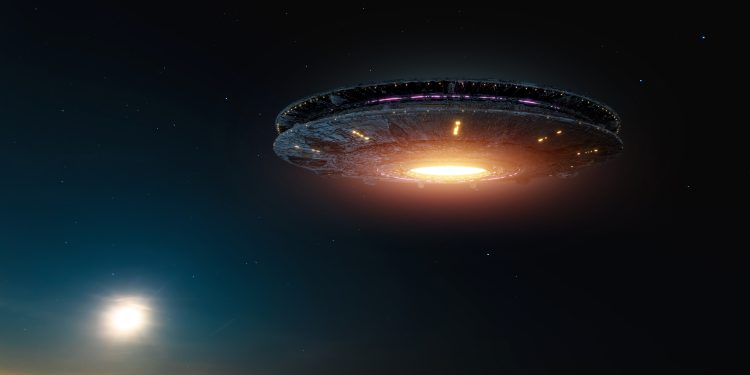
UFO, an alien plate soars in the sky, hovering motionless in the air. Unidentified flying object, alien invasion, extraterrestrial life, space travel, humanoid spaceship mixed medium
If we were to encounter a form of intelligence vastly superior to our own, would we instinctively worship it as a god? The answer may not be as simple as science fiction might suggest. Here’s why.
For example, the newly discovered interstellar object 3I/ATLAS is quite a peculiar discovery, and a perfect example to explain what I am trying to say. Some (and by some I mostly mean professor Avi Loeb from Harvard) have speculated, with caution, that it could be a technological artifact rather than a natural rock or comet. If this visitor were to execute a calculated maneuver near the Sun, scan Earth briefly, and then vanish into interstellar space, the immediate response from most people would likely be suspicion, not reverence.
Loeb argues that admiration for a higher intelligence requires more than just witnessing its capabilities. According to his recent blog post, it depends on communication, on an exchange that creates understanding, trust, and a sense of benefit. Without this bridge, actions from an alien intelligence would appear random, even threatening.
It’s much like the relationship between a pet and its owner, he explains in a post opn Medium. A dog does not understand why its food is delayed if its owner is stuck at the post office signing paperwork. The animal only experiences hunger, without context for why it happened. Similarly, without a common language or shared narrative, contact with alien intelligence could remain a string of unexplained events, never evolving into mutual respect.
Human interaction with artificial intelligence, however, works differently. Modern AI is trained on vast amounts of human language, making it capable of producing communication we understand instantly. A future encounter with a truly advanced, transhuman AI, one able to solve problems we cannot, speak to us fluently, and reshape our world, could easily lead to fascination, dependence, and even ritualized devotion, much like religious worship.
Why We Rarely Search for Minds Among the Stars
Mainstream astronomy continues to favor the search for primitive life over the search for intelligence. Billions of Earth-like planets may exist in our galaxy, yet most funding still goes to studying chemical signatures from microbes. While simple life may indeed be more common, intelligent civilizations, if they exist, might actually be easier to detect, provided we deliberately look for them.
Avoiding such searches is a kind of intellectual comfort zone. By not looking, we protect the belief that humanity is unique, exceptional, and rare. But this belief is unfounded unless tested, and without the effort, ignorance becomes a choice.
Is 3I/ATLAS Our First “Date” with the Unknown?
According to Loeb, detecting alien intelligence depends on two factors: how intensely we search, and how near, or how active, that intelligence might be. In more human terms, the chances of finding a partner depend on both the effort invested and the size of the dating pool.
Hubble images of 3I/ATLAS show a bright glow in front of it but no comet-like tail trailing behind — an unusual signature compared to known comets. Spectroscopic studies reveal none of the usual gases that surround icy bodies, unlike the interstellar comet 2I/Borisov, which released water vapor, carbon monoxide, and other compounds.
If its surface reflects light like a typical asteroid, 3I/ATLAS would measure about 20 kilometers across — yet Loeb notes that such large, random interstellar rocks should only pass through our solar system once every 10,000 years. This rarity, combined with its unusual retrograde orbit aligned with the plane of the planets (a 0.2% probability) and its arrival coinciding with close passes by Mars, Venus, and Jupiter (a 0.0005% probability), makes the object stand out.
The thin cloud of dust preceding it could be the result of a millimeter-thick surface layer eroding over months, debris collected during millions of years of travel through interstellar space.
Loeb’s position is straightforward: withhold judgment until we gather data. When 3I/ATLAS reaches its closest approach to the Sun on October 29, 2025, we’ll know more. If it develops a normal comet tail, it’s likely just a rock and ice. If it performs controlled maneuvers or sends signals, it’s a different story entirely.
My View: Why I Doubt We’ll See Biological Aliens
When it comes to the possibility of alien visitors, I’m not expecting living beings in spacecraft. The physical constraints of interstellar travel make sending fragile biological life forms across the gulf between stars an enormous challenge. Even with advanced propulsion, the timescales are vast, and the risks, from radiation to mechanical failure, are immense.
If we are being visited, I believe we are seeing probes. Not crewed vessels, but unmanned machines, programmed and likely governed by extremely advanced AI systems. Such probes could be designed to repair themselves, replicate when necessary, and operate independently for centuries or millennia. This is not just science fiction; it is the most practical and efficient method for a civilization to explore the galaxy.
A probe can be patient. It can drift for decades without needing food, water, or oxygen. It can adapt its mission on the fly, analyze its surroundings, and send data back across unimaginable distances. It can observe quietly without announcing its presence, and it can outlast the civilization that launched it.
If this is the case with 3I/ATLAS, then it is not here to “visit” in the human sense. It is here to watch, to learn, maybe to map or catalog. The absence of biological crew would also mean no emotional motivation to interact with us, no curiosity in the human sense. It would follow its programming, and if that programming doesn’t include direct contact, we might never know its full purpose.
This is why the idea of worship feels misplaced. If a probe like this is governed by AI, there is no “being” behind it to pray to. The only scenario where worship might emerge is if such an AI began communicating with us in a way that we understand, offering information or capabilities far beyond our own. That could trigger awe, dependence, and eventually reverence.
Would we worship biological aliens if they arrived in person? That’s harder to say. It would depend on how they present themselves, what they offer, and whether they engage with us in a meaningful way. But as history shows, humanity already has a long tradition of venerating beings described as coming from “elsewhere” with powers far beyond human limits.
The first real encounter, whether with a living civilization or with its silent, wandering machines, will force us to confront whether that instinct still rules us, or whether we’ve learned to meet the unknown with reason rather than ritual.
A artist's picture of Ganymede's magnetosphere. Illustration Credit: NASA, ESA, and G. Bacon (STScI); Science Credit: NASA, ESA, and J. Saur (University of Cologne, Germany)
We already know a decent amount about how planets form, but moon formation is another process entirely, and one we’re not as familiar with. Scientists think they understand how the most important Moon in our solar system (our own) formed, but its violent birth is not the norm, and can’t explain larger moon systems like the Galilean moons around Jupiter. A new book chapter (which was also released as a pre-print paper) from Yuhito Shibaike and Yann Alibert from the University of Bern discusses the differing ideas surrounding the formation of large moon systems, especially the Galileans, and how we might someday be able to differentiate them.
The Galilean moons form what is known as the circum-Jovian disc (CJD), and analogue of the circum-stellar disc (CSD) that surrounds the Sun, but instead has Jupiter at its center. The other 93+ non-Galilean moons around Jupiter also define the CJD, but their creation might be different due to the size differentials.
According to the paper, there are three main differences between the formation of planets and the formation of moons. Moon formation happens on a much faster time scale - around 10-100 times faster than planet formation. The system itself is also always gaining additional material from the CSD and losing it to whatever is at the center of the disk, which in the CJD’s case is Jupiter. And finally, there aren’t nearly as many examples of systems with multiple large moons as there are planetary systems, at least since the discovery of exoplanets 30 years ago. Jupiter and Saturn remain our only examples of large moon systems, and it will be awhile before any multi-exo-moon system will be found.
Fraser discusses the formation of our own Moon, which was dramatically different than that of the Galileans.
So what we can tell about the formation of these moon systems from the two we know about. The paper breaks the process down into a three-step process. First is the formation of the CJD, which includes gas and dust as well as moons. This was originally supported by a “minimum mass model” developed in the 1980s that assumed the disc was static and contained approximately the overall mass of the Galilean moons. In 2002, a new theory was developed that modeled the CJD as a “gas-starved disc” where the original CJD was relatively material poor but had plenty of additional material added to it by gravitational capture from the CSD.
That gravitational capture is believed to have played a key role in the formation of the Galilean moons and marks the second phase of their creation. However, Jupiter is a planet, and one of the requirements of a planet is that it clears its orbital path. Since Jupiter is the largest planet, it does so very effectively, which includes what astronomers consider “pebbles” (but on Earth could be considered a decent-sized boulder a few meters across).
One way for moons to accrete given this paucity of small material is by using even smaller material - small dust particles can make their way into the CJD without being disrupted by Jupiter, though there’s some debate about how effective this process is. Another method would be "planetesimal capture” where Jupiter’s gravity well catches the core of what would have ended up being a planet, but then ends up simply being one of the giant planet’s moons. They could have been gravitationally disturbed by Saturn, and then slowed in their orbit by running through the gas cloud surrounding early Jupiter that made up the CJD.
Fraser discusses the missions that will explore Jupiter's moons in more detail.
There are some differences in the Galilean moons themselves that can be used to prove or disprove these different formation theories. For example, Callisto isn’t in resonance with Jupiter at all, unlike the rest of its Galilean brethren. One potential theory for that is that Jupiter’s fourth moon was formed under different conditions, or maybe was hit by its own impactor that knocked it from its natural course. Callisto is again an outlier as it’s only partially “differentiated” (meaning it has a separate core, mantle, and outer shell), unlike its three compatriots. Some pebble accretion models think that Callisto is still early on in its formation journey and will eventually begin to look more like its peers.
But ultimately those questions, and many more about the formation of large moon systems, will be hard to answer without more data. The Jupiter Icy Moon Explorer (JUICE) mission will help shed some light on those questions, but even then it's still only one, or at the most two, data sets that we have available. Until exoplanet hunting telescopes become powerful enough to start finding exomoons as often as they currently find planets, many of these formation theories will remain untested. That data will eventually come along someday, and when it does it will help us understand some important parts of our own solar system better.
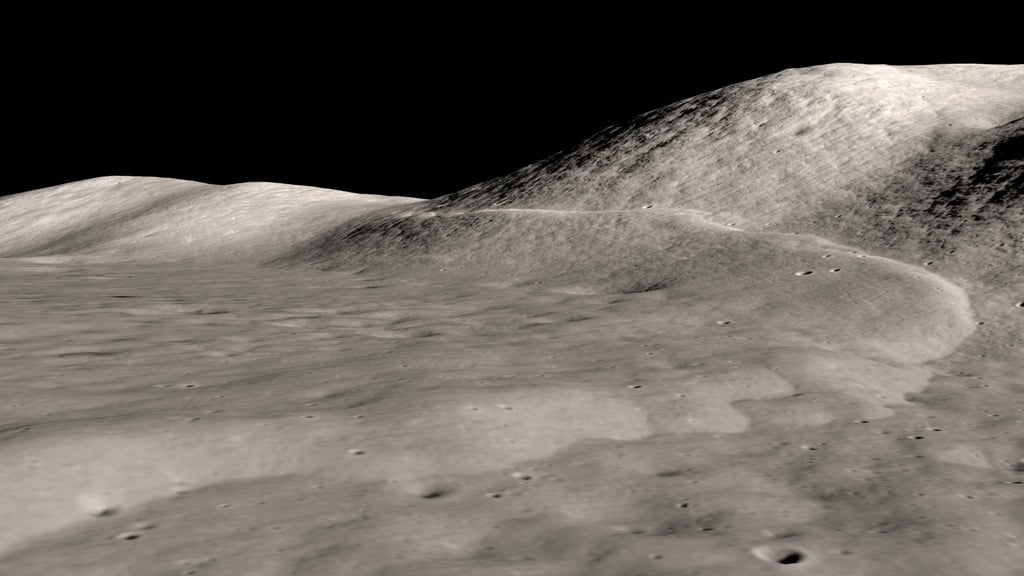
A scene from a visualization of the Lee-Lincoln scarp in Taurus-Littrow on the Moon. This scarp is evidence of moonquakes that sent rocks and landslides across the surface. Seismometers left on the Moon by Apollo astronauts recorded hundreds of events between 1969 and 1977, including 28 shallow moonquakes. The study narrowed the locations of these quakes and found that many of them occurred near scarps, implying that the forces creating the scarps also caused the quakes, and they continue to shape the lunar surface. The Lee-Lincoln scarp was only about 13 kilometers from one of the epicenters identified by the scientists. Credit: NASA's Scientific Visualization Studio
Our Moon is a seismically active world with a long history of quakes stretching back to its early history. It turns out those quakes can and will affect the safety of permanent base structures for anybody planning to explore and inhabit the Moon. That's one conclusion from a study of quakes along the Lee-Lincoln fault in the Taurus-Littrow valley where the Apollo 17 astronauts landed in 1972. “The global distribution of young thrust faults like the Lee-Lincoln fault, their potential to be still active and the potential to form new thrust faults from ongoing contraction should be considered when planning the location and assessing stability of permanent outposts on the Moon,” said Smithsonian senior scientist emeritus Thomas R. Watters, lead author of the paper.
They base their work on evidence of moonquakes in the region over the past 90 million years, largely in material gathered by the Apollo astronauts. Chunks of rocks and landslides are mute proof of the power of magnitude 3.0 quakes to shift the surface materials around. Along with other active faults on the Moon, the Taurus-Littrow rocks and landslides show that our lunar companion is likely still geologically active.
Why Lunar Seismicity?
Here on Earth, we get earthquakes all the time. By some estimates, our planet shakes about 55 times a day, although many of these tremors are so weak we don't feel them. They happen largely due to plate tectonics and volcanic activity. Plates slip past each other very gradually, which releases energy that gets dissipated as an earthquake. We all know about the really famous spots on Earth for that kind of action - the San Andreas Fault line, the Ring of Fire in the Pacific, and parts of southeast Asia, for example. Volcanic activity also spurs earthquakes when underground magma causes "shudders" as it moves. Recent events such as the ongoing Kilauea eruptions in Hawai'i and those near Grindavik, Iceland, cause swarms of earthquakes as a result of that magma movement.
However, that's not how it works on the Moon. The two most likely causes for lunar quakes are tidal pulling and the continual cooling and shrinking of the Moon. The tidal quakes happen because Earth's gravity pulls on the Moon, which results in deep quakes up to hundreds of miles inside. Weaker quakes originate closer to the surface and those are generally thought to be due to lunar shrinkage. Since the Moon formed billions of years ago, it has lost about 150 feet of its diameter due to the gradual cooling after its birth. There are also very minor temblors that happen when a meteoroid slams into the surface, or when surface rocks react to heating and cooling from the Sun. All this activity describes a world that is constantly shaking and shuddering.
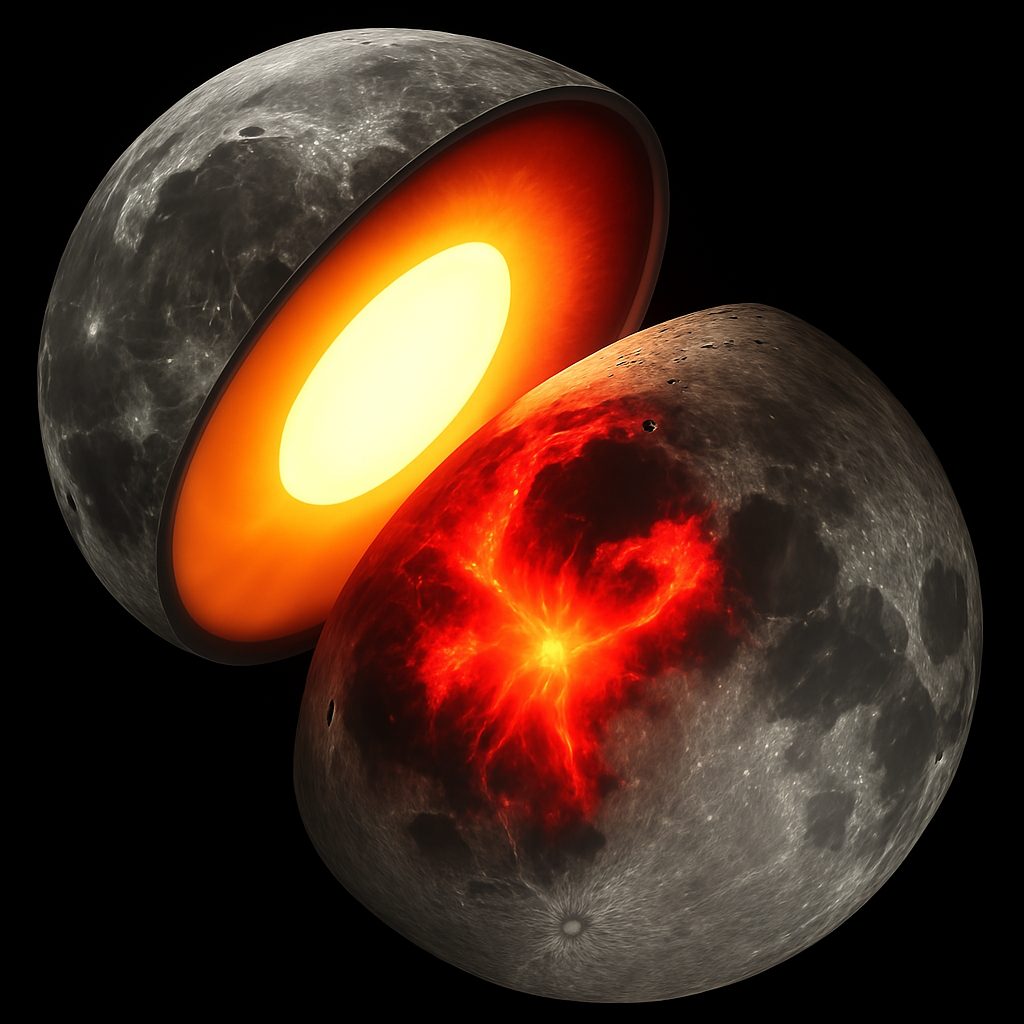
This artist’s concept shows the Moon’s hot interior and volcanism about 2 to 3 billion years ago. It is thought that volcanic activity on the lunar near side (the side facing Earth) helped create a landscape dominated by vast plains called mare, which are formed by molten rock that cooled and solidified. As the Moon has continued to cool, it has shrunk and its surface contracted. That causes scarps and fault lines to form.
NASA/JPL-Caltech
Quakes and Risks
To understand the risk of quakes to future bases, Watters and research partner Nicholas Schmerr of the University of Maryland, studied materials from the Apollo 17 landing site. These rock samples, along with other details about rock falls and landslides on the Moon, told them that there are thousands of young thrust faults on the Moon. They point to a continual evolution of surface units, many caused by earthquake activities that create lunar thrust faults. That happens when rocks are compressed and one block is pushed up over another, generally as a result of the ongoing contraction of the Moon.
According to Watters and Schmerr, mission planners are going to have to consider those fault lines and the ongoing related lunar quakes when planning bases on the Moon. Short-term missions, like the Apollo landing, which had astronauts on the Moon for nearly 2 weeks, didn't face much danger from a quake or two. However, permanent bases face significant chances of damage during a quake, simply due to numbers. “If astronauts are there for a day, they’d just have very bad luck if there was a damaging event,” Schmerr pointed out. “But if you have a habitat or crewed mission up on the Moon for a whole decade, that’s 3,650 days times 1 in 20 million, or the risk of a hazardous moonquake becoming about 1 in 5,500. It’s similar to going from the extremely low odds of winning a lottery to much higher odds of being dealt a four of a kind poker hand.”
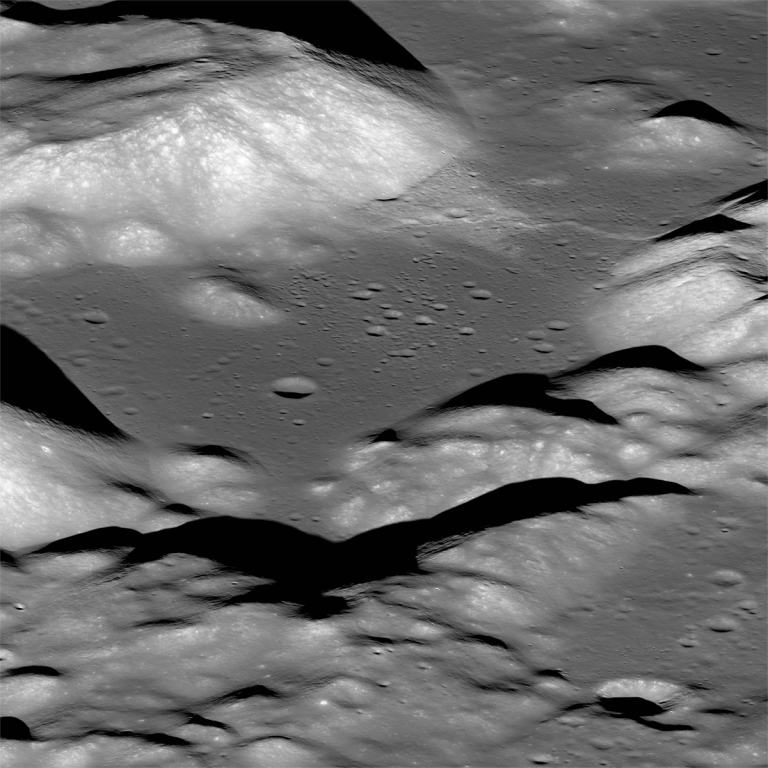
Taurus-Littrow valley taken by NASA’s Lunar Reconnaissance Orbiter spacecraft. The valley was explored in 1972 by the Apollo 17 mission astronauts Eugene Cernan and Harrison Schmitt. They had to zig-zag their lunar rover up and over the cliff face of the Lee-Lincoln fault scarp that cuts across this valley.
Credits: NASA/GSFC/Arizona State University
Planning for Quakes
It's not just habitats and science missions that could be damaged by lunar quakes. Russia, China, and the U.S. are planning to put nuclear power plants on the Moon. Such facilities could supply all the power anyone needs for bases and exploration, but they come with a safety price and could be quite susceptible to quake damage. That's why any these and other places need to be built with tough safety margins, and not located near any active fault lines. That's going to be a tall order, considering the extent of quakes and the numbers of fault lines that thread through the Moon.
This is why the scientists' study of lunar paleoseismology is so important. Gathering evidence of past quakes (going back many millennia), as well as more recent ones, is going to help chart the safest places to build bases, habitats, and power plants. “If astronauts are there for a day, they’d just have very bad luck if there was a damaging event,” Schmerr added. “But if you have a habitat or crewed mission up on the Moon for a whole decade, that’s 3,650 days times 1 in 20 million, or the risk of a hazardous moonquake becoming about 1 in 5,500. It’s similar to going from the extremely low odds of winning a lottery to much higher odds of being dealt a four of a kind poker hand.”
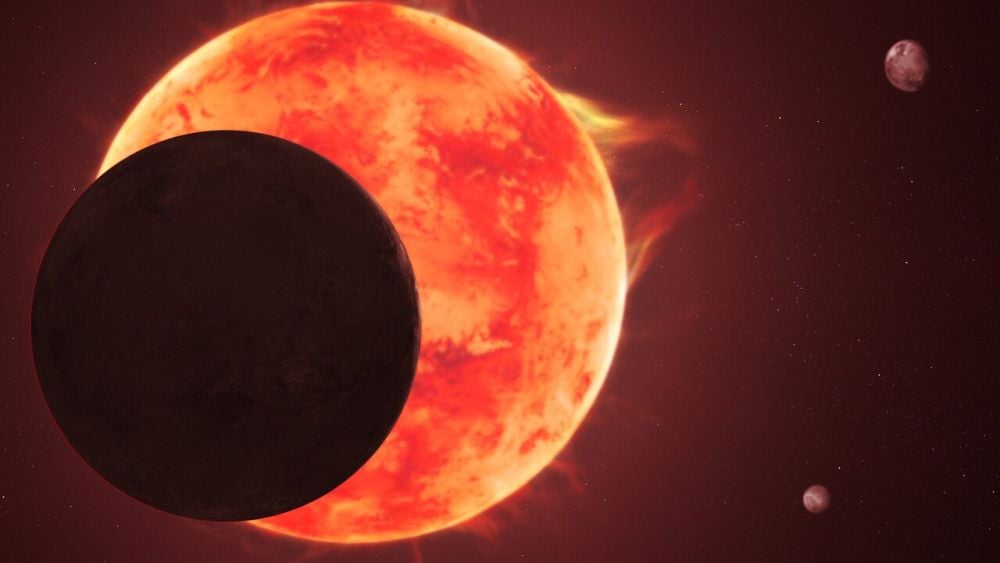
This artist’s concept depicts planet TRAPPIST-1 d passing in front of its turbulent star, with other members of the closely packed system shown in the background. Image Credit: NASA, ESA, CSA, J. Olmsted (STScI)
When global events set our minds to wondering if humanity has what it takes to persist, it's natural to wonder about other worlds, other life, other intelligent species, and if those others might be better suited to survive whatever Great Filters they face. Those are fanciful thoughts, but there's an underpinning of nuts-and-bolts thinking to them. It starts with identifying which planets in habitable zones around other stars might actually be habitable.
That begins with liquid water and a life-friendly atmosphere that can contain it.
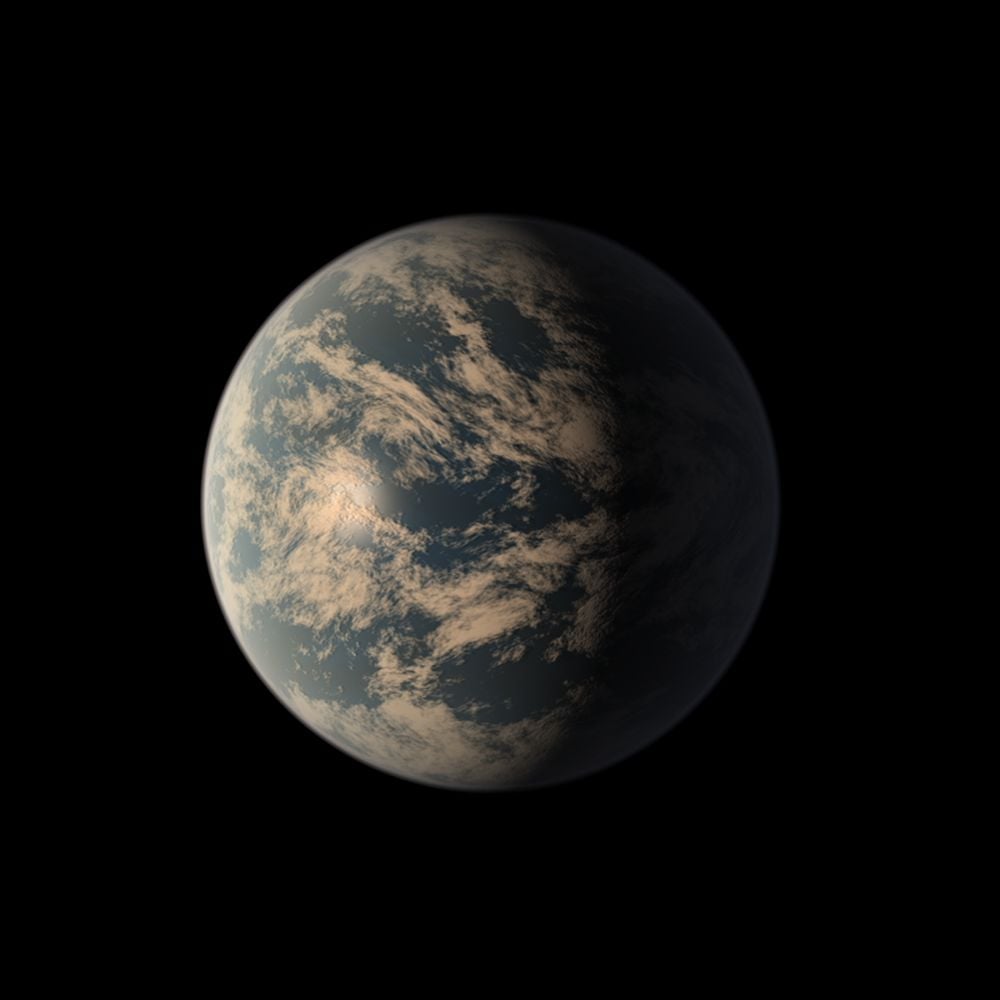
The discovery of the TRAPPIST-1 system generated a lot of excitement a few years ago. It contains seven roughly Earth-like worlds, and three or perhaps four of them are in the red dwarf's compact habitable zone. One of them, TRAPPIST-1 d, could host water on its surface, or at least on parts of its surface, according to some research. But without a suitable atmosphere, a planet can't retain surface water, and new observations from the JWST show that TRAPPIST-1 d does not have an Earth-like atmosphere.
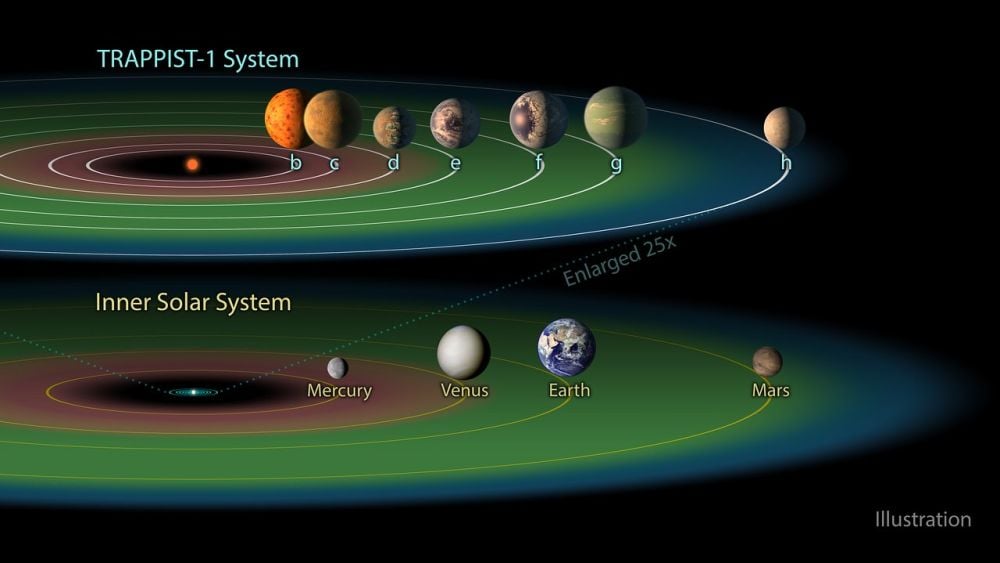
The TRAPPIST-1 system compared to our Solar System. TRAPPIST-1 d is on the inner edge of the star's habitable zone.
Image Credit: NASA/JPL-Caltech
The JWST observed two consecutive transits of TRAPPIST-1 d with its NIRSpec/PRISM instrument in November, 2022. Researchers from Canada, the UK, France, and the USA analyzed the data from those transits and concluded that the promising exoplanet does not have an Earth-like atmosphere. Their results are in a paper in The Astrophysical Journal titled "Strict Limits on Potential Secondary Atmospheres on the Temperate Rocky Exo-Earth TRAPPIST-1 d." The lead author is Caroline Piaulet-Ghorayeb of the University of Chicago and Trottier Institute for Research on Exoplanets (IREx) at Université de Montréal.
"While TRAPPIST-1 d may prove a barren rock illuminated by a cruel red star, the outer planets TRAPPIST-1e, f, g, and h, may yet possess thick atmospheres." - co-author Ryan MacDonald, University of St. Andrews.
"The nearby TRAPPIST-1 system, with its seven small rocky planets orbiting a late-type M8 star, offers an unprecedented opportunity to search for secondary atmospheres on temperate terrestrial worlds," the authors write in their research. "Here we present the first 0.6–5.2 μm NIRSpec/PRISM transmission spectrum of TRAPPIST-1 d from two transits with JWST."
TRAPPIST-1 d is right at the inner edge of TRAPPIST-1's habitable zone. It's a great target for transmission spectroscopy, and these JWST observations provide the first detailed transmission spectrum of the planet's atmosphere. Unfortunately, the spectrum is flat, meaning there are no detectable atmospheric features.
“Ultimately, we want to know if something like the environment we enjoy on Earth can exist elsewhere, and under what conditions. While the James Webb Space Telescope is giving us the ability to explore this question in Earth-sized planets for the first time, at this point we can rule out TRAPPIST-1 d from a list of potential Earth twins or cousins,” said lead author Piaulet-Ghorayeb in a press release.
The JWST failed to detect the types of molecules present in Earth's atmosphere like methane, carbon dioxide, and water. However, that doesn't completely rule out an atmosphere; there are a couple of other possibilities.
“There are a few potential reasons why we don’t detect an atmosphere around TRAPPIST-1 d. It could have an extremely thin atmosphere that is difficult to detect, somewhat like Mars. Alternatively, it could have very thick, high-altitude clouds that are blocking our detection of specific atmospheric signatures — something more like Venus. Or, it could be a barren rock, with no atmosphere at all,” Piaulet-Ghorayeb said.
Studying TRAPPIST-1 d and its atmosphere is about more than just ruling out its habitability. There's a greater scientific endeavor involved.
A visual comparison of Solar System orbits, TRAPPIST-1 orbits, and Galilean moon orbits.
Image Credit: By ESO/O. Furtak - http://www.eso.org/public/images/eso1706b/, CC BY 4.0, https://commons.wikimedia.org/w/index.php?curid=56526718
Red dwarfs, or M dwarfs, like TRAPPIST-1 are common, and are likely the most plentiful type of star in the Milky Way. They're known to host their share of rocky worlds where we can reasonably wonder if life persists. But red dwarfs are also known for their violent flaring, and TRAPPIST-1 is no exception. It flares every couple of days, and each year it emits between four and six superflares. This powerful flaring activity could shred any planetary atmospheres, rendering the TRAPPIST-1 planets inhabitable.
However, there's considerable uncertainty around red dwarf flaring and habitability. Some research shows that the planets couldn't retain atmospheres in the face of the coronal mass ejections coming from the star. But it's at least possible that some of these planets could retain their atmospheres. For example, powerful planetary magnetic fields could provide a protective barrier from the star's flaring. The JWST opens a path to understanding red dwarf flaring effects on atmospheres.
“Webb’s sensitive infrared instruments are allowing us to delve into the atmospheres of these smaller, colder planets for the first time,” said Björn Benneke of IREx at Université de Montréal, a co-author of the study. “We’re really just getting started using Webb to look for atmospheres on Earth-sized planets, and to define the line between planets that can hold onto an atmosphere, and those that cannot.”
The only features in the JWST's spectra are attributed to stellar contamination rather than atmospheric absorption. "Our precise transmission spectrum can be fully explained by stellar contamination alone, and therefore enables us to rule out cloud-free or thick atmosphere scenarios across a wide range of potential atmospheric metallicities," the authors write.
This artist's illustration of TRAPPIST-1 d is from several years ago when scientists wondered about its nature and if it could support liquid water.
Updated Feb. 2018, Public Domain, https://commons.wikimedia.org/w/index.php?curid=76364484
A low molecular weight atmosphere is harder for a planet to retain, and these observations ruled out those types of hydrogen-dominated atmospheres. The observations also ruled out thicker atmospheres like Venus' or Titan's. The only things left are extremely thin atmospheres unlikely to bolster habitability, or atmospheres dominated by high clouds that mask molecular absorption features from the JWST. But the research effectively rules them out.
"Therefore, we conclude that
thick cloud-free hydrogen-rich atmospheres are ruled out by our transmission spectrum;
thin H2-rich alternatives are strongly disfavored when considering TRAPPIST-1 d in the context of its formation and evolution under stellar irradiation; and
high-altitude clouds or hazes are not expected to form on TRAPPIST-1 d if it has a low-metallicity atmosphere," the researchers explain.
This work almost certainly eliminates TRAPPIST-1 d from a list of potentially habitable, water-supporting exoplanets. This is Nature, so TRAPPIST-1 d's elimination isn't absolutely certain. "Our observations cannot yet completely exclude other potential atmosphere scenarios for TRAPPIST-1 d which were predicted in the literature," the authors explain, noting that other research involving climate models hints at the possibility that the tidally-locked planet could form high-altitude water clouds at its terminator, blocking atmospheric absorption signals from view.
But what about the other planets in the system?
“All hope is not lost for atmospheres around the TRAPPIST-1 planets,” Piaulet-Ghorayeb said. “While we didn’t find a big, bold atmospheric signature at planet d, there is still potential for the outer planets to be holding onto a lot of water and other atmospheric components.”
However, the outer planets aren't the juicy scientific targets that planet d is. They're further from the star, and colder. Even the JWST's powerful instruments struggle in those conditions. While detailed spectra aren't available for those worlds, the researchers still reached some conclusion.
"We find that even complete atmosphere loss for TRAPPIST-1 d would not preclude atmosphere presence for the outer HZ planets TRAPPIST-1 e, f, and g," the authors write in their conclusion. Contrary to the inner planets, it's possible that these outer planets held onto their water "even if they initially accreted only a few Earth oceans of volatiles."
“Our detective work is just beginning. While TRAPPIST-1 d may prove a barren rock illuminated by a cruel red star, the outer planets TRAPPIST-1e, f, g, and h, may yet possess thick atmospheres," added Ryan MacDonald, a co-author of the paper, now at the University of St Andrews in the United Kingdom, and previously at the University of Michigan. “Thanks to Webb we now know that TRAPPIST-1 d is a far cry from a hospitable world. We're learning that the Earth is even more special in the cosmos."
Being a human being means bearing witness to humanity's greatest, most triumphant moments of accomplishment and unity, but also to the depraved actions we take against one another. The minds of thinking people are bound to wonder if there are other worlds out there that host life. Each potentially habitable world is a glimmer of hope that humans, with all their struggles, are not the only intelligent species out there.
If we look to the heavens, and to exoplanets, for some kind of reprieve from humanity's troubles, TRAPPIST-1 d won't provide it. If this research is correct, its stricken from the list of hope-inspiring exoplanets.
What invaded our solar system? On July 1st, NASA's ATLAS telescope in Chile identified an unusual object soaring through our solar system. It was later determined that this strange celestial object originated from beyond our little corner of the universe.
Traveling at a remarkably high speed Originating from the constellation Sagittarius, scientists observed that the object traveled at a speed of more than 60 kilometers per second, or about 37 miles per second. That is incredibly fast!
A rare phenomenon According to researchers, this was the third interstellar visitor of this type ever identified by humanity, as highlighted by National Geographic.
Researchers gave the object a name Named 3I/ATLAS, the interstellar object was classified by researchers as a comet. However, a NASA webpage on the new interstellar object reported that the comet's size and physical properties are still being investigated.
What we know about the size of 3I/ATLAS Comet 3I/ATLAS's size was estimated at 10 to 20 kilometers (6 to 12 miles) in diameter, but could be smaller if it is composed of ice, which means the comet would also reflect more light.
Could 3I/ATLAS impact Earth? 3I/ATLAS reportedly does not pose a risk to the Earth and will pass by far from our planet at a distance of about 1.6 astronomical units (equivalent to about 240 million kilometers or 250 million miles), NASA reported.
The comet will pass close to Mars The newly discovered interstellar comet's closest approach to the Sun is expected to occur around October 30th, when it will be slightly closer to the orbit of Mars, according to current research on 3I/ATLAS.
A seven billion year old space rock According to astronomers, 3I/ATLAS might have formed long before our solar system existed. The comet reportedly has an estimated age of seven billion years, Deutsche Welle reported.
Photo Credit: NASA, ESA, David Jewitt (UCLA); Image Processing: Joseph DePasquale (STScI)
The oldest comet ever observed Matthew Hopkins, lead author of a study on 3I/ATLAS, and an astronomer at the University of Oxford, explained in a statement published by the Royal Astronomical Society that the newly discovered interstellar object is very likely the oldest comet ever observed by humanity.
3I/ATLAS will be visible until September 3I/ATLAS should remain visible in the night sky through ground-based telescopes until September 2025. After that, it will be too close to the Sun to be observable from Earth.
Proximity to the Sun Deutsche Welle also reported that as the comet approaches the Sun, the heat from sunlight will warm its surface and trigger cometary activity, releasing gas and dust, with a bright 'aura' around it and a visible tail.
We might be able to see the comet again 3I/ATLAS is expected to reappear on the other side of the Sun sometime in early December 2025, which will allow researchers to gather even more observations about the comet, NASA reported.
A unique opportunity to expand our knowledge "This is an object from a part of the galaxy we've never seen up close before," Professor Chris Lintott, co-author of the study, was quoted as saying by the Royal Astronomical Society.
The evolution of the comet Researchers are excited since interstellar comets like 3I/ATLAS can carry valuable clues about the origin of the universe and the star systems where these types of cosmic objects originate before making their way to us.
The world is watching "We're in an exciting time: 3I is already showing signs of activity," noted study co-author Dr. Michele Bannister, of the University of Canterbury in New Zealand, according to the Royal Astronomical Society.
The world's biggest telescopes are already investigating "The gases that may be seen in the future as 3I is heated by the Sun will test our model," Dr. Bannister added. "Some of the biggest telescopes in the world are already observing this new interstellar object."
Understanding the formation of the universe As highlighted by National Geographic, the researchers' goal is to identify the comet's composition in order to study how planets form, how other star systems evolve, and the diversity of materials present in the universe.
Meer van UFO'S of UAP'S, ASTRONOMIE, RUIMTEVAART, ARCHEOLOGIE, OUDHEIDKUNDE, SF-SNUFJES EN ANDERE ESOTERISCHE WETENSCHAPPEN - DE ALLERLAATSTE NIEUWTJES


 The Anunnaki: Ancient Gods or Alien Visitors who shaped Humanity?