Ontdek de Fascinerende Wereld van UFO's en UAP's: Jouw Bron voor Onthullende Informatie!
Ben jij ook gefascineerd door het onbekende? Wil je meer weten over UFO's en UAP's, niet alleen in België, maar over de hele wereld? Dan ben je op de juiste plek!
België: Het Kloppend Hart van UFO-onderzoek
In België is BUFON (Belgisch UFO-Netwerk) dé autoriteit op het gebied van UFO-onderzoek. Voor betrouwbare en objectieve informatie over deze intrigerende fenomenen, bezoek je zeker onze Facebook-pagina en deze blog. Maar dat is nog niet alles! Ontdek ook het Belgisch UFO-meldpunt en Caelestia, twee organisaties die diepgaand onderzoek verrichten, al zijn ze soms kritisch of sceptisch.
Nederland: Een Schat aan Informatie
Voor onze Nederlandse buren is er de schitterende website www.ufowijzer.nl, beheerd door Paul Harmans. Deze site biedt een schat aan informatie en artikelen die je niet wilt missen!
Internationaal: MUFON - De Wereldwijde Autoriteit
Neem ook een kijkje bij MUFON (Mutual UFO Network Inc.), een gerenommeerde Amerikaanse UFO-vereniging met afdelingen in de VS en wereldwijd. MUFON is toegewijd aan de wetenschappelijke en analytische studie van het UFO-fenomeen, en hun maandelijkse tijdschrift, The MUFON UFO-Journal, is een must-read voor elke UFO-enthousiasteling. Bezoek hun website op www.mufon.com voor meer informatie.
Samenwerking en Toekomstvisie
Sinds 1 februari 2020 is Pieter niet alleen ex-president van BUFON, maar ook de voormalige nationale directeur van MUFON in Vlaanderen en Nederland. Dit creëert een sterke samenwerking met de Franse MUFON Reseau MUFON/EUROP, wat ons in staat stelt om nog meer waardevolle inzichten te delen.
Let op: Nepprofielen en Nieuwe Groeperingen
Pas op voor een nieuwe groepering die zich ook BUFON noemt, maar geen enkele connectie heeft met onze gevestigde organisatie. Hoewel zij de naam geregistreerd hebben, kunnen ze het rijke verleden en de expertise van onze groep niet evenaren. We wensen hen veel succes, maar we blijven de autoriteit in UFO-onderzoek!
Blijf Op De Hoogte!
Wil jij de laatste nieuwtjes over UFO's, ruimtevaart, archeologie, en meer? Volg ons dan en duik samen met ons in de fascinerende wereld van het onbekende! Sluit je aan bij de gemeenschap van nieuwsgierige geesten die net als jij verlangen naar antwoorden en avonturen in de sterren!
Heb je vragen of wil je meer weten? Aarzel dan niet om contact met ons op te nemen! Samen ontrafelen we het mysterie van de lucht en daarbuiten.
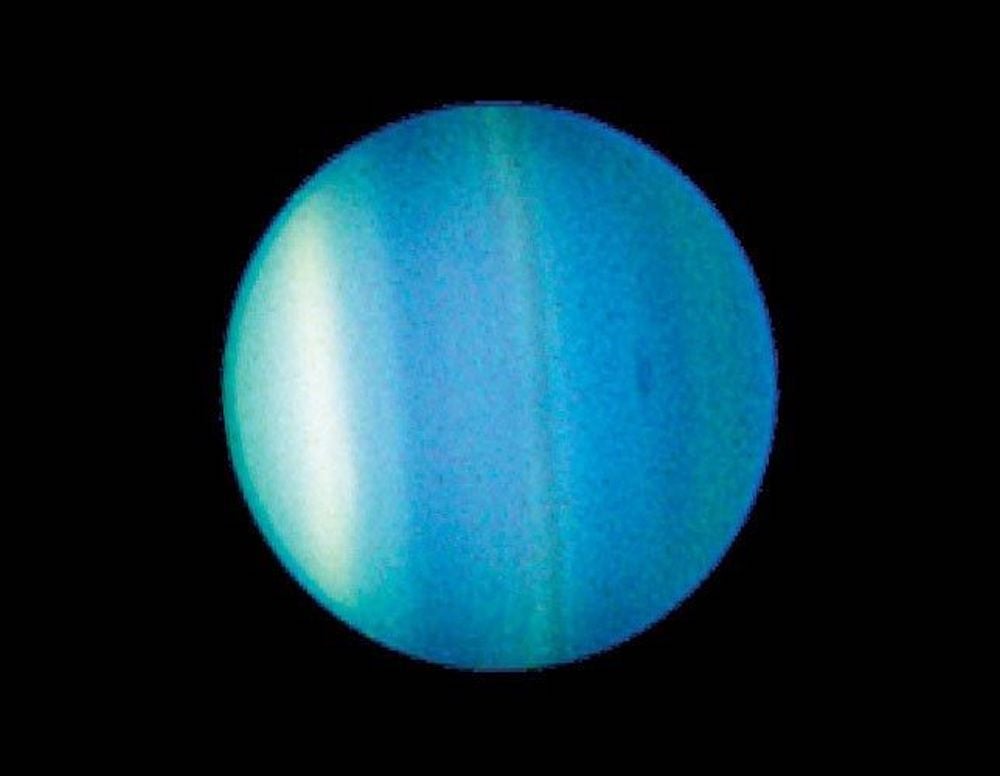
Image of Uranus from the Hubble Space Telescope shows bands and a new dark spot in Uranus' atmosphere. (Credit : NASA/Space Telescope Science Institute)
In the vast expanse between Uranus and Neptune, a team of researchers have uncovered something really quite extraordinary, a minor planet that has been locked in precise gravitational manouevres with Uranus for at least a million years. This discovery sheds new light on the complex dynamics that govern our Solar System's outer reaches.
The object in question, designated 2015 OU₁₉₄, belongs to a class of small bodies called Centaurs, rocky and icy objects that orbit between Jupiter and Neptune. What makes this particular Centaur special is its remarkably stable relationship with Uranus, locked in what is known as a 3:4 mean motion resonance. This means that for every three orbits 2015 OU₁₉₄ completes around the Sun, Uranus completes exactly four. This precise mathematical relationship creates a gravitational partnership that keeps the two objects in a stable dance, preventing them from colliding or drifting apart.
Uranus, the 7th planet in the Solar System seems to have an asteroid tagging along.
(Credit : NASA)
The discovery came about through detective work with archival observations. Researchers led by Daniel Bamberger from the Northolt Branch Observatories in Germany, located additional observations of 2015 OU₁₉₄ from 2017 and 2018, extending the object's data points from just one year to 3.5 years. This longer observation period was crucial for understanding the object's true orbital behavior.
Computer simulations revealed the remarkable stability of this relationship. The resonance has remained stable for at least 1,000 years in the past, probably even 1 million years and is predicted to continue for another 500,000 years into the future. This longevity suggests that the gravitational partnership formed early in our Solar System's history and has persisted through countless changes.
What makes this discovery particularly significant is that no objects has previously been found in resonance between the orbits of Uranus and Neptune. It’s a region of space, while containing many small bodies, that appears to lack the kind of stable orbital relationships commonly found elsewhere in the Solar System.
The asteroids of the inner Solar System, where they are far more numerous than the outer Solar Sytem, are plotted on this diagram.
(Credit : MDF)
The researchers didn't stop with just one object though. Their investigation uncovered additional candidates, including 2013 RG₉₈, which also appears to maintain this same 3:4 resonance with Uranus for several hundred thousand years. A third candidate, 2014 NX₆₅, shows strong gravitational influence from Neptune, suggesting the complex interplay of forces in this region.
The existence of these Uranus resonant objects suggests that similar relationships may be more common than previously thought. As our survey capabilities improve and we discover more objects in the outer Solar System, we may find that these gravitational partnerships are common and fundamental to understanding how small bodies are distributed throughout the region.
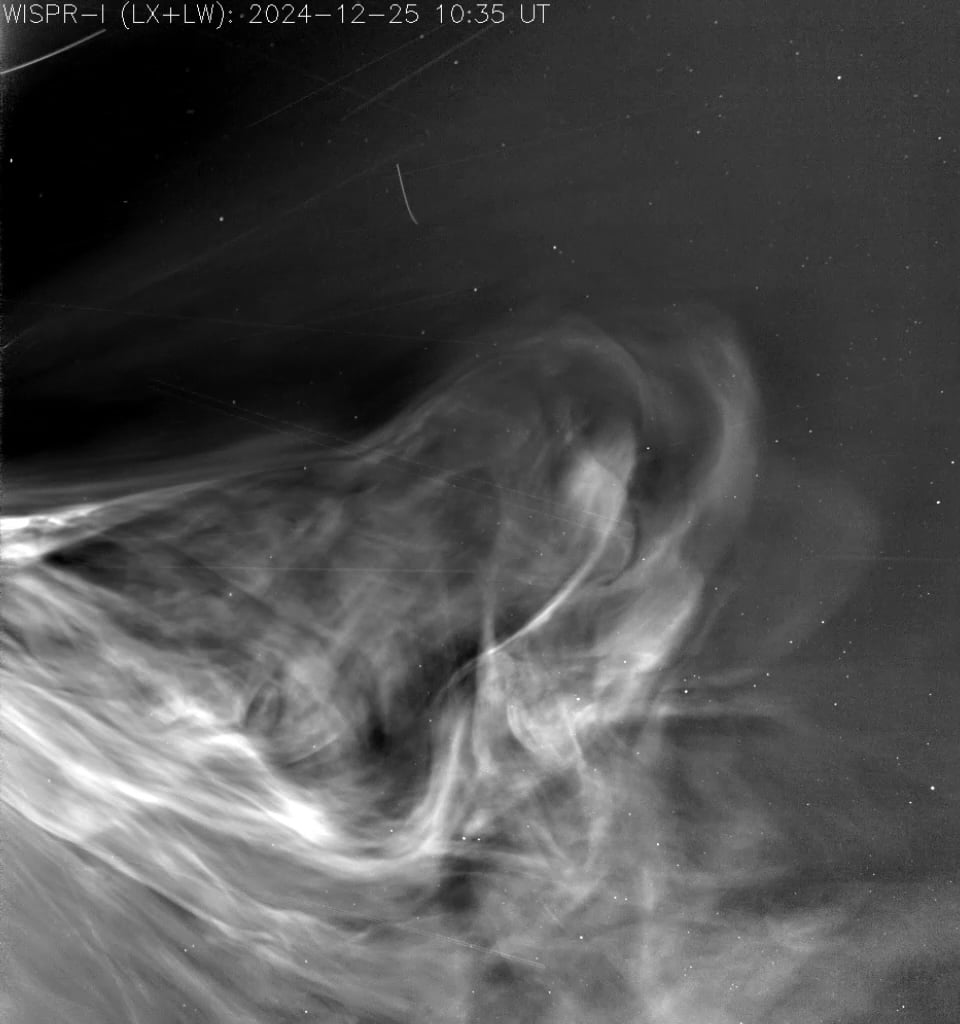
Parker Solar Probe’s WISPR instrument during its record-breaking flyby of the Sun on Dec. 25, 2024, shows the solar wind racing out from the Sun’s outer atmosphere, the corona. NASA/Johns Hopkins APL/Naval Research Lab
From one perspective, the Sun is a benevolent orb of plasma and its warmth makes Earth habitable and has kept if habitable for billions of years, allowing complex things like human beings to evolve. From another perspective, it's a malevolent orb that sends deadly UV radiation our way, and sometimes erupts and hurls massive blobs of plasma toward Earth. The truth is somewhere in the middle, and NASA launched the Parker Solar Probeto flesh out that truth.
NASA launched the Parker Solar Probe (PSP) in 2018 and its mission is to examine the Sun's coronal plasma and its magnetic field. To do this, it has to get close. NASA describes it as a mission to "touch the Sun," and that's pretty accurate. Throughout its mission it has gotten progressively closer, setting a new record each time for closest approach to the Sun. On Dec. 24, 2024, the spacecraft flew just 6.1 million km (3.8 million miles) from the solar surface.
That is incredibly close, but luckily, the spacecraft has several layers of protection. The PSP is also the fastest-moving spacecraft ever built. It was travelling at 692,000 km/h (430,000 mph) during its 2024 flyby, and didn't spend much time that close to the star.
The result of this daring piece of coronal navigation is the closest images yet of our star. The PSP carries four main instruments, and one of them is WISPR, the Wide-field Imager for Solar Probe. WISPR has two radiation-hardened cameras that can withstand the Sun's power. It's job is to image the corona, the solar wind, and other phenomena near the Sun. On the last flyby, WISPR showed us the solar corona and the solar wind in a way we've never seen before.
“Parker Solar Probe has once again transported us into the dynamic atmosphere of our closest star,” said Nicky Fox, associate administrator, Science Mission Directorate at NASA Headquarters in Washington. “We are witnessing where space weather threats to Earth begin, with our eyes, not just with models. This new data will help us vastly improve our space weather predictions to ensure the safety of our astronauts and the protection of our technology here on Earth and throughout the solar system.”
There are important implications for understanding or misunderstanding the solar wind and coronal mass ejections (CME). They're ever present forces in the Solar System. The wind is a stream of charged particles that constantly flows outward from the Sun. It's responsible for the gorgeous aurorae that we love to gaze it, but it's also responsible for damaging power grids and satellites. As we expand into cislunar space and crowd more satellites into Low-Earth Orbit, it's important that we understand not only the solar wind, but everything that flows from the Sun, including coronal mass ejections (CME).
While the solar wind is a continuous phenomenon, coronal mass ejections are episodic. They're ejections of plasma that can reach Earth. CMEs can contain billions of tons of plasma moving at high speeds. Only a small number of them reach Earth, but when they do, they can also cause geomagnetic storms that can damage power grids and other equipment.
The Parker Solar Probe is named after the American heliophysicist Eugene Parker, who coined the term 'solar wind in 1958. His theories, though they faced stiff resistance at the time, revolutionized our scientific understanding of the Sun. Multiple spacecraft have been launched to study the Sun and the solar wind, but the Parker Solar Probe has outdone them all.
Each mission has revealed more about the Sun and the solar wind, but none have come as close to the star as the PSP. It also has the advantage of the most modern technologies and instruments. One of the things its revealed is the nature of so-called switchbacks.
When measured near Earth, the solar wind is pretty much constant. But closer to the Sun, things are more chaotic. The Sun has extremely powerful magnetic fields, and when the PSP came within 14.7 million miles of the Sun, it showed us that some of those fields zig-zag. These zig-zagging fields are called switchbacks. The PSP also showed us that these switchbacks are more common than thought, and that they come in clumps.
As the PSP got progressively closer and travelled through the Sun's corona, it noticed that the corona's boundary was uneven and complex. Getting even closer in subsequent flybys, it was able to pinpoint the source of the switchbacks. The source is patches on the Sun where magnetic funnels form and images showed that the switchbacks are partly responsible for the fast solar wind, one of the wind's two components.
“The big unknown has been: how is the solar wind generated, and how does it manage to escape the Sun’s immense gravitational pull?” said Nour Rawafi, the project scientist for Parker Solar Probe at the Johns Hopkins Applied Physics Laboratory. “Understanding this continuous flow of particles, particularly the slow solar wind, is a major challenge, especially given the diversity in the properties of these streams — but with Parker Solar Probe, we’re closer than ever to uncovering their origins and how they evolve.”
The slow solar wind is twice as dense as the fast solar wind, and interplay between the two seems to create moderately strong conditions on Earth that can rival conditions generated by CMEs. The slow solar wind appears to originate from the Sun's equatorial regions, but scientists are still debating what structures they originate in and how the material is released.
“We don’t have a final consensus yet, but we have a whole lot of new intriguing data,” said Adam Szabo, Parker Solar Probe mission scientist at NASA’s Goddard Space Flight Center in Greenbelt, Maryland.
We've learned a lot about the Sun in recent decades, and the PSP is poised to show us more and hopefully provide answers to our most probing questions. It's next perihelion will be in September, 2025, when it will again fly through the solar corona. That approach will gather even more data on the slow solar wind and other facets of the Sun.
Astrobiology can be split into two very distinct fields. There’s the field that astronomers are likely more familiar with, involving large telescopes, exoplanets, and spectroscopic signals that are pored over to debate whether they show signs of life. But there is another camp, collective known as the Origins researchers that focus on developing a scientific understanding of how life originally developed on Earth. A new paper from Cole Mathis at Arizona State and Harrison B. Smith at the Institute of Science in Tokyo suggests a new path forward to tackling those challenges - set them up as competitions and let a hefty prize motivate scientific teams and individuals to pursue them.
The paper, which was published on arXiv, is a response to NASA’s Decadal Astrobiology Research and Exploration Strategy (DARES) call for community input. It calls on the “challenge” funding model popularized by organizations like the X Prize, and the Defense Research Advanced Projects Agency (DARPA), whose early autonomous driving challenges inspired the self-driving cars that are finally starting to navigate public roadways.
A similar method could be used to stimulate research into specific, measurable, and important “origins” research according to Drs. Mathis and Smith. They point out that one hurdle holding back development in this field is a lack of consensus on even simple definitions, such as “what is life?”. However, they lay out five different “finish lines” that, though some of them would prove certain theories, lack of progress towards them could also be held up as proof of opposing theories.
Fraser interviews Mary Volek, the longtime head of NASA's astrobiology program.
One finish line will attempt to solve the debate of whether metabolism or genetics were developed first in the course of life. It focuses on creating a biological pathway known as the pentose phosphate pathway (PPP) using abiotic chemistry. If possible, it would make a strong case that the “metabolism first” camp is correct.
A second finish line utilizes the concept of “assembly theory”, a framework developed by Leroy Cronin and Sara Walker, that quantifies the complexity of organic molecules, and draws a distinct line at a certain complexity level, showing that anything more complex must be made within a biological system. The challenge the authors put forward is to create a sufficiently complex molecule using only abiotic chemistry.
The third challenge attempts to settle the debate between “determinism” and “contingency”. In the determinism world view, if we manage to rewind life back to its early beginnings, would the same process happen in the same way all over again if given the same starting conditions? Or, according to the “contingency” theory, would small differences in the chemistry makeup of early life lead to massive differences in the biochemistry of later lifeforms. The challenge itself is to design an organic chemistry experiment where exactly the same initial conditions can lead to different products. If someone manages to do this, it would prove the “contingency” theory of early life formation.
Fraser interviews Wallace Arthur, an expert on evolutionary biology.
The fourth challenge tackles self-replication, by requiring a team to make polymers that can self-replicate but still overcome “Eigen’s error threshold”. According to the information theory developed by Manfred Eigen that goes along with replicators passing data to the new copies of themselves, early replicators would have to be much smaller than would be necessary to contain any error-correcting biological machinery common when our cells copy their own DNA during the replication process. Understanding how early life got through this bottle neck to develop reliable error checking systems without losing all their information once they cross the threshold in terms of size is at the problem at the heart of this challenge.
Scientists have long thought that, somewhere in the process of evolution, there was a transition from RNA to DNA. However, that has never actually been proven, and the fifth and final challenge pushes researchers to prove that the RNA to DNA jump can be made gradually. If such a jump is infeasible, that would call into question the significance of RNA in the overall scheme of the development of life on Earth.
These challenges are well defined, measurable, and have an obvious tie back to the fundamental challenge of understanding where life originally came from. Whether or not NASA, especially with its own current funding challenges, would be willing to back a challenge-based structure to pursue these efforts remains to be seen. But there are plenty of other challenge-based funding supporters out there, such as the team around the Evolution 2.0 challenge and the X Prize itself. Astrobiology research remains key to understanding our place in the universe - it might be time to consider a different path to how we approach it.
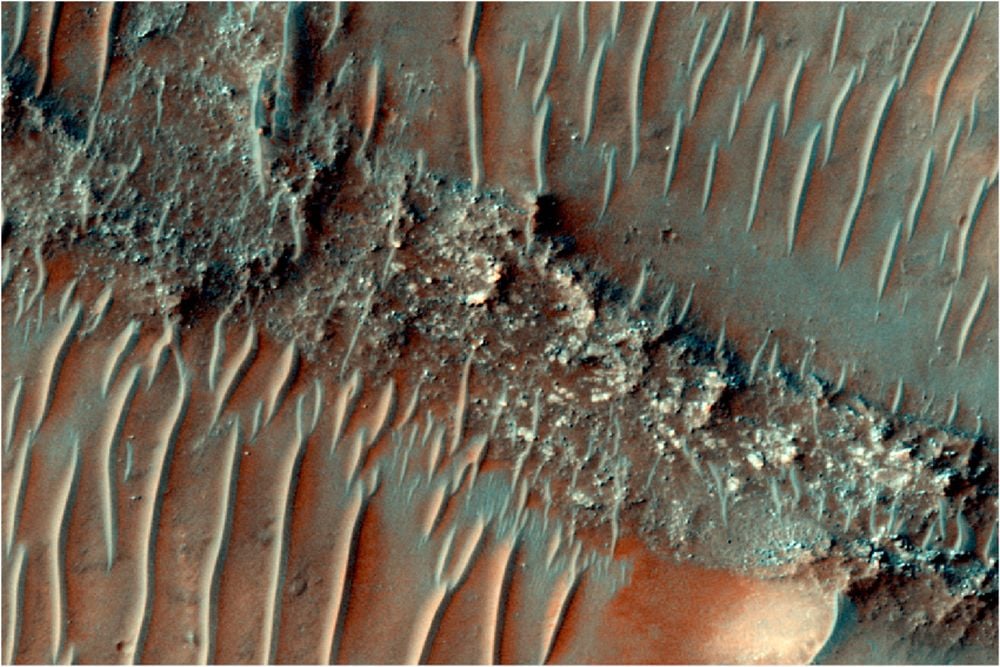
This color image from the MRO's HiRISE camera shows a flat topped, heavily eroded fluvial sinuous ridge (FSR) on Mars. Sand dunes can be seen migrating over the top of the FSR. FSRs are created when rivers deposit sediment. The sediments hardens until it's harder than the surrounding terrain. As aeolian erosion wears down the softer, surrounding rock, the FSR is left behind as evidence of the ancient river. HiRISE Image: ESP_085386_1505. Image Credit: NASA/JPL/University of Arizona. Licence type: Attribution (CC BY 4.0)
There's very little scientific debate about the existence of surface water on Mars in its past. The evidence at this point is overwhelming. Orbiter images clearly show river channels and deltas, and rovers have found ample minerals that only form in the presence of water. Now the scientific debate has moved on. Scientists are trying to learn the extent of Martian surface water, both on the planet's surface and through time.
NASA's Mars Reconnaissance Orbiter (MRO) is a prolific purveyor of images of Mars' surface. One of its most well-known image shows Jezero Crater, the landing site of the Mars Perseverance rover. Jezero Crater is an ancient paleolake filled by an ancient river that created a delta of sediments. The orbiter also identified clays and carbonate salts, minerals that were altered by water in the planet's past.
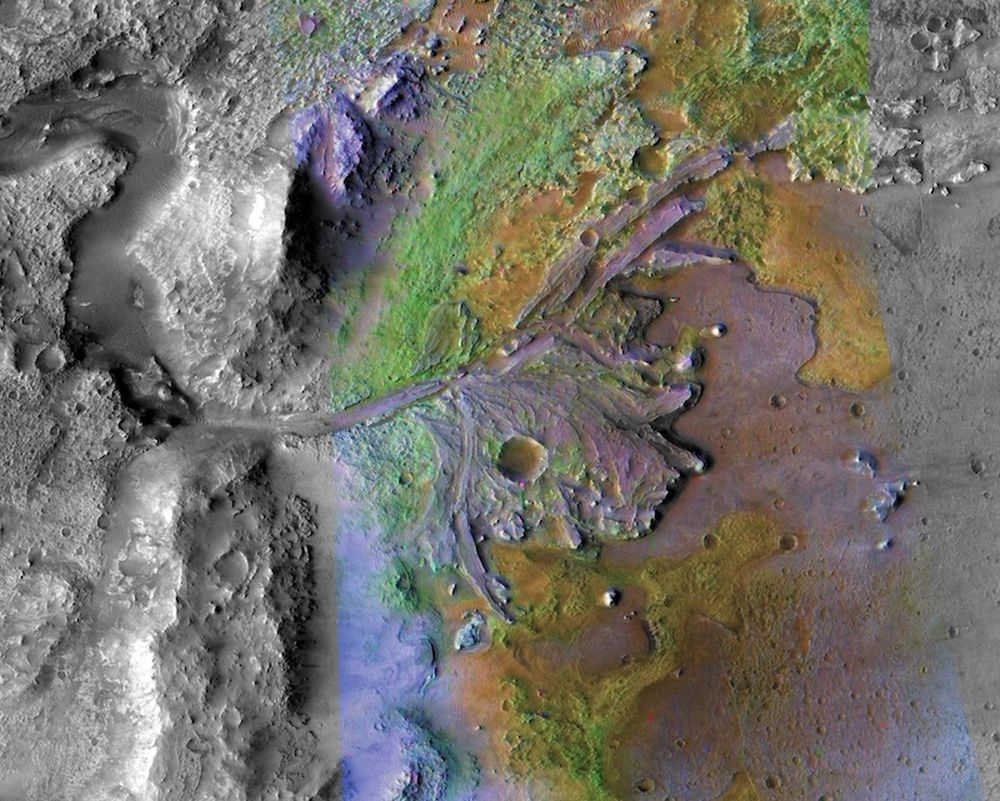
This image of Jezero Crater is one of the MRO's most well-known images. It shows clear evidence of flowing water. The colours map the location of different minerals, including water-altered clays and carbonate salts.
Image Credit: NASA/ JPL-Caltech/ MSSS/ JHU-APL.
There are two schools of thought around Mars' watery past. One says that water was stable on the Martian surface for long periods of time, while the other states that the water channels were carved during geologically brief periods of time when climate shifts caused ice sheets to melt. Call the first one the 'warm and wet' theory and the second one the 'cold and dry' theory. Both theories are well developed, and make predictions about what scientists will find when they dig deeper.
Some research into Noachis Terra supports the idea that water features there were carved by ice-related processes during short-lived periods of wetness, the cold and dry theory. This 2016 paper illustrates that point of view. "Our studied valleys' association with ice-rich material and abundant evidence for erosion caused by downslope flow of ice-rich material are consistent with a cold, wet Mars hypothesis where accumulation, flow, and melting of ice have been dominant factors in eroding crater valleys," those researchers concluded.
Not all regions of Mars have been studied equally, and the Noachis Terra is not as well-studied as some other regions. The 'warm and wet' climate theory predicts that Noachis Terra would've had high levels of precipitation. However, there's an overall lack of Valley Networks (VNs) in the region. Valley Networks are similar to Earth's river drainage basins and are compelling evidence of Mars' watery past.
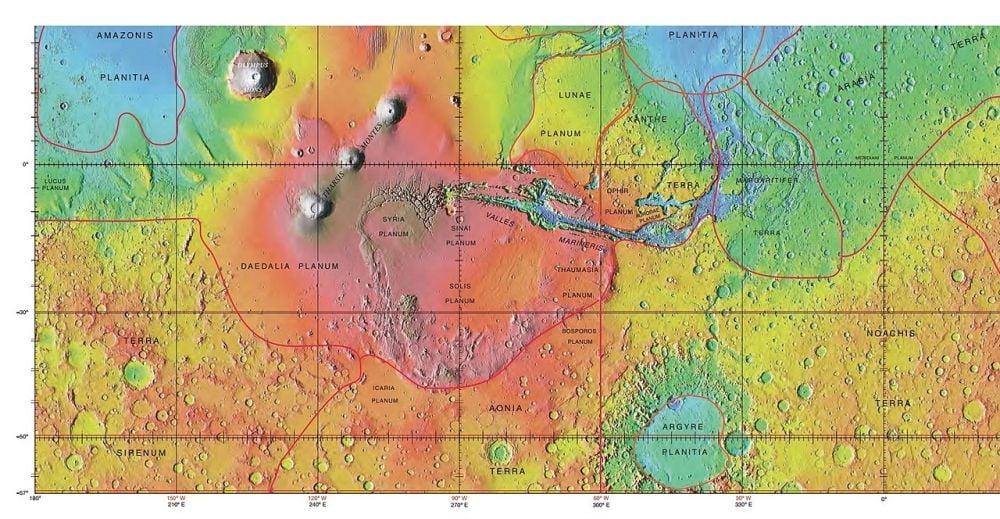
This map of Mars shows important surface features, as well as all of the planet's surface regions. Noachis Terra is a southern highland region of heavily cratered ancient terrain.
Image Credit: By Jim Secosky modified NASA image. - http://planetarynames.wr.usgs.gov/images/mola_regional_boundaries.pdf, Public Domain,
New research presented at the Royal Astronomical Society's National Astronomy Meeting presented a different sort of evidence to support the high levels of precipitation predicted in Noachis Terra by the warm and wet theory. It's titled "The Fluvial History of Noachis Terra, Mars," and the lead researcher is Adam Losekoot. Losekoot is a PhD student at the Open University, a public research university in the UK.
"Studying Mars, particularly an underexplored region like Noachis Terra, is really exciting because it's an environment which has been largely unchanged for billions of years. It's a time capsule that records fundamental geological processes in a way that just isn't possible here on Earth," Losekoot said in a press release.
The evidence Losekoot and his fellow researchers uncovered is in the form of Fluvial Sinuous Ridges.
"Noachis Terra, in Mars’ southern highlands, is a region where ‘warm, wet’ climate models predict high rates of precipitation, but is poorly incised by VNs," Losekoot explained. "We searched instead for Fluvial Sinuous Ridges (FSRs, aka inverted channels) here as they provide alternate evidence to VNs for stable surface water."
FSRs are winding, elevated features left behind from Mars' watery past. They form when water flows across the surface carrying sediment with it. The sediment deposits become harder than the rock in the surrounding terrain due to compaction and mineral precipitation. When Mars' water disappeared, aeolian erosion ate away at the softer, surrounding rock, leaving the elevated FSRs behind.
To find the FSRs in Noachis Terra, Losekoot and his co-researchers turned to NASA's MRO. No other mission has done more to reveal Mars' past than the MRO. They used data from its HiRISE and other instruments, as well as data from the Mars Orbital Laser Altimeter on the Mars Global Surveyor, to identify FSRs.
Losekoot and his co-researchers found 15,000 km of FSRs in Noachis Terra. "We find FSRs to be common across Noachis Terra, with a cumulative length of more than 15,000 km. These are often isolated segments, but some systems are hundreds of km in length," Losekoot writes.
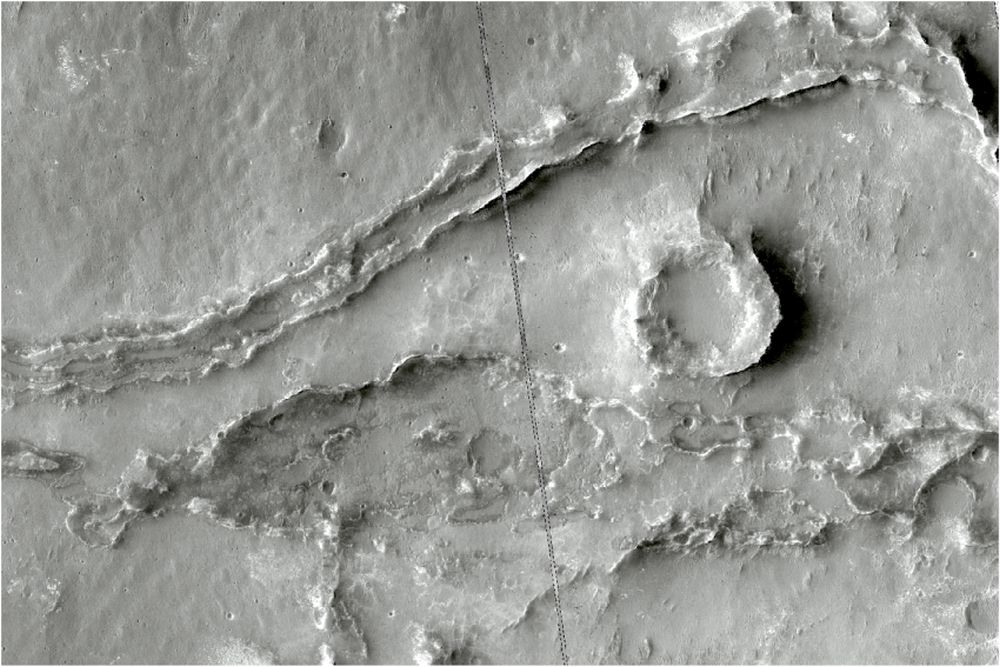
This HiRISE image shows two branches of an FSR. The river split into two then rejoined outside of the image. The lower branch is heavily eroded and quite spread out, the upper branch is narrower but more clearly preserved. They could've had different exposure times or undergone different geological processes. Or they could be from different periods of water activity. There are remnants of an infilling material within the ridge and a meander where the branch turns back towards the lower trunk. The mesa in between the branches could be a crater that was filled with the same sediment as the FSR.
Image Credit: HiRISE Image: ESP_085519_1585NASA/JPL/University of Arizona. Licence type: Attribution (CC BY 4.0)
The FSRs are broadly distributed across Noachis Terra, and some are tens of meters tall. That means the water flowed for a long time.
"The broad distribution of FSRs suggests a broadly distributed source of water," Losekoot writes. "The most likely candidate is precipitation, suggesting a benign surface environment. For FSRs to have formed mature, interconnected systems, up to tens of meters high, these conditions must also have been relatively long-lived."
"This suggests that ~3.7 Ga, Noachis Terra experienced warm and wet conditions for a geologically relevant period," Losekoot explained.
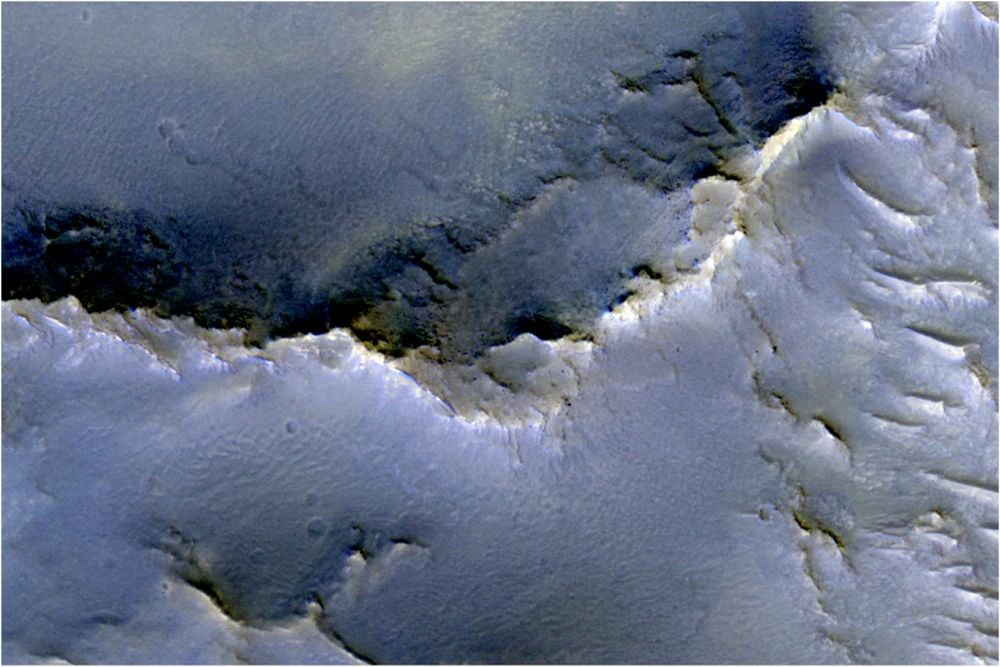
This HiRISE image shows narrow FSR with a pointed pinnacle ridge. The pointed could indicate that this FSR has suffered heavy erosion for a long time until only a narrow peak remained, or it may be that only a narrow part of the original river infill has been preserved.
Image Credit: HiRISE Image: ESP_067439_1505 NASA/JPL/University of Arizona. Licence type: Attribution (CC BY 4.0)
The way the FSRs are distributed across Noachis Terra and their extent suggests that precipitation is responsible. They also form large, interconnected systems, which suggests the watery period was long-lived. This work supports the idea that Mars was warm and wet for a long time, rather than just for bursts of time when ice sheets melted.
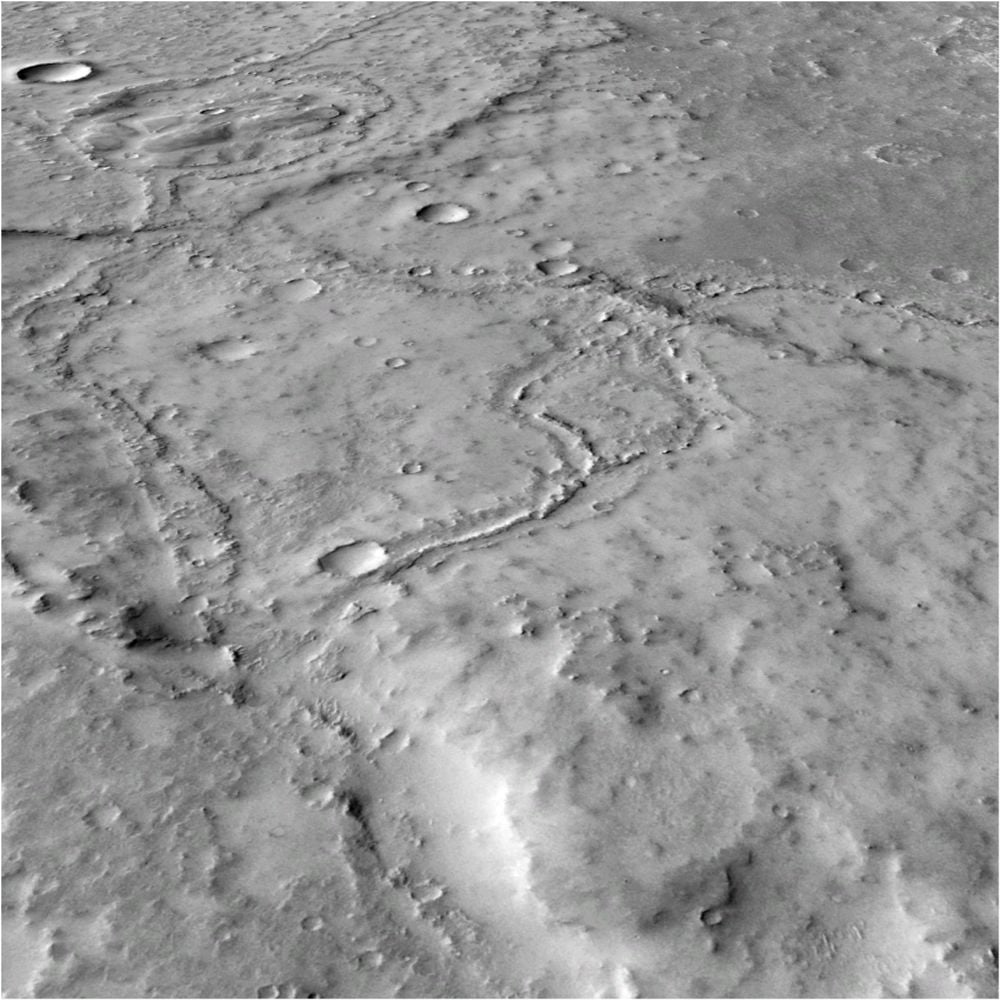
This MRO CTX image gives an oblique view of part of a system of FSRs in Noachis Terra. It shows river tributaries that were probably active at the same time. The rivers meandered, and there are areas where the river banks burst and deposited fine layers of sediment. At the top of the image is a really clear example of an area where two FSRs intersect with an infilled crater. This is likely where the river flowed into the crater, filling it up and then breaching the other side to continue through the crater and down to the bottom of the image.
"Our work is a new piece of evidence that suggests that Mars was once a much more complex and active planet than it is now, which is such an exciting thing to be involved in," said Losekoot.
Alien face on island in Antarctica is a sign they left for us, UFO UAP sighting news ancient aliens
Date of discovery: July 2025
Location of discovery: Antarctica
Coordinates: 3°00'41"S 60°46'11"W
I found a face again, but this time not on Mars or the moon, it's on a small little island without a name...next Deception Island. The face is like that of an ancient person, with a leather hat that has two long sides as well as a belt that wraps under the persons chin. The person is human-like and has two eyes, a nose, mouth and chin. As I have said before...when you find the face, you find a base. Aliens will create faces of their loved ones that past away while they were far across the galaxy or universe working. Aliens are lazy, meaning they like things done by ai and wont make faces in mountains just anywhere, they always choose locations within 2km of the alien base. Google Ruler says this face is 28 meters by 14, that includes the long parts of the hat that hangs down to where the chest area should be.
Ancient alien base discovered in remote Antarctica region, ET Structures UFO UAP sighting news
Date of discovery: July 2025
Location of discovery:Antarctica region
Coordinates: -80.303889 -81.385611
I found this strange structure in a remote Antarctica region of Google Earth Map. The structure measures 50 meters across and 20 meters wide according to Google ruler. This might be just the entrance, not the full structure, it may lead to an underground alien base below the Arctic ice. The real question is...are the aliens still living there or is this an abandoned base that other countries military can take over? Exploration of this structure needs to take place to learn more first hand.
But scientists are finally uncovering what Antarctica’s landscape really looks like – and it’s not what they expected.
It's well known that much of the surface underneath the smooth ice sheet consists of mountains, valleys and deep troughs.
Now, a new study using radio-echo sounding reveals there are vast areas of ‘remarkably’ flat surfaces along the 3,500km stretch of East Antarctic coastline.
These previously unmapped surfaces were once connected and it is believed were formed by large rivers after East Antarctica and Australia broke apart around 80 million years ago.
The flat areas – now hidden beneath the ice sheet – are separated by deep trenches which fast-moving glaciers are steered through.
Lead author Dr Guy Paxman, from Durham University, said: ‘The landscape hidden beneath the East Antarctic Ice Sheet is one of the most mysterious not just on Earth, but on any terrestrial planet in the solar system.
‘When we were examining the radar images of the sub-ice topography in this region, these remarkably flat surfaces started to pop out almost everywhere we looked.’
The topography beneath the Antarctic Ice Sheet, with the green areas highlighting increased altitude. The scientists mapped 31 flat surfaces as part of their study
The extensive flat surfaces were found beneath approximately 40 per cent of the East Antarctic Ice Sheet’s 3,500km-long coastline between Princess Elizabeth Land and George V Land. Pictured: Crevassed ice in Princess Elizabeth Land
Bunger Hills, a small exposed fragment of a larger flat surface at the edge of the East Antarctic Ice Sheet
The study, published in the journal Nature Geoscience, also revealed the ice above these flat surfaces is moving much more slowly.
Ice loss from Antarctica is increasing – boosted by global warming – but the flat areas appear to act as a barrier to ice flow and may currently be regulating the rate of ice loss, the team said.
This finding is significant, as East Antarctica has the potential to raise global sea levels by 52 metres if it were to melt completely.
Adding the flat surface effects into models of future ice sheet behaviour could help refine projections of how the ice sheet might react to climate change, the researchers said.
‘The flat surfaces we have found have managed to survive relatively intact for over 30 million years, indicating that parts of the ice sheet have preserved rather than eroded the landscape,’ Dr Paxman said.
‘Information such as the shape and geology of the newly mapped surfaces will help improve our understanding of how ice flows at the edge of East Antarctica.
‘This in turn will help make it easier to predict how the East Antarctic Ice Sheet could affect sea levels under different levels of climate warming in the future.’
The extensive flat surfaces were found beneath approximately 40 per cent of the East Antarctic Ice Sheet’s 3,500km-long coastline between Princess Elizabeth Land and George V Land.
The researchers discovered there are 'remarkably' flat surfaces along the 3,500km stretch of East Antarctic coastline
The Windmill Islands, small nunataks - ridges - protruding above the surface of the East Antarctic Ice Sheet
The preservation of these enigmatic surfaces over tens of millions of years indicates a lack of intense, selective erosion of these areas throughout Antarctica’s glacial history.
Research co-author Professor Neil Ross, from Newcastle University, said: ‘We’ve long been intrigued and puzzled about fragments of evidence for ‘flat’ landscapes beneath the Antarctic ice sheets.
‘This study brings the jigsaw pieces of data together, to reveal the big picture: how these ancient surfaces formed, their role in determining the present-day flow of the ice, and their possible influence on how the East Antarctic Ice Sheet will evolve in a warming world.’
The team emphasised the need to further explore the influence of these flat surfaces on ice sheet movement during past warmer climates.
This would include drilling through the ice to retrieve rock from the flat surfaces to understand when they were last free from ice cover.
This will help improve predictions for how the ice around this large section of the East Antarctic margin will respond as the climate and ocean warms.
A separate team of researchers recently revealed there are mysterious radio signals emerging from deep within Antarctica’s ice.
The strange radio pulses were detected by the Antarctic Impulsive Transient Antenna (ANITA), an array of instruments designed to detect elusive particles called neutrinos.
Configuration of East Antarctica, Australia, and India prior to continental break-up. Red outlines show the flat surfaces mapped in this study.
Rather than detecting these cosmic particles, the researchers were baffled to find signals emerging from the ice at seemingly impossible angles.
Worryingly, they have no idea what could be causing them.
In a paper, published in Physical Review Letters, an international team of researchers explained that these findings cannot be explained by the current understanding of particle physics.
This might mean there are entirely new forms of particles and interactions at play or that these unusual signals are the product of mysterious dark matter.
Dr Stephanie Wissel, an astrophysicist from The Pennsylvania State University who worked on the ANITA team, says: 'The radio waves that we detected were at really steep angles, like 30 degrees below the surface of the ice.
'It's an interesting problem because we still don't actually have an explanation for what those anomalies are.'
The three ice sheets that cover the continent contain around 70 per cent of our planet’s fresh water - and these are all to warming air and oceans.
If all the ice sheets were to melt due to global warming, Antarctica would raise global sea levels by at least 183ft (56m).
Given their size, even small losses in the ice sheets could have global consequences.
In addition to rising sea levels, meltwater would slow down the world’s ocean circulation, while changing wind belts may affect the climate in the southern hemisphere.
In February 2018, Nasa revealed El Niño events cause the Antarctic ice shelf to melt by up to ten inches (25 centimetres) every year.
El Niño and La Niña are separate events that alter the water temperature of the Pacific ocean.
The ocean periodically oscillates between warmer than average during El Niños and cooler than average during La Niñas.
Using Nasa satellite imaging, researchers found that the oceanic phenomena cause Antarctic ice shelves to melt while also increasing snowfall.
In March 2018, it was revealed that more of a giant France-sized glacier in Antarctica is floating on the ocean than previously thought.
This has raised fears it could melt faster as the climate warms and have a dramatic impact on rising sea-levels.
Chinese scientists have successfully turned bees into cyborgs by inserting controllers into their brains.
The device, which weighs less than a pinch of salt, is strapped to the back of a worker bee and connected to the insect’s brain through small needles.
In tests the device worked nine times out of 10 and the bees obeyed the instructions to turn left or right, the researchers said.
The cyborg bees could be used in rescue missions – or in covert operations as military scouts.
The tiny device can be equipped with cameras, listening devices and sensors that allow the insects to collect and record information.
Given their small size they could also be used for discreet military or security operations, such as accessing small spaces without arousing suspicion.
Zhao Jieliang, a professor at the Beijing Institute of Technology, led the development of the technology.
It works by delivering electrical pulses to the insect’s optical lobe – the visual processing centre in the brain – which then allows researchers to direct its flight.
The device, which weighs less than a pinch of salt, is strapped to the back of a worker bee and connected to the insect’s brain through small needles
The study was recently published in the Chinese Journal of Mechanical Engineering, and was first reported by the South China Morning Post.
‘Insect-based robots inherit the superior mobility, camouflage capabilities and environmental adaptability of their biological hosts,’ Professor Zhao and his colleagues wrote.
‘Compared to synthetic alternatives, they demonstrate enhanced stealth and extended operational endurance, making them invaluable for covert reconnaissance in scenarios such as urban combat, counterterrorism and narcotics interdiction, as well as critical disaster relief operations.’
Several other countries, including the US and Japan, are also racing to create cyborg insects.
While Professor Zhao’s team has made great strides in advancing the technology, several hurdles still remain.
For one, the current batteries aren’t able to last very long, but any larger would mean the packs are too heavy for the bees to carry.
The same device cannot easily be used on different insects as each responds to signals on different parts of their bodies.
Before this, the lightest cyborg controller came from Singapore and was triple the weight.
The researchers, from the Beijing Institute of Technology, used worker bees - similar to this one pictured - as part of their study (stock image)
Researchers at RIKEN, Japan have created remote-controlled cyborg cockroaches, equipped with a control module that is powered by a rechargeable battery attached to a solar cell
It also follows the creation of cyborg dragonflies and cockroaches, with researchers across the world racing to develop the most advanced technology.
Scientists in Japan have previously reported a remote-controlled cockroach that wears a solar-powered ‘backpack’.
The cockroach is intended to enter hazardous areas, monitor the environment or undertake search and rescue missions without needing to be recharged.
The cockroaches are still alive, but wires attached to their two 'cerci' - sensory organs on the end of their abdomens - send electrical impulses that cause the insect to move right or left.
In November 2014, researchers at North Carolina State University fitted cockroaches with electrical backpacks complete with tiny microphones capable of detecting faint sounds.
The idea is that cyborg cockroaches, or ‘biobots’, could enter crumpled buildings hit by earthquakes, for example, and help emergency workers find survivors.
‘In a collapsed building, sound is the best way to find survivors,’ said Alper Bozkurt, an assistant professor of electrical and computer engineering at North Carolina State University.
North Carolina State University researchers have developed technology that allows cockroaches (pictured) to pick up sounds with small microphones and seek out the source of the sound. They could be used in emergency situations to detect survivors
‘The goal is to use the biobots with high-resolution microphones to differentiate between sounds that matter - like people calling for help - from sounds that don't matter - like a leaking pipe.
‘Once we've identified sounds that matter, we can use the biobots equipped with microphone arrays to zero-in on where those sounds are coming from.’
The ‘backpacks’ control the robo-roach's movements because they are wired to the insect’s cerci - sensory organs that cockroaches usually use to feel if their abdomens brush against something.
By electrically stimulating the cerci, cockroaches can be prompted to move in a certain direction.
In fact, they have been programmed to seek out sound.
One type of 'backpack' is equipped with an array of three directional microphones to detect the direction of the sound and steer the biobot in the right direction towards it.
Another type is fitted with a single microphone to capture sound from any direction, which can be wirelessly transmitted, perhaps in the future to emergency workers.
They ‘worked well’ in lab tests and the experts have developed technology that can be used as an ‘invisible fence’ to keep the biobots in a certain area such as a disaster area, the researchers announced at the IEEE Sensors 2014 conference in Valencia, Spain.
The mystery of a 'underground city' beneath Egypt's pyramids has intensified after scientists revealed new scans showing a shaft plunging below the Great Sphinx.
Italian researchers, who made waves earlier this year with claims of vast structures hidden beneath the Pyramid of Khafre, now say they have identified a colossal vertical shaft leading and two chambersbelow the Sphinx.
While mainstream archaeologists have slammed the work as unscientific and speculative, the team insists their latest scans point to something extraordinary.
The scans detailed a massive shaft surrounded by a spiral-like staircase, decedending from the center of the Sphinx's base and down into two square structures, one at 2,000 feet and another 4,000 feet underground.
Armando Mei, an Egyptologist and co-author of the study, noted that similar underground features have now been detected beneath all three major pyramids, suggesting a unified architectural blueprint.
'The discovery proves that the Giza Plateau was engineered long before the dynastic era, possibly around 36,400 BCE, as my research suggests,' he added.
If confirmed, the findings could dramatically rewrite the history of ancient Egypt, challenging the long-held belief that the pyramids were built solely as royal tombs, and hinting instead at a forgotten civilization with advanced engineering skills.
The mystery of a 'underground city' beneath Egypt 's pyramids has intensified after scientists revealed new scans showing a shaft plunging below the Great Sphinx
But the researchers are shaking up that timeline, suggesting these legendary monuments may rest atop far older, hidden structures that could predate known history by tens of thousands of years.
It all began in March when the team announced four massive shafts and chambers were found under the Pyramid of Khafre using a type of sonar technology.
They employed cutting-edge SAR Doppler Tomography, a technique that uses satellite radar to detect tiny seismic movements.
By analyzing radar signals are and the timing or pattern of those signals when they bounce back, the team was able to create 3D maps revealing hidden subsurface structures. The technology has been published in a peer-reviewed journal.
However, latest work by Corrado Malanga from Italy's University of Pisa, Biondi and Mei has not yet been published in a scientific journal for the review of independent experts. They plan to publish a study in 2026.
'Our geophysical surveys beneath the Great Sphinx uncovered pillar-like formations remarkably similar to those beneath the Khafre and Menkaure pyramids,' explained Biondi.
'Even more compelling, our tomographic imaging revealed two large chambers nearly 2,000 feet below the surface.'
Italian researchers, who made waves earlier this year with claims of vast structures hidden beneath the Pyramid of Khafre, now say they have identified a colossal vertical shaft below the Sphinx
The scans also captured two large chambers, one at 2,000 feet and another 4,000 feet underground
The two massive chambers, each measuring 131 feet by 131 feet, appear to be connected by an underground shaft, according to recent findings.
The data collected also points to a network of hidden structures below the surface, possibly part of a vast underground city, potentially as expansive as the entire Giza Plateau itself.
Mei explained that their theory of a lost city draws from ancient Egyptian texts, particularly Chapter 149 of the Book of the Dead, which references the '14 residences of the city of the dead.'
'It describes certain chambers and some inhabitants of the city. That is why we believe it could be Amenti [realm of the dead], as described in ancient texts,' he said.
'Of course, we must be certain, but we believe this could be the case because the pyramids are located exactly where the texts say.
'The texts state that the pyramids were built on top of the city, sealing its entrance.'
Biondi added that the mysterious chambers found more than 4,000 feet below the pyramids may be linked to the legendary Hall of Records.
The shaft appears to be wrapped in a spiral-like structure
Armando Mei (center) and his team, which includes Corrado Malanga (right) and Filippo Biondi (left), took the world by storm last month when they discovered shafts and chambers more than 2,000 feet below the surface.
Despite its enduring allure, there is no solid evidence proving the Hall of Records exists.
The team proposes that an advanced civilization originally built the complex, but was destroyed around 12,000 years ago by a 'divine flood' triggered by an asteroid impact.
According to their theory, the pyramids are the lone surviving 'megastructure' from this ancient society.
Alternate historians, including Graham Hancock, a frequent guest on Joe Rogan's podcast, have long suggested that a sophisticated prehistoric civilization was wiped out by a global cataclysm, possibly a comet strike.
Researchers believe there are other structures reaching more than 4,000 feet below the surface. The scans captured structures extend along the northern side with a tuning fork shape
This theory holds that the catastrophic floods and upheaval erased most traces of this civilization, with survivors passing down critical knowledge of astronomy, engineering, and sacred architecture to later cultures such as the ancient Egyptians.
The researchers now hope to gain permission from Egyptian authorities to excavate beneath the Giza Plateau and put their findings to the test, potentially rewriting the story of human history.
'We have the right. Humanity has the right to know who we are because, right now, we don't,' Biondi said.
The company attempting to bring back the woolly mammoth has now set its sights on a new extinct species.
Colossal Biosciences has announced it will attempt to 'de-extinct' a group of birds called the moa, which once lived in New Zealand.
These extraordinary animals included nine species, the largest being the South Island Giant Moa, which stood at 3.6 metres (11.8ft) tall and weighed 230 kg (507 lbs).
Colossal Biosciences will use genes extracted from moa bones to engineer modern birds until they very closely resemble the extinct moa.
This project will be done in collaboration with the Ngāi Tahu Research Centre at the University of Canterbury and backed by $15 million in funding from Lord of the Rings director Sir Peter Jackson.
Jackson, who has one of the largest private collections of moa bones, says: 'With the recent resurrection of the dire wolf, Colossal Biosciences has also made real the possibility of bringing back lost species.
'There’s a lot of science still to be done – but we can start looking forward to the day when birds like the moa or the huia are rescued from the darkness of extinction.'
The company trying to bring back the woolly mammoth has set its sights on a new extinct creature, the moa. These were a species of 3.6-metre-tall, 230 kg birds that once roamed New Zealand
Of the nine species of moa, the largest is the South Island Giant Moa which lived in New Zealand for millions of years prior to the arrival of humans. Pictured: Māori students pose with a reconstruction of a South Island Giant Moa in 1903
The nine species of moa were found widely across New Zealand until the arrival of the first Polynesian settlers around 1300 AD.
Within just 200 years, the people who became the Māori had pushed all moa species into extinction through a combination of hunting and forest clearing.
The disappearance of the moa also led to a cascade of changes across New Zealand's isolated island ecosystem.
Less than 100 years after the moa became extinct their main predator, the enormous Haast's eagle, also died out.
The first step is to recreate the genomes of all nine moa species using ancient DNA stored in preserved moa bones.
Colossal Biosciences has already begun this process with visits to caves containing moa deposits within the tribal area of the Ngāi Tahu and hopes to complete all genomes by 2026.
These genomes will then be compared to those of the moa's closest living relatives, the emu and tinamou, to see which genes gave the moa their unique traits.
The moa went extinct in the 15th century due to hunting and forest clearing by the first Māori settlers. Colossal Biosciences says restoring this megafauna species will help restore New Zealand's ecosystem
Colossal Biosciences has partnered with the Ngāi Tahu Research Centre at the University of Canterbury and is backed by $15 million in funding from Lord of the Rings director Sir Peter Jackson. Pictured: Sir Peter Jackson (left) and Colossal Biosciences CEO Ben Lamm (right) holding moa bones
How will the moa be brought back?
DNA is extracted from moa bones to sequence the moa genome.
The genome is compared to modern species to see which genes make the moa distinct.
CRISPR is used to alter the genome of modern birds to express these target genes.
Edited embryos are placed in a surrogate emu egg to develop.
A bird closely resembling the moa hatches.
A selection of these genes are then inserted into stem cells called Primordial Germ Cell Culture, cells that turn into eggs and sperm, taken from an emu.
Those engineered cells are allowed to develop into male and female gametes and used to create an embryo, which will be raised inside a surrogate emu egg.
Scientists used the gene editing tool CRISPR to modify the DNA in blood cells from a living grey wolf in 20 places, creating a wolf with long white hair and muscular jaws.
However, recreating this process in bird species poses much greater technical challenges.
Colossal Biosciences admits that creating Primordial Germ Cell Culture for bird species has been a challenge that has eluded scientists for decades.
Likewise, since bird embryos develop inside eggs, the process of transferring an embryo into a surrogate will be completely different from that used for mammals.
Scientists have also raised questions about whether restoring the moa is something that should be pursued at all.
The process begins by extracting DNA from ancient moa bones such as those found in the caves of Ngāi Tahu takiwā
A selection of moa genes will then be inserted into stem cells derived from their closest living relative, the emu (pictured). Those cells will create embryos that can be raised by surrogacy into animals closely resembling moa
Conservationists say that money would be better spent looking after the endangered species that are already alive.
Others point out that introducing a species which has been gone for over 600 years could have unintended consequences for the ecosystem.
Professor Stuart Pimm, an ecologist at Duke University who was not involved in the study, told AP: 'Can you put a species back into the wild once you’ve exterminated it there?
'I think it’s exceedingly unlikely that they could do this in any meaningful way.'
Professor Pimm adds: 'This will be an extremely dangerous animal.'
However, Colossal Biosciences maintains that their plan to 'rewild' the moa is beneficial for both the environment and the Māori people.
As grazing herbivores, the moa's browsing habits shaped the distribution and evolution of plants over millions of years.
These effects led to significant changes in New Zealand's ecosystems, which Colossal Biosciences argues would be more stable with the moa once again introduced.
Colossal Biosciences recently used similar techniques to create grey wolf puppies that closely resemble the extinct dire wolf
Ngāi Tahu archaeologist Kyle Davis, who is working with Colossal Biosciences on the project, says that the project has a deeper ancestral meaning.
During the 14th century, the moa were a vital source of meat for sustenance as well as bones and feathers, which became part of traditional jewellery.
The moa came to have a large role in Māori mythology, symbolising strength and resilience.
Mr Davis says: 'Our earliest ancestors in this place lived alongside moa and our records, both archaeological and oral, contain knowledge about these birds and their environs.
'We relish the prospect of bringing that into dialogue with Colossal’s cutting-edge science as part of a bold vision for ecological restoration.'
Earth was once inhabited by a variety of giant forms of animals that would be recognisable to us today in the smaller forms taken by their successors.
They were very large, usually over 88 pounds (40kg) in weight and generally at least 30 per cent bigger than any of their still-living relatives.
There are several theories to explain this relatively sudden extinction. The leading explanation of around was that this was due to environmental and ecological factors.
It was almost completed by the end of the last ice age. It is believed that megafauna initially came into existence in response to glacial conditions and became extinct with the onset of warmer climates.
In temperate Eurasia and North America, megafauna extinction concluded simultaneously with the replacement of the vast periglacial tundra by an immense area of forest.
Glacial species, such as mammoths and woolly rhinoceros, were replaced by animals better adapted to forests, such as elk, deer and pigs.
Reindeer and Caribou retreated north, while horses moved south to the central Asian steppe.
This all happened about 10,000 years ago, despite the fact that humans colonised North America less than 15,000 years ago and non-tropical Eurasia nearly one million years ago.
Worldwide, there is no evidence of Indigenous peoples systematically hunting nor over-killing megafauna.
The largest regularly hunted animal was bison in North America and Eurasia, yet it survived for about 10,000 years until the early 20th century.
For social, spiritual and economic reasons, First Nations peoples harvested game in a sustainable manner.
Meer van UFO'S of UAP'S, ASTRONOMIE, RUIMTEVAART, ARCHEOLOGIE, OUDHEIDKUNDE, SF-SNUFJES EN ANDERE ESOTERISCHE WETENSCHAPPEN - DE ALLERLAATSTE NIEUWTJES


 Scientists Discover Uranus Has a Dancing Partner