UFO made cloud over Antelope Island, Utah June 20, 2025, UAP Alien Sighting News. Strange Sky

UFO made cloud over Antelope Island, Utah June 20, 2025, UAP Alien Sighting News. Strange Sky
Skull found cut into island 🏝️ in Canada, 10,000+ years old! Ancient alien sign, they look like us, UFO UAP Sighting News
Wetenschappelijke Analyse: De Verandering van Kleuren in de Oceanen en de Betekenis voor het Klimaat en Ecosysteem

Inleiding
De oceanen vormen het grootste aquatische ecosysteem op aarde, met een cruciale rol in het wereldwijde klimaat, het zuurstofniveau in de atmosfeer, en de biodiversiteit. Recente wetenschappelijke rapporten en satellietwaarnemingen wijzen op een opvallende verandering in de kleur van de oceanen. Dit fenomeen, dat op het eerste gezicht esthetisch en onbeduidend lijkt, heeft diepgaande implicaties voor de oceanografie, klimaatwetenschap en ecologie. In deze analyse wordt de wetenschappelijke basis van de waargenomen kleurverandering onderzocht, inclusief de onderliggende processen, de methoden voor waarneming, en de mogelijke gevolgen voor het mondiale ecosysteem.
Waarnemingen en Methodologie
De toename of verandering in oceaankleuren wordt voornamelijk gedocumenteerd via satellietbeelden en remote sensing-technologieën. Satellieten zoals NASA’s MODIS (Moderate Resolution Imaging Spectroradiometer) en ESA’s Sentinel-3 gebruiken spectroradiometrische instrumenten om de reflectie en absorptie van licht door het oceaanwater te meten. Deze metingen maken het mogelijk om de kleur van het water te kwantificeren in termen van de reflectie in verschillende golflengten, die vervolgens worden vertaald naar kwantitatieve parameters zoals chlorofyl-a concentraties en de aanwezigheid van plankton of andere deeltjes.
De waarnemingen laten zien dat bepaalde oceanen en oceanische regio’s, zoals de Noord-Atlantische Oceaan, de gebieden rond de Indische Oceaan en de Stille Oceaan, in de loop van de afgelopen decennia een duidelijke verandering in kleur vertonen. Vaak wordt deze verandering gekenmerkt door een intensivering van de groene en bruine tinten, wat wijst op een verhoogde aanwezigheid van fytoplankton en organisch materiaal in het water. Het gebruik van algoritmes voor het analyseren van satellietbeelden maakt het mogelijk om deze veranderingen te kwantificeren en te volgen over tijd.
Fysiologische en Biologische Oorzaken
De primaire oorzaak van de verandering in oceaankleuren wordt toegeschreven aan de toename van fytoplankton, microscopische fotosynthetische organismen die een belangrijke rol spelen in de koolstofcyclus en het zuurstofniveau in de atmosfeer. De verhoogde aanwezigheid van fytoplankton wordt vaak gekoppeld aan verhoogde nutrientenconcentraties in het water, zoals stikstof en fosfor, die de groei van deze organismen stimuleren.
Deze nutrienten kunnen afkomstig zijn uit verschillende bronnen:
Een hogere concentratie van fytoplankton leidt tot een toename in chlorofyl-a, wat direct gerelateerd is aan de groene tinten in de oceaan. Deze verhoogde algengroei, vaak aangeduid als “algenbloei”, kan natuurlijk voorkomen, maar wordt in veel gevallen versterkt door menselijke activiteiten.
Naast fytoplankton kunnen ook andere deeltjes, zoals sedimenten, zand en organisch materiaal, bijdragen aan de kleurverandering. Sedimenten die door rivierafvoer worden meegenomen, kunnen bijvoorbeeld de waterkleur donkerder maken, vooral in kustgebieden.

Uit het nieuwe onderzoek blijkt dat 21% van de wereldwijde oceaan een afname van de diepte van de verlichte zones heeft ervaren.
Krediet: Getty
Chemische en Fysische Processen
De verandering van oceaankleuren wordt niet alleen beïnvloed door biologische factoren, maar ook door fysische en chemische processen die de optische eigenschappen van water bepalen:

Een donker wordende fotische zone zou dieren kunnen dwingen om dichter naar het oppervlak te gaan, waar de concurrentie om hulpbronnen groter is, aldus de onderzoekers.
Krediet: Getty
Ecologische en Klimaatimplicaties
De waargenomen verandering in oceaankleuren heeft belangrijke ecologische gevolgen:
Veranderingen in het mariene ecosysteem: Een toename in fytoplankton kan leiden tot “algenbloei”, die op zijn beurt de zuurstofvoorziening in het water beïnvloedt. Bij massale algenbloei kunnen dood organisch materiaal en afbraakprocessen zuurstoftekorten veroorzaken, wat bekend staat als hypoxie of “dead zones”.
Effect op het voedselweb: Fytoplankton vormt de basis van het mariene voedselweb. Een verandering in de hoeveelheid en types van fytoplankton heeft directe gevolgen voor het hele mariene ecosysteem. Een toename kan leiden tot een verschuiving in de soortenrijkdom en de biodiversiteit. Sommige soorten fytoplankton kunnen giftige stoffen produceren, wat de voedselketen kan verontreinigen en schadelijk kan zijn voor zeezoogdieren, vissen en menselijke consumptie. Daarnaast kunnen veranderingen in de samenstelling van de fytoplanktongemeenschap de populaties van andere mariene organismen beïnvloeden, zoals kleine kreeftachtigen (krill) en planktoneters, wat verder de stabiliteit van het ecosysteem onder druk zet.
Klimaatverandering en oceaanverzuring versterken deze effecten nog verder. Door de opwarming van de aarde neemt de oceaanopwarming toe, wat de stratificatie van het water vergemakkelijkt. Dit betekent dat warme, minder gemengde oppervlaktewaterlagen langer blijven bestaan, waardoor de toevoer van voedingsstoffen naar het oppervlakte vermindert. Dit kan leiden tot minder productieve gebieden voor fytoplankton, maar in sommige regio’s kunnen warmere omstandigheden juist een toename van bepaalde soorten veroorzaken. Tegelijkertijd zorgt de opname van CO2 door de oceaan voor verzuring, wat de groei en het functioneren van kalkproducerende organismen zoals koraal en schelpdieren beïnvloedt.
De ecologische gevolgen van dergelijke veranderingen zijn ingrijpend. Bijvoorbeeld, de afname van kalkhoudende organismen kan het mariene voedselweb verder destabiliseren, aangezien veel van deze organismen een essentiële rol spelen in het ecosysteem. Bovendien kunnen grote algenbloei en de daaropvolgende hypoxie leiden tot massale sterfte onder zeeleven, wat niet alleen de biodiversiteit aantast, maar ook de visserij en lokale gemeenschappen die afhankelijk zijn van gezonde oceanen.
Klimaatimplicaties kunnen zich verder uiten in de versterking van de klimaatverandering zelf. Oceanen functioneren als een koolstofput, maar de versnelde opname van CO2 en de daarmee gepaard gaande verzuring verminderen hun capaciteit om koolstof op te slaan. Dit versterkt de opwarming van de aarde en versnelt de negatieve ecologische effecten.
Bovendien beïnvloeden de veranderingen in oceaankleuren en de bijbehorende ecologische processen ook het wereldwijde klimaat. Een verstoord marien ecosysteem kan leiden tot veranderingen in de koolstofcyclus en de wereldwijde temperatuurregulatie. Dit onderstreept het belang van het monitoren van oceaanveranderingen en het nemen van passende maatregelen om de negatieve gevolgen te beperken.

A world map showing changes in global photic zones between 2003 and 2022. Reds indicate regions where the oceans are getting darker, while blues indicate regions where oceans are getting lighter and white indicates regions where there was no statistically significant change over the period.
Credit: University of Plymouth
Conclusie
Het observeren van veranderingen in oceaankleuren biedt belangrijke inzichten in de ecologische en klimaatimplicaties van de recente milieuveranderingen. De toename van fytoplankton en de daaruit voortvloeiende algenbloei kunnen zowel positieve als negatieve effecten hebben op het mariene ecosysteem. Echter, de negatieve gevolgen, zoals hypoxie, verlies van biodiversiteit en verstoring van het voedselweb, wegen op lange termijn zwaarder. Klimaatverandering en oceaanverzuring versterken deze problemen en maken het noodzakelijk dat wereldwijd actie wordt ondernomen. Het beschermen van onze oceanen vergt een geïntegreerde aanpak, inclusief vermindering van broeikasgasemissies, duurzame visserijpraktijken en het bevorderen van mariene biodiversiteit. Alleen door bewustwording en collectieve inspanning kunnen we de ecologische en klimaatimplicaties beperken en zorgen voor een gezonde oceaan voor toekomstige generaties.
{ PETER2011 }
Another Unexplained Metallic Orb-Shaped UFO Was Filmed Flying And Hovering In The Sky
by

iStockphoto
For some reason, orb or sphere-shaped UFOs keep appearing all over the world. They are usually metallic-looking and there is almost never a solid explanation for what they are or why they are flying around.
In 2023, a group that was formed by NASA to study UFOs that was made up of “some of the world’s leading scientists, data and artificial intelligence practitioners, aerospace safety experts” revealed in a public briefing that a large number of unexplained metallic orbs have been reported being seen at high altitudes around the world.
Since then, a sphere-shaped UFO was filmed darting back and forth in a zig-zag motion above a city in Colombia, another was reported by a Connecticut police officer, and one more was photographed by a visitor to Exmouth Beach in Devon, England. And those are just a few of the orb-shaped UFO sightings that have garnered media attention.
This latest orb-shaped UFO video was reportedly captured on June 5th at around 7 p.m. local time by a witness in Beijing, China.
“I was walking and taking photos of the scenery on the shallow area of Shayukou Reservoir,” the witness stated. “At first, I saw a metallic spherical object flying eastward above the water surface from the west side of the reservoir. At that time, it seemed to hover occasionally before continuing to fly, and it disappeared behind a hill. I initially thought it was just a strange hydrogen balloon and didn’t pay much attention.
“Around 7:30 p.m., as I was about to head back, the sphere reappeared in the south. There was no wind at all, and the evening was very quiet. Surprisingly, the sphere was able to fly at varying altitudes, hovering midway before continuing to fly. I watched for a few minutes and became certain it was definitely not a balloon or a drone. I then started filming, but the object was strange — every time I filmed for a short while, it would move behind the trees. Whenever I thought it had completely disappeared, it would reappear. This continued intermittently for over ten minutes, during which I recorded three video clips. After the last clip, it disappeared completely.”
Once again, no explanation has been provided. So, what are all of these orb-shaped UFOs that keep appearing all over the world? And what is their purpose? We may never know.
RELATED VIDEOS
Is Mars really red? A physicist explains the truth.

People from cultures across the world have been looking at Mars since ancient times. Because it appears reddish, it has often been called the red planet.
The English name for the planet comes from the Romans, who named it after their god of war because its color reminded them of blood. In reality, the reddish color of Mars comes from iron oxide in the rocks and dust covering its surface.
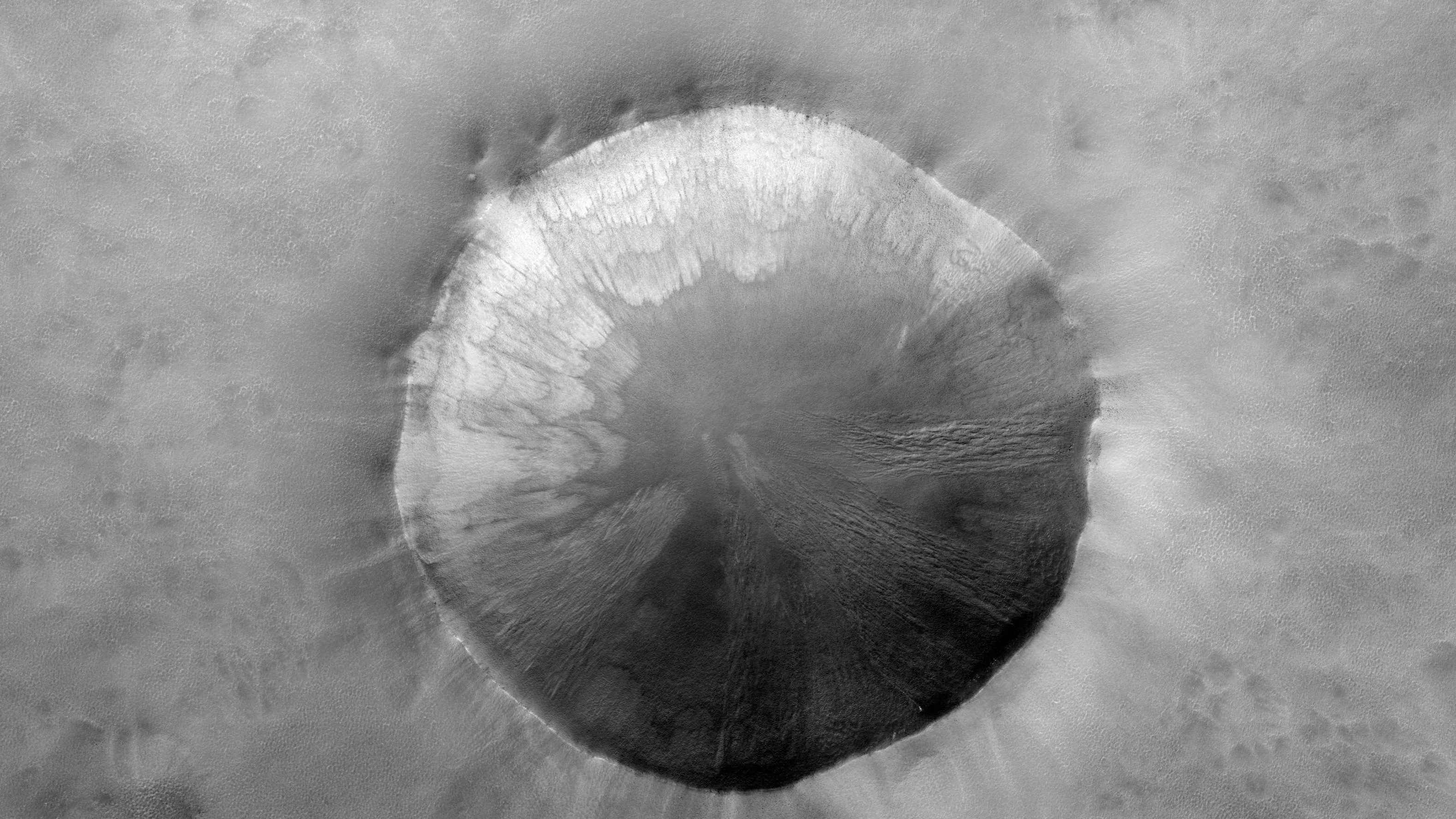
You may likeNASA Mars satellite uncovers markings 'like paint dripping down a wall' on Martian surface
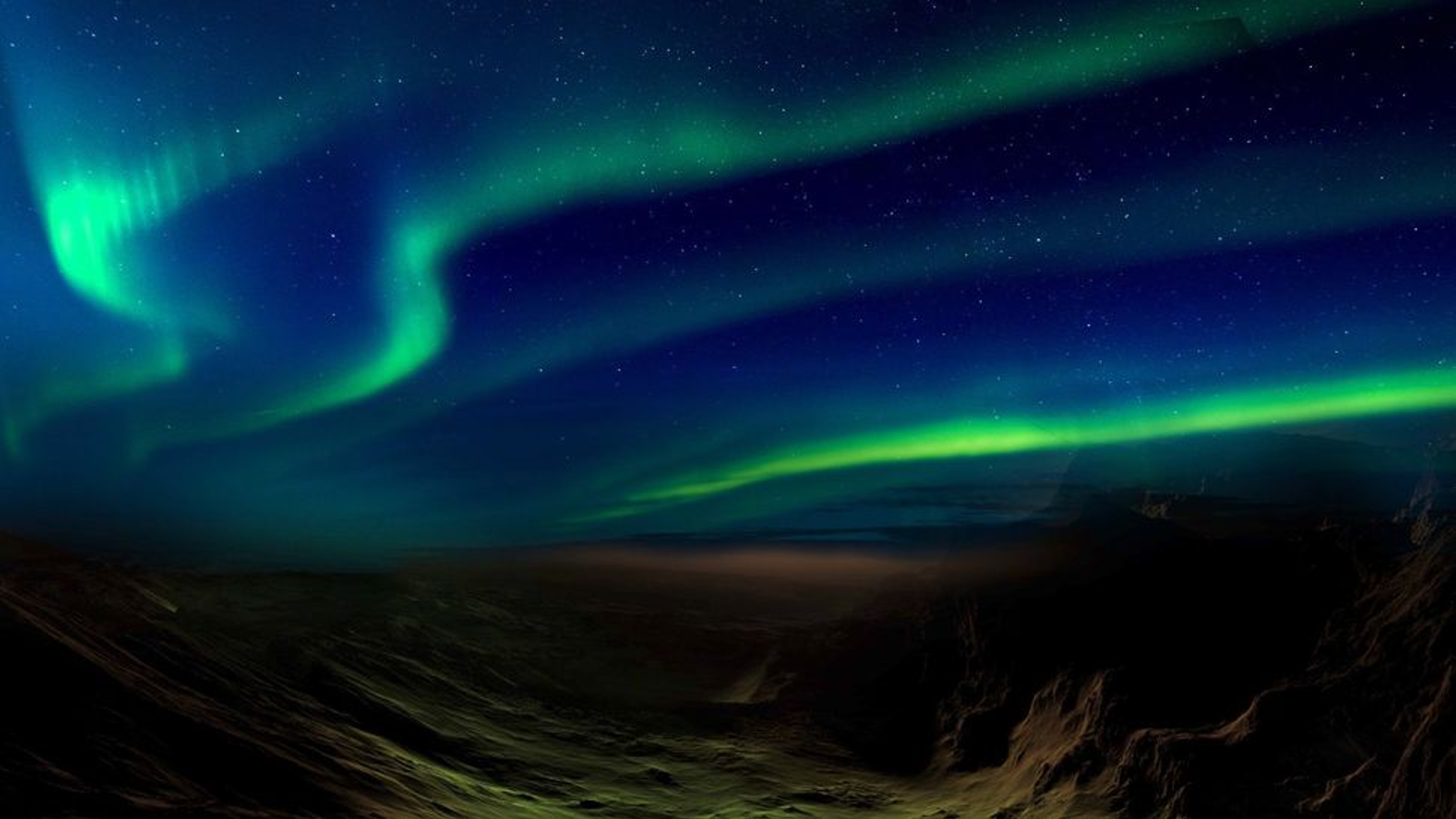
Lights on Mars! NASA rover photographs visible auroras on Red Planet for the first time
'The Martian' predicts human colonies on Mars by 2035. How close are we?
Your blood is also red because of a mixture of iron and oxygen in a molecule called hemoglobin. So in a way, the ancient connection between the planet Mars and blood wasn't completely wrong. Rust, which is a common form of iron oxide found here on Earth, also often has a reddish color.
In my current research on exoplanets, I observe different types of signals from planets beyond Earth. Lots of interesting physics goes into how researchers perceive the colors of planets and stars through different types of telescopes.
If you look closely at pictures of Mars taken by rovers on its surface, you can see that most of the planet isn't purely red, but more of a rusty brown or tan color.

Probes sent from Earth have taken pictures showing rocks with a rusty color. A 1976 picture from the Viking lander, the very first spacecraft to land on Mars, shows the Martian ground covered with a layer of rusty orange dust.
Not all of Mars' surface has the same color. At the poles, its ice caps appear white. These ice caps contain frozen water, like the ice we usually find on Earth, but these ice caps are also covered by a layer of frozen carbon dioxide — dry ice.
This layer of dry ice can evaporate very quickly when sunlight shines on it and grows back again when it becomes dark. This process causes the white ice caps to grow and shrink in size depending on the Martian seasons.
Related:

Mars also gives off light in colors that you can't see with your eyes but that scientists can measure with special cameras on telescopes.
Light itself can be thought of not only as a wave but also as a stream of particles called photons. The amount of energy carried by each photon is related to its color. For example, blue and violet photons have more energy than orange and red photons.
Ultraviolet photons have even more energy than the photons you can see with your eyes. These photons are found in direct sunlight, and because they have so much energy, they can damage the cells in your body. You can use sunscreen to protect yourself from them.
Infrared photons have less energy than the photons you can see with your eyes, and you don't need any special protection from them. This is how some types of night-vision goggles work: They can see light in the infrared spectrum as well as the visible color spectrum. Scientists can take pictures of Mars in the infrared spectrum using special cameras that work almost like night-vision goggles for telescopes.

The colors on the infrared picture aren't really what the infrared light looks like, because you can't see those colors with your eyes. They are called "false colors," and researchers add them to look at the picture more easily.

When you compare the visible color picture and the infrared picture, you can see some of the same features — and the ice caps are visible in both sets of colors.
NASA's MAVEN spacecraft, launched in 2013, has even taken pictures with ultraviolet light, giving scientists a different view of both the surface of Mars and its atmosphere.
Each new type of picture tells scientists more about the Martian landscape. They hope to use these details to answer questions about how Mars formed, how long it had active volcanoes, where its atmosphere came from and whether it had liquid water on its surface.
Astronomers are always looking for new ways to take telescope pictures outside of the regular visible spectrum. They can even make images using radio waves, microwaves, X-rays and gamma rays. Each part of the spectrum they can use to look at an object in space represents new information they can learn from.
Even though people have been looking at Mars since ancient times, we still have much to learn about this fascinating neighbor.
Monster Oort Cloud Comet Observed in the Outer Solar System
An artist rendition of comet C/2014 UN271, the largest known comet in the Oort Cloud.
Credit: NSF/AUI/NSF NRAO/M.Weiss
A team of astronomers has recently completed a long-range observation of a comet far from the Sun. This analysis proves that there’s lots going on, even in the icy depths of the solar system.
The targeted comet is C/2014 UN271 Bernardinelli-Bernstein. Comet UN271 is one of the largest Oort Cloud comets ever observed, measuring 140 kilometers across. It's currently at a distance of 16.5 Astronomical Units (AU) from the Sun, which makes it tough to observe with all but the largest telescopes. Astronomers have used the powerful Atacama Large Millimeter/submillimeter Array (ALMA) in Chile to observe the comet, watching as jets of carbon monoxide gas are erupting from its nucleus. This is a surprising level of activity for a comet that's so far from the Sun.
ALMA telescopes on the Chajnantor Plateau.
Credit: ALMA/NSF/ESO
Comet UN271 was discovered in 2014 by astronomers Gary Bernstein and Pedro Bernardinelli. They noticed the faint fuzzball in archival images from the Dark Energy Survey, moving slowly as a +22nd magnitude smudge through the constellation Sculptor.
Almost immediately, astronomers knew Comet UN271 was something special, as its slow motion through the sky suggested it was far out in the solar system, and therefore quite large. After following the comet for a bit, astronomers realized it was 29 AU from the Sun at the time of discovery—about ¾ of the way to Pluto from the Sun—and had a nucleus about 120 kilometers (75 miles) across. For context, Halley’s Comet has a nucleus just 15 kilometers across. This puts Comet UN271 up there in terms of size, as the largest Oort Cloud comet seen to date.
The discovery image for Comet UN271 (annotated).
Credit: NOIRLab.
We’re fortunate to see Comet UN271 on its perihelion approach. In January 2031, the comet will pass 10.9 AU from the Sun, just outside the orbit of Saturn. On a 2.8-million-year orbit inbound, the comet will then head out of the solar system on a 4.6-million-year orbit outbound, for a far-off aphelion 55,000 AU from the Sun. That’s 87% of a light-year away, about a fifth of the way to Proxima Centauri, the nearest star.

The orbit of Comet UN271 through the solar system.
Credit: NASA/JPL Horizons.
The difference in orbit inbound versus outbound for the comet is due to its interaction with solar system planets while it's near the Sun. Any new comet entering the inner solar system stands about a 40% chance of having its orbit altered. Likely, Comet UN271 was knocked off its Oort Cloud perch by a stellar pass near the solar system that sent sunward, long ago.
Looking at a cold distant object like Comet UN271 really pushed the sensitivity and resolution of ALMA to its limits. The thermal signal received by ALMA will not only help to refine the comet’s size, but also help to chronicle the dust production rate seen.
"These measurements give us a look at how this enormous, icy world works," says Nathan Roth (NASA/GSFC) in a recent press release. "We're seeing explosive outgassing patterns that raise new questions about how this comet will evolve as it continues its journey towards the inner solar system."
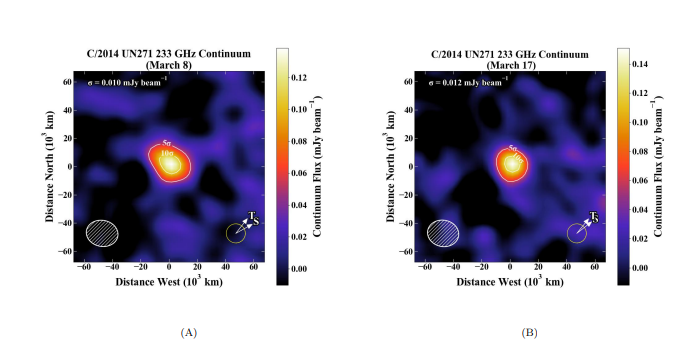
False color images of Comet UN271, showing activity.
Credit: ALMA/NSF/ESO.
Not only was this a record-setting detection in terms of distance, but it also demonstrates that comets can still display activity, far from the Sun.
No missions are planned to give us a view of Comet UN271 up close. The European Space Agency does have a mission named Comet Interceptor in the works that would loiter in the inner solar system, ready to chase down the next big comet. Comet Interceptor is planned for launch in 2029.
The Hubble Space Telescope imaged Comet UN271 in January 2022. We should get good views of the comet from the James Webb Space Telescope leading up to perihelion if it's ever tasked to observe it. The Vera Rubin Observatory, which is set to reveal its very first images next week could provide amazing views of the comet as well in the years to come.

Hubble's view of Comet UN271 in 2022.
Credit: NASA/HST/STScI
And yes, a comet the size of UN271 would spell a bad day for Earth, though in this case, it isn’t coming anywhere near the inner solar system. UN271 is 12 times the size of the Chicxulub impactor (which was only about 10 kilometers across) that struck the Earth 66 million years ago, so it would definitely be an extinction-level event if something the size of UN271 ever came our way.
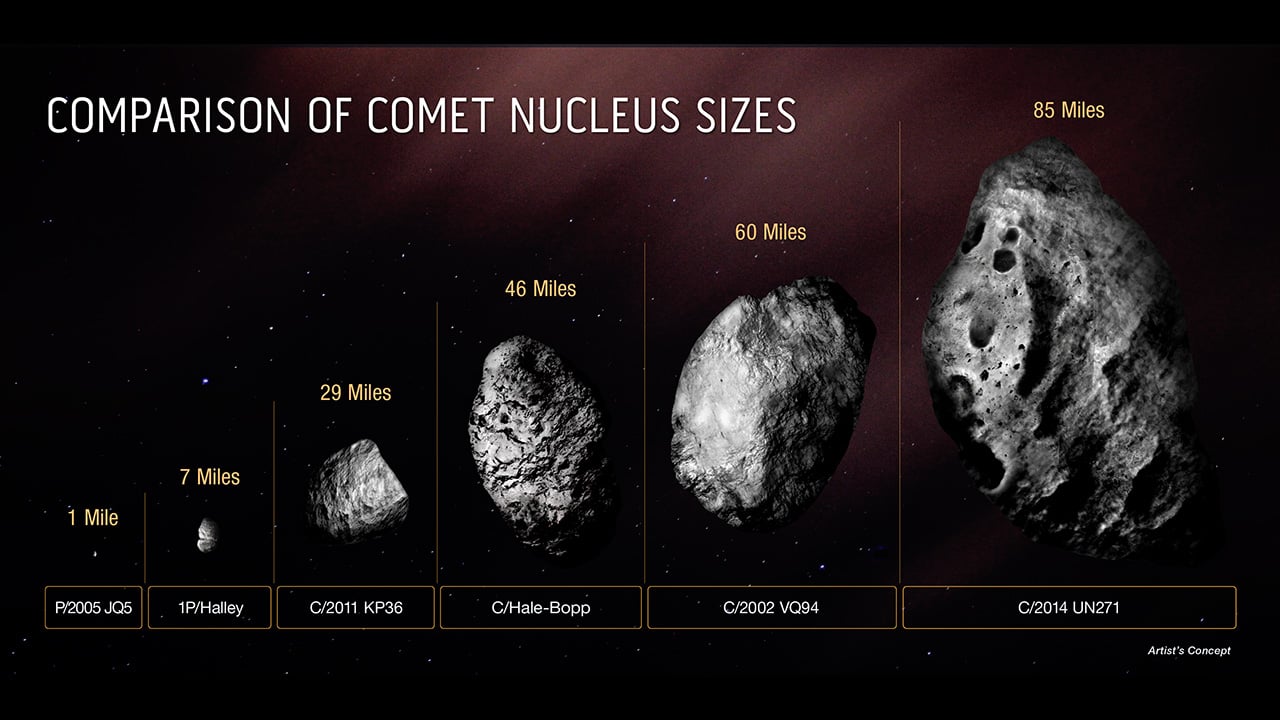
A size comparison for other known comets, versus UN271.
Credit: NASA/ESA/Zena Levy/STScI
Too bad Comet UN271 won’t visit the inner solar system... (just not too close!) It’s bigger than Hale-Bopp, and would provide an amazing show. For now, we’ll have to wait for the next Oort Cloud interloper to turn up. Still, the appearance of Comet UN271 shows us just what might be lurking out there, in the remote realms of the outer solar system.

The Solar System's Greatest Mystery May Finally Be Solved!
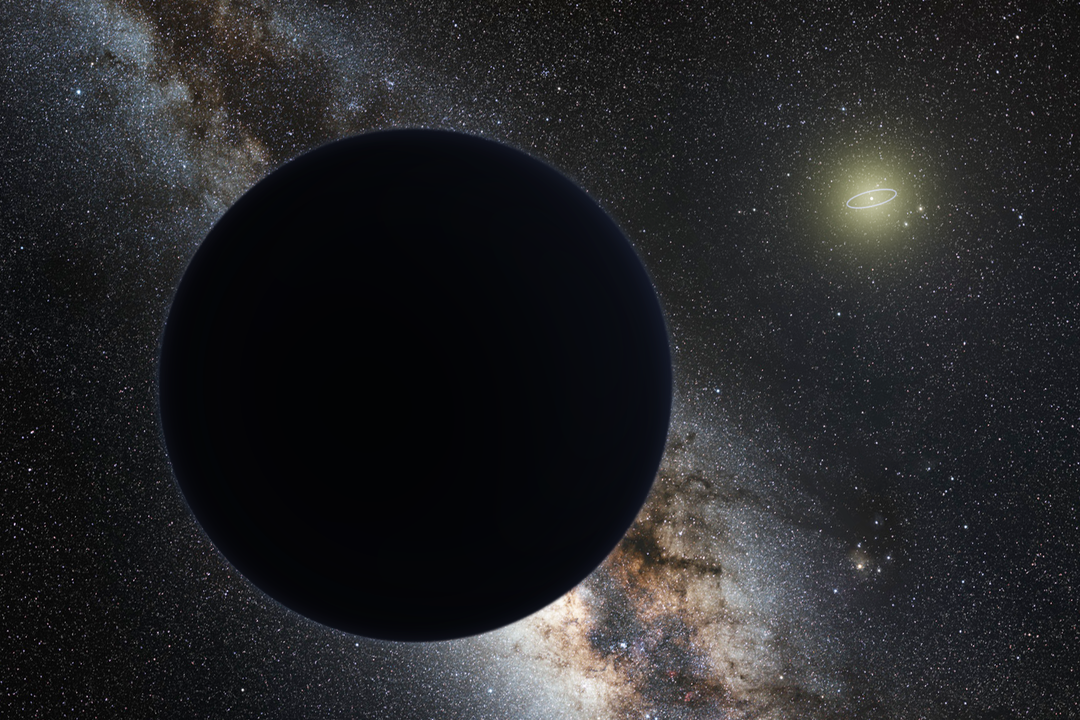
Artist's impression of Planet Nine as an ice giant eclipsing the central Milky Way, with a star-like Sun in the distance. Neptune's orbit is shown as a small ellipse around the Sun.
(Credit : Nagual Design)
For years, astronomers have been searching for a mysterious ninth planet lurking in the dark outer reaches of our Solar System. Now, a team of researchers have taken a completely different approach to this cosmic detective story, instead of looking for reflected sunlight, they're hunting for the planet's own heat signature.
The story begins with a puzzle in the outer Solar System. Scientists noticed that small icy bodies called Kuiper Belt Objects, which orbit far beyond Neptune, seem to be clustered together in unusual ways. Their orbits are aligned in patterns that shouldn't exist by chance alone. The leading and most tantalising explanation…. a massive, undiscovered planet (dubbed "Planet Nine”) is gravitationally shepherding these distant objects into their strange orbits.
Known objects in the Kuiper belt beyond the orbit of Neptune. Scale in Astronomical Units. Sun at centre, Jupiter, Saturn, Uranus and Neptune depicted as J, S, U and N
(Credit : Minor Planet Center)
If it exists, Planet Nine would be a true giant, roughly 5-10 times the mass of Earth, orbiting somewhere between 400-800 times farther from the Sun than our planet does. At such an enormous distance, it would be incredibly faint and nearly impossible to spot with traditional telescope searches that rely on detecting reflected sunlight.
This is where the new research gets ingenious. Led by Amos Chen from the National Tsing Hua University, the team realised that searching for Planet Nine's heat signature could be far more effective than looking for its reflected light. Here's why: when you double the distance from the Sun, reflected light becomes 16 times fainter (following what scientists call an inverse fourth-power relationship). But thermal radiation, the heat that all objects naturally emit, only becomes 4 times fainter when you double the distance.
Thermal image of Jupiter from JWST
(Credit : NASA/ESA)
The researchers turned to data from AKARI, a Japanese space telescope that conducted the most sensitive all-sky survey in far infrared light, the perfect wavelength range to detect the heat signature of a cold, distant planet. Unlike ground based telescopes that are hampered by Earth's atmosphere, AKARI could detect the faint thermal glow that Planet Nine should emit.
The team focused their search on a specific region of sky where computer simulations suggested Planet Nine was most likely to be found, based upon the orbital patterns of the Kuiper Belt Objects. They then faced the challenging task of distinguishing a slowly moving planet from the countless stars, galaxies, and cosmic debris that populate this region.
They had a rather elegant solution however, Planet Nine should appear stationary over the course of a single day but show detectable movement over months. By comparing AKARI observations taken at different times, they could identify objects with this specific type of motion while filtering out cosmic rays, background galaxies, and other false signals.
Illustration of JAXA's infrared astronomy satellite ASTRO-F "AKARI"
(Credit : JAXA)
After this meticulous analysis, the researchers identified two candidates. Both objects appear in the predicted location and emit the amount of infrared light that theory suggests Planet Nine should produce. While this doesn't constitute definitive proof, it represents the most promising lead in the search for our Solar System's hidden giant.
These discoveries mark an important milestone, but the journey isn't over. The candidates require follow up observations with more powerful telescopes to confirm whether they're truly moving in ways consistent with Planet Nine, or whether they're imposters, perhaps background galaxies or other astronomical objects.
If confirmed, the discovery of Planet Nine would revolutionise our understanding of how our Solar System formed and evolved. It would also demonstrate the power of thinking creatively about astronomical searches, sometimes the best way to find something isn't to look directly at it, but to feel its warmth instead!
Source :
Dragon shaped river, an alien sign Reptilians left for us to find, UFO UAP sighting breaking news
City In Mars Photo, NASA Calls It A Bear Face! Look In Its Mouth! UFO UAP Sighting News.
“They’re Never Going to Give This Up”: What George Knapp and Jeremy Corbell Reveal About UFO Sightings
In recent years, the conversation around UFO sightings has shifted from fringe conspiracy to legitimate national-security concern. Veteran investigative journalist George Knapp and documentary filmmaker Jeremy Corbell, hosts of the Weaponized podcast, sat down to dissect this seismic shift—and why those in power still resist full transparency.
Knapp explains that the watershed moment came in 2017 when the New York Times ran its explosive UFO report. Since then, Congress, mainstream media, and even academia have cautiously flipped the script from ridicule to inquiry—opening the door for renewed, serious discussion on UFO sightings.
Yet the same forces that kept UFOs in the shadows—DoD insiders, intelligence agencies, defense contractors—remain highly adept at muddying the narrative. Knapp warns: “They’ve admitted they’ve lied to Congress…made up stories, propaganda. It’s disgraceful—but now a lot of it is out in the open.”
Corbell notes that every administration touts transparency, yet delivers the same evasive answers. He emphasizes that credible whistleblowers and authenticated military footage are the only path forward. “True transparency on this topic is going to come through good journalism,” he affirms.
Together, Knapp and Corbell are interviewing whistleblowers like Matthew Brown and digging for undeniable evidence to reignite public trust—and keep UFO sightings in the headlines.
According to Knapp, UFO secrecy isn’t driven by a nebulous cabal—it’s orchestrated by a complex web: the Department of Defense, intelligence networks, and private defense firms. But even insiders don’t see the full picture.
“Those whose job it is to confuse the public, to muddy the waters, to slip out propaganda…” have been the real gatekeepers of the UFO narrative. Their aim: keep the mystery alive while controlling what gets revealed.
One of Knapp’s core revelations is the divergence between official denial and private concern. Declassified documents from the 1950s show high-ranking military and CIA officials treating UFO sightings as real intelligence issues—yet publicly shaming those who reported them.
The infamous 1953 Robertson Panel exemplified this duality: spent days reviewing data, concluded UFOs weren’t a threat, then immediately painted reports as ridicule-worthy. A public relations campaign to keep the science off the table.
Knapp says if he ever sat down with someone who knows the truth, these are the questions he’d ask:
These questions reveal why secrecy persists—and why politicians keep platitudes instead of evidence.
A definitive, whistleblower-backed piece of evidence—a smoking-gun video, document, or insider testimony—may be the only thing that cracks the facade.
Knapp predicts that only when a whistleblower with true authority and irrefutable proof emerges will the pentagon and allied agencies finally give in. Until then, the dance of denial and misinformation continues.
Knapp and Corbell remind us: UFOs aren’t just sci-fi fodder—they’re a national question, one that demands journalistic rigor and real-world evidence.
UFO sightings have evolved from cult curiosity to geopolitical hot potato—with serious implications for science, transparency, and the future of public trust. Thanks to ground-breaking journalism, congressional attention, and brave insiders, the story is only heating up. But the ultimate reveal—what UFOs really are—might still be years away.
RELATED VIDEOS