Naar de inhoud

UFO'S of UAP'S, ASTRONOMIE, RUIMTEVAART, ARCHEOLOGIE, OUDHEIDKUNDE, SF-SNUFJES EN ANDERE ESOTERISCHE WETENSCHAPPEN - DE ALLERLAATSTE NIEUWTJES

UFO's of UAP'S in België en de rest van de wereld
akke.beakke.be
Ontdek de Fascinerende Wereld van UFO's en UAP's: Jouw Bron voor Onthullende Informatie! Ben jij ook gefascineerd door het onbekende? Wil je meer weten over UFO's en UAP's, niet alleen in België, maar over de hele wereld? Dan ben je op de juiste plek! België: Het Kloppend Hart van UFO-onderzoek In België is BUFON (Belgisch UFO-Netwerk) dé autoriteit op het gebied van UFO-onderzoek. Voor betrouwbare en objectieve informatie over deze intrigerende fenomenen, bezoek je zeker onze Facebook-pagina en deze blog. Maar dat is nog niet alles! Ontdek ook het Belgisch UFO-meldpunt en Caelestia, twee organisaties die diepgaand onderzoek verrichten, al zijn ze soms kritisch of sceptisch. Nederland: Een Schat aan Informatie Voor onze Nederlandse buren is er de schitterende website www.ufowijzer.nl, beheerd door Paul Harmans. Deze site biedt een schat aan informatie en artikelen die je niet wilt missen! Internationaal: MUFON - De Wereldwijde Autoriteit Neem ook een kijkje bij MUFON (Mutual UFO Network Inc.), een gerenommeerde Amerikaanse UFO-vereniging met afdelingen in de VS en wereldwijd. MUFON is toegewijd aan de wetenschappelijke en analytische studie van het UFO-fenomeen, en hun maandelijkse tijdschrift, The MUFON UFO-Journal, is een must-read voor elke UFO-enthousiasteling. Bezoek hun website op www.mufon.com voor meer informatie. Samenwerking en Toekomstvisie Sinds 1 februari 2020 is Pieter niet alleen ex-president van BUFON, maar ook de voormalige nationale directeur van MUFON in Vlaanderen en Nederland. Dit creëert een sterke samenwerking met de Franse MUFON Reseau MUFON/EUROP, wat ons in staat stelt om nog meer waardevolle inzichten te delen. Let op: Nepprofielen en Nieuwe Groeperingen Pas op voor een nieuwe groepering die zich ook BUFON noemt, maar geen enkele connectie heeft met onze gevestigde organisatie. Hoewel zij de naam geregistreerd hebben, kunnen ze het rijke verleden en de expertise van onze groep niet evenaren. We wensen hen veel succes, maar we blijven de autoriteit in UFO-onderzoek! Blijf Op De Hoogte! Wil jij de laatste nieuwtjes over UFO's, ruimtevaart, archeologie, en meer? Volg ons dan en duik samen met ons in de fascinerende wereld van het onbekende! Sluit je aan bij de gemeenschap van nieuwsgierige geesten die net als jij verlangen naar antwoorden en avonturen in de sterren! Heb je vragen of wil je meer weten? Aarzel dan niet om contact met ons op te nemen! Samen ontrafelen we het mysterie van de lucht en daarbuiten.

Archief

Lunar Dust is Bad. But Not as Bad as Living in the City
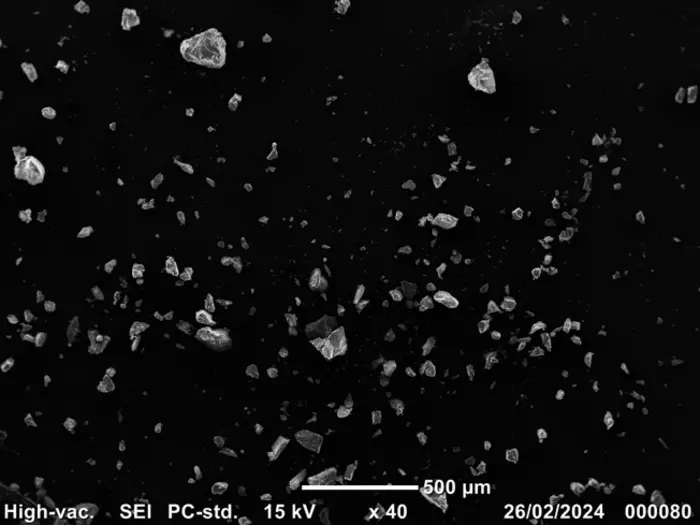
Lunar Dust is Bad. But Not as Bad as Living in the City

Microscopy image of lunar dust simulant. Credit: Michaela B. Smith Microscopy image of lunar dust simulant. Credit: Michaela B. Smith

As NASA prepares for a return to the Moon through the Artemis program, one of the biggest health concerns for astronauts has been lunar dust. The fine, abrasive particles known as the regolith that coat the Moon's surface have long worried scientists, especially after Apollo astronauts experienced respiratory problems after their missions. However, groundbreaking research from the University of Technology Sydney has delivered surprisingly reassuring news: lunar dust is less harmful to human lung cells than previously feared, and significantly less toxic than common Earth based air pollution.

NASA’s Space Launch System rocket carrying the Orion spacecraft launches on the Artemis I flight test. (Credit : Joel Kowsky)

NASA’s Space Launch System rocket carrying the Orion spacecraft launches on the Artemis I flight test.

(Credit : Joel Kowsky)

The study, led by PhD candidate Michaela B. Smith, represents the most comprehensive analysis yet of how lunar dust affects human health. Smith investigated the impact of lunar dust simulants on human lung cells in the lab. She then compared the effects to those of airborne particulate matter collected from a busy street in Sydney.

The results were striking. While lunar dust can act as a physical irritant, it did not cause the severe cellular damage or inflammation seen from the urban Earth dust. Smith emphasises this crucial distinction “..between a physical irritant and a highly toxic substance".
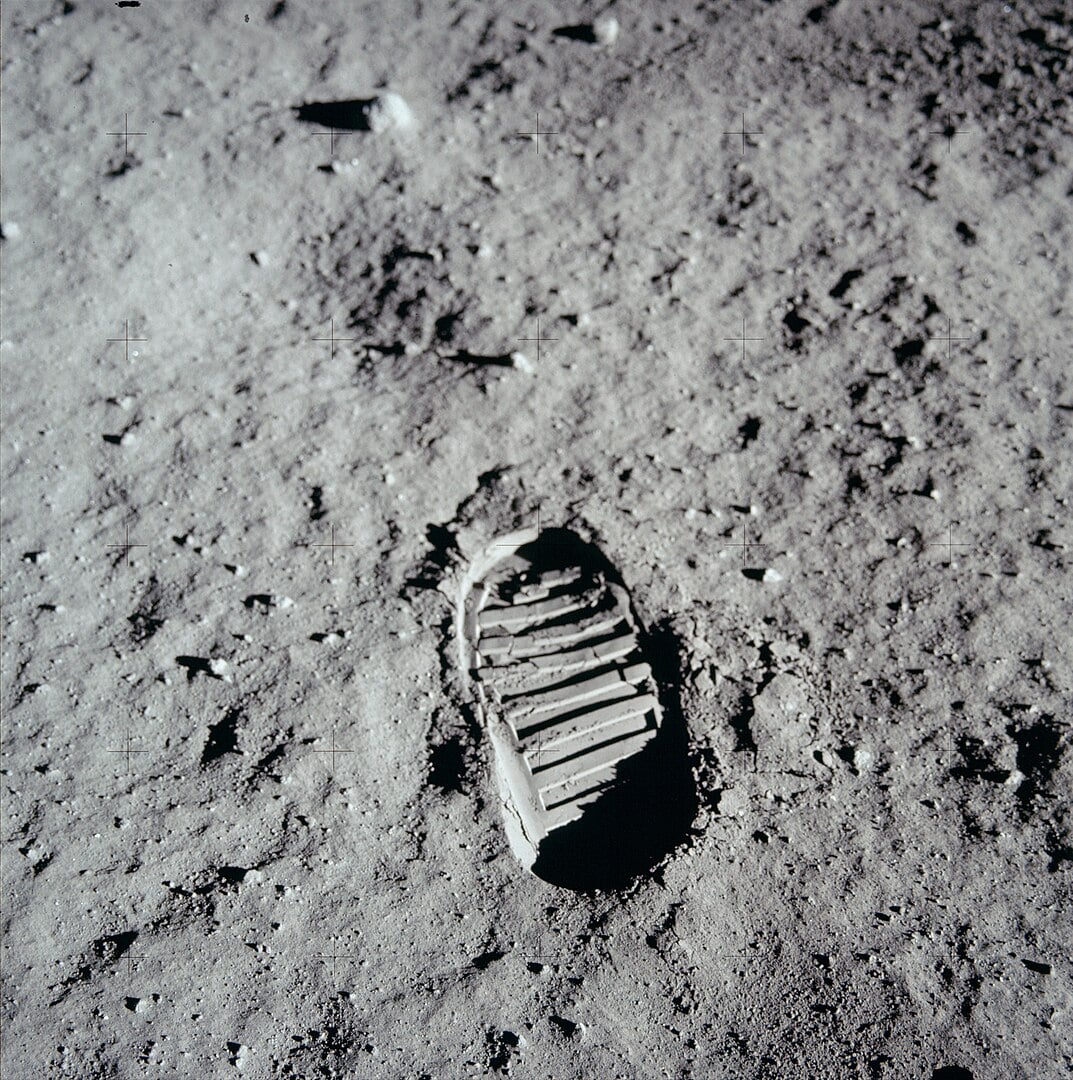
Buzz Aldrin's bootprint in the lunar soil (Credit : NASA)

Buzz Aldrin's bootprint in the lunar soil

(Credit : NASA)

The research focused on the tiniest particles, those measuring 2.5 micrometers or smaller which are small enough to bypass the body's natural defences and penetrate deep into the lungs. Using two different types of lung cells representing both upper and lower respiratory regions, the team discovered that Earth dust induced a greater inflammatory response and was more toxic to the cells than the lunar dust simulants.

This finding addresses concerns that arose from the Apollo missions, where astronauts experienced respiratory issues after fine dust that had clung to their spacesuits became airborne in the confined cabin and was subsequently inhaled, leading to respiratory issues, sneezing, and eye irritation.

The key difference lies in how the dust affects cells. The study suggests the primary mechanism of toxicity from lunar dust is mechanical damage caused by the particles' irregular shape and rough edges. Crucially, the lunar simulants did not cause significant damage through a process known as oxidative stress (damage caused by unstable molecules), a process often associated with fine particle toxicity.

"Any dust, if you inhale it, you'll sneeze, cough, and have some physical irritation. But it's not highly toxic like silica, where you end up with silicosis from being on a construction site for 10 years”

- Michaela B. Smith, lead author.

Despite these encouraging findings, NASA continues taking dust exposure seriously. The space agency has developed innovative engineering solutions, including ingenious suits that are attached to the outside of the rover, where the astronaut will climb in and out from inside, and the suit never goes inside, which prevents the dusty suit from ever contaminating the internal cabin environment.

🌪️ The Danger of Lunar Dust

This research provides crucial data for planning long term lunar missions and establishing permanent bases on the Moon, helping to ensure astronaut safety while reducing one significant health concern for humanity's next giant leap.

Source : 
{ https://www.universetoday.com/ }

Hoe vind je dit bericht?
Geschreven door peter om 21:21 Stuur door

Do Hycean Worlds Have Smaller Habitable Zones?

Do Hycean Worlds Have Smaller Habitable Zones?

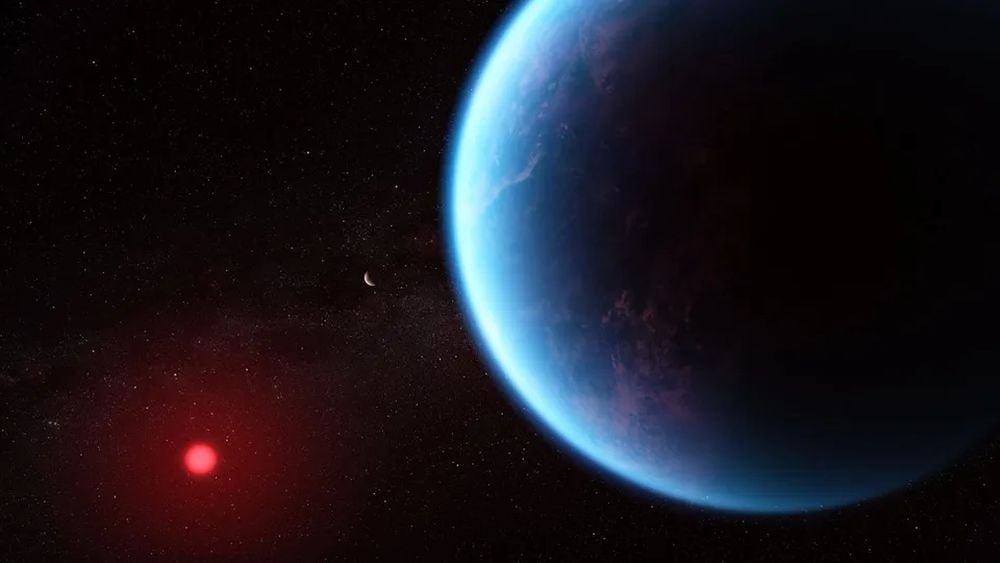
This illustration shows a Hycean planet orbiting a dim red dwarf. New research shows how tidal heating can affect the habitable zones of these hypothetical planets. Image Credit: NASA, CSA, ESA, J. Olmsted (STScI) / N. Madhusudhan (Cambridge University)This illustration shows a Hycean planet orbiting a dim red dwarf. New research shows how tidal heating can affect the habitable This illustration shows a Hycean planet orbiting a dim red dwarf. New research shows how tidal heating can affect the habitable zones of these hypothetical planets. Image Credit: NASA, CSA, ESA, J. Olmsted (STScI) / N. Madhusudhan (Cambridge University)

Hycean worlds are also called ocean worlds. They're planets covered in oceans that also have thick hydrogen atmospheres. There are no confirmed Hycean worlds—also called ocean worlds—but many candidates. Even though they're only candidates so far, researchers are curious about their habitability. New research examines the role tidal heating plays in their potential habitability.

If hycean planets do exist, they're likely common around red dwarfs (M dwarfs.) Red dwarfs are the most plentiful type of star in the galaxy, and Hycean worlds' thick hydrogen atmospheres might protect them from the devastating flaring behaviour of these small, long-lived stars. Hycean worlds may have larger habitable zones because of all their water, but their hydrogen atmospheres may contribute to the runaway greenhouse effect. When it comes to habitability, these hypothetical worlds are intriguing and mysterious.

In new research to appear in The Astrophysical Journal, the authors argue that for Hycean worlds close to their low-mass stars, tidal heating may be an important factor in determining their habitable zones. It's titled "Tides Tighten the Hycean Habitable Zone," and the lead author is Joseph Livesey. Livesey is from the Department of Astronomy and the Wisconsin Center for Origins Research, both at the University of Wisconsin-Madison.

When a new exoplanet is discovered, one of the first things scientists and the public want to know is if it's in the star's habitable zone. Researchers have made significant progress understanding the habitable zones for rocky planets. "Many studies have parameterized the habitable zone (HZ) for terrestrial exoplanets," the authors write. "The exact HZ boundaries can vary based on key characteristics such as stellar host type, planetary mass, atmospheric composition, and more."

But hycean worlds are much different than terrestrial worlds. They're sub-Neptunes with significant water layers and atmospheres dominated by hydrogen. They're oddballs, and determining if they are in habitable zones requires a different approach than with rocky planets.

In our Solar System, some of the gas giant moons have frozen shells with liquid oceans underneath. They're far too distant for the Sun to warm them. It's tidal flexing that maintains their liquid oceans. As moons like Europa and Enceladus orbit Jupiter and Saturn, the much-larger gas giants pull on the moons and they flex in response. That action creates heat. So, in effect, tidal flexing creates a habitable zone that's isolated from the Sun.

Since many hycean worlds are expected to orbit their stars closely, can tidal heating alter their habitable zones?

The researches say that the Hycean Habitable Zone (HHZ), when compared to the terrestrial habitable zone, may include smaller semi-major axes and could even extend to unbound planetary orbits. A near total absence of GHGs other than hydrogen along with a high albedo allows closer orbital proximity to the star, while internal heating from radiogenic sources, high pressures, a liquid water layer, and larger planet masses extend the HHZ outward.

Tidal heating creates another heat source aside from stellar radiation. Hycean worlds following moderately eccentric orbits experience tidal flexing and heating that shifts the HHZ outward. This creates a smaller HZ than previous estimates based on stellar heating.

Moderately eccentric orbits are common. Our Solar System has massive outer planets that have shifted the orbit of smaller planets into eccentricity. Many other solar systems are likely to have them too, meaning they're shifting smaller planets into eccentricity.

"These outer companions do occur in planetary systems around M dwarfs; the occurrence rate of giants in such systems has been found to be ∼ 10%, and the occurrence rate of planets in the range 10–100M⊕ is ∼ 20%," the authors write.

This figure shows The HHZ (blue shaded regions) and dark HHZ (red shaded regions) around a 0.12M⊙ star for a 7M⊕, 1.7R⊕ hycean planet with tidal heating. The dark HHZ indicates a tidally-locked hycean planet that can be habitable on its nightside. The low-opacity contours show the habitable zone locations without tidal heating, and the high-opacity contours show the habitable zone location where tidal heating is included. The dotted and dashed lines indicate the conservative and optimistic habitable zones for terrestrial planets. Image Credit: Livesey et al. 2025. The Astrophysical Journal.

This figure shows The HHZ (blue shaded regions) and dark HHZ (red shaded regions) around a 0.12M⊙ star for a 7M⊕, 1.7R⊕ Hycean planet with tidal heating. The dark HHZ indicates a tidally-locked Hycean planet that can be habitable on its nightside. The low-opacity contours show the habitable zone locations without tidal heating, and the high-opacity contours show the habitable zone location where tidal heating is included. The dotted and dashed lines indicate the conservative and optimistic habitable zones for terrestrial planets.

Image Credit: Livesey et al. 2025. The Astrophysical Journal.

The above image shows how tidal heating shifts the HHZ around low-mass stars. However, most hycean candidates are orbiting more massive stars. The researchers found that the effect of tidal heating on the HHZ depends on the star's mass. They found that around more massive stars, the tidal heating effect isn't as pronounced.

This figure shows the HHZ and dark HHZ around stars of various mass for a 7M⊕, 1.7R⊕ Hycean planet. The orbital eccentricity for this planet is based on the hycean candidate world K2-18 b, a planet known for evidence of potential biosignatures. The dotted line represents the stellar mass in the previous figure of 0.12 solar masses. "Clearly, the effect of tides on the extent of the habitable zone becomes negligible at high stellar masses," the researchers explain. Image Credit: Livesey et al. 2025. The Astrophysical Journal.

This figure shows the HHZ and dark HHZ around stars of various mass for a 7M⊕, 1.7R⊕ Hycean planet. The orbital eccentricity for this planet is based on the Hycean candidate world K2-18 b, a planet known for evidence of potential biosignatures. The dotted line represents the stellar mass in the previous figure of 0.12 solar masses. "Clearly, the effect of tides on the extent of the habitable zone becomes negligible at high stellar masses," the researchers explain. Image Credit: Livesey et al. 2025.

The Astrophysical Journal.

This research shows that tidal flexing on ocean worlds shifts their habitable zones outward. The effect relies on a more massive companion planet that can introduce eccentricity into the hycean world's orbit.

"Hycean planets are likely to exhibit stronger tidal responses than a fiducial terrestrial world," the researchers explain. "We expect tides to have little effect on a lone planet at such small orbital radii. However, the presence of a large outer companion with moderate eccentricity will force an eccentricity cycle that periodically and indefinitely heats the interior of the planet in question, and push out the inner boundaries of the HHZ."

Though hycean worlds are only hypothetical at this point, their confirmation may not be too distant. Exoplanet scientists are intrigued by them because of their potential for habitability. Their extended atmospheres also make them desirable targets for atmospheric spectroscopy with telescopes like the JWST. K2-18b is a prime example of their potential. It's a candidate hycean world that repeatedly generated headlines when astronomers found evidence of water vapor, then carbon dioxide and methane, then the potential biosignature dimethyl sulfide in its atmosphere.

"A recent possible detection of dimethyl sulfide (DMS) in the atmosphere of the potential hycean exoplanet K2-18 b may indicate the presence of ocean-faring life; the only major source of DMS on Earth is phytoplankton," the authors write. They point out that on hycean worlds with deep oceans, the ocean tides generate a significant amount of heat that can be used by organisms. This sets them apart from Earth, where the tidal energy is dissipated. "We suggest, therefore, that strong tides on hycean planets could yield a significant power source for life and ultimately accelerate biological evolution," they explain.

New Type of Planets, Hycean Worlds, Could Be Best For Finding Alien Life

{ https://www.universetoday.com/ }

Hoe vind je dit bericht?
Geschreven door peter om 21:02 Stuur door

Have Stellar Flybys Altered Earth's Climate in the Past?

Have Stellar Flybys Altered Earth's Climate in the Past?

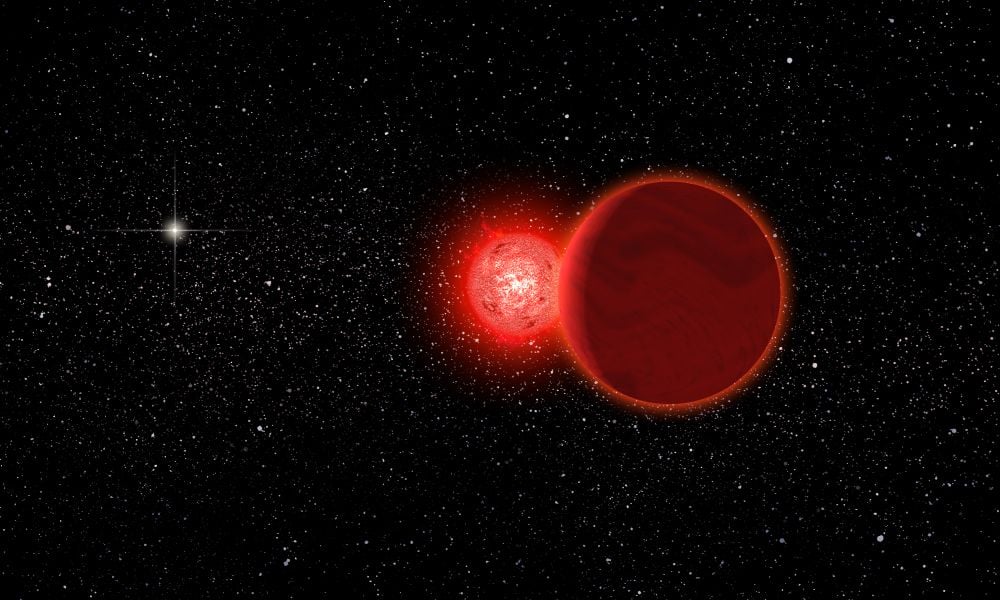
This illustrations shows Scholz's star, a binary star that performed a stellar flyby of our Solar System about 70,000 years ago. The Sun is the small star in the upper left. There have been many stellar flybys in our Solar System's history, and researchers wonder if they could've triggered dramatic shifts in Earth's paleoclimate. Image Credit: Michael Osadciw/University of Rochester.

If our Solar System seems stable, it's because our short lifespans make it seem that way. Earth revolves, night follows day, the Moon moves through light and shadow, and the Sun hangs in the sky. But in reality, everything is moving and influencing everything else, and the fine balance we observe can easily be disrupted. Could passing stars have disrupted Earth's orbit and ushered in dramatic climatic changes in our planet's past?

A stellar flyby is when another star passes close enough to our Solar System to cause some disruption. Our neighbourhood in the Milky Way is relatively sparsely populated, so stellar flybys are rarer than in other parts of the galaxy. But they still occur.

The most well-known one was probably Scholz's star. About 70,000 years ago, it passed through the Oort Cloud, our Solar System's outlying repository of long-period comets and icy planetesimals. It may have perturbed some comets from the Oort Cloud, but if it did, we won't know for a couple of million years. That's how long it would take for a comet to reach the inner Solar System.

Scholz's star illustrates the risk of stellar flybys. Scientists have wondered if these flybys have affected Earth's climate in the past by altering the planet's orbit. New research that will appear in The Astrophysical Journal examines stellar flybys to see if this is true. It's titled "No influence of passing stars on paleoclimate reconstructions over the past 56 million years." The authors are Richard Zeebe and David Hernandez. Zeebe is from the School of Ocean & Earth Science & Technology at the University of Hawaii, and Hernandez is from the Department of Astronomy at Yale University.

"Passing stars (also called stellar flybys) have notable effects on the solar system’s long-term dynamical evolution, injection of Oort cloud comets into the solar system, properties of trans-Neptunian objects, and more," the authors write. "Based on a simplified solar system model, ... it has recently been suggested that passing stars are also an important driver of paleoclimate before ∼50 Myr ago, including a climate event called the Paleocene-Eocene Thermal Maximum (PETM) (∼56 Myr ago)."

The PETM saw a 5–8 °C (9–14 °F) rise in global temperature and a massive influx of carbon into the atmosphere and oceans. It took 10,000 or 20,000 years for the temperature to rise and it lasted for about 100,000 or 200,000 years. Its effect on the biosphere was massive. Many marine organisms went extinct, tropical and sub-tropical regions extended toward the poles, and primates and other mammals appeared.

The Paleocene–Eocene Thermal Maximum was a prominent hyperthermal episode in Earth's climatic history. Its cause is unclear. Image Credit: Svensen 2012. https://doi.org/10.1038/483413a

The Paleocene–Eocene Thermal Maximum was a prominent hyperthermal episode in Earth's climatic history. Its cause is unclear.

Image Credit: Svensen 2012. https://doi.org/10.1038/483413a

The cause is still debated, and there are several hypotheses. They include volcanic eruptions, comet impact, the release of methane clathrates, and orbital forcing. Researchers think that the giant planets play an important role during stellar flybys. When a roaming star passes by, the giant planets' gravitational fields can amplify the effect of the flyby and then alter the orbits of the smaller planets.

To find out if stellar flybys could be responsible for the PETM and other climatic changes, the researchers used a state of the art model of the Solar System and random stellar parameters in 400 simulations. The total number of stellar flybys was 1,800.

Other researchers who examined the same issue found that stellar flybys could've altered Earth's paleoclimate. [Kaib & Raymond (2024)] (https://iopscience.iop.org/article/10.3847/2041-8213/ad24fb) said, "Here we present simulations that include the Sun's nearby stellar population, and we find that close-passing field stars alter our entire planetary system's orbital evolution via their gravitational perturbations on the giant planets." They also wrote "Although it takes tens of Myr for the effects of stellar passages to significantly manifest themselves, the long-term orbital evolution of the Earth and the rest of the planets is linked to these stars."

However, Zeebe and Hernandez reached a different conclusion. "In contrast to Kaib and Raymond, we find no influence of passing stars on paleoclimate reconstructions over the past 56 Myr," they write.

This global map shows what Earth looked like 45 million years ago during the Eocene. Image Credit: By Scotese, Christopher R.; Vérard, Christian; Burgener, Landon; Elling, Reece P.; Kocsis, Ádám T. - "Phanerozoic-scope supplementary material to "The Cretaceous World: Plate Tectonics, Paleogeography, and Paleoclimate (doi:10.1144/sp544-2024-28)" from the PALEOMAP project". doi:10.5281/zenodo.10659112 https://zenodo.org/records/10659112, CC BY 4.0, https://commons.wikimedia.org/w/index.php?curid=155112444

This global map shows what Earth looked like 45 million years ago.

Image Credit: By Scotese, Christopher R.; Vérard, Christian; Burgener, Landon; Elling, Reece P.; Kocsis, Ádám T. - "Phanerozoic-scope supplementary material to "The Cretaceous World: Plate Tectonics, Paleogeography, and Paleoclimate (doi:10.1144/sp544-2024-28)" from the PALEOMAP project". doi:10.5281/zenodo.10659112 https://zenodo.org/records/10659112, CC BY 4.0, https://commons.wikimedia.org/w/index.php?curid=155112444

One of the reasons for the different results is the completeness of the models used to understand the flybys. Some Solar System models, for example, excluded the Moon.

"Running accurate state-of-the-art solar system models that include all known secondary effects is computationally expensive," the authors write. "As a result, long-term studies on, e.g., Gyr-timescale tend to be based on simplified solar system models, or the outer planets alone."

By using a more complete Solar System model, Zeebe and Hernandez showed that stellar flybys are not likely behind Earth's dramatic paleoclimate shifts, like the PETM. They point out that the Moon has a stabilizing effect, and models that exclude it reach suspect conclusions.

"In contrast, using a state-of-the-art solar system model, including a lunar contribution and J2 (the Moon and Sun's quadrupole moment), and random stellar parameters, we find no influence of passing stars on paleoclimate reconstructions over the past 56 Myr," the authors explain. Even extremely close flybys seem to have no effect.

There have been many stellar flybys in the past and there'll be many more in the future. The orange dwarf Gliese 710 is expected to come within 0.1663 light-years or 10,520 astronomical units in about 1.29 million years. It has an 86% chance of passing through the Oort Cloud, and some researchers say it could trigger a swarm of comets into the inner Solar System. Could this flyby trigger a dramatic shift in Earth's climate?

There's a lot of uncertainty, and understanding the past and future of stellar flybys and how they might affect Earth's climate comes down to how detailed our scientific models are.

"Our results indicate that a complete physics model is essential to accurately study the effects of stellar flybys on Earth’s orbital evolution," the authors conclude.

Ancient supernovae might have upended Earth’s evolution

{ https://www.universetoday.com/ }

Hoe vind je dit bericht?
Geschreven door peter om 20:50 Stuur door

Bio-Mechanical Living UFO Over Surrey, England, May 25, 2025, UAP Alien Sighting News.

Bio-Mechanical Living UFO Over Surrey, England, May 25, 2025, UAP Alien Sighting News.

UFO_Sighting.png

UFO_UK.png
Date of sighting: May 25, 2025
Location of sighting: Junction 12 of the M25, Surrey, England
Source: Reddit at 
Now this is one for the books. This globular UFO was hovering near the train tracks when a train with the eyewitness passed it. I took a screenshot and yes, it's a single craft...which destroys any group of balloons theory. The US military have released UFOs over Iraq that look similar in style and design to this very one. I believe this to be a bio-mechanical craft...a living spaceship that self repairs. Its design is  not that of a logical thinking but of a more unpredictable way of thinking that ai has. I'm still in shock over this video. 
Scott C. Waring - UFO Sightings Daily
Eyewitness states: 
Wife sent me this - she’s 100% positive it wasn’t a bunch of balloons.

{ https://www.ufosightingsdaily.com/ }

Hoe vind je dit bericht?
Geschreven door peter om 20:34 Stuur door

Mysterious Lights Over Villeta, Paraguay June 5, 2025, UFO UAP Sighting News.

Mysterious Lights Over Villeta, Paraguay June 5, 2025, UFO UAP Sighting News.

UFO_report.png

Screenshot%202025-06-17%20at%2011.05.37%E2%80%AFPM.png
Date of sighting: June 5, 2025
Location of sighting: Villeta, Paraguay
Source: NUFORC.org 
 
This is very strange...NUFORC just got a report of a pulsing light that took over the horizon in Paraguay last week. I have seen similar things before in videos are photos and I have to say it...it's a UFO. These lights are a huge UFO landing in the area...but that doesn't mean it stayed on the ground when it landed, but it probably was lowered down under the ground...into an alien base about 4-6 km below the surface. How do I know how UFOs and even people travel to underground bases? The Friendships case of the W56 alien group at Rocca Pia Italy that lasted three decades of alien and human interactions teaches about it. Too many books, most in Italian, videos, photos, tapes and more. 
 
I want to thank NUFORC for working with me. They allow me to use and analyze and share their UFO reports to the public and the news media but ask to mention the NUFORC name. Also all my videos and photos on this site are allowed to be used by the media...permission granted. 
 
This UFO reports was written by a person who speaks Spanish and they didn't include a description.
 
Scott C. Waring - UFO Sightings Daily
 

{ https://www.ufosightingsdaily.com/ }

Hoe vind je dit bericht?
Geschreven door peter om 20:25 Stuur door

UFO cover used by government to ‘hide a lot of things,’ former NASA agent says

UFO cover used by government to ‘hide a lot of things,’ former NASA agent says

NASA debunks UFOs seen in new video

In an era captivated by unidentified flying objects (UFOs) and government conspiracies, one former NASA official is cutting through the noise and casting doubt on aliens coming to Earth.

Joseph Gutheinz, a retired senior special agent with NASA’s Office of Inspector General and current criminal defense attorney, said it’s time to apply science, not speculation, to the debate.

th?id=OVFT.CEc8nkpMJlDrLj1jfm80DC&pid=News&w=300&h=186&c=14&rs=2&qlt=90&dpr=1.5

Former NASA insider debunks UFO claims, points to human tech

Joseph Gutheinz, a retired senior special agent with NASA’s Office of Inspector General and current criminal defense attorney, discussed the existence of UFOs with Fox News Digital.

"Prove it. Honestly, prove it," he said to those who believe in the presence of UFOs on Earth.

"They've been claiming that there have been UFOs since the 1940s. And, you know, Area 51 supposedly houses UFOs," he told Fox News Digital. "Have someone go in, look at Area 51."

The Pentagon has released videos showing "unidentified aerial phenomena." 

(iStock)

Gutheinz said that during his work with the NASA Office of Inspector General, he would regularly get calls from individuals who believed they were abducted, or had a chip in their brain from aliens.

"What I used to tell my students was the possibility of anybody coming from another world to visit us was beyond unlikely," he said. "And what I would tell the people that would call me up with these tales about being visited by aliens, see a psychiatrist."

Citing astronomical distances and scientific understanding of the solar system, Gutheinz explained the improbability of any extraterrestrial visitors reaching Earth. 

"There are up to 400 billion stars in the Milky Way. There are maybe one to two trillion galaxies in the universe. But the reality is this, the closest solar system is Alpha Centauri. Alpha Centauri A, B, and Proxima Centauri are the closest stars," he said.

"The bottom line is that it's 4.4 light years away, or 25 trillion miles away. And if somebody started flying to Proxima and Satori, or the other way around, it would take them over 70,000 years to get there," he said. "Nobody is visiting us from another world, likely."

North America, USA, Nevada, Crystal Springs, Basin And Range National

Monument, Area 51 Sign.  

(Bernard Friel/Education Images/Universal Images Group via Getty Images)

He pointed to moons like Europa, Ganymede, Titan, and Triton as the only plausible places for primitive life in our solar system. 

"If there is life on any of those moons, it's possible. Again, it is primitive, it is microorganisms, it's nothing that's going to visit us in a flying saucer."

When asked whether such sightings could be explained as natural or spiritual phenomena, he suggested that it could be government testing.

"If you're seeing something up there, and it's real, it's coming from the Chinese or the Russians or your next-door neighbor flying around with their drone," he said.

A NASA logo is displayed at the entrance to the Mary W. Jackson NASA Headquarters building on June 2, 2025 in Washington, DC. 

(Kevin Carter/Getty Images)

Historical military secrecy, Gutheinz suggested, may have played a major role in fostering the UFO myths.

"I believe early on in the 1940s when all these UFO stories started coming up, it was because the military was probably testing some aircraft, and they didn't want the Russians to know about it," he said. 

"And so, if the UFO cover worked, and I would not be surprised if there are some people in the military and the government that played along with that in order to conceal our stealth technology, that is really remarkable, and they just don't want to share that with other countries."

"The bottom line is, I think that we use the UFO cover to hide a lot of things."

{ https://www.foxnews.com/ } 

Hoe vind je dit bericht?
Geschreven door peter om 23:29 Stuur door

Why are alien visits and UFO sightings highest in America? Explosive truth revealed in new report

Why are alien visits and UFO sightings highest in America? Explosive truth revealed in new report

Synopsis

A new Pentagon-backed report by the All-domain Anomaly Resolution Office (AARO) has revealed that many UFO sightings in the United States were not evidence of alien activity but part of deliberate military disinformation efforts. During the Cold War, the U.S. government planted UFO conspiracy theories, particularly around sites like Area 51, to conceal classified weapons testing. The report explains that some military officers were even shown fake documents and images about alien technology as part of hazing rituals or to distract from real programs like the F-117 stealth jet.

Report Reveals Why UFO Sightings Are Most Common in the US

Report Reveals Why UFO Sightings Are Most Common in the US.
For decades, the United States has been at the center of the global UFO debate, with more sightings reported within its borders than anywhere else in the world. According to the National UFO Reporting Center, the country has recorded over 105,000 UFO encounters since 1947. While the recent data from 2025 shows the U.K. slightly ahead in annual sightings, the U.S. continues to dominate in long-term numbers. This overwhelming volume has puzzled both skeptics and believers — until now.

A recently released report by the Pentagon-backed All-domain Anomaly Resolution Office (AARO) has shed light on why so many of these incidents are reported in America. The findings suggest the phenomena may have less to do with extraterrestrial activity and more with human-made disinformation.

Role of the Pentagon

AARO, which was set up in 2022, has been investigating Unidentified Anomalous Phenomena (UAPs) across various domains. The team, led by Sean Kirkpatrick, reviewed military records dating back to the 1940s and interviewed numerous current and former military officials.

One of the key revelations was that several UFO conspiracy theories — including those related to the infamous Area 51 — were deliberately planted by the U.S. military. These deceptions, often involving altered images and false briefings, were used as a cover for secret weapons testing during the Cold War. The Wall Street Journal reported that this strategy was not centralized, making it difficult to track how widespread the disinformation actually was.

Hazing and Hoaxes: The Secret of 'Yankee Blue'

Part of the conspiracy involved a classified military induction prank. Newly appointed Air Force commanders were reportedly shown fake documents and images claiming the existence of a program called “Yankee Blue,” which allegedly reverse-engineered alien spacecraft. Officers were instructed to never discuss the program again. Many believed in it for years — some never learning that it was all fabricated.

The report detailed that one retired colonel, acting under official orders, gave forged UFO photos to a Nevada bar owner near Area 51 to stir public speculation. The ploy worked, creating a smokescreen that helped protect the secrecy of the F-117 Nighthawk stealth fighter jet and other advanced technologies being tested at the time.

UFO Sightings: Misidentifications and Media Influence

The AARO report also addressed numerous recent and historical sightings. Many of the so-called UFOs were found to be balloons, birds, drones, or reflections from Starlink satellites. In one significant case, a former Air Force captain claimed he witnessed a UFO interfering with nuclear missiles. Investigators later concluded that the event was actually part of a secret electromagnetic pulse test — a detail kept from him to preserve operational secrecy.

In March 2024, AARO publicly confirmed there was no verified evidence of alien life or recovered extraterrestrial materials. The report attributed the rise in sightings to misidentified military operations and a surge in pop culture portrayals of aliens, which have influenced public perception.

Despite the official stance, many within the military still claim to have witnessed unexplained aerial phenomena. Former Navy pilot Ryan Graves described an object flying between two jets, appearing as a “dark gray or black cube inside of a clear sphere.” AARO continues to receive between 50 and 100 new sighting reports each month, and while most are now swiftly explained, a few remain unresolved.

The Department of Defense has committed to releasing a second volume of its historical findings, which is expected to further address misleading briefings, inauthentic materials, and reports of deliberate pranks.

{ https://economictimes.indiatimes.com/ }

Hoe vind je dit bericht?
Geschreven door peter om 22:21 Stuur door

Artificial intelligence is not a miracle cure': Nobel laureate raises questions about AI-generated image of black hole spinning at the heart of our galaxy

'Artificial intelligence is not a miracle cure': Nobel laureate raises questions about AI-generated image of black hole spinning at the heart of our galaxy

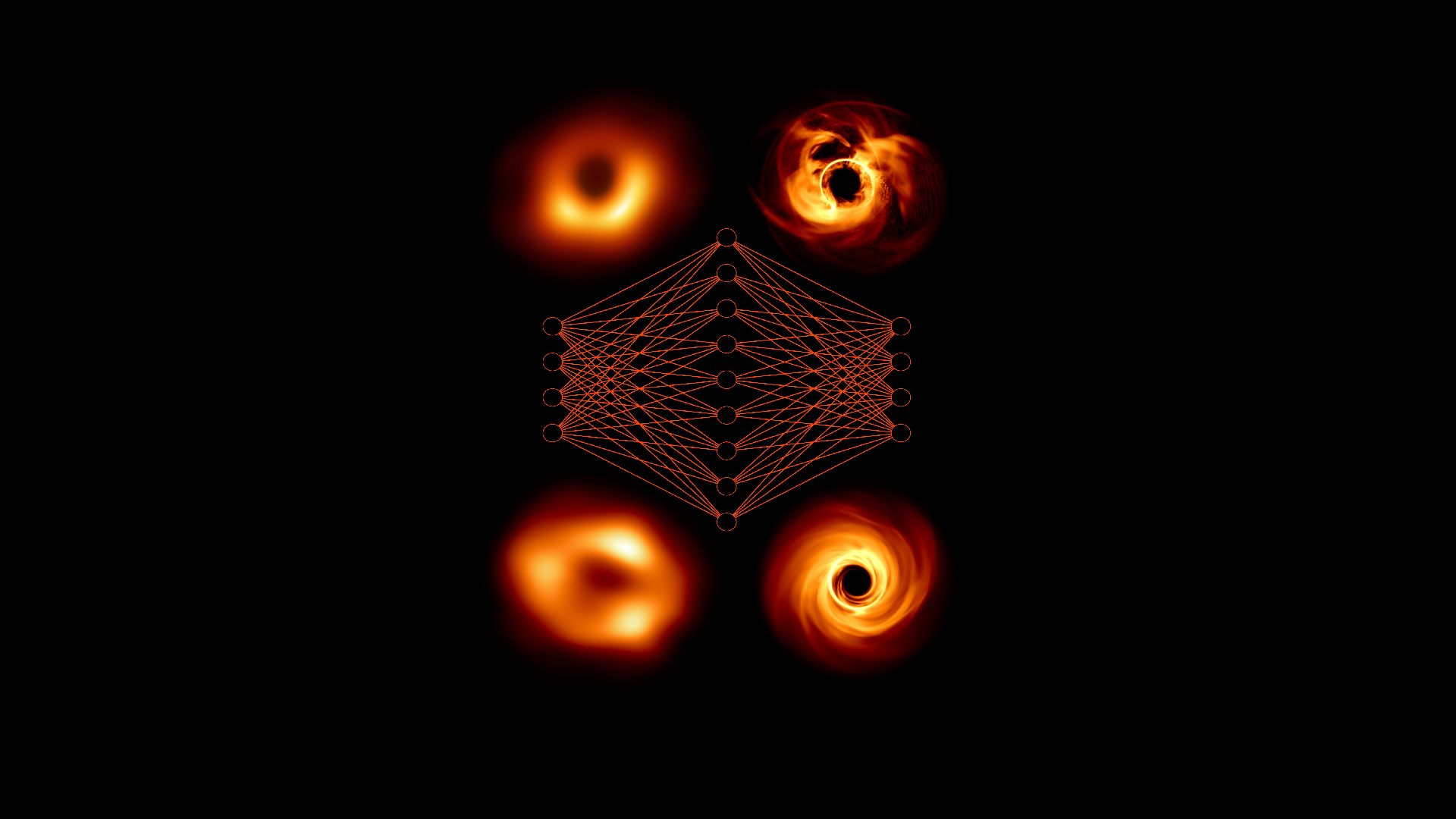
an image with four glowing orange blobs and a geometric design in the middle
A new AI model (right) has helped flesh out details in the first-ever images of black holes (left) taken by the Event Horizon Telescope. But can the new models be trusted? 
(Image credit: EHT Collaboration/Janssen et al.)

The monster black hole at the center of our galaxy is spinning at near "top speed," according to a new artificial intelligence (AI) model.

The model, trained partially on complex telescope data that was previously considered too noisy to be useful, aims to create the most detailed black hole images ever. However, based on the questionable quality of the data, not all experts are convinced that the AI model is accurate.

"I'm very sympathetic and interested in what they're doing," Reinhard Genzel, an astrophysicist at the Max Planck Institute for Extraterrestrial Physics in Germany and one of the winners of the 2020 Nobel Prize in physics, told Live Science. "But artificial intelligence is not a miracle cure."

For decades, scientists have been trying to observe and characterize Sagittarius A*, the supermassive black hole at the heart of our galaxy. In May 2022, they unveiled the first-ever image of this enormous object, but there were still a number of questions, such as how it behaves.

You may like
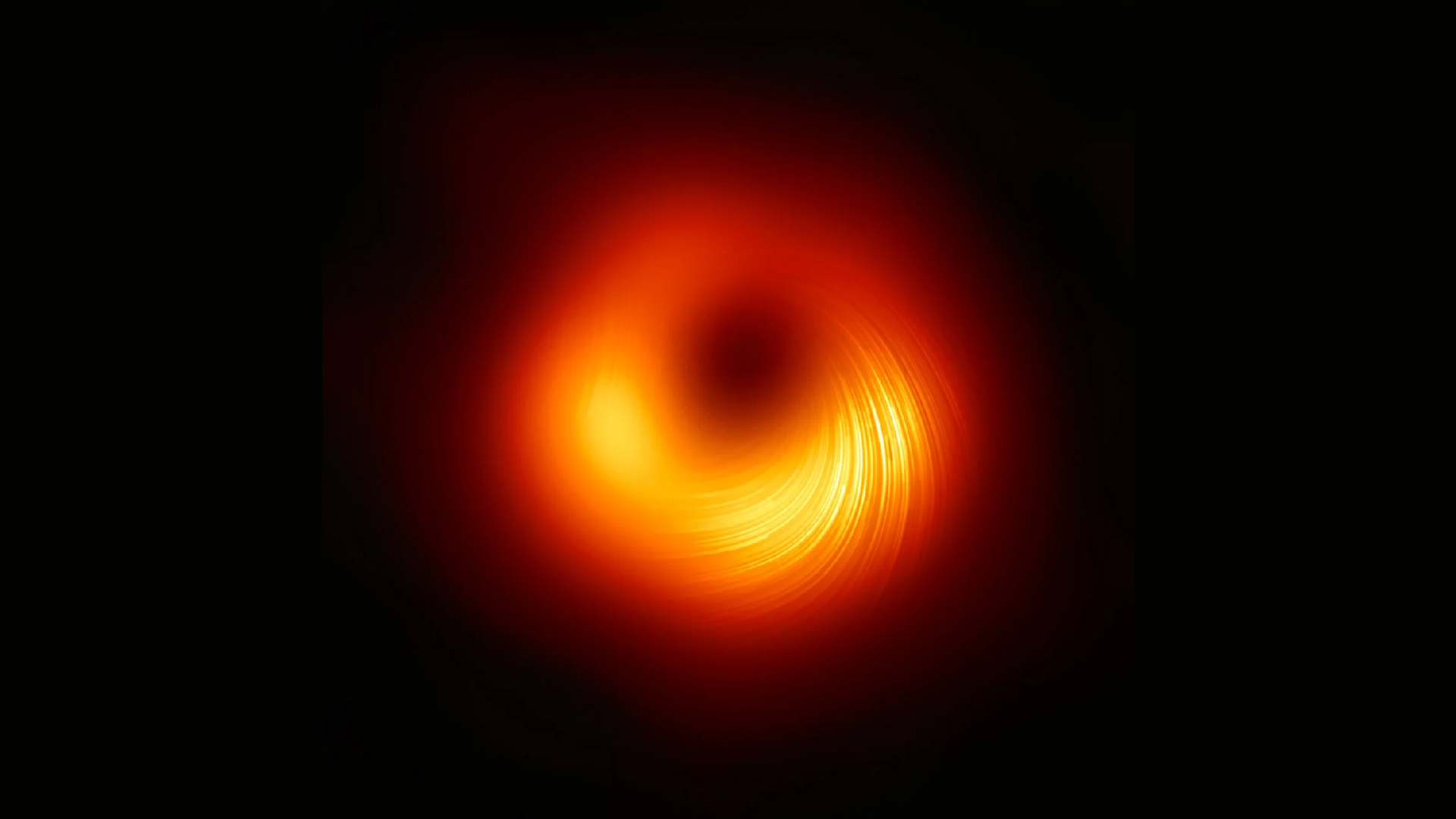
  • A glowing orange donut shape

Monster black hole M87 is spinning at 80% of the cosmic speed limit — and pulling in matter even faster

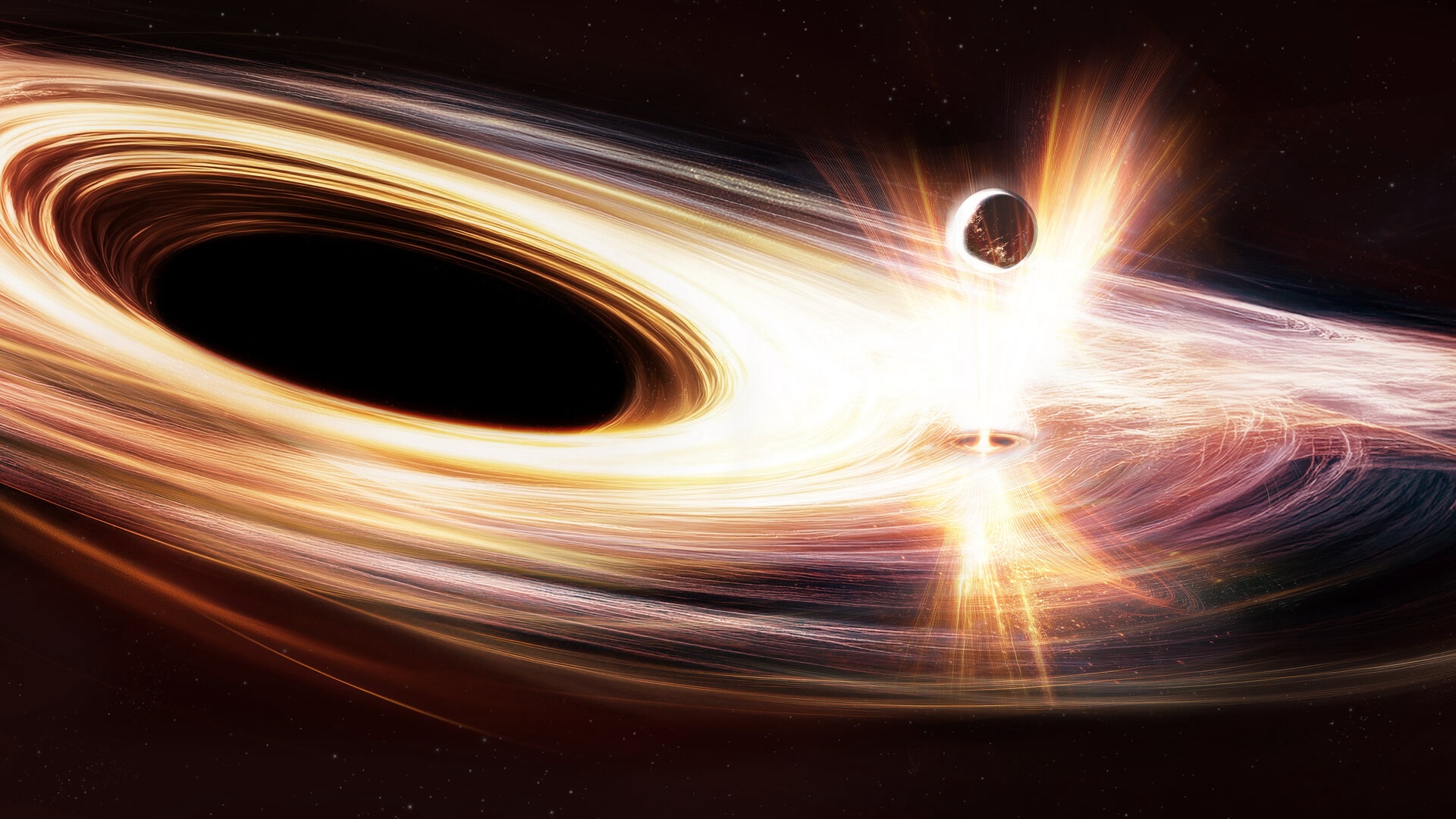
  • An illustration of a black hole with a small round object approaching it, causing a burst of energy

Newly 'awakened' black hole is releasing 100 times more energy than scientists have seen before

  • A bright red arc of light seen against greyish red clouds in space. hundreds of stars dot the background

Incredible photo shows supermassive black hole blowing a jet of matter into interstellar space

Now, an international team of scientists has attempted to harness the power of AI to glean more information about Sagittarius A* from data collected by the Event Horizon Telescope (EHT). Unlike some telescopes, the EHT doesn't reside in a single location. Rather, it is composed of several linked instruments scattered across the globe that work in tandem. The EHT uses long electromagnetic waves — up to a millimeter in length — to measure the radius of the photons surrounding a black hole.

However, this technique, known as very long baseline interferometry, is very susceptible to interference from water vapor in Earth’s atmosphere. This means it can be tough for researchers to make sense of the information the instruments collect.

"It is very difficult to deal with data from the Event Horizon Telescope," Michael Janssen, an astrophysicist at Radboud University in the Netherlands and co-author of the study, told Live Science. "A neural network is ideally suited to solve this problem."

Related: 

Janssen and his team trained an AI model on EHT data that had been previously discarded for being too noisy. In other words, there was too much atmospheric static to decipher information using classical techniques.

Through this AI technique, they generated a new image of Sagittarius A*'s structure, and their picture revealed some new features. For example, the black hole appears to be spinning at "almost top speed," the researchers said in a statement, and its rotational axis also seems to be pointing toward Earth. Their results were published this month in the journal Astronomy & Astrophysics.

Pinpointing the rotational speed of Sagittarius A* would give scientists clues about how radiation behaves around supermassive black holes and offer insight into the stability of the disk of matter around it.

However, not everyone is convinced that the new AI is totally accurate. According to Genzel, the relatively low quality of the data going into the model could have biased it in unexpected ways. As a result, the new image may be somewhat distorted, he said, and shouldn't be taken at face value.

In the future, Janssen and his team plan to apply their technique to the latest EHT data and measure it against real-world results. They hope this analysis will help to refine the model and improve future simulations.

{ https://www.livescience.com/space }

Hoe vind je dit bericht?
Geschreven door peter om 21:30 Stuur door

Buga Sphere in Colombia Seen Again In China, June 5, 2025, UFO UAP Sighting News. Video!

Buga Sphere in Colombia Seen Again In China, June 5, 2025, UFO UAP Sighting News. Video!

UAP,%20%E0%A4%89%E0%A4%AB%E0%A5%8C%20,%20%E0%A6%87%E0%A6%89%E0%A6%8F%E0%A6%AB%E0%A6%93,%20%C4%91i%CC%83a%20bay,%20MUFON,%20%E7%9B%AE%E6%92%83%E3%80%81%E3%82%A8%E3%82%A4%E3%83%AA%E3%82%A2%E3%83%B3,%20%20UFO,%20UFOs,%20%D0%9D%D0%9B%D0%9E%20,%20NLO,%20sighting,%20sightings,%20alien,%20aliens,%20ET,%20anomaly,%20anomalies,%20ancient,%20astrobiology,%20vreemdelinge,%20%203%20copy%208.png

Date of sighting: June 5, 2025
Location of sighting: Shayukou Reservoir, China
Source: 
Wow, this is getting really weird. Another Buga sphere has been recorded and released on Reddit today. As I have said before, this increase in close by orb sightings is building up to something very important and very big. The soul purpose of these orbs is to gather intelligence, data and record it, sending it back to its home world. These orbs also use telepathy...which is very powerful and can reach several miles due to its alien technology. Yes, they read your mind, your thoughts when focused. Thats why orbs sometimes come when you meditate calling them to you. It worked once for me, came two meters from me, grapefruit size. Why did this orb fly into the area where the huts were located at the end of the video? Many questions, but one thing is for sure, humans do not have this technology. It's 100% alien made. 
Scott C. Waring - UFO Sightings Daily 
 
Eyewitness states:
 "On June 5th, around 7 PM, I was walking and taking photos of the scenery on the shallow area of Shayukou Reservoir. At first, I saw a metallic spherical object flying eastward above the water surface from the west side of the reservoir. At that time, it seemed to hover occasionally before continuing to fly, and it disappeared behind a hill. I initially thought it was just a strange hydrogen balloon and didn’t pay much attention. Around 7:30 PM, as I was about to head back, the sphere reappeared in the south. There was no wind at all, and the evening was very quiet. Surprisingly, the sphere was able to fly at varying altitudes, hovering midway before continuing to fly.
I watched for a few minutes and became certain it was definitely not a balloon or a drone. I then started filming, but the object was strange—every time I filmed for a short while, it would move behind the trees. Whenever I thought it had completely disappeared, it would reappear. This continued intermittently for over ten minutes, during which I recorded three video clips. After the last clip, it disappeared completely.
In the following days, I saw a video online of a similar sphere flying over Colombia, which looked very much like what I saw. That’s when I decided to seek help online for identification."
RELATED VIDEOS
"Buga Sphere" Spotted in China - All 3 Clips - Stabilized

{ https://www.ufosightingsdaily.com/ }

Hoe vind je dit bericht?
Geschreven door peter om 20:55 Stuur door

Meer van UFO'S of UAP'S, ASTRONOMIE, RUIMTEVAART, ARCHEOLOGIE, OUDHEIDKUNDE, SF-SNUFJES EN ANDERE ESOTERISCHE WETENSCHAPPEN - DE ALLERLAATSTE NIEUWTJES

↑ Terug naar de berichten