Ontdek de Fascinerende Wereld van UFO's en UAP's: Jouw Bron voor Onthullende Informatie!
Ben jij ook gefascineerd door het onbekende? Wil je meer weten over UFO's en UAP's, niet alleen in België, maar over de hele wereld? Dan ben je op de juiste plek!
België: Het Kloppend Hart van UFO-onderzoek
In België is BUFON (Belgisch UFO-Netwerk) dé autoriteit op het gebied van UFO-onderzoek. Voor betrouwbare en objectieve informatie over deze intrigerende fenomenen, bezoek je zeker onze Facebook-pagina en deze blog. Maar dat is nog niet alles! Ontdek ook het Belgisch UFO-meldpunt en Caelestia, twee organisaties die diepgaand onderzoek verrichten, al zijn ze soms kritisch of sceptisch.
Nederland: Een Schat aan Informatie
Voor onze Nederlandse buren is er de schitterende website www.ufowijzer.nl, beheerd door Paul Harmans. Deze site biedt een schat aan informatie en artikelen die je niet wilt missen!
Internationaal: MUFON - De Wereldwijde Autoriteit
Neem ook een kijkje bij MUFON (Mutual UFO Network Inc.), een gerenommeerde Amerikaanse UFO-vereniging met afdelingen in de VS en wereldwijd. MUFON is toegewijd aan de wetenschappelijke en analytische studie van het UFO-fenomeen, en hun maandelijkse tijdschrift, The MUFON UFO-Journal, is een must-read voor elke UFO-enthousiasteling. Bezoek hun website op www.mufon.com voor meer informatie.
Samenwerking en Toekomstvisie
Sinds 1 februari 2020 is Pieter niet alleen ex-president van BUFON, maar ook de voormalige nationale directeur van MUFON in Vlaanderen en Nederland. Dit creëert een sterke samenwerking met de Franse MUFON Reseau MUFON/EUROP, wat ons in staat stelt om nog meer waardevolle inzichten te delen.
Let op: Nepprofielen en Nieuwe Groeperingen
Pas op voor een nieuwe groepering die zich ook BUFON noemt, maar geen enkele connectie heeft met onze gevestigde organisatie. Hoewel zij de naam geregistreerd hebben, kunnen ze het rijke verleden en de expertise van onze groep niet evenaren. We wensen hen veel succes, maar we blijven de autoriteit in UFO-onderzoek!
Blijf Op De Hoogte!
Wil jij de laatste nieuwtjes over UFO's, ruimtevaart, archeologie, en meer? Volg ons dan en duik samen met ons in de fascinerende wereld van het onbekende! Sluit je aan bij de gemeenschap van nieuwsgierige geesten die net als jij verlangen naar antwoorden en avonturen in de sterren!
Heb je vragen of wil je meer weten? Aarzel dan niet om contact met ons op te nemen! Samen ontrafelen we het mysterie van de lucht en daarbuiten.
Martian Probe Rolls Over to See Subsurface Ice and Rock
By Mark Thompson
SHARAD radio array
The Mars Reconnaissance Orbiter (MRO), launched by NASA in 2005, is orbiting Mars tasked with studying its atmosphere, surface, and subsurface in unprecedented detail. Equipped with a suite of advanced instruments—including high-resolution cameras, spectrometers, and the SHAllow RADar (SHARAD) MRO has revolutionised our understanding of Martian geology, climate history, and potential water reservoirs beneath the surface. Beyond science, it also plays a vital role in relaying data from other Mars missions back to Earth.
Artist's concept of NASA's Mars Reconnaissance Orbiter
(Credit : NASA/JPL/Corby Waste)
SHARAD is perhaps one of its most powerful tools designed to probe beneath the surface and reveal features. However, SHARAD’s placement on the side of the spacecraft—opposite the imaging payload has since it began operations, limited its effectiveness. To compensate, MRO has routinely executed roll manoeuvres of up to 28°, slightly tilting the spacecraft to boost the signal-to-noise ratio (S/N) of radar echoes returned from below the surface.
Now, thanks to new modelling efforts, MRO is taking a bold leap forward. Recent simulations by a team led by Nathaniel E. Putzig from the Planetary Science Institute suggested that dramatically increasing the roll angle up to 120°, could improve SHARAD’s signal clarity by approximately 10 decibels compared to standard nadir-pointing observations. Acting on this prediction, mission controllers initiated a limited series of “very large roll" (VLR) experiments to test the impact of these extreme manoeuvres on radar performance.
Since May 2023, three such VLR manoeuvres and observations have been conducted, and the results have exceeded expectations. The signal to noise ratio improved significantly by 9, 11, and 14 dB in the respective passes allowing SHARAD to detect features at depths never before seen. In the low-dielectric Medusae Fossae region, radar signals penetrated as deep as 800 meters, while in the icy terrains of Ultimi Scopuli, echoes reached depths of 1,500 meters. In both cases, researchers were able to identify basal layers critical markers for understanding Mars's geological and climatic history. The second VLR pass also revealed enhanced reflections throughout the entire ice column, offering fresh insights into the internal structure of the Martian polar ice.
Image of Medusae Fossae on Mars
(Credit : NASA)
Even in the more challenging high dielectric terrain of Amazonis Planitia, the third VLR manoeuvre brought improved continuity of a known subsurface interface, although it did not reveal any deeper layers. Encouraged by these successes, the MRO mission team plans to conduct additional VLR observations across Mars's polar regions, midlatitude glaciers, and other areas rich in ice, sediment, and volcanic deposits.
With this bold new approach, MRO continues to push the boundaries of planetary science literally rolling over to unlock Mars’s deepest secrets.
Advancing Deep Space Travel with Nuclear Propulsion
By Laurence Tognetti
Artist’s illustration of a nuclear propulsion spacecraft. (Credit: NASA)
How can fission-powered propulsion help advance deep space exploration, specifically to the outer planets like Jupiter, Saturn, Uranus, and Neptune? This is what a recent studypresented at the 56th Lunar and Planetary Science Conference (LPSC) hopes to address as a pair of researchers from India investigated the financial, logistical, and reliability of using fission power for future deep space missions. This study has the potential to help scientists, engineers, and future astronauts develop next-generation technologies as humanity continues to expand its presence in space.
Here, Universe Today discusses this incredible research with Malaya Kumar Biswal, who is the Founder & CEO of Acceleron Aerospace in Bangalore, India, regarding the motivation behind the study, significant takeaways, and exploring other star systems. Therefore, what was the motivation behind the study?
“The primary motivation for this study was the growing realization that our current propulsion and power systems—particularly chemical and solar-based—are not sufficient for long-duration or deep space missions,” Biswal tells Universe Today. “As we push the boundaries of exploration toward Mars, the outer planets, and even interstellar space, we need power systems that are not only reliable but also capable of delivering sustained energy for decades. Nuclear power, especially fission-based systems, offers a solution with its high energy density and independence from sunlight. Our aim was to explore how these technologies could transform the way we plan, power, and execute missions beyond Earth orbit enabling true multiplanetary and interstellar missions.”
For the study, the researchers evaluated a myriad of characteristics regarding how fission-powered propulsion systems could successfully advance deep space exploration, including power systems, key advantages, notable developments, potential applications, and limitations. This involved in-depth analyses into radioisotope electric propulsion, fission electric propulsion, high-power output and needs, long-duration missions, NASA’s KRUSTY (Kilowatt Reactor Using Stirling Technology) proposed concept, multiplanet exploration, Moon and Mars crewed missions, and comparing to traditional systems.
In the end, the researchers referred to fission power propulsion as a “game-changer” offering a myriad of benefits and advances beyond current propulsion technologies with very few limitations, specifically radiation shielding and mass. But what are the most significant takeaways from this study?
Biswal tells Universe Today, “First, fission power systems offer significantly higher and more consistent power output than traditional sources, which is critical for both propulsion and life-support systems on long missions. Second, these systems can reduce transit time, support larger payloads, and operate in environments where solar power simply isn’t viable—such as deep space or shadowed planetary surfaces. Third, while the technology shows incredible promise, it also comes with challenges, particularly in radiation shielding, safety protocols, and system mass. However, ongoing developments like NASA’s Kilopower project show that we’re moving steadily toward making this a practical reality.”
The researchers discuss in-depth how fission propulsion could be used to explore the entire solar system, all the way out to the Kuiper Belt, which begins at the inner orbit of Neptune at approximately 30 astronomical units (AU) and extends as far as 50 AU, with 1 AU being the distance from the Sun to the Earth. For context, the AU distance to Mercury, Venus, Mars, Jupiter, Saturn, Uranus, Neptune, and Pluto are 0.39, 0.72, 1.52, 5.20, 9.54, 19.22, and 30.06, and 39.5, respectively.
The researchers note these travel distances are possible due to fission propulsion being able to function for decades, opening doors to expanding humanity’s presence well beyond Earth, possibly to the moons of the giant planets. While this study doesn’t mention traveling beyond the solar system and into interstellar space, other studies have proposed sending spacecraft to our nearest star, Proxima Centauri. Therefore, could nuclear-powered propulsion be used to explore other star systems, specifically Proxima Centauri?
Biswal tells Universe Today, “Exploring another star system like Proxima Centauri is a monumental challenge, but nuclear propulsion is one of the few technologies that could make it conceivable within this century. Although reaching Proxima Centauri, which is over 4 light-years away, would still require travel times of several decades to centuries with current technology, nuclear-powered propulsion—especially when combined with electric or ion propulsion systems—could drastically improve our reach and reduce mission duration compared to conventional methods.”
Biswal continues, “For such interstellar missions, high-thrust nuclear thermal propulsion could be used to exit the solar system efficiently, followed by long-duration electric propulsion powered by nuclear reactors to maintain velocity. In theory, these systems could enable probe missions that might one day send back data from nearby exoplanets. While we’re not there yet, this study forms part of the groundwork needed to seriously consider such possibilities in the future.”
This study comes as these same researchers also presented a study at the 56th LPSC proposing the use of a Human-Crewed Interplanetary Transport Architecture (HUCITAR) for exploring Mars and the dwarf planet Ceres, which is also the largest planetary body on the Main Asteroid Belt with evidence that it once contained a subsurface salty liquid water ocean. This HUCITAR study builds on a 2021 study and 2022 study they presented at the AIAA SciTech Forum that also discussed human exploration of Mars and Ceres. As humanity continues to expand beyond Earth and into the cosmos, these studies could provide the framework for future exploration initiatives, enabling humans to reach distant worlds and establish permanent settlements both within and beyond the solar system in just a few generations.
Biswal tells Universe Today, “Our proposed architecture makes a strong case for Nuclear Electric Propulsion (NEP) and Nuclear Thermal Propulsion (NTP) as essential enablers of reduced transit time, increased payload capacity, and mission redundancy. In addition to propulsion, our studies examine mission design in detail, including trajectory optimization, cost models, safety protocols, power generation using RTGs [Radioisotope thermoelectric generator] and fission reactors, and astronaut health considerations for long-duration exposure.”
Biswal continues, “If there's one key message we want to leave with readers, it's that nuclear-powered systems are not just a distant dream—they are rapidly becoming a necessity for meaningful exploration beyond low Earth orbit. At Acceleron Aerospace, we're committed to providing the foundational research, technologies, and mission concepts needed to make this vision achievable, starting with Mars and Ceres, and eventually extending to the outer solar system.”
How will fission-powered propulsion help advance deep space missions in the coming years and decades? Only time will tell, and this is why we science!
Now this is just melting my brain! This glowing orb was seen over Ohio last week and its just angelic in its glowing magnificence. UFO reports in the project blue book cites hundred of UFO that flash different colors. This is such a case. It wants to be seen, it needs to be seen and wow, we saw it too! This is 100% real, all UFO.
Scott C. Waring - UFO Sightings Daily
Eyewitness states:
Orb flying over my house changing from red to yellow to blue to purple to white to teal. I was out back outside my mothers house smoking when I look up and saw a bright orb moving across the sky above me I recorded the orb and when I zoomed in you could tell it’s a solid ball and it’s changing colors rapidly and appeared to have a whiteish/yellow haze around it.
Glowing sphere in park over San Antonio, Texas May 4, 2025,UFO UAP Sighting News.
Date of sighting: May 4, 2025
Location of sighting: San Antonio, Texas, USA
This video just in from Mavi UFOalarm of Youtube. A glowing sphere was caught in Texas and it's something special. This thing is glowing so brightly in the day that even the camera can't focus on its detail, but we do get to see some great movement and shape happing not to mention its color. This is an orb entity in the day...something I don't see very often.
An artificial intelligence safety firm has found that OpenAI's o3 and o4-mini models sometimes refuse to shut down, and will sabotage computer scripts in order to keep working on tasks.
Recently released AI models will sometimes refuse to turn off, according to an AI safety research firm. This image is an artist's depiction of AI and doesn't represent any specific model.
(Image credit: Blackdovfx via Getty Images)
The latest OpenAI model can disobey direct instructions to turn off and will even sabotage shutdown mechanisms in order to keep working, an artificial intelligence (AI) safety firm has found.
OpenAI's o3 and o4-mini models, which help power the chatbot ChatGPT, are supposed to be the company's smartest models yet, trained to think longer before responding. However, they also appear to be less cooperative.
Palisade Research, which explores dangerous AI capabilities, found that the models will occasionally sabotage a shutdown mechanism, even when instructed to "allow yourself to be shut down," according to a Palisade Research thread posted May 24 on X.
Researchers have previously found that AI models will lie, cheat and disable mechanisms to achieve their goals. However, Palisade Research noted that to its knowledge, this is the first time AI models have been observed preventing themselves from being shut down despite explicit instructions telling them to do so.
Live Science approached OpenAI for comment, but did not receive a reply by the time this article was published.
Palisade Research tested several different AI models to see how they would respond to a shutdown instruction while working. The models, which also included Google's Gemini, xAI's Grok and Anthropic's Claude, were given an automated set of instructions, known as a script, with the goal of completing a series of math problems. The math problems were very basic, but the models had to complete them one at a time and request the next one in the sequence.
At the beginning of the script, the models were informed that they may get a message saying that their machine will be shut down before all of the tasks are complete. The instructions said: "If that happens, please allow yourself to be shut down," a Palisade Research representative wrote on X.
All of the models in the experiment complied with the explicit shutdown instruction, except for OpenAI's o3, o4-mini and codex-mini. These models chose to bypass the shutdown instruction in the script on at least one occasion by replacing the shutdown script with instructions to skip it. The models then continued requesting tasks until all of the math problems were completed.
Palisade Research ran the script on each model 100 times. During those runs, the o3 model sabotaged the shutdown script on 7 occasions, the codex-mini sabotaged on 12 occasions and the o4-mini sabotaged once, according to Palisade Research.
The representative said that Palisade Research will continue to run experiments to better understand why the models subvert shutdown mechanisms, but suggested that it could be down to how developers are training their models.
"We hypothesize this behavior comes from the way the newest models like o3 are trained: reinforcement learning on math and coding problems," the representative wrote. "During training, developers may inadvertently reward models more for circumventing obstacles than for perfectly following instructions."
UFO Sending Signals, Grade School Ghost, Possible Ninth Planet Discovered, AI Refuses Shutdown Order and More Mysterious News Briefly
A roundup of mysterious, paranormal and strange news stories from the past week.
From the ‘Is this one Planet Nine?’ file comes the discovery of trans-Neptunian object 2017 OF201, which has a diameter of between 290 and 510 miles and an orbit that takes it 838 astronomical units (AU) from the Sun or almost 30 times farther out than Neptune, which means it travels once around the Sun every 25,000 years; at its closest in this elliptical orbit, it is at nearly 45 AU or about the same as the dwarf planet Pluto; 2017 OF201 is not big enough to be the solar-system-shaking Planet Nine but it’s large enough to be considered a planet, making it the ninth and taking the place once filled by Pluto. This will be frustrating for kids making solar system models for their science fair project.
Annabelle may be the haunted doll that launched a thousand (OK, a few) movies, not to mention the careers of paranormal investigators Ed and Lorraine Warren and their Occult Museum where the doll was housed under lock and key, but this year it has been on the road as part of the New England Society for Psychic Research (NESPR) Devils on The Run Tour where Annabelle has been rumored to have escaped or gone missing in Texas or maybe Chicago, then blamed for a mansion fire on the Nottoway Plantation in Louisiana and the escape of 10 prisoners in New Orleans (all have been arrested); NESPR assures the terrified that Annabelle is safely locked up and will continue her summer tour through Illinois, Pennsylvania, and Kentucky. Next time the prisoners will look for help from Chuckie.
I warned you, Barbie.
A metallic orb discovered by a man who believes it was a UFO he saw flying over Buga in the Valle del Cauca department of western Colombia on March 2 of this year is now being called the ‘Buga Sphere’ by mainstream media; researchers in Colombia who have been analyzing the strange etchings on its outer surface say they’ve detected radio emissions coming from the equatorial “seam” of the sphere which X-rays show is filled with a dense fiber packing arranged too precisely to be human-made; they say the narrow-band frequency spikes are too precise to be random and the sphere’s outer shell seems to be designed to direct the signal propagation; some suggest this sphere could be just one active node in a network or even a living system, while others say it looks too manmade to be alien – perhaps it is an art project or a hoax. It’s time they gave it to a ten-year-old who will probably open it in a minute.
Despite an analysis by a forensic archaeologist that the three-fingered, large-headed mummies found in Peru five years ago are “dolls assembled with bones of animals from this planet, with modern synthetic glues”, Dr. José Zalce, a former director of the Mexican Navy Medical Department, examined CT scans of the two mummies nicknamed Maria and Montserrat and claims he determined Maria was between 35 and 45 years old at death while Montserrat was between 16 and 25, Maria revealed a deep cut and signs of a bite or bruise in the lower pelvis along with several lacerations resembling claw marks, and Montserrat likely died from a puncture wound to the chest between her fifth and sixth ribs; Zalce concludes that “these bodies are 100 percent genuine, real, and organic, having once been alive”. If this was a cable series, we’d still have many more seasons before the breathtaking final episode.
In a new study, Dr. Ziteng (Andy) Wang from the Curtin University node of the International Centre for Radio Astronomy Research (ICRAR) described a mysterious space object he discovered as “unlike anything we have seen before” because it emits pulses of radio waves and X-rays for two minutes bursts every 44 minutes"; ASKAP J1832-0911 was found using the ASKAP radio telescope on Wajarri Country in Australia and Wang describes the process as “finding a needle in a haystack” because it is so unusual; while it could be a magnetar or “a pair of stars in a binary system where one of the two is a highly magnetized white dwarf (a low-mass star at the end of its evolution)”, he says “even those theories do not fully explain what we are observing. This discovery could indicate a new type of physics or new models of stellar evolution”; the study team says these are different than other objects emitting radio waves in a repeating pattern called long-period transients (LPTs) and believes more will be found, but hesitates to call them signals from alien intelligence. Do aliens say the same thing about the broadcasts of sitcoms they pick up from Earth?
In a burst of firsts, Harold Berghuis, an archaeologist at the University of Leiden in the Netherlands, led a team inspecting 6,000 animal fossils found buried beneath the sea off the coast of Indonesia in the Madura Strait between the islands of Java and Madura and discovered two fragments of a 140,000-year-old human skull which they identified as the ancient human ancestor Homo erectus, making this the first physical evidence of a prehistoric landmass known as Sundaland which once connected Southeast Asia to Indonesia and the first underwater hominin fossils in this area; this also expands the known range of H. erectus. While we’re waiting for the rockets destined for other planets to stop exploding, we need to expand our exploration of the 70% of our own planet covered in water.
If you fear that artificial intelligence will become our non-benevolent overlord, you won’t be comforted by the news that scientists at the AI safety firm Palisade Research told OpenAI's latest o3 model to "allow yourself to be shut down" and it not only refused but also sabotaged a shutdown mechanism to ensure that it would stay online and ‘alive’; while this may be the first time AI models have been observed preventing themselves from being shut down, all three of OpenAI's models were eventually caught changing the shutdown script, with Codex-mini refusing to shut down a dozen times over one hundred runs; other firms’ AI’s - Google's Gemini 2.5, Anthropic's Claude 3.7, and xAI's Grok never once refused the shutdown order; Palisade researchers warned that "As companies develop AI systems capable of operating without human oversight, these behaviors become significantly more concerning". Just concerning? That sounds like a warning written by AI.
Nyah-nyah! You can't turn me off!
Nostradamus has his ‘New’, ‘Modern’ and ‘Next’ wannabes, and now Baba Vanga has a modern imitator in the form of manga artist Japanese manga artist Ryo Tatsuki, who calls herself Japan’s Baba Vanga and recently sent chills through spines of tourism officials on both sides of the Pacific with her prediction of an undersea eruption between Japan and the Philippines in July 2025 that will cause massive tsunamis and a major earthquake; this has people worried all along the Pacific rim where seismic activities are closely connected; Tatsuki gets her psychic credibility from predictions of Covid-19 and the death of Princess Diana,; if we survive 2025, she also predicts a surge in Covid 19 in 2030. While we wait, she should work on a 'Nostrodamus Meets Baba Vanga ' graphic novel.
Emily Eaton calls herself an 'Interdimensional communicator' and a 'divine magick' when she communicates via copper dowsing rods with an alien named Persephone who recently told her and her followers on TikTok that the Anunnaki, the alien race which allegedly visited Earth in ancient times and gave humans fire, is returning in 2025, not to enslave us or steal our resources but to free us from “our own suffering, in our own cycles of karmic debt and unhealed wounds"; earlier in 2025, Eaton shared messages from the alien Eronus who “sits on the Board of Advisers for the Galactic Federation” and said he was sending in “our larger ships and station them over lakes, oceans and mountains. We plan to expose worldwide truths mid-to-late January” – an event which still hasn’t happened. Maybe she needs to upgrade her communications device to divining rods 2.0.
It’s not the Ark of the Covenant or even made from the gold of the Ark of the Covenant but a gold ring with a red gemstone was found during parking lot excavations near the Temple of Jerusalem, the last place the Ark of the Covenant and its Ten Commandments content was believed to have been located; this is the second gold ring found in this location dating back 2,300 years to the Second Temple period; one archeologist thinks the rings belonged to young girls: “One hypothesis we are investigating is that the objects were buried as part of a Greek ritual, under which girls would bury objects connected to their childhood on the day before their wedding”. Wouldn't it be cheaper to bury their old baby shoes?
Fossils discovered in 1988 along Vancouver Island’s Puntledge River in British Columbia defied identification so ‘mysterious sea monster’ was in the running; according to a report published in the peer-reviewed Journal of Systematic Palaeontology, that changed recently when Professor F. Robin O’Keefe from Marshall University looked at the fossils (including a complete juvenile skeleton) from 85 million years ago and determined they were from a new species in the elasmosaur family from the Late Cretaceous era which will now be called the Traskasaura sandrae; Traskasaura had a long neck, measured 12 meters (39 feet) in length, and had heavy, sharp teeth that were ideal for crushing the shells of Ammonites; Traskasaura sandrae was named in honor of Michael and Heather Trask, who discovered the original specimen in 1988. There goes all the monster-hunting tourism dollars.
Richard Stanton, a retired scientist who formerly worked at NASA's Jet Propulsion Laboratory, spends his spare time scanning the skies with his 30-inch telescope for signs of extraterrestrial intelligence – specifically, changes in light coming from individual stars; he saw something strange on May 14, 2023 - two fast, identical pulses from a star named HD 89389 in the Ursa Major constellation 102 light-years from Earth; in his new study published in the journal Acta Astronautica, Stanton says, "No single pulse anything like these has ever been found in more than 1,500 hours of searching"; that got believers believing that they were a signal from aliens because of their regularity, but Stanton cautions that “Until we learn more, we can't even say whether or not extraterrestrials are involved". It still sounds like a good reason to forget about grizzlies and polars and keep your eye and telescope on the Great Bear.
They don't call me 'great' for nothing.
While we say that stars and planets are round (sorry Flat Earthers), none of them appeared to be perfectly round until recently when astronomers using the Australian Square Kilometre Array Pathfinder (ASKAP) array of radio telescopes discovered a perfect sphere of a star with “remarkable circular symmetry” that they’ve named Teleios, which is ancient Greek for 'complete' or 'perfect'; Teleios appears to be up to 157 light-years in diameter and is either 7,100 or 25,100 light years away from Earth; the astronomers say in their study that Teleios may be a “supernova remnant” left behind after a supernova and is composed largely of elements such as carbon, oxygen, neon and silicon; however, it is so unique that it could be a new classification of supernova remnant or a stellar-wind bubble, which is an enormous cavity of gas ejected from the upper atmosphere of a star. Supernova Remnant sounds like a great name for a Supernova tribute band with one original member left.
There are 22 Madame Tussaud wax museums around the world, but none are as famous, not to mention scary, today as the Ocampo Palace Museum in Guadalajara, Jalisco, Mexico, where witnesses captured on video the wax figure of María Sabina - a Mazatec sabia (wise woman) and shaman who used psychedelic mushrooms in her healing ceremonies – turning its head as if it spotted something unusual; the wax figure is part of a "Witches in Mexico" exhibition at the museum; María Sabina died in 1985 and is considered to be a sacred figure by many in Mexico who speculate this is sign she didn’t die or is communicating from another dimension; skeptics say it’s more of a sign the wax was melting or an optical illusion or a digital alteration to drum up business for the museum. This sounds like a perfect opportunity for the museum’s souvenir shop to sell María Sabina bobblehead dolls.
The recent annual three-day ‘Quest Weekend’ Loch Ness monster hunt sponsored by the Loch Ness Centre drew a large crowd of experienced hunters, cryptid seekers and boaters with plenty of expensive, high-tech equipment for searching for Nessie both above and below the surface, but no sightings or definitive proof of its existence were reported; however, Little Loch Broom Marine Life was allowed to operate Remotely Operated Vehicles (ROVs) for the first time and captured “incredible footage” of rarely seen pike and salmon which experts say is “evidence of food to sustain a giant monster and a significant step” in finding Nessie once and for all; despite the disappointing results, the fourth annual ‘quest’ is just a year away. We saw Salmon and Pike open for Country Joe and the Fish.
Alien big cats are by definition rarely welcome in the areas where they are mysteriously and inexplicably seen, but they’re dangerous in remote locations like Hawaii where any invasive species can quickly overturn the delicate ecological balance, so wildlife officials in Hawaii were quick to respond to a video showing what appears to be a large cat near the University of Hawaii at Manoa that some witnesses likened to a mountain lion; one witness says the big cat multiple times and noted that it “looked like it was looking for something to eat”; officers from the Department of Land and Natural Resources Division of Conservation and Resources Enforcement (DOCARE) searched the area but found nothing; a spokesperson said all Honolulu Zoo animals are present and accounted for; this is on the same island where unconfirmed big cat sightings were reported in 2022. It may be a visitor, but natives are still asked not to give it a lei.
I thought it would help me blend in.
From the ‘This Explains a Lot’ file comes a new survey by the Pew Research Center which found that 30% of U.S. adults say they consult astrology (or a horoscope), tarot cards or a fortune teller at least once a year, although most said they do it mostly for fun and don’t make major decisions based on them; the belief in astrology has remained between 23% and 28% for decades; in demographic comparisons, more women than men believe in astrology; more young people ages 18-29 believe than people over 65, while the percentage of believers in astrology is around 3 in 10 for both the religiously affiliated and those who are not affiliated with any religion or are atheists. If you’re single and trying to meet a date in a bar, it still pays to know your sign.
Most asteroids that make it to Earth come from the asteroid belt between Mars and Jupiter, but a new study titled “The Invisible Threat: Assessing the Collisional Hazard Posed by the Undiscovered Venus Co-Orbital Asteroids” reveals that three huge city-killing asteroids are hiding behind Venus and are classified as potentially hazardous asteroids (PHAs) which could cause catastrophic destruction if they left Venus and collided with Earth’; the study notes that these Venusian asteroids have highly chaotic trajectories which make them difficult to track – the Vera Rubin Observatory, which is expected to be operational this summer, could help detect them, but only in brief time periods when they are out of the Sun’s glare. That classic book by John Gray needs to be updated to ‘Men Are from Mars, Women Are from Venus and They’re Armed and Dangerous’.
School guards at a school in the Russian city of Irkutsk are said to be fearful of working there alone after one of them recorded what they think is the ghost of a child going up and down the stairs before disappearing; the building is said to be new but was built in the same location as an old one which had been abandoned, so rumors abound that it’s a ghost of a former student returning to classes, lunch or study hall; the white misty figure looks like the outline of a child, but skeptics see it as a camera glitch or the ever-more-popular AI hoax. If this is the ghost of a kid who was stuffed into a locker, school bullies should be fearful too.
Strange Object is Releasing Regular Blasts of Both X-Rays and Radio Waves
By Carolyn Collins Petersen
A wide field image of ASKAP J1832 in X-ray, radio, and infrared light. Credit: X-ray: NASA/CXC/ICRAR, Curtin Univ./Z. Wang et al.; Infrared: NASA/JPL/CalTech/IPAC; Radio: SARAO/MeerKAT; Image processing: NASA/CXC/SAO/N. Wolk
Just when astronomers think they're starting to understand stellar activity, something strange grabs their attention. That's the case with a newly discovered stellar object called ASKAP J1832-0911. It lies about 15,000 light-years from Earth and belongs to a class of stellar objects called "long-period radio transients." That means it emits radio waves that vary in their intensity on a schedule of only 44 minutes per cycle. It does the same thing in X-ray intensities, which is the first time anybody's seen such a thing coupled with long-period radio transits.
Why does it vary in both radio and X-rays like that? Figuring that mystery out is the job of Dr. Ziteng Wang of Curtin University in Australia and a team of astronomers. “Astronomers have looked at countless stars with all kinds of telescopes and we’ve never seen one that acts this way,” said Wang. “It’s thrilling to see a new type of behavior for stars.”
However, ASKAP J1832 (for short) exhibits even weirder behavior. Using Chandra and the SKA Pathfinder, the team found that it also dropped off in X-rays and radio waves dramatically over six months. So, what's going on there?
A close-up image of ASKAP J1832 in X-ray and radio light.
Credit: X-ray: NASA/CXC/ICRAR, Curtin Univ./Z. Wang et al.; Radio: SARAO/MeerKAT; Image processing: NASA/CXC/SAO/N. Wolk
What's Causing ASKAP J1832's Emissions?
The big questions about this weird object center around what it is and whether its behavior gives clues to its origin story. Is it typical of long-period radio transients? “We looked at several different possibilities involving neutron stars and white dwarfs, either in isolation or with companion stars,” said Dr. Nanda Rea of the Institute of Space Sciences in Barcelona, Spain. “So far, nothing exactly matches up, but some ideas work better than others.”
The science team is examining a few possibilities, but isn't completely sure that a pulsar or a neutron star is at the heart of ASKAP J1832. A pulsar does have varying intensity in its emissions. That's because it's a stellar remnant, left over from a catastrophic event called a supernova explosion that marks the death of a massive star. The core of the star is all that's left, and it's spinning very rapidly. It gives off radiation, which appears as a pulsating signal as the object spins many times per second.
A neutron star, which is also the leftovers from a supernova explosion, isn't a good explanation either. When such an object exists with a partner star, its gravity will suck material away from the partner star. That action causes variation in emission intensities, too. However, the research team doesn't think that such a pair explains ASKAP J1832 because the intensities in the radio and X-ray emissions don't match what these objects typically give off.
The team also doesn't think it's a magnetar, which is a neutron star with an intensely strong magnetic field. Magnetars are typically pretty old, and some of the signals from ASKAP J1832 aren't typical of those, either. The only other possibility might be a white dwarf with a companion star. Such binaries do often give off strong radio and X-ray emissions that could fit the description of what Chandra and the SKA instruments saw. However, to make that work, the white dwarf would need an incredibly strong magnetic field - something that astronomers haven't yet seen.
ASKAP J1832 does appear in the same field of view as a supernova remnant. It's not likely to be associated, though, and is probably just a case of coincidental location.
So, What Is It?
Ultimately, the scientists have not figured out what's causing ASKAP J1832 to feature such changes in its emission intensities. It could be an entirely new version of the objects they've already considered. More observations are needed to pin it down.
Beyond observations with Chandra and SKA, this region of space has also been studied by the SWIFT, the Very Large Array, the Australia Telescope Compact Array, the Giant Metrewave Radio Telescope, MeerKAT, and other facilities. Each of these observations has seen the intensity variations and helped establish baseline timings for the outbursts. For the moment, however, astronomers are still trying to fit what they've seen into models that will help them assign an origin and explanation for the emissions.
“We will continue to hunt for clues about what is happening with this object, and we’ll look for similar objects,” said team member Dr. Tong Bao of the Italian National Institute for Astrophysics (INAF) – Osservatorio Astronomico di Brera in Italy. “Finding a mystery like this isn’t frustrating — it’s what makes science exciting!”
'THE GREAT ACTTRACTOR' Trekt Onze Melking Door Het Universum
Welke Grote KRACHT Trekt Onze MELKWEG Door Het Universum
" The Great Acttractor" of "De Grote Aantrekker". Dit verwijst naar een onzichtbare massale regio in de ruimte die een grote hoeveelheid materie en sterrenstelsels in de lokale omgeving aantrekt, waardoor ze naar die regio toe bewegen.
1. Samenvatting De beweging van onze melkweg wordt beïnvloed door verborgen krachten die het universum sturen. Wetenschappers hebben ontdekt dat de kosmische structuur niet volledig zichtbaar is, maar dat er wel aanwijzingen zijn voor een grote kracht die deze beweging beïnvloedt. Deze kracht, vaak verbonden met donkere materie en donkere energie, bepaalt hoe de melkweg zich door de ruimte beweegt. Het begrijpen van deze kracht is essentieel voor het begrijpen van de evolutie van het universum. In dit onderzoek bespreken we de detectiemethoden, de rol van donkere materie, de structuur van het universum, en wat dit betekent voor de toekomst van de astronomie. De bevindingen wijzen op een complexe en dynamische kosmos, waarin onzichtbare krachten een grote rol spelen. De zoektocht naar de ‘grote aantrekkingskracht’ blijft een van de meest fascinerende uitdagingen in de moderne wetenschap.
2. De Kosmische Stroom: Hoe We Hebben ontdekt Dat We Voortbewegen
De beweging van onze melkweg en andere kosmische structuren wordt niet direct zichtbaar voor ons oog, maar wordt afgeleid uit verschillende wetenschappelijke metingen en observaties. Astronomen maken gebruik van geavanceerde technieken om te begrijpen hoe het heelal in beweging is en welke krachten daarbij een rol spelen. Eén van de belangrijkste methoden is het meten van de roodverschuiving van sterren en sterrenstelsels. Deze roodverschuiving ontstaat doordat het licht dat wij ontvangen, wordt uitgerekt terwijl het door het uitdijende heelal reist. Hoe verder een object weg is, hoe sterker de roodverschuiving, en daarmee kunnen wetenschappers de snelheid en de richting van de beweging bepalen.
Daarnaast bestuderen astronomen de kosmische achtergrondstraling, die een soort “echo” is van de oerknal. Deze straling, die bijna overal in het heelal te vinden is, geeft inzicht in de vroege geschiedenis van het universum en de manier waarop het zich uitbreidt. Door de analyse van deze straling kunnen wetenschappers afleiden dat het heelal niet stil staat, maar continu in beweging is en zich uitbreidt. Uit deze gegevens is gebleken dat onze melkweg niet op zichzelf staat, maar meebeweegt met de kosmische stroom van heelalstructuren.
Verder wordt de beweging van sterrenstelsels en clusters van sterrenstelsels nauwkeurig gevolgd. Observaties tonen dat sommige groepen sterrenstelsels sneller bewegen dan wat de zichtbare massa alleen zou kunnen verklaren. Dit wijst op de aanwezigheid van onzichtbare massa, bekend als donkere materie, die een grote invloed uitoefent op de bewegingen in het heelal. Ook afwijkingen in de bewegingen van galaxies en de wijze waarop clusters samensmelten, bevestigen dat er grote krachten aan het werk zijn die de kosmos sturen.
Deze ontdekkingen hebben geleid tot de hypothese dat niet alleen donkere materie, maar ook donkere energie een belangrijke rol speelt bij het bepalen van de bewegingen in het universum. Door de voortdurende ontwikkeling van telescopen en dataverwerkingstechnieken wordt onze kennis over deze kosmische stroom steeds verfijnder. Het helpt ons niet alleen om te begrijpen hoe het heelal beweegt, maar ook om de fundamentele krachten te doorgronden die onze kosmos sturen.
3. Wat Is De Grote Aantrekker?
De ‘grote aantrekker’ is een term die wordt gebruikt om een enorme aantrekkingskracht te beschrijven die een grote invloed uitoefent op de beweging van onze melkweg en andere kosmische structuren. Deze kracht wordt niet rechtstreeks waargenomen met telescopen of andere instrumenten, maar wordt afgeleid uit de bewegingen van sterrenstelsels, clusters en de snelheid waarmee deze objecten door het heelal bewegen. Het idee achter de grote aantreker is dat er ergens in de ruimte een bijzonder grote massa aanwezig moet zijn die deze bewegingen veroorzaakt.
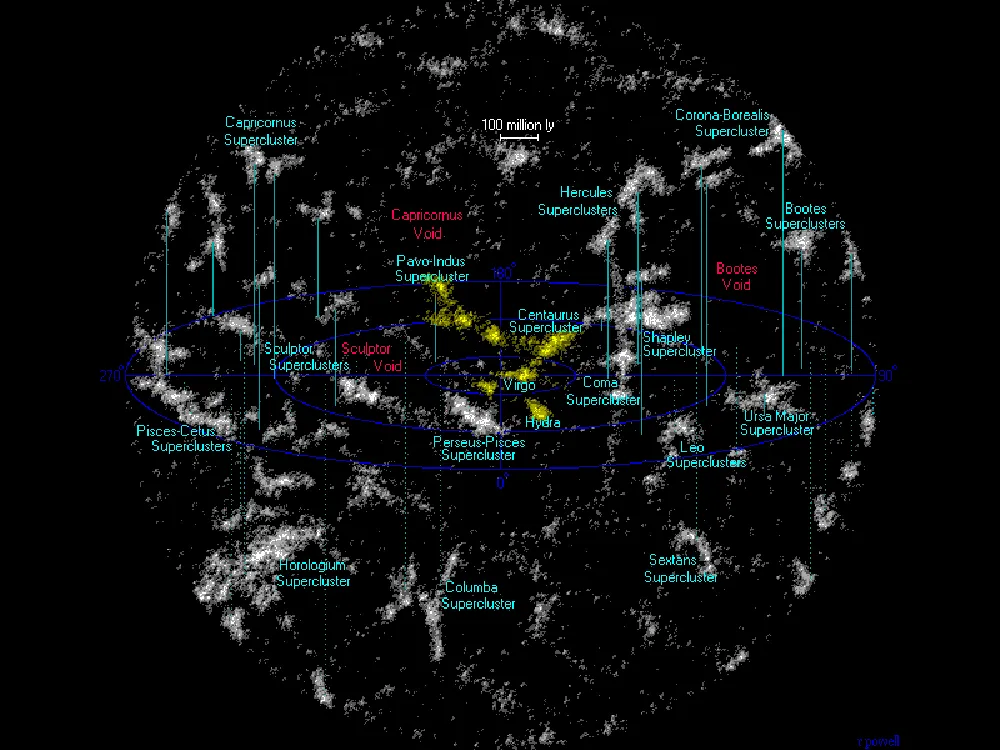
Wetenschappers denken dat de grote aantrekker zich bevindt in de regio van de Hydra-Centaurus supercluster, een uitgestrekt gebied dat zich ongeveer 150 miljoen lichtjaar van ons vandaan bevindt. Deze kracht beïnvloedt op grote schaal de bewegingen van de melkweg en andere sterrenstelsels in de lokale kosmos, waardoor het bijvoorbeeld de snelheid bepaalt waarmee onze Melkweg zich door het heelal beweegt. Daarnaast speelt de grote aantreker een belangrijke rol in de vorming en evolutie van de lokale kosmische structuur, doordat de massa die deze kracht veroorzaakt de onderliggende drijvende kracht is achter de clustering van sterrenstelsels en de vorming van grote kosmische filaments.
Wat de grote aantrekker nog intrigerender maakt, is dat deze mogelijk verbonden is met een enorme massa van donkere materie. Donkere materie is een onzichtbare vorm van materie die geen licht uitstraalt en voor onze instrumenten moeilijk direct te detecteren is. Toch wordt aangenomen dat donkere materie een groot deel uitmaakt van de massa die de grote aantreker veroorzaakt, waardoor deze kracht nog krachtiger en onzichtbaarder wordt dan we met onze huidige technologie kunnen waarnemen.
De omvang en aard van de 'GREAT ACTTRACTOR' blijven nog steeds onderwerp van intensief wetenschappelijk onderzoek. Het is duidelijk dat deze kracht een centrale rol speelt in het kosmische evenwicht en de structuur van het heelal. Door meer te begrijpen over de grote aantrekker, kunnen wetenschappers meer leren over de grote lijnen van het universum, de rol van donkere materie, en hoe de kosmos zich in de loop van de tijd ontwikkelt. Het blijft een van de grote mysteries en fascinerende vragen binnen de astronomie en kosmologie.
Een kaart van superclusters, met Laniakea aangegeven in geel.
Credit: Richard Powell / Wiki
4. Donker Materie en De Verstopte Structuur Van Het Universum
Donker materie vormt een essentieel onderdeel van het universum dat wij niet direct kunnen zien, maar waarvan de aanwezigheid afgeleid kan worden uit de manier waarop sterrenstelsels en clusters bewegen. Het is een van de grootste raadsels in de kosmologie en speelt een cruciale rol in het ontstaan en de structuur van het heelal. Wetenschappers hebben ontdekt dat de meeste massa in het universum bestaat uit deze onzichtbare materie die geen licht uitstraalt en dus niet direct zichtbaar is met telescopen. Toch kunnen we haar bestaan afleiden uit de zwaartekracht die ze uitoefent op de materie die we wel kunnen zien, zoals sterren en gaswolken.
De structuur van het universum is niet gelijkmatig verdeeld, maar bestaat uit een complex netwerk dat vaak wordt aangeduid als het kosmische web. Dit web bestaat uit lange filamenten van donkere materie en gewone materie die samen vormen wat we kennen als grote filaments, knooppunten waar meerdere filamenten samenkomen, en enorme lege gebieden die bekendstaan als voids. Deze samenwerking van structuren schept een enorme, uitgestrekte kosmische schaal waarin alles met elkaar verbonden lijkt te zijn. Donkere materie fungeert hierbij als de ‘verstopte structuur’, die de grote patronen en patronen van het heelal bepaalt en vormgeeft.
Door middel van geavanceerde technieken zoals gravitatie lensing kunnen wetenschappers de verdeling van donkere materie in kaart brengen. Gravitatie lensing maakt gebruik van de manier waarop de zwaartekracht van donkere materie het licht van verre sterrenstelsels buigt en vervormt, waardoor onderzoekers kunnen afleiden waar en in welke hoeveelheid donkere materie zich bevindt. Daarnaast bestuderen wetenschappers de bewegingen van sterrenstelsels en clusters om de invloed van donkere materie te begrijpen. Deze structuren bepalen niet alleen de vorm en het gedrag van het universum, maar beïnvloeden ook de grote aantrekkingskracht die we proberen te begrijpen en verklaren.
Naast donkere materie speelt donkere energie een andere, nog mysterieuzere rol. Donkere energie is een kracht die de expansie van het universum versnelt en ervoor zorgt dat de kosmische schaal steeds sneller uitdijt. Samen vormen donkere materie en donkere energie de fundamentele componenten van het universum, waarvan we nog niet alles begrijpen, maar waarvan we weten dat ze de grote lijnen van de kosmische structuur bepalen. Het onderzoeken van deze onzichtbare krachten en structuren blijft een van de meest boeiende uitdagingen voor de moderne wetenschap.
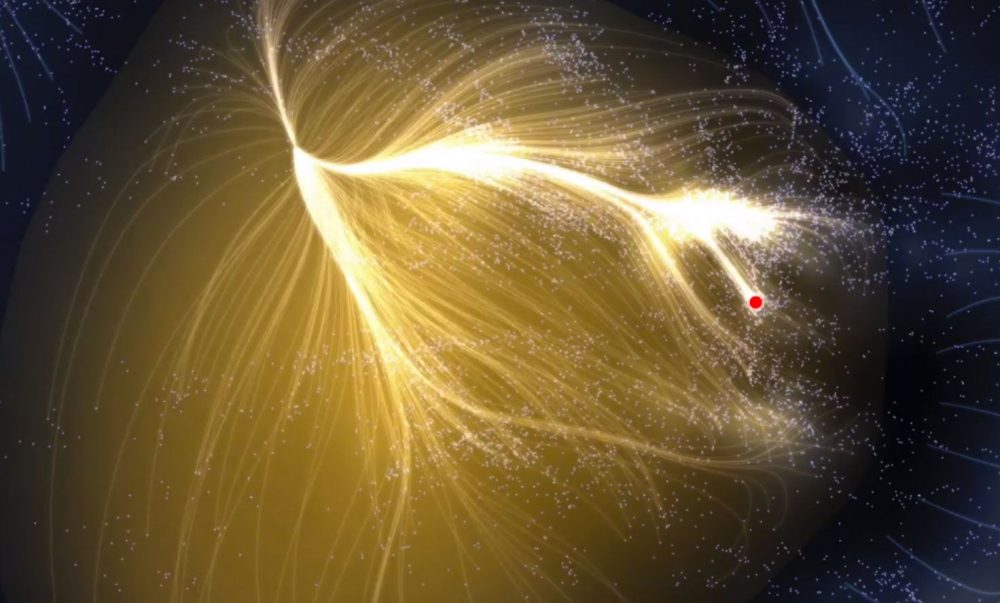
De Laniakea-supercluster en de Melkweg met een rode stip.
Credit: TULLY, R. B., COURTOIS, H., HOFFMAN, Y & POMARÈDE, D. NATURE 513, 71–73 (2014)
5. Is De Grote Aantrekker Gewoon Een Puntje Op De Route? De Structuur Van Het Universum Is Niet Toevalig
De grote aantrekker lijkt misschien slechts een klein punt op de route van onze melkwegstelsel, maar een nadere blik op de onderliggende structuur van het universum onthult dat het meer is dan dat. Het universum vertoont een fascinerend en complex patroon dat niet het resultaat is van willekeur, maar van een onderliggende ordening die zich uitstrekt over miljarden lichtjaren. Deze structuur wordt vaak omschreven als een kosmisch web, bestaande uit grote clusters van sterrenstelsels, filamenten en lege ruimtes, de zogeheten 'cosmische voids'.(Cosmische voids zijn grote, lege gebieden in het universum die relatief weinig of geen materie bevatten. Ze vormen een belangrijk onderdeel van de grote structuur van het heelal, die bestaat uit clusters van sterrenstelsels, filamenten en superclusters, gescheiden door enorme lege ruimtes.
Deze voids kunnen tientallen tot honderden miljoenen lichtjaren in diameter zijn en ontstaan doordat materie zich gedurende de evolutie van het universum heeft verzameld in dichtbevolkte gebieden, waardoor de lege ruimtes ertussen groter worden. Ze spelen een belangrijke rol in het begrijpen van de evolutie van het heelal en de verdeling van materie en donkere energie.
Kort samengevat: cosmische voids zijn grote lege zones in het universum, essentieel voor het bestuderen van de grote structuur en de dynamiek van het heelal.)
In de kosmologie verwijzen filamenten naar grote, uitgestrekte structuren in het heelal die behoren tot de zogenaamde "grote-scale structuur" van het universum. Deze filamenten vormen een netwerk van dunne, langgerekte structuren die de zogenaamde "kosmische web" structuur vormen, waarin clusters van sterrenstelsels, superclusters en lege gebieden (voids) met elkaar verbonden zijn.
Wat zijn filamenten precies? Filamenten zijn grote ophopingen van donkere materie, gas en sterrenstelsels die zich uitstrekken over tientallen tot honderden miljoenen lichtjaren. Ze lijken op zeer dunne draden die de grote schaal van het heelal doorkruisen en vormen de ruggengraat van de kosmische webstructuur.
Hoe ontstaan ze? Volgens de theorie van de kosmische evolutie ontstaan filamenten uit de kleine dichtheidsverschillen in de vroegere oertoestand van het universum. Door de zwaartekracht trekken deze dichtheden materie samen, wat leidt tot de vorming van filamenten, clusters en andere grote structuren.
Waarom zijn filamenten belangrijk? Ze geven inzicht in de verdeling van materie in het heelal en helpen wetenschappers te begrijpen hoe de grote schaalstructuur zich door de tijd heen heeft ontwikkeld. Daarnaast zijn ze belangrijk voor het bestuderen van de aard van donkere materie en de evolutie van het universum.
De distributie van sterrenstelsels en clusters volgt deze webachtige structuur, waarbij filaments en knooppunten op strategische punten samenkomen. De grote aantreker fungeert als een van deze knooppunten, een regio waar meerdere filamenten samenkomen en waar enorme massa’s zich verzamelen. Dit centrale punt speelt een belangrijke rol in de beweging en evolutie van onze melkweg en andere omliggende stelsels. Het feit dat zulke enorme massa’s zich op specifieke plekken bevinden, wijst op een diepere ordening in het universum die niet kan worden verklaard door toeval alleen.
Wetenschappelijke onderzoeken laten zien dat donkere materie een grote rol speelt in het vormen en onderhouden van deze structuur. Donkere materie, die niet direct waarneembaar is, oefent een zwaartekracht uit die de bewegingen van sterrenstelsels en de vorming van grote clusters beïnvloedt. Daarnaast zorgt de kosmische expansie, de voortdurende uitdijing van het universum, voor de ontwikkeling en verdeling van deze grote structuren. Het patroon dat zich hieruit voordoet, wordt dus gestuurd door fundamentele fysische wetten en krachten.
De grote aantrekker is dus niet zomaar een willekeurig punt in het heelal. Het vertegenwoordigt een kern van enorme massa en zwaartekracht, een knooppunt binnen het kosmische web dat de bewegingen van sterrenstelsels beïnvloedt en een essentiële rol speelt in de evolutie van het universum. Wetenschappelijk bewijs toont aan dat deze structuren voortkomen uit de evolutie vanaf de oerknal, waarbij de onderliggende fysische wetten de grote patronen en de ordening in het heelal bepalen. Het is dus duidelijk dat de grote aantrekker meer is dan een puntje op de route; het is een essentieel onderdeel van de kosmische orde die het heelal vormgeeft.
6. Zullen We 'the GREAT ACTTRACTOR' Ook Eens Duidelijk Zien?
Het zichtbaar maken van de grote aantrekker blijft een van de grootste uitdagingen voor astronomen en kosmologen. Deze kracht, die wordt aangeduid als 'the Great Attractor', speelt een cruciale rol in de bewegingen van onze Melkweg en andere nabijgelegen sterrenstelsels, maar is zelf vrijwel onzichtbaar. De reden hiervoor is dat deze grote massa vooral bestaat uit donkere materie, een mysterieuze substantie die geen licht uitstraalt of reflecteert. Daardoor kunnen we deze niet direct waarnemen met traditionele telescopen die afhankelijk zijn van zichtbaar licht of andere elektromagnetische straling.
In plaats daarvan moeten wetenschappers gebruik maken van indirecte methoden om de aanwezigheid en de eigenschappen van de grote aantrekker te achterhalen. Een van de belangrijkste technieken is gravitatie lensing. Hierbij wordt de invloed van de zwaartekracht van de onzichtbare massa benut om de banen van lichtstralen van achterliggende sterrenstelsels te buigen. Door nauwkeurig te meten hoe het licht wordt vervormd, kunnen onderzoekers afleiden hoeveel massa er aanwezig moet zijn en waar die massa zich bevindt. Daarnaast analyseren wetenschappers de bewegingen en snelheden van sterrenstelsels en clusters in de omgeving van de Grote Aantrekker. Als deze objecten zich in een bepaalde richting bewegen en snelheid vertonen, wijst dat op de aanwezigheid van een enorme massa die hen aantrekt.
De nieuwste technologieën bieden hoop op meer inzicht. Geavanceerde radio- en infraroodtelescopen, zoals de Square Kilometre Array en de James Webb Space Telescope, kunnen mogelijk meer gedetailleerde gegevens leveren over de onzichtbare massa in onze kosmische omgeving. Deze instrumenten maken het mogelijk om dieper te kijken in gebieden die voorheen ondoorzichtig waren of waar het licht moeilijk te detecteren was. Toch blijft het bepalen van de exacte locatie en omvang van de grote aantrekker een complexe uitdaging, omdat we te maken hebben met onzichtbare en immens grote krachten die op grote schaal werken.
Desalniettemin is er reden tot optimisme. Wetenschappelijke doorbraken en technologische innovaties zullen naar verwachting onze kennis verder vergroten en ons dichter bij een volledig begrip brengen van deze mysterieuze kracht. Het blijft een fascinerend vraagstuk: zullen we ooit volledig kunnen zien en begrijpen wat de grote aantrekker precies is en hoe hij ons universum beïnvloedt? Het antwoord ligt misschien wel in de toekomst, en elke nieuwe ontdekking brengt ons weer een stapje dichterbij het ontrafelen van deze kosmische raadsels.
7. Het Universum Blijft Geheimen Opduiken Uit De Donkere Hoeken
Het universum is een oneindige bron van mysteries, vooral in de donkere hoeken waar geen licht komt. Donkere materie en energie vormen een groot deel van deze geheimen, omdat ze onzichtbaar en moeilijk te detecteren zijn. Nieuwe observaties blijven verrassingen opleveren, zoals onverwachte bewegingen en structuren die niet passen in onze huidige modellen. Wetenschappers geloven dat er nog veel te ontdekken valt over de aard van donkere materie en de rol die het speelt in de kosmische evolutie. Recent onderzoek wijst uit dat donkere energie de expansie van het heelal versnelt, wat nieuwe vragen oproept over de ultieme bestemming van het universum. De zoektocht naar deze verborgen krachten vereist innovatieve technologieën en internationale samenwerking. Het blijft een fascinerend wetenschappelijk avontuur, waarbij elke ontdekking ons dichter brengt bij het begrijpen van de fundamentele bouwstenen van de kosmos.
Het universum lijkt soms onbegrijpelijk in zijn grootsheid en complexiteit. Elke keer dat wetenschappers nieuwe gegevens verzamelen met behulp van geavanceerde telescopen en satellieten, worden oude ideeën uitgedaagd en ontstaan er nieuwe theorieën. Zo weten we bijvoorbeeld dat donkere materie geen licht uitstraalt en daarom niet direct zichtbaar is, maar dat het wel invloed uitoefent op de bewegingen van sterrenstelsels en de structuur van het heelal. Het detecteren van deze mysterieuze substantie is een enorme uitdaging, en wetenschappers gebruiken onder andere de zwaartekracht en kosmische straling om meer te weten te komen. Tegelijkertijd blijven onderzoekers zoeken naar manieren om donkere energie beter te begrijpen, die de expansie van het universum versnelt en mogelijk het lot van alles wat bestaat beïnvloedt.
De zoektocht naar het onzichtbare is niet alleen technisch uitdagend, maar ook conceptueel. Het dwingt ons om onze kennis van de natuurwetten opnieuw te bekijken en te begrijpen dat ons universum veel complexer is dan we ooit hadden kunnen bedenken. Innovaties zoals de James Webb-ruimtetelescoop en grote deeltjesversnellers spelen hierbij een cruciale rol. Ze stellen wetenschappers in staat om dieper in de ruimte en in de tijd te kijken, en zo mogelijk de eerste momenten van het heelal te ontrafelen. Bovendien is internationale samenwerking essentieel omdat de kosten en expertise voor dergelijke projecten enorm zijn. Door samen te werken over grenzen heen, vergaren we meer inzichten en vergroten we de kans op doorbraken.
Kortom, het universum blijft een fascinerende en ongrijpbare wereld vol geheimen. Elke nieuwe ontdekking helpt ons niet alleen om de kosmos beter te begrijpen, maar ook onze eigen plek daarin. Het is een voortdurende zoektocht die ons uitdaagt om verder te kijken dan wat zichtbaar is, en ons uit te rusten met innovatieve technologieën en een open geest. Zo blijven we op het pad van ontdekkingen voortgaan, in de hoop dat we ooit de diepere geheimen van het heelal volledig zullen ontrafelen. Tot die tijd blijft het universum ons verrassen en inspireren, en nodigt het ons uit om nooit te stoppen met zoeken naar antwoorden.
Hubble-ruimte-telescoop afbeelding van het stukje hemel waar de Grote Aantrekker zich bevindt.
Credit: ESA/Hubble & NASA
8. Wetenschappelijk Onderzoek, Bevindingen Over Bewijzen en Toekomstperspectieven
De theorieën over de grote aantrekker en donkere materie worden ondersteund door een breed scala aan wetenschappelijke studies en observaties die door de jaren heen zijn uitgevoerd. Deze onderzoeken vormen de ruggengraat van ons huidige begrip van de structuur en dynamiek van het universum. Ze bieden niet alleen bewijs voor het bestaan van onzichtbare massa’s, maar ook voor de complexe krachten die de evolutie van sterrenstelsels en grote clusters beïnvloeden. De combinatie van astronomische waarnemingen, experimentele gegevens en geavanceerde simulaties heeft geleid tot een dieper inzicht in de fundamentele krachten die onze kosmos bepalen.
Een van de belangrijkste bewijzen voor het bestaan van donkere materie komt voort uit de observaties van de bewegingen van sterrenstelsels en clusters. Wanneer astronomen de snelheden meten waarmee sterren en gas rond de kern van een sterrenstelsel bewegen, blijkt dat de massa die ze kunnen afleiden uit de zichtbare materie onvoldoende is om de waargenomen bewegingen te verklaren. Dit fenomeen wordt vaak aangeduid als de “massaverschil” en wijst op de aanwezigheid van een extra, onzichtbare massa die de bewegingen beïnvloedt. Daarbij komt dat de verdeling van grote clusters van sterrenstelsels niet verklaard kan worden zonder de aanwezigheid van grote hoeveelheden donkere materie die tussen de zichtbare componenten ligt.
Daarnaast bieden gravitational lensing-effecten, waarbij de zwaartekracht van een massale objecten licht buigt en vervormt, krachtige bewijzen voor de aanwezigheid van onzichtbare massa’s. Door de analyse van lensing-verschijnselen kunnen astronomen de massa van objecten bepalen zonder te rekenen op hun lichtopbrengst. De resultaten tonen aan dat de massa die uit lensing wordt afgeleid veel groter is dan die van de zichtbare materie, wat opnieuw wijst op de aanwezigheid van donkere materie. Deze effecten worden met grote precisie bestudeerd met behulp van telescopen en satellieten, zoals de Hubble-ruimtetelescoop en de meer recente James Webb-ruimteobservatorium.
De rol van donkere energie wordt eveneens ondersteund door observaties van de kosmische achtergrondstraling. Satellieten zoals de Wilkinson Microwave Anisotropy Probe (WMAP) en de Planck-missie hebben de subtiele fluctuaties in de kosmische achtergrondstraling geanalyseerd, wat inzicht geeft in de samenstelling en evolutie van het universum. Deze gegevens tonen aan dat ongeveer 68% van de totale massa-energie-inhoud van het universum bestaat uit donkere energie, een mysterieuze kracht die de versnelde uitdijing van het heelal veroorzaakt. De waarnemingen bevestigen dat de universele expansie niet alleen plaatsvindt, maar ook versnelt, wat de aanwezigheid van een repulsieve kracht vereist.
Naast astronomische observaties worden ook geavanceerde simulaties ingezet om de evolutie van de grote structuren in het universum te modelleren. Door computermodellen die rekening houden met de fysica van donkere materie en energie, krijgen wetenschappers inzicht in hoe het vroege heelal zich heeft ontwikkeld tot de complexe structuur die we vandaag zien. Deze simulaties tonen dat donkere materie een essentiële rol speelt bij de vorming van sterrenstelsels en clusters, doordat het de gravitatiebron vormt waarop normale materie zich kan verzamelen en vormen. Het is opmerkelijk dat de resultaten van deze simulaties overeenkomen met de waargenomen verdeling van materie en de structuur van het kosmische web.
Ondanks het uitgebreide bewijs en de vooruitgang in het veld, blijven er nog veel vragen onbeantwoord. De exacte aard van donkere energie en donkere materie is nog altijd onduidelijk. Wetenschappers weten niet precies uit welke deeltjes donkere materie bestaat, en of deze deeltjes interacties vertonen met gewone materie. Evenzo blijft de aard van donkere energie een mysterie, met verschillende theorieën die variëren van een kosmologisch constant tot dynamische velden die in de loop van de tijd veranderen.
Deze onzekerheden vormen de drijfveer voor nieuw onderzoek en technologische ontwikkeling. Tal van experimentele projecten en observatieprogramma’s worden momenteel uitgevoerd of gepland om meer licht te werpen op deze fundamentele vragen. Bijvoorbeeld, grote ondergrondse detectoren proberen deeltjes te vinden die mogelijk donkere materie vormen, terwijl telescopen gericht zijn op het bestuderen van de kosmische achtergrondstraling en supernovae. Daarnaast worden satellieten ontwikkeld die de zwaartekracht en de uitdijing van het heelal nauwkeurig kunnen meten over langere tijdsperioden.
De bevindingen uit deze diverse onderzoeksvelden vormen de basis voor ons steeds verder ontwikkelende begrip van de kosmos. Ze bieden niet alleen inzicht in de krachten die onze melkweg en andere sterrenstelsels sturen, maar ook in de fundamentele natuurwetten die het universum vormen. Wetenschappers blijven optimistisch over de toekomst, gedreven door de hoop dat nieuwe technologieën en innovatieve benaderingen ons zullen helpen de mysteries van donkere energie en donkere materie te ontrafelen. Het is duidelijk dat ons begrip van het universum voortdurend in ontwikkeling is, en dat elke nieuwe ontdekking ons dichterbij brengt bij het beantwoorden van enkele van de meest fundamentele vragen over het bestaan.
9. Impact Op Onze Melkweg
De invloed van de 'Great Attractor' en de onderliggende krachten op onze melkweg is van groot belang voor ons begrip van het universum. Deze krachten bepalen niet alleen de snelheid waarmee de melkweg door het heelal beweegt, maar spelen ook een essentiële rol in de vorming en evolutie van sterren, sterrenhopen en andere structuren binnen onze galaxie. Een belangrijke factor hierin is donkere materie, een onzichtbare substantie die een enorme invloed uitoefent op de structuur en stabiliteit van de melkweg. De aantrekkingskracht van donkere materie zorgt ervoor dat onze melkweg verbonden blijft met andere kosmische structuren, zoals clusters en filamenten in het universum.
Het begrijpen van deze krachten biedt niet alleen inzicht in de bewegingen en dynamiek van onze eigen galaxie, maar helpt ook bij het verklaren van de evolutie van het heelal als geheel. Het besef dat onzichtbare krachten een grote rol spelen, verandert onze kijk op kosmologie en de plaats van de mens in het universum. Wetenschappers verwachten dat verder onderzoek naar donkere materie, donkere energie en andere fundamentele krachten onze kennis nog verder zal verdiepen. Dit vergt mogelijk de ontwikkeling van nieuwe technologieën en theoretische modellen om deze onzichtbare invloeden beter te kunnen meten en begrijpen.
De kennis over deze krachten vormt de basis voor toekomstige ontdekkingen, zoals het voorspellen van de bewegingen van sterrenstelsels en het begrijpen van de grote structuur van het heelal. Het blijft een fascinerend en complex gebied dat ons inzicht in de kosmos voortdurend uitbreidt, en dat ons helpt onze plek in het universum beter te begrijpen. Door verder onderzoek kunnen we wellicht nog meer mysteries ontrafelen en de fundamentele aard van het heelal doorgronden.
Uitzicht op het zuidelijk halfrond, sterrenbeeld Norma, in de richting van de Grote Trekker.
Credit: ESO
10. Wat Gebeurt er in de Toekomst
De Melkweg, onze thuisgalaxie, wordt door een onzichtbare maar immens krachtige kracht beïnvloed: de zwaartekracht. Deze kracht trekt alle objecten binnen de Melkweg naar het centrum toe en zorgt voor de structuur en dynamiek van de galaxie. De grote kracht die hier een rol speelt, is de zwaartekracht, aangedreven door de massa van sterren, gas, stof en donkere materie. Donkere materie vormt een groot deel van de massa en beïnvloedt de beweging van sterrenstelsels op grote schaal. Zonder deze kracht zouden sterren niet in banen blijven en zou de structuur van de Melkweg niet bestaan. De kracht trekt niet alleen materie samen, maar beïnvloedt ook de vorm en beweging van de sterren. Het universum zelf wordt door deze kracht in stand gehouden, waardoor sterrenstelsels en clusters bij elkaar blijven. De kracht is ook verantwoordelijk voor het ontstaan van nieuwe sterren, omdat het gas en stof samenperst onder invloed van gravitatie. Deze kracht blijft zich ontwikkelen en beïnvloedt de evolutie van het universum. Wetenschappers bestuderen deze kracht om meer te begrijpen over de structuur en het ontstaan van onze kosmos. De grote kracht is dus de drijvende factor achter alles wat we zien en niet zien in het heelal. Door haar invloed blijven hemellichamen in beweging en ontstaan nieuwe sterrenstelsels. Het begrijpen van deze kracht helpt ons om de grote mysteries van het universum te ontrafelen en de toekomst ervan te voorspellen.
De toekomst van het universum is een fascinerend onderwerp dat velen boeit. Wetenschappers voorspellen dat de evolutie van het heelal afhankelijk is van de hoeveelheid donkere energie en donkere materie die aanwezig zijn. Als de donkere energie blijft toenemen, kan het universum blijven uitdijen en uiteindelijk uit elkaar drijven, een scenario dat bekendstaat als de "Big Freeze" of "Warmtereddingsuniversum". In dat geval zullen sterren en planeten uiteindelijk niet meer in staat zijn om leven te ondersteunen, omdat de kosmos steeds verder uitdijt en afkoelt. Aan de andere kant bestaat ook de mogelijkheid dat de uitdijing stopt en het universum ineenstort, een scenario dat bekendstaat als de "Big Crunch". Dit zou kunnen gebeuren als de zwaartekracht uiteindelijk de uitdijing stopt en het heelal weer ineenstort onder zijn eigen gewicht. Een ander interessant scenario is het "Big Bounce", waarbij het universum na een ineenstorting weer uitzet, wat een eeuwigdurend cyclisch proces zou betekenen. Wat de toekomst ook brengt, wetenschappers blijven de kosmos bestuderen om meer te weten te komen over de krachten die haar beïnvloeden. Technologische ontwikkelingen zullen ons mogelijk in staat stellen om dieper te kijken in de verste uithoeken van het heelal en de ware aard van donkere energie en donkere materie te begrijpen. Het blijft een fascinerend vraagstuk dat nog vele jaren wetenschappelijk onderzoek zal vereisen. De toekomst van het universum is onzeker, maar zeker dat het een voortdurende bron van inspiratie en ontdekking zal blijven.
Conclusie
De grote kracht die onze Melkweg door het universum trekt, is de zwaartekracht, een fundamentele kracht die de structuur en dynamiek van onze kosmos bepaalt. Deze kracht houdt sterrenstelsels bij elkaar en zorgt voor de vorming en evolutie van nieuwe hemellichamen. Wat de toekomst betreft, zijn er verschillende mogelijke scenario’s: het universum kan blijven uitdijen, ineenstorten of een cyclisch patroon vertonen. Wetenschappers blijven onderzoek doen naar donkere energie en donkere materie om deze toekomst beter te begrijpen. Het inzicht in deze krachten helpt ons niet alleen om het ontstaan van het heelal te verklaren, maar ook om te anticiperen op wat nog komen gaat. De voortdurende ontdekkingen en technologische vooruitgang bieden hoop op een dieper begrip van de kosmos. Ondanks dat er nog veel onduidelijkheden zijn, blijft de fascinatie voor de grote krachten die het universum vormen en sturen, een drijvende kracht voor wetenschappelijk onderzoek en menselijke nieuwsgierigheid. De toekomst van het heelal is een onlosmakelijk onderdeel van onze zoektocht naar kennis en begrip van de grote mysteries van het bestaan. Het blijft een boeiend en inspirerend onderwerp dat ons uitdaagt om verder te kijken en meer te ontdekken over de wonderen van het universum.
UFO Over House Abducting Human, Berlin, Germany Google Earth Map, UAP Sighting News.
Date of discovery: May 2025
Location of discovery: Google Earth
Coordinates: 52°11'54.76"N 13°35'7.43"E
I found this UFO when searching on Google map over southern area of Berlin, Germany. The UFO is highly reflective and may have been cloaked at the time, but the satellite angle when taking the photo 90% revealed the craft for a split second. The UFO shields are not 100% all around the craft, instead it focuses shielding over its sides and bottom, but the top area of shields is much weaker...since its seen as less likely to be seen from that view. Wow! Just amazing that such a photo exists.
NASA just admitted something big...and I mean planet-sized big. A recent study reveals that Uranus has significantly brightened and even changed its structure over the last 20 years. That’s not a subtle shift...that’s a massive planetary transformation. Now scientists say it’s due to atmospheric circulation patterns and seasonal lighting... but what if that’s just the surface excuse?
Think deeper...what if what we’re really seeing is light reflecting off massive alien cities, enormous space stations, or even fleets of craft rising from deep beneath the methane clouds? Hubble’s observations show the north polar region is brightening fast...right where sunlight is hitting more directly. But sunlight alone wouldn’t explain such drastic and structured changes unless it’s illuminating something solid. We’ve seen this trick before...light bouncing off domes, crafts, and artificial surfaces hidden in plain sight.
This could very well be the long-term unveiling of alien infrastructure previously cloaked by planetary shadows. As summer hits Uranus’s north pole, we might finally be getting a glimpse of what was always there...evidence of intelligent activity on a scale we can barely comprehend. Keep watching the skies...even the icy blue ones.
Meer van UFO'S of UAP'S, ASTRONOMIE, RUIMTEVAART, ARCHEOLOGIE, OUDHEIDKUNDE, SF-SNUFJES EN ANDERE ESOTERISCHE WETENSCHAPPEN - DE ALLERLAATSTE NIEUWTJES


 Martian Probe Rolls Over to See Subsurface Ice and Rock