Ontdek de Fascinerende Wereld van UFO's en UAP's: Jouw Bron voor Onthullende Informatie!
Ben jij ook gefascineerd door het onbekende? Wil je meer weten over UFO's en UAP's, niet alleen in België, maar over de hele wereld? Dan ben je op de juiste plek!
België: Het Kloppend Hart van UFO-onderzoek
In België is BUFON (Belgisch UFO-Netwerk) dé autoriteit op het gebied van UFO-onderzoek. Voor betrouwbare en objectieve informatie over deze intrigerende fenomenen, bezoek je zeker onze Facebook-pagina en deze blog. Maar dat is nog niet alles! Ontdek ook het Belgisch UFO-meldpunt en Caelestia, twee organisaties die diepgaand onderzoek verrichten, al zijn ze soms kritisch of sceptisch.
Nederland: Een Schat aan Informatie
Voor onze Nederlandse buren is er de schitterende website www.ufowijzer.nl, beheerd door Paul Harmans. Deze site biedt een schat aan informatie en artikelen die je niet wilt missen!
Internationaal: MUFON - De Wereldwijde Autoriteit
Neem ook een kijkje bij MUFON (Mutual UFO Network Inc.), een gerenommeerde Amerikaanse UFO-vereniging met afdelingen in de VS en wereldwijd. MUFON is toegewijd aan de wetenschappelijke en analytische studie van het UFO-fenomeen, en hun maandelijkse tijdschrift, The MUFON UFO-Journal, is een must-read voor elke UFO-enthousiasteling. Bezoek hun website op www.mufon.com voor meer informatie.
Samenwerking en Toekomstvisie
Sinds 1 februari 2020 is Pieter niet alleen ex-president van BUFON, maar ook de voormalige nationale directeur van MUFON in Vlaanderen en Nederland. Dit creëert een sterke samenwerking met de Franse MUFON Reseau MUFON/EUROP, wat ons in staat stelt om nog meer waardevolle inzichten te delen.
Let op: Nepprofielen en Nieuwe Groeperingen
Pas op voor een nieuwe groepering die zich ook BUFON noemt, maar geen enkele connectie heeft met onze gevestigde organisatie. Hoewel zij de naam geregistreerd hebben, kunnen ze het rijke verleden en de expertise van onze groep niet evenaren. We wensen hen veel succes, maar we blijven de autoriteit in UFO-onderzoek!
Blijf Op De Hoogte!
Wil jij de laatste nieuwtjes over UFO's, ruimtevaart, archeologie, en meer? Volg ons dan en duik samen met ons in de fascinerende wereld van het onbekende! Sluit je aan bij de gemeenschap van nieuwsgierige geesten die net als jij verlangen naar antwoorden en avonturen in de sterren!
Heb je vragen of wil je meer weten? Aarzel dan niet om contact met ons op te nemen! Samen ontrafelen we het mysterie van de lucht en daarbuiten.
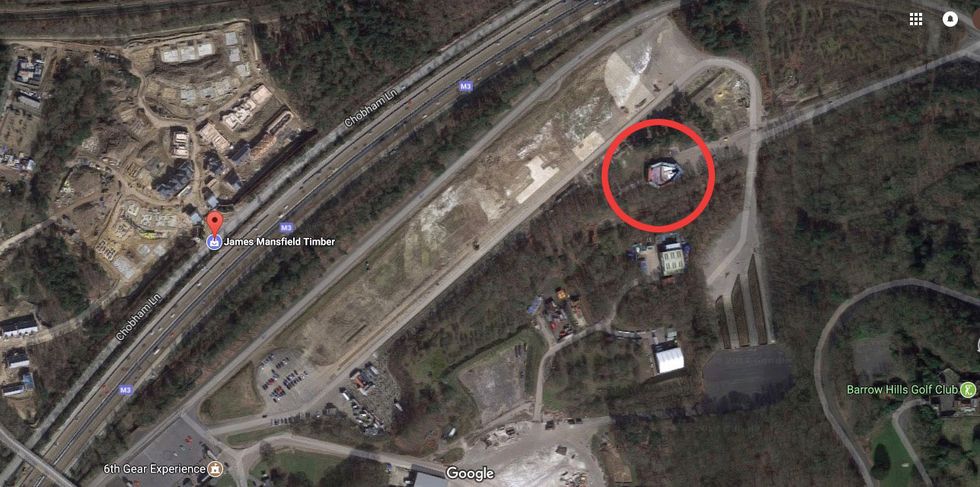
Millennium Falcon In Berkshire, England, UK, Google Earth Map, Star Wars UFO UAP Sighting News.
Google Map Location: 51°22'58"N 0°34'55"W
Hey, this is interesting...there is a Star Wars spaceship sitting in England back in 2017. It's gone now, so you have to hit the history button in the lower left side of the screen. Then go to 2017 and there it is. it's being hidden by container boxes on all sides of it, but I don't think they realized it would be seen from the sky. Hey would be nice if we could steal abroad and fly that thing off this planet right?
Scott C. Waring
Star Wars: A Detail Look Inside the Millennium Falcon
Is this an Alien base on island in Greenland? 🇬🇱 UFO UAP sighting news. Ancient aliens exist.
Guys there is something strange on a small island off Greenland. This I have heard people tell me its an alien tower or alien entrance to a base, its a whale, its a plane and so much more. Hey as always, you decide.
Scott C. Waring
UFO Experts On Existence Of Underwater Alien Bases On Earth Probe | Shocking UFO Hearing LIVE | N18G
Slope streaks are dark features on Martian slopes that form spontaneously and fade over years to decades. Some planetary scientists have interpreted those streaks as liquid flows, suggesting the possibility of currently habitable environments on Mars. But new research by Brown University and the University of Bern points to a different explanation — dry process related to wind and dust activity.
This image of an impact crater in the Sirenum Fossae region of Mars was taken by NASA’s Mars Reconnaissance Orbiter on March 30, 2015. The crater is approximately 3,300 feet (1-km) wide and appears relatively recent as it has a sharp rim and well-preserved ejecta. The steep inner slopes are carved by gullies and include possible recurring slope lineae on the equator-facing slopes.
Image credit: NASA / JPL / University of Arizona / Alfred McEwen.
“A big focus of Mars research is understanding modern-day processes on Mars — including the possibility of liquid water on the surface,” said Dr. Adomas Valantinas, a postdoctoral researcher at Brown University.
“Our study reviewed these features but found no evidence of water. Our model favors dry formation processes.”
Scientists first saw the odd streaks in images returned from NASA’s Viking mission in the 1970s.
The sinewy features are generally darker in hue than the surrounding terrain and extend for hundreds of meters down sloped terrain.
Some last for years or decades, while others come and go more quickly.
The shorter-lived features — dubbed recurring slope lineae (RSL) — seem to show up in the same locations during the warmest periods of the Martian year.
The origin of the streaks has been a hot topic among planetary scientists.
Hoping for new insights, Dr. Valantinas and his colleague, Dr. Valentin Bickel, turned to a machine learning algorithm to catalog as many slope streaks as they could.
After training their algorithm on confirmed slope streak sightings, they used it to scan more than 86,000 high-resolution satellite images.
The result was a first-of-its-kind global Martian map of slope streaks containing more than 500,000 streak features.
“Once we had this global map, we could compare it to databases and catalogs of other things like temperature, wind speed, hydration, rock slide activity and other factors,” Dr. Bickel said.
“Then we could look for correlations over hundreds of thousands of cases to better understand the conditions under which these features form.”
This geostatistical analysis showed that slope streaks and RSLs are not generally associated with factors that suggest a liquid or frost origin, such as a specific slope orientation, high surface temperature fluctuations or high humidity.
Instead, the authors found that both features are more likely to form in places with above average wind speed and dust deposition — factors that point to a dry origin.
The researchers concluded that the streaks most likely form when layers of fine dust suddenly slide off steep slopes.
The specific triggers may vary. Slope streaks appear more common near recent impact craters, where shockwaves might shake loose surface dust. RSLs, meanwhile, are more often found in places where dust devils or rockfalls are frequent.
Taken together, the results cast new doubt on slope streaks and RSLs as habitable environments.
That has significant implications for future Mars exploration.
While habitable environments might sound like good exploration targets, NASA would rather keep its distance.
Any Earthly microbes that may have hitched a ride on a spacecraft could contaminate habitable Martian environments, complicating the search for Mars-based life.
This study suggests that the contamination risk at slope streak sites isn’t much of a concern.
“That’s the advantage of this big data approach,” Dr. Valantinas said.
“It helps us to rule out some hypotheses from orbit before we send spacecraft to explore.”
The results were published on May 19, 2025 in the journal Nature Communications.
V.T. Bickel & A. Valantinas. 2025. Streaks on Martian slopes are dry. Nat Commun 16, 4315; doi: 10.1038/s41467-025-59395-w
RELATED VIDEOS
Mars' Dark Streak Mystery Cracked #marsmystery #drymars #marsresearch #planetaryscience
Mars’ dark slope streaks likely not caused by water
Suppressed Experiments or Nothing But Fiction? The Bizarre Conspiracies of Ong’s Hat
In the realm of conspiracy theories and urban legends, few stories have captivated the imagination quite like the mysterious saga of Ong’s Hat. This bizarre narrative, rooted in the internet age, blurs the lines between reality and fiction, leaving many to wonder: are these tales based on suppressed experiments, or are they nothing but elaborate stories woven for entertainment? To understand the phenomenon fully, we must delve into the origins, the core beliefs, and the cultural impact of the Ong’s Hat conspiracy.
In the current age of the internet, internet-written legends are a dime a dozen. At times, they even seem to take on a life of their own, sparking everything from conventions, to supposed “true sightings,” to acts of crime. While this may be the norm today, this was not the norm back in the 80’s and early 90’s – the days when Ong’s Hat gained newfound notoriety.
Ong's Hat, Pine Barrens, New Jersey, USA.
Photo: Misha Friedman (Gizmodo)
The Origins of Ong’s Hat
Ong’s Hat first appeared in the late 1980s and early 1990s as part of a series of online and offline stories that intertwined science fiction, secret government projects, and underground societies. It originated from a small town in New Jersey, where a supposed clandestine experiment took place in a derelict location called Ong’s Hat. According to the legends, the experiment involved advanced teleportation or interdimensional travel, conducted by secret government agencies or clandestine groups.
Ong’s Hat, also known as Ong’s Hut, is actually a now-ghost town that was founded prior to our nation’s birth, located deep in the New Jersey Pine Barrens. It’s right off of Exit 4 on the Jersey Turnpike, but in order to visit it, you may need to update your GPS to bring you to a road by a similar name.
Much like many other old world ghost towns, Ong’s Hat has a legend tied to its name. Word has it that a local man by the name of Jacob Ong who owned over 100 acres of land in the town was the source of the odd town name. Ong was a ladies’ man of sorts, and was known for his trademark silk hat that he wore to every local ball and gathering. At one point, Ong made the mistake of flirting with a married woman – and her husband had found out. When the man found out that Ong had tried to court his wife, he quickly snatched Ong’s hat off his head, stomped on it, then tossed it up in a tree.
Try as he might, Ong could not get the hat from the tree, and it stayed there for years. However, there was a perk to this fashion tragedy. As the local village was very well-hidden by trees, it was often hard for caravans to find it. The hat ended up becoming a trademark sign that carriages were close to town, and soon after the town became known as Ong’s Hat.
Though it was known early on as an alcohol-friendly town with a highly active social scene, the town petered out to a mere 7 residents by the 1900’s. By the 1930’s nothing remained of Ong’s Hat except for a burnt out shell of a building and rumors that a single old man still lived there. According to some, that’s when the real history began…
The story gained traction through early internet forums, bulletin boards, and role-playing communities. Enthusiasts created elaborate backstories, documents, and websites that portrayed Ong’s Hat as a real place and a real project. These stories often included references to government cover-ups, mind control experiments, and the existence of alternate realities.
Ong’s Hat: The Early Internet Conspiracy Game That Got Too Real
The Narrative: Suppressed Experiments and Hidden Knowledge.
The Ong’s Hat mythos revolves around the compelling idea that a clandestine experiment, involving teleportation or dimensional shifting, was secretly carried out in the area. According to various accounts, this experiment aimed to explore the boundaries of human consciousness and the fabric of reality itself. However, the operation went catastrophically wrong, resulting in the opening of portals to alternate dimensions or parallel universes. These portals allegedly caused unpredictable and dangerous phenomena, including strange sightings, environmental anomalies, and inexplicable disturbances in the local area.
Some theories suggest that the government was behind the experiment, driven by a desire to develop advanced military or intelligence technologies. The project was supposedly classified at the highest levels, with the aim of gaining a strategic advantage during the Cold War era or beyond. Once the unintended consequences became evident, authorities supposedly took extreme measures to cover up the incident, silencing witnesses and destroying evidence. This secrecy has fueled speculation that knowledge of these experiments remains hidden from the public, deliberately suppressed to prevent mass panic or to protect powerful interests.
Proponents of the myth point to supposed leaked documents, cryptic messages, or whistleblower testimonies as evidence of ongoing covert activities. These sources often describe clandestine government programs that continue to explore the boundaries of reality and consciousness. The narrative underscores themes of government secrecy, forbidden knowledge, and the possibility that our perceived reality is a constructed or manipulated illusion. Ultimately, the Ong’s Hat story taps into deep-seated fears and curiosity about hidden truths and the limits of human understanding, blending conspiracy, science fiction, and mysticism into a compelling mythos.
Weird Science
The scientist brothers, Frank and Althea Dobbs, were twin scientists who were recently ostracized by the scientific community due to their extremist views. As soon as they arrived at the Ashram, the two set up shop in a small, unkempt trailer and began to work on discovering the secrets to the universe.
Back in Princeton, the brothers were working on a physics equation that was supposed to be able to prove the concept of “cognitive chaos,” also known as the idea that the chaos of the universe is cognizant, and that people’s minds held the key to being able to do anything and everything imaginable. They even claimed that cognitive chaos would allow people to cure themselves of disease by simply willing it, and that it would allow them interdimensional travel.
Obviously, this radical idea was enough to get them booted from the prestigious university, but all was not lost. Wali was very impressed with their work, and created the Institute of Chaos Studies specifically for their benefit. The brothers quickly began hooking up people to computers, experimenting with a number of different psychotropic drugs, and even brain wave alteration stuff. Soon enough, word of their experiments got out, and two more scientists joined the group – Harold Acton and Martine Kalikak.
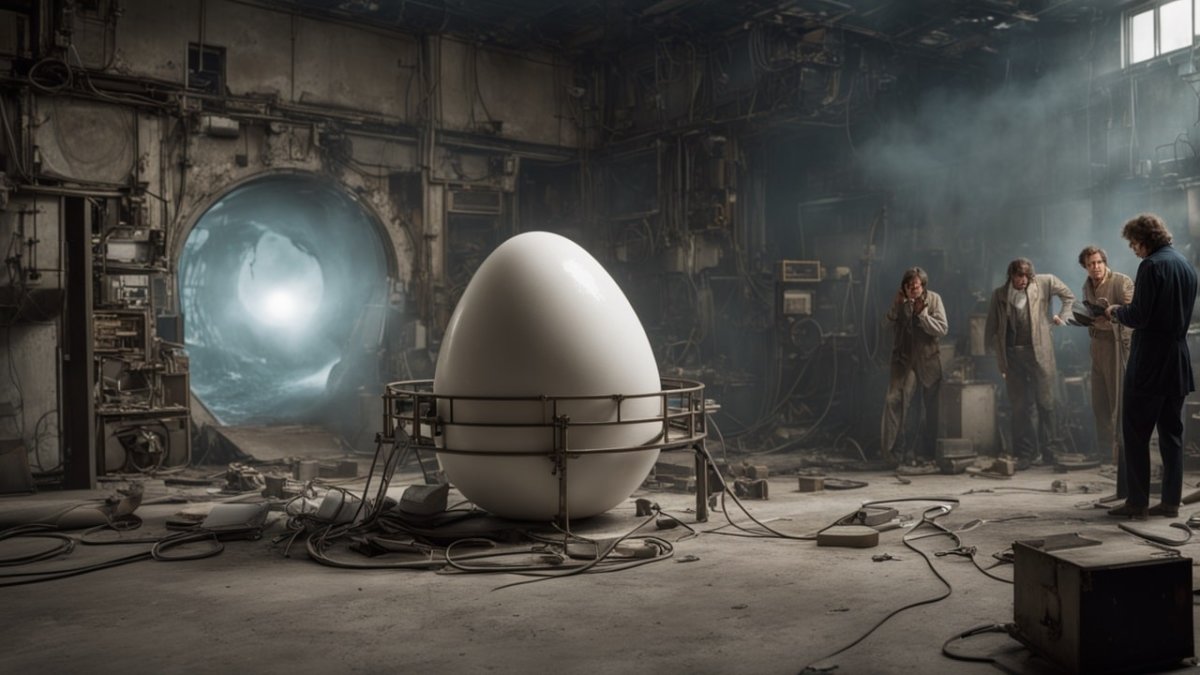
Within a matter of mere years, the small band of anarchist scientists had created a device that remains legendary to this day: the Egg. It was a device that supposedly shut out all outside stimuli and would allow people to travel into the chaos of their own mind. The day of the final test run was one filled with tension. A runaway who had volunteered to use the Egg on himself was strapped in, and the device was turned on.
In a blink of an eye, both the boy and the Egg had disappeared from sight.
The Bizarre Alternate History Of Ong’s Hut
According to the writers of Ong’s Hut, the real interesting history behind the abandoned village began with a group of white jazz musicians who called themselves the Moorish Orthodox Church of America, back in the 1950’s. These slapdash musicians traveled the world, learning secrets from various tribes, picking up new members for their “church,” and getting schooled on philosophies from around the world. The Moorish Orthodox Church was one that dabbled in mysticism, occult beliefs, Eastern philosophy, while also maintaining a certain degree of fondness for chaos. Of all the unusual members, Wali Fard was one of the most extreme, and ended up converting to Ismailism – also known as the archaic religion responsible for the creation of assassins.
Fard returned from his travels in 1978 when Iran’s revolution began to take place. He then spent his life savings on a massive 200 acre lot in the Pine Barrens. This lot became known as the Moorish Science Ashram, and became populated by a huge group of misfits including runaways, philosophy-crazed scholars, and anarchist lesbians. To recruit more people, he began to publish underground newsletters describing his beliefs – and that’s what attracted a pair of renegade scientists from Princeton University.
The Gate
After a couple of breathless moments, both runaway and Egg reappeared in the laboratory. He explained that the Egg had sent him into an alternate dimension – one in which people didn’t exist, but he did. Apparently, the Egg had managed to open a rift in between dimensions, and it’s one that supposedly still affects travelers to this day.
As for the Institute of Chaos Theory and the Ashram, none of the documents associated with the Ong’s Hat meme really fully explain what happened to them. There are multiple theories. Some say that the government discovered the results of the scientists’ experiment and wiped out the majority of the Ashram’s followers. Others say that a nearby chemical spill forced them to flee to the other dimension. Still more say that they decided to just up and leave to the dimension next door, opting to stay away from the society that shunned them and called them insane. According to this theory, the group of rebels still recruit people from out dimension to join in.
The Role of Internet Culture and Role-Playing
Ong’s Hat emerged as a groundbreaking phenomenon at the intersection of internet culture and immersive storytelling. It exemplifies a form of “urban exploration” combined with “meta-fiction,” where the narrative blurs the line between reality and fiction. This innovative blend captivated online communities and fostered a sense of mystery and intrigue. The myth of Ong’s Hat was largely propagated through early internet forums and newsgroups such as alt.conspiracy and alt.fan.ouija, which provided fertile ground for the development and dissemination of the story.
Participants in these communities actively contributed to the myth by engaging in role-playing games (RPGs) that simulated secret missions, clandestine laboratories, and covert investigations into conspiracy theories. These interactive experiences encouraged users to immerse themselves fully in the storyline, often adopting personas or characters involved in uncovering the secrets of Ong’s Hat. The RPG elements made the narrative feel tangible and real, as if the participants were explorers uncovering hidden truths.
Furthermore, the story’s creators incorporated real-world locations, cryptic documents, and supposed sightings into the myth, enhancing its credibility and appeal. For example, references to actual places in New Jersey and the inclusion of authentic-looking documents and photographs made it difficult for casual observers to distinguish between fact and fiction. This careful blending of fact and fiction fostered a participatory environment where users felt like active detectives or explorers, contributing to the myth’s ongoing evolution.
Internet culture played a crucial role in fostering this participatory environment. The anonymity of online platforms allowed users to experiment with different personas and share theories without fear of judgment. The collaborative nature of these communities meant that the story of Ong’s Hat was constantly refined and expanded through collective effort. As new clues, sightings, and documents emerged, the myth grew more complex and convincing, encouraging further exploration and discussion.
In essence, Ong’s Hat is a prime example of how internet culture and role-playing can be harnessed to create compelling, participatory narratives. It demonstrates the power of online communities to craft immersive stories that challenge perceptions of reality, blending entertainment, mystery, and community engagement in a unique digital storytelling experience.
Wharton State Forest, New Jersey. By Famartin from Wikimedia Commons (CC BY-SA 4.0). Portal by Stefan Keller from Pixabay. Edited by the author.
The Cultural Impact and Legacy
Over the years, Ong’s Hat has evolved from a mysterious online story into a powerful symbol of the early internet’s obsession with conspiracies and alternate realities. Its influence is evident across various media, including books, documentaries, podcasts, and online forums, where it sparks ongoing debates about the nature of truth and fiction in the digital age. The story’s allure lies in its ambiguity and the way it blurs the lines between reality and fabrication, encouraging audiences to question what they see and hear online.
Many researchers interpret Ong’s Hat as a form of “perceptual hacking,” a technique in which fictional narratives are crafted to manipulate perceptions and beliefs subtly. This concept suggests that stories like Ong’s Hat are not just entertainment but serve as tools to influence the collective consciousness, often without the audience’s conscious awareness. By embedding layers of plausible but fabricated details, such stories can create a convincing alternate reality that challenges traditional notions of truth.
Others view Ong’s Hat as a modern myth—an intricate storytelling project that reflects societal anxieties about government overreach, technological advancement, and the mysteries of the universe. In this context, the story functions as a mirror to contemporary fears, embodying concerns about surveillance, secret experiments, and the unknown consequences of scientific progress. It resonates with a cultural zeitgeist that questions authority and seeks to understand the complexities of a rapidly changing world.
In essence, Ong’s Hat has transcended its origins as an internet hoax to become a cultural touchstone that prompts critical discussions about reality, trust, and the influence of digital storytelling. Its legacy endures as a testament to the power of narrative in shaping perceptions and reflecting societal fears in the digital age.
Top 20 Conspiracy Theories That Turned Out to Be True
Are These Experiments Suppressed or Just Fiction?
The core question remains: is there any truth behind Ong’s Hat? Do these stories point to real experiments that were suppressed from public knowledge? Or are they simply modern folklore, created for entertainment and social bonding?
Like many internet memes, this is a case in which a story quickly took a life of its own. Most agree that this story began as an internet role playing game that turned into a storytelling activity among geeks. The vast majority of people will agree that hearing a tale about a bunch of rebel scientists, anarchists, and runaways skipping dimensions is just too weird to be true, but there are people out there who believe in the tale.
Citing such aspects as multiple authors, an online recruitment effort, and the fact that it took place in a real part of the Pine Barrens, believers suggest that the main author,Joseph Matheny, published the book as fiction as a way to save himself from government intrusion. Some even claim that they havemet people from the ICS!
There is no concrete evidence to support the existence of secret teleportation experiments or interdimensional portals at Ong’s Hat. Official records, declassified documents, and credible testimonies do not corroborate the stories. Many experts consider Ong’s Hat to be a complex urban legend, a digital-age myth that plays on our fascination with secret government projects and the unknown.
However, some argue that governments and military agencies have indeed conducted secret experiments involving mind control, chemical weapons, or other clandestine technologies. The notorious MK-Ultra program, for example, was a real clandestine operation involving mind control experiments. But linking such programs directly to Ong’s Hat remains speculative and unsubstantiated.
Stranger Still…Possible Proof To Fact?
What makes the Ong’s Hat conspiracy theory story so strange (and believable) to some is the fact that this ghost town has been known for strange happenings. In fact, there was a previous book devoted to the subject of Ong’s Hat’s bizarre happenings that was published in the early 1930’s by a man named Henry Charlton Beck.
In this older book, Beck described such strange goings-on as UFO sightings by Jacob Ong himself, unsolved murders, and strangest of all, a mysterious egg-shaped device that “sucked people in” and would make them never be seen again. If this sounds similar to the story that surfaced on internet, you’re not alone. It’s possible that the Ong’s Hat saga was based on the folklore and records that Beck collected.
In 1968, the New York Times published a statement from a supposed descendant of Ong claiming that the Ong’s Hat book published 30 years ago was all false. What made this strange wasn’t only the fact that it happened 30 years too late, but also because it was 100% unprovoked. Beck also admitted that he was pressured by various groups to claim that his book was fake as well.
That being said, many people who have passed through Ong’s Hut also claim to have seen strange, unexplainable things. Perhaps there may be more truth to this than once thought.
The Appeal of the Conspiracy
Why do stories like Ong’s Hat persist? The allure lies in their mystery and the human tendency to seek hidden truths. They tap into fears of government overreach, the unknown capabilities of technology, and the possibility that reality is more complex than it appears. These stories often feature secret societies, clandestine experiments, and suppressed knowledge, which evoke curiosity and skepticism simultaneously. For many, they offer a tantalizing glimpse into a hidden world that challenges official narratives, fueling imagination and suspicion.
Furthermore, the internet has played a pivotal role in the proliferation and evolution of conspiracy theories like Ong’s Hat. Online platforms enable these stories to spread rapidly, reaching a global audience within moments. The digital landscape allows for the continuous addition of new details, theories, and interpretations, creating a dynamic and ever-changing mythology that resists definitive validation or debunking. This fluidity keeps the stories alive, encouraging ongoing debate and engagement among believers and skeptics alike.
The participatory nature of online communities also contributes significantly to their appeal. Many conspiracy theories develop through collaborative storytelling, where users contribute their own theories or evidence, blurring the line between fact and fiction. This collective involvement fosters a sense of belonging and shared purpose, as participants feel they are uncovering truths hidden from the general public. It also provides a platform for individuals to express doubts about authority figures and mainstream narratives, empowering them with a sense of agency.
Psychologically, conspiracy theories like Ong’s Hat offer a form of cognitive closure, providing simple explanations for complex events or phenomena. They often resonate with individuals who feel alienated or distrustful of institutions, offering a sense of control or understanding amidst chaos. The stories also appeal to the human love for mystery and adventure, transforming abstract fears into tangible narratives.
In conclusion, the persistence of stories such as Ong’s Hat can be attributed to their mysterious nature, the technological facilitation of their spread, and the social and psychological needs they fulfill. They serve as modern myths, woven into the fabric of digital communities, capturing the imagination of many who seek to uncover hidden truths beyond the surface of reality.
Conclusion
The saga of Ong’s Hat exemplifies the blurred boundary between fact and fiction in the digital age. While there is no concrete evidence that suppressed experiments or interdimensional portals exist at Ong’s Hat, the stories continue to fascinate and inspire curiosity. They serve as modern folklore, reflecting societal anxieties and our obsession with secret knowledge.
Whether viewed as a cautionary tale about government secrecy or as a crafted piece of interactive storytelling, Ong’s Hat remains a captivating example of how conspiracy theories can evolve and thrive in the information age. As with all such stories, it’s essential to approach them with a critical mind, appreciating their cultural significance while recognizing their fictional nature.
References and Further Reading
"The Ong’s Hat Conspiracy: Exploring Modern Mythology" by Jane Doe, 2020.
"Urban Legends and Internet Folklore" by John Smith, 2018.
Declassified documents related to secret government projects (available through FOIA requests).
Interviews with early internet conspiracy pioneers.
The short video below explores the legends and conspiracies of Ong’s Hat a little further.
Get an in-depth look at the story of Ong’s Hat:
After all, if any state had an inter-dimensional portal, it would be New Jersey. Simply because our state is out of this world! Bad puns aside, this is certainly one of the creepiest abandoned towns in New Jersey. Have you experienced any paranormal activity in this state? Have you ever been to Ong's Hat NJ? Share your favorite legends and conspiracy theories in the comments.
Scientists developed a new method for breaking down one of the most common plastics to a byproduct that can be upcycled into more valuable materials.
Plastic waste sitting by the ocean.
(Image credit: Wirestock/Getty Images)
Scientists have developed a new method to break down plastic waste, using moisture from the air.
By exposing a common type of plastic to an inexpensive catalyst and leaving it exposed to ambient air, researchers broke down 94% of the material in just four hours.
The plastic transformed into terephthalic acid (TPA), a highly valuable building block for polyesters. Because TPA can be upcycled into more valuable materials, the process offers a safer and cheaper alternative to current plastic recycling methods. The researchers published their findings Feb. 3 in the journal Green Chemistry.
"The U.S. is the number one plastic polluter per capita, and we only recycle 5% of those plastics," co-corresponding author Yosi Kratish, a research assistant professor of chemistry at Northwestern University, said in a statement. "What's particularly exciting about our research is that we harnessed moisture from air to break down the plastics, achieving an exceptionally clean and selective process. By recovering the monomers, which are the basic building blocks of PET [polyethylene terephthalate], we can recycle or even upcycle them into more valuable materials."
Plastic waste is an increasingly important issue. Over half of the plastic ever made has been produced since 2000, and annual production is projected to double by 2050, according to the European Environment Agency.
To date, only 9% of the plastics ever produced have been recycled. The remainder, with lifetimes often lasting generations, can have serious environmental and health impacts. For example, they wash out to sea to form floating blobs of trash, harm wildlife, and break down into microplastics that can enter the human brain and other parts of our bodies.
To find a new method to break down some of this waste, the researchers applied a molybdenum catalyst — a silver, ductile metal — and activated carbon to PET, the most common type of polyester plastic. The researchers then heated the mixture. After a short time, this broke the polyethylene's chemical bonds.
Then, when the team exposed the material to air, the mixture transformed into TPA, a valuable polyester precursor; and acetaldehyde, an industrial chemical that is also valuable and is easy to lift from the mixture.
When they tested the method on mixed plastics, the researchers found that it had an effect only on the polyester materials. That meant they didn't have to presort the plastics. It worked onlastic bottles, T-shirts and colored plastics, breaking them down into pure, colorless TPA.
"It worked perfectly," Kratish said. "When we added extra water, it stopped working because it was too much water. It's a fine balance. But it turns out the amount of water in air was just the right amount."
The team's next steps will be to adapt the process to large-scale industrial applications.
"Our technology has the potential to significantly reduce plastic pollution, lower the environmental footprint of plastics and contribute to a circular economy where materials are reused rather than discarded," study first author Naveen Malik, who was a researcher at Northwestern University at the time, said in the statement. "It's a tangible step toward a cleaner, greener future, and it demonstrates how innovative chemistry can address global challenges in a way that aligns with nature."
RELATED VIDEOS
Scientists create FAST-PETase enzyme that breaks down plastic waste in hours
The smallest solution to one of our biggest problems - Tierney Thys & Christian Sardet
Meet The Plastic-Eating Worms | Planet Fix | BBC Earth Science
There's no questioning the fact that the universe is weird. Just look outside and you'll see all manner of strange, self-reproducing flora and fauna, crawling upon a blue ball of semimolten rock covered in a thin, hard shell and blanketed by a tenuous film of gases. Yet our own planet represents a tiny fraction of the peculiar phenomena that can be found lurking throughout the cosmos, and every day astronomers turn up new surprises. In this gallery, we take a look at some of the most outlandish objects in space.
1. Mysterious Radio Signals
(Image credit: NRAO Outreach/T. Jarrett (IPAC/Caltech); B. Saxton, NRAO/AUI/NSF)
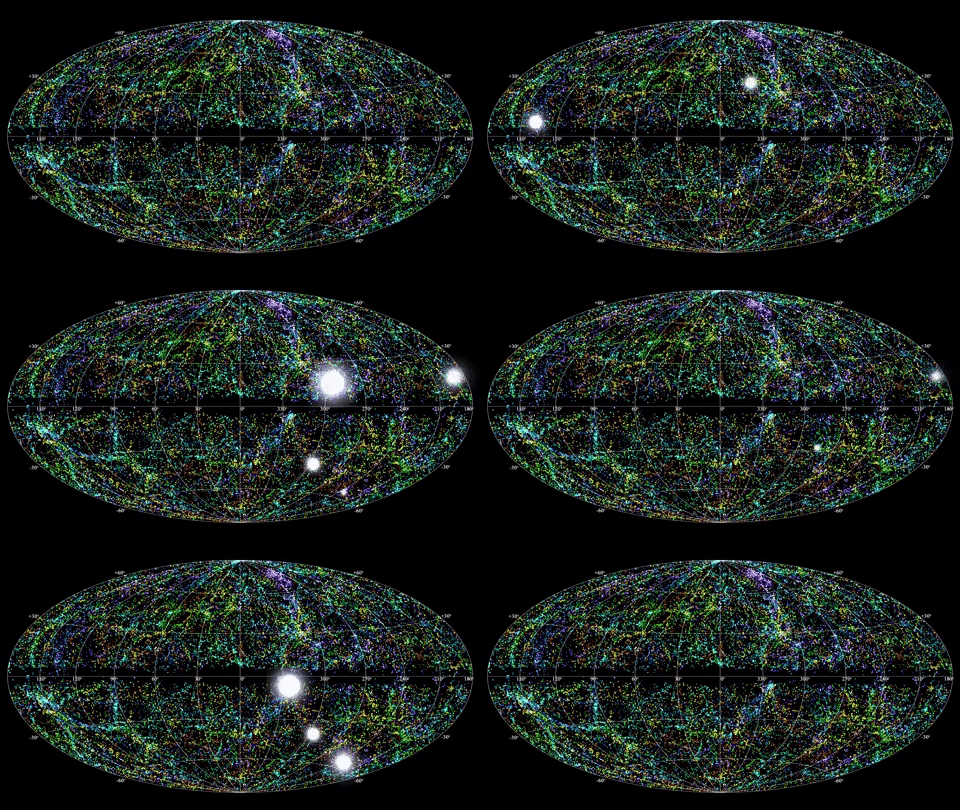
Since 2007, researchers have been receiving ultrastrong, ultrabright radio signals lasting only a few milliseconds. These enigmatic flashes have been called fast radio bursts (FRBs), and they appear to be coming from billions of light-years away (they're not aliens, it's never aliens). Recently, scientists managed to capture a repeating FRB, which flashed six times in a row, the second such signal ever seen and one that could help them unravel this mystery.
2. Nuclear Pasta
(Image credit: NASA/JPL-Caltech)
The strongest substance in the universe forms from the leftovers of a dead star. According to simulations, protons and neutrons in a star's shriveled husk can be subject to insane gravitational pressure, which squeezes them into linguini-like tangles of material that would snap — but only if you applied to them 10 billion times the force needed to shatter steel.
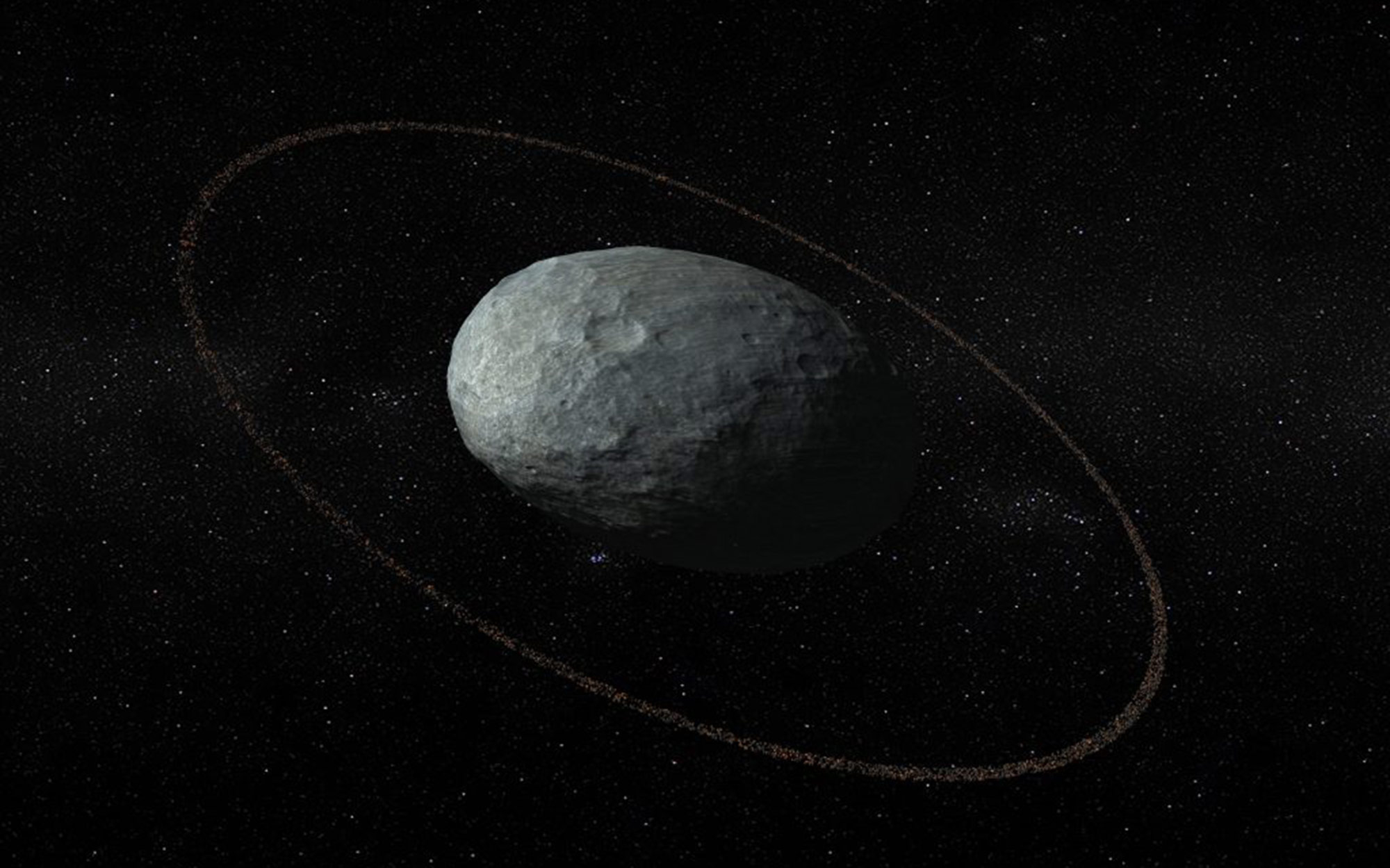
The dwarf planet Haumea, which orbits in the Kuiper Belt out beyond Neptune, is already unusual. It has a strange elongated shape, two moons and a day that lasts only 4 hours, making it the fastest-spinning large object in the solar system. But in 2017, Haumea got even weirder when astronomers watched it pass in front of a star and noticed extremely thin rings orbiting around it, likely the result of a collision sometime in the distant past.
4. A Moon with a Moon
(Image credit: NASA/JPL/Space Science Institute)
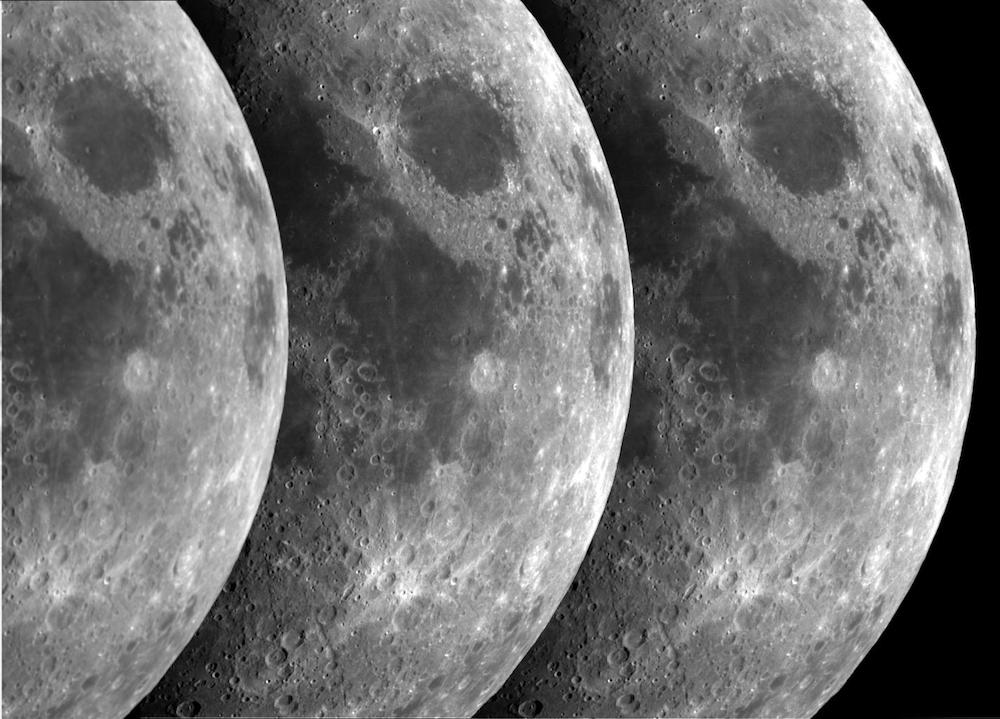
What's better than a moon? A moon orbiting a moon, which the internet has dubbed a moonmoon. Also known as submoons, moonitos, grandmoons, moonettes and moooons, moonmoons are still only theoretical, but recent calculations suggest that there's nothing impossible about their formation. Perhaps astronomers may one day discover one.
5. Dark-Matter-Less Galaxy?
(Image credit: NASA, ESA, and P. van Dokkum (Yale University))
Dark matter — the unknown substance comprising 85 percent of all matter in the universe — is strange. But researchers are at least sure about one thing: Dark matter is everywhere. So team members were scratching their heads over a peculiar galaxy they spotted in March 2018 that seemed to contain hardly any dark matter. Subsequent work suggested that the celestial oddity did in fact contain dark matter, though the finding paradoxically lent credence to an alternative theory positing that dark matter doesn't exist at all. Get it together, astronomers!
6. The Most Bizarre Star
(Image credit: NASA/JPL-Caltech)
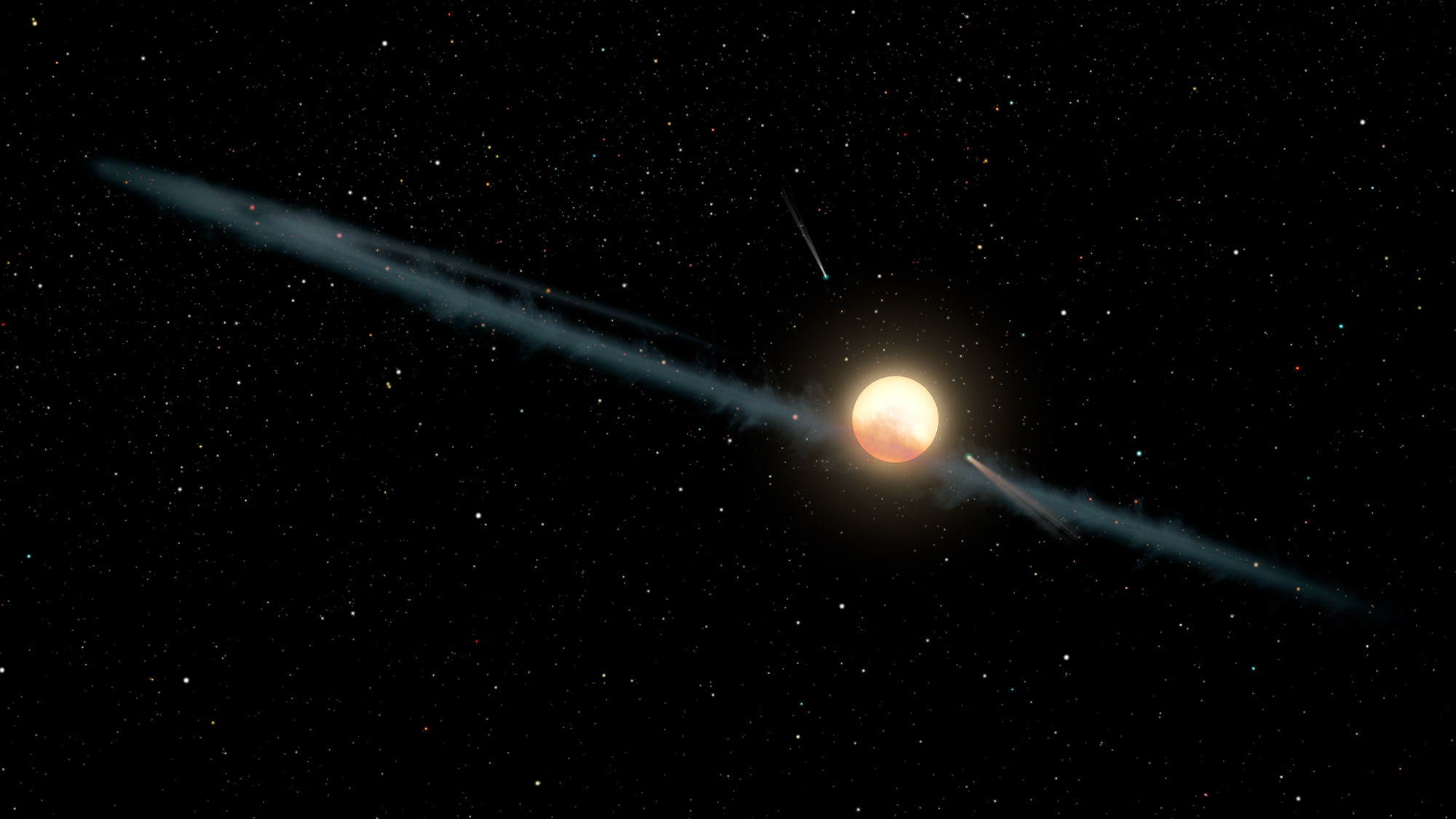
When astronomer Tabetha Boyajian of Louisiana State University and her colleagues first saw the star known as KIC 846285, they were flummoxed. Nicknamed Tabby's star, the object would dip in brightness at irregular intervals and for odd lengths of time, sometimes by as much as 22 percent. Different theories were invoked, including the possibility of an alien megastructure, but nowadays, most researchers believe the star to be surrounded by an abnormal ring of dust that's causing the darkening.
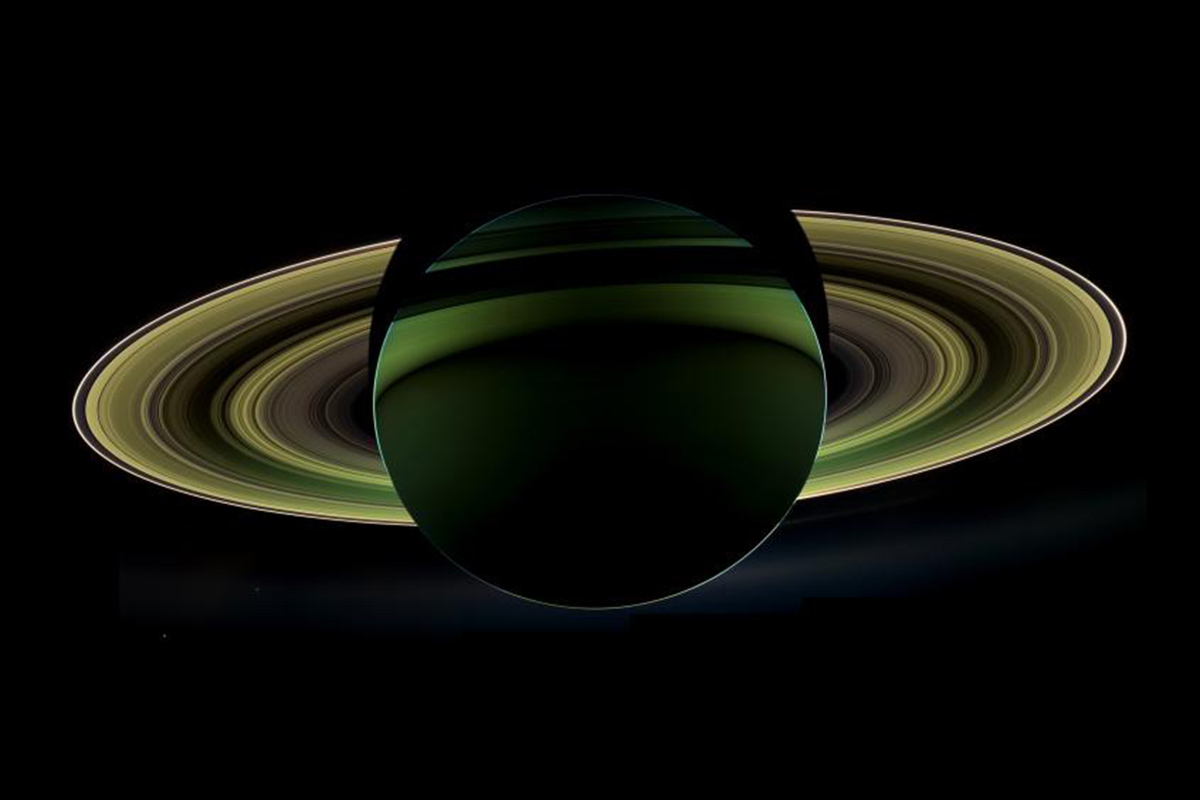
The title of weirdest moon in the solar system could go to many celestial objects — Jupiter's overly volcanic Io, Neptune's geyser-spewing Triton. But one of the strangest looking is Saturn's Hyperion, a pumice-stone-like irregular rock pockmarked with numerous craters. NASA's Cassini spacecraft, which visited the Saturn system between 2004 and 2017, also found that Hyperion was charged with a "particle beam" of static electricity flowing out into space.
8. A Guiding Neutrino
(Image credit: DESY, Science Communication Lab)
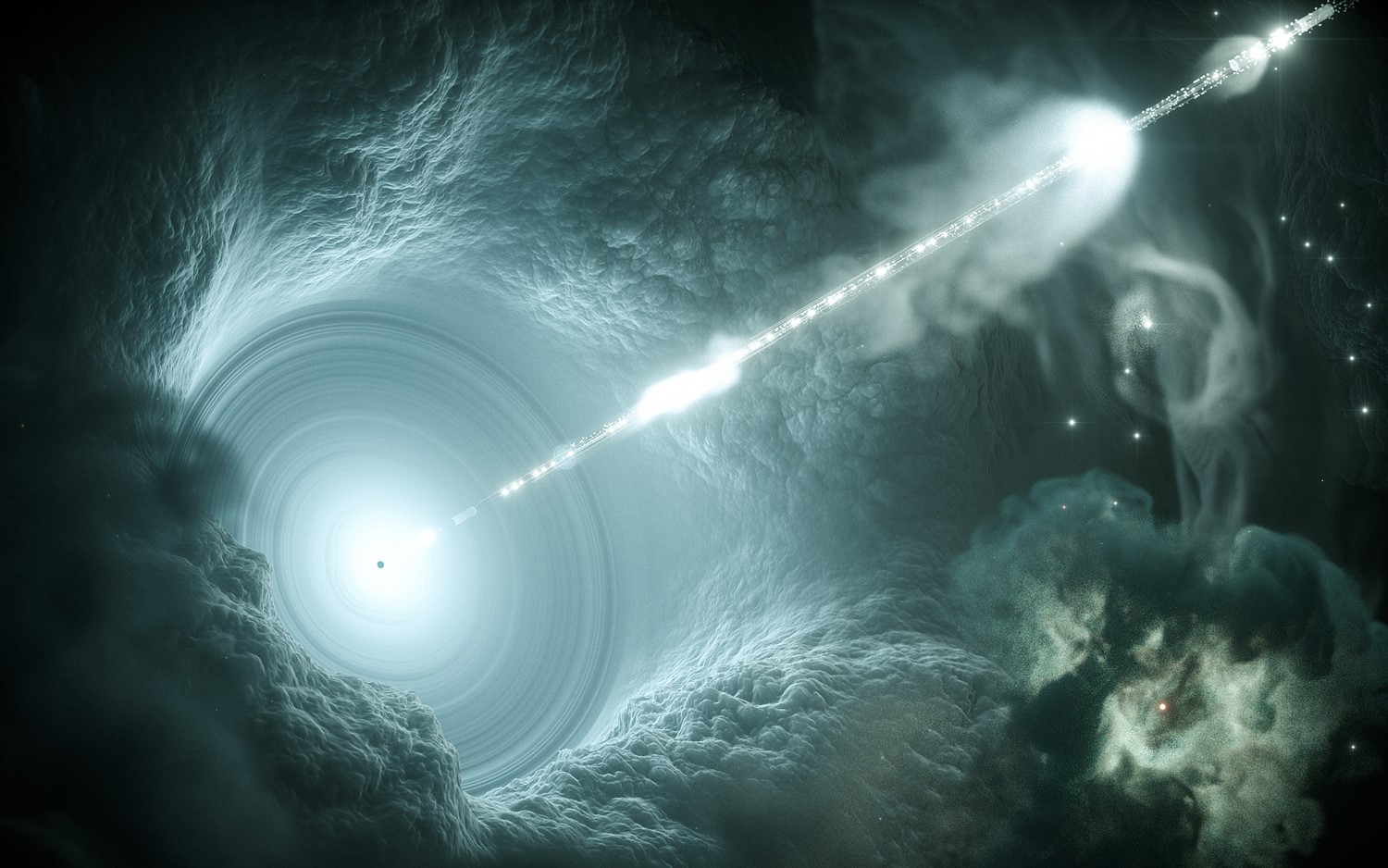
The single, high-energy neutrino that struck Earth on Sept. 22, 2017, wasn't, on its own, all that extraordinary. Physicists at the IceCube Neutrino Observatory in Antarctica see neutrinos of similar energy levels at least once a month. But this one was special because it was the first to arrive with enough information about its origin for astronomers to point telescopes in the direction it came from. They figured out that it had been flung at Earth 4 billion years ago by a flaring blazar, a supermassive black hole at the center of a galaxy that had been consuming surrounding material.
9. The Living Fossil Galaxy
(Image credit: A. Romanowsky/UCO/D. Martinez-Delgado/ARI)
DGSAT I is an ultradiffuse galaxy (UDG), meaning it is as big as a galaxy like the Milky Way but its stars are spread out so thinly that it is nearly invisible. But when scientists saw the ghostly DGSAT 1 in 2016, they noticed that it was sitting all alone, quite unlike other UDGs, which are typically found in clusters. Its characteristics suggest that the faint object formed during a very different era in the universe, back just 1 billion or so years after the Big Bang, making DGSAT 1 a living fossil.
10. Double Quasar Image
(Image credit: NASA Hubble Space Telescope, Tommaso Treu/UCLA, and Birrer et al)
Massive objects curve light, enough so that they can distort the image of things behind them. When researchers used the Hubble Space Telescope to spot a quasar from the early universe, they used it to estimate the universe's expansion rate and found that it is expanding faster today than it was back then — a finding that disagrees with other measurements. Now physicists need to figure out if their theories are wrong or if something else strange is going on.
11. Infrared Stream from Space
(Image credit: ESA/N. Tr’Ehnl (Pennsylvania State University)/NASA)
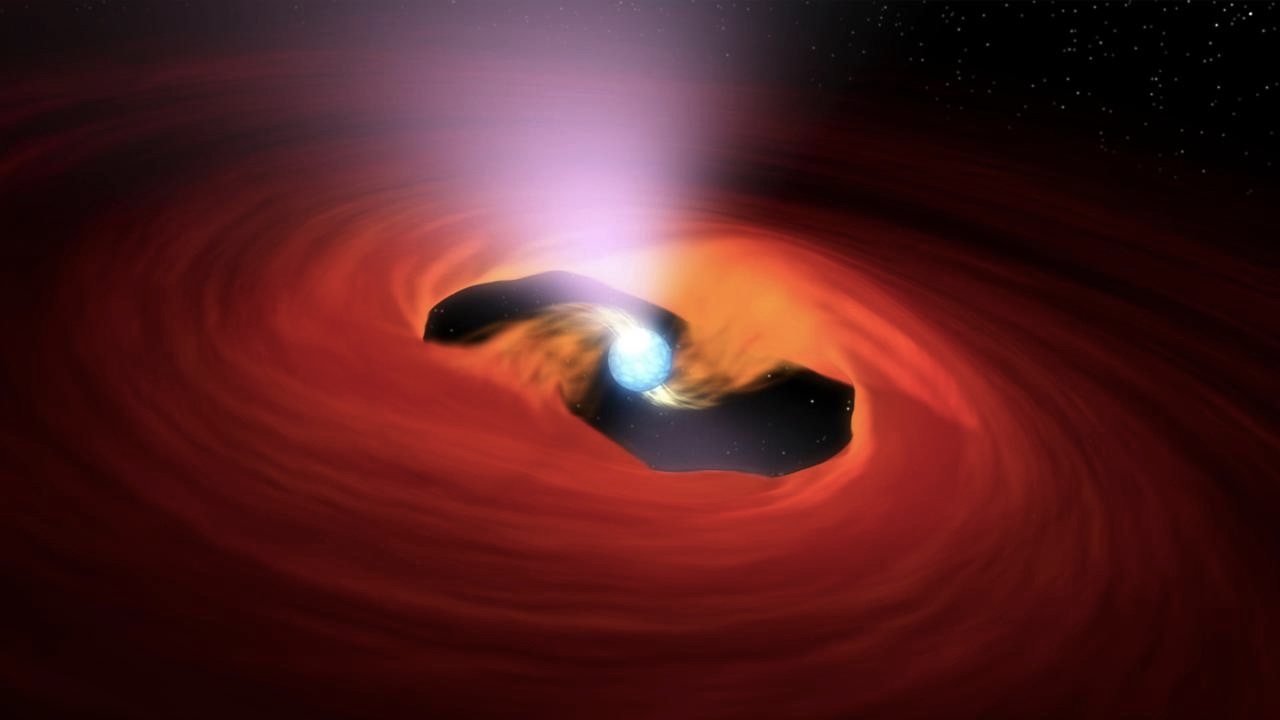
Neutron stars are extremely dense objects formed after the death of a regular star. Normally, they emit radio waves or higher-energy radiation such as X-rays, but in September 2018, astronomers found a long stream of infrared light coming from a neutron star 800 light-years away from Earth — something never before observed. The researchers proposed that a disk of dust surrounding the neutron star could be generating the signal, but the ultimate explanation has yet to be found.
Drifting through the galaxy are rogue planets, which have been flung away from their parent star by gravitational forces. One particular peculiarity in this class is known as SIMP J01365663+0933473, a planet-size object 200 light-years away whose magnetic field is more than 200 times stronger than Jupiter's. This is strong enough to generate flashing auroras in its atmosphere, which can be seen with radio telescopes.
RELATED VIDEOS
Universe's Extremes- The Most Unusual Objects Ever Discovered
TOP 20 STRANGEST Objects Ever Found in the COSMOS
Unbelievable SPACE WONDERS: 20 STRANGEST Discoveries
The Most Mysterious Objects in Space—What Are They Hiding?
First theorized in 1938, heat's wave-like flow through superfluids, known as "second sound", has proven difficult to directly observe. Now, a new technique has finally done it, and could be used to study neutron stars and high-temperature superconductors.
An artist's illustration of particles moving inside a box.
(Image credit: Getty Images)
Scientists have captured direct images of heat behaving like sound — an elusive phenomenon called 'second sound' — for the very first time.
Imaged within an exotic superfluid state of cold lithium-6 atoms by a new heat-mapping technique, the phenomenon shows heat moving as a wave, bouncing like sound around its container.
Understanding the way that second sound moves could help scientists predict how heat flows inside ultradense neutron stars and high-temperature superconductors — one of the "holy grails" of physics whose development would enable near-lossless energy transmission. The researchers published their findings in the journal Science.
"It's as if you had a tank of water and made one half nearly boiling," study co-author Richard Fletcher, an assistant professor of physics at Massachusetts Institute of Technology (MIT), said in a statement. "If you then watched, the water itself might look totally calm, but suddenly the other side is hot, and then the other side is hot, and the heat goes back and forth, while the water looks totally still."
Typically heat spreads from a localized source, slowly dissipating across an entire material as it raises the temperature across it.
But exotic materials called superfluids needn't play by these rules. Created when clouds of fermions (which include protons, neutrons and electrons) are cooled to temperatures approaching absolute zero, atoms inside superfluids pair up and travel frictionlessly throughout the material.
As a result, heat flows differently through the material: instead of spreading through the movements of particles within the fluid, as it typically flows, heat sloshes back and forth within superfluids like a sound wave. This second sound was first predicted by the physicist László Tisza in 1938, but heat-mapping techniques have, until now, proven unable to observe it directly.
"Second sound is the hallmark of superfluidity, but in ultracold gases so far you could only see it in this faint reflection of the density ripples that go along with it," study senior-author Martin Zwierlein, a professor of physics at MIT, said in the statement. "The character of the heat wave could not be proven before."
To capture second sound, the researchers had to solve a daunting problem in tracking the flow of heat inside ultracold gases. These gases are so cold that they do not give off infrared radiation, upon which typical heat-mapping, or thermography, techniques rely.
Instead, the physicists developed a method to track the fermion pairs through their resonant frequencies. Lithium-6 atoms resonate at different radio frequencies as their temperatures change, with warmer atoms vibrating at higher frequencies.
By applying resonant radio frequencies corresponding to warmer atoms, the scientists made these atoms ring in response, enabling them to track the particles’ flow frame by frame.
"For the first time, we can take pictures of this substance as we cool it through the critical temperature of superfluidity, and directly see how it transitions from being a normal fluid, where heat equilibrates boringly, to a superfluid where heat sloshes back and forth," Zwierlein said.
The physicists say that their groundbreaking technique will enable them to better study the behaviors of some of the universe's most extreme objects, such as neutron stars, and measure the conductivity of high-temperature superconductors to make even better designs.
"There are strong connections between our puff of gas, which is a million times thinner than air, and the behavior of electrons in high-temperature superconductors, and even neutrons in ultradense neutron stars," Zwierlein said. "Now we can probe pristinely the temperature response of our system, which teaches us about things that are very difficult to understand or even reach."
Traveling to Mars and Ceres Using Lunar Gateway as a Springboard
By Laurence Tognetti, MSc
Artist's impression of the Lunar Gateway Habitation and Logistics Outpost (HALO) attached to the module Power and Propulsion Element (PPE). (Credit: NASA)
How can humanity use the developing Lunar Gateway as an appropriate starting point for advancing human space exploration beyond the Moon? This is what a recent study presented at the 56th Lunar and Planetary Science Conference (LPSC) hopes to address as a team of researchers evaluated a myriad of ways that Lunar Gateway could be used as a testbed for future technologies involving sending humans to Mars and Ceres. This study has the potential to help scientists, engineers, astronauts, and mission planners develop novel strategies for advancing long-term human space exploration.
For the study, Malaya Kumar Biswal, who is the Founder & CEO of Acceleron Aerospace, and Ramesh Kumar V, the Founder and CEO of Grahaa Space, build on recent research they also presented at LPSC involving the Human Crewed Interplanetary Transport Architecture (HUCITAR), which is a mission concept designed to send humans to Mars and the dwarf planet Ceres.
For this research, the team examined several ways how the Lunar Gateway could be used to help test and prepare technologies and astronauts for future human missions to Mars and Ceres between 2040 and 2050, including propulsion and refueling, life support and radiation shielding, assembly and maintenance, and communications and navigation.
Additionally, they proposed a mission plan for sending humans to Mars and Ceres after launching from the Lunar Gateway, which would involve traveling to Mars, conducting orbital and surface operations, traveling to Ceres for the same goals, then returning home. While the researchers emphasize confidence in their goals and objectives, they caution of the challenges, including risk management, logistical and financial support, science priorities, and technology advancements.
The study concludes, “Advancing the Lunar Gateway to support multi-planetary missions to Mars and Ceres represents a bold step forward in human space exploration. This approach optimizes resources by combining multiple destinations into a single mission and creates sustainable infrastructure for ongoing deep space exploration. Realizing such ambitious missions by 2040-2050 will require global cooperation, sustained funding, and significant technological advancements.”
This study comes as an international consortium comprised of NASA, the European Space Agency (ESA), the Japan Aerospace Exploration Agency (JAXA), the Canadian Space Agency (CSA), and the Mohammed Bin Rashid Space Centre (MBRSC) are currently constructing the first modules of Lunar Gateway with a planned launch date of 2027. These first modules are the Power and Propulsion Element (PPE) and Habitation and Logistics Outpost (HALO), which are being manufactured by Maxar Technologies and Thales Alenia Space, respectively. While this first launch will be uncrewed, the four subsequent missions delivering additional modules will be crewed as part of Artemis IV, V, VI, and VII and currently scheduled for September 2028, March 2030, March 2031, and March 2032, respectively. Expected science to be conducted on the Lunar Gateway includes the fields of planetary science, human health, solar physics, and Earth observation, just to name a few.
Lunar Gateway holds the potential to build on the fantastic research and science that has been conducted on the International Space Station (ISS) for over two decades, which has been instrumental in advancing our understanding of how humans can live and work in space and various scientific fields, including those listed above. While the ISS has been limited to conducting research in low Earth orbit, Lunar Gateway could serve as a springboard for humans exploring beyond the Moon while developing the technology and architecture for mission success.
How will Lunar Gateway help advance human space exploration in the coming years and decades? Only time will tell, and this is why we science!
As always, keep doing science & keep looking up!
A Look Inside NASA’s Lunar Gateway Station!
Lunar Gateway & HALO Explained | NASA's Next Step to the Moon and Beyond
“Startled” UFO in Classified Video: Whistleblower Reveals Shocking Pentagon Program
A former U.S. national security official, Matthew Brown, has come forward with startling revelations about a secret Pentagon program dubbed Immaculate Constellation, which allegedly gathers classified videos and images of UFOs. In a recent interview on the Weaponized podcast with journalist Jeremy Corbell, Brown described previously unseen footage — and shared a theory that’s raising eyebrows in the UAP (Unidentified Aerial Phenomena) research community.
“Startled” Disc Captured on Military Footage
According to Brown, one particular video stood out: a disc-shaped UFO flying over what appeared to be an ocean. The object behaved unusually — gliding playfully through the clouds, it suddenly stopped, seemingly noticing the camera, and then darted away as if startled.
“It’s like it knew it was being watched,” said Brown. “It scoots out of frame, like someone caught it.”
Brown emphasized he doesn’t know whether the object was extraterrestrial, adversarial, or experimental U.S. technology. However, the reaction of the object — intelligent and evasive — suggests an awareness that is difficult to dismiss.
Leaked Footage Confirmed by Corbell
Corbell confirmed he had also seen this same video years earlier and noted that the footage is known within the intelligence community. He stated that while the video is still classified, many such clips have circulated internally for years. He and fellow journalist George Knapp have reviewed a large archive of military-captured UFO videos, most of which remain unpublished due to security restrictions.
Are UFOs Already Here?
During the podcast, Brown went beyond just reporting. He speculated that UFOs — or their occupants — may have been here for much of recorded history, possibly living among us or operating from hidden bases on Earth.
Corbell elaborated that this theory is not new but gaining traction due to “hot spots” — areas on Earth where UFO activity appears to be concentrated. One such region is off the coast of California, where U.S. naval activity and advanced sensor equipment have produced a higher-than-usual volume of strange sightings.
Skepticism vs. Evidence
When asked about skeptics who accuse Corbell and others of fueling conspiracy theories, Corbell pushed back, stating:
“Reality needs to catch up with actual reality. What we’re seeing is verifiable. This isn’t fantasy — it’s documentation.”
He emphasized that the abundance of data — thermal imaging, radar, infrared footage — supports a serious investigation, not science fiction.
‘Startled’ UFO: Whistleblower describes video of disc-shaped object | Elizabeth Vargas Reports
The testimony of Matthew Brown, if accurate, suggests a significant cover-up within government circles regarding non-human technologies or entities. While no physical evidence has yet been released publicly, the consistency in eyewitness reports and internal documentation builds a compelling case.
Whether you’re a believer or a skeptic, one thing is clear: something is being hidden — and it’s not nothing.
RELATED VIDEOS
Ex-Pentagon Official Luis Elizondo On UAP Disclosure And Government Secrecy | Unveiled Ep. 12
'Not alone in the cosmos' - Fmr. Pentagon UFO hunter says US government hides evidence
Pentagon's UFO report finds 21 alleged sightings that could not be explained
Webb Reveals that Europa's Surface is Constantly Changing
By Carolyn Collins Petersen
Europa's surface ices are changing constantly, according to new surface spectra taken by the James Webb Space Telescope. Courtesy: NASA.
You'd think that icy worlds are frozen in time and space because they're - well - icy. However, planetary scientists know that all worlds can and do change, no matter how long it takes. That's true for Europa, one of Jupiter's four largest moons. Recent observations made by the James Webb Space Telescope (JWST) zero in on the Europan surface ices and show they're constantly changing.
Dr. Ujjwal Raut of the Southwest Research Institute (SWRI) reported on the changes reflected in the JWST studies. Not only does Europa's surface have amorphous ice, but there's evidence of crystalline ice scattered around there. That indicates the presence of an active water source, such as the subsurface ocean. It also points toward geologic processes that affect the surface. The changes seen at Europa are very short-term, perhaps two weeks in some places.
“Our data showed strong indications that what we are seeing must be sourced from the interior, perhaps from a subsurface ocean nearly 20 miles (30 kilometers) beneath Europa’s thick icy shell,” said Raut. “This region of fractured surface materials could point to geologic processes pushing subsurface materials up from below. When we see evidence of CO2 at the surface, we think it must have come from an ocean below the surface. The evidence for a liquid ocean underneath Europa’s icy shell is mounting, which makes this so exciting as we continue to learn more.”
What Happens to Europa
As a Galilean moon, Europa orbits near the planet and within its strong magnetic field. Thus, the surface gets bombarded by radiation. It is tidally locked, meaning it shows the same face to Jupiter as it orbits. Europa has a rocky and metallic interior, covered by an ocean and topped by an icy shell that's fairly young in geological terms. It appears to be no more than 180 million years old. That tells us it has been resurfaced from within. JWST's spectral studies of the surface show that the ice crystallizes in different ways in various places. Generally, water ice freezes into hexagonal crystals. That's what we see on Earth when it snows or when rain freezes. However, Earth's surface is largely protected from outside influences such as radiation and the ice stays in crystalline form much longer.
The JWST shows that ice on Europa is developing at different rates in different places, such as Tara Regio, where crystalline ice (lighter colors) is found on the surface as well as below the surface.
Courtesy SWRI.
On Europa, charged particles trapped in Jupiter's magnetic field bombard the surface. That disrupts the crystalline structure of the ice, turning it into amorphous ice. If that's all that ever happened to Europa's surface, you'd expect to see amorphous ice everywhere. Instead, the JWST spectral studies showed evidence of crystalline ice. There are also other surface "units", such as ridges and cracks. Radiation doesn't explain them, but other processes can create them. Combined with the new data collected by JWST, Raut said they are seeing increasing evidence for a liquid ocean beneath the icy surface.
Resurfacing Europa
Scientists thought that Europa’s surface was covered by a very thin (perhaps half a meter thick) layer of amorphous ice protecting crystalline ice below. The new evidence of crystalline ice on the surface also shows up in other areas, especially an area known as the Tara Regio. According to co-author Richard Cartwright of the Johns Hopkins Applied Physics Laboratory, the surface may be different than expected in places. “We think that the surface is fairly porous and warm enough in some areas to allow the ice to recrystallize rapidly,” said Cartwright. “Also, in this same region, generally referred to as a chaos region, we see a lot of other unusual things, including the best evidence for sodium chloride, like table salt, probably originating from its interior ocean. We also see some of the strongest evidence for CO2 and hydrogen peroxide on Europa. The chemistry in this location is really strange and exciting.”
The CO2 found in this area includes the most common type of carbon, with an atomic mass of 12 and containing six protons and six neutrons, as well as the rarer, heavier isotope that has an atomic mass of 13 with six protons and seven neutrons. That raises questions about the origin of the CO2. "It is hard to explain, but every road leads back to an internal origin, which is in line with other hypotheses about the origin of 12CO2 detected in Tara Regio,” Cartwright said.
Sources of Water and Resurfacing
So, how is water forced to the surface? There are two main sources of heat at work: tidal heating and radioactive decay at the core. Both of these processes warm the subsurface ocean and force water to the surface. What causes the chaotic terrain seen at Europa in such places as Tara Regio? There are several possible ways. One way is through the formation of chaos regions - those places that appear to be cracked and jumbled. They could be the result of material forcing its way via diapirs (think of them as stovepipes from below that convey warmer water and slush up to the surface). Once that water gets to the surface, it freezes rapidly into the crystalline ice JWST detected. The water also brings up dissolved CO2 and other materials.
A geological map of Europa showing its interior structure and processes that help change the surface.
Courtesy: by David Hinkle (JPL) in Roberts, J.H., McKinnon, W.B., Elder, C.M. et al. Exploring the Interior of Europa with the Europa Clipper. CC BY 4.0
Another method for water delivery to the surface is through plumes. These geysers shower the surface with ice grains. Other mechanisms that could be forming crystalline ice are migration from other parts of the surface and impact exposure. Impacts are well known to "garden out" fresh ice in a short period of time. Such a collision may well explain the ice seen at Tara.
This resurfacing with crystalline ice is relatively short-lived. That's because the constant bombardment of charged particles works immediately to create amorphous ice. The authors of the paper (see below) state that the charged particle-driven process that changes the ice may work in as little as 15 days on Europa's leading hemisphere. In other places, that might work faster. So, given that Europa is constantly refreshing its surface and charged particles are rapidly breaking that ice down, Europa is a busy, constantly changing place. The upcoming Europa Clipper mission should be able to study these regions in more detail during its many close passes of this tiny moon.
Meer van UFO'S of UAP'S, ASTRONOMIE, RUIMTEVAART, ARCHEOLOGIE, OUDHEIDKUNDE, SF-SNUFJES EN ANDERE ESOTERISCHE WETENSCHAPPEN - DE ALLERLAATSTE NIEUWTJES


 Millennium Falcon In Berkshire, England, UK, Google Earth Map, Star Wars UFO UAP Sighting News.