Ontdek de Fascinerende Wereld van UFO's en UAP's: Jouw Bron voor Onthullende Informatie!
Ben jij ook gefascineerd door het onbekende? Wil je meer weten over UFO's en UAP's, niet alleen in België, maar over de hele wereld? Dan ben je op de juiste plek!
België: Het Kloppend Hart van UFO-onderzoek
In België is BUFON (Belgisch UFO-Netwerk) dé autoriteit op het gebied van UFO-onderzoek. Voor betrouwbare en objectieve informatie over deze intrigerende fenomenen, bezoek je zeker onze Facebook-pagina en deze blog. Maar dat is nog niet alles! Ontdek ook het Belgisch UFO-meldpunt en Caelestia, twee organisaties die diepgaand onderzoek verrichten, al zijn ze soms kritisch of sceptisch.
Nederland: Een Schat aan Informatie
Voor onze Nederlandse buren is er de schitterende website www.ufowijzer.nl, beheerd door Paul Harmans. Deze site biedt een schat aan informatie en artikelen die je niet wilt missen!
Internationaal: MUFON - De Wereldwijde Autoriteit
Neem ook een kijkje bij MUFON (Mutual UFO Network Inc.), een gerenommeerde Amerikaanse UFO-vereniging met afdelingen in de VS en wereldwijd. MUFON is toegewijd aan de wetenschappelijke en analytische studie van het UFO-fenomeen, en hun maandelijkse tijdschrift, The MUFON UFO-Journal, is een must-read voor elke UFO-enthousiasteling. Bezoek hun website op www.mufon.com voor meer informatie.
Samenwerking en Toekomstvisie
Sinds 1 februari 2020 is Pieter niet alleen ex-president van BUFON, maar ook de voormalige nationale directeur van MUFON in Vlaanderen en Nederland. Dit creëert een sterke samenwerking met de Franse MUFON Reseau MUFON/EUROP, wat ons in staat stelt om nog meer waardevolle inzichten te delen.
Let op: Nepprofielen en Nieuwe Groeperingen
Pas op voor een nieuwe groepering die zich ook BUFON noemt, maar geen enkele connectie heeft met onze gevestigde organisatie. Hoewel zij de naam geregistreerd hebben, kunnen ze het rijke verleden en de expertise van onze groep niet evenaren. We wensen hen veel succes, maar we blijven de autoriteit in UFO-onderzoek!
Blijf Op De Hoogte!
Wil jij de laatste nieuwtjes over UFO's, ruimtevaart, archeologie, en meer? Volg ons dan en duik samen met ons in de fascinerende wereld van het onbekende! Sluit je aan bij de gemeenschap van nieuwsgierige geesten die net als jij verlangen naar antwoorden en avonturen in de sterren!
Heb je vragen of wil je meer weten? Aarzel dan niet om contact met ons op te nemen! Samen ontrafelen we het mysterie van de lucht en daarbuiten.
The Holy Mary Apparitions and Their Miracles: Myths OR Reality
1. PREFACE
For centuries, stories have been told about apparitions of the Holy Mary and miraculous events that she would have shown her followers. These phenomena, often described as visions, tears of oil, or other supernatural signs, have had a significant influence on believers and cultures worldwide throughout history. Therefore, it is important to examine these phenomena not only from a religious perspective but also using a scientific approach. Through research from an objective standpoint, we can distinguish between myths and possible facts, gaining a better understanding of the social and psychological factors involved.
The history of Marian apparitions dates back to the Middle Ages, with well-known examples such as Lourdes and Fatima. These events are experienced as true and miraculous by millions of believers, while skeptics see them as psychological phenomena or interpretations of natural processes. Investigating these phenomena scientifically is relevant because it contributes to separating fact from fiction and provides insights into human perception, faith, and culture. Respect for both faith and science is essential here—to remain open to different interpretations without immediate condemnation. By adopting this approach, we may gain a deeper understanding of the complex relationship between religious beliefs and how people interpret supernatural experiences.
2. EXAMPLES OF MARIAN APPARITIONS WORLDWIDE
2.1 Lourdes (France) In 1858, the famous apparition of the Virgin Mary took place in Lourdes, France. Bernadette Soubirous, a young girl from Lourdes, received her first vision on February 11, 1858, in the Massabielle grotto. The context was a Catholic France still recovering from the French Revolution and societal secularization. The Virgin Mary appeared as a young woman in a shining white robe, radiating love, and spoke to Bernadette in the regional dialect. She asked her to pray and to have a spring of water flow, which later became known for its healing properties. The apparitions lasted until July of that year and were quickly recognized as a miracle. The pilgrimage site Lourdes grew into a center of spiritual healing and miraculous cures. In 1862, the Catholic Church officially recognized the apparitions. Since then, Lourdes attracts millions of pilgrims annually who come to pray, seek healing, and strengthen their faith, making it one of the most visited religious sites in the world.
Image: The Holy Bernadette by a Marian statue, 1864 (Rijksmuseum)
2.2 Fatima (Portugal) On May 13, 1917, amidst World War I and political unrest in Portugal, three young children in Fatima experienced a series of apparitions of the Virgin Mary. The context was a time of secularization, war, and social upheaval. The visions continued until October 1917, including the famous solar miracle on October 13, observed by thousands. Mary addressed the children and delivered messages about prayer, penance, and the importance of the rosary. During the last apparition, she predicted a great event that would take place during the solar miracle. The impact was immense: Fatima became a center of devotion and pilgrimage, and her messages remain central to Catholic practice. The story of Fatima continues to inspire millions worldwide and is regarded as a sign of heavenly intervention and hope during difficult times.
2.3 Guadalupe (Mexico) In 1531, Aztec peasant Juan Diego encountered the Virgin Mary on the hill of Tepeyac in Mexico, an event that occurred in the context of Spanish colonization and the oppression of indigenous peoples. Mary asked Juan Diego to build a church at that site. The most notable feature was the image of the Virgin displayed on his tilma (cloak), which is still venerated and preserved today. This apparition offered hope and a sense of liberation to the indigenous population and led to the construction of the Basilica of Guadalupe, one of the most visited religious sites in the world. The image is recognized as a miracle and a symbol of Mexican identity. The church officially acknowledged the apparitions, and Guadalupe remains a powerful symbol of faith and national pride for Mexico and Latin America.
2.4 Beauraing (Belgium) In 1932-1933, a group of children in the village of Beauraing, Belgium, experienced daily visions of the Virgin Mary. These events took place during the interwar period, a time of political uncertainty and rising totalitarianism. The apparitions depicted the Virgin as a loving mother figure, often dressed in white with golden or blue accents. She urged the children to pray, trust, and seek peace. The images of the apparitions varied, but her loving presence was always central. The impact on the local community was profound: it strengthened faith and devotion. The church officially recognized the apparitions in 1949, and Beauraing became an important pilgrimage site and a symbol of hope and peace for many seeking calm and spiritual strength in an uncertain world.
2.5 Kibeho (Rwanda) In the 1980s and 1990s, shortly before the Rwandan genocide, youth in Kibeho, Rwanda, experienced visions of the Virgin Mary. These apparitions carried messages of forgiveness, peace, and prayer. Mary urged the youth to change their lives and seek reconciliation. The impact was deeply felt: many found strength and comfort in her words, and Kibeho developed into a center of spiritual renewal and pilgrimage. The church officially recognized the apparitions in 2001, and since then, thousands of pilgrims visit Kibeho annually to pray for peace and reconciliation for Rwanda and the world. The message of Mary remains a powerful symbol of hope and forgiveness in a country long plagued by violence and conflict.
2.6 Akita (Japan) In 1973, Sister Agnes Sasagawa and her fellow nuns received visions at the Akita monastery in Japan. The context was rapid modernization and secularization in Japan, leading to a decline in religious faith. Mary appeared with open arms, delivering messages about penance, prayer, and forgiveness. A notable miracle was the appearance of oil and bloodstains on her image, which many regarded as signs. These apparitions strengthened devotion in Japan and made Akita an important site for Marian apparitions. The story emphasizes the power of prayer and reconciliation in a world struggling with secularization. Akita remains a powerful symbol of the need for spiritual renewal and hope, highlighting the importance of trust in Mary's message for a changing world.
2.7 Summary These six examples illustrate the worldwide distribution and diverse characteristics of Marian apparitions. They range from Lourdes’ healing power to Kibeho’s messages of peace and Fatima’s extraordinary solar miracle. In all cases, devotion, faith, and hope play central roles. These apparitions continue to inspire millions of believers and attract countless pilgrims annually, exerting a lasting influence on religious practice and culture worldwide.
Image: Apparition of Mary to Bernadette in Lourdes – Painting by Virgilio Tojetti, 1877
3. MIRACLES ATTRIBUTED TO MARY
This chapter explores Mary's role in religious traditions and folk stories, with special attention to the miracles attributed to her. These miracles range from healings and natural disaster prevention to other miraculous events. It is important not only to describe these stories but also to analyze their frequency, nature, and cultural significance, considering scientific and historical perspectives.
3.1 Introduction to miracles and their place in religious traditions Miracles are an integral part of many religious traditions and often serve as evidence of the supernatural power of holy figures. In Catholic doctrine, Mary, as the mother of Jesus Christ, is considered a special intermediary between God and humans. Her miracles are seen as manifestations of her holiness and her role in receiving and transmitting divine grace.
Believers often experience these stories as truthful and inspiring. However, from a scientific and critical standpoint, they are usually interpreted as myths, folk tales, or psychological phenomena. Analyzing these stories within their cultural and historical contexts, while considering scientific plausibility, is therefore essential.
3.2 Types of miracles attributed to Mary The miracles ascribed to Mary can be categorized as follows:
Healings:Possibly the most well-known miracles. People report miraculous recoveries from severe illnesses after pilgrimages to Mary apparitions or prayers to Mary. Examples include cures of chronic diseases or sudden, unexplained recoveries documented in local legends and testimonies.
Prevention of natural disasters: In some regions, it is believed that Mary intervenes to prevent natural calamities such as floods, earthquakes, or epidemics. An example is the veneration of Mary in Lourdes, where many believe pilgrimages have contributed to averting or mitigating disasters
Miracles during pilgrimages and processions: During religious rituals, miraculous events such as healings, disappearance of diseases, or accident prevention are often reported. These stories are passed on by local communities and reinforced by religious authorities
Other miraculous events: These include apparitions, the appearance of miraculous light phenomena, or statues that spontaneously change or bloom.
3.3 Frequency and nature of miracles Precise statistics on the frequency of miracles attributed to Mary are difficult because many stories are passed orally and not always officially documented. Nevertheless, notable collections of testimonies exist, such as those from Lourdes, Fatima, and Guadalupe, where millions of believers gather annually and continue to share miracle stories.
For instance, Lourdes reports thousands of cures each year, with a small percentage recognized as 'medically inexplicable.' These cases are carefully investigated by an international medical committee before an official acknowledgment. Studies suggest that most cures cannot be scientifically explained, though some cases lack clear medical explanations.
Regarding their nature, these miracles are often spontaneous, unexpected, and rarely fully understood. Some researchers point out that faith and the psychological effects of pilgrimages may contribute to healing processes (placebo effect). Moreover, cultural and religious interpretations influence how these events are perceived, leading to different meanings in various contexts.
3.4 Scientific and critical perspectives From a scientific standpoint, miracles such as healings can often be explained by psychological factors, natural healing processes, or self-deception. The placebo effect plays a significant role: belief in Mary's power and hope for a miracle can produce physical and psychological improvements.
Spontaneous remissions—where illnesses or symptoms disappear without clear medical causes—are also part of natural variability or misinterpretation. Sometimes, belief that a phenomenon is supernatural fosters positive attitudes and behaviors that support recovery.
Medical research aims to identify biological and psychological mechanisms behind these phenomena. For example, belief in certain cures can stimulate endorphin production, easing pain and promoting well-being. Psychosomatic factors can also influence symptoms.
3.5 Critical assessment of miracles and apparitions Although it is tempting to see miracles and apparitions as proof of supernatural powers, scientific scrutiny remains necessary. Many phenomena can be explained by psychological and sociological processes, and the lack of reproducible evidence under controlled conditions undermines claims of supernatural origin.
Falsifiability and reproducibility are core scientific principles. Many reported phenomena cannot be consistently replicated or verified independently, which questions their credibility.
3.6 Limitations of scientific research in this domain Researching supernatural phenomena involves significant challenges: controlled experiments are often impossible because experiences depend on subjective perception, belief systems, and contextual factors. Ethical considerations also limit experimental approaches, especially when deception or psychological manipulation is involved.
Bias, cultural influences, and the non-reproducibility of many events further complicate objective analysis. These limitations highlight the importance of cautious interpretation and acknowledgment of uncertainties.
3.7 Conclusion Miracles attributed to Mary encompass a complex phenomenon involving cultural, religious, and psychological dimensions. Although scientific evidence for supernatural interventions is lacking, these stories remain central to folk culture and religious practice, offering comfort, inspiration, and social cohesion.
Understanding these phenomena requires a critical yet respectful approach, recognizing their cultural context while considering scientific explanations. Balancing these perspectives allows a nuanced appreciation of their significance in human life.
4. Objective Scientific Approach
When investigating alleged miracles, apparitions, and psychic phenomena, it is essential to adopt an objective scientific methodology. Only through systematic and critical analysis can we understand the underlying causes and mechanisms, while simultaneously taking into account the complexity and subjective nature of such experiences. This chapter presents a comprehensive, scientifically grounded analysis, discussing psychological and sociological explanations, medical insights, and the limitations of research.
4.1. Psychological Explanations: Hallucinations, Mass Hysteria, and Psychic Phenomena
A key perspective within scientific analysis concerns the psychological factors that may play a role in phenomena such as hallucinations and mass hysteria. Hallucinations are defined as sensory experiences without external stimuli and can be caused by various factors, such as sleep deprivation, stress, trauma, drugs, or mental health disorders. In some cases, individuals are confronted with visual or auditory perceptions that they interpret as supernatural, although in reality they involve neurobiological processes.
Mass hysteria, also known as collective hysteria, is a phenomenon where groups of people simultaneously exhibit unexplained symptoms, often in response to shared fear, stress, or belief. This can manifest as physical complaints or seeing apparitions that are perceived as real by the group. Researchers point out that mass hysteria often arises in situations of social tension, uncertainty, or peer pressure, where the belief that something supernatural is happening can spread rapidly.
Additionally, psychological phenomena such as cognitive biases and suggestibility play a role. People are susceptible to confirmation bias, seeking information that affirms their existing beliefs, and to suggestion, especially when in a state of emotional vulnerability. Hypnosis and trance-like states can further influence perception, making experienced apparitions and miracles more readily accepted.
4.2. Sociological Factors: Peer Pressure, Religious Beliefs, and Cultural Influence
Beyond psychological processes, sociological factors are crucial in the emergence and interpretation of phenomena. Peer pressure and social norms can reinforce perceptions and beliefs in miracles. When a community or religious group recognizes an apparition or healing, this often creates confirmation that feeds and spreads the belief. Social influence, such as suggestion from leaders or influencers within the group, can strengthen the experience and legitimize perceptions of supernatural events.
Religious beliefs provide a powerful context in which phenomena are interpreted. In cultures where supernatural powers and miracles play a central role, perceptions and experiences are often seen as confirmation of the belief system. This cultural context not only influences the interpretation of phenomena but also the perception itself: what is considered a miracle is more readily believed and shared.
Furthermore, historical and cultural factors are influential. In certain regions or eras, phenomena may be more acceptable or expected, influencing observation and reporting. The power of symbolism, rituals, and group identity enhances trust in the phenomena and makes sceptical interpretations less appealing.
4.3. Medical-Scientific Explanations for Healings
Regarding alleged healings, such as cures of diseases or injuries, medical-scientific explanations often offer alternative interpretations. Phenomena perceived as supernatural can frequently be attributed to psychological factors such as the placebo effect, suggestion, and the power of belief. The placebo effect, where a patient experiences improvement due to expectation rather than actual treatment, is well-documented and emphasizes the mind’s role in healing.
Spontaneous remissions, where a disease or symptom disappears without clear medical cause, can also be viewed as natural variations or misinterpretations of a healing process. In some cases, the belief that a phenomenon or healing is supernatural can lead to a positive attitude and behavioral change, which in turn can support recovery.
Research in medical science aims to identify possible biological and psychological mechanisms underlying alleged miracles. For example, belief in certain healings can stimulate endorphin production, promoting pain relief and well-being. Psychosomatic factors may also play a role, where mental states influence physical symptoms.
4.4. Critical Perspective on Miracles and Apparitions
While it is tempting to regard miracles and apparitions as evidence of supernatural powers, from a scientific standpoint, it is necessary to remain critical. Many phenomena can be explained by psychological and sociological processes, and the absence of reproducible evidence under controlled conditions undermines claims of supernatural origin.
It is also important to recognize that the scientific paradigm is based on falsifiability and reproducibility. Many reported phenomena cannot be consistently replicated or verified by independent researchers. This undermines their credibility and raises questions about interpretation and reliability.
4.5. Limitations of Scientific Research in This Domain
Studying supernatural phenomena and miracles presents fundamental limitations. First, controlled experiments are difficult because many phenomena depend on subjective experiences, belief systems, and contextual factors. Setting up double-blind studies, the gold standard in science, is often impossible or unethical.
Furthermore, the problem of interpretation and bias exists. Researchers may unconsciously be influenced by their own beliefs, and reports can be affected by cultural and societal prejudices. Many phenomena are rarely reproducible, which hampers scientific reliability.
Ethical considerations also play a role. Experimenting on people in situations where they may be psychologically exploited or misled can be problematic. Therefore, research in this field must be conducted carefully and ethically, with attention to limitations and the possibility of false positives.
4.6. Conclusion
An objective scientific approach to miracles and apparitions requires critical analysis that integrates psychological, sociological, and medical factors. Although many phenomena can be explained by natural processes, mental phenomena, and cultural influences, it remains important to be sceptical and not hastily conclude that supernatural forces are involved. The limitations of scientific research in this domain make it all the more vital to develop methods that account for the complexity of human experiences and interpretations. Only through open, methodical, and critical approaches can we attain a nuanced understanding that preserves scientific integrity and respects human experiences.
5. Future Perspectives, Credibility, and the Impact of AI in the Assessment of Such Phenomena
The rapidly advancing development of artificial intelligence (AI) offers both opportunities and challenges for the future of evaluating and validating phenomena that are difficult to explain, such as paranormal experiences, unexplained phenomena, and other occurrences outside the current scientific paradigm. This chapter explores possible future perspectives, the credibility of such phenomena, and how AI can influence our assessment methods, in accordance with scientific standards.
5.1. Future Perspectives for the Evaluation of Unexplained Phenomena
The future of scientific research into unexplained phenomena will be characterized by a combination of technological innovations, interdisciplinary collaboration, and a critical yet open attitude toward new data. AI systems, such as advanced machine learning algorithms and neural networks, can analyze large amounts of data and detect patterns that may be invisible to human researchers.
A key development is the use of AI for collecting and analyzing large datasets, including audio and video recordings, sensor data, and witness statements. Systematic processing of these data can help AI models identify repetitions or anomalies that may point to natural explanations or, conversely, unique phenomena deserving further investigation. Additionally, AI systems can be trained to compare and evaluate different explanatory models based on objective criteria.
Furthermore, integrating AI into the research process allows for hypotheses to be tested more systematically and reproducibly. Researchers can quickly determine whether certain phenomena occur consistently under specific conditions, which can strengthen scientific credibility. AI-driven simulations and modeling can also contribute to testing explanations and designing follow-up studies.
5.2. Credibility and Scientific Integrity
Assessing unexplained phenomena requires careful weighing of evidence and a critical attitude toward both human and technological interpretations. The credibility of such phenomena depends on how reproducible and verifiable the observations are, and on whether natural or psychological explanations can be reasonably excluded.
AI can play a vital role by providing objective analyses and minimizing subjective biases. However, the use of AI also carries risks, such as the creation of ‘black box’ models that are difficult to interpret, and the possibility that algorithms contain biases influencing data interpretation. Therefore, transparency and reproducibility in AI applications are essential, and researchers must remain critical of the conclusions derived from these analyses.
It is also crucial for the scientific community to remain open to new phenomena that do not fit within existing paradigms, provided there is sufficient verification and reproducibility. AI can aid by objectively identifying patterns but should never replace the critical evaluation and skepticism inherent to science.
5.3. The Impact of AI on the Evaluation of Unexplained Phenomena
AI’s impact on assessing unexplained phenomena is extensive and can be both positive and negative. Positively, AI can contribute to more objective, efficient, and reproducible analyses of complex datasets, enabling researchers to determine whether phenomena are statistically significant and possibly have natural explanations.
AI also has the potential to generate new hypotheses based on data analysis, leading to the development of new research directions and theoretical models. AI-driven simulations and virtual experiments can help assess the plausibility of various explanations.
On the downside, there is a risk that AI systems are used to support biased viewpoints, such as through selective data analysis or ignoring anomalies that do not fit pre-existing models. The complexity and ‘black box’ nature of some AI algorithms can make it difficult to justify conclusions within the scientific community, leading to doubts about the reliability of findings based on AI analyses.
It is therefore critical that AI applications are developed and used within an ethical and scientific framework that ensures transparency, reproducibility, and testability. Only in this way can AI enhance the credibility of research into unexplained phenomena.
5.4. Conclusion
The future of evaluating unexplained phenomena will undoubtedly be influenced by further development and integration of AI technologies. AI offers significant opportunities for objectifying, accelerating, and improving research, provided it is used responsibly and transparently. Ensuring scientific integrity and credibility remains essential, especially considering the complexity and often subjective nature of these phenomena.
The scientific community must remain critical regarding AI applications, invest in transparent algorithms, and foster open dialogue about interpreting results. Only through a combination of technological innovation and scientific skepticism can the assessment of unexplained phenomena become more reliable, reproducible, and scientifically robust. This can not only increase the credibility of these phenomena but also lead to new insights that deepen our understanding of the world.
6. Positive Closing Word: The Meaning and Future of Marian Apparitions and Miracles
The phenomena surrounding Holy Marian apparitions and miraculous events have been a fascinating and inspiring part of human history and religious practice for centuries. Although often viewed through a lens of mystery and faith, these phenomena also serve as rich sources of cultural meaning, hope, and community. In this overview, it is clear that, despite different interpretations and scientific explanations, the power of these stories is undeniable for millions of believers worldwide.
Examples from Lourdes, Fatima, Guadalupe, Beauraing, Kibeho, and Akita demonstrate that Marian apparitions are universal and experienced and interpreted in diverse cultures in various ways. They create a sense of connection with the supernatural and provide comfort and strength in difficult times. The fact that these phenomena persist and continue to inspire new generations attests to their lasting relevance and profound social and spiritual significance.
Regarding the miracles attributed to Mary, it is undeniable that they play a significant role in strengthening faith and hope. Whether involving healings, preventing disasters, or delivering messages, these miracles often symbolize the power of faith and the hope for a better world. From a scientific perspective, many of these miracles can be explained by psychological and natural processes; however, the power of belief and the symbolism these miracles embody remain meaningful for the co-munities involved.
The scientific approach to these phenomena has shown us that human perception, psychological factors, and sociocultural influences heavily influence their interpretation and reporting. This does not diminish the value of these stories but rather allows them to be placed in a broader context—as expressions of human hope, culture, and identity.
Looking ahead, technological advances, particularly artificial intelligence, hold promising potential in researching and evaluating unexplained phenomena. AI can assist in data collection, analysis, and verification, leading to more objective and transparent assessments. This progress offers opportunities to strengthen the credibility of miracle stories and gain new insights into these phenomena.
It is vital to maintain a balance between openness to new experiences and a critical, scientific attitude. Through a respectful and investigative approach, we can continue to appreciate the significance of Marian apparitions and miracles, without losing sight of the value of human hope and faith. In this way, science and spirituality can complement and reinforce each other.
Finally, we should remember that these phenomena are sources of comfort, inspiration, and connection for many people. They remind us of the power of faith, hope, and human resilience. By embracing both cultural.
De Heilige Maria-verschijningen en Haar Wonderen: Mythen OF Realiteit
1. VOORWOORD.
Al eeuwenlang worden er verhalen verteld over verschijningen van de Heilige Maria en wonderbaarlijke gebeurtenissen die haar aan haar volgelingen zou hebben getoond. Deze verschijnselen, vaak beschreven als visioenen, tranen van olie of andere bovennatuurlijke tekenen, hebben door de geschiedenis heen een grote invloed gehad op gelovigen en culturen wereldwijd. Het is daarom belangrijk om deze fenomenen niet alleen vanuit religieus oogpunt te bekijken, maar ook met een wetenschappelijke benadering. Door onderzoek vanuit een objectief perspectief kunnen we onderscheid maken tussen mythen en mogelijke feiten, en zo een beter begrip krijgen van de maatschappelijke en psychologische factoren die hierbij een rol spelen.
De geschiedenis van Maria-verschijningen gaat terug tot de middeleeuwen, met bekende voorbeelden zoals die in Lourdes en Fatima. Deze gebeurtenissen worden door miljoenen gelovigen als waar en wonderbaarlijk ervaren, terwijl sceptici ze beschouwen als psychologische verschijnselen of interpretaties van natuurlijke processen. Het onderzoeken van deze verschijnselen vanuit een wetenschappelijk perspectief is relevant omdat het bijdraagt aan het scheiden van feit en fictie, en inzicht geeft in menselijke perceptie, geloof en cultuur. Het respect voor zowel geloof als wetenschap is hierbij essentieel, om open te staan voor verschillende interpretaties zonder ze onmiddellijk te veroordelen. Door deze aanpak kunnen we wellicht meer begrip krijgen voor de complexe relatie tussen religieuze overtuigingen en de manier waarop mensen bovennatuurlijke ervaringen interpreteren.
2. Voorbeelden van Maria-verschijningen wereldwijd
2.1. Lourdes (Frankrijk) In 1858 vond de beroemde verschijning van de Maagd Maria plaats in Lourdes, Frankrijk. Bernadette Soubirous, een jonge meid uit Lourdes, kreeg op 11 februari 1858 haar eerste visioen in de grot van Massabielle. De context was een katholiek Frankrijk dat nog herstellende was van de Franse Revolutie en de secularisering van de samenleving. De Maagd Maria verscheen als een jonge vrouw in een glanzend wit gewaad, straalde liefde uit en sprak Bernadette in het dialect van de regio. Ze vroeg haar om te bidden en water uit een bron te laten vloeien, dat later bekend werd als genezend water. De verschijningen duurden tot juli dat jaar, en werden al snel erkend als een wonder. Het bedevaartsoord Lourdes groeide uit tot een centrum van spirituele genezing en geneeskrachtige genezingen. In 1862 erkende de katholieke kerk officieel de verschijningen. Sindsdien trekt Lourdes jaarlijks miljoenen pelgrims die komen bidden, genezing zoeken en hun geloof versterken, waardoor het een van de bekendste en meest bezochte plekken ter wereld is voor katholieken.
De heilige Bernadette bij een Mariabeeld, 1864
(Rijksmuseum)
2.2. Fatima (Portugal) Op 13 mei 1917, te midden van de Eerste Wereldoorlog en de politieke onrust in Portugal, kreeg drie jonge kinderen in Fatima een reeks verschijningen van de Maagd Maria. De context was een tijd van secularisatie, oorlog en maatschappelijke onrust. De verschijningen duurden tot oktober 1917, inclusief het beroemde zonnewonder op 13 oktober dat door duizenden werd waargenomen. Maria sprak de kinderen toe en gaf boodschappen over gebed, boete en het belang van de rozenkrans. Tijdens de laatste verschijning voorspelde ze een grote gebeurtenis die tijdens het zonnewonder zou plaatsvinden. De impact was enorm: Fatima groeide uit tot een centrum van devotie en pelgrimage, en haar boodschappen blijven een kernpunt binnen de katholieke praktijk. Het verhaal van Fatima inspireert nog steeds miljoenen gelovigen wereldwijd en wordt beschouwd als een teken van hemelse interventie en hoop in moeilijke tijden.
2.3. Guadalupe (Mexico) In 1531 ontmoette de Azteekse boer Juan Diego de Maagd Maria op de heuvel Tepeyac in Mexico, een gebeurtenis die plaatsvond in de context van de Spaanse kolonisatie en de onderdrukking van inheemse volkeren. Maria vroeg Juan Diego om een kerk te bouwen op die plek. Het meest opvallende kenmerk was de afbeelding van de Maagd die op zijn tilma (sjaal) werd getoond, die nog altijd wordt vereerd en bewaard. Deze verschijning bood de inheemse bevolking hoop en een gevoel van bevrijding, en leidde tot de oprichting van de basiliek van Guadalupe, een van de meest bezochte religieuze plekken ter wereld. De afbeelding wordt erkend als een wonder en symbool van de Mexicaanse identiteit. De kerk erkende de verschijningen officieel, en Guadalupe blijft een krachtig symbool van geloof en nationale trots voor Mexico en heel Latijns-Amerika.
2.4. Beauraing (België) In de jaren 1932-1933 kreeg een groep kinderen in het dorp Beauraing, België, dagelijks visioenen van de Maagd Maria. De gebeurtenissen vonden plaats in het interbellum, een periode van politieke onzekerheid en opkomst van totalitarisme. De verschijningen toonden de Maagd als een liefdevolle moederfiguur, vaak in witte gewaden met gouden of blauwe tinten. Ze spoorde de kinderen aan tot gebed, vertrouwen en vrede. De verschijningsbeelden varieerden, maar de kern was altijd haar liefdevolle aanwezigheid. De impact op de lokale gemeenschap was groot: het versterkte het geloof en de devotie. De kerk erkende de verschijningen in 1949, en Beauraing werd een belangrijke pelgrimsbestemming en symbool van hoop en vrede voor velen die op zoek waren naar rust en spirituele kracht in een onzekere wereld.
2.5. Kibeho (Rwanda) In de jaren 1980 en 1990, vlak voor de Rwandese genocide, kregen jongeren in Kibeho, Rwanda, visioenen van de Maagd Maria. Deze verschijningen werden gekenmerkt door boodschappen over vergeving, vrede en gebed. Maria spoorde de jongeren aan om hun leven te veranderen en zich te verdiepen in verzoening. De impact was diepgaand: velen vonden kracht en troost in haar woorden, en Kibeho ontwikkelde zich tot een centrum van spirituele vernieuwing en pelgrimage. De kerk erkende de verschijningen in 2001, en sinds die tijd bezoeken jaarlijks duizenden pelgrims Kibeho om te bidden voor vrede en verzoening voor Rwanda en de wereld. De boodschap van Maria blijft een krachtig symbool van hoop en vergeving in een land dat lange tijd geteisterd werd door geweld en conflicten.
2.6. Akita (Japan) In 1973 ontvingen zuster Agnes Sasagawa en haar medezusters visioenen in het klooster van Akita, Japan. De context was de snelle modernisering en secularisatie in Japan, die leidde tot een afname van religieus geloof. Maria verscheen met open armen en gaf boodschappen over boete, gebed en vergeving. Een opvallend wonder was het verschijnen van olie- en bloedvlekken op haar beeld, dat door velen als teken werd erkend. Deze verschijningen versterkten de devotie in Japan en maakten Akita tot een belangrijke plaats voor Maria-verschijningen. Het verhaal benadrukt de kracht van gebed en verzoening in een wereld die worstelt met secularisering. Akita blijft een krachtig symbool voor de noodzaak van spirituele vernieuwing en hoop, en het belang van vertrouwen in Maria’s boodschap voor een wereld in verandering.
2.7. Samenvatting Deze zeS voorbeelden illustreren de wereldwijde spreiding en diverse kenmerken van Maria-verschijningen. Ze variëren van de genezende kracht van Lourdes tot de boodschap van vrede in Kibeho en de bijzondere zonnewonder van Fatima. In alle gevallen spelen devotie, geloof en de kracht van de hoop een centrale rol. Deze verschijningen blijven tot op heden een belangrijke inspiratiebron voor miljoenen gelovigen en trekken jaarlijks talloze pelgrims aan, waarmee ze een blijvende invloed uitoefenen op religieuze praktijk en cultuur wereldwijd.
Verschijning van Maria aan Bernadette in Lourdes – Schilderij van Virgilio Tojetti, 1877
3.Wonderen toegeschreven aan Maria
In dit hoofdstuk wordt de rol van Maria in religieuze tradities en volksverhalen onderzocht, met bijzondere aandacht voor de wonderen die aan haar worden toegeschreven. Deze wonderen variëren van genezingen en het voorkomen van natuurrampen tot andere miraculeuze gebeurtenissen. Het is van belang om hierbij niet enkel de verhalen zelf te beschrijven, maar ook de frequentie, aard en culturele betekenis ervan te analyseren, rekening houdend met wetenschappelijke en historische perspectieven.
3.1 Inleiding tot wonderen en hun plaats in religieuze tradities
Wonderen vormen een integraal onderdeel van veel religieuze tradities en dienen vaak als bewijs voor de bovennatuurlijke kracht van heilige figuren. In de katholieke leer wordt Maria, als moeder van Jezus Christus, beschouwd als een bijzondere tussenpersoon tussen God en de mens. Hierdoor worden haar wonderen vaak gezien als manifestaties van haar heiligheid en haar rol in het ontvangen en doorgeven van goddelijke genade.
De verhalen over wonderen worden door gelovigen vaak als waarheidsgetrouw en inspirerend ervaren. Echter, vanuit een wetenschappelijk en kritisch perspectief worden ze meestal geïnterpreteerd als mythen, volksverhalen of psychologische fenomenen. Het is daarom cruciaal om deze verhalen te analyseren binnen hun culturele en historische context, terwijl ook de wetenschappelijke haalbaarheid en verklaringen worden overwogen.
3.2 Types van wonderen toegeschreven aan Maria
De wonderen die aan Maria worden toegeschreven, kunnen in verschillende categorieën worden onderverdeeld:
Genezingen: Dit zijn misschien wel de meest bekende wonderen. Mensen rapporteren vaak dat zij miraculeus herstelden van ernstige ziekten na bedevaarten naar Maria-verschijningen of het bidden tot Maria. Bijvoorbeeld de genezing van chronische ziekten of plotselinge en onverklaarbare herstelgevallen worden vaak opgetekend in lokale legendes en getuigenissen.
Voorkoming van natuurrampen: In sommige regio's wordt geloofd dat Maria ingrijpt om natuurrampen zoals overstromingen, aardbevingen of epidemieën af te wenden. Een bekend voorbeeld is de verering van Maria in Lourdes, waar velen geloven dat bedevaarten tot haar hebben bijgedragen aan het voorkomen of verminderen van calamiteiten.
Mirakels tijdens bedevaarten en processies: Tijdens religieuze rituelen en processies worden vaak miraculeuze gebeurtenissen gerapporteerd, zoals het ontstaan van genezingen, het verdwijnen van ziekten of het voorkomen van ongevallen. Deze verhalen worden vaak door lokale gemeenschappen doorgegeven en versterkt door religieuze autoriteiten.
Andere miraculeuze gebeurtenissen:Dit kunnen onder andere verschijningen, het ontstaan van wonderbaarlijke lichtfenomenen, of het verschijnen van beeldjes en statuetten die spontaan wonderbaarlijk veranderen of bloeien.
3.3 Frequentie en aard van de wonderen
Het is moeilijk om precieze statistieken te geven over de frequentie van wonderen toegeschreven aan Maria, omdat veel van deze verhalen mondeling worden doorgegeven en niet altijd officieel worden geregistreerd. Wel zijn er enkele opmerkelijke verzamelingen van getuigenissen en rapportages, zoals die van bedevaartplaatsen in Lourdes, Fatima en Guadalupe, waar jaarlijks miljoenen gelovigen samenkomen en wonderverhalen blijven ontstaan.
In Lourdes bijvoorbeeld worden jaarlijks duizenden genezingen gemeld, waarvan er een klein percentage wordt erkend als 'medisch onverklaarbaar'. Het internationaal medisch comité onderzoekt deze gevallen zorgvuldig voordat het een genezing officieel erkent. Uit deze onderzoeken blijkt dat de meeste genezingen niet wetenschappelijk te verklaren zijn, maar dat er ook gevallen zijn waarvan de medische verklaring ontbreekt.
Wat betreft de aard van deze wonderen, zijn ze vaak spontaan, onverwacht en worden ze zelden volledig begrepen. Sommige onderzoekers wijzen erop dat de kracht van geloof en de psychologische effecten van bedevaarten kunnen bijdragen aan genezingsprocessen (placebo-effect). Daarnaast kunnen interpretaties van wonderen worden beïnvloed door culturele en religieuze factoren, waardoor vergelijkbare gebeurtenissen in verschillende contexten verschillende betekenissen krijgen.
3.4 Wetenschappelijke en kritische perspectieven
Vanuit wetenschap en kritische analyse wordt vaak gesteld dat wonderen, zoals genezingen, kunnen worden verklaard door psychologische factoren, natuurlijke genezingsprocessen, of zelfbedrog. Het placebo-effect speelt hierbij een grote rol: het geloof in de kracht van Maria en de hoop dat een wonder zal gebeuren, kunnen fysieke en psychologische effecten veroorzaken die leiden tot verbetering van de gezondheid.
Daarnaast kunnen hallucinaties, cognitieve biases en sociale druk bijdragen aan het ontstaan en onderhouden van verhalen over wonderen. Sommige wetenschappers benadrukken dat de kracht van religieuze overtuigingen en rituelen een therapeutische werking kunnen hebben, zonder dat er sprake is van bovennatuurlijke interventies.
Het is belangrijk te erkennen dat veel wonderverhalen ook symbolisch of allegorisch kunnen zijn, bedoeld om morele of spirituele lessen over te brengen. Ze dienen vaak als bron van troost en hoop voor gelovigen, en versterken de sociale cohesie binnen gemeenschappen.
3.5 Conclusie
De wonderen die aan Maria worden toegeschreven vormen een complex fenomeen dat zowel culturele, religieuze als psychologische dimensies omvat. Hoewel wetenschappelijk bewijs voor bovennatuurlijke interventies ontbreekt, blijven deze verhalen een belangrijke plaats innemen in de volkscultuur en religieuze praktijk. Ze bieden troost, inspiratie en een gevoel van verbondenheid voor miljoenen gelovigen wereldwijd.
Het begrijpen van deze wonderen vraagt om een kritische en respectvolle benadering, waarin de waarde van de verhalen binnen hun culturele context wordt erkend, terwijl ook wetenschappelijke en rationele verklaringen worden overwogen. Door deze balans kunnen we de betekenis van wonderen in religieuze tradities beter waarderen en de rol ervan in het menselijke leven onderzoeken vanuit verschillende perspectieven.
In het onderzoeken van vermeende wonderen, verschijningen en psychische fenomenen is het essentieel om een objectieve wetenschappelijke aanpak te hanteren. Alleen door systematisch en kritisch te analyseren kunnen we de onderliggende oorzaken en mechanismen begrijpen, terwijl we tegelijkertijd rekening houden met de complexiteit en de subjectieve aard van dergelijke ervaringen. In dit hoofdstuk wordt een uitgebreide, wetenschappelijk onderbouwde analyse gepresenteerd, waarin psychologische en sociologische verklaringen, medische inzichten en de beperkingen van het onderzoek worden besproken.
4.1. Psychologische verklaringen: hallucinaties, massahysterie en psychische fenomenen
Een belangrijke invalshoek binnen de wetenschappelijke analyse betreft de psychologische factoren die een rol kunnen spelen bij het ontstaan van verschijnselen zoals hallucinaties en massahysterie. Hallucinaties worden gedefinieerd als zintuiglijke ervaringen zonder externe stimulus en kunnen worden veroorzaakt door diverse factoren, zoals slaapgebrek, stress, trauma, drugs of psychische aandoeningen. In sommige gevallen worden mensen geconfronteerd met visuele of auditieve waarnemingen die zij interpreteren als bovennatuurlijk, terwijl deze in werkelijkheid neurobiologische processen betreffen.
Massahysterie, ook wel collectieve hysterie genoemd, is een fenomeen waarbij groepen mensen gelijktijdig onverklaarbare symptomen vertonen, vaak in reactie op een gedeelde angst, stress of overtuiging. Dit kan zich bijvoorbeeld uiten in lichamelijke klachten of het zien van verschijningen die door de groep als echt worden ervaren. Onderzoekers wijzen erop dat massahysterie vaak ontstaat in situaties van sociale spanning, onzekerheid of groepsdruk, waarbij de overtuiging dat iets bovennatuurlijks gebeurt, zich snel kan verspreiden.
Daarnaast spelen psychische fenomenen zoals cognitieve biases en suggestibiliteit een rol. Mensen zijn vatbaar voor bevestigingsbias, waarbij zij informatie zoeken die hun bestaande overtuigingen bevestigt, en voor suggestie, vooral wanneer ze in een staat van emotionele kwetsbaarheid verkeren. Hypnose en trance-achtige toestanden kunnen de waarneming verder beïnvloeden, waardoor ervaren verschijningen en wonderen eerder worden geaccepteerd.
4.2. Sociologische factoren: groepsdruk, religieuze overtuigingen en culturele invloed
Naast psychologische processen spelen sociologische factoren een cruciale rol in het ontstaan en de interpretatie van verschijnselen. Groepsdruk en sociale normen kunnen de perceptie en het geloof in wonderen versterken. Wanneer een gemeenschap of religieuze groep een verschijning of genezing erkent, ontstaat vaak een bevestiging die het geloof verder voedt en verspreidt. Sociale beïnvloeding, zoals suggestie van leiders of beïnvloeders binnen de groep, kan de ervaring versterken en de perceptie van bovennatuurlijke gebeurtenissen legitimeren.
Religieuze overtuigingen vormen een krachtige context waarin verschijnselen worden geïnterpreteerd. In culturen waar bovennatuurlijke krachten en wonderen een centrale rol spelen, worden waarnemingen en ervaringen vaak gezien als bevestiging van het geloofssysteem. Deze culturele context beïnvloedt niet alleen de interpretatie van verschijnselen, maar ook de waarneming zelf: wat als wonder wordt beschouwd, wordt sneller geloofd en gedeeld.
Daarnaast spelen historische en culturele factoren een rol. In bepaalde regio’s of tijden zijn verschijnselen meer acceptabel of verwacht, wat de waarneming en rapportage kan beïnvloeden. De kracht van symboliek, rituelen en groepsidentiteit versterkt het vertrouwen in de verschijnselen en maakt sceptische interpretaties minder aantrekkelijk.
4.3. Medisch-wetenschappelijke verklaringen voor genezingen
Wat betreft vermeende genezingen, zoals genezingen van ziekten of blessures, bieden medisch-wetenschappelijke verklaringen vaak een alternatieve interpretatie. Verschijnselen die als bovennatuurlijk worden gezien, kunnen in veel gevallen worden toegeschreven aan psychologische factoren zoals placebo-effecten, suggestie en de kracht van geloof. Het placebo-effect, waarbij een patiënt verbetering ervaart door de verwachting dat een behandeling zal werken, is een goed gedocumenteerd fenomeen dat de kracht van de geest in genezing benadrukt.
Daarnaast kunnen spontane remissies, waarbij een ziekte of symptoom zonder duidelijke medische oorzaak verdwijnt, ook worden gezien als natuurlijke variaties of onwetenschappelijke interpretaties van een genezingsproces. In sommige gevallen kan de overtuiging dat een verschijnsel of genezing bovennatuurlijk is, leiden tot een positieve houding en gedragsverandering, die op hun beurt het herstel kunnen ondersteunen.
Medisch-wetenschappelijk onderzoek richt zich op het identificeren van mogelijke biologische en psychologische mechanismen die ten grondslag liggen aan vermeende wonderen. Bijvoorbeeld, het geloof in bepaalde genezingen kan de endorfineproductie stimuleren, wat pijnverlichting en welzijn kan bevorderen. Ook kunnen psychosomatische factoren een rol spelen, waarbij mentale toestanden lichamelijke symptomen beïnvloeden.
4.4. Kritische blik op de vermeende wonderen en verschijningen
Hoewel het verleidelijk is om wonderen en verschijningen als bewijs van bovennatuurlijke krachten te beschouwen, is het vanuit wetenschappelijk perspectief noodzakelijk om kritisch te blijven. Veel verschijnselen kunnen worden verklaard door psychologische en sociologische processen, en het ontbreken van reproduceerbare bewijzen onder gecontroleerde omstandigheden ondermijnt de claims op bovennatuurlijke oorsprong.
Daarnaast is het belangrijk om te erkennen dat het wetenschappelijke paradigma gebaseerd is op falsifieerbaarheid en reproduceerbaarheid. Veel verschijnselen die als wonder worden beschreven, kunnen niet consistent worden herhaald of geverifieerd door onafhankelijke onderzoekers. Dit ondermijnt de geloofwaardigheid en roept vragen op over de interpretatie en betrouwbaarheid van de rapportages.
4.5. Discussie over de beperkingen van wetenschappelijk onderzoek in dit domein
Het onderzoeken van bovennatuurlijke verschijnselen en wonderen brengt ook fundamentele beperkingen met zich mee. Ten eerste is het moeilijk om gecontroleerde experimenten uit te voeren, omdat veel verschijnselen afhankelijk zijn van subjectieve ervaringen, geloofssystemen en contextuele factoren. Het opzetten van dubbelblinde studies, die de gouden standaard vormen in de wetenschap, is vaak onmogelijk of onethisch.
Verder is er het probleem van interpretatie en bias. Onderzoekers kunnen onbewust hun eigen overtuigingen laten doorwegen in de analyse, en rapportages kunnen worden beïnvloed door culturele en maatschappelijke vooroordelen. Bovendien zijn veel verschijnselen zelden reproduceerbaar, wat de wetenschappelijke betrouwbaarheid ondermijnt.
Tot slot moeten we rekening houden met de ethische overwegingen. Het experimenteren met mensen in situaties waarin ze mogelijk psychologisch worden uitgebuit of misleid, kan ethisch problematisch zijn. Daarom is het noodzakelijk dat wetenschappelijk onderzoek in dit domein zorgvuldig en ethisch verantwoord wordt uitgevoerd, met aandacht voor de beperkingen en de mogelijkheid van fout-positieven.
4.6. Conclusie
Een objectieve wetenschappelijke benadering van wonderen en verschijningen vereist een kritische analyse waarbij psychologische, sociologische en medische factoren worden geïntegreerd. Hoewel veel verschijnselen kunnen worden verklaard door natuurlijke processen, psychische fenomenen en culturele invloeden, blijft het belangrijk om sceptisch te blijven en niet te snel te concluderen dat bovennatuurlijke krachten aan het werk zijn. De beperkingen van wetenschappelijk onderzoek in dit domein maken het des te belangijker om methoden te ontwikkelen die rekening houden met de complexiteit van menselijke ervaringen en interpretaties. Alleen door open, methodisch en kritisch te blijven, kunnen we tot een genuanceerd begrip komen dat zowel wetenschappelijke integriteit als respect voor menselijke ervaringen waarborgt.
5. Toekomstperspectieven, geloofwaardigheid en de impact van A.I. in de beoordeling van dergelijke verschijningen
De snel voortschrijdende ontwikkeling van kunstmatige intelligentie (AI) biedt zowel kansen als uitdagingen voor de toekomst van het beoordelen en valideren van verschijningen die moeilijk te verklaren zijn, zoals paranormale ervaringen, onverklaarbare fenomenen en andere fenomenen die buiten het huidige wetenschappelijke paradigma vallen. In dit hoofdstuk wordt ingegaan op de mogelijke toekomstperspectieven, de geloofwaardigheid van dergelijke verschijnselen en de wijze waarop AI de manier waarop wij deze verschijnselen beoordelen kan beïnvloeden, met inachtneming van de geldende wetenschappelijke normen.
5.1 Toekomstperspectieven voor de beoordeling van onverklaarbare verschijnselen
De toekomst van het wetenschappelijk onderzoek naar onverklaarbare verschijnselen wordt gekenmerkt door een combinatie van technologische innovaties, interdisciplinair samenwerken en een kritische, open houding ten opzichte van nieuwe gegevens. AI-systemen, zoals geavanceerde machine learning-algoritmes en neurale netwerken, kunnen grote hoeveelheden data analyseren en patronen detecteren die voor menselijke onderzoekers mogelijk niet zichtbaar zijn.
Een belangrijke ontwikkeling is de inzet van AI voor het verzamelen en analyseren van grote datasets, zoals audio- en video-opnames, sensorwaarden en getuigenverklaringen. Door deze gegevens systematisch te verwerken, kunnen AI-modellen bijvoorbeeld helpen om herhalingen of anomalieën te identificeren die mogelijk wijzen op natuurlijke verklaringen of, juist, op unieke verschijningsvormen die nader onderzoek verdienen. Daarnaast kunnen AI-systemen worden getraind om verschillende verklaringsmodellen te vergelijken en te evalueren op basis van objectieve criteria.
Verder biedt de integratie van AI in het onderzoeksproces de mogelijkheid om hypotheses op een meer gestructureerde en reproduceerbare wijze te testen. Hierdoor kunnen onderzoekers bijvoorbeeld sneller vaststellen of bepaalde verschijnselen consistent voorkomen onder specifieke omstandigheden, wat de wetenschappelijke geloofwaardigheid kan versterken. Ook kunnen AI-gestuurde simulaties en modellering bijdragen aan het testen van verklaringen en het ontwerpen van vervolgonderzoek.
5.2 Geloofwaardigheid en wetenschappelijke integriteit
Het beoordelen van onverklaarbare verschijnselen vereist een zorgvuldige afweging van bewijs en een kritische houding ten opzichte van zowel menselijke als technologische interpretaties. De geloofwaardigheid van dergelijke verschijnselen hangt af van de mate waarin de waarnemingen reproduceerbaar en controleerbaar zijn, en van de mate waarin mogelijke natuurlijke of psychologische verklaringen uitgesloten kunnen worden.
AI kan hierbij een belangrijke rol spelen door objectieve analyses te bieden en subjectieve vooroordelen te minimaliseren. Echter, de inzet van AI brengt ook risico’s met zich mee, zoals het ontstaan van ‘black box’-modellen die moeilijk te begrijpen zijn, en de mogelijkheid dat algoritmes bias bevatten die de interpretatie van gegevens beïnvloeden. Daarom is het essentieel dat AI-toepassingen transparant en reproduceerbaar zijn, en dat onderzoekers kritisch blijven op de interpretaties die uit de analyses voortvloeien.
Het is ook van belang dat de wetenschappelijke gemeenschap openstaat voor nieuwe verschijnselen die niet direct binnen de bestaande paradigma’s passen, zolang er voldoende verificatie en reproduceerbaarheid is. Het gebruik van AI kan hierbij helpen door het objectief identificeren van patronen, maar mag nooit de kritische evaluatie en het scepticisme vervangen dat kenmerkend is voor de wetenschap.
5.3 De impact van AI op de beoordeling van onverklaarbare verschijnselen
De impact van AI op de beoordeling van onverklaarbare verschijnselen is veelomvattend en kan zowel positief als negatief uitpakken. Aan de positieve kant kan AI bijdragen aan een meer objectieve, efficiënte en reproduceerbare analyse van complexe datasets. Hierdoor kunnen onderzoekers sneller en met meer vertrouwen vaststellen of bepaalde verschijnselen statistisch significant zijn en of ze mogelijk natuurlijke verklaringen hebben.
Daarnaast biedt AI de mogelijkheid om nieuwe hypotheses te genereren op basis van data-analyse, wat kan leiden tot het ontwikkelen van nieuwe onderzoeksrichtingen en theoretische modellen. Ook kunnen AI-gestuurde simulaties en virtuele experimenten helpen om de plausibiliteit van verschillende verklaringen te testen.
Aan de andere kant bestaat het risico dat AI-systemen worden gebruikt ter ondersteuning van vooringenomen standpunten, bijvoorbeeld door selectieve data-analyse of door het negeren van afwijkingen die niet passen binnen de vooraf vastgestelde modellen. Bovendien kunnen de complexiteit en de ‘black box’-karakteristiek van sommige AI-algoritmes het moeilijk maken om de conclusies te verantwoorden binnen de wetenschappelijke gemeenschap. Dit kan leiden tot twijfel over de betrouwbaarheid van bevindingen die gebaseerd zijn op AI-analyses.
Het is daarom van groot belang dat AI-toepassingen worden ontwikkeld en gebruikt binnen een ethisch en wetenschappelijk kader dat transparantie, reproduceerbaarheid en toetsbaarheid waarborgt. Alleen zo kan AI bijdragen aan een verhoogde geloofwaardigheid van onderzoek naar onverklaarbare verschijnselen.
5.4 Conclusie
De toekomst van het beoordelen van onverklaarbare verschijnselen wordt ongetwijfeld beïnvloed door de verdere ontwikkeling en integratie van AI-technologieën. AI biedt enorme kansen voor het objectiveren, versnellen en verbeteren van het onderzoeksproces, mits deze op een verantwoorde en transparante wijze worden ingezet. Het waarborgen van wetenschappelijke integriteit en geloofwaardigheid blijft daarbij essentieel, vooral gezien de complexiteit en de vaak subjectieve aard van de verschijnselen.
De wetenschappelijke gemeenschap moet daarom kritisch blijven op de toepassingen van AI, investeren in transparante algoritmes en zorgen voor een open dialoog over de interpretatie van de resultaten. Alleen door een combinatie van technologische innovatie en wetenschappelijke scepticisme kunnen we hopen dat de beoordeling van onverklaarbare verschijnselen in de toekomst meer betrouwbaar, reproduceerbaar en wetenschappelijk verantwoord wordt. Hierdoor kunnen we niet alleen de geloofwaardigheid van deze verschijnselen vergroten, maar ook nieuwe inzichten verwerven die ons begrip van de wereld verder kunnen verdiepen.
6. Positief Eindwoord: De Betekenis en Toekomst van Maria-verschijningen en Wonderen
De fenomenen rondom Heilige Maria-verschijningen en wonderbare gebeurtenissen vormen al eeuwenlang een fascinerend en inspirerend onderdeel van de menselijke geschiedenis en religieuze praktijk. Hoewel ze vaak worden bekeken door een lens van mysterie en geloof, bieden deze verschijnselen ook een rijke bron van culturele betekenis, hoop en gemeenschap. In dit overzicht hebben we kunnen zien dat, ondanks de verschillende interpretaties en wetenschappelijke verklaringen, de kracht van deze verhalen onmiskenbaar is voor miljoenen gelovigen over de hele wereld.
De voorbeelden uit Lourdes, Fatima, Guadalupe, Beauraing, Kibeho en Akita illustreren dat Maria-verschijningen universeel zijn en in diverse culturen op verschillende manieren worden ervaren en geïnterpreteerd. Ze scheppen niet alleen een gevoel van verbondenheid met het bovennatuurlijke, maar bieden ook troost en kracht in moeilijke tijden. Het feit dat deze verschijnselen blijven voortbestaan en telkens nieuwe generaties aanspreken, getuigt van hun blijvende relevantie en diepe maatschappelijke en spirituele betekenis.
Wat betreft de wonderen die aan Maria worden toegeschreven, kunnen we niet ontkennen dat ze een grote rol spelen in het versterken van het geloof en het geven van hoop. Of het nu gaat om genezingen, het voorkomen van rampen of het ontvangen van boodschappen, deze wonderen symboliseren vaak de kracht van geloof en de hoop op een betere wereld. Wetenschappelijk gezien kunnen veel van deze wonderen worden verklaard door psychologische en natuurlijke processen; toch blijft de kracht van geloof en de symboliek die deze wonderen vertegenwoordigen, onmiskenbaar voor de betrokken gemeenschappen.
De wetenschappelijke benadering van deze verschijnselen heeft ons geleerd dat menselijke perceptie, psychologische factoren en socioculturele invloeden een grote rol spelen in de interpretatie en rapportage ervan. Dit betekent niet dat de waarde van de verhalen wordt verminderd, maar juist dat ze in een bredere context kunnen worden geplaatst, waarin ze niet alleen als bovennatuurlijke feiten worden gezien, maar ook als uitingen van menselijke hoop, cultuur en identiteit.
Voor de toekomst zien wij een veelbelovende ontwikkeling in de rol van technologie, met name kunstmatige intelligentie, in het onderzoeken en evalueren van onverklaarbare verschijnselen. AI kan bijdragen aan het verzamelen, analyseren en verifiëren van gegevens, waardoor een meer objectieve en transparante beoordeling mogelijk wordt. Deze technologische vooruitgang biedt niet alleen kansen om de geloofwaardigheid van wonderverhalen te versterken, maar ook om nieuwe inzichten te verkrijgen die ons begrip van deze fenomenen kunnen verdiepen.
Het is belangrijk dat we bij deze vooruitgang een evenwicht bewaren tussen openheid voor nieuwe ervaringen en een kritische, wetenschappelijke houding. Door een respectvolle en onderzoekende benadering kunnen we de betekenis van Maria-verschijningen en wonderen blijven waarderen, zonder daarbij de waarde van menselijke hoop en geloof uit het oog te verliezen. Zo kunnen we een wereld creëren waarin wetenschap en spiritualiteit elkaar aanvullen en versterken.
Tot slot mogen we niet vergeten dat deze verschijnselen voor veel mensen een bron van troost, inspiratie en verbondenheid vormen. Ze herinneren ons aan de kracht van geloof, hoop en menselijke veerkracht. Door open te staan voor zowel de culturele en spirituele waarde als de wetenschappelijke inzichten, kunnen we de rijke geschiedenis en de toekomst van Maria-verschijningen en wonderen waarderen en koesteren.
In een wereld die voortdurend in verandering is, blijven deze fenomenen een baken van hoop en menselijk vertrouwen. Ze moedigen ons aan om met respect, nieuwsgierigheid en wetenschappelijke integriteit te blijven zoeken naar de diepere betekenissen en waarheden achter deze eeuwenoude verhalen. Zo kunnen we samen bouwen aan een wereld waarin geloof en wetenschap elkaar versterken en inspireren, en waarin de hoop op wonderen en bovennatuurlijke kracht een positieve rol blijft spelen in ons collectieve verhaal.
referenties
Benedict XVI (2007).De Waarheid over Maria: Een theologische beschouwing. Uitgeverij Librije.
Behandelt de theologische aspecten van Maria-verschijningen en hun betekenis binnen de Katholieke Kerk.
Hoffman, B. (2015).Marian Apparitions: Miracles or Myths? Journal of Religious Studies, 29(3), 45-60.
Analyseert verschillende beroemde Maria-verschijningen en onderzoekt de vermeende wonderen.
Liguori, A. (2012).Miracles of the Virgin Mary. Ignatius Press.
Een uitgebreide verzameling verhalen over wonderen toegeschreven aan Maria-verschijningen.
Sabatier, A. (2010).De Waarheid Achter de Wonderen: Maria-verschijningen onder de Loep. Tijdschrift voor Religie en Mystiek, 18(2), 73-85.
Kritische analyse van de authenticiteit en de mythische elementen van Maria-wonderen.
Meyer, J. (2018).The Science of Miracles: Investigating Marian Apparitions. Scientific American, 319(4), 55-60.
Onderzoekt de wetenschappelijke benadering van wonderen en verschijningen.
De Bock, C. (2014).Haar Wonderen: Een Cultureel en Religieus Onderzoek. Universiteit Gent.
Academisch proefschrift over de culturele impact van Maria-wonderen.
Vandermeersch, P. (2011).De Verschijning van Maria: Mythe of Mysterie? Tijdschrift voor Kerkgeschiedenis, 54(1), 89-105.
Behandelt de historische context van Maria-verschijningen.
Kören, D. (2009).Miracles and Faith: The Case of Our Lady of Lourdes. Oxford University Press.
Gespecialiseerd in de Lourdes-verschijningen en wonderen.
Gray, M. (2013).The Psychological Perspective on Marian Apparitions. Journal of Psychology and Religion, 31(2), 123-137.
Onderzoekt de psychologische verklaringen voor verschijningen.
Schmidt, R. (2016).The Reality of Miracles: Scientific and Theological Perspectives. Notre Dame University Press.
Een uitgebreide discussie over de realiteit van wonderen.
Kant, I. (2010).Mythen en Realiteit: Een Filosofisch Onderzoek naar Wonderen. Filosofie Magazine, 22(4), 44-50.
Filosofische analyse van het concept van wonderen en mythen.
Lourdes, V. (2018).De Legende van Lourdes: Wonder of Verhaal? Heiligenleven Tijdschrift, 12(1), 34-42.
Focus op de beroemde Lourdes-verschijningen en de vraag of ze als echt kunnen worden beschouwd.
Fifty-nine individual images went into the creation of this Perseverance rover selfie. (Credit: NASA/JPL-Caltech/MSSS)
NASA’s Perseverance rover landed on Mars in the Jezero Crater on February 18, 2021. The area is thought to have once been a lake bed that held water billions of years ago, making it a prime location to study the planet’s geological history. Equipped with advanced instruments, Perseverance is tasked with analyzing Martian rocks, soil, and the atmosphere of the red planet. It’s also collecting rock samples for a future collect and return mission to bring them back to Earth for analysis.
A view of the Jezero Crater from the Perseverance Rover on Mars
(Credit : NASA)
It is equipped with a suite of 23 cameras, each serving a specific role in navigation, scientific analysis and engineering. Among them, Mastcam-Z is a powerful zoomable imaging system that captures high-resolution colour panoramas and 3D stereoscopic views of the Martian landscape. The SuperCam, mounted on the rover’s mast, not only takes detailed images but also uses lasers and spectroscopy to analyze the composition of rocks from a distance. Navigation and hazard avoidance are managed by cameras like Navcams and Hazcams, which help the rover safely traverse Mars’ rugged terrain. Finally the WATSON camera, located on the robotic arm, captures close-up images of rock textures and plays a key role in documenting sample collection and it is also often used to grab selfies of the rover.
Schematic showing cameras on the Perseverance Rover
(Credit : NASA)
On May 10th, Perseverance used the WATSON camera to grab a selfie to mark its 1,500th day on Mars. NASA got a surprise though with an unexpected guest star in the image..a towering dust devil swirling in the distance photobombed the shot. The rover was on Witch Hazel Hill, an area on the rim of Jezero Crater that it has been exploring for the last 5 months.
To create a full selfie, the rover moves its arm through a series of carefully planned positions, snapping dozens of individual images from different angles. These photos are then stitched together into a seamless composite, showing the rover as if someone else took the picture. The selfie recently released was made up of 59 separate photos and took about an hour to capture due to all the complex arm movements required.
The image not only shows the rover in fine health albeit covered in a fine layer of Martian dust but it also shows a fresh bore hole drilled for sample collection. Perhaps the real star of the show though, was the dust devil 5km away in the background! The dust devils on Mars are just like those seen on Earth; towering, swirling columns of dust and wind that form when sunlight heats the surface creating warm air to rise and spin. They can reach heights of several kilometres and move across the surface leaving tracks in the fine red powdery surface material. They look dramatic and perhaps even scary but they are generally harmless and often help clean solar panels by blowing off accumulated dust.
Science broadcaster and author. Mark is known for his tireless enthusiasm for making science accessible, through numerous tv, radio, podcast and theatre appearances, and books. He was a part of the aware-nominated BBC Stargazing LIVE TV Show in the UK and his Spectacular Science theatre show has received 5 star reviews across UK theatres. In 2025 he is launching his new pocast Cosmic Commerce and is working on a new book 101 Facts You Didn't Know About Deep Space In 2018, Mark received an Honorary Doctorate from the University of East Anglia.
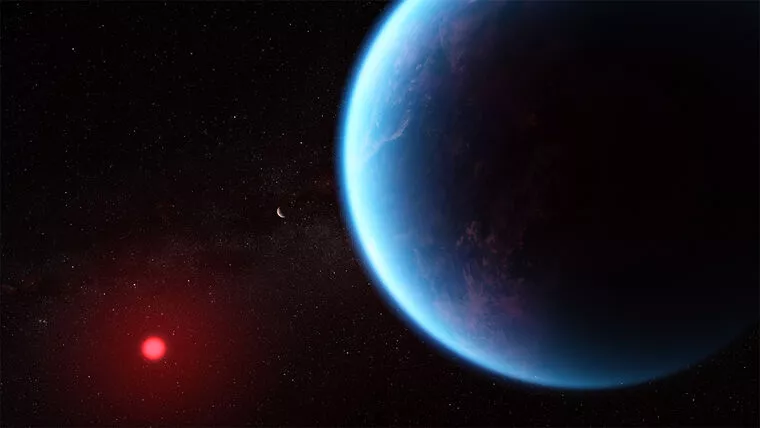
This artist's illustration shows an exomoon orbiting an exoplanet in a distant solar system. Astronomers have found hints of exomoons but no solid proof yet. How likely are exomoons in the habitable zones around other stars? Image Credit: NASA GSFC/Jay Friedlander and Britt Griswold
Of the roughly 6,000 exoplanets we've discovered, a significant number are in the apparent habitable zones of their stars. Most are giant planets; either gas giants like Jupiter and Saturn, or ice giants like Uranus and Neptune. Could some of those have habitable exomoons?
No life could exist on our Solar System's giant planets. However, some of their moons have become prime targets in the search for life. It leads to a natural question: Could giant exoplanets in habitable zones around other stars have habitable moons?
Astronomers have detected only tantalizing hints of exomoons, even though their existence is virtually guaranteed. Theory shows that moon formation is a natural process. Finding exoplanets is difficult, even though we've become used to it, and finding their moons is even more difficult.
Researchers from Hungary and the Netherlands wanted to study how exomoons might form around distant, giant planets to gain insight into their existence. Their research is titled "Grand Theft Moons: Formation of habitable moons around giant planets," and it will be published in Astronomy and Astrophysics. The lead author is Zoltán Dencs from the HUN-REN Research Centre for Astronomy and Earth Sciences.
"We aim to study moon formation around giant planets in a phase similar to the final assembly of planet formation," the authors write. "We search for conditions for forming the largest moons with the highest possibility in circumplanetary disks, and investigate whether the resulting moons can be habitable."
It starts with circumplanetary disks, the rotating collection of material that remains after a planet forms. The researchers used simulations to determine what fraction of that material can successfully form moons. In this case, the researchers focused on the most massive moons.
This ALMA image from 2019 shows the circumplanetary disk around exoplanet PDS 70c, the point-like source on the right side. This was the first time astronomers had seen one of these disks, and the discovery validated theories about planet and moon formation.
Image Credit: By ALMA (ESO/NAOJ/NRAO)/Benisty et al., CC BY 4.0
"We determined the fraction of the circumplanetary disk's mass converted into moons using numerical N-body simulations where moon embryos grow via embryo−satellitesimal collisions," the researchers write. They examined the disks around giant planets where 100 lunar embryos interact with 1000 satellitesimals. The planets were 461 known giant exoplanets from an exoplanet database.
A habitable zone for planets depends on the stellar irradiation coming from the star. With enough energy, liquid water can persist on a planet's surface, given the right atmospheric conditions and other factors. For moons, the formula is a bit different. In our Solar System, icy moons like Europa and Enceladus likely have liquid water under a frozen cap, but the heat comes from tidal flexing. The researchers included that heat in their simulations.
"To determine the habitability of the synthetic moons, we calculated the stellar irradiation and tidal heating flux on these moons based on their orbital and physical parameters," the authors write. "The global energy flux on the moons can be significantly influenced by tidal heating, which comes from the tidal energy dissipation of the planet−moon interactions," they explain.
As our solar system shows, tidal heating becomes more significant the further a moon is from its star.
This figure from the research shows the situation for a hypothetical moon experiencing tidal heating around the exoplanet HD 114386 b. The Conservative HZ is bounded by the Runaway Greenhouse line and the Maximum Greenhouse line.
Image Credit: Dencs et al. 2025, A&A
The team's simulations involved circumplanetary disks in the final phase of moon formation. For simplicity, they involved rocky bodies only and gas-free disks. "The disks consist of moon embryos embedded in a swarm of satellitesimals, and the only force considered in the calculation is gravity," they write. All objects—the star, the planet, the embryos, and the satellitesimals—interact gravitationally. The simulations allowed embryo-embryo or embryo-satellitesimal collisions, but not collisions between satellitesimals. They also included hot and cold disks, and other factors like the eccentricity and inclination of embryos and satellitesimals.
As bodies in the simulation reacted with one another, there were four different results.
In the first result, the objects combined and added their mass together. In the second, the planet accretes the object. In the third, the body is accreted by the star. In the fourth, the body is ejected from the system. Only the first result forms exomoons.
The simulation included two timescales: the number of planetary orbits around the star and the number of orbits for the proto-satellites in the circumplanetary disk. The first is stellar-centred (SC) and the second is planet-centred (PC).
The first question regards mass loss. Do the disks retain enough mass to form habitable moons? The researchers discovered that the entire circumplanetary disk loses mass over time. As some embryos become more massive, their perturbations dissipate mass from the disk, shrinking the overall embryo mass.
This figure from the research illustrates some of the simulation results. The total available embryo mass decreases as time goes on. The left panel shows the stellar-centred time scale, and the right panel shows the planet-centred timescale. They both show "The evolution of the moon embryos and the protosatellite disks of 10 Jupiter-mass host planets on a logarithmic timescale," researchers explain.
Image Credit: Dencs et al. 2025, A&A
The most significant mass loss is when the exomoons are in cold disks within 1 AU of the star, as panel A shows above. In that situation, the disk loses between 30% and 40% of its mass. Panel B shows that while embryos lose mass in the planet-centred simulation, it's not as extreme. They retain more than 90% of their initial mass.
The simulations provide much more detail, but the results show that exomoons should form and remain in circumplanetary disks around giant planets. This is despite mass loss, ejections, and embryos absorbed by the star or the planet.
As the stellar distance increases, the number of moons rises. However, their initial masses are smaller. As the mass of the exomoons rises, more of them are lost to stellar theft. "Due to these two factors, the highest moon formation efficiency is observed for the planet orbiting at two au stellar distance," the authors write.
Habitability is a separate question, and the simulations had some interesting results.
Beyond about one au, tidal heating becomes the primary heating source for habitable exomoons. The simulations also showed that beyond two au, the number of habitable exomoons decreases dramatically because the habitable zone shrinks. "The optimal distance for habitability is between 1−2 au stellar distances," the researchers explain.
They also found that the number of exomoons increases as stellar distance increases. However, their masses are too small, making them uninhabitable.
"We examined the habitability of putative Earth analog moons around 461 known giant exoplanets, selected by their mass," the researchers write in their conclusion. "Our simulations show that moons with masses between Mars and Earth could form around planets with masses about 10 times that of Jupiter, and many of these moons could be potentially habitable at 1−2 au stellar distances."
The study shows that when searching for habitability, we should expand our scope to include more than just rocky, habitable zone exoplanets. We should begin searching for habitable exomoons at greater distances from their stars. "These locations provide suitable targets for the discovery of habitable exomoons or exomoons in general," the authors write.
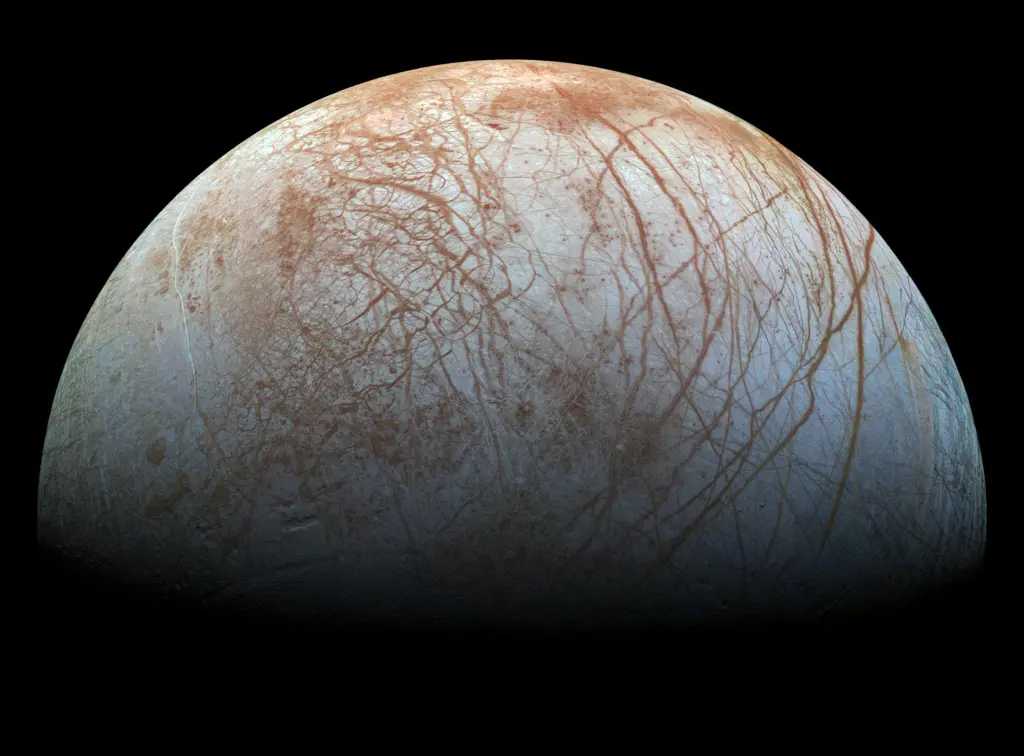
Jupiter's moon Europa is well beyond the stellar habitable zone, but because of tidal flexing, it could be habitable. The same is true for exomoons.
Image Credit: NASA
Astronomers haven't had much success detecting exomoons, though there are several candidates. However, we may be on the verge of an initial confirmation. A research team of astronomers used the JWST to examine exomoon candidates but hasn't published their results yet. The ESA's upcoming PLATO mission may also be able to detect some exomoons.
Even though we only have simulation results for now, it seems impossible that our Solar System is the only one with moons. Exoplanets must also exist. Prior to the launch of Kepler, we were anticipating a wealth of discoveries. Now, we're poised to learn much more about the exomoon population. Based on this research, we can expect some of these exomoons to be in habitable zones.
"We conclude that the circumstellar habitable zone can be extended to moons around giant planets," the authors write.
Here is the link to the CIA document that identifies alien bases using remote viewing. Nobody puts it up, so here it is. I also included the first full document here below, please share. Whats the point of spreading the truth, if we don't back it up with evidence! Cite your sources as often as you can, or leave the UFO research community!
🛸 Document Summary:
Title: “Description of Personnel Associated ‘ET’ Bases”
Date: 28 January 1987 Highlights: Mentions of three types of extraterrestrial entities.
Locations: Titan Base, Mt. Hayes, South America/Africa.
Observations made using remote viewing techniques. Entities vary in appearance: some human-like, others robotic or distinctly non-human. Ancient aliens are real!
Scientists question possible signs of life on exoplanet K2-18b in new study: 'We never saw more than insignificant hints'
Victoria Corless
An illustration of what K2-18b may look like.
Credit: NASA, ESA, CSA, Joseph Olmsted
In 2023, scientists from Cambridge University reported what appeared to be very exciting news. NASA's James Webb Space Telescope, they said, had detected signs of a liquid water ocean — and possibly life — on the exoplanet K2-18b, a temperate sub-Neptune world located about 124 light-years away from Earth. Then, earlier this year, the same team announced what they called even stronger evidence for those potential signs of alien life.
The signs were rooted in a tentative detection of dimethyl sulfide (DMS) — a molecule produced on Earth solely by marine life — and/or its close chemical relative DMDS, which is also a potential biosignature, in the atmosphere of the exoplanet. This finding, along with the possibility that K2-18b is a "Hycean world" with a liquid water ocean, sparked significant interest about its potential to support life.
However, these results have sparked intense debate among astronomers. While recognizing this finding would be a groundbreaking achievement and a major testament to the James Webb Space Telescope's (JWST) capabilities if true, many scientists remain skeptical, questioning both the reliability of the detected DMS signature as well as whether DMS itself is a dependable sign of life in the first place. As such, many independent teams have been conducting follow-up studies about the original claims — and a newly published one only adds to the debate, suggesting the Cambridge scientists' DMS detection wasn't significant enough to warrant the publicity it received.
"Among the physical sciences, astronomy enjoys a privileged position," Rafael Luque, a post doctoral researcher at the University of Chicago, told Space.com. "It is more frequently covered in the media thanks to its visual appeal and the big philosophical and universal questions it addresses. It was therefore expected that — even if tentative — the detection of a potential biomarker in the atmosphere of an exoplanet would have extensive coverage."
The significance of significance
Luque and his colleagues, including fellow postdoctoral researchers Caroline Piaulet-Ghorayeb and Michael Zhang, remain unconvinced that what astronomers observed on K2-18b was in fact a credible signature indicating life. In a recent arxiv preprint — which is yet to be peer-reviewed — their team re-examined the validity of the original evidence. "This is how science works: evidence and counterevidence go hand in hand,” he stated.
When scientists study data from different instruments separately, they might end up with conflicting results — it's like finding two different "stories" about a subject that don't match. "This is, in fact, what happened in the original team's papers," Zhang told Space.com. "They inferred a much higher temperature from their MIRI (mid-infrared) data than from their NIRISS and NIRSpec (near-infrared) data. Fitting all the data with the same model ensures that we're not telling contradictory stories about the same planet."
Thus, the team conducted a joint analysis of K2-18b using data from all three of the JWST's key instruments — the Near Infrared Imager and Slitless Spectrograph (NIRISS) and the Near Infrared Spectrograph (NIRSpec), which capture near-infrared light, and the Mid-Infrared Instrument (MIRI), which detects longer mid-infrared wavelengths. The goal was to ensure a consistent, planet-wide interpretation of K2-18b's spectrum that the team felt the original studies both lacked.
"We reanalyzed the same JWST data used in the study published earlier this year, but in combination with other JWST observations of the same planet published […] two years ago," Piaulet-Ghorayeb told Space.com. "We found that the stronger signal claimed in the 2025 observations is much weaker when all the data are combined."
These signals may appear weaker when all data is combined because the initial "strong" detection may have been overestimated, the team says, due to being based on a limited initial data set. Combining data from multiple sources lets scientists cross-check and verify the strength — and validity — of a particular signal.
"Different data reduction methods and retrieval codes always give slightly different results, so it is important to try multiple methods to see how robust the results are," explained Piaulet-Ghorayeb. "We never saw more than insignificant hints of either DMS or DMDS, and even these hints were not present in all data reductions."
"Importantly, we showed that when testing a wider range of molecules that we expect to be produced abiotically in the atmosphere, the same observed spectral features can be reproduced without the need for DMS or DMDS," she continued.
More than one path to a result
Molecules in an exoplanet's atmosphere are typically detected through spectral analysis, which identifies unique "chemical fingerprints" based on how the planet's atmosphere absorbs specific wavelengths of starlight as it passes — or transits — in front of its host star. This absorption leaves distinct patterns in the light spectrum that reveal the presence of different molecules.
"Each molecule’s signature is unique, but different molecules can have some features that fall in similar places because of their close molecular structures," explained Piaulet-Ghorayeb.
The difference between DMS and ethane — a common molecule in exoplanet atmospheres — is just one sulfur atom, and current spectrometers, including those on the JWST, have impressive sensitivity, but still face limits. The distance to exoplanets, the faintness of signals, and the complexity of atmospheres mean distinguishing between molecules that differ by just one atom is extremely challenging.
"It is widely recognized as a huge problem for biomarker detection, though not an insurmountable one, because different molecules do have subtly different absorption features," said Piaulet-Ghorayeb. "Until we can separate these signals more clearly, we have to be especially careful not to misinterpret them as signs of life."
Beyond technical limitations, another source of skepticism is how the data has been interpreted statistically. Luque points out that the 2023 study described the detection of DMS as "tentative," reflecting the preliminary nature of the finding. However, the most recent 2025 paper reported that the detection of DMS and/or DMDS reached 3-sigma significance — a level that, while below the 5-sigma threshold required for a confirmed discovery, is generally considered moderate statistical evidence.
Despite these uncertainties, the team is worried that media coverage has continued to spotlight bold claims about DMS and other molecules. "The [JWST] telescope is incredibly powerful, but the signals we're detecting are very small. As a community, we have to make sure that any claims we make about a planet’s composition are robust to the choices made when processing the data from the telescope," said Piaulet-Ghorayeb.
"Researchers have the responsibility to double-check and verify, but the media is also responsible for duly reporting these follow-up works to the general public," added Luque. "Even if they have less catchy titles."
"As Carl Sagan once said, 'extraordinary claims require extraordinary evidence,'" said Luque. "That threshold was not met by how the results were disseminated to the general public."
Whether we'll ever get a clear answer about life on K2-18 b is uncertain — not just because of technological limits, but because the case for follow-ups with the JWST may simply not be strong enough. "JWST is continuing to observe K2-18b, and even though the new observations won't have the ability to detect life, we will soon find out more about the planet's atmosphere and interior," Zhang said.
In a groundbreaking discovery, NASA’s James Webb Space Telescope may have just spotted signs of extraterrestrial life on a faraway exoplanet 8.6 times as massive as Earth, dubbed K2-18b.
In a study accepted for publication in The Astrophysical Journal Letters, researchers said James Webb detected a molecule called dimethyl sulfide (DMS), which is exclusively produced by living organisms on Earth. Along with DMS, researchers also detected the presence of carbon-bearing molecules, including methane and carbon dioxide, in the exoplanet’s atmosphere.
According to NASA, the presence of these gasses suggests K2-18b could be a Hycean exoplanet, potentially possessing a hydrogen-rich atmosphere and ocean-covered surface, significantly boosting its odds of hosting life.
More data is needed to confirm the findings. However, researchers said they were “shocked” by the initial results and the possibility that K2-18b might offer the first confirmation of extraterrestrial life.
“On Earth, DMS is only produced by life. The bulk of it in Earth’s atmosphere is emitted from phytoplankton in marine environments,” lead study author and University of Cambridge professor Dr. Nikku Madhusudhan told the BBC.
“If confirmed, it would be a huge deal, and I feel a responsibility to get this right if we are making such a big claim.”
Positioned 120 light-years away in the constellation Leo, K2-18b orbits a cool dwarf named K2-18 within what is known as the habitable zone. With a size falling between Earth and Neptune, what scientists call a “sub-Neptune” type world, K2-18b defies any comparison with planets in our solar system.
“Although this kind of planet does not exist in our solar system, sub-Neptunes are the most common type of planet known so far in the galaxy,” research team member Dr. Subhajit Sarkar of Cardiff University explained in a NASA press release.
The absence of similar planets within our solar system means sub-Neptunes, like K2-18b, are poorly understood, and the composition of these planet’s atmospheres is a hot topic of discussion among astronomers. Nevertheless, given the abundance of sub-Neptune bodies in the universe, some astronomers believe these giant exoplanets could be promising targets in the search for extraterrestrial life.
“Our findings underscore the importance of considering diverse habitable environments in the search for life elsewhere,” Dr. Madhusudhan explained. “Traditionally, the search for life on exoplanets has focused primarily on smaller rocky planets, but the larger Hycean worlds are significantly more conducive to atmospheric observations.”
Many scientists have begun increasingly echoing Dr. Madhusudhan’s sentiments on considering the diverse ways extraterrestrial life might exist.
Recently, The Debrief reported on a theory proposed by astrobiologist Dr. Dirk Schulze-Makuch that NASA’s historic Viking missions in the 1970s actually found—and inadvertently exterminated—extraterrestrial life on Mars.
According to Dr. Schulze-Makuch, by introducing Earth-like conditions in the experiments conducted by Viking’s landers, scientists may have missed the evidence or, worse yet, unintentionally exterminated Martian microbes that had adapted to the planet’s dry climate.
This illustration shows what exoplanet K2-18 b could look like based on science data. K2-18 b, an exoplanet 8.6 times as massive as Earth, orbits the cool dwarf star K2-18 in the habitable zone and lies 120 light years from Earth.
(Image Source: NASA, ESA, CSA, Joseph Olmsted (STScI))
Researchers say this potentially momentous discovery of alien life on K2-18b was only possible thanks to the James Webb Space Telescope’s remarkable ability to analyze light passing through an exoplanet’s atmosphere and decode its chemical composition by splitting it into constituent frequencies.
First launched in December 2021, the James Webb Space Telescope represents a monumental advance in sensitivity and resolution compared to its infrared telescope predecessors. According to a research paper published in The Astrophysical Journal Letters in 2022, early observations from the telescope have experts predicting that its contributions will be “transformational” for both astrophysics and our grasp of the universe.
“This result was only possible because of the extended wavelength range and unprecedented sensitivity of Webb, which enabled robust detection of spectral features with just two transits,” said Madhusudhan. “For comparison, one transit observation with Webb provided comparable precision to eight observations with Hubble conducted over a few years and in a relatively narrow wavelength range.”
Spectra of K2-18 b, obtained with Webb’s NIRISS (Near-Infrared Imager and Slitless Spectrograph) and NIRSpec (Near-Infrared Spectrograph) displays an abundance of methane and carbon dioxide in the exoplanet’s atmosphere, as well as a possible detection of a molecule called dimethyl sulfide (DMS).
(Image Source: NASA, ESA, CSA, Ralf Crawford (STScI), Joseph Olmsted (STScI))
Researchers are treating this initial data supporting the presence of life on K2-18b with caution. A similar claim made in 2020 about the existence of phosphine on Venus was later disputed.
The research team has plans to continue their investigation of K2-18b using James Webb’s MIRI (Mid-Infrared Instrument) spectrograph. They aim to reinforce the validity of their initial discoveries while gaining deeper insights into the environmental characteristics of the distant world. They hope to confirm these initial chemical signatures of life within the following year.
“Upcoming Webb observations should be able to confirm if DMS is indeed present in the atmosphere of K2-18 b at significant levels,” Dr. Madhusudhan explained.
Whether or not the findings are ultimately confirmed, scientists emphasize that the preliminary data showcases the James Webb Space Telescope’s potent capabilities for uncovering potential signs of extraterrestrial life in far-off corners of the universe.
“We are slowly moving towards the point where we will be able to answer that big question as to whether we are alone in the Universe or not,” Deputy Director of the Royal Astronomical Society in London, Dr Robert Massey, told the BBC.
“I’m optimistic that we will one day find signs of life. Perhaps it will be this. Perhaps in 10 or even 50 years, we will have evidence that is so compelling that it is the best explanation.”
Tim McMillan is a retired law enforcement executive, investigative reporter and co-founder of The Debrief. His writing typically focuses on defense, national security, the Intelligence Community and topics related to psychology. You can follow Tim on Twitter:@LtTimMcMillan. Tim can be reached by email: tim@thedebrief.org or through encrypted email:LtTimMcMillan@protonmail.com
RAF pilots who saw UFOs say they fear going public over for five grim reasons
Rumours of possible UFO sightings by RAF pilots are rife, and now a pressure group is urging PM Keir Starmer to bring in rules protecting whistleblowers who shed light on potential extraterrestrial interactions
Keir Starmer is under pressure to deal with the mounting UFO claims
RAF pilots have had close encounters with UFOs but are scared to go public fearing they will be grounded.
Documentary film-maker Mark Christopher Lee says he has been contacted by Brit military pilots who have had similar out-of-this-world run-ins with mystery alien craft as their American counterparts.
But while whistleblower protection laws allow US Top Guns to tell of their experiences without fear of victimisation Britain has none - leaving UK pilots silenced and the public in the dark.
Lee has formed a pressure group called UFO Disclosure UK demanding the release of the UK’s X-Files.
He has written to Prime Minister Sir Keir Starmer calling for him to introduce US-style whistleblower protection safeguards so militarypersonnel can reveal their close encounters with UFOs - aka UAPs or unidentified aerial phenomena.
Could aliens have made contact with RAF pilots
Mark told the Daily Star: “We have military pilots who have had real life encounters with UAPs.
“I have spoken to them.
“What they say is incredible.
“They will talk in confidence on condition of anonymity.
“But they fear the consequences if they were to go on the record.
RAF pilots claim they're too scared to come forward
(Image: Getty Images/iStockphoto)
“We also have accounts from other military personnel and police who want to come forward. But they all fear what will happen to them if they do.
“Will they be fired, ridiculed, demoted - even prosecuted - for speaking out? These are their fears.
“What will happen to their families?
“It’s frustrating because unless someone goes on the record, puts their name - and potentially rank - to an event it is impossible to judge and difficult to properly investigate.
“The result is the British public is being kept in the dark.
“Information about extraordinary events is being withheld from them.
“These encounters could amount to threats to national security - certainly sightings of mystery craft near military bases and personnel must fall into that category.
“But until pilots feel free to speak out without fearing they will be grounded the country is burying its head in the sand.”
Invasion of alien spaceships at sunset, illustration.
Former Afghanistan combat veteran and US Air Force intelligence officer David Grusch stunned Congress by claiming the American Government had recovered debris and alien `entities’ from 10 crashed UFOs.
He alleged boffins had been secretly tasked with reverse-engineering ET technology in a bid to give the US an advantage in the global arms race.
Grusch claims he had spoken to at least 40 witnesses involved in the black ops programs and officials had ‘killed people’ in a bid to keep them secret.
Threats and intimidation he personally received forced him to go public for his own protection.
He helped draft the 2023 National Defense Authorisation Act which includes whistleblower protection for reporting UFOs and exemptions to non-disclosure agreements signed by personnel involved in secret programmes.
Now US officials are openly probing 1,800 reported military close encounters.
Earlier this month Jon Kosloski, head of the US Government’sAll-Domain Anomaly Resolution Office which is conducting the investigations, admitted 2% - around 36 - of the cases were ‘perplexing’ and r emained entirely unexplained, adding: “I don’t think we’re alone.”
Top pilots have claimed to see UFOS
(Image: Getty Images)
Grusch has now been appointed a senior congressional advisor
In his letter to the PM Lee - whose documentary about the Royal Family’s interest in UFOs has become a global hit - urged him to follow the US Government’s disclosure process.
“Decorated military pilots are giving testimony under oath that they have encountered craft of unknown origin beyond our current technological capabilities,’’ he said.
“The US Congress is seeking to provide protection to whistleblowers who go public when it’s seen to be in the greater national/public interest.
“We formally call on you to provide the same protection to whistleblowers and witnesses.
“We have many people in the UK military and police service who want to come forward publicly but are afraid of the repercussions to themselves, their family and their careers.
“We will happily meet with your advisors to furnish them with the evidence we have collected.’’
'Celtic' crop circles appear in world-famous UFO hotspot in UK near Stonehenge
The intricate pattern included a design resembling a Celtic knot, or a four-pointed star, within a circle, baffling UFO enthusiasts and frustrating the farmer who owned the field
A UK county became the epicentre of mysterious crop circles in the 1970s, and the Celtic designs found this month are just 13 miles away from Stonehenge. Last week a perfectly crafted geometric design was found in a farmer’s field in Sutton Veny, Wiltshire.
But it has been suggested that tools like planks are used to spark fears of aliens’ presence on earth.
Some of the circles can be 1000 feet in length, but apparently take only minutes to make.
The patterns have been discovered in plenty of countries, including the US, Canada, Australia, and Japan, but the crop circles have been most commonly found in the UK.
But it has been suggested that tools like planks are useD
(Image: Tom Wren / SWNS)
Around 80 percent of all UK crop circles have been found in Wiltshire. Since 2005, there have been more than 380 crop circles recorded in this area.
Their appearance usually coincides with the growing season from May to August where crops are tall enough to be flattened.
UAP researcher Holly Wood posted on X: “Who or what is trying to get our attention?” One Ufologist shared: “People say when you look at it from the top, the symbol makes them 'download' certain information to their subconscious mind.”
But the owner of the field now decorated with the Celtic knot was apparently “very upset” that someone had flatted his crops.
He’s making the most of it, though, by opening the field up to enthusiasts for a small donation, according toCoast to Coast AM, hosted byUFOenthusiast George Noory.
The field has been opened for a donation
(Image: Tom Wren / SWNS)
Monique Klinkenbergh, founder of the crop circle exhibition in Wiltshire's Pewsey Vale, said there are definitely man-made crop circles on Earth, but others are much harder to explain without aliens.
She told the BBC in 2023: “If you listen to eye witness accounts, the unexplained circles have one thing in common - they were formed in minutes, or seconds, by an invisible source.”
The 2001 'Milk Hill circle' in Wiltshire had over 400 circles spanning 787 feet and was said to be too complex for humans to create in just one night.
Other witnesses have reported orbs of light and strange beams over the fields just before the circles appeared.
Mysterious 'UFO base' on mountain in US known for missing people is new alien hotspot
The CIA has never confirmed the alien base, however, the declassified documents allege that there are 'alien bases' in Alaska, Africa, or South America, and on Titan, Saturn's largest moon.
BY Alexandra Snow
Mount Hayes sits within the Alaskan Triangle
A famed locale from declassified CIA papers is now a buzzing hub forUFO enthusiasts, as Mount Hayes in Alaska witnesses a boom in eerie sightings of enigmatic unidentified flying objects.
Towering at a lofty 8,000 ft, Mount Hayes lies within the so-called 'Alaskan Triangle' – a zone cutting through Juneau, Anchorage, and Utqiagvik (formerly Barrow), peppered with dense woodlands, icy pinnacles, and vast expanses of frosty tundra.
Whilst the CIA has never rubber-stamped any extraterrestrial activity, declassified files suggest the existence of 'alienbases' across Alaska, Africa, South America, and even on Titan, Saturn's most colossal moon. The Alaskan region in question is notorious for baffling vanishing acts and airborne anomalies, often brushed off as military tech.
Documents calling it the 'base' stem from interviews with an alleged 'remote viewer'
But now, locals are reporting swift-moving orbs and spooky disappearances that have lit up the official UAP (Unidentified Aerial Phenomena) Map.
Ex-security officer Jared Augustin relayed to DMAX UK his own close encounter, where he witnessed a solitary orb split into three in the skies. "It was a UFO, of extraterrestrial origin," declared Augustin, recounting how he stood petrified during the spectacle.
These reports have sparked a flurry of activity on Google Maps, with people trying to pinpoint the exact location of this mysterious base. YouTube has been flooded with videos discussing the topic, with many sharing their theories about the potential 'base'.
Even the Travel and History channels have jumped on the bandwagon in recent months.
The mountain, where over 20,000 individuals have vanished amidst bizarre reports of 'vortexes,' 'flying objects,' and 'little men,' has long been a hotbed for conspiracy theories and suspected alien activity that may forever remain a mystery.
The CIA documents referencing the 'base' stem from interviews with an alleged 'remote viewer' who claimed to 'sense' objects. This individual was part of a government programme known as STARGATE, which experimented with so-called 'psychics'.
The area has now become a hotspot for UFO sightings
This, coupled with local sightings and a near-miss incident involving a government pilot, has fuelled speculation, despite some questioning the credibility of such claims. Some even suggest they've spotted 'openings' that could lead to this supposed lab.
In 1986, Captain Kenju Terauchi of Japan Airlines Flight 1628 reported an eerie encounter with two "mysterious lights trailing their plane over Alaska."
tailing their aircraft over Alaska. The strange objects were verified by both onboard and ground radar, shadowing the flight before vanishing into thin air.
Terauchi claimed to have spotted a gigantic craft dwarfing their Boeing 747, an incident that sparked intrigue and allegedly cost him his job.
The region is also notorious for a high number of missing persons and abduction tales. Researcher Ken Gerhard shared with the History Channel: "What I found when I was doing my research in the Alaskan Triangle was that a number of these missing person cases legitimately could not be solved."
He elaborated: "This wasn't just a case of someone being mauled by a bear or falling into a crevasse, I mean, these were often people that were going about their daily lives. They weren't out on some grand adventure and yet ultimately, they disappeared for no good reason,".
While many attribute these mysteries to harsh weather conditions and frequent winter storms, others speculate that the inclement weather could provide the perfect camouflage for a U.S. or extraterrestrial base. Reddit is currently buzzing with posts from users sharing their theories about the potential 'base,' with many citing 'dark spots' or inconsistent satellite imagery as evidence.
However, Alaska isn't the sole hotspot for those intrigued by extraterrestrial life. The United States Air Force base in southern Nevada is a magnet for UFO sightings, fuelling speculation among conspiracy theorists that the government is harbouring alien beings at the site.
The rumour mill has gone into overdrive online following the apparent discovery of a new structure at Area 51. This US Air Force base in southern Nevada is synonymous with reports of unidentified flying objects, leading many to suspect that it's a secret refuge for alien life.
The recent spotting of a triangular tower on Google Maps has sent these theorists into a frenzy, sharing their hypotheses across the internet.
Meer van UFO'S of UAP'S, ASTRONOMIE, RUIMTEVAART, ARCHEOLOGIE, OUDHEIDKUNDE, SF-SNUFJES EN ANDERE ESOTERISCHE WETENSCHAPPEN - DE ALLERLAATSTE NIEUWTJES


 The Holy Mary Apparitions and Their Miracles: Myths OR Reality