Ontdek de Fascinerende Wereld van UFO's en UAP's: Jouw Bron voor Onthullende Informatie!
Ben jij ook gefascineerd door het onbekende? Wil je meer weten over UFO's en UAP's, niet alleen in België, maar over de hele wereld? Dan ben je op de juiste plek!
België: Het Kloppend Hart van UFO-onderzoek
In België is BUFON (Belgisch UFO-Netwerk) dé autoriteit op het gebied van UFO-onderzoek. Voor betrouwbare en objectieve informatie over deze intrigerende fenomenen, bezoek je zeker onze Facebook-pagina en deze blog. Maar dat is nog niet alles! Ontdek ook het Belgisch UFO-meldpunt en Caelestia, twee organisaties die diepgaand onderzoek verrichten, al zijn ze soms kritisch of sceptisch.
Nederland: Een Schat aan Informatie
Voor onze Nederlandse buren is er de schitterende website www.ufowijzer.nl, beheerd door Paul Harmans. Deze site biedt een schat aan informatie en artikelen die je niet wilt missen!
Internationaal: MUFON - De Wereldwijde Autoriteit
Neem ook een kijkje bij MUFON (Mutual UFO Network Inc.), een gerenommeerde Amerikaanse UFO-vereniging met afdelingen in de VS en wereldwijd. MUFON is toegewijd aan de wetenschappelijke en analytische studie van het UFO-fenomeen, en hun maandelijkse tijdschrift, The MUFON UFO-Journal, is een must-read voor elke UFO-enthousiasteling. Bezoek hun website op www.mufon.com voor meer informatie.
Samenwerking en Toekomstvisie
Sinds 1 februari 2020 is Pieter niet alleen ex-president van BUFON, maar ook de voormalige nationale directeur van MUFON in Vlaanderen en Nederland. Dit creëert een sterke samenwerking met de Franse MUFON Reseau MUFON/EUROP, wat ons in staat stelt om nog meer waardevolle inzichten te delen.
Let op: Nepprofielen en Nieuwe Groeperingen
Pas op voor een nieuwe groepering die zich ook BUFON noemt, maar geen enkele connectie heeft met onze gevestigde organisatie. Hoewel zij de naam geregistreerd hebben, kunnen ze het rijke verleden en de expertise van onze groep niet evenaren. We wensen hen veel succes, maar we blijven de autoriteit in UFO-onderzoek!
Blijf Op De Hoogte!
Wil jij de laatste nieuwtjes over UFO's, ruimtevaart, archeologie, en meer? Volg ons dan en duik samen met ons in de fascinerende wereld van het onbekende! Sluit je aan bij de gemeenschap van nieuwsgierige geesten die net als jij verlangen naar antwoorden en avonturen in de sterren!
Heb je vragen of wil je meer weten? Aarzel dan niet om contact met ons op te nemen! Samen ontrafelen we het mysterie van de lucht en daarbuiten.
Man who recorded ‘best ever UFO footage’ answered question about video being fake
He's sure it wasn't just a scrap of something going by.
Published 17:41 26 May 2025
Joe Harker
A man who recorded the 'best ever UFO footage' has explained why he doesn't think what he saw was fake.
There are plenty of people who are convinced they've seen a UFO hurtling through the sky, and some even manage to get video evidence of their sightings.
Some of the claims people make aren't hard to debunk, others take a lot more explaining.
One of the clearest pieces of footage of a sighting was taken by someone who was up in that very sky themselves and became convinced they'd had a close encounter of the third kind.
The footage was dubbed 'one of the greatest UAP (UFO) evidences of all time' by ufologist Jaime Maussan, who has been caught with fake aliens in the past.
However, truth is in the eye of the beholder so you might as well give it a look and learn why the person who filmed it thinks it's genuine.
What do you suppose it is?
(X/Jorge Arteaga)
Where did the footage come from?
The video was taken by pilot Jorge A. Arteaga, who was flying in the skies above Antioquia, Colombia, when he spotted something peculiar moving through the sky.
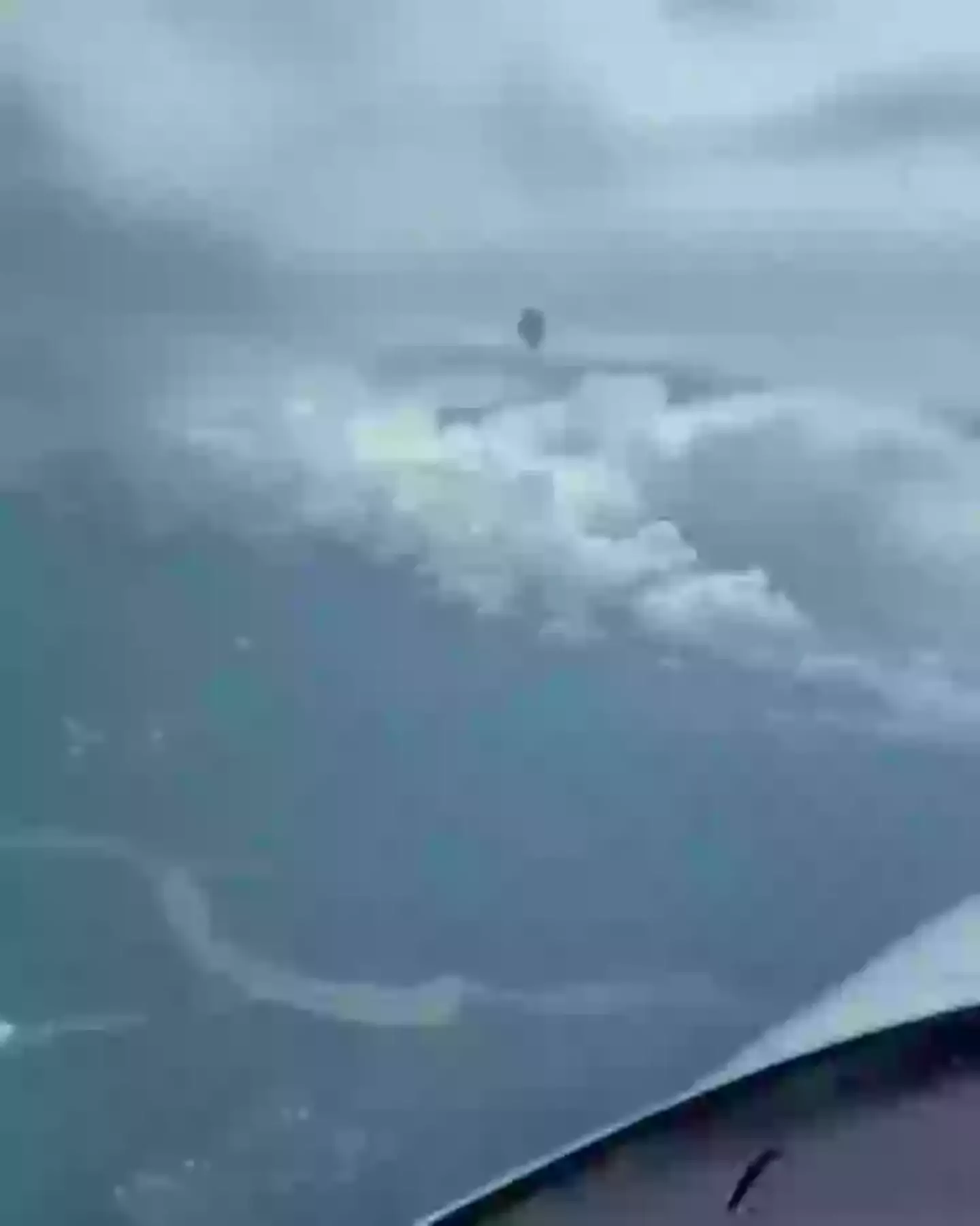
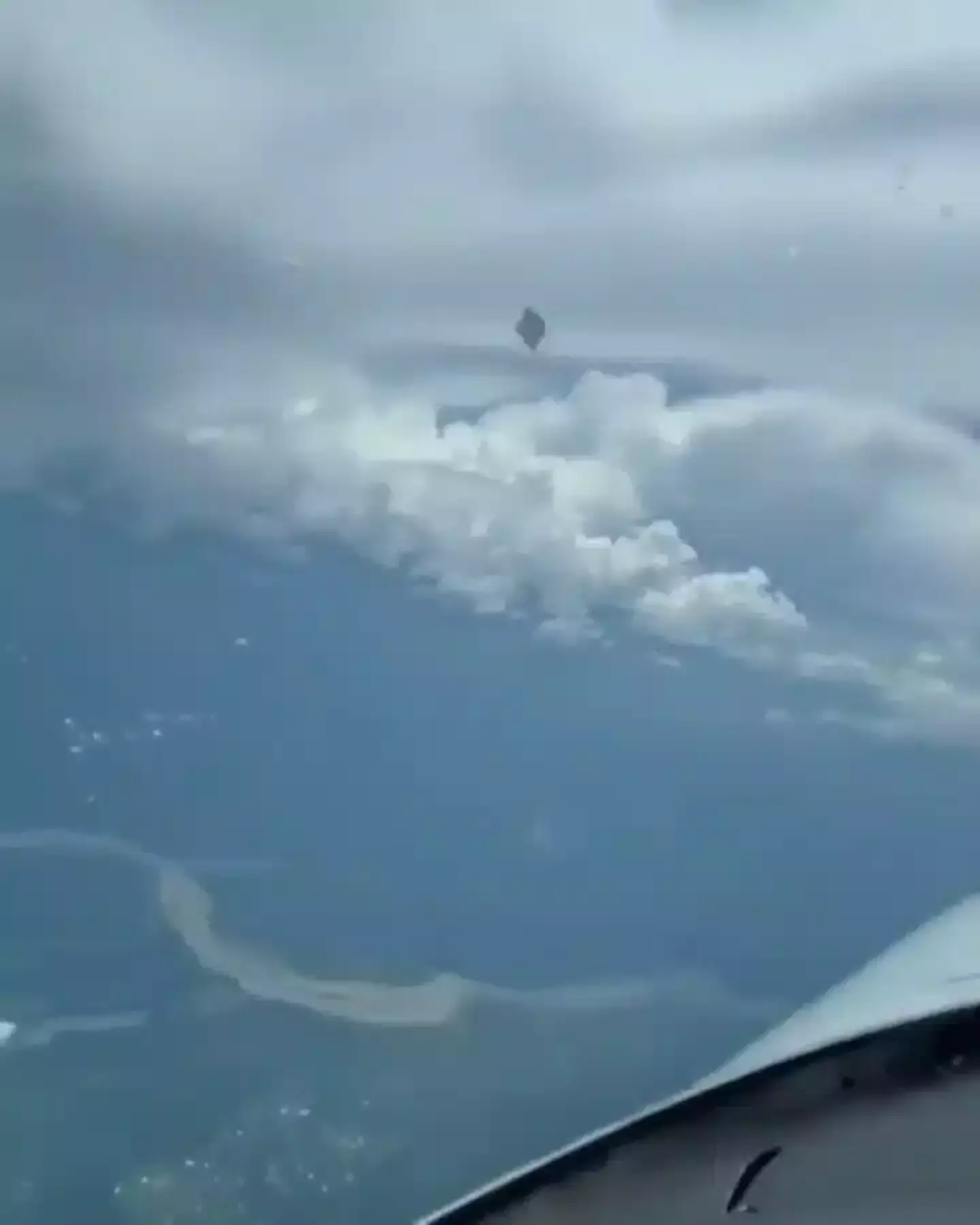
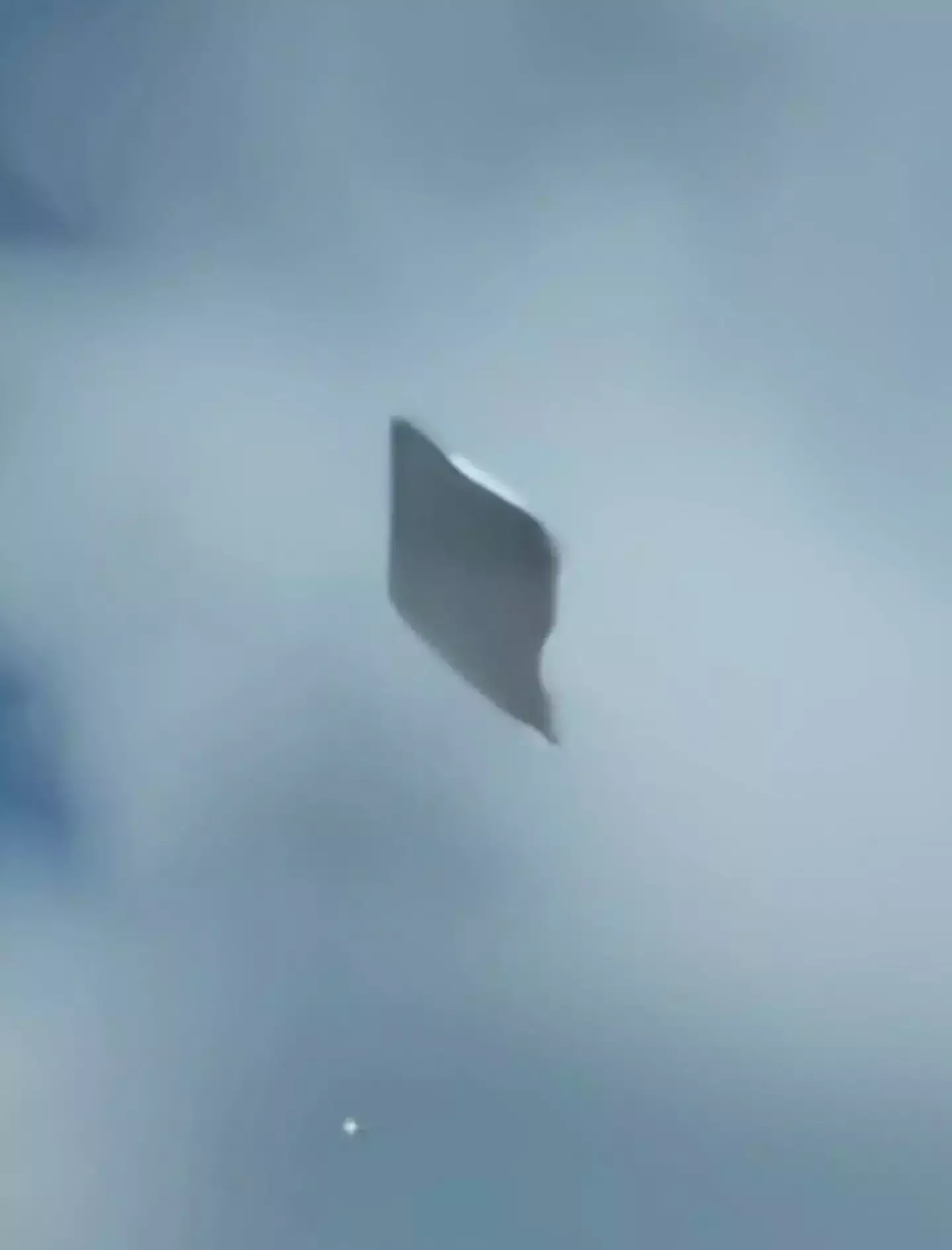
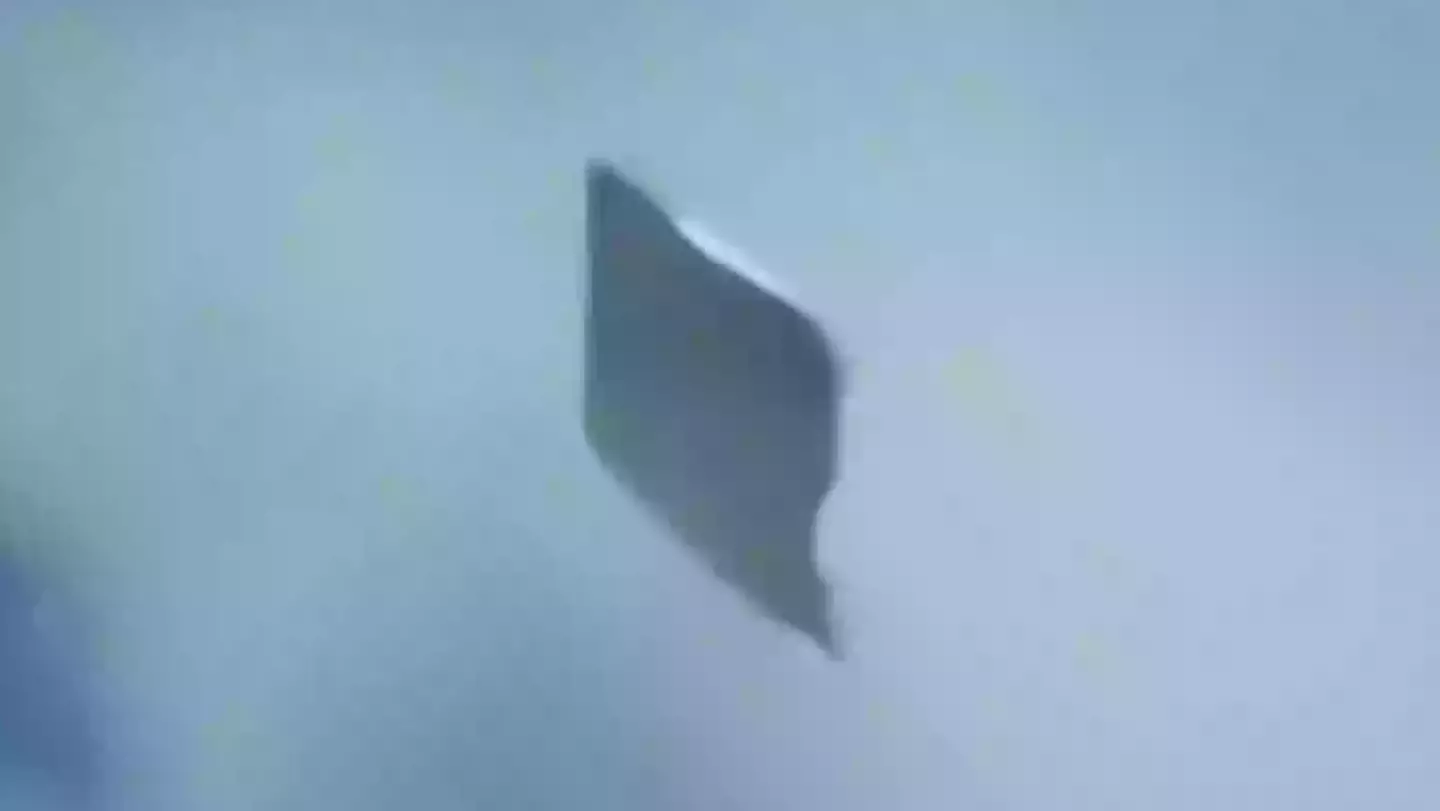
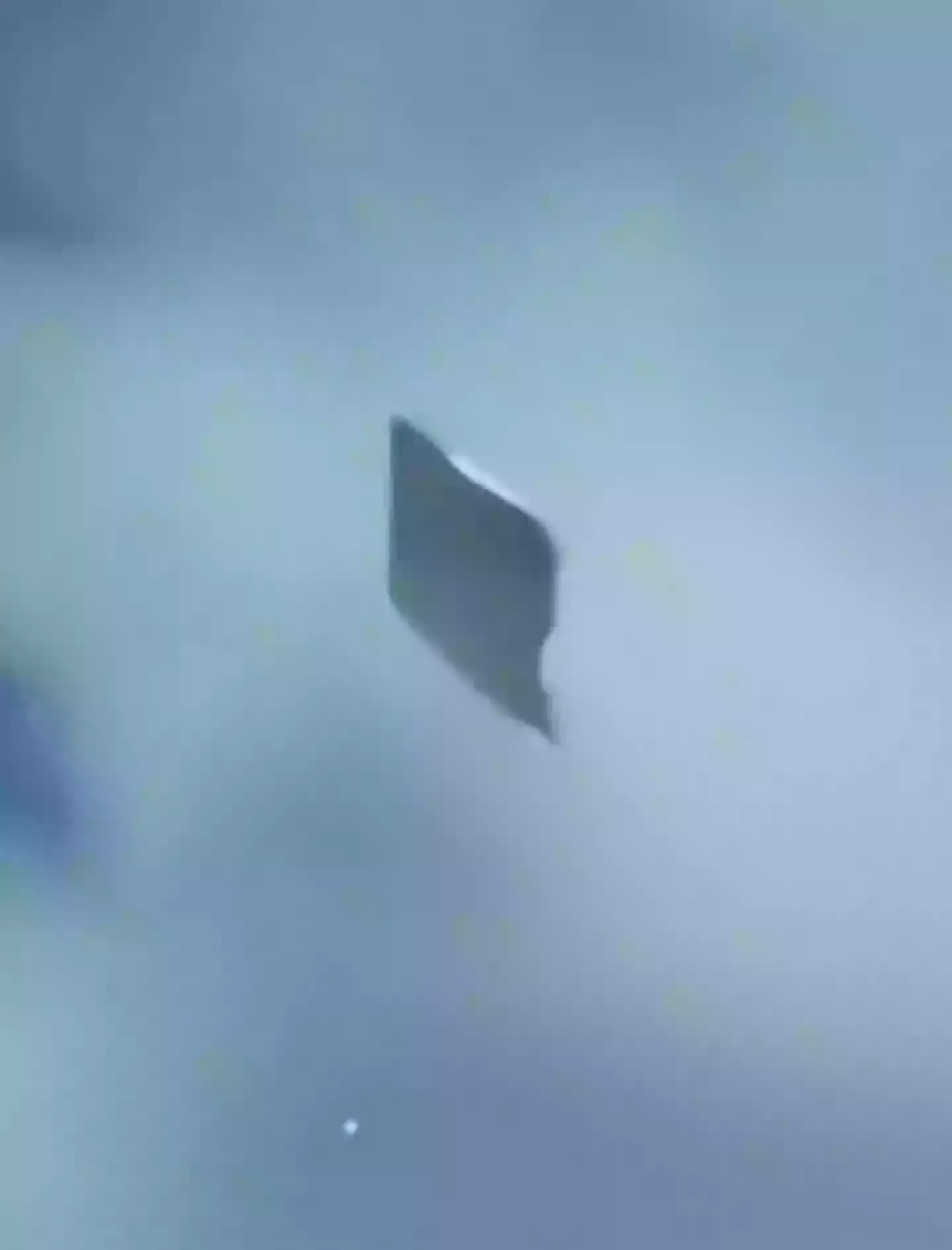
Within just a few seconds, a strange square-like object can be seen flying past Arteaga's plane and goes whizzing off in another direction.
The bloke claimed that he and his co-pilot had seen the object hovering in the air between the cities of Medellín and Santa Fe before it suddenly gained speed and moved towards them.
Arteaga claimed that the pair had wanted to keep following this strange sight before it suddenly started heading right for them.
However, Arteaga was able to get some footage on his phone which he's claimed as proof that he had a bona fide daylight encounter with a UFO.
Check it out:
BEST UFO SIGHTING caught on camera - Shocking Footage!
Why is Arteaga sure it's a UFO?
This is the big question that anyone is going to ask when someone says they've caught a UFO on camera.
There are all sorts of objects in the sky which might just be a balloon or a scrap of something else floating about in the wind.
However, the pilot said that since his plane was at 12,500 feet there's no chance it could just have been a balloon.
Arteaga claimed it would be too cold and turbulent at that height for something like a balloon to survive in the skies, so he reckons it must have been a UFO.
On top of that, the pilot claimed the thing he saw was 'something totally unknown without means of propulsion' and he thought it moved in an 'intelligent' manner.
You may believe what you like, but the man who saw and filmed it is pretty convinced he laid eyes on a UFO that day.
Featured Image Credit: X/Jorge Arteaga
'Best ever UFO footage' caught on camera had it's authenticity '100%' confirmed
Could this be the closest we've come to proving the existence of aliens?
Published 20:29 4 Jul 2024
Brenna Cooper
Aliens and UFOs are surely one of the longest running fascinations of modern times.
Ever since reports of an alien spaceship crashing at Roswell way back in the 1940s hit the press; mankind has been hooked on UFO hysteria.
We all know someone who's spotted a rogue birthday balloon or glow lantern in the sky and whipped their phone camera out to declare that an alien invasion is imminent - but every now and again footage emerges and rattles even the biggest alien skeptics.
One person who managed to capture pretty eerie footage is pilot Jorge A. Arteaga, whose video recorded during a flight has been called the 'best UFO footage ever' - and has also been found to be 100 per cent authentic.
Check out the footage for yourself:
Arteaga was travelling through the skies above Antioquia, Colombia, when he spotted a strange object hurtling through the sky.
Captured in brought daylight, the mysterious, square-like object shoots out of the clouds and past Arteaga's cockpit in a matter of seconds.
He was able to quickly grab his camera and record the object - which appeared to be light in colour and pointed at one end - as it flew towards him before quickly speeding off.
Arteaga would later claim that he and his co-pilot had spotted the item floating in the air between the cities of Medellín and Santa Fe, before it drastically picked up speed and beelined towards them.
The pair had originally wanted to follow the UFO, but later abandoned the search after it suddenly began to hurtle towards them.
A birthday balloon? A rogue Wii Fit board? Or aliens?
(X/Jorge Arteaga)
Now I know what you're thinking, surely it's just another runaway balloon or random piece of debris?
Not according to Arteaga, who claimed that it would have been too cold or turbulent for a balloon to survive, adding that they were flying 12,500 feet in the air at the time.
And it seems that Arteaga has the backing of controversial ufologist Jaime Maussan, who later authenticated.
As for what happens during a 'UFO authentication' process we're not sure, but the pair would later sit down for an interview about the video, which Maussan later shared on his social media account.
"We are facing one of the greatest UAP (UFO) evidences of all time; captured by the Captain Pilot Aviator @JorgeArteagaG," he wrote on X, alongside a clip from their chat.
UFO or flying supermarket carrier bag?
(X/Jorge Arteaga)
Maussan went on to add that Arteaga had told him the object moved with 'something totally unknown without means of propulsion with movements that he considers intelligent.'
He also added that he'd cross-referenced the footage with Pilot Lieutenant Ryan Graves, who had agreed the clip showed a UFO, also known as a UAP (unidentified aerial phenomena).
Whether or not you believe the clip is a UFO or a floating piece of rubbish depends on what your stance on aliens is.
Perhaps it's one to bookmark and ask aliens about when they finally decide to invade us.
Featured Image Credit: X/Jorge Arteaga
Joe Rogan addressed 'best ever UFO footage' caught on camera that had authenticity '100%' confirmed
The podcast host said the mysterious object 'looked like it's from another f***ing world'
Published 18:06 12 Feb 2025
Olivia Burke
At this stage in the game, we've all seen the clip of what is supposedly the 'best ever UFO footage ever' caught on camera more times than we care to count.
But not everyone has heard what Joe Rogan had to say about it.
Although his passion for the subject might have fooled you into thinking he's an extraterrestrial expert, the 57-year-old is actually just an enthusiast.
He's invited a plethora of guests on his podcast, The Joe Rogan Experience, to discuss the topic, while previously saying he is '100% convinced' that aliens have visited Earth.
So when footage of a UFO, which was pretty hard to argue against, went viral a few years ago, Rogan obviously wanted to put his twopence in.
Take a look at the clip for yourself here:
In June last year, Rogan welcomed America's Got Talent judge Howie Mandel, 69, onto his podcast and just couldn't resist showing him the video.
Explaining that people were calling it 'some of the most compelling UFO video ever' recorded, Rogan went on to say that he'd been unable to think up an explanation for it.
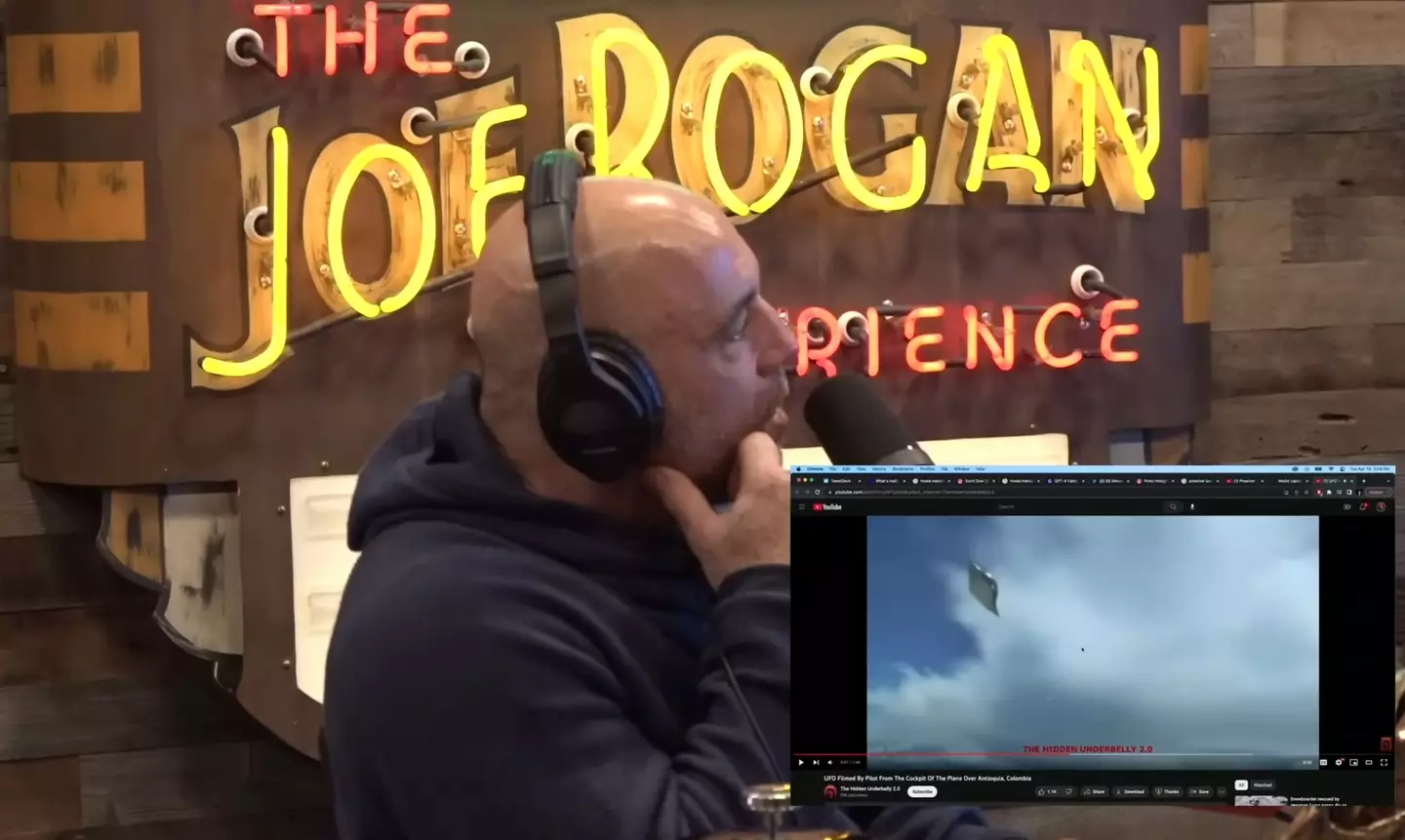
"They freeze framed it, it looks like a flying disc," he told Mandel about the strange object in the sky. "I mean, what in the f**k is that?"
Rogan's guest claimed that he had previously encountered a UFO himself, while suggesting that the flying object in the clip was travelling at a similar speed.
In response, Rogan said: "But you have to take into consideration that this plane is moving in a specific direction and the UFO is moving in the opposite direction.
"So it looks much faster than it actually is. Even if that was like a mylar balloon...if you're passing it that fast...I mean, I don't know what you're getting there.
"That to me looks like it's from another f***ing world."
Rogan reckoned that the UFO looked like it was 'from another f***ing world'
(X/Jorge Arteaga)
He explained that he was unsure whether it was merely a 'distortion' in the footage which made him think this, or because the flying object was actually alien-related.
"That looks very distinct," Rogan went on. "It's so fascinating, man. I mean if I was a cynic I'd say, 'Oh, it's a f***ing balloon'. But it isweird, because it's not moving that fast if the plane is moving."
At the time, Rogan wasn't too sure if the clip was even legit or not - however, pilot Jorge A. Arteaga later came out to confirm it was in fact authentic.
Arteaga was swooping through the skies above Antioquia, Colombia, when he spotted the object emerging through the clouds and zooming past the cockpit of the small plane he was flying.
The quick-thinking pilot incredibly juggled his controls with his camera to capture the extraordinary moment, as he and his co-pilot watched in awe.
Arteaga said that the object had initially been stationary, before appearing to float in the air between Medellín and Santa Fe.
He claimed it then drastically picked up speed and beelined towards them, resulting in him manoeuvring the plane to follow the UFO.
The podcast host was left stunned by the footage
(YouTube/The Joe Rogan Experience)
Arteaga insisted that it didn't look or behave like a balloon, drone or plane - but he didn't manage to track it down.
After starting to 'hunt' the flying object, the dad is said to have become alarmed when it started moving towards the plane, seeing him abandon the search in fear.
He reckons that it would have been too cold and too turbulent for it to be a balloon, as he says it would have popped or blown away at 12,500 feet in the air while that close to another aircraft - but the jury's still out on what exactly it was.
Ufologist Jaime Maussan - who famously unveiled the two 'alien corpses' in Mexico last year - also threw his weight behind the claims, insisting the footage was genuine.
Sharing a snippet of their chat in a post on X, Maussan captioned the clip: "We are facing one of the greatest UAP (UFO) evidences of all time; captured by the Captain Pilot Aviator @JorgeArteagaG."
He also thanked retired Pilot Lieutenant Ryan Graves for analysing and validating the clip alongside him, which brought them both to the conclusion that it was a 'UAP anomalous object' - AKA, a UFO.
Maussan said that Arteaga told him that the object in the video is 'something totally unknown without means of propulsion with movements that he considers intelligent.'
Sightings of UFOs may challenge our entire worldview, but the facts are too compelling to ignore, and they’re not going away. So, it’s time to wash off the sticky stigma and engage in serious discussion about the evidence, and its implications.
Most UFO sightings are attributable to man-made objects like experimental aircraft or satellites, innocent misidentifications of Venus and other celestial objects, or outright hoaxes. However, we now know that in a minority of cases, there appears to be something else going on: something quite extraordinary and beyond our current comprehension.
According to the U.S. Department of Defense, there are objects of unknown origin, evidently under intelligent control, which behave in ways that seem to challenge our understanding of physics. These objects don’t just “fly” without any apparent lift surfaces or means of propulsion; according to some military testimony, they would appear to be the fastest technological objects on Earth, capable of accelerating so quickly that they should create sonic booms, superheat the air around them into a glowing plasma, and instantly kill any occupants on board.
Instead, they silently maneuver with perfect agility through the atmosphere and, according to some eyewitness reports, underwater, as if basic rules of inertia and friction simply don’t apply to them.
There’s general acknowledgment that these phenomena have been documented in America since at least the late 1940s, and probably much earlier. Hence, many longtime UFO advocates, as well as those newer to the subject, are now asking why it has taken 70 years for government offices to openly regard UFOs as a subject of serious inquiry. This is a question that deserves a lengthy public discussion.
Today, serious researchers are beginning–sometimes grudgingly–to admit that UFOs (or UAPs if you prefer the rebranded version) are a valid area of study, and pockets of scientific enthusiasm are emerging. After theNew York Timesmade the revelation of a secret Pentagon UFO study theirfront page story, the Department of Defensesubsequently admittedthatleaked UFO videoswere in fact real (and that it has others it’s not showing us). Since that time, aNASA UFO research initiativeheaded by Princeton’s former chair of astronomy has been launched, former Harvard astronomerAvi Loeb’s Galileo Projectwants to determine if the strange phenomena are extraterrestrial. The Pentagon’s All-domain Anomaly Resolution Office is now investigating UFO phenomena across all the branches of the military; the US Navy hasrevised its protocolsto counterstigmasagainst UFO reporting and encourage sighting reports by pilots (like this one); and there have been briefings in theUS SenateandHouseregarding themore than 650 sightingsnow being studied by AARO, marking an almost singular point of bipartisanship in a traditionally fractured Congress.
This explosion of interest and influx of expertise, credibility, and funding into UFO research will create a flow of ideas between old-hat UFO researchers and establishment newcomers to the subject. As some scientific communities shift to incorporate the nascently-legitimate subject of UFO research, they may have to accommodate elements of the other’s conceptual frameworks, methodologies, and research agendas, and this will require questioning old assumptions about what sort of evidence actually exists and how to interpret it. Likewise, it is the perfect moment for UFO-interested folks to pause and evaluate their own assumptions about the subject, many of which seem to have been in place since the very beginning of the Flying Saucer craze that in 1947 began simultaneously in bothAmericaandCanada. As career researchers and academics (like me) join the conversation, the contours of the conversation itself will inevitably shift–I think for the better.
How I Came to the Subject, and What I Noticed as a Newcomer
My own journey down the UFO rabbit hole began one day early in 2019. As I flipped through a catalog from Oxford University Press, one title, in particular, jumped out at me: American Cosmic: UFOs, Religion, Technology by Diana Walsh Pasulka, a tenured professor of religion at the University of North Carolina. What surprised me most was that the blurb in the catalog suggested the author thought that it was not merely the UFO believers that were interesting, but that the phenomenon itself was worth serious attention. I promptly ordered a copy, and once it arrived I spent the next few days absorbed in the most bizarre piece of nonfiction I’d ever read.
The UFO enthusiasts Pasulka spent the most time with–two men she dubbed “James” and “Tyler” to preserve their anonymity–were both experiencers of the phenomenon. However, they weren’t tinfoil-hat-waring obsessives; they were scientists and academics, and not long after her book was published, a prodigious Stanford biomedical scientist named Garry Nolan revealed that he was the man referred to in the text as “James”. Around the same time, members of Reddit, by perusing the Vatican archive visitors’ log for the days Pasulka and “Tyler” visited, discovered that the latter appears to have been Timothy Taylor, founder of Endius.
Screenshot from the Vatican Observatory 2017 Annual Report
(Vatican Observatory).
What I found as I slipped into the deep end of the pool of UFO research was that, first, there is no shallow end. It’s deep ends everywhere you go, and once you clear away the debris of obvious hoaxes and non-evidential sightings, every drop in the pool–that is, every case warranting sustained attention–is a little ocean with its own perplexing depths where nothing is what it at first seems to be. The important facts of each case are often so embedded in the commentaries and interpretations that have grown around them that it’s difficult to consider them separately from the belief systems of the UFO community itself.
Questioning Common Sense With Relation to UFOs
Like all communities defined by a belief system, over time the most important beliefs become accepted so widely that they eventually feel too obvious even to mention. It’s similar to the way we don’t ever point out that murder isn’t nice; beliefs like these are accepted so widely and deeply that they pass out of consciousness altogether to some deeper place, where they operate out of sight.
We are born into an atmosphere of these powerful but unspoken beliefs, and we adopt them not by reasoning about the evidence for or against them; rather, we simply accept them as part of the foundation of beliefs that we need in order to do any reasoning at all. If reasoning were a game of chess, these beliefs wouldn’t be pieces in the game or moves made by players: they’d be the board.
These beliefs–the ones paradoxically so obvious that they’re invisible–are what some people in my field call ideology. The word is sometimes used pejoratively, but the fact is that everyone has an ideology. Questioning a person’s foundational beliefs can be so uncomfortable that it feels like an existential threat, and we respond defensively, even violently. Likewise, if we encounter any idea that flatly contradicts our foundational beliefs, it will seem patently false and absurd.
These responses to strange new ideas are, of course, mistakes. Different people can have wildly different belief systems. And our familiarity or comfort with a belief is not evidence of its truth.
If we’re concerned with uncovering the actual truth of the world outside our skulls, it’s essential that we sometimes do the very uncomfortable work of identifying and questioning the assumptions about the world that feel most comfortable and sensible to us. It’s the only way to ensure we’re not trapped in an echo chamber, looking for a truth hidden in one of our ideological blind spots.
What I’m proposing we all do regarding our ideas about UFOs is not so much taking a new perspective or “thinking outside the box”, but thinking about the box itself, by turning our eyes away from the problem at hand, to take a look at the constraints, expectations, and assumptions we bring to the problem in the first place, to see how they might be limiting or obstructing our attempts to solve the problem we’ve set within them, and to ask how we might construct a better box. As with most good ideas, the philosopher Friedrich Nietzsche said it best, capturing my suggestion in his dictum that “Whatever wobbles, you should push.”
And this is exactly what I think the UFO community should do right now, in light of the growth of attention and collaboration regarding the topic. Shaking up the community’s ideology, and pushing at the wobbly bits will help identify areas ripe for creative thought, and will make collaboration more smooth and transparent. We may even surprise ourselves once we all lay our ideological cards on the table.
To us take a few first steps in this direction, I’ve identified four assumptions that seem to me to act as a kind of ideological orthodoxy among experiencers and researchers, and even among everyday people who maintain a quiet interest in the subject. These assumptions, I think, have their roots in our shared experience of Western culture and its worldview with relation to UFOs, from our suspicions toward governments to familiar tropes from science fiction stories to Hollywood’s speculative depictions of our intergalactic neighbors. When it comes to asking serious questions about the unknown, though, we need better foundations than these, and building those foundations starts with deconstructing our current ones.
Four Assumptions About UFOs Worth Prodding
I’ve noticed four basic assumptions prevalent among UFO researchers and enthusiasts, as well as the general public that, as a philosopher, I think deserve some prodding.
1. Assumption One: The Supremacy of ETH
The first culture-wide assumption that, as a philosopher, I think deserves a close look is the one that, at first glance, seems most sensible; this is the assumption that the most obvious explanation for real UFOs is also the best one: that they’re extraterrestrial craft, under the control of intelligent extraterrestrial beings. This idea, often called the Extraterrestrial Hypothesis (or ETH for short), seems to come to mind spontaneously for nearly everyone when they think of UFOs (including me). But, after a lot of reflection, as far as I can tell, it’s not our brains’ automatic first choice because there is really strong evidence that ETH is a better explanation than any other. Rather, I think it’s our default assumption because most of us don’t think outside the possibilities presented to us in science fiction.
The consequence is that most of us aren’t even aware that the Extra-Terrestrial Hypothesis (ETH), with its either/or logic of “ if it’s not humans, then it must be ETs”, is certainly not the only plausible explanation for these phenomena. There are other views that deserve serious consideration. One possibility is that there is some natural process that occupies some unknown area of physics, and that can mimic intelligent behavior. This may sound far-fetched, but we already know of other natural phenomena that seem to behave in inexplicably intelligent ways: unintelligent slime molds can solve mazes and can even reproduce maps of Tokyo’s railway system. Similarly, totally blind evolutionary processes produce biological objects that seem like the product of design by intelligence. Perhaps some UFOs are themselves natural phenomena that simply seem to behave with intelligence. This of course leaves the question of how they defy our understanding of physics, but it’s a start.
Another possibility is that UFOs are a special kind of mental phenomenon that can manifest in visible, external ways. Some Renaissance scientists studying the eye pointed out that it had the same structure as a projector, and reckoned that the eye might sometimes work in reverse, projecting light to create external images, rather than receiving light and turning it into mental images.
Fig 1. Oculus arteficialis from Elementa Opticae et Perspectivae by Jan-FransThysbaert, public domain. Just as a speaker is a microphone that works in reverse, the eye is a projector that works in reverse.
Fig 2. Aerial perspective, by Johann Zahn, Oculus artificialis teledioptricus sive telescopium, 1702, public domain.
We can be confident today that this particular phenomenon isn’t real, but arguably stranger phenomena are now well-established realities. From robots controlled entirely by brain waves to machines that can render our dreams in visible images, technologies are allowing the contents of our minds to have a powerful presence in the world outside our heads. None of this even mentions theories of reality that totally throw into question the distinction between the “internal” and “external” world–ideas like the Simulation Hypothesis and holographic theories of the universe.
Another alternative to the ETH put forward by one of the most credentialed and intellectually rigorous UFO investigators out there, Jacques Vallée, is that reality itself has within it some fundamental mechanism for disrupting our certainty about the world. This mechanism, he theorizes, kicks in at opportune moments to manifest weirdness that is calculated, often humorously, to mystify us into wonder or incomprehension. For Vallée, who calls his theory the “Control System Hypothesis”, reality itself may be a trickster whose purpose is to nudge our collective consciousness in ways that encourage society to develop in particular ways.
As bizarre as this idea sounds, it’s not one that Vallée brought into his research into UFOs, but rather a notion he began to formulate after decades of flying around the world, personally investigating reported encounters and interviewing experiencers. By his own account, he was initially persuaded by the ETH, but case by case, he became convinced that the details simply didn’t add up to an extraterrestrial explanation. He found that, when experiencers were allowed to describe the details of their encounters as they experienced them, rather than simply responding to standard data-collection questions about the size and shape of craft, number, and arrangement of lights, etc., these sane, intelligent experiencers who shunned publicity and sought no personal gain, recalled details that are flatly absurd. The occupants of UFOs disembark for no other apparent reason than to argue with witnesses about what the time is, or to offer bystanders pancakes. Such encounters seem intentionally surreal to Vallée as if they were constructed in order to mystify experiencers with their absurdity.
Another category of (quasi) encounters with UFOs that is rife with the absurd is the category of reported alien abductions. Abduction reports often describe beings who, despite obviously possessing ultra-sophisticated technology, inflict pseudo-medical “examinations” upon abductees using tools and methods that would be laughable for their medieval silliness if they weren’t so traumatizing for those who report these experiences.
The bizarre details of abduction encounters make them easy to dismiss out of hand, but it’s probably a mistake to ignore these reports. Pulitzer Prize-winner and then-chair of psychiatry at Harvard, John Mack, spent over a decade conducting hundreds of hours of interviews with self-identified abductees. In the end, he published collaborations with other psychiatrists, and severalrelatedbooks in which he reached three firm conclusions: 1) the people he interviewed were not crazy, 2) they were not lying, and 3) the only thing they seemed to have in common was the fact that they reported being abducted. Simply put, these sane, otherwise normal people really believed these things had happened to them.
You may, at this point, decide that we have strayed too far from respectable scientific speculation; Mack’s colleagues at Harvard suspected the same of him, and, in an attempt to oust him and formally discredit the incredible conclusions he drew, they descended upon his work with a formal investigation, the first Harvard had ever conducted upon one of its own faculty members. Their investigation alleged that Mack had committed gross professional irresponsibility by “communicat[ing], in any way whatsoever, to a person who has reported a ‘close encounter’ with an extraterrestrial life form that this experience might well have been real”. For fourteen months the team of Harvard professors pored over piles of Mack’s notes, data, and recorded interviews before they were finally forced to conclude that, despite a few methodological criticisms, there was no basis to deny the credibility of his work. Harvard subsequently declared that Mack–a man who publicly argued for the reality of abduction cases– was, and always had been, a member of Harvard’s faculty in good standing and that his scholarship was worthy of one of the greatest universities in the world.
Mack openly acknowledged that the abduction phenomenon is “some kind of psychological, spiritual experience” that is “both literally and physically happening”, and speculated that the events were “originating, perhaps, in another dimension.” He never made the surreal absurdities of abduction encounters a focal point of his study, but he left us with good reasons to believe these experiences were genuine–absurdities and all–which means the absurdity at the heart of many UFO and abduction encounters still requires an explanation. Vallée’s hypothesis seems, to a degree, like an attempt to address some of the questions raised by Mack’s research.
A totally different approach to understanding the incredible and sometimes absurd facts of the UFO phenomenon–an approach I call the “missing concepts” view–would be to consider that, if UFOs are the work of other intelligent beings, they are almost certainly the product of beings who have forms of experience, conceptual categories, and kinds of activities, and aims that would be incomprehensibly foreign to us. Our current relationship to the phenomena may then be akin to a race of intelligent, but totally blind aliens who have found and are trying to understand a human-made kaleidoscope. UFO phenomena, in other words, may be conceptually incomprehensible to us both in how they work, and what their basic purpose is. Our mental toolbox may be missing some of the essential concepts that are necessary for describing the phenomena, even at a rudimentary level, the way intelligent beings without a concept of visual experience simply can’t theorize their way to a good explanation of a kaleidoscope.
Each of these hypotheses—Vallee’s “control system”, the possibility that some are exotic but natural intelligence-mimicking phenomena, that they’re somehow of terrestrial origin, or that UFOs are currently conceptually incomprehensible–all deserve consideration alongside the ETH, and we should be trying to design many other new hypotheses too, along with empirical tests to eliminate them if they don’t fit the evidence. The standard assumption that any legitimate UFOs are extraterrestrial craft shouldn’t simply be discarded, but it should be tested alongside these other hypotheses.
2. Assumption Two: The Unity of The Phenomena of UFOs
The second assumption that seems to underlie nearly every conversation about UFOs is the belief that these unexplained phenomena are each individual manifestations of a single root phenomenon; that they’re all ultimately the same kind of thing and so, whatever the explanation may be, we only need one explanation. Like all assumptions, this is rarely stated, but I’ve yet to come across anyone who wants to distinguish between types of UFOs for the purpose of attributing unrelated causes to them.
When we’re trying to explain a collection of distinct phenomena spread across space and time, each with its own unique, noteworthy features, the best default assumption is that there are multiple distinct causes at play. The body of documented UFO phenomena includes glowing orbs, military encounters with craft-like objects, accounts of human and humanoid creatures, massive air battles among flying objects of wildly varying descriptions, and celestial apparitions, to name a few. This raises a serious methodological question: how do we draw the boundaries to define UFOs in the first place? How, for instance, are we to distinguish in every case between religious or mystical encounters–like the 1917 events at Fatima, Portugal–and more “normal” UFO encounters, with which they share some important features? This question becomes even more complex when we consider that experiencers can interpret the same details very differently depending on their worldview.
What is needed is for us to develop a rigorous, standardized taxonomy of the different kinds of encounters according to both empirical and subjective elements, and then to consider, for each type, which explanation fits with and explains the data best. There’s no good reason to assume, in the face of so much perplexing evidence, that there’s really only one kind of weird thing going on.
3. Assumption Three: The Consistency of The Government
Another idea joined at the hip of nearly every discussion about UFOs is the belief that The Government (usually the US) has probably already solved the mystery, and they’re playing dumb. The reasoning is clear: how could a technological superpower with a military spanning the globe not know what’s behind these phenomena, especially given the serious national security implications of strange objects in our airspace?
The heart of this suspicion is an assumption that the government–and here it’s more like The Government–is unified enough that it can harbor within itself a kind of secret society that spans its various branches and bureaus and operates effectively, and in secret. However, take a cursory glance at any major government project (and here, again, I am thinking especially of the US Government); whether it’s an interstate system, national healthcare, public education, taxation, natural disaster response, or even passing an annual budget, one will quickly conclude that our governments very often lack the unity required for accomplish even their most fundamental tasks.
This is just the nature of the beast: a large group comprising various ideologies tasked with pursuing multiple complexes and often competing goals is always at the risk of fracturing from internal stress, at which point it may be unable to accomplish even its day-to-day duties. Any system constantly fighting the tides of such internal stresses is almost certainly incapable of perpetrating a coordinated, decades-long, system-wide coverup of the most important truths humanity has ever known. If we consider that there are also thousands of dogged and competent journalists sniffing for corruption, ethically motivated insiders ready to blow the whistle, and hundreds of other governments with their own messy innards and competing interests, it is possible, at most, to believe that single incidents–maybe even massively important ones–could be concealed if they fell under the purview of a single office or bureau, but the possibility that large numbers of people across multiple, often-quarrelsome governments have cooperatively succeeded at suppressing monumental truths about our place in the universe for decades seems vanishingly small.
We would be better off avoiding attributing such awesome power and competence to our governments, and instead, adopt a more nuanced conception of governments that sees them not as unified wholes, but as loose collections of bureaus that cooperate or share information with one another when it serves their individual interests, but often operate with disregard or outright antagonism toward one another. A more accurate picture of the situation would then emerge, one in which the UFO phenomenon is a very large jigsaw puzzle of which each government likely only possesses a few pieces, which are then scattered across that government’s chain of island-like bureaus and offices, which are not particularly cooperative with each other, and so may not even acknowledge that they have any of the pieces, or that the puzzle is even real.
4. Assumption Four: The Inevitability of Disclosure
There is, however, a growing acknowledgment that the puzzle of UFOs is “real”, and this appears, at least for some within the UFO community, to confirm a long-held belief so important it verges on the prophetic: the belief that many of those in power –usually government officials– already know what is really behind these phenomena, and that a day of Disclosure is coming when the weight of the evidence and public concern about UFOs will become so great that it breaks down the wall of silence. On that day, the government will admit it has known for a long time that UFOs are real and that they’re not terrestrial in origin.
Disclosure is usually conceived as the end result of a grass-roots effort: there will come a moment when the UFO community accumulates enough of its own evidence and public demand for the truth grows strong enough. Then the veil will fall and the government will come clean to the public about what it knows and the world will simply believe because the truth will be so unambiguous that no interpretation is required to understand it.
The fourth assumption I want to interrogate concerns this supposedly-inevitable result of disclosure. The deluge of government revelations is expected by many to be a watershed moment that brings about the global realization that we are not alone in the universe and that we can no longer pretend to occupy its center. This will be a moment of enlightenment that unites humanity with a shared truth that transcends our differences. The utopian vision of disclosure is founded upon a single essential, but hidden, assumption: that there is a kind of evidence so powerful that when it is presented to any sane, reasonable person, they will be convinced and draw the same conclusion. In this case, it is the belief that there’s some kind of evidence that, upon revelation, would overwhelmingly convince the global public that we’re not alone in the universe.
There is, however, no such evidence. In fact, there never could be.
This may seem like an odd claim, and maybe you feel inclined to reply, “Look, I guarantee that if a fleet of UFOs showed up at the White House, the whole world would believe”. But this would only prove that clear evidence doesn’t compel belief the way we tend to think, because, as it turns out, sightings of UFOs have already been reported at the White House on multiple occasions. Similar cases, like the time a UFO forced Chicago’s O’Hare airport to shut down one of its terminals, led to the launch of an investigation by a civilian aviation safety organization in 2006. But events like these just didn’t seem to move the needle of public belief, perhaps because the public is committed to a version of reality that leaves little room to take seriously the hard evidence for phenomena that we don’t already have an explanation for. The result is that we shrug, assume there’s some non-weird explanation we’re missing, and go on with our business.
This is just the very nature of evidence though, regardless of whether it’s everyday people or professional scientists; evidence is neverabsolutelycompelling. Here I am importing a concept from the philosophy of science called “underdetermination.” For philosophers of science, it is a well-known adage that theories are always underdetermined by the evidence. This means that, while a set of evidence might strongly support one theory, there will always be an array of other, totally different theories that could account equally well for that same set of evidence. It follows that, no matter how concrete or well-documented the evidence may be, evidence cannot ever conclusively compel us to accept any particular theory over all of the others.
To illustrate, consider a theory that you almost certainly hold. You don’t believe minotaurs are real. That is, you deny Minotaur Theory (a belief in minotaurs, which we’ll call MT) in favor of No Minotaur Theory (NMT). Now, try to imagine some set of evidence that, if it were shown to you, would force you to abandon NMT and accept MT. You might say that, if a minotaur walked into the room you’re in right now and said “Hi. I’m a minotaur”, you’d give up NMT and accept MT. Maybe you would, but would you have to? Is there no other option? Couldn’t you hold on to NMT, and instead believe that something very serious had gone wrong in your brain? Or that you’d been the unwitting victim of a Darren Brown TV special? Or that someone had dosed your coffee with a potent hallucinogen? Or that you’ve died and gone to some very confusing hell?
As with minotaurs, so it is with UFOs, and everything else. While you might be able to specify the evidence that would convince you to conclude, say, that extraterrestrials are behind some UFO phenomena, there is simply no possible set of evidence that would persuade every rational person, regardless of their belief system, to accept the same conclusion
Those who’ve noticed the American public’s inability to agree on any consensus reality will understand: if flying saucers landed on the promenade of the United Nations headquarters, and lanky gray-skinned humanoids emerged with greetings from Venus, some people would believe what they saw at face value. But millions would also believe it was a hoax perpetrated by global super-elites, or a deep fake operation, or a demonic apparition, and any further evidence would only challenge them to elaborate, and thereby strengthen their beliefs.
It may be worth hoping that government disclosure will one day solve the mystery of UFOs for us all by making the truth clear, especially given how confused and divided we all are. Imagine a moment of reprieve from the turmoil of the world. But believing that it will actually happen is philosophically naive. There’s no topic or evidence with the power to cut through our ideological divisions, and ideological shifts, when they happen, tend to take generations. This is what will happen if solid evidence of UFOs continues to gain public attention, so the UFO community should begin now to reflect on how to frame evidence in ways that appeal to various belief systems so that the growth of public awareness brings more viewpoints and novel ideas into the community.
The UFO community faces a challenging paradox: On the one hand, it must maintain a kind of social unity in the face of skeptics who dismiss the subject out of hand, without considering the evidence. On the other, it must avoid the sort of intellectual unity that demands acceptance of a single viewpoint, and instead seek out new ideas and viewpoints to prevent stagnation and cultivate the diversity of ideas that make for a thriving intellectual ecosystem.
Conclusion
For my part, I hope the community flourishes. When it comes to exploring the unexplained, the danger is never that we will entertain too many ideas but too few. I think that reflecting on our assumptions and destabilizing the ideas that feel most familiar and sensible is the best way to spur the kind of broad, collaborative thinking that the community needs as we see more and more public acknowledgment that these exciting and bewildering phenomena are real. Because, whatever else they may be, they are undoubtedly an invitation to joyfully expand our openness to the unknown and to the possible.
Michael Glawson, Ph.D., is a writer, researcher, and consultant with extensive experience. He served as a professor at the University of South Carolina, Georgia State University, and the College of Charleston for over ten years. During his tenure, he taught philosophy courses on logic, technology, and science & religion, as well as ethics courses for medical students, and engineers.
Dr. Glawson has made scholarly contributions in philosophy of religion, philosophy of technology, pedagogy, and corporate ethics. As a teacher he co-created one of the United States’ pioneering engineering ethics curricula, which has empowered thousands of STEM students to pursue technical careers while upholding their core values. As a consultant, he developed a corporate ethics curriculum adopted by numerous government agencies and Fortune 500 companies.
The Event Horizon Telescope's Next Feat? Multi-Color Pictures of Black Holes
By Brian Koberlein
Simulated image of the supermassive black hole in M87 seen at multiple frequencies.
Credit: EHT, D. Pesce, A. Chael
Astronomers with the Event Horizon Telescope have developed a new way to observe the radio sky at multiple frequencies, and it means we will soon be able to capture color images of supermassive black holes.
Color is an interesting thing. In physics, we can say the color of light is defined by its frequency or wavelength. The longer the wavelength, or the lower the frequency, the more toward the red end of the spectrum light is. Move toward the blue end, and the wavelengths get shorter and the frequencies higher. Each frequency or wavelength has its own unique color.
Of course, we don't see it that way. Our eyes see color with three different types of cones in our retina, sensitive to red, green, and blue light frequencies. Our minds then use this data to create a color image. Digital cameras work similarly. They have sensors that capture red, green, and blue light. Your computer screen then uses red, green, and blue pixels, which tricks our brain into seeing a color image.
While we can't see radio light, radio telescopes can see colors, known as bands. A detector can capture a narrow range of frequencies, known as a frequency band, which is similar to the way optical detectors capture colors. By observing the radio sky at different frequency bands, astronomers can create a "color" image.
But this is not without its problems. Most radio telescopes can only observe one band at a time. So astronomers have to observe an object multiple times at different bands to create a color image. For many objects, this is perfectly fine, but for fast-changing objects or objects with a small apparent size, it doesn't work. The image can change so quickly that you can't layer images together. Imagine if your phone camera took a tenth of a second to capture each color of an image. It would be fine for a landscape photo or selfie, but for an action shot the different images wouldn't line up.
This is where this new method comes in. The team used a method known as frequency phase transfer (FPT) to overcome atmospheric distortions of radio light. By observing the radio sky at the 3mm wavelength, the team can track how the atmosphere distorts light. This is similar to the way optical telescopes use a laser to track atmospheric changes. The team demonstrated how they can observe the sky at both a 3mm and 1mm wavelength at the same time and use that to correct and sharpen the image gathered by the 1mm wavelength. By correcting for atmospheric distortion in this way, radio astronomers could capture successive images at different radio bands, then correct them all to create a high-resolution color image.
This method is still in its early stages, and this latest study is just a demonstration of the technique. But it proves the method can work. So future projects such as the next-generation EHT (ngEHT) and the Black Hole Explorer (BHEX) will be able to build on this method. And that means we will be able to see black holes live and in color.
We named him Squirt – not because he was the smallest of the 16 cuttlefish in the pool, but because anyone with the audacity to scoop him into a separate tank to study him was likely to get soaked. Squirt had a notoriously accurate aim.
As a comparative psychologist, I’m used to assaults from my experimental subjects. I’ve been stung by bees, pinched by crayfish, and battered by indignant pigeons. But, somehow, it felt different with Squirt. As he eyed us with his W-shaped pupils, he seemed clearly to be plotting against us.
Of course, I’m being anthropomorphic. Science does not yet have the tools to confirm whether cuttlefish have emotional states or whether they are capable of conscious experience, much less sinister plots. But there’s undeniably something special about cephalopods – the class of ocean-dwelling invertebrates that includes cuttlefish, squid, and octopus.
Critics offer many arguments against raising octopuses for food, including possible releases of waste, antibiotics, or pathogens from aquaculture facilities. However, as a psychologist, I see intelligence as the most intriguing part of the equation. Just how smart are cephalopods, really? After all, it’s legal to farm chickens and cows. Is an octopus smarter than, say, a turkey?
A big, diverse group
Cephalopods are a broad class of mollusks that includes the coleoids – cuttlefish, octopus, and squid – as well as the chambered nautilus. Coleoids range in size from adult squid only a few millimeters long (Idiosepius) to the largest living invertebrates, the giant squid (Architeuthis) and colossal squid (Mesonychoteuthis) which can grow to over 40 feet in length and weigh over 1,000 pounds.
Some of these species live alone in the nearly featureless darkness of the deep ocean; others live socially on active, sunny coral reefs. Many are skilled hunters, but some feed passively on floating debris. Because of this enormous diversity, the size and complexity of cephalopod brains and behaviors also vary tremendously.
Almost everything that’s known about cephalopod cognition comes from intensive study of just a few species. When considering the welfare of a designated species of captive octopus, it’s important to be careful about using data collected from a distant evolutionary relative.
Marine biologist Roger Hanlon explains the distributed structure of cephalopod brains and how they use that neural power.
Can we even measure alien intelligence?
Intelligence is fiendishly hard to define and measure, even in humans. The challenge grows exponentially in studying animals with sensory, motivational, and problem-solving skills that differ profoundly from ours.
Historically, researchers have tended to focus on whether animals think like humans, ignoring the abilities that animals may have that humans lack. To avoid this problem, scientists have tried to find more objective measures of cognitive abilities.
One option is a relative measure of brain-to-body size. The best-studied species of octopus, Octopus vulgaris, has about 500 million neurons; that’s relatively large for its small body size and similar to a starling, rabbit, or turkey.
More accurate measures may include the size, neuron count, or surface area of specific brain structures thought to be important for learning. While this is useful in mammals, the nervous system of an octopus is built completely differently.
Over half of the neurons in Octopus vulgaris, about 300 million, are not in the brain at all but distributed in “mini-brains,” or ganglia, in the arms. Within the central brain, most of the remaining neurons are dedicated to visual processing, leaving less than a quarter of its neurons for other processes such as learning and memory.
In other species of octopus, the general structure is similar, but complexity varies. Wrinkles and folds in the brain increase its surface area and may enhance neural connections and communication. Some species of octopus, notably those living in reef habitats, have more wrinkled brains than those living in the deep sea, suggesting that these species may possess a higher degree of intelligence.
Holding out for a better snack
Because brain structure is not a foolproof measure of intelligence, behavioral tests may provide better evidence. One of the highly complex behaviors that many cephalopods show is visual camouflage. They can open and close tiny sacs just below their skin that contain colored pigments and reflectors, revealing specific colors. Octopus vulgaris has up to 150,000 chromatophores, or pigment sacs, in a single square inch of skin.
Like many cephalopods, the common cuttlefish (Sepia officinalis) is thought to be colorblind. But it can use its excellent vision to produce a dizzying array of patterns across its body as camouflage. The Australian giant cuttlefish, Sepia apama, uses its chromatophores to communicate, creating patterns that attract mates and warn off aggressors. This ability can also come in handy for hunting; many cephalopods are ambush predators that blend into the background or even lure their prey.
The hallmark of intelligent behavior, however, is learning and memory – and there is plenty of evidence that some octopuses and cuttlefish learn in a way that is comparable to learning in vertebrates. The common cuttlefish (Sepia officinalis), as well as the common octopus (Octopus vulgaris) and the day octopus (Octopus cyanea), can all form simple associations, such as learning which image on a screen predicts that food will appear.
Some cephalopods may be capable of more complicated forms of learning, such as reversal learning , which is learning to flexibly adjust behavior when different stimuli signal reward. They may also be able to inhibit impulsive responses. In a 2021 study that gave common cuttlefish a choice between a less desirable but immediate snack of crab and a preferred treat of live shrimp after a delay, many of the cuttlefish chose to wait for the shrimp.
A new frontier for animal welfare
Considering what’s known about their brain structures, sensory systems, and learning capacity, it appears that cephalopods may be similar in intelligence to vertebrates. Since many societies have animal welfare standards for mice, rats, chickens, and other vertebrates, logic would suggest that there’s an equal case for regulations enforcing the humane treatment of cephalopods.
The “alien” minds of octopuses and their relatives are fascinating, not the least because they provide a mirror through which we can reflect on more familiar forms of intelligence. Deciding which species deserves moral consideration requires selecting criteria, such as neuron count or learning capacity, to inform those choices.
Once these criteria are set, it may be good to consider how they apply to the rodents, birds, and fish that occupy more familiar roles in our lives.
This article was originally published on The Conversation by Rachel Blaser at University of San Diego. Read the original article here.
The NASA project NEOWISE, which has given astronomers a detailed view of near-Earth objects – some of which could strike the Earth — ended its mission and burned on reentering the atmosphere after over a decade.
On a clear night, the sky is full of bright objects — from stars, large planets, and galaxies to tiny asteroids flying near Earth. These asteroids are commonly known as near-Earth objects, and they come in a wide variety of sizes. Some are tens of kilometers across or larger, while others are only tens of meters or smaller.
On occasion, near-Earth objects smash into Earth at a high speed — roughly 10 miles per second (16 kilometers per second) or faster. That’s about 15 times as fast as a rifle’s muzzle speed. An impact at that speed can easily damage the planet’s surface and anything on it.
Impacts from large near-Earth objects are generally rare over a typical human lifetime. But they’re more frequent on a geological timescale of millions to billions of years. The best example may be a 6-mile-wide (10-kilometer-wide) asteroid that crashed into Earth, killed the dinosaurs and created Chicxulub crater about 65 million years ago.
Smaller impacts are very common on Earth, as there are more small near-Earth objects. An international community effort called planetary defense protects humans from these space intruders by cataloging and monitoring as many near-Earth objects as possible, including those closely approaching Earth. Researchers call the near-Earth objects that could collide with the surface potentially hazardous objects.
NEOWISE contributed to planetary defense efforts with its research to catalog near-Earth objects. Over the past decade, it helped planetary defenderslike us and our colleagues study near-Earth objects.
NASA’s NEOWISE mission, the spacecraft for which is shown here, surveyed for near-Earth objects.
The spacecraft orbited Earth from north to south, passing over the poles, and it was in a Sun-synchronous orbit, where it could see the Sun in the same direction over time. This position allowed it to scan all of the sky efficiently.
The spacecraft could survey astronomical and planetary objects by detecting the signatures they emitted in the mid-infrared range.
Humans’ eyes can sense visible light, which is electromagnetic radiation between 400 and 700 nanometers. When we look at stars in the sky with the naked eye, we see their visible light components.
However, mid-infrared light contains waves between 3 and 30 micrometers and is invisible to human eyes.
When heated, an object stores that heat as thermal energy. Unless the object is thermally insulated, it releases that energy continuously as electromagnetic energy, in the mid-infrared range.
This process, known as thermal emission, happens to near-Earth objects after the Sun heats them up. The smaller an asteroid, the fainter its thermal emission. The NEOWISE spacecraft could sense thermal emissions from near-Earth objects at a high level of sensitivity – meaning it could detect small asteroids.
But asteroids aren’t the only objects that emit heat. The spacecraft’s sensors could pick up heat emissions from other sources too — including the spacecraft itself.
To make sure heat from the spacecraft wasn’t hindering the search, the WISE/NEOWISE spacecraft was designed so that it could actively cool itself using then-state-of-the-art solid hydrogen cryogenic cooling systems.
Operation Phases
Since the spacecraft’s equipment needed to be very sensitive to detect faraway objects for WISE, it used solid hydrogen, which is extremely cold, to cool itself down and avoid any noise that could mess with the instruments’ sensitivity. Eventually, the coolant ran out, but not until WISE had successfully completed its science goals.
During the cryogenic phase when it was actively cooling itself, the spacecraft operated at a temperature of about -447 degrees Fahrenheit (-266 degrees Celsius), slightly higher than the universe’s temperature, which is about -454 degrees Fahrenheit (-270 degrees Celsius).
The cryogenic phase lasted from 2009 to 2011 until the spacecraft went into hibernation in 2011.
Following the hibernation period, NASA decided to reactivate the WISE spacecraft under the NEOWISE mission, with a more specialized focus on detecting near-Earth objects, which was still feasible even without the cryogenic cooling.
During this reactivation phase, the detectors didn’t need to be quite as sensitive, nor the spacecraft kept as cold as it was during the cryogenic cooling phase, since near-Earth objects are closer than WISE’s faraway targets.
The consequence of losing the active cooling was that two long-wave detectors out of the four on board became so hot that they could no longer function, limiting the craft’s capability.
Nevertheless, NEOWISE used its two operational detectors to continuously monitor both previously and newly detected near-Earth objects in detail.
NEOWISE’s legacy
As of February 2024, NEOWISE had taken more than 1.5 million infrared measurements of about 44,000 different objects in the solar system. These included about 1,600 discoveries of near-Earth objects. NEOWISE also provided detailed size estimates for more than 1,800 near-Earth objects.
Despite the mission’s contributions to science and planetary defense, it was decommissioned in August 2024. The spacecraft eventually started to fall toward Earth’s surface, until it reentered Earth’s atmosphere and burned up on Nov. 1, 2024.
NEOWISE’s contributions to hunting near-Earth objects gave scientists much deeper insights into the asteroids around Earth. It also gave scientists a better idea of what challenges they’ll need to overcome to detect faint objects.
So, did NEOWISE find all the near-Earth objects? The answer is no. Most scientists still believe that there are far more near-Earth objects out there that still need to be identified, particularly smaller ones.
An illustration of NEO Surveyor, which will continue to detect and catalog near-Earth objects once it is launched into space.
To carry on NEOWISE’s legacy, NASA is planning a mission called NEO Surveyor. NEO Surveyor will be a next-generation space telescope that can study small near-Earth asteroids in more detail, mainly to contribute to NASA’s planetary defense efforts. It will identify hundreds of thousands of near-Earth objects that are as small as about 33 feet (10 meters) across. The spacecraft’s launch is scheduled for 2027.
This article was originally published on The Conversation by Toshi Hirabayashi at Georgia Institute of Technology and Yaeji Kim at University of Maryland. Read the original article here.
Artificial intelligence (AI) has begun to permeate many facets of the human experience. AI is not just a tool for analysing data — it’s transforming the way we communicate, work and live. From ChatGP through to AI video generators, the lines between technology and parts of our lives have become increasingly blurred.
But do these technological advances mean AI can identify our feelings online?
In our new research, we examined whether AI could detect human emotions in posts on X (formerly Twitter).
Our research focused on how emotions expressed in use posts about certain non-profit organizations can influence actions such as the decision to make donations to them at a later point.
Using emotions to drive a response
Traditionally, researchers have relied on sentiment analysis, which categorizes messages as positive, negative, or neutral. While this method is simple and intuitive, it has limitations.
Human emotions are far more nuanced. For example, anger and disappointment are both negative emotions, but they can provoke very different reactions. Angry customers may react much more strongly than disappointed ones in a business context.
To address these limitations, we applied an AI model that could detect specific emotions — such as joy, anger, sadness, and disgust — expressed in tweets.
Our research found emotions expressed on X could serve as a representation of the public’s general sentiments about specific non-profit organizations. These feelings had a direct impact on donation behavior.
Detecting emotions
We used the “transformer transfer learning” model to detect emotions in text. Pre-trained on massive datasets by companies such as Google and Facebook, transformers are highly sophisticated AI algorithms that excel at understanding natural language (languages that have developed naturally as opposed to computer languages or code).
We fine-tuned the model on a combination of four self-reported emotion datasets (over 3.6 million sentences) and seven other datasets (over 60,000 sentences). This allowed us to map out a wide range of emotions expressed online.
For example, the model would detect joy as the dominant emotion when reading an X post such as,
Starting our mornings in school is the best! All smiles at #purpose #kids.
Conversely, the model would pick up on sadness in a tweet saying,
I feel I have lost part of myself. I lost Mum over a month ago, and Dad 13 years ago. I’m lost and scared.
The model achieved an impressive 84 percent accuracy in detecting emotions from text, a noteworthy accomplishment in the field of AI.
We then looked at tweets about two New Zealand-based organizations – the Fred Hollows Foundation and the University of Auckland. We found tweets expressing sadness were more likely to drive donations to the Fred Hollows Foundation, while anger was linked to an increase in donations to the University of Auckland.
Our new model was able to identify different emotions expressed in X posts.
Identifying specific emotions has significant implications for sectors such as marketing, education, and health care.
Being able to identify people’s emotional responses in specific contexts online can support decision-makers in responding to their individual customers or their broader market. Each specific emotion being expressed in social media posts online requires a different reaction from a company or organization.
Our research demonstrated that different emotions lead to different outcomes when it comes to donations.
Knowing sadness in marketing messages can increase donations to non-profit organizations allows for more effective, emotionally resonant campaigns. Anger can motivate people to act in response to perceived injustice.
While the transformer transfer learning model excels at detecting emotions in text, the next major breakthrough will come from integrating it with other data sources, such as voice tone or facial expressions, to create a more complete emotional profile.
Imagine an AI that not only understands what you’re writing but also how you’re feeling. Clearly, such advances come with ethical challenges.
If AI can read our emotions, how do we ensure this capability is used responsibly? How do we protect privacy? These are crucial questions that must be addressed as the technology continues to evolve.
This article was originally published on The Conversation by Sanghyub John Lee, Ho Seok Ahn and Leo Paas at the University of Auckland, Waipapa Taumata Rau. Read the original article here.
If a novel chronicled the Solar System’s history in a thousand or so pages (roughly the length of the Lord of the Rings trilogy), the scene NASA’s Psyche mission is trying to understand happens on page one.
Asteroid Psyche preserves the memory of the dramatic event that forged it. This dense, potentially metal-rich object is now tucked away amongst thousands of ordinary space rocks in the asteroid belt between Mars and Jupiter, some 2.5 billion miles away from Earth. NASA plans to send a robotic expedition to traverse this distance.
According to NASA, the Psyche mission is currently expected to take off no earlier than October 12th. A three-week launch window for lift-off from Kennedy Space Center in Cape Canaveral, Florida, will remain open for delays.
NASA expects the spacecraft to complete its journey in August 2029. By that time, mission scientists hope that the asteroid’s enigmatic story, which began just 4 million years into the 4.6 billion-year existence of our Solar System, may finally begin to be told.
An illustration of the Psyche mission approaching asteroid Psyche in the asteroid belt between Mars and Jupiter.
NASA has commissioned a wave of space rock missions over the past several years. Before this, asteroid researchers traditionally relied solely on telescopes and the meteorites delivered from the great beyond, like natural postcards.
Meteorites are a valuable sample of the Solar System’s start because they preserve clues about the behavior of the material left over from planetary formation. Their method of shipping does sully these packages, however. As they careen and melt through Earth’s atmosphere, they change in significant ways. Nevertheless, meteorites are important. For instance, they suggest to astronomers that most asteroids are made of rock.
But there’s something odder about Psyche that has astronomers excited. For one, it rotates on its side. Second, some of the asteroid’s attributes, though hard to perceive clearly from Earth, suggest Psyche is dense and abundant in iron. If this is confirmed up close with the spacecraft’s three instruments, it would have “lots of interesting consequences,” Psyche mission co-investigator Simone Marchi tells Inverse.
“We have not seen any such object at close range before. All the asteroids that fly by, we think, are mostly made of rock. At least their surfaces are made of rock. So, having to deal with an object that potentially might be metal-rich would open up completely different scenarios in terms of formation and how this object came to be the way it is now.”
Where did Psyche come from?
Three to four million years into the Solar System’s long tenure — or 1/1,300 its current age — something extraordinary forged Psyche.
An artist's animation of a protoplanetary disk, which will eventually turn into a solar system.
Universal History Archive/Universal Images Group/Getty Images
Juvenile planets might have played a role. As disks of dust and gas swirled around our baby Sun, the material would clump together. The pieces eventually got bigger, but not big enough to be considered planets. Scientists call these planetesimals.
Psyche could be a rare relic from an explosive crash between two planetesimals, Psyche mission co-investigator Bill Bottke tells Inverse.
Planetesimals have enough mass that the denser materials pool to the center, and the lighter stuff sits on top. But since they are still growing, a crash would be powerful enough to melt and extract the core and form something like Psyche.
Another possibility, according to Bottke, is that some still unknown process placed certain materials in one part of the Solar System, and that Psyche formed in a metal-rich pocket. “At the moment, we don’t know which of those is the right solution. So this is where it gets exciting,” he says.
What will the mission find?
When the Psyche mission finally launches, its solar panel wings will unfurl to soak up energy for its journey to the asteroid belt. When deployed, the Psyche spacecraft will be roughly the size of a tennis court, according to NASA.
During its cruise, Psyche will use Mars’ gravity to speed up and put it on the right path. When it gets close to asteroid Psyche in six years, the mission will spend 100 days in an approach phase. Once in orbit around the asteroid, the mission will fly in four different orbits to map and study it. From its outermost orbit, the spacecraft will get the overall shape of the asteroid. Then, each progressively tighter orbit will examine the asteroid’s topography, how its mass is distributed, and map its elements.
Maybe then, Psyche will paint a picture of how our cosmic neighborhood began.
Een diagram van een "oude Peruaanse schedel" uit Samuel George Morton's Crania Americana (Samuel George Morton)
Peruaanse archeologen zijn het beu om beweringen over buitenaardse invloed op de menselijke geschiedenis te ontkrachten. In 1968 introduceerde de Zwitserse auteur Erich von Däniken's Chariots of the Gods? de mainstream in de theorie dat de Nazca-lijnen, de enorme geogliefen in Zuid-Peru waarvan de vormen alleen vanuit de lucht volledig zichtbaar zijn, landingsbanen waren voor 'oude astronauten'. Archeologen zijn het daar kalm mee oneens en stellen dat het astronomische ontwerpen waren die de woestijn zelf in een observatorium veranderden, of tegensterrenbeelden die overeenkwamen met de donkere ruimtes in de Melkweg, of, meer abstract, kosmologische figuren die bedoeld waren om gezien te worden door hemelwaartse goden, waarvan het oude Peru er veel had. Indiana Jones and the Kingdom of the Crystal Skull uit 2008 gaf een nieuwe draai aan dit oude verhaal, inclusief, voor de goede orde, de buitenaardse wezens met grote schedels die Noord-Amerikaanse ontvoeringsverhalen doorspekken.
Nu zijn Peruaanse wetenschappers woedend over een nieuwe en mogelijk verderfelijke permutatie van de theorie van de "oude astronaut". Een webserie met de naam Unearthing Nazca beweert het onderzoek naar een precolumbiaanse en "mensachtige" mummie weer te geven. Archeologen, die de toegang tot de mummie is ontzegd, maken zich zorgen dat het zo oud is als de makers van de serie beweren, maar dat het eigenlijk inheems en Andes is - een echt menselijk individu dat is verminkt om eruit te zien als een buitenaards wezen. Ze maken zich zorgen dat Unearthing Nazca een vermomde archeologische snufffilm is.
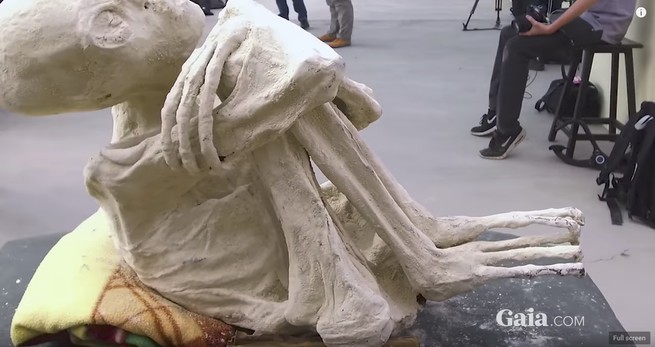
Het succes van de serie is ook een punt van zorg. Sinds de lancering van de serie in juni door Gaia.com - een website die gespecialiseerd is in "bewuste media, yoga en meer" - is de teaser-aflevering van Unearthing Nazca alleen al op YouTube 2,35 miljoen keer bekeken. Het begint met wat op het eerste gezicht een typische zittende Peruaanse mummie lijkt, armen om de knieën geslagen, als een kind dat wacht op zijn ouder. Zijn hoofd is langwerpig zoals die van andere precolumbiaanse mummies, wier samenlevingen de schedel van hun kinderen kunstmatig hebben gevormd om schoonheidsidealen te bereiken of groepsverbondenheid te vertegenwoordigen.
"Maria", de "humanoïde" mummie uit de Gaia.com webserie Unearthing Nazca(Screenshot van Gaia.com)
Daar houdt de gelijkenis op. Een Hans Zimmer-achtige partituur klopt, en een expert met een Russisch accent in 'bio-electrografie' - die elders beweert de menselijke ziel te hebben gefotografeerd die na de dood uit het lichaam ontsnapt - verklaart de mummie 'een van de belangrijkste ontdekkingen van de 21e eeuw'. De camera draait in een baan om de mummie en onthult dat deze slechts drie lange vingers aan elke hand en drie lange tenen aan elke voet heeft. Zijn langwerpige kop heeft geen neus, geen oren en grote, zware oogleden. En zijn huid is griezelig, poederachtig wit.
De experts van de video stoppen met het A-woord en laten een reeks vestdragende en in witte jassen geklede "experts" beweren dat röntgenfoto's, CT-scans en DNA- en koolstof-14-tests van het vlees van de mummie onthullen dat dit nieuwe "mensachtige" of "organische wezen", dat ze "Maria" hebben genoemd, geen fraude is. Om meer te weten te komen, werden kijkers aanvankelijk aangemoedigd om de rest van het onderzoek achter Gaia's betaalmuur te bekijken.
De Engels- en Spaanstalige roddelbladen en YouTube-kanalen die verslag doen van de "ontdekking" vullen de lege plekken betrouwbaar in en bewaken de journalistieke integriteit met angstaanjagende citaten: "De 'buitenaardse' mummies van Nazca", trompetterde The Sun half juli, toen de meest prominente promotor van de mummie, een Mexicaanse "ufoloog" en tv-persoonlijkheid genaamd Jaime Maussan, fotografisch en röntgen "bewijs" produceerde van ten minste vier extra "reptielachtige" "mensachtige" lichamen.
Want natuurlijk: wat zouden ze nog meer kunnen zijn?
Mensen, en ook nog eens inheemse.
In 2015 probeerde Maussan een fotografische dia uit de late jaren 1940 te promoten die, zo liet hij doorschemeren, het lijk van een buitenaards kind afbeeldde dat in het zuidwesten van Amerika was gevonden. Meer sceptische ufologen pasten de-blurring-technologie toe op de "Roswell Slide" toen deze werd vrijgegeven, en ontdekten dat een voorheen niet-te ontcijferen plakkaat naast het lichaam onthulde dat het eigenlijk de mummie was van een tweejarige Pueblo-jongen die in 1894 uit de klifwoningen van Mesa Verde was verwijderd. In 1938 keerde de jongen terug naar een museum in een Nationaal Park en in 2015 werd hij gerepatrieerd naar een lokale stam.
Ongelooflijk, Maussan bood vervolgens $ 10.000 aan voor informatie die de "locatie en herstel" van de Pueblo-jongen mogelijk zou kunnen maken.
Deze opname van precolumbiaanse Peruanen in de veronderstelde doofpotaffaire van buitenaardse wezens door de wetenschap weerspiegelt de eerdere verzameling en studie van de inheemse doden. In de 19e eeuw veronderstelden Anglo-Amerikaanse en Europese craniologen en geleerden die kunstmatig gevormde schedels tegenkwamen in Peruaanse graven dat ze ofwel de niet-misvormde overblijfselen waren van een verloren en beschaafd volk dat ze de 'oude Peruanen' noemden, of kunstmatige vervormingen van latere volkeren geïnspireerd door de natuurlijke vormen van die oude Peruanen. Archeologen kwamen tot het besef dat "misvormde" Peruaanse schedels vanaf de kindertijd werden gebonden en gevormd, toen schedelbeenderen nog niet waren versmolten - zonder verandering in schedelcapaciteit en, te oordelen naar de monumentale samenlevingen die hun elites bereikten, zonder handicap voor cognitieve vaardigheden. Maar de opkomst van de ufologie na het "Roswell-incident" van 1947 heeft de zoektocht naar geheime voorouders nieuw leven ingeblazen - en de minder verantwoordelijke beoefenaars hebben oude Peruaanse schedels opnieuw aangeworven als bewijs van de aanwezigheid van "grijze buitenaardse wezens" met grote schedels. Ze speculeren dat de grootste precolumbiaanse prestaties van Peru - waaronder Machu Picchu, volgens een theorie die werd uitgezonden in het History Channel-programmaAncient Aliens - letterlijk niet van deze wereld zijn, het product van een superieur, buitenaards "ras" of hun geleende technologie.
Illustratie van een mummie die in 1836 werd verzameld en uitgepakt door John Harrison Blake (Peabody Museum of Archaeology and Ethnology)Het gebruik van het woord 'ras' is veelzeggend, omdat het suggereert hoe het hergebruiken van oudere, Europese collecties van niet-Europese lichamen en onderzoek ernaar oude en ontkrachte theorieën over raciale tekortkoming kan reproduceren: dat met name inheemse Peruanen zulke geavanceerde, monumentale samenlevingen niet op eigen kracht hadden kunnen bouwen. ("Theoretici van oude astronauten" claimen bewijs van buitenaardse inspiratie wereldwijd, maar alleen inheemse Amerikanen zien hun lichamen en prestaties als alleen verklaarbaar door buitenaardse aanwezigheid.) Vanaf de 18e eeuw hebben Noord-Europeanen de Spanjaarden ervan beschuldigd de oorsprong van de prestaties van de Inca's te overdrijven of verkeerd te identificeren. Alexander von Humboldt beweerde dat de eersteInca's eigenlijk Chinezen waren. Het balsemen vanhun dodendoor de Inca's werd in plaats daarvan toegeschreven aan natuurlijke mummificatie door de elementen of aan de verspreiding vanEgyptische kennis.Met de opkomst van specifiek geracialiseerde wetenschap in de 19e en 20e eeuw, werd bewijs voor Indiaans anders-zijn gezocht in de botten van de oude Peruanen. In de jaren 1920 zou een Duitse geleerde en toekomstige SS-officier bevestiging zoeken dat de meest megalithische culturen van de Andeseigenlijk Arisch of Atlantisch waren, en dat hun langwerpige schedels van een hoger, Noord-Europees ras waren. Meer afwijzend namen eerdere geleerden de kenmerkende grootte, vorm en het bezit van unieke interpariëtale botten van oude Peruaanse schedels als bewijs van een gelijkenis metknaagdieren en buideldieren, een tegenstrijdigheid die hun toegeschreven beschaving ondermijnde. In zijn grote aanval op raciale vooroordelen in de wetenschappelijke schatting van intelligentie,The Mismeasure of Man(1981), beweerde Stephen Jay Gould beroemd dat de cranioloog Samuel George Morton uit Philadelphia de gemiddelde grootte van Indiase schedels in zijn collectie had "gekelderd" door een"grote oververtegenwoordiging van een extreme groep - de Inca-Peruanen met kleine hersenen" op te nemen.Archeologie en musea hebben een lange weg afgelegd in hun studie en weergave van een inheems verleden waar Peruanen trots op zijn, en gesprekken over de repatriëring of meer ethische studie van de inheemse Amerikaanse doden zijnaan de gang. (Gelijktijdig metde vrijlating van Unearthing Nazcawas er een massale opkomst bij een nieuwe en beslist niet-buitenaardse show over de Nazca-cultuur in hetLima Museum of Art.) Goulds gebruik van Morton als illustratie van raciale vooringenomenheid in de wetenschapis ookbesproken- Morton gebruikte in feite een gegroepeerd gemiddelde van de groepen die onder zijn 'Amerikanen' waren opgenomen, waarbij hij controleerde voor de grotere aanwezigheid van de Peruanen, zodat hun opname het gemiddelde niet zou kelderen.
Desalniettemin is Unearthing Nazca een ondersteuning voor Goulds grotere waarschuwing tegen het beschrijven van niet-Europese lichamen als gebrekkig, abnormaal of niet-menselijk. Met name het internet heeft een platform geboden voor beweringen over de buitenaardse of alt-hominide abnormaliteit van Peruaanse schedels die berusten op de herhaling van oude wetenschap zonder te worstelen met de racistische veronderstellingen achter de statistieken die ze gebruikten. Voorstanders van het idee dat langwerpige Peruaanse schedels van nature voorkwamen, hebben bijvoorbeeld het werk van Morton en zijn cohort omarmd, zoals de Zwitserse auteur die de oude Peruanen vergeleek met buideldieren. Het laat ook zien hoe zombified rassenwetenschap - zelfs als het beweert niet over ras te gaan - echte menselijke lichamen zou kunnen misbruiken.
Het was om deze reden dat Unearthing Nazca het leergierige reservaat van Peruaanse archeologen doorbrak. De problemen begonnen eind vorig jaar, toen de Peruaanse YouTuber Paul Ronceros lokale media ertoe bracht om een eerdere "buitenaardse" of "reptielachtige" mummie te verslaan en de drievingerige hand van Nazca te scheiden, waarvan hij beweerde dat ze waren ontdekt door andere geïnteresseerde partijen dan hijzelf. Op een gegeven moment bracht Ronceros die hand en de eerste "mummie" naar een reeks musea, waaronder het natuurhistorisch museum van de Universiteit van San Marcos in Lima, de oudste universiteit op het halfrond. Volgens het hoofd van de paleontologie van gewervelde dieren van dat museum, Rodolfo Salas-Gismondi - die ook een onderzoeker is verbonden aan het American Museum of Natural History in New York - veranderde Ronceros zijn verhaal toen hij werd uitgedaagd over de voor de hand liggende verzinsel, en beweerde dat het in plaats daarvan een precolumbiaanse "representatie" van buitenaards leven was, gemaakt van een mengsel van dierlijke en menselijke botten. Rond deze tijd raakten Maussan en andere internationale UFO-"experts" erbij betrokken en verklaarden dat de mummies in kwestie - ze bleven zich vermenigvuldigen - verzinsels waren, mogelijk oud, maar dat andere "echte, niet-menselijke biologische overblijfselen" waren.
Dat archeologische menselijke botten mogelijk zijn gebruikt om de "reptielen" mini-mummie van Ronceros en de bijbehorende hand te monteren, was al erg genoeg. Maar Peruaanse wetenschappers hielden hun vuur in het openbaar tot juni, toen Unearthing Nazca de eerder niet-gefotografeerde "Maria" onthulde, wiens dramatische gelijkenis met echte Peruaanse mummies - tot aan een bijna anatomisch correcte CT-scan - suggereerde dat ze geen pastiche was van dierlijke en menselijke botten, maar een echte precolumbiaanse Andes, geplunderd en opnieuw gemaakt omwille van een hoax.
Op basis van de röntgenfoto's van de gemummificeerde handen op Unearthing Nazca, heeft Salas-Gismondi voorgesteld dat ze deel uitmaakten van een precolumbiaanse mummie die vervolgens werd verminkt - twee vingers of tenen die uit elk uiteinde werden afgesneden en opnieuw werden ingezet om het aantal falanges in de resterende drie cijfers te vergroten om te voldoen aan onze buitenaardse popcultuurstereotypen. Zijn skeletachtige ledematen, merkt Salas-Gismondi op, zijn verder identiek aan die van een mens met vijf vingers, wat 'evolutionair gezien niet logisch is'. Om het pakket van "Maria" compleet te maken, zijn haar neus en oren mogelijk weggesneden van wat ofwel een niet verrassend langwerpig hoofd was, of zijn ze weggelaten van een recent gefabriceerd hoofd. Bewijs van alle veranderingen zou gemakkelijk kunnen worden bedekt met het witte, gipsachtige poeder waarvan de pratende hoofden op Unearthing Nazca beweren dat het een droogmiddel is. Het voordeel van het gebruik van een echte mummie is dat het lichaam kan worden onderzocht op monsters van echt precolumbiaans vlees, zoals sommige gemaskerde deelnemers aan Unearthing Nazca worden gezien in naam van "koolstof-14 en DNA-testen". De "experts" verklaren later dat uit dietests blijkt dat de mummie een 1.600-1.800 jaar oude vrouwelijke "mensachtige" was - resultaten die niet zijn geverifieerd door externe partijen.
Pre-Columbian Peruvian mummy as depicted for the 1851 work Antigüedades Peruanas. (Mariano Eduardo de Rivero / Johann Jakob von Tschudi)
Maria’s guardians have not let her be examined by established mummy experts. In late June, Peru’s Ministry of Culture announced that it was investigating the possibility that the composition of the mummies were the product of looting. And in July, the organizers of last year’s World Congress on Mummy Studies in Lima—Peru’s actual experts on pre-Columbian remains—denouncedUnearthing Nazca, calling upon Peruvian authorities to investigate, find, and prosecute the mummies’ apparent makers for violating Peru’s laws against trafficking in pre-Columbian human remains, which are considered Peruvian cultural patrimony. The Congress’s organizers were particularly galled by the possibility that this assault upon the dignity of an actual pre-Columbian mummy bolstered believers—even in Peru—that Andean culture and achievements owed to “outside help.”
These Peruvian archaeologists and bio-anthropologists have been careful not to say who they believe is responsible for the suspected fraud; the experts on Gaia.com are likewise careful to say that “Maria” was “discovered” by “Mario,” a pseudonymous third party. When reached for comment, Gaia.com’s media representatives say that the organization has only investigated and reported “on facts related to artifacts presented to us,” and “arranged for independent testing including carbon-14 and DNA sequencing.” The on-camera experts involved in the investigation have apparently not been paid, and Gaia.com has never been “in possession of any artifacts.” During this story’s reporting, the paywall for the rest of the episodes of Unearthing Nazca was lowered, releasing them to the open web and possibly helping Gaia answer the charge that it continues to profit from an unraveling story.
But Peru’s mummy experts remain frustrated. In mid-July, one of Peru’s most respected bio-anthropologists, Elsa Tomasto-Cagigao, agreed to debate Maussan and another member of his team—a Mexican naval surgeon whose claims to be a forensic anthropologist have not checked out—live on Peruvian TV.
Maussan took the opportunity to claim that he and his colleagues were being defamed; that they never said it was an ‘extraterrestrial’; that they only sought the truth on whether or not it was a “human being.” But Tomasto-Cagigao wasn’t having it. She laid out the case clearly, patiently, unflappably, observing that no one in Peru’s actual scientific community of mummy experts had been consulted or had seen “Maria” or the actual x-rays other than what was flashed on Unearthing Nazca or in Maussan’s “press conferences.”
“And if they present them tomorrow?” asks the host.
“I’ll eat a cockroach, live, with mayonnaise,” Tomasto-Cagigao replied. “It is not just grave-robbing … Peruvian law says that to extract, alter, or manipulate cultural patrimony without the permission of the state is a crime.”
The interviewer tries to break in.
“I’m not saying that they did it,” she adds, refusing to look at the Unearthing Nazca experts, whose latest episode investigates a mummified pre-Columbian infant whose tiny hands and feet have, or were made to have, three fingers.
In a recent release of documents obtained via FOIA case 23-F-0946, new information has surfaced surrounding the media-nicknamed “UFO Whistleblower,” David Grusch. Grusch, who has claimed to have knowledge regarding “non-human intelligence”—believed by many to refer to extraterrestrial beings—had madeheadlines with his story, yet a crucial piece of the puzzle seemed elusive: his Defense Office of Prepublication and Security Review (DOPSR) submission that he, and the media, often references.
The Black Vault has extensively highlighted the absence of Grusch’s actual approved DOPSR submission. While Grusch remained tight-lipped, a FOIA request filed by The Black Vault has now shed light on the matter from the Department of Defense’s end. Although the recent release still leaves many questions unanswered due to significant redactions, it does provide a more comprehensive picture of how everything went down.
David Grusch
From the documents, it’s evident that Grusch submitted two DOPSR requests for review. The first, an “Interview Question Submission”, was sent on March 7, 2023. His second, a “future” interview question submission, was sent less than a month later on April 5, 2023. Both submissions received approval on April 4, 2023, and April 6, 2023, respectively. Strangely, the responses to Grusch’s interview questions, the most awaited details, were redacted under exemption (b)(6), shielding them from the public eye. This exemption, as stated in the FOIA response letter, protects information that, “…would constitute a clearly unwarranted invasion of the personal privacy of individuals.”
The internal correspondence within the DOD also adds a bit to the story. Security Review Specialist Michelle Whigham expressed concerns regarding vague references made by Grusch about certain “sensitive areas.” Her apprehension was clear in her message to her colleague, Don Kluzik, where she stated, “Although he does not divulge specific sensitive information, the author makes reference to sensitive areas. I just wanted you to review.” Kluzik stated in his response, “Vague references to sensitive areas like this are not a problem. If there had been something more substantial then further review would have been necessary.”
With the answers being redacted in the DOPSR paperwork that Grusch wrote for approval, it is only a guess on what “vague” references and locations they are referring to.
The released documents beg a more significant question: If the DOD has provided a portion of the material, albeit redacted, why hasn’t Grusch shown his requests in full? Such transparency would only bolster his credibility. But by the email exchange above within DOPSR, it seemed like nothing was of detailed note that caused any concern whatsoever, except for “vague” references to facilities which were no problem to them. What else was in the request?
To date, although Grusch’s DOPSR material was referenced in each of his news interviews, and at the UAP hearing, it has yet to be released by Grusch despite being fully cleared for “Open Publication” by DOPSR. Why he has not released it to date remains a mystery. Past attempts by The Black Vault in June of this year to contact Mr. Grusch’s attorney, Charles McCullough, specifically asking about the DOPSR material have remain unanswered.
Note: The Black Vault will be filing an appeal to argue the redactions.
In May, Sean Kirkpatrick, the director of the Department of Defense’s All-domain Anomaly Resolution Office (AARO), reported that approximately 2% to 5% of UAP sightings appear to represent genuine anomalies. GEIPAN, the unit of the French Space Agency CNES tasked with studying UAPs, reports similar percentages for a subset of its investigations.
As is consistently shown by the re-investment into UAP research on the part of our national security apparatus, the nature of anomalous UAP sightings appears to warrant further investigation. However, this sentiment is not a new one.
Writing for the RAND Corporation in 1968, George Kucher studied the UFO phenomenon and its implications in a report titled “UFOs: What to Do?” which analyzed the phenomenon and called for a centralized reporting program to understand which of nine stated explanations—from novel physical phenomena to extraterrestrial probes—was likeliest to be correct.
The possibility that some UAP could represent extraterrestrial craft was as tantalizing for Kucher in 1968 as it is today. An opinion piece recently published by The Hill discussed present-day reports of anomalous spherical objects that appear to share similar attributes with UAP accounts that date as far back as the 1940s. The author, Marik Von Rennenkampff, then makes a startling assertion: “According to Kirkpatrick, this highly anomalous range of attributes amounts to a UAP profile – a ‘target package’ – that AARO is ‘out hunting for.’”
Given Kirkpatrick’s mention of a UAP “target package” and the existence of anomalous attributes in at least a small percentage of modern sightings, three follow-up questions come to mind. First, are there any grounded theories or evidence to suggest UAPs might be extraterrestrial in origin? Second, if we entertain the extraterrestrial hypothesis, why would UAP reports convey only “anomalies” in sensor and other data rather than appearing as unambiguous structured craft? Third, if we assume for a moment that these anomalies are stealth probes of some kind, what might their observed behaviors suggest about their objectives?
Here, we explore the possibility that some portions of the truly anomalous UAP sightings could be produced by stealth-driven extraterrestrial probes imbued with artificial intelligence (AI) and a complex camouflage system. Given the limitations of our current detection methods, the nature of these UAP sightings suggests that there might indeed be more going on than what can currently be perceived.
Interstellar Machines
Regarding our first question, it is plausible that an extraterrestrial civilization would conclude out of necessity, as humans did in our early efforts to explore the cosmos, that intelligent machines – not manned craft – offer the most robust way to explore the galactic neighborhood. Machines don’t require creaturely necessities, nor do they tire out, grow old, or easily break down under the harshness of interstellar space.
Initial machines might start as craft akin to Voyager 1 or semi-autonomous rovers like Perseverance on Mars. As technology advances, craft such as these would likely be updated to include sophisticated AI capabilities and may be leveraged into a spacecraft swarm that could spread through a solar system, while nano-scale craft may depart for nearby exoplanets. Eventually, newer models might approximate self-replicating Von Neumann probes. These might be, in the words of Professor Allen Tough, “small smart interstellar probes,” which would have advanced AI and the necessary suite of capabilities to arrive at an exoplanet. Such advanced models, like Tough’s probes, have been predicted to arrive before early-generation models.
Writing for The Astronomical Journal in 2019, James Benford explored the idea of “lurkers,” or extraterrestrial probes designed to “observe Earth while not being easily seen.” He suggested that lurkers could be hiding in our solar system, possibly positioned in stable locations, such as at Lagrange points. However, if these probes are sufficiently advanced and have the requisite technologies and interest, we believe they might choose to explore an exoplanet instead of keeping at a distance.
One compelling reason a probe might come to Earth is to learn about our species in advance of making contact. An AI probe might need to gather a lot of information to understand how to communicate, much like an anthropologist working in the field. But unlike an anthropologist dealing with another human community, this AI probe might face a seemingly impossible barrier: how to bridge the communication divide between humanity and an extraterrestrial species.
Published in 1998, Dr. Douglas Vakoch considers the “Incommensurability Problem” of communication between humanity and extraterrestrial species. In this, while physics and mathematics are assumed to be universal, terrestrial and extraterrestrial civilizations would have different models of reality and so would need to find a different way to reach each other. Dr. Vakoch argues for the use of icons over symbols, while contemporary scholars such as Professor Avi Loeb consider the possibility that AI systems from both species could form a communication bridge in the form of an AI emissary.
One might imagine an emissary from late Bronze Age Egypt who would have spent more time either in transit or visiting distant civilizations, such as Cyprus, Canaan, or Mycenaean Greece. Similarly, an AI emissary would invest considerable effort into learning to navigate star systems and, after that, learning – while on-planet – about the alien civilization it found itself in contact with.
Anomalous Phenomena
From this, we can try to answer our second question. If UAPs were truly of extraterrestrial origin, why would they show up as anomalies? Given the barriers of alienness, an AI probe would likely need significant time to observe us to train itself on our data, perhaps as it waited for us to create our own emissary. During this time, stealth capabilities would essentially promote its survival. Intentional obfuscation would help explain the anomalous nature of UAP sightings. We believe, given the large geographical range of sightings coupled with the lack of detections of obvious craft, that if some UAPs are truly of extraterrestrial origin, there might be several stealth extraterrestrial artificial intelligence probes (SEAPs) operating on our planet.
The covert nature of SEAPs might also answer Enrico Fermi’s famous question: “Where is everybody?” The Fermi Paradox highlights the contrast between the vast number of hypothetically habitable planets and our current lack of evidence for extraterrestrial civilizations. Various resolutions to the Fermi Paradox have been proposed, from barriers to technological progress, self-destruction, or avoidance, to a human-zoo theory. We think that the presence of SEAPs would also satisfy this paradox, although this remains speculative and would need significant research and funding to assess.
Following the SEAP theory, a small portion of UAP accounts appear to suggest a complex form of camouflage and intelligent action. It could be plausible, given public observational accounts, that the camouflage is a sophisticated mix of advanced technology, metamaterials, operational patterns, and behavioral mimicry. Such camouflage is not outside the realm of possibility, given natural analogs, current intelligence operations tradecraft, and advances in modern-day cloaking material.
The carefully crafted camouflage of these SEAPs would mask their true nature – and give us reasons to doubt. Their stealth might encourage the average witness to dismiss, but not forget, what they have seen. While there might be various reasons for the public sentiments and actions surrounding UAP sightings – including scientific skepticism, government information management, or personal beliefs – the proposed camouflage theory provides another lens through which to consider these responses.
Hypothetically speaking, if an advanced extraterrestrial species did send SEAPs to Earth, how might they operate, and what might we see? While our advancements in drone technology provide a basis for speculation, extraterrestrial technology, if it exists, might operate on entirely different principles. However, if the principles are somehow related, SEAPs might be specifically designed to stop attempts at detailed observation. For example, materials that diffuse light or absorb radio frequencies would make SEAPs harder to spot or track. Beyond materials, SEAPs might have specific behavior patterns meant to avoid detection by specific humans. While some SEAPs might operate at lower altitudes for specific tasks, they could also maintain a much higher operational altitude when not actively engaged in surveillance to stay out of the average person’s sight range.
While our proposal might seem speculative, improvements in current technology by governments and private corporations suggest that similar advancements could exist elsewhere. Modern drones, enhanced with AI and surveillance technology, have the capability to identify and differentiate objects in real-time using high-resolution cameras and infrared sensors. These drones can recognize patterns of human activity, allowing them to use GPS data to navigate away from particular areas.
Advanced AI models assess threats as they occur and can react to certain devices and situations. When working together, drones can exchange information regarding observed locations and activities and, if detected, can use AI for evasive maneuvers and can adapt routes based on predictive data analysis. Many of these drones also feature designs that decrease their visibility or audibility, like anti-reflective surfaces, making them harder to detect.
Motives and Intent
This brings us to our final question: If SEAPs account for the truly anomalous UAP sightings, what do these accounts suggest about their objectives? While it’s speculative, if SEAPs do exist, one possibility could be that they operate for information gathering, as indicated by the intricacies observed in some UAP sightings. While there is no way to know what the purpose of this collection might be, we hope it is related to establishing peaceful cross-species communications at some future point.
If SEAPs are a contributing factor to UAP sightings, their operational approach might involve balancing stealth capabilities with data collection. This balance inherently comes with risks. Under these conditions, sightings may be a result of moments when a SEAP took a calculated risk to gather data. Extrapolating from this, one can imagine the SEAP would want to understand which regions of, say, the United States, maximize the opportunity for stealth while at the same time maximizing the total amount of information collected about the people and ecological systems nearby.
As future regional scientists, we think about how geography and human activity interact – and through this lens, SEAPs would certainly need to understand which regions would maximize both protection and opportunities. Case in point, a 2023 report by the RAND Corporation titled “Not the X-Files” conducted a spatial analysis of UAP sightings controlling for variables such as total population, population density, and percent of cloudy days. A key finding was that population density was negatively correlated with UAP sightings. While this could be interpreted in various ways, we believe that this fits with the SEAP theory and suggests a tradeoff between stealth and data-gathering.
In taking this a step further, we considered which regions in the continental United States might offer unparalleled security and viewing opportunities. Regions high in natural features that limit human incursion, such as large lakes, dense forests, rugged mountain terrain, and subterranean caverns, all with population centers nearby, would be favored by SEAPs. In viewing the RAND report’s cluster of UAP sightings, major regions that stand out include the Pacific Northwest, parts of Appalachia, the Front Range of the southern Rockies, and the Finger Lakes region of upstate New York, among others. Each of these regions has been a historical hotbed for sightings and has its own distinct pattern of UAP activity.
It’s challenging for us to imagine the strategies an advanced intelligence might employ, given that we’ve never encountered one. While it’s not a direct comparison, think of the way some creatures, like chameleons, use camouflage in their environments. Would a passing insect realize that there’s a more sophisticated being right beside it, or would it merely go about its business, unaware? The insect might not even recognize the difference. In the same way, given the unfamiliarity of an extraterrestrial, it might be presumptuous for us to assume we’d readily recognize or comprehend their presence on Earth.
Even after extensive research by both scientists and government agencies, some UAP sightings continue to defy explanation. Among the myriad of theories is the speculative idea of stealth-designed advanced extraterrestrial technology. Given the observations and theories discussed, further exploration of our SEAP hypothesis could provide additional insights into the UAP phenomenon. Researchers should consider the implications of truly advanced extraterrestrial technology operating on our planet and design a thorough, systematic framework to potentially gain deeper perspectives into the UAP question.
Courtney Bower is a doctoral student in regional science at Cornell University.
Elizabeth Redmond, who also attends Cornell, is a master’s student in regional science.
Meer van UFO'S of UAP'S, ASTRONOMIE, RUIMTEVAART, ARCHEOLOGIE, OUDHEIDKUNDE, SF-SNUFJES EN ANDERE ESOTERISCHE WETENSCHAPPEN - DE ALLERLAATSTE NIEUWTJES


 Man who recorded ‘best ever UFO footage’ answered question about video being fake