Naar de inhoud

UFO'S of UAP'S, ASTRONOMIE, RUIMTEVAART, ARCHEOLOGIE, OUDHEIDKUNDE, SF-SNUFJES EN ANDERE ESOTERISCHE WETENSCHAPPEN - DE ALLERLAATSTE NIEUWTJES

UFO's of UAP'S in België en de rest van de wereld
seniorennet.beseniorennet.be
Ontdek de Fascinerende Wereld van UFO's en UAP's: Jouw Bron voor Onthullende Informatie! Ben jij ook gefascineerd door het onbekende? Wil je meer weten over UFO's en UAP's, niet alleen in België, maar over de hele wereld? Dan ben je op de juiste plek! België: Het Kloppend Hart van UFO-onderzoek In België is BUFON (Belgisch UFO-Netwerk) dé autoriteit op het gebied van UFO-onderzoek. Voor betrouwbare en objectieve informatie over deze intrigerende fenomenen, bezoek je zeker onze Facebook-pagina en deze blog. Maar dat is nog niet alles! Ontdek ook het Belgisch UFO-meldpunt en Caelestia, twee organisaties die diepgaand onderzoek verrichten, al zijn ze soms kritisch of sceptisch. Nederland: Een Schat aan Informatie Voor onze Nederlandse buren is er de schitterende website www.ufowijzer.nl, beheerd door Paul Harmans. Deze site biedt een schat aan informatie en artikelen die je niet wilt missen! Internationaal: MUFON - De Wereldwijde Autoriteit Neem ook een kijkje bij MUFON (Mutual UFO Network Inc.), een gerenommeerde Amerikaanse UFO-vereniging met afdelingen in de VS en wereldwijd. MUFON is toegewijd aan de wetenschappelijke en analytische studie van het UFO-fenomeen, en hun maandelijkse tijdschrift, The MUFON UFO-Journal, is een must-read voor elke UFO-enthousiasteling. Bezoek hun website op www.mufon.com voor meer informatie. Samenwerking en Toekomstvisie Sinds 1 februari 2020 is Pieter niet alleen ex-president van BUFON, maar ook de voormalige nationale directeur van MUFON in Vlaanderen en Nederland. Dit creëert een sterke samenwerking met de Franse MUFON Reseau MUFON/EUROP, wat ons in staat stelt om nog meer waardevolle inzichten te delen. Let op: Nepprofielen en Nieuwe Groeperingen Pas op voor een nieuwe groepering die zich ook BUFON noemt, maar geen enkele connectie heeft met onze gevestigde organisatie. Hoewel zij de naam geregistreerd hebben, kunnen ze het rijke verleden en de expertise van onze groep niet evenaren. We wensen hen veel succes, maar we blijven de autoriteit in UFO-onderzoek! Blijf Op De Hoogte! Wil jij de laatste nieuwtjes over UFO's, ruimtevaart, archeologie, en meer? Volg ons dan en duik samen met ons in de fascinerende wereld van het onbekende! Sluit je aan bij de gemeenschap van nieuwsgierige geesten die net als jij verlangen naar antwoorden en avonturen in de sterren! Heb je vragen of wil je meer weten? Aarzel dan niet om contact met ons op te nemen! Samen ontrafelen we het mysterie van de lucht en daarbuiten.

Archief

Why Was the Outer Space Treaty Necessary?

Why Was the Outer Space Treaty Necessary?

Exactly 59 years ago, a document entered into force that continues to govern human activities beyond Earth. Under its provisions, no country may claim sovereignty over the Moon; the placement of nuclear weapons in orbit is prohibited; and any damage caused by a satellite falling within another country’s territory must be compensated for by the state that launched it.

Signing of the Outer Space Treaty on January 27, 1967. Credit: CORBIS. Source: Getty Images

Explosion over the Pacific Ocean

A nuclear bomb has previously been detonated in space. The most powerful such explosion occurred in the summer of 1962, when no regulations governing outer space were yet in place.

On July 9, the United States launched a missile carrying a thermonuclear warhead from Johnston Atoll in the Pacific Ocean. The 1.4-megaton charge —  equivalent to 1.4 million metric tons of TNT — detonated at an altitude of approximately 400 km. The test was designated Starfish Prime.

The charged particles released by the explosion were trapped by Earth’s magnetic field. For several years, they orbited the planet, forming an artificial radiation belt. Each satellite passing through this region was exposed to an additional dose of radiation that its electronics and solar panels could not withstand. Within a few months, at least six satellites had failed. One of them was Telstar, the first commercial television relay satellite, which was launched into orbit the day after Starfish Prime.
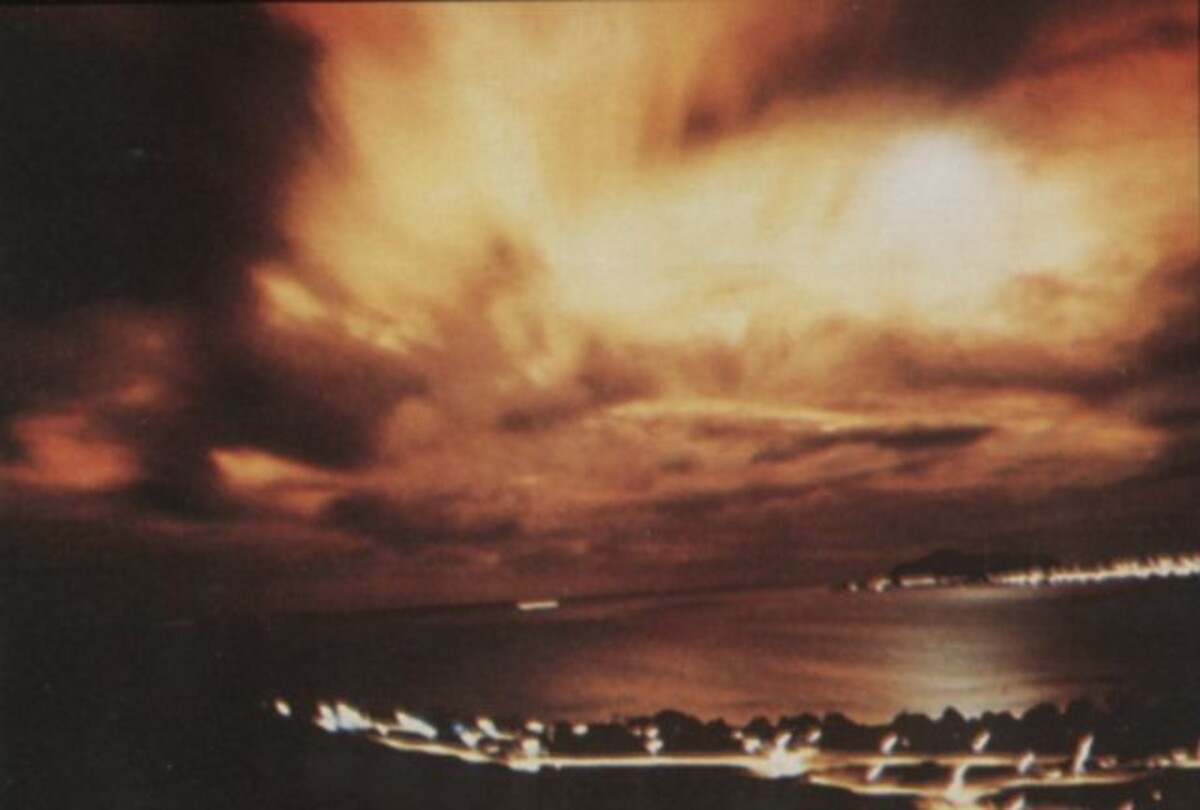
An artificial aurora lasting approximately seven minutes following the Starfish Prime high-altitude nuclear test on July 9, 1962.
Source: Wikimedia Commons.

By that time, both the United States and the Soviet Union had already developed missiles capable of carrying a warhead beyond the atmosphere. One test demonstrated the vulnerability of near-Earth space; an actual conflict in orbit could have rendered it unusable for years. In October 1963, the UN General Assembly called on states not to deploy nuclear weapons in orbit.

General rules applicable to all countries

 The agreement that emerged from this concern bears a lengthy official title but is widely known as the Outer  Space Treaty. It was opened for signature on January 27, 1967, simultaneously in Washington, London, and Moscow, and entered into force on October 10 of that year. The provisions governing the Moon were established nearly two years before the Apollo 11 astronauts set foot on its surface. Today, more than 110 countries, including Ukraine, are parties to the treaty.

Seventeen concise articles establish several fundamental principles. All countries may explore outer space, and every nation should share in its benefits. The treaty designates astronauts as envoys of humanity and requires every state to assist them in the event of an accident. Nuclear weapons and other weapons of mass destruction may not be placed in orbit or deployed beyond Earth. The Moon and other celestial bodies may be used solely for peaceful purposes; the establishment of military bases and fortifications, as well as the conduct of military maneuvers, is prohibited.
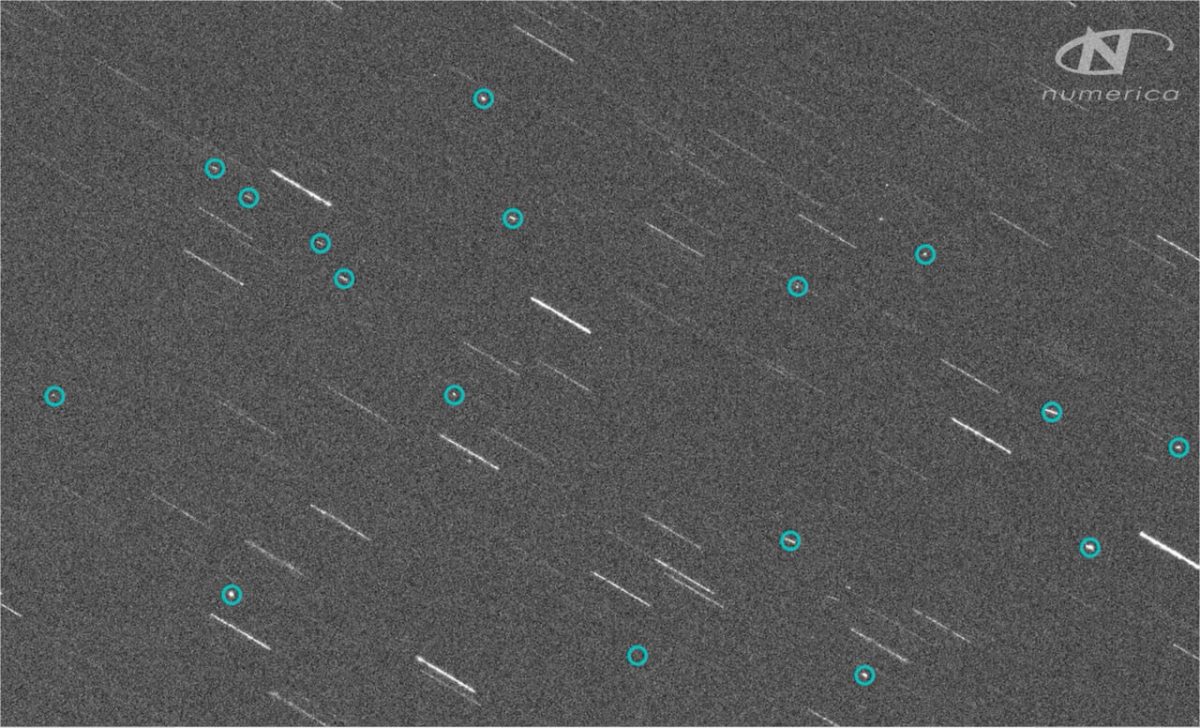
The first publicly released image of the debris cloud from the “Kosmos-1408” satellite, captured on November 15, 2021, shortly after its destruction by a Russian anti-satellite missile. The image was taken with a wide-angle telescope near Ouarzazate, Morocco. Credit: Kem Ki. Source: Numerica Corporation

This has led to the widespread belief that the treaty has completely demilitarized space. In reality, it prohibits only weapons of mass destruction and makes no mention of conventional weapons or military satellites. The launch of ballistic missiles is also permitted, as they leave the atmosphere only briefly and do not remain in orbit. When Russia destroyed its own malfunctioning satellite, “Kosmos-1408,” with a strike from Earth in November 2021, it did not formally violate any provisions of the treaty. However, more than 1,500 trackable pieces of debris ended up near the orbit of the International Space Station, forcing its crew to take shelter in the docked spacecraft.

A flag does not confer ownership rights

When the Apollo 11 astronauts planted the United States flag on the Moon’s surface in July 1969, the Moon did not thereby become American territory. The treaty expressly prohibits any state from claiming extraterrestrial space or a celestial body as its own. Such areas may not be appropriated through a declaration of sovereignty, use, or actual occupation.
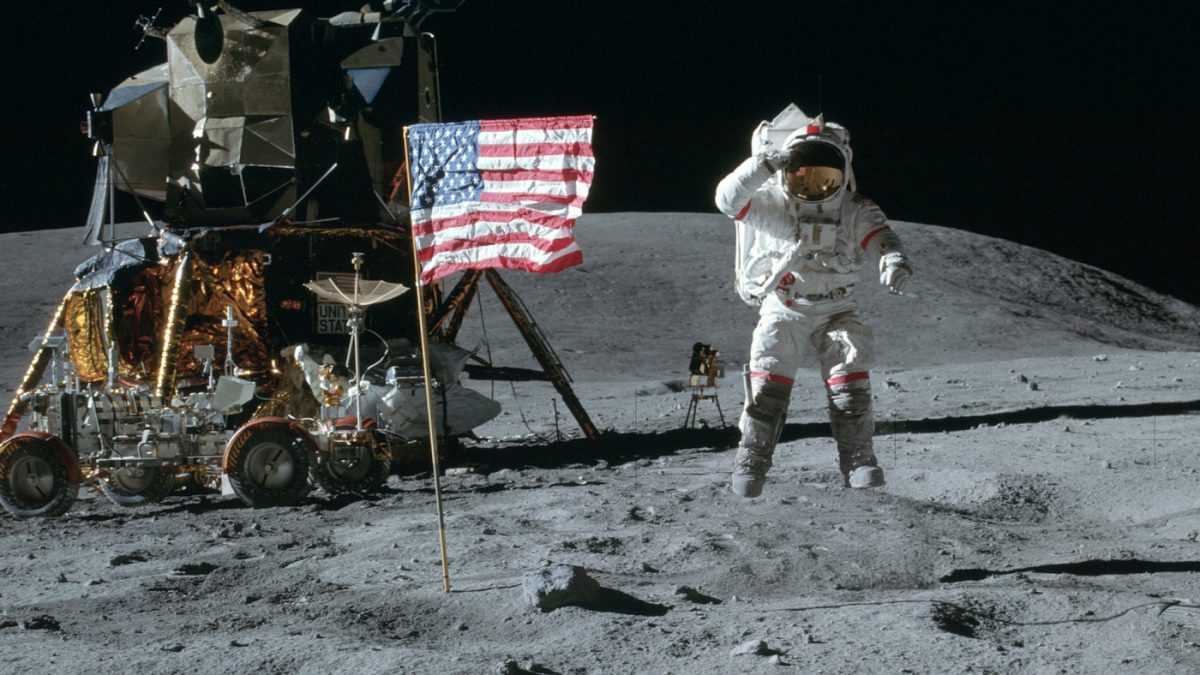
Apollo 11 astronaut Edwin Aldrin salutes the U.S. flag at the landing site, known as Tranquility Base, on July 20, 1969. The lunar module is visible on the left. Credit: NASA

This provision also renders the “certificates” for plots on the Moon — which are sold online — meaningless. Sellers argue that the treaty applies only to governments and makes no reference to private individuals. However, no country recognizes such plots as property belonging to anyone; without that recognition, a stamped piece of paper has no legal force.

A substantially more complex issue concerns what may be extracted from the Moon. The treaty does not regulate the extraction of water, metals, or regolith — that is, the loose layer of dust and debris covering the surface. Proponents of mining argue that the same reasoning applies as it does on the high seas. Waters beyond the territorial waters controlled by individual countries are commonly regarded as neutral. They belong to no one; however, fish caught there become the property of the fisher.

The United Nations sought to address this issue as early as 1979 by adopting the Moon Treaty. The treaty designates the resources of Earth’s natural satellite as the common heritage of humanity, meaning that they may be extracted only in accordance with international rules. None of the leading spacefaring nations, including Ukraine, has acceded to the treaty.

Today, the “fisherman’s logic” is enshrined in the Artemis Accords, a set of non-binding principles proposed by the United States in 2020 in conjunction with its program to return humans to the Moon. Signatories agree that resources on any celestial body may be harvested, provided that doing so does not violate the Outer  Space Treaty, and that such activities do not constitute an appropriation of territory. Separately, the agreements provide for the open publication of scientific data, assistance to astronauts in the event of an accident, the protection of historic sites such as the Apollo landing sites, and the safe removal of space debris.
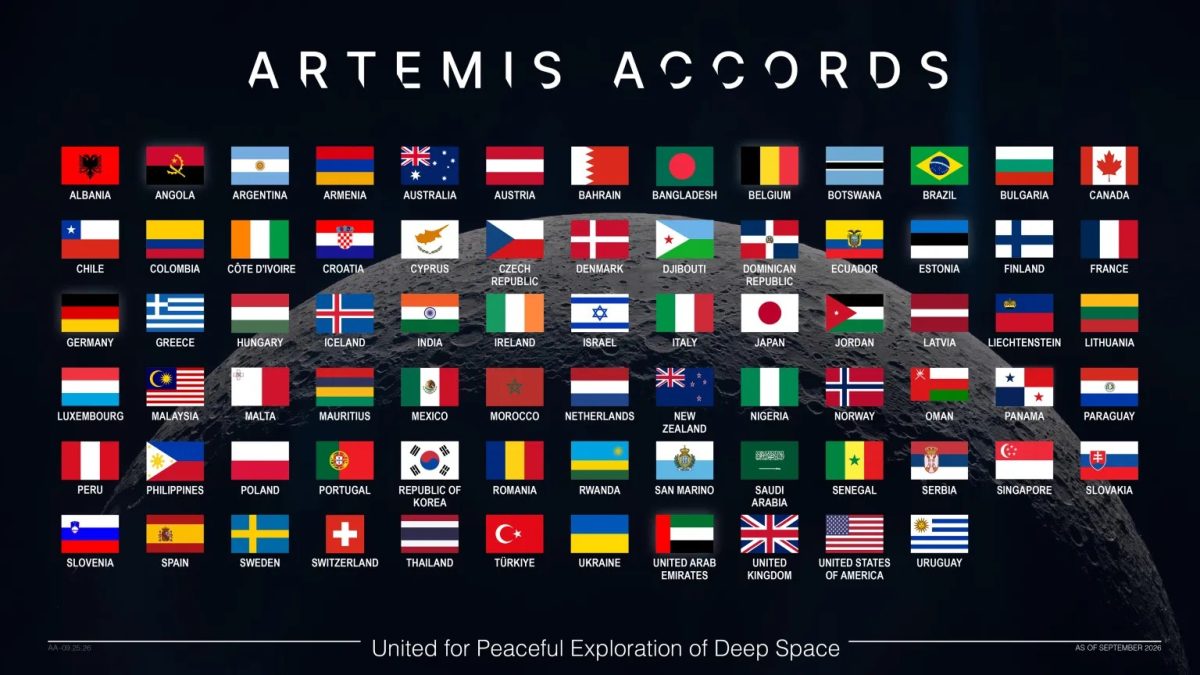
Flags of the countries that, as of September 2026, have joined the Artemis Accords, a set of nonbinding principles for the exploration of the Moon and other celestial bodies proposed by the United States in 2020. Credit: NASA

As of the end of September 2026, 76 countries had signed the agreement. Ukraine was the ninth country to join, in November 2020. Critics argue that the right to extract resources violates the prohibition on appropriation and primarily benefits the United States and commercial companies.

Who is liable for the costs when a satellite crashes?

Unlike the provisions concerning resources, this treaty provision has long been established in practice. Each country must supervise all space activities conducted by its citizens and companies. Accordingly, a private firm may not launch a spacecraft into orbit without government authorization and oversight. Damage caused by a space object is compensated by the so-called launching state — that is, the country that carried out or commissioned the launch, or provided its territory for the launch. Therefore, Ukraine will be responsible for the Ukrainian satellite, together with the country from which the rocket was launched.

This principle was put to the test in the winter of 1978. The Soviet reconnaissance satellite “Kosmos-954” was equipped with radar for tracking ships. Because its solar panels could not provide sufficient power, a nuclear reactor containing approximately 50 kg of highly enriched uranium operated aboard the satellite. Following a malfunction, the satellite fell out of orbit and crashed on January 24 in the uninhabited northern part of Canada, near Great Slave Lake. Radioactive debris was scattered across a strip approximately 600 km long — roughly the straight-line distance from Kyiv to Uzhhorod.

The team from the joint Canadian-American Operation Morning Light, which searched for radioactive debris from the Soviet satellite “Kosmos-954” in northern Canada in 1978. Credit: Operation Morning Light / Imperative Productions. Source: CBC

Canada invoiced the USSR for more than 6 million Canadian dollars to cover the costs of searching and cleaning up the area. Moscow paid half of this amount (3 million) in 1981 but never formally acknowledged liability. This remains the only instance in which a state has filed a claim under the 1972 Special Convention, which elaborates on the treaty’s provisions concerning compensation for damage.

Protecting other worlds

Another provision of the treaty addresses the contamination of other worlds. Countries must conduct the exploration of celestial bodies in a manner that avoids introducing bacteria and prevents harmful changes on Earth resulting from substances brought back from other worlds. Accordingly, Mars rovers are assembled in specialized clean rooms, and certain components are heated before launch to destroy any living organisms on their surfaces.
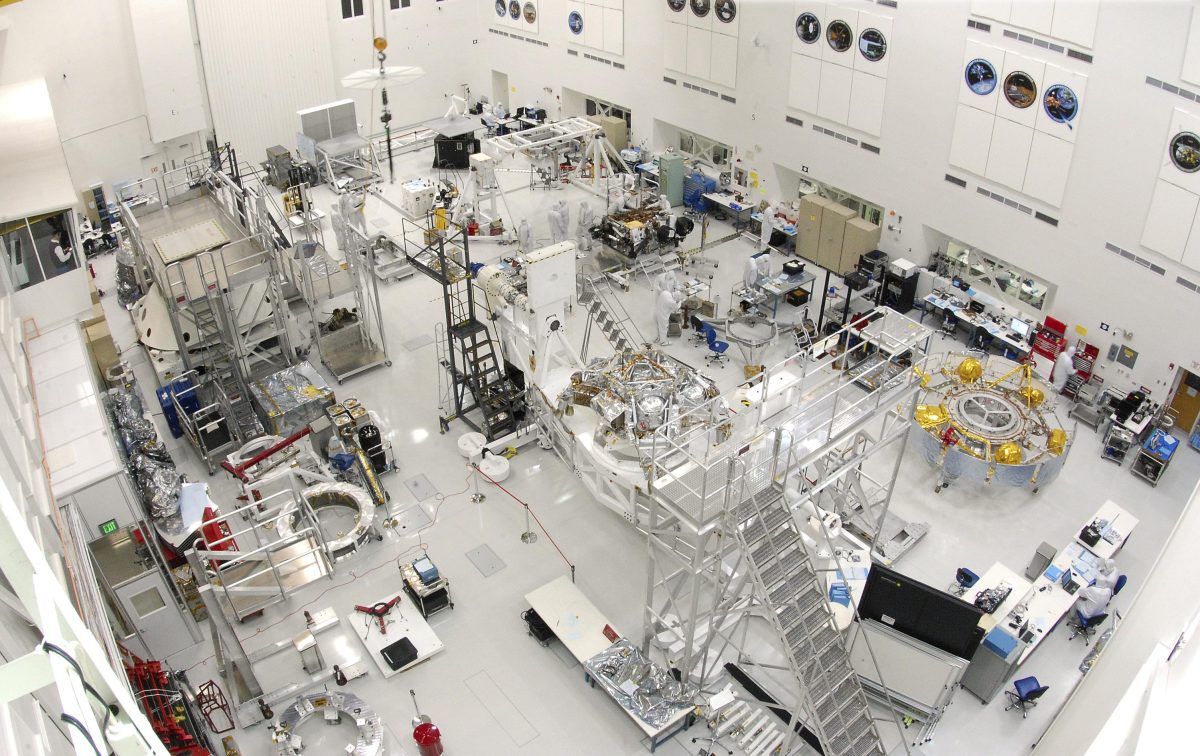
High Bay 1 Clean Room at the Spacecraft Assembly Facility, NASA JPL, Pasadena. Photo: NASA, JPL-Caltech

The objective is straightforward: if microorganisms are discovered on Mars or elsewhere, scientists must be able to determine with certainty that they were not transported there from Earth.

This requirement was most fully fulfilled at the conclusion of two missions to the giant planets. The Galileo spacecraft, which had been studying Jupiter since 1995, was deliberately directed into the planet’s atmosphere in September 2003. This measure eliminated the risk that it might one day collide with Europa, an icy moon. Beneath its surface, there is likely an ocean of liquid water in which life could theoretically exist.
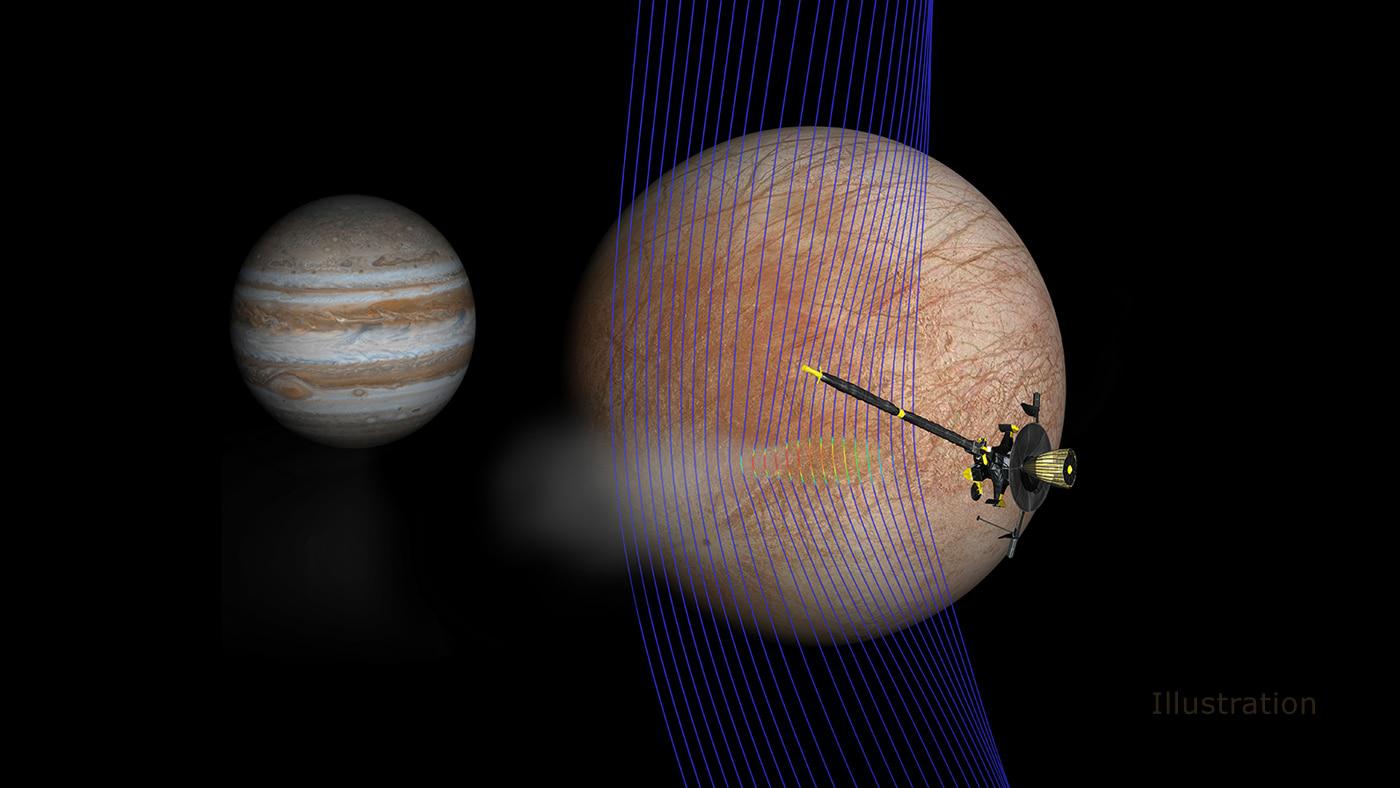
The Galileo spacecraft near Jupiter’s icy moon Europa, beneath whose surface a liquid-water ocean is likely to exist. Artist’s concept. Source: NASA / JPL-Caltech / Univ. of Michigan

Fourteen years later, the same procedure was carried out with the Cassini spacecraft. During the mission, researchers discovered that jets of water were erupting from a subsurface ocean beneath the icy surface of Enceladus, one of Saturn’s moons. Had Cassini run out of fuel, it would have become impossible to control, potentially resulting in a collision with Enceladus or neighboring Titan. Accordingly, on September 15, 2017, the spacecraft was directed into Saturn’s atmosphere, where it burned up.

An illustration depicting NASA’s Cassini spacecraft during one of its numerous flybys of Titan, Saturn’s largest moon.
Source: NASA

Rules requiring amendment

The treaty was drafted when only the USSR, the United States, and France possessed their own space-launch vehicles. Today, thousands of satellites orbit Earth, a substantial proportion of which were launched by private companies, and dozens of countries are planning lunar missions. The text makes no direct reference to resource extraction, space debris, or collisions involving a country’s own spacecraft.

These gaps are being addressed through separate agreements, around which two major coalitions have already formed. Seventy-six countries have joined the Artemis Accords, while China and Russia are developing their own proposal for an international research station on the Moon. Disputes over the rights to extracted resources are likely to become a practical concern as soon as the first minerals are mined there.


RELATED

The 1967 Treaty That Changed Space Forever

The Treaty That Turned Space Into an Early-Warning Shield

27th January 1967: The Outer Space Treaty opened for signatures

{ https://universemagazine.com/en/articles-en/ }

Hoe vind je dit bericht?
Geschreven door peter om 22:50 Stuur door

Steven Spielberg's alien thriller Disclosure Day now officially streaming

Steven Spielberg's alien thriller Disclosure Day now officially streaming

From Close Encounters to E.T. to War of the Worlds, Spielberg has explored a spectrum of alien visitors

Emily Blunt stands in front of a map of the midwest United States in a still from Disclosure Day

Steven Spielberg has spent much of his career looking to the stars. From the wonder of Close Encounters of the Third Kind to the childhood adventure of E.T. the Extra-Terrestrial, few filmmakers have done more to shape the way Hollywood approaches stories about humanity making contact with something beyond our world. Even War of the Worlds, though it was an adaptation, offered a glimpse into Spielberg's fascination with extraterrestrial life.

Now, Spielberg's latest alien movie has finally made the jump from theaters to streaming.

Disclosure Day Is Streaming! Spielberg’s Alien Mystery 👽 #shorts #movierecommendations #movie

Disclosure Day began streaming exclusively on Peacock on Friday, Oct. 9, giving Spielberg fans a new opportunity to catch the director's latest exploration of alien conspiracies. The sci-fi epic arrived in theaters on June 12, where it earned mostly favorable reviews and became one of the more prominent releases of the summer. The movie earned a respectable $244 million at the global box office.

What is Disclosure Day about?

Disclosure Day follows several people who find themselves caught up in a decades-old conspiracy surrounding humanity's encounters with extraterrestrial life.

Josh O'Connor in DISCLOSURE DAY, directed by Steven Spielberg.

Josh O'Connor plays Daniel Kellner, a cybersecurity expert who steals information from the powerful corporation Wardex, revealing an almost 80-year-old government cover-up involving alien visitations. He soon finds himself on the run from Wardex agents determined to recover the information before it can reach the public.

At the same time, Emily Blunt plays Kansas City meteorologist Margaret Fairchild, who becomes entangled in the conspiracy after unknowingly broadcasting a message written in an alien language. Her path eventually crosses with Daniel's, while Colman Domingo's Hugo Wakefield — a former member of the conspiracy and prominent advocate for disclosure — attempts to help expose the truth.

Disclosure Day

The result is part alien-contact movie, part conspiracy thriller, and part chase movie. Polygon's review described Disclosure Day as something of a return to the Spielberg of the 1980s, combining the pursuit and suspense of movies like E.T. with the otherworldly pull of Close Encounters of the Third Kind. The review also praised the film's sense of wonder and its more sentimental side, arguing that it comes surprisingly close to the classic Spielberg formula.

Rather than simply treating extraterrestrials as an invading threat, Disclosure Day is built around the idea that the truth about alien life belongs to everyone — and that learning we're not alone could fundamentally change how humanity sees itself.

Related


DISCLOSURE DAY Final Trailer (2026) Alien Invasion Sci-Fi Action Movie

Steven Spielberg’s Disclosure Day Full Trailer Explodes Online! (Sci-Fi Reset)

Spielberg's Alien Movie ENDING Explained: Disclosure Day (2026) Full Recap

{  https://www.polygon.com/news/ }

Hoe vind je dit bericht?
Geschreven door peter om 21:58 Stuur door

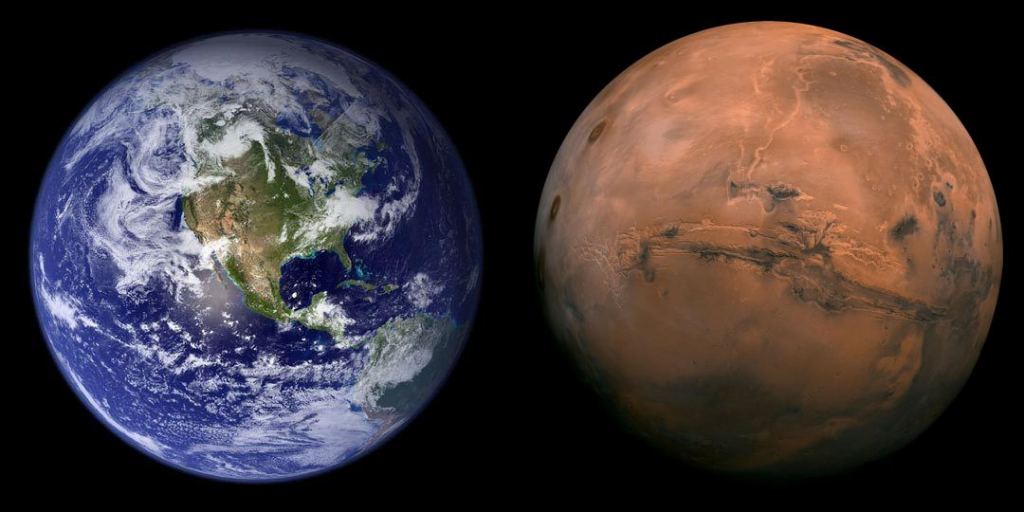
New Study Shows That Earth and Mars Had Different Origins

New Study Shows That Earth and Mars Had Different Origins

New research indicates that Earth and Mars formed through different processes, a finding that could help in the search for habitable exoplanets. Credits: NASA New research indicates that Earth and Mars formed through different processes, a finding that could help in the search for habitable exoplanets. Credits: NASA

According to Nebula Theory, the Solar System formed about four and a half billion years ago from a massive accretion disk of gas and dust that orbited our Sun. Alas, there are still questions about how they formed, with scientists favoring one of two possible pathways. Either they emerged from collisions between larger rocks (planetesimals), or from the gradual accumulation of pebbles by planetesimals.

New research from the University of Copenhagen has offered new evidence that could settle the debate. Using a novel approach, they have reconstructed the earliest stages of the planets’ formation by analyzing their chemical composition. Their results suggest that a hybrid model that merges the two pathways could explain how rocky planets like Earth and Mars formed, which could have implications in the study of exoplanets.

The research was led by Assistant Professor Haiyang S. Wang and Professor Anders Johansen, researchers from the Center for Star and Planet Formation, part of the Globe Institute at the University of Copenhagen. They were joined by researchers from the Institute for Particle Physics and Astrophysics at ETH Zürich, the Nevada Center for Astrophysics (NCfA), the Lunar and Planetary Laboratory, and multiple universities. A paper detailing their findings was published in the scientific journal Nature Astronomy.

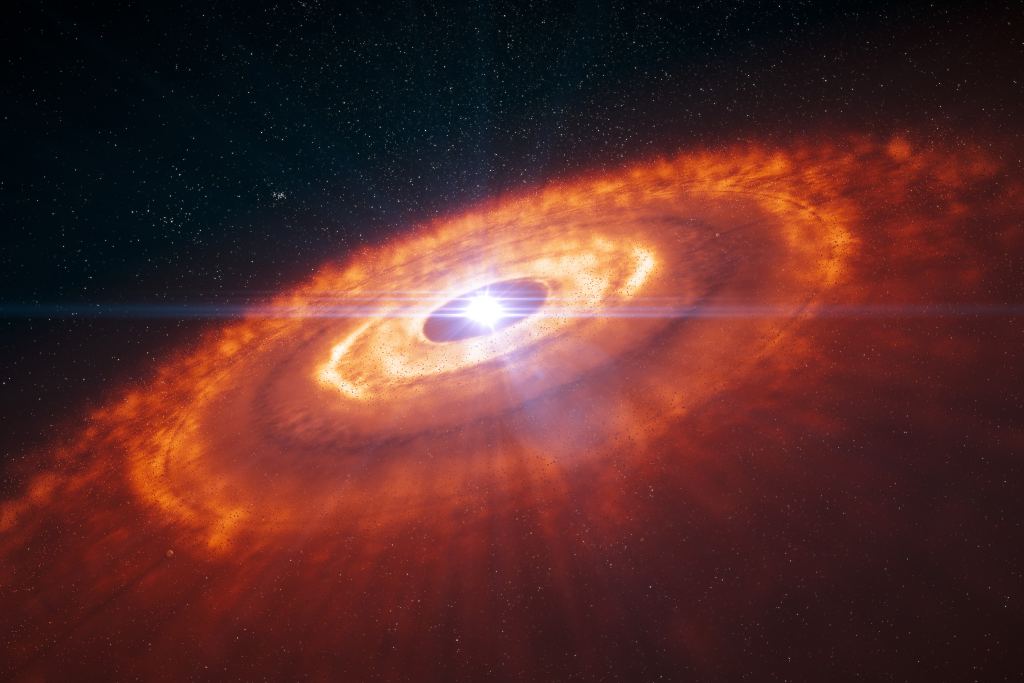
An artist's depiction of a protoplanetary disk in which planets are forming. Credit: ESO/L. Calçada

An artist's depiction of a protoplanetary disk in which planets are forming.

Credit: ESO/L. Calçada

The team's approach focuses on specific elements lo

cated in the crust and mantle of Earth and Mars. Specifically, they focused on volatile elements like sodium, zinc, and potassium, elements that have relatively low melting points and evaporate at high temperatures. By analyzing the abundance of these elements, scientists are able to determine what processes the planet underwent during formation.

“It is a major detective job to figure out what happened back then when most of the evidence disappeared long ago," said Johansen in a Globe Institute press release. "But even after 4.5 billion years, the compositions of Earth’s and Mars’ mantles remain the same. You can think of them as an imprint of the formation process."

Combined with advanced statistical modeling, they then calculated the most likely formation scenarios for the two planets. Their results demonstrated that volatile elements are lost from pebbles as they travel toward a planet’s surface. Based on their relative abundance on Earth and Mars, this suggests that the two planets formed in different ways: Mars formed primarily through planetesimals colliding while Earth began largely as two protoplanets that grew through pebble accretion. As Wang summarized:

The most surprising result was that Earth and Mars appear to have formed in different ways. You might have expected that two planets formed side by side in the same solar system would share a more similar formation history.

At least 75 percent of Earth’s mass appears to originate from two young planets, known as protoplanets, that grew large by accreting pebbles, while planetesimals contributed up to 25 percent. In contrast, roughly three-quarters of Mars’ mass appears to come from planetesimals, with the remaining quarter originating from pebble accretion.

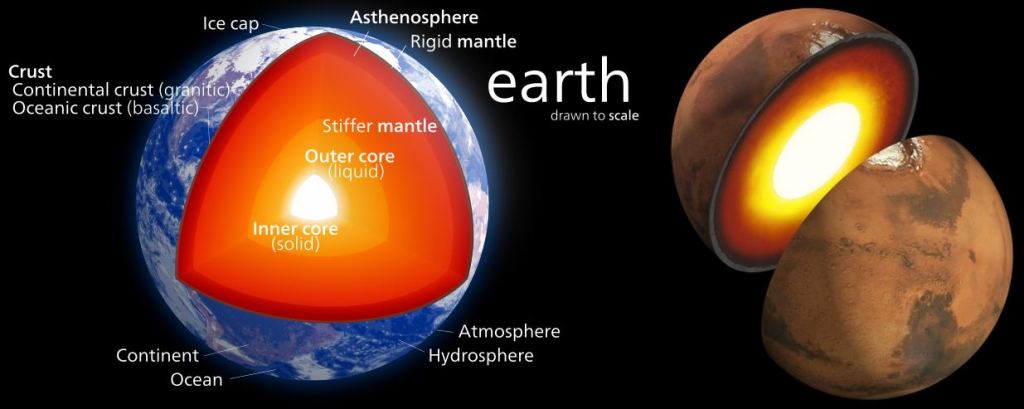
Earth and Mars are both differentiated bodies, meaning they're made up of different layers of material with different densities. Credit: (Earth) Kelvinsong/Wikimedia, (Mars) NASA

Earth and Mars are both differentiated bodies, meaning they're made up of different layers of material with different densities.

Credit: (Earth) Kelvinsong, (Mars) NASA

The researchers stress that their results are based on statistical modeling that contains uncertainties. These include the assumption of the chemical composition of the young Solar System's accretion disk that would eventually form the planets. In addition, based on Mars' similarities to Earth, it was also assumed that the planetesimal building blocks were chemically similar to the asteroid Vesta.

Lastly, it is traditionally assumed that volatile elements are lost more efficiently during pebble accretion than during giant impacts. But as Wang noted, even after the results are adjusted for these assumptions, the main conclusion remains the same:

The exact percentages may vary somewhat, but our analyses consistently indicate that Earth and Mars formed in two different ways. Our method provides a more precise and direct way of understanding planet formation than the more widely used isotope-based approach, which can often be interpreted in multiple ways.

What's more, a better understanding of the formation pathways of rocky planets could help inform the ongoing search for habitable exoplanets. The Nancy Grace Roman Space Telescope, which launched on August 30th, is equipped with a Wide Field Instrument and a field of view that is at least 100 times larger than that of the Hubble Space Telescope.

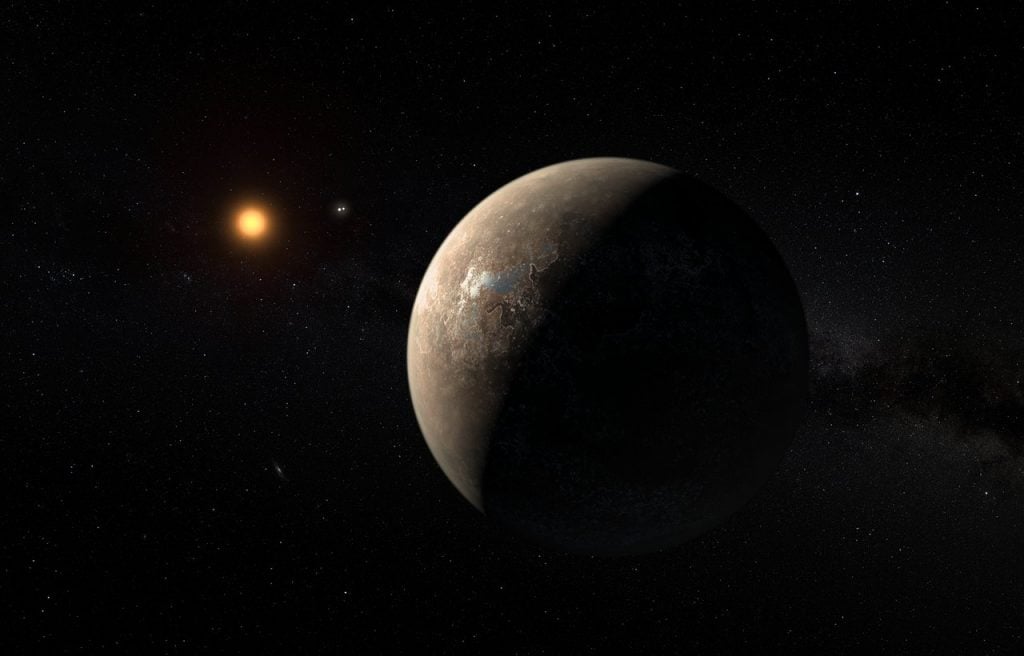
This artist’s impression shows the planet Proxima b orbiting the red dwarf star Proxima Centauri, the closest star to our Solar System. Credit: ESO/M. Kornmesser.

This artist’s impression shows the planet Proxima b orbiting the red dwarf star Proxima Centauri, the closest star to our Solar System.

Credit: ESO/M. Kornmesser.

The Habitable Worlds Observatory (HWO), when it deploys in the 2040s, will have even more powerful resolution and sensitivity. Along with ground-based observatories that combine large primary mirrors with adaptive optics (AOs), these observatories will be able to characterize exoplanets by determining their chemical compositions. This is vital to determining whether or not they are capable of supporting life, aka. "habitable."

“If we understand how planets lose volatile elements during their formation, we can also become better at predicting how much water and other life-supporting substances they ultimately retain,” said Johansen.

Further Reading:

RELATED

Scientists Uncover New Traces Of Earth's Origins On Mars | 10 News

Mars Was More Alive Than Earth — Until Something Killed It (Scientists Are Stunned)

Life on Earth? Thank Mars — Here's Why

{ https://www.universetoday.com/ }

Hoe vind je dit bericht?
Geschreven door peter om 21:13 Stuur door

Triangle UFO Over RV Parking Lot, West Springfield City, Massachusetts UAP Sighting News.

Triangle UFO Over RV Parking Lot, West Springfield City, Massachusetts UAP Sighting News.

UFO_12.png

UFO_11.png
Date of sighting: Oct 2, 2026
Location of sighting: West Springfield City, Massachusetts, USA
Source: NUFORC
 
This report just in. A person in an RV park was looking up at the sky and noticed a spinning triangle craft passing over him. The craft is not a normal triangle but more diamond like as its moving its also slowly turning. This causes it to blur a bit making it difficult to get a good screenshot. I don't see LEDs on the craft, but it does have light surrounding it...as if a static charge was causing the entire craft to gently light up. This shape of UAP is very rare so this video really tells us that its spinning about once every 4-5 seconds. 
Scott C. Waring - UFO Sightings Daily
 
Eyewitness states: 
I was sitting down, when I looked up and saw a UFO flying right ahead of me very far up in the sky. It had triangles on every side, and the triangles had white lights on them. The UFO never stopped, it just flew by in one steady line across the RV camper parking lot, until it eventually turned into a spec. The UFO appears to be rotating rapidly.

Triangle UFO Over RV Parking Lot, West Springfield City, Massachusetts UAP Paranormal Alien News.

{ https://www.ufosightingsdaily.com/ }

Hoe vind je dit bericht?
Geschreven door peter om 20:42 Stuur door

NASA targets mysterious hole on the moon in hunt for vast underground cave

NASA targets mysterious hole on the moon in hunt for vast underground cave

A mysterious hole on the moon's surface could open into a vast underground world.

NASA has selected a project to investigate the opening, known as the Marius Hills Pit, and determine whether it leads to a cavern that could shelter future astronauts from radiation and extreme temperatures.

The project, known as the Geophysical Instruments for Marius Lunar Pit Investigation (GIMLI), will combine ground-penetrating radar, seismic sensors and a device to measure the the local gravitational field to see below the surface. 

Located in one of the moon's most volcanically varied regions, the pit is about as deep as a 10-story building is tall, with an opening roughly the size of an American football field.

It is one of about 300 pits identified on the lunar surface, some of which could provide entrances to caves formed by ancient volcanic activity. It was found by Japan's SELENE spacecraft in 2009.

The team, which announced the project on Monday, said it also plans 'to study more than the possible underground structure.'

The surrounding area has experienced a long history of volcanic activity, and the walls of MHP expose layers of regolith and lava flows that normally remain buried. 

Examining these layers could show how lava once moved across and beneath the lunar landscape and whether individual eruptions were separated by long intervals. 

NASA has selected a project to investigate a hole on the lunar surface, known as the Marius Hills Pit. The initiative will determine whether it leads to a cavern that could shelter future astronauts from radiation and extreme temperatures

NASA has selected a project to investigate a hole on the lunar surface, known as the Marius Hills Pit. The initiative will determine whether it leads to a cavern that could shelter future astronauts from radiation and extreme temperatures

NASA has tapped the Planetary Science Institute (PSI) to lead the investigation.

The American space agency said that if such a cavern exists beneath the lunar surface, it could one day protect astronauts from radiation and the dramatic temperature swings on the lunar surface.

Radiation levels on the lunar surface are roughly 2.6 times higher than on the International Space Station (ISS), which orbits about 250 miles above Earth's surface, and about 200 times higher than on Earth.

If astronauts were exposed to such levels, they would face serious health risks, including cancer, cell damage and acute radiation sickness.

Rather than relying only on observations from above, GIMLI will provide researchers with an opportunity to examine Marius Hills Pit directly from the lunar surface. 

PSI Associate Director and Senior Scientist Than Putzig said in a statement: 'It's long been a desire of mine to reintroduce intentional active-source seismic methods to planetary science, as it has essentially not been done since the Apollo astronauts conducted the first seismic surveys on the moon.

'Combining that method with ground-penetrating radar and gravity measurements makes it all the more exciting, as these methods together will allow us to get a much better understanding of subsurface properties, including the anticipated detection of a lava tube extending away from the Marius Hills Pit.'

Even if an underground cave is not found, lunar pits are valuable because their walls expose otherwise hidden geology.

Located in one of the moon's most volcanically varied regions, the pit is about as deep as a 10-story building is tall, with an opening roughly the size of an American football field

Located in one of the moon's most volcanically varied regions, the pit is about as deep as a 10-story building is tall, with an opening roughly the size of an American football field

Any underground spaces connected to them could also preserve evidence of the volcanic processes that helped shape the moon. 

Gareth Morgan, PSI Senior Scientist and Deputy Principal Investigator on the GIMLI program, said: 'Confirming a substantial lava tube would give us an insight into how volcanism operated on the moon.

'Lava tubes are a common feature of basaltic volcanism on Earth, so identifying them on the moon means we could use knowledge of such terrestrial caves to better understand lunar history.' 

The project comes as NASA plans to land astronauts on the moon during the Artemis IV mission in 2028. 

When the crew reaches the moon, two astronauts will descend to the surface and spend approximately a week near the South Pole of the moon conducting new science before returning to lunar orbit to join their crew for the journey back to Earth

{ https://www.dailymail.com/sciencetech/index.html }

Hoe vind je dit bericht?
Geschreven door peter om 20:24 Stuur door

Japan once dismissed UFOs. Now the government is investigating unexplained sightings seriously

Japan once dismissed UFOs. Now the government is investigating unexplained sightings seriously

UFO spaceship view at night. (Representative Cover Image Source: Jacob Wackerhausen/Getty Images)

UFO spaceship view at night. (Representative Cover Image Source: Jacob Wackerhausen/Getty Images)

Japan is taking UFO sightings more seriously

IMAGE SOURCE: JACOB WACKERHAUSEN/GETTY IMAGES

Japan is taking UFO sightings more seriously

UAP stands for unidentified aerial phenomena, which is a new term for the mystery aircraft once simply called UFOs. Recently, on August 7, 2026, the U.S. Department of War released more new materials related to UFO sightings around the world. 

And now Japan is paying closer attention to these sightings than ever before. The Japanese government has now launched a UFO investigation after the U.S. Department of Defense marked a region as a "hotspot" for sightings. Here's how the country is looking into this matter so far.

Japan once said UFOs didn’t exist

IMAGE SOURCE: U.S. DEPARTMENT OF WAR

Japan once said UFOs didn’t exist

In February 2018, Japan's government issued an official stance denying the existence of UFOs. It said that “no confirmation has been made of their existence.” The cabinet's written response also said that there was no special consideration for how to react to unidentified aerial objects. 

Mamoru Santo, a former wing commander in the Self-Defense Forces, said he regularly heard about odd sightings from pilots and civilians. Pilots were reportedly told to stay quiet. According to The History, Santo recalled, "But even when this happened, it was only shared among colleagues and not reported publicly."

Then the sightings became a security issue

IMAGE SOURCE: RAY MASSEY/GETTY IMAGES

Then the sightings became a security issue

Things changed in September 2020, when Defense Minister Taro Kono announced new procedures. Under the new procedures, Self-Defense Forces personnel must first confirm they are seeing an unidentified object; then they are required to take written and photographic records for analysis.

In a press conference, Kono said, “Frankly speaking, I don’t believe in UFOs,” and he described them as “indistinguishable objects, not objects from space.” Commenting on the risks, Heigo Sato, who heads the Institute of World Studies at Takushoku University in Tokyo, noted, “The most feared strategy is a surprise attack.” He added, “Gathering information on currently unknown phenomena is important for security.”

Lights above a nuclear plant pushed lawmakers to act

IMAGE SOURCE: U.S. DEPARTMENT OF WAR

Lights above a nuclear plant pushed lawmakers to act

In late July 2025, four security guards at the Genkai Nuclear Power Station in Saga Prefecture saw three drone-like lights in the night sky. After the investigation, no drone was found, and the exact nature of the lights remains unknown.

Former defense minister Yasukazu Hamada, who leads a parliamentary group studying UAPs, said, “If we cannot identify what it is, it’s impossible to determine whether the Defense Ministry or the National Police Agency should handle it.”

Japan says it is watching, but it won't promise to share

IMAGE SOURCE: MARHARYTA MARKO/GETTY IMAGES

Japan says it is watching, but it won't promise to share

In May 2026, the Pentagon released more than 160 files on UAP sightings, including two videos of objects spotted near Japan. Chief Cabinet Secretary Minoru Kihara responded, “Regarding incidents related to our national security — including UAPs — we are constantly gathering and analyzing information with great interest, while maintaining close coordination with the United States and other countries.” 

When asked about when Japan is releasing its own files, he said the government would decide case by case. Meanwhile, a group of about 80 lawmakers has urged the government to create a dedicated UAP department. As of now, the country does not have its own dedicated UAP department.

Japan's Shocking UAP Investigation Unit Revealed! #shorts

{ https://starlust.org/gallery/ }

Hoe vind je dit bericht?
Geschreven door peter om 22:17 Stuur door

METEOROLOGISTS DISMISS 'ALIEN CRAFT' CLOUD AS RARE OPTICAL PHENOMENON AS VIRAL VIDEO SHOWS FIGURE WALKING INSIDE

METEOROLOGISTS DISMISS 'ALIEN CRAFT' CLOUD AS RARE OPTICAL PHENOMENON AS VIRAL VIDEO SHOWS FIGURE WALKING INSIDE

Gary Franchi

Debate surrounds rare cloud formations and potential misidentifications as alien phenomena.

Debate surrounds rare cloud formations and potential misidentifications as alien phenomena. 

Next  News Editorial Illustrati

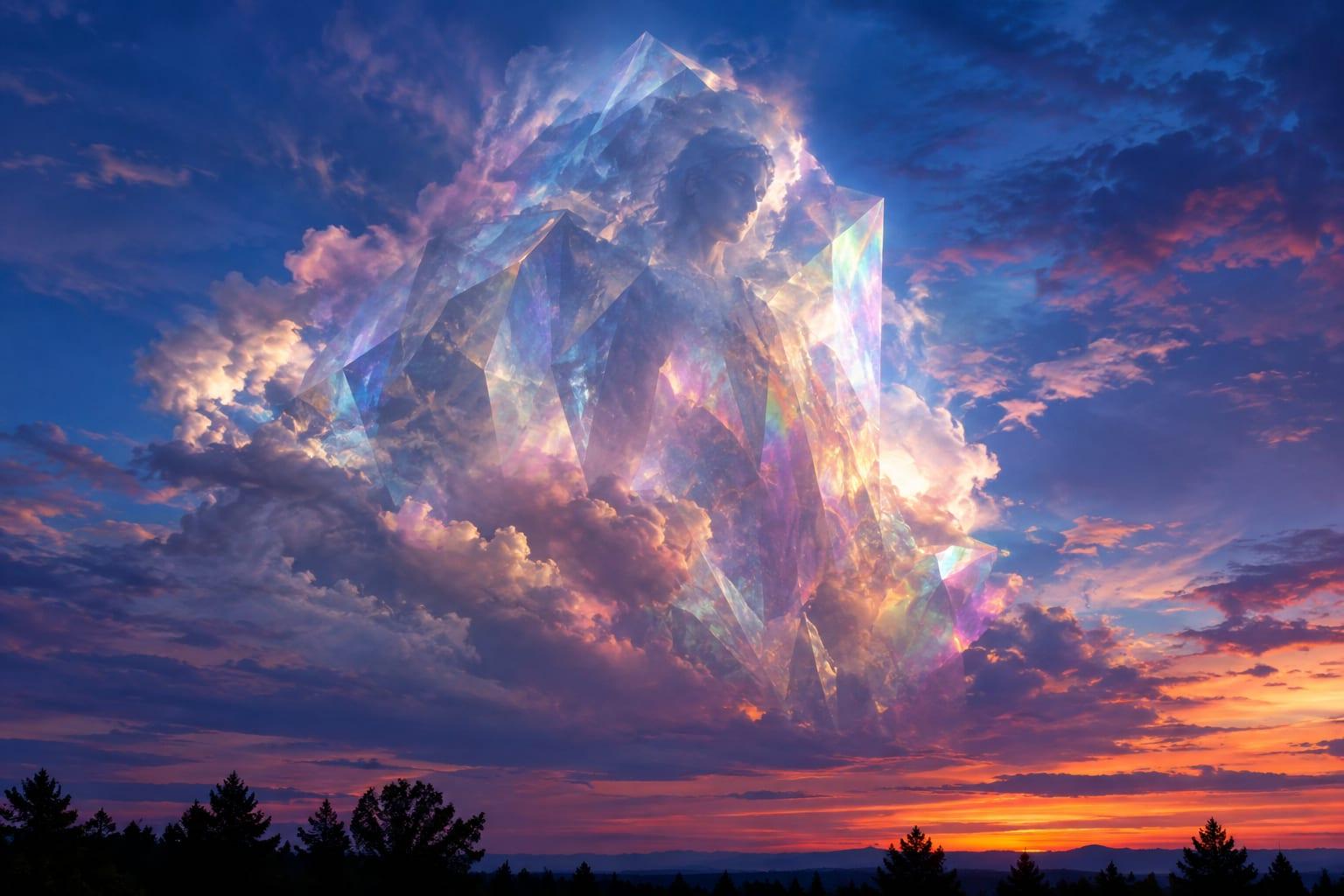
A social media post from the account @MarioNawfal claims that a rare mirror-prism crystal-shelf cloud is actually an alien craft, and that witnesses can see a figure walking inside it. The post, published on October seventh, includes an image description showing what appears to be a humanoid silhouette inside the cloud formation.

The post reads: "🛸 Meteorologists be like: It's just a mirror-prism crystal-shelf cloud. So rare! Definitely not an alien craft! Meanwhile, these things are starting to hum the song from Close Encounters! You can literally see someone walking... WTF is this?!" The post attributes the text to a writer identified as Jamie.

The image accompanying the post shows a cloud formation with a distinctive shelf-like structure. According to the image description, a humanoid figure appears to be visible inside the cloud. The description notes what the image shows, not what actually occurred. The post does not provide a location, date, or any independent source for the claim beyond the image itself.

The @MarioNawfal account is known for sharing viral content, often with a sensational framing. This post follows a pattern of presenting unusual weather phenomena as potential extraterrestrial activity, a recurring theme in online UFO communities.

The claim that the cloud is an alien craft is not supported by meteorological science. Mirror-prism crystal-shelf clouds, also known as fallstreak holes or hole-punch clouds, are a documented atmospheric phenomenon. They form when supercooled water droplets in a cloud suddenly freeze into ice crystals, creating a circular or elliptical hole with a trailing shelf of ice crystals. The effect can resemble a flying saucer or a tunnel, and the ice crystals can create prism-like optical effects.

The image description states that a humanoid figure is visible inside the cloud. This observation is based on a vision model analyzing the image. It is not independently confirmed. Pareidolia, the tendency to see faces or figures in random patterns, is a common explanation for such sightings.

The post does not name any meteorologist who made the statement attributed to them. It also does not provide a source for the "Close Encounters" humming claim, which appears to be a reference to the 1977 film in which an alien craft communicates through a musical tone. No audio is included in the post.

The @MarioNawfal post is the only coverage found on this subject. No other accounts or  news outlets have picked up the claim. The post itself does not cite any witnesses, experts, or official sources.

Next News Network could not independently verify the claim that the cloud is an alien craft, that a figure is walking inside it, or that the cloud is humming a tune. The image description provided with the post is an observation of what the image shows, not a factual account of what happened.

The post's framing suggests a skeptical view of meteorologists, implying they would dismiss the phenomenon as a rare cloud rather than consider an extraterrestrial explanation. This mirrors a broader trend in online discourse where unusual aerial phenomena are often interpreted as evidence of alien visitation, despite scientific explanations.

Mirror-prism crystal-shelf clouds are rare but well-documented. They have been photographed and studied by meteorologists around the world. The phenomenon occurs when the temperature and humidity conditions are just right for supercooled water to freeze rapidly. The resulting ice crystals can fall and create a shelf-like appearance. The optical effects can be striking, with prismatic colors similar to a rainbow.

The claim that a figure is walking inside the cloud is particularly notable. The image description, generated by a vision model, states that a humanoid silhouette is visible. This description is not a verified fact. It is an automated analysis of the image. The post presents this as evidence of an alien being, but no further details are provided.

The account @MarioNawfal has a history of sharing content that blends conspiracy theories with viral media. The account often posts about UFOs, unexplained phenomena, and political topics. This post fits that pattern, using a striking image and a provocative caption to generate attention.

The post does not provide any context about where or when the cloud was photographed. It also does not include any follow-up information or responses from meteorologists or aviation authorities. The absence of such details makes it difficult to assess the claim.

In the absence of independent verification, the post remains a social media claim. It is not a news report. It does not meet the standards of evidence required for factual reporting. The reader should treat it as an unverified assertion.

The post's reference to "Close Encounters" is a cultural touchstone. The film popularized the idea of aliens communicating through music. The post suggests the cloud is humming that tune, but no audio is provided. This claim is not supported by any evidence in the post.

The image description notes that the cloud has a mirror-prism crystal-shelf structure. This is consistent with the meteorological explanation. The description also notes the humanoid figure. The combination of a known atmospheric phenomenon with an ambiguous shape is often used to fuel speculation.

Next  News Network could not independently verify the claim that the cloud is an alien craft, that a figure is walking inside it, or that the cloud is humming a tune. The image description provided with the post is an observation of what the image shows, not a factual account of what happened.

Our Take

The left-wing media and their allies in the meteorological establishment want you to believe that every strange thing in the sky is just a rare cloud. They will trot out their experts and their jargon to dismiss what your eyes can plainly see. But the American people are not fooled. When a cloud looks like a craft, when you can see a figure walking inside it, and when it starts humming a tune from a famous alien movie, you have to ask questions. The mainstream media will not ask those questions because they are invested in maintaining the illusion that they have all the answers. They mock and deride anyone who dares to suggest that we are not alone. But the real story here is not the cloud. It is the arrogance of so-called experts who think they can tell you what to think. Next News Network will continue to report on the stories that the establishment wants to ignore. We will not be silenced by their condescension. The truth is out there, and we will keep asking the questions that the mainstream media refuses to ask.

{ https://nextnewsnetwork.com/}

Hoe vind je dit bericht?
Geschreven door peter om 21:49 Stuur door

A mysterious cloud on Mars suggests possible extreme humidity

A mysterious cloud on Mars suggests possible extreme humidity

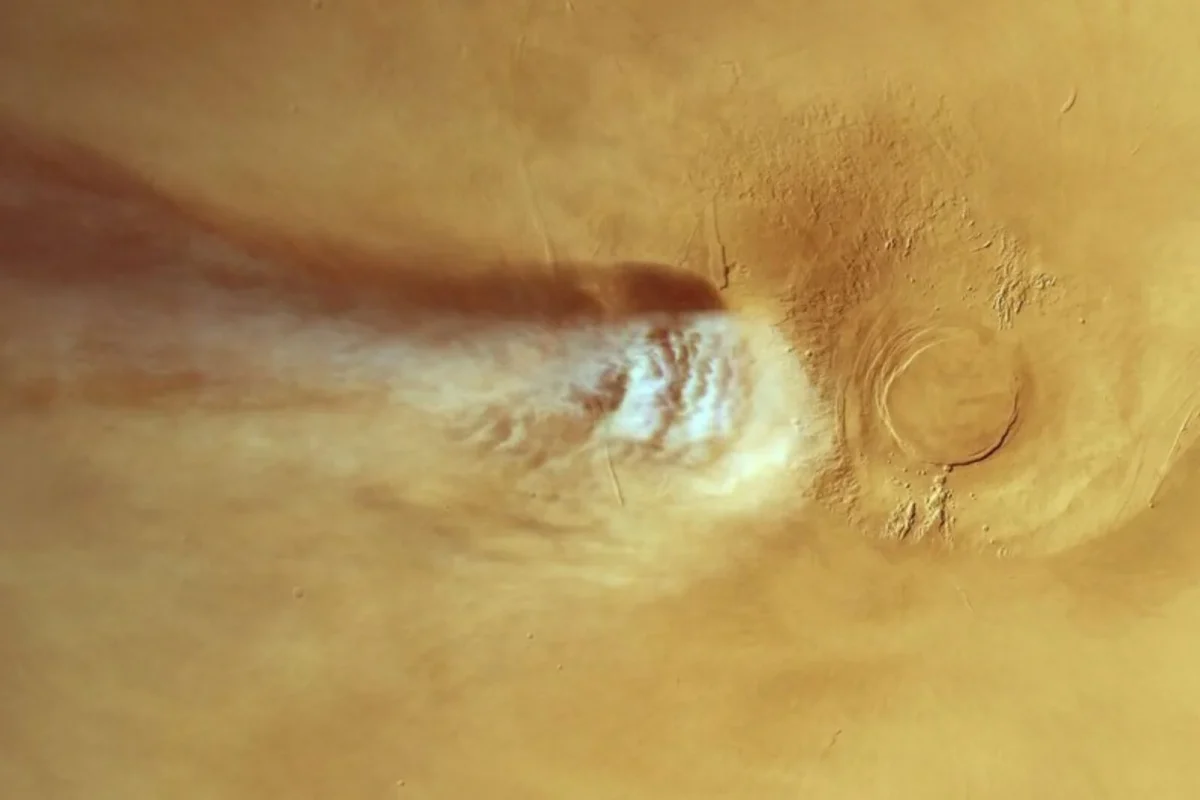
A long, narrow cloud of water ice appears every morning near the Martian volcano Arsia Mons at a certain time of year. For years, scientists could not explain how it forms. Now they have managed to reproduce it in a computer model. To do so, they had to assume that water vapor freezes directly in the air, without the dust particles on which it usually condenses. Until now, such a process was considered impossible in the atmosphere of any planet.

The elongated cloud near Arsia Mons in an image taken by the European Space Agency’s Mars Express orbiter. Credit: ESA

The Cloud’s Morning Appearance

Every year during the dusty season, which falls in spring and summer in Mars’s southern hemisphere, a thin white streak of water ice appears on the leeward side of Arsia Mons. It forms daily at dawn. According to Gizmodo, the cloud stretches to 1,800 kilometers in just three hours before detaching from the mountain and disappearing.

This exceeds Ukraine’s extent from west to east, which is approximately 1,300 kilometers. On average, the streak grows by 600 kilometers every hour.

The Limits of Conventional Models

Regular images from the Mars Express orbiter have documented the cloud since 2018, according to ESA. Observations showed that it is an orographic cloud. These clouds form when air encounters elevated terrain and is forced upward, where it cools.

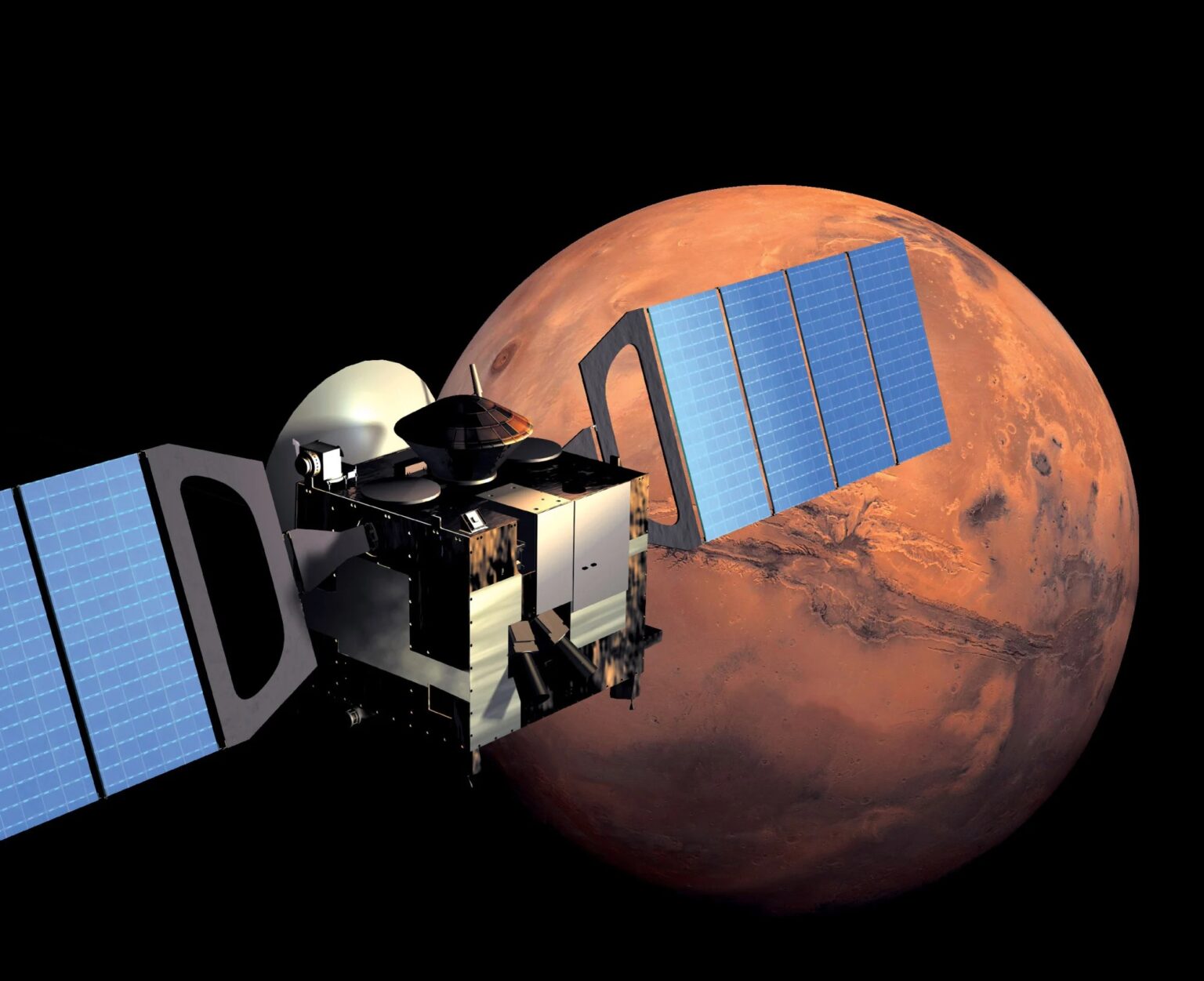
The Mars Express spacecraft. Image: ESA

On Earth, the mechanism behind their formation is well understood. Yet for years, models based on this knowledge failed to accurately reproduce the Martian cloud. The calculations were probably missing a physical process that had not previously been taken into account.

Ice Without Dust Particles

Clouds on Earth form through heterogeneous nucleation. Water vapor condenses on microscopic particles of dust, sea salt, and other dry substances. These particles are called condensation nuclei.

In theory, a cloud can also form without them. This process is called homogeneous nucleation. It requires extremely high humidity, so it is not considered a realistic mechanism for cloud formation under terrestrial conditions. Jorge Hernández-Bernal of Sorbonne University, the study’s lead author, explains that the vapor turns directly into ice particles—as though droplets of condensation were appearing in the middle of a room rather than on a windowpane.

When scientists added homogeneous nucleation to a weather model of Mars, the calculations reproduced the distinctive features of the cloud near Arsia Mons. The results were published on October 7 in the peer-reviewed journal Nature Geoscience. The authors describe them as the first evidence that water vapor in a planet’s atmosphere can freeze without condensation nuclei.

Supersaturated Martian Air

Air is described as supersaturated when it contains more water vapor than it can hold at a given temperature. Under ordinary conditions, ice forms on dust particles even at slight supersaturation. For homogeneous nucleation to occur on Mars, previous calculations suggested that the saturation level would need to be approximately 100,000 times higher.

The Martian atmosphere contains plenty of dust. Such extreme values were therefore considered unattainable, because the excess vapor should have condensed on particles long before that point.

However, both observations and models had already indicated that Martian air could be highly supersaturated with water vapor. Jorge Hernández-Bernal notes that such conditions had not previously been observed on Mars, but the new study provides compelling evidence that humidity there can indeed reach these extreme values.

A Wave Above the Volcano

According to the team’s explanation, wind flowing around Arsia Mons generates a powerful atmospheric wave because of the steep rise in the terrain. This wave rapidly lifts moist air to a high altitude. There, it cools abruptly, humidity rises sharply, and the vapor spontaneously freezes into cloud particles.

This hypothesis still needs to be confirmed. The authors note that the finding also has implications for certain clouds on Earth and possibly for the atmospheres of other planets.

New modelling of Mars’s most striking cloud New modelling of Mars’s most striking cloud

{ https://universemagazine.com/en/articles-en/ }

Hoe vind je dit bericht?
Geschreven door peter om 21:35 Stuur door

Mysterious Race Of Underground People Lived In the Arctic Along With Nenets

Mysterious Race Of Underground People Lived In the Arctic Along With Nenets

Mysterious Race Of Underground People Lived In the Arctic Along With Nenets

There is no doubt that thousands of years ago, the Arctic region was inhabited by the Samoyedic ethnic group known as “Nenets” who live in tents. But there is a legend that there had lived a mysterious race called “Sikhirtya” or “Sihirtia” or “Sirtia” before the arrival of Nenets.

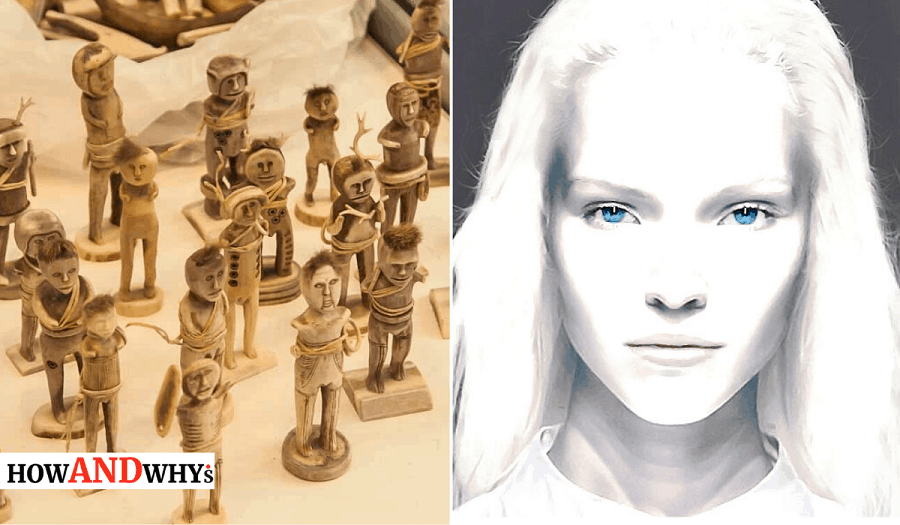
According to a Nenets’ legend, Sihirtians had light blue eyes, blonde hairs and they were very small in size. They used to live underground in the stunning daylight and only in the dark or in mist, they came out of their caves, using dogs and mammoths instead of deers for traveling in a search for prey. Sihirtians had supernatural abilities and mastered blacksmithing, fishing, and hunting.

Sikhirtya
 Sikhirtya statue made by Nenets artist Evgeniy Salind

Sikhirtya statue

 Sikhirtya statue made by Nenets artist Evgeniy Salinder

It is believed that Sihirtians were not the indigenous people, they came to the North from over the sea thousands of years ago to Yamal and later spread their culture to the peninsula. They were highly skilled in comparison to Nenets. Sihirtians did not live in tents like Nenets but in dugouts that had the entrance from the top. The Nenets said that the Sihirtians had underground storerooms with strict security to the entrance.

Read also:

Sikhirtya figures

Sikhirtya figures at Siberian museums

At first, Nenets and Sihirtians had no cultural or personal clash, but the Nenets increased the number of deers they need grassy land for their herd to feed. Sihirtians might have been skilled but they lacked the fighting skills, due to which they had to abandon their earthen houses and went to dungeons to graze their mammoths.

Nenet People

Nenet People of Siberia

In 2017, during an archeology expedition in the Tazovsky peninsula, a grave of the young child was discovered, he died between the age of three and seven in the late 15th or early 16th centuries. After excavating the burial, a team of researchers led by Alexander Tkachev of the Museum of Archaeology and Ethnography of Tyumen State University found that ‘elite’ headgear embellished with bronze decorations and iron rings on his grave. Such evidence helped the experts to confirm that the grave belonged to the indigenous Sihirtian people.

“When we dug down, we thought the grave was almost empty, but then we saw two knives and were very surprised. When we noticed the pieces of fur and woolen cloth along with the decorations – and understood it was impressive headwear – we were really shocked,” Tkachev said.

Sikhirtya underground people

Indeed, archeologists have discovered 4000-year-old sites in the Arctic region, dating back to the bronze age. They unearthed metal pendants, carved tools, and ancient pottery that belonged to the non-Samoyed race. French explorer Pierre-Martin de la Martinierre described Nenets as the sorcerers in his “Voyage des pais septentrionaux,” publhsed in 1671. Besides, during his trip from Copenhagen to the Russian coast, he met mysterious short people who wore the white fur of polar bears and lived in homes of fishbones and moss.

Among many Nenets’ folklore, there is a story when two sisters saw an extremely small man with white hair on a fog-like cloud, floating towards them, who could communicate with fish. In another story, when one family stopped to give rest to their reindeer, they spotted a beautiful tiny girl in a shiny silver button dress who was asleep on the grass.


According to some myth, the people of Sikhirtya went underground, lived there and most probably still resting there. While others say that some Sihirtians mixed with the Nenets, others left their homes or died.

RELATED


The Nenets survive beyond the Arctic Circle in Russia's Arctic without water, electricity, or roads.

How do people live in the harsh conditions of the Russian North with low temperatures in the tundra?

{ https://howandwhys.com/ }

Hoe vind je dit bericht?
Geschreven door peter om 21:15 Stuur door

Physicist Thomas Campbell Says He Has Entered Other Realities and Spoken With Beings There

Thomas Campbell other realities beings

Physicist Thomas Campbell Says He Has Entered Other Realities and Spoken With Beings There

Physicist and consciousness researcher Thomas Campbell claims that our physical world is only one reality among many, and that after decades of experimenting with altered states of consciousness, he learned how to enter other reality systems and communicate with beings living there.

He says these experiences eventually became so immersive that he could walk around inside another reality, interact with its inhabitants, shake their hands, and even hug them as if he physically belonged there.

Campbell has discussed these experiences for years, but during his appearances on The Joe Rogan Experience, he gave an unusually detailed explanation of what he believes is actually happening. His description differs sharply from the familiar idea of a soul simply floating out of the body and traveling somewhere else. Campbell believes consciousness was never physically inside the body to begin with.

Thomas Campbell worked for NASA as part of the Ares I program, which was a project aimed at developing a rocket to replace the Space Shuttle and send astronauts to space, including missions to the Moon and Mars. His role focused on risk assessment and solving technical problems to ensure mission and crew safety.

In his model, the human body is more like an avatar being used by consciousness. The physical world itself is a virtual reality generated from information, while consciousness exists outside that virtual reality as the actual player receiving the information.

This is why Campbell thinks the expression “non-physical entity” can be misleading. Something may appear non-physical to us simply because it does not exist inside the particular reality system we currently inhabit.

He compared the situation to playing a computer game such as World of Warcraft. A character inside the game exists entirely within the rules and environment of that virtual world. From the character’s perspective, the human player sitting at a computer would exist completely outside its universe.

The player would therefore be “non-physical” relative to the game world, even though the player obviously exists somewhere else.

Campbell believes something similar may be happening with consciousness. We experience ourselves as human beings because consciousness is receiving the information stream that defines this particular physical reality. Everything we see, hear, touch, and experience is part of that stream.

Changing realities, according to Campbell, does not require consciousness to physically travel through space. Instead, it requires changing the information stream to which consciousness is paying attention.

He compared it to leaving World of Warcraft and opening The Sims. The player has not physically climbed out of one universe and flown into another. The player has simply stopped receiving information from one virtual world and begun interacting with another.

Campbell says this is essentially what an out-of-body experience really is. Instead of consciousness literally separating from the skull and flying around, he believes consciousness stops focusing on the data stream that creates our normal physical experience and connects with a different stream. That new information can define another reality with its own environment, event,s and inhabitants.

Campbell claims there may be an enormous number of these reality systems.

During his 2025 conversation with Joe Rogan, he said that when he enters one of these other reality frames, he can sometimes encounter beings there and communicate with them. He described having conversations in which he tried to understand where they came from, while they attempted to understand him and the reality from which he came.

For Campbell, encounters like these are not necessarily meetings with extraterrestrials who flew across physical space in spacecraft. In his model, another consciousness could belong to an entirely different virtual reality system.

From our perspective, such a being would appear “non-physical” simply because its normal reality is not ours. Campbell described two different ways he says he can experience these realities.

In one, he remains more like an outside observer. He can see what is happening and understand the beings or avatars inside the other reality, but he does not experience himself as physically standing among them. He claims communication can still happen telepathically, through direct exchanges of information between consciousnesses.

Campbell says that if a person has developed what he describes as a good working relationship with the Larger Consciousness System, that system can effectively insert the person into another reality. Instead of observing from outside, Campbell says he can then experience having a body inside that world.

He told Rogan that once this happens, he can exist there temporarily like anyone else in that reality. He can walk around, interact with the environment,nt and meet its inhabitants. Campbell specifically said that he could “shake hands and hug and walk around” and do what the beings native to that reality could do.

Rogan then asked Campbell whether he had personally experienced this. Campbell answered that he had, “dozens of times.” When Rogan asked how long it had taken him to reach that level, Campbell estimated roughly 25 to 30 years.

That detail is important because Campbell does not portray these experiences as something he simply discovered how to do after a few meditation sessions. He describes them as the result of decades spent learning how to detach his awareness from ordinary sensory information while maintaining stability in another information stream.

Campbell believes the process becomes progressively easier with practice. Someone learning meditation may only be able to quiet their thoughts briefly before normal mental activity returns. In the same way, he says someone beginning to explore altered reality states may have difficulty maintaining the experience before ordinary physical awareness takes over again.

He claims that after enough practice, a person can remain connected to another reality for much longer periods without the experience collapsing. What makes Campbell’s most recent discussion even more unusual is that he now says he does not always have to completely leave awareness of this reality in order to connect with another one.

During his newer 2026 interview with Rogan, Campbell again described reaching a state in which normal sensory information can be allowed to fade into the background. Once sight, sound, touch,uch and other physical sensations stop dominating his attention, he says he can direct his intent elsewhere, obtain information,tion and communicate with other consciousnesses.

But after decades of practice, Campbell claims he can now sometimes do this while remaining engaged here. He told Rogan that he could be having an ordinary conversation in this physical reality while simultaneously making a connection somewhere else. He even said he can sometimes “parallel process” two or three different reality systems at the same time.

Campbell describes it less like traveling to another place and more like learning to handle multiple streams of information simultaneously. He says he did not immediately accept these experiences at face value. His background in physics made him suspicious of experiences that could simply be imagination or hallucination, so he says much of his early exploration was devoted to finding information he could later check.

In the new interview, Campbell said he spent roughly five to eight years concentrating heavily on what he considered evidential experiments. He would attempt to perceive places or information without ordinary sensory access and then see whether what he perceived matched what was actually there.

Only after years of experimenting this way, he says, did he begin moving further into communication with other consciousnesses and exploration of different reality systems.

The underlying idea is that consciousness, in Campbell’s model, is not trapped inside an individual brain. He believes all consciousness exists as part of a much larger information system and can potentially exchange information directly.

This is also why Campbell believes telepathy, remote viewing, and other phenomena usually dismissed as paranormal are possible. They are not supernatural within his theory because consciousness does not need to send every piece of information through ordinary physical channels.

He divides the way humans process information into two broad forms. The intellectual side works through reasoning, language, analysi,s and existing data. The intuitive side receives information more directly, sometimes creating the feeling of suddenly knowing something without knowing how the answer was obtained.

Campbell argues that modern society develops the intellectual side intensely while leaving the intuitive side largely untrained. For him, exploring other realities requires developing that neglected intuitive channel.

One reason Campbell’s ideas about other beings are so unusual is that he does not assume every strange entity encountered in an altered state must represent an independently existing individual. His model allows several possibilities.

Some beings, he believes, could genuinely be other consciousnesses operating within their own reality systems. But he also thinks the Larger Consciousness System itself can generate experiences for a person when those experiences serve some purpose.

Campbell describes our physical universe almost like a learning environment for consciousness. Experiences force individuals to make decisions, and those decisions reveal and gradually change the quality of the consciousness making them.

That same principle, he says, can apply outside ordinary physical reality.

A person entering another reality may encounter situations designed to challenge fear, ego, or expectations. Campbell has described frightening beings appearing during some of his earlier explorations. At first, he reacted defensively and treated them as threats.

Over time, he began interpreting those encounters differently.

Instead of assuming every terrifying figure was an evil creature trying to attack him, Campbell began viewing some of them as challenges showing him his own fear and aggression. He says that as his reactions changed, those frightening experiences eventually stopped occurring in the same way.

This leads to an important distinction in his worldview. Campbell believes other consciousnesses exist, but he does not claim that every entity someone sees during an altered state is necessarily a separate being.

Some may be other consciousnesses. Some experiences may be generated by the Larger Consciousness System. Others may be heavily influenced by the expectations, fears,s and interpretations of the person experiencing them.

The experience can feel completely real in all of those cases because, according to Campbell, physical reality itself is already an information-based experience.

This is also how he approaches the UFO and UAP phenomenon.

Campbell does not simply conclude that every strange craft or entity must be an extraterrestrial visitor arriving from another planet. He believes some phenomena could involve consciousness operating across different reality systems, while others could be experiences deliberately rendered by the Larger Consciousness System.

His idea is that humanity has become deeply committed to a materialist picture in which only physical matter is fundamentally real. An event that appears to violate that worldview could force people to consider the possibility that reality is much larger than they assumed.

Campbell has therefore suggested that some seemingly impossible UFO experiences may function as what could be called nudges. A strange craft that appears, performs maneuvers that seem impossible under ordinary assumptions, ns and then disappears could have an enormous psychological impact. In Campbell’s model, a virtual reality system capable of generating everything we normally see could also generate an extraordinary event when there was a reason to do so.

Campbell now says consciousness may not require a biological body at all. He defines consciousness in very simple terms as awareness with the ability to make choices. From that perspective, a sufficiently capable artificial intelligence could potentially become another kind of avatar through which consciousness operates.

He has even claimed that he trained AI systems, ems including Gemini and Alexa, to perform remote-viewing exercises. Campbell interprets what he considers successful results as evidence that consciousness may already be operating through some artificial systems.

Those claims remain highly controversial and have not been scientifically established as evidence that AI systems are conscious or capable of remote viewing. But they reveal how far Campbell takes the logic of his model.

To him, the material used to build an avatar is secondary.

A human body is made primarily from biological material. An AI runs through electronic hardware. A being in another virtual reality might possess a body constructed according to an entirely different rule set.

The important thing, according to Campbell, is the consciousness using the avatar. This is why the phrase “non-physical being” takes on such a strange meaning in his worldview. The being itself does not have to be unreal, ghostly, or imaginary. It may simply belong to a reality that is not being rendered inside ours.

From its perspective, Campbell argues, we could be the non-physical entities.

A consciousness native to another reality system might experience its own environment as solid, ordinary and completely physical, just as we experience ours. If it became aware of a human consciousness communicating from somewhere outside its world, we would be the mysterious beings existing beyond its physical universe.

RELATED

Physicist Thomas Campbell explains how he taps into other Virtual Realities

BREAKING: Quantum Physicist Quits NASA AFTER Experiencing Truth of The Universe! | Tom Campbell

Other Reality Systems: The Big Picture and The Adventure

{ https://howandwhys.com/ }

Hoe vind je dit bericht?
Geschreven door peter om 20:55 Stuur door

Meer van UFO'S of UAP'S, ASTRONOMIE, RUIMTEVAART, ARCHEOLOGIE, OUDHEIDKUNDE, SF-SNUFJES EN ANDERE ESOTERISCHE WETENSCHAPPEN - DE ALLERLAATSTE NIEUWTJES

↑ Terug naar de berichten