Naar de inhoud

UFO'S of UAP'S, ASTRONOMIE, RUIMTEVAART, ARCHEOLOGIE, OUDHEIDKUNDE, SF-SNUFJES EN ANDERE ESOTERISCHE WETENSCHAPPEN - DE ALLERLAATSTE NIEUWTJES

UFO's of UAP'S in België en de rest van de wereld
akke.beakke.be
Ontdek de Fascinerende Wereld van UFO's en UAP's: Jouw Bron voor Onthullende Informatie! Ben jij ook gefascineerd door het onbekende? Wil je meer weten over UFO's en UAP's, niet alleen in België, maar over de hele wereld? Dan ben je op de juiste plek! België: Het Kloppend Hart van UFO-onderzoek In België is BUFON (Belgisch UFO-Netwerk) dé autoriteit op het gebied van UFO-onderzoek. Voor betrouwbare en objectieve informatie over deze intrigerende fenomenen, bezoek je zeker onze Facebook-pagina en deze blog. Maar dat is nog niet alles! Ontdek ook het Belgisch UFO-meldpunt en Caelestia, twee organisaties die diepgaand onderzoek verrichten, al zijn ze soms kritisch of sceptisch. Nederland: Een Schat aan Informatie Voor onze Nederlandse buren is er de schitterende website www.ufowijzer.nl, beheerd door Paul Harmans. Deze site biedt een schat aan informatie en artikelen die je niet wilt missen! Internationaal: MUFON - De Wereldwijde Autoriteit Neem ook een kijkje bij MUFON (Mutual UFO Network Inc.), een gerenommeerde Amerikaanse UFO-vereniging met afdelingen in de VS en wereldwijd. MUFON is toegewijd aan de wetenschappelijke en analytische studie van het UFO-fenomeen, en hun maandelijkse tijdschrift, The MUFON UFO-Journal, is een must-read voor elke UFO-enthousiasteling. Bezoek hun website op www.mufon.com voor meer informatie. Samenwerking en Toekomstvisie Sinds 1 februari 2020 is Pieter niet alleen ex-president van BUFON, maar ook de voormalige nationale directeur van MUFON in Vlaanderen en Nederland. Dit creëert een sterke samenwerking met de Franse MUFON Reseau MUFON/EUROP, wat ons in staat stelt om nog meer waardevolle inzichten te delen. Let op: Nepprofielen en Nieuwe Groeperingen Pas op voor een nieuwe groepering die zich ook BUFON noemt, maar geen enkele connectie heeft met onze gevestigde organisatie. Hoewel zij de naam geregistreerd hebben, kunnen ze het rijke verleden en de expertise van onze groep niet evenaren. We wensen hen veel succes, maar we blijven de autoriteit in UFO-onderzoek! Blijf Op De Hoogte! Wil jij de laatste nieuwtjes over UFO's, ruimtevaart, archeologie, en meer? Volg ons dan en duik samen met ons in de fascinerende wereld van het onbekende! Sluit je aan bij de gemeenschap van nieuwsgierige geesten die net als jij verlangen naar antwoorden en avonturen in de sterren! Heb je vragen of wil je meer weten? Aarzel dan niet om contact met ons op te nemen! Samen ontrafelen we het mysterie van de lucht en daarbuiten.

Archief

UFO Historian Richard Dolan on the Drone Mystery and Disclosure in 2025 (Video)

UFO Historian Richard Dolan on the Drone Mystery and Disclosure in 2025 (Video)

In this 17 January 2025 video, WatchMjo dives back into the topic of UAPs or Unidentified Anomalous Phenomena with UFO researcher and historian Richard Dolan. Richard has over 30 years of experience studying UFOs and he joins us to talk about the ongoing drone mystery over the Northeastern seaboard of the United States. He also shares some insights into possible disclosures that could happen in 2025 as well as some of the broader implications of a non-human intelligence being revealed to the general public.


UFO Disclosure 2025 Richard Dolan Exposes the Truth Behind the Drone Mystery

{ https://beforeitsnews.com/v3/list/v2_top_beyond_science.html }

Hoe vind je dit bericht?
Geschreven door peter om 16:13 Stuur door

China Has Launched New Generation Transport Shocking the US

China Has Launched New Generation Transport Shocking the US

China Has Launched New Generation Transport System SHOCKING the US and the World

China is rapidly emerging as a global leader in engine innovation, showcasing impressive advancements that are pushing the boundaries of what’s possible. Their technology is developing at a breakneck pace, challenging the US to keep up with their rapid revolution. While China has consistently delivered awesome, futuristic innovations, their dominance now extends to the engine department. It’s time for the market to meet these new-generation engines, combining both beauty and quality .


China Has Launched New Generation Transport SHOCKING The US

{ https://beforeitsnews.com/v3/list/v2_top_beyond_science.html }

Hoe vind je dit bericht?
Geschreven door peter om 16:06 Stuur door

A Bola Robot Could Provide Stable Jumping Capability on Low-Gravity Bodies

A Bola Robot Could Provide Stable Jumping Capability on Low-Gravity Bodies

New research on locomotion techniques that could be used in space exploration is constantly coming out. A lab from UCLA known as the Robotics and Mechanisms Laboratory (RoMeLa) is presenting a paper at the upcoming IEEE Aerospace Conference in March that details a unique system. The Space and Planetary Limbed Intelligent Tether Technology Exploration Robot (SPLITTER) consists of two miniaturized jumping robots tethered together.

Such a system might sound like a recipe for chaos and bring back memories of ladder ball games where no amount of control seems to make the tether go where you want it to. But, according to the paper, that system is actually quite stable, even in airless environments.

Mechanically, their system consists of two four-legged robots designed for jumping and tied together at their tops by a tether. Jumping is much more effective than “roving” on the surface of an asteroid because of all the jagged obstacles that need to be avoided. It is also more effective than flying since there is no atmosphere to push against in many space environments. Jumping robots, however, have been around for a while, but the real secret sauce is in the controls the RoMeLa team has developed.

Video describing some of the underlying tech of the SPLITTER robot.
Credit – Alvin Zhu YouTube Channel

The concept they used is called inertial morphing. In the case of SPLITTER, the robots “adjust inertia with changes in limb configurations and tether length,” according to lead author Yusuke Tanaka in an interview with TechXplore. The researchers turned to a technique called Model Predictive Control (MPC) to determine how each variable needs to be adjusted.

MPC is used in various industries and comes as advertised, with a model (i.e., a mathematical representation of the robots) and a prediction, which reflects what the software estimates will happen to the model next. With the model’s current state and expected next state, a controller can change the variables that affect the model’s state. Those changes will result in a stable flying path, allowing SPLITTER to soar through the skies, even without air. It also uses a physical phenomenon known as the Tennis Racket Theorem, which describes how an object can flip rotation around its intermediate axis while rotating around it. Most famously, this was demonstrated on the ISS with a t-handle. It looks chaotic, but the mathematics behind the motion are well-understood.

Implementing it in a tethered robotic system is another matter altogether, though. While SPLITTER is flying, it looks a lot like a bola used in ladder ball, except instead of round spheres on each end, it’s a robot body with four legs splayed out in different directions. The orientation of how those legs are spread out and the length of the tether connecting the two ends are the variables the MPC controls to stabilize its flight. SPLITTER can operate without heavy attitude control hardware, like reaction wheels or thrusters.

Famous video of the Tennis Racket Effect on the ISS.
Credit – Plasma Ben YouTube Channel

It also allows the system to perform other actions, like spelunking, where one robot is anchored firmly to the top of a cave system while the other rappels using the tether. Both robots only weigh about 10kg each on Earth, as well, which would make them even more agile on a world with smaller gravity like the Moon or an asteroid.

This isn’t the first robot system the RoMeLa lab designed for this purpose. They initially worked on a robot called the Spine-enhanced Climbing Autonomous Legged Exploration Robot) (SCALER), which had its limitations as they found the limbed climbing robot was too slow.

With SPLITTER, the research team thinks they have a better concept that can both traverse terrain faster and collect data that a robot tied to the ground would be unable to do. Unfortunately, for now, at least, SPLITTER is best described as a computer model, though some preliminary work has been done on the physics of MPC controlling a reaction wheel. Researchers at the lab intend to continue working on the concept, so maybe soon we’ll see a bola robot test jumping near Los Angeles.

Learn More:

Lead Image:

  • Depiction of one SPLITTER robot descending into a crater while the other anchors on the rim.
    Credit – Yusuke Tanaka, Alvin Zhu, & Dennis Hong

{ https://www.universetoday.com/  }

Hoe vind je dit bericht?
Geschreven door peter om 16:00 Stuur door

Dramatically Decreasing the Time it Takes to Measure Asteroid Distances

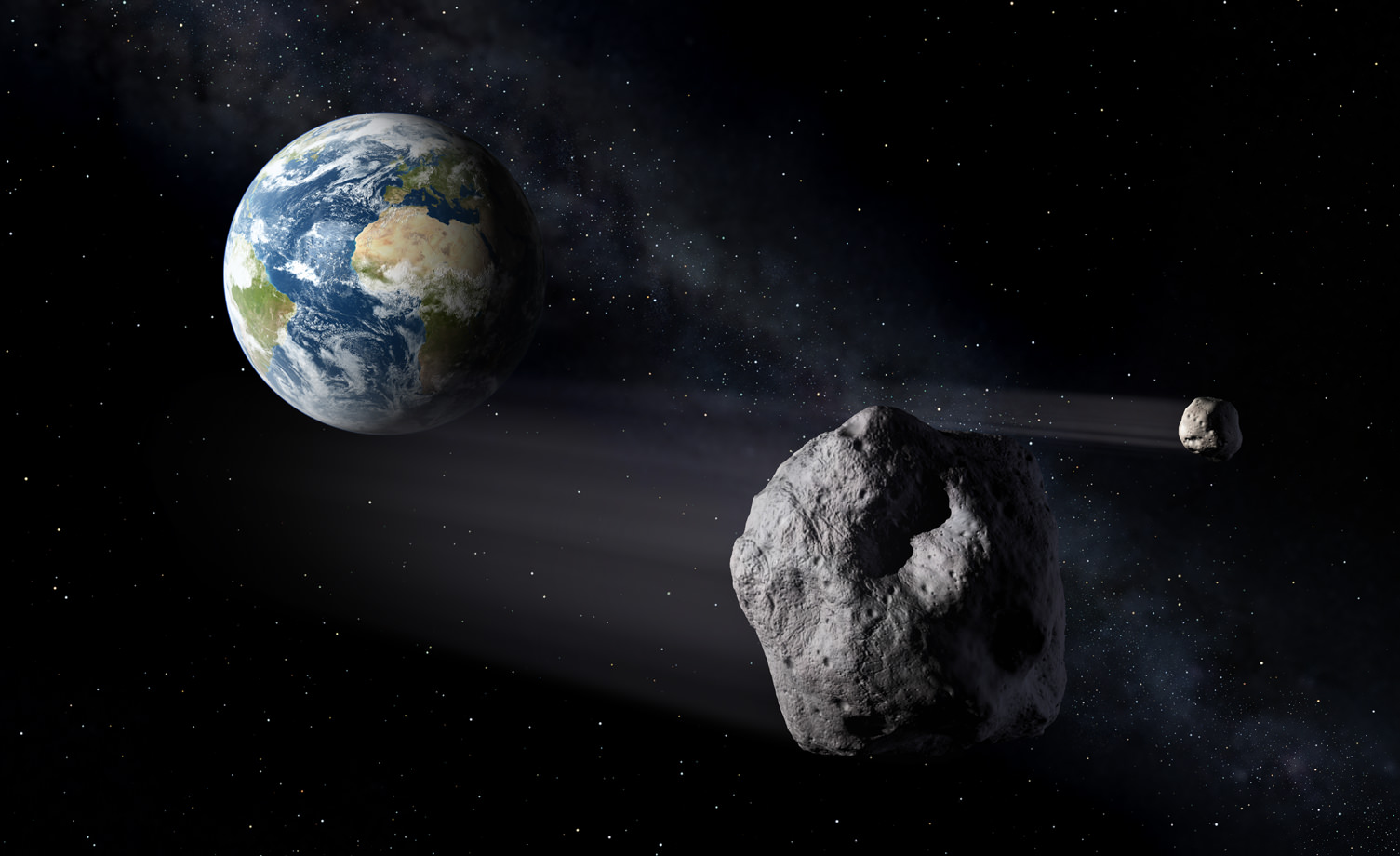
Artist's impression of a Near-Earth Asteroid passing by Earth. Asteroids are out there and they pose a threat to Earth. A new method of determining their distance more quickly could help keep us safe. Image Credit: ESA

Dramatically Decreasing the Time it Takes to Measure Asteroid Distances

We all know that asteroids are out there, that some of them come dangerously close to Earth, and that they’ve struck Earth before with catastrophic consequences. The recent discovery of asteroid 2024 YR4 reminds us of the persistent threat that asteroids present. There’s an organized effort to find dangerous space rocks and determine how far away they are and where their orbits will take them.

A team of scientists has developed a method that will help us more quickly determine an asteroid’s distance, a critical part of determining its orbit.

Our asteroid concern is centred on NEOs or Near-Earth Objects. These are asteroids whose closest approach to the Sun is less than 1.3 astronomical units (AU). (A small number of NEOs are comets.) There are more than 37,000 NEOs, and while potential impacts are rare, the results can be catastrophic. Considering what happened to the dinosaurs, there’s not much room for complacency or hubris.

Large asteroids in the Main Asteroid Belt (MAB) are easier to study. Their large sizes mean they produce a bigger signal when observed, and astronomers can more easily determine their orbits. However, the MAB holds many smaller asteroids around 100-200 meters. There could be hundreds of millions of them. They’re big enough to devastate entire cities if they strike Earth, and they’re more difficult to track. The first step in determining their orbits is determining their distances, which is challenging and takes time.

Recent research submitted to The Astronomical Journal presents a new method of determining asteroid distances in much less time. It’s titled “Measuring the Distances to Asteroids from One Observatory in One Night with Upcoming All-Sky Telescopes” and is available at arxiv.org. The lead author is Maryann Fernandes from the Department of Electrical and Computer Engineering at Duke University.

The Vera Rubin Observatory (VRO) should see its first light in July 2025. One of its scientific objectives is to find more small objects in the Solar System, including asteroids, by scanning the entire visible southern sky every few nights. If it moves and reflects light, the VRO has a good chance of spotting it. However, it won’t automatically determine the distance to asteroids.

The Vera Rubin Observatory is poised to begin observations in 2025. It could detect 130 Near Earth Objects each night. Image Credit: Rubin Observatory/NSF/AURA/B. Quint

The Vera Rubin Observatory is poised to begin observations in 2025. It could detect 130 Near Earth Objects each night. Image Credit: Rubin Observatory/NSF/AURA/B. Quint

“When asteroids are measured with short observation time windows, the dominant uncertainty in orbit construction is due to distance uncertainty to the NEO,” the authors of the new paper write. They claim their method can shorten the time it takes to determine an asteroid’s distance to one night of observations. It’s based on a technique called topocentric parallax.

Topocentric parallax is based on the rotation of the Earth. In a 2022 paper by some of the same researchers, the authors wrote that “Topocentric parallax comes from the diversity of the observatory positions with respect to the center of the Earth in an inertial reference frame. Observations from multiple observatories or a single observatory can measure parallax because the Earth rotates.”

In the two years since that paper, the researchers have refined their method. The research expands on previous algorithms and tests the technique using both synthetic data and real-world observations.

“In this paper, we further develop and evaluate this technique to recover distances in as quickly as a single night,” the authors write in the new paper. “We first test the technique on synthetic data of 19 different asteroids ranging from ~ 0.05 AU to ~ 2.4 AU.”

The figure below shows the results of the test with synthetic data. Each asteroid was observed six times in one night, and two different equations were employed to process the data.

This figure shows the measured and true distances to 19 asteroids as part of the method's test. In this test, each asteroid was observed six times in one night. The top shows Measured distance (AU) versus True distance (AU) for all 19 asteroids considered in this analysis. Each panel is based on a separate equation that can be employed in the method. "We see the fit from Eq. 1 for the group of asteroids yielding precise distances with relatively good agreement with true distances," the authors write. Image Credit: Fernandes et al. 2025. This figure shows the measured and true distances to 19 asteroids as part of the method’s test. In this test, each asteroid was observed six times in one night. The top shows Measured distance (AU) versus True distance (AU) for all 19 asteroids considered in this analysis. Each panel is based on a separate equation that can be employed in the method. “We see the fit from Eq. 1 for the group of asteroids yielding precise distances with relatively good agreement with true distances,” the authors write. Image Credit: Fernandes et al. 2025.

The researchers also tested their method by taking 15 observations of each asteroid over five nights (3 per night). In this test, Equation 1 performed poorly, while Equation 2 performed well.

This scenario featured 15 observations taken over 5 nights, with three observations per night. Equation 1 produces poor distance agreement, while with Equation 2, the distance recovery improves. Image Credit: Fernandes et al. 2025. This scenario featured 15 observations taken over 5 nights, with three observations per night. Equation 1 produces poor distance agreement, while with Equation 2, the distance recovery improves. Image Credit: Fernandes et al. 2025.

Of course, the distance to the asteroid affected the accuracy of the measurements. The closer the object was, the more precise the measurement was. The paper notes that the method was able to recover distances “with uncertainties as low as the ~ 1.3% level for more nearby objects (about 0.3 AU or less) assuming typical astrometric uncertainties.”

After these tests with synthetic data, the team acquired their own single-night observations of two asteroids using a different algorithm. The real observations produced a less precise result, but it was still a meaningful improvement. The authors explain that they were able to recover distances “to the 3% level.”

So, what do all these tests, equations, and algorithms boil down to?

When we hear of an asteroid that could potentially strike Earth in a few years, people can wonder why the situation is so uncertain. Shouldn’t we know if an asteroid is heading straight for us? Trying to determine the orbit of these small rocks from tens of millions of km away is extremely difficult. An AU is almost 150 million km (93 million miles). 2024 YR, the latest asteroid of concern, is only 40 to 90 metres (130 to 300 ft) in diameter. Those numbers illustrate the problem.

If this method can improve the accuracy of our distance measurements and do it based on a single night of observations, that’s a big improvement.

The technique can be applied to data generated by the Vera Rubin Observatory and the Argus Array. According to the authors, “distances to NEOs on the scale of ~ 0.5 AU can be constrained to below the percent level within a single night.” As the study shows, the accuracy of those measurements from a single-site observatory depends heavily on the spacing between individual observations. If multiple observatories at different sites are used on the same night, the accuracy increases.

The Argus Array is a planned astronomical survey instrument that will be unique in its ability to observe the entire visible sky simultaneously. It will consist of 900 small telescopes, each with its own camera. It's currently under construction, but its location isn't being publicized. The researchers say their method can work with Argus' data. Image Credit: Argus Array

The Argus Array is a planned astronomical survey instrument that will be unique in its ability to observe the entire visible sky simultaneously. It will consist of 900 small telescopes, each with its own camera. It’s currently under construction, but its location isn’t being publicized. The researchers say their method can work with Argus’ data. Image Credit: Argus Array

Though larger asteroids, like the one that wiped out the dinosaurs, tend to remain stable in the main asteroid belt, smaller asteroids are more easily perturbed and can become part of the NEO population. An impact from a smaller asteroid might not spell the end of civilization, but it can still be extremely destructive.

Anything humanity can do to understand the asteroid threat is wise. Many asteroids have struck Earth in the past, and it’s only a matter of time before another one comes our way. If we can see it coming in advance, we can try to do something about it.

Research: 

{ https://www.universetoday.com/  }

Hoe vind je dit bericht?
Geschreven door peter om 15:39 Stuur door

UFC Legend George St-Pierre Reveals Close Encounter With a UFO!

UFC Legend George St-Pierre Reveals Close Encounter With a UFO!

UFC Champion George St-Pierre’s Close Encounter With a UFO

George St-Pierre, one of the most accomplished fighters in UFC history, has always been known for his discipline, precision, and ability to control the fight. However, in a revelation that has left many intrigued, the former welterweight and middleweight champion shared his personal experience with an unidentified flying object (UFO). This encounter, which he describes as both surreal and unexplainable, has fueled ongoing discussions about the existence of extraterrestrial life and unexplained aerial phenomena.

The Encounter: A Night to Remember

According to St-Pierre, the incident occurred while he was in the company of four friends. They were outdoors, engaged in conversation, when they suddenly noticed an unusual object in the sky. What initially appeared to be a bright light soon began to exhibit behavior that defied conventional explanations. The object hovered in place, made abrupt movements, and vanished at a speed that no known aircraft could achieve.

The UFC legend, known for his methodical approach to fighting and analytical mindset, was left speechless by what he saw. Unlike anything he had ever witnessed, the object’s movements and speed challenged his understanding of physics. St-Pierre, who has trained his mind and body to react quickly in high-pressure situations, admitted that this experience left him baffled.

Skeptic Turned Believer?

St-Pierre has always been a man who relies on logic and reason, making his encounter with a UFO even more intriguing. While he refrains from making definitive claims about extraterrestrial life, he remains firm in his assertion that what he saw was beyond normal human comprehension. His curiosity about the unknown was further heightened by this event, leading him to explore topics related to consciousness, perception, and reality.

In various interviews, he has discussed his interest in subjects like remote viewing, out-of-body experiences, and altered states of consciousness. His journey into understanding these phenomena suggests that he is open to the idea that human perception is limited, and there might be more to existence than what we currently understand.

UFOs and the Martial Arts Mindset

For St-Pierre, martial arts have always been about pushing boundaries—both physical and mental. His UFO experience seems to have added another dimension to his exploration of the mind. He acknowledges that the world operates on principles that we do not fully understand, and his encounter has led him to seek deeper knowledge about the universe.

His perspective aligns with the growing body of evidence suggesting that unidentified aerial phenomena (UAPs) are being observed worldwide. With government agencies such as the Pentagon openly investigating these occurrences, St-Pierre’s testimony adds to the credibility of firsthand accounts from highly trained individuals.

VIDEO:

UFC Champion Has a Close Encounter With a UFO - George St-Pierre - DEBRIEFED ep. 25

George St-Pierre’s encounter with a UFO serves as a compelling testament to the mysteries that still exist beyond our understanding. His disciplined approach to life and deep curiosity about human consciousness make his experience even more fascinating. Whether or not the object he saw was extraterrestrial remains unknown, but his willingness to question reality and seek answers showcases his relentless pursuit of knowledge—both in and out of the octagon.

As more people, including trained professionals and high-profile individuals, come forward with similar experiences, the discussion around UFOs and UAPs continues to gain momentum. If nothing else, St-Pierre’s story reminds us that the universe is vast, and there is still much to discover beyond the confines of our daily experiences.

{ https://www.latest-ufo-sightings.net/ }

Hoe vind je dit bericht?
Geschreven door peter om 12:19 Stuur door

Scientists Uncover Possible Explanation for Bizarre ‘Atmospheric Ghosts’ Phenomenon

Scientists Uncover Possible Explanation for Bizarre ‘Atmospheric Ghosts’ Phenomenon

To be clear, we’re talking about the afterglow from transient luminous events, not the specters of dead people.

by Doris Elín Urrutia
 
An image from Earth's surface, looking up at a star-studded sky where a broad region of light is sha...
Thomas Ashcraft

Four years ago, a green “ghost” appeared over a thunderstorm cloud in the Mediterranean Sea. To the delight of Spanish scientists, this ephemeral sighting finally offered a rare window into a little-known phenomenon playing out high in Earth’s skies.

When lightning strikes, it sometimes triggers the release of a violent optical emission at altitudes between 50 and 90 km above the thunderstorm cloud. These millisecond-long events, called transient luminous events (TLEs), are mysterious.

They can be shaped like jellyfish. These are known as sprites. Other TLE forms exist, boasting playful names like halos and elves. Just a few years ago, thrill seekers and citizen scientists discovered a new TLE, hovering above a sprite, called a ghost. While sprites appear red owing to the nitrogen in Earth’s atmosphere, and blue at more shallow altitudes due to higher atmospheric pressure, ghosts are green. They appear during and after the sprites, like fuzz on top of the jellyfish.

An image from Earth's surface, looking up at a star-studded sky where a broad region of light is sha...

A green ghost, seen here, is a luminous glow that sometimes appears above a jellyfish sprite and lasts briefly after the sprite’s flash. 

Thomas Ashcraft

This puzzling afterglow was the subject of a new paper published in the journal Nature Communications on Tuesday.

Finding a Good Ghost

Researcher María Passas Varo led a team to use a special instrument called the Granada Sprite Spectrograph and Polarimeter (GRASSP), located outside Barcelona, to make a clear ghost sighting.

She and other atmospheric researchers were intrigued when, in the early half of 2019, storm chaser Hank Schyma noticed something new: in the wake of a sprite over the skies of Oklahoma, there was a greenish afterglow. He called the emerald-colored splotch a ghost, short for Green emissions from excited Oxygen in Sprite Tops. The idea behind the name was that, since oxygen is associated with the verdant tones of auroras, that the gas creates the ghosts.

Passas Varo, a telecommunications engineer, spectroscopist, and surveyor of atmospheric electricity based at the Astrophysics Institute of Andalucía in Spain, searched relentlessly for a new ghost. But finding one that GRASSP could glean a lot of data from was hard.

“We have analyzed more than 2,000 spectra, one by one, with the naked eye. We only found one good spectrum of a ghost. So, it is a lot of work. It is tedious,” she tells Inverse.

In a sequence of three images, the viewer looks at Earth down below. Above a great round flash of li...

A red sprite (circled) appears and just as quickly disappears. This triptych is part of a sequence from an April 2012 video taken onboard the International Space Station. 

NASA Earth Observatory/ISS Expedition 31/Image Science & Analysis

Laboratory, NASA Johnson Space Center

Then they finally found a science-worthy ghost, radiating from a thunderstorm cloud in the Mediterranean Sea on September 21, 2019. It was their best candidate for spectrographic analysis, in which the team peered into light from the ghost for clues about its composition.

They found a surprise. Oxygen was present, as they expected. But the team also found evidence of iron.

Iron is present in Earth’s upper atmosphere. It comes from the interplanetary dust particles that enter our atmosphere. But according to Passas Varo, it’s usually found at much higher altitudes.

Approximately one in every 100 sprites have ghosts. These events sometimes happen, but aren’t consistent. What makes a ghost appear could be a combination of different phenomena, and iron might provide a special clue.

A Need for Harmony

Cumulonimbus clouds are towers made of water droplets and ice crystals. These tiny particles journey along the updraft from the hot base of the cloud higher and higher until they reach the chilly top. Sometimes, they become larger molecules. If they bang against one another, they produce static electricity. These charged particles create lightning.

What goes down must be balanced in another form, and this need for harmony could be what causes the sprites and jets and all the other TLE oddities.

“When the lightning occurs, when the lightning strikes the ground, then an electric field appears above the cloud because you have to maintain, somehow, the balance of the electric field of the global electrical circuit,” Passas Varo tells Inverse. “Once you have this big discharge in the form of huge lightning downwards, then an electric field develops upwards. And this electric field develops a transient luminous event.”

One possible explanation for ghosts is that the sonic boom we know as thunder is, in one way or another, disrupting the iron from its usual altitude. Gravity waves on Earth, which are vertical, could also be playing a role in producing ghosts.

But what is clear is that a plethora of new observations are necessary. Passas Varo and the team have one good spectrum of a ghost but say it will take 99 more to get a clearer picture of what’s really happening.

{ https://www.inverse.com/ }

Hoe vind je dit bericht?
Geschreven door peter om 00:00 Stuur door

2006 Chicago O’Hare UFO Sighting: 22ft Long Alien Craft Witnessed by Many

2006 O'Hare International Airport UFO sighting

2006 Chicago O’Hare UFO Sighting: 22ft Long Alien Craft Witnessed by Many

The UFO event over Chicago’s O’Hare Airport in 2006 is one of the most intriguing UFO sightings in recent history. Despite being unremarkable as far as UFO sightings go, the reaction of the airline and the Federal Aviation Administration (FAA) was anything but ordinary, suggesting some type of cover-up between the implicated authorities.

On November 7, 2006, United Airlines Flight 446 was preparing to depart from O’Hare International to North Carolina when a dozen of airline employees, including mechanics and pilots, spotted a gray and metallic saucer-like object hovering above Gate C17 of the United terminal. The object remained there for several minutes before flying off into the clouds at an unnatural speed. This event was captured in official FAA audio recordings, with a United controller and a colleague discussing the sighting.

The disc was estimated to be at least 22 feet in diameter and hovered around 1,500 feet off the ground, below a heavy cloud cover at 1,900 feet. One grounded pilot announced his sightings over the radio, alerting a taxi mechanic and several other pilots to the presence of the object. At least two grounded pilots were able to lean out of their cockpit windows and see the object in great detail.

The story of the O’Hare UFO incident went almost completely unnoticed until the Chicago Tribune published an article on December 31, 2006, nearly two months after the incident. The story became the highest-hitting article in the website’s history, and other news outlets picked up the story as well.

Jon Hilkevitch, a transportation reporter with the Chicago Tribune, started interviewing the witnesses. Initially, both the FAA and United Airlines denied any knowledge of the event but were forced to admit that this was a lie when an audio tape was leaked to the press that captured a United Airlines radio conversation on the date of the event.

The FAA supervisor identified as “Sue” was asking several controllers at O’Hare if they had seen a flying disc over gate C-17. They initially laughed off the question, but she called back 15 minutes later to confirm that several pilots had seen the disc and that one had captured a photograph of it. Unfortunately, this alleged photograph has never surfaced.

The tape also recorded the control tower operators warning outgoing planes of the UFO and advising them to be cautious. Even in the wake of the tape, United Airlines and the FAA continued to brush off the incident. The airline prohibited any employees from discussing the incident with the media.

However, after the Chicago Tribune article compelled them to address the situation, a spokesperson from the FAA claimed that the alleged disc was nothing but the reflection of airport lights off the low cloud cover. However, this explanation was unconvincing, as the sighting occurred in daylight, before any of the airport’s lights were turned on.

Read also:

Despite the assertions of several credible witnesses, the airline and the FAA declined to investigate the matter further and wrote it off as a rare weather phenomenon known as a fallstreak or “hole-punch cloud.” However, Mark Rodeghier, the director for the Center for UFO Studies Scientific Director, did not accept this explanation and stated:

“It’s an unknown object over O’Hare, and it’s seen by official personnel and does United or the FAA take it seriously? Of course not, they have zero interest because UFOs can’t exist. But how can you not worry about something hovering over an airport after 9/11? It doesn’t make sense.”

This explanation did not stand up to reason too, as journalist Leslie Kean soon discovered. Hole-punched clouds form, when ice crystals from higher clouds fall down through a lower cloud shelf, punch a hole in it, and evaporate in the warm air below, only forming in below-freezing temperatures. The air at the altitude of the sighting on the day in question was 53 degrees Fahrenheit, which was above freezing.

Despite the FAA’s lack of interest in the O’Hare UFO incident, an independent investigation group called NARC conducted their own research. The team of former NASA scientists, pilots, meteorologists, and aerospace engineers, among others, prepared a 154-page report that confirmed the presence of a physical object over O’Hare. The report stated that the object’s maneuvers could not be explained by conventional means and advised the FAA to launch their own investigation. However, to this day, the FAA has not acted upon this recommendation. (Source)

2006 Chicago O’Hare UFO Sighting Joe Abegg, Captain at United, says “The employees that I talked to about the sighting accepted it as real.”

“There have been documented cases where safety appears to have been implicated, and more and more we are coming to the point of view that we are dealing with an intelligent phenomenon. We must be proactive before an aircraft goes down,” said Richard Haines, a former chief of the Space Human Factors Office at NASA’s Ames Research Center.

The reaction of the airline and the FAA in the aftermath of the incident suggests some type of cover-up between the implicated authorities. The airline prohibited its employees from sharing the details of the incident, and the FAA provided unconvincing explanations for the UFO sighting, such as the reflection of airport lights off low cloud cover or a misidentified weather phenomenon. These explanations were quickly debunked by journalists and independent investigators.

Jon Hilkevitch emphasized how unusual it is for the FAA to ignore such a significant UFO sighting. The FAA has launched investigations for far less extraordinary incidents, such as spilled coffee pots and airport aisles. This lack of interest in the O’Hare UFO incident raises questions about the extent of government involvement in hiding the truth about UFOs from the public.

The taxi mechanic described Chicago’s O’Hare UFO as follows:

“The craft appeared to be hovering right below the ceiling of the cloud cover (about 700 or 800 feet). The cloud ceiling that day was 1900 feet. The top of the craft was clearly outlined as a very dark gray material, but the bottom and the edges of the craft were hazy like when you see the mirage-like surface of the road on a hot day.

The other interesting observation was that after the craft accelerated straight up (observed by other witnesses), there was a hole punched in the clouds. The hole in the clouds was about the same size as the unidentified craft. It looked like a cookie cutter hole stamped out of dough ‘very similar in size’ to the craft. The hole stayed for a little while and then dissipated into the overcast clouds. The sighting lasted about 20 minutes from the time of the first radio call to the time when the mechanic and witness parked the Boeing 777 that he was taxiing across the airport.”

Reddit user Buddy_Felcher describes what he saw during the 2006 O’Hare Airport UFO sighting:

“I was working at American Airlines as a ramp service clerk at O’Hare when that thing came. I saw it, and only one other coworker saw it as well. And nobody believed me even after other airline workers said they saw it too. Until I heard other people saw it everyone had me convinced I was crazy…

Have you ever seen the movie flight of the navigator? That’s what it sort of looked like but also kind of like it was a chrome bubble of air or like the way invisible people in movies look when it’s raining on them. I only saw the latter part of it being there, the guy I worked with said it was solid grey at first and then changed to what I saw.” (Source)


Military Aircraft Experiment Spotted at Chicago O'Hare | Strange Evidence | Science Channel

UAP/UFO Phenomenon: The O'Hare Incident | Parallel Universes | The Big Thing

{ https://howandwhys.com/ }

Hoe vind je dit bericht?
Geschreven door peter om 23:59 Stuur door

Deze slimme uitvinding haalt CO2 uit de lucht en maakt er brandstof van

marek-piwnicki-WiZOyYqzUss-unsplash-954x596_1.jpg

Deze slimme uitvinding haalt CO2 uit de lucht en maakt er brandstof van.

Andrei Stiru

Wetenschappers hebben een apparaat ontwikkeld dat twee grote uitdagingen van onze tijd aanpakt: het verwijderen van CO2 uit de atmosfeer én het produceren van duurzame brandstof.

CO2-afvang, oftewel het verwijderen van kooldioxide uit de atmosfeer, is een van de vele middelen die kunnen worden ingezet in de strijd tegen klimaatverandering. Het principe is eenvoudig: vang het broeikasgas af en sla het op. Onderzoekers aan de Universiteit van Cambridge hebben echter een andere oplossing bedacht. In plaats van het gas op te slaan, willen zij het meteen gebruiken om er brandstof mee te maken. De onderzoekers publiceerden hun bevindingen in het wetenschappelijke vakblad Nature Energy.

Spons voor CO2
Het systeem werkt op zonne-energie en kan overdag CO2 omzetten in synthesegas, een waardevol mengsel van waterstof en koolmonoxide. Het apparaat bestaat uit twee compartimenten. Het eerste deel vangt CO2 uit de lucht met behulp van een speciaal absorptiemateriaal op basis van silica en polyethyleenimine. Dit materiaal werkt als een spons die selectief CO2-moleculen uit de lucht filtert. Het heeft een extreem groot oppervlak (vergelijkbaar met ongeveer twee voetbalvelden per gram) waardoor het zeer effectief CO2 kan vangen. Tijdens tests kon het materiaal gedurende ongeveer 9 uur lang alle CO2 uit de toegevoerde lucht filteren voordat het verzadigd raakte.

In het tweede compartiment vindt de chemische omzetting plaats. Hier zorgt geconcentreerd zonlicht, opgevangen door een parabolische spiegel die het drie keer sterker maakt dan normaal zonlicht, voor de benodigde energie om de opgevangen CO2 om te zetten in synthesegas. Dit gebeurt met behulp van een katalysator die bestaat uit titaniumdioxide gecombineerd met een kobalthoudend molecuul.

Dag en nacht
Het systeem maakt slim gebruik van het dag-nachtritme. Tijdens de nachtelijke uren vangt het apparaat CO2 op uit de lucht. Overdag, als de zon schijnt, wordt deze opgevangen CO2 omgezet in bruikbare brandstof. Belangrijk is dat het proces stabiel blijft en meerdere cycli kan doorlopen zonder significant verlies van efficiëntie. Het systeem kan zelfs worden aangepast om de verhouding tussen waterstof en koolmonoxide in het eindproduct te optimaliseren, afhankelijk van de gewenste toepassing. Het geproduceerde synthesegas is een tussenproduct dat de industrie kan gebruiken voor het maken van verschillende brandstoffen en chemicaliën. Het wordt bijvoorbeeld gebruikt voor de productie van methanol, synthetische diesel en andere vloeibare brandstoffen. Ook dient het als grondstof voor diverse industriële chemicaliën.

Energiezuinig
Het systeem heeft geen hoge temperaturen of druk nodig, wat het volgens de onderzoekers energiezuiniger maakt dan bestaande methoden. Ook kan het direct CO2 uit de lucht halen, zonder dat eerst concentratie nodig is. Dit is een belangrijke vooruitgang, want momenteel is CO2-afvang uit de lucht nog zeer duur. De meeste bestaande systemen verbruiken veel energie en hebben dure installaties nodig. Dit nieuwe zonnegedreven systeem zou deze kosten aanzienlijk kunnen verlagen doordat het direct bruikbare brandstof produceert en weinig energie verbruikt.

Als grondstof voor het proces gebruiken de onderzoekers gerecycled PET-plastic. Dit plastic wordt eerst afgebroken tot ethyleenglycol, dat vervolgens dient als elektronendonor in de chemische reactie. Zo worden meteen twee afvalstromen ingezet: CO2 uit de lucht en plastic afval.

Vooral handig in zonnige regio’s
Het systeem blijkt vooral geschikt voor gebieden met veel zonlicht. In tropische en subtropische regio’s zou de technologie optimaal kunnen functioneren, waarbij de dagelijkse zonnecyclus perfect aansluit bij het proces van nachtelijke CO2-opvang en omzetting overdag. Hoewel het systeem nu nog op laboratoriumschaal werkt, geloven de wetenschappers dat het makkelijk kan worden opgeschaald. De gebruikte materialen zijn relatief goedkoop en het proces is modulair opgezet, wat uitbreiding vergemakkelijkt.

Bronmateriaal


Hybrid Direct Air Capture of CO2 – Water-Positive Carbon Dioxide Removal

Direct Air Capture of CO2 from the Atmosphere | Carbon Engineering

{ https://scientias.nl/}

Hoe vind je dit bericht?
Geschreven door peter om 23:44 Stuur door

Scientists pinpoint exactly WHERE the 'city-destroying' asteroid could strike Earth in 2032

Scientists pinpoint exactly WHERE the 'city-destroying' asteroid could strike Earth in 2032

The terrifying prediction that a 'city-destroying' asteroid is hurtling towards Earth has set alarm bells ringing at the world's space agencies.

Now, a NASA scientist has predicted exactly where the asteroid 2024 YR4 could strike.

David Rankin, an engineer with the NASA-funded Catalina Sky Survey Project, has sketched the 'risk corridor' according to the asteroid's current trajectory.

If 2024 YR4 really does hit Earth in 2032, it should fall somewhere in a narrow band stretching from northern South America across the Pacific to sub-Saharan Africa and into Asia.

Worryingly, this path extends over several densely populated regions including Chennai, India and Hainan Island, China.

Currently, NASA estimates that the asteroid has a one in 48, or 2.1 per cent, chance of colliding with the planet on December 22, 2032.

And with a diameter of up to 90 metres (300ft), or roughly the size of the Statue of Liberty, it could cause devastating damage to any populated area along the risk corridor.

If it were to strike, experts suggest it could unleash a blast equal to eight megatons of TNT - more than 500 times the size of the atomic bomb dropped on Hiroshima.

Scientists have predicted the exact path (shown in red) where the city-destroying asteroid 2024 YR4 could hit Earth. It should fall somewhere in a narrow band stretching from northern South America across the Pacific to sub-Saharan Africa and into Asia

Scientists have predicted the exact path (shown in red) where the city-destroying asteroid 2024 YR4 could hit Earth. It should fall somewhere in a narrow band stretching from northern South America across the Pacific to sub-Saharan Africa and into Asia 

2024 YR4 was first detected in December last year but has quickly shot to the top of NASA's and the European Space Agency's (ESA) impact risk tables.

The asteroid is currently the only large asteroid with an impact probability greater than one per cent and has been awarded the rare rating of three on the Torino Scale, a scale for measuring the danger posed by asteroids.

The 'God of Chaos' asteroid 99942 Apophis is the only other object in the history of astronomy to be given a rating of three or higher on this scale.

While the odds of 2024 YR4 hitting Earth are still slim, Dr Rankin was able to use data about its orbit to predict where it might hit.

In the scenario where the asteroid does indeed collide with Earth, the 'risk corridor' threatens countries including India, Pakistan, Bangladesh, Ethiopia, Sudan, Nigeria, Venezuela, Colombia, and Ecuador.

Where it lands will also determine just how powerful the impact is, with regions at the end of the corridor more likely to receive a glancing blow. 

However, there currently isn't enough information to say where along this risk corridor the asteroid is most likely to hit.

Dr Rankin told Space.com: 'Size and are big players in possible damage, along with impact location.

NASA predicts that the asteroid 2024 YR4 currently has a one in 48, or 2.1 per cent, chance of hitting Earth on December 22, 2032 (stock image)

NASA predicts that the asteroid 2024 YR4 currently has a one in 48, or 2.1 per cent, chance of hitting Earth on December 22, 2032 (stock image)

What do we know about 2024 YR4?

First detected: December 27, 2024

Estimated size: 40-90 metres (130-300 feet)

Speed relative to Earth: 29,000 miles per hour (46,800 kmph)

Date of closest pass: December 2, 2032

Probability of impact: 2.3 per cent (one in 43)

Destructive potential: A 'city killer' on a scale on the Tunguska asteroid, which detonated with a force equal to 15-30 megatons of TNT. 

Where it could hit: 'Risk corridor' threatens countries including India, Pakistan, Bangladesh, Ethiopia, Sudan, Nigeria, Venezuela, Colombia, and Ecuador

'It's hard to constrain size and composition with the current orbital situation, as it's outbound. Typically, the best way to constrain size is with radar observations and those are not possible right now.'

It is currently estimated that the blast would be similar in size to the Tunguska asteroid which detonated in an air-burst explosion in 1908.

While this blast hit an unpopulated area, the shockwave still flattened an estimated 80 million trees over 830 square miles (2,150 square kilometres) - more than twice the land area of New York.

At the higher end of estimates, scientists suggest this explosion could have been equivalent to 15 megatons of TNT.

A blast this powerful would topple residential buildings and cause fatalities up to 12 miles (18.9 km) in any direction from the epicentre.

In the coming months, NASA and ESA hope to use Earth's most powerful telescopes to further refine their predictions about the asteroid's orbit.

This includes a rare emergency decision to grant an international team of scientists the use of the James Webb Space Telescope (JWST) to study 2024 YR4.

This team will use the JWST's infrared sensors to measure the heat radiating from the asteroid to make a better prediction of its size and orbit.

With an estimated size of up to 90 metres (300 ft), or roughly the size of the Statue of Liberty, 2024 YR4 could hit Earth with a blast equal to eight megatons of TNT (artist's impression)

With an estimated size of up to 90 metres (300 ft), or roughly the size of the Statue of Liberty, 2024 YR4 could hit Earth with a blast equal to eight megatons of TNT (artist's impression)

Asteroid 2024 YR4 is about the same size as the Tunguska asteroid, which caused the largest impact event in recorded history when it shot through Earth's atmosphere in 1908, flattening 830 square miles (2,150 square km) of forest (pictured)

Asteroid 2024 YR4 is about the same size as the Tunguska asteroid, which caused the largest impact event in recorded history when it shot through Earth's atmosphere in 1908, flattening 830 square miles (2,150 square km) of forest (pictured)

Scientists will also have a good opportunity to learn more about the asteroid when it makes its first close pass of Earth in March at a distance of around 5 million miles (8 million kilometres).

article image

The world's space agencies currently predict that the impact probability will drop towards zero as they learn more, but an impact cannot currently be ruled out.

A new simulation of the asteroid's path also presents a slim possibility that it could hit the moon instead of Earth.

Dr Rankin's calculations suggest that there is a one in 333 chance that 2024 YR4 will collide with the lunar surface, creating a brilliant but otherwise harmless explosion that could be seen from Earth with the naked eye. 

However, for the countries along this predicted risk corridor, these predictions raise the chilling possibility that they may face a devastating collision within the next eight years.

WHAT COULD WE DO TO STOP AN ASTEROID COLLIDING WITH EARTH?

Currently, NASA would not be able to deflect an asteroid if it were heading for Earth but it could mitigate the impact and take measures that would protect lives and property.

This would include evacuating the impact area and moving key infrastructure.

Finding out about the orbit trajectory, size, shape, mass, composition and rotational dynamics would help experts determine the severity of a potential impact.

However, the key to mitigating damage is to find any potential threat as early as possible.

NASA and the European Space Agency completed a test which slammed a refrigerator-sized spacecraft into the asteroid Dimorphos.

The test is to see whether small satellites are capable of preventing asteroids from colliding with Earth.

The Double Asteroid Redirection Test (DART) used what is known as a kinetic impactor technique—striking the asteroid to shift its orbit.

The impact could change the speed of a threatening asteroid by a small fraction of its total velocity, but by doing so well before the predicted impact, this small nudge will add up over time to a big shift of the asteroid's path away from Earth.

This was the first-ever mission to demonstrate an asteroid deflection technique for planetary defence.

The results of the trial are expected to be confirmed by the Hera mission in December 2026.

{ https://www.dailymail.co.uk/ }

Hoe vind je dit bericht?
Geschreven door peter om 22:00 Stuur door

Mysterious UFO-like disc seen in New Mexico on Google Maps sparks investigation

A mysterious structure in a mountainous region of New Mexico has taken the internet by storm, sparking an investigation to uncover the truth.

Google Map users spotted a large, white disc poking out from the ground at an elevation of 7,400 feet. Its coordinates are 34°24'21.6"N 107°05'44.5"W.

The location, about 34 miles from the Sevilleta National Refuge in La Joay, is nestled in the Sierra Ladrones with no clear roads or homes nearby.

Google Map images of the site show the top of the disc features metallic hardware and part of one side has since been covered by vegetation.

Users speculated it could be 'a UFO that has been lodged in this mountain for centuries' or a 'ceiling hatch of a subterranean hanger for a UAP [Unidentified Anomalous Phenomena].'

Others claimed they saw windows, a fuselage and electrical circuits on the object.

Some Google Map users have looked back at historical images of the area, finding a black, box-shaped structure in the same spot in 1975. A look forward to 2003 showed the disc among the barren landscape.

The images were shared on X where people are calling for someone to send a drone to the mountain and capture images of the scene.

A mysterious structure in a mountainous region of New Mexico has taken the internet by storm, sparking speculations of a UFO crash site

A mysterious structure in a mountainous region of New Mexico has taken the internet by storm, sparking speculations of a UFO crash site

Google Map users spotted a large, white disc poking out from the ground at an elevation of 7,400 feet. Its coordinates are 34°24'21.6"N 107°05'44.5"W

Google Map users spotted a large, white disc poking out from the ground at an elevation of 7,400 feet. Its coordinates are 34°24'21.6"N 107°05'44.5"W

The Google Map images were shared by X user Steph Kent who posted: 'Something in the shape of a disc embedded in a mountain in New Mexico, USA, at an altitude of 2,255 meters.'

Commenters suggested it could be an observatory, old water reservoir or a crash alien craft. 

The earliest Google image, in 1996, revealed a completely barren landscape without a dirt path or the disc. 

YouTuber MrMBB333 shared a video in August while investigating the site on Google Maps.

'This is a very remote location, nothing going on up here,' he said in the clip.

'This looks very much like a disc that is stuck in the top of this mountain. I measured the disc from side to side, it's around 30 feet across.'

He claimed that 'whenever it crash landed in the mountains,' it lunged forward and became buried in the ground. 

While the YouTuber's theory suggested the object was a crash UFO,  a user of Mick West's Metabunk website had a more realistic investigation. 

The post initially claimed the object was a crashed disc when the user started the thread last August, but they later updated it to read: 'The structure has been identified as a rainwater catchment that has since been removed and replaced by a different structure.'

They searched through historical records on the US Geological Survey, uncovering images dating back to 1975 that showed a black dot where the white disc is now. 

There is also a clear path leading from a clear to the site. 

Some users have looked back at historical images of the area, finding a black, box-shaped structure in the same spot in 1975

Some users have looked back at historical images of the area, finding a black, box-shaped structure in the same spot in 1975 

A look forward, and the white disc appeared in 2003

A look forward, and the white disc appeared in 2003

An image from 2013 shows the disc has not yet been overgrown by vegetation, but has suffered some damage

An image from 2013 shows the disc has not yet been overgrown by vegetation, but has suffered some damage

'So what is it? A research station of some kind? Something related to the nearby testing range,' they asked in the post dated August 26. 

'Some suggested a wildlife catchment tank (which looks similar if not a bit smaller) or a Frank Lloyd Wright project (it's not). 

Wright was an American architect famous for unusually designed homes, some of which that were circular. 

'From a quick search there appears to have been a structure built on that exact spot from at least the 1975 so it seems unlikely anything coincidentally 'crashed' there,' the MetaBunk user shared. 

Google Map users have come across many strange locations worldwide with a recent one in Los Angeles when people spotted 'HELP' spelled out with various materials on a plot of storage or waste facility in Los Angeles, California.

A 2017 images shows part of the disc had been covered by vegetation. An internet investigation ound the object was a rainwater catchment that has since been removed and replaced by a different structure

A 2017 images shows part of the disc had been covered by vegetation. An internet investigation ound the object was a rainwater catchment that has since been removed and replaced by a different structure

Disturbing messages written on the ground in Los Angeles have taken the internet by storm last month

Disturbing messages written on the ground in Los Angeles have taken the internet by storm last month


This area is about one mile east of Los Angeles City Hall, situated between the Los Angeles River, North Mission Road and E Cesar E Chavez Avenue. Its coordinates are 34°03'18'N 118°13'30'W. 

The Spanish words 'TRAFFICO' (traffic) and 'TERRORISMO,' (terrorism) also appear, as well as 'LAPD,' 'FEDERAL,' and 'FBI.'

The images went viral on social media over the weekend, sparking fears that someone may be trying to alert the public or law enforcement to a human trafficking operation in the area.

article image

One Reddit user wrote: 'This sounds like someone or a group are being trafficked and used materials available to them to spell out an SOS. I hope if a random person noticed, authorities noticed as well.'

'We have all known for a long time that shipping containers are being used for human trafficking,' one X user posted, referencing the location's close proximity to the shipping yard.

Concerned viewers also pointed out what appears to be holes or tunnel entrances nearby, speculating that nefarious activity may be taking place inside.

One such person, who goes by 'LAguy' on X, spoke with a woman experiencing homelessness who lives near the lot.

She told him the words were written by a man named Jose who has been writing them 'for years.'

'[José's] the one who puts [help] all the time,' she said. 'He writes it everywhere [...] it's been years,' she added, though she made clear she didn't know the reason why he has been writing the messages.

Others claiming to live nearby offered similar explanations.

{ https://www.dailymail.co.uk/ }

Hoe vind je dit bericht?
Geschreven door peter om 21:41 Stuur door

Meer van UFO'S of UAP'S, ASTRONOMIE, RUIMTEVAART, ARCHEOLOGIE, OUDHEIDKUNDE, SF-SNUFJES EN ANDERE ESOTERISCHE WETENSCHAPPEN - DE ALLERLAATSTE NIEUWTJES

↑ Terug naar de berichten