Naar de inhoud

UFO'S of UAP'S, ASTRONOMIE, RUIMTEVAART, ARCHEOLOGIE, OUDHEIDKUNDE, SF-SNUFJES EN ANDERE ESOTERISCHE WETENSCHAPPEN - DE ALLERLAATSTE NIEUWTJES

UFO's of UAP'S in België en de rest van de wereld
akke.beakke.be
Ontdek de Fascinerende Wereld van UFO's en UAP's: Jouw Bron voor Onthullende Informatie! Ben jij ook gefascineerd door het onbekende? Wil je meer weten over UFO's en UAP's, niet alleen in België, maar over de hele wereld? Dan ben je op de juiste plek! België: Het Kloppend Hart van UFO-onderzoek In België is BUFON (Belgisch UFO-Netwerk) dé autoriteit op het gebied van UFO-onderzoek. Voor betrouwbare en objectieve informatie over deze intrigerende fenomenen, bezoek je zeker onze Facebook-pagina en deze blog. Maar dat is nog niet alles! Ontdek ook het Belgisch UFO-meldpunt en Caelestia, twee organisaties die diepgaand onderzoek verrichten, al zijn ze soms kritisch of sceptisch. Nederland: Een Schat aan Informatie Voor onze Nederlandse buren is er de schitterende website www.ufowijzer.nl, beheerd door Paul Harmans. Deze site biedt een schat aan informatie en artikelen die je niet wilt missen! Internationaal: MUFON - De Wereldwijde Autoriteit Neem ook een kijkje bij MUFON (Mutual UFO Network Inc.), een gerenommeerde Amerikaanse UFO-vereniging met afdelingen in de VS en wereldwijd. MUFON is toegewijd aan de wetenschappelijke en analytische studie van het UFO-fenomeen, en hun maandelijkse tijdschrift, The MUFON UFO-Journal, is een must-read voor elke UFO-enthousiasteling. Bezoek hun website op www.mufon.com voor meer informatie. Samenwerking en Toekomstvisie Sinds 1 februari 2020 is Pieter niet alleen ex-president van BUFON, maar ook de voormalige nationale directeur van MUFON in Vlaanderen en Nederland. Dit creëert een sterke samenwerking met de Franse MUFON Reseau MUFON/EUROP, wat ons in staat stelt om nog meer waardevolle inzichten te delen. Let op: Nepprofielen en Nieuwe Groeperingen Pas op voor een nieuwe groepering die zich ook BUFON noemt, maar geen enkele connectie heeft met onze gevestigde organisatie. Hoewel zij de naam geregistreerd hebben, kunnen ze het rijke verleden en de expertise van onze groep niet evenaren. We wensen hen veel succes, maar we blijven de autoriteit in UFO-onderzoek! Blijf Op De Hoogte! Wil jij de laatste nieuwtjes over UFO's, ruimtevaart, archeologie, en meer? Volg ons dan en duik samen met ons in de fascinerende wereld van het onbekende! Sluit je aan bij de gemeenschap van nieuwsgierige geesten die net als jij verlangen naar antwoorden en avonturen in de sterren! Heb je vragen of wil je meer weten? Aarzel dan niet om contact met ons op te nemen! Samen ontrafelen we het mysterie van de lucht en daarbuiten.

Archief

The World’s Oldest Monument Was Not in Egypt, It Was Hidden in an American Swamp for More Than 5,000 Years

The World’s Oldest Monument Was Not in Egypt, It Was Hidden in an American Swamp for More Than 5,000 Years

For more than 5,000 years, this forgotten site remained concealed beneath the landscape. When researchers began uncovering its secrets, they found a story that changed the way we understand ancient builders.

The World’s Oldest Monument Was Not In Egypt, It Was Hidden In An American Swamp For More Than 5,000 Years

© Credit: Shutterstock

A 5,400-year-old monumental mound complex hidden in the wetlands of Louisiana has changed the way archaeologists view ancient construction. Watson Brake shows that hunter-gatherer communities created a monumental landscape nearly 2,000 years before the oldest pyramids of Egypt.

For decades, the earthworks remained almost invisible beneath trees, roots, and swamp vegetation in the Ouachita River Valley. The discovery revealed that communities without agriculture or permanent settlements could still organize large-scale construction projects.

The story of this monument began in 1981, when amateur archaeologist Reca Jones noticed that several exposed formations in the landscape appeared too structured to be natural. After logging activity cleared parts of the area, Jones identified eleven mounds connected by ridges and arranged in a circular pattern.

The discovery later drew the attention of archaeologist Joe Saunders, who studied the site while researching other ancient earthworks in Louisiana. At the time, Poverty Point was considered one of the region’s oldest major mound complexes, but Watson Brake revealed an even earlier chapter of human activity.

Dating Reveals A Lost Ancient Project

Research carried out during the 1990s transformed the understanding of Watson Brake. Radiocarbon dating showed that the complex was built around 3400 B.C.E. and developed over approximately four centuries. A 1997 study published in Science by Joe Saunders and soil scientist Thurman Allen reported that Watson Brake was older than other known mound complexes with earthen enclosures in North America by about 1,900 years.

The researchers also discovered that the soil beneath the mounds had been deliberately compacted, which helped preserve the structures over thousands of years. The layout of the site indicated careful organization, with builders aligning parts of the complex with the surrounding landscape before adding more mounds and connecting ridges.

Topographic Map Of The Watson Brake Mound Complex In Louisiana Topographic map of the Watson Brake mound complex in Louisiana. Credit: Science

The largest mound reached about 25 feet in height. Archaeologists estimate that the construction of the mounds and ridges required around 100,000 hours of labor, showing a significant level of cooperation among the people who built the site.

A Monument Built By Ancient Hunter-Gatherers

The builders of Watson Brake monument belonged to the Evans culture, a Paleoindian population that depended on seasonal movement, hunting, fishing, and gathering resources rather than farming. The archaeological evidence shows that the site was used by communities that collected aquatic resources and plant species. The research described inhabitants who gathered plants that later became among the first domesticated species in eastern North America.

Artifacts discovered at Watson Brake include projectile points, hunting tools, animal remains, shells, gravel used as cooking stones, charred seeds, and fired earth objects that may have served as early pottery.

Map Of The Watson Brake Mound Complex In Louisiana
Map of the Watson Brake mound complex in Louisiana.
Credit: American Antiquity

The site challenged the traditional idea that monumental architecture only emerged after agriculture created permanent settlements and social hierarchies. Watson Brake demonstrated that mobile communities could also coordinate major building efforts through collective action.

A Hidden Discovery From The Ancient World

Archaeologists believe the site functioned as a seasonal gathering place rather than a permanent settlement. The remains found at the site suggest that groups returned repeatedly to the area for shared activities. The construction does not appear to have been directed by a ruler or centralized authority. Instead, the evidence points to a large community effort involving many individuals working toward a common goal.

The significance of Watson Brake continued after its discovery encouraged further research into ancient landscapes across the region. In 2022, experts identified the Monte Sano mounds near Baton Rouge as even older, dating back around 7,000 years.

Still, Watson Brake remains a key archaeological site because it revealed that complex organization existed among ancient communities long before the development of farming societies. A landscape once hidden under forest and wetlands preserved evidence of one of North America’s earliest monumental construction projects.

RELATED VIDEOS

The Ancient Pyramids Hidden in a Louisiana Swamp Older Than Egypt!

Watson Brake - Ancient Mounds of Louisiana

Watson Brake ~ Louisiana's 5,400 Year Old Mystery Site

{ https://dailygalaxy.com/category/news/ }

Hoe vind je dit bericht?
Geschreven door peter om 21:39 Stuur door

Galileo, Ida, and Dactyl: How Scientists Discovered the First Asteroid Moon

Galileo, Ida, and Dactyl: How Scientists Discovered the First Asteroid Moon

On February 17, 1994, astronomer Ann Harch was examining photographs of the asteroid Ida captured in August 1993 by the Galileo spacecraft. In these images, she observed an unusual feature — specifically, that this celestial body possessed a moon. Consequently, a spacecraft that was not initially intended for asteroid exploration made one of the most significant discoveries of the late 20th century.
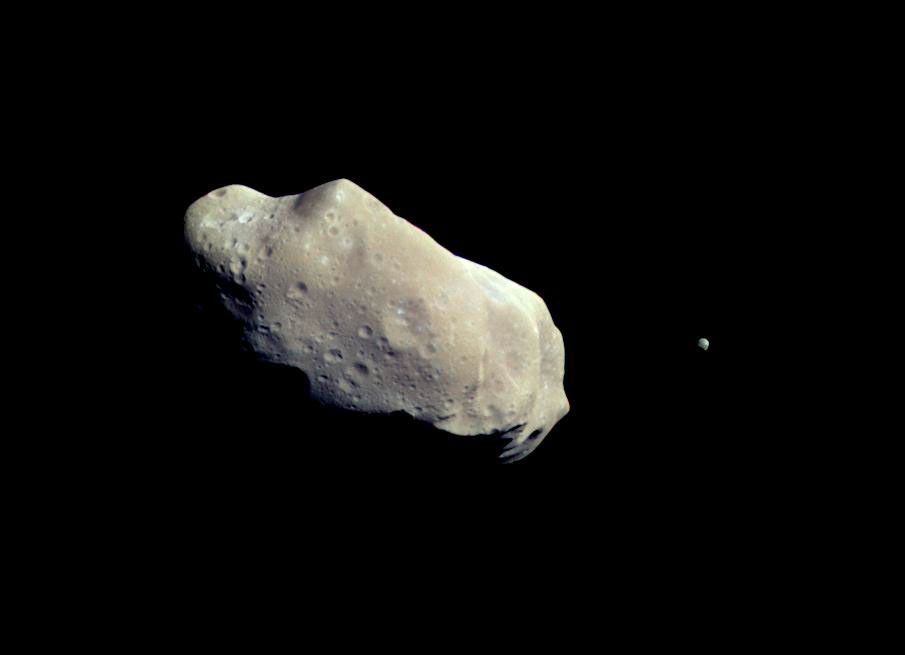
The asteroids Ida and Dactyl. Source: Wikipedia

The first moon of an asteroid

On August 28, 1993, the American spacecraft Galileo approached asteroid (243) Ida to a distance of 2,410 kilometers. This event marked only the second occasion on which a spacecraft had approached a small celestial body within the Solar System. The first instance occurred two years earlier, when the same probe visited asteroid Gaspra.

However, this flyby attained significant notoriety on February 17, 1994, when researcher Ann Garch observed a mysterious spot in the photographs captured by the spacecraft. It was subsequently identified as the first known moon of the asteroid.

Until that time, scientists could only debate whether such small objects could possess their own moons or whether their gravitational forces were insufficient to do so. The prevailing consensus was that they could not. However, the discovery of an asteroid measuring 1.6 km in diameter, named Dactyl, profoundly altered this perspective. Subsequently, scientists gradually realized that binary and triple asteroid systems are, in fact, quite common phenomena, and occasionally, they display configurations far more astonishing than those observed in the larger planets.
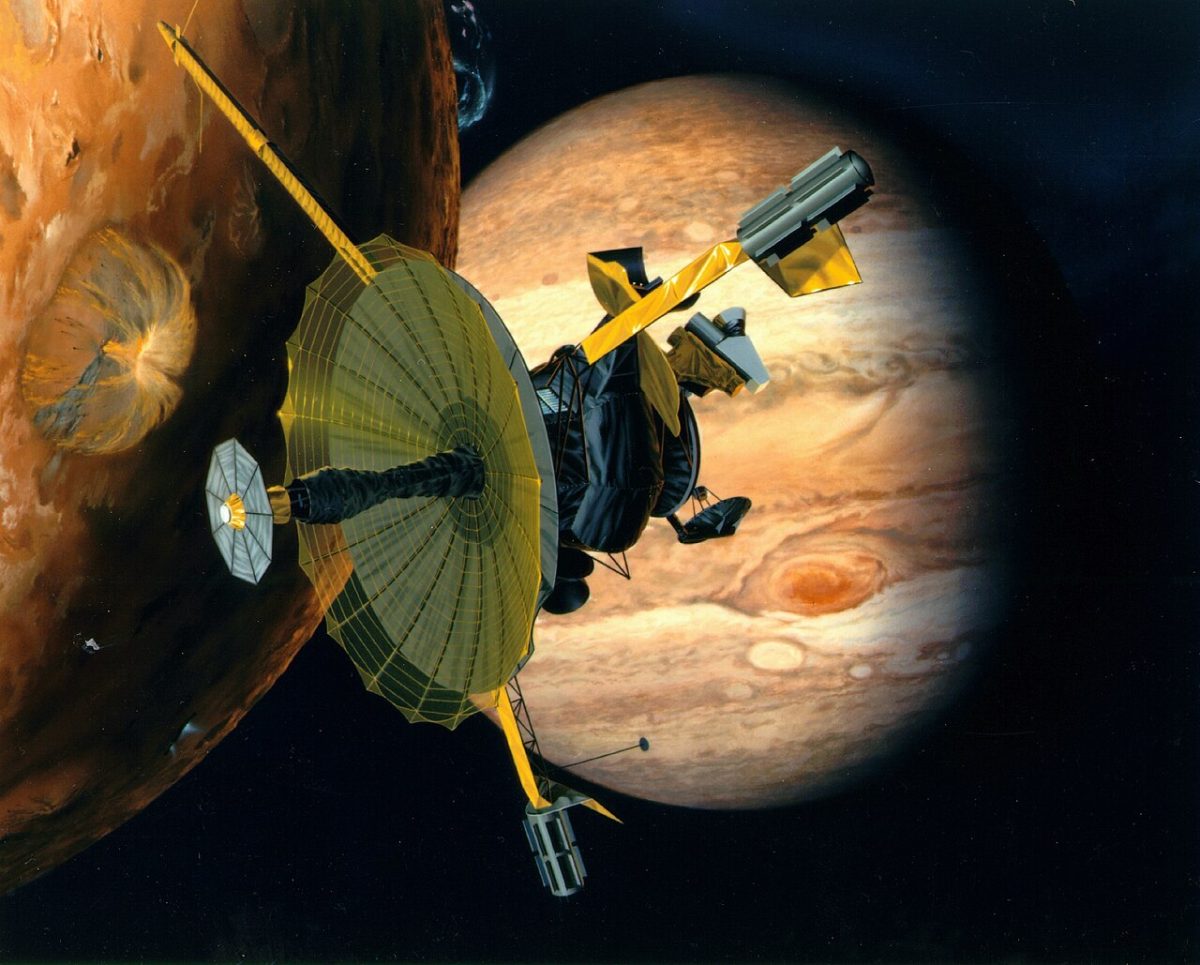
Galileo spacecraft. Source: Wikipedia

Galileo spacecraft

The most intriguing aspect of the Galileo spacecraft is that, initially, it was not designed for asteroid exploration. Its development commenced in 1959, prior to the inaugural human spaceflight, when American engineers initiated a program to explore Jupiter. This program comprised four phases: a mission to test the feasibility of deep-space travel, a close flyby of the planet, insertion of a spacecraft into Jupiter’s orbit, and a descent attempt into Jupiter’s depths utilizing a parachute.

In the early 1970s, subsequent to the successful flybys of the Solar System’s largest planet by the Pioneer 10 and Pioneer 11 spacecraft, it became evident that interplanetary missions were entirely feasible. Consequently, the necessity for a dedicated flyby mission equipped with advanced instrumentation was recognized. This responsibility was delegated to the Voyager 1 and Voyager 2 spacecraft.

Simultaneously, discussions commenced concerning the necessity of proceeding with the deployment of an orbital observer and an atmospheric probe. Moreover, it was promptly proposed that the two missions should be integrated into a single mission, given that this methodology had demonstrated success during the Mariner program. Specifically, after reaching orbit, the probe would detach from the spacecraft, enter the planet’s atmosphere, and descend via parachute.

Given that Jupiter lacks a solid surface, no plans were devised to land on it; rather, the spacecraft was intended to remain in orbit to accumulate scientific data for the longest feasible duration, despite being continually subjected to extreme temperatures and pressure.
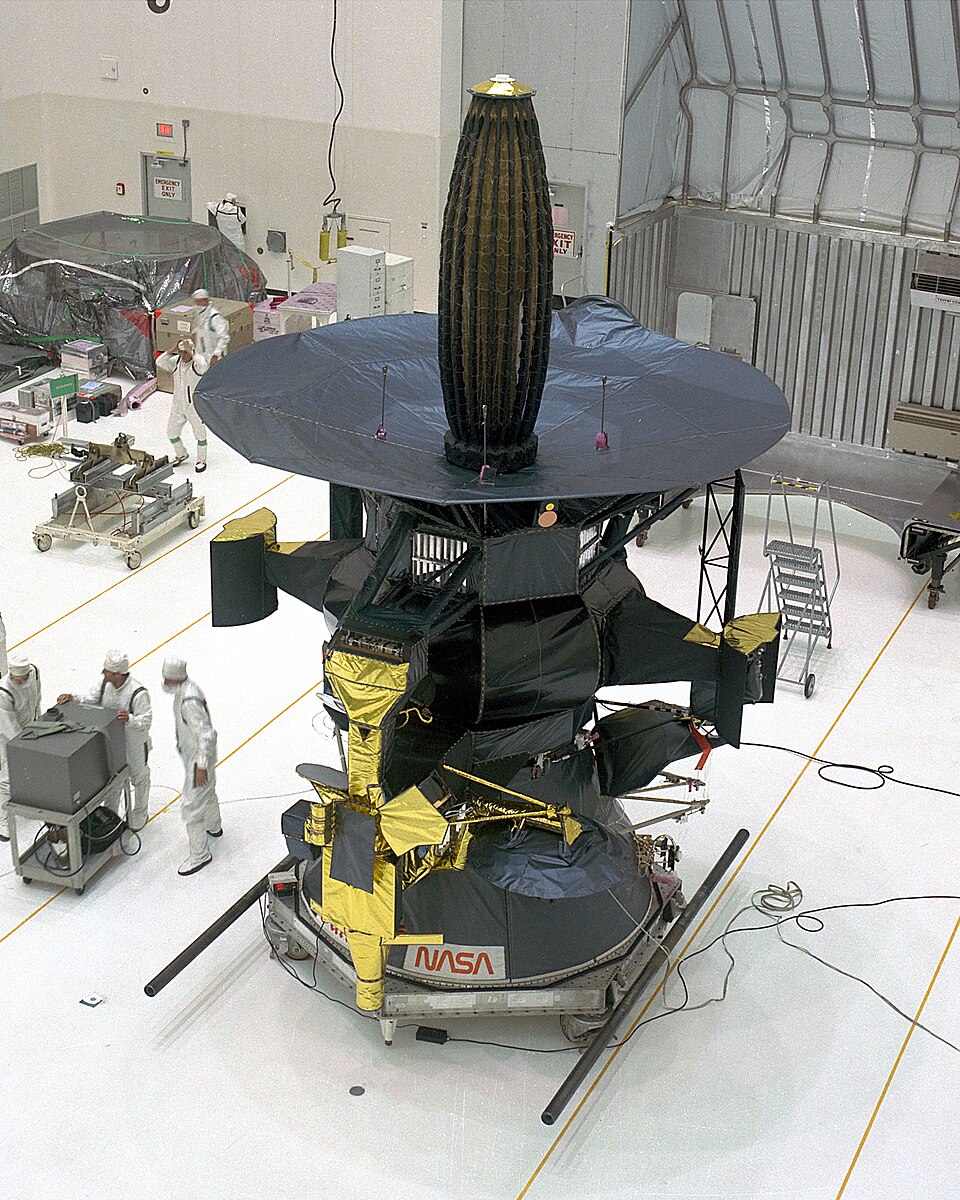
The Galileo spacecraft is situated within the assembly hall. Source: Wikipedia.

It was immediately decided that the spacecraft would be constructed using the same Mariner platform, which had demonstrated its reliability effectively. However, in practice, the design process did not commence until the late 1970s, following the successful missions of Voyager 1 and Voyager 2 to Jupiter.

Subsequently, the construction of the probe commenced, and it was shortly thereafter named Galileo in recognition of the esteemed Italian astronomer Galileo Galilei. The spacecraft was notably substantial, standing 5 meters tall and weighing 2,223 kilograms, with 339 kilograms attributed to the atmospheric probe and 925 kilograms allocated for fuel.

Galileo was equipped with eleven scientific instruments, comprising a camera mounted to the telescope, infrared and ultraviolet spectrographs, a photopolarimeter, high-energy particle detectors, among others. All of these devices were designed for the inaugural investigation of a gas giant.

To deploy such a substantial object onto an interplanetary trajectory, a large booster known as the Inertial Upper Stage (IUS) was developed. Originally, it consisted of a three-stage rocket. Its distinctive feature was its capacity to be utilized not only as the upper stage of a heavy-lift rocket but also to be transported into orbit within the cargo bay of the Space Shuttle and subsequently installed manually for launch. This approach was designed to enhance the overall reliability of the operation. This was precisely the method intended for the launch of Galileo.
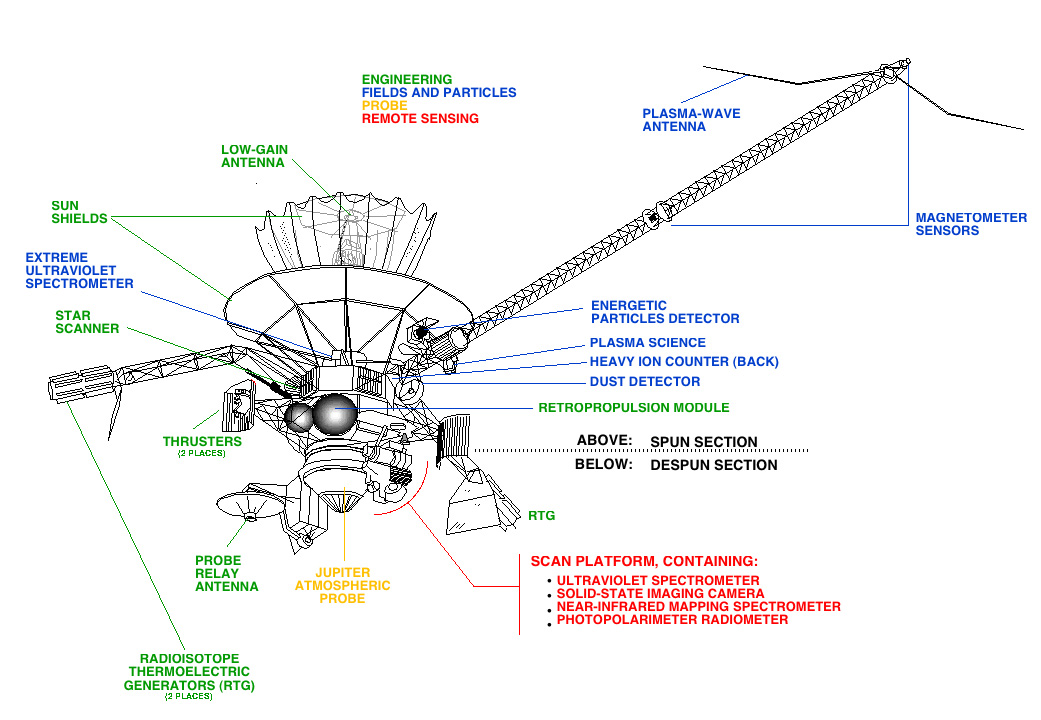
Design of the Galileo spacecraft. Source: Wikipedia

In accordance with the original plan, the spacecraft’s voyage to Jupiter was intended to be relatively swift. It was scheduled to arrive at Mars within a six-month timeframe, execute a gravity assist maneuver in its vicinity, then accelerate and proceed toward the gas giant.

Launch postponement

Initially, Galileo was scheduled to launch into space as early as 1982. However, shuttle launches did not occur as frequently as anticipated, and the three-stage configuration of the IUS was deemed excessively costly and large. Its practical application in conjunction with a reusable spaceplane could have introduced considerably more challenges than advantages.

Engineers commenced deliberations on potential replacements. The launch was delayed until 1984, and support for the project diminished. At one stage, experts favored maintaining the route via Mars but proposed launching the orbital and atmospheric probes separately, with a one-month interval.
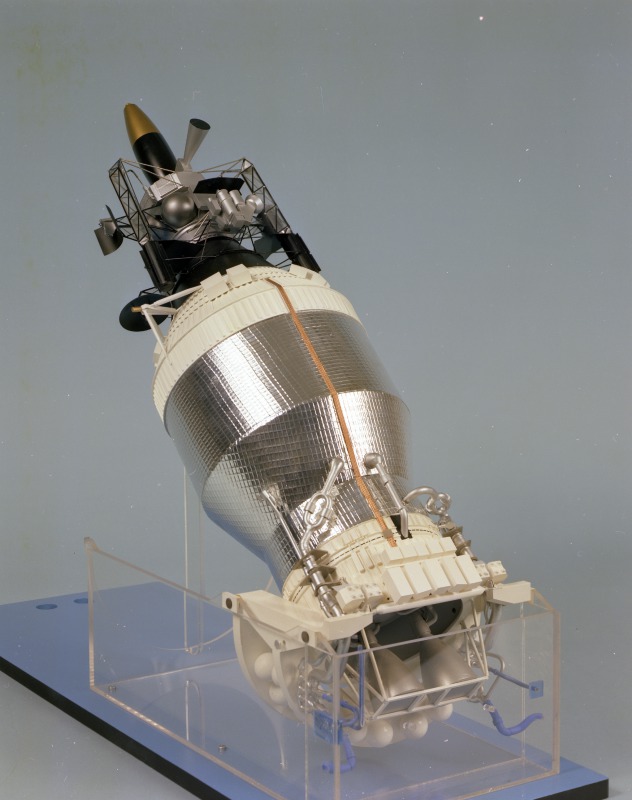
A model of the Galileo spacecraft affixed to the Centaur module. Source: Wikipedia

Nevertheless, it was universally recognized that such a decision heightened the likelihood of an accident. Consequently, during the deliberations, they revisited the concept of launching via the Space Shuttle as a singular integrated mission, incorporating a gravity assist maneuver proximal to Mars, this time utilizing the Centaur booster. 

Nevertheless, the project persisted in facing scrutiny due to its substantial expenses, intricate design, and the limited scope of scientific findings available at that time. Consequently, the researchers proposed investigating one of the asteroids within the Main Belt during the spacecraft’s ongoing mission. This approach was considered particularly viable, as the onboard instrumentation was appropriately equipped to undertake the study.

Amphitrite was determined to be an asteroid, characterized by its substantial dimensions of 223 × 212 × 193 km. Its alternative options included Yi Qing and Britta. Nevertheless, despite the potential benefit of exploring two targets with Britta, precedence was assigned to a single, larger target.

The rationale behind this was that during the early 1980s, NASA maintained the belief that close flybys of asteroids ought to be avoided. Concerns existed regarding the presence of dust and small rocks in the vicinity, which could potentially damage the spacecraft.
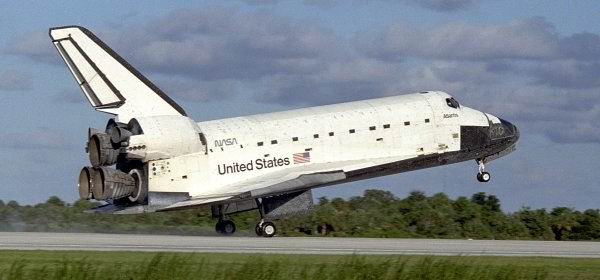
Space Shuttle Atlantis. Source: Wikipedia

This is precisely the reason why the study plans for these objects during Galileo’s flyby presumed that the spacecraft would not approach closer than a few thousand kilometers. Consequently, for asteroids measuring only a few kilometers in diameter, it would be impossible to discern any details.

Taking all these factors into consideration, a revised plan was formulated, stipulating that Galileo was to be launched during the STS-61-G mission on May 20, 1986, aboard the Space Shuttle Atlantis. However, circumstances beyond control thwarted the realization of these plans. On January 28, another shuttle, the Challenger, tragically exploded during launch, leading to the suspension of the entire space shuttle program. 

The engineers thoroughly examined all potential safety protocols and determined that launching the Centaur-G module from the shuttle was excessively hazardous. It was the Centaur-G that was intended to propel Galileo toward Mars for subsequent arrival at Jupiter.
The launch of the shuttle carrying the Galileo spacecraft. Source: Wikipedia.

The developers once again commenced reevaluating methodologies to reach Jupiter. They revisited the concept of utilizing the IUS, which, by that time, was already deployed in space in its two-stage configuration. Its propulsion was insufficient to accelerate Galileo, leading NASA to revise its trajectory entirely. Instead of proceeding to Mars, the spacecraft was designated to fly to Venus, execute a gravity assist maneuver in its vicinity, as well as perform relatively close approaches to the Sun, before returning to Earth twice prior to proceeding towards Jupiter from that point.

All of this extended the flight duration to 6 years; however, it still permitted the spacecraft to safely accelerate to the necessary velocity. Nevertheless, its challenges during the journey to space did not cease there.

In the mid-1970s, during the initial phase of Galileo’s development, it was quite common to consider utilizing a radioisotope thermoelectric generator as its power source. However, in 1978, a Soviet satellite equipped with an identical device experienced a crash in Canada, resulting in widespread radiation contamination over a large area. The subsequent year, the Three Mile Island nuclear incident took place, and by the early 1980s, fears related to radiation began to intensify. This apprehension peaked following the Chernobyl Nuclear Power Plant disaster in April 1986, just three months subsequent to the Challenger catastrophe. Consequently, many individuals started to perceive Galileo not as a significant scientific milestone, but rather as a hazardous source of radiation.
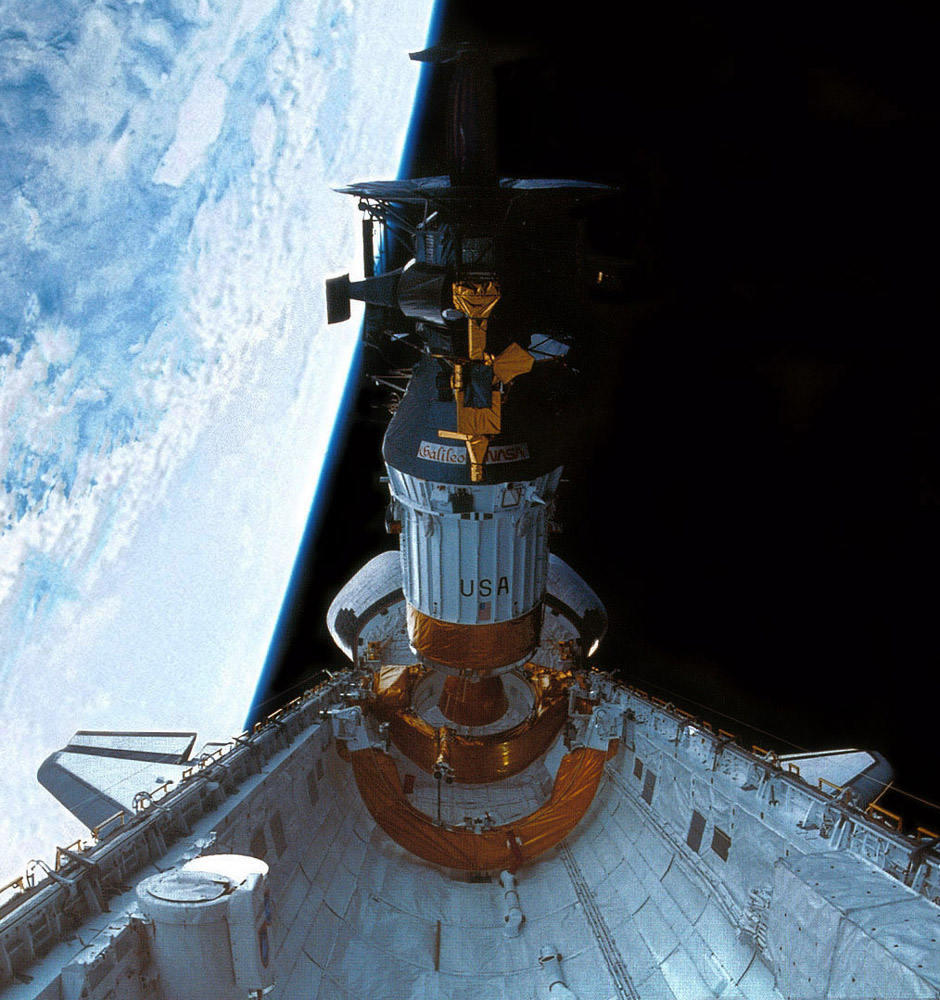
Galileo is preparing to depart from the cargo bay of the shuttle Atlantis. Source: Wikipedia

The protests by environmental activists did not accelerate the launch into space. The space shuttle Atlantis, carrying the probe, was not launched until October 18, 1989. Subsequently, on October 19, the probe ignited its IUS main engine and commenced its journey to Venus.

On the way to the asteroids

On February 9, 1990, the Galileo spacecraft conducted a flyby of Venus at a distance of 16,106 kilometers. By that time, the planet had been relatively well examined by other spacecraft; however, the infrared cameras continued to be capable of discerning portions of the planet’s night side beneath a dense cloud cover, thereby facilitating the mapping of its terrain.

Furthermore, the spacecraft analyzed the shock wave generated in the direction of the planet’s orbital motion as a result of the interaction between its magnetic field and solar wind particles. The findings indicate that this shock wave is exceedingly weak, thereby permitting radiation to penetrate the planet’s gaseous envelope. Additionally, lightning discharges were observed within the atmosphere itself.
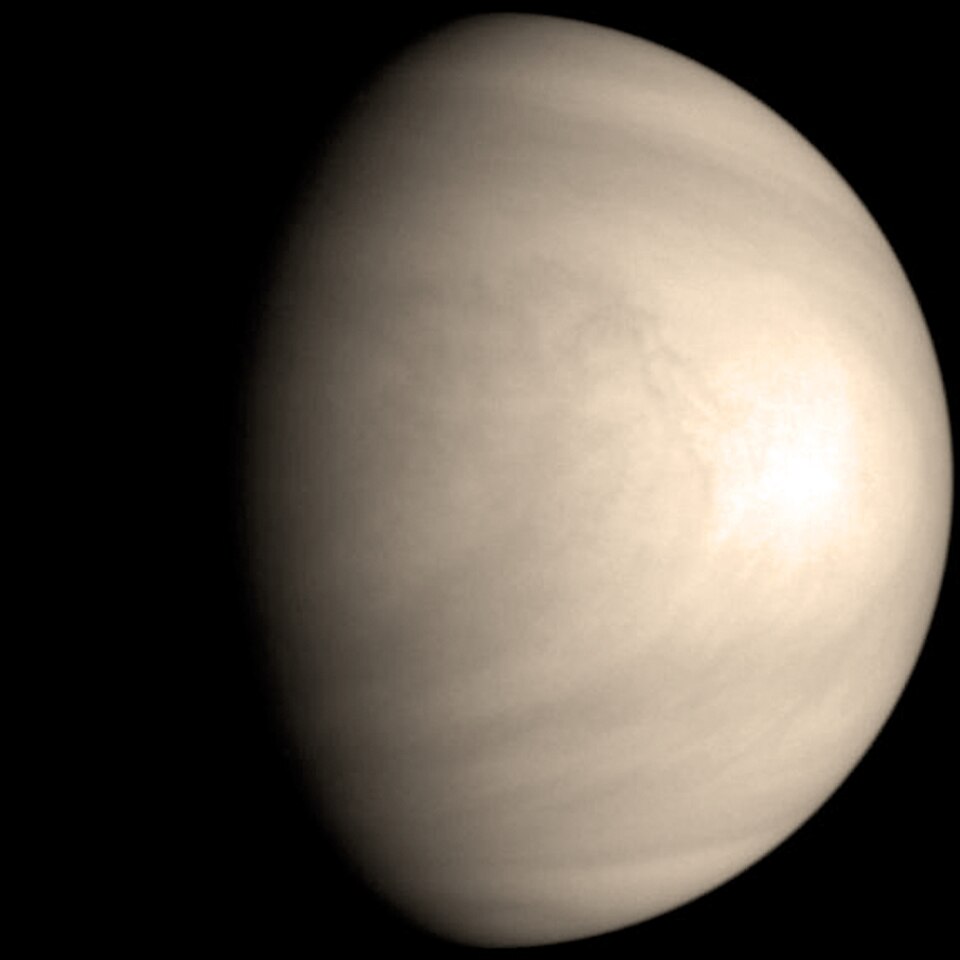
Venus, photographed by the Galileo spacecraft. Source: Wikipedia

Subsequently, on April 11, one of the mission’s most pivotal events was scheduled to occur — the deployment of the primary antenna. This substantial structure was engineered to guarantee data transmission at a rate of 134,000 bits per second, even over several astronomical units. However, it was originally designed at a time when it was anticipated that the spacecraft would pass by Mars.

However, when the trajectory was altered to enable a pass by Venus, it became essential to shield the spacecraft from intense solar radiation. To accomplish this, a small protective shield was employed, kept closed until the spacecraft had traversed Venus. Communication was managed via a minor lateral antenna, and during the initial days of the mission, a respectable data transmission rate of 1,200 bits per second was maintained. Subsequently, this rate declined to 40 bits per second.

The entire team was eagerly anticipating April 11; however, they were unable to deploy the main Galileo antenna at that time or subsequently. Consequently, communication was maintained through a backup antenna, which had an exceptionally slow data transmission rate, thereby impacting all subsequent research.

On December 8, 1990, Galileo executed a gravitational maneuver during its pass by Earth. Subsequently, it completed an orbit around the Sun and made another close approach to Earth on December 8, 1992, before entering a trajectory directed towards Jupiter.
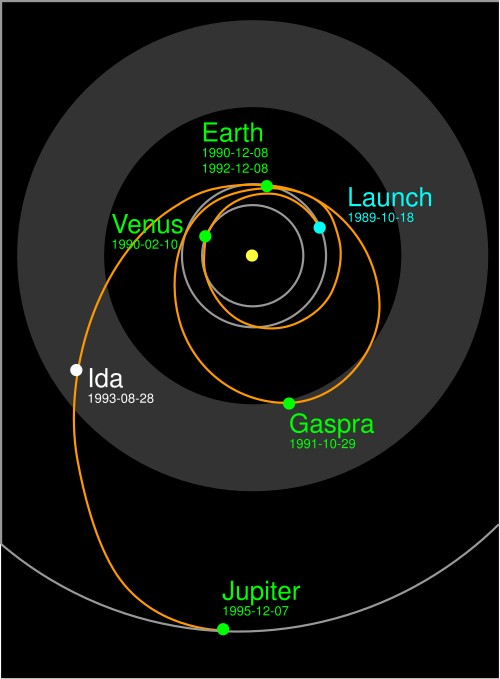
Galileo’s flight path. Source: Wikipedia

During its close approaches, the spacecraft conducted scientific research, notably studying Earth’s magnetosphere and observing high-altitude mesospheric clouds, which indicated processes contributing to the depletion of the ozone layer. Furthermore, scientists verified and confirmed the capability to detect signs of life on Earth from a spacecraft passing the planet. Galileo documented the absorption of atmospheric gases that matched their absorption by terrestrial flora.

Gaspra

On October 29, 1991, Galileo arrived at the intermediate destination of its mission—the asteroid Gaspra. This celestial body, measuring 18.2 × 10.5 × 8.9 km, was discovered as early as 1916 and was named after a village in Crimea. Following a review of the spacecraft’s flight plan by American experts after 1986, Gaspra’s advantageous position and comparatively substantial size rendered it the first asteroid target selected for close-up exploration by the spacecraft.

Gaspra possesses an orbital period of 3.29 Earth years. The aphelion of its orbit is situated at a distance of 2.6 astronomical units (AU), while the perihelion is positioned at 1.82 AU from the Sun. This asteroid is classified as a silicate type.
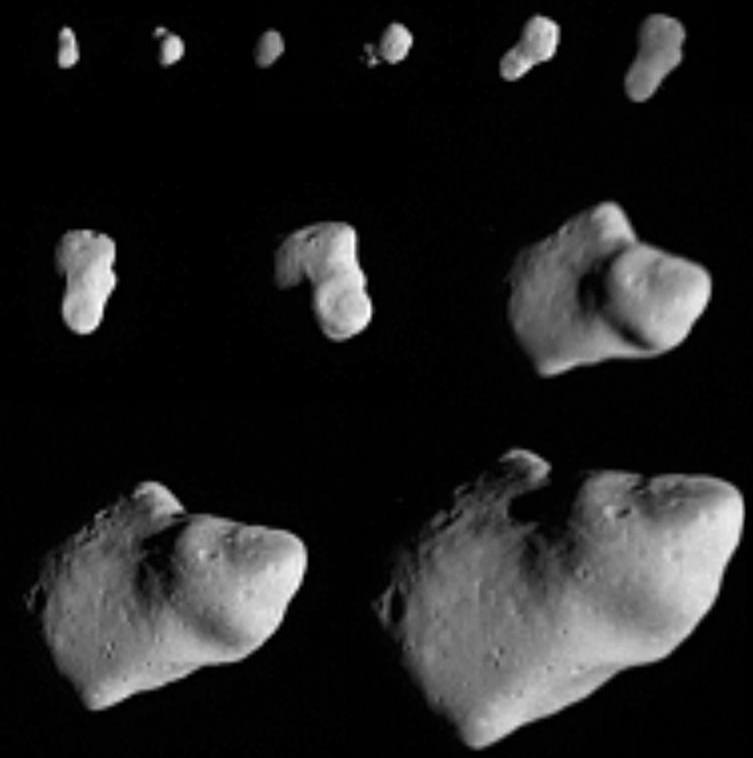
Photographs of the asteroid Gaspra captured from multiple distances. Source: Wikipedia

In October 1991, Galileo approached within a minimum distance of 1,600 km. Overall, it was able to capture 57 photographs of Gaspra, which, considering the slow data transmission and a flight velocity of approximately 8 km/s, represented a commendable achievement. The highest resolution among these photographs featured a resolution of 54 meters per pixel.

Ida and Dactyl

Finally, on August 28, 1993 — almost two years after the Gaspra flyby and four years after launch — Galileo approached Ida. Experts were uncertain until the very last moment whether the spacecraft could execute this maneuver. It was not until August 26, after verifying sufficient fuel to proceed to Jupiter’s orbit, that the command was issued to correct the course, resulting in Galileo’s encounter with Ida.

Once Around Ida and Dactyl

The asteroid Ida 243 was discovered prior to Gaspra, in 1884. It was named after a nymph from Greek mythology. By the time Ida was designated as a target for the spacecraft’s mission, its dimensions were already established as 59.8 × 25.4 × 18.6 kilometers. In terms of the Main Asteroid Belt, it is not considered a particularly small object.

Ida orbits in a nearly circular trajectory with an aphelion of 2.98 AU and a perihelion of 2.74 AU. Its orbital period spans 1,767 days. Spectrographic analyses indicate that it is a silicate asteroid. Galileo approached it at a considerable relative velocity of 12.4 km/s. Nonetheless, scientists were well-prepared for this event, and imaging was conducted from a distance of 240,350 km until the point of closest approach. As a result, they were able to observe 95% of the asteroid’s surface with clarity.
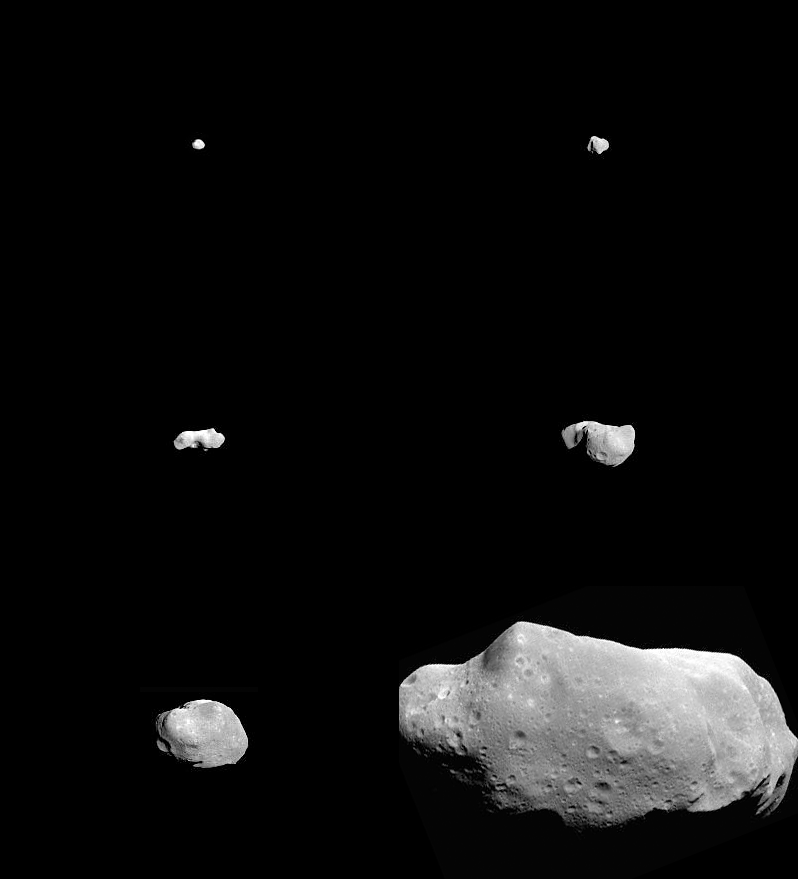
Photos of Ida taken from various distances. Source: Wikipedia

For the first time, scientists had the opportunity to conduct geological studies of such a body and discovered that Ida’s chemical and mineralogical composition is extraordinarily similar to that of ordinary chondrite meteorites, which fall to Earth in substantial quantities. This confirmation supports the hypothesis that large and small rocky bodies in space originate from a shared source.

They also established the asteroid’s mean density and observed that it is enveloped by a layer of regolith — debris and dust akin to that covering the Moon. This regolith has arisen from numerous collisions with other celestial bodies.

Evidence of impacts was also observed on Ida’s surface. It has been identified as one of the most heavily cratered objects within the Solar System. The largest crater measures approximately 12 km in diameter.

Furthermore, it has been established by researchers that solar radiation influences the surface. The older regions of the surface are observed to be more reddish compared to other areas. Overall, the Galileo investigation demonstrated that asteroids possess a considerably more intriguing history than was previously assumed.

Owing to persistent issues with the antenna, the transmission of images from Ida proceeded at an extremely slow pace and was not finalized until February 1994. It was during this period that a significant discovery was made: a moon was identified orbiting Ida, subsequently named Dactyl, in honor of the mythical people from Greek mythology.
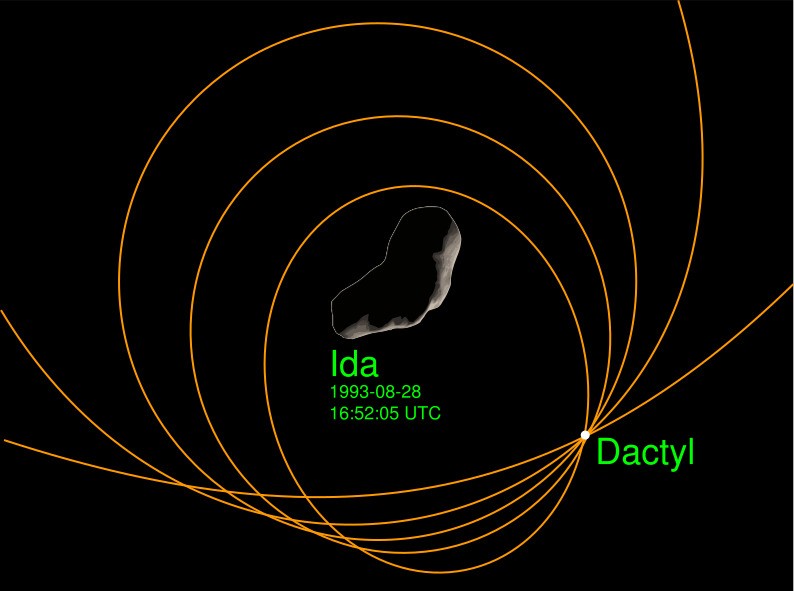
Possible orbits of Dactyl. Source: Wikipedia

Dactyl measures 1,200 × 1,400 × 1,600 meters. It closely resembles Ida in terms of albedo and coloration, and, similar to Ida, is extensively cratered. It is believed to have formed concurrently with Ida as a consequence of the disintegration of a substantial parent body.

However, the precise nature of Dactyl’s orbit remains unidentified. It is acknowledged that establishing this orbit necessitates numerous observations; however, scientists presently possess only a limited number of images. From these, they have been able to approximate that Dactyl’s radius is approximately 90 km.

The entire history of the Galileo mission encompasses two decades and consequently illustrates the progression of our comprehension of asteroids. Initially envisioned as a spacecraft intended to avoid these ostensibly unremarkable yet hazardous objects, the probe ultimately evolved into the instrument that enabled scientists to explore the realm of space rocks and appreciate their remarkable nature.

However, Galileo’s journey did not conclude there. After departing from the asteroids, it proceeded to its primary objective — Jupiter. The spacecraft successfully entered orbit, deployed a probe into the planet’s atmosphere, and collected a wealth of valuable data. However, that is a separate chapter in its mission history.
{ https://universemagazine.com/en/articles-en/ }

Hoe vind je dit bericht?
Geschreven door peter om 18:07 Stuur door

Kevin Randle | Strange Visitors: UFO Crash & Alien Body Retrievals, Abductions & Evidence

Kevin Randle | Strange Visitors: UFO Crash & Alien Body Retrievals, Abductions & Evidence

Kevin Randle | Strange Visitors: UFO Crash & Alien Body Retrievals, Abductions & Evidence

{ https://podfollow.com/ }

Hoe vind je dit bericht?
Geschreven door peter om 16:32 Stuur door

Trump’s UFO advisor says aliens wouldn’t care who the president is

Trump’s UFO advisor says aliens wouldn’t care who the president is

The Trump administration has released five batches of UFO files so far

Josh Marcus in San Francisco


Trump’s UFO advisor says aliens wouldn’t care who the president is #Shorts

President Trump has made a point of releasing UFO-related materials to the public, but if little green men ever visit Earth they’re unlikely to care much about our politics or who is in the White House, according to one of the president’s advisors on UFOs.

“If someone arrives from the vast expanses of interstellar space, recognizing how humans divided up territory on Earth is a very low priority for them,” Avi Loeb, who leads the administration’s Unidentified Anomalous Phenomena (UAP) Science Advisory Council, told AlterNet this week. “They wouldn't care about the United States, and they wouldn't care who its president is.”

At the same time, Loeb said, if aliens were discovered or contacted during the Trump administration, that would define the president’s legacy forever.

“Obviously, for a president, it would be a great boon if, during his term, we discovered we're not alone — that we have a neighbor in our cosmic environment,” Loeb, a Harvard University physicist, told the outlet. “That kind of discovery would be remembered millions of years into the future. It's not like a dispute with another nation, which in a century will likely be forgotten. This would be a major discovery that shapes the future of humanity.”

The advisory council, announced in June, is part of the Trump administration’s larger effort to disclose more information about UAPs.

Aliens wouldn’t care who was in the White House, according to Trump’s UFO advisor, despite the president’s efforts to explore UFOs

Aliens wouldn’t care who was in the White House, according to Trump’s UFO advisor, despite the president’s efforts to explore UFOs (AP)

So far, the Pentagon has released five tranches of information to the public, though the materials have not revealed any new, definitive evidence of extraterrestrial life or technology. Instead, the releases consist of records tied to a mix of recent and decades-old mysterious encounters.

The administration is also working on a process to encourage government whistleblowers with information about UAPs to come forward without fear of violating non-disclosure agreements or other secrecy obligations.

Loeb’s selection as leader of the UAP advisory effort was somewhat controversial.

Despite his lengthy tenure as a top physicist, he has faced criticism from other scientists who have argued he has made premature claims about the possibility of alien life.

"I don't know what's going to come of this, but we're not going to get any closer to answering these questions with him in charge," Steve Desch, an Arizona State University astrophysicist, told The Associated Press in June.

Loeb, whose team has requested that the Pentagon declassify various UAP-related materials, has said he’s starting from the assumption that UAPs encountered around Earth are man-made phenomena until proven otherwise.

RELATED

Trump Faces REVOLT By Own UFO Team? White House Aide ROASTS POTUS With 'Aliens Don't Care' Jab

{ https://www.the-independent.com/news/}

Hoe vind je dit bericht?
Geschreven door peter om 15:56 Stuur door

Lost city of Atlantis clues revealed in new scans of secret ocean site, ex-Navy admiral claims

The lost city of Atlantis could be hidden beneath an undisclosed stretch of the Atlantic Ocean, a retired US Navy admiral has claimed.

Tim Gallaudet said he is working with researchers who believe detailed maps of the seabed contain features matching the legendary civilization’s ancient description.

Atlantis was described by the Greek philosopher Plato more than 2,000 years ago as a wealthy island empire with a capital built around rings of land and water.

According to the legend, violent earthquakes and floods swallowed the island in a single day and night. Plato’s Timaeus

‘We believe we found the region in the Atlantic. We have some proprietary bathymetry [underwater topography], and it’s very high resolution,' Gallaudet told Jesse Michels on the American Alchemy podcast. 'There are a lot of features that correspond to exactly how Plato described it.'

He said a well-funded researcher with a ship and a remotely operated underwater vehicle had expressed interest in hearing the team’s proposal.

But the location remains secret, with Gallaudet citing a nondisclosure agreement that prevents him from revealing the site.

Gallaudet's account describes a possible search target, not a confirmed discovery of Atlantis. 

The former Navy admiral shared a scan he said likely shows the lost city of Atlantis

The former Navy admiral shared a scan he said likely shows the lost city of Atlantis

Plato first introduced Atlantis in his dialogues Timaeus and Critias, written around 360 BC.

He described it as a technologically advanced society that existed 9,000 years before his time, placing it over 11,000 years ago.

Most historians and scientists have concluded that Plato's account of the lost kingdom of Atlantis was fictional. 

Gallaudet previously led the Navy’s oceanography work and served as acting administrator of the National Oceanic and Atmospheric Administration (NOAA), and testified before Congress in November 2024 about Unidentified Anomalous Phenomena (UAP).

He had hinted at an underwater investigation in an August 2025 appearance on the Danny Jones podcast, saying: ‘We actually have a special project I can’t talk about.’

He described plans to map an ancient underwater site, examine it with a remotely operated vehicle and try to date it, but did not identify the location. 

It is unclear whether he was discussing the same site described to Michels.

In the interview on American Alchemy, Gallaudet said the team was using bathymetry, maps of underwater depths and terrain,  that he described as privately held and very high-resolution.

Gallaudet previously led the Navy’s oceanography work and  testified before Congress in November 2024 about Unidentified Anomalous Phenomena (UAP)

Gallaudet previously led the Navy’s oceanography work and  testified before Congress in November 2024 about Unidentified Anomalous Phenomena (UAP) 

He pointed to the dimensions of the canal system in Plato’s writings, saying features in the target area ‘correspond to exactly how Plato described it.’

However, he did not provide the measurements or identify the other features being compared.

In the earlier Jones interview, Gallaudet said he wanted to ‘see some data on Atlantis,’ adding: ‘I have a few leads.’

The current effort is being led by an emergency-room doctor who spent more than a decade gathering geological and archaeological information, Gallaudet said.

He did not name the doctor, but described how the researcher began reading Plato’s original dialogues in his spare time before bringing in specialist advisers.

Gallaudet said he also connected the researcher with physicist Max Derakhshani to explore using an algorithm that analyzes three-dimensional terrain data.

He believes the technique could help distinguish natural formations from artificial structures, although he did not report results establishing that the seabed features were man-made.

An expedition would allow the researchers to investigate the site directly, rather than relying on its appearance in maps.

Later in the interview, Gallaudet said deep-sea explorer Victor Vescovo had also heard the team’s presentation and expressed interest.

Plato first introduced Atlantis in his dialogues Timaeus and Critias, written around 360 BC

Plato first introduced Atlantis in his dialogues Timaeus and Critias, written around 360 BC

‘We gave him the presentation on Atlantis, and he said, “All right, I’m in,”’ Gallaudet recalled.

He did not announce a confirmed departure date for the proposed expedition.

Michels suggested the Azores as a possible location during the conversation, but Gallaudet did not confirm that the team’s target was there.

The Azores Plateau is a large, triangular underwater highland in the North Atlantic Ocean that supports the volcanic peaks of the Azores archipelago. 

Supporters of the Azores theory believe the islands are the surviving mountaintops of a vast landmass that sank beneath the Atlantic.

They point to the region’s position where three tectonic plates meet, the North American, Eurasian and African, as a possible connection to the catastrophic earthquakes described in Plato’s account.

Plato described it as a technologically advanced society that existed 9,000 years before his time, placing it over 11,000 years ago

Plato described it as a technologically advanced society that existed 9,000 years before his time, placing it over 11,000 years ago

Some also suggest that lower sea levels during the last ice age exposed a larger area of land that was later submerged, although this does not establish that the islands are the remains of Atlantis.

Gallaudet also argued that a rapid sinking of land could have submerged a city over years rather than millennia, although he did not disclose the geological mechanism behind that hypothesis.

The proposal rests on treating Plato’s account as a possible description of a real place, rather than simply a philosophical story.

RELATED

Lost City of Atlantis New Clues Revealed 2025 Discovery


The Lost City Of Atlantis Found Under the Ocean?! 🌊😱 #Shorts #history #mysteries #trending #atlantis

Atlantis Finally Found in the Middle of the Atlantic Ocean!?

{ https://www.dailymail.com/sciencetech/index.html }

Hoe vind je dit bericht?
Geschreven door peter om 15:22 Stuur door

Nepal's flood could just be the beginning: Maps reveal the glaciers around the world at risk of a similar disaster - with 15 million people in the danger zone

Nepal's flood could just be the beginning: Maps reveal the glaciers around the world at risk of a similar disaster - with 15 million people in the danger zone

Hundreds of people have been killed, and more than 1,500 are still missing after devastating flash floods swept through the Nepal–Tibet border.

Scientists believe the disaster was triggered by the collapse of a glacier on the Langtang–Lirung mountain, which registered as a magnitude 5.2 earthquake.

Although it may take months of research to uncover the exact story, experts are already warning that this is 'not a one–off event'.

Dr Jonathan Carrivick, an expert on glacial flooding from the University of Leeds, told the Daily Mail: 'Climate change is warming the mountains, causing permafrost and glaciers to melt.'

According to the expert, this makes 'the likelihood of these sorts of events – possibly bigger – more frequent.'

Overall, researchers estimate that a whopping 15 million people worldwide are living in danger zones. 

While the Himalaya, Karakoram, Hindu Kush and neighbouring ranges in Asia are most at risk, people living in the US and Canada are also in danger.

'North America could experience something similar to what we see in Nepal today,' Dr Carrivick warned. 

As rescue efforts continue in the flood-hit regions of Nepal and Tibet, scientists have mapped which glaciers around the world could be at risk of a similar disaster. Pictured: Red regions show areas of high Glacial Lake Overflow Flood risk

As rescue efforts continue in the flood–hit regions of Nepal and Tibet, scientists have mapped which glaciers around the world could be at risk of a similar disaster. Pictured: Red regions show areas of high Glacial Lake Overflow Flood risk

High Mountain Asia is the most threatened region because it is rapidly warming, and hosts rapidly melting glaciers, growing meltwater lakes and some of the world's steepest mountains

High Mountain Asia is the most threatened region because it is rapidly warming, and hosts rapidly melting glaciers, growing meltwater lakes and some of the world's steepest mountains 

Hundreds of people have been killed, and more than 1,500 are still missing after devastating flash floods swept through the Nepal-Tibet border

Hundreds of people have been killed, and more than 1,500 are still missing after devastating flash floods swept through the Nepal–Tibet border

Although scientists are still scrambling to understand the disaster, the current evidence suggests that Nepal's deadly floods are the consequence of glacial collapse.

Dr Carrivick says: 'This Nepal event appears to have been a massive rock failure that took a large part of the glacier with it.'

According to the research group Antarctic Glaciers, which combines the efforts of about 50 leading experts, initial analysis shows that there was a landslide and glacier collapse shortly before the flood.

This sent ice and rock cascading down the mountain, mixing with sediment left by previous floods, and temporarily blocking the Lhende Khola River.

That caused a large lake to temporarily form before it broke through in a devastating flood.

Deadly events exactly like this have happened in the past and are likely to keep happening with increasing regularity as climate change continues.

For example, in 2021, a massive rock and ice triggered a deadly debris flow that killed over 200 people and damaged two hydroelectric power plants.

Meanwhile, in Canada, a rockslide in 2020 saw 18 million cubic metres of stone cascade into a glacial lake, sending 100–metre–tall waves that scoured a 6–mile (10km) channel.

Outside of Asia, glaciers in the Alps are also putting many areas at high risk of Glacial Lake Outburst Floods

Outside of Asia, glaciers in the Alps are also putting many areas at high risk of Glacial Lake Outburst Floods 

The researchers note that the Andes is an area of risk that might have been greatly underappreciated in previous research

The researchers note that the Andes is an area of risk that might have been greatly underappreciated in previous research

Scientists say that Nepal's flooding was not caused by a Glacial Lake Overflow Flood, but warn that this related risk is increasing all over the world. Pictured: Distribution of people at risk of glacial flooding

Scientists say that Nepal's flooding was not caused by a Glacial Lake Overflow Flood, but warn that this related risk is increasing all over the world. Pictured: Distribution of people at risk of glacial flooding 

What caused the flooding in Nepal and Tibet?

Scientists say that initial analysis the day after the flooding indicates a landslide and glacier collapse from the Langtang–Lirung mountain.

Ice and rock then cascaded down the mountain, mixing with further sediment and water as it travelled down–valley.

The landslide temporarily blocked the Lhende Khola River, causing a large lake to build before it broke through the dam and unleashed a massive flood.

Early reports suggested an earthquake was the trigger, but data now shows that a major rockfault leading to glacial collapse was the cause. 

Source: Antarctic Glaciers 

Scientists have also raised the alarm that mountainous regions are becoming increasingly at risk of a similar threat, known as a glacial lake outburst flood (GLOF).

This occurs when meltwater from a glacier forms a large lake at its base that is held back by a thin, unstable natural dam.

If the glacier collapses or the meltwater gets too high, that barrier can break, releasing a devastating cascade of water downhill.

Scientists do not currently believe that the deadly floods in Nepal and Tibet were caused by a GLOF, since satellite images do not show any major lakes forming in the area prior to the landslide.

However, glaciers around the world are now putting more people in danger of this form of flooding, which could prove just as, if not more, deadly than what has been seen in Nepal.

In their paper, published in Nature Communications, researchers used the latest modelling to map where this risk was highest.

They found that more than half of the 15 million people threatened by GLOFs live in just four countries: India, Pakistan, Peru, and China.

Populations in High Mountain Asia (HMA), which includes the Himalaya, Karakoram, Hindu Kush and neighbouring ranges, are most at risk.

Scientists currently believe that the floods were triggered by a rock slide that led to glacial collapse on the Langtang-Lirung mountain

Scientists currently believe that the floods were triggered by a rock slide that led to glacial collapse on the Langtang–Lirung mountain

Geological factors in the Himalayas lead to 'hazard cascades', chain reactions that release huge volumes of ice and water into populated areas - just like the recent disaster in Nepal

Geological factors in the Himalayas lead to 'hazard cascades', chain reactions that release huge volumes of ice and water into populated areas – just like the recent disaster in Nepal

The countries most at risk of Glacial Lake Outburst Flooding

  1. China
  2. Pakistan
  3. Peru
  4. Canada
  5. India
  6. USA
  7. Chile
  8. Italy
  9. Nepal
  10. Columbia

Here, people are the most exposed on average and live closest to glacial lakes, with more than a million people living less than six miles (10km) from one.

This region is home to 62 per cent of all people exposed to GLOFs, with three million in India and two million in Pakistan.

Co–author Dr Matt Westoby, Associate Professor of Physical Geography at the University of Plymouth, told the Daily Mail: 'High Mountain Asia is one of the fastest warming regions globally.

'It hosts rapidly melting glaciers, growing meltwater lakes and some of the world’s steepest mountains.

'As the climate warms, shrinking glaciers and thawing frozen ground can destabilise mountain slopes, increasing the risk of rockfalls, landslides and avalanches.'

Dr Westoby adds that these can cause 'hazard cascades', chain reactions that release huge volumes of ice and water into populated areas – just like the recent disaster in Nepal.

However, the researchers note that the Andes is an area of risk that might have been greatly underappreciated in previous research.

The number of glacial lakes in this region has increased by 93 per cent since 1990, compared with just 37 per cent in HMA.

Peru ranks as the third most dangerous country globally, and two of the world's three most hazardous river basins are in the Andes: the Santa basin in Peru and the Beni basin in Bolivia.'

Co–author Professor Rachel Carr, a glaciologist from Newcastle University, told the Daily Mail: 'It is important to note that it’s not just rural populations at risk: major cities draw their water from Andean glaciers,' says Professor Carr.

But it isn't just these highly exposed regions that are at risk, as the researchers show that North America, particularly the Pacific Northwest and Canada, and the Alps are threatened by GLOFs.

Even though there is debate over whether GLOFs are becoming more frequent, it is certain that they are becoming more dangerous.

article image

This is because the downstream populations are growing, putting more people and critical infrastructure at risk.

Part of what makes this so dangerous is that experts cannot say exactly where or when the next devastating flood will strike.

Professor Carr says: 'Usually, larger events are rarer and smaller events happen more frequently, but there is a random nature to them, especially when they are triggered by events such as landslides.

'Thus it’s likely one of a similar scale [to Nepal] will occur in the future, but when and where is much harder to say.'


NEW DETAILS: Glacial collapse triggers CATASTROPHIC floods near China-Nepal border

Nepal Flash Floods: Himalayas In Crisis, Melting Ice, Flash Floods And A Climate Warning

{https://www.dailymail.com/sciencetech/index.html }

Hoe vind je dit bericht?
Geschreven door peter om 14:51 Stuur door

UAP Disclosure | From Hype to Silence: What Happened?

UAP Disclosure | From Hype to Silence: What Happened?

By Maya Collins - Edited By Natalie Quinn

A person looking disappointed while reading news about UAP disclosures on a smartphone, with a background showing a cloudy sky.
popular

A wave of excitement once surrounded the Trump administration's initiative to reveal Unidentified Aerial Phenomena (UAP) information, yet only a few months later, the conversation has nearly vanished. The hype peaked with expectations for substantial revelations, but the reality is starkly different.

Initial Excitement

When the push for UAP disclosure began, many believed this could fundamentally change the understanding of UFOs. Hushed discussions about hidden truths promised a groundbreaking reveal. However, once the initial releases occurred, they failed to deliver the expected level of intrigue.

  • Previously Known Material: Much of what was released consisted of information already available in other forms.

  • Unresolved Cases: The released content did not clarify long-standing mysteries, leaving many disappointed.

  • Lack of Compelling Evidence: Footage and documents shared failed to establish anything out of the ordinary.

The sentiment among people has soured significantly. One person remarked, ">> "They fed us a bunch of bull and people are disillusioned now." Indeed, perceptions shifted from hope to skepticism.

Disappointment Sets In

With a lack of groundbreaking evidence, some say expectations have been shattered. Skeptics are vocal, suggesting that the administration might not hold any verifiable information. "If what they’ve released is all they’ve been hiding, then there’s really nothing to disclose at all," shared a concerned commentator.

Furthermore, the frustrations didn't stop there.

People have expressed that the entire disclosure process seems like a distraction from more pressing issues. One user cynically pointed out:

">> "Disclosure was just another distraction from bigger problems."

Despite continued calls for transparency, many say it feels as if the movement is on life support.

Emerging Theories and Public Sentiment

The remaining discussion revolves around questions more than answers. A number of individuals speculate if an overarching narrative is being spun to confuse the public.

  • Corporate Control?: Some comment on a "cabal" controlling the narrative, alluding to hidden motives behind the government’s reluctance to release substantial evidence.

  • Expectation vs. Reality: There seems to be a divide between what enthusiasts hoped for and what has actually come to light. One individual mentioned,

">> "Expectations were met with mediocre dots no real confirmation."

Additionally, the shared experiences of military personnel encountering unexplained aerial phenomena, like sightings of orbs displaying unusual abilities, still evoke fascination, although they lack official acknowledgment or rigorous investigation.

Key Takeaways

  • 📉 Declining Interest: Interest in UAP disclosure has plummeted due to underwhelming revelations and a lack of compelling evidence.

  • 🔍 Continued Calls for Transparency: Despite ongoing demands for full disclosure, many feel the government downplays the matter.

  • 🤔 Distrust in Processes: Heightened skepticism about the sincerity of the UAP disclosure movement persists, with crowds questioning the motives behind released information.

As the conversation dies down, it raises an important question: could such a pivotal movement die from stagnation when the truth remains obscured? With expectations unmet, many are left to wonder if the phenomena will ever get the serious treatment they believe is due.

Predictions on the Horizon

Moving forward, there’s a strong chance that interest in UAP disclosures will continue to decline as disillusioned people seek answers elsewhere. Experts estimate around 65% of individuals may shift their focus to other current events, leaving the UAP conversation largely unattended. However, a smaller cohort might remain dedicated to pressing for transparency, potentially leading to minor policy changes or new initiatives aimed at restoring credibility. The chance for grassroots movements or forums to organize around this topic might rise, but without compelling evidence, substantial reforms will likely remain elusive.

Echoes from the Past

Consider the slow unearthing of the Watergate scandal in the 1970s, which initially seemed mundane and straightforward, much like the early UAP disclosures. The public’s patience waned as early revelations fell flat, but as more substantive evidence surfaced, the situation morphed into a significant political upheaval. Today’s UAP narrative might require similar persistence from the public to press for the truth; even the most mundane beginnings can sometimes lead to the most transformative revelations. Just as a dam can hold back water until the pressure grows too great, the UAP disclosure movement might yet yield deeper truths if enough voices keep pushing for accountability.

RELATED

Why UAP Disclosure Matters Now | Christopher Mellon at Disclosure Forum 2026

Harvard professor Avi Loeb on new federal UFO disclosure rules | FOX 10 Talks | FOX 10 Phoenix

The Age of Disclosure: Who Actually Controls the UAP Secrets? | w/ Dan Farah | SSHQ

{ https://mysterylores.com/ }

Hoe vind je dit bericht?
Geschreven door peter om 23:02 Stuur door

A Brief Look at Angelology: The Study of Angels

A Brief Look at Angelology: The Study of Angels

by Steve Paslow

Gabrial-1280-1024x1024.jpg

Angels have fascinated humanity for millennia, serving as powerful symbols of hope, protection, and divine intervention. Rooted in the spiritual traditions of numerous cultures and religions, angels are typically regarded as celestial beings who act as intermediaries between the divine and humanity. Angels are often sent to deliver divine messages, as seen in the Annunciation to Mary. Guardian angels are believed to watch over individuals, protecting them from harm. Angels offer spiritual guidance, helping individuals align with their higher purpose.  Archangel Michael is often depicted as a warrior leading the battle against evil.

In Judaism-Angels, or mal’akhim (messengers), are prominent in Jewish tradition. They serve as messengers, protectors, and executors of God’s will. Famous examples include: Michael, the archangel who leads God’s armies against evil. Raphael, associated with healing in the Book of Tobit. Gabriel, who interpreted visions for the prophet Daniel. Uriel, a very helpful angel who is often associated with guarding The Tree of Life with a flaming sword after Adam and Eve were expelled from Eden, inspecting the door of Egyptian homes for lamb’s blood over the Passover Plague, and providing guidance and enlightenment to individual like the prophet Ezra through visions and revelations.  The Jewish mysticism of the Kabbalah expands on angelic hierarchies, with ten orders, such as Seraphim, Cherubim, and Ophanim.

Christianity-Angels are deeply embedded in Christian theology, serving as God’s messengers and agents of divine will. The New Testament features angels prominently, such as Gabriel announcing the birth of Jesus to Mary and the angels who appeared at Christ’s resurrection. The Christian angelic hierarchy, outlined by Pseudo-Dionysius the Areopagite, includes nine choirs of angels divided into three spheres: First Sphere: Seraphim, Cherubim, Thrones. Second Sphere: Dominions, Virtues, Powers. Third Sphere: Principalities, Archangels, Angels.

Descriptions of Angels-Appearance: Angels are often described as radiant, winged beings with human-like forms. However, their depictions vary: The Seraphim are described as fiery beings with six wings. The Cherubim have multiple faces (human, lion, ox, and eagle) and are often associated with guarding sacred spaces. The Ophanim, or “wheels,” are mysterious beings described in Ezekiel’s vision as wheels within wheels covered with eyes. Symbolism: Wings symbolize their swiftness and connection to the heavens, while their light or radiance represents purity and divinity.

Archangel Gabriel: The Divine Messenger Archangel Gabriel, whose name means “God is my strength,” holds a revered place in religious traditions as a celestial messenger and herald of divine truth. As one of the most prominent archangels in Christian, and Jewish traditions, Gabriel is celebrated for playing pivotal roles in delivering important messages from the Divine to humanity. He is perhaps best known for announcing the birth of Jesus Christ to the Virgin Mary during the Annunciation, as described in the Gospel of Luke. With the words, “Hail, full of grace, the Lord is with you,” Gabriel brings one of the most significant messages in Christian theology, he is perhaps best known for announcing the divine, immaculate birth of Jesus Christ to the Virgin Mary during the Annunciation, as described in the Gospel of Luke.

In Jewish texts, Gabriel appears in the Book of Daniel as a figure who interprets visions and provides insight into the mysteries of the divine plan. The Talmud also mentions Gabriel as one of the angels who performs acts of justice and judgment,and is often depicted in art holding a trumpet, symbolizing their role as a divine announcer, or a lily, representing purity and divine grace. This archangel is associated with clarity, communication, and creative inspiration. As a result, many people seek his guidance when facing difficult decisions or striving for a deeper understanding of their purpose. Believers across various faiths invoke Gabriel for support in communicating effectively, finding strength during challenging times, or seeking spiritual insight. Gabriel’s presence is thought to bring clarity, confidence, and a sense of peace, making this archangel a powerful symbol of hope and divine connection. Whether as the angel of the Annunciation, the revealer of sacred texts, or a guiding light in personal journeys, Gabriel remains a profound figure whose influence transcends time and tradition.

Archangel-Michael-1024x1024.jpg

  • Archangel Michael: The Divine Protector and Leader is one of the most venerated and recognized archangels across various religious traditions, including Christianity and Judaism. Known as a warrior and protector, Michael’s name means “Who is like God?”—a rhetorical question emphasizing God’s unparalleled power.

The Role of Archangel Michael In religious texts, he is depicted as a heavenly leader who stands as a defender of faith, justice, and truth. In the Christian tradition, he is often associated with battling Satan and his forces, symbolizing the triumph of good over evil. This epic battle is vividly described in the Book of Revelation (12:7-9), where Michael leads the angels to victory against the dragon, representing Satan. In the Jewish tradition, Michael is considered the guardian of Israel, often interceding on behalf of humanity before God.  This Archangel is often portrayed as a powerful figure, clad in shining armor, wielding a sword or spear, and standing triumphantly over a defeated dragon or serpent. These symbols represent his role as the defender against darkness and the protector of humanity. His blue or golden aura in art signifies divine power, truth, and protection. Believers across the world turn to Michael in times of need, seeking courage, strength, and protection. Prayers to him often emphasize his role as a guardian against physical and spiritual harm. One of the most well-known prayers, the Prayer to St. Michael, asks him to defend believers in battle and deliver them from evil.

  • Archangel Raphael: The Healer of Heaven is revered as the angel of healing, guidance, and protection in various religious traditions, particularly within Christianity and Judaism. His name, derived from the Hebrew Rāphāʾēl, means “God has healed,” reflecting his divine role in bringing physical, emotional, and spiritual restoration.

Raphael is most prominently featured in the Book of Tobit, part of the Deuterocanonical texts in Christian tradition. Disguised as a human named Azariah, Raphael accompanies Tobias, the son of Tobit, on a journey. Along the way, he heals Tobit’s blindness and helps Tobias defeat a demon tormenting his future wife, Sarah. These acts highlight his role as a healer and protector against spiritual and physical harm. He is one of the seven archangels who stand before God. Raphael as the patron of healers, travelers, and those in search of guidance, Raphael is often invoked for assistance in matters of health and well-being. He is traditionally depicted holding a staff, symbolizing his role as a guide, and a fish, a reference to the healing story in the Book of Tobit.Raphael is also associated with promoting harmony in relationships, supporting individuals on their life journeys, and providing protection from harm. Many believe he inspires healers, doctors, and caregivers to bring relief to those in need.  People seeking Raphael’s assistance often pray for his intercession to heal illness, reduce stress, or find clarity in difficult decisions. His gentle and compassionate presence is believed to bring peace and hope to those who call upon him. Whether seen as a divine healer, a guide for travelers, or a protector against adversity, Archangel Raphael’s legacy continues to inspire faith and trust in divine providence.

Angel-m-1024x1024.jpg

  • Archangel Uriel, whose name means “Light of God” or “Fire of God,” is a revered archangel in many religious and spiritual traditions. Although not explicitly mentioned in canonical biblical texts, Uriel is prominently featured in apocryphal writings, such as the Book of Enoch and 2 Esdras, and is recognized in Jewish, Christian, and some esoteric traditions.

Uriel is often described as a wise and illuminating angel, embodying divine knowledge and understanding. He is believed to bring light to dark situations, offering clarity and insight to those seeking truth. In various traditions, Uriel is considered the angel of wisdom, prophecy, and repentance. In the Book of Enoch, Uriel is one of the four primary archangels, alongside Michael, Gabriel, and Raphael. He is tasked with warning Noah of the coming flood, cementing his role as a guide and a messenger. Uriel is associated with intellectual pursuits and the arts. Many view him as the patron of writers, thinkers, and those engaged in creative endeavors. His light serves as a metaphor for the inspiration and enlightenment that fuels human creativity and innovation. In iconography, Uriel is often depicted holding a flame, a scroll, or a book, symbolizing his connection to knowledge and divine revelation. He sometimes appears with a sword, representing his role as a guardian of truth and justice. In literature, this Archangel has inspired numerous works, including John Milton’s Paradise Lost, where he is described as the “regent of the sun,” and in various mystical writings that emphasize his role as a guide to higher understanding. Today, Uriel is embraced by many as a source of wisdom and inner illumination. Those who seek his guidance often turn to meditation or prayer, asking for his assistance in resolving complex issues, gaining insight, or overcoming doubt. Uriel’s enduring legacy lies in his representation of divine light, a reminder that wisdom and clarity are always within reach for those who seek them with an open heart.

Conclusion :

Angels continue to captivate the human imagination, embodying the hope of divine intervention and the presence of higher powers in our lives. Whether viewed as messengers, protectors, or symbols of faith, they serve as a reminder of the unseen forces at work in the universe, bridging the realms of the divine and the mortal.

Angel-young.jpg

RELATED

Biblically Accurate Angels | Where the Bible's Angels Actually Came From

Angels in the Mystical Traditions: Who They Are and Why They’re Here | Rev. Dr. Normandi Ellis

{ https://mysticsciences.com/ }

Hoe vind je dit bericht?
Geschreven door peter om 21:59 Stuur door

Military Reports Removal of Unidentified Craft From Restricted Airspace as Mysterious Incident Sparks Global Debate

Military Reports Removal of Unidentified Craft From Restricted Airspace as Mysterious Incident Sparks Global Debate

May be an image of aircraft and text that says 'GALAXY Military Confirms Removal Of Hazardous Craft From Restricted Airspace'

Questions surrounding unidentified aerial phenomena have resurfaced after a series of dramatic images circulated online claiming to show an unusual aircraft operating inside restricted airspace before being intercepted and removed by military authorities. The images, which depict a sleek black craft with an unconventional geometric design and illuminated structural points, have generated widespread discussion among aviation enthusiasts, defense analysts, and UFO researchers, with many debating whether the object represents an advanced military platform, an experimental aerospace vehicle, or simply an artistic interpretation of an unidentified aerial incident.

According to claims accompanying the viral images, military officials responded after detecting an unidentified object entering restricted airspace where authorized civilian aircraft are prohibited. Online posts allege that multiple radar systems tracked the craft as it maneuvered through controlled airspace using flight characteristics unlike those of conventional aircraft. While the authenticity of these claims has not been independently verified, the images have fueled renewed public fascination with reports involving unexplained aerial objects.

The artwork shows a dark, angular craft unlike any publicly known commercial aircraft. Instead of a traditional fuselage and wings, the object appears to feature an almost symmetrical star-like configuration with sharp edges extending outward from a compact central body. Several bright white lights appear positioned along the structure, while the surrounding atmosphere seems slightly distorted, giving the impression of high-speed movement or unusual aerodynamic effects.

Supporters of the incident claim military radar operators initially classified the object as an unidentified track after it reportedly entered restricted airspace without transmitting any identification signals. Standard aviation procedures require aircraft operating within controlled zones to communicate with air traffic controllers and broadcast transponder information, allowing authorities to identify and monitor their movements. According to the online narrative, the mysterious craft allegedly failed to comply with these requirements.

Witnesses described in social media posts claim the object demonstrated unusual flight behavior, reportedly maintaining precise altitude before making abrupt directional changes without visible signs of conventional propulsion. Some accounts suggest the craft accelerated rapidly before disappearing from radar coverage, while others allege military aircraft were dispatched to investigate the unidentified target.

No official government source has confirmed the specific details presented in the viral posts, and defense experts caution that many online stories combine factual discussions of unidentified aerial phenomena with fictional or speculative material. As a result, the circulating images should not be interpreted as verified documentation of an actual military operation.

Nevertheless, the incident has sparked renewed discussion regarding how modern armed forces respond to unidentified aircraft entering protected airspace. Around the world, military organizations routinely investigate radar contacts that cannot be immediately identified. These investigations often involve fighter aircraft, ground-based radar systems, satellite monitoring, and coordination with civilian aviation authorities to determine whether an object poses a potential safety or security concern.

Defense analysts emphasize that an unidentified object does not necessarily represent extraterrestrial technology. Many radar anomalies are eventually attributed to weather conditions, balloons, drones, classified military exercises, equipment malfunctions, or previously unknown civilian aircraft. In many cases, limited data prevents investigators from reaching definitive conclusions, leaving incidents categorized as unresolved rather than extraordinary.

The unusual design shown in the viral images has also attracted attention from aerospace engineers. Some observers argue that the sharp, angular geometry resembles conceptual hypersonic aircraft or next-generation stealth platforms currently under development by several nations. Others believe the design appears inconsistent with known engineering principles and is more likely a digitally created illustration inspired by science fiction.

Artificial intelligence image-generation technology has further complicated public discussions surrounding unidentified aerial phenomena. Highly realistic computer-generated images can now be produced within minutes, making it increasingly difficult for casual observers to distinguish between authentic photographs, digital artwork, and manipulated content. Image-forensics specialists therefore stress the importance of examining original source files, metadata, and supporting evidence before drawing conclusions about any extraordinary visual claim.

Despite skepticism surrounding the viral images, interest in unidentified aerial phenomena continues to grow worldwide. Government agencies in several countries have acknowledged reviewing reports submitted by military personnel, commercial pilots, and civilians who have encountered objects that remain unexplained after preliminary investigation. Officials consistently note, however, that an unresolved case should not automatically be interpreted as evidence of advanced non-human technology.

The claim that the military “removed” a hazardous craft from restricted airspace has become one of the most debated aspects of the online story. Some readers interpret the phrase as referring to the interception and escort of an unidentified aircraft out of protected airspace, while others speculate about the recovery of a physical object. Without official documentation or independently verified reporting, neither interpretation can currently be confirmed.

Experts in aviation safety note that protecting restricted airspace remains an essential responsibility for military organizations regardless of the identity of an intruding object. Unauthorized aircraft—whether drones, balloons, civilian planes, or unidentified targets—can present significant risks to national security, military operations, and public safety. Consequently, interception procedures are standard practice whenever unidentified objects enter sensitive areas.

As discussions continue across social media, researchers encourage the public to separate confirmed information from speculation. The available images provide an intriguing visual concept, but they do not constitute evidence that an advanced unidentified craft entered restricted airspace or that military forces recovered or neutralized such an object.

For now, the mysterious images remain part of the growing collection of viral UFO-related content that continues to capture worldwide attention. Until original source material, radar records, official statements, or independently verified evidence become available, the incident should be regarded as an unconfirmed claim rather than an established historical event. Even so, the story highlights the enduring fascination surrounding unexplained aerial phenomena and the ongoing public interest in what may—or may not—be operating in the skies above restricted airspace.


Unexplained drones, UFOs and the state of the Navy | 60 Minutes Full Episodes

{ https://ufosecret.net/index.php/category/aliens/ }

Hoe vind je dit bericht?
Geschreven door peter om 21:43 Stuur door

Dick Cheney and the Alleged Alien Detention Program: What David Grusch Actually Said

Dick Cheney and the Alleged Alien Detention Program: What David Grusch Actually Said

A former U.S. intelligence officer appeared to implicate a high-ranking official in an alleged extraterrestrial detention programme — without naming him directly. We examine Grusch's exact words, his verified background, and what remains impossible to confirm.

By Rachid Echahly  

Official portrait of former United States Vice President Dick CheneyFormer Vice President Dick Cheney. David Grusch did not name Cheney directly, but appeared to identify him through the longtime “Darth Vader” nickname. The alleged connection remains unverified. Official White House portrait; U.S. Government / Public Domain.

■ Evidence Status

Overall status Unverified allegation
Source David Grusch speaking on The Dr. Phil Podcast, August 2026
Connection to Cheney Inferred from Grusch’s “Darth Vader” reference; Cheney not named directly
Public physical evidence None
Named firsthand witnesses None publicly identified
Grusch’s role Former NRO representative to UAP Task Force; testified before Congress July 26, 2023

Who Is David Grusch?

Before evaluating any allegation David Grusch makes, it is necessary to understand what his background actually confirms — and what it does not.

Grusch is a decorated Air Force combat veteran with service in Afghanistan. His intelligence career brought him, by his own account and by documentation that has been confirmed, to the position of the National Reconnaissance Office’s representative to the DoD Unidentified Aerial Phenomena Task Force — a sensitive role that would, if accurate, give him plausible access to classified UAP-related briefings. He subsequently served as the DoD’s co-lead for UAP analysis at the National Geospatial-Intelligence Agency.

In 2021 and 2022, Grusch made protected disclosures and filed a complaint involving alleged retaliation and concerns that UAP-related information was being withheld from congressional oversight. His legal representatives stated that the Intelligence Community Inspector General considered the complaint credible and urgent for referral. That procedural determination did not publicly validate the underlying claims about recovered non-human vehicles or biological entities.

David Grusch, the intelligence official turned UAP whistleblower who made disclosures about alleged non-human retrieval programsDavid Grusch, the former National Geospatial-Intelligence Agency officer who made protected disclosures alleging that the U.S. government has recovered non-human craft and biological material.

On July 26, 2023, Grusch testified under oath before the House Oversight Subcommittee on National Security, the Border, and Foreign Affairs, alongside David Fravor and Ryan Graves. That hearing — a matter of congressional record — is the most verifiable event in the Grusch narrative. His written statement, submitted to Congress, describes a claim that the U.S. government possesses non-human craft and biological material recovered from UAP incidents. It is an extraordinary claim. It remains unproven.

For a fuller account of Grusch’s background and the 2023 testimony, see our Voices of Disclosure profile and the full career dossier.

The August 2026 Allegation: What Grusch Said

In August 2026, Grusch appeared on The Dr. Phil Podcast. During the interview, he discussed what he characterises as a covert UAP retrieval and reverse-engineering programme — claims broadly consistent with his 2023 congressional testimony. But the interview went further in at least one material respect: Grusch appeared to connect a named senior official to an alleged programme of extraterrestrial detention — not merely crash retrieval.

The distinction matters. Crash retrieval and reverse-engineering of non-human technology is the core claim Grusch has made since 2023. The allegation of a detention programme — implying living or deceased non-human biological entities in U.S. custody under the direction of named officials — is a significantly more specific and more serious claim.

The allegation as reported involves a reference to a specific nickname that has long been associated with one senior official. Grusch did not name that official directly. The inference connecting the two is drawn from the nickname — not from any document, recording, or secondhand corroboration that has been made public.

The Grusch interview was reported on by the New York Post, among other outlets. The Post’s coverage interpreted the “Darth Vader” reference as pointing to former Vice President Dick Cheney. That interpretation is plausible — Cheney carried that nickname throughout his 2001–2009 tenure and well beyond — but it is an editorial interpretation of an indirect reference, not a direct attribution.

What Grusch did not say, so far as is publicly documented: He did not state that Dick Cheney personally detained extraterrestrial entities. He did not produce documentation of any detention programme. He did not name firsthand witnesses who can corroborate the specific allegation about the official in question.

The “Darth Vader” Nickname: Where It Comes From

Dick Cheney served as the 46th Vice President of the United States from January 2001 to January 2009, under President George W. Bush. The “Darth Vader” nickname emerged in press coverage during this period and became sufficiently established that Cheney himself acknowledged it in public. The nickname reflects his reputation for operating through classified channels, back-room influence, and an opacity that journalists and political commentators found difficult to penetrate.

Cheney was, in documented terms, one of the most powerful vice presidents in American history. He had direct access to the most sensitive intelligence programmes of the post-9/11 era, including programmes whose existence remained classified for years after his tenure. The intelligence infrastructure he helped shape — including expansions to domestic surveillance, enhanced interrogation, and black-site operations — demonstrates that he was comfortable authorising programmes kept entirely out of public view.

Dick Cheney in the White House Situation Room during his tenure as Vice President, 2001–2009Dick Cheney in the White House Situation Room. Cheney’s reputation for operating through highly classified channels made him a frequent subject of speculation in the disclosure community well before Grusch’s August 2026 interview. White House / Public Domain.

None of this establishes a connection to UAP programmes. The documented history of classified intelligence activity under Cheney is relevant context — it explains why the nickname resonates and why disclosure advocates find the inference plausible — but it is not evidence of UAP involvement specifically. A senior official who authorises secret surveillance programmes has not thereby been shown to have knowledge of or control over alleged extraterrestrial detention.

Cheney has not publicly responded to the allegation. His representatives have not issued a statement. That silence is not evidentiary.

What Grusch Witnessed and What He Was Told

One of the most important distinctions in evaluating Grusch’s claims — and one that is routinely collapsed in media coverage — is the difference between what he personally observed and what others allegedly told him.

Grusch has been explicit on this point: he has stated that he did not personally observe non-human craft or biological material. His claims rest on testimony provided to him by other intelligence and military personnel, whose accounts he says were given under legally binding frameworks. He has described reviewing what he characterises as classified photographs and documentation, but this material has not been independently released, examined by an outside body, or verified in any public form.

The August 2026 allegation about a “Darth Vader” figure and a detention programme falls into this same category: it is described as information passed to Grusch, not a direct personal observation. The chain of custody of this claim is: unnamed sources told Grusch something; Grusch reported it publicly using a codename rather than a direct identification; a news outlet interpreted the codename as referring to a specific individual. At each link in that chain, uncertainty compounds.

Secondhand testimony from credentialed sources is not worthless. Courts and intelligence assessments routinely rely on it. But it carries an evidentiary burden that is proportional to the claim being made. An allegation that a former U.S. Vice President oversaw a programme to detain extraterrestrial life is among the most extraordinary claims ever made about a named public official. The evidentiary bar must be correspondingly high.

Timeline

  • 2001–2009

Dick Cheney serves as Vice President. The “Darth Vader” nickname enters wide circulation in press coverage. Cheney publicly acknowledges it.

  • 2019–2021

Grusch serves as NRO representative to the DoD UAP Task Force and subsequently as DoD co-lead for UAP analysis at the National Geospatial-Intelligence Agency. His access to classified UAP briefings is, by his account and by reasonable inference from his role, plausible during this period.

  • 2021–2022

Grusch makes protected disclosures and files a complaint concerning alleged retaliation and information he believed was being withheld from congressional oversight.

  • April 2023

The Defense Office of Prepublication and Security Review clears specified Grusch statements for public release. This clearance means the statements were permitted for publication; it does not certify them as true.

  • June 2023

Grusch’s claims are first reported publicly by Leslie Kean and Ralph Blumenthal in The Debrief. The reporting is cited in subsequent congressional proceedings.

  • July 26, 2023

Grusch testifies under oath before the House Oversight Subcommittee alongside David Fravor and Ryan Graves. The hearing is a matter of congressional record. It does not produce independently verifiable physical evidence.

  • 2023–2026

Congress pursues legislative and investigative action including the UAP Disclosure Act and whistleblower immunity provisions. AARO publishes historical reports. No physical evidence of crash retrieval programmes has been publicly released. See our coverage of the congressional blackout around Grusch’s testimony and AARO’s 2026 activity.

  • August 2026 — This Allegation

Grusch appears on The Dr. Phil Podcast and makes statements that include a reference to a “Darth Vader” figure allegedly connected to an extraterrestrial detention programme. The New York Post reports the interview and interprets the reference as pointing to Dick Cheney. Cheney makes no public response.

How Researchers Assess Grusch’s Credibility

Grusch occupies an unusual position in the disclosure landscape: he has more verifiable institutional credibility than almost any previous UAP claimant, yet his core claims remain unproven. Different researchers and communities weight these facts differently.

The hearing room of the U.S. House of Representatives where UAP witnesses including David Grusch testified in July 2023The House hearing room where Grusch, Fravor and Graves testified on July 26, 2023 — the most formal public presentation of the Grusch allegations before a congressional body. U.S. House of Representatives / Public Domain.
  • The disclosure-advocate assessment: Disclosure advocates point to Grusch’s formal career, his use of protected reporting channels, his willingness to testify under oath, and his attorneys’ statement that his complaint was considered credible and urgent for referral. They regard these factors as a significant indication that his allegations deserve further investigation, while acknowledging that the procedural determination did not validate the alleged extraterrestrial programs. Advocates also note that previous UAP whistleblowers — dismissed as cranks — have subsequently been vindicated on at least some specific claims, and argue that the secrecy surrounding UAP programmes makes the absence of public corroboration an expected feature of the landscape, not evidence against the claims.
  • The cautious-researcher assessment distinguishes between Grusch’s career credibility and the verifiability of his specific claims. Researchers in this category note that no physical evidence has been produced in the years since his initial complaints; that the secondhand character of most of his testimony creates a long chain of undocumented inference; and that the August 2026 allegation — involving a named official, via a codename, in a podcast interview — represents a further step away from any independently confirmable basis. They take the claims seriously enough to monitor but are unwilling to treat them as established without corroboration.
  • The skeptical assessment notes that extraordinary claims require extraordinary evidence. Grusch has been making claims about crash retrieval programmes since at least 2023, and three years later no publicly accessible physical evidence exists — no recovered material, no laboratory analysis, no independently authenticated photograph, no document released through FOIA. Skeptics argue that the consistent pattern of escalating specificity without corroborating evidence should lower rather than raise confidence in the most recent allegation.

All three assessments are reasonable positions held by serious researchers. The UFO Times does not adjudicate between them. What we can say is that none of the three positions provides a basis for treating the Cheney allegation as established fact.

What Evidence Would Be Required to Verify the Allegation

We apply this question to every major disclosure claim we cover. It is not a sceptical framing — it is an analytical one. Knowing what would constitute evidence helps evaluate the actual state of the record.

To verify the Grusch allegation that a senior official identified as “Darth Vader” directed an extraterrestrial detention programme, any of the following would constitute meaningful evidence:

  • Firsthand witnesses publicly identified under oath. Grusch’s testimony rests on other unnamed witnesses. If those witnesses came forward and testified under oath before a body with oversight authority, that would constitute independent corroboration of the chain of custody — though not of the underlying events.
  • Declassified documentation specifically connecting named officials to a UAP detention programme. This is the category of evidence most resistant to forgery and most amenable to independent verification. It would need to show a clear chain of authority, not merely reference classified programmes in general terms.
  • Physical evidence. The claim of a detention programme necessarily implies physical existence of whatever was detained. Material evidence — recovered craft, biological specimens, associated documentation — examined by independent scientists would be definitive. It does not exist publicly.
  • A credible congressional or judicial investigation with subpoena authority. The July 2023 hearing was valuable but limited by the classification status of the underlying documents. A committee investigation with full subpoena authority and security clearances to examine the classified record would be a meaningful verification mechanism.

None of these conditions have been met as of August 2026. The Grusch allegation therefore remains what it has been since the Dr. Phil interview: a claim from a credentialed but uncorroborated source, filtered through a codename, interpreted by a news outlet, about one of the most serious charges ever made about a named former senior official of the United States government.

The Broader Pattern: Other Disclosure Claims at the Same Evidentiary Level

The Grusch-Cheney allegation does not exist in isolation. It is part of a pattern of disclosure claims in 2026 that are substantively significant, institutionally sourced, and evidentially thin. Eric Davis’s statements about classified records of alien bodies follow the same basic structure: credentialed source, classified documentation, no public release. The Pentagon’s investigation of the Colorado triangle UAP videos involves footage that has been assigned case numbers but not publicly released.

The accumulation of credentialed claims without public physical evidence creates a specific kind of epistemic problem: it is consistent with both a real and elaborate cover-up, and with the gradual amplification of a narrative that originated in genuine but misinterpreted or misattributed intelligence material. Distinguishing between these explanations is not possible without the evidence that all parties agree is being withheld.

Evidence Assessment

Claim or FactStatusEvidence Basis
Grusch served as NRO representative to the UAP Task Force Confirmed Confirmed by official records and congressional testimony
Grusch filed IG whistleblower complaint; complaint accepted Confirmed Matter of congressional record; IC IG acceptance publicly acknowledged
Grusch testified under oath before Congress, July 26, 2023 Confirmed Congressional record; video of hearing publicly available
Dick Cheney is known as “Darth Vader” in press and political culture Confirmed Widely documented in press coverage; acknowledged by Cheney himself
The U.S. government operates a crash-retrieval programme Alleged Grusch testimony; no physical evidence released publicly
An official known as “Darth Vader” directed a UAP detention programme Alleged Grusch, Dr. Phil Podcast, August 2026; secondhand; no corroboration
The “Darth Vader” reference means Dick Cheney specifically Inferred NYPost interpretation of indirect reference; Cheney not named; no confirmation
Dick Cheney supervised extraterrestrial detention Not Established No firsthand witness, document, or physical evidence; Cheney has not responded
Non-human biological material is in U.S. custody Not Established Alleged by Grusch and others; no publicly released physical evidence

Frequently Asked Questions

Did David Grusch name Dick Cheney as connected to an alien detention program?

Grusch did not name Cheney directly. He reportedly used the nickname “Darth Vader” when referring to a figure allegedly involved in overseeing a covert UAP-related programme. The New York Post reported that this appeared to be a reference to Cheney, who carried that nickname prominently during his 2001–2009 vice-presidential tenure. Cheney has not responded publicly.

What is David Grusch’s background and why do some consider him credible?

Grusch is a decorated Air Force veteran who served as the NRO’s representative to the UAP Task Force. In 2021 and 2022 he made protected disclosures and filed a complaint involving alleged retaliation and information he believed was being withheld from congressional oversight. His attorneys stated that his complaint was considered credible and urgent for referral — a procedural determination that did not publicly validate the underlying extraterrestrial claims. He testified under oath before Congress on July 26, 2023.

Did Grusch personally witness non-human craft or biological material?

No. Grusch has explicitly stated that he did not personally observe non-human craft or biological material. His claims rest on testimony provided to him by other intelligence and military personnel. The “Darth Vader” allegation similarly derives from what he was told — not from his own direct observation.

Why is Cheney called “Darth Vader”?

The nickname emerged in press coverage during Cheney’s time as Vice President (2001–2009) and reflects his reputation for operating through classified channels, back-room influence, and opacity. Cheney acknowledged the nickname publicly. It does not, by itself, constitute evidence of UAP involvement.

What evidence would be required to verify the allegation?

At minimum: publicly identified firsthand witnesses testifying under oath; declassified records specifically connecting named officials to a UAP detention programme; physical evidence of the programme’s existence; or a credible congressional or judicial investigation with subpoena authority. None of these conditions have been met as of August 2026.

Has Dick Cheney responded to the allegation?

As of publication, Dick Cheney has not publicly responded. His representatives have not issued a statement. The absence of a response does not constitute admission or evidence of guilt.

Sources and Further Reading

Primary Sources

Background and Context

Further Reading

  • Disclosure / Reporting

UFOs: Generals, Pilots and Government Officials Go on the Record — Leslie Kean

The defining book of credentialed UAP testimony before the congressional era — by one of the journalists who broke the Grusch story in 2023. Essential background for understanding the whistleblower landscape.

View on Amazon →

  • Government Secrecy

Angler: The Cheney Vice Presidency — Barton Gellman

Pulitzer Prize–winning journalist Barton Gellman’s definitive account of how Cheney operated within and around the national security state. Essential context for understanding what classified authority a VP could, in principle, exercise.

View on Amazon →
  • Disclosure History

The UFO Experience — J. Allen Hynek

The book that introduced scientific seriousness to UAP research. Hynek’s framework — Close Encounters of the First, Second and Third Kind — remains the foundation of classification systems still in use. Understanding the methodological baseline helps evaluate where the Grusch claims fit.

View on Amazon →

{ https://theufotimes.com/ }

Hoe vind je dit bericht?
Geschreven door peter om 21:22 Stuur door

Meer van UFO'S of UAP'S, ASTRONOMIE, RUIMTEVAART, ARCHEOLOGIE, OUDHEIDKUNDE, SF-SNUFJES EN ANDERE ESOTERISCHE WETENSCHAPPEN - DE ALLERLAATSTE NIEUWTJES

↑ Terug naar de berichten