Naar de inhoud

UFO'S of UAP'S, ASTRONOMIE, RUIMTEVAART, ARCHEOLOGIE, OUDHEIDKUNDE, SF-SNUFJES EN ANDERE ESOTERISCHE WETENSCHAPPEN - DE ALLERLAATSTE NIEUWTJES

UFO's of UAP'S in België en de rest van de wereld
akke.beakke.be
Ontdek de Fascinerende Wereld van UFO's en UAP's: Jouw Bron voor Onthullende Informatie! Ben jij ook gefascineerd door het onbekende? Wil je meer weten over UFO's en UAP's, niet alleen in België, maar over de hele wereld? Dan ben je op de juiste plek! België: Het Kloppend Hart van UFO-onderzoek In België is BUFON (Belgisch UFO-Netwerk) dé autoriteit op het gebied van UFO-onderzoek. Voor betrouwbare en objectieve informatie over deze intrigerende fenomenen, bezoek je zeker onze Facebook-pagina en deze blog. Maar dat is nog niet alles! Ontdek ook het Belgisch UFO-meldpunt en Caelestia, twee organisaties die diepgaand onderzoek verrichten, al zijn ze soms kritisch of sceptisch. Nederland: Een Schat aan Informatie Voor onze Nederlandse buren is er de schitterende website www.ufowijzer.nl, beheerd door Paul Harmans. Deze site biedt een schat aan informatie en artikelen die je niet wilt missen! Internationaal: MUFON - De Wereldwijde Autoriteit Neem ook een kijkje bij MUFON (Mutual UFO Network Inc.), een gerenommeerde Amerikaanse UFO-vereniging met afdelingen in de VS en wereldwijd. MUFON is toegewijd aan de wetenschappelijke en analytische studie van het UFO-fenomeen, en hun maandelijkse tijdschrift, The MUFON UFO-Journal, is een must-read voor elke UFO-enthousiasteling. Bezoek hun website op www.mufon.com voor meer informatie. Samenwerking en Toekomstvisie Sinds 1 februari 2020 is Pieter niet alleen ex-president van BUFON, maar ook de voormalige nationale directeur van MUFON in Vlaanderen en Nederland. Dit creëert een sterke samenwerking met de Franse MUFON Reseau MUFON/EUROP, wat ons in staat stelt om nog meer waardevolle inzichten te delen. Let op: Nepprofielen en Nieuwe Groeperingen Pas op voor een nieuwe groepering die zich ook BUFON noemt, maar geen enkele connectie heeft met onze gevestigde organisatie. Hoewel zij de naam geregistreerd hebben, kunnen ze het rijke verleden en de expertise van onze groep niet evenaren. We wensen hen veel succes, maar we blijven de autoriteit in UFO-onderzoek! Blijf Op De Hoogte! Wil jij de laatste nieuwtjes over UFO's, ruimtevaart, archeologie, en meer? Volg ons dan en duik samen met ons in de fascinerende wereld van het onbekende! Sluit je aan bij de gemeenschap van nieuwsgierige geesten die net als jij verlangen naar antwoorden en avonturen in de sterren! Heb je vragen of wil je meer weten? Aarzel dan niet om contact met ons op te nemen! Samen ontrafelen we het mysterie van de lucht en daarbuiten.

Archief

UFO-believing congresswoman Anna Paulina Luna's cryptic message has everyone saying the same thing

UFO-believing congresswoman Anna Paulina Luna's cryptic message has everyone saying the same thing

A Florida congresswoman who believes some UFOs are of non-human origin has teased a major announcement in the coming days.

Rep Anna Paulina Luna (R) - who was privy to classified UAP files - posted she has 'an announcement next week that will impact the entire nation.'

Video: UFO-believing congresswoman Anna Paulina Luna's cryptic message has everyone saying the same thing

Florida Rep. Anna Paulina Luna says she 'absolutely believes' in technology 'not of human origin' after working on House committee that deals with whistleblowers and investigate UFO sightings.

Americans filled the comments with a single idea that 'UAP disclosure is finally coming.' UAP, or Unidentified Anomalous Phenomena, has replaced UFO to reduce stigma and encourage scientific study.

Florida Congressman Jared Moskowitz (D) also commented on the post with a simple. 'I know.'

DailyMail.com asked Moskowitz if Luna's statement was about UAP disclosure, to which the representative said he did not 'want to get ahead of her.'

While Luna has not provided further details about what is to come, she and Moskowitz were part of a secret UFO briefing last month to investigate claims from a high-profile whistleblower.

Reports suggested that members of Congress were left with little clarity about what the government knows about extraterrestrial life.

However, Luna, Moskowitz and the other lawmakers were banned by law for relaying what they heard during the closed-door briefing. 

Rep Anna Paulina Luna (R) posted a cryptic message on X Monday, saying she has a big announcement next week

Rep Anna Paulina Luna (R) posted a cryptic message on X Monday, saying she has a big announcement next week

Americans filled the comments with a single idea that 'UAP disclosure is finally coming.' Luna is in the group of lawmakers who believe some UFO sightings are non-human life

Americans filled the comments with a single idea that 'UAP disclosure is finally coming.' Luna is in the group of lawmakers who believe some UFO sightings are non-human life

DailyMail.com has reached out to Luna for comment.

Luna is a member of the House Committee on Oversight and Reform, which has been investigating claims about UFOs and carrying out historic hearings with military whistleblowers.

She and Moskowitz are also cosponsors of the UAP Transparency Act introduced in 2024, which requires the president to direct all federal agencies and departments to make all documents relating to UAPs available to the public within 270 days.

Luna's post, shared Monday, has more than 3,000 comments, many of which suggest the big announcement about UAPs.

One X user asked if she would be 'announcing it through the UAP Disclosure Act,' while many other comments just asked if it was 'aliens?'

Several X users raised the fact that Luna said the announcement would impact the world, questioning the idea of alien life being exposed.

'If it was related to UAP disclosure, it would have a worldwide impact. Therefore, this is not related to UAP disclosure,' shared UAP Juan.

While many people agreed with him, another user shared: 'Her responsibility is to our nation not the world. 

'It would be inappropriate to assume world-changing things even if it was US disclosure. Other nations could have disclosed if they had the means too long ago.'

DailyMail.com asked Jared Moskowitz if Luna's statement was about UAP disclosure, to which the representative said he did not 'wanna get ahead of her,' but 'you are warmish.'

DailyMail.com asked Jared Moskowitz if Luna's statement was about UAP disclosure, to which the representative said he did not 'wanna get ahead of her,' but 'you are warmish.'

The secret briefing in January reportedly focused on claims by David Grusch who said the government has recovered non-human bodies from UFO crash sites.

Grusch - a former high-ranking intelligence official - was one of three military whistleblowers who testified under oath in 2023 that they had firsthand encounters or knowledge about secret government programs involving technology that is 'non-human.'

article image

He claimed that the US has been in possession of UFOs since 'the 1930s' and has been secretly back-engineering them and carrying out a public disinformation campaign to prevent the details from leaking publicly.

Rep. Tim Burchett (R-Tenn.) held the hearing with Luna and asked Grusch: 'Personally, have you heard anyone [has] been murdered?'

Grusch replied: 'I have to be careful answering that question. I directed people with that knowledge to the appropriate authorities.'

The Pentagon has denied the claims.

The January briefing was said to provide some evidence to support Grusch's testimony was factual, but lawmakers did not reveal exact details.

'This is the first real briefing that we've had that we've now made, I would say, progress on some of the claims Mr. Grusch has made,' Moskowitz told the New York Times.

 'This is the first time we kind of got a ruling on what the I.G. thinks of those claims.'

Luna echoed the statements, saying lawmakers 'are continually being stonewalled.'

'We are authorizing money that is supposed to be spent on certain programs, and yet there is compartmentalization in which Congress doesn’t have access to oversight in those programs,' she added. 'And that’s a problem.' 

RELATED VIDEOS


Do aliens exist? Florida congresswoman wants government transparency on UFO’s

BREAKING NEWS: Anna Paulina Luna And More Demand More Information On Unidentified Aerial

Anna Paulina Luna: Kamala Harris is the worst thing to happen to our country in a while

{ https://www.dailymail.co.uk/ }

Hoe vind je dit bericht?
Geschreven door peter om 16:22 Stuur door

Incredible images capture US Navy testing its new laser weapon that NEVER runs out of power

Incredible images capture US Navy testing its new laser weapon that NEVER runs out of power

The US Navy has released stunning images showing its incredible new drone-destroying laser weapon in action for the first time.

The HELIOS system was tested aboard the USS Preble, with photos capturing its bright beam shooting an unmanned aerial vehicle out of the sky.

HELIOS, which stands for High Laser with Integrated Optical-dazzler and Surveillance, was developed by Lockheed Martin in 2021 and delivered to the Navy a year later.

The system blasts more than 60 kilowatts of directed energy, enough to power up to 60 homes, at the speed of light and can hit targets up to five miles away.

It is designed to counter a range of threats, including drones, small boats, and potentially incoming missiles.

HELIOS was also designed to disrupt the intelligence and reconnaissance sensors on enemy vessels.

The testing comes as threats against America's warships are growing as foreign nations stock their arsenals with drones and anti-ship missiles.

The US Naval Institute said in a recent report: 'The drone threat has been around for years, but the Navy has yet to prioritize defending against these easily acquired weapons.'

The US Navy conducted the first tests of its drone-kill laser weapon. HELIOS can fire for as long as it has power, which it collects from the ship

The US Navy conducted the first tests of its drone-kill laser weapon. HELIOS can fire for as long as it has power, which it collects from the ship

'Expecting sailors who shoot shotguns, rifles, or machine guns twice a year on a range to be able to engage multiple small, fast-moving targets is unreasonable, 'the report added.

'Even if a few sailors were expert shooters capable of shooting down drones, it likely would take a few minutes from the first report of a potential drone to identify the drone, raise the alarm, and bring key weapons and associated ammunition to bear against the threat—time the ship might not have.'

But the Navy sees its new HELIOS as a way to fight back, showing off its capabilities on the open ocean.

The US Center for Countermeasures (CCM) released details on the testing, SWNS reported.

'CCM supported the Navy’s demonstration on USS Preble (DDG 88) to verify and validate the functionality, performance, and capability of the HEL with Integrated Optical Dazzler and Surveillance system against an unmanned aerial vehicle target, it shared in a report. 

The weapon was integrated into the ship's combat system, enhancing its target detection and tracking capabilities. 

HELIOS can fire for as long as it has power, which it collects from the ship.

The system blasts more than 60 kilowatts of directed energy, enough to power up to 60 homes, at the speed of light and can hit targets up to five miles away

The system blasts more than 60 kilowatts of directed energy, enough to power up to 60 homes, at the speed of light and can hit targets up to five miles away

The HELIOS system was tested aboard the USS Preble, with photos showing its bright beam shooting an unmanned aerial vehicle out of the sky

The HELIOS system was tested aboard the USS Preble, with photos showing its bright beam shooting an unmanned aerial vehicle out of the sky

And because the ship's power source is constantly replenished, the laser has an unlimited supply of power. 

The test comes as a Homeland Security Advisor and billionaire Marc Andreessen suggested AI-powered jets will be the main fighters in future wars.

Speaking on the Joe Rogan Experience podcast in November, Andreessen said jets that travel five times the speed of sound, Mach 5, are going to be more common 'within a few years.'

article image

'Image a thousand of these things coming over the horizon right at you,' Andreessen said. 'It really changes the fundamental equation of war.' 

He explain that instead of needing the most soldiers and material to win, people with the most technology and money will take over.

Andreessen also noted that there are 'a bunch of reasons' why he believes a future of AI-piloted fighter jets is all but inevitable.

'Part of it is simply the speed of processing,' Andreessen explained.

'But the other big thing is, if you don't have a human in the plane, you don't have [...] 'the Spam in the Can.''

'You don't have the human body in the plane to keep alive, which means you can be a lot faster,' the billionaire White House advisor continued, 'much higher G-forces.'

RELATED VIDEOS

US Navy testing its new laser weapon that never runs out of power

"Incredible Images: U.S. Navy Tests Powerful New Laser Weapon!"


US Navy Tests Tesla's Advanced Laser Weapon System

{ https://www.dailymail.co.uk/ }

Hoe vind je dit bericht?
Geschreven door peter om 15:53 Stuur door

NASA warns three giant asteroids will skim past Earth TODAY

NASA warns three giant asteroids will skim past Earth TODAY

NASA is keeping a close eye on three giant asteroids that are set to make close approaches to Earth today.

One of them will come within just 77,200 miles of our planet, which is roughly one-third of the average distance between Earth and the moon.

That asteroid, called '2025 CF,' is an estimated 12 feet wide and has not had a close encounter with Earth since 2013.

The space rock will make another fly-by of our planet in January 2033.

The other two space rocks, 2025 CD and 2025 CE, are an estimated 22 feet and 43 feet wide, respectively.

That makes each of them approximately the size of a bus, but they will keep further away from our planet when they pass by today.

Asteroid 2025 CD's closest approach will be 396,000 miles, and 2025 CE's will be 680,000 miles.

Two more bus-sized asteroids will also zip through Earth's cosmic neighborhood today, but will remain millions of miles away. 

NASA is keeping a close eye on three vehicle-sized asteroids that will make close approaches to Earth today

These recently discovered space rocks likely hail from the main asteroid belt located between Mars and Jupiter.

According to NASA, more than one million asteroids travel around the sun within this belt, following elliptical orbits and often rotating erratically as they go.

Occasionally, the massive gravitational force of Jupiter can pull asteroids out of the belt and send them hurtling in random directions.

Sometimes they shoot toward the inner solar system and enter Earth's vicinity, encountering our planet in what's known as a 'fly-by.'

These fly-bys are harmless the vast majority of the time. None of the asteroids that will approach Earth today pose any threat to our planet, according to NASA. 

But the agency's Planetary Defense Coordination Office always keeps a watchful eye on any Near Earth Objects (NEOs), including asteroids, to monitor their impact risk.

Recently, the agency detected one space rock that does have a slight chance of hitting Earth in the near future.  

That asteroid, called 2024 YR4, is estimated to be nearly 200 feet wide and currently has a more than one percent chance of directly hitting Earth on December 22, 2023, according to NASA.

One of them will come within just 77,200 miles of our planet, which is roughly one third of the average distance between Earth and the moon

One of them will come within just 77,200 miles of our planet, which is roughly one third of the average distance between Earth and the moon

Astronomers have also calculated a predicted impact zone that stretches from South America across the Atlantic Ocean to sub-Saharan Africa.

The asteroid has the potential to cause significant damage, especially if it lands in a densely populated area like a major city.

Astronomers believe it is roughly the same size as the Tunguska asteroid, which entered Earth's atmosphere and exploded in the air over Siberia in 1908.

The blast was equivalent to detonating 50 million tons of TNT. 

If 2024 YR4 infiltrates Earth's atmosphere, it could cause a similar event, astronomers say. 

Alternatively, it could remain intact during the descent and slam into the ground, creating a massive crater and decimating human communities in the impact zone.

But the odds of a direct-hit are very slim, with astronomers estimating a 1.2 to 1.3 percent chance. 

It is much more likely that 2024 YR4 safely whizzes by our planet just like these three smaller asteroids will today.

Astronomers have calculated a predicted impact zone for 2024 YR4 that stretches from South America across the Atlantic Ocean to sub-Saharan Africa.

Astronomers have calculated a predicted impact zone for 2024 YR4 that stretches from South America across the Atlantic Ocean to sub-Saharan Africa.

Analysis of 2024 YR4's orbit indicates that the asteroid will come within 66,000 miles of Earth on December 22, 2032. Though there is a slight chance it could hit Earth, it is much more likely that this asteroid safely passes by our planet, astronomers say

Analysis of 2024 YR4's orbit indicates that the asteroid will come within 66,000 miles of Earth on December 22, 2032. Though there is a slight chance it could hit Earth, it is much more likely that this asteroid safely passes by our planet, astronomers say

That's not to say that a large asteroid could never impact our planet though, which is why NASA's Planetary Defense Coordination Office is developing strategies to  protect Earth from an incoming threat. 

The agency's Double Asteroid Redirection Test (DART) mission launched from California in November 2021 and finally completed its 10-month journey when it hit the asteroid Dimorphos in September 2022.

Dimorphos, around 560 feet in diameter, orbits a larger asteroid called Didymos, both of which are around 6.8 million miles away from our planet.

article image

DART hit the space rock at more than 14,000 miles per hour and was destroyed upon impact, while Dimorphos received a 'small nudge' intended to alter its trajectory by a fraction.

The mission demonstrated that the kinetic impactor technique - which involves deliberately ramming a spacecraft into an asteroid - is an effective way to alter an asteroid's trajectory.

In the event that a Potentially Hazardous Asteroid (PHA) were headed towards Earth, NASA could one day use this technique to save our planet.

But scientists are still studying DART's aftermath to ensure that NASA could do this safely.

That's why the European Space Agency (ESA) is launched the Hera mission in October last year.

The Hera spacecraft is currently on its way to Dimorphos to perform a detailed survey of the damage and debris created by the DART.

This will help astronomers on Earth verify that the kinetic impactor technique can be used safely and responsibly to save our planet from an approaching asteroid. 

{ https://www.dailymail.co.uk/ }

Hoe vind je dit bericht?
Geschreven door peter om 15:24 Stuur door

Ancient Vimana: 5 Important Things to Know About India’s Mythical Flying Machines

Ancient Vimana: 5 Important Things to Know About India’s Mythical Flying Machines

Descriptions of Vimana often mention their ability to cloak themselves, hover in midair, and reach incredible speeds.

  1. Ancient Indian Science and Vimana Technology

The Vimana’s advanced technology is often linked to the scientific achievements of ancient India, a civilization known for its contributions to mathematics, astronomy, and medicine.

This connection has led some researchers to propose that the Vimana could be evidence of an ancient Indian civilization with knowledge of advanced technologies such as anti-gravity propulsion and nuclear power. However, this theory remains unproven and is still the subject of much debate.

  1. Vimana and Extraterrestrial Theories

The astonishing capabilities attributed to Vimana have fueled speculation about possible extraterrestrial origins or influence. Some researchers believe these ancient flying machines might be evidence of alien contact or ancient astronauts visiting Earth. This theory is based on the notion that such advanced technology would have been impossible for humans to develop independently during the time period in question. While these ideas are compelling, they remain unconfirmed and are often met with skepticism from mainstream scholars.

  1. Modern Interpretations and Popular Culture

In recent years, the Vimana have gained renewed interest in academia and popular culture. These ancient flying machines have inspired works of fiction, movies, and television series, often blending science fiction and historical intrigue elements. Additionally, some researchers continue to explore the possibility that Vimana technology could provide insights into developing new forms of transportation and energy sources in the modern era.

The Vimana, ancient India’s mysterious flying machines, have left a lasting impression on the world’s imagination. The Vimana continue to captivate and inspire with their origins in sacred texts and their purported advanced capabilities. Whether viewed as evidence of advanced ancient technology, extraterrestrial encounters, or simply as fascinating stories from a rich cultural history, the Vimana remain an enduring enigma worth exploring.

RELATED VIDEOS


India's BEST KEPT SECRET: Flying Machines of the Ancients!

The Mystery of India's Ancient Flying Machine

Vimanas: The Ancient Flying Machines of India

Secrets of India’s 7000 year old Vimana | Ancient Aerospace Technology | RAAAZ ft. Aadil Roy

Ancient Indian Vimana Technology explained

{ https://curiosmos.com/ }

Hoe vind je dit bericht?
Geschreven door peter om 22:04 Stuur door

15 Fascinating Facts About the Mysterious Lost Continent of Kumari Kandam

15 Fascinating Facts About the Mysterious Lost Continent of Kumari Kandam

15-Fascinating-Facts-About-the-Mysterious-Lost-Continent-of-Kumari-Kandam-750x375.webp

Deep beneath the waves of the Indian Ocean, legends whisper of a sunken land that once flourished with life, culture, and unparalleled knowledge. Known as Kumari Kandam, this mythical continent is said to have existed south of present-day India, serving as the cradle of the Tamil people—a civilization renowned for its ancient language, rich traditions, and far-reaching influence.

While modern science has found no evidence of this lost landmass, the story of Kumari Kandam continues to intrigue, blending elements of mythology, cultural pride, and historical speculation. Some say the Tamil people, facing a cataclysm that swallowed their homeland, spread across the globe, planting seeds of civilization in far-off lands.

Similar to the tales of Atlantis or Lemuria, Kumari Kandam invites us to explore the boundaries between myth and reality. Is it purely a creation of folklore, or does it carry echoes of forgotten history? Regardless of its factual basis, this captivating tale provides a fascinating glimpse into humanity’s enduring quest to understand its origins and preserve its stories for generations to come.

The Myth of Kumari Kandam: A Tale of Lost Civilizations

1. A South Indian Atlantis?

Kumari Kandam is often likened to the legendary Atlantis. Both are said to have been advanced civilizations that were lost to the sea, leaving only whispers of their existence in ancient texts.

2. The Tamil Connection

The Tamil people, one of the world’s oldest known cultures, are believed to have called Kumari Kandam their home. Legends suggest they migrated globally, establishing other civilizations after the catastrophic loss of their homeland.

3. More Than Atlantis and Lemuria

While Atlantis and Lemuria are well-known tales of lost continents, Kumari Kandam adds another layer to the mystery, specifically tied to Tamil history and mythology.

4. Location Below the Indian Ocean

The mythical land is said to have been located south of modern India, beneath the Indian Ocean.

Ancient Texts and Historical Claims

5. A Name from Sacred Texts

The term “Kumari Kandam” first appeared in a 15th-century version of the Skanda Purana, a major Hindu text. It was authored by Kachiappa Sivacharyar and remains central to Tamil cultural identity.

6. Etymological Roots

Contrary to popular belief, the name derives from the Sanskrit term Kumarika Khanda, emphasizing its connection to ancient Hindu traditions.

7. The Cradle of Civilization

Kumari Kandam is described in Tamil texts as the origin of human civilization, where humanity and culture first flourished.

8. Geological Theories of Lemuria

The continent was initially theorized in the 19th century to explain geological and biological similarities between India, Africa, and Madagascar, sparking connections with ancient Tamil legends.

Controversies and Modern Perspectives

9. Continental Drift vs. Myth

Modern geology dismisses the idea of Kumari Kandam as a landmass, citing the theory of continental drift, which explains the distribution of continents without invoking submerged continents.

10. Ancient Texts Speak of Submerged Lands

Despite scientific skepticism, Tamil and Sanskrit writings consistently refer to lands submerged in South India, fueling the legend of Kumari Kandam.

11. Rama’s Bridge: A 1.7-Million-Year-Old Clue?

A structure known as Rama’s Bridge, or Adam’s Bridge, in the Palk Strait has been cited as potential evidence for the lost land. Some claim this natural formation was a man-made link to Kumari Kandam.

Cultural and Historical Legacy

12. The Tamil Diaspora

Many believe the Tamil people’s migrations post-catastrophe were responsible for founding other ancient civilizations, making their cultural impact global.

13. A Tale Interwoven with Myth and Reality

Kumari Kandam blends mythological lore with historical speculation, capturing the imagination of those intrigued by ancient mysteries.

14. A Symbol of Tamil Pride

For the Tamil people, Kumari Kandam represents their ancient heritage and enduring legacy, celebrated through stories, texts, and art.

15. Unraveling the Mystery

While modern science may refute its existence, Kumari Kandam continues to be a subject of fascination, bridging the gap between legend and history.

The tale of Kumari Kandam taps into our fascination with ancient mysteries and lost civilizations. Much like the stories of Atlantis or Lemuria, it blurs the line between history and myth. While there’s no scientific evidence to confirm its existence, such legends continue to capture imaginations, reflecting how cultures across the world create narratives to explain their past. Kumari Kandam, like many other myths, serves as a reminder of our collective desire to make sense of the unknown.

RELATED VIDEOS
The Lost Continent of Kumari Kandam

The Lost Continent of Kumari Kandam or Lemuria

"The Unsolved Mystery of Kumari Kandam: Exploring the Lost Land"

Kumari Kandam, The Lost Continent of India!! Shocking Indian Mystery!!

{ https://curiosmos.com/ }

Hoe vind je dit bericht?
Geschreven door peter om 21:41 Stuur door

This Stunning Green Aurora Filmed by an Astronaut Is Unlike Anything You’ve Seen Before

This Stunning Green Aurora Filmed by an Astronaut Is Unlike Anything You’ve Seen Before

Over the past weeks, the Sun has been hyperactive, releasing massive bursts of energy, including solar flares and coronal mass ejections.

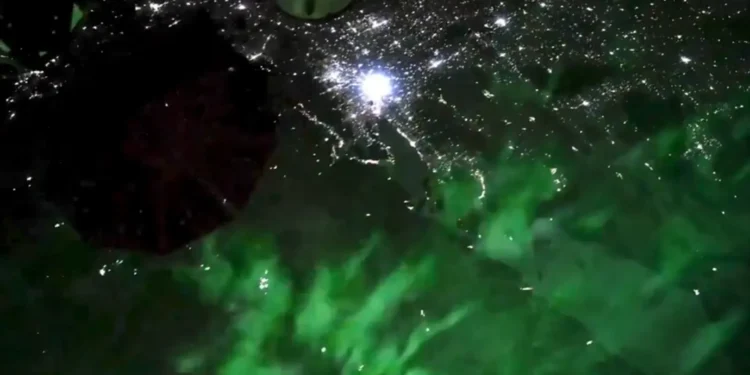
A Green aurora filmed from space. Credit: Don Pettit/ISS.

A mesmerizing video captured from the International Space Station (ISS) reveals a breathtaking aurora shimmering in intense green hues—a phenomenon few have witnessed from above. Filmed by NASA astronaut Don Pettit on January 6, the footage showcases nature’s spectacular light show, amplified by heightened solar activity.

auroradiagram.png?w=1140&ssl=1

When a solar storm emanates towards Earth, some of the energy and small particles can travel down the magnetic field lines at the poles into our atmosphere.

(NOAA/JPL-Caltech)

Over the past weeks, the Sun has been hyperactive, releasing massive bursts of energy, including solar flares and coronal mass ejections. These energetic events are responsible for the auroras that paint the night sky with vibrant greens, pinks, and blues. But what causes this awe-inspiring display?

The Science Behind Auroras

Coronal mass ejections (CMEs) are massive outbursts of charged plasma from the Sun that travel across the Solar System, reaching Earth’s magnetic field. Upon impact, these charged particles are guided toward the planet’s poles by magnetic field lines, colliding with atmospheric gases like oxygen and nitrogen. These interactions release energy as vivid ribbons of light.

While greens dominate auroras, their specific colors depend on the type of gas involved and the altitude of the collision. For example:

  • Green Auroras: Caused by oxygen atoms around 100–300 kilometers above Earth’s surface.
  • Red Auroras: Occur at even higher altitudes, where oxygen atoms have more time to emit light.
  • Purple and Blue Auroras: Result from interactions with nitrogen molecules.

During the 19th century, scientists puzzled over the source of the green auroras. Early theories attributed them to hydrogen or a mythical element called “aurorium.” Eventually, oxygen was identified as the culprit. Its electrons take nearly a second to release energy, a phenomenon known as “forbidden transition,” which makes the green glow particularly rare under normal conditions.

“Flying over aurora; intensely green.” 

(Don Pettit/X)

Capturing Rare Auroral Moments

Astronauts aboard the ISS have a unique vantage point for observing auroras, providing insights unattainable from Earth’s surface. Don Pettit’s video is part of a growing collection of auroral imagery shared from space, following iconic photos by astronauts like Thomas Pesquet, Josh Cassada, and Koichi Wakata.

As the Sun approaches its solar maximum—a peak in its 11-year activity cycle—auroras are becoming more frequent and intense. With advanced satellite technology and high-resolution cameras, future observations will likely unveil even more extraordinary views of this natural phenomenon.

aurora-borealis-over-iceland_1024.jpg?w=1140&ssl=1

The northern lights over Iceland.

(Arctic-images/Stone/Getty)

{ https://curiosmos.com/ }

Hoe vind je dit bericht?
Geschreven door peter om 21:19 Stuur door

ESA is Building its Own Lunar Lander

ESA's Argonaut lander

ESA is Building its Own Lunar Lander

It seems everyone is talking about the Moon and everyone wants to get their foot in the door with the renewed passion for lunar exploration. ESA too have jumped into the lunar landing game having just signed a contract with Thales Alenia Space to build its Argonaut Lunar Lander. Compared to other landers, it will be unique in its ability to handle the harsh night and day conditions on the lunar surface. Each mission is planned to have a 5 year life and will have a standard descent and cargo module but with different payloads determined by the Moon. If all goes to plan then the first lander will fly in 2031. 

The Moon, Earth’s only natural satellite, is a celestial body that has fascinated us for centuries. It orbits Earth at an average distance of about 384,400 kilometres and is a barren, rocky surface covered in craters, mountains, and vast plains of solidified lava. Its lack of atmosphere results in extreme temperature fluctuations, with daytime temperatures reaching up to 127°C and nighttime temperatures plummeting as low as -173°C. 

Occultation The occultation of Aldebaran by the Moon in 2016. Credit: Andrew Symes.

Since the Apollo missions of the 1960’s lunar exploration has become a central part of space science.  The first major milestone was achieved in 1959 when the Soviet Luna 2 mission became the first human-made object to impact the Moon. This was followed by Luna 9, which successfully landed and transmitted images from the surface. This was followed by Apollo 11 and humanity’s first steps on another celestial body. Since then robotic missions like China’s Chang’e program, India’s Chandrayaan missions, and NASA’s Artemis program have aimed to study lunar water ice, geology, and sustainability for long-term human presence. 

800px-Apollo_11_Launch_-_GPN-2000-000630.jpg

Apollo 11 launch using the Saturn V rocket

The European Space Agency have got in on the act now with their plans to build Argonaut, an autonomous lunar lander. It will launch on regular missions to the moon and can be used for delivering rovers, infrastructure, instrumentation or resources to the Moon for lunar explorers. The lander will compose of the descent module, the payload and the cargo platform which will act as the interface between the lander and the payload and will integrate operations between the two. 

ESA signed their contract with Thales Alenia Space in Italy, a joint venture and prominent player in the global space market. They have been delivering high-tech solutions for navigation, telecommunication and Earth observation for over 40 years. They will be leading the European group to build the descent module with the remaining core team from the Group’s UK and France. 

Artist’s impession of the Lunar Gateway with the Orion spacecraft docked on the left side. Credit: ESA

Once complete, Argonaut will become a key part of ESA’s lunar exploration strategy and will integrate with their Lunar Link on the new lunar Gateway. This new international space station is planned to orbit the Moon as part of the NASA Artemis programme. Argonaut will become one of Europe’s main contributions to international lunar exploration as nations work together to establish permanent presence on our nearest celestial neighbour. 

Source : 


Europe's future of space travel

European Large Logistics Lander

{ https://www.universetoday.com/ }

Hoe vind je dit bericht?
Geschreven door peter om 21:01 Stuur door

SETI Researchers Double-Checked 1 Million Objects for Signs of Alien Signals

SETI is developing a new way to search for technosignatures and the first results are in. Sadly, no alien signals were detected. Image Credit: SETI

SETI Researchers Double-Checked 1 Million Objects for Signs of Alien Signals

We can’t help ourselves but wonder about life elsewhere in the Universe. Any hint of a biosignature or even a faint, technosignature-like event wrests our attention away from our tumultuous daily affairs. In 1984, our wistful quest took concrete form as SETI, the Search for Extraterrestrial Intelligence.

Unfortunately, or maybe fortunately, SETI has turned up nothing. Recently, scientists used a powerful new data system to re-examine data from one million cosmic objects and still came up empty-handed. Did they learn anything from this attempt?

This effort used COSMIC, which stands for Commensal Open-Source Multimode Interferometer Cluster. It’s a signal-processing and algorithm system attached to the Karl G. Jansky Very Large Array (VLA) radio astronomy observatory. According to SETI, it’s designed to “search for signals throughout the Galaxy consistent with our understanding of artificial radio emissions. “

Modern astronomy generates vast volumes of data and algorithms and automated processing are needed to comb through it all. So far, COSMIC has observed more than 950,000 objects, and the results of the effort are in a new paper. It’s titled “COSMIC’s Large-Scale Search for Technosignatures during the VLA sky Survey: Survey Description and First Results” and will be published in The Astronomical Journal. The lead author is Chenoa Tremblay from SETI.

Image of radio telescopes at the Karl G. Jansky Very Large Array, located in Socorro, New Mexico. Image Credit: National Radio Astronomy Observatory Image of radio telescopes at the Karl G. Jansky Very Large Array, located in Socorro, New Mexico. Image Credit: National Radio Astronomy Observatory

“The place of humanity in the Universe and the existence of life is one of the most profound and widespread questions in astronomy and society in general,” the authors write. “Throughout history, humans have marvelled at the starry night sky.”

In our modern technological age, we marvel not only with our eyes but with powerful telescopes. The Karl G. Jansky Array is one of those telescopes, though it’s actually 28 radio dishes working together as an interferometer. Each one is 25 meters across, and they’re all mounted on movable bases that are maneuvered around railway tracks. This gives the system the ability to change its radius and density so it can balance its angular resolution and its sensitivity.

The Array is used to observe astronomical objects like quasars, pulsars, supernova remnants, and black holes. It’s also used to search trillions of systems quickly for signs of radio transmissions.

Currently, the VLA is engaged in the VLA Sky Survey (VLASS), a long-term effort to detect transient radio signals in the entire visible sky. The elegance of the COSMIC system is that it can “tag along” as VLASS progresses. “COSMIC was designed to provide an autonomous real-time pipeline for observing and processing data for one of the largest experiments in the search for extraterrestrial intelligence to date,” the authors write.

One of the problems facing modern astronomy is the deluge of data. There aren’t enough astronomers or students to possibly manage it. “The idea is that we are receiving increasing quantities of data that must be sorted in new ways in order to find information of scientific interest,” the authors write. “Developing algorithms to search through data efficiently is a challenging part of searching for signs of technology beyond our solar system.”

There aren't enough human brains to manage the tidal wave of valuable data created by modern astronomy. The signals we seek are buried in this wave, and we need automated help to find them. Image Credit: DALL-E There aren’t enough human brains to manage the tidal wave of valuable data created by modern astronomy. The signals we seek are buried in this wave, and we need automated help to find them. Image Credit: DALL-E

COSMIC is a digital signal processing pipeline that VLASS data flows through. It searches for signals that display temporal and spectral characteristics consistent with our idea of what an artificial technological signal would look like.

The sky is full of radio signals from astrophysical objects. In order for a signal to be considered a technosignature, it needs to be a narrowband signal, and its frequency should change over time as a result of the Doppler effect. That still leaves potentially millions of hits. Researchers are forced to make other assumptions about what might constitute a technosignature, and COSMIC filters through signals based on those assumptions. “In this pipeline, extraterrestrial technosignatures are characterized by a set of assumptions and conditions that, if not met, are used to eliminate hits that do not meet these assumptions,” Tremblay and her co-authors write. “The output of this search is a database of “hits” and small cutouts of the phase-corrected voltage data for each antenna around the hits called “postage stamps.”

COSMIC examined more than 950 million objects in space for technosignatures and found nothing. But that’s okay. SETI scientists still learned things from the effort by testing their system.

“As shown in <Figure 15>, within the last 11 months of operation, COSMIC has observed over 950,000 fields and is rapidly becoming one of the largest SETI experiments ever designed,” the authors write.

Figure 15 from the paper shows a plot in galactic coordinates of all the coordinates currently in the database observed from 29 March 2023 to 14 July 2024. The orange points represent data from frequencies below 4 GHz (S-band), and the blue points are from data collected above 4 GHz (C-band). Image Credit: Tremblay et al. 2025. Figure 15 from the paper shows a plot in galactic coordinates of all the coordinates currently in the database observed from 29 March 2023 to 14 July 2024. The orange points represent data from frequencies below 4 GHz (S-band), and the blue points are from data collected above 4 GHz (C-band). Image Credit: Tremblay et al. 2025.

Though COSMIC has observed almost 1 million sources, researchers focused on a small subset to rigorously test the postprocessing system. In a test field of 30 minutes of data, they searched toward 511 stars from the Gaia catalogue. “In this search, no potential technosignatures were identified,” the authors write.

However, this is just the beginning and constitutes a successful test of the system. Future efforts with COSMIC will be both faster and more automated, which is necessary to manage the vast volume of data in modern astronomy.

“This work overall represents an important milestone in our search,” the authors write in their paper’s conclusion. “With the rapidly growing database, we need new methods for sorting through the data, and this paper describes a rapid and viable filtering mechanism.”

Research: 


SETI Talks: Mysterious Radio Signals in the Milky Way

{ https://www.universetoday.com/ }

Hoe vind je dit bericht?
Geschreven door peter om 18:39 Stuur door

Lieven Scheire over Chinese AI die wereld verbaast: “Geheime projecten zou ik niet bespreken met DeepSeek”

Kopfoto Lieve Scheire
PREMIUM
Kopfoto Lieve Scheire © UAntwerpen, GTT, montage HLN

Lieven Scheire over Chinese AI die wereld verbaast: “Geheime projecten zou ik niet bespreken met DeepSeek”

InterviewDat wij, Vlamingen, ook ‘mee’ zijn met artificiële intelligentie danken we toch ook aan Lieven Scheire, succesvol theatermaker over AI en sinds kort eredoctor in wetenschapscommunicatie (UAntwerpen). Wat vindt hij van het Chinese DeepSeek, dat voor een ‘habbekrats’ een gratis ChatGPT bouwde? “Dit is bijzonder pijnlijk voor de VS.”


Deepseek AI Assistant: ALWAYS ON Python AI Agent for Engineers that SHIP

DeepSeek facts vs hype, model distillation, and open source competition

Kan je aan ons, leken, nog even uitleggen hoe die Chinese start-up DeepSeek de AI-wereld op z’n kop zette?

Lieven Scheire: “Het lijkt erop dat DeepSeek een taalmodel in AI bouwde dat even krachtig is als dat van ChatGPT, maar voor een fractie van de kosten. Machinelearning laat een computerprogramma zichzelf aanpassen door miljoenen voorbeelden te verwerken, het “neurale netwerk” in die computer wordt dan stap voor stap verbeterd tot het werkt. Tot nu toe werd altijd gezegd dat je alleen zulke krachtige AI kunt ontwikkelen als je beschikt over de nieuwste, duurste computerchips. Maar DeepSeek beweert nu dat het ook met 6 miljoen dollar kan, terwijl anderen miljarden nodig hebben.”

article-quote-73b7a2ab1b.svg

Als je genoeg computer­kracht hebt – en we spreken dan al over een kmo met een stevige server – kun je het model downloaden. Je kunt thuis met je eigen DeepSeek werken, zonder dat er verbinding met het internet of met China nodig is

Lieven Scheire

Meer dan 1.000 miljard aan beurswaarde ging bij AI-bedrijven in rook op.

“De concurrentiepositie van ChatGPT van OpenAI is plotseling onderuitgehaald. En het toekomstperspectief van chipfabrikant Nvidia komt onder druk. Als blijkt dat die krachtigste chips niet meer nodig zijn, verandert dat alles. Stel het je voor als een goudkoorts waarbij Nvidia bulldozers verkoopt waarmee je goud kan delven en in China graven ze met een simpele spade evenveel op. Geopolitiek gezien is het bijzonder pijnlijk voor de VS. Zij probeerden China te beperken: ‘Jullie krijgen onze geavanceerde chips niet.’ Maar nu zegt China: ‘Dankjewel voor die sancties, want we hebben ontdekt dat we die straffe chips helemaal niet nodig hebben.’ Dit is echt enorm. Ik belde al verschillende AI-wetenschappers, die wel wat gewend zijn en ook zij trekken grote ogen. Vanavond treed ik op in Roosendaal (Scheire toert momenteel met z’n theatershow ‘Artificiële Intelligentie’ door Nederland en het Verenigd Koninkrijk, red.) en ik moét hier gewoon iets over vertellen. Dit is te groot om te negeren.”

Lieven Scheire toert momenteel door Nederland en het Verenigd Koninkrijk met zijn theatershow over AI. Daarin krijgt DeepSeek ook meteen aandacht.
Lieven Scheire toert momenteel door Nederland en het Verenigd Koninkrijk met zijn theatershow over AI. Daarin krijgt DeepSeek ook meteen aandacht. 
© VTM

DeepSeek kan toch niets meer dan ChatGPT? Waarom is er dan, behalve dat het dus goedkoper kan, zoveel fuss?

“Belangrijk is dat het hele model van DeepSeek ‘open source’ is. Bij OpenAI houden ze wat ze ontwikkelen gesloten als een zwarte doos. Het is hun uitvinding en ze vragen geld aan gebruikers voor toegang. Maar DeepSeek maakt alles openbaar. Als je genoeg computerkracht hebt – en we spreken dan al over een kmo met een stevige server – kun je het model downloaden. Je kunt thuis met je eigen DeepSeek werken zonder dat er verbinding met het internet of met China nodig is. Dit zet bedrijven zoals Microsoft, die fors hebben geïnvesteerd in OpenAI, onder druk.’”

article-quote-73b7a2ab1b.svg

Net toen Trump aankondig­de dat hij 500 miljard dollar zou investeren om de VS op de eerste plek te houden in AI, lanceerde China DeepSeek. Een toevallige timing? Misschien niet. Dit is een wa­ke-up­call voor de VS

Lieven Scheire

DeepSeek claimt efficiënter te zijn, zowel in ontwikkelingskosten als in energieverbruik. Da’s toch vooral goed nieuws, want dan is er een duurzame toekomst voor dat energieverslindende AI?

“Voor energieverbruik zou dit goed nieuws kunnen zijn, maar dat is nog afwachten. AI is een consumentenproduct geworden. Zolang een tiental grote onderzoeksinstellingen veel energie gebruiken, valt dat nog mee. Maar als miljarden mensen dagelijks AI gebruiken, zit je met een ander probleem. DeepSeek zou dat proces efficiënter kunnen maken. Maar we blijven mensen: zodra iets goedkoper en sneller kan, willen we meer. Dat zagen we ook met computers. Het zou me niet verbazen als we die efficiëntiewinst in energieverbruik gebruiken voor nog ingewikkeldere modellen, in plaats van voor duurzaamheid.”

“Als je geheime projecten hebt, zou ik die niet met DeepSeek bespreken. Maar eerlijk gezegd weet ik niet of je dat bij ChatGPT wel veilig kunt doen.”
“Als je geheime projecten hebt, zou ik die niet met DeepSeek bespreken. Maar eerlijk gezegd weet ik niet of je dat bij ChatGPT wel veilig kunt doen.”  © ID/ Christophe De Muynck

Eindelijk iedereen een robot in huis.

“Op dit moment zijn taalmodellen nog steeds dé revolutie binnen AI. Beeldherkenning en andere vormen van AI ontwikkelen zich ook, maar waar iedereen naar streeft, is de ontwikkeling van artificial general intelligence (AGI): een AI-systeem dat niet één specifieke taak uitvoert, maar alles kan. Volgens veel onderzoekers komt dat steeds dichterbij, terwijl anderen het nog als een luchtkasteel beschouwen. Toch lijkt één ding zeker: als er meer rekenkracht beschikbaar komt door efficiëntere methoden, zoals die van DeepSeek, zal dat vrijwel zeker gebruikt worden in de race naar AGI.”

Sommigen vergelijken deze AI-race tussen de VS en China met het ‘Spoetnik-moment’ van de Koude Oorlog. Zie jij die vergelijking?

“Ja, die vergelijking is goed gekozen. Spoetnik was voor de VS een koude douche: opeens had de grote vijand een satelliet die boven het hoofd van de Amerikanen hing. Nu hebben we iets vergelijkbaars. Net toen Trump aankondigde dat hij 500 miljard dollar zou investeren om de VS op de eerste plek te houden in AI, lanceerde China DeepSeek. Een toevallige timing? Misschien niet. Dit is een wake-upcall voor de VS. Ze gaan daar hun aanpak moeten herzien. Waar ze tot nu toe vertrouwden op dure hardware en brute rekenkracht, laat DeepSeek zien dat het ook anders kan: efficiënter en goedkoper. Dit zal niet alleen Amerikaanse bedrijven aan het denken zetten, maar ook Aziatische en Europese start-ups, die hun eigen plannen voor een ChatGPT-alternatief wellicht in de prullenbak gooien om te kijken hoe DeepSeek dit heeft gedaan. Wat ontwikkeling betreft, is dit fantastisch natuurlijk, maar laat ons hopen dat het geopolitiek niet nog meer opschudding veroorzaakt.”

Je waarschuwde al voor ‘de dag dat de leerling-tovenaar ermee aan de slag gaat’ en ook grote namen in de AI-wereld zeggen dat wie de race wint, technologie kan ontwikkelen die de mensheid niet meer onder controle krijgt. Komen we dichter bij dat moment?

“Da’s een lastige vraag. Zelfs de grootste specialisten hebben compleet tegengestelde meningen. Sommigen waarschuwen dat de ‘geest uit de fles’ is en dat dergelijke technologieën hun eigen gang kunnen gaan, zonder menselijke controle. Aan de andere kant zijn er collega-wetenschappers, die ook aan de wieg stonden van AI, die benadrukken dat we altijd de mogelijkheid hebben om de stekker eruit te trekken.”

DeepSeek komt uit China en dat roept vragen op over privacy en dataveiligheid. Hoe moeten we daarmee omgaan?

“Het lijkt me logisch dat ze data verzamelen en gebruikers profileren op basis van vragen die je stelt. Als je geheime projecten hebt, zou ik die niet met DeepSeek bespreken. Maar eerlijk gezegd weet ik niet of je dat bij ChatGPT wel veilig kunt doen.”

LEES OOK.

{ https://www.hln.be/ }

Hoe vind je dit bericht?
Geschreven door peter om 17:20 Stuur door

How Betty and Barney Hill’s Alien Abduction Story Defined the Genre

How Betty and Barney Hill’s Alien Abduction Story Defined the Genre

Their account, recovered with the help of hypnosis, detailed extensive medical exams, including a crude pregnancy test.

Bettmann Archive/Getty Images

Is it chasing us? That thought coursed through Betty and Barney Hill’s minds as they drove down the empty winding country road in New Hampshire’s White Mountains. It was a September night in 1961, they hadn’t seen a car for miles, and a strange light in the sky seemed to follow them.

When they finally got home to Portsmouth at dawn, they were far from relieved. They felt dirty. Their watches stopped working. Barney’s shoes were strangely scuffed and Betty’s dress was ripped. There were two hours of the drive that neither one of them could remember. What had happened?

With the help of a psychiatrist, the quiet couple eventually revealed a startling story: Gray beings with large eyes had walked them into a metallic disc as wide, Betty said, as her house was long. Once inside, the beings examined the couple and erased their memories.

Their experience would kick off an Air Force inquiry, part of the secretive initiative Project Blue Book that investigated UFO sightings across the country. The incident would also become the first-ever widely publicized alien-abduction account and shape how stories like it were told—and understood—from then on. Debate continues as to whether the husband and wife were liars, fantasists, crackpots or simply sleep-deprived people who later recovered seriously scrambled memories.

The Hills Saw Strange Lights Pursuing Their Car

The Hills’ road trip was spontaneous, a well-earned break Barney decided the couple needed, as explained in The Interrupted Journey, a 1966 book they collaborated on with author John G. Fuller. Barney worked a grueling night shift at the post office, driving 60 miles each way. Betty’s job handling state child-welfare cases was no easier. The little free time this biracial couple had was devoted to their church and activities related to the civil-rights movement. After 16 months of marriage, Betty and Barney saw this trip through Montreal and Niagara Falls as their delayed honeymoon. They left so impulsively they had no time to go to the bank before it closed for the weekend. They got in their car with less than $70 in their pockets.

On the last night of their three-day trip, the tired couple sipped coffee in a Vermont diner to recharge before driving back. Barney figured if they pushed through, they could beat the wind and rains from an approaching hurricane. They left the diner around 10 p.m., estimating they could reach their red-framed house in Portsmouth, New Hampshire between 2 a.m. and 3 a.m. at the latest.

As they drove, strange light in the sky gave another reason to hurry. At first it looked like a falling star, but grew larger and brighter with each mile. Barney, an avid plane watcher and World War II vet, was sure they had nothing to worry about. It’s just a satellite, he assured Betty. It probably went off course.

The light seemed to move with the car as Barney steered down the curving mountain road. The light zigged and zagged, ducking past the moon and behind trees and mountain ridges, only to reappear moments later. Sometimes it seemed to move toward them in a game of cat-and-mouse. It had to be an illusion, they thought. Maybe the car’s movement made it seem like the light, too, was moving.

Curiosity overcame them. The couple pulled over at road stops and picnic turnouts to get a closer look. Through binoculars, Betty saw that the white light was really an object spinning in the air.

“Barney,” she told her husband, “if you think that’s a satellite or a star, you’re being completely ridiculous.”

Betty and Barney Hills’ Close Encounter

He knew she was right. Barney had an IQ of 140, noted Fuller in his book. Barney was also a pragmatic man who wouldn’t give flying saucers a second thought, remembered his niece Kathleen Marden in her work, Captured: The Betty and Barney Hill Experience. The night was too quiet for a helicopter, a commercial plane or even military jet with a hotshot pilot. He didn’t want to spook Betty, but he was becoming concerned. What was this light and why was it toying with them?

About 70 miles past the diner, the object hovered just above the treetops, approximately 100 feet above them. Barney abruptly stopped the car, keeping the engine running. He shoved a handgun he’d hidden beneath the seat into his pocket and rushed into a dark field, leaving Betty in the car. What he saw was as big as a jet but as round and flat as a pancake. “My God, what is this thing?” he recalled thinking. “This can’t be real.”

API/Gamma-Rapho/Getty Images

An illustration of Betty and Barney Hill’s 1961 alien abduction

Behind rows of windows, gray uniformed beings seemed to look right at him, Barney recalled. He tried to lift his hand to his pistol but somehow couldn’t. A voice told him not to put down his binoculars.

He had a startling thought: We’re about to be captured. Yelling hysterically, he ran back to the car and barreled down the road as Betty tracked the craft, craning her head outside the car window. Without explanation, loud, rhythmic beeps sounded from the car’s trunk. The couple felt instantly drowsy and lost consciousness.

They came to around two hours later and 35 miles down the road.

Using Hypnosis to Recover the Hills’ Abduction Memory

Back home in Portsmouth, they tried to make sense of the night. Barney felt compelled to examine his body’s lower half. Both seemed aware of a puzzling presence.

In the weeks and months after, Betty, an avid reader, checked out books from the library discovering the civilian UFO group National Investigations Committee on Aerial Phenomena (NICAP). She also reported the sighting to the Air Force, worried about radiation.

University of New Hampshire/Gado/Getty Images

Image depicting an alien space ship, at 200 feet and 100 feet above the Earth’s surface, drawn by alleged alien abductee Betty Hill and regarded as one of the first examples of the Flying Saucer alien spaceship archetype, September 20, 1961.

In coming years, with Betty suffering from disturbing dreams and Barney developing an ulcer and anxiety, the couple sought mental help. The two met with Benjamin Simon, a psychiatrist and neurologist who specialized in hypnosis, a mainstream technique at the time.

Through months of weekly sessions, Simon helped the couple piece together what they think had happened: A vessel had landed on the Hill’s car, putting them to sleep. Afterward, gray beings walked them up a long ramp and into the spacecraft.

Once inside, the Hills were separated, taking turns in an examination room that had curved walls and a large light hanging from the ceiling. Each was asked to climb up on a metal table. The table was so short, Barney’s legs hung over the side.

During the examinations, the beings removed Betty and Barney’s clothes, plucked strands of their hair, took clippings of their nails and scraped their skin. Each sample was placed on a clear material, not unlike a glass slide. Needles, connected to long wires, probed their heads, arms, legs and spines. One large needle, around 4 to 6 inches long, was inserted into Betty’s belly. This pregnancy test left her twisting in pain. Throughout, a being Barney and Betty called “the leader” watched from the side.

After Betty’s examination ended, the beings rushed back into her room, excited. They discovered that Barney’s teeth could be removed. Betty laughed, explaining that Barney had dentures, a fact of human aging the beings struggled to understand.

Later, alone with the leader, Betty asked where the craft had flown, admitting she knew little of the universe. The being joked with her, saying “if you don’t know where you are, there wouldn’t be any point in telling you where I am.” Later, under hypnosis, she drew a star map shown to her on the ship.

In 1965, the Hills’ story was picked up by a Boston newspaper. After that, everything changed. The quiet couple’s story became the subject of a best-selling book and a movie starring James Earl Jones. The upstanding civil servants had become celebrity abductees.

The Hills’ Story Became a Model for Alien Abductions

Bettmann Archive/Getty Images

Barney holding up a diagram explaining the alien abduction

The Hills weren’t the first to spot a UFO or even to report an abduction. But their story did capture the nation’s imagination and was so widely publicized, it has helped shape how we talk about alien encounters and abductions to this day.

Before the Hill’s story, alien encounters were friendly, according to Christoper Bader, a professor of sociology at California’s Chapman University. Some aliens even lived on earth and commuted back on weekends. But once the Hills’ story became better known, abduction accounts shared certain characteristics, such as medical examinations and missing time. Aliens with large heads and big eyes—dubbed “grays” in UFO circles—became classic sci-fi staples in personal accounts and pop culture, Close Encounters of the Third Kind and shows like the X-Files.

The Hills’ story—and those that came after—helped pave the way for a new understanding of human experience. Richard J. McNally, a Harvard psychologist, puts it this way: “The ‘alien-abduction’ phenomenon, in my opinion, shows how sincere, non-psychotic individuals can develop beliefs about, and false memories of, incredible experiences that never happened.”

RELATED VIDEOS

Betty and Barney Hill: The UFO Case that Changed Everything | STUFF THEY DON'T WANT YOU TO KNOW

Ben Hansen And The True Story Behind The Alien Abduction Of Betty And Barney Hill | Talking Strange

Unearthly Encounters | ALIEN ABDUCTION: THE STRANGEST UFO CASE FILES | Beyond Beli

{ https://paranormalscience.co.uk/ }

Hoe vind je dit bericht?
Geschreven door peter om 17:01 Stuur door

Meer van UFO'S of UAP'S, ASTRONOMIE, RUIMTEVAART, ARCHEOLOGIE, OUDHEIDKUNDE, SF-SNUFJES EN ANDERE ESOTERISCHE WETENSCHAPPEN - DE ALLERLAATSTE NIEUWTJES

↑ Terug naar de berichten