Naar de inhoud

UFO'S of UAP'S, ASTRONOMIE, RUIMTEVAART, ARCHEOLOGIE, OUDHEIDKUNDE, SF-SNUFJES EN ANDERE ESOTERISCHE WETENSCHAPPEN - DE ALLERLAATSTE NIEUWTJES

UFO's of UAP'S in België en de rest van de wereld
akke.beakke.be
Ontdek de Fascinerende Wereld van UFO's en UAP's: Jouw Bron voor Onthullende Informatie! Ben jij ook gefascineerd door het onbekende? Wil je meer weten over UFO's en UAP's, niet alleen in België, maar over de hele wereld? Dan ben je op de juiste plek! België: Het Kloppend Hart van UFO-onderzoek In België is BUFON (Belgisch UFO-Netwerk) dé autoriteit op het gebied van UFO-onderzoek. Voor betrouwbare en objectieve informatie over deze intrigerende fenomenen, bezoek je zeker onze Facebook-pagina en deze blog. Maar dat is nog niet alles! Ontdek ook het Belgisch UFO-meldpunt en Caelestia, twee organisaties die diepgaand onderzoek verrichten, al zijn ze soms kritisch of sceptisch. Nederland: Een Schat aan Informatie Voor onze Nederlandse buren is er de schitterende website www.ufowijzer.nl, beheerd door Paul Harmans. Deze site biedt een schat aan informatie en artikelen die je niet wilt missen! Internationaal: MUFON - De Wereldwijde Autoriteit Neem ook een kijkje bij MUFON (Mutual UFO Network Inc.), een gerenommeerde Amerikaanse UFO-vereniging met afdelingen in de VS en wereldwijd. MUFON is toegewijd aan de wetenschappelijke en analytische studie van het UFO-fenomeen, en hun maandelijkse tijdschrift, The MUFON UFO-Journal, is een must-read voor elke UFO-enthousiasteling. Bezoek hun website op www.mufon.com voor meer informatie. Samenwerking en Toekomstvisie Sinds 1 februari 2020 is Pieter niet alleen ex-president van BUFON, maar ook de voormalige nationale directeur van MUFON in Vlaanderen en Nederland. Dit creëert een sterke samenwerking met de Franse MUFON Reseau MUFON/EUROP, wat ons in staat stelt om nog meer waardevolle inzichten te delen. Let op: Nepprofielen en Nieuwe Groeperingen Pas op voor een nieuwe groepering die zich ook BUFON noemt, maar geen enkele connectie heeft met onze gevestigde organisatie. Hoewel zij de naam geregistreerd hebben, kunnen ze het rijke verleden en de expertise van onze groep niet evenaren. We wensen hen veel succes, maar we blijven de autoriteit in UFO-onderzoek! Blijf Op De Hoogte! Wil jij de laatste nieuwtjes over UFO's, ruimtevaart, archeologie, en meer? Volg ons dan en duik samen met ons in de fascinerende wereld van het onbekende! Sluit je aan bij de gemeenschap van nieuwsgierige geesten die net als jij verlangen naar antwoorden en avonturen in de sterren! Heb je vragen of wil je meer weten? Aarzel dan niet om contact met ons op te nemen! Samen ontrafelen we het mysterie van de lucht en daarbuiten.

Archief

Alien Abduction: The Chilling Truth Behind the Examination Table

Alien Abduction: The Chilling Truth Behind the Examination Table

Alien abduction experience the examination table

Alien abduction phenomena have long been a topic of fascination, fear, and skepticism. Among the many accounts reported by individuals who claim to have experienced extraterrestrial encounters, a recurring and chilling element is the presence of a metallic examination table. This setting is often described as the location where abductees undergo various medical-like procedures performed by non-human entities. The similarities among these testimonies, spanning across decades and cultures, suggest a pattern that continues to intrigue researchers and believers alike.

The Common Themes of the Examination Table Experience

1. The Setting and Restraints

Many abductees recall finding themselves lying on a cold, metallic table inside a spacecraft or a sterile, clinical environment. Often, they describe the room as dimly lit, with strange equipment surrounding them. Some report being restrained, either physically or through an unknown force that renders them paralyzed. Despite their conscious awareness, they are unable to resist or move freely.

2. The Entities Performing the Procedures

The beings that abductees report encountering vary in appearance. The most commonly described are the Grays, characterized by their short stature, large black eyes, and thin bodies. However, another frequently mentioned entity is the praying mantis-like creature, often described as taller, with an elongated head and jerky movements. These beings are perceived as overseeing or directing the procedures while the Grays conduct the examinations.

3. The Medical Procedures and Physical Examinations

The core of the abduction experience often revolves around invasive medical procedures. Victims describe being subjected to tests that resemble human medical examinations but with an unsettling level of detachment and precision. Common reported procedures include:

    • Neurological Examinations: Some abductees recall instruments inserted into their heads, ears, or eyes, often experiencing sensations of pressure or pain.
    • Reproductive and Gynecological Procedures: A significant number of female abductees claim to have undergone gynecological examinations, including the extraction of eggs or even the removal and implantation of fetuses. Male abductees frequently report sperm extraction procedures.
    • Implant Insertions: Many individuals claim that foreign objects were implanted in their bodies, typically in their ears, nasal cavities, or limbs. These implants are believed by some researchers to be tracking or monitoring devices.
    • Surgical-Like Procedures: Some abductees describe incisions made on their bodies without experiencing bleeding, as well as the removal of skin, hair, or tissue samples.

4. Telepathic Communication and Emotional Manipulation

Unlike human medical professionals, these extraterrestrial beings rarely communicate through speech. Instead, abductees frequently report receiving telepathic messages, sometimes reassuring but often cold and emotionless. Some individuals claim that they were instructed not to remember their experiences or were made to feel a strange sense of calm despite the invasive nature of the procedures.

5. Unexplained Scars and Physical Evidence

One of the most perplexing aspects of alien abduction stories is the presence of physical evidence. Many abductees discover scars, marks, or even embedded objects beneath their skin that they cannot explain. In some cases, these marks appear overnight, without any recollection of an injury occurring. Some abductees, upon medical examination, report having tiny metallic implants that defy conventional explanations.

The Psychological and Emotional Impact of Abduction Experiences

The aftermath of an abduction experience is often deeply traumatic. Many individuals struggle with PTSD-like symptoms, including anxiety, sleep disturbances, and an overwhelming sense of helplessness. The violation of personal autonomy, combined with the inability to explain or prove the experience, leaves many abductees feeling isolated and reluctant to share their stories.

Additionally, the philosophical implications of these encounters challenge fundamental beliefs about reality, human autonomy, and the nature of the universe. For some, these experiences lead to a profound spiritual awakening, while for others, they become a source of lasting fear and paranoia.

VIDEO:

The alien abduction phenomenon remains one of the most controversial subjects in the study of unexplained events. The recurring theme of the examination table—with its clinical detachment, medical procedures, and unsettling entities—adds credibility to the possibility of a shared experience among abductees. Whether these accounts stem from actual extraterrestrial encounters, psychological phenomena, or a combination of both, the consistency in these stories continues to captivate researchers and experiencers alike.

While skeptics argue that these accounts are fabrications or manifestations of sleep paralysis and subconscious fears, the undeniable similarities across different cases present an intriguing mystery that science has yet to fully unravel. Until definitive evidence emerges, the question remains: Are these abductees reliving a terrifying dream, or is humanity truly being observed and examined by beings beyond our comprehension?

RELATED VIDEOS

5 Terrifying Cases Of Alien Abduction

Top 10 Scariest Alien Abduction Experiment Scenes

Hands-Down The Most Bizarre Alien Abduction Stories Of All Time

{ https://www.latest-ufo-sightings.net/ }

Hoe vind je dit bericht?
Geschreven door peter om 16:39 Stuur door

12 pivotal moments in the history of robotics, from Isaac Asimov to self-driving cars

12 pivotal moments in the history of robotics, from Isaac Asimov to self-driving cars

In the image a silver, faceless, humanoid, robot stands still as a lady take a photo of the robot on her phone
(Image credit: VCG / VCG via Getty Images)

Few technologies have captured the human imagination in quite the same way as robots. The idea of machines that can walk and talk like us has been a staple of science fiction for decades. The reality has been more prosaic — most real-world robots are disembodied arms relegated to dull and repetitive factory work. But recent breakthroughs in both artificial intelligence (AI) and robotic hardware mean that the smart, humanoids of our imaginations are getting ever closer to reality.

Here are 12 of the most important milestones that got us here.

1921 — Invention of the term "robot"

R.U.R.'. Poster for puppet version of a 1920 science-fiction play by Karel Capek.

(Image credit: Heritage Art/Heritage Images via Getty Images)

Since antiquity, people had imagined the possibility of artificial humans — from the clay Golems of Jewish folklore to the mechanical servants of the Greek god Hephaestus. History is also littered with examples of complex automata designed to wow audiences with their life-like movements. But the word "robot" was first introduced by the Czech writer Karel Čapek in his 1921 play R.U.R., which stands for Rossumovi Univerzální Roboti (Rossum's Universal Robots). The term is derived from the Czech word "robota," which means forced labor, and the play features artificial workers made of synthetic organic matter that rise up against their human masters — a narrative that would be echoed in many later works.

1942 — Isaac Asimov's Three Laws of Robotics

View of American science fiction & mystery writer Isaac Asimov (1920 - 1992) as he attends at the 5th Avenue Book Fair, New York.

(Image credit: Rita Barros/Getty Images)

Robots became a popular science fiction trope, with legendary author Isaac Asimov featuring them prominently in many of his stories. A major theme of his work was how these artificial humans would interact with human society. In his 1942 short story "Runaround" he introduced the Three Laws of Robotics, which were supposed to govern how all robots in his fictional universe operated. The first law prohibited the robots from harming humans, the second mandated robots to obey humans unless it violated the first law, and the third ordered the machines to protect themselves as long as that didn't conflict with the two other laws. While entirely fictional, Asimov's three laws were influential on the development of ethical frameworks for AI and robotics.

1961 — The first industrial robot

Robot arm.

It didn't take long for ideas from science fiction to filter through to the real world. In the early 1950s, serial inventor George Devol began work on a robotic arm that could perform repetitive tasks in factories. He teamed up with entrepreneur Joseph Engelberger to form Unimation, the world's first robotics company, and in 1961 their Unimate robot went to work on the assembly line at a General Motors plant in New Jersey. The hydraulically-powered arm had five degrees of freedom (DoF) — a measure of dexterity that means its arm could move or rotate in five different directions. Programming the device required the user to physically move the arm to different positions to teach it the required sequence of actions, which was then recorded in a magnetic storage device known as a drum memory.

1966 — World's first intelligent mobile robot

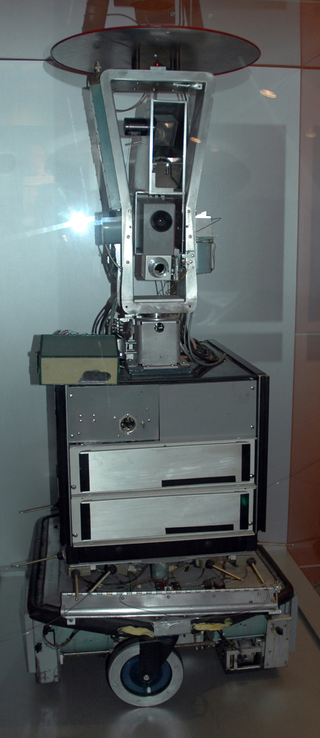
A photo of Shakey the Robot in its case at the Computer History Museum.

(Image credit: Marshall Astor from San Pedro, United States, CC BY-SA 2.0 , via Wikimedia Commons)

While significant progress had been made on the mechanical capabilities of robots by the mid-1960s, they were still essentially dumb machines that needed to be programmed by hand. In 1966, researchers at the Stanford Research Institute started work on a wheeled robot with cameras and touch sensors that could reason about its actions, make plans and navigate the real world. It could move between multiple rooms autonomously, avoiding obstacles, opening doors, flicking light switches and pushing boxes around. The robot, which the team named "Shakey," received significant media attention — in 1970 — Life magazine even referred to it as the first electronic person." A key advance behind the robot was its layered software architecture, which enabled it to reason through tasks, something replicated in many subsequent robots.

1969 — The Stanford Arm spawns a new industry

The Stanford arm, the first electric robot with closed-form arm solution, Invented and built by Victor Scheinman while at Stanford University

(Image credit: Gildardo Sánchez, CC BY 2.0 , via Wikimedia Commons)

While the Unimate was the first robotic arm to go into production, the Stanford Arm became the blueprint for the emerging industrial robotics industry. Designed in 1969 by Victor Scheinman, who was then a student in the Stanford Artificial Intelligence Lab, the six-DoF arm was electrically powered and controlled by a computer. Over the following years Scheinman built increasingly sophisticated versions of the arm at both Stanford and MIT, before eventually starting a company called Vicarm Inc. in 1974 to commercialize his work. He ended up selling his designs to Unimation in 1977, which released the Programmable Universal Machine for Assembly (PUMA) robot in 1978. The initial customer was General Motors, which used it to assemble automotive subcomponents.

1970 — First robotic rover sent to the Moon

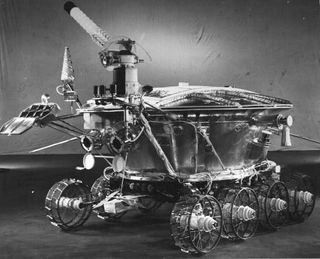
Historical rover.

(Image credit: NASA)

The birth of robotics overlapped with another major technological leap — the advent of the Space Age. Scientists recognized that machines that could be controlled remotely or even operate autonomously could be a powerful tool for exploring the solar system. In 1970, the Soviet Union landed Lunokhod 1, the world's first robotic rover, on the moon. Shaped like a bathtub and with eight independently powered wheels, the rover could be controlled remotely from Earth via antennas and a feed from four cameras. The solar-powered vehicle operated for almost a year, roughly three and half times longer than it was designed to last, and travelled 6.5 miles (10.5 kilometers). It also used extendable probes to carry out more than 500 tests on the mechanical properties of lunar soil.

1990 — Rodney Brooks rewrites AI for robotics

Stock photo with AI symbol in the center connected to a blue lit circuit.

(Image credit: Panuwat Sikham via Getty Images)

By the 1980s, industrial robots that could carry out repetitive tasks in controlled environments had become commonplace, but efforts to create more flexible and autonomous machines were foundering. Australian roboticist Rodney Brooks had the intuition that this plateau was due to the top-down approach researchers were taking. This involved a focus on imbuing machines with abstract reasoning skills and developing complex systems of mathematical symbols to represent the world around them. Instead, he took inspiration from nature and focused on the feedback loops between sensing and action that enable sophisticated behavior in animals. He demonstrated that by taking this bottom-up approach, outlined in the 1990 paper Elephants Don't Play Chess, it was possible to combine multiple simple behavioral modules to solve challenges beyond the robots that existed at the time.

1996 — Honda unveils first humanoid walking robot

Despite considerable progress in robotics, most machines were a far cry from the mechanical people depicted in sci-fi. That changed in 1996 when Honda unveiled its P2 robot, which was the first humanoid robot capable of walking independently on two legs. The company had started working on the problem of bipedal locomotion in the late 1980s by studying, and trying to replicate, how humans walked. Research on P2 and its successors P3 and P4 eventually culminated in the development of the company's iconic ASIMO humanoid robot, which was unveiled for the first time in 2000 and set the standard for humanoid robotics going forward.

2000 — The da Vinci surgical robot cleared by the FDA

Intuitive Surgical da Vinci Sp Single Port Robotic Surgical System
While most commercial robotics companies focused on machines designed to replace brute labor in factories, Intuitive Surgical decided to focus on the delicate process of minimally invasive surgery. They built a four-armed robotic surgical system called da Vinci that could be controlled remotely by a surgeon. The arms were capable of holding surgical instruments like scalpels, graspers and scissors and enabled the surgeon to carry out ultra-precise movements. The device was cleared for use by the U.S. Food and Drug Administration in 2000 and has been used in more than 14 million procedures.

2010 — Google unveils self driving car project

Front view of Waymo self driving car in San Francisco, California, August 20, 2024.

(Image credit: Smith Collection/Gado/Getty Images)

There had been scattered experiments in autonomous vehicles over the years, but the first company to devote serious resources to the idea was Google. The firm began developing self-driving cars in 2009 and drove more than 140,000 miles on public roads before announcing the project in October 2010. Earlier experiments were carried out in a modified Toyota Prius with a safety driver behind the wheel. But in 2015 the company carried out the first fully autonomous ride on a public road in a custom-built vehicle with steering wheel or pedals. After rebranding as Waymo, the company started its first public trials of a driverless taxi service in Phoenix, Arizona in 2017.

2012 — The DARPA robotics challenge is launched

Computer Science in Robotics PhD Alex Stumpf of TU Darmstadt positions the ViGIR (Virginia-Germany Interdisciplinary Robotics) Team robot for testing in preparation for the Defense Advanced Research Projects Agency (DARPA) Robotics Challenge April 10, 2015 in Blacksburg, Virginia.

(Image credit: Photo by Chip Somodevilla/Getty Images)

One of the major catalysts for recent breakthroughs in smart, humanoid robots was the DARPA Robotics Challenge. Launched by the Defense Advanced Research Projects Agency in 2012, the competition challenged teams to develop semi-autonomous robots that could carry out complex tasks in simulated disaster zones. The bots were tasked with walking across rubble, climbing ladders, closing leaky valves and even driving a utility vehicle. The finals were held in 2015. While some teams competed with their own robots, six were provided with humanoid Atlas robots built by Boston Dynamics. The company continued to develop the robot after the competition was over, showing off increasingly advanced capabilities over the years such as running outdoors, jumping and tackling parkour courses.

2020 — The first bipedal robot goes on sale

Unitree Introducing | Unitree G1 Humanoid Agent | AI Avatar | Price from $16K
The startup Agility Robotics became the first company to release a commercial bipedal robot after selling two units of its Digit model to Ford. While not strictly a humanoid, thanks to its "backward" legs that work more like a bird's than a person's, the robot is roughly the size and shape of a small human and designed to help out in warehouses and other industrial settings. The release marked the beginning of a boom in commercial humanoid robotics, with companies like Tesla, Figure and 1X unveiling their own offerings shortly afterwards. And costs are falling rapidly — earlier this year Chinese company Unitree released its G1 humanoid robot, which costs just $16,000.

Decoding Asimov: The Three Laws of Robotics Explained

#2 Evolution of Robotics | Introduction to Robotics

{ https://www.livescience.com/ }

Hoe vind je dit bericht?
Geschreven door peter om 00:00 Stuur door

6 Things to Know About SPHEREx, NASA’s Newest Space Telescope

6 Things to Know About SPHEREx, NASA’s Newest Space Telescope

NASA’s SPHEREx observatory undergoes testing

NASA’s SPHEREx observatory undergoes testing at BAE Systems in Boulder, Colorado, in August 2024. Launching no earlier than Feb. 27, 2025, the mission will make the first all-sky spectroscopic survey in the near-infrared, helping to answer some of the biggest questions in astrophysics. 

Credit: BAE Systems/NASA/JPL-Caltech

Shaped like a megaphone, the upcoming mission will map the entire sky in infrared light to answer big questions about the universe.

Expected to launch no earlier than Thursday, Feb. 27, from Vandenberg Space Force Base in California, NASA’s SPHEREx space observatory will provide astronomers with a big-picture view of the cosmos like none before. Short for Spectro-Photometer for the History of the Universe, Epoch of Reionization and Ices Explorer, SPHEREx will map the entire celestial sky in 102 infrared colors, illuminating the origins of our universe, galaxies within it, and life’s key ingredients in our own galaxy. Here are six things to know about the mission.

1. The SPHEREx space telescope will shed light on a cosmic phenomenon called inflation.

In the first billionth of a trillionth of a trillionth of a second after the big bang, the universe increased in size by a trillion-trillionfold. Called inflation, this nearly instantaneous event took place almost 14 billion years ago, and its effects can be found today in the large-scale distribution of matter in the universe. By mapping the distribution of more than 450 million galaxies, SPHEREx will help scientists improve our understanding of the physics behind this extreme cosmic event.

2. The observatory will measure the collective glow from galaxies near and far.

Scientists have tried to estimate the total light output from all galaxies throughout cosmic history by observing individual galaxies and extrapolating to the trillions of galaxies in the universe. The SPHEREx space telescope will take a different approach and measure the total glow from all galaxies, including galaxies too small, too diffuse, or too distant for other telescopes to easily detect. Combining the measurement of this overall glow with other telescopes’ studies of individual galaxies will give scientists a more complete picture of all the major sources of light in the universe.

3. The mission will search the Milky Way galaxy for essential building blocks of life.

Life as we know it wouldn’t exist without basic ingredients such as water and carbon dioxide. The SPHEREx observatory is designed to find these molecules frozen in interstellar clouds of gas and dust, where stars and planets form. The mission will pinpoint the location and abundance of these icy compounds in our galaxy, giving researchers a better sense of their availability in the raw materials for newly forming planets.

E2-PIA10181

Molecular clouds like this one, called Rho Ophiuchi, are collections of cold gas and dust in space where stars and planets can form. SPHEREx will survey such regions throughout the Milky Way galaxy to measure the abundance of water ice and other frozen molecules.

Credit: NASA/JPL-Caltech

4. It adds unique strengths to NASA’s fleet of space telescopes.

Space telescopes like NASA’s Hubble and Webb have zoomed in on many corners of the universe to show us planets, stars, and galaxies in high resolution. But some questions — like how much light do all the galaxies in the universe collectively emit? — can be answered only by looking at the big picture. To that end, the SPHEREx observatory will provide maps that encompass the entire sky. Objects of scientific interest identified by SPHEREx can then be studied in more detail by targeted telescopes like Hubble and Webb.

5. The SPHEREx observatory will make the most colorful all-sky map ever.

The SPHEREx observatory “sees” infrared light. Undetectable to the human eye, this range of wavelengths is ideal for studying stars and galaxies. Using a technique called spectroscopy, the telescope can split the light into its component colors (individual wavelengths), like a prism creates a rainbow from sunlight, in order to measure the distance to cosmic objects and learn about their composition. With SPHEREx’s spectroscopic map in hand, scientists will be able to detect evidence of chemical compounds, like water ice, in our galaxy. They’ll not only measure the total amount of light emitted by galaxies in our universe, but also discern how bright that total glow was at different points in cosmic history. And they’ll chart the 3D locations of hundreds of millions of galaxies to study how inflation influenced the large-scale structure of the universe today.

6. The spacecraft’s cone-shaped design helps it stay cold and see faint objects.

The mission’s infrared telescope and detectors need to operate at around minus 350 degrees Fahrenheit (about minus 210 degrees Celsius). This is partly to prevent them from generating their own infrared glow, which might overwhelm the faint light from cosmic sources. To keep things cold while also simplifying the spacecraft’s design and operational needs, SPHEREx relies on an entirely passive cooling system — no electricity or coolants are used during normal operations. Key to making this feat possible are three cone-shaped photon shields that protect the telescope from the heat of Earth and the Sun, as well as a mirrored structure beneath the shields to direct heat from the instrument out into space. Those photon shields give the spacecraft its distinctive outline.

More About SPHEREx

SPHEREx is managed by NASA’s Jet Propulsion Laboratory for the agency’s Astrophysics Division within the Science Mission Directorate at NASA Headquarters in Washington. BAE Systems (formerly Ball Aerospace) built the telescope and the spacecraft bus. The science analysis of the SPHEREx data will be conducted by a team of scientists located at 10 institutions in the U.S., two in South Korea, and one in Taiwan. Data will be processed and archived at IPAC at Caltech, which manages JPL for NASA. The mission principal investigator is based at Caltech with a joint JPL appointment. The SPHEREx dataset will be publicly available at the NASA/IPAC Infrared Science Archive.

For more information about the SPHEREx mission visit:

RELATED VIDEOS

How NASA’s SPHEREx Mission Will Map the Cosmos
ASA’s upcoming SPHEREx space telescope mission will map the entire sky like no spacecraft before it. To do that, SPHEREx needs specialized hardware. Three concentric cones called photon shields surround the telescope and block light and heat from the Sun and Earth. Without those shields, the telescope’s detectors would be blinded.
SPHEREx also needs to be cold because it detects infrared light. Invisible to human eyes, infrared is emitted by warm objects on Earth and out in the universe. It’s also emitted by the telescope. Keeping it cold reduces the infrared glow, which lets SPHEREx see faint objects that are really far away. SPHEREx stands for the Spectro-Photometer for the History of the Universe, Epoch of Reionization and Ices Explorer.
Managed by NASA’s Jet Propulsion Laboratory, a division of Caltech in Pasadena, California, SPHEREx is set to launch no later than April 2025.

NASA's SPHEREx: The Most Colorful Cosmic Map Ever!

{ https://www.nasa.gov/ }

Hoe vind je dit bericht?
Geschreven door peter om 23:12 Stuur door

Revealed: What life on Earth will look like in 2100 - with entire cities plunged underwater and millions of people perishing in the heat

Revealed: What life on Earth will look like in 2100 - with entire cities plunged underwater and millions of people perishing in the heat

From Snowpiercer to The Day After Tomorrow, countless movies and series have put forward their vision of how climate change might reshape the world.

Worryingly, scientists predict that the reality might be far more shocking than anything imagined by a Hollywood studio.

Now, artificial intelligence (AI) reveals what this might look like.

With Google's ImageFX AI image generator, MailOnline has used the latest scientific research to predict how the world will be in 2100.

As greenhouse gas levels continue to increase, scientists predict that entire cities will be plunged under water.

Meanwhile, climbing temperatures and punishing heatwaves could kill millions of people around the globe. 

Professor Julienne Stroeve, a climate scientist from University College London, told MailOnline: 'The largest impacts that affect all of us are sea level rise and changes in weather extremes.

'All of these will increase through the century if we do not do anything to reduce greenhouse gas emissions.'

Scientists say that the real impacts of climate change could be far more shocking than anything imagined in a Hollywood studio. Now AI has revealed what that might look like

Scientists say that the real impacts of climate change could be far more shocking than anything imagined in a Hollywood studio. Now AI has revealed what that might look like 

Rising temperatures  

Scientists have known for years that human-caused climate change is leading to a warmer climate.

As greenhouse gases like carbon dioxide and methane build up in the atmosphere, they act like a blanket covering the planet, trapping heat from the sun and leading to rising temperatures.

This year, the Copernicus Climate Change Service confirmed that 2024 was the hottest year on record, reaching an average surface temperature of 15.1°C (59.2°F).

Last year was also the first year when average temperatures exceeded 1.5°C above the pre-industrial record.

In the future, scientists predict that temperatures will continue to get hotter on average.

The Intergovernmental Panel on Climate Change (IPCC) makes predictions about future climate change based on three different scenarios.

In the most optimistic scenario, the world achieves net-zero CO2 emissions by 2050, preventing any more significant increases in global temperatures.

Scientists predict that global temperatures could rise by as much as 4.4°C (7.92°F) above the pre-industrial average in the worst-case scenario. This would lead to widespread drought in water-shortage-prone countries like France

Scientists predict that global temperatures could rise by as much as 4.4°C (7.92°F) above the pre-industrial average in the worst-case scenario. This would lead to widespread drought in water-shortage-prone countries like France 

What will life be like in 2100?

Hotter 

* Temperatures could be up to 4.4°C (7.92°F) higher

Wilder weather

* Greater risk of flash floods, heatwaves, and tropical storms 

Higher sea levels

* Sea levels could rise by 6.2ft (1.9 metres)

More wildfires

* Extreme fires could be 50 per cent more likely by 2100

More polluted air

* Changes in the climate will make air pollution more of a problem

Millions dead

* Estimates suggest that climate change could kill 30 million people globally by 2100

In the middle scenario, CO2 emissions stay around current levels until the mid-century before declining towards net-zero by 2100.

Meanwhile, in the very high emissions scenario, the world does not take measures to curb greenhouse gas emissions and CO2 levels actually increase by 2100.

The IPCC predicts that global temperatures will be 2.7°C (4.86°F) higher than the pre-industrial average by 2100 in the medium scenario and 4.4°C (7.92°F) higher in the worst-case scenario.

In either of these scenarios, it could trigger widespread droughts with devastating impacts.

In a report last year, the UN warned that the spread of dry, arid areas was an 'existential crisis' threatening billions around the globe.

Since 1990, arid regions have expanded by an area a third larger than India and now cover 40 per cent of the Earth's land excluding Antarctica.

If nothing is done to reduce greenhouse gas emissions, the number of people living in drylands will more than double from 2.3 billion to 5 billion in 2100.

Likewise, one 2023 paper predicted that the risk of 'flash droughts', in which drought conditions occur abnormally fast, will increase from 32 per cent to 53 per cent in Europe by 2100.

That means that countries like France which already struggle with systematic water shortages are more likely to face devastating droughts.

Melting Ice and higher sea levels

As the atmosphere gets warmer over the next 75 years, the seas will also begin to warm.

In the 1980s, scientists recorded that ocean temperatures were rising at a rate of about 0.06°C per decade.

However, a recent study by experts from the University of Reading found that the rate has surged to a whopping 0.27°C per decade.

Looking ahead, the researchers say is 'plausible' that the ocean temperature increase seen over the past 40 years will be exceeded in just the next 20 years.

In turn, that will lead to potentially devastating impacts for all life on Earth.

Professor Stroeve says: ‘Summer sea ice for sure will be gone well before 2100 but there will be several months of ice-free conditions, not just one month.

By 2100, scientists say the Arctic will be 'unrecognisable' with sea ice totally vanishing in the summer, leaving months of ice-free waters (AI impression)

By 2100, scientists say the Arctic will be 'unrecognisable' with sea ice totally vanishing in the summer, leaving months of ice-free waters (AI impression)

Antarctic sea ice also hit near-record lows during 2024. Reduced sea ice means that less energy from the sun is reflected back out of the atmosphere, triggering even faster rates of warming

Antarctic sea ice also hit near-record lows during 2024. Reduced sea ice means that less energy from the sun is reflected back out of the atmosphere, triggering even faster rates of warming 

'This will warm up the Arctic even faster, leading to more melting from Greenland and faster sea level rise, destabilization of the permafrost areas, and disruption of the thermohaline [deep ocean currents] circulation.'

For any people or animals that rely on snow and ice, Professor Stroeve says this rate of change will simply be too fast to adapt to.

Studies predict that more than half of the world's glaciers will be gone by 2100, with the European Alps losing 75 per cent of its glaciers in a high emissions scenario. 

Combined with decreasing snow coverage, that will bring huge changes to the Arctic as well as now-popular skiing regions.

'The Arctic will be unrecognizable from its contemporary state,' says Professor Stroeve.

'Further, the ice-free conditions exposes the coastlines to waves from storms, and that combined with permafrost thaw results in entire communities to be moved.'

As the oceans warm, they will also expand, combining with fresh water from the melting ice caps to drive up sea levels.

Researchers from Nanyang Technological University (NTU) in Singapore have predicted that global sea levels could rise by a staggering 6.2ft (1.9 metres) by 2100 if carbon dioxide (CO2) emissions continue to increase.

In the European Alps, glaciers will be reduced by 75 per cent by volume and snow will be absent for much of the year (AI impression)

In the European Alps, glaciers will be reduced by 75 per cent by volume and snow will be absent for much of the year (AI impression)

Global heating will melt the icecaps and cause the oceans to expand, leading to rising sea levels. UK cities like Hull (pictured in AI impression) could be completely submerged as the sea level rises by a staggering 6.2ft (1.9 metres) by 2100

Global heating will melt the icecaps and cause the oceans to expand, leading to rising sea levels. UK cities like Hull (pictured in AI impression) could be completely submerged as the sea level rises by a staggering 6.2ft (1.9 metres) by 2100

If global sea levels were to rise this much, towns and cities around the world could be plunged underwater - including Hull, London, and Cardiff.

Meanwhile, in the US, people living on the East Coast would be hit the hardest - with large portions of New York City, Boston, Atlantic City and Miami submerged.

These findings also predict President Donald Trump's Mar-a-Lago resort, located in Palm Beach, Florida will also be underwater in about 75 years.

More extreme weather

By 2100, one of the biggest ways we will feel the impact of climate change will be in the massive increase in extreme weather events.

Dr Suzanne Bartington, associate professor of environmental health at the University of Birmingham, told MailOnline: 'Climate change is significantly increasing the frequency and intensity of extreme weather events, including heatwaves, heavy rainfall, droughts, wildfires which affect physical and mental health.'

As the atmosphere gets warmer, it is able to hold onto more water vapour before releasing it as precipitation leading to much heavier rainfall.

A Met Office study predicts that weather rivalling the wettest day ever recorded could become ten times more likely by 2100 thanks to climate change in a medium emissions scenario.

Even as sea levels rise, plunging cities like London underwater, scientists predict that there will be a significant increase in flooding. The UK will receive up to 35 per cent more precipitation in winter and record-breaking days of rain will be 10 times more likely

Even as sea levels rise, plunging cities like London underwater, scientists predict that there will be a significant increase in flooding. The UK will receive up to 35 per cent more precipitation in winter and record-breaking days of rain will be 10 times more likely 

The increased temperature led to record-breaking amounts of water vapour in the atmosphere which created more severe storms and flooding around the world

The increased temperature led to record-breaking amounts of water vapour in the atmosphere which created more severe storms and flooding around the world 

At the same time, changing weather patterns mean that some places will experience very little rain at other times of the year.

By 2070, the Met Office predicts that average summer rainfall in the UK could decrease by up to 47 per cent.

Meanwhile, the same study found that there could be up to 35 per cent more precipitation in winter.

When these sudden bursts of rain hit areas where drought has already hardened the ground, the risk of flash flooding becomes extremely high.

Unfortunately, we do not need AI to help us imagine such a scenario.

Last year, Spain was hit by the worst ecological disaster in the country's history as flash floods tore through Valencia and the surrounding regions.

Leading climate scientists say there is 'no doubt' that these floods were made worse by climate change.

In the future, the situation is likely to become even more dire.

In Valencia, Spain a combination of high temperatures and a long time without rain led to devastating flash floods which killed at least 213 people. This photo shows residents and volunteers carry out clearing duties in the flood-hit municipality of Paiporta, Valencia province, Spain, November 4, 2024

In Valencia, Spain a combination of high temperatures and a long time without rain led to devastating flash floods which killed at least 213 people. This photo shows residents and volunteers carry out clearing duties in the flood-hit municipality of Paiporta, Valencia province, Spain, November 4, 2024

Studies have shown that the Mediterranean region - which is home to more than 510 million people - is warming 20 per cent faster than the global average.

The UN predicts that, outside of summer, the Mediterranean will see up to 20 per cent more rainfall events by 2080.

Elsewhere in the world, the biggest concern will be the rise of catastrophic 'mega-hurricanes'.

Typhoons, hurricanes, and tropical storms, which are all essentially the same weather phenomena, are caused when warm moist air rises from the ocean.

As human-caused climate change warms the oceans where these form, there is more energy to drive the storm - leading to ever more powerful events.

Last year, a group of researchers called for the standard scale used to measure hurricanes, the Saffir-Simpson Windscale, to be extended to include these abnormally-strong storms.

A 'category-6' hurricane would unleash winds of 192 miles per hour or higher and a rise in seawater exceeding 25 feet.

For places like Japan, Indonesia, the Philippines, and the southern states of the US, these devastating storms may become much more common by 2100.

Warmer waters also mean more intense tropical storms in Asia and above the Gulf of Mexico. This puts cities like Toyko (depicted here by AI), which already experiences typhoons, at serious risk

Warmer waters also mean more intense tropical storms in Asia and above the Gulf of Mexico. This puts cities like Toyko (depicted here by AI), which already experiences typhoons, at serious risk 

During 2023 and 2024 a natural weather phenomenon called the El Niño Southern Oscillation created exceptionally high sea surface temperatures. This event occurs once every 14 years, leading to warmer temperatures. However, the end of El Niño does not mean that temperatures will begin to decline

During 2023 and 2024 a natural weather phenomenon called the El Niño Southern Oscillation created exceptionally high sea surface temperatures. This event occurs once every 14 years, leading to warmer temperatures. However, the end of El Niño does not mean that temperatures will begin to decline 

Raging wildfires

While some parts of the world will be battered by intense storms, others will be baked by stifling droughts and heatwaves.

Scientists predict that this combination of intense heat and low rainfall will turn some regions into 'tinderboxes' - regions susceptible to wildfires.

Worryingly, there are clear signs that this process has already begun.

The devastating Los Angeles wildfires started on January 7 and spread quickly, killing at least 28 people and destroying more than 10,000 homes, racking up billions in costs and leaving thousands of people homeless.

At the time the fires started, LA was experiencing its driest start to the year since records began in 1944.

As of January, Los Angeles Airport had recorded just 0.03-inch (0.08cm) of rain since October 1, creating 'severe drought' conditions across Los Angeles County.

The World Weather Attribution - a network of researchers from the US, UK and a number of other European countries - warned the hot, dry and windy conditions that drove the fires were about 35 per cent more likely due to global warming.

Extreme wildfires are predicted to become 50 per cent more frequent by 2100 as drier, hotter conditions create highly flammable conditions. In cities like LA, these fires could cause huge destruction. This is an ultra-realistic AI depiction of Los Angeles affected by climate change

Extreme wildfires are predicted to become 50 per cent more frequent by 2100 as drier, hotter conditions create highly flammable conditions. In cities like LA, these fires could cause huge destruction. This is an ultra-realistic AI depiction of Los Angeles affected by climate change

The devastating Los Angeles wildfires (pictured in this photo) started on January 7 and spread quickly, killing at least 28 people and destroying more than 10,000 homes, racking up billions in costs and leaving thousands of people homeless

The devastating Los Angeles wildfires (pictured in this photo) started on January 7 and spread quickly, killing at least 28 people and destroying more than 10,000 homes, racking up billions in costs and leaving thousands of people homeless

By 2100, the UN Environment Programme predicts that climate change and changing land usage will make wildfires more intense and more frequent.

The frequency of extreme fires is predicted to increase by 14 per cent by 2030, 30 per cent by 2050, and 50 per cent by the end of the century.

The researchers warn that even the Arctic will face a growing wildfire risk unless radical steps are taken.

In areas like LA and Australia where fires are already common, the impact of these fires could be devastating.

Choking air pollution

If nothing is done to invest in cleaner technologies, scientists warn that air pollution could become one of humanity's deadliest challenges.

Over the last 160 years, the levels of toxic air pollution around our cities have generally decreased for most wealthy countries.

However, recent studies have shown that 99 per cent of the world's population still live in areas with dangerously dirty air.

Studies suggest that cities like Delhi (pictured) which already has deadly levels of air pollution could face even worse conditions. Warmer air and less rain mean pollution stays in the air longer

Studies suggest that cities like Delhi (pictured) which already has deadly levels of air pollution could face even worse conditions. Warmer air and less rain mean pollution stays in the air longer 

Due to mass urbanisation, industrialisation, and population growth cities like Delhi, India (pictured) now have worse pollution than ever before

Due to mass urbanisation, industrialisation, and population growth cities like Delhi, India (pictured) now have worse pollution than ever before

Studies have predicted that air pollution will lead to 260,000 deaths by 2100 as a result of the changes caused by climate change

Studies have predicted that air pollution will lead to 260,000 deaths by 2100 as a result of the changes caused by climate change

In countries experiencing rapid industrial growth, poor environmental regulation has allowed pollution to reach unsafe levels.

Over the last few years, Delhi's air pollution levels have exceeded 100 micrograms per cubic meter - 20 times higher than the WHO recommendations.

By 2100, many researchers expect these conditions to get worse for many people around the globe.

Less rain and warmer temperatures mean that pollution tends to stay in the air for longer.

This means that climate change will increase the amount of ground-level ozone and fine particle pollution we breathe - leading to lung disease, heart conditions, and strokes.

Research published in Nature Climate Change found that if climate change continues, air pollution will cause an extra 60,000 deaths worldwide by 2030 and 260,000 deaths by 2100 as a result.

Millions dead

Through a combination of these factors, scientists believe that the world will see millions of extra deaths by 2100 thanks to human-caused climate change.

Excess heat alone is predicted to cause 5.8 million extra deaths in Europe by 2100. The worst affected city will be Barcelona (depicted in this AI impression) where 246,000 net extra deaths are forecast

Excess heat alone is predicted to cause 5.8 million extra deaths in Europe by 2100. The worst affected city will be Barcelona (depicted in this AI impression) where 246,000 net extra deaths are forecast 

As the climate warms, more and more people will be exposed to the effects of deadly heatwaves.

This will be particularly harmful in areas which have never had to adapt to extreme heat conditions in the past.

A study published this year suggests that dangerous temperatures will kill 50 per cent more Europeans by the end of the century.

Even under the most optimistic scenario, an additional 8,000 people will be killed by the heat every year while an extra 80,00 could die in the worst-case scenario.

Dr Bartington says: 'Under current climate policies it is expected that heat-related deaths will increase, particularly among older people in the context of an ageing population.'

article image

Between 2015 and 2099, heat alone will lead to 5.8 million extra deaths with the worst affected city in Europe being Barcelona - with 246,082 net deaths.

That is even after accounting for the number of people that climate change would save from death in the cold European winters - challenging the popular theory that global heating could be a net positive for cold countries.

Combined with rising air pollution, the effects on life around the globe could be even worse.

Researchers from the Max Planck Institute for Chemistry, recently predicted that air pollution and extreme temperatures could lead to 30 million excess deaths by 2100.

Even in the most likely scenario, an additional 10.8 million people could die each year due to heat while 19.5 million might be killed by air pollution.

Given that these figures do not even consider the increased risk of extreme weather, wildfires, and famine caused by disruption to agriculture, the true toll of climate change could be higher still.

THE PARIS AGREEMENT: A GLOBAL ACCORD TO LIMIT TEMPERATURE RISES THROUGH CARBON EMISSION REDUCTION TARGETS

The Paris Agreement, which was first signed in 2015, is an international agreement to control and limit climate change.

It hopes to hold the increase in the global average temperature to below 2°C (3.6ºF) 'and to pursue efforts to limit the temperature increase to 1.5°C (2.7°F)'.

It seems the more ambitious goal of restricting global warming to 1.5°C (2.7°F) may be more important than ever, according to previous research which claims 25 per cent of the world could see a significant increase in drier conditions. 

The Paris Agreement on Climate Change has four main goals with regards to reducing emissions:

1)  A long-term goal of keeping the increase in global average temperature to well below 2°C above pre-industrial levels

2) To aim to limit the increase to 1.5°C, since this would significantly reduce risks and the impacts of climate change

3) Governments agreed on the need for global emissions to peak as soon as possible, recognising that this will take longer for developing countries

4) To undertake rapid reductions thereafter in accordance with the best available science

Source: European Commission 

RELATED VIDEOS

Life of 2100 What will life be like in the year 2100? The World in Year 2100 : Skies of Progress

What will life in 2100 look like

{ https://www.dailymail.co.uk/ }

Hoe vind je dit bericht?
Geschreven door peter om 20:56 Stuur door

EXCLUSIVE * Experts studying 'alien mummies' from Peru make startling find while dissecting their bodies

Dissection has begun on hands from one of Peru's hotly debated 'alien mummies' — seen in an eerie new video revealing bones and odd metallic structures.

Worldwide controversy has followed these now roughly dozen or so small peculiar specimens, often referred to as the 'Nazca Tridactyls' after the region in Peru where they are believed to have been taken by anonymous local 'huaqueros' (tomb raiders).

Now, doctors claimed to have removed a 'light metal' implant from the new specimen's palm, a reporter who is working with medical professionals involved in the investigation told DailyMail.com.

The short video documents the moment one physician carefully pulls the suspected 'alien implant' from the Nazca Tridactyl's severed, three-fingered hand with tweezers.

Mexican Navy forensic doctor Dr Jose Zalce Benitez — who devoted his free time to remove the metal — said: 'It is a very complex metal alloy that requires special knowledge and techniques to be able to achieve it with such quality and purity.'

'It was possible to identify elements such as aluminum, tin, silver, copper, cadmium and osmium among others in smaller quantities and percentages,' Dr Zalce added.

The video also depicts what appears to be one of the mummified hands peeled back to reveal two of its 'metacarpal' or 'palm' bones.

Mexican Navy Forensic doctor Dr. Jose Zalce Benitez, working with a colleague, removed an 'implantation of light metal' from the hand (pictured) of a tiny, 2-ft-tall specimen - believed by some to be an 'alien mummy' - as reporter Fernando Correa Dominguez told DailyMail.com

Mexican Navy Forensic doctor Dr. Jose Zalce Benitez, working with a colleague, removed an 'implantation of light metal' from the hand (pictured) of a tiny, 2-ft-tall specimen - believed by some to be an 'alien mummy' - as reporter Fernando Correa Dominguez told DailyMail.com

Dissection has begun on these hands from one of Peru's macabre and hotly debated 'alien mummies' - seen in eerie new videos revealing two of its apparent 'metacarpal' or 'palm' bones (above) as well as a thin, eerie metallic structure

Dissection has begun on these hands from one of Peru's macabre and hotly debated 'alien mummies' - seen in eerie new videos revealing two of its apparent 'metacarpal' or 'palm' bones (above) as well as a thin, eerie metallic structure

'This tridactyl hand, from which I obtained the metal, does not belong to any of the bodies presented at the Mexican Congress,' Dr Zalce emphasized.

'This hand is part of a series of loose pieces that belong to the place where the tridactyl bodies of Peru were found,' the physician and forensic expert clarified. 

The doctor's volunteer investigation into these unusual, potentially extraterrestrial bodies dates back to his testimony before an open hearing of Mexico's Congress last year, during which two similar alleged 'alien' corpses were presented.

Since that September 12, 2023 congressional presentation, two distinct sizes of these alleged 'alien mummies' have been subjected to public scrutiny — but the new video examination relates to the smaller and more controversial of the specimens.

The alleged 'metal implant' can be see looking like a torn patch of silvery reptilian scales in the new video, as it is tilted toward the camera by Dr Zalce's gloved hand.

Reporter Fernando Correa Dominguez explained to DailyMail.com that the hand had been carefully rehydrated by the doctors to better remove the 'metal implant.'

Initially, Correa noted, 'they did not see any moisture inside the hand, [only] dehydrated skin tissue was observed inside the tendons and muscles.' 

Dr Zalce described the procedure in more detail: 'We used a forensic technique to protect the tissue and minimize its degradation [...] a special serum that is used for the rehydration of corpses that has very specific concentration percentages.'

Correa told DailyMail.com that this hand from this alleged non-human mummy had been rehydrated by Drs Zalce and Rangel to better remove the 'metal implant' (above)

Correa told DailyMail.com that this hand from this alleged non-human mummy had been rehydrated by Drs Zalce and Rangel to better remove the 'metal implant' (above)

Above: 'The metal implant,' as Correa explained from Mexico on Wednesday, 'looks like aluminum and tin: a very light alloy [...] However, it is not possible to confirm what type of metals it contains until it is subjected to metallurgical analysis

Above: 'The metal implant,' as Correa explained from Mexico on Wednesday, 'looks like aluminum and tin: a very light alloy [...] However, it is not possible to confirm what type of metals it contains until it is subjected to metallurgical analysis

'We use sterile swabs with a soft surgical cotton tip to avoid any type of damage or contamination to both the metal sample and the tridactyl hand,' Dr Zalce elaborated.

'This technique is used by the FBI and helps recover data or information from relevant evidence in forensic investigations,' the physician noted.

Correa, who took credit for bringing Dr Zalce onto this project, added that the severed 'tridactyl' hand closely resembles the hands present on the specimens brought before Mexican Congress last year.

That spectacle within the nation's highest legislative body had been spearheaded by UFO researcher and broadcaster Jaime Maussan, Correa's boss for over two decades at the paranormal-focused TV news magazine 'Tercer Milenio.'

'It is a hand from small bodies,' Correa told DailyMail.com, 'such as the mummies of Josephina, Victoria and Louise' as the mummies have been nicknamed by the team. 

These purported beings — typically just under two feet (60.96 centimeters) long — have originated from sites in Peru along with larger, more human-sized specimens, similarly coated in white, powdery algae fossils known as diatomaceous earth.

Critics, including top Peruvian officials from the Ministry of Culture, have claimed the smaller bodies are grim fabrications, based on two specimens seized by customs.

Dr Flavio Estrada, a forensic archaeologist with Peru's Institute for Legal Medicine and Forensic Sciences, concluded the seized bodies were grisly dolls, 'assembled with bones of animals from this planet, with modern synthetic glues.'

Radiologist technician Guillermo Ramirez examines an x-ray of one of Maussan's 'Nazca mummy' specimens (above) at Noor Clinic, in Huixquilucan, Mexico on September 18, 2023

Radiologist technician Guillermo Ramirez examines an x-ray of one of Maussan's 'Nazca mummy' specimens (above) at Noor Clinic, in Huixquilucan, Mexico on September 18, 2023 

'They're not extraterrestrials,' Dr Estrada pronounced after his group's examination last January. 'It's totally a made-up story.'

But Colorado attorney Josh McDowell has told DailyMail.com that these two alleged mummies, which were confiscated by Peruvian customs from courier DHL at an airport in Lima, only superficially resemble those brought before Mexico's congress.

These contraband specimens, he said, also did not resemble those kept at the University of Ica in Peru, where many of the Nazca Tridactyls are currently stored.

McDowell said that the seized 'mummies,' dressed-up in miniature imitations of traditional Andean dress, had merely been bootlegs made by an artist who intended to cash-in on the 'Nazca mummy' craze.

'The artist that made them said as much,' he continued.

'There is a way to obtain definitive answers as to what these specimens are through genetic testing and additional forensic examination,' McDowell emphasized. 

'It would mean a true collaborative effort with a multidisciplinary team of scientists, working with the Peruvian Ministry of Culture, to complete the studies legally, ethically and with respect to the cultural heritage of Peru.'  

The prolific UFO researcher and broadcaster Jaime Maussan (left) was Correa's boss for decades at the paranormal-focused TV news magazine 'Tercer Milenio.' Above, Correa (right) and Maussan pose beside a statue of a 'grey alien' in Tercer Milenio's studio in Mexico City

The prolific UFO researcher and broadcaster Jaime Maussan (left) was Correa's boss for decades at the paranormal-focused TV news magazine 'Tercer Milenio.' Above, Correa (right) and Maussan pose beside a statue of a 'grey alien' in Tercer Milenio's studio in Mexico City

But whatever the truth behind these two seized 'alien mummies,' Correa said that the hand dissected by his partners closely match those presented to Mexico's congress. 

'Dr Ricardo Rangel, molecular geneticist, and Dr Zalce, a physician expert in forensic sciences, are the two scientists with the most experience in this case,' he said.

'I invited them from the beginning to analyze the bodies of the Nazca mummies.'

Correa noted that Rangel and Zalce's study of this specimen's hand greatly resembled the internal structure of Maussan's prior Nazca bodies, scanned via a noninvasive x-ray-like method, high-resolution computed tomography.

article image

'Both agreed on the inside of the hand,' Correa said.

'There is anatomical correspondence with this member that comes from the same place where the other specimens were found: a cave in the Peruvian desert,' he said.

But even some sympathetic observers and amateur 'ancient alien' archeologists online have voiced their doubts about the hand as depicted in the new video.  

Posters on the Reddit forum r/alienbodies likened the interior seen in the new alien hand video to 'wet sludge and bones' or hastily stuffed 'with ground coffee beans.' 

'The more I learn about these,' one opined, 'the less authentic I believe them to be.' 

For his part, Dr Rangel, whose past research work has focused on a form of gene called Human leukocyte antigens (HLA), has focused the most of his studies on DNA samples taken from the Nazca mummies over the past few years.

In one of his 2023 assessments of the specimens, he asserted that 'there is a probability greater than 50 percent that this organism is not related to living beings known to date on our planet.'


Peru's alien mummies' 'Non-human' fingerprints leave experts puzzled | WION Originals

{ https://www.dailymail.co.uk/ }

Hoe vind je dit bericht?
Geschreven door peter om 18:48 Stuur door

‘Alien Mummies from Peru’ Debunked? Absolutely Not, Says Mexican Scientist

Mysterious Peruvian mummy with unusual physical features, leaving some to suspect they are not human.

‘Alien Mummies from Peru’ Debunked? Absolutely Not, Says Mexican Scientist

The so-called 'alien mummies' discovered in Peru, supposedly near the Nazca lines, have been dismissed as a hoax by skeptics and most of the scientific community, with claims that a definitive study released in 2024 has exposed the fraud. But researchers who’ve been studying the small and oddly shaped specimens for many years feel otherwise, and they are now fighting back to save their reputations and let the public know about the latest evidence suggesting the mummies are something organic and real.

The lead investigator on the ongoing investigation of the strangely shaped mummified bodies is Dr. José Zalce, the former director of the Mexican Navy Medical Department, and by anyone’s measure, a legitimate scientist with bonafide credentials. He has analyzed 21 of the strange bodies, all of which were recovered during excavations in Peru, and he told the Daily Mail that he has identified “fingerprints, bone wear, dental formations, muscular features and internal organs - proving they're 100 percent real biological organisms.” He even claims to have found evidence that one of the females mummies was pregnant at the time of her death and mummification, which in his words is something “impossible to fake or replicate fraudulently.”

To back this assertion, Dr. Zalce has provided a recent scan of the “pregnant” mummy that seems to show an intact fetus inside of her body.

All of this is important for those who advocate for the reality of the alien mummies, as the debunking study put out in 2024 claimed the mummified beings weren’t “beings” at all, alien, mutated human, lost hominin species, or anything else, because they were actually “dolls” assembled from animal bones fixed together with glue and then wrapped up to make fake mummies. This is the theory that Dr. Zalce has had to respond to, as he attempts to keep the story of the Peruvian mummies and their true identify alive.

The Science is On Our Side, Leading Advocate Declares

The mummies emerged from obscurity in 2023, when controversial UFOologist and journalist Jaime Maussan brought two small wrapped beings before the Mexican Congress, in his version of alien disclosure. He said they were not part of 'our terrestrial evolution', as a third of their genetic features had proven to be unidentifiable.

QQ52.jpg?itok=NlA1QP-j

Ufologist and journalist Jaime Maussan presenting an “alien mummy” to the Mexican Congress.

(Cámara de Diputados ).

This presentation was not particularly helpful to the cause of those who swear the mummies are legitimate, since Maussan has a reputation as a grifter and attention-seeker even among those who take the UFO phenomenon seriously.

Dr. Zalce and his team, however, have carried out a range of scientific tests on the mummies over the past several years, including X-rays, CT scans with 3D reconstruction, fluoroscopy, DNA analysis, forensic fingerprinting and tissue sample examinations. This is the sort of analysis that is required for the story of the alien mummies to be taken seriously, and Dr. Zalce insists his findings debunk the debunkers.

“These confirm with 100 percent certainty their organic, biofunctional, and skeletal anatomical authenticity,' Dr. Zalce stated, throwing down the gauntlet to the scientific community as a whole.

Jois Mantilla, a Peruvian journalist who has worked closely with the doctor’s team, accepts this conclusion, having been persuaded finally by the pregnant mummy called Monserrat.

Scanned image showing alleged fetus inside alleged “alien” mummy from Peru.

(Dr. José Zalce).

“The fact that the fetus is a tridactyl [three-fingered being] makes it one of the most important proofs of the authenticity of these bodies,” he said.

Dr Zalce and his team have determined that Monserrat was  between 15 and 25 years old at time of her mummification, based on her “bodily condition, gestational state, and a comparison of her anthropomorphic bone structure.” He estimates Montserrat's remains are from 1,200 to 1,600 years old.

While much has been made of the claim by Maussan and others that the Peruvian mummies are alien, Dr. Zalce and his team and supporters are only interested in proving they are anomalous. In fact Mantilla believes that the mummies are remains from an unknown species of hominin, due to the mixture of features that match humans in some cases but differ in others (the three-fingered hands, facial features, and elongated skull and feet are variants).

'It could be a different species of hominid that had not been described before by science,' he said.

This idea is backed by a different study of a Peruvian mummy named Maria, which was published in May 2024. The researchers involved in this work found biological similarities with humans but also “many morphological and anatomical structural differences.”

Image of skull of mummy known as Maria, studied by researchers in 2024.

(Hernandez Huaripaucar, et.al./Revista de Gestao Social e Ambiental).

This creature's bones were observed to fit together naturally under the mummified casing, as would be the case with a human body, and the elongated skull showed no signs of artificial cranial deformation.

Image of three-fingered hand from mummy named Maria. 

(Hernandez Huaripaucar, et.al./Revista de Gestao Social e Ambiental).

Skeptics Respond to Believers, Believers Respond to Skeptics

While Dr. Zalce is more convinced than ever that he and his team are studying a truly bizarre lifeform, from Earth or elsewhere, scientists outside this group who’ve tried to squash the story because they see it as a hoax aren’t backing down from their conclusions, either.

Peruvian forensic archaeologist Flavio Estrada, who led the much-cited analysis that refuted Dr. Zalce’s assertions, said the claims that the two objects came from another world, or are truly anomalous in any way, are “totally false.”

“The conclusion is simple: they are dolls assembled with bones of animals from this planet, with modern synthetic glues, therefore they were not assembled during pre-Hispanic times,” he stated definitively. “They are not extraterrestrials; they are not aliens.”

As confident as this sounds, Estrada's statements have not stopped Zalce and his team from continuing their research.

 “All serious researchers involved have confirmed that these are non-human bodies with unique anatomical differences, such as tridactyl, without any traces of artificial manipulation or alteration,” Dr Zalce countered, insisting that the mummies' “authenticity is supported by fingerprints, DNA analysis showing remarkable differences from human DNA, and other surprising genetic and pathological findings.”

One intriguing discovery, according to Dr. Zalce, are many metal plates that have been found in different areas of the mummies' bodies. They are located “from the interior covering some bones to external attachments on the skin, forming a biofunctional implant with no signs of rejection. These polymetallic plates have been analyzed using [a light-based measurement], revealing an alloy composed of copper, cadmium, osmium, aluminum, gold, and silver. Notably, the silver has a purity of over 95 percent, which is rare in nature,” he continued.

According to Mantilla, Montserrat was found with a metallic-like object on its head that was put into the body before death.

“They have been placed on the skin using a technique that we still do not know,” he said. “In some cases, [like Montserrat], the skin has been seen to have grown around the implant.”

Dr. Zalce, Mantilla, and everyone advocating for the legitimacy of the Peruvian mummies are making some extraordinary claims, which have been rejected in at least one peer-reviewed study (that of Dr. Estrada). To progress further, they plan to work collaboratively with the Peruvian Ministry of Culture to complete additional genetic and forensic testing.

'There are a lot of unknowns about these tridactyl specimens that could be definitively answered through additional testing modalities not currently available in Peru, “Mantilla said. “Our position is simply that they should be tested, in a legal and culturally sensitive manner, with the best methods available today.”

Top image: Mysterious Peruvian mummies with unusual physical features, leaving some to suspect they are not human.

By Nathan Falde

  • Tags: mummies, aliens, UFOs, strange discoveries, Peru, unexplained mysteries
  • FB: If you thought the story of the alien mummies from Peru had been totally debunked, think again—the story is back, and the former director of the Mexican Navy Medical Department says his work proves the mummies are real and not human.
  • Meta: The former director of the Mexican Navy Medical Department, Dr. José Zalce, says that several

UFO Proof? “Non-Human” Alien Corpses Retrieved From Peru Displayed At Mexico Congressional Hearing

{ https://www.ancient-origins.net/mysterious-phenomena }

Hoe vind je dit bericht?
Geschreven door peter om 18:31 Stuur door

Are We Being Watched? Exploring the Zoo Hypothesis for Alien Life

Are We Being Watched? Exploring the Zoo Hypothesis for Alien Life

The universe is vast, filled with billions of stars and potentially countless planets capable of hosting life. Yet, despite our best efforts to search for extraterrestrial intelligence, we’ve encountered only silence. Could it be that intelligent civilizations are deliberately avoiding us? This idea forms the basis of the intriguing “zoo hypothesis,” a speculative answer to one of humanity’s greatest mysteries.

Discussed: What If We Lived in a Galactic Zoo?

In the summer of 1950, physicist Enrico Fermi posed a question that has since haunted scientists: “Where is everybody?” Over lunch with colleagues at Los Alamos National Laboratory, Fermi was pondering the growing fascination with UFOs. His question wasn’t about little green men but the conspicuous absence of evidence for extraterrestrial life, given the immense age and scale of the universe.

Earth, after all, is proof that intelligent life can emerge. With over 13 billion years of cosmic history and billions of stars in our galaxy alone, it seems likely that civilizations more advanced than ours should already exist. Yet, there’s no trace—no signals, no alien megastructures, no wandering probes. This puzzling contradiction between high probabilities and zero evidence became known as the Fermi Paradox.

The Fermi Paradox: Zoo Hypothesis

The Zoo Hypothesis: A Cosmic Isolation Strategy?

Among the many theories proposed to solve the Fermi Paradox, the zoo hypothesis stands out as one of the most thought-provoking. It suggests that advanced alien civilizations are not only aware of humanity but are actively avoiding contact. Why? To observe us from afar, much like zookeepers monitor animals in an enclosure.

Supporters of this idea argue that intelligent aliens could easily detect us. Our broadcasts have been leaking into space for decades, and our technological advancements, from peaceful space missions to destructive weaponry, are undeniable. To them, humanity might appear unpredictable or even dangerous—an intelligent species still grappling with its place in the cosmos.

If the hypothesis holds, these alien civilizations might be using advanced technology to mask their presence. This intentional silence could be their way of protecting both themselves and us, giving us the space to evolve without interference. The ultimate goal? Perhaps one day, when humanity has matured, we might be invited to join a larger galactic community.

The zoo hypothesis is captivating but faces criticism for assuming too much about alien motives and behaviors. It presumes not only the existence of multiple advanced civilizations but also a collective agreement to avoid Earth. For now, it remains an interesting thought experiment, one that highlights our persistent desire to answer the age-old question: are we alone?

Ultimately, the only way to resolve the Fermi Paradox is to keep exploring. As our tools and techniques improve, we may one day find the evidence we’ve been seeking—or confirm that solitude is humanity’s unique cosmic condition.

RELATED VIDEOS

Are Aliens Experimenting On Us? And is the Government Hiding Something HUGE?

How Close Are We To Finding Alien Life?

{ https://curiosmos.com/ }

Hoe vind je dit bericht?
Geschreven door peter om 17:38 Stuur door

Are We Looking for Alien Life in the Right Places?

Are We Looking for Alien Life in the Right Places?

The search for alien life, one of science’s most intriguing questions, raises another fundamental issue—where should we actually look? While astrobiologists focus on finding conditions similar to those on Earth for microbial life, hunting for advanced civilizations presents a different challenge. Professor Avi Loeb, a prominent astrophysicist, recently shared his perspective on where humanity might find traces of life beyond our planet and how the search can be expanded.

Life as We Know It

Astrobiologists typically focus on planets in the so-called “habitable zone”—a region around a star where liquid water can exist. Since water is crucial for all known life forms, planets in these zones are prime targets for missions aiming to detect microbial life. NASA’s upcoming Habitable Worlds Observatory, expected to launch in the 2040s, will search for biosignatures—chemical markers that could indicate life. This ambitious project, with an estimated cost exceeding $10 billion, will examine about 25 potentially habitable exoplanets.

The strategy is simple: look for life in environments similar to Earth’s. But what happens when life evolves beyond its home planet? That’s when the search becomes far more complex.

What About Intelligent Life?

While microbes are tied to their environment, advanced civilizations could become nomadic, escaping planetary risks by living on artificial platforms in space. Professor Loeb emphasizes that survival, even for intelligent species, is precarious. On Earth alone, more than 99.9% of species have gone extinct. Some, like the dinosaurs, perished due to catastrophic events, such as the impact of the Chicxulub meteor. Others disappeared due to environmental changes and competition.

Given that the average species lasts between 1 to 10 million years, Professor Loeb points out that humanity, which evolved roughly 5–7 million years ago, may already be approaching the end of its natural lifespan. While technology might help delay extinction, it can’t eliminate all risks. Even our Sun poses a long-term threat—within a billion years, it will heat up enough to boil Earth’s oceans away. This recognition drives efforts like Elon Musk’s vision to colonize Mars, but Professor Loeb suggests that advanced civilizations might go even further, building space platforms powered by artificial energy sources.

A New Approach to Finding Advanced Civilizations

Traditional SETI (Search for Extraterrestrial Intelligence) efforts have focused on detecting signals from star systems. However, if advanced civilizations have already left their planets, they might be roaming interstellar space. Professor Loeb leads the Galileo Project, an initiative searching for evidence of extraterrestrial technology within our solar system.

Instead of looking for radio signals, the Galileo Project focuses on identifying physical artifacts—objects that could have originated from advanced extraterrestrial technology. Currently, the team operates observatories at Harvard University and plans to expand with new facilities in Pennsylvania and Nevada. Future expeditions aim to recover materials from interstellar meteors, while upcoming data from the Rubin Observatory and the James Webb Space Telescope will aid in these investigations.

Professor Loeb argues that humanity should broaden its search by not only looking for microbial life on distant planets but also by hunting for technological relics near Earth. He believes it’s crucial to keep an open mind—what we might find could be far beyond our current understanding. As we invest billions in these efforts, one thing is clear: the search for alien life, whether microbial or advanced, might yield its first results right in our own cosmic neighborhood.

RELATED VIDEOS

Why Can't We See Evidence of Alien Life? | Documentary

5 Incredible Places to Look for Alien Life

Where Are The Aliens? The Search For Extraterrestrial Life

{ https://curiosmos.com/ }

Hoe vind je dit bericht?
Geschreven door peter om 17:25 Stuur door

Harvard Astronomer Suggests Using Satellite Images to Look for UFOs

Harvard Astronomer Suggests Using Satellite Images to Look for UFOs

Not long ago, Netflix premiered the movie “Don’t Look Up,” kick-starting a global debate about a series of subjects, humankind’s addiction to technology, mobile phones, and, climate change.

The Netflix movie tells the story of astronomers who attempt to warn humanity about an approaching comet that will destroy human civilization.

Although the movie has nothing to do with the current article, its title does, in a way.

When it comes down to the search for evidence of UFOs, we might not need to “Look Up” expecting to catch a glimpse of “saucers” cruising through our skies.

According to Professor Avi Loeb from Harvard University, we should not be so concerned about Looking Up, searching for UFOs.

I had the great pleasure of speaking with Professor Loeb about a plethora of subjects on Kozmos.hr in 2021, where Professor Loeb kindly answered 15 questions I asked about technology, space exploration, and, among other things, the evidence of alien life and alien te

Now, in an article from The Hill, professor Loeb dives into the UFO subject one more time, speaking about the different ways we can look for Flying Objects that might turn out to be not from Earth.

Don’t Look Up—kind of

Professor Loeb explains that we are used to looking up when searching for UFOs or UAP—Unidentified Aerial Phenomenon, a new acronym that better describes the sightings.

However, the Harvard astronomer also explains we can search and find UAP by analyzing and looking at satellites images of our planet,

One example is Planet Labs and its fleet of miniature satellites that are used to take images of our planet once a day, with a spatial resolution of a dozen feet per pixel.

Galileo—a project to search for UAP

Professor Loeb also leads the Galileo Project, a systematic scientific search for evidence of Extraterrestrial Technological artifacts. In the article written by Professor Loeb for the Hill, he explains that Galileo will help unravel the nature of UAP.

The project will use Planet Labs’ satellite data and search for UFOs—UAP—from above, in combination with Artificial Intelligence algorithms that can distinguish extraterrestrial equipment from objects such as meteors, airplanes, or atmospheric phenomena.

“Since there are no birds, airplanes, or lightning above the Earth’s atmosphere, any object with an elevation larger than 50 kilometers would appear unusual and merit further analysis,” writes Professor Loeb.

UAP tell-tale signs

The Harvard researcher further explains that we can also identify and distinguish extraterrestrial technology from terrestrial technology by looking at its strange behavior.

By that, Professor Loeb means anomalies including unexpected motion, incredible speeds that our current technology or natural phenomena cannot match, as well as intelligent activity.

“Behavioral anomalies include motion at unprecedented speeds or accelerations, not accessible to human-made or natural phenomena, as well as intelligent activity — seeking information or responding to circumstances in ways that cannot be mimicked by familiar objects,” explains Professor Loeb.

One of the most popular UAP encounters occurred when, in 2004, pilots off the coast of California encountered unidentified aerial vehicles with estimated accelerations ranging from almost 100g to 1000s of gs with no observed air disturbance, no sonic booms, and no evidence of excessive heat commensurate with even the minimal estimated energies.

What then?

But what will happen if we manage to identify extraterrestrial objects in our atmosphere?

According to professor Loeb, we then need to figure out what it—they—want(s).

Understanding why we are being visited—and what the intentions of these visitors are—is of the utmost importance because this will help us engage with them.

However, we need to tread carefully when it comes to communicating with a potential extraterrestrial civilization; an encounter with a visitor not from Earth could easily be interpreted, wards Professor Loeb.

“…especially if the guest’s AI system is far more advanced than our natural intelligence,” explained Professor Loeb.

Beyond our technological understanding

It is only logical to assume that if we are indeed visited by beings that are not from Earth, their technology is far more advanced than ours.

In fact, according to professor Loeb, it is only natural to assume that extraterrestrial hardware could take advantage of physical reality beyond our current understanding.

After all, such hardware would have been crafted by an extraterrestrial civilization whose scientific knowledge is far more advanced than our current understanding of quantum mechanics.

The Kardashev scale

The Kardashev Scale measures a civilization’s level of technological advancement based on the amount of energy it utilizes.

According to this scale, we would fit into a Type I civilization.

A Type I civilization has developed the necessary technology to harness all the energy that falls on a planet from its star.

However, Type II, III civilizations are far more advanced.

A Type II civilization can harness the energy radiated by its own star by building a structure such as a Dyson Sphere or Matrioshka brain—a theoretical megastructure of enormous computational power powered by a Dyson sphere.

A Type III civilization developed the necessary technology to harness the energy on a galactic level, accessing the power comparable to the luminosity of the entire Milky Way.

Do known laws of physics count?

This is perhaps one of the most important questions we need to ask when attempting to study and identify UAP.

Whether airplanes or spacecraft, our current aerial technology produces some exhaust plumes that are visible to an outside observer.

Does this mean that alien technology should too?

The question is both a Yes and a No.

Professor Loeb explains that the known laws of physics and mathematics must apply to all technological civilizations that have existed since the Big Bang, around 13.8 billion years ago.

However, there could be propulsion systems and technology that are simply too advanced for us to even imagine, given our current technological knowledge.

This means that if we encounter extraterrestrial devices that have come to Earth, these might potentially provide a significant advancement to our current technological level, changing the natural evolutionary path of our civilization.

Whatever the case, we should look forward to the systematic scientific approach to the study of UAP by scientists such as Professor Loeb.

RELATED VIDEOS

Aliens Are Real, Says Harvard Astronomer

ALIENS in the OCEAN?! Harvard Astronomer Obtains EVIDENCE of Interstellar Objects in Earth Waters

Dr. Avi Loeb Teases BOMBSHELL From UAP Retrieval In Pacific Ocean: Rising

{ https://curiosmos.com/ }

Hoe vind je dit bericht?
Geschreven door peter om 17:07 Stuur door

Ex-Pentagon Official Confirms Alien Language Exists – Lue Elizondo Reveals Shocking Details

Ex-Pentagon Official Confirms Alien Language Exists – Lue Elizondo Reveals Shocking Details

For decades, the question of extraterrestrial existence has been the subject of intense speculation, with governments and intelligence agencies often accused of withholding crucial information. In a groundbreaking revelation, former Pentagon official Lue Elizondo, who previously led the Advanced Aerospace Threat Identification Program (AATIP), has confirmed the existence of alien language and symbols found on unidentified aerial phenomena (UAPs).

The Existence of Alien Symbols

During a recent discussion, Elizondo disclosed that multiple encounters with unidentified flying objects have included evidence of engravings or markings on their surfaces. According to his statements, these symbols appear to have structured patterns, suggesting they serve as a form of communication or identification.

“When you have reports of a UAP with something written on it, the first presumption is that it is conveying information. Writing exists to communicate, whether through symbols, hieroglyphics, or some advanced script,” Elizondo explained. He emphasized that the presence of these markings indicates a higher level of intelligence behind these unidentified craft.

The Implications of Alien Communication

One of the key takeaways from Elizondo’s statements is that these symbols may provide insights into the nature of non-human intelligence (NHI). If an advanced civilization is visiting Earth, the presence of an alien language suggests a need for communication—whether among themselves, with humanity, or as part of their operational mechanisms.

Elizondo also pointed out that the markings were not randomly placed scratches or damage from atmospheric conditions but appeared to be precise engravings. The implication is that these symbols hold specific meanings, much like how human aircraft and spacecraft bear identification numbers, insignia, and operational codes.

The Scientific Approach to Decoding Alien Language

The confirmation of alien symbols opens up new avenues for scientific research. Linguists, cryptographers, and artificial intelligence experts may play a role in deciphering these markings. The study of alien language could resemble efforts to decode ancient human scripts, such as Egyptian hieroglyphs or Sumerian cuneiform.

Elizondo suggested that researchers have likely already begun examining patterns in the engravings. While he did not disclose classified information, he acknowledged that efforts were ongoing within certain government and private research sectors to understand the significance of these symbols.

The Broader Context of UAP Disclosure

This revelation aligns with a growing body of evidence that suggests government agencies have been studying UAPs for years. Elizondo has consistently advocated for greater transparency, arguing that the public deserves to know what is being discovered. His comments reinforce testimonies from military pilots, intelligence officials, and defense personnel who have encountered UAPs exhibiting advanced technology far beyond human capabilities.

Furthermore, the discussion about alien language adds another dimension to the debate on extraterrestrial intelligence. If symbols have been observed on UAPs, it suggests these objects are not merely advanced drones or experimental human aircraft but possibly vehicles of an intelligent civilization.

What’s Next?

As the study of UAPs continues to gain legitimacy, Elizondo’s claims about alien language provide an important lead for researchers. Whether these symbols can be fully understood remains uncertain, but their presence alone is a significant step in acknowledging that humanity may not be alone.

With government agencies slowly releasing more information and public interest at an all-time high, the question is no longer if UAPs are real, but what they signify and how we can engage with their messages. The discovery of alien language, if verified and deciphered, could become one of the most important breakthroughs in human history.

RELATED VIDEOS

UFO hearing: Eyewitnesses describe encounters with "non human" entities to Congress | FULL

EXCLUSIVE - Ex Pentagon official Luis Elizondo reveals UFO bombshells | The Basement Office

EXCLUSIVE - (Part 2) Ex Pentagon official Luis Elizondo reveals UFO bombshells | The Basement Office

{ https://www.latest-ufo-sightings.net/ }

Hoe vind je dit bericht?
Geschreven door peter om 16:31 Stuur door

Meer van UFO'S of UAP'S, ASTRONOMIE, RUIMTEVAART, ARCHEOLOGIE, OUDHEIDKUNDE, SF-SNUFJES EN ANDERE ESOTERISCHE WETENSCHAPPEN - DE ALLERLAATSTE NIEUWTJES

↑ Terug naar de berichten