

Naar de inhoud

UFO'S of UAP'S, ASTRONOMIE, RUIMTEVAART, ARCHEOLOGIE, OUDHEIDKUNDE, SF-SNUFJES EN ANDERE ESOTERISCHE WETENSCHAPPEN - DE ALLERLAATSTE NIEUWTJES

UFO's of UAP'S in België en de rest van de wereld
akke.beakke.be
Ontdek de Fascinerende Wereld van UFO's en UAP's: Jouw Bron voor Onthullende Informatie! Ben jij ook gefascineerd door het onbekende? Wil je meer weten over UFO's en UAP's, niet alleen in België, maar over de hele wereld? Dan ben je op de juiste plek! België: Het Kloppend Hart van UFO-onderzoek In België is BUFON (Belgisch UFO-Netwerk) dé autoriteit op het gebied van UFO-onderzoek. Voor betrouwbare en objectieve informatie over deze intrigerende fenomenen, bezoek je zeker onze Facebook-pagina en deze blog. Maar dat is nog niet alles! Ontdek ook het Belgisch UFO-meldpunt en Caelestia, twee organisaties die diepgaand onderzoek verrichten, al zijn ze soms kritisch of sceptisch. Nederland: Een Schat aan Informatie Voor onze Nederlandse buren is er de schitterende website www.ufowijzer.nl, beheerd door Paul Harmans. Deze site biedt een schat aan informatie en artikelen die je niet wilt missen! Internationaal: MUFON - De Wereldwijde Autoriteit Neem ook een kijkje bij MUFON (Mutual UFO Network Inc.), een gerenommeerde Amerikaanse UFO-vereniging met afdelingen in de VS en wereldwijd. MUFON is toegewijd aan de wetenschappelijke en analytische studie van het UFO-fenomeen, en hun maandelijkse tijdschrift, The MUFON UFO-Journal, is een must-read voor elke UFO-enthousiasteling. Bezoek hun website op www.mufon.com voor meer informatie. Samenwerking en Toekomstvisie Sinds 1 februari 2020 is Pieter niet alleen ex-president van BUFON, maar ook de voormalige nationale directeur van MUFON in Vlaanderen en Nederland. Dit creëert een sterke samenwerking met de Franse MUFON Reseau MUFON/EUROP, wat ons in staat stelt om nog meer waardevolle inzichten te delen. Let op: Nepprofielen en Nieuwe Groeperingen Pas op voor een nieuwe groepering die zich ook BUFON noemt, maar geen enkele connectie heeft met onze gevestigde organisatie. Hoewel zij de naam geregistreerd hebben, kunnen ze het rijke verleden en de expertise van onze groep niet evenaren. We wensen hen veel succes, maar we blijven de autoriteit in UFO-onderzoek! Blijf Op De Hoogte! Wil jij de laatste nieuwtjes over UFO's, ruimtevaart, archeologie, en meer? Volg ons dan en duik samen met ons in de fascinerende wereld van het onbekende! Sluit je aan bij de gemeenschap van nieuwsgierige geesten die net als jij verlangen naar antwoorden en avonturen in de sterren! Heb je vragen of wil je meer weten? Aarzel dan niet om contact met ons op te nemen! Samen ontrafelen we het mysterie van de lucht en daarbuiten.

Archief

UFO Author Will Lead Exploration of Rendlesham Forest Encounters Site

Representational image representing a UFO flying over Rendlesham Forest in Suffolk. Source: fergregory / Adobe Stock

UFO Author Will Lead Exploration of Rendlesham Forest Encounters Site

One of the most celebrated and debated UFO incidents of all time took place in Rendlesham Forest near Suffolk, England just after Christmas in 1980. United States Air Force personnel stationed at two former Royal Air Force installations in the area, RAF Bentwaters and RAF Woodbridge, told incredible stories about encounters with mysterious lights and metallic craft that seemed under intelligent control as they danced around and above the trees on the nights of December 26, 27 and 28 that year.

Now, an ex-detective and the author of a recently released book entitled Non-Human: The Rendlesham Forest Incidents: 42 Years of Denial, Gary Heseltine, is organizing a special tour. The Sun reported that the aim of this tour to take UFO enthusiasts and other curious souls deep into the heart of Rendlesham Forest, so they can visit the exact locations where these strange and unexplained events occurred over the course of three nights more than four decades ago.

On the nights of June 3 and 4, Heseltine will lead his tour group to various sites in the woods, as he relates the fascinating and frightening stories of the multiple witnesses to the UFO-related events that allegedly took place at those spots. It has been claimed that as many as 17 lighted objects were spotted by one or more witnesses, all of whom were serving in the US Air Force (USAF) at the time of the Rendlesham Forest incident.

The supposed UFO landing site at Rendlesham Forest. (Simon Leatherdale / CC BY-SA 2.0)

The supposed UFO landing site at Rendlesham Forest.

(Simon Leatherdale / CC BY-SA 2.0)

Gary Heseltine and the Rendlesham Forest UFOs

Gary Heseltine is a retired British police constable and a UFO sightings field investigator who is currently the vice president of the International Coalition for Extra-terrestrial Research (ICER). He is widely recognized as one of the premier experts on the weird events reported at Rendlesham Forest.

Heseltine’s new book has been praised by readers and reviewers for the immense amount of detail it reveals about what the witnesses experienced and about how the US and UK militaries have apparently tried to cover up the truth about this astonishing incident. “The Rendlesham Forest incident has often been referred to as ‘Britain's Roswell’, and in terms of its significance in UFO history the comparison is well made,” Heseltine wrote in the introduction to his new book.

“However, I have to say that in many aspects the RFI, as it has become known, is very, very different in certain key areas,” he continued. “After almost 14 years of public research into the RFI, I can think of no other case that has been subject of so much disinformation and damaging internal witness ‘political’ infighting.”

Heseltine’s mission during his upcoming two-day summer tour will be to reveal the real story about the Rendlesham Forest incident. During the event, he aims to separate fact from fiction as relates to the supposed Unidentified Flying Object spotted there, not just for the benefit of the members of his tour group, but ultimately for the historical record as well.

The USAF abandoned the installations at Woodbridge and Bentwaters in the 1990s, and while the former was eventually converted to a British army base, the latter is now closed and is the site of a public park. Rendlesham Forest is now open to visitors and is quite heavily trafficked, by picnickers, hikers, cyclists and UFO and alien enthusiasts who can visit the park on their own to follow a nature trail that traces the path USAF personnel followed on the nights they were chasing UFOs.

Representational image of a UFO flying over a forest, much like the accounts of the events which took place at Rendlesham Forest in Suffolk. (RookStuff / Adobe Stock)

Representational image of a UFO flying over a forest, much like the accounts of the events which took place at Rendlesham Forest in Suffolk.

(RookStuff / Adobe Stock)

Aliens, a Hoax or an Elaborate Prank?

It is fitting that the Rendlesham Forest incident is referred to as the British Roswell. The 1980 sightings on forest land adjacent to RAF Bentwaters and RAF Woodbridge have been vigorously discussed, debated and written about since the time they happened, and the alleged crash of a flying saucer near Roswell, New Mexico in 1947 is the only UFO incident that has generated more public interest.

The list of men who wandered through the woods chasing the lights and looking for landed craft on those remarkable nights included deputy commander Charles Halt and enlisted men Larry Warren, John Burroughs and James Pennington. These individuals are the most well-known of the Rendlesham witnesses, as all have been extensively interviewed and all have written their own books about the subject.

Their stories differ in some of the details, and both skeptics and believers alike suspect there have been embellishments and distortions. Back in 2017, the Mirror reported that Larry Warren’s claims have proven especially controversial. Nevertheless, the eerie and otherworldly nature of their accounts is consistent.

Interestingly, many suspect the Rendlesham Forest incident was real but did not involve aliens. They believe the sightings may have been a high-level hoax coordinated by the USAF itself, as part of a military psy-op meant to test the reactions of Air Force personnel when confronted with what seemed to be a real alien invasion.

Some media reports on the Rendlesham incident, including an article about the UFO tour just published in the Daily Mail, have claimed that the purported alien invasion was actually a prank carried out by personnel from the British Army’s Special Air Service (SAS).

The 1980 UFO sightings took place near Royal Air Force installations, on forest land adjacent to RAF Bentwaters and RAF Woodbridge, whose East Gate is pictured above. (Taras Young / CC BY-SA 4.0)

The 1980 UFO sightings took place near Royal Air Force installations, on forest land adjacent to RAF Bentwaters and RAF Woodbridge, whose East Gate is pictured above.

(Taras Young / CC BY-SA 4.0)

Was the Rendlesham Forest UFO Incident a Prank?

This claim comes from a letter sent to researcher David Clarke in 2018, purportedly from a former SAS airman who said he and others in his unit had concocted this elaborate hoax as a way to get revenge on US Air Force personnel for an earlier incident. It seems the Air Force men had treated them rudely following a secret security exercise that required SAS personnel to penetrate the defensive perimeter of the RAF Woodridge base without US Air Force permission.

To perpetrate their UFO prank, the individual from the SAS said he and his cohorts had rigged lights and shot off flairs in Rendlesham Forest. The also claimed they had used remote-controlled kites and black helium balloons to carry lighted materials up into the sky. “A great deal of nocturnal Christmas fun was had at the expense of the USAF — and the matter should have ended there,” the anonymous source wrote.

“Unfortunately, a senior US officer (Lt Col Halt) led the US contingent out into the forest on the second night and took along his tape recorder,” he continued when discussing the Rendlesham Forest events. “The hovering and whizzing lights were sufficiently impressive for him to send a report to the MoD.”

The letter writer told Clarke that the truth about the matter had been disclosed privately to the US Air Force, and that people at the highest levels in both the US and UK military knew what had really taken place.

Many media sources, including the Daily Mail reporter, take this claim seriously and report it as a likely explanation for what happened at Rendlesham. But the Daily Mail failed to mention that David Clarke, who is an experienced professional journalist currently employed as an associate professor in the Media Arts and Communication Department at Sheffield Hallam University, investigated the claims of the anonymous letter writer and determined them to be without merit.

It seems the letter’s assertions about what had been done didn’t match the eyewitness testimony about what had been seen. Additionally, military sources Clarke contacted said that SAS personnel would not have been able to pull off such a prank on secure air force grounds without being quickly apprehended. Topping it all off, David Clarke received the anonymous letter on April 1st, leading him to conclude (quite reasonably) that the letter writer’s revelations were an April Fool’s Day joke.

The Rendlesham Forest Incident: The Truth is Out There

The truth about the events at Rendlesham Forest will likely never be established with 100-percent certainty. Even if insiders or whistle-blowers were to come forward to reveal exactly what happened, they probably wouldn’t be able to prove their claims. Their statements would undoubtedly be rejected by skeptics if they said the events were caused by aliens and by many UFO researchers if they said they weren’t.

The upcoming tour will be open to everyone, regardless of their opinions on the matter. With Gary Heseltine leading the way, they will have an educated and knowledgeable narrator to guide them. Although he personally believes in the possibility of alien visitation, he is perfectly content to allow each participant to draw their own conclusions about the events that occurred at Rendlesham Forest in December 1980.

  • Top image: Representational image representing a UFO flying over Rendlesham Forest in Suffolk.
  • Source: fergregory / Adobe Stock

By Nathan Falde

{ https://www.ancient-origins.net/mysterious-phenomena }

Hoe vind je dit bericht?
Geschreven door peter om 22:28 Stuur door

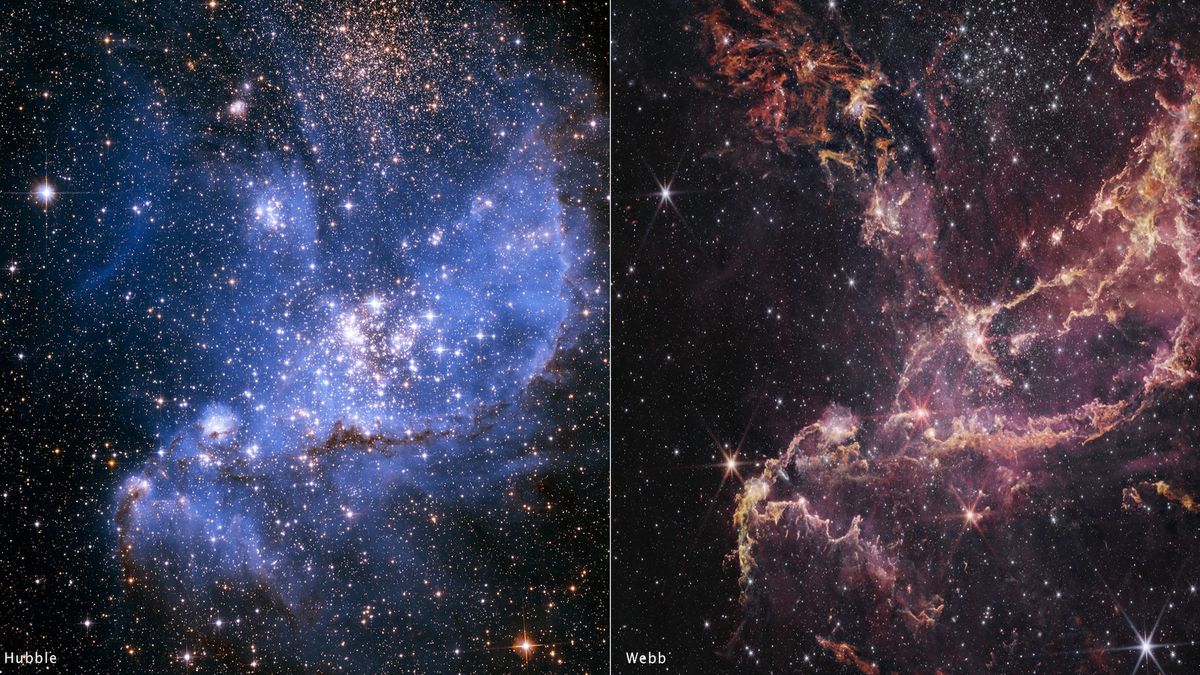
Space photo of the week: James Webb and Hubble telescopes unite to solve 'impossible' planet mystery

Space photo of the week: James Webb and Hubble telescopes unite to solve 'impossible' planet mystery

A side-by-side comparison of images of NGC 346 from JWST and Hubble
An image of NGC 346 from the Hubble Space Telescope (left) and the James Webb Space Telescope (right). 
(Image credit: Image credit: NASA, ESA, CSA, STScI, Olivia C. Jones (UK ATC), Guido De Marchi (ESTEC), Margaret Meixner (USRA), Antonella Nota (ESA))
  • What it is: An open cluster of stars called NGC 346
  • Where it is: 210,000 light-years away, in the constellation Tucana
  • When it was shared: Dec. 16, 2024
  • Why it's so special: This James Webb Space Telescope (JWST) image has helped astronomers untangle a long-standing mystery about how planets form. The mystery arose more than 20 years ago, when the Hubble Space Telescope spotted the universe's oldest known planet, which formed earlier in the universe's history than scientists thought was possible.

Stars form in large clouds of gas and dust called molecular clouds. Any remaining gas and dust gather in disks around the stars. Planets, in turn, form from these disks. Scientists believed that early stars didn't have planets because there was a lack of heavier elements, such as carbon and iron, which are created by stars' nuclear fusion and supernova deaths. They thought that these heavier elements were essential for planet-forming disks to exist long enough for planets to form.

Related: 

But in 2003, Hubble detected a massive planet orbiting an ancient star in the M4 globular cluster, which is about 5,600 light-years distant in the Milky Way. Globular clusters are extremely old and, therefore, lack heavier elements. The exoplanet is about 13 billion years old, which suggests that planets may have formed earlier in the universe's history than scientists thought was possible. But astronomers were unsure exactly how it formed so early in the universe's history

To learn more about the early universe, astronomers use proxies that have similar conditions to ancient galaxies. One such proxy is the star cluster NGC 346, a star-forming region within the Small Magellanic Cloud (SMC), a dwarf galaxy that orbits the Milky Way. Like early galaxies, the SMC lacks heavier elements and is made up mainly of hydrogen and helium.

When astronomers pointed Hubble at NGC 346, they found signs that planet-forming disks existed around stars for 20 million to 30 million years — about 10 times longer than theories predicted such disks could survive. However, the signs were faint, so astronomers needed further proof.

In 2023, JWSTused the unprecedented sensitivity and resolution provided by its Near Infrared Spectrograph and Mid-Infrared Instrument to confirm the existence of long-lived planet-forming disks in NGC 346.

The findings, published Dec. 16, 2024, in The Astrophysical Journal, affirm the Hubble result and suggest that the lack of heavier elements may slow the star's ability to disperse its planet-forming disk — giving planets more time to form. Another theory is that the initial gas cloud from which the star forms might be larger, resulting in a more massive, longer-lived disk.

{ https://www.livescience.com/space }

Hoe vind je dit bericht?
Geschreven door peter om 22:11 Stuur door

High-Resolution Imaging of Dyson Sphere Candidate Reveals no Radio Signals

A Type II civilization is one that can directly harvest the energy of its star using a Dyson Sphere or something similar. Credit: Fraser Cain (with Midjourney)

High-Resolution Imaging of Dyson Sphere Candidate Reveals no Radio Signals

In the more than sixty years where scientists have engaged in the Search for Extraterrestrial Intelligence (SETI), several potential examples of technological activity (“technosignatures”) have been considered. While most SETI surveys to date have focused on potential radio signals from distant sources, scientists have expanded the search to include other possible examples. This includes other forms of communication (directed energy, neutrinos, gravitational waves, etc.) and examples of megastructures (Dyson Spheres, Clarke Bands, Niven Rings, etc.)

Examples of modern searches include Project Hephaistos, the first Swedish Project dedicated to SETI. Named in honor of the Greek god of blacksmiths, this Project is focused on the search for technosignatures in general rather than looking for signals deliberately sent toward Earth. In a recent paper, a team led by the University of Manchester examined a Dyson Sphere candidate identified by Hephaistos. Their results confirmed that at least some of these radio sources are contaminated by a background Active Galactic Nucleus (AGN).

The team was led by Tongtian Ren, a Ph.D. student in astrophysics from the Jodrell Bank Centre for Astrophysics at the University of Manchester. He was joined by Prof. Michael Garrett, his supervisor at the University of Manchester, the Leiden Observatory, and the Institute of Space Sciences and Astronomy at the University of Malta; and Andrew Siemion, an Associate Research Astronomer at the Berkeley SETI Research Center, the SETI Institute, and the University of Oxford. The paper that describes their findings recently appeared in the Monthly Notices of the Royal Astronomical Society.


Dyson Spheres are a class of megastructures originally proposed by physicist Freemon Dyson, who proposed how advanced civilizations could create structures large enough to enclose their stars (thus harnessing all of their energy). Project Hephaestos, led by Prof. Erik Zackrisson, has published numerous papers exploring possible Dyson Sphere candidates using different methods and data sources. The fourth and most recent paper in the series focused on seven potential candidates (designated A to G) around M-type stars from a sample of 5 million detected by the ESA’s Gaia Observatory.

Previously, Ren and his team have investigated these candidates to identify possible natural explanations. As they explored in a previous paper, these include dust-rich debris disks that absorb light and re-emit it as infrared radiation. This will lead to an observed infrared excess, which Dyson proposed as a possible indication of his proposed megastructure. However, as they indicate in their most recent paper, the Project’s measurements do not appear to resemble typical debris disks. As Garrett explained to Universe Today via email:

“When I saw the original results from Project Hephaestos last year, I was skeptical – they had surveyed 5 million stars, and if you do that, there is a good chance your measurements might include emission from background sources. You don’t expect stars to show radio emission at this level, and it basically tells you that the radio emission is probably coming from background (radio) galaxies. But then you also need a special kind of galaxy that is faint in the optical but very bright in the infrared – the only galaxies I knew that had this characteristic are DOGs – Dust Obscured Galaxies.”

The team was also inspired by another paper by Jason T. Wright, a professor of astronomy and astrophysics at Penn State, the director of the Penn State Extraterrestrial Intelligence Center (PSETI), and a member of the Center for Exoplanets and Habitable Worlds (CEHW). In this paper, Wright hypothesized that a true Dyson Sphere might use radio emissions to discharge waste heat. This led them to consider the possibility that these candidates were indeed Dyson Spheres.

Artist’s impression of a bright, very early active galactic nucleus. Credit: NSF/AUI/NSF NRAO/B. Saxton

As Tongtian explained, they were also inspired by previous research by Garrett:

“Mike briefly argued in 2015 that even in a Kardashev Type I Civilization, where energy consumption is significantly higher than that of humans on Earth, their radio communication signals are too weak to detect. However, the Dyson Spheres could correspond to a Kardashev Type II Civilization—one that harnesses over a billion times more energy than a Type I Civilization. Therefore, regardless of whether the beings reside on planets or elsewhere near the Dyson Sphere, it might be possible to detect their use of similar electromagnetic technologies.”

To investigate these possibilities further, the team searched through data obtained by the enhanced Multi-Element Radio Linked Interferometer Network (e-MERLIN) and the European VLBI Network (EVN) for data on the brightest radio source (candidate G). To their surprise, they found that three candidates from Project Hephaestos had radio counterparts in the astronomy databases. As Tongtian explained, the most logical explanation is that these signals (including candidate G) were due to contamination from bright radio sources – Active Galactic Nuclei (AGN) – in the background:

“They shouldn’t belong to one civilization. Otherwise, many anomalous stars would be connected as a swarm in the sky, not isolated seven. At that moment, we realized that either different extraterrestrial civilizations located hundreds of light-years away all have mastered the same or similar advanced radio emission technologies, or these signals originate from some form of natural contamination. We preferred to assume that they were some natural objects beyond the Milky Way – and most likely to be hot DOGS.”

These results effectively confirmed their earlier hypothesis that at least some of the candidates identified by Project Hephaistos are contaminated by bright radio sources that are also very bright in the infrared wavelength. This causes them to mimic the characteristics that Freeman Dyson predicted and what astronomers expect from Dyson Spheres. However, this does not rule out the remaining six candidates and highlights the importance of thoroughly analyzing each candidate with high-resolution radio observations.

Artist’s impression of a Dyson Sphere, a megastructure associated with a Type II Civilization. Credit: SentientDevelopments.com

“We don’t know that all of the candidates are contaminated, but some, maybe all, probably are. I really hope some of them are indeed good Dyson Sphere candidates,” said Garrett. “This all shows that a multiwavelength approach is really required when looking for candidates in order to rule out background contamination.”

“The development of new astronomical instruments does not follow the rapid update cycles of consumer electronics—it takes decades,” added Tongtian. “Gaia (launched in 2013 and recently decommissioned) and WISE (launched in 2009 and expired in 2024) provided a crucial observational window. The next generation of similar probes may not be available for a long time, making it unlikely that a large-scale Dyson Sphere search program like Project Hephaistos will be conducted again in the near future. So the current seven Dyson Sphere candidates deserve to be carefully examined.”

Further Reading: 

RELATED VIDEOS

Explained: The Dyson Sphere

The Fermi Paradox: Searching For Dyson Spheres

The Dyson Sphere Debate and Von Neumann Probes w/ Dr. Zaza Osmanov

{ https://www.universetoday.com/ }

Hoe vind je dit bericht?
Geschreven door peter om 21:39 Stuur door

Stranded NASA astronaut says she's lost ability to perform vital bodily function after being in space so long

Stranded NASA astronaut says she's lost ability to perform vital bodily function after being in space so long

One of NASA's stranded astronauts has revealed she has lost the ability to perform several basic tasks after being stranded in space for eight months. 

Sunita Williams admitted this week that she has forgotten what it's like to walk after spending 234 days in microgravity.

'I've been up here long enough, right now I've been trying to remember what it's like to walk. I haven't walked. I haven't sat down. I haven't laid down,' she said during a video call with students at Needham High School in Massachusetts on Monday. 

Williams, 59 and her crewmate, Barry Wilmore, 62, were supposed to spend eight days on the ISS when they embarked on their mission on June 5, but the Boeing capsule that took them was plagued by technical issues.

The capsule has since returned to Earth empty, leaving the two astronauts stuck on the ISS until at least late March when they can catch a ride home on SpaceX's Crew-9 spacecraft.

President Donald Trump said 'the two brave astronauts' were 'virtually abandoned by the Biden administration' and asked Elon Musk and SpaceX to 'go get' them.

'Elon will soon be on his way. Hopefully, all will be safe,' the president said. 'Good luck Elon!!!'

The 53-year-old billionaire vowed in a post to retrieve Wilmore and Sunita Williams 'as soon as possible.' 

Sunita Williams admitted this week that she has forgotten how to walk after spending 234 days in microgravity

otten how to walk after spending 234 days in microgravity Sunita Williams admitted this week that she has forg

Musk said he was asked by President Donald Trump to bring NASA's stranded astronauts home as soon as possible

Musk said he was asked by President Donald Trump to bring NASA's stranded astronauts home as soon as possible 

Musk's SpaceX was already tasked with bringing astronauts Williams and Wilmore back from the ISS prior to this new order due to Boeing's Straliner malfunctioning in space.

The capsule experienced helium leaks and thruster malfunctions before, during and after its launch.

By August, NASA decided Starliner was unfit to safely bring the astronauts home, and announced that Williams and Wilmore would instead hitch a ride back to Earth on SpaceX's Crew-9 capsule, which is currently docked to the ISS.

NASA previously said that Crew-9 would return home as soon as February, but the agency changed the mission timeline in December.

In a statement, officials explained that SpaceX needed more time to complete work on the Crew-10 capsule, which must launch to the ISS before Crew-9 can leave the ISS. 

Thus, the astronauts' return was pushed back to late March. By that time, they will have spent eight months in space. 

During long space missions, microgravity takes a toll on astronauts' bodies, causing significant muscle and bone deterioration.

For every month in space, astronauts' weight-bearing bones become roughly one percent less dense if they don't take precautions to counter this loss, according to NASA.

If Barry Wilmore and Sunita Williams do return in late March as expected, they will have spent 10 months on the ISS, which is two months longer than a standard long-term ISS mission

If Barry Wilmore and Sunita Williams do return in late March as expected, they will have spent 10 months on the ISS, which is two months longer than a standard long-term ISS mission

President Donald Trump asked SpaceX CEO Elon Musk to 'go get' two astronauts who remain stuck in space

President Donald Trump asked SpaceX CEO Elon Musk to 'go get' two astronauts who remain stuck in space

And their muscles which are usually activated by simply moving around on Earth also weaken because they no longer need to work as hard, the agency says. 

When astronauts return from long-term space missions, it's not uncommon for them not to be able to walk under their own power.  

The recent statements from Musk and President Trump suggest the timing of Williams and Wilmore's rescue mission could change again, potentially bringing them home sooner. 

There are a couple ways SpaceX might do this, according to astrophysicist and science communicator Scott Manley.

One option is to launch Crew-10 earlier, which would also allow the Crew-9 capsule to bring Williams and Wilmore home earlier, he explained in a recent X post. 

Welcome to MAGALAND: Insider Trump's Second 100 Days - The podcast bringing you the latest news and gossip from the White House. Listen here.

Welcome to MAGALAND: Insider Trump's Second 100 Days - The podcast bringing you the latest news and gossip from the White House. Listen here. 

This would require SpaceX to finish work on the spacecraft ahead of schedule, but the company has not said that it is on track to do so. 

Option two is to allow Crew-9 to return to Earth before Crew-10 launches, Manley said. 

This would go against NASA protocol, which requires the agency to maintain a critical mass of astronauts on the ISS during the 'handover process,' or the overlap between a departing ISS crew's time on the space station and a new crew's arrival. 

This period allows the departing crew (in this case, Crew-9 and the Starliner crew) to share any lessons learned with the newly arrived crew (Crew-10) and support a better transition for ongoing science and maintenance at the complex, according to NASA.

The handover process helps operations on the ISS run smoothly, but it is not an absolute necessity. 

Should NASA opt to let the Crew-9 capsule leave the ISS before Crew-10 arrives, Russian Soyuz astronauts would be there to receive the Crew-10 astronauts. 

SpaceX CEO Elon Musk has vowed to bring NASA astronauts Wilmore and Williams back from the ISS 'as soon as possible' by order of President Donald Trump

SpaceX CEO Elon Musk has vowed to bring NASA astronauts Wilmore and Williams back from the ISS 'as soon as possible' by order of President Donald Trump 

SpaceX's Crew-9 capsule launched aboard a Falcon 9 rocket in September. The capsule is currently docked on the ISS and ready to bring its crew plus Williams and Wilmore home by late March, unless NASA and SpaceX move its departure up

SpaceX's Crew-9 capsule launched aboard a Falcon 9 rocket in September. The capsule is currently docked on the ISS and ready to bring its crew plus Williams and Wilmore home by late March, unless NASA and SpaceX move its departure up

There are a couple ways SpaceX might do this, according to astrophysicist and science communicator Scott Manley.

One option is to launch Crew-10 earlier, which would also allow the Crew-9 capsule to bring Williams and Wilmore home earlier, he explained in a recent X post. 

This would require SpaceX to finish work on the spacecraft ahead of schedule, but the company has not said that it is on track to do so. 

Option two is to allow Crew-9 to return to Earth before Crew-10 launches, Manley said. 

This would go against NASA protocol, which requires the agency to maintain a critical mass of astronauts on the ISS during the 'handover process,' or the overlap between a departing ISS crew's time on the space station and a new crew's arrival. 

This period allows the departing crew (in this case, Crew-9 and the Starliner crew) to share any lessons learned with the newly arrived crew (Crew-10) and support a better transition for ongoing science and maintenance at the complex, according to NASA.

article image

The handover process helps operations on the ISS run smoothly, but it is not an absolute necessity. 

Should NASA opt to let the Crew-9 capsule leave the ISS before Crew-10 arrives, Russian Soyuz astronauts would be there to receive the Crew-10 astronauts.

It's also possible that the timing of the Starliner crew's return will not change at all. 

When Musk stated he would bring the astronauts home 'as soon as possible,' he may actually have been referring to the current mission schedule, Manley said. 

What's more, it could be that 'Elon is trolling,' he added. In other words, these statements from Musk and Trump may be displays of political showmanship that do not actually promise any real changes to the rescue mission's timeline.

Neither SpaceX, NASA, nor the White House have made any official public  statements regarding a revised return date for Williams and Wilmore.

In an emailed statement, NASA told DailyMail.com: 'NASA and SpaceX are expeditiously working to safely return the agency's SpaceX Crew-9 astronauts Suni Williams and Butch Wilmore as soon as practical, while also preparing for the launch of Crew-10 to complete a handover between expeditions.' 

SpaceX and the White House did not  immediately respond to DailyMail.com's request for comment.  

Despite the astronauts' dramatically extended stay on the ISS, NASA has repeatedly stated that they are not stranded. 

The agency has also emphasized that NASA astronauts always train for lengthy missions, and that medical experts have been closely monitoring the Starliner crew's health as they endure the harsh conditions aboard the ISS, including low-gravity, heightened radiation exposure and the psychological stress of confinement. 

If Williams and Wilmore do return home in late March as expected, their mission will have lasted two months longer than a standard long-term ISS mission, which typically lasts six months.

But they will not break astronaut Frank Rubio's record for the longest stretch of time spent on the ISS, which is 371 consecutive days. 

RELATED VIDEOS

Astronaut Sunita Williams Speaks Out After Weight Concerns

Astronaut Sunita Williams Has Lost A Lot Of Weight, Sparking Health Concerns | SpaceX | N18G

{ https://www.dailymail.co.uk/ }

Hoe vind je dit bericht?
Geschreven door peter om 01:10 Stuur door

NASA says chances of 'city-destroying' asteroid hitting Earth have increased

NASA says chances of 'city-destroying' asteroid hitting Earth have increased

The odds of a 'city-killer' asteroid smashing into the Earth on December 22, 2032 appear to have ticked up slightly.

NASA previously estimated that Asteroid 2024 YR4, a nearly 200-foot-wide space rock, has a one-in-83 chance (1.2 percent) of striking our planet.

But now, the agency's 'Sentry' Earth Impact Monitoring system reports a one-in-77 chance (1.3 percent) of a direct hit.

Astronomers have also calculated a predicted impact zone that stretches from South America across the Atlantic Ocean to sub-Saharan Africa.

The asteroid has the potential to cause significant damage, especially if it lands in a densely populated area like a major city due to it being the size of another space rock that hit Earth in 1908 with a blast equivalent to detonating 50 million tons of TNT.

Though estimates suggest a very small increase in the likelihood of impact, astronomer and professor of planetary sciences at the Massachusetts Institute of Technology (MIT) Richard P Binzel told DailyMail.com that it is nothing to worry about. 

'The difference between 1.2 percent and 1.3 percent doesn't matter,' he said. 

'Until the data are sufficient to pinpoint which of these two final answers is correct, we can expect the probability numbers to wobble around a bit. This is simply how scientific data measurements play out,' he added. 

The current 'risk corridor,' or the geographical area where the 2024 YR4 is most likely to hit, runs from South America across the Atlantic Ocean to sub-Saharan Africa

The current 'risk corridor,' or the geographical area where the 2024 YR4 is most likely to hit, runs from South America across the Atlantic Ocean to sub-Saharan Africa

Regardless, the odds of this asteroid impacting our planet are still very low.

Astronomers say it is much more likely to safely pass us by, coming within roughly 66,000 miles of Earth. 

Astronomers believe 2024 YR4 is roughly the same size as the Tunguska asteroid, which caused the most explosive impact in recorded history when it shot through Earth's atmosphere in 1908, reportedly killing three people.

It exploded in the air over Siberia in what's known as an 'air burst,' flattening an estimated 80 million trees over 830 square miles of forest.

If 2024 YR4 infiltrates Earth's atmosphere, it could cause a similar event, astronomers say. 

Alternatively, it could remain intact during the descent and slam into the ground, creating a massive crater and decimating human communities in the impact zone. 

Asteroid 2024 YR4 shot to the top of NASA's automated Sentry risk list that ranks known Near Earth Objects (NEOs) on how likely they are to collide with our planet. 

NEOs are asteroids and comets that orbit the sun and pass close to Earth. 

The recently found space rock, however, is currently the most threatening NEO astronomers are aware of, ranking as a three out of 10 on the Torino risk scale,  a tool for categorizing potential Earth impact events. 

It's a scale from zero to 10, with higher numbers indicating a greater risk of impact. 

Most NEOs never reach higher than two on the scale. 

Analysis of 2024 YR4's orbit indicates that the asteroid will come within 66,000 miles of Earth on December 22, 2032. But when orbital uncertainties are factored in, it turns out there is a 1.2 percent chance of it directly hitting out planet

Analysis of 2024 YR4's orbit indicates that the asteroid will come within 66,000 miles of Earth on December 22, 2032. But when orbital uncertainties are factored in, it turns out there is a 1.2 percent chance of it directly hitting out planet 

Asteroid 2024 YR4 is about the same size as the Tunguska asteroid, which caused the largest impact event in recorded history when it shot through Earth's atmosphere in 1908

Asteroid 2024 YR4 is about the same size as the Tunguska asteroid, which caused the largest impact event in recorded history when it shot through Earth's atmosphere in 1908

The Tunguska asteroid exploded in the air over Siberia in what's known as an 'air burst,' and a blast equivalent to detonating 50 million tons of TNT that flattened an estimated 80 million trees over 830 square miles. Experts say Asteroid 2024 YR4 could cause a similar event

The Tunguska asteroid exploded in the air over Siberia in what's known as an 'air burst,' and a blast equivalent to detonating 50 million tons of TNT that flattened an estimated 80 million trees over 830 square miles. Experts say Asteroid 2024 YR4 could cause a similar event

While NASA and astronomers worldwide are keeping a close eye on the incoming asteroid, they are unable to predict how much damage it would cause. 

Experts will need to determined the asteroid's composition and true size before calculated its impact, which can only be done when it moves closer to our planet Rankin told Space.com. 

'Size and composition are big players in possible damage, along with impact location,' he said. 

'It's hard to constrain size and composition with the current orbital situation, as it's outbound,' or moving away from us, he added.

Experts still aren't 100 percent sure how much damage a direct hit from 2024 YR4 would cause (STOCK)

Experts still aren't 100 percent sure how much damage a direct hit from 2024 YR4 would cause (STOCK)

But best way to measure an asteroid's size is with radar observations, he added.

This technique reflects radio waves or microwaves off an asteroid's surface and then analyzes the reflections to calculate its size. 

Astronomers may have a chance to perform radar observations in 2028 when the asteroid passes within roughly five million miles of Earth, Rankin said. 

Until then, astronomers must rely on the asteroid's absolute magnitude, or brightness, to indirectly estimate its size.

This calculation gives them a rough diameter of 196 feet, but this estimate assumes that the asteroid's surface has a certain level of reflectivity that may not be accurate. 

'If the asteroid has a darker surface, that number is too small; if it has a more reflective surface, that number is too high,' Rankin said.

article image

Asteroid reflectivity depends on its composition, which also plays an important role in how space rocks behave once they penetrate Earth's atmosphere.  

'If [asteroid 2024 YR4] is made of stony material, it could cause a significant air burst and fireball reaching the ground,' Rankin said. 

'If made of iron, it will punch right through the atmosphere with little trouble and make an impact crater. This is why understanding not just the orbit but also the composition and size are so critical.'

Due to these risk scenarios, astronomers will closely study and monitor 2024 YR4 in the years leading up to its approach. 

But 'people should absolutely not worry about this yet,' Rankin said. 

'Impact probability is still very low, and the most likely outcome will be a close approaching rock that misses us,' he said.

Now that 2024 YR4 has been identified as a potential — but unlikely — threat, the race to learn as much about it as possible before 2032 is on. 

RELATED VIDEO

'City killer' asteroid will make its closest approach to Earth for centuries this Friday (Feb. 2)

{ https://www.dailymail.co.uk/ }

Hoe vind je dit bericht?
Geschreven door peter om 00:43 Stuur door

EXCLUSIVE - Scientists studying 'alien mummies' from Peru claim bodies are '100% real' after new details emerge

The 'alien mummies' discovered in Peru have largely been dismissed as a hoax by the scientific community, but researchers studying the specimens believe otherwise.

Dr José Zalce, former director of the Mexican Navy Medical Department, has analyzed 21 of the strange bodies, finding 'fingerprints, bone wear, dental formations, muscular features and internal organs - proving they're 100 percent real biological organisms.'

He even claimed some were pregnant, 'making them impossible to fake or replicate fraudulently,' said Zalce who has testified under oath that the mummies are real following his six years of work with them.

Recent scans of a 'pregnant' mummy revealed what appeared to be an intact fetus that had the same physical characteristics of the corpses, which the team said was proof of authenticity.

The mummies first exploded on the scene when controversial UFO enthusiast and journalist Jaime Maussan ushered two small beings into Mexico Congress in 2023.

He claimed they were not part of 'our terrestrial evolution', with 30 percent of their genetic composition still 'unknown.'

Dr Zalce and his team, however,  have performed X-rays, CT scans with 3D reconstruction, fluoroscopy, DNA analysis, forensic fingerprinting and tissue sample examinations on each body for the last six years.

'These confirm with 100 percent certainty their organic, biofunctional, and skeletal anatomical authenticity,' Dr Zalce told DailyMail.com.

Researchers have been studying these 'alien mummies' for about six years, claiming them to be 100 percent real

Researchers have been studying these 'alien mummies' for about six years, claiming them to be 100 percent real

The researchers conducted a recent scan of a mummy named 'Montserrat,' finding it was pregnant at the time of death, which they believe was at least 1,200 years ago

The researchers conducted a recent scan of a mummy named 'Montserrat,' finding it was pregnant at the time of death, which they believe was at least 1,200 years ago

The mystery began in 2017 when Maussan and a team of self-proclaimed paranormal researchers said they found a mysterious three-fingered 'mummified humanoid' with an elongated skull near the city of Nazca.

The body was found covered in white powder, which the team said was used to preserve the remains.

And five years later, the tiny beings were paraded through Mexico's Congress where Maussan argued his case and did so on two occasions.

During the second meeting, he brought in a string of doctors who all said the bodies were those of real, once-living organisms - some experts claimed to have studied 'five similar specimens over four years.

Now, a group of researchers who have studied nearly two dozen specimens are 100 percent sure they are real.

Jois Mantilla, a Peruvian journalist, has worked closely with the team stands with the experts' conclusion, specifically when the fetus was discovered in a mummy named Montserrat.

'The fact that the fetus is a tridactyl [three-fingered being] makes it one of the most important proofs of the authenticity of these bodies,' he said.

Dr Zalce and his team have determined that the specimen was between 15 and 25 years old at time of due to its 'bodily condition, gestational state, and a comparison of her anthropomorphic bone structure.'

He estimated Montserrat's remains are from 1,200 to 1,600 years old.

Mantilla also believes the the mummies are remains from an unknown species of hominin due to having some physical characteristics of a human, while its hands, facial features, elongated skull and feet are completely different.

One specimen, named Montserrat, was found with a metallic-like object on its head that experts said said was placed on the body while it was alive

One specimen, named Montserrat, was found with a metallic-like object on its head that experts said said was placed on the body while it was alive

Dr José Zalce, former director of the Mexican Navy Medical Department, has analyzed 21 bodies , finding 'fingerprints, bone wear, dental formations , muscular features and internal organs - proving they're 100 percent real biological organisms'

Dr José Zalce, former director of the Mexican Navy Medical Department, has analyzed 21 bodies , finding 'fingerprints, bone wear, dental formations , muscular features and internal organs - proving they're 100 percent real biological organisms'

'It could be a different species of hominid that had not been described before by science,' he said.

'We presume that these beings, so similar to humans, but different at the same time, may have been genetically created by combining genes as in the case of Maria.'

A study on the mummy named Maria, published in May 2024, found that it has biological similarities to that of a human - but with 'many morphological and anatomical structural differences.'

The creature's bones were observed to flow smoothly under the mummified casing, in a way that is found throughout the human body, and its elongated skull showed no signs of artificial cranial deformation.

Mantilla claimed that genes of a bamboo and chimpanzee were used to genetically modify a 'human from the East.'

However, scientists outside this group have also studied two mummies and found different results.

Forensic archaeologist Flavio Estrada, who led the analysis, said the claims that the two objects came from another word are 'totally false.'

'The conclusion is simple: they are dolls assembled with bones of animals from this planet, with modern synthetic glues, therefore they were not assembled during pre-Hispanic times,' he said in January 2024.

Researchers said the fingerprints are very unique as they are linear and not wavy like those of humans

Researchers said the fingerprints are very unique as they are linear and not wavy like those of humans

'They are not extraterrestrials; they are not aliens.'

However, a former Colorado prosecutor and current defense attorney, who has examined one of the mummies, is also a true believer.

Joshua McDowell said: 'The bodies studied by Estrada were not related to any specimen that we have studied. They were folk dolls made to look like tridactyls confiscated at the airport.'

Estrada's statements have not stopped Zalce and his team from looking deeper into the mysterious bodies.

 'All serious researchers involved have confirmed that these are non-human bodies with unique anatomical differences, such as tridactyl, without any traces of artificial manipulation or alteration,' Dr Zalce said.

One of those differences, according to researchers, are the specimens' fingerprints do not correspond to any hominid, they are linear.

'Those of humans, hominids, are oblique, they are wavy, they are rounded shapes and these are totally linear,' Mantilla said.

'In some of the bodies, the number of fingers reach five, in others four and some have only three.'

Dr Zalce added that the mummies' 'authenticity is supported by fingerprints, DNA analysis showing remarkable differences from human DNA, and other surprising genetic and pathological findings.'

Experts speculated that the mummies could be a remains from an unknown species of hominin due to having some physical characteristics of a human, while its hands, facial features, elongated skull and feet are completely different

Experts speculated that the mummies could be a remains from an unknown species of hominin due to having some physical characteristics of a human, while its hands, facial features, elongated skull and feet are completely different

'We presume that these beings,so similar to humans, but different at the same time, may have been genetically created by combining genes as in the case of Maria,' they said. Pictured is Maria

'We presume that these beings,so similar to humans, but different at the same time, may have been genetically created by combining genes as in the case of Maria,' they said. Pictured is Maria

Metallic plates have been found throughout other areas of the mummies' bodies, 'from the interior covering some bones to external attachments on the skin, forming a biofunctional implant with no signs of rejection,' said Dr Zalce.

'These polymetallic plates have been analyzed using [a light-based measurement], revealing an alloy composed of copper, cadmium, osmium, aluminum, gold, and silver,' he added.

'Notably, the silver has a purity of over 95 percent, which is rare in nature. Additionally, cadmium and osmium, relatively recent discoveries, are currently used in satellite communication and satellite structures.'

article image

Montserrat was found with a metallic-like object on its head that Mantilla said was placed on the body while it was alive.

'They have been placed on the skin using a technique that we still do not know,' he said. 'In some cases, [like Montserrat], the skin has been seen to have grown around the implant.

'This gives us the understanding that these implants were used while the subject was still alive. They were not metal implants placed for ritual purposes.'

McDowell is helping the researchers work collaboratively with the Peruvian Ministry of Culture to complete additional genetic and forensic testing not currently available in Peru.

'There are a lot of unknowns about these tridactyl specimens that could be definitively answered through additional testing modalities not currently available in Peru,' he said.

'Our position is simply that they should be tested, in a legal and culturally sensitive manner, with the best methods available today.'

RELATED VIDEOS

Bizarre three-fingered ‘alien mummies’ are real and contain unique DNA, filmmakers say

UFO Proof? “Non-Human” Alien Corpses Retrieved From Peru Displayed At Mexico Congressional Hearing

{ https://www.dailymail.co.uk/ }

Hoe vind je dit bericht?
Geschreven door peter om 00:26 Stuur door

Scientists Use NASA Spacecraft Data to Predict Alien Contact

Scientists Use NASA Spacecraft Data to Predict Alien Contact

Using advanced star-mapping data from the Gaia mission, the researchers have pinpointed potential star systems that may have intercepted Earth’s messages and calculated when a response could arrive.

NASA’s interstellar missions, such as Voyager and Pioneer, have carried Earth’s messages to the cosmos for decades, broadcasting radio signals into the vastness of space. These transmissions represent humanity’s quest to connect with intelligent civilizations beyond Earth.

Now, researchers at the University of California, Berkeley, and UCLA are studying these messages to predict where they might have been intercepted—and when we might expect a reply. Using precise star-mapping data from the Gaia space observatory, the team has identified key regions in space where Earth’s signals could encounter extraterrestrial life.

Their findings, published in 2023, provide a more focused approach for SETI (Search for Extraterrestrial Intelligence) researchers, narrowing the search to specific stars and planetary systems.

Tracing Earth’s Signals into Deep Space

In 1973, NASA sent its first interstellar radio signal via the Pioneer 10 spacecraft. Pioneer 10 traveled toward the star Aldebaran, approximately 65 light-years away, though it has yet to come close to this distant star.

Similarly, the Voyager 1 and Voyager 2 spacecraft, launched in 1977, transmitted signals as they journeyed beyond the solar system. Voyager 2 left the Sun’s heliosphere in 2018 and is now traveling through interstellar space. Along its trajectory, it passed near the direction of a brown dwarf star located about 24 light-years away.

As per The Debrief, by analyzing these trajectories and combining them with Gaia’s data, researchers have mapped where other civilizations might intercept Earth’s signals. The team predicts that if intelligent life near this brown dwarf intercepted Voyager 2’s signal, we could theoretically receive a reply by the early 2030s.

Using Gaia Data to Refine Predictions

The Gaia space observatory, renowned for producing the most accurate star maps in history, was instrumental in this research. By charting the positions and motions of stars, the researchers calculated the time required for Earth’s radio signals to reach specific systems and for a potential reply to return.

“Our estimates are based on the time it takes for light-speed signals to travel between stars,” said lead researcher Howard Isaacson, an astronomer at UC Berkeley. “If an extraterrestrial civilization intercepted our signals and chose to respond, their reply would also travel at the speed of light, taking years to reach us.”

This analysis also highlights specific systems where SETI researchers could focus their telescope time, maximizing the chances of detecting alien signals.

The Odds of Contact

While the predictions are scientifically grounded, Isaacson acknowledges the slim likelihood of receiving an alien signal. “The probability is low, but the potential impact of such a discovery is enormous,” he explained. “Even if we don’t find signals immediately, this research inspires new ideas and technologies for exploring the cosmos.”

The study has also drawn attention from UFO enthusiasts, some of whom speculate that significant extraterrestrial-related events might occur by 2027. However, Isaacson has distanced his work from such unverified claims, emphasizing that the research relies on scientific data rather than speculation.

This study represents more than just a search for alien life—it’s a testament to humanity’s curiosity and determination to explore the unknown. By leveraging cutting-edge technology and precise measurements, the research opens new doors for understanding our place in the universe.

“Whether or not we find extraterrestrial life soon, the effort to look inspires us to think bigger and imagine the possibilities,” Isaacson concluded.

RELATED VIDEOS


Alien Contact: NASA Exposed7

Scientists JUST DISCOVERED A NEW Alien Communication Signal From Space

NASA releases UFO report. Here's what they found

{ https://curiosmos.com/ }

Hoe vind je dit bericht?
Geschreven door peter om 22:35 Stuur door

Scientists Discover Vast Traces of Life Deep Beneath Earth’s Surface

Scientists Discover Vast Traces of Life Deep Beneath Earth’s Surface

The study shows that microbial life deep in Earth’s crust is far more diverse than previously thought, rivaling or even surpassing surface ecosystems in some cases.

In a discovery that some would say redefines the boundaries of life on our planet, scientists have unveiled thriving microbial ecosystems hidden miles beneath Earth’s surface. This groundbreaking research reveals a diverse and resilient network of life flourishing in the deep subsurface, far removed from sunlight and traditional energy sources.

The findings, published in the journal Science Advances, highlight an unexpected abundance of life in these extreme environments, challenging long-held assumptions about the limitations of Earth’s biosphere.

A New Understanding of Life’s Diversity

The study shows that microbial life deep in Earth’s crust is far more diverse than previously thought, rivaling or even surpassing surface ecosystems in some cases. This defies the traditional view that life becomes less diverse and abundant as it moves away from sunlight and accessible energy sources.

“It’s commonly assumed that the deeper you go, the less energy is available, and the fewer cells can survive,” said Emil Ruff, a microbial ecologist at the Woods Hole Marine Biological Laboratory and lead author of the study. “But our research demonstrates that in some subsurface environments, diversity can match or exceed that of the surface.”

The researchers identified a universal ecological principle showing that subsurface microbial ecosystems are not anomalies but a significant and thriving part of Earth’s biosphere.

The Global Collaboration Behind the Discovery

This breakthrough is the result of an eight-year international effort that analyzed over 1,400 datasets from microbial ecosystems worldwide. A lack of standardization in microbial DNA data had long hindered global comparisons, but that changed with a project led by molecular biologist Mitchell Sogin of the Bay Paul Center.

Sogin and his team worked to harmonize data collection and analysis techniques, enabling researchers to compare microbial samples from diverse environments, such as caves in Utah and subsurface layers in Spain. This collaborative approach revealed striking similarities in microbial diversity across vastly different regions.

kimberlite-marker-hg.jpg

Kimberlites are complex rocks that came to the Earth's surface from great depths. The picture shows a thin section of a carbonate-?rich kimberlite.

(Photograph: David Swart / Messengers of the Mantle Exhibition)

The study not only highlights the resilience of life on Earth but also provides a template for exploring life in extreme environments elsewhere in the solar system.

The discovery of microbial ecosystems thriving under extreme conditions has profound implications beyond Earth. These microbes rely on chemical energy rather than sunlight, making them analogous to potential life forms that might exist in subsurface environments on Mars or the icy moons of Jupiter and Saturn.

This research serves as a reminder of the untapped potential within Earth’s hidden ecosystems and reinforces the importance of international collaboration in uncovering the planet’s secret


Scientists discovered oceans of water deep in the Earth || Mantle's Transition zone || Ringwoodite.

The Remains of an Ancient Planet Lie Deep Within Earth

{ https://curiosmos.com/ }

Hoe vind je dit bericht?
Geschreven door peter om 22:21 Stuur door

Japanese Lander Looks Back at Earth as it Heads to the Moon

Who can get tired of looking at Earth? Not ispace, who had their Hakuto-R mission to the Moon capture this view of Earth. The image is centered on Point Nemo, the point on Earth furthest from land. Image Credit: ispace

Japanese Lander Looks Back at Earth as it Heads to the Moon

The Hakuto-R 2 mission launched on January 15, 2025. It’s the successor to Hakuto-R, which launched in December 2022 but failed when it lost communications during its descent. Both missions carried rovers, and this image was captured by the rover Resilience as it travels toward the Moon.

The company behind Hakuto-R 1 and 2 is ispace. ispace develops robotics and other technologies that they intend to use to compete for commercial contracts. These missions are technology demonstration missions. Hakuto-R 1 carried the Emirates Lunar Mission, a rover named Rashid. Hakuto-R 2 carries ispace’s own micro-rover named Resilience.

ispace posted this image on social media with the text, “The RESILIENCE lander remains in excellent health as it continues to orbit Earth in its planned trajectory towards the Moon!”

“RESILIENCE knows what it means to be alone in the vastness of space. Looking back at Earth on Jan. 25, 2025, the lander was about 10,000km from our Blue Marble, poignantly capturing Point Nemo, the most remote place on our planet, about 2,688 kilometres from the nearest land.”

The most well-known picture of our Blue Marble came from astronauts on Apollo 17 in 1972. It appeared during a boom in environmental activism and helped people around the world understand the planet they live on and consider its future and our impact on it.

The Blue Marble image of Earth from Apollo 17. Image Credit: NASA The Blue Marble image of Earth from Apollo 17. Image Credit: NASA

The second most well-known image of Earth is probably Carl Sagan’s Pale Blue Dot image. Voyager 1 captured that image in 1990 on its way to the outer Solar System. The spacecraft captured the image from 6 billion km away when it passed Saturn. Carl Sagan proposed the idea not for scientific reasons but to drive home the idea that humanity’s home was just a tiny dot in the dark.

The The “pale blue dot” of Earth captured by Voyager 1 in Feb. 1990 (NASA/JPL)

It seems de rigueur now for space missions to turn around and capture an image of Earth on their way to their destinations.

OSIRIS REx did it.

Black and white image of Earth taken by the OSIRIS-REx's NavCam 1 instrument. Image Credit: NASA/OSIRIS-REx team and the University of Arizona Black and white image of Earth taken by the OSIRIS-REx’s NavCam 1 instrument. Image Credit: NASA/OSIRIS-REx team and the University of Arizona

So did Artemis 1’s Orion spacecraft.

On Flight Day 9, NASA’s Orion spacecraft captured imagery looking back at the Earth from a camera mounted on one of its solar arrays. Image Credit: NASA On Flight Day 9, NASA’s Orion spacecraft captured imagery looking back at the Earth from a camera mounted on one of its solar arrays. Image Credit: NASA

So have Lucy and many others. Now, they’re as common as pictures of their homes that young people take as they leave for college.

Yet, we don’t seem to ever tire of them. For some reason.

Maybe it’s because we’re accustomed to looking at maps with borders and labels on them, emphasizing how we see our planet through a political and historical lens. In those images, the context is human.

"The RESILIENCE lander remains in excellent health as it continues to orbit Earth in its planned trajectory towards the Moon!" ispace updated about its lander's health as it shared the visual.

But images of Earth from space have none of that. They show the true context of our planet. It’s a brilliant blue sphere, rippling with life, delicate and precious. It’s at the mercy of greater events that go on elsewhere in the Solar System and beyond, events beyond our control.

The people at ispace might not have intended their image to trigger this type of thinking. But regardless, this image takes its place in a long lineage of images of Earth captured by our departing spacecraft.

Hopefully, that lineage will continue for a long time.

ALSO SEE: 

 { https://www.universetoday.com/ }

Hoe vind je dit bericht?
Geschreven door peter om 18:24 Stuur door

Evidence of Recent Geological Activity on the Moon

A new study suggests that the moon's magnetic field from a dynamo in its liquid metallic core (inner red sphere) lasted 1 billion years longer than thought. (Image credit: Hernán Cañellas (provided by Benjamin Weiss))

Evidence of Recent Geological Activity on the Moon

According to the Giant Impact Hypothesis, the Moon formed from a massive impact between a primordial Earth and a Mars-sized object (Theia) roughly 4.5 billion years ago. This is largely based on the study of sample rocks retrieved by the Apollo missions and seismic studies, which revealed that the Earth and Moon are similar in composition and structure. Further studies of the surface have revealed features that suggest the planet was once volcanically active, including lunar maria (dark, flat areas filled with solidified lava).

In the past, researchers suspected that these maria were formed by contractions in the interior that occurred billions of years ago and that the Moon has remained dormant ever since. However, a new study conducted by researchers from the National Air and Space Museum (NASM) and the University of Maryland (UMD) revealed small ridges on the Moon’s far side that are younger than those on the near side. Their findings constitute another line of evidence that the Moon still experiences geological activity billions of years after it formed.

The research was conducted by Cole Nypaver and Thomas R. Watters, a postdoctoral student and Senior Geologist with the NASM’s Center for Earth and Planetary Studies at the Smithsonian Institute. They were joined by Jackie Clark, an Assistant Research Scientist with UMD’s Department of Geology. The paper detailing their findings, “Recent Tectonic Deformation of the Lunar Farside Mare and South Pole–Aitken Basin,” recently appeared in the Planetary Science Journal.

Based on previous research, scientists have determined that the Moon once had a magnetic field. Like Earth’s, this field was powered by a dynamo in the Moon’s interior caused by a liquid outer core (surrounding a solid inner core) that rotated opposite to its axial rotation. However, crystallization began in the Moon’s core about 4 billion years ago, causing this dynamo to disappear between 2.5 and 1 billion years ago. This led to the disappearance of its magnetosphere and volcanic activity, ceasing about 3 billion years ago. As Clark summarized in a recent UMD press release:

“Many scientists believe that most of the Moon’s geological movements happened two and a half, maybe three billion years ago. But we’re seeing that these tectonic landforms have been recently active in the last billion years and may still be active today. These small mare ridges seem to have formed within the last 200 million years or so, which is relatively recent considering the moon’s timescale.”

Using advanced mapping and modeling, Nypang, Watters, and Clark found 266 previously unknown small ridges on the Moon’s far side. These were largely arranged in groups of 10 to 40 ridges that likely formed in narrow areas 3.2 to 3.6 billion years ago where underlying weaknesses in the lunar crust may have existed. Based on a technique known as “crater counting,” the team found that these ridges were notably younger than other features in their surroundings.

“Essentially, the more craters a surface has, the older it is; the surface has more time to accumulate more craters,” said Clark. “After counting the craters around these small ridges and seeing that some of the ridges cut through existing impact craters, we believe these landforms were tectonically active in the last 160 million years.”

MIT-Lunar-Dyn-1_0.jpg

New measurements of lunar rocks have demonstrated that the ancient Moon generated a dynamo magnetic field in its liquid metallic core (innermost red shell). Credit: Hernán Cañellas/Benjamin Weiss

The team also noted that the ridges observed on the far side of the Moon were similar in structure to ones found on the near side. This suggests both were created by the same forces, possibly by shallow moonquakes first detected by the Apollo missions. Scientists have since deduced that these are caused by a combination of shifts in the Moon’s orbit and its gradual shrinking – which explains why the Moon still experiences landslides. Understanding the factors that shape the lunar surface is of immense importance to future lunar missions.

As Clark indicated, this presents opportunities for further studies of lunar evolution:

“We hope that future missions to the moon will include tools like ground penetrating radar so researchers can better understand the structures beneath the lunar surface. Knowing that the moon is still geologically dynamic has very real implications for where we’re planning to put our astronauts, equipment and infrastructure on the moon.”

Further Reading: 

 { https://www.universetoday.com/ }

Hoe vind je dit bericht?
Geschreven door peter om 18:06 Stuur door

Meer van UFO'S of UAP'S, ASTRONOMIE, RUIMTEVAART, ARCHEOLOGIE, OUDHEIDKUNDE, SF-SNUFJES EN ANDERE ESOTERISCHE WETENSCHAPPEN - DE ALLERLAATSTE NIEUWTJES

↑ Terug naar de berichten