Naar de inhoud

UFO'S of UAP'S, ASTRONOMIE, RUIMTEVAART, ARCHEOLOGIE, OUDHEIDKUNDE, SF-SNUFJES EN ANDERE ESOTERISCHE WETENSCHAPPEN - DE ALLERLAATSTE NIEUWTJES

UFO's of UAP'S in België en de rest van de wereld
akke.beakke.be
Ontdek de Fascinerende Wereld van UFO's en UAP's: Jouw Bron voor Onthullende Informatie! Ben jij ook gefascineerd door het onbekende? Wil je meer weten over UFO's en UAP's, niet alleen in België, maar over de hele wereld? Dan ben je op de juiste plek! België: Het Kloppend Hart van UFO-onderzoek In België is BUFON (Belgisch UFO-Netwerk) dé autoriteit op het gebied van UFO-onderzoek. Voor betrouwbare en objectieve informatie over deze intrigerende fenomenen, bezoek je zeker onze Facebook-pagina en deze blog. Maar dat is nog niet alles! Ontdek ook het Belgisch UFO-meldpunt en Caelestia, twee organisaties die diepgaand onderzoek verrichten, al zijn ze soms kritisch of sceptisch. Nederland: Een Schat aan Informatie Voor onze Nederlandse buren is er de schitterende website www.ufowijzer.nl, beheerd door Paul Harmans. Deze site biedt een schat aan informatie en artikelen die je niet wilt missen! Internationaal: MUFON - De Wereldwijde Autoriteit Neem ook een kijkje bij MUFON (Mutual UFO Network Inc.), een gerenommeerde Amerikaanse UFO-vereniging met afdelingen in de VS en wereldwijd. MUFON is toegewijd aan de wetenschappelijke en analytische studie van het UFO-fenomeen, en hun maandelijkse tijdschrift, The MUFON UFO-Journal, is een must-read voor elke UFO-enthousiasteling. Bezoek hun website op www.mufon.com voor meer informatie. Samenwerking en Toekomstvisie Sinds 1 februari 2020 is Pieter niet alleen ex-president van BUFON, maar ook de voormalige nationale directeur van MUFON in Vlaanderen en Nederland. Dit creëert een sterke samenwerking met de Franse MUFON Reseau MUFON/EUROP, wat ons in staat stelt om nog meer waardevolle inzichten te delen. Let op: Nepprofielen en Nieuwe Groeperingen Pas op voor een nieuwe groepering die zich ook BUFON noemt, maar geen enkele connectie heeft met onze gevestigde organisatie. Hoewel zij de naam geregistreerd hebben, kunnen ze het rijke verleden en de expertise van onze groep niet evenaren. We wensen hen veel succes, maar we blijven de autoriteit in UFO-onderzoek! Blijf Op De Hoogte! Wil jij de laatste nieuwtjes over UFO's, ruimtevaart, archeologie, en meer? Volg ons dan en duik samen met ons in de fascinerende wereld van het onbekende! Sluit je aan bij de gemeenschap van nieuwsgierige geesten die net als jij verlangen naar antwoorden en avonturen in de sterren! Heb je vragen of wil je meer weten? Aarzel dan niet om contact met ons op te nemen! Samen ontrafelen we het mysterie van de lucht en daarbuiten.

Archief

32 things on Mars that look like they shouldn't be there - PART I

32 things on Mars that look like they shouldn't be there - PART I

Is that really a floating spoon on Mars or just a strange rock?
Is that really a floating spoon on Mars or just a strange rock? 
(Image credit: NASA/JPL-Caltech/MSSS)

As one of Earth's closest neighbors in space, Mars has long captivated humans with the prospect of alien life located just a short rocket trip away. No such life has been found. But now, as NASA and other space agencies have begun to explore the skies and surface of the Red Planet using robotic technology, images of strange features and formations continue to inflame skywatchers' hopes, fears and curiosities.

Here are some of our favorite objects on Mars that look like they don't belong on a dead and dusty planet. Many of these are a result of pareidolia — the tendency for humans to seek familiar patterns and shapes in inanimate objects. However, some of them may even lead scientists to the long-sought evidence of past Martian life.

1. An open "travel book"

An orange rock that looks like an open book with a page being turned

(Image credit: NASA/JPL-Caltech/MSSS)

Perhaps weary from hunting for evidence of ancient water, NASA's Curiosity rover took a short break in April 2023 to leaf through the pages of an old Martian hardback lying in the dust of Gediz Vallis. While the strange object may look like a book with a single page frozen mid-turn, it is in fact just a rock — and a small one at that. The charming little book-rock measures just 1 inch (2.5 centimeters) wide, according to NASA. Hey, at least it's travel-size!

Related:

A cracked hillside on Mars looks just like the face of a teddy bear

(Image credit: NASA/JPL-Caltech/UArizona)

In an image shared in January 2023 by the University of Arizona (UA), what appears to be the face of an enormous Martian teddy bear — complete with two beady eyes, a button nose and an upturned mouth — grins at the camera of NASA's Mars Reconnaissance Orbiter. According to UA, the cuddly-wuddly formation is likely just a broken-up hill in the center of an ancient crater. But as far as we're concerned, it's the cutest pile of rubble in the known universe.

3. Frozen "mineral flowers"
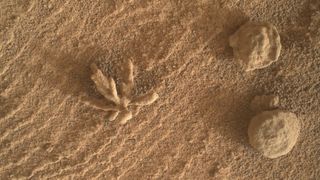
A photo of the

(Image credit: NASA/JPL-Caltech/MSSS)

Branching outward like a tiny coral, this delicate mineral flower is about the closest thing to greenery one can find on the Red Planet today. Mineral deposits like these are common sights across Mars and result from ancient water mixing with ancient rock. Still, it's rare to see a deposit that's so perfectly flower-like, NASA researchers said. You'll notice two slightly less impressive, circular rocks of the same type to the right of the coral. Curiosity spotted this floral feature in February 2022.

4. A mysterious "doorway"

A black and white image of what appears to be a doorway in rock

(Image credit: NASA/JPL-Caltech/MSSS)

Is this perfectly hewn "doorway" into a Martian cliffside evidence of intelligent alien life on the Red Planet — or perhaps signs of a secret society of human astronauts camped out in clandestine Mars bunkers? Sadly (for conspiracy theorists), the truth is far simpler: It's just an eroded rock formation caught at the perfect angle. The image was captured by NASA's Curiosity rover in 2022.

5. Fossilized "animal tracks"

Mars stick-like features

(credit: NASA/JPL-Caltech/MSSS)

Did alien creatures once skitter across the surface of Mars, leaving fossilized tracks embedded in the rocks? One researcher made this controversial claim in 2018, pointing to images of stick-like structures, each about the size of a grain of rice, crisscrossing a Martian rock. NASA researchers quickly debunked the claims, noting that similar features are plentiful on Earth in areas where salts become concentrated in water, such as evaporating lakes. Their presence on Mars is yet more evidence of past rivers and lakes on the Red Planet, but they offer no proof that living creatures ever adorned its surface.

6. A bushel of "blueberries"

martian blueberries

(Image credit: NASA)

Blueberries are not a significant source of iron when consumed on Earth — but these geological "blueberries" discovered by NASA's Opportunity rover on Mars in 2004 are built differently. The iron-rich spheres, polished smooth by plentiful amounts of water billions of years ago, are some of the earliest evidence scientists have of Mars once being an incredibly wet world. Whether they also taste good on cheesecake is a question for future generations to grapple with.

7. Thousands of black "spiders on Mars"
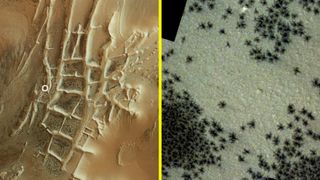
Mars' Inca City formation (left) is overrun with rounds of black 'spiders' (right), a regular springtime phenomenon on the Red Planet

(Image credit: ESA/DLR/FU Berlin (left) ESA/TGO/CaSSIS (right))

Every spring, thousands of squiggly black "spiders" emerge from their hibernation near the Martian south pole. No, they are not real spiders — they are not alive at all, of course. The seasonal phenomenon is a result of buried carbon dioxide ice sublimating, or turning to gas, as the weather warms. The newly released gas bursts through layers of surface ice, carrying with it dark dust that splatters across the ground in craggy patterns. To be visible from space, as these formations are, the "spiders" must be fairly big — each one measuring 150 to 3,300 feet (45 meters to 1 kilometer) across, according to the European Space Agency (ESA). Please, nobody tell Ziggy Stardust the bad news.

8. Ruins of an "Inca City"

An image of Mars from above showing a linear network of ridges reminiscent of Inca ruins.

(Image credit: ESA/DLR/FU Berlin)

Near the Martian south pole are curious structures that look like the ruins of a vast and ancient city. Dubbed the "Inca City" for its resemblance to actual ruins discovered in South America, the bizarre rock formation may be made of elevated sand dunes that turned to stone over time, according to ESA. However, its exact origins remain a mystery. The labyrinthine formation appears to curve, forming part of a giant circle 53 miles (86 km) in diameter, leading scientists to suspect it may be part of a much larger impact crater from a meteor strike ages ago.

9. An ancient smiley face

A pink smiley face with meteor craters for eyes on the surface of mars

(Image credit: ESA/TGO/CaSSIS)

Did someone spray-paint a grinning face onto the Martian surface? Not quite, despite what it looks like in this infrared image snapped by ESA's ExoMars Trace Gas Orbiter. Visible only under certain conditions, the face seen here is actually the remnants of an ancient lake, outlined by chloride salt deposits and dotted with two meteor crater eyes. While no Martian graffiti artists are going to pop up from the lake to claim their work, the face-like structure could contain evidence of ancient life on the Red Planet. As Mars' once-plentiful lakes dried up, the remaining water sources likely became very salty, possibly offering a haven for microbial life.

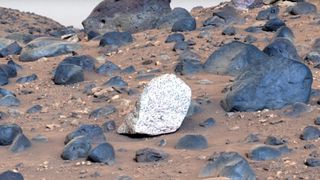
10. An extremely out-of-place rock
Light-toned Martian rock

(Image credit: NASA/JPL-Caltech/ASU/MSSS)

One of these things is not like the other. Standing out like a sore Martian thumb inside dusty Jezero Crater, this unusually white rock is the first of its kind ever seen on the Red Planet. Dubbed "Atoko Point" after a similarly light-colored feature of the Grand Canyon, the speckled rock is likely made of the minerals pyroxene and feldspar, according to an analysis by NASA's Perseverance rover. How did such a white rock find itself in such dark-hued company? It likely tumbled down from the crater rim or was transported to the crater floor from elsewhere on Mars back when rivers raged across the region.

11. A stony "Star Trek" symbol

The Curiosity rover from NASA captured a rock shaped as a

(Image credit: NASA/JPL-Caltech)

Looks like someone from Starfleet left their communicator badge on the Red Planet — or so it would appear from the familiar shape of this rock spotted by the Curiosity rover. The rock's delta shape is just a coincidence, according to NASA. It is one of thousands located on Mount Sharp, which Curiosity has been exploring for years in its search to uncover clues about Mars' past and whether it ever held the conditions for life.

12. A "tile floor"

Hundreds of polygon-shaped crack in the Martian surface

(Image credit: NASA/JPL-Caltech/MSSS/IRAP)

While scaling the slopes of Mount Sharp in 2021, NASA's Curiosity rover found remnants of what looks like a tile floor from a Martian bathroom. Dozens of interlocked polygons cracked through the dirt; most contain five or six sides and date to between 3.8 billion and 3.6 billion years ago. These jagged polygons are mud cracks, which have repeatedly dried out and moistened again over the course of untold years. They likely date to a time when the water level in the surrounding Gale Crater rose and fell repeatedly, causing the polygonal cracks in the ground to appear and disappear over time before a final dry spell left them as they are today.

13. Perfectly circular sand dunes

Almost perfectly circular sand dunes dot the surface of Mars.

(Image credit: NASA/JPL-Caltech/University of Arizona)

Mars is covered in dunes of all shapes and sizes, but few of them are as perfectly circular as the group spotted above by NASA's Mars Reconnaissance Orbiter in 2022. Snapped while flying over Mars' northern hemisphere, the image shows a bubbling patchwork of dark and strangely round dunes, slanting southward in the direction where the Martian wind likely blew them. Scientists are still not certain why these particular dunes are so circular or why they appear to be slowly migrating away from Mars' equator at a rate of roughly 3.3 feet (1 m) per Martian year (687 days on Earth).

14. A "shark fin" and a "crab claw"

(Left) a shark fin shaped rock on Mars (Right) an accompanying crab claw shaped boulder (Insert) NASA's Perseverance Rover.

(Image credit: NASA)

While trawling through Jezero Crater, NASA's Perseverance rover caught sight of a few fishy-looking rocks. The two odd boulders — one jutting upward like a shark fin, and the other crimped like a crab claw — surprised researchers. However, there isn't much mystery to them. They are just rocks, sculpted by the wind over billions of years and left in the Martian dust for pattern-seeking human minds to find.

15. A "floating spoon"

Is that really a floating spoon on Mars or just a strange rock?

(Image credit: NASA/JPL-Caltech/MSSS)

In 2015, NASA's Curiosity rover spotted what appeared to be a wooden spoon, floating in midair with a shadow on the ground beneath it. It was, of course, an optical illusion; the spoon is simply a rock, shaped by the wind over eons, also known as a ventifact. The handle of the spoony rock juts out from a larger formation, allowing the spoon's rounded tip to hover over the ground below, casting a distinct shadow beneath it.

16. An eerie "face"

The 1976 'Face on Mars' image from the Viking Orbiter.

(Image credit: NASA)

One of the earliest Martian rock formations to capture the public's interest was this infamous "face" spotted b{{ y NASA's Viking 1 satellite in 1976. While circling the planet looking for a landing site for its robotic companion, Viking 2, the satellite spotted a mound of rocks, partially obscured in shadow, distinctly resembling a human face. Follow-up observations with later spacecraft showed that the face was visible only from certain angles and under certain light conditions, proving that the Martian mound's humanlike appearance was just a trick of light and shadow.

{ https://www.livescience.com/ }

Hoe vind je dit bericht?
Geschreven door peter om 21:23 Stuur door

32 things on Mars that look like they shouldn't be there - PART II

32 things on Mars that look like they shouldn't be there - PART II

17. A "giant's fingerprint"

An image of the Airy-0 crater on Mars taken by the using the High-Resolution Imaging Science Experiment on NASA's Mars Reconnaissance Orbiter Sept. 8 2021.

(Image credit: NASA/JPL-Caltech/University of Arizona)

A long time ago, something slammed into the surface of Mars and left this enormous, ridged, thumbprint-like depression behind. A giant finger was not the culprit, of course. Located inside a much larger crater called Airy-0, this Martian hole is the result of an ancient meteor impact. The bright striations forming the "lines" of the fingerprint are a common sight across Mars. Known as transverse aeolian ridges, they are created when sand dunes get coated in a thin layer of dust. The dust likely contains reflective minerals, giving the depression its glowing appearance in this image.

18. A rock with an, er … crack

An image of a rock with a crack down the middle

(Image credit: NASA/JPL-Caltech/ASU)

Try not to laugh at this rock snapped by NASA's Perseverance rover in 2021. The cracked boulder became the butt of more than a few jokes after its close-up was first released to the public. There's really not much to see, though — the Red Planet is full of cracked rocks, albeit not quite as plump as this one. Perseverance spotted this rock in dusty Jezero Crater, on its 102nd day on Mars.

19. An "angel" and a heart

An angel-like province of red sediment has appeared near the south pole of Mars. What created it?

(Image credit: ESA)

When it's summertime on Mars, the angels come out to play. The Martian south pole is usually covered in an enormous ice cap, but when the ice melts in warmer weather, patterns in the ancient, red-hued sediment below come to light. This image, snapped by ESA's Mars Express spacecraft, shows an angel-like pattern next to a heart-shaped one. Both of these familiar-looking structures are the result of meteor impact craters that scraped away Mars' dusty topsoil to reveal the darker sediment below.

20. A weirdly green rock with "drill holes"

The Perseverance rover used its SuperCam laser to study this strange green rock on Mars.

(Image credit: NASA/JPL-Caltech)

Did a bored Martian teenager get a hold of his parents' power tools again? That is one (unlikely) explanation for a strange, green rock seemingly pumped full of drill holes that was spotted by NASA's Perseverance rover early in its mission. The roughly 6-inch (15 cm) rock looks out of place in its environment, and scientists aren't totally sure how to explain it. Perhaps it is the remnant of a meteor that collided with the Red Planet, or maybe it is a piece of Martian bedrock that was flung far across the world during an impact event. Most of the holes are also a mystery — but, if you look just right of center, you may see a small train of tiny, uniform pockmarks left by Perseverance's laser, which it fired at the rock while trying to analyze its composition.

21. A small "foreign object"

NASA's Mars rover Curiosity photographed this odd object on Aug. 13, 2018. Mission team members initially thought it might be a piece of the rover, but Curiosity's observations revealed it to be a rock flake.

(Image credit: NASA/JPL-Caltech/MSSS)

A small, rectangular object spotted in Mars' Gale Crater in 2018 briefly gave NASA scientists a scare. Looking vaguely like a dusty sheet of metal, the object was potentially thought to be a chunk of the Curiosity rover that had inexplicably fallen off. Luckily, a quick analysis showed that the "foreign object," as NASA initially dubbed it, was just a flake of rock that had split off of a larger formation and wasn't foreign to Gale Crater at all.

22. A strange, white tower

A black and white image of the surface of Mars with a small twister on the horizon (circled)

(Image credit: NASA/JPL-Caltech)

Towering over the Martian horizon in an image captured by NASA's Perseverance rover in 2023, a tall, white column stands against the dark, rocky background. It is, in fact, a Martian dust devil. And it's an enormous one: The dusty vortex captured here is taller than an average tornado on Earth and five times taller than the Empire State Building, according to NASA. Formed when rising cells of warm air meet falling columns of cool air, dust devils are exceedingly common on Mars — perhaps numbering as many as 145 million per day, one 2018 study estimated.

23. A "scar" longer than the Grand Canyon

A satellite photo of mars with a massive, curved crack in its surface

(Image credit: ESA/DLR/FU Berlin)

Gaping like a fresh wound in this image captured by ESA's Mars Express orbiter in 2024, the Martian feature known as Aganippe Fossa is a sight to behold. The deep, dark ravine stretches around 375 miles (600 km) long — longer than the Grand Canyon, which measures about 277 miles (446 km) long. Located near the base of an extinct volcano, the Martian canyon likely formed as the result of ancient volcanic activity — possibly when a large pool of magma beneath the volcano pushed violently upward, tearing the ground asunder, according to ESA.

24. "Rock candy," or ultra-rare crystals?

A photo showing a pile of rocks with yellow crystals inside

(Image credit: NASA/JPL-Caltech/MSSS)

These strangely colored crystals on Mars were discovered by pure accident. In May 2024, NASA's Curiosity rover drove over a small rock in its path, unintentionally crushing it. Buried within the stone tomb was a cache of rare minerals, including some never seen before on the Red Planet. The yellowish crystals are made of pure elemental sulfur. Scientists had long expected that this material existed on Mars but had no proof until Curiosity's bout of destructive driving.

25. A "bullet" hole

pit crater on Arsia Mons

(Image credit: NASA/JPL–Caltech/UArizona)

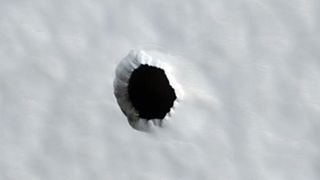
What looks like a hole blasted into the Martian landscape by a stray bullet may be something much more exciting — a possible refuge for future astronauts. The hole, which measures a few meters across, was imaged by NASA's Mars Reconnaissance Orbiter in 2022 on the flank of a massive volcano called Arsia Mons. The pit is located along a lava flow and appears to be a vertical shaft that could potentially connect to a deep system of caverns below the volcano. Although the hole's depth is unknown, it may be a tempting refuge for future astronauts who need a place to shield themselves from the intense radiation that beams down on the Red Planet.

26. An underground "dog"

A screenshot of the map showing the dog-shaped blob

(Ima creditge: Root et al.)

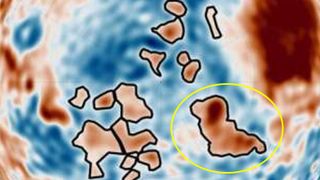
Strange structures don't appear only on Mars' surface but underground as well. In September 2024, researchers combined data from several Mars-orbiting spacecraft to create a planet-wide map of gravitational anomalies — places where the pull of gravity is stronger than average, suggesting the presence of massive, dense structures located under the planet's surface. Most of these dense blobs are amorphous, but one caught the researchers' attention: a strange, dog-shaped structure, with a dark tail and ears, located near the Martian north pole. It's unclear how the dense, doggy structure formed, but it could be related to a past meteor impact or a pile-up of volcanic material.

27. Debris from outer space?

'Ames Knob' Rock on Mars

(Image credit: NASA/JPL-Caltech/MSSS)

Nestled among the dusty, red rocks of Gale Crater, a jagged, gray object instantly caught the attention of scientists operating NASA's Curiosity rover. The shrapnel-like rock looks out of place because it almost certainly is — according to researchers, the pointy boulder is probably the remnant of a meteorite that crash-landed on Mars' surface ages ago. Dubbed Ames Knob and measuring about 4 inches wide by 5.5 inches long (10 by 14 cm), this meteorite isn't just space trash; according to NASA researchers, studying the rock could help reveal the past conditions on the planet when the meteorite fell, including whether it landed on land or in now-vanished water.

28. Debris … from Earth?

Perseverance's backshell and parachute can be seen in this image snapped by NASA’s Ingenuity helicopter during its 26th flight on April 19, 2022.

(Image credit: NASA/JPL-Caltech)

In 2022, NASA spotted what looked like the wreck of an "alien" spacecraft on Mars. In this case, the "aliens" were, in fact, Earthlings; the wreckage seen by NASA's Ingenuity Mars helicopter was a piece of the helicopter's own parachute and backshell, a saucer-like cover that helped slow the robotic craft's descent as it dropped onto the Red Planet along with the larger Perseverance rover. This piece of wrecked human technology, photographed by Ingenuity while it was flying 26 feet (8 m) above the Martian surface, looks particularly alien amid the desolate rocks and dust of the surrounding landscape.

29. An alien "egg"?

This dark, lumpy, golf ball-size object is an iron-nickel meteorite. NASA's Curiosity rover discovered it on Mars on Oct. 30, 2016.

(Image credit: NASA/JPL-Caltech/LANL/CNES/IRAP/LPGNantes/CNRS/IAS/MSSS)

From certain angles, this pockmarked rock looks like an oozing, green egg belonging to some unknown alien monster. But a quick analysis from NASA's Curiosity rover revealed that the odd boulder — dubbed Egg Rock — is actually a fragment of a meteorite that landed on the Red Planet at some unknown time in the past. Studying Martian meteorites like this one can reveal valuable clues about the planet's past but is unlikely to lead back to any extraterrestrial monster nests.

30. Swirling patterns

An image of the Martian mineral that scientists now think may have been created by volcanic eruptions, as seen from orbit.

(Image credit: NASA/Christopher Kremer/Brown University)

Strange patterns carved into the surface of Mars' Nili Fossae region aren't alien sand art or the Martian version of Peru's Nazca Lines. They are, in fact, mineral deposits containing large quantities of olivine, a mineral typically only found deep below the surface of Mars. How did so much olivine-rich rock reach the planet's surface? That question presents a tempting mystery for scientists. It could be that a huge asteroid impact excavated the Martian interior, bringing olivine to the surface in swirling splatters — or perhaps the subsurface mineral saw daylight following a massive volcanic eruption. Its precise origin remains a mystery to this day.

31. An alien monolith?

The Martian surface feature in question.

(Image credit: Image: NASA HiRISE; Arrow: thesun.co.uk)

When amateur stargazers were looking through images from NASA's Mars Reconnaissance Orbiter, they spotted something strange in the satellite's data: a bizarrely rectangular object reminiscent of the alien monolith from the opening scene of "2001: A Space Odyssey." The perplexing feature is indeed monolithic in shape and size, according to mission scientists. However, it is likely nothing more than a big, perfectly rectangular rock.

32. A crawling robot

The HiRISE camera aboard NASA's Mars Reconnaissance Orbiter captured this photo of the Curiosity rover ascending Mont Mercou on April 18, 2021.

(Image credit: NASA/JPL-Caltech/UArizona)

Spotted from miles above by NASA's Mars Reconnaissance Orbiter, a crawling metallic robot glints on the Martian surface far below. This is a rare case where the mystery object is exactly what it looks like; that robot is NASA's Curiosity rover, making its way up Mount Sharp several years into its mission to explore the Red Planet. Concrete evidence that Mars ever held life is still lacking — but at least we can say Mars is the only known planet in the universe inhabited exclusively by robots.

RELATED VIDEOS

Everything Discovered On Mars So Far
Hoe vind je dit bericht?
Geschreven door peter om 21:21 Stuur door

NASA’s Mars Reconnaissance Orbiter Has Captured Images of Something Odd Carved into the Martian Landscape

NASA’s Mars Reconnaissance Orbiter Has Captured Images of Something Odd ...

(NASA / JPL-Caltech / University of Arizona_

NASA’s Mars Reconnaissance Orbiter Has Captured Images of Something Odd Carved into the Martian Landscape

NASA’s Mars Reconnaissance Orbiter recently captured images of an odd-looking series of ridged lines carved into the landscape of the Red Planet, the U.S. space agency recently announced.

Designed to aid in the search for water on Mars and assist missions to the planet with its high-quality imaging capabilities, since its launch in 2006 the Mars Reconnaissance Orbiter, or MRO, has collected information from its position in orbit above the Red Planet.

On August 18, the MRO captured a series of unusual, ridged lines that appeared to be carved into the Martian landscape, as can be seen in the image below.

Mars Reconnaissance Orbiter The unusual-looking ridged lines scoring the Martian surface were captured in August by the Mars Reconnaissance Orbiter (Credit: NASA / JPL-Caltech / University of Arizona)

However, these aren’t evidence of remnants from roadways built by ancient Martians; the curious-looking lines are a natural formation, produced by the subtle movement of ice on the planet’s surface.

Generally, ice deposits located on the surface of Mars accumulate in the greatest abundance around the planet’s polar caps. However, in the past these odd-looking ridged patterns have been found in other regions on the surface of the Red Planet as well, revealing the presence of ice on the planet’s surface in various other regions.

The ridges form as ice naturally flows downhill, moving soil and stony deposits from their positions along the Martian landscape as it goes. However, it isn’t a fast process; this gradual movement of ice that shifts the Martian soil as it flows can take several thousands of years, processes that imagery collected by the MRO can help to shed light on, as well as reveal their history.

With its ongoing studies, the MRO continues to scour the surface of Mars from its position in orbit in search of water, as well as mineral formations and evidence of water beneath the planet’s surface. The MRO also monitors daily weather patterns on the Red Planet and collects information about where minerals and water may have existed on the planet in the past.

Such information could be useful for future crewed space missions to Mars, and may also provide astrobiologists with crucial information that may help in the search for evidence of life—past or present—on the planet.

{ https://thedebrief.org/category/space/ }

Hoe vind je dit bericht?
Geschreven door peter om 01:05 Stuur door

Elizondo & Tom Delonge Found Photos Of Italian Helicopter Destroyed By UFO In 2004

Italian Helicopter Destroyed By UFO In 2004

Elizondo & Tom Delonge Found Photos Of Italian Helicopter Destroyed By UFO In 2004

In 2003 and 2004, a series of unexplained fires broke out in Canneto di Caronia, Sicily, Italy. These fires were seen in household objects such as fridges, TVs, and mobile phones. The phenomenon attracted the attention of residents and dozens of experts, including scientists, electrical engineers, and military personnel.

Investigations ruled out arson, and an amazed scientist reported witnessing an unplugged electrical cable burst into flames. Locals blamed supernatural forces, and the Vatican’s chief exorcist even weighed in, stating that the fires could be caused by demons occupying electrical goods. (Source)

A leaked interim report by the Italian Civil Protection Department, conducted with the involvement of a NASA scientist and ordered by the government, concluded that the most likely cause of the fires was “aliens.” The report estimated the cost of the two-year investigation at $1.2 million.

According to the report, the fires were caused by high-power electromagnetic emissions with a power of 12 to 15 gigawatts, which were not man-made. The report also cited a possible unidentified flying object (UFO) landing near the village, with burnt imprints found in a field that could not be explained.

Francesco Mantegna Venerando, Sicily’s Civil Protection chief, stated that they were still working on their conclusions. He noted that while they were not claiming little green men from Mars caused the fires, they were considering the possibility of unnatural forces producing a large amount of electromagnetic energy. Another possibility being explored was the testing of top-secret weapons by an unknown power capable of producing an enormous amount of energy.

In April 2004, when a series of mysterious fires broke out, the Italian Military became involved since there had been several reports by fishermen of luminous objects at night flying over and going into the sea. The Military detected a UFO on the radar, but they could not make visual confirmation from the ground. So, they sent a helicopter to investigate everything.

Canneto di Caronia UFO
Vedruccio showed Elizondo a photo showing the claimed UFO on the left and the helicopter in question on the right

In the “Unidentified: Inside America’s UFO Investigation” series (Season 1 Episode 6), former Director of Advanced Aerospace Threat Identification Program (AATIP) Luis Elizondo and Tom Delonge paid a visit to Rome, where they discovered shocking details about the 2004 Sicily UFO attack.

Lt. Col. Clarbruno Vedruccio of the Italian Navy’s Special Forces shared a story about a series of spontaneous fires in Sicily in 2004 and how a UFO approached the helicopter and fired a beam forced the pilots to make an emergency landing.

Read also:

“In 2004, in Sicily, a craft appeared a few hundred meters behind the copter tail and it shot an (electromagnetic) ray that destroyed the helicopter wings. The signal was absolutely directional. It was a beam. On a certain band of frequencies. Then we discovered that when they use their energy weapons, they must go outside stealth mode. We could see them on a certain band of (electromagnetic) frequencies.” […] “You could use the same frequency to provide a radio beacon to call them, to attract them. To show them that we have understood their technology,” said Lt. Col. Clarbruno Vedruccio.

Once the helicopter approached the coordinates, the UFO revealed itself, coming out of stealth mode. Officials said the helicopter was chased by a saucer-shaped UAP that shot a powerful, focused electromagnetic beam at its rotors. It fried them enough to disable the helicopter and force it to crash land. They figured out that the source of the spontaneous fires was an electromagnetic frequency from the sea. About 80 kilometres offshore and deep underwater really surprised Elizondo, as he was quite aware of underate sightings.

Elizondo said: “They were very pointed, in a matter of fact, that these things had been kind of plaguing them for some time. One individual, in particular, provided some very, very detailed information to include some analysis on frequency. I hate to say it, but they may have more information than we do, even in the US potentially.”

Another incident involved Captain Achille Zaghetti and his co-pilot, who encountered a 10-foot-long, khaki-colored UFO while flying from Milan to Heathrow. Capt. Zaghetti, recounting the 1991 event above Lydd, Kent, told Italian journalists: “It was shaped like a cigar and passed very close about 300 meters on the right, or 1,000ft.” (Source)

“The color was military beige. We guessed that it was around three meters long. It was approximately 8 or 9 p.m., when it was still bright at altitude but pitch black on the ground,” said Captain Zaghetti, who resides in Grosseto, Tuscany.

“It could have caused a terrible accident. If you’re flying at 700 kilometers an hour, hitting an object of 1kg is like hitting something which weighs 700kg.” Air traffic controllers at Heathrow spotted the UFO on the radar while directing a British Airways jet into the airport.

Capt Zaghetti claimed the object was not a weather balloon and resembled instead the sort of long-distance fuel tanks that fighter aircraft sometimes carry.

He was later contacted by a counter-terrorism official from an American agency who asked for more details about the encounter. He said he was glad his co-pilot had seen the UFO as well, because he did not want to be accused of being a fantasist. “And we had to visit the doctors every six months,” Capt Zaghetti added, saying there were no doubts about his health at the time.

“Had any foreign adversary attacked a military helicopter of another nation, that could surely be a sign of aggression, and maybe potentially an act of war. So that’s a big deal,” Elizondo said. So are the world militaries engaged in combat with UFOs? It was not the first time UFO attacked man-made crafts and missiles.

For 18 years, Robert Jacobs, a former US Air Force officer, had been participating in the official United States Government-ordered UFO cover-up. The cover-up was about the UFO shooting down one of the ballistic missiles back in 1964 in Big Sur, California. He claimed that his colleagues had ridiculed him for writing about this cover-up that appeared in The National Enquirer. (Click here to read full article)

According to him, the warhead was approached by a UFO and fired a beam of light from different directions. Subsequently, the warhead malfunctioned and tumbled out of sub orbit hundreds of miles short of its target. “This… unidentified flying… thing had apparently shot down an American dummy atomic warhead,” Dr. Jacobs said.

{ https://howandwhys.com/ }

Hoe vind je dit bericht?
Geschreven door peter om 22:17 Stuur door

Former Air Force Pilot Claims He Worked For Secret UFO Retrieval Program

Former Air Force Pilot Claims He Worked For Secret UFO Retrieval Program

Hoe vind je dit bericht?
Geschreven door peter om 20:51 Stuur door

Lehto & Forbes Reveal Zero Point Energy Secrets: UFO Tech Unveiled!

Lehto & Forbes Reveal Zero Point Energy Secrets: UFO Tech Unveiled!

The intersection of advanced physics, zero-point energy, and UFO technology is an area of growing intrigue. In a groundbreaking discussion, Chris Lehto and Ashton Forbes delve deep into the science behind these enigmatic topics. Their dialogue explores how suppressed innovations in zero-point energy could revolutionize humanity’s understanding of the universe and the mysteries surrounding UFO technology.

What Is Zero Point Energy?

Zero-point energy (ZPE) refers to the latent energy present in the quantum vacuum of space. Unlike traditional energy sources, ZPE is not derived from matter but from the fabric of the universe itself. This idea challenges many assumptions of classical physics, suggesting that space is not empty but filled with a vast, untapped ocean of energy. As Lehto and Forbes note, this energy could power advanced technologies, including anti-gravity propulsion systems, if harnessed effectively.

The Ether Revisited

Historical scientific debates often dismissed the concept of an “ether” as the medium through which light waves travel. However, Lehto and Forbes argue that the ether is synonymous with the modern understanding of zero-point energy. Revisiting these ideas through advanced experiments, they highlight that gravity, inertia, and even the speed of light could be influenced by the energy density of the ether.

Forbes connects this concept to the Michelson-Morley experiment, which historically concluded that no ether existed. However, he suggests that revisiting the experiment from a different perspective could reveal that the ether is real and foundational to our understanding of physics.


The Implications for UFO Technology

One of the central themes of the discussion is how zero-point energy could explain the propulsion systems of unidentified flying objects (UFOs). Traditional propulsion relies on fuel and combustion, whereas UFOs appear to defy these limitations, achieving rapid acceleration and abrupt directional changes without visible exhaust. Forbes and Lehto propose that these movements are consistent with an advanced understanding of physics, where gravitational manipulation and high-frequency gravitational waves come into play.

This technology, they suggest, has been hidden from public knowledge for decades. The reasons for this secrecy range from national security concerns to fears of misuse. However, both Lehto and Forbes advocate for greater transparency, arguing that the potential benefits of zero-point energy—including free, limitless power—far outweigh the risks.

Challenges in Mainstream Acceptance

Lehto and Forbes emphasize the societal resistance to groundbreaking scientific ideas. Historically, major advancements like heavier-than-air flight and quantum mechanics were initially dismissed. Similarly, concepts like zero-point energy and warp drives are often ridiculed, despite mounting evidence supporting their plausibility.

A key obstacle is the academic and institutional gatekeeping in science, where peer review processes often stifle unconventional ideas. Lehto and Forbes call for a cultural shift that encourages curiosity and challenges entrenched assumptions, making science accessible and exciting for future generations.

The Role of Disclosure

The conversation also touches on the importance of full disclosure regarding UFOs and advanced technologies. While acknowledging the risks, Lehto and Forbes argue that humanity cannot fully progress without addressing these hidden truths. They caution that withholding knowledge about zero-point energy and its potential applications perpetuates inequality and slows innovation.

Lehto & Forbes EXPOSE Zero Point Energy UFO Secrets!

Moreover, they highlight the ethical implications of using advanced technologies for destructive purposes, such as high-frequency scalar weapons. Transparency, they argue, is the only way to ensure that these technologies benefit humanity rather than endanger it.

The Future of Zero Point Energy

Lehto and Forbes remain optimistic about the future. They believe that as awareness grows and more people engage with these ideas, the potential for breakthroughs increases. They encourage a renewed focus on physics and engineering, particularly among young people, to drive humanity toward a more advanced and equitable future.

Their message is clear: Zero-point energy is not just a theoretical concept but a pathway to unlocking the universe’s mysteries and transforming our way of life.


Zero-Point Energy Demystified

{ https://www.latest-ufo-sightings.net/ }

Hoe vind je dit bericht?
Geschreven door peter om 20:06 Stuur door

Area 51: Het Mysterie en de Waarheid Achter de Verboden Basis

 Area 51: Het Mysterie en de Waarheid Achter de Verboden Basis

een replica van een waarschuwingsboord bij area 51 in nevada in de verenigde staten

BrianPIrwin//Getty Images

Inleiding

Area 51, een afgelegen militaire basis in Nevada, is een van de meest omstreden en mysterieuze locaties ter wereld. Het heeft talloze speculaties, complottheorieën en fascinatie opgewekt sinds het in de jaren vijftig werd opgericht. Hoewel de basis officieel bekend staat als het Nevada Test and Training Range, is het vooral beroemd vanwege de vermeende connecties met buitenaardse technologie en UFO-waarnemingen. Dit artikel verkent de geschiedenis, de mythes en de realiteit van Area 51.

1. De Geschiedenis van Area 51

260px-Area_51_28_August_1968_2.jpg

Satellietfoto van Area 51 op 28 augustus 1968

Area 51 werd in 1955 opgericht door de Amerikaanse luchtmacht. De basis was aanvankelijk bedoeld voor het testen van de U-2 spionagevliegtuig, dat een cruciale rol speelde tijdens de Koude Oorlog. De afgelegen locatie, omgeven door bergen en woestijn, bood de perfecte omgeving om militaire technologie in het geheim te ontwikkelen en te testen.

In de jaren zestig werd de basis verder uitgebreid met de ontwikkeling van de A-12 Oxcart, een geavanceerd spionagevliegtuig. De geheimhouding rond de basis was zo intens dat zelfs de naam "Area 51" pas in de jaren negentig officieel werd bevestigd. Voor die tijd werd het vaak aangeduid als "Dreamland" of "Watertown".

260px-Wfm_area51_map_en.png

Het Nellis Air Force Base Complex, met de Nellis Air Force Range, de Nevada Test Site (Nevada National Security Site) en het daartussen gelegen Area 51, dit alles ten noordwesten van de Nellis Air Force Base

2. De Opkomst van de Mythologie

Met de opkomst van de UFO-cultuur in de jaren vijftig en zestig, begon Area 51 een centrale rol te spelen in complottheorieën. De legendarische Roswell-incident in 1947, waarbij een vermeende UFO neergestort zou zijn, droeg bij aan de opbouw van een mystieke aura rond de basis. Veel mensen geloofden dat de Amerikaanse overheid buitenaardse technologie en zelfs buitenaardse wezens op de basis had opgeslagen.

Een van de meest prominente figuren in de UFO-gemeenschap is Robert Lazar, die in 1989 beweerde dat hij had gewerkt aan reverse engineering van buitenaardse technologie bij Area 51. Lazar's verklaringen waren schokkend en leidden tot een golf van belangstelling en speculatie over wat er werkelijk op de basis gebeurde.

Area 51 Is the Internet's Latest Fascination: Here's Everything About the Mysterious Site | TIME

3. De Rol van de Media

De media hebben een aanzienlijke rol gespeeld in het creëren van de mythe rond Area 51. Documentaires, boeken en films hebben de fantasieën van het publiek gevoed. Sinds de jaren negentig zijn er talloze documentaires verschenen, waaronder de populaire serie "Ancient Aliens", die de link tussen Area 51 en buitenaardse wezens verder heeft versterkt.

De pers heeft ook bijgedragen aan de geheimhouding van de basis. Journalisten die probeerden informatie over Area 51 te verkrijgen, werden vaak geconfronteerd met juridische dreigingen en intimidatie van de overheid. Dit heeft de speculaties alleen maar aangewakkerd en geleid tot de overtuiging dat er iets te verbergen viel.

4. De Waarheid Achter de Mythen

Ondanks de vele theorieën en geruchten, heeft de Amerikaanse overheid nooit officieel bevestigd dat er buitenaardse technologie of wezens op Area 51 aanwezig zijn. Wat we wel weten, is dat de basis voornamelijk wordt gebruikt voor militaire doeleinden, waaronder de ontwikkeling van geavanceerde luchtvaartuigen en technologieën.

In 2013 declassificeerde de CIA een aantal documenten die bevestigden dat Area 51 werd gebruikt voor het testen van spionagevliegtuigen, zoals de U-2 en de A-12. Deze onthullingen gaven een zekere mate van duidelijkheid over de activiteiten op de basis, maar ze ontkrachtten de mythen over buitenaardse technologie.

5. De Impact van Area 51 op de Populaire Cultuur

Area 51 heeft een blijvende invloed gehad op de populaire cultuur. Films, boeken en videogames hebben het mysterie van de basis benut om spannende verhalen te creëren. Van sciencefictionfilms zoals "Independence Day" tot populaire videogames zoals "Call of Duty" en "Grand Theft Auto", de basis is een terugkerend onderwerp dat de verbeelding van mensen blijft prikkelen.

Bovendien heeft de online cultuur bijgedragen aan de verspreiding van informatie en desinformatie over Area 51. Sociale media en forums zoals Reddit hebben een platform geboden voor discussies over UFO's en complottheorieën, waardoor de mythe rondom de basis verder is gegroeid.

6. De Toekomst van Area 51

Met de voortschrijdende technologie en de toenemende interesse in ruimteverkenning, is het waarschijnlijk dat Area 51 een centrale rol zal blijven spelen in de discussie over buitenaards leven en militaire technologie. De recente onthullingen over UFO-waarnemingen door militaire piloten hebben de belangstelling voor het onderwerp nieuw leven ingeblazen.

De overheid heeft in de afgelopen jaren enkele van deze waarnemingen erkend en onderzocht, wat heeft geleid tot een nieuwe golf van speculatie over wat er werkelijk in de lucht gebeurt. Dit heeft de vraag doen rijzen of Area 51 ooit meer geheimen zal onthullen of dat het altijd een mysterie zal blijven.

Conclusie

Area 51 blijft een fascinerend onderwerp dat de nieuwsgierigheid van mensen over de hele wereld blijft prikkelen. De combinatie van militaire geheimhouding, UFO-mythologie en populaire cultuur heeft geleid tot een rijke en complexe geschiedenis die nog steeds in ontwikkeling is. Of je nu gelooft in buitenaardse wezens of niet, het mysterie van Area 51 zal ongetwijfeld voortleven in de harten en geesten van velen.

De basis vertegenwoordigt niet alleen een plek van geheimhouding, maar ook een symbool van de menselijke nieuwsgierigheid naar het onbekende. Terwijl we de toekomst ingaan, zal de zoektocht naar waarheid en begrip over Area 51 en de mysteries van het universum blijven voortduren.

{ PETER2011 }

Hoe vind je dit bericht?
Geschreven door peter om 22:40 Stuur door

Ontvoeringen door Aliens: De Waarheid Achter het Mysterie

Ontvoeringen door Aliens: De Waarheid Achter het Mysterie

Realistic Alien Life

Inleiding

Het fenomeen van ontvoeringen door aliens is een onderwerp dat de verbeelding van mensen over de hele wereld al tientallen jaren bezighoudt. Van mysterieuze verhalen tot diepgaande onderzoeken, deze ontvoeringen hebben geleid tot tal van speculaties en theorieën. In dit artikel zullen we de geschiedenis, getuigenissen, mogelijke verklaringen en de impact van deze ontvoeringen op de samenleving onderzoeken.

Geschiedenis van Alien Ontvoeringen

De moderne verhalen over ontvoeringen door aliens begonnen in de jaren '50 van de 20e eeuw. Een van de bekendste gevallen is dat van Betty en Barney Hill, een Amerikaans paar dat in 1961 beweerde te zijn ontvoerd door een UFO. Hun verhaal omvatte gedetailleerde beschrijvingen van hun ontvoerders en de omstandigheden waarin ze werden vastgehouden. Dit geval vormde de basis voor veel van de latere ontvoeringsverhalen.

In de jaren '70 en '80 nam het aantal meldingen van ontvoeringen toe. Mensen over de hele wereld begonnen vergelijkbare ervaringen te delen, vaak met opmerkelijke overeenkomsten. Deze verhalen bevatten vaak elementen zoals medische onderzoeken, telepathische communicatie en het gevoel van tijdverlies.

Bekende Gevallen van Ontvoeringen

1. Betty en Barney Hill

THE UFO INCIDENT (Betty and Barney Hill abduction case 1961)

Het verhaal van Betty en Barney Hill is een van de meest gedocumenteerde ontvoeringen. Het paar reed in september 1961 terug naar huis van een vakantie in Canada, toen ze een heldere licht in de lucht zagen. Na het voorval ervoeren ze een tijdsverlies van enkele uren en herinnerden ze zich vage details van hun ontvoering. Tijdens hypnose onthulden ze gruwelijke details over hun ervaringen aan boord van een ruimteschip.

2. Travis Walton

ALIEN CHRONICLES (S1E11) - TRAVIS WALTON - ALIEN AND UFO ENCOUNTERS

In 1975 werd boswerker Travis Walton ontvoerd terwijl hij met zijn collega's aan het werk was in Arizona. Zijn vrienden verklaarden dat ze een fel licht zagen en Walton verdween. Na vijf dagen werd hij weer gevonden, en hij had een angstaanjagend verhaal over zijn tijd aan boord van een UFO. Walton's geval is sindsdien omgevormd tot een populaire film, "Fire in the Sky".

3. Kelly Cahill

The Kelly Cahill Alien Abduction

In 1993 beweerde Kelly Cahill dat ze tijdens een rit in Australië werd ontvoerd door aliens. Ze vertelde over haar ontmoeting met een ruimteschip en de buitenaardse wezens die haar benaderden. Cahill's ervaring omvatte visioenen en een gevoel van terror. Haar getuigenis is uniek omdat ze beschrijvingen gaf van de buitenaardse wezens die overeenkwamen met andere getuigenissen.

Gemeenschappelijke Kenmerken van Ontvoeringen

Veel verhalen over ontvoeringen door aliens bevatten vergelijkbare elementen. Dit zijn enkele van de meest voorkomende kenmerken:

1.Medische Onderzoeken

Vele slachtoffers beweren dat ze medische onderzoeken ondergaan hebben terwijl ze vastgehouden werden. Dit omvat vaak het afnemen van monsters, zoals bloed of huidcellen. Sommige getuigen beschrijven zelfs het gevoel van een naald die in hun lichaam wordt gestoken.

2. Tijdverlies

Een ander veelvoorkomend thema is het gevoel van tijdverlies. Slachtoffers melden vaak dat ze uren of zelfs dagen kwijt zijn terwijl ze denken dat er slechts enkele minuten zijn verstreken. Dit fenomeen heeft geleid tot speculaties over de manier waarop aliens de tijd kunnen manipuleren.

3. Telepathische Communicatie

Veel getuigen beweren dat ze telepathisch konden communiceren met hun ontvoerders. Dit betekent dat ze gedachten en gevoelens konden uitwisselen zonder woorden te gebruiken. Dit aspect van de ontvoering heeft geleid tot de hypothese dat buitenaardse wezens een hogere ontwikkeling hebben dan mensen.

Psychologische Verklaringen

Er zijn verschillende psychologische verklaringen voor het fenomeen van alienontvoeringen. Sommige onderzoekers suggereren dat deze ervaringen kunnen voortkomen uit slaapparalyse, waarbij mensen ontwaken maar niet in staat zijn om te bewegen. Dit kan een gevoel van angst en hallucinaties veroorzaken, wat kan leiden tot ontvoeringsverhalen.

Daarnaast zijn er theorieën over valse herinneringen, waarbij mensen onjuiste herinneringen ontwikkelen door suggestie of invloeden van buitenaf. Het gebruik van hypnose om herinneringen op te roepen heeft ook geleid tot controverses, aangezien het kan resulteren in het creëren van vervalste herinneringen.

Culturele Impact

Het fenomeen van alienontvoeringen heeft een aanzienlijke impact gehad op de populaire cultuur. Films, boeken en televisieprogramma's hebben deze verhalen verder verspreid en het publiek gefascineerd. De invloed is zo groot dat het idee van ontvoeringen door aliens een integraal onderdeel is geworden van de sciencefictiongenre.

Bovendien heeft het fenomeen geleid tot de oprichting van verschillende organisaties en clubs die zich richten op het onderzoeken van UFO-waarnemingen en ontvoeringen. Deze groepen bieden vaak ondersteuning aan mensen die denken dat ze zijn ontvoerd, en ze proberen de waarheid achter deze ervaringen te achterhalen.

Wetenschappelijk Onderzoek

Hoewel veel wetenschappers het fenomeen van alienontvoeringen als onwaarschijnlijk beschouwen, zijn er enkele die het serieus onderzoeken. Het is een complex onderwerp dat de grenzen van wetenschap en geloof raakt. Onderzoekers hebben geprobeerd om patronen en gemeenschappelijke elementen in ontvoeringsverhalen te identificeren.

In de afgelopen jaren zijn er verschillende studies uitgevoerd die probeerden de psychologische en sociologische aspecten van ontvoeringen te begrijpen. Deze studies hebben aangetoond dat veel getuigen een sterke behoefte hebben om hun verhalen te delen, wat kan helpen bij hun verwerking van de ervaring.

Kritiek en Skepsis

Er is veel kritiek en scepsis rond het fenomeen van alienontvoeringen. Veel skeptici wijzen op het gebrek aan concreet bewijs en beschouwen de verhalen als verzinsels of hallucinaties. Critici wijzen ook op de mogelijkheid van collectieve illusies, waarbij groepen mensen vergelijkbare ervaringen delen zonder dat er een feitelijke basis voor is.

Wetenschappers hebben herhaaldelijk gepleit voor een rationele benadering van het onderwerp en benadrukken dat persoonlijke getuigenissen niet altijd betrouwbaar zijn. De afwezigheid van fysiek bewijs maakt het moeilijk om deze claims serieus te nemen.

Conclusie

Het fenomeen van ontvoeringen door aliens blijft een intrigerend onderwerp dat zowel fascinatie als scepsis oproept. Of het nu gaat om persoonlijke verhalen van slachtoffers of wetenschappelijke onderzoeken, het blijft een mysterie dat ons uitdaagt om na te denken over de mogelijkheden van buitenaards leven en onze eigen realiteit.

Terwijl de discussie over dit onderwerp voortduurt, blijft de vraag bestaan: zijn we echt alleen in het universum, of zijn er andere wezens die ons observeren en misschien zelfs met ons communiceren? De waarheid is misschien nog steeds daarbuiten, wachtend om ontdekt te worden.

{ PETER2011 }

Hoe vind je dit bericht?
Geschreven door peter om 22:22 Stuur door

Hubble’s Photomosaic of Andromeda Galaxy Unveils Hundreds of Millions of Stars

Hubble’s Photomosaic of Andromeda Galaxy Unveils Hundreds of Millions of Stars

A century ago, the American astronomer Edwin Hubble first established that this so-called ‘spiral nebula’ was approximately 2.5 million light years away from our Milky Way Galaxy. Now, the NASA/ESA Hubble Space Telescope has accomplished the most comprehensive survey of the Andromeda galaxy. It took more than 10 years to collect data for this colorful portrait, which captures the glow of 200 million stars, and was created from more than 600 snapshots.

This the largest photomosaic ever assembled from Hubble observations. It is a panoramic view of the neighboring Andromeda galaxy, located 2.5 million light-years away. Image credit: NASA / ESA / B. Williams, University of Washington.

This the largest photomosaic ever assembled from Hubble observations. It is a panoramic view of the neighboring Andromeda galaxy, located 2.5 million light-years away.

Image credit: NASA / ESA / B. Williams, University of Washington.

The Andromeda galaxy (Messier 31), which is located 2.5 million light-years away, is the Milky Way’s nearest large galactic neighbor.

Hubble’s sharp imaging capabilities can resolve more than 200 million stars in the galaxy, detecting only stars brighter than our Sun. They look like grains of sand across the beach. But that’s just the tip of the iceberg.

Andromeda’s total population is estimated to be one trillion stars, with many less massive stars falling below Hubble’s sensitivity limit.

“Photographing Andromeda was a herculean task because the galaxy is a much bigger target on the sky than the galaxies Hubble routinely observes, which are often billions of light-years away,” said University of Washington astronomer Zhuo Chen and colleagues.

“The full mosaic was carried out under two Hubble observing programs. In total it required over 1,000 Hubble orbits, spanning more than a decade.”

“This panorama started with the Panchromatic Hubble Andromeda Treasury (PHAT) program about a decade ago.”

The Andromeda galaxy is seen almost edge-on, tilted by 77 degrees relative to Earth’s view; interesting regions include: (a) clusters of bright blue stars embedded within the galaxy, background galaxies seen much farther away, and photo-bombing by a couple bright foreground stars that are actually inside our Milky Way; (b) NGC 206 is the most conspicuous star cloud in Andromeda; (c) a young cluster of blue newborn stars; (d) the satellite galaxy M32, that may be the residual core of a galaxy that once collided with the Andromeda galaxy; (e) dark dust lanes across myriad stars. Image credit: NASA / ESA / B. Williams, University of Washington.

The Andromeda galaxy is seen almost edge-on, tilted by 77 degrees relative to Earth’s view; interesting regions include: (a) clusters of bright blue stars embedded within the galaxy, background galaxies seen much farther away, and photo-bombing by a couple bright foreground stars that are actually inside our Milky Way; (b) NGC 206 is the most conspicuous star cloud in Andromeda; (c) a young cluster of blue newborn stars; (d) the satellite galaxy M32, that may be the residual core of a galaxy that once collided with the Andromeda galaxy; (e) dark dust lanes across myriad stars.

Image credit: NASA / ESA / B. Williams, University of Washington.

“Images were obtained at near-ultraviolet, visible, and near-infrared wavelengths using Hubble’s Advanced Camera for Surveys (ACS) and the Wide Field Camera 3 (WFC3) to photograph the northern half of Andromeda.”

“This program was followed up by the Panchromatic Hubble Andromeda Southern Treasury (PHAST), which added images of approximately 100 million stars in the southern half of Andromeda.”

“This region is structurally unique and more sensitive to the galaxy’s merger history than the northern disk mapped by the PHAT survey.”

“The combined programs collectively cover the entire disk of Andromeda, which is seen almost edge-on — tilted by 77 degrees relative to Earth’s view.”

“The galaxy is so large that the mosaic is assembled from approximately 600 separate fields of view.”

  • The results are described in a paper in the Astrophysical Journal.
  • Zhuo Chen et al. 2025. PHAST. The Panchromatic Hubble Andromeda Southern Treasury. I. Ultraviolet and Optical Photometry of over 90 Million Stars in M31. ApJ 979, 35; doi: 10.3847/1538-4357/ad7e2b
RELATED VIDEOS

Video tour of Hubble’s panoramic view of the Andromeda Galaxy

Hubble Telescope’s Greatest Discoveries [4K]

What Scientists Discovered Deep Within the Andromeda Galaxy is Incredible! (4K)

{ https://www.sci.news/ }

Hoe vind je dit bericht?
Geschreven door peter om 20:58 Stuur door

Prime Minister of Grenada’s Push for UFO Disclosure at the UN in 1970s

Sir Eric M. Gairy, Prime Minister and Minister for Foreign Affairs of Grenada, addressing the General Assembly on 12 October, 1978.

Prime Minister of Grenada’s Push for UFO Disclosure at the UN in 1970s

We are familiar with the government officials, scientists, former intelligence officers, air force and navy personnel, journalists, politicians, and others who have been pushing for disclosure about UFOs, particularly since 2017.

However, the momentum for their current actions was built over decades, when similar clarion calls were issued for information about non-human intelligence by high-ranking individuals and influential personalities, often in the face of ridicule.

UFO2.jpg?itok=-JcoHycv

A congressional hearing on July 26, 2023, under the House Committee on Oversight and Accountability, with Ryan Graves, David Grusch, and David Fravor. 

(U.S. House Committee On Oversight and Accountability).

One of those prominent voices was that of Sir Eric Gairy, the late Prime Minister of Grenada, who through his untiring and spirited efforts in the 1970s brought humanity closer to learning the truth about the existence of extraterrestrial life.

Global Coalition for Disclosure

Sir Eric M. Gairy was the Prime Minister of Grenada—an island country of the West Indies dubbed the “Spice Isle”—from the mid to late-1970s. He held a slew of portfolios, including Minister for Foreign Affairs and Defense.

On November 27, 1978, Sir Eric made an unprecedented move for a head of state, then or in present times, when he led a group including scientists and an astronaut in addressing the United Nations General Assembly in New York on the subject of unidentified flying objects. He had brought a short film along with him, which consisted of still and motion pictures depicting actual sightings of UFOs.

An important milestone in the history of ufology, the official UFO Hearing held at the United Nations Special Political Committee witnessed the participation of notable international institutions, scientists, and military personnel.

Prior to delivering his speech at the UN, during a bilateral meeting with President Jimmy Carter in Washington on September 9, 1977, Eric Gairy had mentioned the UFO topic. Carter was no stranger to UFOs, as he is one of the few presidents who had a personal sighting of a strange craft. In 1969, he had observed an unusual aerial object in Leary, Georgia, and then proceeded to file an official report with the International UFO Bureau in 1973—though he did not claim it was an alien craft.

Moreover, during his 1976 election campaign, Carter told reporters that he would make public all reports of UFO sightings. But, once in office, he cited national security to distance himself from disclosure.

Back to Sir Eric: alluding to a resolution he had introduced on the agenda of the UN. General Assembly proposing an international study of UFOs, as well as a study of psychic and other related phenomena, Gairy asked President Carter if he could support it. He added that he had no doubt in his mind that, "…planet earth is not the only one God created."

Jimmy Carter, the President of the United States, meets Sir Eric Gairy, Prime Minister of Grenada in September 1977.

(White House) 

During his address to the United Nations General Assembly, the Grenadian prime minister said that he had come before the august body because of a "deep personal conviction" that UFOs were of "worldwide importance and significance".

Eric Gairy emphasized that the UN needed to, "...come alive to its responsibilities and take a serious look at the UFO phenomenon to which planet Earth has been conspicuously exposed since 1947". The prime minister then introduced a resolution, which would establish an expert group to formulate guidelines for a UN led study of unidentified flying objects.

UFO4.jpg?itok=v0CZrQn8

The United Nations General Assembly hall in New York City.

(Patrick Gruban/CC BY-SA 2.0)

Among other heavy-weight participants the UFO study panel included astronaut, Gordon Cooper; astronomer, J. Allen Hynek; astronomer and ufologist, Jacques Vallée; nuclear physicist, Stanton Friedman; astronomer and astrophysicist, Claude Poher; and Lieutenant Colonel Larry Coyne of the U.S. Army, who appeared in his private capacity.

Later, after gaining the approval of the panelists, Dr. Hynek presented a statement on their behalf on the need to initiate a centralized United Nations authority on unidentified flying objects. Interestingly, the graphics in the presentation given by NBC Radio producer and UFO researcher, Lee Speigel, — who was sponsored by Grenada to guide the initiative at the UN — were prepared by Steven Spielberg, who was at that time putting the finishing touches on his pathbreaking film ‘Close Encounters of the Third Kind.’

Dr. J. Allen Hynek and Dr. Jacques Vallée.

(United States Government)

It should be stressed that this major recognition of the UFO topic by the United Nations was in many ways not just the culmination of the determined endeavors of Sir Eric, but also a recognition of the sentiments he had expressed a year earlier to the U.N. General Assembly. Back in October 1977, Eric Gairy astonished the audience when he revealed, "...I have myself seen an unidentified flying object and I have been overwhelmed by what I have seen."

Sir Eric also noted, "...In the same way that this planet is the accepted inheritance of all humanity, knowledge is also to be shared for the benefit of all mankind... one wonders why the existence of UFO's continues to remain a secret."

A UN Secretary-General Gets Involved

It was no mean feat for Sir Eric Gairy to assemble a team of high-ranking experts from disparate fields, to impress upon the United Nations to grant the UFO phenomenon the importance it duly deserved.

However, it must be remembered that prior to Sir Eric’s move for disclosure, U. Thant, the third Secretary-General of the UN from 1961 to 1971 too made similar efforts. According to Press reports, he is said to have confided to his colleagues that he considered “UFOs the most important problem facing the UN next to the war in Vietnam.”

U Thant, Burmese diplomat and the third secretary-general of the United Nations.

(Anefo/CC BY-SA 3.0)

To address the matter Thant invited University of Arizona physicist, James E. McDonald, to brief the UN Outer Space Affairs group in New York in 1967. And so, McDonald attempted to persuade the UN to undertake a global study on the UFO phenomenon, urging any member nation to sponsor the research. That call was answered by Sir Eric Gairy, nearly a decade later.

A Chilling Extraterrestrial Encounter

Even though Sir Eric purportedly had a bizarre experience with an extraterrestrial in his home country, Grenada, a sudden and wholly unexpected turn of events halted the late prime minister from ensuring complete disclosure about alien life. Here’s how these events came to pass:

The tight-lipped approach regarding the subject of extraterrestrial life that governments across the world have adopted, primarily in the United States, is something that has flummoxed anybody who has ever pondered the need for such confidentiality on so vital a topic to humankind.

It is worth digging further to understand what prompted Sir Eric’s determination to know "...why the existence of UFO's continues to remain a secret."

These words gain great consequence when we learn they aren't merely exaggerated statements made by a world leader who was a UFO enthusiast, too. Strange as it sounds, well before his address at the United Nations and the eager push for UFO disclosure, Sir Eric claimed to have had his own personal encounter with an other-worldly being—albeit a dead one.

Image of a classic, metallic "Flying saucer" sourced from the U.S. National Archives and Records Administration.

(Public Domain).

On the night of the incident, Eric Gairy, who was spending his leisure hours in a popular Grenadian nightclub, the "Evening Palace", was taken aback to see a local fisherman burst in and excitedly say he'd come across an odd-looking humanoid that had washed up on the beach.

Eric, who was heavily interested in paranormal phenomena, quickly arranged a small military unit and a photographer. He then asked the man to lead him to the spot where the entity was found. Eric alleged later that when the investigating team arrived at the scene shortly before dawn, they witnessed a couple of fishermen at the site standing guard next to something covered by a tarpaulin.

An aerial photo of the island-nation, Grenada, in the eastern Caribbean Sea.

( Drkreative/CC BY-SA 3.0) 

When the men pulled the tarp back, Sir Eric and his group momentarily recoiled in horror, for their eyes beheld an inexplicable sight. An enormous humanoid creature nearly eight feet tall, with pale white skin and white braided hair, lay soaking wet and motionless. With the facial features of an adult human male, the bizarre being's hands had six digits each. This extraterrestrial entity was clothed in a dark blue, skin-tight, one-piece suit with footwear attached.

As the sun rose, it became apparent to Sir Eric and the assembled crew that the entire beach was littered with weird metallic debris. Eight boxes were identified, of which only two could be opened with considerable difficulty. These boxes contained aquatic flora and fauna—as though the dead creature was on a mission to collect the specimens for study.

Two trucks—one for the boxes and another for the giant—appeared on the scene, and the peculiar cargo was spirited away to an undisclosed location.

Although Sir Eric spoke about the incident in an interview, he never disclosed where the body had been taken nor what became of the containers retrieved along with it. And of course, he wasn't forthcoming about the photographs they'd clicked onsite.

Defeat in the Face of Victory

Prime Minister Eric Gairy earned a massive victory on December 18, 1978, when the UN General Assembly adopted Grenada's resolution to study the taboo subject of UFO's.

But, before any gains could be realized for the ufology community from the November 1978 UN resolution, Eric Gairy was dislodged from power in a bloodless coup in March 1979 - ironically, while he was away at the UN for further discussions with Secretary-General, Kurt Waldheim, about the recently adopted UFO resolution.

National flag of Grenada

(Public Domain)

The meeting was cancelled and subsequently, given the timing of the coup, conspiracy theorists blamed the UK for sabotaging Sir Eric's bid to gain transparency about unidentified flying objects (Sir Eric had been Grenada’s prime minister when the island gained its independence from the UK in 1974 ). At the UN Great Britain had raised objections to Grenada’s plan, stating, “The British delegation does not think that the establishment of an agency for research into unidentified flying objects is appropriate to the functions of the United Nations.” By and large the US remained neutral.

Sir Eric Gairy passed away in 1997 at the age of 75, and his efforts at shepherding UFO disclosure through the United Nations are widely recognized as one of his most memorable accomplishments as a political leader.

For now, all we are left with is speculation and great appreciation for Sir Eric's unwavering attempts to seek the truth. Or perhaps we have had disclosure all along; for as leading UFO researcher Grant Cameron observed, “Every leak by the government, every movie in Hollywood that has an alien theme, and every UFO joke by the president is a type of disclosure.”

  • Top Image: Sir Eric M. Gairy, Prime Minister and Minister for Foreign Affairs of Grenada, addressing the General Assembly on 12 October, 1978.
  • Source: United Nations.

By Anand N. Balaji

{ https://www.ancient-origins.net/unexplained-phenomena }

Hoe vind je dit bericht?
Geschreven door peter om 20:09 Stuur door

Meer van UFO'S of UAP'S, ASTRONOMIE, RUIMTEVAART, ARCHEOLOGIE, OUDHEIDKUNDE, SF-SNUFJES EN ANDERE ESOTERISCHE WETENSCHAPPEN - DE ALLERLAATSTE NIEUWTJES

↑ Terug naar de berichten