Naar de inhoud

UFO'S of UAP'S, ASTRONOMIE, RUIMTEVAART, ARCHEOLOGIE, OUDHEIDKUNDE, SF-SNUFJES EN ANDERE ESOTERISCHE WETENSCHAPPEN - DE ALLERLAATSTE NIEUWTJES

UFO's of UAP'S in België en de rest van de wereld
akke.beakke.be
Ontdek de Fascinerende Wereld van UFO's en UAP's: Jouw Bron voor Onthullende Informatie! Ben jij ook gefascineerd door het onbekende? Wil je meer weten over UFO's en UAP's, niet alleen in België, maar over de hele wereld? Dan ben je op de juiste plek! België: Het Kloppend Hart van UFO-onderzoek In België is BUFON (Belgisch UFO-Netwerk) dé autoriteit op het gebied van UFO-onderzoek. Voor betrouwbare en objectieve informatie over deze intrigerende fenomenen, bezoek je zeker onze Facebook-pagina en deze blog. Maar dat is nog niet alles! Ontdek ook het Belgisch UFO-meldpunt en Caelestia, twee organisaties die diepgaand onderzoek verrichten, al zijn ze soms kritisch of sceptisch. Nederland: Een Schat aan Informatie Voor onze Nederlandse buren is er de schitterende website www.ufowijzer.nl, beheerd door Paul Harmans. Deze site biedt een schat aan informatie en artikelen die je niet wilt missen! Internationaal: MUFON - De Wereldwijde Autoriteit Neem ook een kijkje bij MUFON (Mutual UFO Network Inc.), een gerenommeerde Amerikaanse UFO-vereniging met afdelingen in de VS en wereldwijd. MUFON is toegewijd aan de wetenschappelijke en analytische studie van het UFO-fenomeen, en hun maandelijkse tijdschrift, The MUFON UFO-Journal, is een must-read voor elke UFO-enthousiasteling. Bezoek hun website op www.mufon.com voor meer informatie. Samenwerking en Toekomstvisie Sinds 1 februari 2020 is Pieter niet alleen ex-president van BUFON, maar ook de voormalige nationale directeur van MUFON in Vlaanderen en Nederland. Dit creëert een sterke samenwerking met de Franse MUFON Reseau MUFON/EUROP, wat ons in staat stelt om nog meer waardevolle inzichten te delen. Let op: Nepprofielen en Nieuwe Groeperingen Pas op voor een nieuwe groepering die zich ook BUFON noemt, maar geen enkele connectie heeft met onze gevestigde organisatie. Hoewel zij de naam geregistreerd hebben, kunnen ze het rijke verleden en de expertise van onze groep niet evenaren. We wensen hen veel succes, maar we blijven de autoriteit in UFO-onderzoek! Blijf Op De Hoogte! Wil jij de laatste nieuwtjes over UFO's, ruimtevaart, archeologie, en meer? Volg ons dan en duik samen met ons in de fascinerende wereld van het onbekende! Sluit je aan bij de gemeenschap van nieuwsgierige geesten die net als jij verlangen naar antwoorden en avonturen in de sterren! Heb je vragen of wil je meer weten? Aarzel dan niet om contact met ons op te nemen! Samen ontrafelen we het mysterie van de lucht en daarbuiten.

Archief

Pentagon Has Clear Image Of Triangle UFO Rising Out Of Ocean, Elizondo Confirmed

Triangle UFO coming from Ocean

Pentagon Has Clear Image Of Triangle UFO Rising Out Of Ocean, Elizondo Confirmed

The Pentagon reportedly holds a highly classified photograph of a “Black Triangle” UFO emerging from the ocean, taken by a US Navy pilot flying an F/A-18F Super Hornet. The photo’s existence has not been officially confirmed by the Pentagon, but many people believe that it does exist, as they have been told by government insiders. It is thought to be one of the most compelling UFO sightings ever captured on camera and is considered to be highly classified because it was captured using military equipment onboard the fighter plane.

In 2020, during an interview on Coast to Coast AM radio with investigative journalist George Knapp, former AATIP head Luis Elizondo stated that the current UAP Task Force obtained images of multiple unknown aerial objects, including a clear image of a mysterious triangle emerging from the ocean, recorded by military pilots.

The object was described as a large triangle with “blunted” edges and spherical white “lights” on each corner, and the encounter is said to have occurred off the East Coast of the US. The pilots who encountered the object are believed to have been operating from either the USS Dwight D. Eisenhower or the USS John C. Stennis, both of which are Nimitz-class nuclear-powered supercarriers, which further deepens the apparent links between UFOs and man’s nuclear capabilities.

Several officials confirmed the photo’s existence, but they did not provide any further details. The report primarily focused on “Unidentified Submersible Phenomena” or unidentified “transmedium” vehicles that can operate both underwater and in the air. The UAP Task Force appears to be concerned that these objects may originate from within the world’s oceans.

Tom Rogan, a national security writer for the Washington Examiner, verified the existence of the photo with his sources. He believes that the photo is “the tip of the iceberg” and that more UAP imagery and data would be leaked in the coming years. Rogan also called on the Pentagon to officially release more material. (Source)

In 2020, The Debrief reported that the Pentagon was investigating the “transmedium” element of the phenomena, which is the apparent ability of some UAPs to transit seamlessly between the air and the ocean.

The idea of “USOs,” or “unidentified submersible objects,” is not exclusive to the current UAP Task Force. In fact, there have been reports of unexplained, very high-speed sonar targets recorded by some of the most sophisticated listening equipment on the planet. A senior member of the intelligence community, whose responsibilities for decades involved underwater surveillance and reconnaissance programs, acknowledged that there are valid claims of extremely fast-moving underwater objects being detected by U.S. military systems.

The UAP Task Force is particularly interested in “transmedium vehicles,” which may seem unusual, but there have been many accounts, some going back centuries, in which people observed unidentifiable craft operating in and out of the water. In public appearances, Marc D’Antonio, an astronomer and chief video/image analyst for the Mutual UFO Network (MUFON), shared an unusual experience involving the detection of an underwater “Fast Mover,” which occurred while he was sailing as a civilian aboard one of the U.S. Navy’s prized attack submarines.

Read also:

Tyler Rogoway, a defense journalist, spoke with several veteran submariners who almost unanimously acknowledged that unexplained, very high-speed sonar targets are indeed recorded by some of the most sophisticated listening equipment on the planet. Although there is skepticism about D’Antonio being granted a civilian ride-along, the Navy vets being interviewed confirmed the validity of such claims. The intelligence official declined to provide further details, citing the high levels of security classification associated with underwater reconnaissance.

Andy McGrillen from UAP Media UK, a team set up to campaign for a more open and serious discussion on UFOs in Britain, told The Sun Online that the triangular object was initially tracked underwater, then emerged, climbing to an altitude of 35-40,000 feet when an aircraft’s onboard systems took a high-fidelity image. He thought that something like this would surely be highly classified given the nature of the equipment taking the picture. However, if it did make its way into the public domain, it could be a key piece of evidence, demonstrating that we are truly in the presence of some other intelligence.

Mystery Wire reported that UFO enthusiast Joe Murgia wrote on his Twitter that Knapp asked Elizondo about an alleged triangle UFO coming out of the water, to which Elizondo responded by saying he was confident the photo exists, and it might even be a still frame from a video. Elizondo and Knapp talked about the need for patience when talking about disclosure and the series of high-level briefings that Elizondo took part in. Elizondo praised Florida Senator Marco Rubio for his willingness to talk about UFOs publicly.

Knapp also asked if the UFO mystery can be solved by just looking at military encounters with UFOs or if we need to expand our horizons and look at other topics like poltergeists and Bigfoot that seem to be connected to close encounter cases. Elizondo said the government programs have limitations, such as an inability to speak with commercial pilots about sightings.

When asked if he would consider ever returning to the government to work on the new Unidentified Aerial Phenomena task force (UAPTF), Elizondo said he would have to clear it with his family first. If he did go back, he would try to run it differently than when he ran the AATIP at the Pentagon. Elizondo said he would push for more openness with the public and work to break down the barriers that stigma about UFOs can cause.

“The problem with it is that the government recognizes it. There are some very authentic UAP images. When people say, “Oh, they’re all grainy and blurry,” no, they’re not. There are some that are really clear and are very authentic because we can look at the date and time stamp and the metadata on the video. We can then correlate that to any other type of assets that may be in the area, and we know where it turns out that we’re picking something up that came across, let’s say, the Pacific Ocean. All of a sudden, someone in San Diego says, “I had this really funny light doing these weird things in the backyard,” and all of a sudden, you realize, “Oh, man, they got it on camera.”

Yeah, there are some very, very compelling ones. There’s one, in particular, I probably can’t talk about it, but there’s one of a triangle, and it’s at night, and it’s not just three points of light. I mean, you can see the skin of the aircraft. You can see a lot, and to the point where some of our folks were like, “Well, should we take it off?” No, don’t take it off the internet. Leave it up. That’s not your video to take down. That’s a private citizen’s. Yes, they got a great video of a UAP. Congratulations. You should probably give them an award. Don’t take the video down”

Elizondo said during an interview with Calling All Beings.

Leaked emails from John Podesta, the chairman of Hillary Clinton’s 2016 presidential campaign, may provide new insight into transmedium UFOs. The emails include a conversation between Podesta and a person named Bob Fish, who claims that the federal government has been collecting data on UFOs since the 1970s, using the Defense Support Program (DSP) satellites. (Click here to read the full article)

Fish shared an incident that happened to him in California, where a USAF official who worked on the program told Fish that there were times when they were diverted from these missions to track UFOs off the east coast of Florida. Fish stated that the UAP entered the atmosphere and descended into the Atlantic Ocean, specifically in an area east of Miami, Florida and north of Bermuda.

The US government has knowledge of some UAPs entering Earth’s orbit from deep space and can actively track them via RF signals emanating from these crafts. The officials realized that if this god-like technology were to be obtained and mastered by their adversaries before the United States, it would make democracy vulnerable.

Additionally, for many years, Bob McGwier worked in clandestine intelligence. He disclosed two incidents about underwater UFOs or USOs, that he saw while performing covert operations. This claim was made several months after a video had been made public by the United States military, in which it appeared to show an unidentified flying object moving from the sky into the water in the year 2019. (Click here to read the full article)

It wasn’t until the “Tic Tac” footage came out that he felt he could actually say something about the triangle UFO he witnessed while on the Nimitz

{ https://howandwhys.com/ }

Hoe vind je dit bericht?
Geschreven door peter om 21:21 Stuur door

'UFO' appears in the sky just weeks after eagle-eyed Aussies spotted unusual 'spaceship' cloud

Video: Aussies freak out after a 'spaceship' suddenly appears in the sky
Aussie's shocked to see unusual UFO spaceship cloud spotted in Cronulla. Captured and supplied by Harry Reay via Facebook.

'UFO' appears in the sky just weeks after eagle-eyed Aussies spotted unusual 'spaceship' cloud

Australians have looked at the skies around southeast Queensland with awe after a giant UFO appeared in the sky. 

It was, in fact, a storm cell - though images show its uncanny shape that eerily resembles a flying saucer.

'We received several pics of this really cool UFO looking storm this morning. This is a lenticular storm cloud and its not that common to see,' Higgins Storm Chasing wrote to their Facebook page on Thursday morning. 

The weather page explained the cloud formation was a hailstorm that was moving across the Darling Downs towards Oakey and north of Toowoomba around sunrise with the light from the early morning sun  'helping ignite the eastern side of the storm, turning it pink and orange'.

Commenters on the post said the phenomenon was a particularly impressive display from nature and said that 'our sky never fails to be amazing'.

'You can see the ''Beam me up Scotty'' rays,' one said.

'Omg! Thankyou for sharing this storm cell is it so stunning,' said a second.

'Who needs drones and aliens when you can have this in the sky,' added a third.

A hailstorm in southeast Queensland at sunrise on Thursday formed this spectacular cloud formation that some mistook for a 'UFO'

A hailstorm in southeast Queensland at sunrise on Thursday formed this spectacular cloud formation that some mistook for a 'UFO'

It is actually a lenticular cloud which can often for smooth circular shapes

It is actually a lenticular cloud which can often for smooth circular shapes

The spectacular display follows a similar 'spaceship' cloud appearing in Sydney. 

The bizarre natural phenomenon formed over the ocean in Cronulla, in Sydney's southern suburbs, with many sharing snaps and videos of the cloud to social media.

But Weatherzone meteorologist Felix Levesque assured Daily Mail Australia the strange cloud was nothing to be worried about. 

Some guessed the 'spaceship' was a lenticular cloud, which the forecaster said is formed when moist winds are forced over a barrier, such as a mountain. 

'This rising motion over the barrier causes the air to cool and condense into a stationary cloud,' Mr Levesque explained. 

'This stationary cloud will have a smooth oval appearance, hence why it's often mistaken as a UFO.'

Mr Levesque said the Cronulla cloud was in fact a roll cloud, a different species to the lenticular cloud which is caused by a similar process. 

'Roll clouds form when a cooler, denser airmass pushes under another airmass, causing this rising and 'rolling' motion on the leading edge of the airmass – hence the name,' he continued.

Some said they could see the 'beam me up Scotty' rays, referring to Star Trek

Some said they could see the 'beam me up Scotty' rays, referring to Star Trek

Residents of Cronulla in Sydney's south were shocked by the unusual appearance of a cloud formation that resembled a spaceship in December

Residents of Cronulla in Sydney's south were shocked by the unusual appearance of a cloud formation that resembled a spaceship in December

'Southerly busters, like on Tuesday, can bring roll clouds, and these can occur about three to five times a year in Sydney.'

'A common location for roll clouds is over the Gulf of Carpentaria – so common it's been given the name 'Morning Glory Cloud'', Mr Levesque said.

{ https://www.dailymail.co.uk/ }

Hoe vind je dit bericht?
Geschreven door peter om 20:56 Stuur door

CIA Built This Nuclear-Powered ‘Eagle’ Drone: Declassified in 2020, Developed in the ’60s at Area 51

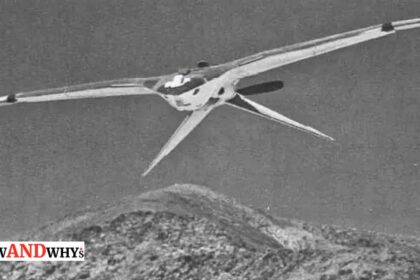
Project Aquiline eagle drone

CIA Built This Nuclear-Powered ‘Eagle’ Drone: Declassified in 2020, Developed in the ’60s at Area 51

Project Aquiline was one of the most unusual and complex spying projects during the Cold War. The idea was to create 12 bird-shaped drones powered by nuclear energy that could fly for up to a month. These drones were meant to be robotic spy planes and deliver secret items, but the project was never finished.

The CIA wanted Aquiline to be the first uncrewed system for gathering intelligence. Its goal was to gather information in areas where access was restricted secretly. The drone, designed by McDonnell Douglas (a defense company known for fighter jets), was very different from the company’s usual aircraft.

Aquiline was a small drone meant to be kept as close to bird-like size as possible—five feet long, 7.5 feet wide, and a takeoff weight of 83 pounds—under the constraints of the time’s technology. A silent 3.5-horsepower, four-cycle engine would give the drone a speed of 47 to 80 knots and an endurance of 50 hours and 1,200 miles. Aquiline’s maximum altitude was estimated at 20,000 feet. CIA file:  https://www.cia.gov/readingroom/collection/aquiline

Project Aquiline Project Aquiline. CIA

Nuclear power was supposed to make Aquiline fly even farther. The CIA suggested adding a system that would use the heat from decaying radioactive materials like plutonium to create electricity. This system, made for deep space missions, would allow the drone to stay in the air for up to 30 days or travel 36,000 miles.

Aquiline was built to carry cameras and spy equipment. It could take photos from a lower height than the U-2 spy plane and collect electronic signals from radios, radar, and other devices for later study.

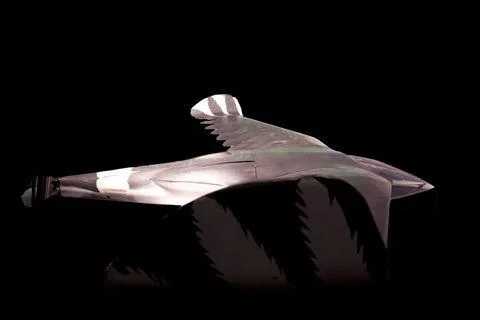
The CIA described Aquiline as a “small, bird-like surreptitious vehicle with sufficiently small acoustic, visible, and radar cross-section to permit it to operate in the natural physical signal environment of living birds.” Radars and human sentries at sensitive sites would mistake Aquiline for a bird and pay little attention to it.

Aquiline would be launched, controlled, and brought back by mobile teams on the ground. These teams could operate Aquiline from areas near the Soviet Union or China, like Taiwan, Turkey, Norway, or other places, to make sure the drone could fly over enemy land for a longer time.

The small drone would send its data to a modified DC-6 (later switched to a U-2R spy plane) flying nearby. This way, the drone wouldn’t need to carry its data storage, since storage at the time was bulky and heavy, using punch cards, tape, or large hard drives, which would use up too much weight and power.

Aquiline The concept of the Aquiline includes bird feathers painted on its wing. The drone would have been a very radioactive bird.

The bird drone was supposed to be developed at Area 51, with various documents listing the personnel requirements and what it would take to regularly fly engineers to and from the mysterious base. The program was top secret, with access doled out on a strictly “need-to-know” basis. The program was so secret that it recommended personnel be recruited two years before the first flight to ensure enough personnel could pass the necessary security checks.

In 1969, the CIA agreed with the McDonnell Douglas Astronautics Corporation (MDAC) to start working on technologies for the Aquiline program. In 1970, people were sent to Area 51 to begin flight testing. This testing was planned to end in early 1971 when the contract was finished. It was expected that by then, a functioning Aquiline drone would be ready, and the program would become fully active.

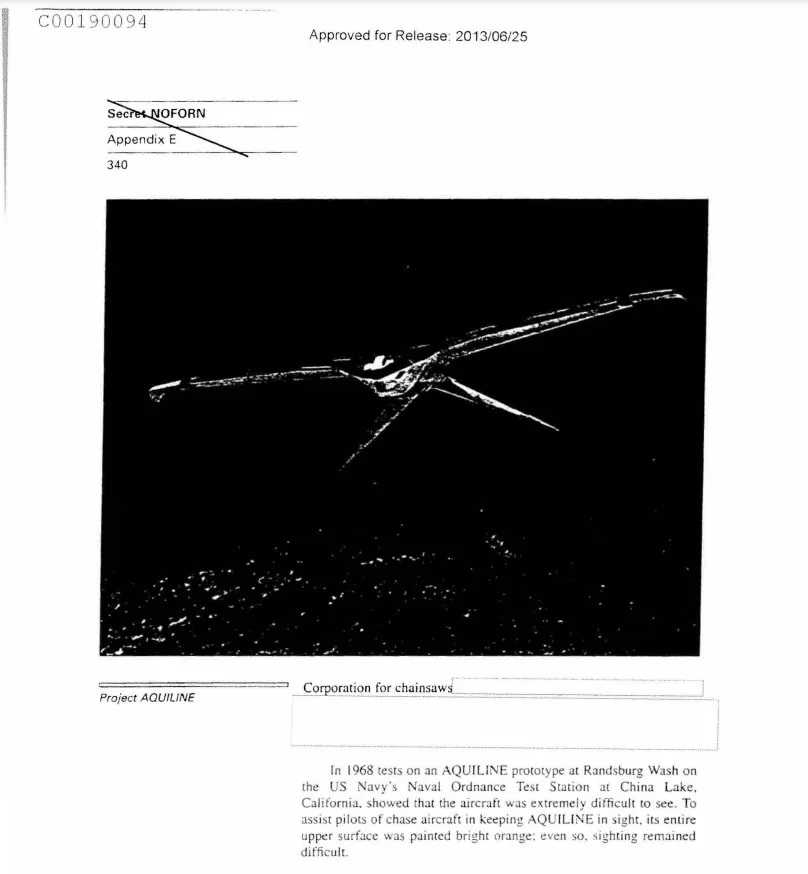
Exact specifications and design details are scarce, but what is known is that Aquiline drones were made to resemble birds and featured a single-tail propeller. Initially, the prototypes were powered by chainsaw motors. In one memo in the CIA’s reading room, the Aquiline drone is referred to as a “high characteristic operating model plane with a lot of expensive gadgetry.”

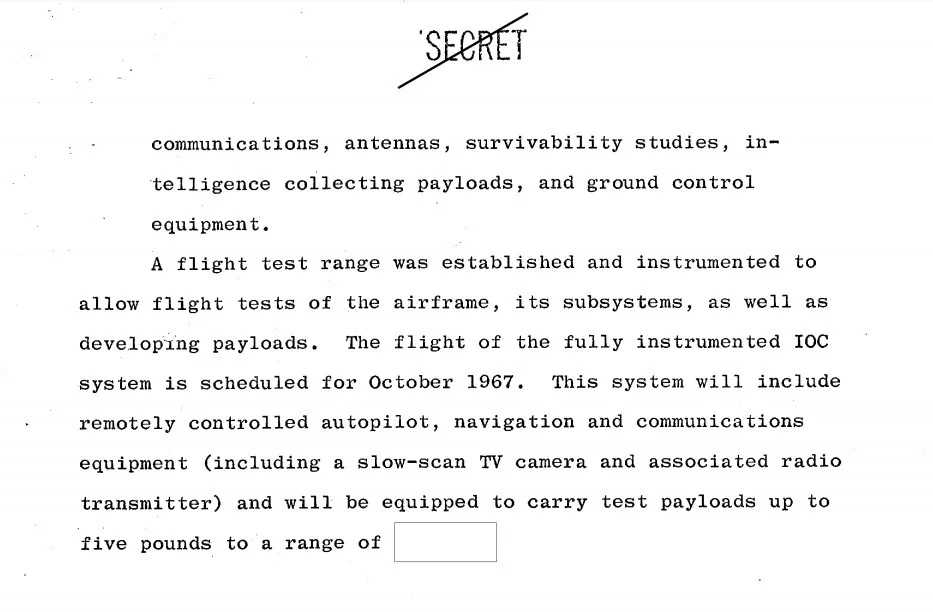
Sensor systems were embedded in the aircraft’s nose and included optical cameras infrared sensors, and even electronic intelligence packages. The drones were intended to have also been able to drop “black box” sensor systems into hostile territory, as well, so some form of payload-carrying capability must have been included in at least some of the Aquiline designs. Specifically, one of the CIA’s documents states that one of the test drones was designed to carry payloads weighing up to five pounds.

Project Aquiline2

The Aquiline drones were hard to spot during testing, so engineers painted one bright orange to make it easier for a chase plane to see during a test flight. Even with the paint, the chase plane crew still had trouble spotting the drone in the air.

The exact range of the Aquiline drones remains unknown and is redacted in all of the CIA’s declassified documents.

However, one account states that Aquiline was able to fly for 130 miles while obtaining “very high-resolution photography,” while another document states one of the proposed mobile control units would have a range of 1,200 miles. A dedicated satellite was planned to offer a long-distance communications link for Aquiline drones but was never launched.

Project Aquiline4

Aquiline drones had an impressive design, but they had a big problem: they didn’t have landing gear. Instead, they had to land by crashing into nets. This often damaged the drones’ wings and propellers, leading to delays because of constant repairs. Three Aquiline prototypes were destroyed during these landings.

In a personal account hosted on RoadrunnersInternationale.com, a site that preserves “the history of the aviation pioneers and programs that developed the U-2, A-12 ,and YF-12 during the Cold War,” John H. Meierdierck, retired Air Force Lieutenant Colonel, offers a brief recollection of the Aquiline program as he remembered it, writing:

The vehicle was a six-foot-long plane that had a small pusher prop and looked like an Eagle or Buzzard when it was in the air. It was designed to fly at very low levels along communications lines and intercept their messages. It also had a small television in the nose as an aid to navigation and to photograph targets of opportunity. There were several successful flights some crashes [reason unknown] and some lousy landings.

Read also:

It’s unclear why Aquiline was canceled. It was meant to be a very complicated program, dealing with issues like stealth, data transfer, and propulsion in a tiny design. Using a nuclear power source would have made it even more complicated, and the technology of the 1960s might not have been enough to handle it.

Aquiline also depended on a trick, and if the Soviets or Chinese discovered it, their anti-aircraft weapons or MiG jets could have easily shot it down. In the end, Aquiline was just an idea held by a few people in the intelligence community.

If the rumors are to be believed, there’s a chance an example or two of Aquiline still exists among the other strange birds caged up in the darkness at Area 51.

RELATED VIDEOS


PROJECT AQUILINE: CIA's Unmanned Aerial Reconnaissance Drone Circa 1960's

Spy Collection Highlights - Meet the Insectothopter (CIA's first dragon-fly drone)

lockheed sr 71 blackbird strategic reconnaissance aircraft the sr 71 is the fastest, highest flying air breathing aircraft in the world it flies at more than three times the speed of sound mach 3 at altitudes in excess of 80,000 feet by co mparison, it flies faster then the speed of a rifle bullet from a 30 06 rifle  photo by greg mathiesonmaimaithe life images collection via getty imagesgetty images

Greg Mathieson/Mai
Project Aquiline would have supplemented manned reconnaissance by platforms such as the SR-71 Blackbird.

{ https://howandwhys.com/ }

Hoe vind je dit bericht?
Geschreven door peter om 20:43 Stuur door

Live broadcast caught UFO moving through California wildfires

Live broadcast caught UFO moving through California wildfires

During a live Fox News broadcast covering the intense Palisades wildfire in California, an unusual event captured viewers' attention. A camera aimed at the blazing inferno recorded a mysterious spherical object emerging suddenly from the middle of the flames. This object moved at a remarkable speed before vanishing over the treetops, leaving many wondering about its origin and purpose. 
UFO%20wildfire%20CA.png

The object does not appear to be debris carried aloft by the fire’s updraft. Its trajectory and speed seem too controlled and deliberate to be a random effect of the wildfire. Additionally, the object shows no signs of explosion or disintegration, characteristics that might be expected if it were merely a piece of material affected by the intense heat. 
Observers have ruled out common explanations such as birds, planes, or helicopters. The object’s rapid movement and apparent change in direction suggest advanced maneuverability, sparking comparisons to UFOs/UAPs. 
With the growing number of reported sightings involving drones, orbs, and UFOs, the appearance of this potential UFO or drone in such an environment is especially intriguing. Could this object represent evidence of advanced technology monitoring Earth's natural disasters? Or is it an entirely natural but poorly understood phenomenon?
VIDEO

{ https://ufosightingshotspot.blogspot.com/ }

Hoe vind je dit bericht?
Geschreven door peter om 18:45 Stuur door

NASA is Keeping an Eye on InSight from Space

This image from October 2024 shows the InSight lander at its final resting place on Mars. As dust covers its solar panels the lander is taking on the same colour as the Martian surface. The image was captured by the Mars Reconnaissance Orbiter. Image Credit: NASA/JPL-Caltech/University of Arizona

NASA is Keeping an Eye on InSight from Space

The InSight Lander arrived on Mars in 2018 to study the planet’s interior. Its mission ended prematurely in December 2022 after its solar panels were covered in the planet’s ubiquitous dust. NASA’s Mars Reconnaissance Orbiter captured an image of InSight recently and will continue to do so as the Martian dust slowly and inexorably reclaims the lander.

NASA and the DLR sent the InSight lander to Mars to study the planet’s interior. Though the lander’s mole instrument wasn’t able to complete its work, the mission is still considered a success. It detected more than 1,000 Marsquakes, which helped scientists understand Mars’ crust, mantle, and core. It also measured the frequency of meteoroid impacts and uncovered some information on the planet’s thermal evolution.

While the mission was pronounced finished in December 2022, mission personnel continued listening for signals from InSight in case the wind cleared dust from its panels. That effort will also soon end.

Now, the 358-kilogram (789 lb) spacecraft sits in its final resting place in Elysium Planitia. Barring some hyper-futuristic, impossible-to-foresee archaeological rescue expedition, the lander will never move. It’s stranded there, waiting to be imaged repeatedly by the Mars Reconnaissance Orbiter (MRO) and its HiRISE camera.

However, perhaps unexpectedly, InSight still has more to offer. Researchers say that by monitoring the way dust collects on the lander and moves around it, they can learn about Mars’ ubiquitous dust. That will help researchers better understand the planet and prepare more thoroughly for future missions.

“It feels a little bittersweet to look at InSight now.”

Ingrid Daubar, InSight Science Team Member, Brown University
This image was taken shortly before the end of the mission. It shows InSight's landing spot and its SEIS instrument, covered with its protective windshield. Note the layer of dust accumulating on SEIS's shield. Image Credit: NASA/JPL This image was taken shortly before the end of the mission. It shows InSight’s landing spot and its SEIS instrument, covered with its protective windshield. Note the layer of dust accumulating on SEIS’s shield. Image Credit: NASA/JPL

“Even though we’re no longer hearing from InSight, it’s still teaching us about Mars,” said science team member Ingrid Daubar of Brown University in Providence, Rhode Island. “By monitoring how much dust collects on the surface — and how much gets vacuumed away by wind and dust devils — we learn more about the wind, dust cycle, and other processes that shape the planet.”

Martian dust is full of iron oxides, which give the planet its red appearance. It’s very fine and can be lifted high into the atmosphere during Mars’ global dust storms. It affects the planet’s weather and climate.

It’s a hazard for landers and rovers. InSight isn’t the only mission to succumb to it. Spirit and Opportunity also struggled with Martian dust before being defeated by it. Landers and rovers need to be protected from it. It can cover solar panels, rendering them ineffective. It can foul unprotected moving parts, contaminate science instruments, and cause problems with electronics and thermal control.

Martian dust is slightly magnetic due to its iron content, making it quite different from Earth dust. Scientists are concerned that its electrostatic properties might make it stick to surfaces and be difficult to remove. It could cling to some components in unanticipated ways.

There are unanswered questions about Mars’ dust. For instance, scientists don’t know exactly how it all formed or when. Are we seeing only ancient dust? Or is some of it newly created? Scientists aren’t certain how it becomes electrically charged during storms, whether it’s toxic and to what degree, or how exactly it’s transported around the planet during storms.

While monitoring InSight from space likely won’t answer all these questions, it can still teach scientists some things. One of the things they can observe is dust devil tracks. Back when the lander was still active, scientists matched MRO images of dust tracks near the lander with its wind data. They found that the whirling wind patterns that produce the dust devils subside in the winter and pick up again in the summer.

via GIPHY

InSight is also helping scientists understand how quickly surface craters can be obscured by dust. When the lander touched down in 2018, its retrorockets left marks on the surface akin to craters. By knowing exactly when they were created and watching from orbit as they’re obscured by dust, researchers can learn how quickly impact craters can be erased.

These HiRISE images from MRO show the InSight lander after it landed with obvious rocket blast marks (L). The blast marks are becoming obscured in the image on the right, taken in 2022. Image Credit: NASA/JPL-Caltech/UArizona These HiRISE images from MRO show the InSight lander after it landed with obvious rocket blast marks (L). The blast marks are becoming obscured in the image on the right, taken in 2022. Image Credit: NASA/JPL-Caltech/UArizona

The people behind missions like InSight put a lot of time and energy into them. They’re not only career-defining; each mission advances our collective understanding of nature, including other planets in our Solar System. InSight ended because of dust, not because we had learned all we could from it. So even though watching it from orbit and learning what they can is somewhat satisfying, it no doubt reminds the mission personnel of what went left undiscovered.

“It feels a little bittersweet to look at InSight now. It was a successful mission that produced lots of great science. Of course, it would have been nice if it kept going forever, but we knew that wouldn’t happen,” Daubar said.

RELATED VIDEOS

Space Facts: NASA is Keeping an Eye on InSight from Space

Meet NASA’s Newest Set of X-ray Eyes on the Universe

{ https://www.universetoday.com/ }

Hoe vind je dit bericht?
Geschreven door peter om 18:38 Stuur door

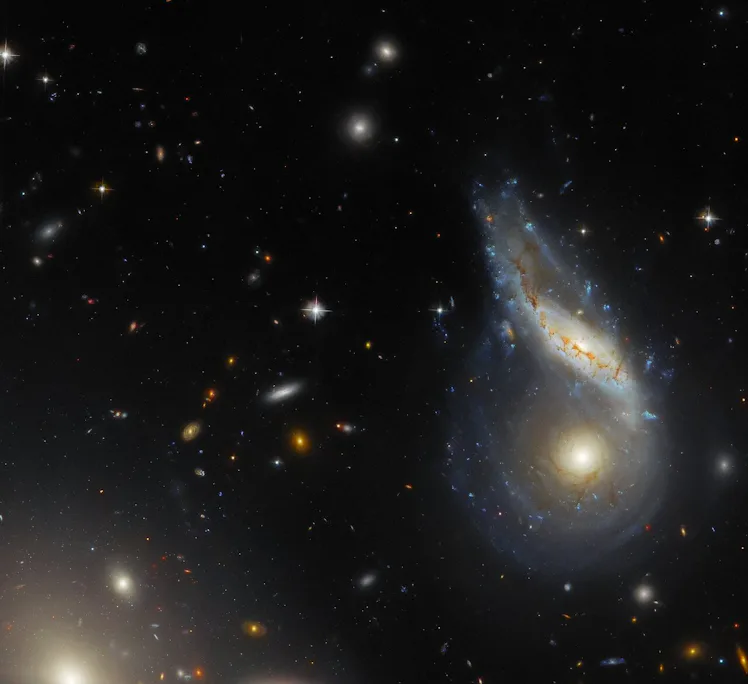
The Milky Way Is On A Terminal Collision Course — Is This New Hubble Image A Preview?

The Milky Way Is On A Terminal Collision Course — Is This New Hubble Image A Preview?

The constellation Hercules hosts this epic clash of two galactic juggernauts.

by Doris Elín Urrutia
 
Two spiral galaxies are merging together at the right side of the image. One is seen face-on and is ...
ESA/Hubble/NASA

Outer space nonchalantly sheds a “tear” as two galaxies meet their end — but is the distant scene, pictured in a new Hubble Space Telescope image, a finale?

At first glance, the answer must be yes. Some 570 million light-years away from Earth, a face-on galaxy called LEDA 59642 is overlapped by a tilted, mostly side-on galaxy called NGC 6040 that has severely warped on one side and taken on a shape resembling the top of a droplet. The galaxies’ proximity and devolution is a story as old as time: galaxy mergers.

The two bodies — known collectively as Arp 122 — are careening into one another. Their stars, planets, gas, and dust will experience new gravitational forces, according to a statement that NASA and the European Space Agency (ESA) published on Friday. “Galactic collisions and mergers are monumentally energetic and dramatic events,” write officials from the two space agencies behind Hubble.

Two spiral galaxies are merging together at the right side of the image. One is seen face-on and is ...

Arp 122, located in the constellation Hercules about 570 million light-years from Earth.

ESA/Hubble & NASA, J. Dalcanton, Dark Energy Survey/DOE/FNAL/DECam/CTIO/NOIRLab/NSF/AURA Acknowledgement: L. Shatz

In many ways, the galaxies will unravel: the grand, highly organized spiral structures may go away. They might turn out to be irregular galaxies, looking like round hazy blobs until maybe evolving into something new.

Although this scene in the constellation Hercules is playing out very far away, it’s a preview of what will happen here at home. The Milky Way is on a collision course with the Andromeda Galaxy (also known as M31), scheduled for 4 billion years from today.

But the Milky Way has always been a work in progress. Many galaxies, large and small, have combined to add or subtract to the Milky Way’s starry profile, according to research from ESA’s Gaia spacecraft. Astronomers know that the Andromeda galaxy is a patchwork of other galaxies, too.

The mashup will happen slowly. “The process of colliding and merging will not be a quick one either: it might take hundreds of millions of years to unfold. These collisions take so long because of the truly massive distances involved,” agency officials wrote.

What will happen to Arp 122 and to us is uncertain, but one possible outcome is that the ménages will sort themselves into elliptical galaxies. One such object appears in this image, too, at the bottom left corner. It’s NGC 6041, the elliptical galaxy that acts as the center of the galaxy cluster to which Arp 122 belongs.

While Arp 122 reveals a preview of what might become of the Milky Way, it also gifts Earthlings with a dazzling cosmic teardrop to admire.

RELATED VIDEOS


The Milky Way and Andromeda Galaxy Collision Has ALREADY Begun!

We Finally Found The Galaxies That Collided With The Milky Way

Milky Way and Andromeda Collision - Time Lapse

{ https://www.inverse.com/ }

Hoe vind je dit bericht?
Geschreven door peter om 01:25 Stuur door

Archaeologists find 3MILLION-year-old tools at site dubbed 'the cradle of humankind'

Archaeologists find 3MILLION-year-old tools at site dubbed 'the cradle of humankind'

Archaeologists have discovered some of the first-ever tools used on Earth at a site in Africa dubbed 'the cradle of humankind.'

Found in Kenya's Homa Peninsula, this region has produced clues about humanity's early beginnings such as other ancient tools and the remains of 'Lucy' - a pre-human relative that lived more than three million years ago.

The team uncovered three-million-year-old flakes, or small knives, created by hominins, the first pre-human species to walk on two legs, who hammered one stone against another to create sharp edges.

Researchers at the City University of New York said the sharpened rock allowed them to peel and cut fruits and vegetables and slice the flesh of hippos. 

The tools are known as the Oldowan tool kit, which previously only spanned from 1.7 million years to 2.9 million years ago.

Lead archaeologist Tom Plummer suggested that the tools found paved the way for everything that followed.

'In terms of technology, I think the Oldowan technology is the most important technological innovation that ever happened in human history,' Plummer told CBS News.

'It allowed hominins to access a whole array of foods that they never had access to before, fueling body and brain size increases.'

Archaeologists have discovered some of the first tools used on Earth. The artifacts are stones that ancient humans sharpened

Archaeologists have discovered some of the first tools used on Earth. The artifacts are stones that ancient humans sharpened 


The new diet would have sparked a 'feedback loop' that led to more sophisticated beings and advanced technologies, Plummer said. 

While uncovering the tools was an amazing discovery for Plummer and his team, finding cut marks on nearby animal bones confirmed butchery was done.

The team uncovered ancient hippo bones at the site, which showed that technology existed nearly three million years ago, CBS News reported.

The site is located on the peninsula called Nyanga, which experts said could help frame humans' existence on Earth.

Rick Potts, the director of the Smithsonian's human origins program and the leader of research on the peninsula, said: 'We are the last biped standing, as I call it.

'All of those other ways of life became extinct. And so that gives us a lot to think about, and it draws attention to the fragility of life, even in our own journey through time.' 

Scientists have found evidence showing that modern humans appeared in Africa about 300,000 years ago - 600,000 years after hominins went extinct - but they only recently understood that the pre-human group began walking upright at least six million years ago.

'Some of the things that we thought occurred in a very short period of time, within the last one million years, are now stretched out over a six million year period,' Potts said. 'That includes tool making.'

The tools were uncovered Kenya's Homa Peninsula, a region that has produced clues about humanity's early beginnings

The tools were uncovered Kenya's Homa Peninsula, a region that has produced clues about humanity's early beginnings

Researchers at the City University of New York said the sharpened rock allowed them to peel and cut fruits and vegetables and slice the flesh of hippos

Researchers at the City University of New York said the sharpened rock allowed them to peel and cut fruits and vegetables and slice the flesh of hippos

article image

Archaeologists uncovered the remains of 'Lucy' in 1974, celebrating with beer and listening to the Beatles.

And when the song 'Lucy in the Sky with Diamonds,' the team knew what to name the ancient species that lived 3.2 million years ago.

In 2016, researchers re-examined her bones to learn more about how she died, finding a simple fall out of a tree may have caused her death.

Lead author John Kappelman, a University of Texas professor in anthropology, said: 'It is ironic that the fossil at the center of a debate about the role of arborealism in human evolution likely died from injuries suffered from a fall out of a tree.

 Kappelman first studied Lucy during her US museum tour in 2008, when the fossil detoured to the High-Resolution X-ray Computed Tomography Facility (UTCT).

The facility has a machine designed to scan through materials as solid as a rock and at a higher resolution than medical CT.

For 10 days, Kappelman and geological sciences professor Richard Ketcham scanned all of her 40-percent-complete skeleton to create a digital archive of more than 35,000 CT slices.

Remains of Lucy, an ancient human species that lived more than three million years ago, was also found in the region

Remains of Lucy, an ancient human species that lived more than three million years ago, was also found in the region 

Kappelman noticed the end of her right humerus was fractured in a manner not normally seen in fossils, preserving a series of sharp, clean breaks with tiny bone fragments and slivers still in place. 

This compressive fracture results when the hand hits the ground during a fall, impacting the elements of the shoulder against one another to create a unique signature on the humerus,' said Kappelman.

He then consulted Dr Stephen Pearce, an orthopedic surgeon at Austin Bone and Joint Clinic, using a modern human-scale, 3D printed model of Lucy.

Pearce confirmed that the injury was consistent with fracture caused by a fall from considerable height when the conscious victim stretched out an arm in an attempt to break the fall.

Kappelman also saw similar, less severe, fractures at the left shoulder and other compressive fractures throughout Lucy's skeleton.

Overall, Lucy suffered a broken ankle, arm, knee, pelvis and at least one fractured rib - suggesting she must have suffered severe internal organ damage.

RELATED VIDEO


Shocking New Evidence: The 3-Million-Year-Old Stone Tools That Rewrote Human Evolution

{ https://www.dailymail.co.uk/ }

Hoe vind je dit bericht?
Geschreven door peter om 01:08 Stuur door

See the Northern Lights from ABOVE: NASA astronaut on board the ISS shares mesmerising bird's-eye view video of the aurora

Looking up at the flickering glow of the Northern Lights is one of Earth's most incredible experiences.

But now, a NASA astronaut has revealed what it is like to look down on one of the planet's great natural wonders.

Astronaut Don Pettit has shared his bird's eye view of the Northern Lights from the window of the International Space Station.

Writing on X, formerly Twitter, Mr Pettit said simply: 'Flying over aurora; intensely green.'

In this mesmerising video, you can see the lower structures of the space station silhouetted against the bright green glow of the aurora.

With the Northern Lights forming between 60 to 186 miles (100 to 300 km) above the ground, the ISS soars above at almost four times this altitude.

On social media, space fans have been blown away to discover that astronauts have this unique perspective.

One amazed commenter wrote: 'Wait wait... auroras are that low?!'

A NASA astronaut has shared his stunning bird's-eye view of the Northern Lights from aboard the International Space Station

A NASA astronaut has shared his stunning bird's-eye view of the Northern Lights from aboard the International Space Station 

On social media, commenters were shocked to learn that astronauts have this unique perspective on one of Earth's natural wonders

On social media, commenters were shocked to learn that astronauts have this unique perspective on one of Earth's natural wonders 

Don Pettit, 69, is NASA's oldest astronaut and a member of NASA's Expedition 72 crew which also includes the stranded astronauts Sunita Williams and Butch Willmore.

Currently undertaking his third stay aboard the station, Mr Pettit is well known for his orbital photography.

Over more than 300 days in space, Mr Pettit has become regarded as one of NASA's best photographers and has captured many stunning images of the Earth and the Northern Lights.

The Northern and Southern lights are caused when charged particles from the sun collide with Earth's atmosphere.

As these particles arrive, they slam into particles of gas and charge them with enough energy to glow brightly.

These are visible from the ISS because the aurora actually forms in a relatively low part of the atmosphere.

The lowest glowing gases are typically found 80 miles (130 km) above the ground but can dip as low as 60 miles (100 km) in some cases.

Orbiting at 230 to 285 miles (370 to 460 km), the ISS safely passes over the top of the aurora, allowing astronauts on board to look down on the show.

Don Pettit (pictured) is NASA's oldest serving astronaut and widely regarded as one of the space agency's best photographers

Don Pettit (pictured) is NASA's oldest serving astronaut and widely regarded as one of the space agency's best photographers 

Since the ISS orbits at an altitude of 230 to 285 miles (370 to 460 km), it can be almost four times higher than the lowest parts of the Northern Lights

Since the ISS orbits at an altitude of 230 to 285 miles (370 to 460 km), it can be almost four times higher than the lowest parts of the Northern Lights 

However, in some of the strongest events, even the ISS can be caught up in the aurora with the uppermost parts of the display extending several thousand miles above the Earth.

In Mr Pettit's video, the bright lights of a city appear beneath the intense green glow of excited gases 

While hints of blue and pink are caused by nitrogen, this emerald green is the characteristic sign of oxygen molecules charged by particles from the sun.

On social media, commenters flocked to share their amazement with Mr Pettit's stunning images.

One commenter wrote: 'It's like a massive emerald come alive!'

'Not sure how I thought it would look from above but this is incredible,' added another.

While one space fan wrote: 'The amount of electrical flow is astounding.'

Normally, the aurora is only visible at very high latitudes – for example at the poles, Scandinavia or the southern tip of South America. 

The ISS' height allows the crew to capture stunning images of the Northern Lights as they pass overhead. Pictured: The aurora seen from the ISS in August, 2024

Commenters on social media were amazed by the view, saying they had no idea that the Northern Lights would look like this from above

Commenters on social media were amazed by the view, saying they had no idea that the Northern Lights would look like this from above 

One commenter said that the green of the aurora was 'like a massive emerald come alive'

One commenter said that the green of the aurora was 'like a massive emerald come alive'

This is because the charged particles which make the atmosphere glow are funnelled towards the poles by the Earth's magnetic fields.

However, when the sun undergoes an event called a 'coronal mass ejection' enormous clouds of charged particles are sent flying towards Earth at around two million miles per hour.

These clouds interact with the Earth's magnetic fields to produce geomagnetic storms which trigger huge auroral displays stretching into the lower latitudes.

Luckily for Mr Pettit, the start of the year has seen a few exceptionally large coronal mass ejections which have made the aurora even brighter than normal.

On January 3 and January 4, the sun was lit up by two X-class solar flares - a class reserved for the most intense kind.

Solar flares are sudden explosions of radiation created by the 'snapping' of tangled magnetic fields in the sun's atmosphere.

Since they are usually followed by coronal mass ejections, these two flares meant stunning auroral displays were soon to follow.

On the day that Mr Pettit posted his video, January 6, there had already been two days of geomagnetic storms according to the National Oceanic and Atmospheric Administration (NOAA).

Mr Pettit's video came after a week of intense Northern Lights due to a series of large solar storms. On January 4, the Northern Lights were forecast to extend as far south as the northern United States

Mr Pettit's video came after a week of intense Northern Lights due to a series of large solar storms. On January 4, the Northern Lights were forecast to extend as far south as the northern United States 

As clouds of charged particles arrived from the sun, they triggered massive outbursts of aurora in the Northern Hemisphere throughout the first week of the year. Pictured: Anchorage, Alaska on New Year's Day

As clouds of charged particles arrived from the sun, they triggered massive outbursts of aurora in the Northern Hemisphere throughout the first week of the year. Pictured: Anchorage, Alaska on New Year's Day 

To make things even more exciting, a massive 'coronal hole' formed in the sun's atmosphere – a dark area of cooler plasma.

These holes allow a constant stream of charged particles called 'solar wind' to escape from the sun and bombard Earth.

This meant that even more particles arrived to collide with the Earth's atmosphere leading to even brighter aurora.

Last week, auroras were forecast in the US as far south as Washington, northern Idaho and Montana over the US.

On Monday, NASA recorded the explosion of an extremely strong solar flare rated as a class X1.8.

NASA wrote: 'Flares and solar eruptions can impact radio communications, electric power grids, navigation signals, and pose risks to spacecraft and astronauts.'

However, no significant disruption is forecast due to this stellar explosion.

The reason that there has been so much activity lately is because the sun is now at its 'solar maximum' – the peak of the sun's 11-year activity cycle. 

The auroral activity was made even stronger by the formation of a coronal hole - a dark, cool region which allows charged particles to escape. On January 3, a large coronal hole (pictured) formed which could have made the Northern Lights even more intense

The auroral activity was made even stronger by the formation of a coronal hole - a dark, cool region which allows charged particles to escape. On January 3, a large coronal hole (pictured) formed which could have made the Northern Lights even more intense 

The Northern Lights have been more active recently because the sun is now at its 'solar maximum'. At this time there are far more sunspots (cool regions associated with solar flares) which leads to an increased level of activity and more intense auroras on Earth

The Northern Lights have been more active recently because the sun is now at its 'solar maximum'. At this time there are far more sunspots (cool regions associated with solar flares) which leads to an increased level of activity and more intense auroras on Earth 

article image

The sun goes through an 11-year cycle in which the number of sunspots (cool regions associated with solar flares) gradually increases.

In October last year, NASA revealed that the sun had reached its solar maximum and could stay at that level for another year.

That means an increased number of sunspots, more solar flares, and even brighter aurora.

While these solar flares can be dangerous to electrical systems on Earth, it also means that there will be plenty more opportunities for NASA's astronauts to bring us some spectacular views of the Northern Lights.

SOLAR STORMS PRESENT A CLEAR DANGER TO ASTRONAUTS AND CAN DAMAGE SATELLITES

Solar storms, or solar activity, can be divided into four main components that can have impacts on Earth:  

  • Solar flares: A large explosion in the sun's atmosphere. These flares are made of photons that travel out directly from the flare site. Solar flares impact Earth only when they occur on the side of the sun facing Earth.  
  • Coronal Mass Ejections (CME's): Large clouds of plasma and magnetic field that erupt from the sun. These clouds can erupt in any direction, and then continue on in that direction, plowing through solar wind. These clouds only cause impacts to Earth when they're aimed at Earth. 
  • High-speed solar wind streams: These come from coronal holes on the sun, which form anywhere on the sun and usually only when they are closer to the solar equator do the winds impact Earth. 
  • Solar energetic particles: High-energy charged particles thought to be released primarily by shocks formed at the front of coronal mass ejections and solar flares. When a CME cloud plows through solar wind, solar energetic particles can be produced and because they are charged, they follow the magnetic field lines between the Sun and Earth. Only charged particles that follow magnetic field lines that intersect Earth will have an impact. 

While these may seem dangerous, astronauts are not in immediate danger of these phenomena because of the relatively low orbit of manned missions.

However, they do have to be concerned about cumulative exposure during space walks.

This photo shows the sun's coronal holes in an x-ray image. The outer solar atmosphere, the corona, is structured by strong magnetic fields, which when closed can cause the atmosphere to suddenly and violently release bubbles of gas and magnetic fields called coronal mass ejections

This photo shows the sun's coronal holes in an x-ray image. The outer solar atmosphere, the corona, is structured by strong magnetic fields, which when closed can cause the atmosphere to suddenly and violently release bubbles or tongues of gas and magnetic fields called coronal mass ejections

The damage caused by solar storms 

Solar flares can damage satellites and have an enormous financial cost.

The charged particles can also threaten airlines by disturbing Earth's magnetic field.

Very large flares can even create currents within electricity grids and knock out energy supplies.

When Coronal Mass Ejections strike Earth they cause geomagnetic storms and enhanced aurora.

They can disrupt radio waves, GPS coordinates and overload electrical systems.

A large influx of energy could flow into high voltage power grids and permanently damage transformers.

This could shut off businesses and homes around the world. 

Source: NASA - Solar Storm and Space Weather 

RELATED VIDEOS


NASA astronaut shares mesmerising bird's-eye view of Northern Lights

ISS Astronaut Treated to Northern Lights, Lightning and Sunrise

Northern Lights Seen From the International Space Station

{ https://www.dailymail.co.uk/ }

Hoe vind je dit bericht?
Geschreven door peter om 00:50 Stuur door

‘The Alien Perspective’ Exclusive Clip: What Happened During The Tic Tac Encounter?

‘The Alien Perspective’ Exclusive Clip: What Happened During The Tic Tac Encounter?

Hoe vind je dit bericht?
Geschreven door peter om 23:54 Stuur door

Politie onderzoekt mysterieuze drones boven haven in Denemarken

Deense politiewagen
Deense politiewagen  © Shutterstock / Maik Meid

Politie onderzoekt mysterieuze drones boven haven in Denemarken

Er zijn vrijdagavond laat verschillende mysterieuze drones gespot rond een haven ten zuiden van Kopenhagen. Een ooggetuige meldde dat hij tot twintig grotere drones had waargenomen rond de jachthaven voor recreatieboten in het kleine stadje Køge, aldus de Deense politie. De man maakte ook videobeelden. Een politiepatrouille zag er vervolgens vier, de laatste omstreeks 1 uur in de nacht van vrijdag op zaterdag 

 Bron: Belga

De politie zegt op dit moment niet te weten waar de drones vandaan komen, wat ze daar deden en wiens eigendom ze zijn. Dat maakt nu voorwerp uit van een onderzoek. Onder meer de Deense geheime dienst PET werd over het incident geïnformeerd.

In de Scandinavische en Baltische staten die grenzen aan de Oostzee is er momenteel verhoogde waakzaamheid wegens mogelijke Russische sabotagedaden. De NAVO kondigde onlangs aan dat ze ter afschrikking haar militaire aanwezigheid in de Oostzee zal vergroten.

De voorbije jaren werden in Scandinavië al eerder drones gesignaleerd boven elektriciteitscentrales of luchthavens, zonder dat steeds duidelijk kon worden vastgesteld wat de bedoeling was of wie er achter zat. Verschillende van dergelijke onbemande vliegtuigen legden in september onder meer het nachtelijke vliegverkeer op de Zweedse luchthaven Stockholm-Arlanda - een van de belangrijkste luchthavens in Scandinavië - kortstondig lam.

Kabelbreuken

De havenstad Køge ligt aan de oostkust van het Deense eiland Seeland, aan de Køge-baai die uitkomt in de Oostzee. Er zijn de jongste tijd verschillende verdachte kabelbreuken in de Oostzee geweest en er wordt momenteel onderzoek gedaan naar mogelijke sabotage door Rusland.

In december waren Amerikanen in de ban van mysterieuze drones die door burgers werden gezien in de staten New Jersey en New York. Ze zouden boven belangrijke infrastructuur zweven, zoals waterreservoirs, elektriciteitsleidingen, treinstations, politiebureaus en militaire installaties. Dat zorgde voor talrijke complottheorieën. Het Witte Huis zei dat er geen reden was tot zorg en dat de dronevluchten “volledig legaal en rechtmatig” waren.

LEES OOK.

{ https://www.hln.be/ }

Hoe vind je dit bericht?
Geschreven door peter om 23:40 Stuur door

Meer van UFO'S of UAP'S, ASTRONOMIE, RUIMTEVAART, ARCHEOLOGIE, OUDHEIDKUNDE, SF-SNUFJES EN ANDERE ESOTERISCHE WETENSCHAPPEN - DE ALLERLAATSTE NIEUWTJES

↑ Terug naar de berichten