Naar de inhoud

UFO'S of UAP'S, ASTRONOMIE, RUIMTEVAART, ARCHEOLOGIE, OUDHEIDKUNDE, SF-SNUFJES EN ANDERE ESOTERISCHE WETENSCHAPPEN - DE ALLERLAATSTE NIEUWTJES

UFO's of UAP'S in België en de rest van de wereld
akke.beakke.be
Ontdek de Fascinerende Wereld van UFO's en UAP's: Jouw Bron voor Onthullende Informatie! Ben jij ook gefascineerd door het onbekende? Wil je meer weten over UFO's en UAP's, niet alleen in België, maar over de hele wereld? Dan ben je op de juiste plek! België: Het Kloppend Hart van UFO-onderzoek In België is BUFON (Belgisch UFO-Netwerk) dé autoriteit op het gebied van UFO-onderzoek. Voor betrouwbare en objectieve informatie over deze intrigerende fenomenen, bezoek je zeker onze Facebook-pagina en deze blog. Maar dat is nog niet alles! Ontdek ook het Belgisch UFO-meldpunt en Caelestia, twee organisaties die diepgaand onderzoek verrichten, al zijn ze soms kritisch of sceptisch. Nederland: Een Schat aan Informatie Voor onze Nederlandse buren is er de schitterende website www.ufowijzer.nl, beheerd door Paul Harmans. Deze site biedt een schat aan informatie en artikelen die je niet wilt missen! Internationaal: MUFON - De Wereldwijde Autoriteit Neem ook een kijkje bij MUFON (Mutual UFO Network Inc.), een gerenommeerde Amerikaanse UFO-vereniging met afdelingen in de VS en wereldwijd. MUFON is toegewijd aan de wetenschappelijke en analytische studie van het UFO-fenomeen, en hun maandelijkse tijdschrift, The MUFON UFO-Journal, is een must-read voor elke UFO-enthousiasteling. Bezoek hun website op www.mufon.com voor meer informatie. Samenwerking en Toekomstvisie Sinds 1 februari 2020 is Pieter niet alleen ex-president van BUFON, maar ook de voormalige nationale directeur van MUFON in Vlaanderen en Nederland. Dit creëert een sterke samenwerking met de Franse MUFON Reseau MUFON/EUROP, wat ons in staat stelt om nog meer waardevolle inzichten te delen. Let op: Nepprofielen en Nieuwe Groeperingen Pas op voor een nieuwe groepering die zich ook BUFON noemt, maar geen enkele connectie heeft met onze gevestigde organisatie. Hoewel zij de naam geregistreerd hebben, kunnen ze het rijke verleden en de expertise van onze groep niet evenaren. We wensen hen veel succes, maar we blijven de autoriteit in UFO-onderzoek! Blijf Op De Hoogte! Wil jij de laatste nieuwtjes over UFO's, ruimtevaart, archeologie, en meer? Volg ons dan en duik samen met ons in de fascinerende wereld van het onbekende! Sluit je aan bij de gemeenschap van nieuwsgierige geesten die net als jij verlangen naar antwoorden en avonturen in de sterren! Heb je vragen of wil je meer weten? Aarzel dan niet om contact met ons op te nemen! Samen ontrafelen we het mysterie van de lucht en daarbuiten.

Archief

How Commercial Satellites Could Track Spy Balloons and Other UFOs

Crosses indicate the apparent position of a spy balloon over Missouri as seen in different spectral bands. (Credit: Planet Labs / Keto and Watters)

How Commercial Satellites Could Track Spy Balloons and Other UFOs

It turns out that you don’t need the Men in Black to spot unidentified anomalous phenomena, which are also known as UAPs, unidentified flying objects or UFOs. Researchers have shown how the task of detecting aerial objects in motion could be done by analyzing Earth imagery from commercial satellites.

They say they demonstrated the technique using one of the most notorious UAP incidents of recent times: last year’s flight of a Chinese spy balloon over the U.S., which ended in a shootdown by an Air Force fighter jet above the Atlantic Ocean. They also analyzed imagery of a different spy balloon that passed over Colombia at about the same time.

“Our proposed method appears to be successful and allows the measurement of the apparent velocity of moving objects,” the researchers report.

In a 2023 video, CBS News recaps lessons learned from the Chinese spy balloon’s flight:

The demonstration is described in a research paper written by Harvard University’s Eric Keto and Wellesley College’s Wesley Andres Watters, who proposed their image analysis technique in an earlier study. The new study was posted to the ArXiv pre-print server last week and has been submitted to the Journal of Astronomical Instrumentation for review.

Keto and Watters started out with multispectral imagery captured by Planet’s SuperDove satellites during last year’s balloon flights. Such imagery isn’t captured all at once. Instead, the satellite’s sensors record a succession of exposures that reflect different spectral bands. That means an aerial object would be seen at a slightly different location in each of the images that are combined to produce a multispectral view, due to the parallax effect created by a moving satellite.

The researchers said the spy balloons were ideal subjects for their study. “High-altitude balloons are advantageous targets, because the motion of the balloon itself can be ignored in the analysis,” they said.

The aim of their study was to create a baseline for interpreting spectral-band images. The researchers conducted a detailed analysis of imagery that was acquired over British Columbia, Missouri and Colombia — and made a few educated guesses about the relative velocities involved. They took a variety of factors into account, including shifts in the background terrain and the potential effects of atmospheric distortion. (The British Columbia imagery wasn’t that useful, because snow and ice covered up the features that would typically be used for ground reference.)

The analysis not only provided a baseline for tracking moving objects using SuperDove satellite imagery, but also made it possible for the researchers to provide estimates for the altitudes of the balloons. They said one balloon flew over Missouri at a height of about 21,200 meters (69,500 feet), while the other balloon’s altitude was about 21,500 meters (70,500 feet) when it was spotted over Colombia.

Keto and Watters aren’t the only ones looking into how commercial satellite data could be used to track anomalous aerial objects. A team of researchers at RAIC Labs (formerly known as Synthetaic) used Planet’s data archive and RAIC Labs’ AI-based image analysis program to trace the infamous Chinese balloon’s route backward from the U.S. to its point of origin near Hainan.

A 2023 video focuses on how Planet and Synthetaic / RAIC Labs tracked the Chinese balloon:

Such techniques could be used to detect phenomena that are even more exotic than Chinese spy balloons: The study conducted by Keto and Watters is part of Harvard University’s Galileo Project, which is aimed at finding ways to collect high-quality data that could be useful in the search for objects of extraterrestrial origin.

Harvard astronomer Avi Loeb, who heads up the Galileo Project, said last year in a blog posting that his team has been searching through Planet’s data archive for signs of unusual objects.

“Extraterrestrial equipment can be distinguished from a terrestrial object, not just by resolving unusual bolts or labels imprinted on its hardware but also based on its motion,” Loeb explained. “As mentioned in the DNI [Director of National Intelligence] reports in 2021 and 2022, unusual flight characteristics can serve as an indicator of an extraterrestrial origin.”

Will satellite data analysis become a standard tool for detecting anomalous aerial phenomena? Stay tuned: We’ve reached out to Loeb, Keto and Watters, and we’ll update this report with any additional information we can pass along.

{ https://www.universetoday.com/ }

Hoe vind je dit bericht?
Geschreven door peter om 23:36 Stuur door

A 2-Mile Wide ‘Planet Killer’ Asteroid Is Headed Towards Earth At 58,000 MPH

A 2-Mile Wide ‘Planet Killer’ Asteroid Is Headed Towards Earth At 58,000 MPH

BY DOUGLAS CHARLES

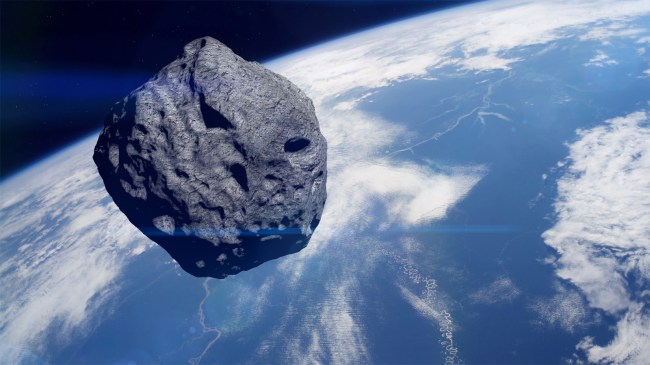
Asteroid approaching planet Earth

ISTOCKPHOTO

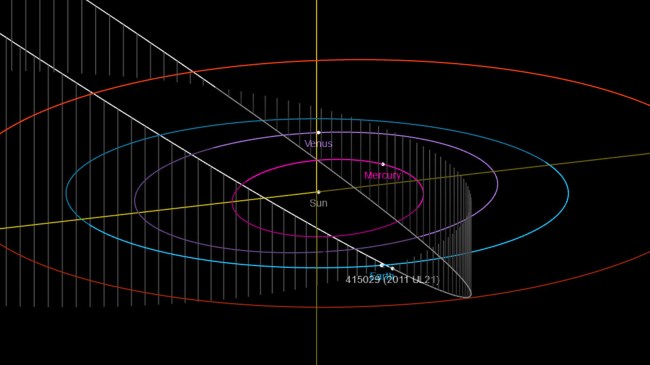
Mountain-sized “planet-killer” Asteroid 2011 UL21 is headed towards Earth this week and during its trip it will be making a very close approach to our planet.

The asteroid, classified as a Potentially Hazardous Asteroid (PHA) by NASA, is supposed to go zooming by Earth at 58,000 mph on June 27th.

Asteroid 2011 UL21 is also classified as a near-Earth object (NEO), which means that its orbit can move the space rock within 1.3 astronomical units (AU) of the sun. An AU is the average distance between Earth and the Sun, or about 93 million miles.

This asteroid is no tiny space rock either. According to SpaceReference.org, it is comparable in size to Mount Everest – Earth’s highest mountain above sea level – and is between 1.1 and 2.4-miles wide.

Needless to say, a 2-mile wide rock traveling at 58,000 mph would definitely “kill” our planet.

Thankfully, the asteroid will only pass Earth at a distance of around 4.1 million miles. Still, that is the closest it will have come to Earth in the past 110 years, at least.

And while 4.1 million miles may sound like a great distance, in terms of space it isn’t so much. By comparison, Mars is 245.22 million miles from Earth.

According to Gianluca Masi, astrophysicist and director of the Virtual Telescope Project, “There is absolutely no risk for our planet.”

“The term ‘Potentially Hazardous Asteroid’ (PHA) is a precise formal definition, referring to minor planets larger than approximately 140 meters that can come within 7.5 million km from the Earth,” said Masi. “In other words, only the largest asteroids capable of approaching close enough to our planet are flagged as PHAs, which does not mean they are going to hit the Earth, but they nonetheless warrant a better monitoring.”

That being said, there is always the possibility that the gravitational tug of Earth could alter the “planet killer” asteroid’s orbit (called the Yarkovsky Effect). And if that were to ever occur there isn’t much we could do to stop it.

{ https://brobible.com/ }

Hoe vind je dit bericht?
Geschreven door peter om 23:26 Stuur door

Researchers Believe They Will Find UFO, Alien Secrets In The Vatican Archives

Researchers Believe They Will Find UFO, Alien Secrets In The Vatican Archives

BY DOUGLAS CHARLES

ufo alien vatican

ISTOCKPHOTO COMPOSITE

Researchers believe a search of the Vatican’s historic archives will reveal key insights into aliens, UFOs and other previously unexplained paranormal activity.

Sorting through the massive amounts of documents located in the Vatican Apostolic Archives (its official name) will be no easy task, however.

According to the archive’s website, the files are stored on over 85 linear kilometers of shelving. That’s almost 53 linear miles worth of documentation, covering over twelve centuries.

A recent article published on the United States Conference of Catholic Bishops’ website explains that “a group of scientists and researchers are seeking access to the Vatican Apostolic Archives to uncover information about UFOs and the paranormal.”

The reason for this has ties to Air Force veteran and Pentagon whistleblower David Grusch’s testimony last year in which he claimed the “Vatican was involved” in the first-ever mission of the United States’ alleged secret UFO retrieval program.

“1933 was the first recovery in Europe, in Magenta, Italy,” Grusch told NewsNation. They recovered a partially intact vehicle, and the Italian government moved it to a secure airbase in Italy until around 1944-1945.

“The Pope back-channeled that and told the Americans what the Italians had and we ended up scooping it.”

Following Grusch’s statements, researcher Roberto Pinotti also came forward with a claim that he has proof that a UFO crash occurred in Italy on June 13, 1933, 14 years before the Roswell incident.

“The historical record is filled with these kinds of events,” Diana Walsh Pasulka, a religious studies professor at the University of North Carolina Wilmington, told Catholic News Service. “The people at the Vatican, they don’t even know where to look; it’s in their basements.”

“[The Vatican’s archivists are in a] mad rush to digitize what they have; they have to prioritize what they think is most important. They aren’t really prioritizing orbs that are bothering nuns in the 1800s.”

Garry Nolan, a professor of medicine at Stanford University and co-founder of the Sol Foundation (a think tank established to research the political, philosophical and scientific implications of UFOs), stated, “The Vatican is probably the oldest library system of paranormal or supernatural knowledge still extant,” adding that the archive “has an aura of both mysticism and a feeling of deep truth that if you just know how to read it, you can pull that information out.”

Despite Nolan, his group, and others’ efforts to suss out any documents pertaining to UFOs and aliens in the Vatican’s archives, Marco Grilli, secretary to the prefect of the archives, claims “the prefect wants to affirm that there is no document in the archives that regards extraterrestrial life.”

So it won’t hurt to let someone take a look then, right?

{ https://brobible.com/ }

Hoe vind je dit bericht?
Geschreven door peter om 23:18 Stuur door

Take a deep dive into UFO history in 'After the Flying Saucers Came' by Greg Eghigian (exclusive)

Take a deep dive into UFO history in 'After the Flying Saucers Came' by Greg Eghigian (exclusive)

a book with the title "after the flying saucers came" in bright green letters. behind the text is a photograph of a saucer-shaped object above a desert scene

Cover art for "After the Flying Saucers Came." 
(Image credit: Getty Images/Oxford University Press)

Providing an academic lens through which to view the huge interest and hysteria surrounding unidentified flying objects since pilot Kenneth A. Arnold witnessed what he called "flying disks or saucers" while cruising past Mt. Rainier on June 24,1947, a new book titled "After the Flying Saucers Came: A Global History of the UFO Phenomenon" has just been released from Oxford University Press.

Author Greg Eghigian is a professor of history and bioethics at Penn State University who spent nearly a decade delving into the subject of UFOs for this project, which was based on exhaustive archival research, interviews, and newspaper reports swirling around these mysterious aerial sightings. 

Eghigian's illuminating 400-page book chronicles how the phenomenon began right here in America then blossomed into a global obsession over the next few decades up to today's digital age government studies of "unidentified aerial phenomena" (UAP).

  • After the Flying Saucers Came: A Global History of the UFO Phenomenon: $28.49 at Amazon

After the Flying Saucers Came: A Global History of the UFO Phenomenon: $28.49 at Amazon

Greg Eghigian's 'After the Flying Saucers' came explores the history of the UFO phenomenon beginning with Kenneth Arnold's famous sighting in 1947 and up through the present day.

Eghigian credits this newest wave of mania as erupting from a New York Times article in December 2017 regarding a secret government program to study UFOS.

"When that dropped, then subsequent films, photos and more stories, that's when it all exploded," he tells Space.com. "As a mainstream media phenomenon, UFOs were kind of dead for a good long period of time and that’s really the thing that ushered it in. The veteran ufologists refer to people as 'seventeeners,' those people who believe that all UFO stuff started in 2017 and have no idea about the past. 

"For me, I began this project around 2013. I grew up on UFOs and loved this stuff as a kid but lost interest in it when I went off to college. I had some time in the summer and I started digging around a digital archive and found all this stuff. No professor of history had written on the subject since 1975, I thought this seemed like it might be worth a revisit. I knew it was going to be a deep dive, and know there were a lot of rabbit holes but I wasn’t completely ready for just how many there were out there." 

Giving the book a solid foundation in history was an important aspect to this comprehensive UFO exploration for Eghigian as he discovered myriad false accounts, unreliable witnesses and semi-established truths.

"What we do in history is ask ourselves how did we get to where we are? And that happens through choices that are made, but also choices that aren't made. There are lots of different forks in the road at various places in time and institutions and people do things for a variety of reasons. So you excavate that whole complicated history of the choices made and not made that inform how things got framed the way they are now. And the extent to which that's reflective of something that represents the reality on the ground versus the image we have of it. 

"What was really missing from the way people talk about UFOs was somebody who approached it from the outside looking in who had no skin in the ontology game. I'm not here to referee or debunk. I'm going to take people seriously here, but I'm not going to just take their word for things."

Author and Penn State University Professor Greg Eghigian.  (Image credit: Penn State University)

Eghigian was most unsettled by many of the more outlandish and imaginative explanations out there that all attempt to explain the true nature of these mysterious phenomena.

"I think some of the bigger rabbit holes that I recall are actually the alternative, speculative theories about where the UFOs are coming from," he notes. "The big ones of course are really the two variations: If these things are real they’re secret technology of the United States or, back then, the Soviet Union. Or they're from another planet. But there's lots of other theories that start to come out of the woodwork pretty quickly. These go from that they are ultra-terrestrials from some other kind of space-time continuum or dimension, they are maybe dead people and that they're a variation on ghosts, to arguments about these are beings that live inside the Earth or live underwater. 

"And then there are people who start to see this in Christian theological ways as demons of Satan. I realized if I started to go too far down that road that the book was never going to get completed, so I largely put my focus solely on the extraterrestrial argument.  

"UFOs don't make history. People make UFOs make history. They are a phenomenon beyond just something that is seen. It's a social phenomenon. It's all the different people and institutions who get involved that try to make this thing important, to try to argue that this matters, and that includes debunkers and irrational people who try to use UFOs as opportunities to make spurious arguments that undermine science." 

a book promo listing important UFO sighting dates

Promotional art for "After the Flying Saucers Came."  (Image credit: Oxford University Press)

According to Eghigian, the fact that military intelligence has declared that there's something real there, and not just the result of computer glitches feels like confirmation for a lot of UFO faithful.

"The UFO world is awash in rumor. This stuff has legs within different segments of academia," he adds. "There are serious people like me who are saying, 'Be ready if you really want us to look into this stuff. Because we academics are slow and we are very, very skeptical. It's the way we operate. So just be careful what you wish for. If we do get into this stuff it's likely not going to play out in the way that a lot of people imagine it playing out.

"It's cooling down a bit but there's still a lot of people excited and enthused about it so I don't think it's going away anytime soon."

 { https://www.space.com/ }

Hoe vind je dit bericht?
Geschreven door peter om 23:06 Stuur door

Study: Active, Seafloor Hydrothermal Systems on Small Ocean Worlds Could Support Life

Study: Active, Seafloor Hydrothermal Systems on Small Ocean Worlds Could Support Life

Ocean worlds are planetary bodies that have a liquid ocean, often under an icy shell or within the rocky interior. In our own Solar System, several moons of Jupiter and Saturn are ocean worlds. Some ocean worlds are thought to have hydrothermal circulation, where water, rocks, and heat combine to drive fluids in and out of the seafloor. Hydrothermal circulation would impact the chemistry of the water and rock of ocean worlds, and could help life to develop deep below the icy surface. In a new study, planetary researchers used computer simulations of hydrothermal circulation, based on a well-understood system on Earth, to measure the influence of lower gravity at values appropriate for ocean worlds smaller than our home planet. The simulations with ocean world (lower) gravity result in fluid circulation much like that occurring on and below Earth’s seafloor, but with several important differences. Lower gravity reduces buoyancy, so fluids don’t become as light when heated, and this reduces flow rates. This can raise temperatures in the circulating fluid, which could allow more extensive chemical reactions, perhaps including those that sustain life.

This graphic illustrates how Cassini scientists think water interacts with rock at the bottom of Enceladus’ ocean, producing hydrogen gas. Image credit: NASA / JPL-Caltech / Southwest Research Institute.

This graphic illustrates how Cassini scientists think water interacts with rock at the bottom of Enceladus’ ocean, producing hydrogen gas.

Image credit: NASA / JPL-Caltech / Southwest Research Institute.

Rock-heat-fluid systems were discovered on Earth’s seafloor in the 1970s, when scientists observed discharging fluids that carried heat, particles, and chemicals.

Many vent sites were surrounded by novel ecosystems, including specialized bacterial mats, red-and-white tubeworms, and heat-sensing shrimp.

In the new study, University of California, Santa Cruz’s Professor Andrew Fisher and colleagues used a complex computer model based on hydrothermal circulation as it occurs on Earth.

After changing variables like gravity, heat, rock properties and fluid-circulation depth, they found that hydrothermal vents could be sustained under a wide range of conditions.

If these kinds of flows occur on an ocean world, like Jupiter’s moon Europa, they could raise the odds that life exists there as well.

“This study suggests that low temperature — not too hot for life — hydrothermal systems could have been sustained on ocean worlds beyond Earth over timescales comparable to that required for life to take hold on Earth,” Professor Fisher said.

The seawater-circulation system that the researchers based their computer models on was found on a 3.5 million-year-old seafloor in the northwestern Pacific Ocean, east of the Juan de Fuca Ridge.

There, cool bottom water flows in through an extinct volcano (seamount), travels underground for about 30 miles (48.3 km), then flows back out into the ocean through another seamount.

“The water gathers heat as it flows and comes out warmer than when it flowed in, and with very different chemistry,” Kristin Dickerson, a Ph.D. candidate at the University of California, Santa Cruz.

“The flow from one seamount to another is driven by buoyancy, because water gets less dense as it warms, and more dense as it cools,” Professor Fisher added.

“Differences in density create differences in fluid pressure in the rock, and the system is sustained by the flows themselves — running as long as enough heat is supplied, and rock properties allow enough fluid circulation. We call it a hydrothermal siphon.”

“While high-temperature vent systems are driven mainly by sub-seafloor volcanic activity, a much larger volume of fluid flows in and out of Earth’s seafloor at lower temperatures, driven mainly by background cooling of the planet.”

“The flow of water through low-temperature venting is equivalent, in terms of the amount of water being discharged, to all of the rivers and streams on Earth, and is responsible for about a quarter of Earth’s heat loss.”

“The entire volume of the ocean is pumped in and out of the seafloor about every half-million years.”

Many previous studies of hydrothermal circulation on Europa and Enceladus have considered higher temperature fluids.

“Cartoons and other drawings often depict systems on their seafloors that look like black smokers on Earth. Lower-temperature flows are at least as likely to occur, if not more likely,” said Dr. Donna Blackman, also from the University of California, Santa Cruz.

The findings show that, under very low gravity — like that found on the seafloor of Enceladus — circulation can continue with low to moderate temperatures for millions or billions of years.

This could help to explain how small ocean worlds can have long-lived fluid-circulation systems below their seafloors, even though heating is limited: the low efficiency of heat extraction could lead to considerable longevity — essentially, throughout the life of the Solar System.

The scientists acknowledge the uncertainty of when the seafloors of ocean worlds will be directly observed for the presence of active hydrothermal systems.

Their distance from Earth and physical characteristics present major technical challenges for spacecraft missions.

“Thus, it is essential to make the most of available data, much of it collected remotely, and leverage understanding from decades of detailed studies of analog Earth systems,” the authors concluded.

  • Their paper was published in the Journal of Geophysical Research: Planets.
  • A.T. Fisher et al. 2024. Sustaining Hydrothermal Circulation with Gravity Relevant to Ocean Worlds. Journal of Geophysical Research: Planets 129 (6): e2023JE008202; doi: 10.1029/2023JE008202

{ https://www.sci.news/ }

Hoe vind je dit bericht?
Geschreven door peter om 22:11 Stuur door

I found a face on Mars in the center of a crater. UFO Sighting News. Video!

I found a face on Mars in the center of a crater. UFO Sighting News. Video!

Screenshot%202024-06-26%20at%209.36.16%E2%80%AFAM.png
Date of discovery: June 26, 2024
Location of discovery: Mars
Source Photo: 

http://viewer.mars.asu.edu/planetview/inst/ctx/F21_043858_1485_XI_31S285W#P=F21_04

3858_1485_XI_31S285W,F21_043810_2049_XN_24N062W,F23_044646_2186_XN_38N205W

,F22_044206_1678_XN_12S068W,Invalid+Record,Invalid+Record,Invalid+Record,Invalid+Re

cord,Invalid+Record,Invalid+Record,Invalid+Record,Invalid+Record,F01_035992_1653_XI_1

4S108W,F02_036378_1411_XN_38S202W&T=15

Knowing what alien species exist out there is of utter most importance, because if we can see their face, we will fear them less knowing already that they exist. I am only trying to help humanity erase the fear that the movies and TV shows try to grow in us all. 
SCW
Screenshot%202024-06-26%20at%209.36.31%E2%80%AFAM.png
Screenshot%202024-06-26%20at%209.38.38%E2%80%AFAM.png

{ https://www.ufosightingsdaily.com/ }

Hoe vind je dit bericht?
Geschreven door peter om 22:02 Stuur door

New Mexico’s History Of UFO Sightings

New Mexico’s History Of UFO Sightings

New Mexico's History Of UFO Sightings

New Mexico, the Land of Enchantment, holds a unique and significant place in the annals of UFO history. The state is home to some of the most famous and intriguing UFO sightings and incidents in the world, drawing both skeptics and believers. From the legendary Roswell incident to the lesser-known yet equally perplexing Hobbs burn case, New Mexico’s UFO history is rich and varied.

The Roswell Incident

The Roswell incident of 1947 is perhaps the most iconic UFO event in New Mexico’s history. Something undeniably crashed on a ranch near Roswell, leading to the recovery of mysterious debris by the military. Initial press releases claimed the recovery of a “flying disc,” only to be retracted the next day in favor of a weather balloon explanation. Over the years, theories have ranged from top-secret military projects like Project Mogul to extraterrestrial spacecraft. Despite the controversy and lack of definitive evidence, the Roswell incident remains a cornerstone of UFO lore and has significantly influenced popular culture.

The Farmington Armada

In March 1950, the town of Farmington witnessed a remarkable series of events known as the Farmington Armada. Over three days, hundreds of residents reported seeing numerous flying objects in broad daylight. Descriptions varied from silver discs to elliptical shapes, often seen in formation. This mass sighting involved credible witnesses, including police officers and business leaders, adding to its legitimacy. The sheer number of objects and the duration of the sightings make the Farmington Armada one of the most substantial UFO events in New Mexico.

Kirtland Air Force Base Incidents

Kirtland Air Force Base has been the site of several significant UFO sightings. On November 4, 1957, military radar operators tracked an unknown object that violated the base’s perimeter. This object exhibited capabilities far beyond conventional aircraft, such as hovering and rapid acceleration. Another notable event occurred in September 1959, when multiple radar stations across New Mexico tracked an object moving at unprecedented speeds, clocking in at around 2,200 miles per hour. These incidents highlight the potential national security implications of unidentified aerial phenomena.

The Hobbs Burn Case

One of the more obscure yet fascinating cases is the Hobbs burn incident of 1964. An eight-year-old boy in Hobbs was reportedly burned by a UFO. According to contemporaneous news accounts, a black, top-shaped object emitted a column of fire that set the boy’s hair on fire and caused severe burns. The FBI was involved in the investigation, and samples of the boy’s shirt, hair, and skin were sent to FBI labs for analysis. Despite extensive investigations, no conventional explanation was found. This case, like many others, underscores the enigmatic nature of some UFO reports.

Historical Preservation and Research

David Marler, Executive Director of the National UFO Historical Records Center, has dedicated his life to preserving the history of UFO sightings. His center holds the largest collection of UFO materials in North America, including civilian and military case files, original Air Force documents, and interviews with credible witnesses. Marler’s approach is not to promote belief in extraterrestrial visitors but to preserve and document the historical record. His efforts ensure that future generations can access and study these phenomena with an objective, evidence-based approach.

Technological and Scientific Context

New Mexico is also home to significant technological and scientific facilities that have contributed to UFO research. The Very Large Array, a radio telescope facility west of Socorro, is used by astronomers to observe natural radio waves from space. Radar technology, infrared sensors, and satellites have all played roles in detecting and analyzing unidentified aerial phenomena. These tools provide objective measures that can corroborate eyewitness reports, adding a layer of scientific credibility to the study of UFOs.

VIDEO:

  • New Mexico’s History Of UFO Sightings

New Mexico’s history with UFO sightings is both rich and complex. From the well-known Roswell incident to the mysterious Hobbs burn case, the state has been a focal point for UFO activity for decades. Through the efforts of researchers like David Marler and the preservation of historical records, the stories of these sightings continue to intrigue and inspire curiosity. Whether one is a skeptic or a believer, the UFO history of New Mexico offers a fascinating glimpse into the unknown and a reminder of the enduring human quest to understand our place in the universe.

{ https://www.latest-ufo-sightings.net/ }

Hoe vind je dit bericht?
Geschreven door peter om 21:29 Stuur door

NASA Doesn't Know When Starliner Will Return From Orbit

An aurora streams below Boeing’s Starliner spacecraft docked to the forward port on the Harmony module as the International Space Station soared 266 miles above the Indian Ocean southwest of Australia. Photo credit: NASA/Matt Dominick

NASA Doesn't Know When Starliner Will Return From Orbit

After helium leaks and thruster problems with Boeing’s Starliner capsule, NASA has been pushing back the return date from the International Space Station. On Friday, the agency announced they no longer had a planned return date. Instead, they will keep testing the capsule, trying to understand its issues, and seeing if they can make any fixes. Plenty of supplies are on the station, so there’s no urgent need to bring the two astronauts back to Earth.

Another reason NASA decided to cancel the planned departure of Wednesday, June 26 is because of conflicting timelines with a series of planned spacewalks on the ISS, set for today (Monday, June 24), and Tuesday, July 2. The delay also allows mission teams time to review propulsion and system data.

Boeing’s CTS-100 Starliner taking off from Cape Canaveral, Florida, on June 5th, 2024. Credit: NASA

After years of delays and two recent scrubbed launch attempts, Starliner finally launched on June 5, 2024 with NASA astronauts Butch Wilmore and Suni Williams on board. Although two of the spacecraft’s thrusters failed during the flight, the spacecraft managed to reach the ISS and delivered 227 kg (500 lbs) of cargo. Additionally, five small leaks on the service module were also detected, and the crew and ground teams have been working through safety checks.

“We are taking our time and following our standard mission management team process,” said Steve Stich, manager of NASA’s Commercial Crew Program in a NASA blog post. “We are letting the data drive our decision making relative to managing the small helium system leaks and thruster performance we observed during rendezvous and docking. Additionally, given the duration of the mission, it is appropriate for us to complete an agency-level review, similar to what was done ahead of the NASA’s SpaceX Demo-2 return after two months on orbit, to document the agency’s formal acceptance on proceeding as planned.”

Safety and gaining a better understanding of the issues with Starliner are NASA and Boeing’s motivations for the delay in returning the spacecraft and crew back to Earth.

This first crewed flight of Starliner was supposed to validate the spacecraft as part of NASA’s Commercial Crew Program (CCP), with the hope of it working alongside SpaceX’s Crew Dragon to make regular deliveries of cargo and crew to the ISS. This mission is the second time the Starliner has flown to the ISS and the third flight test overall. During the first uncrewed test flight (OFT-1), which took place back in December 2019, the Starliner launched successfully but failed to make it to the ISS. After making 61 corrective actions recommended by NASA, another attempt was made (OFT-2) on May 22nd, 2022. That flight successfully docked to the ISS, staying there for four days before undocking and landing in the White Sands Missile Range in New Mexico.

ISS-starliner-crew.jpg

The seven Expedition 71 crew members gather with the two Crew Flight Test members for a team portrait aboard the space station. In the front from left are, Suni Williams, Oleg Kononenko, and Butch Wilmore. Second row from left are, Alexander Grebenkin, Tracy C. Dyson, and Mike Barratt. In the back are, Nikolai Chub, Jeanette Epps, and Matthew Dominick. Photo credit: NASA

Wilmore and Williams are now  working with the Expedition 71 crew, assisting with station operations as needed and completing add-on in-flight objectives for NASA’s certification of Starliner.

Stich said that despite all the issues, Starliner is performing well in orbit while docked to the space station.

“We are strategically using the extra time to clear a path for some critical station activities while completing readiness for Butch and Suni’s return on Starliner,” he said, “and gaining valuable insight into the system upgrades we will want to make for post-certification missions.”

Mission managers will evaluate future return opportunities for Starliner and NASA said they will host a media telecon with mission leadership following a readiness review. NASA added that Starliner is actually cleared for return in case of an emergency on the space station that would require the crew to leave orbit and come back to Earth.

{ https://www.universetoday.com/ }

Hoe vind je dit bericht?
Geschreven door peter om 23:50 Stuur door

China’s Chang’e-6 Probe Drops Off Samples From Moon’s Far Side

A Chinese flag flies next to the Chang'e-6 sample return capsule after its landing in Inner Mongolia. (Credit: CCTV / CNSA via Weibo)

China’s Chang’e-6 Probe Drops Off Samples From Moon’s Far Side

Three weeks after it lifted off from the far side of the moon, China’s Chang’e-6 spacecraft dropped off a capsule containing first-of-its-kind lunar samples for retrieval from the plains of Inner Mongolia.

The gumdrop-shaped sample return capsule floated down to the ground on the end of a parachute, with the descent tracked on live television. After today’s touchdown, at 2:07 p.m. local time (0607 GMT), members of the mission’s recovery team checked the capsule and unfurled a Chinese flag nearby.

Chang’e-6, which was launched in early May, is the first robotic mission to land and lift off again from the moon’s far side — the side that always faces away from Earth. It’s also the first mission to bring dirt and rocks from the far side back to Earth.

“The Chang’e-6 lunar exploration mission achieved complete success,” Zhang Kejian, director of the China National Space Administration, said from mission control. Chinese President Xi Jinping extended congratulations to the mission team, the state-run Xinhua news service reported.

Chang’e-6 followed a flight plan similar to the one used for Chang’e-5, a mission that brought back samples from the moon’s Earth-facing side in 2020. After entering lunar orbit, the spacecraft sent a lander down to the moon’s South Pole-Aitken Basin region.

The lander used an onboard drill and robotic arm to collect and store samples on its ascent stage. It also gathered data about its surroundings with a radon detector, a negative-ion detector and a mini-rover. Data and telemetry were relayed between Chang’e-6 and Earth via China’s Queqiao-2 satellite.

On June 4, Chang’e-6’s ascent stage lifted off for a rendezvous with the orbiting spacecraft. The samples were transferred to a re-entry capsule, and the spacecraft left lunar orbit several days ago for the trip back to Earth. The re-entry capsule was released as the spacecraft sped about 5,000 kilometers (3,100 miles) over the South Atlantic Ocean, CNSA said in a mission update.

After an initial round of processing at the landing site in China’s Inner Mongolia region, the capsule is due to be airlifted to Beijing, where the mission’s precious cargo will be removed for distribution to researchers.

The samples are expected to include volcanic rock and other materials that could shed fresh light on the moon’s origins and compositional differences between the near side and the far side. Scientists may also learn more about resources in the moon’s south polar region. That region is of high interest because it’s thought to harbor deposits of water ice that could be used to support future lunar settlements.

NASA is targeting the south polar region for a series of robotic missions — leading up to a crewed landing during the Artemis 3 mission, which is currently scheduled for 2026. China has its own lunar ambitions, including plans for sending astronauts to the lunar surface by 2030.

{ https://www.universetoday.com/ }

Hoe vind je dit bericht?
Geschreven door peter om 23:37 Stuur door

Do We Now Have an Accurate Map of Nearby Stars?

This image shows the bright stars within 15 parsecs of the Sun. If red dwarfs and brown dwarfs were included, there would be far more stars. But those stars are difficult to spot. Have we found all of them yet? Image Credit: By Andrew Z. Colvin - Own work, CC BY-SA 3.0, https://commons.wikimedia.org/w/index.php?curid=14359465

Do We Now Have an Accurate Map of Nearby Stars?

If the Sun has a stellar neighbourhood, it can be usefully defined as a 20 parsec (65 light-years) sphere centred on our star. Astronomers have been actively cataloguing the stellar population in the neighbourhood for decades, but it hasn’t been easy since many stars are small and dim.

Even with all of the challenges inherent in the effort, astronomers have made steady progress. Do we now have a complete catalogue?

In a new article in Research Notes of the American Astronomical Society, a pair of researchers from the Leibniz Institute for Astrophysics in Potsdam, Germany, try to understand how complete or incomplete our catalogue of the stellar neighbourhood is. The article is titled “Do We Finally Know all Stellar and Substellar Neighbors within 10~pc of the Sun?” The authors are Ralf-Dieter Scholz and Alexey Mints.

If all stars shone as brightly as main sequence stars like our Sun do, it would be easy to catalogue the stars in our neighbourhood. But they don’t. Some are so small and dim that they’re considered failed stars. We call them brown dwarfs or substellar objects.

When we look up at the night sky with the unaided eye, our view is dominated by main sequence stars and giant stars, many of which are far beyond our stellar neighbourhood. Many stars are too dim to see, like red dwarfs and brown dwarfs. In fact, Proxima Centauri, a red dwarf and our nearest neighbour, wasn’t discovered until the early 20th century.

Proxima Centauri. Credit: ESA/Hubble & NASA Proxima Centauri. Credit: ESA/Hubble & NASA

In the early days of astronomy, measurements of proper motions showed that some stars that appear fixed in place are closer than other stars. All stars move and have proper motion; it’s just not always noticeable in the span of a single lifetime. High proper motion surveys of stars led to the selection of certain stars for measurements of their parallax, which helped locate more stars correctly in space. Then, in the early 20th century, as astronomy and photography were used in conjunction, photographic astrometry triggered a wave of discoveries of our solar neighbours. Those efforts showed that our nearest neighbours are red dwarfs (M dwarfs).

In the 1990s, as technology advanced, infrared sky surveys found more dim stars. “A second wave of discoveries started in the late 1990s with the advance of infrared sky surveys,” the authors write. Missions like the Two Micron All-Sky Survey (2MASS) gave us a new, unprecedented look at the sky. It found M dwarfs, brown dwarfs, and substellar objects like L, T, and Y types, and even minor planets in the Solar System. (Definitions of brown dwarfs and other substellar objects overlap.) By the year 2,000, the Sloan Digital Sky Survey came online, strengthening our catalogue of the sky.

In 1997, Henry et al. published an important paper on the solar neighbourhood titled “The solar neighborhood IV: discovery of the twentieth nearest star.” It showed that the discovery of LHS 1565, about 3.7 pc from Earth, spelled trouble for our census of the neighbourhood. “It ranks as the twentieth closest stellar system and underscores the incompleteness of the nearby star sample, particularly for objects near the end of the main sequence,” Henry et al. wrote. “Ironically, this unassuming red dwarf provides a shocking reminder of how much we have yet to learn about even our nearest stellar neighbours.”

Since about 1997, there’s been a burst of discoveries of stars within the Sun’s neighbourhood. The authors say that these seem to have filled in the gaps in our 10 pc neighbourhood. But some of the knowledge was still based on two assumptions. The first was that the survey out to 5 parsecs was complete, and the second was that the density was uniform out to 10 parsecs. “The first of these is not true, and the second is in question,” the authors write.

Where does that leave us? Up to 90 star systems could still be missing.

An artist's conception of a brown dwarf. A new study identifies CK Vulpeculae as the remnant of a collison between a brown dwarf and a white dwarf. Image: By NASA/JPL-Caltech (http://planetquest.jpl.nasa.gov/image/114) [Public domain], via Wikimedia Commons An artist’s conception of a brown dwarf. Brown dwarfs are more massive than Jupiter but less massive than the smallest main sequence stars. Their dimness and low mass make them difficult to detect. Image: By NASA/JPL-Caltech (http://planetquest.jpl.nasa.gov/image/114) [Public domain], via Wikimedia Commons

“Using all neighbours the luminosity and mass functions and the star-to-brown dwarf (BD) number ratio can be studied,” the authors state. Astronomers don’t fully understand the ratio of brown dwarfs to other stars, but two recent papers (1,2), in particular, have continued the work to better understand and catalogue our stellar neighbourhood’s dim members.

Earlier this year, Kirkpatrick et al. published a study claiming that a complete survey of nearby stars is possible, largely thanks to Gaia data. They found 462 objects (including the Sun) in 339 systems within 10?pc. of the Sun.

In previous work, the authors of this new paper added 16 more stars to the list. These were late M-dwarfs, some of the coolest and dimmest main sequence stars, and brown dwarfs. They also discovered a new white dwarf companion to an existing M dwarf.

But how complete is this newest survey?

The problem lies in the difficulty of detecting dim stars like brown dwarfs and late M-dwarfs. The further we look, the more difficult they are to detect. They’re also more difficult to detect in the direction of the galactic plane.

Dim objects like brown dwarfs are more difficult to detect when looking toward the galactic plane because that's where most of the Milky Way's mass is. Image Credit: ESA/Gaia/DPAC Dim objects like brown dwarfs are more difficult to detect when looking toward the galactic plane because that’s where most of the Milky Way’s mass is. Image Credit: ESA/Gaia/DPAC

The authors say that our neighbourhood stellar catalogue is still likely missing 93 stellar systems, “… corresponding to a deficit of ?21.5%,” they write. In terms of individual stars, it’s not much better: “…138 missing objects corresponding to a deficit of ?23.0%,” they write.

They broke it down even further to individual star types. We’re probably missing 28.1% of AFGK stars, -31% of white dwarfs, and ?27.8% of M-dwarfs. There’s also a higher deficit for late M-dwarfs. These deficits are higher than expected. What does it mean?

“The estimated deficits of systems and individual objects within 10?pc exceed expectations, in particular for the well-known AFGK stars,” the authors write. They conclude that the general assumption of a constant stellar density in the solar neighbourhood is incorrect. They say that small-scale density fluctuations can at least partly explain the deficits.

“Our statistical estimates show that the probability of these discrepancies being caused by random fluctuations is around 40%,” the authors conclude.

We clearly have more work to do.

{ https://www.universetoday.com/ }

Hoe vind je dit bericht?
Geschreven door peter om 23:31 Stuur door

Meer van UFO'S of UAP'S, ASTRONOMIE, RUIMTEVAART, ARCHEOLOGIE, OUDHEIDKUNDE, SF-SNUFJES EN ANDERE ESOTERISCHE WETENSCHAPPEN - DE ALLERLAATSTE NIEUWTJES

↑ Terug naar de berichten