Naar de inhoud

UFO'S of UAP'S, ASTRONOMIE, RUIMTEVAART, ARCHEOLOGIE, OUDHEIDKUNDE, SF-SNUFJES EN ANDERE ESOTERISCHE WETENSCHAPPEN - DE ALLERLAATSTE NIEUWTJES

UFO's of UAP'S in België en de rest van de wereld
akke.beakke.be
Ontdek de Fascinerende Wereld van UFO's en UAP's: Jouw Bron voor Onthullende Informatie! Ben jij ook gefascineerd door het onbekende? Wil je meer weten over UFO's en UAP's, niet alleen in België, maar over de hele wereld? Dan ben je op de juiste plek! België: Het Kloppend Hart van UFO-onderzoek In België is BUFON (Belgisch UFO-Netwerk) dé autoriteit op het gebied van UFO-onderzoek. Voor betrouwbare en objectieve informatie over deze intrigerende fenomenen, bezoek je zeker onze Facebook-pagina en deze blog. Maar dat is nog niet alles! Ontdek ook het Belgisch UFO-meldpunt en Caelestia, twee organisaties die diepgaand onderzoek verrichten, al zijn ze soms kritisch of sceptisch. Nederland: Een Schat aan Informatie Voor onze Nederlandse buren is er de schitterende website www.ufowijzer.nl, beheerd door Paul Harmans. Deze site biedt een schat aan informatie en artikelen die je niet wilt missen! Internationaal: MUFON - De Wereldwijde Autoriteit Neem ook een kijkje bij MUFON (Mutual UFO Network Inc.), een gerenommeerde Amerikaanse UFO-vereniging met afdelingen in de VS en wereldwijd. MUFON is toegewijd aan de wetenschappelijke en analytische studie van het UFO-fenomeen, en hun maandelijkse tijdschrift, The MUFON UFO-Journal, is een must-read voor elke UFO-enthousiasteling. Bezoek hun website op www.mufon.com voor meer informatie. Samenwerking en Toekomstvisie Sinds 1 februari 2020 is Pieter niet alleen ex-president van BUFON, maar ook de voormalige nationale directeur van MUFON in Vlaanderen en Nederland. Dit creëert een sterke samenwerking met de Franse MUFON Reseau MUFON/EUROP, wat ons in staat stelt om nog meer waardevolle inzichten te delen. Let op: Nepprofielen en Nieuwe Groeperingen Pas op voor een nieuwe groepering die zich ook BUFON noemt, maar geen enkele connectie heeft met onze gevestigde organisatie. Hoewel zij de naam geregistreerd hebben, kunnen ze het rijke verleden en de expertise van onze groep niet evenaren. We wensen hen veel succes, maar we blijven de autoriteit in UFO-onderzoek! Blijf Op De Hoogte! Wil jij de laatste nieuwtjes over UFO's, ruimtevaart, archeologie, en meer? Volg ons dan en duik samen met ons in de fascinerende wereld van het onbekende! Sluit je aan bij de gemeenschap van nieuwsgierige geesten die net als jij verlangen naar antwoorden en avonturen in de sterren! Heb je vragen of wil je meer weten? Aarzel dan niet om contact met ons op te nemen! Samen ontrafelen we het mysterie van de lucht en daarbuiten.

Archief

China lands Chang'e 6 sample-return probe on far side of the moon, a lunar success (video)

China lands Chang'e 6 sample-return probe on far side of the moon, a lunar success (video)

Afbeelding

China has landed on the moon's mysterious far side — again.

The robotic Chang'e 6 mission touched down inside Apollo Crater, within the giant South Pole-Aitken basin, at 6:23 a.m. Beijing Time on Sunday (June 2) , according to Chinese space officials. It was 6:23 p.m. EDT (2223 GMT) on June 1 at the time of the landing. The probe "successfully landed in the pre-selected area," China's space agency said.

The China National Space Administration (CNSA) now has two far-side landings under its belt — this one and Chang'e 4, which dropped a lander-rover combo onto the gray dirt in January 2019. No other country has done it once.

newspress collage ovcjawo88 1717320280587

newspress collage ovcjawo88 1717320280587

© Provided by The UBJ

A depiction of China's Chang'e 6 moon lander on the far side of the moon after landing on June 2, 2024.  (Image credit: CCTV)

And Chang'e 6 will make further history for China, if all goes according to plan: The mission aims to scoop up samples and send them back to Earth, giving researchers their first-ever up-close looks at material from this part of the moon.

"The Chang'e-6 mission is the first human sampling and return mission from the far side of the moon," CNSA officials said in a translated statement. (To be clear: Chang'e 6 is a robotic, not crewed, mission.) "It involves many engineering innovations, high risks and great difficulty." 

Sampling a new environment

Chang'e 6 launched on May 3 with a bold and unprecedented task: haul home samples from the moon's far side, which always faces away from us. (The moon is tidally locked to Earth, completing one rotation on its axis in roughly the same amount of time it takes to orbit our planet. So observers here on Earth always see the same side of our natural satellite.)

Every lunar surface mission before Chang'e 4 targeted the near side, largely because that area is easier to explore. It's harder to communicate with robots operating on the far side, for example; doing so generally requires special relay orbiters, which China launched ahead of both Chang'e 4 and Chang'e 6. China's newest moon relay satellite, called Queqiao-2, aided the Chang'e 6 landing, CNSA officials said.

Chang'e 6 arrived in lunar orbit about four days after liftoff. It spent the next few weeks scrutinizing its planned landing site and gearing up for today's big event, which went according to plan: Chang'e 6's lander came down softly in Apollo Crater, leaving the mission's orbiter, with its attached Earth-reentry module, circling the moon.

Diagram showing the various phases of the Chang'e 6 lunar sample-return mission.  (Image credit: CNSA)

The lander will spend the next few days studying its surroundings and collecting about 4.4 pounds (2 kilograms) of lunar dirt and rock. Some of these samples will be scooped from the surface and some will be dug from up to 6.5 feet (2 meters) underground, using Chang'e 6's onboard drill.

This material will then be launched into lunar orbit by a rocket that rode down with the lander. The sample container will rendezvous with the Chang'e 6 orbiter, then make the long trek back to Earth, eventually touching down here under parachutes on June 25.

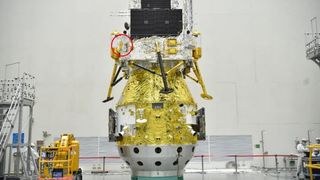
Chang'e 6 is also carrying a tiny moon rover and has a variety of scientific experiments onboard the lander.

The China National Space Administration's Chang'e 6 sample-return probe and its mini-rover (circled) seen before launching to the far side of the moon.  (Image credit: CAST)

Scientists will study the returned material in detail, seeking insights about the moon's history and evolution and clues about why the lunar far side is so different than the near. The dark volcanic seas known as maria are common on the near side, for example, but are rare on the far side, for reasons that remain mysterious.

Researchers will doubtless compare the Chang'e 6 material to the samples collected on the moon's near side by Chang'e 5, which came down to Earth in December 2020. (Chang'e 5 and Chang'e 6 are sister missions, with virtually identical architectures.)

Big lunar dreams

The Chang'e moon program, which is named after the Chinese moon goddess, has launched increasingly complex and ambitious missions over the past 17 years.

Chang'e 1 and Chang'e 2 sent orbiters to the moon in 2007 and 2010, respectively. Chang'e 3 marked China's first trip to the lunar surface, putting a lander-rover duo on the near side in late 2013. Chang'e 4 landed a similar pair on the far side in early 2019. Chang'e 5-T1 launched a test capsule around the moon and back to Earth in 2014, proving out the gear that could get lunar samples here safely, which Chang'e 5 did in late 2020.

And there are more missions to come. Chang'e 7 is scheduled to launch in 2026 to assess the resource potential of the moon's south polar region, which is thought to harbor large stores of water ice. Chang'e 8, which will lift off two years later, will test ways to use those resources on-site — building a structure out of lunar dirt and rock, for example.

And all of this robotic work will lead to something even bigger, if all goes according to plan: crewed missions to the moon, which China aims to start launching by 2030. The nation wants to build an astronaut outpost near the south pole called the International Lunar Research Station later in the 2030s, with help from partners such as Russia, Belarus and Pakistan.

The United States has similar aims with its Artemis program, which is targeting late 2026 for its first crewed lunar landing. The U.S. is also building a moon-exploration coalition via a diplomatic framework called the Artemis Accords; more than 40 nations have signed on to date.

{ https://www.space.com/ }

Hoe vind je dit bericht?
Geschreven door peter om 01:41 Stuur door

the Monthly MUFON UFO Sighting Statistics

the Monthly MUFON UFO Sighting Statistics

COUNTRIES OF THE WORLD

UNITED STATES 407

FRANCE 25

UNITED KINGDOM 20

CANADA 18

ITALY 7

AUSTRALIA 5

GERMANY 5

COLOMBIA 5

BRAZIL 4

SPAIN 3

SOUTH AFRICA 3

POLAND 2

SWEDEN 2

IRELAND 2

INDONESIA 2

INDIA 2

BELGIUM 1

NETHERLANDS 1

NORWAY 1

COSTA RICA 1

SAUDI ARABIA 1

SLOVAKIA 1

SWITZERLAND 1

BAHAMAS 1

ALBANIA 1   

TOTAL: 521

SHAPE

Sphere 88

Circle 85

Other 47

Unknown 36

Oval 33

Triangle 33

Star-like 27

Disc 27

Cigar 19

Square/Rectangular 14

Diamond 12

Tic Tac 11

Fireball 8

Bullet/Missile 8

Cylinder 7

Boomerang 6

N/A 4

Egg 3

Saturn-like 3

Teardrop 2

Blimp 1

Cross 1

Cone 1

Flash 1

Chevron 1

STATES OF THE UNITED STATES OF AMERICA

California 49

Arizona 30

Florida 24

Michigan 19

Texas 18

Washington 15

Colorado 13

Maryland 13

Pennsylvania 13

Ohio 13

North Carolina 13

Illinois 12

Oregon 12

New York 11

Missouri 10

Georgia 10

Tennessee 9

Kentucky 8

Indiana 8

New Jersey 8

Wisconsin 8

New Mexico 7

Virginia 7

Alabama 6

Idaho 6

Connecticut 6

Nevada 5

Oklahoma 5

South Carolina 5

Vermont 4

Massachusetts 4

Maine 4

Arkansas 4

Nebraska 3

Louisiana 3

Kansas 3

Iowa 3

Utah 3

Montana 2

South Dakota 2

Minnesota 2

Rhode Island 1

New Hampshire 1

Mississippi 1

West Virginia 1

District of Columbia 1

Wyoming 1

DISTANCE

< 100 ft 60 1

01-500 ft 55

501 ft - 1 Mile 87

Over 1 Mile 102

Unknown 60

NO VALUE 12

Most impressively there were 8 Landings, Hovering, or Takeoffs reported and 20 Entities observed.

{ https://mufon.com/ }

Hoe vind je dit bericht?
Geschreven door peter om 01:19 Stuur door

A New Way to Make Precise Maps of the Lunar Surface

Lunar surface

A New Way to Make Precise Maps of the Lunar Surface

There was a time when maps of the Moon were created from telescopic observations and drawings. Indeed Sir Patrick Moore created maps of the Moon that were used during the historic Apollo landings. Now researchers have enhanced a technique to create accurate maps from existing satellite images. Their approach uses a technique called ‘shape-from-shading’ and involves analyzing shadows to estimate the features and shape of the terrain. Future lunar missions will be able to use the maps to identify hazards on the surface making them far safer. 

Researchers at the Brown University in Rhode Island have helped refine a process used to map the surface of the Moon making it more accurate than ever before. In their paper, published in the Planetary Science Journal and authored by Benjamin Boatwright and team details the enhancements to the mapping technique. It can generate detailed models of the Moon’s surface to highlight craters, ridges and slopes from composites of 2D images. 

Closeup of lunar surface (Credit NASA)

Highly detailed maps are of crucial importance to lunar missions and help the planners to identify the safest place to land. They can also use them to identify areas of particular interest that require further study enabling the whole mission to be far more efficient. Missions such as the Artemis project will benefit when it heads for the south pole of the Moon, an area which is not well mapped. High resolution maps of the area will aid the autonomous landing systems to avoid hazards. 

artemis_humans_space_moon_gateway_main-2000x1200-750.jpg

Artist impression of Artemis lunar landing

Creating the maps is a time consuming job and is difficult to be accurate when lighting levels on target area are poor. The interpretation of shadows has been less than effective until now with the team addressing the issues. In their paper, the team explain how advanced computer algorithms can automate a lot of the process and improve the resolution of the generated models. Their new software gives lunar astronomers the necessary tools and information to create larger more detailed maps of the surface. 

To allow lunar scientists to create a map from images requires at least two images of the same area. Each image must be perfectly aligned with its counterpart so that features in one are in exactly the same place in the other. Until now, the technology has not been able to take multiple images of an area and create a perfect map. Boatwright said ‘We implemented an image alignment algorithm where it picks out features in one image and tries to find those same features in the other and then line them up, so that you’re not having to sit there manually tracing interest points across multiple images, which takes a lot of hours and brain power.’

Along with the image alignment algorithm, the researchers created quality control algorithms and filters to remove poor quality images from the alignment process. By only inputing good quality images to the process means the output will be of far higher quality. It is a similar model that astronomical imaging employs when processing multiple images through stacking and alignment techniques. 

To evaluate the accuracy of their work, the team compared the output from existing maps of the Moon to look for errors. To their delight, they found that maps created using their enhanced ‘shape-from-shading’ technique was more precise compared to those acquired during traditional techniques. 

Source : 

{ https://www.universetoday.com/ }

Hoe vind je dit bericht?
Geschreven door peter om 01:01 Stuur door

EXCLUSIVE / Have people really been 'killed by aliens?' Expert weighs in on fatalities linked to UFOs

EXCLUSIVE - Have people really been 'killed by aliens?' Expert weighs in on fatalities linked to UFOs

Many reports of untimely deaths in the US have been linked to aliens, sparking theories that these individuals may have been murdered by the third kind.

They include a US Air Force pilot who died shortly after claims he witnessed a flying object and a Brazilian man who was 'zapped in the head by an extraterrestrial.'

Nigel Watson has written about the cases in a new bookazine, the UFO Files, which includes a chapter Death By UFO dealing with these mysterious deaths.

UFO believers are on a missions to prove that aliens were behind many high-profile murders in the past few decades

UFO believers are on a missions to prove that aliens were behind many high-profile murders in the past few decades

Watson has spent years researching UFO reports worldwide and published several books and reports about his findings.

Fatal encounter in the skies

One of the cases explored in the book is the death of U.S. Air Force Captain Thomas Mantell who was asked to investigate a silvery, conical flying object in 1948.

Reports have claimed that Mantell, who was a 25-year-old Second World War hero, and three other pilots were conducting training exercise when the request came in to investigate a high-flying silvery object tipped with red. 

'It appears to be a metallic object or possibly the reflection of the sun from a metallic object, and it is of tremendous size,' Mantell reported as he flew in the skies above Fort Knox in Kentucky.

The three planes soared 22,000ft into the air to intercept the object. 

Captain Thomas Mantell died after he followed a mysterious metallic object in his jet

Captain Thomas Mantell died after he followed a mysterious metallic object in his jet

At 2.45pm, Mantell radioed the tower that he had spotted the object.

'The object is directly ahead of me and above me now, moving at about half my speed,' he said. 

He provided another update 30 minutes later: 'It appears to be a metallic object or possible reflections of sun from a metallic object, and it is of tremendous size. I’m still climbing. The object is above and ahead of me moving at my speed or faster. I’m trying to close in for a better look.'

Shortly after, the two other planes had to aborted the mission due to a lack of oxygen supplies.

Mantell, however, continued soaring higher and higher - reaching around 25,000ft.

But at 5pm, debris from his plane was discovered in Shelby County, south-east of Louisville.

The U.S. Air Force first claimed he was chasing the planet Venus, but then said the object was a secret CIA-sponsored Skyhook balloon launched in Southern Ohio.

UFO believers still maintain that Mantell met his demise at the hands of a murderous UFO, Watson said - with the Skyhook explanation not being revealed until the late 1960s.

Zapped by 'death ray'

Brazilian man Inacio de Souza and his wife were returning to their home in August 1967 when they saw an object shaped like an inverted wash basin - and three men wearing skin-tight clothes.

Souza reflexively shot one of the men with his rifle It seemed to have no effect, but a green ray of light shot out at Souza's head from the UFO.

De Souza fell unconscious and suffered numbness and tremors in his head and hands.

A doctor suggested that Souza had merely suffered hallucinations - and a few days later was diagnosed as having leukemia. The illness progressed quickly and he died on 11 October 1967.

Watson wrote: 'While some ufologists think the encounter and de Souza's illness are simply a tragic coincidence, others prefer to believe that the green light from the UFO was an intense beam of deadly radiation.'

'Heavy rain' from a UFO

In 1947, Harold A Dahl along with his son Charles and two crewmen were in a tugboat off Maury Island in Puget Sound between Seattle and Tacoma.

The men said they saw six golden and silver doughnut-shaped objects above them - with one 'wobbling' before releasing a rain of thin metallic strips and black lumps.

Harold Dahl was said to have seen six gold before

Harold Dahl was in a tugboat with his sons when he saw mysterious golden and silver objects above them

One struck the boy's arm, burning it, and their dog died.

Dahl's boss Fred Lee Crisman visited the site and claimed some of the debris.

Dahl was then confronted by a dark-suited man driving a black sedan who drove him to a diner in Tacoma and warned him to keep silent.

Kenneth Arnold - who had spotted 'flying saucers' just days earlier - asked for help from Air Force Intelligence.

On 31 July 1947, Captain William Davidson and Lieutenant Frank M Brown were dispatched to Tacoma, but found no evidence of a rain of molten lead, and thought the sample fragments were slag from a smelting plant.

Davidson and Brown died when their B-25 crashed on their way back to base - and many of the samples and photographs associated with the case vanished.

Watson writes: 'To many, this all smacked of a military-intelligence cover-up. When, in October 1968, District Attorney Jim Garrison brought Clay Shaw to trial for his suspected involvement in the assassination of John F Kennedy, a Fred Lee Crisman was subpoenaed to attend.

Kenneth Arnold, who saw the first 'flying saucers'

Kenneth Arnold, who saw the first 'flying saucers'

A B-25 bomber aircraft similar to the one the men rode in

A B-25 bomber aircraft similar to the one the men rode in

'Garrison believed Shaw and Crisman were long-standing CIA employees involved in a range of dubious activities including the JFK killing.

'As they were returning to their base at Hamilton Field, California, the port engine of their B-25 aircraft caught fire and they were killed when he crashed near Kelso, Washington State. An anonymous caller to the local newspaper, named the victims before the crash was made public and claimed the aircraft was shot down by a 20mm cannon because it was carrying fragments of a flying saucer.'

'When Kenneth Arnold took off from Tacoma, his engine failed and he had to make a crash landing. On checking his aircraft, he found that his fuel valve had been switched off. Paul Lance, a reporter for the Tacoma Times, who covered this story, died suddenly two weeks later of meningitis.'

'Many of these stories sound outlandish and many of these deaths do have credible explanations. So they don't go much beyond the UFO community. Government agencies or the notorious Men in Black, could be at work but it seems very extreme to murder people, especially over decades, when there are easier ways to discredit UFO researchers..'

'Frozen' near a UFO

New York UFO researcher Jennifer Stevens was contacted by two boys in February 1968 who claimed to have seen a 'glowing fireball' over the Mohawk River.

The boy's friend thought he saw a white-suited humanoid in bushes.

Another 16-year-old boy's body was found nearby after leaving a note with his grandparents to say he was going for a walk.

Watson writes: 'The coroner's verdict was death from exposure, but Stevens was convinced that his death was connected to UFO activity in the area. She noted that the boy's tracks in the snow indicated he had been running at first, then it seemed as if something had dragged him from above.'

After the sighting, Stevens husband was accosted by a man who said, 'People who look for UFOs should be very careful.'

When her husband died suddenly, Stevens gave up her UFO investigations.

  • The UFO Files bookazine by Fortean Times is available here.

{ https://www.dailymail.co.uk/ }

Hoe vind je dit bericht?
Geschreven door peter om 23:48 Stuur door

Experts say they've identified 'hairy UFO' that crash landed in North Carolina

Experts say they've identified 'hairy UFO' that crash landed in North Carolina

Space experts believe they have identified the bizarre 'UFO' debris discovered by a North Carolina groundskeeper and his coworker at a luxury campsite.

Justin Clontz found the three-foot-wide panel, fuzzed with burnt and frayed carbon fibers, in the middle of a trail in the town of Canton last week.

And now an astronomer has told DailyMail.com that the mangled metal is likely pieces of a storage trunk from one of Elon Musk's SpaceX spacecraft.

'The debris matches the expected location of these reentries,' Smithsonian astrophysicist Dr Jonathan McDowell told DailyMail.com, adding that he was 'very confident' in this assessment. 

Astronomer Dr Jonathan McDowell has told DailyMail.com that the bizarre 'UFO' crash debris discovered by a North Carolina groundskeeper at a luxury campsite has been determined to be pieces of a storage trunk from one of SpaceX 's reusable Cargo Dragon spacecraft (above)

Astronomer Dr Jonathan McDowell has told DailyMail.com that the bizarre 'UFO' crash debris discovered by a North Carolina groundskeeper at a luxury campsite has been determined to be pieces of a storage trunk from one of SpaceX 's reusable Cargo Dragon spacecraft (above)

Justin Clontz (above) was working grounds maintenance at Glamping Collective, a luxury campsite in Haywood County, North Carolina when he made the bewildering discovery. he had to tow the 'UFO' out of the area with a riding lawnmower because it was so massive and heavy

Justin Clontz (above) was working grounds maintenance at Glamping Collective, a luxury campsite in Haywood County, North Carolina when he made the bewildering discovery. he had to tow the 'UFO' out of the area with a riding lawnmower because it was so massive and heavy

The charred black, metal object also resembles two pieces of debris found in Canada and Australia, which are now known to be from SpaceX Dragons. 

'We have coincidence in time and place. They look similar to each other and to the Australia debris which is confirmed to come from a Dragon trunk,' Dr McDowell said. 

Clontz was working on grounds maintenance at Glamping Collective, a luxury campsite in Haywood County, when he made the eerie discovery. 

The career groundskeeper and landscaper told local news he was 'just shocked as to what it was,' adding: 'It's once in a lifetime, you know, it don't happen every day.' 

The UFO-like debris' carbon fiber looked almost like some kind of weird fur, as initial reports described the now very likely identified mystery object. 

'We don't know what it is,' Clontz told local news earlier this month. 'We just know that it's not from up here.'

Although this piece of SpaceX debris fell safely about a half-mile down a remote trail on Glamping's property, Dr McDowell noted that both governmental and private space programs have become dangerously lax with their space junk in recent years.

Although this piece of SpaceX debris fell safely about a half-mile down a remote forest trail, Dr McDowell noted that both governmental and private space programs have become notably lax with their space junk in recent years. Above, the open trunk of a SpaceX Cargo Dragon craft

Although this piece of SpaceX debris fell safely about a half-mile down a remote forest trail, Dr McDowell noted that both governmental and private space programs have become notably lax with their space junk in recent years. Above, the open trunk of a SpaceX Cargo Dragon craft

SpaceX's Dragon 'trunk' has storage space of over 350 cubic-feet internally, with an extender option that expands its capacity to over 1200 cubic-feet of storage space. This cargo container comes with mounted radiators that help it regulate the temperature of sensitive items

SpaceX's Dragon 'trunk' has storage space of over 350 cubic-feet internally, with an extender option that expands its capacity to over 1200 cubic-feet of storage space. This cargo container comes with mounted radiators that help it regulate the temperature of sensitive items

'The risk to life and property is fairly small — because the Earth is a big target and is mostly not covered with people — but it's not tiny,' Dr McDowell wrote via email. 

'We have seen some close shaves,' he said. 

Dr McDowell's work, which involves collecting and analyzing data from NASA's Chandra X-ray telescope observatory and other space-based astronomy platforms, often includes paying some attention to space traffic in Earth's orbit.

'The government is also taking unwarranted risks,' noted Dr McDowell, who publishes a monthly newsletter on space launches, 'as shown by the incident in Florida earlier this year when a bit of ISS came through the roof of someone's house.'

That incident, this March, involved a 5,800-pound battery pallet plunging into a Florida home. The heavy metal object was later confirmed to have been discarded by the International Space Station (ISS) in 2021.

'The risk to life and property is fairly small - because the Earth is a big target and is mostly not covered with people - but it's not tiny,' Dr McDowell wrote via email about the SpaceX crash

'The risk to life and property is fairly small - because the Earth is a big target and is mostly not covered with people - but it's not tiny,' Dr McDowell wrote via email about the SpaceX crash

Dr McDowell's work, which has involved NASA's Chandra X-ray telescope observatory and other space-based astronomy platforms, often includes paying some attention to the space traffic in Earth's orbit. Above, another close-up of the SpaceX debris in North Carolina

Dr McDowell's work, which has involved NASA's Chandra X-ray telescope observatory and other space-based astronomy platforms, often includes paying some attention to the space traffic in Earth's orbit. Above, another close-up of the SpaceX debris in North Carolina

Naples homeowner Alejandro Otero was on vacation when he received a call from his son, saying he heard a 'tremendous sound' and there were gaping holes in the ceiling and floor. Otero's son reportedly told him that whatever fell almost hit him.

SpaceX has not yet confirmed whether the object found in Canada earlier this year, or the object found in North Carolina, were debris from their spacecraft.

But, ground tracking of the SpaceX Dragon 'trunk' that made its re-entry this February would indicate that both of these crash debris objects came from the trunk as it burned up in the hot friction of its descent back towards Earth.

Dr McDowell told Space.com that the most likely sites for debris from this descent could include US states from Tennessee through Virginia and West Virginia, but North Carolina was certainly within the realm of possibility.

Clontz had to improvise to tow this apparent hull panel from the SpaceX Dragon's trunk out of off the trail because it was so massive: 'I just tied a rope to it and drug it out with a lawn mower'

Clontz had to improvise to tow this apparent hull panel from the SpaceX Dragon's trunk out of off the trail because it was so massive: 'I just tied a rope to it and drug it out with a lawn mower'

Above, more detail from the futuristic SpaceX trunk panel, fuzzed with burnt and frayed carbon fibers, bolted between heavy metal plates

Above, more detail from the futuristic SpaceX trunk panel, fuzzed with burnt and frayed carbon fibers, bolted between heavy metal plates

SpaceX's Dragon 'trunk' has storage space of over 350 cubic-feet internally, with an extender option that expands its capacity to over 1200 cubic-feet. 

This cargo container comes with mounted radiators — electrical and fluid connections that allow it to regulate its storage space's internal temperature to accommodate a variety of sensitive payloads, including small satellites that can be released in orbit.

Clontz had to improvise to tow this apparent cargo hull panel from the SpaceX Dragon's trunk out of his trail area, just because it was so massive. 

'I just tied a rope to it and drug it out with a lawn mower,' as Clontz explained to WLOS. 

He added that the 'UFO' had landed perfectly in the middle of the trail and that none of the trees or leaves looked like they had caught fire in the crash.

Nobody had even heard the object land, he told reporters, which surprised him, given its size and weight.

'It's a one in a million chance that it lands, especially if it landed somewhere off the trail in the woods you'd have never found it,' he told the local news team, 'but it just happened to land on the trail.' 

{ https://www.dailymail.co.uk/ }

Hoe vind je dit bericht?
Geschreven door peter om 23:30 Stuur door

Top Secret UFO Files to be Released by October 2024: Daniel Sheehan Reveals Groundbreaking Details

Top Secret UFO Files to be Released by October 2024: Daniel Sheehan Reveals Groundbreaking Details

Top Secret UFO Files to be Released by October 2024

In an enlightening discussion on the Freedom Pact Podcast, esteemed attorney Daniel Sheehan unveiled critical information regarding the U.S. government’s clandestine UFO programs. Known for his notable legal career involving high-profile cases like the Pentagon Papers and Iran-Contra, Sheehan provides a unique and credible perspective on the impending release of classified UFO documents.

The Testimony of Colonel David Grusch

Central to the revelations is the testimony of Colonel David Grusch before the House Oversight Committee. Grusch, a former senior official in the National Reconnaissance Office and the Global Intelligence Center, declared under oath that the U.S. is in possession of an extraterrestrial spacecraft and non-human biologics. His credentials, including his access to top-secret satellite data and involvement in the Pentagon’s special UFO task force, lend significant weight to his claims.

Grusch’s testimony highlighted two critical programs: a UFO crash retrieval program and a back-engineering initiative aimed at developing weapon and propulsion systems from recovered extraterrestrial technology. His disclosures, approved by the Department of Defense Office of Pre-publication Security Review, underscore the authenticity and seriousness of these programs.

Government Actions and Legislative Developments

Following Grusch’s eye-opening testimony, the Senate Intelligence Committee took decisive action by unanimously approving a 64-page bill. This bill acknowledges the U.S. government’s extensive knowledge of UAPs (Unidentified Aerial Phenomena) and non-human intelligence. Although the bill was later condensed to 24 pages, it retained crucial provisions and was signed into law by President Biden.

The enacted law mandates that all U.S. military services, intelligence agencies, and defense department entities compile and digitize every piece of information they possess regarding UAPs. This comprehensive collection process must be completed by October 18, 2024. The law also stipulates that all information older than 25 years must be made publicly accessible. This encompasses historical incidents such as Roswell, Aztec, and Project Blue Book, marking a significant shift towards transparency.

Implications of the Upcoming Disclosure

The October 2024 deadline for the release of classified UFO files represents a monumental moment in the pursuit of transparency regarding extraterrestrial phenomena. For decades, UFO enthusiasts and researchers have speculated about government cover-ups and hidden evidence. This mandated disclosure is poised to provide unprecedented access to information that could reshape public understanding of extraterrestrial life and the government’s involvement in studying and managing UAPs.

Sheehan emphasized the importance of this legislative milestone, noting that despite the initial disappointment over the reduction of the bill’s length, the remaining provisions are extraordinary in their scope and impact. The law requires all relevant agencies to report their UAP-related documents, ensuring that oversight is maintained and that the public gains access to critical information.

VIDEO:

  • Top Secret UFO Files to be Released by October 2024 | Sheehan Explains

As the October 18, 2024, deadline approaches, anticipation builds around the potential release of top-secret UFO files. Daniel Sheehan’s insights and the legislative actions taken by the Senate and House underscore a significant move towards greater transparency and public awareness. The forthcoming disclosure promises to shed light on long-standing mysteries and provide a clearer picture of the U.S. government’s knowledge and handling of extraterrestrial phenomena. This historic event is set to redefine our understanding of UAPs and potentially unveil truths that have been hidden for decades.

{ https://www.latest-ufo-sightings.net/ }

Hoe vind je dit bericht?
Geschreven door peter om 21:14 Stuur door

The Sun's Magnetic Field Starts Just Beneath the Surface, New Study Reveals

The Sun's Magnetic Field Starts Just Beneath the Surface, New Study Reveals

The Sun's magnetic field, which drives solar storms and solar wind, doesn't originate deep within the Sun after all.

IN SPACE - JUNE 7:  In this handout from NASA/Solar Dynamics Observatory, a solar large flare erupts...
Handout/Getty Images News

They say beauty is only skin deep, and apparently so is the Sun’s magnetic field, according to a recent study.

The Sun’s magnetic field is shallow, suggests new research, which used computer simulation to model the flow of plasma in the outer layers of the Sun. Astrophysicists had suspected that the Sun’s powerful magnetic field, which has a huge impact on communications, navigation, and other electronics on and around Earth, was produced by motion much deeper in the star (similar to the way Earth’s magnetic field is generated by the motion of our planet’s metallic core). Armed with a better understanding of where the Sun’s magnetic field comes from, physicists may soon stand a better chance of predicting how much activity each 11-year solar cycle holds in store.

University of Edinburgh mathematician Geoffrey Vasil and his colleagues published their work in the journal Nature.

IN SPACE - JUNE 7:  In this handout from NASA/Solar Dynamics Observatory, a solar large flare erupts...

X n this handout from NASA/Solar Dynamics Observatory, a solar large flare erupts off the sun June 7, 2011 in space. A large cloud of particles flew up and then was pulled back down to the sun's surface.

HANDOUT/GETTY IMAGES NEWS/GETTY IMAGES

SHALLOW, NO DIVING

Vasil and his colleagues used a computer simulation to model how plasma flows in the outer layers of the Sun, called the convective zone: a 124,000-mile-deep sea of roiling plasma, heated from below by the Sun’s thermonuclear core. Specifically, they were interested in what happened in the top 20,000 miles or so of the plasma.

Massachusetts Institute of Technology mathematician Keaton Burns, a coauthor on the study, designed the program, called the Dedalus Project, to be very good at simulating how fluids flow, from the movements of liquid inside a cell to the circulation of Earth’s oceans and atmosphere. And the Sun, although we tend to picture it as a big ball of fire, is actually a big ball of super-hot gas.

Physicists know that the magnetic field is driven by an enormous dynamo: physical mass in motion, whose mechanical energy becomes electrical energy.

“One of the basic ideas for how to start a dynamo is that you need a region where there’s a lot of plasma moving past other plasma, and that shearing motion converts kinetic energy into magnetic energy,” explains Burns in a recent statement.

Most astrophysicists are convinced that process happens more than 125,000 miles deep inside the Sun, at the very bottom of the convection layer. That explanation makes sense in a lot of ways, but simulations based on it don’t actually produce results that look much like the churning, roiling plumes of plasma in the Sun’s outer layers — or the pattern of sunspots (dark, relatively cool patches of the Sun’s surface, where magnetic field lines meet and tangle) that astronomers actually see on the Sun’s surface. The real Sun is much more turbulent than most simulations suggest. And in simulations of a magnetic field coming from deep within the Sun, sunspots tend to gather near the Sun’s poles; on the real Sun, most sunspots form near the equator.

Knowing more about how the Sun’s magnetic field works could help scientists make predictions about the kinds of solar activity that produced stunning auroras — and briefly stalled spring planting on some farms by disrupting navigation systems on tractors and other equipment — earlier in May.

Cutaway illustration of the Sun, showing layers including the corona, photosphere and chromosphere, ...

Cutaway illustration of the Sun, showing layers including the corona, photosphere and chromosphere

ALL ABOUT SPACE MAGAZINE/FUTURE/GETTY IMAGES

JUST BENEATH THE SURFACE OF THE SUN

Vasil and his colleagues’ simulations showed that the Sun’s outermost reaches are made of layers of plasma, which normally rotate past each other (picture an onion; now picture an onion 865,000 miles wide and made of super-hot gas with a giant thermonuclear reactor running at its center). But tiny changes in how one layer flowed past the next — like a little plume or a slight eddy — could create an instability that fed on itself and rapidly grew into major turbulence.

“It doesn’t take much to trigger an instability! If a system is unstable, it is like a pencil balanced on its point — any slight breeze is enough to knock it over,” co-author Daniel Lecoanet, an assistant professor of Engineering Sciences and Applied Mathematics at Northwestern University, tells Inverse. “The outer part of the Sun is convective, which is kind of like it is boiling. These roiling motions are definitely enough to seed the instability.”

Most of the instabilities that eventually formed got their start thanks to powerful winds in the interior of the Sun, which move at different speeds depending on how deep into the Sun you go. As you sink deeper into the Sun, the winds get stronger — until about 21,000 miles below the outer edge, when they suddenly slow down.

“The difference in wind speed at the surface vs. deeper into the Sun is a source of energy that can drive instability,” says Lecoanet. That energy is eventually converted into the Sun’s magnetic field.

And in Vasil and his colleagues’ simulations, those instabilities in the outer layers of the simulated Sun eventually produced a pattern of magnetic field lines and sunspots that looked remarkably like the real thing.

“Our work provides strong evidence that the solar cycle starts near the surface of the Sun in the equatorial region,” says Lecoanet.

PREDICTING SOLAR STORM SEASONS

Eventually, Vasil and his colleagues hope their work will help astrophysicists forecast how active the next solar cycle will be, similar to the way that meteorologists predict how active the coming hurricane season will be.

“This work is not trying to make predictions about individual solar storms,” says Lecoanet.

At the moment, NOAA’s Space Weather Prediction Center can predict the severity of a solar storm a few days in advance, around the time a huge belch of plasma called a coronal mass ejection leaves the Sun’s surface. But we don’t have a good way to predict what the next few years hold; some solar cycles are more active than others, and knowing what’s coming could help us prepare.

“We want to forecast if the next solar cycle will be particularly strong, or maybe weaker than normal,” says Lecoanet. “The previous models (assuming the solar magnetic field is generated deep within the Sun) have not been able to make accurate forecasts of if the next solar cycle will be strong or weak. We are hoping to make predictions of if a cycle will have a lot of solar storms or not a lot.”

{ https://www.inverse.com/ }

Hoe vind je dit bericht?
Geschreven door peter om 01:14 Stuur door

LOOK: DARPA’S HIGH-SPEED X-PLANE JUST GOT A MAKEOVER, NEW IMAGES REVEAL

8zjG5hCr?format=jpg&name=900x900

LOOK: DARPA’S HIGH-SPEED X-PLANE JUST GOT A MAKEOVER, NEW IMAGES REVEAL

An experimental high-speed, vertical-lift X-plane has a new look, as revealed in new conceptual images as the aircraft moves toward its preliminary design phase.

Developed by Aurora Flight Sciences, a Boeing company, the Aurora X-plane was recently revealed in a series of new conceptual images depicting the aircraft during test flights over Dugway Proving Ground in Utah. The aircraft is currently being developed for the Defense Advanced Research Projects Agency (DARPA) under its Speed and Runway Independent Technologies (SPRINT) program.

Under the SPRINT program, Aurora has been tasked with delivering DARPA an aircraft capable of demonstrating a range of key technological capabilities. The agency says this will “enable a transformational combination of aircraft speed and runway independence.”

Aurora’s demonstrator will be a fan-in-wing design, which achieves low-drag flight thanks to an innovative wing body platform that blends the best capabilities in current vertical take-off and landing (VTOL) technology with high speed.

Aurora’s aircraft will help advance the SPRINT program’s objectives of attaining “game-changing capability for air mobility and Special Operations Forces (SOF) missions,” the company said in a recent statement on its website.

WHAT THE NEW IMAGES REVEAL

In Aurora’s latest artist concept images, the experimental aircraft’s fan-in-wing (FIW) design is revealed. It features a trio of lift fans and a more streamlined composite exterior.

“The choice of three lift fans reflects the team’s strategy to simplify the demonstrator and streamline its path to flight test,” the company says, with the fans designed to be scaled to provide additional fans as may be needed for future aircraft based on the new design.

Aurora X-plane

Above: Fan configuration shown in recent artist’s concept images of the X-plane, currently under development by Aurora for DARPA’s SPRINT program

(Credit: Aurora Flight Sciences/Boeing).

Previously, Aurora has already demonstrated the use of fan systems in the development of its Excalibur Unmanned Aerial System (UAS), which employs jet power to drive three electric “louvered lift” fans for vertical takeoff and landing. On the new X-plane, the fan configurations will be retractable within the wings during primary flight mode operations.

Although the current X-plane design is an uncrewed demonstrator, Aurora says this offers advantages during the testing phase by reducing risks while allowing the FIW technologies it demonstrates to be carried over and scaled to aircraft designs featuring traditional crewed configurations.

SETTING THE PACE FOR ‘SPRINT’

Additionally, the new images reveal elements of the aircraft that will serve as crucial components for meeting the SPRINT program’s objectives. These include a body capable of 450-knot cruise speeds, short take-off and vertical landing (STOVL) capabilities, and seamless transitions between vertical and horizontal flight modes.

X-Plane

Above: Updated artist’s concept imagery of the Aurora X-plane, currently in development for DARPA’s SPRINT program

(Credit: Aurora Flight Sciences/Boeing).

Larry Wirsing, vice president of aircraft development at Aurora Flight Sciences, said that the company’s work with DARPA on its SPRINT program offers “an exciting opportunity to continue our history of advancing technology demonstrator programs that enable new capabilities for the U.S. military.”

According to current timelines, Aurora and Boeing anticipate their primary design review will likely conclude within the next 12 months, after which the X-plane’s first official flight will take place in approximately 36 months.

{ https://thedebrief.org/category/space/ }

Hoe vind je dit bericht?
Geschreven door peter om 00:56 Stuur door

Egyptian Gods, Tall Grays, Reptilians and Space Pirates

Egyptian Gods, Tall Grays, Reptilians and Space Pirates

Exopolitics Today Week in Review with Dr Michael Salla – June 1, 2024

Topics

  • Ancient Egyptian Gods were Extraterrestrials According to leading QHHT practitioner
  • It’s the 25th anniversary of The Thirteenth Floor.
  • Ancient Gods & ETs Among Us Today – The Exopolitical Implications – New Webinar – June 15, 2024.
  • A transcript of an interview a 25-year CIA agent gave a couple of years ago about his contact with Mantid/Tall Gray ET is now available.
  • The evidence of ancient Reptilian species walking and living among humanity spans multiple national cultures.
  • Col Karl Nell on the reality of non-human intelligence visiting Earth and interacting with humanity.
  • Extraterrestrial Contact in Washington and Hawaii
  • A forensic image expert has conducted a frame-by-frame analysis of the 2023 Las Vegas alien sighting & concluded the tall beings are genuine.
  • Only a few months to go before GSIC-2024 – JP will be appearing as a presenter.
  • Total signatories to Artemis Accords rises to 42 with Peru & Slovakia joining.
  • First Annual Space Piracy Conference Scheduled for February 2025
  • Congressman Robert Garcia is offering 3 UFO amendments to the NDAA for 2025

Watch on YouTube, Rumble, & Odysee

Audio Podcast on Apple, Spotify, or Google

Twitter Feed: https://twitter.com/michaelsalla

{ https://exopolitics.org/ }

Hoe vind je dit bericht?
Geschreven door peter om 00:22 Stuur door

De grootste astronomische ontdekkingen aller tijden

De grootste astronomische ontdekkingen aller tijden

 De grootste astronomische ontdekkingen aller tijden

©Getty Images

De grootste astronomische ontdekkingen aller tijden
Het heelal heeft ons mensen al sinds we op planeet aarde rondlopen, gefascineerd. Er wordt dan ook al duizenden jaren studie gedaan naar dat donkere gat met al die lichtpuntjes. Van de oude Assyriërs, Grieken en de grootste geesten van de Renaissance tot de miljardair ruimteverkenners van de 21e eeuw. Er is ongelooflijk veel tijd, moeite en geld gestoken in het beter begrijpen van onze hemelse omgeving. En toch, ondanks alle grote stappen die zijn gezet om het universum te begrijpen, wordt geschat dat 95% daarvan nog steeds onontdekt is.

Desalniettemin weten we al aardig wat over het heelal. Benieuwd naar de grootste ontdekkingen? LEES dan verder!

Wat is dat toch?

©Getty Images

Wat is dat toch?
Het heelal is voor ons nog altijd een behoorlijk mysterie. Moet je nagaan wat onze voorvaderen daarover moeten hebben gedacht.

Wat is dat toch?

©Getty Images

Wat is dat toch?
De sterren waren direct verbonden met de religies van de prehistorie. Oude volkeren begonnen hemellichamen al snel te zien als wezens die verantwoordelijk waren voor aardse gebeurtenissen zoals regen, wind en stormen. Sommige van 's werelds vroegste bouwwerken en monumenten werden waarschijnlijk gebouwd als centra van aanbidding in overeenstemming met hemelse gebeurtenissen zoals de zonsverduistering en lente-equinox.

Babylonische astronomie

©Getty Images

Babylonische astronomie
De eerste schriftelijke astronomische waarnemingen verschijnen in Babylonische spijkerschriftteksten die rond 1500 voor Christus zijn geschreven. De vroegste planetaire waarneming werd vastgelegd in de 'Enuma Anu Enlil'. Daarin werd de beweging van Venus in de loop van 21 jaar gevolgd.

De eerste sterrencatalogus

©Public Domain

De eerste sterrencatalogus
Gan De, een vroege voorvechter van Chinese astrologie, wordt gecrediteerd met het produceren van de eerste uitgebreide sterrencatalogus ter wereld, ergens in de 4e eeuw v.Chr., eeuwen voordat de Griekse astronomie Hipparchus zijn eigen atlas samenstelde.

Eerste waargenomen komeet

©Getty Images

Eerste waargenomen komeet
Een van de meest bekende hemelse gebeurtenissen over de hele wereld, het passeren van de komeet van Halley werd voor het eerst vastgelegd in een Chinese tekst die teruggaat tot 240 v.Chr., en vervolgens opnieuw door de Babyloniërs in 164 v.Chr.. De komeet van Halley passeert de aarde op zo'n afstand dat hij elke 75 jaar met het blote oog zichtbaar is.

De eerste heliocentrische theorie

©Public Domain

De eerste heliocentrische theorie
Meer dan een millennium voordat Nicolaus Copernicus zijn heliocentrische theorie aan de wereld introduceerde, veronderstelde de oude Griekse astronoom Aristarchus, ergens tussen de 3e en 4e eeuw v.Chr., dat de zon en niet de aarde het centrum van het universum was.

Ptolemaeus' Almagest

©Getty Images

Ptolemaeus' Almagest
In de 2e eeuw n.Chr. introduceerde de Griekse astronoom Ptolemaeus de 'Almagest'. Die beschreef een enorm invloedrijke, zij het onnauwkeurige, geocentrische theorie van het universum. Dit idee dat de aarde het centrum van het universum was, zou meer dan duizend jaar heersen, tot de Italiaanse Renaissance.

Astronomy through the Dark Ages

©Getty Images

Astronomy through the Dark Ages
Terwijl de westerse vooruitgang in de astronomie tijdens de donkere Middeleeuwen bijna tot stilstand kwam, bleven astronomen in de Aziatische en Arabische wereld het veld verder pushen, nieuwe meetinstrumenten creëren en verbeteren en enorme, prachtige observatoria bouwen.

De heliocentrische theorie van Copernicus

©Getty Images

De heliocentrische theorie van Copernicus
In 1543 publiceerde Copernicus zijn heliocentrische theorie, die de Copernicaanse revolutie ontketende. Het was de eerste keer in meer dan duizend jaar dat een heliocentrische theorie werd geponeerd, en hoewel het niet onmiddellijk werd aanvaard, onderschreven veel astronomen na Copernicus zijn theorieën en verbeterden ze totdat ze als feit werden geaccepteerd.

Uraniborg

©Getty Images

Uraniborg
Een tijdgenoot en tegenstander van Copernicus, Tycho Brahe, die de heliocentrische theorie verwierp, boekte wel onschatbare vooruitgang met betrekking tot de posities van sterren met behulp van zijn enorme observatorium, Uraniborg. Uraniborg, gebouwd op het toenmalige Deense eiland Hven, was een van de grootste en belangrijkste observatoria die in gebruik was vóór de uitvinding van de telescoop.

De sterrencatalogus van Tycho Brahe

©Getty Images

De sterrencatalogus van Tycho Brahe
In Uraniborg werkte Brahe aan zijn sterrencatalogus, waarvan de definitieve versie uit meer dan 1.000 sterren bestond. De catalogus van Brahe, die aan het einde van de 16e eeuw werd voltooid, maar pas in 1627 werd gepubliceerd, bevatte gegevens die tot 10 keer nauwkeuriger waren dan voorheen.

De manen van Galileo

©Getty Images

De manen van Galileo
Een van Galileo's grootste prestaties, bereikt met de hulp van zijn telescoop in 1610, was de eerste waarneming van de vier grootste manen van Jupiter, gezamenlijk bekend als de Galileïsche manen. Dit was de eerste keer dat satellieten van een andere planeet werden waargenomen.

De afstand tussen de aarde en Mars

©Public Domain

De afstand tussen de aarde en Mars
In 1672 berekende de Italiaanse astronoom Giovanni Cassini, met de hulp van zijn assistent Jean Richer, de afstand van de aarde tot Mars. Dit was de eerste bewezen afstand van de aarde naar een andere planeet, en speelde een belangrijke rol bij het bepalen van de ware grootte van ons zonnestelsel.

De sterren zijn niet vast op hun plaats

©Getty Images

De sterren zijn niet vast op hun plaats
Edmond Halley, een Engelse wetenschapper en astronoom, was de eerste die zich realiseerde dat de verre sterren aan de hemel bewegende en dynamische objecten waren, terwijl hij hedendaagse kaarten en sterposities vergeleek met de posities die waren opgenomen in de 'Almagest' van Ptolemaeus. Daarin werd nog aangenomen dat sterren niet bewegende, statische objecten waren. Er werd een komeet naar Halley vernoemd.

De ontdekking van Uranus

©Getty Images

De ontdekking van Uranus
De Engelse astronoom William Herschel ontdekte de eerste 'nieuwe' planeet, Uranus, in 1781. Er waren al eerder waarnemingen van Uranus gedaan, maar tot de 18e eeuw werd ten onrechte aangenomen dat Uranus een verre ster was en geen planeet in ons eigen zonnestelsel.

De Carte du Ciel

©Public Domain

Het bestaan ​​van andere sterrenstelsels

Het twistpunt van het Grote Debat van 1920 tussen de Amerikaanse astronomen Harlow Shapley en Heber Curtis was hoe groot het universum eigenlijk was. Centraal in dit argument stond de Grote Spiraalnevel. Shapley betoogde dat deze nevel een kleine, relatief dichtbij gelegen wolk van gas en stof was.

Het bestaan ​​van andere sterrenstelsels

©Getty Images

Het bestaan ​​van andere sterrenstelsels
Curtis beweerde echter correct dat de Grote Spiraalnevel, nu bekend als de Andromedanevel, in feite een massief en onafhankelijk sterrenstelsel was, vele lichtjaren verwijderd van ons eigen Melkwegstelsel.

Het heelal breidt zich uit

©Getty Images

Het heelal breidt zich uit
In de jaren twintig werd een van de meest schokkende en revolutionaire ontdekkingen over de aard van de ruimte gedaan. De wet van Hubble-Lemaître, eerst verondersteld door de Belgische priester en astronoom Georges Lemaître en later bevestigd door Edwin Hubble, had bewezen dat het universum zelf in een constante staat van verandering en uitbreiding verkeert. De wet van Hubble-Lemaître vertelt ons dat de snelheid waarmee een hemellichaam van ons af beweegt recht evenredig is met zijn afstand tot de aarde.

De ontdekking van donkere energie

©Getty Images

De ontdekking van donkere energie
Wat deze expansie voortstuwde, was echter nog onbekend in de tijd van Lemaître en Hubble. Pas in 1998 ontdekten wetenschappers donkere energie. Het universum bestaat voor 69% uit donkere energie. In tegenstelling tot materie en donkere materie, lijkt donkere energie gelijkmatig over het universum te zijn verspreid, en is zwaartekracht afstotend. Dat betekent dat de energie naar buiten duwt, waardoor alles in het universum verder uit elkaar wordt geduwd. Tot op de dag van vandaag blijft donkere energie een van de grootste mysteries van het universum.

Kosmische magnetron achtergrond

©Getty Images

Kosmische magnetron achtergrond
Een van de belangrijkste vorderingen bij het in kaart brengen van de geschiedenis van het universum was de ontdekking van de kosmische microgolfachtergrond van het universum. In 1963 ontdekten natuurkundigen Arno Penzias en Robert Wilson de achtergrondstraling die in alle uithoeken van het universum aanwezig is en fungeert als een voetafdruk voor de kosmische gebeurtenissen die eraan voorafgingen. Deze ontdekking was instrumenteel in de brede acceptatie van de oerknaltheorie.

De ontdekking van het eerste zwarte gat

©Getty Images

De ontdekking van het eerste zwarte gat
Astronomen ontdekten het eerste zwarte gat in 1964 in een diep deel van het sterrenbeeld Zwaan, na onderzoek naar onverwachte röntgenstraling in de ruimte. Het zwarte gat kreeg de naam Cygnus-X en bewees voor het eerst de theorie van Albert Einstein over zwarte gaten van bijna 50 jaar eerder.

Verkenning van Mars

©Getty Images

Verkenning van Mars
De Sovjet Mars 3 rover, gelanceerd in 1971, was de eerste sonde die met succes op Mars landde, hoewel de verbinding minder dan een minuut daarna verbrak. Vijf jaar later, in 1976, landde NASA met succes de Viking I en Viking II rovers op de rode planeet. Deze twee rovers stuurden in de loop van vier jaar meer dan 52.000 beelden van het oppervlak van Mars naar de aarde.

Ondergang van de dinosaurussen uitgelegd

©Getty Images

Ondergang van de dinosaurussen uitgelegd
In 1980 was de Amerikaanse Nobelprijswinnaar Luis Alvarez, met de hulp van zijn zoon, geoloog Walter Alvarez, en een team van nucleaire chemici, de eerste die stelde dat een enorme asteroïde die in botsing kwam met de aarde leidde tot het uitsterven van de dinosauriërs en een einde maakte aan het Krijt. Enkele jaren later, in de jaren negentig, werd de Chicxulub-krater, met een diameter van 180 kilometer, ontdekt in Mexico. Tegenwoordig wordt algemeen aangenomen dat de Chicxulub-krater de plek is waar de legendarische asteroïde was ingeslagen.

Eerste planeet gevonden buiten ons zonnestelsel

©Getty Images

Eerste planeet gevonden buiten ons zonnestelsel
In 1992 ontdekte een team van astronomen dat werkte vanuit het beroemde Arecibo-observatorium, twee exoplaneten buiten ons melkwegstelsel. Dit waren de eerste planeten buiten ons eigen zonnestelsel die ooit werden waargenomen, maar zeker niet de laatste. Er zijn inmiddels meer dan 4.000 exoplaneten ontdekt.

Water op Mars

©Getty Images

Water op Mars
Er werd lang gedacht dat Mars een ongelooflijk droge planeet was, verstoken van water. Echter veranderde de perceptie in 2012 toen NASA's Curiosity-rover bewijs vond van een enorm waterbed dat bevroren was onder het oppervlak van Mars. Sindsdien zijn er talloze andere ontdekkingen van water gedaan en wetenschappers zijn het er nu over eens dat minstens een derde van Mars bedekt is met bevroren water.

Een tweede aarde

©Getty Images

Een tweede aarde
Een van de meest prikkelende vragen van ruimteverkenning is of er planeten zijn die zo op de aarde lijken dat ze leven zouden kunnen ondersteunen. In 2015 kondigde NASA aan dat ze een zeer aardachtige planeet hadden gevonden, bekend als Kepler-452b, in een baan rond een ster die veel op onze zon lijkt. Hoewel de samenstelling van de atmosfeer van de exoplaneet onbekend is, is het wel bekend dat hij op een bewoonbare afstand van zijn thuisster ligt en een rotsachtig oppervlak heeft.

Een oceaan op Europa

©Getty Images

Een oceaan op Europa
Een internationaal gezamenlijk onderzoeksteam onder leiding van NASA kondigde in 2019 aan dat er waterdamp was gedetecteerd in de atmosfeer van de maan Europa, een van de 79 manen van Jupiter. Deze ontdekking ondersteunde de lang gekoesterde theorie dat er zich een enorme oceaan verbergt onder het oppervlak van deze maan, waarvan veel wetenschappers denken dat het een 24 kilometer diepe ijslaag is.

Zie ook:

Bronnen:

  • (European Space Agency)
  • (NASA)
  • (Futurism)

{ https://www.msn.com/nl-be/feed?ocid=msedgntp&pc=acts }

Hoe vind je dit bericht?
Geschreven door peter om 23:13 Stuur door

Meer van UFO'S of UAP'S, ASTRONOMIE, RUIMTEVAART, ARCHEOLOGIE, OUDHEIDKUNDE, SF-SNUFJES EN ANDERE ESOTERISCHE WETENSCHAPPEN - DE ALLERLAATSTE NIEUWTJES

↑ Terug naar de berichten