Ontdek de Fascinerende Wereld van UFO's en UAP's: Jouw Bron voor Onthullende Informatie!
Ben jij ook gefascineerd door het onbekende? Wil je meer weten over UFO's en UAP's, niet alleen in België, maar over de hele wereld? Dan ben je op de juiste plek!
België: Het Kloppend Hart van UFO-onderzoek
In België is BUFON (Belgisch UFO-Netwerk) dé autoriteit op het gebied van UFO-onderzoek. Voor betrouwbare en objectieve informatie over deze intrigerende fenomenen, bezoek je zeker onze Facebook-pagina en deze blog. Maar dat is nog niet alles! Ontdek ook het Belgisch UFO-meldpunt en Caelestia, twee organisaties die diepgaand onderzoek verrichten, al zijn ze soms kritisch of sceptisch.
Nederland: Een Schat aan Informatie
Voor onze Nederlandse buren is er de schitterende website www.ufowijzer.nl, beheerd door Paul Harmans. Deze site biedt een schat aan informatie en artikelen die je niet wilt missen!
Internationaal: MUFON - De Wereldwijde Autoriteit
Neem ook een kijkje bij MUFON (Mutual UFO Network Inc.), een gerenommeerde Amerikaanse UFO-vereniging met afdelingen in de VS en wereldwijd. MUFON is toegewijd aan de wetenschappelijke en analytische studie van het UFO-fenomeen, en hun maandelijkse tijdschrift, The MUFON UFO-Journal, is een must-read voor elke UFO-enthousiasteling. Bezoek hun website op www.mufon.com voor meer informatie.
Samenwerking en Toekomstvisie
Sinds 1 februari 2020 is Pieter niet alleen ex-president van BUFON, maar ook de voormalige nationale directeur van MUFON in Vlaanderen en Nederland. Dit creëert een sterke samenwerking met de Franse MUFON Reseau MUFON/EUROP, wat ons in staat stelt om nog meer waardevolle inzichten te delen.
Let op: Nepprofielen en Nieuwe Groeperingen
Pas op voor een nieuwe groepering die zich ook BUFON noemt, maar geen enkele connectie heeft met onze gevestigde organisatie. Hoewel zij de naam geregistreerd hebben, kunnen ze het rijke verleden en de expertise van onze groep niet evenaren. We wensen hen veel succes, maar we blijven de autoriteit in UFO-onderzoek!
Blijf Op De Hoogte!
Wil jij de laatste nieuwtjes over UFO's, ruimtevaart, archeologie, en meer? Volg ons dan en duik samen met ons in de fascinerende wereld van het onbekende! Sluit je aan bij de gemeenschap van nieuwsgierige geesten die net als jij verlangen naar antwoorden en avonturen in de sterren!
Heb je vragen of wil je meer weten? Aarzel dan niet om contact met ons op te nemen! Samen ontrafelen we het mysterie van de lucht en daarbuiten.
On September 7, 1936, the last known thylacine, often referred to as the Tasmanian tiger, is believed to have died in captivity in Hobart, Tasmania.
Since then, the species, long presumed extinct, has taken on a near-mythical status. The thylacine still captures the public’s imagination, having earned its place as a modern symbol of both loss, and also possibilities. The creature’s unmistakable striped appearance has also helped propel it to its current position as a pop cultural icon and a constant reminder of humanity’s more destructive side.
Yet what is perhaps the most intriguing about the thylacine is that, for many decades, alleged sightings of the creatures have continued, causing even some of the most skeptical wildlife experts to wonder whether the beloved Tasmanian tiger might have survived extinction, remaining alive but critically endangered in some of Tasmania’s most remote forests.
Last year, a comprehensive analysis of 1,237 thylacine sightings reported since 1910 indicated the possibility that the creatures might have indeed persisted until as recently as the 1980s, if not more recently. The study, led by Professor Barry Brook from the University of Tasmania and published in the journal Science of the Total Environment, based its evaluations on the quality of observations by assigning them a credibility rating, providing a fresh perspective on the timing and location of the thylacine’s potential last days.
Above: A living Thylacine on display at the Hobart Zoo in 1928 (public domain).
According to the study’s findings, contrary to the widely accepted death of the last known thylacine in 1936, which marked its extinction, the species likely survived until sometime between the 1940s and 1970s, with the northwest of Tasmania near Waratah serving as its likely final stronghold.
Following the death of the last officially recognized thylacine in the 1930s, hopes remained that confirmation of the species’ existence would be obtained, but after several decades of intriguing sightings, the International Union for Conservation of Nature officially declared the thylacine extinct in 1982. However, Brook’s study also examined sightings of slightly lower reliability that were logged in later decades, which indicated an intriguing possibility: that at least a few representatives of Australia’s most iconic marsupial species may have lived long enough to have seen the arrival of the new millennium.
CREDIBLE SIGHTINGS
Among the most credible sightings of thylacines that occurred after their accepted extinction was a report by Hans Naarding, a park ranger who said he observed one of the creatures for several minutes while illuminated by torchlight in 1982. The sighting was deemed so credible that it resulted in a search for the species by Tas Parks, in cooperation with Dr. Eric Guiler, which lasted more than two years.
Peter Murrell, then Director of the Tasmanian Parks and Wildlife Service, cited the Naarding sighting as the best “in the history of the service,” which he called “irrefutable and conclusive” evidence of the creature’s survival.
Such sightings prompted numerous additional searches. Between 1982 and 1983, Parks and Wildlife Officer Nick Mooney attempted to confirm Naarding’s sighting during searches conducted near the Arthur River in northwestern Tasmania, which failed to find any conclusive evidence of the creatures. The following year, in 1984, Tasmanian Wildlife Park owner Peter Wright conducted similar unsuccessful searches. Then, in 1988, photographers Dave Watts and Ned Terry spent several years seeking evidence of Thylacines but eventually gave up their search in 1993.
Despite the failed searches, a few intriguing reports continued. In one instance, a thylacine was reportedly shot near Adamsfield, Tasmania, in the early 1990s, after which a photograph of one of the creature’s feet was compared with a specimen kept at Museum Victoria. Chris Rehberg, who manages the website Where Light Meets Dark, which collects information on sightings of rare fauna like the thylacine, wrote, “It is my opinion that the features shown in the photograph categorically demonstrate the animal to be Thylacine, to the exclusion of all other candidate species in Tasmania.”
COULD THE THYLACINE STILL EXIST?
Brook believes that while the 2023 study’s findings are compelling, there is a less than 1% chance that the creatures are still alive today. Still, some compelling—though unconfirmed—accounts and photographs could point to this intriguing possibility, which served as the basis for a 60 Minutes segment that aired in April 2024.
In May 2024, new photos allegedly depicting a Tasmanian tiger in the wild were publicized by wildlife biologist Forrest Galante on his YouTube channel. During an interview with the alleged photographer, identified only as “Zack,” Galante expressed the view that some of the images looked legitimate, but that he remained skeptical about at least one of the photos and planned to have them examined by an expert.
In 2022, The Debrief spoke with Professor Andrew Pask from the University of Melbourne, who, along with the U.S.-based company Colossal Biosciences, announced a cooperative effort with hopes of reviving the thylacine with help from modern genetic technologies.
Pask told The Debrief that he remains skeptical about the thylacine’s possible survival and that the creatures would likely have only lasted a few generations beyond the death of the last known thylacine in captivity in 1936.
Pask also emphasized that the loss of the thylacine played a significant role in destabilizing the environment in which the creatures once thrived.
“That role as an apex predator was incredibly important in the ecosystem in which it sits,” Pask told The Debrief. “There are no other marsupial apex predators at all.”
“When that animal was lost, it really affects that entire ecosystem. It really has massive effects on multiple other species,” Pask said.
While questions remain about how long thylacines may have persisted, as well as the seemingly very slim possibility that a few of the creatures may remain alive today, Australia’s most enigmatic marsupial lives on through stories, art, scientific endeavors, and even recent studies like those conducted by Brook, reminding modern generations of the fragile balance between humanity and nature, and helping to inspire interest in conservation that may help other species that are currently designated as critically endangered.
Filmmaker James Fox has attended back-to-back two podcasts with Julian Dorey, where he discussed the history of UFOs and made a surprising claim about theVarginha UFO incident. He revealed a claim about the incident that he could not include in his documentary “Moment of Contact,” where an alien entity telepathically contacted one of the witnesses.
In January 1996, Brazil experienced the most controversial Varginha UFO incident, which involved numerous eyewitness testimonies of peculiar beings in Varginha, in addition to reports of a crashed UFO and the retrieval of extraterrestrial remains by the Brazilian military.
The first person to disclose the strange details of the incident was Roger Leir, a ufologist who visited Varginha shortly after the event in 2003 and later wrote the book “UFO Crash in Brazil.” Upon the police arrival, they immediately fired shots at the aliens, resulting in one of them being wounded. The injured extraterrestrial was then transported to a nearby hospital approximately 1.5 kilometers away from Varginha.
According to hospital staff, an entire wing of the facility was shut down, and the hospital was swarmed with military personnel fully armed. Despite the doctors’ attempts to save the creature, it ultimately perished and was pronounced dead on January 22, 1996.
A team of over a dozen specialists, including geneticists, conducted an autopsy, which revealed that the alien had a black tongue, no genitals, and a navel. After the autopsy, the deceased alien was placed in a wooden coffin with screws securing the lid.
Filmmaker James Fox (Left, )Marco Chereze (in photo shown by his sister) died after one of the creatures scratched him
Retired Brazilian Air Force General Jose Carlos Pereira told Fox in the documentary that “Governments tend to cover up everything they can’t explain to their population.” Whereas a university professor and amateur ultralight pilot Carlos de Sousa claimed to have seen the crash on January 13, 1996, in Varginha, Brazil.
Mr. de Sousa described the UFO in the film as the size of a school bus, a submarine-like shape, leaving the white smoke behind. He spoke to researcher Claudeir Covo on camera in 1996 and said: “It was floating and slowly losing altitude. It looked like a washing machine struggling, fighting to keep its altitude… The side of it was completely torn and it had white smoke coming out. It wasn’t black smoke like from a fire. At the time I thought it was like an aircraft in trouble, an airplane, so I decided to follow it.”
Whether the account is fictional or not, it remains one of the most discussed UFO incidents that happened outside the United States. Even twenty-five years later, the witnesses’ testimony is highly convincing to most who hear it. For 27 years, James Fox traveled across the world in pursuit of the truth regarding UFOs.
His latest UFO documentary “Moment of Contact” presents the most compelling evidence to date that extraterrestrial life exists, has visited our planet, and has even perished here.
On Julian Dorey’s podcast, Mr. Fox disclosed that the creature recovered from a 1996 incident had supposedly established telepathic contact with two doctors who treated its injuries at Humanitas hospital in Brazil. He could not include this in his documentary because he needed testimony on it. But he referred to Dr. Roger K. Leir’s book “UFO Crash in Brazil: A Genuine UFO Crash with Surviving ETs” to know more about it.
In Chapter 6, “The Medical Testimony,” Lier mentioned his conversation with a doctor who had treated one of the recovered alien entities. The being, which did not appear to have a gender, telepathically communicated to him that humans were “totally detached” from their spiritual selves and it felt sorry for them.
The doctor said the alien was transferred to another hospital in “satisfactory condition,” but was apparently dead within 24 hours. Leir speculated that the being may have left its body on its accord. The alien’s craft, he was told, was taken to a military installation in the US, where it currently remains.
Dr. L (Lier): Please go ahead. I trust what you are saying is the truth.
MP (Medical Personnel): When we had finished the surgery for repair of the fracture, we were still highly tense. We did not know how the patient was going to respond to what we had done to it. We were also afraid if something untoward happened to the creature, we would get the blame from the military and the punishment might be severe. Those thoughts were going through my head. Suddenly, out of nowhere the room began to fill with a greenish mist. We all stepped back from the operating table. We did not immediately know the origin of this mist and feared it might be toxic. One of the operating room nurses began frantically banging on the operating room door. A voice on the other side inquired if we were finished with the surgery. We told them we were essentially finished but there seemed to be greenish gas collecting in the room and we did not know the origin. With that, there was some heated conversation outside of the operating room and we were told to find the origin of the greenish substance and let them know. We did not know at this point whether it was a gas, vapor or mist but finally realized it seemed to be emanating from the creature lying on the table. In deep fear, I walked slowly closer to it and approached the head of the table. Without consciously realizing it, my gaze caught the eyes of the being. His eyes were glowing red and appeared as two swirling pools of liquid. They were pulling, pulling me in, deeper and deeper. All at once giant portions of information came pounding into my head. These were like thought grams, large blocks of information. Over and over and over, like someone hitting me in the head with a hammer. I was also becoming dizzy and slightly nauseated.
Dr. L: Undoubtedly you survived this ordeal. Can you tell us what was in these thought messages?
MP: All that I am willing to tell you at this time is what the creature told me about human beings. I also want to tell you he downloaded a tremendous amount of knowledge into my head. It caused me to have headaches lasting for over two weeks following the event.
Dr. L: Please go ahead and tell us what he told you.
MP: Yes. Essentially he told me his race felt very sorry for human beings for basically two reasons. The first is that all humans have the same potential and abilities to perform the very same things his race could do. Those things we find so marvelous and magical but humans did not know how to do them. For example, he told me in cases where there is injury or disease of the body, it would not be necessary to confine one of his species to a special treatment facility such as the one he was confined in at the moment. He told me they either individually or joined together could produce all the healing necessary to repair their bodies. The second reason they felt sorry for us was we did not seem to realize we were spiritual beings only living in a temporary shell and we were totally disconnected from our spiritual self.
Dr. L: That is a fascinating piece of information. Can you tell us anything further that you learned?
MP: No, that is all we are willing to share at this time.
In an “Ask Me Anything” session on Reddit, Fox stated that even bigger updates were coming in the future. When asked about rumors of an alleged 35-second video of the creature, Fox said: “I have personally spoken to three witnesses in Brazil. [They] claim to have seen photographic evidence — both video and stills.” “There will be details coming soon… very soon,” he wrote.
In this YouTube video, Vitorio Pacaccini, a prominent UFOlogist who had been missing from the community for a while, claims to have watched a highly compelling and detailed video proof of the Varginha alien in 2012.
According to Pacaccini, the being was very weak and not communicating, they were trying to help it stand and actually tried to feed it with an apple and water but the being did not respond to it. He describes the audio and video quality as excellent and asserts that the being matches the descriptions provided by the witnesses and military whistleblowers. It is possible that James Fox intends to share this footage in collaboration with Pacaccini.
China's mysterious Shenlong space plane has released an unidentified object in orbit — the seventh such object released in the past six months. The U.S. Space Force is monitoring the situation.
An illustration of China's secretive Shenlong space plane in orbit.
(Image credit: Erik Simonsen via Getty Images)
At around 3 p.m. ET on May 24, China's mysterious Shenlong space plane released an unidentified flying object 372 miles (600 kilometers) above Earth's surface. Experts outside China don't know exactly what the object is, but they believe it may be a small satellite or a piece of hardware ejected before the craft is scheduled to deorbit.
The U.S. Space Force has been tracking the space plane since it launched aboard a Long March 2F rocket from Jiuquan Launch Center on Dec. 14. Little is known about the craft, although it appears to be similar to the clandestine Boeing X-37B space plane developed by the U.S., which is capable of making years-long excursions into orbit. China's secret space plane first launched in 2020 and remained in orbit for just two days. However, it stayed aloft for 276 days during its second voyage, which began in late 2022.
Shenlong (which means "Divine Dragon") deployed six smaller objects shortly after launch last year; each appeared to be emitting some kind of signal. So far, Chinese officials have remained secretive about the plane and its activities, and have not addressed the nature of the mystery objects or even acknowledged them.
Meanwhile, the U.S. military's X-37B space plane is also in Earth's orbit. The craft launched on Dec. 28 on a SpaceX Falcon Heavy rocket. The fact that the two missions are operating simultaneously is "probably no coincidence," Space Force Chief of Space Operations B. Chance Saltzman told Air & Space Forces magazine.
Perhaps unsurprisingly, China's state-run media outlets have not indicated any military applications for the space plane. "After operating in orbit for a period of time, the experimental spacecraft will return to the designated landing site in China," Xinhua reported, according to Gizmodo. "During this period, it will carry out reusable technology verification and space science experiments as planned, providing technical support of the peaceful use of space."
Reusable space planes have many potential commercial and scientific applications, including carrying passengers and launching satellites more efficiently. Nevertheless, the Space Force will continue to monitor the Shenlong mission until it returns to Earth.
Kunstmatige intelligenties zijn steeds meer aanwezig in ons dagelijks leven en ondanks de controverse hebben ze sommige handelingen eenvoudiger gemaakt. Deze trend heeft het creëren van valse beelden echter ook veel gemakkelijker gemaakt: het is niet altijd gemakkelijk te begrijpen welke echt zijn en welke niet. Juist om deze reden is het essentieel om valse afbeeldingen op internet te herkennen, ongeacht hoe ze zijn gemaakt. Gelukkig zijn er enkele tools beschikbaar gesteld door Google om veiliger te navigeren.
Valse afbeeldingen en desinformatie op internet
Unsplash
Het is inmiddels voor iedereen duidelijk dat het internet niet meer de vrije en verantwoordelijke plek is die het aan het begin van zijn geschiedenis leek te zijn. Vandaag de dag zijn sociale media zowel een informatiemiddel geworden als kanalen waar desinformatie zich snel verspreidt. Een groot deel van het nepnieuws wordt publieke kennis, mede dankzij valse of gemanipuleerde beelden die onware verhalen ondersteunen. Het probleem is dat deze beelden vaak niet van echt te onderscheiden zijn: in combinatie met de onmiddellijke verspreiding van een inhoud op sociale media, wordt het onmogelijk om nepnieuws van echt nieuws te onderscheiden.
Zoals we in de inleiding al zeiden, heeft Google een aantal gratis tools beschikbaar gesteld waarmee het mogelijk is om een nepafbeelding te herkennen. Natuurlijk is het niet zo direct als doemscrollen op een social, maar het is wel een mogelijkheid om te voorkomen dat je nepnieuws gelooft. Misschien is een afbeelding bewerkt, misschien is deze helemaal gecreëerd: is het, met de mogelijkheid het nooit te weten, dan niet beter om te begrijpen hoe je het kunt herkennen?
Google en factchecking van nepnieuws, ook voor afbeeldingen
Unsplash
Het eerste hulpmiddel dat Google ter beschikking stelt, is de Fact Check Explorer, essentieel voor het verifiëren van valse beweringen over foto's en video's die op internet circuleren. Dit is een bijzonder nuttig hulpmiddel voor journalisten en nieuwsmedia, maar de toegang hiertoe is gratis. Al vanaf de startpagina is het mogelijk om te zien welke foto's en video's onlangs door de tool zijn geverifieerd, maar dat is nog niet alles.
Door een eenvoudige zoekopdracht op een trefwoord uit te voeren, geeft de Fact Checker een lijst met foto's die geverifieerd moeten worden. Sommige zullen waar zijn, sommige zullen zonder context zijn, sommige zullen gemarkeerd zijn als nep, enzovoort. Daarnaast is het ook mogelijk om op afbeeldingen te zoeken: deze mogelijkheid is al aanwezig in de klassieke Google zoekmachine, maar is vooral handig in de Fact Check Explorer. Door een afbeelding te uploaden, kan de tool deze vergelijken met bronnen op het web en begrijpen of het een echte of nepafbeelding is.
Soms hoef je alleen maar de informatie bij de afbeelding te lezen
Pexels
Google's Fact Checker Explorer is een krachtig en eenvoudig te gebruiken hulpmiddel, maar er is een nog eenvoudigere functie die ons op zichzelf in staat zou kunnen stellen om een nepafbeelding te herkennen. Om het te gebruiken en het potentieel ervan te realiseren, hoef je alleen maar:
te zoeken naar een trefwoord op Google;
“afbeeldingen” te selecteren en vervolgens de afbeelding die we willen controleren;
op de drie puntjes naast het resultaat klikken;
“over deze afbeelding” selecteren.
De zoekmachine opent dan een tabblad met de belangrijkste exemplaren van die afbeelding op internet en de eerste datum van online publicatie. Misschien is dat beeld bij een recente gebeurtenis onlangs verschenen en kan het daarom ook waarheidsgetrouw blijken te zijn. Misschien is het een afbeelding dat al enkele jaren oud is, maar gebruikt werd om verontwaardiging op te wekken over een recente gebeurtenis: ook in dit geval is het beter om het te weten, toch?
Zoals we kunnen zien, is de verspreiding van valse afbeeldingen een steeds ernstiger probleem. Tegelijkertijd zijn er hulpmiddelen om te begrijpen of we met een valse afbeelding worden geconfronteerd. Het is gemakkelijk om niet in nepnieuws te trappen: je hoeft alleen maar te weten hoe je deze tools moet gebruiken, of de tijd vinden om dit te doen tussen het ene sociale netwerk en het andere.
Giant beings might still reside underground today!
The notion that giants once roamed the earth has been widely discussed and supported by photographs of their skulls and skeletons found worldwide.
Ancient megalithic structures, enormous and enigmatic, prompt us to question their builders. It seems impossible that human beings could have constructed such structures.
Take, for instance, the colossal stones of Sacsayhuamán in Peru. When The conquistadors asked theInca about the walls at Sacsayjuaman, the Inca told them the Giants had built it.
Similarly, Malta, an island steeped in history and legend, houses mysterious megalithic structures that have baffled archaeologists for centuries. These massive stone temples, among the oldest globally, appear beyond the capabilities of prehistoric farmers.
However, the intrigue doesn't stop there.
Legends speak of the Nephilim, giant beings believed to have built these monumental structures. Some theories even suggest their descendants might still reside underground today.
We investigate the possibility of these giants, examining bones, elongated skulls, and mysterious hidden subterranean chambers called The Hypogeum.
This artist’s impression shows a possible seed for the formation of a supermassive black hole. Two of these possible seeds were discovered by an Italian team, using three space telescopes: the NASA Chandra X-ray Observatory, the NASA/ESA Hubble Space Telescope, and the NASA Spitzer Space Telescope.
The lifecycle of a star is regularly articulated as formation taking place inside vast clouds of gas and dust and then ending either as a planetary nebula or supernova explosion. In the last 70 years however, there seems to be a number of massive stars that are just disappearing! According to stellar evolution models, they should be exploding as supernova but instead, they just seem to vanish. A team of researchers have studied the behaviour of star VFTS 243 – a main sequence star with a black hole companion – and now believe it, like the others, have just collapsed, imploding into a black hole!
During the life of a star, the inward pulling force of gravity is balanced by the outward pushing thermonuclear force (the result of fusion in the core.) Once the core is rich in iron, as happens with massive stars about 8 times more massive than the Sun, the fusion process ceases as does the thermonuclear force. With the cessation of the force, the core collapses, the outer layers collapse in on the core and bounce back out as a massive explosion known as a supernova. The actual mechanism of the explosion and the formation of the compact object that is left behind from the core is still the subject of a lot of debate.
The supernova process is one of the most powerful explosions in the universe. As the star collapses, a shockwave is produced that can create fusion in the outer shell of the progenitor star. The reactions can create new elements heavier than iron. In a paper recently published by an international team of astronomers led by Alejandro Vigna-Gómez from the Max Planck Institute for Astrophysics in Germany the team shed new light on the process. They showed that it is possible for a star to be so massive that its gargantuan force of gravity can be strong enough that even the supernova explosion is not able to take place.
The Fred Lawrence Whipple Observatory’s 48-inch telescope captured this visible-light image of the Pinwheel galaxy (Messier 101) in June 2023. The location of supernova 2023ixf is circled. The observatory, located on Mount Hopkins in Arizona, is operated by the Center for Astrophysics | Harvard & Smithsonian. Hiramatsu et al. 2023/Sebastian Gomez (STScI)
The team’s discovery seems to be linked to the concept of disappearing stars. Over the last few years, it has become evident that some stars seem to just vanish from view, neither passing through the planetary nebula phase nor going supernova. The discovery of supermassive stars undergoing complete collapse without supernova now provides a good explanation for the phenomenon.
The team reached their conclusion when they explored an object known as VFTS 243; a binary system which includes a star thought to be 25 times more massive than the Sun and a blackhole 10 times more massive than the Sun. Both objects orbit a common centre of gravity over a period of 10.4 days and lie in the Tarantula Nebula in the Large Magellanic Cloud – 160,000 light years away. The binary system is not the first of its kind to be discovered, such systems have been known about for decades.
30 Doradus, also known as the Tarantula Nebula, is a region in the Large Magellanic Cloud. Streamlines show the magnetic field morphology from SOFIA HAWC+ polarization maps. These are superimposed on a composite image captured by the European Southern Observatory’s Very Large Telescope and the Visible and Infrared Survey Telescope for Astronomy. Credit: Background: ESO, M.-R. Cioni/VISTA Magellanic Cloud survey. Acknowledgment: Cambridge Astronomical Survey Unit. Streamlines: NASA/SOFIA
Studying the system revealed the orbit was almost circular. Given that one of the stars had collapsed into a black hole, the nearly circular orbit and the lack of any evidence of an explosion all point to a star that collapsed completely. The complete collapse meant that all matter from the star collapsed into the blackhole and no material escaped out as a supernova. Could it be then that the team have finally revealed the mechanism by which massive stars have been vanishing? It certainly looks like it but further observations of binary systems with stars and black holes is required to confirm.
Could Martian atmospheric samples teach us more about the Red Planet than surface samples?
NASA is actively working to return surface samples from Mars in the next few years, which they hope will help us better understand whether ancient life once existed on the Red Planet’s surface billions of years ago. But what about atmospheric samples? Could these provide scientists with better information pertaining to the history of Mars? This is what a recent studypresented at the 55th Lunar and Planetary Science Conference hopes to address as a team of international researchers investigated the significance of returning atmospheric samples from Mars and how these could teach us about the formation and evolution of the Red Planet.
Here, Universe Today discusses this research with the study’s lead author, Dr. Edward Young, who is a professor in the Department of Earth, Planetary, and Space Sciences at UCLA, and study co-author, Dr. Timothy Swindle, who is a Professor Emeritus in the Lunar & Planetary Laboratory at the University of Arizona, regarding the motivation behind the study, how atmospheric samples would be obtained, current or proposed missions, follow-up studies, and whether they think life ever existed on the Red Planet. Therefore, what was the motivation for the study?
Dr. Young tells Universe Today, “We learn a lot about the origin of a planet from its atmosphere as well as its rocks. In particular, isotope ratios of certain elements can constrain the processes leading to the formation of the planet.”
Credit: European Space Agency
Dr. Swindle follows this with, “There are two basic types of motivation. One is that we’re planning on bringing all these rock samples, and we’re going to be interested in knowing how they’ve interacted with the atmosphere, but we can’t figure that out without knowing the composition of the atmosphere in detail. So, we need an atmospheric sample to know what the rocks might have been exchanging elements and isotopes with. But we’d also like to have a sample of the Martian atmosphere to answer some basic questions about processes that have occurred, or are occurring, on Mars. For example, Martian meteorites contain trapped atmospheric noble gases, like krypton and xenon. But it appears that there are at least two different “atmospheric” components in those meteorites.”
For the study, the researchers proposed several benefits of returning a Mars atmospheric sample to Earth, including atmospheric samples being among the NASA Perseverance (Percy) rover sample tubes, gaining insight into potential solar gar within the Martian interior, evolutionary trends in atmospheric compositions, nitrogen cycling, and sources of methane on Mars. For the Percy atmospheric sample, also known as Sample No.1 “Roubion”, the study notes how this sample was obtained after Percy tried to collect a rock core sample but ended up collecting atmospheric gases instead. Additionally, the study proposes the lack of leakage the sample tube will experience while awaiting its return to Earth and the gases present within the sample are ideal for analysis once returned to Earth, as well. But aside from the Percy rover sample, how else could a Martian atmosphere sample be obtained?
“At least two other ideas for collecting a sample of Martian atmosphere have been suggested,” Dr. Swindle tells Universe Today. “One is to fly a spacecraft through the Martian atmosphere, collect a sample as it goes through, then return it to Earth. The other is to have a sample return “cannister” (it doesn’t have to be any bigger than a Perseverance tube) that has valves and a (Martian) air compressor. You could land it on the surface of Mars, open the valve to the atmosphere, turn on the compressor, and get a sample that has hundreds or thousands of times as much Martian atmosphere as a volume that is just sealed without compression, as Perseverance has done, and hopefully will do again.”
Dr. Swindle and Dr. Young both mention the Sample Collection for Investigation of Mars (SCIM) mission, which was proposed in 2002 by a team of NASA and academic researchers with the goal of collecting atmospheric samples at an altitude of 40 kilometers (25 miles) above the Martian surface and return them to Earth for further analysis. While SCIM was selected as a semi-finalist for the 2007 Mars Scout Program, it was unfortunately not selected for further development, and both Dr. Young and Dr. Swindle tell Universe Today there are currently no atmospheric sample missions being planned aside from the Percy rover sample. Therefore, what follow-up studies from this research are currently underway or being planned?
Dr. Swindle and Dr. Young both mention how efforts are being made to collect small quantities of atmospheric gas due to the small size of the sample tubes, with Dr. Swindle telling Universe Today, “A big set of questions right now is how good a sealed Perseverance tube would be at containing an atmospheric sample. How good is the seal? Might the tube spring a leak on a hard landing? Would some molecules in the Martian atmosphere stick to the coatings of the tubes? There’s been some activity on all of these questions, and so far, the answers have all been good – it looks like those Perseverance tubes may do well, even though they weren’t really designed with atmospheric sampling in mind.”
As noted, the purpose of obtaining and returning an atmospheric sample from Mars could help scientists better understand the formation and evolution of the Red Planet. While present-day Mars is a very cold and dry world with an atmosphere that is a fraction of the Earth’s atmosphere, with liquid water being unable to exist on the surface, along with no active volcanism, as well. However, significant evidence obtained from landers, rovers, and orbiters over the last several decades point to a much different Mars billions of years ago after it first formed. This included an active interior that produced a magnetic field that shielded the surface from harmful solar and cosmic radiation, a much thicker atmosphere being replenished from active volcanism, and flowing liquid water, all of which potentially led to the existence of some forms of life on the surface.
However, given Mars’ small size (half of Earth), this means its internal heat cooled off much faster (possibly over millions of years), resulting in volcanism becoming inactive and the dissipation of the magnetic field the interior activity was driving, the latter of which led to harmful solar and cosmic radiation stripping the atmosphere, with the surface liquid water evaporating to space along with it. Therefore, do Dr. Young and Dr. Swindle believe life ever existed on Mars, and will we ever find it?
Dr. Young tells Universe Today, “I really don’t know. I think microbial life sometime in the past, or even now, is a reasonable hypothesis but we don’t have enough information.”
Dr. Swindle also echoes his uncertainty whether life ever existed on Mars, but elaborates by telling Universe Today, “If there hasn’t, why did life start so early on Earth, but didn’t start on Mars, which had a similar climate at the time. If there has been, how similar is it to life on Earth? Since Earth and Mars are always exchanging rocks because of impacts, is life on Earth related to life on Mars? If it has existed, it will be tough to find. But an atmospheric sample could help. For instance, there seems to be methane in the Martian atmosphere. Most, but not all, of the methane in Earth’s atmosphere is biological, and analyzing the relative ratios of the isotopes of carbon or hydrogen is one of the best ways to figure that out.”
When will we obtain an atmospheric sample of Mars and what will it teach us about the formation and evolution of the Red Planet in the coming years and decades? Only time will tell, and this is why we science!
The Jovian moon Io as seen by the New Horizons spacecraft. The mission's camera caught a view of one of this moon's volcanos erupting. Courtesy: NASA Goddard Space Flight Center Scientific Visualization Studio.
Io Has Been Volcanically Active for its Entire History
Jupiter’s moon Io is a volcanic powerhouse. It’s the most geologically active world in the Solar System, sporting more than 400 spouting volcanoes and vents on its surface. Has it always been this way? A team of planetary scientists says yes, and they have the chemical receipts to prove it.
In a recent paper, the team headed by CalTech scientist Katherine de Kleer cites data from millimeter observations of elemental isotopes found in Io’s eruptions. They found that chemicals like chlorine and sulfur exist in higher quantities at Io than in comparable places in the Solar System. Analysis shows that Io hasn’t just started erupting lately—it’s been going on for most of its history. And, it’s so volcanic that it practically resurfaces itself every million years or so.
The discovery of volcanism on Io was one of the major results of the Voyager mission. As the two spacecraft swept past Jupiter in 1979, their images revealed Io’s volcanic features and plumes. Since that time, the Galileo, Cassini-Huygens, New Horizons, and Juno missions also sent images. The Jovian system and its moons are also frequent targets for ground- and space-based observatories, including Hubble Space Telescope and JWST.
Facts about Io
Io is the fourth-largest Jovian moon and is one of the four Galilean satellites. It orbits closest to Jupiter and gets pulled by a gravitational tug-of-war between Jupiter and the other Galilean moons. The result is a process called “tidal heating” deep inside Io, produced by friction. That generates heat, which melts Io’s interior, and opens up vents so that the heat and melted material can escape to the surface.
An artist’s concept of the interior of Io. By Kelvinsong – Own work, CC BY-SA 3.0, https://commons.wikimedia.org/w/index.php?curid=31526383
This little moon is mostly silicate rock atop an iron or iron sulfide core. The surface is scarred with volcanoes and deformed by compressional forces beneath the crust. The most obvious features are the volcanic mountains, plumes, and lava flows. Currently, Io’s volcanoes resurface the landscape at a rate of about 0.1 to 1.0 cm per year. They also paint its surface in an amazing array of colors. During the Voyager 2 flyby, people often compared its appearance to a pizza. The colors come mainly from sulfur and sulfurous compounds deposited across the landscape.
Normally, geologists would look at its surface and count craters to get an idea of its age. But, since volcanic flows erase craters, there’s no easy visual way to determine how long volcanic features have been around. However, it turns out that abundances of certain isotopes of sulfur and other elements could provide a good record the history of volcanism on Io.
Analyzing Io’s Chemistry
Io has probably lost mass to space throughout its history. de Kleer and her colleagues point out that its supply of volatile elements should be highly enriched in heavy stable isotopes. That’s because atmospheric escape processes generally favor the loss of lighter isotopes. They suggest that stable isotope measurements of volatile elements, such as sulfur and chlorine, could give accurate details about the history of volcanism at Io. So, it makes sense, then, to do a thorough chemical analysis of Io’s volcanic emissions now and extrapolate back.
Understanding Io’s current chemistry, requires, among other things, a good idea of its mass-loss history. Io’s mass loss occurs because of collisions between atmospheric molecules and energetic particles trapped in Jupiter’s magnetosphere. If this continued over Io’s history, then its chemistry should provide evidence of the volcanic past. In their paper, the team discusses the assumptions they made, including estimates of Io’s initial inventory of sulfur, as well as possible early mass-loss rates that could affect its current abundances of sulfur and chlorine—two elements that help determine past and present volcanism.
To get that history, team used the Atacama Large Millimeter Array to observe gases in Io’s atmosphere. The goal was to measure SO2, SO, NaCl, and KCl in various forms and determine the ratios of 34S to 32S and 37Cl to 35Cl. After analyzing the data, the team found that Io has lost at least 94 to 99 percent of its available sulfur over time. In addition, the measurements show enriched levels of chlorine. This probably indicates that Io has been volcanically active throughout time. It’s also possible that this tiny moon has experienced higher rates of outgassing and mass loss early in its history. More measurements should help scientists constrain Io’s volcanic activity even more tightly.
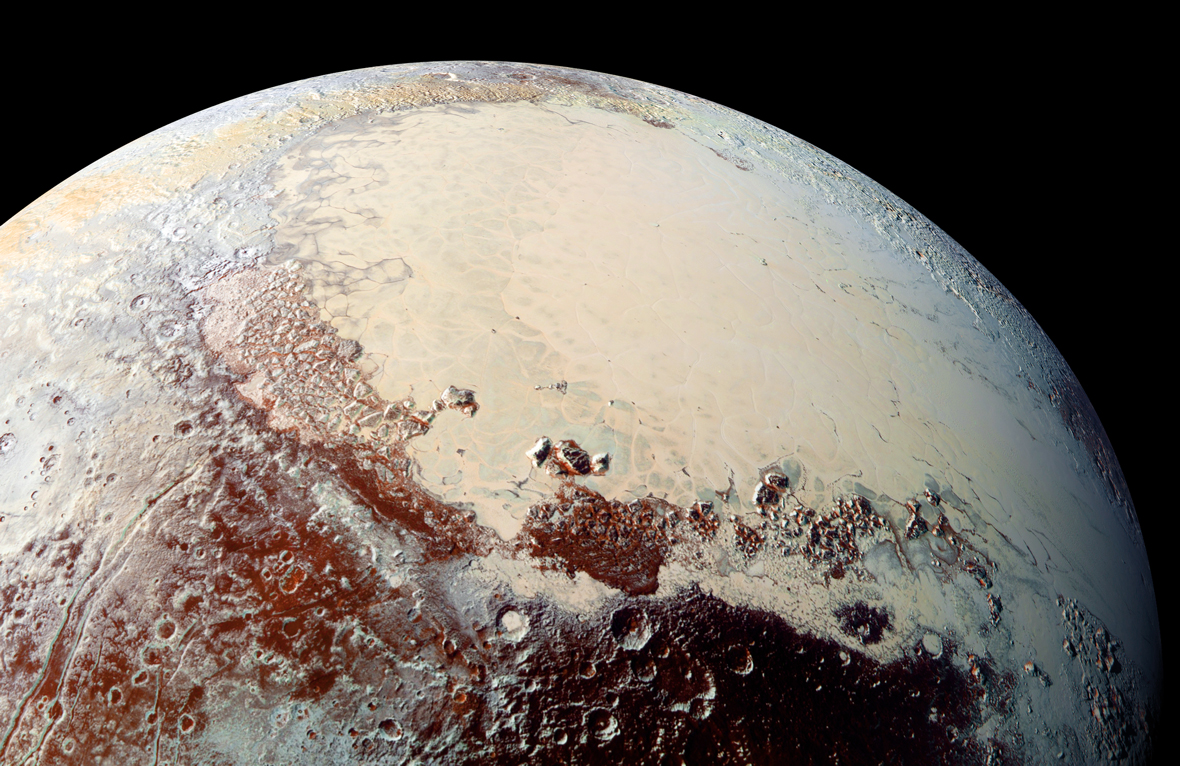
NASA's New Horizons spacecraft captured this image of Sputnik Planitia — a glacial expanse rich in nitrogen, carbon monoxide and methane ices — that forms the left lobe of a heart-shaped feature on Pluto’s surface. SwRI scientists studied the dwarf planet’s nitrogen and carbon monoxide composition to develop a new theory for its formation. Credit: NASA/Johns Hopkins University Applied Physics Laboratory/Southwest Research Institute
Pluto Has an Ocean of Liquid Water Surrounded by a 40-80 km Ice Shell
On July 14th, 2015, the New Horizons spacecraft conducted the first-ever flyby of Pluto, which once was (and to many, still is) the ninth planet of the Solar System. While the encounter was brief, the stunning images and volumes of data it obtained revealed a stunningly vibrant and dynamic world. In addition to Pluto’s heart, floating ice hills, nitrogen icebergs, and nitrogen winds, the New Horizons data also hinted at the existence of an ocean beneath Pluto’s icy crust. This effectively made Pluto (and its largest moon, Charon) members of the “Ocean Worlds” club.
Almost a decade after that historic encounter, scientists are still making discoveries from New Horizons data. In a new paper, planetary scientists Alex Nguyen and Dr. Patrick McGovern used mathematical models and images to learn more about the possible ocean between Pluto’s icy surface and its silicate and metallic core. According to their analysis, they determined that Pluto’s ocean is located beneath a surface shell measuring 40 to 80 km (25 to 50 mi), an insulating layer thick enough to ensure that an interior ocean remains liquid.
Nguyen is a graduate student in Earth, environmental, and planetary sciences in Arts & Sciences at Washington University in St. Louis (WUSTL), while Dr. McGovern is a Senior Staff Scientist with the Lunar and Planetary Institute (LPI) in Houston. Their paper, “The role of Pluto’s ocean’s salinity in supporting nitrogen ice loads within the Sputnik Planitia basin,” recently appeared in the journal Icarus. The study is part of Nguyen’s Ph.D. research at Washington University, where he is an Olin Chancellor’s Fellow and a National Science Foundation Graduate Research Fellow.
This cutaway image of Pluto shows a section through the area of Sputnik Planitia, with dark blue representing a subsurface ocean and light blue for the frozen crust. Artwork by Pam Engebretson, courtesy of UC Santa Cruz.
For decades, planetary scientists assumed Pluto was far too cold to support an interior ocean. Pluto orbits well beyond the Solar System’s “Frost Line,” the boundary beyond which volatile elements (water, carbon dioxide, ammonia, etc.) become solid. With an average surface temperature of -229 °C (-380°F), even nitrogen and methane become as solid as rock. As Nguyen indicated in a recent interview with The Source (WUSTL’s news site), “Pluto is a small body. It should have lost almost all of its heat shortly after it was formed, so basic calculations would suggest that it’s frozen solid to its core.”
But thanks to New Horizons, scientists were presented with multiple lines of evidence that suggest Pluto likely has an interior ocean. This includes cryovolcanoes, such as those observed on Ceres, Europa, Ganymede, Enceladus, Titan, Triton, and other “Ocean Worlds.” While the existence of this ocean is still subject to debate, the theory is gaining acceptance to the point that it is considered a very real possibility. For their study, Nguyen and McGovern created mathematical models to explain the cracks and bulges in the ice covering Pluto’s Sputnik Planitia Basin.
Their results indicate that an ocean could exist beneath an icy shell 40 to 80 km (25 to 50 mi) thick, which would be sufficient to ensure that Pluto could maintain a liquid water ocean in its interior despite surface conditions. They also calculated the likely density or salinity of the ocean based on the surface features and determined that Pluto’s ocean could be up to 8% denser than Earth’s oceans. This salinity level would make Pluto’s ocean comparable to the Great Salt Lake, the Dead Sea, and other high-salinity bodies of water on Earth.
According to Nguyen, any variations in this density (greater or lower) would be evident from the cracks and fractures in the Sputnik Platina Basin. “We estimated a sort of Goldilocks zone where the density and shell thickness is just right,” he said. If the ocean were less dense, the ice shell would collapse, leading to many more fractures in the surface. If it were denser, the ice sheet would be more buoyed, which would be evident from there being fewer fractures. Unfortunately, it could be many decades before another spacecraft reaches Pluto to help confirm these findings. In the meantime, the case for Pluto’s interior ocean grows stronger!
How Much Water Would a Self-Sustaining Moonbase Need?
As humanity returns to the Moon in the next few years, they’re going to need water to survive. While resupplies from Earth would work for a time, eventually the lunar base would have to become self-sustaining? So, how much water would be required to make this happen? This is what a recently submitted study hopes to address as a team of researchers from Baylor University explored water management scenarios for a self-sustaining moonbase, including the appropriate location of the base and how the water would be extracted and treated for safe consumption using appropriate personnel.
Here, Universe Today discusses this research with Dr. Jeffrey Lee, who is an assistant adjunct professor in the Center for Astrophysics, Space Physics & Engineering Research at Baylor University, and lead author of the study, regarding the motivation behind the study, significant results, the importance of having a self-sustaining moonbase, and what implications this study could have for the upcoming Artemis missions. Therefore, what is the motivation behind this study?
Dr. Lee tells Universe Today, “This paper is actually an eclectic diversion for me from my astrophysics research on primordial black holes, early universe cosmology, breakthrough propulsion physics, and my geophysics research on asteroid impacts. If human missions throughout the Solar System, particularly to Mars, are to be realized, then a permanent lunar facility seems to be a logical early step.”
For the study, the researchers investigated water management requirements for a 100-person self-sustaining lunar base measured at 500 m x 100 x 6 m (1640 ft x 328 ft x 20 ft), including the location of the lunar base near water ice deposits, the technology required to convert the water ice to water vapor (since liquid water can’t exist on the Moon), and the technology required for water treatment and recovery that would result in safe consumption for the 100-person base. The study used the current water usage estimates for American households, which is approximately 100 gallons per day (GPD) per person, which includes cleaning, cooking, drinking, flushing toilets, and washing clothes.
Additionally, the researchers examined the amount of water required for agricultural, technical, and overall needs for the lunar base. Regarding the location of the lunar base, the researchers deduced that the best location for the base would be either near, or exactly on, the Shackleton-de Gerlache Ridge, which is located at 89.9°S 0.0°E, or almost directly on the lunar south pole. The reason this location is ideal for water ice deposits is because Shackleton Crater resides within a permanently shadowed region (PSR), meaning it is shrouded in permanent darkness due to the Moon’s small axial tilt, and water ice has potentially built up over billions of years.
In the end, the team concluded the water requirements for the 100-person lunar base for human, agricultural, and technical needs are 12.3, 72, and 2 acre-feet per year. For context, one acre-foot is equivalent to approximately 326,000 gallons, so a 100-person lunar base would need more than 4,000,000 gallons per year for human needs, more than 23,000,000 gallons per year for agricultural needs, and 652,000 gallons per year for technical needs. So, based on these findings, what were the most significant results from this study, and what follow-up studies are currently in the works or being planned?
Dr. Lee tells Universe Today, “There is good evidence that sufficient water exists on the Moon to support a permanent lunar colony, and the acquisition, treatment, and distribution of the lunar water can be achieved with current technology. An appropriate administrative structure will be necessary to oversee all aspects of lunar water. The relative scarcity and management of water on the Moon can potentially provide insight for improving the management of water on Earth. The next study for my group will be to investigate the ways in which the management of lunar water could help to improve terrestrial water management. However, the timeline for this research is yet to be determined.”
The study discusses in-situ resource utilization (ISRU), which is using available, on-site resources for both sustainability and survivability. In this case, using water ice deposits on the Moon, and specifically near the south pole of the Moon, to meet the water needs of a 100-person, self-sustaining lunar base. The potential for NASA using ISRU has gained considerable traction in the last few years since sending water from the Earth to the Moon could prove to be extremely costly. But aside from the financial risks, if a resupply mission gets delayed or fails on the way to the Moon, the crew could face significant danger. Therefore, learning to “live off the land” for a lunar base could prove to be a viable, long-term option for mitigating the need of resupply missions from Earth. But what additional importance could a self-sustaining moonbase also provide?
Dr. Lee tells Universe Today, “Over the years, there has been a groundswell of excitement at the prospect of colonizing Mars. Indeed, at present, we are conceivably able to mount a short-term human voyage to the Red Planet in which the astronauts would collect samples, conduct experiments, plant flags, and when the next launch window occurs, return to Earth. However, the permanent colonization of Mars is much more ambitious and challenging. Mars is much farther away than the Moon, requiring 9 months to get there and a round trip time of 21 months (a 3-month stay on Mars is needed until the next launch window arrives).”
NASA’s goal is to send humans to Mars through the agency’s Moon to Mars Architecture, which is an elaborate, years-long endeavor to develop the necessary technologies on the Moon for use during a crewed mission to the Red Planet. This includes science, infrastructure, transportation, habitation, and operations, just to name a few. However, as noted, while we can (possibly) send humans to the Red Planet for short-term stays with our current technology, a long-term human presence on Mars would require significantly more time and resources.
Dr. Lee tells Universe Today, “Beyond low Earth orbit, the Moon is a logical next destination. Lunar colonization is technologically achievable, and in comparison to Martian colonization, it is far easier. Being capable of establishing a moonbase seems like an obvious prerequisite for establishing a Mars base. Furthermore, the Moon would be an excellent jumping off point for further Solar System colonization including potentially the eventual establishment of small colonies in the interiors of Near-Earth Asteroids. Additionally, some have suggested that the Moon is an ideal location from which the interception of Earth-bound asteroids could be conducted.”
This study comes as NASA’s Artemis program plans to land the first woman and person of color on the lunar surface in the next few years. The current landing sites of the Artemis missions are near the south pole to access nearby water ice deposits within the aforementioned PSRs and could be ideal to develop ISRU technologies that can also be used on future Mars crewed missions, as well. Therefore, what implications could this study have for the upcoming Artemis missions?
“Short term lunar visits, such as the planned Artemis missions would not require lunar water,” Dr. Lee tells Universe Today. “In these instances, sufficient water could be brought from Earth. However, if at some point in the future, a lunar colony were to become a priority, future Artemis missions could serve to provide valuable in situ information about the presence and abundance of lunar water, particularly at the lunar south pole and in proximity to the Shackleton Crater (an ideal area for a moonbase).”
How will water management play a role in a self-sustaining lunar base in the coming years and decades? Only time will tell, and this is why we science!
Meer van UFO'S of UAP'S, ASTRONOMIE, RUIMTEVAART, ARCHEOLOGIE, OUDHEIDKUNDE, SF-SNUFJES EN ANDERE ESOTERISCHE WETENSCHAPPEN - DE ALLERLAATSTE NIEUWTJES


 ONGOING SIGHTINGS OF THIS ENIGMATIC LOST SPECIES CONTINUE TO CHALLENGE ACCEPTED VIEWS ON ITS EXTINCTION