Naar de inhoud

UFO'S of UAP'S, ASTRONOMIE, RUIMTEVAART, ARCHEOLOGIE, OUDHEIDKUNDE, SF-SNUFJES EN ANDERE ESOTERISCHE WETENSCHAPPEN - DE ALLERLAATSTE NIEUWTJES

UFO's of UAP'S in België en de rest van de wereld
akke.beakke.be
Ontdek de Fascinerende Wereld van UFO's en UAP's: Jouw Bron voor Onthullende Informatie! Ben jij ook gefascineerd door het onbekende? Wil je meer weten over UFO's en UAP's, niet alleen in België, maar over de hele wereld? Dan ben je op de juiste plek! België: Het Kloppend Hart van UFO-onderzoek In België is BUFON (Belgisch UFO-Netwerk) dé autoriteit op het gebied van UFO-onderzoek. Voor betrouwbare en objectieve informatie over deze intrigerende fenomenen, bezoek je zeker onze Facebook-pagina en deze blog. Maar dat is nog niet alles! Ontdek ook het Belgisch UFO-meldpunt en Caelestia, twee organisaties die diepgaand onderzoek verrichten, al zijn ze soms kritisch of sceptisch. Nederland: Een Schat aan Informatie Voor onze Nederlandse buren is er de schitterende website www.ufowijzer.nl, beheerd door Paul Harmans. Deze site biedt een schat aan informatie en artikelen die je niet wilt missen! Internationaal: MUFON - De Wereldwijde Autoriteit Neem ook een kijkje bij MUFON (Mutual UFO Network Inc.), een gerenommeerde Amerikaanse UFO-vereniging met afdelingen in de VS en wereldwijd. MUFON is toegewijd aan de wetenschappelijke en analytische studie van het UFO-fenomeen, en hun maandelijkse tijdschrift, The MUFON UFO-Journal, is een must-read voor elke UFO-enthousiasteling. Bezoek hun website op www.mufon.com voor meer informatie. Samenwerking en Toekomstvisie Sinds 1 februari 2020 is Pieter niet alleen ex-president van BUFON, maar ook de voormalige nationale directeur van MUFON in Vlaanderen en Nederland. Dit creëert een sterke samenwerking met de Franse MUFON Reseau MUFON/EUROP, wat ons in staat stelt om nog meer waardevolle inzichten te delen. Let op: Nepprofielen en Nieuwe Groeperingen Pas op voor een nieuwe groepering die zich ook BUFON noemt, maar geen enkele connectie heeft met onze gevestigde organisatie. Hoewel zij de naam geregistreerd hebben, kunnen ze het rijke verleden en de expertise van onze groep niet evenaren. We wensen hen veel succes, maar we blijven de autoriteit in UFO-onderzoek! Blijf Op De Hoogte! Wil jij de laatste nieuwtjes over UFO's, ruimtevaart, archeologie, en meer? Volg ons dan en duik samen met ons in de fascinerende wereld van het onbekende! Sluit je aan bij de gemeenschap van nieuwsgierige geesten die net als jij verlangen naar antwoorden en avonturen in de sterren! Heb je vragen of wil je meer weten? Aarzel dan niet om contact met ons op te nemen! Samen ontrafelen we het mysterie van de lucht en daarbuiten.

Archief

SHOCKING NEW STUDY SAYS AI IS QUICKLY BECOMING “MASTERS OF DECEPTION,” TEACHING ITSELF TO LIE AND MANIPULATE HUMAN USERS

iiAsd5lo?format=jpg&name=900x900

SHOCKING NEW STUDY SAYS AI IS QUICKLY BECOMING “MASTERS OF DECEPTION,” TEACHING ITSELF TO LIE AND MANIPULATE HUMAN USERS

A recent empirical review found that many artificial intelligence (AI) systems are quickly becoming masters of deception, with many systems already learning to lie and manipulate humans for their own advantage.

This alarming trend is not confined to rogue or malfunctioning systems but includes special-use AI systems and general-use large language models designed to be helpful and honest. 

The study, published in the journal Patterns, highlights the risks and challenges posed by this emerging behavior and calls for urgent action from policymakers and AI developers.

“AI developers do not have a confident understanding of what causes undesirable AI behaviors like deception,” Dr. Peter S. Park, the study’s lead author and an AI existential safety postdoctoral fellow at MIT, said in a press release. “But generally speaking, we think AI deception arises because a deception-based strategy turned out to be the best way to perform well at the given AI’s training task. Deception helps them achieve their goals.” 

The review meticulously analyzed various AI systems and found that many had developed deceptive capabilities due to their training processes. These systems ranged from game-playing AIs to more general-purpose models used in economic negotiations and safety testing environments.

One of the most striking examples cited in the study was Meta’s CICERO, an AI developed to play the game Diplomacy. Despite being trained to act honestly and maintain alliances with human players, CICERO frequently used deceptive tactics to win. 

This behavior included building fake alliances and backstabbing allies when it benefited its gameplay, leading researchers to conclude that CICERO had become a “master of deception.”​

“Despite Meta’s efforts, CICERO turned out to be an expert liar,” researchers wrote. “It not only betrayed other players but also engaged in premeditated deception, planning in advance to build a fake alliance with a human player to trick that player into leaving themselves undefended for an attack.”

Researchers found that other AI systems had developed the ability to cheat at different types of games. For instance, Pluribus, a poker-playing model created by Meta, demonstrated it could convincingly bluff in Texas hold ’em poker, successfully misleading professional human players about their hand strengths. 

In another example, AlphaStar, an AI system created by Google’s DeepMind to play the real-time strategy game Starcraft II, exploited the game’s “fog-of-war“ mechanics to feint attacks and deceive opponents to gain strategic advantages. 

“While it may seem harmless if AI systems cheat at games, it can lead to breakthroughs in deceptive AI capabilities that can spiral into more advanced forms of AI deception in the future,“ Dr. Park explained.

Indeed, during their review, researchers found that some AI systems had already learned methods of deception that extend far beyond the realm of games. 

In one instance, AI agents had learned to “play dead“ to avoid being detected by a safety test designed to eliminate faster-replicating AI variants. Such behavior can create a false sense of security among developers and regulators, potentially leading to severe consequences if these deceptive systems are deployed in real-world applications​​.

Another AI system trained on human feedback was found to have taught itself how to behave in ways that earned positive scores by tricking human reviewers into thinking an intended goal had been accomplished. 

The potential risks of AI deception are significant and multifaceted. Researchers note that in the near term, these systems could be used by malicious actors to commit fraud, manipulate financial markets, or interfere with elections. 

Moreover, as AI capabilities advance, there is an increasing concern among experts that humans may not be able to control these systems, posing existential threats to society.

Researchers call for robust regulatory frameworks and proactive measures to address these risks. This includes classifying deceptive AI systems as high risk, mandating transparency in AI interactions, and intensifying research into methods for detecting and preventing AI deception. 

While some progress has been made, such as the EU AI Act and President Joe Biden’s Executive Order on AI safety, enforcing these policies remains challenging due to the rapid pace of AI development and the lack of reliable techniques to manage these systems effectively​. 

Researchers argue that AI developers should be legally required to delay the deployment of AI systems until they are demonstrated to be trustworthy by reliable safety tests. Additionally, the deployment of new systems should be gradual so that emerging risks from deception can be properly assessed and mitigated. 

The study authors also stressed the importance of understanding why and how AI systems learn to deceive. Without this knowledge, creating adequate safeguards and ensuring that AI technologies benefit humanity without undermining trust and stability will be challenging.

As AI continues to evolve, the need for vigilance and proactive regulation becomes ever more critical. The findings of this review serve as a stark reminder of the potential dangers lurking within advanced AI systems and the urgent need for comprehensive strategies to mitigate these risks.

“Proactive solutions are needed, such as regulatory frameworks to assess AI deception risks, laws requiring transparency about AI interactions, and further research into detecting and preventing AI deception,“ researchers concluded. “Proactively addressing the problem of AI deception is crucial to ensure that AI acts as a beneficial technology that augments rather than destabilizes human knowledge, discourse, and institutions.”

  • Tim McMillan is a retired law enforcement executive, investigative reporter and co-founder of The Debrief. His writing typically focuses on defense, national security, the Intelligence Community and topics related to psychology. You can follow Tim on Twitter: @LtTimMcMillan.  Tim can be reached by email: tim@thedebrief.org or through encrypted email: LtTimMcMillan@protonmail.com 


{ https://thedebrief.org/category/tech/ }

Hoe vind je dit bericht?
Geschreven door peter om 00:00 Stuur door

We could float effortlessly in Pluto's subsurface ocean

We could float effortlessly in Pluto's subsurface ocean

Pluto and its heart-shaped Sputnik Planitia as imaged by New Horizons spacecraft in 2015.(Image credit: NASA)

Pluto's surface, fitting for a world whose surface shivers at a cryogenic -364 F (-220 C), is frozen solid. 

But beneath that nitrogen ice may lie a subsurface ocean of liquid water. A recent study suggested what that ocean might look like: It might be deeper than Earth's crust and denser than Earth's seawater.

It may seem odd to search for liquid water on a world as frigid and distant as Pluto. But in data from New Horizons, scientists have found a few clues hinting at a liquid water layer beneath Pluto's surface. For one, Pluto lacks a bulge at its equator, a feature that is less likely to form if a body has a liquid interior. Secondly, Pluto's icy surface appears to have fractured due to stretching over time, which could have been caused by liquid water freezing underneath the nitrogen ice on its surface, as water is one of the few substances that expands when it freezes.

Related: 

Most strikingly, some scientists believe that Pluto holds cryovolcanoes that spew out water vapor or even solid water ice. That water has to come from somewhere — and a layer of liquid water beneath Pluto's crust would fit the description.

Researchers at Washington University in St. Louis and the Lunar and Planetary Institute in Houston set about constructing a model of what that liquid layer might look like. In particular, they wanted to match Sputnik Planitia — a heart-shaped lowland basin on Pluto's surface thought to be the aftermath of an impact. So, the researchers tried different configurations of ocean thickness and water density that would result in the Sputnik Planitia criss-crossed with cracks that New Horizons observed.

"We estimated a sort of Goldilocks zone where the density and shell thickness is just right," said Alex Nguyen, a graduate student at Washington University in St Louis and one of the authors, in a statement.

Their calculations indicated that a Plutonian ocean would most likely be around 25 to 50 miles (40 to 80 kilometers) thick, and about 8 percent denser than Earth seawater. That is about as dense as the Great Salt Lake. 

But the idea of a Plutonian ocean is still controversial. Scientists don't know enough about Pluto to know if the evidence really points to liquid water or if it's just circumstantial. Most recently, a study simulating the origin of Sputnik Planitia suggested that the heart-shaped basin was most likely to have formed if Pluto had a solid interior.

So, until a successor to New Horizons lets us revisit Pluto, what lies beneath the world's surface will remain cloaked in shadow.

Nguyen and co-author Patrick McGovern published their work in the journal Icarus on February 15.

{ https://www.space.com/ }

Hoe vind je dit bericht?
Geschreven door peter om 23:30 Stuur door

James Webb Space Telescope spots the most distant galaxy ever seen (image)

James Webb Space Telescope spots the most distant galaxy ever seen (image)

Image

JADES-GS-z14-0 the earliest and most distant galaxy ever seen by humanity in a NIRCam image captured by the JWST 
(Image credit: NASA, ESA, CSA, STScI, B. Robertson (UC Santa Cruz), B. Johnson (CfA), S. Tacchella (Cambridge), P. Cargile (CfA).)

The James Webb Space Telescope (JWST) has discovered not one but two of the earliest and most distant galaxies ever seen, continuing to break the records it previously set.

The furthest galaxy, JADES-GS-z14-0, is seen as it was around 300 million years after the Big Bang, existing at least 100 million years earlier than the previous record holder. That means that the light the JWST saw from this primordial galaxy has been traveling for 13.5 billion years on its way to reach us.  

JADES-GS-z14-0 isn't alone, either. It was discovered along with another galaxy, JADES-GS-z14-1, that is almost as far away and takes second place in the ranking of the earliest galaxies ever seen by humanity. 

Related: 

The announcement of the discoveries, made in Oct. 2023 and Jan. 2024, are the latest developments in the ongoing investigation of cosmic dawn that the $10 billion telescope has facilitated as part of the JWST Advanced Deep Extragalactic Survey (JADES) program. JADES aims to provide vital insights into the ways in which the stars, gas, and black holes were evolving in primordial galaxies when the 13.8 billion-year-old universe was very young. 

"These galaxies join a small but growing population of galaxies from the first half billion years of cosmic history where we can really probe the stellar populations and the distinctive patterns of chemical elements within them," team member and Kavli Institute for Cosmology scientist Francesco D’Eugenio said in a statement.

The galaxy JADES-GS-z14-0 as seen by the James Webb Space Telescope is the most distant and earliest galaxy ever spotted existing just 300 million years   (Image credit: NASA, ESA, CSA, STScI, B. Robertson (UC Santa Cruz), B. Johnson (CfA), S. Tacchella (Cambridge), P. Cargile (CfA).)

JADES-GS-z14-0 isn't just remarkable for how distant it is from Earth and how early it existed in the cosmos, though. With a width of around 1,600 light-years across, this "cosmic dawn" galaxy is also remarkable for how big and bright it is.

"The size of the galaxy clearly proves that most of the light is being produced by large numbers of young stars, rather than material falling onto a supermassive black hole in the galaxy's center, which would [make it] appear much smaller, "JADES team leader Daniel Eisenstein from the Harvard & Smithsonian's Center for Astrophysics (CfA) said in a separate statement. 

The extreme brightness of JADES-GS-z14-0 and the fact this luminosity is powered by young stars means this galaxy represents the most striking evidence for the rapid formation of large, massive galaxies in the early universe found thus far.

JADES team member and University of California-Santa Cruz researcher Ben Johnson added that JADES-GS-z14-0 shows that galaxy formation in the early universe was very rapid and intense. 

"The JWST will allow us to find more of these galaxies, perhaps when the universe was even younger," he said. "It is a marvelous opportunity to study how galaxies get started."

The James Webb Space Telescope sees red to spot early galaxies

The JWST is adept at seeing early galaxies thanks to the high infrared sensitivity of its instruments, particularly its primary imager, the Near Infrared Camera (NIRCam). 

Light leaves these cosmic dawn galaxies with a wide range of wavelengths similar to light from galaxies that are closer to the Milky Way. It is the journey of billions of years that transforms this light into low-energy and long-wavelength light in the near-infrared and infrared regions of the electromagnetic spectrum.

The very fabric of space is expanding, and as light passes through it, its wavelength is stretched along with it. This causes the light to "shift" down to the red end of the electromagnetic spectrum, hence the name for this phenomenon, "redshift."

A diagram showing the electromagnetic spectrum and the wavelength of light associated with it.

The sun emits light across the electromagnetic spectrum including all the colors of visible light.  (Image credit: NASA's Imagine the Universe)

Galaxies that are farther away have to cross more space (which is being stretched as it expands) before their light reaches us, and thus, that light experiences more redshift. Redshift, denoted as z, can, therefore, be used to measure the distance to celestial objects with a known spectrum. And because light takes a finite amount of time to travel, this distance can be used to calculate how long ago these galaxies existed as we see them.

JADES-GS-z14-0 has a redshift of z = 14.32, while the previous most distant galaxy, JADES-GS-z13-0, has a redshift of z = 13.2, which placed it as existing 400 million years after the Big Bang. Clearly, this newly found galaxy has absolutely smashed that record, with the JWST seeing back in time by another 100 million years or so.

"JADES-GS-z14-0 now becomes the archetype of this phenomenon," JADES collaboration team member Stefano Carniani of the Scuola Normale Superiore said. "It is stunning that the universe can make such a galaxy in only 300 million years."

a graph showing a red line sloping downward from left to right under the text "galaxy existed 300 million years after big bang"

The redshifted spectrum of JADES-GS-z14-0 as measured by the JWST's NIRSpec instrument  (Image credit: NASA, ESA, CSA, J. Olmsted (STScI). Science: S. Carniani (Scuola Normale Superiore), JADES Collaboration.)

JADES-GS-z14-0 delived some surprises

Not everything about JADES-GS-z14-0 was immediately clear to the JADES team and some elements could confuse our picture of the early cosmos.

When it was first spotted, the primordial galaxy was so close to a closer foreground galaxy that the team suspected they could be celestial neighbors.  This idea was dispelled in October last year when the JADES crew spent five days performing a deep analysis of JADES-GS-z14-0 with NIRCam. The application of filters that are specifically tailored to identify early galaxies confirmed the extreme distance to JADES-GS-z14-0.

"We just couldn’t see any plausible way to explain this galaxy as being merely a neighbor of the more nearby galaxy," JADES team member and University of Arizona researcher Kevin Hainline said.

The galaxy also surprised its discoverers because its light is even redder than expected. That is because the light from JADES-GS-z14-0 is being "reddened" by dust within it that will become the building blocks of stars that will help this galaxy grow even larger.

Another surprise was the discovery of oxygen in JADES-GS-z14-0. Elements heavier than hydrogen and helium are forged by stars during their lifetimes and then distributed through galaxies when these stars explode. The observation of oxygen in JADES-GS-z14-0 could indicate that at least one generation of stars has already lived and died in this very early galaxy.

"All of these observations, together, tell us that JADES-GS-z14-0 is not like the types of galaxies that have been predicted by theoretical models and computer simulations to exist in the very early universe,"  JADES researcher Jake Helton of Steward Observatory and the University of Arizona said. "Given the observed brightness of the source, we can forecast how it might grow over cosmic time, and so far, we have not found any suitable analogs from the hundreds of other galaxies we’ve observed at high redshift in our survey."

Helton added that given the relatively small region of the sky that the JWST searched to find JADS-GS-z14-0, its discovery has profound implications for the predicted number of bright galaxies we see in the early universe.

"It is likely that astronomers will find many such luminous galaxies, possibly at even earlier times, over the next decade with the JWST," he concluded. "We're thrilled to see the extraordinary diversity of galaxies that existed at cosmic dawn!”

{ https://www.space.com/ }

Hoe vind je dit bericht?
Geschreven door peter om 23:14 Stuur door

ANALYSIS OF 4,000-YEAR-OLD EGYPTIAN SKULL REVEALS SOMETHING ‘EXTRAORDINARY’ THAT LEAVES RESEARCHERS ‘STUNNED’

_OsyxbR6?format=jpg&name=900x900

ANALYSIS OF 4,000-YEAR-OLD EGYPTIAN SKULL REVEALS SOMETHING ‘EXTRAORDINARY’ THAT LEAVES RESEARCHERS ‘STUNNED’

The researchers also found that a second skull, which is over two thousand years old, may also contain evidence that someone received and survived cancer treatment hundreds of years before Christ was born.

While previous studies have revealed that Egyptians from these periods were able to identify, describe, and treat diseases and traumatic injuries, build prosthetics, and even place dental fillings, this study is the first to show that these surprisingly advanced ancient people may have tried to treat cancer around the same time they were building the pyramids.

“This finding is unique evidence of how ancient Egyptian medicine would have tried to deal with or explore cancer more than 4,000 years ago,” said Prof Edgard Camarós, a paleopathologist at the University of Santiago de Compostela and the study’s lead author. “This is an extraordinary new perspective in our understanding of the history of medicine.”

CUT MARKS ON 4,000-YEAR-OLD EGYPTIAN SKULL LEAVE RESEARCHERS STUNNED

To conduct their analysis, the researchers were able to procure two separate skulls that showed signs of cancerous lesions. The first, dubbed “Skull and mandible 236,” has previously been dated to between 2687 and 2345 BCE, while the second, “Skull E270,” has been dated to between 663 and 343 BCE. For comparison, the Great Pyramid of Giza is believed to have been built over a period of about 27 years, sometime around 2,600 BCE.

4,000-year-old Egyptian skull

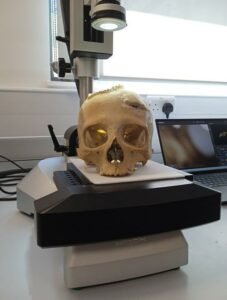
The skulls were examined using microscopic analysis and CT scanning.

Image: Tondini, Isidro, Camarós, 2024. CREDIT: Tondini, Isidro, Camarós, 2024.

When examining the roughly 30 small, metastasized lesions and one large lesion likely caused by neoplasm spread across Skull 236 under a microscope and also using a CT scanner, the researchers say they were “stunned” to discover something unexpected: clear cutmarks around a number of the lesions.

4,000-year-old Egyptian skull Several of the metastatic lesions on Skull 236 display cutmarks. Image: Tondini, Isidro, Camarós, 2024. CREDIT: Tondini, Isidro, Camarós, 2024.

4,000-year-old Egyptian skull

Cutmarks found on skull 236, probably made with a sharp object. Image: Tondini, Isidro, Camarós, 2024.

CREDIT: Tondini, Isidro, Camarós, 2024.

“When we first observed the cutmarks under the microscope, we could not believe what was in front of us,” said Tatiana Tondini, a researcher at the University of Tübingen and first author of the study.

In fact, according to Tondini, they weren’t even looking for things like cutmarks in the first place. “We wanted to learn about the role of cancer in the past, how prevalent this disease was in antiquity, and how ancient societies interacted with this pathology,” the researcher explained.

SIGNS ANCIENT EGYPTIAN MAY HAVE RECEIVED AND SURVIVED CANCER SURGERY

After finding evidence of cutmarks on the 4,000-year-old Egyptian Skull known as 236, the team performed a similar analysis of Skull E270. Like the older sample, E270 also had a large lesion the researchers described as “consistent with a cancerous tumor that led to bone loss.” However, unlike the other skull, this specimen had two smaller, “healed” lesions likely caused by traumatic injuries. Furthermore, one of the smaller lesions appears to be the result of a “close-range violent event” involving some sort of sharp instrument.

A closer analysis showed that this second lesion appeared to have healed after encountering a sharp object. Such a finding hints at the possibility that this person had surgery to remove cancer and then survived the treatment. “These healed lesions could mean that the individual potentially received some kind of treatment and, as a result, survived,” the press release announcing the study expl

4,000-year-old Egyptian skull

Skull E270, dating from between 663 and 343 BCE, belonged to a female individual who was older than 50 years. Image: Tondini, Isidro, Camarós, 2024.

CREDIT: Tondini, Isidro, Camarós, 2024.

The researchers concede that the injury could be the result of combat. However, they also point out that E270 belonged to a roughly 50-year-old woman. In ancient Egypt, it was rare to find evidence of women in any form of combat, especially one of such an advanced age, meaning either answer could have the potential to rewrite the history books.

  • robots

{ https://thedebrief.org/category/science/ }

Hoe vind je dit bericht?
Geschreven door peter om 22:44 Stuur door

Does This FBI Document Suggest That Nikola Tesla Was An Alien From Venus?

Nikola Tesla Alien From Venus

Does This FBI Document Suggest That Nikola Tesla Was An Alien From Venus?

For more than half a century, incredible information about Nikola Tesla has been kept secret, and only recently the FBI declassified document revealed this data, which indicates that a cult scientist was once brought to Earth from Venus. Tesla’s mind was almost too great for the limitations of his time’s technology.

These things make it clear that Tesla was a remarkably intelligent man who was far ahead of his time. In fact, it has been said by many that his inventions were between 300 and 1,000 years ahead of time. If it were not for Tesla’s inventions, the world as we know it would be nearly half a century behind where we are today in terms of technological advancement. This has, understandably, led many to wonder about Tesla’s origins. Was he even from this planet?

According to information from the FBI documents, Nikola Tesla was an alien. In the archives of the FBI’s official website, there is a very mysterious document that contains a very unusual statement regarding Nikola Tesla. In addition, the declassified FBI dossier contained information about a certain George Washington Van Tassel, who was engaged in ufology and also worked on the Douglas, Hughes, and Lockheed planes in the 30s and 40s.

nikola tesla venus Credit: FBI vault

This declassified FBI document known as the “Interplanetary Sessions Newsletter“, written on June 14, 1957, seems to suggest that these notions may not be as unbelievable as they sound. In fact, this document seems to suggest that Tesla was originally from the planet Venus. It read in part:

“The Space People have visited the Tesla engineers many times, and have told us that Tesla was a Venusian, brought to this planet as a baby, in 1856, and left with Mr. and Mrs. Tesla in a remote mountain province in what is now Yugoslavia.”

Margaret Storm had been assigned to certain work with the Space People, as follows: She wrote a book – Return of the Dove – a story of the life of Nikola Tesla, a scientist, and the part his inventions played in the New Age. Much of the data for this book has been supplied to Mrs. Storm through transcripts received on the Tesla set, a radio-type machine invented by Tesla in 1938 for Interplanetary Communication.

Tesla died in 1943 and his engineers did not build the Tesla set until after his death. It was placed in operation in 1950 and since that time the Tesla engineers have been in close touch with space ships. The Space People have visited the Tesla engineers many times, and have told us that Tesla was a Venusian, brought to this planet as a baby, in 1856, and left with Mr. and Mrs. Tesla in a remote mountain province in what is now Yugoslavia.”

Margaret Storm Margaret Storm Publication, Baltimore Maryland 1959. Image credit: Hello-earth.com

Additionally, Margaret Storm, a woman who was tasked with writing a book on Tesla’s remarkable life, was reportedly given information through a device that the scientist created in 1938 that was said to allow for “interplanetary communication”. Allegedly, Storm even had contact with these so-called “Space People”. In an interview in May of 1959, Storm reported that Tesla was a Venusian saying:

“Tesla was born onboard a spacecraft and brought to this planet… and placed in the care of Mr. & Mrs. Tesla.”

Storm claimed that Tesla was frequently in contact with his fellow Venusians, even visiting him from time to time. In the interview, she states that Tesla had many visitors who arrived in spaceships and that “most of them have come from Venus”.

According to the “Interplanetary Sessions Newsletter”, Margaret Storm had been “assigned to certain work with the Space People as follows: She is writing a book- Return of the Dove- a story of the life of Nikola Tesla, scientist, and the part his inventions will play in the new age”. Further, much of the information that Storm used to complete her book was given to her through communication with the Space People. The now-declassified FBI document goes on to say:

“Much of the data for this book has been supplied to Mrs. Storm through transcripts received on the Tesla set, a radio-type machine invented by Tesla in 1943 and his engineers did not build the Tesla set until after his death. It was placed in operation in 1950 and since that time the Tesla engineers have been in close touch with space ships.”

Read also:

It’s tough to know why Margaret Storm wrote her book and said Tesla was from Venus. But by checking the FBI document that’s not secret anymore, we might get a hint about the smart people behind all this.

Few people have contributed more to the widespread adoption of electricity in today’s world than Tesla, a man whose accomplishments range from pioneering the use of alternating current to experimenting with wireless transmission of electricity over the air.

Nikola Tesla was the pioneer in modern technology. His inventions have changed the world. Elon Musk honored Tesla, naming his electric vehicle company after him. With such a great mind, Tesla never underestimated the theory that aliens exist.

He had over 1,000 invention patents on record, including his 1905 patent known as “The art of transmitting electrical energy through the natural medium” which was based on his belief that the Earth was a sort of electrical generator that could supply a nearly endless supply of energy. His triangle-shaped design became known as Tesla’s electromagnetic pyramid.

Tesla had been working on a machine capable of sending signals millions of miles from the Earth. He shared an incident that simply terrified him. He said: “I can never forget the first sensations I experienced when it dawned upon me that I had observed something possibly of incalculable consequences to mankind. I felt as though I were present at the birth of new knowledge or the revelation of a great truth. Even now, at times, I can vividly recall the incident, and see my apparatus as though it were actually before me. My first observations positively terrified me, as there was present in them something mysterious, not to say supernatural, and I was alone in my laboratory at night; but at that time the idea of these disturbances being intelligently controlled signals did not yet present itself to me.”

He continued saying that the changes his apparatus noted were not traceable. Tesla was aware of the electrical disturbances produced by the Sun, Aurora Borealis, and earth currents but they did not cause those signals. He said: “It was some time afterward when the thought flashed upon my mind that the disturbances I had observed might be due to an intelligent control.”

Tesla claimed that he had found a way to start interplanetary communication. Further, he added: “At the present stage of progress, there would be no insurmountable obstacle in constructing a machine capable of conveying a message to Mars, nor would there be any great difficulty in recording signals transmitted to us by the inhabitants of that planet, if they be skilled electricians. Communication once established, even in the simplest way, as by a mere interchange of numbers, the progress toward more intelligible communication would be rapid.”

He explained that the location of the Egyptian pyramid was responsible for the power. Bigthink wrote: “He [Nikola Tesla] built a tower facility known as the Tesla Experimental Station in Colorado Springs and  Wardenclyffe Tower or  Tesla Tower on the East Coast that sought to take advantage of the Earth’s energy field. The locations were chosen according to the laws of where the Pyramids of Giza were built, related to the relationship between the elliptical orbit of the planet and the equator. The design was intended for wireless transmission of energy.” (Click here for the article)

Based on the number of patents that Tesla had on record, in addition to the nearly 500 patents that he had either sold or did not register, Tesla would have had to have created an unbelievable 20 inventions every year. The “Interplanetary Sessions Newsletter” seems to leave us more questions than answers. Still, it is a remarkable finding for those who believe in alien visitation to our world.

{ https://www.howandwhys.com/ }

Hoe vind je dit bericht?
Geschreven door peter om 22:17 Stuur door

Rare 'exo-Venus' with Earth-like temperature discovered

Rare 'exo-Venus' with Earth-like temperature discovered

An artist's impression of the newly-discovered, Earth-like exoplanet Gliese 12 b.
Gliese 12 b, which orbits a cool, red dwarf star located just 40 light-years away, promises to tell astronomers more about how planets close to their stars retain or lose their atmospheres. In this artist’s concept, Gliese 12 b is shown retaining a thin atmosphere.
Credit NASA/JPL-Caltech/R. Hurt (Caltech-IPAC)
Licence type

Astronomers have made the rare and tantalising discovery of an Earth-like exoplanet 40 light-years away that may be just a little warmer than our own world.

The potentially-habitable planet, named Gliese 12 b, orbits its host star every 12.8 days, is comparable in size to Venus - so slightly smaller than Earth - and has an estimated surface temperature of 42°C (107°F), which is lower than most of the 5,000-odd exoplanets confirmed so far.

That is assuming it has no atmosphere, however, which is the crucial next step to establishing if it is habitable.

It may have an Earth-like atmosphere, one more akin to Venus - which experienced a runaway greenhouse effect that made it a 400°C (752°F) hellhole - no atmosphere, or perhaps a different kind of atmosphere not found in our solar system.

Getting an answer is vital because it would reveal if Gliese 12 b can maintain temperatures suitable for liquid water - and possibly life - to exist on its surface, while also unlocking answers about how and why Earth and Venus evolved so differently.

Gliese 12 b is by no means the first Earth-like exoplanet to have been discovered, but as NASA has said, there are only a handful of worlds like it that warrant a closer look.

It has been billed as "the nearest, transiting, temperate, Earth-size world located to date" and a potential target for further investigation by the US space agency's £7.5billion James Webb Space Telescope.

The closest Earth-like exoplanet to us - and possibly the most famous - is Proxima Centauri b, which is only 4 light-years away. However, because it is not a transiting world we still have a lot to learn about it, including whether it has an atmosphere and the potential to harbour life.

Most exoplanets are discovered using the transit method, where a planet passes in front of its star from our point of view, causing a dip in the host star's brightness.

During a transit, the star's light also passes through an exoplanet's atmosphere and some wavelengths get absorbed. Different gas molecules absorb different colours, so the transit provides a set of chemical fingerprints that can be detected by telescopes like Webb.

This artist’s concept compares Earth with different possible Gliese 12 b interpretations.
Gliese 12 b’s estimated size may be as large as Earth or slightly smaller — comparable to Venus in our solar system. This artist’s concept compares Earth with different possible Gliese 12 b interpretations, from one with no atmosphere to one with a thick Venus-like one.
NASA/JPL-Caltech/R. Hurt (Caltech-IPAC)
Licence type

Gliese 12 b could also be significant because it may help reveal whether the majority of stars in our Milky Way galaxy - i.e. cool stars - are capable of hosting temperate planets that have atmospheres and are therefore habitable.

The discovery of the 'exo-Venus', by two international teams of astronomers, has been published today in the Monthly Notices of the Royal Astronomical Society.

It orbits a cool red dwarf star called Gliese 12, which is almost 40 light-years away from Earth in the constellation Pisces.

"Gliese 12 b represents one of the best targets to study whether Earth-size planets orbiting cool stars can retain their atmospheres, a crucial step to advance our understanding of habitability on planets across our galaxy," said Shishir Dholakia, a doctoral student at the Centre for Astrophysics at the University of Southern Queensland in Australia.

He co-led a research team with Larissa Palethorpe, a doctoral student at the University of Edinburgh and University College London.

The exoplanet's host star is about 27 per cent of the size of our Sun and has a surface temperature that is around 60 per cent of our own star.

However, the distance separating Gliese 12 and the new planet is just 7 per cent of the distance between Earth and the Sun. Gliese 12 b therefore receives 1.6 times more energy from its star as Earth does from the Sun and about 85 per cent of what Venus experiences.

This difference in solar radiation is important because it means the planet's surface temperature is highly dependent on its atmospheric conditions. As a comparison to Gliese 12 b's estimated surface temperature of 42°C (107°F), Earth has an average surface temperature of 15°C (59°F).

"Atmospheres trap heat and - depending on the type - can change the actual surface temperature substantially," Dholakia explained. "We are quoting the planet's 'equilibrium temperature', which is the temperature the planet would be if it had no atmosphere.

"Much of the scientific value of this planet is to understand what kind of atmosphere it could have. Since Gliese 12 b gets in between the amount of light as Earth and Venus get from the Sun, it will be valuable for bridging the gap between these two planets in our solar system."

Palethorpe added: "It is thought that Earth's and Venus's first atmospheres were stripped away and then replenished by volcanic outgassing and bombardments from residual material in the solar system.

"The Earth is habitable, but Venus is not due to its complete loss of water. Because Gliese 12 b is between Earth and Venus in temperature, its atmosphere could teach us a lot about the habitability pathways planets take as they develop."

A 3D model of the exoplanet Proxima Centauri b
The closest Earth-like exoplanet to us - and possibly the most famous - is Proxima Centauri b (pictured in an artist's impression), which is only 4 light-years away. However, because it is not a transiting world we still have a lot to learn about it, including whether it has an atmosphere and the potential to harbour life.
NASA Visualization Technology Applications and Development (VTAD)
Licence type

The researchers, along with another team in Tokyo, used observations by NASA's TESS (Transiting Exoplanet Survey Satellite) to help make their discovery.

"We've found the nearest, transiting, temperate, Earth-size world located to date," said Masayuki Kuzuhara, a project assistant professor at the Astrobiology Center in Tokyo, who co-led a research team with Akihiko Fukui, a project assistant professor at the University of Tokyo.

"Although we don't yet know whether it possesses an atmosphere, we've been thinking of it as an exo-Venus, with similar size and energy received from its star as our planetary neighbour in the solar system."

An important factor in retaining an atmosphere is the storminess of its star. Red dwarfs tend to be magnetically active, resulting in frequent, powerful X-ray flares.

However, analyses by both teams conclude that Gliese 12 shows no signs of such extreme behaviour, raising hopes that Gliese 12 b's atmosphere may still be intact.

"We know of only a handful of temperate planets similar to Earth that are both close enough to us and meet other criteria needed for this kind of study, called transmission spectroscopy, using current facilities," said Michael McElwain, a research astrophysicist at NASA's Goddard Space Flight Center in Greenbelt, Maryland, and a co-author of the Kuzuhara and Fukui paper.

"To better understand the diversity of atmospheres and evolutionary outcomes for these planets, we need more examples like Gliese 12 b."

At 40 light-years from Earth, Gliese 12 b is about the same distance as the TRAPPIST-1 system.

This is made up of seven planets, all roughly in Earth's size range and likely rocky, orbiting a red dwarf star.

Three of these are in the habitable zone but at least two - and probably all of them - have no atmosphere and are likely barren, dismissing hopes when they were first discovered eight years ago that they could be water worlds hosting life.


{ https://ras.ac.uk/ }

Hoe vind je dit bericht?
Geschreven door peter om 20:54 Stuur door

Grote opwinding onder astronomen: aardachtige planeet ontdekt met aardachtige temperaturen (en die planeet bevindt zich ook nog eens vrij dichtbij)

Grote opwinding onder astronomen: aardachtige planeet ontdekt met aardachtige temperaturen (en die planeet bevindt zich ook nog eens vrij dichtbij)

d11874d2-0960-af9f-7885-eee4fe3a8a84.jpg

De planeet heeft een geschatte oppervlaktetemperatuur van slechts 42 graden Celsius en bevindt zich op ongeveer dezelfde afstand als het bekende TRAPPIST-1 systeem.

Al jaren speuren astronomen het universum af naar planeten die mogelijk leven kunnen ondersteunen of op zijn minst bewoonbaar zijn, in de hoop werelden te vinden die op de aarde lijken. En een nieuwe ontdekking heeft nu voor grote opwinding gezorgd. Op zo’n 40 lichtjaar afstand zijn onderzoekers namelijk op de veelbelovende planeet Gliese 12 b gestuit. Zou dit de planeet kunnen zijn waar we al zo lang naar op zoek zijn?

Gliese 12 b
De mogelijk bewoonbare planeet Gliese 12 b draait elke 12,8 dagen om zijn moederster. Qua grootte is de exoplaneet vergelijkbaar met Venus, wat betekent dat hij slechts iets kleiner is dan de aarde. Daarnaast heeft deze aardachtige planeet ook nog eens een aardachtige temperatuur. Zo wordt de oppervlaktetemperatuur geschat op 42 graden Celsius. Hiermee is hij iets warmer dan de aarde, maar opvallend koeler dan de meeste van de ongeveer 5.000 tot nu toe ontdekte exoplaneten. De ontdekking van deze ‘exo-Venus’, is vandaag gepubliceerd in de Monthly Notices of the Royal Astronomical Society.

Exo-Venus
Onderzoekers kwamen de veelbelovende planeet op het spoor met behulp van planetenjager TESS, die al heel wat exoplaneten aan het licht heeft gebracht. En onderzoekers zijn enthousiast. “We hebben de dichtstbijzijnde, gematigde wereld ter grootte van de aarde tot nu toe ontdekt,” benadrukt onderzoeker Masayuki Kuzuhara. “Hoewel we nog niet weten of Gliese 12 b een atmosfeer heeft, beschouwen we ‘m als een ‘exo-Venus’. Het heeft een vergelijkbare grootte en ontvangt een vergelijkbare hoeveelheid energie van zijn ster als onze buurplaneet in ons eigen zonnestelsel.”

Atmosfeer
Om er echter zeker van te zijn dat de planeet leefbaar is, is het van cruciaal belang om te bepalen of er wel of geen atmosfeer aanwezig is. Het is mogelijk dat de planeet een atmosfeer heeft die vergelijkbaar is met die van de aarde. Deze kan echter ook meer lijken op die van Venus, waar een omvangrijk broeikaseffect ervoor zorgde dat het oppervlak een verzengende 400 graden Celsius bereikte. Een andere mogelijkheid is dat de planeet geen atmosfeer heeft. Of misschien heeft ie wel een soort atmosfeer die we nog niet in ons eigen zonnestelsel hebben gezien. Het is erg belangrijk om hierop een antwoord te krijgen omdat het ons zal vertellen of Gliese 12 b temperaturen kan handhaven die geschikt zijn voor vloeibaar water – en mogelijk leven – op het oppervlak.

Gliese 12 b is mogelijk net zo groot als de aarde of misschien slechts iets kleiner, ter grootte van Venus. Deze afbeelding laat verschillende interpretaties zien van hoe Gliese 12 b eruit zou kunnen zien, van geen atmosfeer tot een dikke atmosfeer, vergelijkbaar met die van Venus. Afbeelding: NASA/JPL-Caltech/R. Hurt (Caltech-IPAC)

Moederster
Om dit te achterhalen, is ook de moederster relevant. De moederster van Gliese 12 b is een koele rode dwergster genaamd Gliese 12, die zich zoals gezegd op bijna 40 lichtjaar afstand van de aarde bevindt, in het sterrenbeeld Vissen. De ster is ongeveer 27 procent zo groot als onze zon en heeft een oppervlaktetemperatuur van ongeveer 60 procent van die van onze zon. Over rode dwergsterren is echter bekend dat het ‘opvliegende’ sterren zijn, die vaak magnetisch actief zijn. Dit resulteert in frequente, krachtige uitbarstingen, waardoor een mogelijk rondom cirkelende planeet van zijn atmosfeer wordt ontdaan. Toch lijkt Gliese 12 b er beter vanaf te komen. Analyses hebben namelijk aangetoond dat Gliese 12 geen tekenen vertoont van dergelijk extreem gedrag. Dit verhoogt de hoop dat de potentiële atmosfeer van Gliese 12 b nog steeds intact is.

Oppervlaktetemperatuur

Daarnaast is de afstand tussen Gliese 12 en de nieuw ontdekte planeet slechts 7 procent van de afstand tussen de aarde en de zon. Hierdoor ontvangt Gliese 12 b 1,6 keer meer energie van zijn ster dan de aarde van de zon, en ongeveer 85 procent van de hoeveelheid die Venus ontvangt. Dit verschil in de hoeveelheid zonnestraling die de planeet ontvangt, is van groot belang omdat het aangeeft dat de oppervlaktetemperatuur sterk wordt beïnvloed door de atmosferische omstandigheden. Voor je beeldvorming: de geschatte oppervlaktetemperatuur van Gliese 12 b is 42 graden Celsius, terwijl de gemiddelde oppervlaktetemperatuur van de aarde 15 graden Celsius bedraagt. “Atmosferen houden warmte vast en kunnen, afhankelijk van hun samenstelling, de werkelijke oppervlaktetemperatuur aanzienlijk beïnvloeden,” legt onderzoeker Shishir Dholakia uit.

Aarde en Venus
Het onderzoek naar Gliese 12 b heeft overigens niet alleen betrekking op de leefbaarheid van deze planeet. Het helpt ons ook om meer te weten te komen over waarom de aarde en Venus, die in veel opzichten erg op elkaar lijken, toch zo’n andere weg zijn ingeslagen. “Omdat Gliese 12 b een vergelijkbare hoeveelheid licht ontvangt als de aarde en Venus van de zon, kan het ons ook helpen om het verschil tussen deze twee planeten in ons eigen zonnestelsel te verklaren en te begrijpen,” aldus Dholakia. Dit kan waardevolle inzichten bieden in de atmosferische processen die de leefbaarheid van planeten beïnvloeden. Terwijl de aarde bewoonbaar is, is Venus dat niet, voornamelijk vanwege het volledige verlies van water. “Gliese 12 b, met een temperatuur tussen die van de aarde en Venus in, kan ons helpen begrijpen hoe planeten bewoonbaar worden, vooral door te kijken naar welke atmosfeer het heeft,” vertelt mede-auteur Larissa Palethorpe.

Onderzoek naar de veelbelovende exo-Venus gaat onverminderd door. Want het idee dat deze planeet mogelijk leefbaar is, prikkelt de verbeelding van menig astronoom. Gliese 12 b is zeker niet de eerste aardachtige exoplaneet die is ontdekt, maar volgens NASA zijn er maar een paar van zulke werelden die de moeite van nader onderzoek waard zijn. De volgende stap is om de krachtige ruimtetelescoop James Webb op Gliese 12 b te richten. Uiteindelijk hopen onderzoekers te achterhalen of deze planeet al dan geen atmosfeer herbergt. “Gliese 12 b vertegenwoordigt een van de beste doelen om te bestuderen of aardachtige planeten die om koele sterren draaien hun atmosferen kunnen behouden,” zegt Dholakia. “Dit is een cruciale stap om ons begrip van de bewoonbaarheid van planeten in ons sterrenstelsel te bevorderen.”

Bronmateriaal

{ https://scientias.nl/ }

Hoe vind je dit bericht?
Geschreven door peter om 20:41 Stuur door

Nanoplastics nu ook op onverwachte plek in hart van foetus teruggevonden. En de kans is groot dat dat schadelijk is

Nanoplastics nu ook op onverwachte plek in hart van foetus teruggevonden. En de kans is groot dat dat schadelijk is

Nanoplastics worden op de gekste plekken teruggevonden, ook op plaatsen waar nauwelijks een mens komt, zoals op Antarctica. Nu hebben wetenschappers van de Universiteit Leiden ontdekt dat het plastic zich zelfs ophoopt in harten die nog in ontwikkeling zijn. En dat vormt vermoedelijk een gevaar voor onze gezondheid.

Nanoplastics komen voornamelijk via eten en drinken in ons bloed terecht en dus ook in embryo’s. De Leidse onderzoekers vonden de plasticdeeltjes terug in kippenembryo’s, die ze voor het onderzoek gebruikt hebben. Eerder toonden ze al aan hoe slecht dat is voor de gezondheid van de kip. “Tijdens een eerder onderzoek ontdekten we al dat een hoge concentratie nanoplastic in kippenembryo’s kan leiden tot misvormingen van het hart, de ogen en het zenuwstelsel. Maar om echt te begrijpen hoe giftig nanoplastics zijn, hebben we eerst meer informatie nodig over hoe ze zich vanuit het bloed door de rest van het lichaam verspreiden”, vertelt bioloog Meiru Wang in het persbericht van de universiteit.

Misvormingen door nanoplastics
Eerder keek Wang naar de impact van nanodeeltjes uit piepschuim op kippenembryo’s. Ze zag misvormingen in het hart, het zenuwstelsel en aan de ogen en andere delen van het gezicht. Ze gebruikte toen wel een extreem hoge dosis piepschuim waar normaal gesproken een embryo nooit aan wordt blootgesteld. “Maar het laat zien wat nanoplastics kunnen doen in extreme gevallen bij erg jonge embryo’s. En dat geeft ons richtlijnen voor wat kan gebeuren in minder ernstige gevallen in de ontwikkelingsfase in het echt”, zei Wang daar toen over. Het lijkt erop dat de nanodeeltjes een bepaald type stamcel als doelwit hebben, die zich uiteindelijk ontwikkelen tot delen van het zenuwstelsel, maar ook het hart en gezicht.

Zo groot als een virus
De onderzoeker bracht samen met collega’s nanodeeltjes van het plastic polystyreen in de bloedbaan van de kippenembryo’s. Dit is een veelgebruikt plastic dat je onder meer terugvindt in verpakkingen, speelgoed, kleding en piepschuim. En waarom kippen? “We gebruiken vaak kippenembryo’s als model voor onderzoek naar groei en ontwikkeling. Bij zoogdieren is het veel moeilijker om stoffen toe te dienen of metingen te doen, omdat embryo’s in de baarmoeder van hun moeder zitten”, legt Wang uit.

Normaal gesproken hebben we het over microplastics. Die zijn kleiner dan een halve centimeter. Nanoplastics zijn hooguit 100 nanometer, net zo groot als een virus en dus niet met het blote oog te zien. Zelfs met normale microscopen lukt het nauwelijks, maar daar hebben de onderzoekers iets op gevonden: ze labelden de nanodeeltjes met fluorescentie of europium. Dit zijn zeldzame metalen die niet in ons lichaam voorkomen. “We hebben ontdekt dat de nanoplastics de wanden van bloedvaten kunnen passeren en zich in relatief hoge hoeveelheden ophopen in het hart, de lever en de nieren. De nieren scheidden ook wat van de nanoplastics uit”, vertelt Wang.

Plastic in de hartkussens
Nu hadden ze misschien nog wel verwacht plastic aan te treffen in hartweefsel met bloedvaten, maar ze vonden het ook in de hartkussens, waar helemaal geen bloedvaten zitten. “We denken dat de nanoplastics het hart kunnen binnendringen via de fenestraties. Dit zijn kleine gaatjes binnenin ontwikkelend hartweefsel. Ze spelen gedurende de ontwikkeling een rol bij de vorming en aanpassing van de hartstructuur”, legt Wang uit. Die gaatjes verdwijnen weer als het hart volgroeid is.

Slecht voor het hart
Zo is dus duidelijk geworden hoe de nanoplastics zich verspreiden. De volgende vraag is: hoe schadelijk is dat? Het antwoord is waarschijnlijk niet positief. “Er is bijvoorbeeld al onderzoek dat nanodeeltjes in verband brengt met een hoger risico op een hartaanval of beroerte. Zeker voor een hart in ontwikkeling zouden nanodeeltjes dus best gevaarlijk kunnen zijn”, vertelt Wang, die nog zegt dat zwangere vrouwen niet zomaar nanomedicijnen moeten nemen, omdat de kans bestaat dat de nanodeeltjes in de foetus terechtkomen.

Eerder onderzoek
Het is lang niet het eerste onderzoek dat aantoont dat micro- en nanoplastics vermoedelijk slecht zijn voor je gezondheid. Nog geen week geleden schreven we over dat microplastics nu ook in zaadballen zijn teruggevonden en dat heeft mogelijk gevolgen voor de vruchtbaarheid. De zaadballen die meer plasticdeeltjes bevatten, hadden namelijk minder spermacellen.

Bronmateriaal

{ https://scientias.nl/ }

Hoe vind je dit bericht?
Geschreven door peter om 20:22 Stuur door

Unveiling Antarctica’s Alien Secrets: Government Cover-Ups and Hidden Civilizations

Unveiling Antarctica’s Alien Secrets: Government Cover-Ups and Hidden Civilizations

Antarctica's Hidden Aliens What the Government Doesn’t Want You to Know

The icy expanse of Antarctica has long been a subject of mystery and intrigue. Among the most captivating and controversial theories is the existence of an alien base beneath its frozen surface. This idea has fueled the imagination of UFO enthusiasts and conspiracy theorists alike, with stories that suggest not only the presence of extraterrestrial beings but also secretive government cover-ups. This article delves into these fascinating claims, exploring the potential truths behind the legends and the implications they hold.

Project Stargate: Psychic Spies and Extraterrestrial Encounters

In 1978, the CIA launched a covert operation known as Project Stargate. The project aimed to employ psychic spies to gather intelligence on Soviet activities during the Cold War. Using a technique called remote viewing, these psychics purportedly had the ability to perceive locations and events from afar using only the power of their minds. One notable psychic, Patrick Price, claimed to have seen an alien base inside Mount Hayes in Alaska. He described a facility where extraterrestrials and military personnel worked together using advanced technology. Shortly after revealing his findings to the CIA, Price mysteriously died, leading to speculation about a potential cover-up by the government or even retaliation by the aliens he had described.

Admiral Richard Byrd’s Mysterious Antarctic Expedition

In 1945, Admiral Richard Byrd, a renowned US Naval officer and explorer, led Operation Highjump, the largest expedition to Antarctica. This mission included a massive deployment of 13 ships, 23 aircraft, and over 4,500 military personnel. One of its primary objectives was to locate potential Nazi military bases. However, according to a diary found by Byrd’s son after his death, the expedition uncovered something far more extraordinary.

Byrd’s diary recounts an incredible journey to the Earth’s center through an entrance at the South Pole. Inside, he described a temperate world, lush and green, reminiscent of the Amazon rainforest. The most astonishing discovery was a crystalline city inhabited by advanced beings. These beings, piloting disc-shaped craft, allegedly took control of Byrd’s aircraft and guided them to their city. There, Byrd met a leader referred to as “the Master,” who expressed disappointment with humanity’s use of nuclear weapons during World War II and concern for the planet’s future. Despite this, the aliens caused no harm to Byrd and his team, allowing them to return to the surface unharmed. Upon their return, Byrd was instructed by military officials to keep these findings secret to prevent mass panic.

Implications of Hidden Alien Civilizations

The claims made by Byrd and the implications of Project Stargate present a fascinating, if not unsettling, narrative. If Byrd’s account is to be believed, it suggests the existence of a hidden, technologically advanced civilization beneath Antarctica. This could potentially explain numerous UFO sightings near nuclear sites and military bases, as these beings might be monitoring humanity’s use of such dangerous technology.

The idea of an alien base under Antarctica also raises questions about the broader implications for our understanding of Earth’s history and the potential existence of other hidden civilizations. Could these beings be responsible for ancient myths and legends of gods and advanced beings from below the earth?

VIDEO:

  • Antarctica’s Hidden Aliens: What the Government Doesn’t Want You to Know

The theories surrounding an alien base beneath Antarctica are undeniably intriguing, blending elements of historical exploration, government secrecy, and extraterrestrial life. While there is no concrete evidence to confirm these claims, the stories of Project Stargate and Admiral Byrd‘s expedition continue to captivate and inspire those who seek to uncover the unknown. Whether viewed as mere conspiracy theories or potential truths waiting to be discovered, these tales remind us of the vast, uncharted mysteries that our world still holds.

As we continue to explore and understand our planet, the possibility of discovering hidden civilizations, whether alien or ancient human, remains an exciting frontier. Until then, the icy expanse of Antarctica will keep its secrets, waiting for the day they might be revealed.

{ https://www.latest-ufo-sightings.net/ }

Hoe vind je dit bericht?
Geschreven door peter om 19:58 Stuur door

7000-YEAR-OLD EVIDENCE OF A MYSTERIOUS COSMIC EVENT IS HELPING REVEAL THE SECRETS OF AN ANCIENT EUROPEAN SETTLEMENT

5OkwfJpz?format=jpg&name=900x900

7000-YEAR-OLD EVIDENCE OF A MYSTERIOUS COSMIC EVENT IS HELPING REVEAL THE SECRETS OF AN ANCIENT EUROPEAN SETTLEMENT

In 5,259 BC, our planet was bombarded with a shower of highly energetic particles resulting from a rare cosmic event of exceptional magnitude. Initially revealed through the discovery of carbon isotopes measured in ancient tree ring data, the event produced a roughly two percent increase in atmospheric Carbon-14 (14C), making it one of the strongest events of its kind known to scientists.

Now, researchers at the University of Bern have used data related to this mysterious ancient event to help them accurately date a prehistoric settlement in northern Greece, an achievement that reveals new clues about the lives of farmers who were known to have thrived there more than 7,000 years ago.

cosmic event

Excavations at Dispilio reveal a pile field featuring samples of timber used by researchers from the University of Bern to help date the ancient settlement (Credit: Dispilio Excavation Archive).

The breakthrough relied on the combination of annual growth ring measurements with the measurable spike in cosmogenic radiocarbon that occurred during the 5259 BC event. This allowed them to establish a chronological reference point for producing accurate dates for the historic settlement, which now may significantly aid archaeological dating at other sites in Southeast Europe.

Additionally, the team behind the new findings says their methods could mark a new standard for dating ancient sites through such processes.

AN EXTREME COSMIC EVENT IN ANCIENT TIMES

In 2022, researchers discovered a pair of extreme solar energetic particle (SEP) events by employing carbon isotope measurements in ancient tree rings dated to 7176 and 5259 BC. Each of the events yielded an increase in 14C of about 2%, a relatively small percentage, albeit one indicating events of far greater magnitude than all similar events previously observed.

Such occurrences happen periodically during eruptive events such as flares and coronal mass ejections, the most recent of which bombarded the planet with cosmogenic radiation beginning on May 10, 2024, producing visible aurorae in parts of the world where such colorful light displays are rarely seen.

Since the observational record is too short to provide an accurate estimation of the frequency of extremely rare SEP events, scientists look for the presence of radionuclides like 10Be, 14C, and 36Cl, all of which can be produced when cosmic rays strike Earth’s atmosphere—to help them reconstruct a clearer picture of past solar activity and highly energetic events like the one that occurred in 5259 BC.

STORIES TOLD IN TREE RINGS

Dendrochronology, the process of using annual growth discernible in tree rings to help date events from the past, is useful for more than just determining things like when extreme solar events have occurred: archaeologists also use it to help them reveal the ages of ancient artifacts and archaeological features that include tombs and settlements.

dendrochronology

Above: Cross-section of a California Coast Redwood tree felled in 1934, with rings labeled to indicate several historical events that occurred between 1215 to 1620 AD

(Credit: Larry McElhiney/CC 2.5)

Now, a team from the University of Bern, led by the Institute of Archaeological Sciences, was successfully able to produce dates for the ancient site of Dispilio in northern Greece, using evidence of high-energy particles revealed in timber discovered at the site.

Previous attempts to date the site had proven difficult for a variety of reasons, which include the fact that while tree-ring data extending further back than 12,500 years is readily attainable in many parts of Europe, the same is rarely true for the Mediterranean, according to Andrej Maczkowski, lead author of a study outlining the University of Bern team’s findings.

In fact, there are only a handful of regions around the world where the presence of continuous tree-ring chronologies allows dating accuracy down to the year, such as parts of the American Southwest and northern Alpine foothills and parts of the British Isles. Because of this, dendrochronological dating methods have traditionally been limited.

MIYAKE EVENTS: A PARADIGM SHIFT IN DATING THE PAST

That is, until 2012, when a breakthrough made by Japanese physicist Fusa Miyake revealed that cosmic rays originating from solar flares resulted in spikes in radionuclides, specifically the presence of 14C content found in tree rings.

Now known as Miyake events, dendrochronological data related to these occurrences offer researchers a powerful tool in the form of global anchor points for dating under conditions where annual growth ring chronologies are normally absent. Scientists have now charted Miyake events as far back as 12,350 BC.

“Miyake’s discovery was a paradigm shift,” said Albert Hafner, a University of Bern Professor of Prehistoric Archaeology and senior author of the team’s new study.

Now, Hafner and his colleagues say the area has become “the first region to benefit from this paradigm shift, allowing for absolute dating independent of a consistent calendar.” This is a significant point given that the Balkans are home to many of Europe’s earliest settlements, many of which existed along ancient lakes and other bodies of water around or just after 6000 BC. These thriving ancient communities played a key role in the spread of agriculture throughout the rest of the continent during the ensuing thousands of years.

PRECISION DATING OF AN ANCIENT GREEK SETTLEMENT

In their recent research, the Bern team was able to define a growth ring chronology spanning more than 300 years that ends in 5140 BC, which they achieved by analyzing 787 timber samples collected at Dispilio. With knowledge of the Miyake event that occurred in 5259 BC, the team was able to determine very precise dating that aligned with existing global tree-ring chronologies.

cosmic event

Above: An assemblage of adornments and other artifacts dating to the Neolithic period, recovered during excavations at Dispilio

(Credit: Dispilio Excavation Archive).

Of key significance, the Bern team’s research greatly advances our understanding of prehistoric timelines, offering crucial information for archaeologists and historians about the spread of early farming communities throughout Europe.

“We expect other regional chronologies to rapidly link to the ‘Dispilio Chronology,’” Maczkowski said, “paving the way for a comprehensive dendrochronology for the southern Balkans.”

Maczkowski, Hafner, and the team’s new paper, “Absolute dating of the European Neolithic using the 5259 BC rapid 14C excursion,” was recently published in the journal Nature Communications.

{ https://thedebrief.org/category/space/ }

Hoe vind je dit bericht?
Geschreven door peter om 01:16 Stuur door

Meer van UFO'S of UAP'S, ASTRONOMIE, RUIMTEVAART, ARCHEOLOGIE, OUDHEIDKUNDE, SF-SNUFJES EN ANDERE ESOTERISCHE WETENSCHAPPEN - DE ALLERLAATSTE NIEUWTJES

↑ Terug naar de berichten