Ontdek de Fascinerende Wereld van UFO's en UAP's: Jouw Bron voor Onthullende Informatie!
Ben jij ook gefascineerd door het onbekende? Wil je meer weten over UFO's en UAP's, niet alleen in België, maar over de hele wereld? Dan ben je op de juiste plek!
België: Het Kloppend Hart van UFO-onderzoek
In België is BUFON (Belgisch UFO-Netwerk) dé autoriteit op het gebied van UFO-onderzoek. Voor betrouwbare en objectieve informatie over deze intrigerende fenomenen, bezoek je zeker onze Facebook-pagina en deze blog. Maar dat is nog niet alles! Ontdek ook het Belgisch UFO-meldpunt en Caelestia, twee organisaties die diepgaand onderzoek verrichten, al zijn ze soms kritisch of sceptisch.
Nederland: Een Schat aan Informatie
Voor onze Nederlandse buren is er de schitterende website www.ufowijzer.nl, beheerd door Paul Harmans. Deze site biedt een schat aan informatie en artikelen die je niet wilt missen!
Internationaal: MUFON - De Wereldwijde Autoriteit
Neem ook een kijkje bij MUFON (Mutual UFO Network Inc.), een gerenommeerde Amerikaanse UFO-vereniging met afdelingen in de VS en wereldwijd. MUFON is toegewijd aan de wetenschappelijke en analytische studie van het UFO-fenomeen, en hun maandelijkse tijdschrift, The MUFON UFO-Journal, is een must-read voor elke UFO-enthousiasteling. Bezoek hun website op www.mufon.com voor meer informatie.
Samenwerking en Toekomstvisie
Sinds 1 februari 2020 is Pieter niet alleen ex-president van BUFON, maar ook de voormalige nationale directeur van MUFON in Vlaanderen en Nederland. Dit creëert een sterke samenwerking met de Franse MUFON Reseau MUFON/EUROP, wat ons in staat stelt om nog meer waardevolle inzichten te delen.
Let op: Nepprofielen en Nieuwe Groeperingen
Pas op voor een nieuwe groepering die zich ook BUFON noemt, maar geen enkele connectie heeft met onze gevestigde organisatie. Hoewel zij de naam geregistreerd hebben, kunnen ze het rijke verleden en de expertise van onze groep niet evenaren. We wensen hen veel succes, maar we blijven de autoriteit in UFO-onderzoek!
Blijf Op De Hoogte!
Wil jij de laatste nieuwtjes over UFO's, ruimtevaart, archeologie, en meer? Volg ons dan en duik samen met ons in de fascinerende wereld van het onbekende! Sluit je aan bij de gemeenschap van nieuwsgierige geesten die net als jij verlangen naar antwoorden en avonturen in de sterren!
Heb je vragen of wil je meer weten? Aarzel dan niet om contact met ons op te nemen! Samen ontrafelen we het mysterie van de lucht en daarbuiten.
UFO over Celle di Bulgheria, in Cilento, Italy May 5, 2024, UAP Sighting News.
A woman in Italy took two photos and a UFO appeared out of know where in one of them. Italy is close to the Rocca Pia, Italy UFO base below the castle...it was an alien interaction with people that lasted several decades. This is absolute proof that the Rocca Pia base is still active even today.
UFO rising out of Seneca Lake, New York, USA water 💦 dripping off it, April 29, 2024, UAP sighting news.
Guys, this is a very rare event. A huge cloaked UFO disk is rising up from the bottom of the lake. When it’s fully out of the water it will wait till most water drips off and then shoot away. This is just mind boggling to see it take place. Scott C. Waring
De Marianentrog: wat weet jij over de diepste plek op aarde? Met zijn bergtoppen en spectaculaire valleien zijn de aarde en zijn landschappen werkelijk bijzonder. Als we het echter over oceanen hebben, denken we vaak dat ze slechts wat water en een bodem met zand zijn, maar ze zijn eigenlijk net zo levendig als de wereld boven water. Een van de meest indrukwekkende locaties onder water is de Marianatrog, een plek van mysterie en verwondering in de Stille Oceaan. Het staat bekend als de diepste oceaantrog ter wereld en hier bevindt zich ook de Challengerdiepte, het diepst bekende punt op aarde.
Van wonderbaarlijke diepten tot verbazingwekkende dieren, klik verder voor wat bijzondere feitjes over deze unieke plek onder water.
Een koninklijke naam De eilanden zijn vernoemd naar koningin Maria Anna van Oostenrijk, die getrouwd was met koning Filips IV van Spanje. Vervolgens werd de trog weer naar de eilanden vernoemd.
De bodem vinden Het deel van de trog dat als diepste wordt beschouwd heet de Challengerdiepte, hoewel de exacte locatie ervan moeilijk vast te stellen is.
Het is dieper dan de Mount Everest hoog is Ter vergelijking: de Mount Everest heeft een hoogte van 8.848 meter boven zeeniveau, wat betekent dat het diepste deel van de Marianentrog 2.147 meter dieper is dan de Mount Everest hoog is.
Het heeft een bijzondere vorm De trog heeft de vorm van een halve maan. Hij ligt in de buurt van twee tektonische platen: de Filipijnse Plaat en de Pacifische Plaat. De Pacifische plaat, die groter is, ligt onder de Marianentrog.
De temperatuur De temperatuur op de bodem varieert van 1 tot 3°C. In de rest van de trog zijn de temperatuurverschillen echter groter. Door de stoom die in sommige delen van de trog aanwezig is en door hydrothermische energie kan het er op sommige plekken 300°C worden.
De platen vormen nieuwe geografische eigenschappen De beweging van de twee platen speelde een belangrijke rol bij het ontstaan van de Marianen. Door onderzoek naar deze platen zijn enkele van de oudste materialen die in de aardkorst zitten ontdekt. Deze materialen zijn tot wel 170 miljoen jaar oud
Het werd ontdekt in 1875 De Marianentrog werd voor het eerst ontdekt tijdens de Challenger-expeditie in 1875, genoemd naar het onderzoeksschip HMS Challenger. Om de diepte van de trog te meten gebruikten de ontdekkingsreizigers een dieplood. Deze werd vastgesteld op 8.183 meter.
Een nauwkeurigere meting Er werd een nauwkeurigere meting gedaan tijdens een tweede onderzoek in 1951. Er werd een echolood gebruikt en bij de Challengerdiepte werd een diepte van 10.899 meter vastgesteld. Op de foto zie je een echolood uit die tijd.
Technologie helpt ons de diepte ervan te onderzoeken Naarmate de technologie verbeterde, werd het mogelijk om duidelijkere beelden vast te leggen en nauwkeurigere metingen te doen. Zowel echoloden als op afstand bediende camera's hebben veel meer informatie over de trog gebracht.
De eerste mensen die de Marianentrog verkenden In 1960 daalden Jacques Piccard en Don Walsh naar het diepste punt van de trog af in een bathyscaaf genaamd Trieste. Een bathyscaaf is een onderwatervoertuig dat zelf kan stijgen en dalen. Tevens kan het grotere diepten bereiken dan een onderzeeër.
De Amerikaanse marine heeft geholpen bij het verkennen van de Marianentrog Het onderzoek van Piccard en Walsh werd gesteund door de Amerikaanse marine. Ze slaagden erin het hele gebied in kaart te brengen.
In 2019 werden in de Marianentrog recorddiepten bereikt In 2019 bracht de Texaanse ontdekkingsreiziger en investeerder Victor Vescovo de DSV Limiting Factor tot een diepte van 10.928 meter, waarmee hij het wereldrecord met 16 meter verbrak. Datzelfde jaar daalde hij voor de tweede keer af en werd daardoor de eerste persoon die tweemaal naar de bodem van de Challengerdiepte afdaalde.
Het is mogelijk om de Marianentrog zonder duikers te verkennen In 2020 bracht een Russisch verkenningsschip genaamd Vityaz drie uur in de trog door en werd daarmee het eerste schip dat het gebied zelfstandig verkende.
'Titanic'-regisseur James Cameron is een van de weinige mensen die het heeft bezocht James Cameron daalde af met een onderzeeër, die hij persoonlijk hielp ontwerpen, tot ongeveer 10.908 meter, waarmee hij in 2012 een wereldrecord vestigde.
Het beschikt over een uniek zeeleven en moddervulkanen Ondanks het gebrek aan licht en de vijandige omgeving leven er talloze organismen in de Marianentrog. Er zijn meer dan 200 micro-organismen en andere levende wezens in de Marianentrog aanwezig.
Het bevindt zich in een hadale zone De term 'hadale zone', die naar Hades is vernoemd, de Griekse god van de onderwereld, verwijst naar de diepste delen van de oceaan (6.000 meter of dieper).
Het is een populaire plek voor wetenschappelijk onderzoek De trog fungeert als een internationale hotspot voor wetenschappelijk en multidisciplinair onderzoek dat gericht is op het ontrafelen van geheimen op het gebied van geologie, biologie en oceanografie.
Het heeft tot innovatie geleid Het verkennen van de Marianentrog stimuleert innovatie op het gebied van wetenschap, techniek en technologie. Op de foto zie je Richard Branson en ontdekkingsreiziger Chris Welsh met een autonome onderzeeër die klaar werd gemaakt om de trog te bezoeken.
Het wordt ernstig geschaad door luchtvervuiling Helaas kunnen er verontreinigende stoffen en weggegooid plastic afval in de diepten van de oceaan terechtkomen. In de Marianentrog is dit heel erg het geval.
Polychloorbyfenil vormt een probleem in de Marianentrog Onderzoekers hebben zorgwekkend veel polychloorbifenyl (een gifstof) aangetroffen in het lichaam van schaaldieren. Dit gif werd in 1970 verboden vanwege de risico's die het teweegbracht voor het milieu. Er werden enorme hoeveelheden van dit gif aangetroffen op meerdere dieptes in de bodem van de trog.
Het is een plek waar radioactief afval werd gedumpt Van 1946 tot 1993 dumpten verschillende landen radioactief afval in de oceaan om zich er van te ontdoen. De Marianentrog was een van de plekken waar dit vaak gedaan werd.
Mensen geven oprecht om de toekomst van de trog Milieuactivisten blijven aandringen op een groter bewustzijn en meer belangstelling voor de bescherming van het milieu tegen door de mens veroorzaakte problemen. De waterkwaliteit en de natuur van de Marianentrog staan onder voortdurend toezicht van de lokale overheid.
Het is aangewezen als Amerikaans monument Het Marianas Trench Marine National Monument werd in 2009 opgericht. Dit was voornamelijk bedoeld om de zeldzame organismen te beschermen die in de diepten leven.
Het geeft een kijkje in de geschiedenis Aan de hand van sedimentair gesteente en geologische formaties biedt het bestuderen van de Marianentrog een unieke kans om een kijkje te nemen in de verre geschiedenis van onze planeet.
De trog heeft ter inspiratie gediend voor fictieboeken Het mysterie en de aantrekkingskracht van de trog hebben als inspiratie gediend voor fictieboeken, waaronder 'Meg: A Novel of Deep Terror' (1997) van de New York Times-bestsellerauteur Steve Alten.
Het was ook te zien op het witte doek In 2018 werd een verfilming van Altens boek genaamd 'The Meg' uitgebracht. Jason Statham is in deze film te zijn, die wordt ingeschakeld om te voorkomen dat een gigantische prehistorische haai de Chinese kust aanvalt.
Government Breaks Silence: Investigating Strange Encounters with UFOs
In 2015, a significant event marked a turning point in the discourse surrounding unidentified flying objects (UFOs) – the government broke its silence. Navy pilots reported perplexing encounters with UFOs off the coast of Virginia Beach, igniting a flurry of speculation and debate within both military and civilian circles. These encounters, characterized by the pilots as objects with no wings, no cockpit, and no visible means of propulsion, spurred a reassessment of the UFO phenomenon.
Lieutenant Ryan Graves, a Navy pilot with over a decade of service, recounted his experiences aboard the USS Theodore Roosevelt. He described radar contacts that defied conventional explanation, prompting his squadron to file safety reports. Graves’ testimony, along with numerous other pilots, shed light on a pattern of encounters with unidentified aerial phenomena that persisted over months and years, occurring almost daily in some cases.
The stigma surrounding UFO sightings, often dismissed as hallucinations or ignored to protect careers, began to erode as more pilots came forward with their testimonies. Despite the risk to their professional reputations, these pilots emphasized the importance of addressing the reality of what they were witnessing. The prevailing sentiment among them was clear – the truth could not be muzzled, especially when it posed potential safety risks in the skies.
The government’s acknowledgment of UFO encounters was underscored by the revelation of the Advanced Aerospace Threat Identification Program (AATIP), initiated in 2007 and funded by the Department of Defense. This program, previously shrouded in secrecy, signaled a shift towards a more transparent approach to investigating UFO sightings. The release of footage captured by military aircraft, accompanied by firsthand accounts from experienced pilots, provided undeniable evidence of the existence of unidentified aerial phenomena.
The New York Times’ groundbreaking article in 2017 further propelled the UFO discourse into the mainstream, revealing the ongoing efforts of the US government to study and understand these phenomena. Former Senator Harry Reid played a pivotal role in catalyzing government interest in UFOs, advocating for official disclosure and transparency. His efforts, along with those of other government officials, culminated in the establishment of the Galileo Project, a scientific initiative
The recent Congressional hearings on UFOs marked a historic moment, signaling a renewed commitment to transparency and accountability. Witnesses from the Pentagon and Naval intelligence testified before Congress, acknowledging the reality of UFO encounters and the potential national security implications. While the hearings fell short of providing definitive answers, they underscored the need for further investigation and collaboration between government agencies and the scientific community.
The Galileo Project, spearheaded by astrophysicist Professor Avi Loeb, represents a groundbreaking effort to study UFOs using scientific methodologies. By deploying advanced sensor systems and artificial intelligence, the project aims to gather empirical data on unidentified aerial phenomena and analyze them with rigor and objectivity. This interdisciplinary approach, supported by leading scientists and researchers, holds the promise of unlocking the mysteries surrounding UFO encounters.
In conclusion, the government’s acknowledgment of UFO encounters represents a significant step towards understanding the unknown. By shedding light on these phenomena and initiating scientific inquiry, we move closer to unraveling one of the greatest scientific mysteries of our time. The journey towards understanding UFOs is fraught with challenges, but with transparency, collaboration, and scientific rigor, we may finally uncover the truth behind these strange encounters.
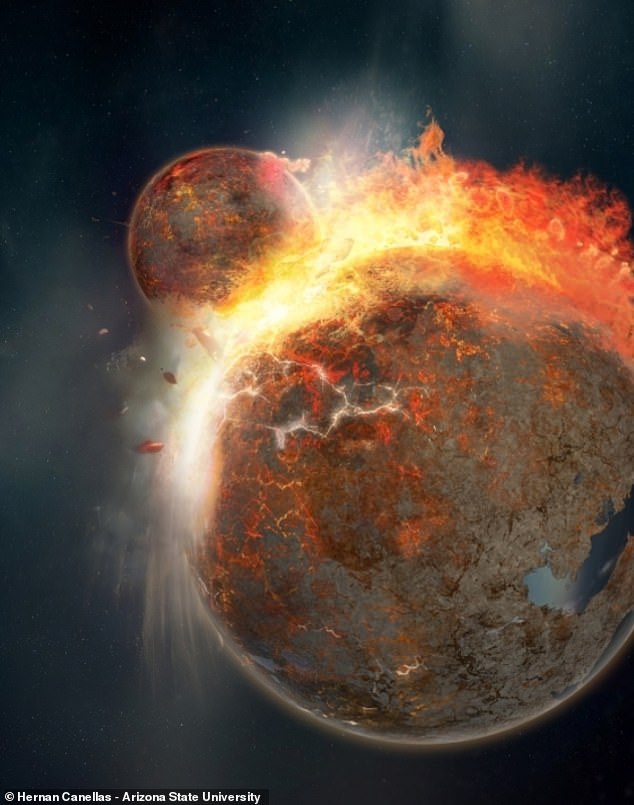
A new study of metal ore deep inside the moon is offering fresh evidence that Earth's natural satellite was formed by an ancient planet crashing into Earth long ago.
This long-theorized interplanetary collision — which scientists believe occurred some 4.5 billion years ago — saw a Mars-sized planet named 'Theia' slice itself into hot lava fragments upon impact with the Earth.
While some of Theia's planetary remains appear to be buried as dense and massive 'blobs' deep underneath Africa and the Pacific Ocean's tectonic plates, scientists said evidence for where the rest of Theia went after this crash had remained elusive.
But now, new data from NASA's Gravity Recovery and Interior Laboratory (GRAIL) spacecraft has found large telltale deposits of titanium-iron ore deep beneath the moon's surface, suggesting Theia's other remains did, in fact, form Earth's moon.
A new study of the moon is offering fresh evidence that Earth's natural satellite was formed by an ancient planet crashing into Earth. This long-theorized collision, some 4.5 billion years ago, saw a Mars-sized planet named 'Theia' slice into hot lava fragments upon impact with Earth
Under the moon's crust, in the region between the crust and the core known as the mantle, NASA's GRAIL craft detected two dense regions (pictured above) that match the titanium and iron 'ilmenite' deposits that would exist if the 'planet Theia' impact theory proves to be correct
Planetary geophysicist, Adrien Broquet of the German Aerospace Center in Berlin, described NASA's GRAIL findings as nothing short of 'mesmerizing.'
His team's new paper, published this April in Nature Geoscience, focused on 'gravity anomalies' deep under the moon's surface: dense, heavy pockets of matter identified by the GRAIL spacecraft's sensors.
'Analyzing these variations in the moon's gravity field allowed us to peek under the moon's surface and see what lies beneath,' Broquet said.
New research led by Durham University involved more than 300 supercomputer simulations designed to show the consequence of a huge collision on the planet.
Under the moon's crust, in the region between the crust and the core known as the mantle, the GRAIL craft detected two dense regions that match the titanium and iron 'ilmenite' deposits that would exist if the Theia impact theory was correct.
After Theia's likely collision with Earth, and after fragments of this lost planet became buried deep below Earth's crust, molten lava pools of heavy titanium and iron on the moon's surface began to sink deeper towards its core, pushing lighter rock up.
'Our moon literally turned itself inside out,' said Broquet's co-author, Jeff Andrews-Hanna, a geophysicist at the University of Arizona's Lunar and Planetary Laboratory.
Computer models by their colleague, Nan Zhang at Peking University in Beijing, offered the original framework for their theory that titanium-rich material would exist deep within the moon as a result of the moon's origins as chunks of planet Theia.
'When we saw those model predictions,' Andrews-Hanna said, 'it was like a lightbulb went on.'
'We see the exact same pattern when we look at subtle variations in the moon's gravity field,' he said, 'revealing a network of dense material lurking below the crust.'
Back on Earth, two similarly dense and unusual regions at the base of our planet's mantle — known as Large Low Velocity Provinces (LLVPs) — have also lent credence to the theory that an interplanetary 'Theia' collision created our moon.
One LLVP is located beneath the African tectonic plate and the other under the Pacific tectonic plate, as measured by seismic equipment similar to that used to detect earthquakes.
Their existence was established when geologists found that seismic waves slowed dramatically at a depth of 1,800 miles (2,900 km) in the two regions, which differed to other parts of the Earth.
Scientists have found new evidence our that the moon was created during a giant impact between Earth and a Mars-sized protoplanet called Theia 4.5 billion years ago. This also buried relics of Theia deep within Earth's mantle (depicted following the collision)
After running a series of simulations, Professor Hongping Deng discovered that following the moon-forming impact a significant amount of Theian mantle material – around two percent of Earth's mass – entered the lower mantle (shown in orange in the artist's impression above)
Scientists believe the material in these LLVPs is between 2 and 3.5 percent denser than the Earth's surrounding mantle.
Last year, Researchers led by the California Institute of Technology came up with the idea that these LLVPs could have evolved from a small amount of Theian material that entered the ancient Earth's lower mantle.
To back this up, they asked Professor Hongping Deng, of the Shanghai Astronomical Observatory, to explore this idea with the help of his pioneering methods in computational fluid dynamics.
After running a series of simulations, Professor Deng discovered that following the moon-forming impact a significant amount of 'Theian' material — around two percent of Earth's mass — would have entered the lower mantle of the ancient planet Earth.
'Through precise analysis of a wider range of rock samples, combined with more refined giant impact models and Earth evolution models, we can infer the material composition and orbital dynamics of the primordial Earth, "Gaia," and "Theia,"' said Deng's co-author Qian Yuan, a CalTech geophysicist who also worked on this project.
Deng and Yuan's team published their study in the journal Nature late last year.
Broquet said he hopes future NASA missions to the moon, like those scheduled for the Artemis program, will be able to take similar seismic measurements: first-of-their-kind seismic data from the moon to better corroborate the Theia collision theory.
'Future missions, such as with a seismic network, would allow a better investigation of the geometry of these structures,' the researcher said.
About 4.45 billion years ago, 150 million years after the solar system formed, Earth was hit by a Mars-size object called Theia.
The collision created the moon, but debate has raged exactly what happened during this event - and a mystery has persisted on why the moon and Earth are so similar in their composition.
The impact of Theia with Earth was so violent, the resulting debris cloud mixed thoroughly before settling down and forming the moon.
This cloud would have been composed of some Earth material, explaining the similarity between Earth and the moon, and other material.
The colliding body is sometimes called Theia, after the mythical Greek Titan who was the mother of Selene, the goddess of the Moon.
But one mystery has persisted, revealed by rocks the Apollo astronauts brought back from the moon - why are the moon and Earth so similar in their composition?
Several different theories have emerged over the years to explain the similar fingerprints of Earth and the moon.
Perhaps the impact created a huge cloud of debris that mixed thoroughly with the Earth and then later condensed to form the moon.
Or Theia could have, coincidentally, been isotopically similar to young Earth.
A third possibility is that the moon formed from Earthen materials, rather than from Theia, although this would have been a very unusual type of impact.
While shot in different locations, witnesses described the UFO as appearing out of nowhere without a sound and disappearing into thin air.
Enigma Lab's UAP advisor Alejandro Rojas said that all the images appeared to be the same, but suggested it could have been a rocket - 'but there were no rockets scheduled at that time.'
Americans in several southwest states reported seeing glowing, hazy UFOs in the night sky around 9pm local on May 2. Pictured is footage from Palm Springs, California
'We live by an airport. This was not an airplane, a planet, a star, a comet, or fireball, a drone, a satellite, or a rocket,' a witness in Oroville, California claimed (pictured)
Enigma Labs has built a massive catalog of incidents to weed out what is real or a hoax.
The batch received by DailyMail.com included seven videos and two non-video reports showing similar objects, but Engima said it collected more than 20 witnesses of the same observation.
'We live by an airport. This was not an airplane, a planet, a star, a comet, or fireball, a drone, a satellite, or a rocket,' a witness in Oroville, California claimed.
'We are familiar with them all as we are used to rocket launches and what they look like. This was something that appeared out of nowhere and disappeared into thin air.'
Enigma confirmed that, in several videos, the object was seen disappearing.
'It appeared to have a spotlight on both sides of the object,' another witness wrote on the website.
One of the videos captured in Palm Springs clearly shows a bowtie-shaped object, with lights appearing to be directed in opposite directions.
'Some of the reports indicate the object could be coming from either Vandenburg, China Lake, or the Nellis Test Range,' Rojas said.
Enigma Labs has built a massive catalog of incidents to weed out what is real or a hoax. The image was taken in Palms, California
A family in Peoria, Arizona (pictured) said they have remained baffled by what they caught on video: 'We've watched this video a hundred times and can't explain it'
Another sighting issues to Enigma came from Las Vegas, Nevada (pictured)
'If this was military testing, it would explain why it is not listed on public sites such as Spaceflight Now.
'We will continue to look into it, but for now we don't have a clear explanation.'
A family in Peoria, Arizona said they have remained baffled by what they caught on video: 'We've watched this video a hundred times and can't explain it.'
The Arizona witness shot the footage in a neighborhood, showing houses lining the streets.
One star is visible in the clip, located northeast of the UFO.
The witness said they and their son were out walking when they saw a 'bright light that looked like it was glowing in the clouds.'
'There were no clouds, no moon and no planes at this time,' the report continued.
'We noticed the light and my son started filming with his iPhone.
'The light with a large glow around it was far away and completely silent. It wasn't falling from the sky but rather coming west to east towards us. It was glowing and steady.'
The person continued to explain that at the end, the object faded out and disappeared - no sounds were heard during the sighing.
Another sighting issues to Enigma came from Las Vegas, Nevada.
'I was in my backyard in Las Vegas. I am in the northwest part of the city. I was at my neighbor's house down the street,' the description reads.
'She has a great view of the sky. And I saw this really bright light in the distance and it looked so fuzzy like it was behind clouds, but it was a super clear night.
Enigma received five other reports from California (pictured is from Mariposa), all showing the same type of object and another from Utah
'You can see the stars in the video. We could tell it was getting closer because it was getting bigger and then the cloudy/foggy part, which kind of had a similar effect that a rocket would have but no trail, started to change. It looked like a bow tie or snow angel wing shape.
'After about a minute it started to fade until it looked like a star and then no more. It was going about the same speed as the ISS. Maybe a tad faster.'
And a similar sighting was reported more than 500 miles away in Oroville, California.
The same hazy orb appeared in the video, which flew in a circular motion before disappearing.
'We live by an airport. This was not an airplane, a planet, a star, a comet, or fireball, a drone, a satellite, or a rocket,' the person shared.
'We are familiar with them all as we are used to rocket launches and what they look like. This was something that appeared out of nowhere and disappeared into thin air.'
Enigma received five other reports from California, all showing the same type of object and another from Utah.
NASA’s Solar Dynamics Observatory captured these images of the solar flares — as seen in the bright flashes in the upper right — on May 5 and May 6, 2024. The image shows a subset of extreme ultraviolet light that highlights the extremely hot material in flares and which is colorized in teal. Credit: NASA/SDO
Solar Max is Coming. The Sun Just Released Three X-Class Flares
The Sun is increasing its intensity on schedule, continuing its approach to solar maximum. In just over a 24-hour period on May 5 and May 6, 2024, the Sun released three X-class solar flares measuring at X1.3, X1.2, and X4.5. Solar flares can impact radio communications and electric power grids here on Earth, and they also pose a risk to spacecraft and astronauts in space.
NASA released an animation that shows the solar flares blasting off the surface of the rotating Sun, below.
NASA’s Solar Dynamics Observatory captured these images of the solar flares — as seen in the bright flashes in the upper right — on May 5 and May 6, 2024. The image shows a subset of extreme ultraviolet light that highlights the extremely hot material in flares and which is colorized in teal. Credit: NASA/SDO
Predicting when solar maximum will occur is not easy and the timing of it can only be confirmed after it happens. But NOAA’s Space Weather Prediction Center (SWPC) currently estimates that solar maximum will likely occur between May 2024 and early 2026. The Sun goes through a cycle of high and low activity approximately every 11 years, driven by the Sun’s magnetic field and indicated by the frequency and intensity of sunspots and other activity on the surface. The SWPC has been working hard to have a better handle on predicting solar cycles and activity. Find out more about that here.
Solar flares are explosions on the Sun that release powerful bursts of energy and radiation coming from the magnetic energy associated with the sunspots. The more sunspots, the greater potential for flares.
Flares are classified based on a system similar to the Richter scale for earthquakes, which divides solar flares according to their strength. X-class is the most intense category of flares, while the smallest ones are A-class, followed by B, C, M and then X. Each letter represents a 10-fold increase in energy output. So an X is ten times an M and 100 times a C. The number that follows the letter provides more information about its strength. The higher the number, the stronger the flare.
Flares are our solar system’s largest explosive events. They are seen as bright areas on the Sun and can last from minutes to hours. We typically see a solar flare by the photons (or light) it releases, occurring in various wavelengths.
Sometimes, but not always, solar flares can be accompanied by a coronal mass ejection (CME), where giant clouds of particles from the Sun are hurled out into space. If we’re lucky, these charged particles will provide a stunning show of auroras here on Earth while not impacting power grids or satellites.
Thankfully, missions like the Solar Dynamics Observatory, Solar Orbiter, the Parker Solar Probe are providing amazing views and new details about the Sun, helping astronomers to learn more about the dynamic ball of gas that powers our entire Solar System.
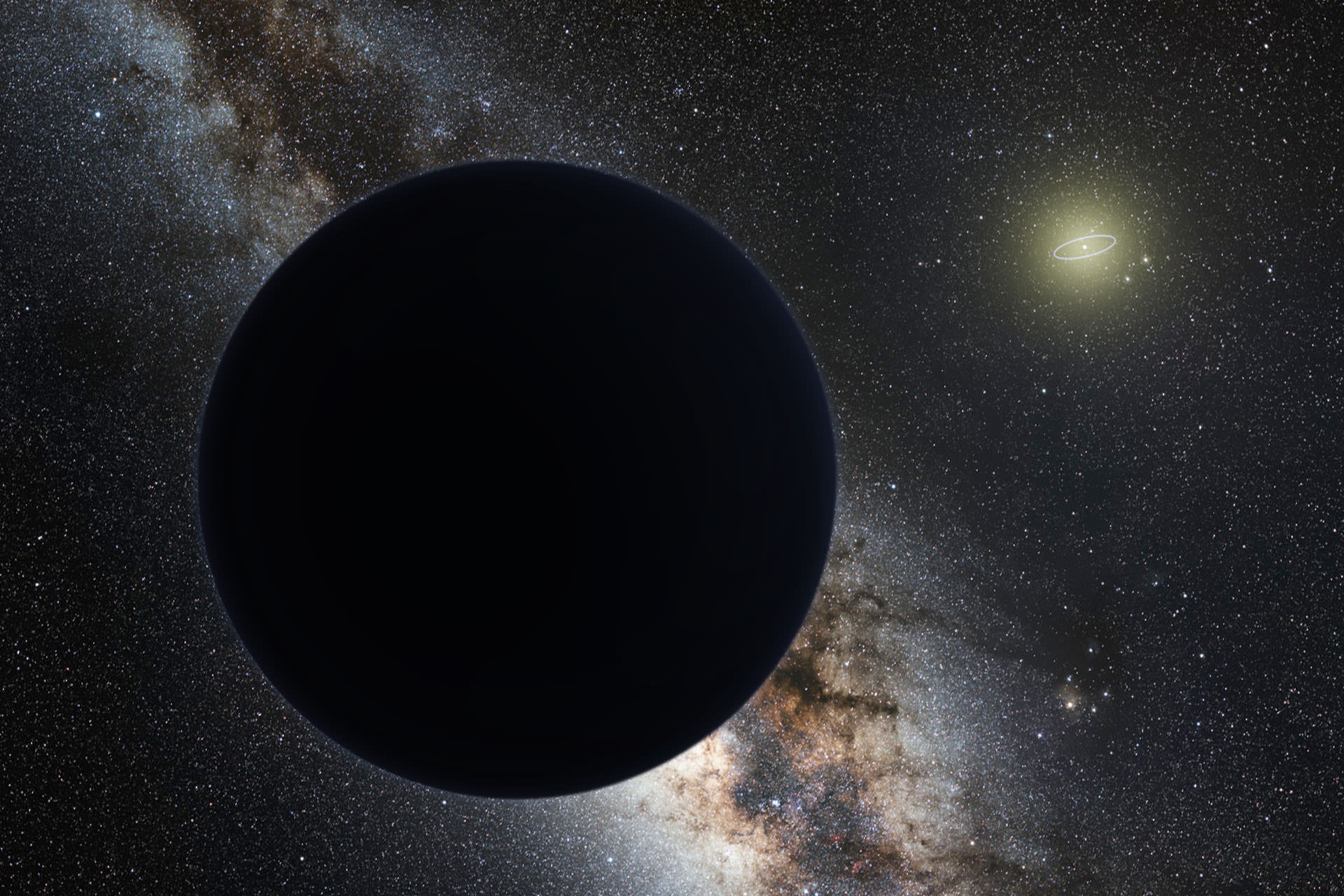
Artist's impression of Planet Nine as an ice giant eclipsing the central Milky Way, with a star-like Sun in the distance. Neptune's orbit is shown as a small ellipse around the Sun. The sky view and appearance are based on the conjectures of its co-proposer, Mike Brown.
New Evidence for Our Solar System’s Ghost: Planet Nine
Does another undetected planet languish in our Solar System’s distant reaches? Does it follow a distant orbit around the Sun in the murky realm of comets and other icy objects? For some researchers, the answer is “almost certainly.”
The case for Planet Nine (P9) goes back at least as far as 2016. In that year, astronomers Mike Brown and Konstantin Batygin published evidence pointing to its existence. Along with colleagues, they’ve published other work supporting P9 since then.
There’s lots of evidence for the existence of P9, but none of it has reached the threshold of definitive proof. The main evidence concerns the orbits of Extreme Trans-Neptunian Objects (ETNOs). They exhibit a peculiar clustering that indicates a massive object. P9 might be shepherding these objects along on their orbits.
This orbital diagram shows Planet Nine (lime green colour, labelled “P9”) and several extreme trans-Neptunian objects. Each background square is 100 AU across. Image Credit: By Tomruen – Own work, CC BY-SA 4.0, https://commons.wikimedia.org/w/index.php?curid=68955415
The names Brown and Batygin, both Caltech astronomers, come up often in regard to P9. Now, they’ve published another paper along with colleagues Alessandro Morbidelli and David Nesvorny, presenting more evidence supporting P9.
“The solar system’s distant reaches exhibit a wealth of anomalous dynamical structure, hinting at the presence of a yet-undetected, massive trans-Neptunian body—Planet Nine (P9),” the authors write. “Previous analyses have shown how orbital evolution induced by this object can explain the origins of a broad assortment of exotic orbits.”
To dig deeper into the issue, Batygin, Brown, Morbidelli, and Nesvorny examined Trans-Neptunian Objects (TNOs) with more conventional orbits. They carried out N-body simulations of these objects that included everything from the tug of giant planets and the Galactic Tide to passing stars.
29 objects in the Minor Planet Database have well-characterized orbits with a > 100 au, inclinations < 40°, and q (perihelia) < 30 au. Of those 29, 17 have well-quantified orbits. The researchers focused their simulations on these 17.
This figure from the research shows the 17 planets, their orbits, their perihelions, semi-major axes, and their inclinations. Image Credit: Batygin et al. 2024.
The researchers’ goal was to analyze these objects’ origins and determine if they could be used as a probe for P9. To accomplish this, they conducted two separate sets of simulations. One set with P9 in the Solar System and one set without.
The simulations began at t=300 million years, meaning 300 million years into the Solar System’s existence. At that time, “intrinsic dynamical evolution in the outer solar system is still in its infancy,” the authors explain, while enough time has passed for the Solar System’s birth cluster of stars to disperse and for the giant planets to have largely concluded their migrations. They ended up with about 2000 objects, or particles, in the simulation with perihelia greater than 30 au and semimajor axes between 100 and 5000 au. This ruled out all Neptune-crossing objects from the simulation’s starting conditions. “Importantly, this choice of initial conditions is inherently linked with the assumed orbit of P9,” they point out.
The figure below shows the evolution of some of the 2,000 objects in the simulations.
These panels show the evolution of selected particles within the calculations that attain nearly planar (i < 40°) Neptune-crossing orbits within the final 500 Myr of the integration. “Collectively, these examples indicate that P9-facilitated dynamics can naturally produce objects similar to those depicted in Figure 1” (the previous figure), the researchers explain. The top, middle, and bottom panels depict the time series of the semimajor axis, perihelion distance, and inclination, respectively. The rate of chaotic diffusion greatly increases when particles attain Neptune-crossing trajectories. Image Credit: Batygin et al. 2024.
These are interesting results, but the researchers point out that they in no way prove the existence of P9. These orbits could be generated by other things like the Galactic Tide. In their next step, they examined their perihelion distribution.
This figure from the research shows the perihelion distance for particles in a simulation with P9 (left) and without P9 (right.) The P9-free simulation shows a “rapid decline in perihelion distribution with decreasing q, as Neptune’s orbit forms a veritable dynamical barrier,” the researchers explain. Image Credit: Batygin et al. 2024.
“Accounting for observational biases, our results reveal that the orbital architecture of this group of objects aligns closely with the predictions of the P9-inclusive model,” the authors write. “In stark contrast, the P9-free scenario is statistically rejected at a ~5? confidence level.”
The authors point out that something other than P9 could be causing the orbital unruliness. The star was born in a cluster, and cluster dynamics could’ve set these objects on their unusual orbits before the cluster dispersed. A number of Earth-mass rogue planets could also be responsible, influencing the outer Solar System’s architecture for a few hundred million years before being removed somehow.
However, the authors chose their 17 TNOs for a reason. “Due to their low inclinations and perihelia, these objects experience rapid orbital chaos and have short dynamical lifetimes,” the authors write. That means that whatever is driving these objects into these orbits is ongoing and not a relic from the past.
An important result of this work is that it results in falsifiable predictions. And we may not have to wait long for the results to be tested. “Excitingly, the dynamics described here, along with all other lines of evidence for P9, will soon face a rigorous test with the operational commencement of the VRO (Vera Rubin Observatory),” the authors write.
A drone’s view of the Rubin Observatory under construction in 2023. The 8.4-meter is getting closer to completion and first light in 2025. The Observatory could provide answers to many outstanding issues, like the existence of Planet Nine. Image Credit: Rubin Observatory/NSF/AURA/A. Pizarro D
If P9 is real, what is it? It could be the core of a giant planet ejected during the Solar System’s early days. It could be a rogue planet that drifted through interstellar space until being caught up in our Solar System’s gravitational milieu. Or it could be a planet that formed on a distant orbit, and a passing star shepherded it into its eccentric orbit. If astronomers can confirm P9’s existence, the next question will be, ‘what is it?’
If you’re interested at all in how science operates, the case of P9 is very instructive. Eureka moments are few and far between in modern astronomy. Evidence mounts incrementally, accompanied by discussion and counterpoint. Objections are raised and inconsistencies pointed out, then methods are refined and thinking advances. What began as one over-arching question is broken down into smaller, more easily-answered ones.
But the big question dominates for now and likely will for a while longer: Is there a Planet Nine?
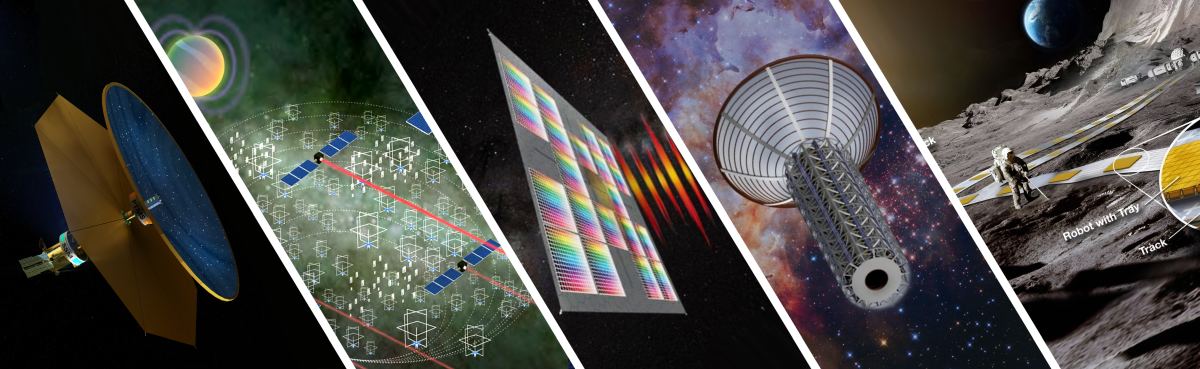
From a lunar railway to a space telescope with a liquid lens, the 2024 NIAC Phase Two awardees are developing some fascinating concepts. This collage of artist concepts highlights the novel approaches proposed by the Phase Two awardees for possible future missions. Credits: NASA, From left: Edward Balaban, Mary Knapp, Mahmooda Sultana, Brianna Clements, Ethan Schaler
It’s that time again. NIAC(NASA Innovative Advanced Concepts) has announced six concepts that will receive funding and proceed to the second phase of development. This is always an interesting look at the technologies and missions that could come to fruition in the future.
The six chosen ones will each receive $600,000 in funding to pursue the ideas for the next two years. NASA expects each team to use the two years to address both technical and budgetary hurdles for their concepts. When this second phase comes to an end, some of the concepts could advance to the third stage.
“These diverse, science fiction-like concepts represent a fantastic class of Phase II studies,” said John Nelson, NIAC program executive at NASA Headquarters in Washington. “Our NIAC fellows never cease to amaze and inspire, and this class definitely gives NASA a lot to think about in terms of what’s possible in the future.”
Telescopes are built around mirrors and lenses, whether they’re ground-based or space-based. The JWST’s large mirror is 6.5 meters in diameter but had to be folded up to fit inside the rocket that launched it and then unfolded in space. That’s a tricky engineering feat. Engineers are building larger and larger ground-based telescopes, too, and they’re equally tricky to design and build. Could FLUTE change this?
FLUTE envisions lenses made of fluid, and the FLUTE team’s concept describes a space telescope with a primary mirror 50 meters (164 ft.) in diameter. Creating glass lenses for a telescope this large isn’t realistic. “Using current technologies, scaling up space telescopes to apertures larger than approximately 33 feet (10 meters) in diameter does not appear economically viable,” the FLUTE website states.
But in the microgravity of space, fluids behave in an intriguing way. Surface tension holds liquids together at their surfaces. We can see this on Earth, where some insects use surface tension to glide along the surfaces of ponds and other bodies of water. Also, on Earth, surface tension holds small drops of water together. But in space, away from Earth’s dominating gravity, surface tension is much more effective. There, water maintains the most energy efficient shape there is: a sphere.
Another force governs water: adhesion. Adhesion causes liquids to cling to surfaces. In the microgravity of space, adhesion can bind liquid to a circular, ring-like frame. Then, due to surface tension, the liquid will naturally adopt a spherical shape. If the liquid can be made to bulge inward rather than outward, and if the liquid is reflective enough, it creates a telescope mirror.
The FLUTE team would like to make optical components in space. The liquid would stay in the liquid state and form an extremely smooth light-collecting surface. As a bonus, FLUTE would also self-repair after any micrometeorite strike.
The FLUTE study is led by Edward Balaban from NASA’s Ames Research Center in California’s Silicon Valley. The FLUTE team has already done some tests on the ISS and on zero-g flights.
FLUTE researchers experience microgravity aboard Zero Gravity Corporation’s G-FORCE ONE aircraft while operating an experiment payload during a series of parabolic flights. Image Credits: Zero Gravity Corporation/Steve Boxall
It takes too long to get to Mars. It’s a six-month journey each way, plus time spent on the surface. All that time in microgravity, exposure to radiation, and other challenges make the trip very difficult for astronauts. PPR aims to fix that.
PPR isn’t a launch vehicle for escaping Earth’s gravity well. It would be launched on a heavy lift vehicle like SLS and then sent on its way.
PPR was originally derived from the Pulsed Fission Fusion concept. But it’s more affordable, and also smaller and simpler. PPR might generate 100,000 N of thrust with a specific impulse (Isp) of 5,000 seconds. Those are good numbers. PPR could reduce the travel time to Mars to two months.
It has other benefits as well. It could propel larger spacecraft to Mars on trips longer than two months, carrying more cargo and also provide heavier shielding against cosmic rays. “The PPR enables a whole new era in space exploration,” the team writes.
PPR is basically a fusion system ignited by fission. It’s similar to a thermonuclear weapon. But rather than a run-away explosion, the combined energy is directed through a magnetic nozzle to produce thrust.
In phase two, the PPR team intends to optimize the engine design to produce more specific impulse, perform proof-of-concept experiments for major components, and design a shielded ship for human missions to Mars.
This study is led by Brianna Clements with Howe Industries in Scottsdale, Arizona.
One of modern astronomy’s last frontiers is the low-frequency radio sky. Earth’s ionosphere blocks our ground-based telescopes from seeing it. And space-based telescopes can’t see it either. It’s because the wavelengths are so long, in the meter to the kilometre scale. Only extremely massive telescopes could see these waves clearly.
GO-LoW is a potential solution. It’s a space-based array of thousands of identical Small-Sats arranged as an interferometer. It would sit at an Earth-Sun Lagrange point and observe exoplanet and stellar magnetic fields. Exoplanet magnetic fields emit radio waves between 100 kHz and 15 MHz. The GO-LoW team says their interferometer could perform the first survey of exoplanetary magnetic fields within 5 parsecs (16 light years.) Magnetic fields tell scientists a lot about an exoplanet, its evolution, and its processes.
GO-LoW is a Great Observatory concept to open the last unexplored window of the electromagnetic (EM) spectrum. The Earth’s ionosphere becomes opaque at approximately 10m wavelengths, so GO-LoW will join Great Observatories like HST and JWST in space to access this spectral window. Image Credits: NASA/GO-LoW
While there’s no doubt that large telescopes like the JWST are powerful and effective, they’re extremely complex and expensive. And if something goes wrong with a critical component, the mission could end.
GO-LoW takes a different approach. By using thousands of individual satellites, the system is more resilient. GO-LoW would have a hybrid constellation. Some of the satellites would be smaller and simpler satellites called “listener nodes” (LN,) while a smaller number of them would be “communication and computation” nodes (CCNs). They would collect data from the LNs, process it, and beam it back to Earth.
The GO-LoW says it would only take a few heavy launches to place an entire 100,000 satellite constellation in space.
The technology for the SmallSats already exists. The challenge the GO-LoW team will address with their phase two funding is developing a system that will harness everything together effectively. “The coordination of all these physical elements, data products, and communications systems is novel and challenging, especially at scale,” they write.
GO-LoW is led by Mary Knapp with MIT in Cambridge, Massachusetts.
The RTCPG is a power source for spacecraft visiting the outer planets. They promise smaller, more efficient power generation for smaller science and exploration missions that can’t carry a solar power system or nuclear power system. Both those systems are bulky, and solar power is limited the further away from the sun a spacecraft goes.
The thermoradiative cell (TRC) uses radioisotopes to create heat as an MMRTG does. But the TRC uses the heat to generate infrared light which generates electricity. In initial testing, the system generated 4.5 times more power from the same amount of PU-238.
Much of phase two’s work will involve materials. “Metal-semiconductor contacts capable of surviving the required elevated temperatures will be investigated,” the team explains. The team developed a special cryostat testing apparatus in phase one.
“Building on our results from Phase I, we believe there is much more potential to unlock here,” the team writes.
This power generation concept study is from Stephen Polly at the Rochester Institute of Technology in New York.
What if Artemis is enormously successful? How will astronauts move their equipment around the lunar surface efficiently?
If the team behind FLOAT has their way, they’ll build the Moon’s first railway. Sort of. This artist’s concept shows a possible future mission depicting the lunar surface with planet Earth on the horizon. Image Credit: Ethan Schaler
FLOAT would provide autonomous transportation for payloads on the Moon. “A durable, long-life robotic transport system will be critical to the daily operations of a sustainable lunar base in the 2030’s,” the FLOAT team writes.
The heart of FLOAT is a three-layer flexible track that’s unrolled into position without major construction. It consists of three layers: a graphite layer, a flex-circuit layer, and a solar panel layer.
The graphite layer allows robots to use diamagnetic levitation to float over the track. The flex-circuit layer supplies the thrust that moves them, and the thin-film solar panel layer generates electricity for a lunar base when it’s in sunlight.
The system can be used to move regolith around for in-situ resource utilization and to transport payloads around a lunar base, for example, from landing zones to habitats.
“Individual FLOAT robots will be able to transport payloads of varying shape/size (>30 kg/m^2) at useful speeds (>0.5m/s), and a large-scale FLOAT system will be capable of moving up to 100,000s kg of regolith/payload multiple kilometres per day,” the FLOAT team explains.
With their phase two funding, the FLOAT team intends to design, build, and test scaled-down versions of FLOAT robots and track. Then, they’ll test their system in a lunar analog testbed. They’ll also test environmental effects on the system and how they alter the system’s performance and longevity.
Ethan Schaler leads FLOAT at NASA’s Jet Propulsion Laboratory in Southern California.
Some of the most intriguing planets and moons in the Solar System are well beyond Jupiter. But exploring them is challenging. Extremely long travel times, restrictive mission windows, and large expenses limit our exploration. But SCOPE aims to address these limitations.
Typically, a spacecraft carries a propulsion and power system along with its instruments and communication systems. NASA’s Juno mission to Jupiter, for example, carries a chemical rocket engine for propulsion, 50 square meters of solar panels, and 10 science instruments. The solar panels alone weigh 340 kg (750 lbs.) Juno is powerful, produces a wide variety of quality science data, and is expensive.
ScienceCraft takes a different approach. It combines a single science instrument and spacecraft into one monolithic structure. It’s basically a solar sail with a built-in spectrometer. They’re aiming their design at the Neptune-Triton system.
This artist’s depiction shows ScienceCraft, which integrates the science instrument with the spacecraft by printing a quantum dot spectrometer directly on the solar sail to form a monolithic, lightweight structure. Image Credit: Mahmooda Sultana
“By printing an ultra-lightweight quantum dot-based spectrometer, developed by the PI Sultana, directly on the solar sail, we create a breakthrough spacecraft architecture allowing an unprecedented parallelism and throughput of data collection and rapid travel across the solar system,” the ScienceCraft team writes.
Instead of merely providing the propulsion, the sail doubles as the spacecraft’s science instrument. The small mass means that ScienceCraft could be carried into orbit as a secondary payload. The team says they’ll use phase two to identify and develop key technologies for the spacecraft and to further mature the mission concept. They say that because of the low cost and simplicity, they could be ready by 2045.
“By leveraging these benefits, we propose a mission concept to Triton, a unique planetary body in our solar system, within the short window that closes around 2045 to answer compelling science questions about Triton’s atmosphere, ionosphere, plumes and internal structure,” the ScienceCraft team explains.
ScienceCraft is led by NASA’s Mahmooda Sultana at the agency’s Goddard Space Flight Center in Greenbelt, Maryland.
Our Alien Overlords: How Humanity Secretly Serves the Tall Whites
In the annals of extraterrestrial lore, few accounts captivate the imagination quite like the saga of Charles Hall and the enigmatic Tall Whites. Hall’s narrative, chronicled in his series of books titled “Millennial Hospitality,” offers a tantalizing glimpse into a clandestine relationship between humans and an otherworldly species known as the Tall Whites. From covert agreements to clandestine operations, the story unveils a complex tapestry of interactions that raise profound questions about the nature of our reality and our place within the cosmos.
The Tall Whites: Alien Enigmas Among Us
According to Hall, the Tall Whites first made contact with the United States government in the early 1950s, purportedly striking a deal that allowed them to establish facilities on Earth in exchange for advanced technology. Described as tall, fair-skinned beings with elongated features, the Tall Whites possess a sophisticated understanding of science and technology far beyond our own. Their presence on Earth, shrouded in secrecy, has fueled speculation and intrigue for decades.
Covert Collaborations: The Shadowy Alliance
Central to Hall’s account is the clandestine collaboration between the United States government and the Tall Whites. Allegedly, the US government agreed to allow the Tall Whites to conduct their operations on Earth with minimal interference in exchange for access to their advanced technology. This covert alliance, hidden from public view, raises profound questions about the extent of our government’s involvement with extraterrestrial entities and the implications for humanity at large.
Unveiling Secret Facilities: Evidence Underground
One of the most compelling aspects of Hall’s narrative is his description of secret facilities where the Tall Whites conduct their operations. Through meticulous research and analysis, investigators have uncovered evidence of underground bases and covert installations that align with Hall’s accounts. Satellite imagery and historical records suggest the existence of hidden facilities linked to the Tall Whites, providing tantalizing clues about the scope of their presence on Earth.
The Human Experiment: Studying Humanity
Beyond their technological prowess, the Tall Whites are said to possess a profound interest in humanity itself. According to Hall, he became the subject of their study during his tenure at Nellis Air Force Base, where he interacted closely with members of the extraterrestrial species. Through these interactions, the Tall Whites sought to understand human behavior and psychology, offering insights into their own enigmatic culture and society.
The Veil of Secrecy: Unraveling the Truth
While Hall’s accounts offer a compelling narrative of human-alien interaction, skepticism abounds regarding the veracity of his claims. Critics point to the lack of concrete evidence to substantiate his story, raising doubts about the existence of the Tall Whites and their alleged collaboration with the US government. Despite these challenges, the enduring mystery surrounding the Tall Whites continues to captivate the imagination of UFO enthusiasts and skeptics alike.
VIDEO:
The Why Files – Our Alien Overlords | How We Secretly Serve The Tall Whites
The saga of Charles Hall and the Tall Whites offers a fascinating glimpse into the shadowy world of extraterrestrial contact and covert collaboration. As humanity grapples with the mysteries of the cosmos, the story serves as a reminder of the profound questions that lie beyond the confines of our understanding. Whether fact or fiction, the tale of our alien overlords invites us to contemplate our place in the universe and the enigmatic beings that may share it with us.
Meer van UFO'S of UAP'S, ASTRONOMIE, RUIMTEVAART, ARCHEOLOGIE, OUDHEIDKUNDE, SF-SNUFJES EN ANDERE ESOTERISCHE WETENSCHAPPEN - DE ALLERLAATSTE NIEUWTJES


 UFO over Celle di Bulgheria, in Cilento, Italy May 5, 2024, UAP Sighting News.