Ontdek de Fascinerende Wereld van UFO's en UAP's: Jouw Bron voor Onthullende Informatie!
Ben jij ook gefascineerd door het onbekende? Wil je meer weten over UFO's en UAP's, niet alleen in België, maar over de hele wereld? Dan ben je op de juiste plek!
België: Het Kloppend Hart van UFO-onderzoek
In België is BUFON (Belgisch UFO-Netwerk) dé autoriteit op het gebied van UFO-onderzoek. Voor betrouwbare en objectieve informatie over deze intrigerende fenomenen, bezoek je zeker onze Facebook-pagina en deze blog. Maar dat is nog niet alles! Ontdek ook het Belgisch UFO-meldpunt en Caelestia, twee organisaties die diepgaand onderzoek verrichten, al zijn ze soms kritisch of sceptisch.
Nederland: Een Schat aan Informatie
Voor onze Nederlandse buren is er de schitterende website www.ufowijzer.nl, beheerd door Paul Harmans. Deze site biedt een schat aan informatie en artikelen die je niet wilt missen!
Internationaal: MUFON - De Wereldwijde Autoriteit
Neem ook een kijkje bij MUFON (Mutual UFO Network Inc.), een gerenommeerde Amerikaanse UFO-vereniging met afdelingen in de VS en wereldwijd. MUFON is toegewijd aan de wetenschappelijke en analytische studie van het UFO-fenomeen, en hun maandelijkse tijdschrift, The MUFON UFO-Journal, is een must-read voor elke UFO-enthousiasteling. Bezoek hun website op www.mufon.com voor meer informatie.
Samenwerking en Toekomstvisie
Sinds 1 februari 2020 is Pieter niet alleen ex-president van BUFON, maar ook de voormalige nationale directeur van MUFON in Vlaanderen en Nederland. Dit creëert een sterke samenwerking met de Franse MUFON Reseau MUFON/EUROP, wat ons in staat stelt om nog meer waardevolle inzichten te delen.
Let op: Nepprofielen en Nieuwe Groeperingen
Pas op voor een nieuwe groepering die zich ook BUFON noemt, maar geen enkele connectie heeft met onze gevestigde organisatie. Hoewel zij de naam geregistreerd hebben, kunnen ze het rijke verleden en de expertise van onze groep niet evenaren. We wensen hen veel succes, maar we blijven de autoriteit in UFO-onderzoek!
Blijf Op De Hoogte!
Wil jij de laatste nieuwtjes over UFO's, ruimtevaart, archeologie, en meer? Volg ons dan en duik samen met ons in de fascinerende wereld van het onbekende! Sluit je aan bij de gemeenschap van nieuwsgierige geesten die net als jij verlangen naar antwoorden en avonturen in de sterren!
Heb je vragen of wil je meer weten? Aarzel dan niet om contact met ons op te nemen! Samen ontrafelen we het mysterie van de lucht en daarbuiten.
It's been an interesting few years for UFO enthusiasts
(Image: Andy Johnstone for The Daily Mirror)
In Moston a shiny silver object was seen 'randomly disappearing and reappearing in a cloudless sky'. Several bright white lights were spotted in Stalybridge ascending towards a bright star.
And in Stretford a 'white light streak' was caught on a doorbell camera zig-zagging across the atmosphere. They're just some of the dozens of UFO sightings reported across Greater Manchester over the last four years, a new report has revealed.
It's been an interesting time for UFO enthusiasts. Last year American fighter jets shot down an unexplained flying object - which was later identified as a Chinese balloon, suspected to be on a spying mission - as well as three other objects in or near American airspace.
Then whistle-blower Major David Grusch, a former Air Force intelligence officer, set the internet on fire when he claimed the US was concealing a long-standing programme that retrieves and reverse-engineers unidentified flying objects.
The intrigue has continued into 2024, with Ukrainian troops recording a huge disc-shaped object over the battlefield of Donetsk, while closer to home a hiker came upon a mysterious monolith on a hilltop in Powys, which he initially assumed was 'some sort of UFO', but has since left some speculating it may have been planted by aliens.
Craig Muir, a builder from a Welsh town, who said he was "taken aback" when he spotted what he assumed was "some sort of a UFO" at the summit of a hill(Image: PA)
But despite increasing speculation about alien visitors online and in the media, the skies above the UK have been relatively quiet in the last year. In its annual report, the research group UFO Identified documented 395 sightings in the UK in 2023 - a 20% drop from 497 sightings in 2022 and lower than in 2021 (413) and 2020 (484).
Information was taken from social media, newspaper reports, and over 50 Freedom of Information requests, as well as from reports made directly to UFO spotter groups around the UK. According to the report, people in the North West had the best chance of seeing a UFO last year, with 41 sightings across the region, followed by the South East (40) and then the South West (39).
Use our interactive map to see the UFO sightings where you live..
Ash Ellis of UFO Identified said: "Overall, it’s disappointing to see such a big decrease in reports this year, especially after the bumper year of 2022. This time last year we were hoping that a reduction in the stigma surrounding the topic would lead to more reports being filed, but this clearly hasn’t been the case.
This strange light in the sky above Tyldesley was reported in 2021(Image: Paul Ellison)
"Hopefully, as we and other groups around the country continue giving people space and a platform to talk about their experiences that will help more people come forward and be confident to stand up and tell their story. Despite the reduced number of reports, we continue to see the same trends across different datasets.
"Whether that's the area in which sightings are being made, to the time of day, and the described shape of UFOs, and so on, these have all been consistent over the past four years. This, to me, tells us that there are areas which are more prone to seeing UFOs and we will be using this data to forecast areas of interest over the coming years."
Astronomers Find Two Ancient Substructures in Inner Milky Way
Dubbed Shakti and Shiva, the newly-identified structures are between 12 and billion years old — so ancient they likely formed before even the oldest parts of the present-day Milky Way’s spiral arms and disk.
This image shows the location and distribution of Shakti (yellow) and Shiva (blue) stars throughout the Milky Way.
Image credit: ESA / Gaia / DPAC / K. Malhan.
“What’s truly amazing is that we can detect these ancient structures at all,” said Dr. Khyati Malhan, an astronomer at the Max Planck Institute for Astronomy.
“The Milky Way has changed so significantly since these stars were born that we wouldn’t expect to recognize them so clearly as a group — but the unprecedented data we’re getting from ESA’s Gaia satellite made it possible.”
Using Gaia observations, Dr. Malhan and Max Planck Institute for Astronomy’s Dr. Hans-Walter Rix were able to determine the orbits of individual stars in the Milky Way, along with their content and composition.
“When we visualised the orbits of all these stars, two new structures stood out from the rest among stars of a certain chemical composition. We named them Shakti and Shiva,” Khyati said.
Each stream contains the mass of about 10 million Suns, with stars of 12 to 13 billion years in age all moving in very similar orbits with similar compositions.
The way they’re distributed suggests that they may have formed as distinct fragments that merged with the Milky Way early in its life.
Both Shakti and Shiva streams lie towards the Milky Way’s heart.
Gaia explored this part of the Milky Way in 2022 using a kind of galactic archaeology. This showed the region to be filled with the oldest stars in the entire Galaxy, all born before the disk of the Milky Way had even properly formed.
“The stars there are so ancient that they lack many of the heavier metal elements created later in the Universe’s lifetime,” Dr. Rix said.
“The stars in our Galaxy’s heart are metal-poor, so we dubbed this region the Milky Way’s ‘poor old heart’.”
“Until now, we had only recognized these very early fragments that came together to form the Milky Way’s ancient heart.”
“With Shakti and Shiva, we now see the first pieces that seem comparably old but located further out.”
“These signify the first steps of our Galaxy’s growth towards its present size.”
While very similar, the two streams are not identical. Shakti stars orbit a little further from the Milky Way’s center and in more circular orbits than Shiva stars.
Fittingly, the streams are named after a divine couple from Hindu philosophy who unite to create the Universe.
Some 12 billion years ago, the Milky Way looked very different to the orderly spiral we see today.
We think that our Galaxy formed as multiple long, irregular filaments of gas and dust coalesced, all forming stars and wrapping together to spark the birth of our Galaxy as we know it.
It seems that Shaki and Shiva are two of these components — and future Gaia data releases may reveal more.
The authors also built a dynamical map of other known components that have played a role in our Galaxy’s formation and were discovered using Gaia data.
These include Gaia-Sausage-Enceladus, LMS1/Wukong, Arjuna/Sequoia/I’itoi, and Pontus.
These star groups all form part of the Milky Way’s complex family tree, something that Gaia has worked to build over the past decade.
“Revealing more about our Galaxy’s infancy is one of Gaia’s goals, and it’s certainly achieving it,” said Gaia project scientist Dr. Timo Prusti, an astronomer at ESA.
“We need to pinpoint the subtle yet crucial differences between stars in the Milky Way to understand how our Galaxy formed and evolved.”
“This requires incredibly precise data — and now, thanks to Gaia, we have that data.”
“As we discover surprise parts of our Galaxy like the Shiva and Shakti streams, we’re filling the gaps and painting a fuller picture of not only our current home, but our earliest cosmic history.”
The study was published in the Astrophysical Journal.
Khyati Malhan & Hans-Walter Rix. 2024. Shiva and Shakti: Presumed Proto-Galactic Fragments in the Inner Milky Way. ApJ 964, 104; doi: 10.3847/1538-4357/ad1885
Roswell was a coverup, and the official photos of the crash debris are not what Army officers found in the desert. A report from the U.S. Air Force and testimony from two officers present, reveal this to be the case. However, the coverup details do not prove what crashed in the desert in 1947 was an alien spacecraft. According to U.S. Air Force investigators, the coverup demonstrates what crashed in Roswell was a top-secret project from the cold war.
In early July 1947, a rancher claimed to have found debris on a ranch approximately 30 miles outside of Roswell, New Mexico. He reported it to the Chavez County Sheriff in the nearby town of Corona. The sheriff called the Roswell Army Air Field (RAAF), who sent intelligence officer Major Jesse Marcel and counterintelligence corps officer (CIC) Captain Sheridan Cavitt to investigate.
On July 7, Marcel and Cavitt went to the debris site and examined the materials. What they reported seeing was strange enough for the base commander to order the creation of a press release claiming the RAAF had captured a “flying saucer.”
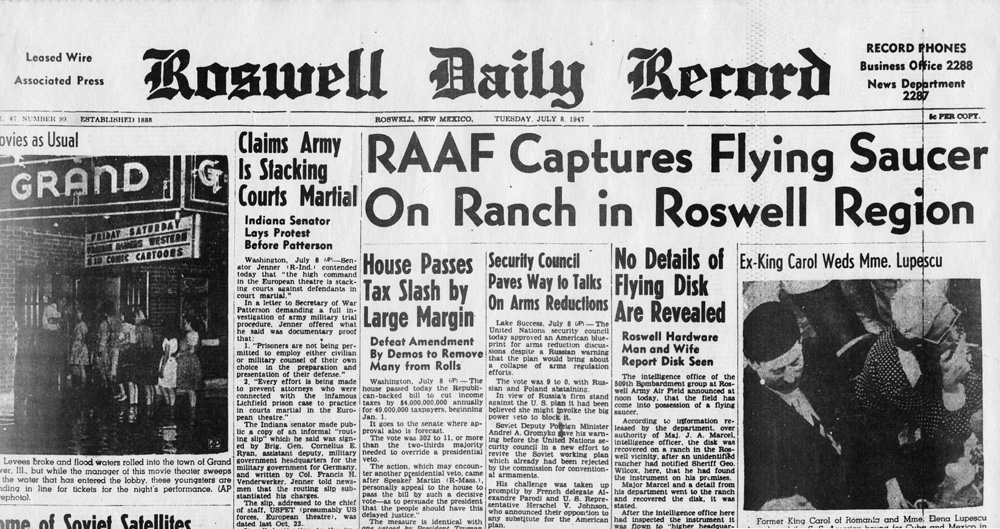
On July 8, the front page of the Roswell Daily Record read “RAAF Captures Flying Saucer On Ranch in Roswell Region.” The article claimed the RAAF reported they had “come into possession of a flying saucer.”
Roswell Daily Record, July 8, 1947. Click to enlarge.
(Credit: Roswell Daily Record)
The story was short-lived. The next day, the front-page headline of the Roswell Daily Record read: “Gen. Ramey Empties Roswell Saucer” with the subheadings: “Ramey Says Excitement Is Not Justified,” and “General Ramey Says Disk Is Weather Balloon.”
Roswell Daily Record, July 9, 1947. Click to enlarge.
(Credit: Roswell Daily Record)
On July 8, Marcel was ordered to bring some of the debris to the Fort Worth Army Air Base in Texas and meet with General Roger Ramey. On July 9, Ramey held a press conference where he said there was no “flying saucer” found, and that the RAAF had mistaken a standard weather balloon for something more mysterious.
Press photos were taken with Marcel, Ramey, Colonel Thomas DuBose (Ramey’s Chief of Staff), and the alleged crash debris.
General Roger Ramey (left) with Colonel Thomas Dubois looking at the weather balloon Ramey claimed was mistaken for a flying saucer in Roswell in 1947.
Jesse Marcel holding the weather balloon debris in Ramey’s office.
The public quickly forgot the entire affair. It wasn’t until the 1980s that the Roswell UFO crash story began to acquire attention. In the late 1970s, researcher Stanton Friedman heard about the case and was able to find Marcel. Marcel told Friedman that the weather balloon story was to coverup what was really found. He said the material was not a weather balloon.
“You couldn’t bend it. You couldn’t dent it. Even a sledgehammer would bounce off of it,” Marcel stated in an interview in the 1980s on the show In Search Of.
“I knew I had never seen anything like that before, and as of now, I do not know what it was,” Marcel continued, “It was not anything from this earth.”
Marcel said he had taken some of the material home to show his family. His son had kept some of it, but after the cover story was released, Marcel says he had to return all the material he had to the Army. Jesse Marcel Jr. confirmed the strange properties of the material.
Friedman was able to track down other witnesses, civilians and military, who backed Marcel’s story. Friedman began working the case with researcher and author Bill Moore. Moore then published their work in a book titled The Roswell Incident coauthored with Charles Berlitz.
In the 1980s and 1990s, several more books were published, and the Roswell incident grew in popularity. In 1989, an alleged witness came forward to claim alien bodies were also recovered.
The mythology of the Roswell UFO crash had received so much attention that in 1993, congressman Steven Schiff, called for an investigation into the incident. The investigation results were released in 1995 by the U.S. Air Force (USAF) as The Roswell Report: Fact versus Fiction in the New Mexico Desert.
“Concerning the initial announcement, ‘RAAF Captures Flying Disc,’ research failed to locate any documented evidence as to why that statement was made,” wrote USAF investigators.
However, they also discovered it was not a weather balloon, as Ramey stated.
“It appears that there was some type of umbrella cover story to protect our work with MOGUL,” Professor Charles Moore told USAF investigators.
According to the report, while researching the Roswell incident, investigators ran across balloon testing conducted at the same time as the Roswell incident out of Alamogordo Air Field (now Holloman Air Force Base), over 100 miles west of Roswell. New York University (NYU) ran the project, and further investigation revealed the NYU testing was part of a Top Secret program called Project MOGUL.
The investigators were able to track down Moore, who was the NYU project engineer. When shown witness descriptions of the debris, Moore told investigators that he believed they had found one of their Project MOGUL test balloons. In particular, Moore’s team had not recovered a balloon they had launched on July 4, 1947.
Google map showing Roswell in upper right, and Alamogordo and Holloman Air Force Base in lower left.
“When we heard the [Flying Saucer] news back in New York, we joked that they probably found one of our balloons,” recalled Moore.
As for why Ramey had called it a weather balloon, the report states: “the Air Force did not find documented evidence that Gen. Ramey was directed to espouse a weather balloon in his press conference, he may have done so because he was either aware of Project MOGUL and was trying to deflect interest from it, or he really perceived the material to be a weather balloon based on the identification from his weather officer, Irving Newton.”
Components of a Mogul balloon train per Professor Moore.
As to why debris from a Top Secret project would be left out in a field to be discovered by a rancher, the report explains that the materials were not classified, only the use was. The project’s purpose was to float listening devices with balloons to detect nuclear tests by the Russians.
In 1991, DuBose, the third man in the photographs with the debris, sent UFO researchers an affidavit claiming he knew the material in the photos was not what was found in the desert.
“The material shown in the photographs taken in Gen. Ramey’s office was a weather balloon,” wrote DuBose. “The weather balloon explanation for the material was a cover story to divert the attention of the press.”
DuBose claims the real debris was sent to a General McMullen in Washington D.C., who said he intended to forward the material to Air Material Command at Wright Field in Dayton, Ohio.
DuBose claimed, “The entire operation was conducted under the strictest secrecy.”
However, DuBose did not say he knew what the debris material consisted of or knew anything about the recovery of an alien spacecraft.
Although it appears Ramey was covering up the true nature of what the RAAF found in the desert, the description of the materials used for the Project MOGUL balloons was not high tech or out of the ordinary. The balloons were standard weather balloons. Other elements included balsa wood, foil, tape, and string.
Cavitt, the CIC officer who accompanied Marcel to the debris site, claimed what he saw looked like regular weather balloon debris.
The report described the tape on the balloons as “fabricated by toy or novelty companies using purplish-pink tape with flower and heart symbols on it.”
Symbols on I-beam as described by the Marcel. This poster is on display at the Roswell UFO Museum.
Symbols and shapes used on Mogul balloons from USAF Roswell report.
Marcel and his son described having a piece of the debris that looked like a small I-beam with strange symbols. However, they recall that although the beam was as light as balsa wood, it was made of metal. They did remember markings on the I-beam but said they were not hearts and flowers.
The USAF investigation led them to conclude: “The Air Force research did not locate or develop any information that the ‘Roswell Incident’ was a UFO event. All available materials, although they do not address Roswell per se, indicate that the most likely source of the wreckage recovered from the Brazel Ranch was from one of the Project MOGUL balloon trains. Although that project was Top Secret at the time, there was also no specific indication found to indicate an official preplanned cover story was in place to explain an event such as that which ultimately happened.”
They claimed that Marcel and the RAAF base commander overacted when they claimed they had caught a “flying disc.”
As for alien bodies, they said that was not possible because the wreckage was from Project MOGUL balloons, which did not have passengers, and that even UFO researchers could not agree on the details related to the alleged alien bodies.
If the USAF seemed to solve the case in 1995, why is Roswell still a thing? Well, many do not believe Marcel would mistake a weather balloon for a crashed alien spacecraft. Further, they argue that the base commander would not have written a press release based on finding foil, balsa wood, and other materials that were not mysterious.
Proponents to the Roswell UFO crash also point to the numerous witnesses who claim to have been threatened by the military to keep their mouths shut, or who had allegedly helped clean up the debris field. Even Apollo astronaut Edgar Mitchell, who was from Roswell, has said he heard from credible locals that the Roswell UFO crash was real, and he did not believe the USAF conclusion.
Another problem is that although there are numerous alleged witnesses, the USAF investigators only talked to Cavitt. There are references to Marcel’s comments in publications, but USAF investigators did not contact him or other alleged witnesses.
Field where the “real” Roswell debris is said to have been found.
(Credit: OpenMinds.tv)
The Roswell incident continues to create heated debate among UFO researchers. Over 70 years later, the mythos of the Roswell UFO crash lives on, despite whatever happened in the lonely desert in 1947.
Northrup Grumman is Studying How to Build a Railway on the Moon
Roughly two years and six months from now, as part of NASA’sArtemis III mission, astronauts will set foot on the lunar surface for the first time in over fifty years. Beyond this mission, NASA will deploy the elements of the Lunar Gateway, the Artemis Base Camp, and other infrastructure that will allow for a “sustained program of lunar exploration and development.” They will be joined by the European Space Agency (ESA), the China National Space Agency (CNSA), and Roscosmos, the latter two collaborating to build theInternational Lunar Research Station (ILRS).
Anticipating this process of lunar development (and looking to facilitate it), the Defense Advanced Research Projects Agency (DARPA) launched the 10-year Lunar Architecture (LunA-10) Capability Study in August last year. In recent news, the agency announced that it selected Northrop Grumman to develop a moon-based railroad network. This envisioned network could transport humans, supplies, and resources for space agencies and commercial ventures, facilitating exploration, scientific research, and the creation of a lunar economy.
According to DARPA, the seven-month LunA-10 study aims to establish “an analytical framework that defines new opportunities for rapid scientific and commercial activity on and around the Moon.” It also aims to foster the development of foundational technology to optimize lunar infrastructure, allowing space agencies to move away from individual efforts within isolated, self-sufficient systems and towards shareable, scalable, resource-driven systems that can operate together. In keeping with NASA’s long-term objectives, this work will complement the administration’s “Moon to Mars” objectives.
Artist rendition of construction of the Moon. Credit: NASA.
In layman’s terms, the plan is to develop the technologies that will allow space agencies and companies to access each others’ resources, facilities, and information to promote further growth opportunities. Several key sectors are identified in the solicitation that must be developed into services to sustain a long-term presence on the Moon based on an independent market analysis of the future lunar economy. They include construction, mining, transit, energy, agriculture, and research (e.g., medicine, robotics, and life sustainment) that will have applications for space exploration and life on Earth.
Other aspects include lunar and planetary science, communications, digital infrastructure, and Position, Navigation, and Timing (PNT) technology. Dr. Michael “Orbit” Nayak, a program manager in DARPA’s Strategic Technology Office, extolled DARPA’s long history of working with NASA during last year’s announcement:
“For 65 years, DARPA has pioneered and de-risked technologies vital to civil space advancement — from the rocket technology in the Saturn V that took humans to the Moon for the first time, to the recent DARPA-NASA partnership to enable faster space travel to the Moon and beyond with a nuclear thermal rocket engine.
“LunA-10 continues this rich legacy by identifying and accelerating key technologies that may be used by government and the commercial space industry, and ultimately to catalyze economic vibrancy on the Moon. Just like DARPA’s foundational node of ARPANET grew into the sprawling web of the internet, LunA-10 is looking for those connective nodes to support a thriving commercial economy on the Moon.”
As part of this 10-year plan, Northrop Grumman will be tasked with creating the infrastructure that will physically connect lunar facilities and allow for the movement of people and resources back and forth. Their responsibilities, as spelled out in their contract of opportunity, include defining the interfaces and resources required to build a lunar rail network; identifying cost, technological, and logistical risks; creating prototypes, demonstrations, and analyses of a concept design and architecture, and exploring robotics concepts for constructing and operating the system.
These robotics concepts must be able to operate on the lunar surface and carry out specific tasks, such as grading and foundation preparation, track placement and alignment, joining and finishing, inspection, maintenance, and repairs. Said Chris Adams, the vice president and general manager of strategic space systems at Northrop Grumman:
“This investment in key developmental research keeps our technology at the forefront of next-generation solutions. With our proven experience in the integration of complex systems and commercialized autonomous services, we will continue to create lasting change for a sustainable space ecosystem.”
Northrop Grumman and other selectees will receive an Other Transaction award of up to $1 million. They will present their work at the Spring meeting of the Lunar Surface Innovation Consortium (LSIC) in April 2024 and provide a final report in June 2024.
In July 1955, a lumberjack, who preferred to remain anonymous, was working in the woods in the Gulf of Bothnia at Västra Norrland, Sweden, with his two brothers. Let’s take a deeper look into the Alien Encounter In Sweden.
The 1955 Alien Encounter In Sweden
At some point, all three heard a very loud and incomprehensible noise, which they described as a sound similar to that of a very large animal running wildly in the bushes.
Listening to this mysterious noise, the rustle and crackle of branches and bushes, they saw above them a cigar-shaped object that flew so low that it touched the tops of the trees. Fragments of branches and leaves rained down on the men like an avalanche.
At first they thought it was a small plane crashing, so when the object passed over them, they ran in the direction it fell. And the fact that he was definitely falling was obvious, the object was quickly losing height.
“I don’t know what we were expecting, maybe a deafening roar when the plane hit the ground, but it didn’t happen. disappeared.
The light was so bright that we could see through the trees. For a second, I could even see the seeds of the trees, and they were more than one meter in diameter, like on an x-ray. After a few seconds, a vacuum wave came, sucking everything towards the center of light. All three of us flew forward, branches and leaves flying past us.
It all probably only lasted a fraction of a second, but I still remember crashing into a tree, time stopped, and my whole life instantly replayed in my head. Even the usual sounds of the forest have ceased.”
When the three lumberjacks finally got to the Esta house where they thought the plane had crashed. They ended up in a clearing where for some reason neither aircraft nor other equipment was visible. There were damaged trees, a bunch of broken branches, but no remains of the plane.
But they found a living humanoid creature on the branches. It was a very short man, apparently about 110-120 cm in height, around whose body a strange white light “vibrated”, “like a halo”.
The creature seemed dead at first, and one of the brothers reached out to touch the lifeless body, he immediately pulled back his hand, as he received a strong electric shock. And then the little man opened his eyes and said in perfect Swedish: “Don’t touch me, it will only bring you problems.”
“After that, I immediately calmed down and carefully examined him. He was not a dwarf in the broad sense of the word. He was very proportionately built, with broad shoulders and normal features. His skin was yellowish, like an Asian. His eyes were deep-set and black , without proteins.
His face was covered in bruises with a couple of large gashes on his chin and forehead. No blood flowed, but the skin around the wounds felt wet. The top of his head was lightly covered with a fluff of almost white hair. The earlobes were integral with the neck and resembled shark fins. The lips were wrinkled, narrow and colorless.
When he smiled reassuringly, as he often did, he would reveal a row of small teeth in both the upper and lower jaws. I especially noted that his fangs were flat and as wide as our two front teeth.
His hands were small with five slender fingers without nails, and when he moved his hand, it seemed that the ring finger was fused with the little finger, because they moved in sync.
His clothes were like reddish metal and seemed to fit snugly to his body. The head and hands were free, but on the feet the clothes passed into a pair of closed boots in size 35-37. The soles of the boots were ribbed and vibrated, and for a moment I thought of the tracks on the tank. The stranger looked at me and nodded slightly. There was no doubt that he knew what I was thinking.
With these boots, he could roll back and forth on the surface without even moving his feet. Around his waist he wore a wide silvery metal belt with an unusually large buckle that glowed slightly with a light blue tint, which later turned dark blue when he was dead.
In the middle of the buckle was a yellow colored sign – UV – it looked like the letter V, which was included in the letter U.
A strange creature told the lumberjack that he was thrown out of his spaceship, he was badly injured and now dying. Then he took out of his pocket a rectangular object the size of a matchbox and with 12 small indentations. He then took out another object that looked like a pencil and poked some of the depressions in the first object before throwing the object into the bushes.
The alien then told the lumberjack not to touch him, and that the item was a homing beacon so that his companions would know where they should come to retrieve his body when he died.
Then a curious thing happened. The two brothers seemed disoriented and left the clearing, leaving the main eyewitness alone with the dying creature in the forest:
“The stranger lay for some time as if asleep. His hands were tightly clenched, and it was obvious that he was in great pain. Then my brothers suddenly became confused, looked at each other, and then, without saying a word, returned to the forest. Later Years later, looking back on this incident, I am convinced that the stranger somehow asked my brothers to leave without saying a word.
I sat talking and listening to him for two hours before he died. Shortly before his death, a stranger gave me a folded package from an invisible pocket and said: “When I die, the light will disappear from my body, and with the help of two other men you will put me in this bag and take me to the river where I will disappear. Then you must carefully bathe in water so as not to get sick.
Now he was breathing heavily and I saw that the end was near. The halo around his body became weaker and gradually disappeared. His light blue buckle gradually darkened. He looked at me and smiled. He said something in a language I had never heard before or since.
Suddenly he switched to Swedish, and I heard the last couple of sentences: “You came without any desire and you leave against your own desire. Our life is like evaporation.”
He said a few more words, but his voice was so weak that I couldn’t hear them. I am convinced that he prayed to some deity before he died. I was very touched.”
The brothers then returned, looking a little stunned and confused, as if they weren’t quite sure what had just happened to them or why they left. The men put the dead alien in a bag and carried him to the river, noticing that the bag smelled of sulfur and burned his hands. When they lowered the sack into the water, the body and the sack dissolved.
“When the bag hit the water, it started bubbling around it, and we realized that some kind of chemical process had begun. After 5 minutes, nothing was left of the bag and the body, and I thought that perhaps the stranger was hoping to fall into the river for a quick death, instead of lying there for a couple of hours, suffering. He would probably prefer to die alone, thinking about his home, which is many light-years away.”
A few days after this incident, the lumberjack again went to the area to find a rectangular object thrown by an alien, but found only one object that looked like a pencil. He kept it as a memory and as proof that he did not dream it all.
After that, he kept this story to himself for many years. It wasn’t until he spoke to a UFO researcher named John Fontaine , who wrote about it all in an article called “Humanoid Dies in Sweden”, that the story became public.
Fontaine personally spoke to the lumberjack and seemed to be the only person the man ever spoke to about it, but the problem was that the eyewitness, even to him, never fully revealed the details of his long conversation with the alien when they were alone:
“What they talked about during these two hours, I could not get the witness to tell. I begged and persuaded him, but he did not tell me anything, only a few of the following fragments.
He said that the alien came from a place close to the constellation we call the Eagle. Several races from outer space have visited Earth and some are so advanced that we would only see them when they materialized or dematerialized to visit a parallel universe orbiting Earth.
Some aliens kept people on earth under surveillance and did so for millennia, while others took earth samples for the purpose of later settlements, and still others had contact with humanity for centuries. That’s it,” Fontaine wrote.
What do you think about this Alien Encounter In Sweden? Tell us in the comments section below.
A Mysterious Encounter in the Nordic Forests: The 1955 Northern Sweden Incident
In the tranquil expanse of Northern Sweden, amidst the dense forests and the serene Gulf of Bothnia, an extraordinary event unfolded in July 1955 that would remain etched in the annals of UFO encounters. This story, unearthed decades later, provides a compelling glimpse into the unknown, challenging our understanding of the cosmos and its inhabitants.
The Encounter Begins
The day started like any other for a forestry worker and his colleagues, who were tasked with timber delivery in the early hours of a warm July morning. Their objective was straightforward: complete the harvest before the sweltering heat became unbearable. However, their routine was abruptly interrupted by an unexpected sight—a cigar-shaped object maneuvering erratically through the sky, cutting a path through the treetops.
The Crash
The forestry workers watched in astonishment as the object descended towards the river, anticipating an explosive impact that never came. Instead, a brilliant light engulfed the area, illuminating the surroundings with an intensity that made daylight pale in comparison. This light, powerful enough to render the forest’s interior visible as if x-rayed, was followed by a forceful vacuum wave that drew everything towards the crash site.
Discovery of the Alien
Venturing towards the impact site, the workers expected devastation but found tranquility instead. The forest stood undisturbed, save for a few downed logs. The real discovery came at the forest’s edge, where they encountered a lifeless figure—an alien being, small in stature and clad in a uniform unlike any earthly material. Attempting to check for signs of life, one worker experienced a shock upon touch, prompting the being to awaken and communicate in perfect Swedish, warning against further contact.
A Dialogue with an Extraterrestrial
The being shared its origin, claiming to hail from near the constellation of the Eagle, and spoke of various intelligences from outer space visiting Earth. It revealed that while some extraterrestrial visitors come in peace to study or establish contacts, others might have different agendas. The conversation delved into the complexities of interstellar travel and the possibility of life beyond our understanding, painting a picture of a universe teeming with life and civilizations far advanced from our own.
The Final Moments
Before its death, the alien imparted instructions for its disposal in the river, ensuring its body would leave no trace through a mysterious chemical process. In its last breaths, the being shared words of wisdom and a perspective on life that transcended the boundaries of worlds, leaving a profound impact on the witnesses.
Legacy of the Encounter
The incident left behind more questions than answers, including a piece of metal—allegedly from the alien’s possession—as the only physical evidence of the encounter. The story, shared years later, stands as a testament to the possibility of life beyond Earth and the potential for encounters that challenge our understanding of the universe.
This incident in NorthernSwedenin 1955 remains a captivating chapter in the history of UFO encounters, inviting us to ponder the vastness of the cosmos and the mysteries that lie waiting to be uncovered. Whether viewed with skepticism or belief, the story encourages us to keep an open mind about the unknown and the myriad possibilities that the universe holds.
The Joe Rogan Experience: A Deep Dive into UFO Sightings
In the realm of the unexplained and the extraordinary, UFO sightings stand as a pinnacle of curiosity and debate. The notion of unidentified flying objects traversing our skies has captivated humanity for generations, spawning theories, research, and endless speculation. The discussions surrounding these enigmatic occurrences have taken many forms, from eyewitness accounts by credible observers to detailed examinations by government and private entities. As we delve into this intriguing subject, our aim is to explore the multifaceted nature of UFO sightings, shedding light on the technological, scientific, and speculative aspects that continue to fuel our fascination with the unknown.
At the heart of many discussions on UFOs are accounts from highly trained individuals, such as fighter pilots, whose credibility and expertise lend significant weight to their observations. These pilots, operating sophisticated military aircraft equipped with advanced tracking systems, have reported encounters with objects exhibiting capabilities far beyond our current technological understanding. One notable example involves a pilot sighting an object that dramatically changed altitude, from over 60,000 feet to just 50 feet above sea level in less than a second, defying known principles of aerodynamics and physics.
Such reports challenge our understanding of technology and propulsion, suggesting the existence of mechanisms and materials unknown to our current scientific paradigm. The debate often revolves around whether these sightings can be attributed to highly advanced drones, experimental aircraft, or even phenomena of extraterrestrial origin. Skeptics and proponents alike ponder the possibility of other nations possessing breakthrough technologies that could account for these observations.
The question of UFOs also intersects with government transparency and secrecy. There have been suggestions that top-secret programs exist, utilizing drones and technologies not yet disclosed to the public. This notion is supported by insiders and former defense department personnel, who claim the existence of spectacular yet classified photos and videos. The rationale for withholding such information often parallels the historical precedent of military projects like the stealth bomber, which remained under wraps until their strategic reveal became advantageous or necessary.
Furthermore, the discussion extends beyond terrestrial explanations to the cosmic scale, where the vastness of space and the statistical likelihood of extraterrestrial life come into play. The Drake Equation and Fermi Paradox provide frameworks for considering the existence of intelligent life beyond Earth, though evidence for visitation remains speculative and anecdotal. Yet, the continuous discovery of exoplanets within habitable zones adds a tantalizing possibility to the mix, suggesting that if we can imagine the technology for interstellar travel, others might already possess it.
In addressing the unknown, the scientific method remains our best tool. While a significant portion of UFO sightings can be explained through natural or man-made phenomena, a small yet persistent fraction defies easy categorization. These anomalies, while not conclusive proof of extraterrestrial visitation, invite further investigation and an open-minded approach to understanding the limits of our knowledge and technology.
As we stand on the brink of new discoveries, both in space exploration and technological advancement, the mystery of UFO sightings continues to provoke thought, debate, and exploration. Whether these phenomena are the result of human ingenuity, natural processes, or indeed, the evidence of other civilizations, the quest for answers remains a compelling testament to human curiosity and the unending quest to understand the universe and our place within it.
Starshot … Not? Get a Reality Check on the Search for Alien Civilizations
Fortunately, the real-world search for signs of extraterrestrial civilizations doesn’t have to deal with an alien armada like the one that’s on its way to Earth in “3 Body Problem,”the Netflix streaming series based on Chinese sci-fi author Cixin Liu’s award-winning novels. But the trajectory of the search can have almost as many twists and turns as a curvature-drive tripfrom the fictional San-Ti star system.
Today, the Breakthrough Initiatives is focusing on projects closer to home. In addition to the millions of dollars it’s spending to support the search for radio or optical signals from distant planetary systems, it’s working with partners on a miniaturized space telescope to identify planets around Alpha Centauri, a radio telescope that could someday be built on the far side of the moon, and a low-cost mission to look for traces of life within the clouds of Venus.
Breakthrough Starshot, however, is on hold. “This looks to be quite feasible. However, it seems to be something that is still pretty, pretty expensive, and probably wouldn’t be feasible until later in the century,” says Pete Worden, executive director of the Breakthrough Initiatives. “So, we’ve put that on hold for a period of time to try to look at, are there near-term applications of this technology, which there may be.”
Worden provides a status report on the search for extraterrestrial intelligence — and sorts out science fact from science fiction — on the latest episode of the Fiction Science podcast.
“3 Body Problem” takes its name from a longstanding challenge in orbital mechanics: It’s devilishly difficult to predict the gravitational interactions of three massive bodies in a system, except in some special cases. In the Netflix series, and in the books on which the series is based, a Chinese radio astronomer makes contact with an alien civilization that suffers repeated crises because its home world is in an unstable triple-star system.
Pete Worden is the executive director of the Breakthrough Initiatives.
(Credit: Breakthrough Initiatives)
When the aliens learn of our existence, they set out on a 400-year mass migration to Earth — an onslaught that puts our own planet on edge. One of the key concepts in the book is the Dark Forest Theory. That’s the idea that civilizations shouldn’t broadcast their existence to the rest of the galaxy, for fear that other denizens of the “Dark Forest” will eventually come after them.
Worden admits that the Dark Forest Theory has had an effect on the Breakthrough Initiatives’ agenda.
“We initially had a program called Breakthrough Message. … Not that we were going to send anything, but we were going to think about it,” he recalls. “We got a lot of resistance to even thinking about sending messages. Interestingly enough, one of the key skeptics of this was Professor Stephen Hawking. He thought it was a bad idea for exactly the Dark Forest reason. Conversely, the chairman of our advisory committee — Lord Martin Rees, the Astronomer Royal of the U.K. — has the opposite view. He doesn’t think that’s a big issue.”
Worden’s personal view is that we’ve been sending out signs of our presence — ranging from radio transmissions to telltale pollutants in the atmosphere — for so long that “it’s probably too late to hide in the forest and be quiet.”
The Breakthrough Initiatives is counting on civilizations in other planetary systems to speak up, one way or the other. Starting in 2015, Breakthrough Listen has provided support for programs looking for radio signals or optical flashes that might have been transmitted by aliens. One signal in particular, known as BLC1, got hearts beating faster in 2019 — but astronomers eventually traced its origin to earthly radio interference rather than Proxima Centauri.
Another initiative, known as Breakthrough Watch, is working with Australian astronomers on a space telescope that would monitor the motions of the three stars in the Alpha Centauri system, looking for ever-so-slight gravitational wobbles that could point to the presence of Earthlike planets a little more than 4 light-years from Earth. The telescope is called TOLIMAN, which is the Arabic name for Alpha Centauri as well as an acronym for “Telescope for Orbit Locus Interferometric Monitoring of our Astronomical Neighborhood.”
Worden says launch is currently scheduled for the first half of 2025. “We’re still negotiating on the launch vehicles, but it’s most likely to be a piggyback mission, possibly on a SpaceX mission.” he says.
Meanwhile, Worden is working with CSIRO, the Australian government’s science agency, on a different sort of telescope.
“We think we can put a radio telescope for on the order of $100 million on the far side of the moon that looks for transients across the broad spectrum, mostly at higher frequencies,” he says. “That’s a good place, because right now it’s blocked from interference from the Earth. Just virtually everything you see is going to be something interesting.”
The Breakthrough team is also interested in extraterrestrial life in our own solar system: Years ago, Yuri Milner looked into the prospects for sending a probe to Enceladus, an icy moon of Saturn that may harbor hidden seas and perhaps even marine organisms. Today, Worden and his colleagues are collaborating with other interested parties — including Schmidt Sciences, researchers at MIT and engineers at Rocket Lab — to send a probe through Venus’ atmosphere to search for organic materials. Liftoff is set for as early as next January.
Getting to other stars
Even though Starshot is on hold, Worden is still thinking about interstellar travel, and he’s not the only one. Last weekend, SpaceX founder Elon Musk referred to the prospects of sending his company’s Starship super-rocket on trips beyond the moon and Mars.
“This Starship is designed to traverse our entire solar system and beyond to the cloud of objects surrounding us,” Musk said in a posting to X / Twitter, his social media platform. “A future Starship, much larger and more advanced, will travel to other star systems.”
Musk may not be thinking about using light sails, but NASA is. One of the proposals that won funding in the latest round of NASA Advance Innovative Concepts grants envisions developing swarms of sail-equipped, laser-propelled micro-probes that would take advantage of the same principle laid out by Breakthrough Starshot to get to the Alpha Centauri system.
An artist’s conception shows an early design for Breakthrough Starshot’s light sail. (Breakthrough Initiatives Illustration)
Worden thinks the best long-term approach to interstellar travel would be a combination of light sails to get the probes where they’re going, plus fusion power to slow them down once they get there. “I think that ultimately, something along that line is probably feasible in a century or so, maybe sooner,” he says.
A century may sound like a long time, but when you’re talking about sending probes to other stars, you have to adjust your time scales. After all, even the super-advanced aliens in “3 Body Problem” need 400 years to get to Earth. You can add interstellar travel to the other multi-generational challenges that are facing humanity, such as climate change. In fact, The New Yorker’s review of “3 Body Problem” notes that the approach of the aliens serves as “an unexpectedly potent metaphor for the looming perils of climate change.”
So, how long could it be before we connect with extraterrestrial civilizations? That’s the kind of question that can get alien-hunters in trouble. Two decades ago, the SETI Institute’s Seth Shostak speculated that we were likely to pick up signals from intelligent alien life by the year 2025 — a scenario that now seems extremely unlikely.
Worden prefers to think in terms of percentages.
“Within a decade, we’ll almost assuredly find life elsewhere,” he says. “We’ll probably find a life-bearing planet nearby. We’ll find life either on Mars, or Venus, or maybe the outer solar system moons. But an alien techno-civilization? I’d say, for any given decade, it’s probably a few percent. But if you don’t look, you don’t find it.”
It doesn’t bother him that he may not be around to answer one of life’s ultimate questions. “One of the cool things about science is that the journey is the fun part, and you never know what you’re going to find,” Worden says. “So, as a scientist, to me, you’re pursuing something that is unlikely, but really fundamental to our future. It’s the most fun thing I can imagine working on.”
If the aliens ever do arrive, let’s hope they find that oh-so-human trait endearing.
Europa Might Not Be Able to Support Life in its Oceans
Can Europa’s massive, interior ocean contain the building blocks of life, and even support life as we know it? This question is at the forefront of astrobiology discussions as scientists continue to debate the possibility for habitability on Jupiter’s icy moon. However, a recent study presented at the 55th Lunar and Planetary Science Conference (LPSC) might put a damper in hopes for finding life as a team of researchers investigate how Europa’s seafloor could be lacking in geologic activity, decreasing the likelihood of necessary minerals and nutrients from being recycled that could serve as a catalyst for life.
Here, Universe Today speaks with Henry Dawson, who is a PhD student in the Department of Earth, Environmental, and Planetary Sciences at Washington University in St. Louis and lead author of the study, about his motivation behind the study, significant results, follow-up studies, and whether Dawson believes there’s life on Europa. So, what was the motivation behind this study?
Dawson tells Universe Today, “A large portion of the community has been looking at the habitability potential of the seafloor, and looking at processes that might occur at seafloor hydrothermal vents, or at water–rock interaction chemistry. However, it was never established that there would actually be any fresh rock exposed at the seafloor, or if the tectonic processes that drive hydrothermal vents would be present. The silicate interior of Europa is a similar size to that of Earth’s Moon, which is largely geologically dead on the surface.”
Artist’s cutaway illustration of Europa and its potential geologic activity.(Credit: NASA/JPL-Caltech/Michael Carroll)
For the study, Dawson and his colleagues examined the likelihood for geologic activity occurring on Europa’s seafloor through analyzing data on Europa’s geophysical characteristics and comparing them with known geologic parameters and processes, including the strength of potential fault lines and fractures within Europa’s rocky interior, how the strength of this rock changes with depth, and how the rock could react to ongoing stresses, commonly known as convection. Using this, they conducted a series of calculations to ascertain whether the seafloor crust could drive geologic activity. Therefore, what were the most significant results from this study?
“It looks a lot more difficult to expose fresh rock (which is required to drive the reactions that life would exploit) to the ocean,” Dawson tells Universe Today. “Tidal forces do not seem able to cause motion along faults, like it can on the surface, and so the seafloor is most likely still. All the rock that water is able to interact with through porosity was likely altered hundreds of millions to billions of years ago, and so the ocean and rock are in chemical equilibrium. This means that there is no present day, continuous input of nutrients into the ocean from the rocky core, and so any possible life would likely have to exploit nutrient input from the icy shell above the ocean.”
While this study focused on geologic stresses related to fractures and fault lines, Europa’s interior ocean is produced from another type of geologic stress known as tidal heating, which is induced from the constant stretching and compressing as Europa orbits the much more massive Jupiter. This same tidal process occurs between the Earth and its Moon, and we see this in action in the rising and falling of the Earth’s waters around the globe. For Europa, over the course of thousands to millions of years, the stretching and compressing leads to friction in Europa’s inner rocky core, which leads to becoming heated and melting the inner ice into the interior ocean that exists today. It is in this ocean that astrobiologists hypothesize that life could exist, possibly even life as we know it.
However, given these study’s unfortunate findings, Dawson and his colleagues give dire implications for the potential habitability on Europa, noting their calculations estimate that geologic activity on Europa’s seafloor is limited enough to indicate habitable conditions within Europa’s interior ocean could be limited, as well. However, the study was quick to note that other geologic processes could be examined to explain the present state of Europa’s seafloor geologic activity, including processes known as serpentinization and thermal expansion anisotropy.
“As rock is exposed to water and chemically alters, the new minerals that form may have a different molar volume than the unaltered minerals in the original rock,” Dawson tells Universe Today. “Serpentinization specifically is the process where peridotite, a typical mantle rock, is altered to serpentinite. This reaction has a net volume increase, which introduces new stresses. These stresses might lead to the fracturing of the rock, fresh rock faces exposed, and more alteration, leading to a self-propagating cycle. On the other hand, the new minerals might cement up pre-existing fractures, preventing further exposure, and creating a negative feedback loop. Thermal expansion anisotropy describes the process where different minerals have varying degrees of expansion upon heating. Thus, when a rock is heated or cooled, the mineral grains inside will push against each other, introducing porosity and interior stresses.”
Regarding the tidal forces responsible for producing Europa’s interior ocean, this icy moon and the Earth’s Moon are not the only planetary bodies in the solar system that could experience these unique forces. Others include Jupiter’s third Galilean Moon, Ganymede, Saturn’s icy moon, Enceladus, and Saturn’s largest moon, Titan, all of which are currently hypothesized to possess interior oceans from tidal heating. Like Europa, Ganymede exhibits a predominantly crater-free surface, which is indicative of frequent resurfacing, and Enceladus was observed on numerous occasions by NASA’s Cassini spacecraft to have geysers on its south pole region that frequently shoots out water into space.
Additionally, Cassini flew through these geysers to obtain data on the ejecta’s composition, discovering organic molecules. For Titan, Cassini data revealed that an interior ocean exists beneath its surface, which is currently hypothesized to contain a combination of ammonia and salts. But regarding this most recent research, what follow-up studies are currently being conducted or planned?
Dawson tells Universe Today, “I’m currently using the same model to estimate whether tidal forces are able to cause fracturing on other icy moons in the outer solar system, such as Ganymede, Enceladus, Titan, and the mid-size Uranian moons. Based on my preliminary results that I presented at LPSC, it appears that tidal forces are insufficient on those moons as well. In addition, our collaborator Austin Green is looking at whether seafloor volcanism might occur, based on the forces that volcanic dikes can exert on the rock that they are propagating through. For Europa, the lithosphere is too deep and too strong for magma to reach the seafloor, and so any melt that forms in the mantle stalls out at depth.”
Despite being discovered by Galileo Galilei in 1610, the fascination for finding life within Europa’s ocean has only come within the last few decades, thanks largely to the NASA Voyager missions, with Voyager 1 and Voyager 2 flying through the Jupiter system in 1979 and imaged the Galilean Moons up close and in detail for the first time, hinting that Europa was currently geologically active. This is because Europa has almost no visible craters throughout its entire surface, indicating specific processes are responsible for reshaping the small moon and covering up evidence of past impacts. Europa, being the second Galilean Moon, shares these traits with the first and third Galilean Moons, Io and Ganymede, respectively, while the fourth Galilean Moon, Callisto has a surface that is almost entirely covered by craters.
The Galilean moons of Jupiter: Io, Europa, Ganymede, and Callisto. (Credit: NASA/JPL-Caltech)
Thanks to further data obtained from proceeding missions, including NASA’s Galileo spacecraft, Hubble Space Telescope, and Juno, scientists are almost entirely convinced that an interior ocean lies beneath Europa’s icy crust, with some estimates putting the volume of liquid water at double of Earth’s oceans. Therefore, as we see on Earth, liquid water means life, which is why Europa’s interior ocean is a target for astrobiology research. But does Henry Dawson think there’s life on Europa?
Dawson tells Universe Today, “I think there’s still a lot more that I would like to understand before I make a yes or no statement on that. While I believe that Europa is one of the most likely candidates to host life, alongside Enceladus, the chance of life remains small, and this research reduces the probability even more.”
This study comes as NASA prepares to launch the Europa Clipper spacecraft this October with a planned arrival date of April 2030 and is designed to explore the habitability potential of Europa and its interior ocean. During its 3.5-year mission, Clipper will perform up to 44 close flybys of Europa ranging between 25 and 2,700 kilometers (16 to 1,678 miles) as the spacecraft will perform elongated orbits to keep from staying within Jupiter’s powerful magnetic field for too long. To assess Europa’s habitability potential, Clipper will carry a powerful suite of scientific instruments designed to analyze Europa’s chemistry, surface geology, and interior ocean characteristics.
Artist’s rendition of NASA’s Europa Clipper (published in January 2021). (Credit: NASA/JPL-Caltech)
Additionally, the European Space Agency’s Jupiter Icy Moons Explorer (JUICE) mission was launched in April 2023 with a planned orbital insertion at Jupiter in July 2031, followed by a departure from Jupiter and an orbital insertion around Ganymede in December 2034. Like Clipper, JUICE is designed to investigate the habitability potential of the icy moon, but will also examine Ganymede and Callisto, as well.
“Get excited for the Europa Clipper and JUICE missions! Dawson exclaims to Universe Today. “While it will still be 6 years before they reach Jupiter, once they arrive, we will be able to learn much more about what is going on at Europa. While they will not be able to directly measure the interior, observations of the ice shell, gravity field, and tidal forcing on Europa will help to constrain future models. As well, always be careful about the assumptions you make for other planetary bodies. While Europa may be covered with ice, it is truly a rocky world that happens to have a deep ocean, and the processes occurring at depth may not reflect what we see at Earth’s seafloor.”
Is Europa’s seafloor geologically active, and what new insights will Europa Clipper and JUICE make about this astonishing and intriguing icy moon in the coming years and decades? Only time will tell, and this is why we science!
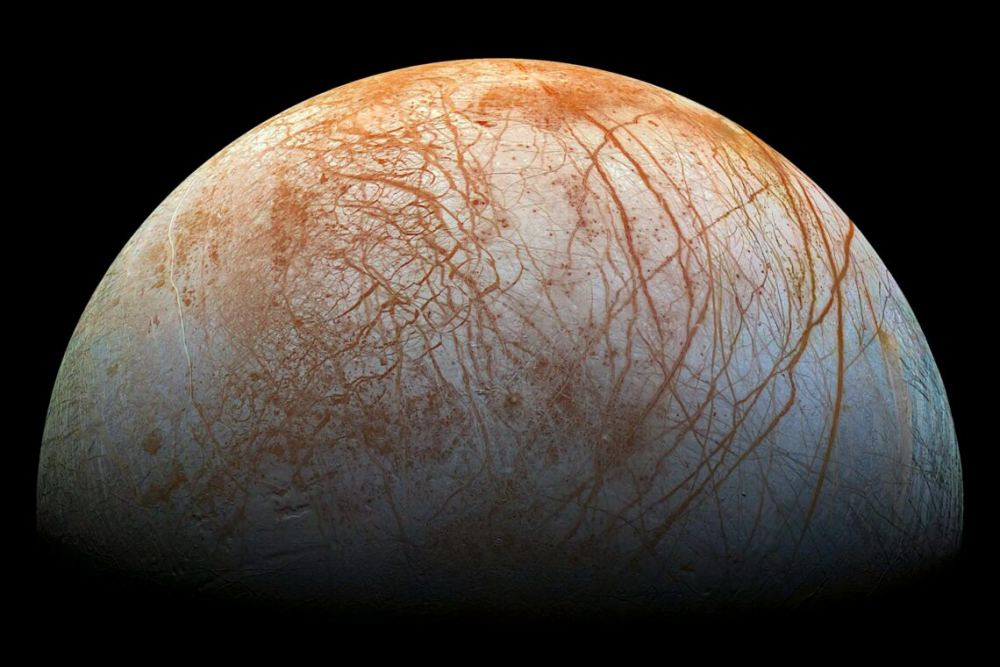
Jupiter's second Galilean moon, Europa. Its smooth surface has fewer craters than other moons, but they help us understand its icy shell. (Credit: NASA/JPL/Galileo spacecraft)
What Can Europa’s Surface Tell Us About the Thickness of Its Ice?
You can tell a lot about a planetary body just by looking at its surface, especially if it has craters. Take Europa, for example. It has a fairly young surface—somewhere between 50 and 100 million years old. That’s practically “new” when you compare it to the age of the Solar System. And, Europa’s icy crust is pretty darned smooth, with only a few craters to change the topography.
Planetary scientists already know that Europa’s icy surface is a thin shell over a large interior ocean of salty water. How thin? To find out, a team of researchers led by Brandon Johnson and Shigeru Wakita at Purdue University studied images of large craters on Europa. They used what they saw, coupled with a variety of physical characteristics, to create computer models of that shell. “Previous estimates showed a very thin ice layer over a thick ocean,” said Wakita. “But our research showed that there needs to be a thick layer—so thick that convection in the ice, which has previously been debated, is likely.”
The thickness of that shell may well influence whether or not life exists at Europa. Its existence is a topic of intense interest since Europa could provide a reasonably habitable ecosystem for life. It has water, warmth, and organic materials for life to eat. That makes the search for life at Europa quite important. So, what do craters have to do with all this?
More About Craters
Impact cratering performs a lot of gardening in the Solar System, according to Johnson. He is the first author on a recently published paper discussing these features on Europa. “Craters are found on almost every solid body we’ve ever seen. They are a major driver of change in planetary bodies,” he said.
Four featured craters among many on the Moon: the triplet of Theophilus, Cyrillus and Catharina and Maurolycus. Many more craters can be seen across the lunar surface. Credit: Virtual Moon Atlas / Christian LeGrande, Patrick Chevalley
Just looking at images of different worlds in the Solar System, we can see some pretty heavily cratered surfaces. The Moon is a good example, as is Mars. And, we see it at many of the smaller bodies, such as the moons of the gas and ice giants. The more craters we see, the older the surface. In some places, multiple overlapping craters indicate a very old surface. In other places, such as at Europa, the craters are fewer and farther between. Something has “paved over” the craters such that any we CAN see were made after the repaving event. In addition, the craters reveal information about the surface as well as the “subsurface” of Europa.
“When an impact crater forms, it is essentially probing the subsurface structure of a planetary body,” said Johnson. “By understanding the sizes and shapes of craters on Europa and reproducing their formation with numerical simulations, we’re able to infer information about how thick its ice shell is.”
What Europa’s Craters Tell Us
This tiny moon is an enigma wrapped in shimmering ice. Its frozen surface hides a rocky inner core covered with a salt-water ocean. Like Earth, it experiences surface plate tectonics, driven by the core region’s heating. Inside, that heating drives currents of warmer water up from the core. That water gets forced to the surface, where it freezes and creates a new layer overlying any other features. This resurfacing happens every 50 to 100 million years.
Incoming impactors carve out new craters in that “freshened-up” surface, which gives scientists some pretty easy-to-study craters. They aren’t terribly deep, however, which tells scientists a lot about the structure of the icy shell. Johnson, Wakita, and their team studied images from the Galileo spacecraft to analyze Europa’s craters. In particular, they focused on two multi-ringed basins imaged on this moon. They show two or more concentric rings around the point of the impact that created them. Such basins are fairly rare and usually indicate some kind of large, energetic impact. On Europa, their appearance and formation give clues to the thickness of the icy shell and their thermal structure, which is a way to understand how the shell conducts heat.
Multi-ringed Crater Basins Tell a Tale
In their study, the Purdue team simulated a multi-ring basin with varying thicknesses of ice. Those thicknesses influence the degree of tidal heating in the shell itself. They also help scientists understand how heat exchange occurs between the bottom of the shell and the underlying ocean. The team found that icy shells thinner than about 15 kilometers don’t show the kinds of multi-ringed basins that exist on Europa. However, a thicker one does. In particular, the best-fit simulation used a 20+ kilometer-thick shell. It consists of two layers: a 6-8 kilometer-thick conductive “lid” that covers up a layer of warm, convecting ice.
One of Galileo’s images of the Tyre multi-ringed basin on Europa. There are at least 5-7 rings around the impact crater center. Courtesy: NASA/JPL/ASU.
In addition to studying the craters, the team also looked at the types of impactors needed to create those multi-ringed basins on Europa. From the structures seen in the Galileo images, they concluded that the impactors would need to be around 1.5 kilometers in radius to create the multi-ringed basins. Smaller ones wouldn’t create the structures they saw, and bigger impactors would result in very different-looking craters and rings.
What About Other Worlds?
Europa isn’t the only world at Jupiter with an icy crust. Both Ganymede and Callisto also show cratering, with multi-ring basins. This tells us that these worlds also have to have thick enough icy crusts where such basins can form. Planetary scientists have suggested their crusts are at least 80 to 105 kilometers thick. In their paper, the Purdue teams suggest that since Europa’s crust is likely to be at least 20 kilometers thick (if not more) it’s also likely that Ganymede and Callisto have much thicker crusts than current predictions suggest.
Callisto has many more craters than Europa and a thicker icy crust. Image credit: NASA/JPL
Finally, although the paper doesn’t specifically address this, the fact that the scientists can deduce impactor size from the characteristics of the resulting craters does provide insight into the sizes of impactors available in Jovian “airspace”. To sustain these kinds of multi-ringed basins, you need a good population of sizable impactors to do the job. Also, for Europa to be so recently “refreshed” really does give a clue to the impact environment in the Jupiter system. While Ganymede and Callisto both have very old surfaces, the existence of “fresh” ice at various cratering sites tells us that they’re still being bombarded in recent times, although they’re not actively resurfacing themselves. These are all additional data points to consider when understanding the habitability of environments, particularly at Europa (and possibly at places such as Enceladus at Saturn).
“Understanding the thickness of the ice is vital to theorizing about possible life on Europa,” Johnson said. “How thick the ice shell is controls what kind of processes are happening within it, and that is really important for understanding the exchange of material between the surface and the ocean. That is what will help us understand how all kinds of processes happen on Europa—and help us understand the possibility of life.”
Meer van UFO'S of UAP'S, ASTRONOMIE, RUIMTEVAART, ARCHEOLOGIE, OUDHEIDKUNDE, SF-SNUFJES EN ANDERE ESOTERISCHE WETENSCHAPPEN - DE ALLERLAATSTE NIEUWTJES


 Mapped: Every UFO spotted in UK since 2020 - see the close encounters where you live