Naar de inhoud

UFO'S of UAP'S, ASTRONOMIE, RUIMTEVAART, ARCHEOLOGIE, OUDHEIDKUNDE, SF-SNUFJES EN ANDERE ESOTERISCHE WETENSCHAPPEN - DE ALLERLAATSTE NIEUWTJES

UFO's of UAP'S in België en de rest van de wereld
akke.beakke.be
Ontdek de Fascinerende Wereld van UFO's en UAP's: Jouw Bron voor Onthullende Informatie! Ben jij ook gefascineerd door het onbekende? Wil je meer weten over UFO's en UAP's, niet alleen in België, maar over de hele wereld? Dan ben je op de juiste plek! België: Het Kloppend Hart van UFO-onderzoek In België is BUFON (Belgisch UFO-Netwerk) dé autoriteit op het gebied van UFO-onderzoek. Voor betrouwbare en objectieve informatie over deze intrigerende fenomenen, bezoek je zeker onze Facebook-pagina en deze blog. Maar dat is nog niet alles! Ontdek ook het Belgisch UFO-meldpunt en Caelestia, twee organisaties die diepgaand onderzoek verrichten, al zijn ze soms kritisch of sceptisch. Nederland: Een Schat aan Informatie Voor onze Nederlandse buren is er de schitterende website www.ufowijzer.nl, beheerd door Paul Harmans. Deze site biedt een schat aan informatie en artikelen die je niet wilt missen! Internationaal: MUFON - De Wereldwijde Autoriteit Neem ook een kijkje bij MUFON (Mutual UFO Network Inc.), een gerenommeerde Amerikaanse UFO-vereniging met afdelingen in de VS en wereldwijd. MUFON is toegewijd aan de wetenschappelijke en analytische studie van het UFO-fenomeen, en hun maandelijkse tijdschrift, The MUFON UFO-Journal, is een must-read voor elke UFO-enthousiasteling. Bezoek hun website op www.mufon.com voor meer informatie. Samenwerking en Toekomstvisie Sinds 1 februari 2020 is Pieter niet alleen ex-president van BUFON, maar ook de voormalige nationale directeur van MUFON in Vlaanderen en Nederland. Dit creëert een sterke samenwerking met de Franse MUFON Reseau MUFON/EUROP, wat ons in staat stelt om nog meer waardevolle inzichten te delen. Let op: Nepprofielen en Nieuwe Groeperingen Pas op voor een nieuwe groepering die zich ook BUFON noemt, maar geen enkele connectie heeft met onze gevestigde organisatie. Hoewel zij de naam geregistreerd hebben, kunnen ze het rijke verleden en de expertise van onze groep niet evenaren. We wensen hen veel succes, maar we blijven de autoriteit in UFO-onderzoek! Blijf Op De Hoogte! Wil jij de laatste nieuwtjes over UFO's, ruimtevaart, archeologie, en meer? Volg ons dan en duik samen met ons in de fascinerende wereld van het onbekende! Sluit je aan bij de gemeenschap van nieuwsgierige geesten die net als jij verlangen naar antwoorden en avonturen in de sterren! Heb je vragen of wil je meer weten? Aarzel dan niet om contact met ons op te nemen! Samen ontrafelen we het mysterie van de lucht en daarbuiten.

Archief

Hi-speed camera caught UFO flying over Spirit Mountain near Las Vegas

Hi-speed camera caught UFO flying over Spirit Mountain near Las Vegas

Paranormal researcher and author Joshua P. Warren has employed cutting-edge technology to unveil a series of mysterious aerial phenomena over Spring Valley in Las Vegas and Spirit Mountain, situated south of the city. Using a high-speed camera capable of capturing 1000 frames per second, Warren has captured startling footage of unidentified flying objects (UFOs) in broad daylight.
ufo,%20uap,%20fastwalker.jpg

High-speed photography offers a unique glimpse into the behavior of fast-moving entities, such as bullets, by slowing down their motion to a visible pace imperceptible to the naked eye. 
On April 20, 2023, at approximately 1:30 pm, Warren recorded his initial encounter. The footage reveals a swift, spherical object streaking across the sky, followed by the sudden ejection of a secondary object and an abrupt 90-degree turn, all within a fraction of a second. Concurrently, a third, cylindrical entity traverses the airspace, adding to the enigma. 
Returning to the field on March 12, 2024, Warren stationed his high-speed camera at Spirit Mountain, located about 80 miles south of Las Vegas. Multiple instances were captured depicting a luminous, pulsating entity darting through the atmosphere above the mountain. 
Highlighting the significance of the captured footage, Warren dismisses conventional explanations such as insects, dust, optical illusions, or conventional aircraft, attributing the observed maneuvers to genuine UAPs.
  

{ https://ufosightingshotspot.blogspot.com/ }

Hoe vind je dit bericht?
Geschreven door peter om 22:39 Stuur door

Citizen Scientists Find Fifteen “Active Asteroids”

Citizen Scientists working on NASA's Active Asteroids Project have discovered 15 active asteroids and one Centaur. But it required 8,000 people poring over 430,000 images to find them. Image Credit: Henry Hsieh

Citizen Scientists Find Fifteen “Active Asteroids”

Nature often defies our simple explanations. Take comets and asteroids, for example. Comets are icy and have tails; asteroids are rocky and don’t have tails. But it might not be quite so simple, according to new research.

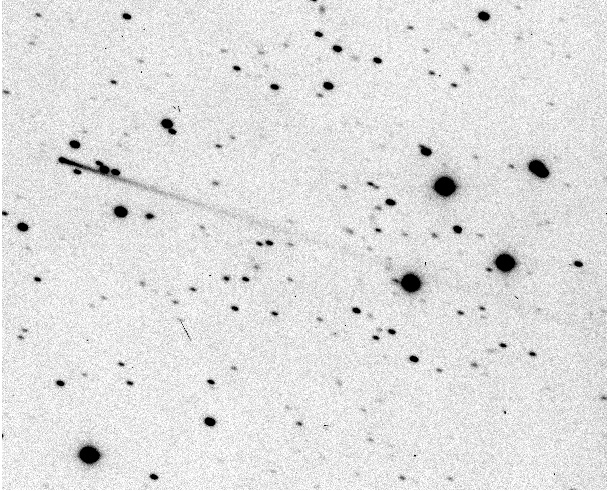
That nice, clean definition took a hit in 1996 when a pair of astronomers discovered that what was thought to be a main-belt comet was actually an asteroid. The object is named 7968 Elst–Pizarro after the two scientists. It displayed a comet-like dust tail at perihelion.

These images from the La Silla Observatory show the active asteroid 7968 Elst–Pizarro. Its tail is clearly visible. Image Credit: By ESO - https://www.eso.org/public/images/eso9637a/, CC BY 4.0, https://commons.wikimedia.org/w/index.php?curid=26500568 These images from the La Silla Observatory show the active asteroid 7968 Elst–Pizarro. Its tail is clearly visible. Image Credit: By ESO – https://www.eso.org/public/images/eso9637a/, CC BY 4.0, https://commons.wikimedia.org/w/index.php?curid=26500568

7968 Elst-Pizarro was classified as a main-belt comet (MBC) because it orbits within the main asteroid belt between Mars and Jupiter. It’s still called an MBC sometimes. However, its icy component that sublimates into a vapour trail likely comes from a small surface crater with volatiles in it rather than from a homogenous ice component. That’s why it’s called an active asteroid.

Active asteroids are unusual and rare objects. To understand them and their place in the Solar System’s history, scientists want to find more of them. That led to the creation of NASA’s Active Asteroids Project.

Now, the Active Asteroids Project has announced the discovery of 15 new active asteroids. These findings are in a new paper published in The Astronomical Journal. It’s titled “The Active Asteroids Citizen Science Program: Overview and First Results,” and the lead author is Colin Chandler from the Dept. of Astronomy & the DiRAC Institute at the University of Washington in Seattle. Among the co-authors are nine volunteer citizen scientists.

“For an amateur astronomer like me, it’s a dream come true,” said volunteer Virgilio Gonano from Udine, Italy. “Congratulations to all the staff and the friends that also check the images!”

“Active objects are rare in large part because they are difficult to identify, so we ask volunteers to assist us in searching for active bodies in our collection of millions of images of known minor planets,” the authors of the paper write. Active asteroids aren’t the only objects they’re trying to find. There are several other types.

Centaurs are small Solar System bodies that orbit between Neptune and Jupiter. Centaurs have crossed the orbits of one or more giant planets, making their orbits unstable. They have traits in common with both comets and asteroids, and about 30 of them have dust-like comas. These are the active ones.

The Active Asteroid Project is also trying to identify active quasi-Hilda asteroids (QHAs). QHAs are beyond the asteroid belt but within Jupiter’s orbit. Astronomers have discovered about 3000 of them, and about 15 of them have tails of gas and dust.

Active asteroids have asteroid-like orbits but have tails or comae like comets do. Image Credit: Mark Garlick/SPL Active asteroids have asteroid-like orbits but have tails or comae like comets do. Image Credit: Mark Garlick/SPL

The Project also hopes to identify Jupiter family comets (JFCs.) JFCs are comets with very short orbital periods of less than 20 years. They’re contained within Jupiter’s orbit but may be captured Kuiper Belt Objects. They likely originated from collisions between objects in the Kuiper Belt and then were captured by Jupiter.

All of these objects have something to tell us about how the Solar System formed. Beyond that, they can help unravel the mystery of Earth’s water. There’s another, more forward-thinking reason for wanting to find these active objects. Their water can be split into hydrogen for rocket fuel and oxygen for respiration in future missions, though that’s so far in the future it’s esoteric.

This image shows one of the active asteroids found by citizen scientists involved with the Active Asteroid project. It's named 2015 VA108, and the green arrow highlights the asteroid and its tail. Image Credit: Colin Orion Chandler (University of Washington) This image shows one of the active asteroids found by citizen scientists involved with the Active Asteroid project. It’s named 2015 VA108, and the green arrow highlights the asteroid and its tail. Image Credit: Colin Orion Chandler (University of Washington)

The commitment of the citizens taking part is admirable. Since the effort launched on August 31st, 2021, about 8300 volunteers have taken part. Collectively, they’ve examined about 430,000 images.

“I have been a member of the Active Asteroids team since its first batch of data,” said volunteer Tiffany Shaw-Diaz from Dayton, Ohio. “And to say that this project has become a significant part of my life is an understatement. I look forward to classifying subjects each day, as long as time or health permits, and I am beyond honoured to work with such esteemed scientists on a regular basis.”

The images in the project all come from the Dark Energy Camera (DECam.) DECam is a high-performance camera with a wide field of view that’s mounted on the Víctor M. Blanco 4-meter Telescope at Cerro Tololo Inter-American Observatory.

The images are filtered by query across multiple databases and image archives before they’re placed in front of the eyes of the citizen scientists. This includes the Minor Planet Center (MPC), the JPL Small-Body Database, the Canadian Astronomy Data Centre, and the National Optical and Infrared Laboratory (NOIRLab) AstroArchive. They also consider the observing telescope’s field-of-view, the objects’ coordinates and semi-major access, and multiple other factors.

The Project then uses scripts to download the desired data from astronomical archives. Then, they generate uniform DECam thumbnail images of each object. This results in millions of images of potential active asteroids or similar objects. There’s no possible way there are enough professional astronomers to handle this much work. So, the images are grouped up into “subject sets” and sent to the citizen scientists who put the effort in and make the project feasible.

Before the volunteers work with any real images, they’re trained on a set of images of objects that display some activity, like a tail or a coma. Then, the participants give them a score from zero (unidentifiable/missing;) to 9 (definitely active, overwhelming activity indicators.) “All training images in Active Asteroids are derived from those images to which we applied a score of ?5; our minimum threshold, for which we consider the activity to be highly likely,” the authors explain.

In each image, a green reticle identifies the object of interest. The citizen scientists are asked a fairly straightforward question: do they see activity (i.e., a tail or coma) coming from the central object?

This is one of the DECam thumbnail images in the project. It shows the active asteroid (62412) 2000 SY178. In the project's analysis system, this object received a score of 0.35, below the threshold of 0.473 needed to classify it as an active object. Image Credit: Chandler et al. 2024/Active Asteroid Project.

This is one of the DECam thumbnail images in the project. It shows the active asteroid (62412) 2000 SY178. In the project’s analysis system, this object received a score of 0.35, below the threshold of 0.473 needed to classify it as an active object. Image Credit: Chandler et al. 2024/Active Asteroid Project.

Over time, most citizen scientists became more productive. But not always.

This figure from the study shows the number of images classified through time by 10 randomly selected participants, numbered from 0 to 9. Most got better over time, though number 7 seemed to buck that trend. Image Credit: Chandler et al. 2024/Active Asteroid Project. This figure from the study shows the number of images classified through time by 10 randomly selected participants, numbered from 0 to 9. Most got better over time, though number 7 seemed to buck that trend. Image Credit: Chandler et al. 2024/Active Asteroid Project.

Each subject set requires a certain amount of preparation by the professional astronomers. That has to be balanced by the work and time it takes a citizen scientist to go through it. After some experimenting, the project settled on sets of about 22,000 images, which took a citizen participant about four to eight weeks to go through.

The project takes place on the Zooniverse platform, home to many other citizen science projects. One of the benefits of that platform is that the citizen participants and the professional astronomers can talk with one another on the “Talk” discussion boards on Zooniverse. “Surprisingly, we have made discoveries that first come to light on the Talk pages, well before the subject set was fully retired,” the authors of the paper write.

This is just the first data release from the project. Finding 15 active asteroids and one Centaur is just the beginning. In fact, the project has produced more than 20 discoveries, resulting in multiple publications. And they’re not done.

They intend to continue working and improving their methods. The Project is also looking ahead to the Vera Rubin Observatory’s Legacy Survey of Space and Time (LSST), which will produce an enormous number of images for evaluation.

If you’re interested in participating, visit the project website.

“The Active Asteroids project is ongoing and can be accessed through the project website,” the authors write. “Participation is easy and intuitive and can take as little as a few minutes to contribute.”

{ https://www.universetoday.com/ }

Hoe vind je dit bericht?
Geschreven door peter om 22:32 Stuur door

One Impact on Mars Produced More than Two Billion Secondary Craters

12663.jpg

BY ANDY TOMASWICK

One Impact on Mars Produced More than Two Billion Secondary Craters

There are plenty of craters on Mars, especially when compared to Earth. That is primarily thanks to the lack of weathering forces and strong plate tectonics that disrupt the formations of such impacts on our home planet. However, not all impact craters on Mars are directly caused by asteroid impacts. Many of them are caused by the ejecta from an asteroid impact falling back to the planet. One recent study showed how impactful this can be – it concludes that a single large impact crater on Mars created over two billion other smaller craters up to almost 2000 km away.

The study, released at the 55th annual Lunar and Planetary Science Conference in Texas, focuses on a crater called Corinto. It’s located in Elysium Planitia, only about 17 degrees north of the Red Planet’s equator. It’s a relatively young crater by Martian standards, with the scientists’ best estimate of its age being around 2.34 million years ago. It’s pretty massive for being that young, though, as the average time between impacts of its size is around 3 million years. As such, the scientists think it might be the most recent crater of its size on Mars.

That’s not why it’s interesting, though. It has an extensive “ray system”. That means that a significant amount of ejecta was cast out from the impact site and landed elsewhere on the planet, creating “rays” from the central impact point that can be seen on a map of the planet’s surface even today.

A video from JHU APL shows the details of how we understand how impact craters are made.
Credit – JHU APl YouTube Channel

Corinto crater is about 14 km in diameter and 1 km deep. Its interior bowl is pock-marked with other, smaller craters that happened its impact. Indications suggest it was full of water ice when it was hit, as there appeared to be some degassing of the superheated ice after the impact. Calculations point to a relatively steep impact angle of about 30-45 degrees from straight on – and the impactor appeared to be coming from the north.

As a result, much of the ejecta impact field lies to the south, especially the southwest, of the crater. While some secondary ejecta craters are sitting to the north of the main one, it appears clear that the impactor’s angle was significant enough to push most ejecta to the south. 

Tracking the path of this ejecta a few million years later isn’t easy. Scientists used data collected by HiRISE and the Context Camera (CTX) on the Mars Reconnaissance Orbiter (MRO) and analyzed characteristics of smaller craters surrounding the main Corinto crater. In particular, they looked for craters that looked like they would be caused by ejecta rather than by an interplanetary impactor.

Graphical Depiction of the Facies of Maritan craters around Corinto.
Credit – Golombek et al.

They grouped the different types of ejecta craters they found into five different “facies,” primarily focused on how far away they were from the main crater. Each facies has its distinct characteristics. For example, Facies 0, the one closest to the main crater, are semi-circular, don’t appear to have any ejecta, or have very distinct rims. On the other hand, Facies 3 craters are long and narrow rather than semi-circular (hinting that something rolled through to create them) and have shown up as very bright in the MRO images. 

Two main findings from the paper will probably turn the most heads. The scientists found that there are close to 2 billion secondary impact craters larger than 10 meters caused by the ejecta from Corinto. And those secondary craters appear up to 1850 km away. That would make it, by far, the most impactful (pun intended) of the recent Martian craters in terms of the sheer number and distance of its ejecta. 

The paper didn’t go into what that might mean for our larger understanding of these processes on the red planet, nor what future work might be completed – the version reviewed for this article was only two pages. But, as with most things in science, a new record for something – in this case, distance and amount of secondary impact craters, attracts additional research, so we’ll have to see what if any, future discoveries can be made regarding this interesting Martian crater.

Learn More:

Lead Image:

  • Corinto Crater
  • Credit – NASA

{ https://www.universetoday.com/ }

Hoe vind je dit bericht?
Geschreven door peter om 22:08 Stuur door

Earth’s Long-Term Habitability Relies on Chemical Cycles. How Can We Better Understand Them?

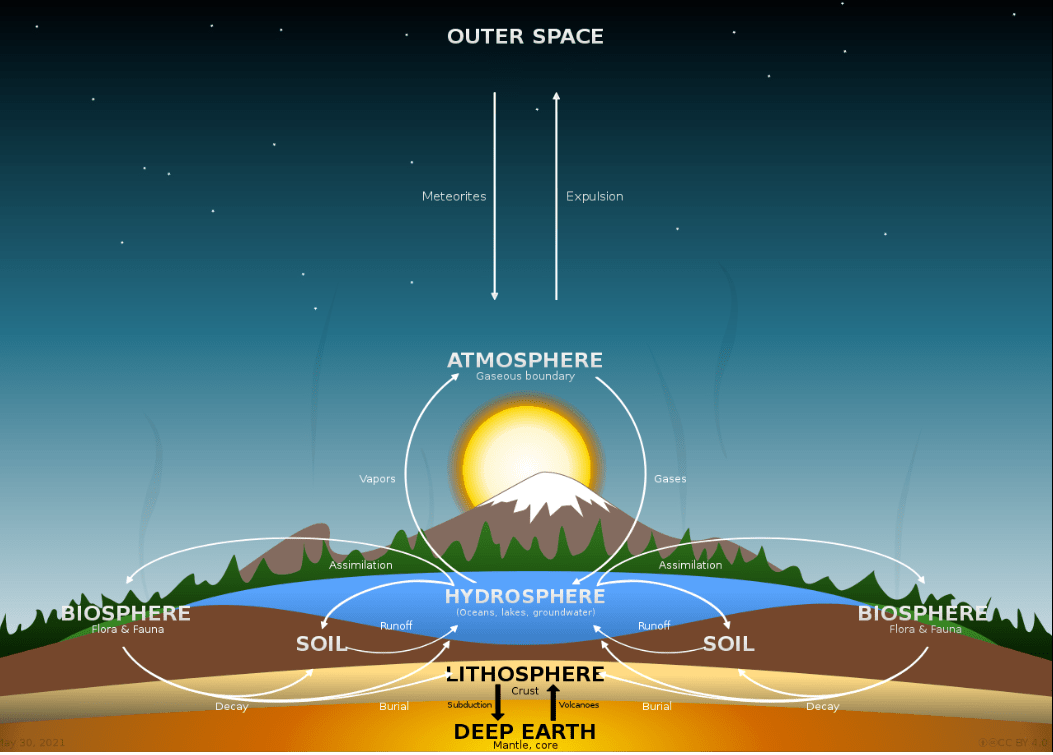
Biogeochemical cycles move matter around Earth between the atmosphere, the oceans, the lithosphere, and living things. Image Credit: By Alexander Davronov - Own work, CC BY-SA 4.0, https://commons.wikimedia.org/w/index.php?curid=106124364

Earth’s Long-Term Habitability Relies on Chemical Cycles. How Can We Better Understand Them?

We, and all other complex life, require stability to evolve. Planetary conditions needed to be benign and long-lived for creatures like us and our multicellular brethren to appear and to persist. On Earth, chemical cycling provides much of the needed stability.

Chemical cycling between the land, atmosphere, lifeforms, and oceans is enormously complex and difficult to study. Typically, researchers try to isolate one cycle and study it. However, new research is examining Earth’s chemical cycling more holistically to try to understand how the planet has stayed in the ‘sweet spot’ for so long.

Earth has supported complex life for hundreds of millions of years, possibly for more than a billion years. This is extremely rare, as far as we can tell. The vast majority of the exoplanets we’ve discovered are not in their stars’ habitable zones. They have very little chance of hosting any life, let alone complex life.

It’s possible that some planets experience a period of stability for much shorter periods of time than Earth. This may describe Mars. It was warm and wet and could’ve hosted simple life, but the planet lost most of its atmosphere and became uninhabitable. Now it’s cold, dry, and dead.

Earth robustly cycles the chemical elements through different systems and has done so for billions of years. Now, about 4.5 billion years after its formation, life is abundant on our precious planet. Biogeochemical cycles like the carbon cycle, the nitrogen cycle, and the methane cycle have allowed the planet to sustain its habitability.

New research published in the Proceedings of the National Academy of Sciences examines these cycles holistically, hoping to better understand the relationships between them. The research is “Balance and imbalance in biogeochemical cycles reflect the operation of closed, exchange, and open sets.” The lead author is Preston Cosslett Kemeny, a University of Chicago TC Chamberlain postdoctoral fellow.

“Overall, this work provides a systematic conceptual framework for understanding balance and imbalance in global biogeochemical cycles.”

From “Balance and imbalance in biogeochemical cycles reflect the operation of closed, exchange, and open sets.”

Earth’s carbon cycle plays a dominant role in the climate. As carbon accumulates in the atmosphere, the planet warms. As carbon is sequestered into the mantle, the planet cools. Even though it’s been stable for a long time, research shows that small imbalances can upset the system.

What Kemeny and his co-researchers wanted to do was get back to the basics. They wanted to identify a framework for all the reactions, both large and small, that comprise Earth’s chemical cycles. What’s different in their work is that they didn’t specify how they all worked together, if they worked together, or how much they affected one another.

“Our approach provides a new way to identify the fundamental building blocks of stability in the chemical components of Earth’s climate—the underlying ways in which the climate can be stabilized over geological time due to the movement of elements across the ocean, atmosphere, and rock reservoirs,” said Kemeny.

Earth's long-lasting habitability created the conditions for complex life like us to appear. That habitability is dependent on the complex interplay of chemistry between the ocean, atmosphere and land. This image, captured from the International Space Station 400km above Earth's surface, shows our planet's thin atmosphere. Image Credit: NASA Earth’s long-lasting habitability created the conditions for complex life like us to appear. That habitability is dependent on the complex interplay of chemistry between the ocean, atmosphere and land. This image, captured from the International Space Station 400km above Earth’s surface, shows our planet’s thin atmosphere. Image Credit: NASA

The researchers describe their effort as ‘agnostic’ and explain that it creates “… a systematic and simplified conceptual framework for understanding the function and evolution of global biogeochemical cycles.” They call it agnostic because it doesn’t specify the relationship between environmental conditions and the strength of biogeochemical processes. “By remaining agnostic to the relationships between environmental conditions and the intensity of biogeochemical processes, we sought to recognize and systematize patterns that underly the stability of major element cycles,” Kemeny explains on his website.

“This is an elegant, simplified way to think about an enormous problem, which organizes a lot of previous research on elemental cycles into packages of chemical reactions that can be balanced and understood,” said University of Chicago Assistant Professor Clara Blättler, senior author of the paper.

The complexity of Earth’s cycles makes them difficult to study. They work on long geological timescales, which puts us at a disadvantage. The planet’s carbon cycle illustrates this.

The movement of carbon plays an important role in regulating the planet’s climate. When carbon dioxide accumulates in the atmosphere, the atmosphere traps more heat, which warms up the oceans. However, carbon also creates a weak acid called carbonic acid that breaks rocks down faster. The carbon eventually finds its way to the ocean floor and becomes sequestered in rock. Carbon can also spend some time as part of living things before being sequestered into rock or fossil fuels. This sequestration of carbon eventually cools the planet but takes millions of years. Carbon is eventually returned to the atmosphere by volcanoes and by the burning of fossil fuels.

The Carbon cycle plays a dominant role in moderating Earth's climate, but other chemical cycles influence it. Image Credit: U.S. DOE, Biological and Environmental Research Information System. The Carbon cycle plays a dominant role in moderating Earth’s climate, but other chemical cycles influence it. Image Credit: U.S. DOE, Biological and Environmental Research Information System.

Trying to understand the carbon cycle is made more difficult by its interaction with other cycles. The Earth’s cycles also aren’t static. They change over time, adding to the complexity. There are also missing pieces from the large puzzle of Earth’s cycles. Researchers are forced to make assumptions to fill in the blanks.

Kemeny devotes much of his time to understanding Earth’s cycles, and he and his colleagues hope that their approach can yield better results. “Models of global element cycles seek to understand how biogeochemical processes and environmental conditions interact to sustain planetary habitability,” Kemeny writes on his website. “However, outcomes from such models often reflect specific interpretations of geochemical archives.”

The researchers think their approach may help overcome the obstacles to understanding Earth’s cycles. They employed a mathematical analysis to develop a framework identifying all of the major and minor cycles that contribute to Earth’s long-term habitability by balancing the carbon cycle.

The result was a new, more holistic way to look at Earth. The climate can be represented by a large set of interconnected chemical equations. These equations must balance over certain time periods to keep the carbon cycle stable and the Earth habitable.

The Sulphur Cycle is just one of Earth's important cycles. It moves sulphur between rocks, water, and living things. Kemeny and his colleagues are trying to understand all of Earth's cycles holistically rather than in isolation. Image Credit: By Bantle - Own work, CC0, https://commons.wikimedia.org/w/index.php?curid=20411832 The Sulphur Cycle is just one of Earth’s important cycles. It moves sulphur between rocks, water, and living things. Kemeny and his colleagues are trying to understand all of Earth’s cycles holistically rather than in isolation. Image Credit: By Bantle – Own work, CC0, https://commons.wikimedia.org/w/index.php?curid=20411832

Kemeny highlights one episode in Earth’s climate history to illustrate the point. The Cenozoic era began about 65.5 million years ago and is the era we live in now. The Cenozoic is a long-term cooling trend in Earth’s history, and the period that preceded it was a greenhouse climate. Kemeny and his colleagues say that their holistic approach can open a window into how the climate changed.

“For example, say that you are considering a hypothesis for why the climate changed in the past – such as the major cooling of the last 65 million years,” Kemeny said. “You can take this framework and use it to say: well, if X process increased or decreased, then it should have also caused Y to happen, or would have needed to be balanced by Z, and that you have to account for those outcomes—so with that prediction we can look for evidence for the joint operation of the whole geochemical system.”

Astrobiology and planetary habitability are key topics in space science. With the help of the JWST and other upcoming observatories and telescopes, scientists are getting a look at the atmospheres of distant exoplanets. But it’s a difficult process, made more difficult by our less-than-complete understanding of our own planet’s habitability. Understanding our own planet can help us better understand exoplanets.

But there’s a certain type of joy in understanding Earth for its own sake, and this new holistic approach should grow our understanding.

“We hope it’s a beautiful way to help understand all the chemistries that are involved in making Earth a safe place for life to evolve,” Blättler said.

“Overall, this work provides a systematic conceptual framework for understanding balance and imbalance in global biogeochemical cycles,” the authors conclude.

{ https://www.universetoday.com/ }

Hoe vind je dit bericht?
Geschreven door peter om 21:53 Stuur door

This New Map of 1.3 Million Quasars Is A Powerful Tool

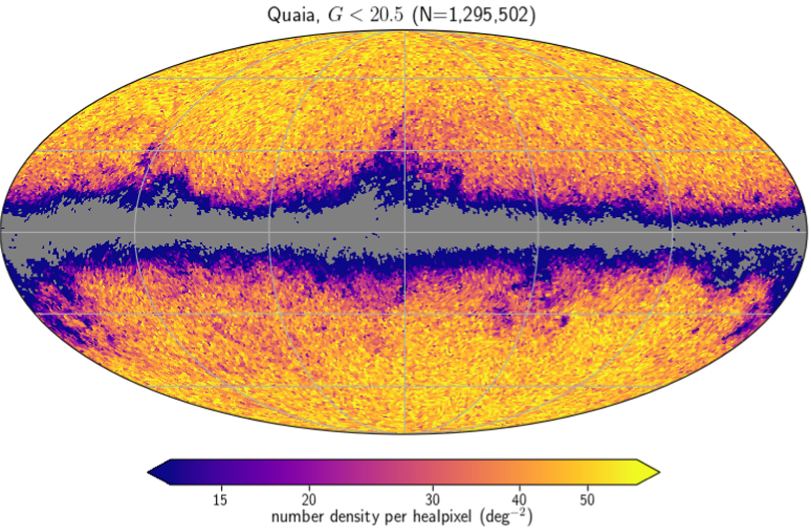
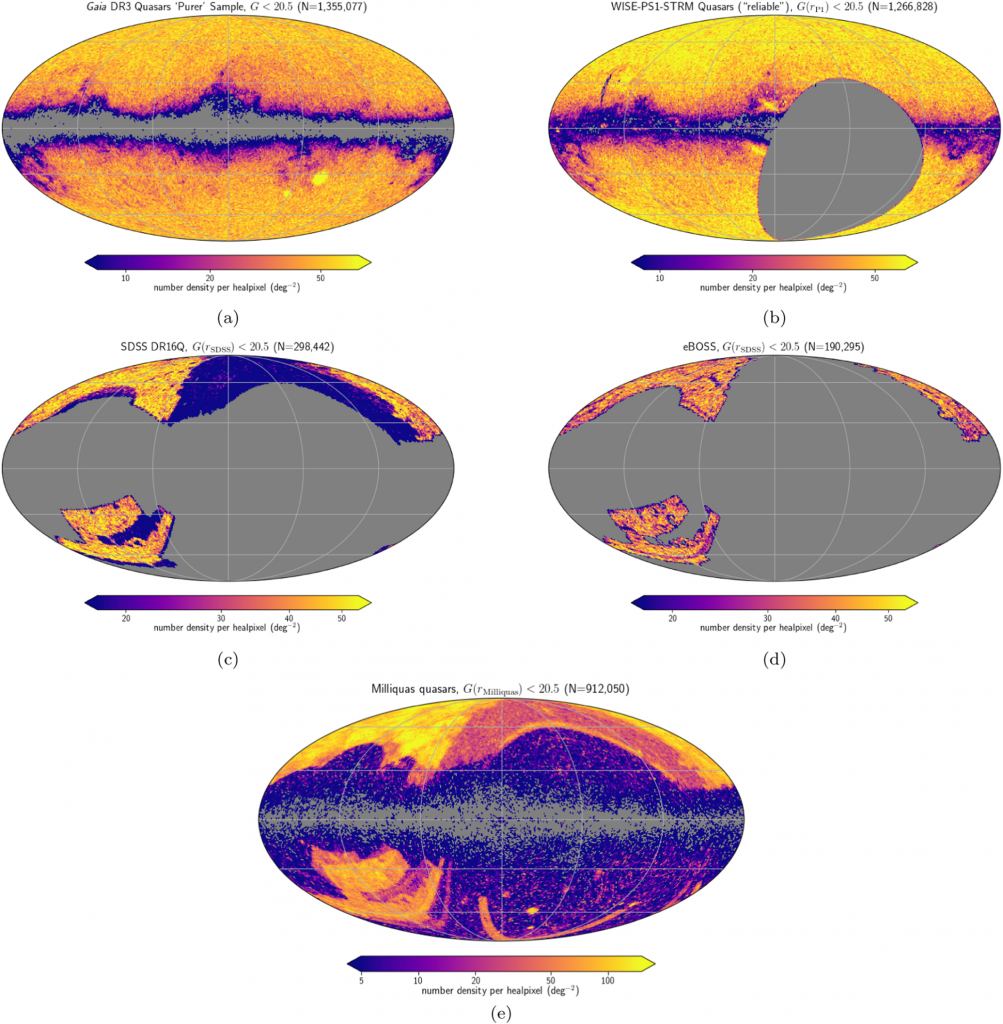
This figure from the research shows the sky distribution of the new Quaia quasar catalogue in Galactic coordinates and is displayed using a Mollweide projection. The grey region across the center is the Milky Way, a blind spot in the Quaia catalogue. Image Credit: K. Storey-Fisher et al. 2024

This New Map of 1.3 Million Quasars Is A Powerful Tool

Quasars are the brightest objects in the Universe. The most powerful ones are thousands of times more luminous than entire galaxies. They’re the visible part of a supermassive black hole (SMBH) at the center of a galaxy. The intense light comes from gas drawn toward the black hole, emitting light across several wavelengths as it heats up.

But quasars are more than just bright ancient objects. They have something important to show us about the dark matter.

Large galaxies have supermassive black holes at their centers. Even those only casually familiar with space know that black holes can suck everything in, even light. But as black holes draw nearby gas towards themselves, the gas doesn’t all go into the hole, past the event horizon and into oblivion. Instead, much of the gas forms a rotating accretion disk around the black hole.

SMBHs aren’t always actively drawing material to them, an act known as ‘feeding.’ But when an SMBH is actively feeding, it’s called an active galactic nucleus (AGN.) When the material in the disk rotates, it heats up. As it heats, it emits different wavelengths of electromagnetic radiation. It can also emit jets.

When astronomers first began to detect this light, they only knew they were seeing objects that emitted radio waves. The name quasar means quasi-stellar radio source. But as time went on astronomers learned more, and the term active galactic nucleus was adopted. The term quasar is still used, but they’re now a sub-class of AGN that are the most luminous AGN.

Quasars inhabit galaxies that are surrounded by enormous haloes of dark matter. Astronomers think there’s a link between the dark matter haloes (DMH) and the quasars. The DMH may direct more matter toward the center of the galaxy, feeding the SMBH and igniting a quasar, and even aiding the formation of more massive galaxies.

Artist rendering of the dark matter halo surrounding our galaxy. For quasars, the dark matter halos are much more massive. Credit: ESO/L. Calçada Artist rendering of the dark matter halo surrounding our galaxy. Credit: ESO/L. Calçada

A team of researchers has created a new catalogue of quasars that will be a powerful tool for probing quasars, DMHs, and SMBHs. Their results are in a new paper in The Astrophysical Journal titled “Quaia, the Gaia-unWISE Quasar Catalog: An All-sky Spectroscopic Quasar Sample.” The lead author is Kate Storey-Fisher, a postdoctoral researcher at the Donostia International Physics Center in Spain.

“This quasar catalogue is different from all previous catalogues in that it gives us a three-dimensional map of the largest-ever volume of the universe,” said map co-creator David Hogg, a senior research scientist at the Flatiron Institute’s Center for Computational Astrophysics in New York City and a professor of physics and data science at New York University. “It isn’t the catalogue with the most quasars, and it isn’t the catalogue with the best-quality measurements of quasars, but it is the catalogue with the largest total volume of the universe mapped.”

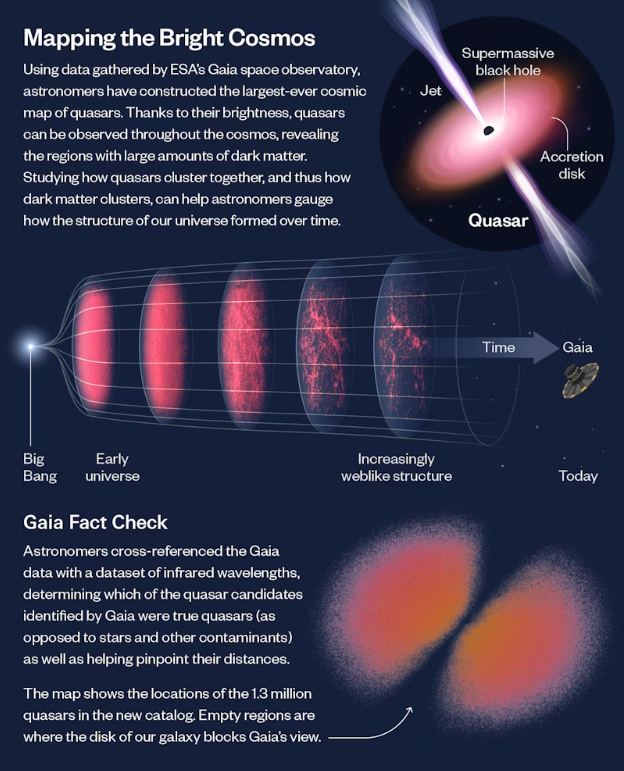
This infographic helps explain Quaia, the new catalogue of 1.3 million quasars. 

This infographic helps explain Quaia, the new catalogue of 1.3 million quasars. Image Credit: ESA/Gaia/DPAC; Lucy Reading-Ikkanda/Simons Foundation; K. Storey-Fisher et al. 2024 Image Credit: ESA/Gaia/DPAC; Lucy Reading-Ikkanda/Simons Foundation; K. Storey-Fisher et al. 2024

The fact that the new catalogue captures the largest total volume of the Universe mapped and all the quasars in that space is key to understanding its purpose. It’s not meant as a survey that captures the largest number of quasars. The catalogue is meant to be a tool astrophysicists can use to understand the relationships between quasars, dark matter, black holes, and galaxies.

They call their catalogue Quaia because the data comes from the ESA’s Gaia spacecraft. Gaia’s mission is to map about one billion objects in the Milky Way, mostly stars. And it’s going about its mission with extreme accuracy. But among the multitudes of stars Gaia has mapped is a large number of quasars well beyond the Milky Way. That generated the name “Quaia.”

“We were able to make measurements of how matter clusters together in the early universe that are as precise as some of those from major international survey projects — which is quite remarkable given that we got our data as a ‘bonus’ from the Milky Way–focused Gaia project,” Storey-Fisher says.

Dark matter tends to clump in haloes around galaxies, and studying the distribution of quasars can help explain the distribution of dark matter. In the large scale of the Universe, dark matter is organized as a web, and the catalogue of quasars helps map that web.

The Cosmic Microwave Background (CMB), a strong piece of evidence for the Big Bang, is also part of this. As the light from the CMB travels toward us through space, the dark matter web’s massive gravitational power bends the light. Scientists can compare the CMB light we receive with the map of quasars and compare the two. The comparisons will them about the relationship between dark matter and quasars and how matter clumps together in the Universe.

Since quasars trace the cosmic web, their distribution gives information about the web that other sources can’t. For example, it can trace the distribution of matter at higher redshifts than galaxies can. And since it’s space-based, it avoids some of the data contamination that other quasar surveys suffer from, such as the Sloan Digital Sky Survey (SDSS.)

This is not the first quasar map/catalogue to be created. There are several others, including one from the Sloan Digital Sky Survey.

This figure shows five different quasar maps created by scientists using different data and methodologies. The creators of Quaia say that its redshifts are more accurate than the others, along with other properties. Image Credit: K. Storey-Fisher et al. 2024 This figure shows five different quasar maps created by scientists using different data and methodologies. The creators of Quaia say that its redshifts are more accurate than the others, along with other properties. Image Credit: K. Storey-Fisher et al. 2024

As the animation below shows, Quaia is more complete than the SDSS’s DR16Q, the SDSS’s quasar catalogue that accompanied its data release 16.

via GIPHY

Though the Gaia mission itself doesn’t generate many of its own headlines, it’s at the foundation of modern space science. Its data is behind lots of published research.

“This quasar catalogue is a great example of how productive astronomical projects are,” says Hogg. “Gaia was designed to measure stars in our own galaxy, but it also found millions of quasars at the same time, which give us a map of the entire universe.”

Now, the new Quaia catalogue is playing a similar role. The data it contains is already being used by other researchers.

“It has been very exciting to see this catalogue spurring so much new science,” Storey-Fisher says. “Researchers around the world are using the quasar map to measure everything from the initial density fluctuations that seeded the cosmic web to the distribution of cosmic voids to the motion of our solar system through the universe.”

{ https://www.universetoday.com/ }

Hoe vind je dit bericht?
Geschreven door peter om 21:38 Stuur door

Unlocking the Unknown: How Ret. Admiral Gallaudet and Insiders Aim to Reveal UAP Secrets

Unlocking the Unknown: How Ret. Admiral Gallaudet and Insiders Aim to Reveal UAP Secrets

Retired US Navy Rear Admiral Tim Gallaudet

In the intriguing world of unidentified aerial phenomena (UAP), credible voices play a pivotal role in shaping public understanding and policy direction. Among these voices, Retired US Navy Rear Admiral Tim Gallaudet stands out, not only for his distinguished service but for his candid remarks on the ongoing efforts to disclose information on UAPs. Gallaudet’s insights offer a rare glimpse into the complex, often shadowy process of how military and government sectors manage such enigmatic occurrences.

Gallaudet’s conviction stems from personal connections with individuals deeply embedded in “legacy programs” – government initiatives tasked with the retrieval and analysis of UAPs. These programs, which have long operated under wraps, are responsible for investigating crash sites and analyzing data related to UAPs. Gallaudet’s assertion underscores a significant point: the existence of a dedicated, albeit discreet, effort within the government to understand and potentially harness the technologies behind these phenomena.

The retired Rear Admiral’s comments were highlighted in an interview with Kristian Harloff on “The Big Thing” show, where he shed light on the collective endeavor of former intelligence officers, Department of Defense personnel, and government insiders. This coalition, according to Gallaudet, is not a loose assembly of interested parties but a coordinated group working “behind the scenes” to facilitate a controlled disclosure of UAP information.

This strategy of “controlled disclosure” aligns with legislative movements, notably the Schumer-Rounds Amendment (UAP Disclosure Act), which seeks to formalize the process of releasing information about UAPs to the public. The amendment aims to balance the public’s right to know with national security considerations, ensuring that disclosures do not compromise sensitive operations or technologies.

Gallaudet’s revelations are significant for several reasons. First, they confirm the existence of government programs focused on UAPs, lending credence to long-standing rumors and speculations. Second, his comments reveal an active push within the establishment for transparency, indicating a shift towards acknowledging the public’s interest and concerns regarding UAPs. Finally, Gallaudet’s insights hint at the complexity of managing UAP-related information, reflecting the challenges faced by those at the helm of these efforts.

FULL INTERVIEW: 

As discussions about UAPs move from the fringes to the mainstream, the contributions of individuals like Ret. Rear Admiral Tim Gallaudet are invaluable. They not only provide a bridge between the public and the obscure world of government UAP programs but also underscore the importance of handling such profound matters with care, responsibility, and an eye towards the future.

The narrative surrounding UAPs is far from complete, and as efforts for disclosure progress, the insights of insiders like Gallaudet will continue to guide public understanding and policy development. The journey towards transparency is complex, fraught with challenges, but undeniably necessary for advancing our collective knowledge and preparedness for whatever truths lie behind the UAP phenomenon.

{ https://www.latest-ufo-sightings.net/ }

Hoe vind je dit bericht?
Geschreven door peter om 21:19 Stuur door

Aerospace Billionaire Saw Interdimensional Forces: Says UFOs & Consciousness Are Linked

Robert Bigelow UFO skinwalker ranch

Aerospace Billionaire Saw Interdimensional Forces: Says UFOs & Consciousness Are Linked

The most common and yet interesting question that many people ask is: Are we alone in this universe? The answer has taken a great turn from “Maybe yes” to “Maybe no” in the past few years. There is a long list of credible personalities who never denied the presence of non-human intelligent life among us. Moreover, a few of them are certain that aliens are on Earth. American billionaire Robert Bigelow said something shocking about aliens in November 2017.

According to Robert Bigelow, famous in the aerospace industry for the manufacture of inflatable modules such as those tested out at the International Space Station, there are extraterrestrial beings living among humans. He said that he is “absolutely convinced” aliens live among humans on Earth. During the interview with CBS’ 60 Minutes, reporter Lara Logan asked Bigelow if he believes in aliens. He replied: “I’m absolutely convinced. That’s all there is to it.” He further said: “There has been and is an existing presence, an ET presence.”

He continued: “I spent millions and millions and millions – I probably spent more as an individual than anybody else in the United States has ever spent on this subject.” “You don’t have to go anywhere” to find aliens and they are here right in front of people. Bigelow had his own close encounters but declined to go into detail.

When award-winning journalist George Knapp asked his comment on this interview, he said: “There are different ways to go at this. So one is from a hardware standpoint. The other one is from the presence standpoint, ET presence. And, you know, a lot of people say, well, whether they’re, you know, that they can be among the population, whether they’re hybrids, or there’s some other kind of, really look alike, you know, kind of thing. But so, so you can look at it in different kinds of ways. And, and so, I know of a really good high quality researcher who has fantastic academic credentials and background. And he would be predisposed to the latter, saying that, yeah, it could be among us, you know, but he’s probably on the more extreme, he’s definitely on the more extreme. Others would say, well, we’re safe in saying that there’s hardware, you know, so that’s among us, and hardware kind of context.” (Source)

Skinwalker Ranch, a property located in northeastern Utah has been the subject of alleged paranormal activity, including UFO sightings and other strange occurrences. The ranch gained notoriety in the 1990s when it was purchased by Mr. Bigelow, who funded a number of studies of the phenomena reported at the ranch.

However, the specifics of what has been reported at the ranch and the credibility of those reports have been the subject of much debate and skepticism. Some people believe that the ranch is a hotspot for extraterrestrial activity, while others believe that the reports of strange occurrences at the ranch are the result of hoaxes or misidentifications of natural phenomena.

UFO skinwalker ranch

Bryant “Dragon” Arnold (Chief Security Officer on Skinwalker Ranch), Casey Smith, Erik Bard and Kaleb Bench, from left, check the radiation in a sinkhole pit on Skinwalker Ranch, in a moment from History’s series “The Secret of Skinwalker Ranch.” Image via The Salt Lake Tribune

Following his interview with Mr. Bigelow, Knapp then asked if the entities at Skinwalker Ranch would be investigated through the Bigelow Institute for Consciousness Studies (which he founded in 2020 after his wife passed away). Besides, he wondered that if they are among us, can they also be considered alien? Bigelow said: “Well, if you if you follow the literature and pay attention to a lot of other kinds of sources, they absolutely are.”

Further, Mr. Bigelow shared his personal experiences and losses that prompted his interest in life after death, as well as UFOs. He talked about possible links between consciousness research and UFOs. He also talked about the risks of trying to establish communications with the unknown.

“That’s been mainly what I’ve been doing except for the skinwalker ranch thing for 20 years as the space world has been huge in my life to pursue the legitimate parochial kind of you know using fire engines rockets to get you there. We didn’t expect anything like this to happen and so there this is different. This is the holy grail and is different than the second holy grail. If the second one is ‘Beings’ (E.T.), then the first one: Is there any part of your consciousness that survives your bodily death? That’s a big deal. That’s a huge story. That’s gigantic.”

“Be a little careful about what you wish for. So on the face of it, communication sounds great and that by the way has been tried forever ever since the oracle of Delphi. I mean you can go back thousands of years and that’s been attempted. So It’s not now you know the last 100 years through electronics and using some kind of electrical apparatus to try to have some kind of communications. And you know communication can be at all different kinds of levels. There might be communication that just causes you an awareness.”

Then Knapp asked him what triggered his curiosity about UFOs, possibly it was after Bob Lazar’s story came out. Mr. Bigelow replied that he was already into UFO research. He was looking at UFO stories worldwide to understand what they actually were.

Read also:

In 1992, he started the Bigelow Foundation with Bob Lazar, who worked on reverse-engineering recovered extraterrestrial craft at Area-51. Mr. Bigelow also backed Dr. John E. Mack, a professor of psychiatry at Harvard who wrote two popular books about his work with people who told him they had been abducted by aliens, and Budd Hopkins, an artist who became an abduction investigator and also wrote popular books.

Mr. Bigelow’s investigative team, headed by Colm Kelleher, the institute’s scientific administrator and biochemist, documented their own paranormal events, according to a 2005 book “Hunt for the Skinwalker,” by Dr. Kelleher and Mr. Knapp.

Mr. Bigelow said he saw “interdimensional” forces at play through portals at certain paranormal hot spots like Skinwalker. But he also said he had frequently visited the ranch without experiencing the kind of chilling events others reported, as if some intelligence were selecting the people to act upon. “I slept like a log every single night,” he said. And no human was physically harmed, but he said he and other visitors often carried strange things home, like a sulfurous stink in a certain part of his house. His wife felt the presence of a faceless creature pressing down on her side of bed. (Source)

Bigelow amassed his fortune through the hotel chain Budget Suites of America and used this money to fund his UFO study. In an interview with The Associated Press, he said that UFOs are “under our noses” and wondered why news organizations had not extensively covered UFO sightings.

In 2008, Mr. Bigelow secretly created BAASS (Bigelow Aerospace Advanced Space Studies) to study the UFO mystery and related phenomena. The public did not know that he had signed a contract with the Defense Intelligence Agency to do an investigation under the AAWSAP program.

His political influence has been strong when it comes to UFO study. He once convinced his friend and then-Democratic U.S. Sen. Harry Reid to allocate $22 million to the Advanced Aerospace Threat Identification Program, which investigated UFO reports from 2007 to 2012. The majority of the funds were sent to Bigelow’s company to investigate, and the allocation was not made public until a 2017 New York Times investigation. The Pentagon stated that the program was terminated in 2012, although Reid later stated that he had no remorse about the expenditure.

Later, he and his team hired dozens of investigators, scientists, and support staff to work on putting together a huge database of original investigations and UFO files from other countries. The now-famous 2004 Tic Tac encounter off the coast of Southern California was one of the cases that BAASS looked into.

{ https://www.howandwhys.com/ }

Hoe vind je dit bericht?
Geschreven door peter om 01:29 Stuur door

Bad news for life on Mars? Red Planet's wet epoch may have been shorter than we thought

Bad news for life on Mars? Red Planet's wet epoch may have been shorter than we thought

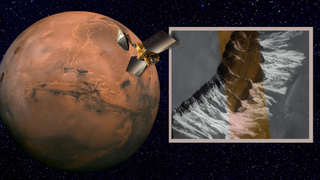
At left, an illustration of a spacecraft in orbit around Mars. At right, a spacecraft photo of icy gullies on Mars.

Main image: Illustration of NASA's Mars Reconnaissance Orbiter investigating Mars. Inset: a satellite image of Martian gullies with carbon dioxide ice visible at their edges. 
(Image credit: Robert Lea/ NASA/ HiRISE (High Resolution Imaging Experiment), a camera on board the Mars Reconnaissance Orbiter (photo no.: ESP_039114_1115))

Mars may be dry and barren today, but multiple lines of evidence show that water flowed across the Red Planet billions of years ago. 

Now, new research has suggested that this water may have existed at the surface of Mars for less time than previously thought. That's because gullies observed on Mars by spacecraft like NASA's Mars Reconnaissance Orbiter (MRO), which had previously been thought to have been carved out by the flow of water, could have instead been created by explosively evaporating carbon dioxide ice. 

Because liquid water is considered a vital ingredient needed for the emergence and sustenance of living organisms, the results may be bad news for the hunt for ancient microscopic life on Mars.

"This influences our ideas about water on Mars in general, and therefore our search for life on the planet," team leader and Utrecht University planetary researcher Lonneke Roelofs said in a statement. "The results of my research suggest that the chance of life having existed on Mars is smaller than previously thought."

Related: 

December 27, 2023

Less time with water means lower odds of life on Mars

Roelofs explained that the atmosphere of Mars is composed of 95% carbon dioxide. During the winter on Mars, temperatures fall to below minus 184 degrees Fahrenheit (minus 120 degrees Celsius), cold enough to freeze carbon dioxide in the Martian atmosphere.  

As it freezes, carbon dioxide gas can change directly to carbon dioxide ice, skipping an intermediate liquid phase altogether. A similar process is seen on Earth when water vapor forms ice crystals that blanket the ground.

When warmer temperatures arrive with the Martian spring, the carbon dioxide ice can go back to a gaseous form, straight from solid to gas again, skipping a liquid phase, a process called "sublimation" that is particularly violent on the Red Planet.

"The process is extremely explosive due to Mars’ low air pressure," Roelofs said. "The created gas pressure pushes sediment grains apart, causing the material to flow, similar to debris flowing in mountainous areas on Earth. These flows can reshape the Martian landscape — even in the absence of water."

Mars gullies with carbon-dioxide ice on their edges, as seen by the HiRISE camera on board NASA's Mars Reconnaissance Orbiter.  (Image credit: HiRISE (High Resolution Imaging Experiment), a camera on board the Mars Reconnaissance Orbiter (photo no.: ESP_039114_1115))

Scientists had previously suggested that geological structures on Mars could have been heavily influenced by the sublimation of carbon dioxide ice, but those theories were based on satellite data or computer modeling. 

Roelofs and colleagues, however, simulated Mars conditions in the lab using their "Mars Chamber" and then directly observed the sublimation of carbon dioxide ice under these conditions. 

"Using this specialized lab equipment, we could directly study this process with our own eyes," he said. "We even observed that debris flows driven by carbon dioxide ice under Martian conditions flow just as efficiently as the debris flows driven by water on Earth."

So flowing water may not have been involved in the creation of some Martian gullies and channels.

"My research now shows that, in addition to debris flows powered by water, the sublimation of frozen carbon dioxide can also serve as a driving force behind the formation of these Martian gully landscapes," Roelofs said. "That pushes the presence of water on Mars further into the past, making the chance of life on Mars smaller."

The research was published last week in the journal Communications Earth & Environment.

{ https://www.space.com/ }

Hoe vind je dit bericht?
Geschreven door peter om 23:27 Stuur door

Forget UFOs, alien hunters say we should be focusing on Unidentified Submerged Objects (USOs)

Forget UFOs, alien hunters say we should be focusing on Unidentified Submerged Objects (USOs)

From sightings by U.S. submarines to mysterious humanoids in the depths of Russian lakes, there is an even more mysterious cousin to the UFO - the USO, or Unidentified Submerged Object.

There are multiple reports of USOs from around the world, often from respected military and academic professionals - with some claiming that underwater ‘fast movers’ are a common part of life on board submarines.

Speaking to DailyMail.com, Nigel Watson, author of Captured by Aliens? A History and Analysis of American Abduction Claims, said: ‘We live on an ocean planet, so it is not surprising that UFOs are seen over or in the vicinity of the great expanses of water that surround us.

'Concentrations of USO sightings indicate bases in the North Sea, and off the coasts of California and Puerto Rico. 

'USOs are as intriguing as UAPs but they are even more difficult to substantiate - and often get mixed with dreams about Atlantis and aliens living in the hollow Earth.

'Personally, to me, they are a myth, like mermaids or the Loch Ness Monster.'

Pilot sights ‘dark mass’ in the water

Retired Navy commander David Fravor

Retired Navy commander David Fravor

Retired U.S. Navy Commander David Fravor, who famously spotted the ‘Tic-Tac’ UFO in 2004, described how a fellow pilot had revealed to him an encounter with a USO.

The pilot said he had seen a ‘dark mass’, which he described as ‘big’ and ‘kinda circular’, and was not a submarine.

Fravor told the Joe Rogan podcast that the helicopter had dropped a swimmer in the water to pick up munitions.

He said: 'The first time they were out and they were going to pick up a munition, he’s sitting in the front—in the CH-53 you can see down by your feet—and as he’s looking down, they’re 50 feet above the water, he sees this kind of dark mass coming up from the depths.”

'He’s looking at this thing going, "What the hell is that?" And then it just goes back down underwater. Once they pull the kid and the munition out of the water, this object descends back into the depths.'

The pilot who was retrieving spent practice munitions out of the sea in a U.S. Navy MH-53E Sea Dragon helicopter said that a practice torpedo he was sent to recover was ‘sucked down’ into the sea by another object.

The torpedo never resurfaced.

The encounter occurred in the sea near Naval Station Roosevelt Roads, on Puerto Rico, Fravor said.

The UFOs of Guantanamo Bay

Did Marines see USOs in the late Sixties?

Did Marines see USOs in the late Sixties? 

In the late Sixties, ‘heavy UFO traffic’ was seen at the Guantanamo Bay base.

An ex-Marine said: ‘'All of us Marines were amazed at the amount of UFO activity over and around this base,' the witness said.

'Virtually every night UFOs were flying overhead with altitudes of less than 300 feet.’

'Most of these UFOs were approximately 50 to 100 feet across, but to the naked eye came off as a dull, hazy hull with a small red light trailing behind it,'

The marine - who wished to remain anonymous in an interview with the paranormal sighting website MUFON - said that he was unsure of the exact dates

The Marine claims he was instructed not to discuss the sightings, and said he saw one UFO which looked like a 'big beautiful cloud with a blue and white pulsating light'.

Underwater craft buzzes U.S.S. Hampton submarine

The Los Angeles-class fast attack submarine USS Hampton

The Los Angeles-class fast attack submarine USS Hampton

A craft moving through the water faster than the speed of sound ‘whizzed by’ the submarine U.S.S. Hampton, a professor has claimed.

Professor Bob McGwier of Virginia Tech and the Institute for Defence Analyses, said the craft’s onboard sonar detected a USO moving through the water faster than the speed of sound.

McGwier was on the submarine doing classified work, and says that the crew opted not to investigate so as to focus on their mission, but did not tell him that he could not talk about the strange encounter.

In an interview with the YouTube Channel UAP Encounters, he said: 'We were underway, and, all of a sudden, I heard a sound. It is really strange and clear that something is whizzing by us.

'When I left there with the knowledge in my head, not having been told to be quiet, not having been told it was classified... It is mine to tell whoever I want. They blew it,'

The encounter with the fast-attack submarine lasted just a few seconds, McGwier says.

The underwater ‘alien base’ off Malibu

Alien-hunters spotted what many described as an ‘alien base’ 2,000 feet beneath the waves off Malibu in 2014.

When Google Earth revealed what appeared to be a ‘structure’ beneath the waves, conspiracy fans went wild.

UFO author Preston Dennett said: 'I have collected probably 50 or 100 reports of people who have seen UFOs going in and out of the water there.

‘My problem is that the Google images are coming out different, depending on what viewpoint you're looking at this thing from. Some show a tunnel. Some don't.

"I'm very intrigued by the possibility. 'm convinced there's something down there."

Geologists however have dismissed the idea that the structure is an alien base, describing the structure as ‘perfectly ordinary’.

The USOs of Lake Baikal

Lake Baikal has seen multiple bizarre sightings over the years

Lake Baikal has seen multiple bizarre sightings over the years

Lake Baikal in Siberia has been the site of multiple sightings of USOs and UFOs, beginning in the Soviet era.

Russian former Navy officer turned UFO researcher Vladimir Azhazha said, "Fifty percent of UFO encounters are connected with oceans. Fifteen more - with lakes. So, UFOs tend to stick to the water,.”

Azhazha has claimed that humanoid beings in strange shiny suits were seen in the water by military divers in 1982.

In more recent years, photographers have captured strange lights and mysterious craft over the lake.

The chairman of the Union of Photographers of Buryatia, Sergey Konechnykh, said in 2009, When I saw it, it was flying low. Until it disappeared over the horizon, I kept looking at it. I call it a fireball, and what it really was - I cannot know.'

{ https://www.dailymail.co.uk/ }

Hoe vind je dit bericht?
Geschreven door peter om 22:45 Stuur door

EXCLUSIVE / Veteran paratrooper reveals British special forces recovered a downed 'non-human' craft in northern England in late 1980s - supporting recent US whistleblowers' claims of a secret UFO crash retrieval program

EXCLUSIVE - Veteran paratrooper reveals British special forces recovered a downed 'non-human' craft in northern England in late 1980s - supporting recent US whistleblowers' claims of a secret UFO crash retrieval program

  • British paratrooper veteran Franc Milburn claims a former member of the British special forces came clean to him about the top secret operation in the late 1980s
  • 'He just said it was obvious it was non-human, and it was obvious that there were occupants who had fled the scene on foot,' he told DailyMail.com 
  • Milburn said he decided to come forward with the story to support recent US whistleblowers' claims of a secret UFO crash retrieval program

British special forces recovered a downed 'non-human' craft in northern England in the late 1980s, a former UK paratrooper and military intelligence officer claims.

Franc Milburn, a veteran of the British Army's elite Parachute Regiment, tells DailyMail.com he has spoken with a member of the MI6-run unit that conducted the alleged operation.

Milburn said he also spoke to UK Royal Air Force crew who chased and fired on a pair of 'disc-shaped' UFOs that traveled at hypersonic speeds outstripping their fighter jets.

Milburn refused to reveal the identity of his former elite comrade, citing security and his desire to remain anonymous. DailyMail.com will refer to him using the alias 'John.'

But in an exclusive interview with DailyMail.com, Milburn divulged eye-popping details of the story told to him by his ex-Special Forces friend after both had left the Army – saying that he wanted to support recent US whistleblowers' claims of a secret UFO crash retrieval program.

British veteran paratrooper Franc Milburn (pictured in Iraq in 1997) claims a former member of the British special forces came clean to him about a top secret operation involving a downed 'non-human' craftFranc Milburn told DailyMail.com with the story to support recent US whistleblowers' claims of a secret UFO crash retrieval program

British veteran paratrooper Franc Milburn (pictured left in Iraq in 1997) claims a former member of the British special forces came clean to him about a top secret operation involving a downed 'non-human' craft in the late 1980s

A now declassified 2000 UK Defence Intelligence Staff report obtained by DailyMail.com states that the existence of 'Unexplained Aerial Phenomena' (UAP) is 'indisputable' and included a scatter plot (pictured) of UAP reports across the UK between 1987 to 1991

A now declassified 2000 UK Defence Intelligence Staff report obtained by DailyMail.com states that the existence of 'Unexplained Aerial Phenomena' (UAP) is 'indisputable' and included a scatter plot (pictured) of UAP reports across the UK between 1987 to 1991

Milburn said that in the 1980s John worked for a reported secret unit now known as the 'E Squadron', which specialized in covert, clandestine, and paramilitary operations.

E Squadron, previously called 'The Increment', recruited the most experienced and reliable operators from the UK's Special Forces units: the Special Air Service (SAS), Special Boat Service (SBS) and Special Reconnaissance Regiment (SRR).

The US equivalent to E Squadron is the CIA's Special Operations Group and Joint Special Operations Command, staffed from 'Tier-1' units including Delta Force and SEAL Team 6.

Milburn said John served in the 1982 Falklands War and on numerous high-risk missions around the world, but one of the most disturbing was in his home country in the late 1980s.

'He told me they were deployed in a troop-sized unit, maybe 20-30 Special Forces operators,' Milburn said. 

'They'd been told by the RAF [Royal Air Force] that a craft which wasn't Russian, British, or American had been downed.

'He said they were tasked to secure and retrieve the craft in the north of England. They were flown in by helicopter. They established a cordon, a perimeter, and they approached the craft.

'He didn't describe the craft, he just said it was obvious it was non-human, and it was obvious that there were occupants who had fled the scene on foot – or whatever you call it.

'He said then it became a task of tracking down these beings to try to bring them into custody.

'Part of the unit was left protecting the craft. They would have left maybe six to eight blokes to cordon the craft, and the others would have been on foot, quad bikes, or 4x4s trying to track down these entities that escaped from it, with helicopters supporting.

'He said after that it was totally passed over. He said, "scientists and technicians came in and it was completely out of our hands. We were flown away by helicopter, and we knew nothing more after that."'

The UK's Ministry of Defence (MoD) told DailyMail.com they are 'not aware of any salvage operations with materials of unexplained origin,' however,

The UK's Ministry of Defence (MoD) told DailyMail.com they are 'not aware of any salvage operations with materials of unexplained origin,' however, 

After leaving the British armed forces in 1997, Milburn worked alongside US Special Forces and the State Department as a contractor in Iraq

After leaving the British armed forces in 1997, Milburn worked alongside US Special Forces and the State Department as a contractor in Iraq

Milburn (pictured) divulged eye-popping details of the story told to him by his ex-Special Forces friend - who he did not wish to identify citing security reasons - after both had left the Army

Milburn (pictured) divulged eye-popping details of the story told to him by his ex-Special Forces friend - who he did not wish to identify citing security reasons - after both had left the Army

Milburn said John declined to give him further details, and did not provide any proof for his wild tale. But the ex-paratrooper said he trusted the word of his elite ex-comrade, after vetting him with other SAS veterans.

'I believe him 100%. I worked with the bloke in Civvy Street [post-military work]. This is a true-blue paratrooper. I spoke to former SAS and paratrooper mates of his.

'We're talking about a guy who fought bravely in the Falklands in some of the most brutal engagements,' he added. 'This is not the kind of guy who f***s around or talks s**t.'

Milburn worked in British military intelligence until the late 1990s, then as a contractor in Iraq alongside US Army Special Forces and the US State Department's Bureau of Diplomatic Security.

He is now an analyst for the Begin-Sadat Center for Strategic Studies, an Israeli university think tank with close ties to Israeli military intelligence, where he has written public research papers on the US government's approach to UFOs.

He said he has been close friends with John for years, and that the Special Forces veteran shared the extraordinary tale with him several years ago to get it off his chest.

'John became like a brother to me. He told me one night because he was sick of keeping this big story bottled up, but knew he couldn't tell anyone who wasn't ex-Special Forces,' Milburn said.

Milburn told DailyMail.com that he is choosing to come forward now to support other whistleblowers who have testified to Congress about alleged UFO crash retrieval programs, and is concerned that the 'excessive secrecy' around the topic is preventing scientific progress.

'The various UAP [Unidentified Aerial Phenomena] programs need to be organized under one roof so that advances can be made before the Russians and Chinese get there,' he said.

However, Milburn's former commanders are staunchly opposed to any suggestion of recovered non-human craft.

The UK's Ministry of Defence (MoD) told DailyMail.com they are 'not aware of any salvage operations with materials of unexplained origin.'

Milburn told DailyMail.com that he is choosing to come forward now to support other whistleblowers who have testified to Congress about alleged UFO crash retrieval programs, and is concerned that the 'excessive secrecy' around the topic

Milburn told DailyMail.com that he is choosing to come forward now to support other whistleblowers who have testified to Congress about alleged UFO crash retrieval programs, and is concerned that the 'excessive secrecy' around the topic 

This file video grab image obtained April 28, 2020 courtesy of the US Department of Defense shows part of an unclassified video taken by Navy pilots that has circulated for years showing interactions with 'unidentified anomalous phenomena'

This file video grab image obtained April 28, 2020 courtesy of the US Department of Defense shows part of an unclassified video taken by Navy pilots that has circulated for years showing interactions with 'unidentified anomalous phenomena'

And in 2021, then-defense minister Baroness Annabel Goldie told Parliament that the MoD 'holds no reports on unidentified aerial phenomena' but 'constantly monitors UK airspace to identify and respond to any credible threat to its integrity.

'In over 50 years no such reporting had indicated the existence of any military threat to the United Kingdom,' the Baroness said during a June 30, 2021 session in the UK's House of Lords.

However, a 2000 UK Defence Intelligence Staff report said the existence of 'Unexplained Aerial Phenomena' (UAP) is 'indisputable'.

'Credited with the ability to hover, land, take-off, accelerate to exceptional velocities and vanish, they can reportedly alter their direction of flight suddenly and clearly can exhibit aerodynamic characteristics well beyond those of any known aircraft or missile – either manned or unmanned,' the report said.

'Attempts by other nations to intercept the unexplained objects, which can clearly change position faster than an aircraft, have reportedly already caused fatalities,' the report warned, adding that 'no attempt should be made to out-maneuver a UAP during interception.'

The December 2000 report, titled Unidentified Aerial Phenomena in the UK Air Defence Region, was originally classified secret but released to the UK National Archives in 2006.

It denied any 'incursions' by UFOs into UK airspace and said that 'no artefacts of unknown or unexplained origin have been reported or handed to the UK authorities.'

'There is no evidence of the penetration of the UKADR by unauthorized air platforms… there are no reports of RAF aircraft intercepting UAPs,' it said.

But Milburn says he knows different.

He told DailyMail.com his credulity towards John was bolstered by his experience debriefing other veterans with shocking UFO encounters.

The former paratrooper said British military pilots told him about 'kinetic' encounters with UFOs, while he was working as an intelligence officer in the 1990s.

He said two pilots and two navigators of two Tornado jets told him they were ordered to intercept 'disc-shaped objects' – but when told to shoot them down, they were outmaneuvered.

Milburn also pointed to two former US Air Force pilots, Major Milton Torres (pictured) and Major George Filer III, stationed in the UK, who claimed to have taken part in intercepts with UFOs in British airspace in 1957 and 1962

Milburn also pointed to two former US Air Force pilots, Major Milton Torres (pictured) and Major George Filer III, stationed in the UK, who claimed to have taken part in intercepts with UFOs in British airspace in 1957 and 1962 

In an archived video shared on YouTube, Major George Filer III said he flew to intercept a UFO 'hovering' at 1,000 ft over the British countryside in 1962

In an archived video shared on YouTube, Major George Filer III said he flew to intercept a UFO 'hovering' at 1,000 ft over the British countryside in 1962

'They closed to within 20 nautical miles (nm). They were ordered to shoot them down. I wasn't told why, that was above my level,' Milburn said.

'They had radar homing missiles. The missiles left the aircraft having achieved lock on but then failed to impact the craft.

'They closed to within 10nm and released more missiles which were infrared homing. Those failed to impact the craft.

'They then flew to within one nm and closer. They were trying to shoot down these craft with the aircraft's 27mm cannon, and they failed to shoot them down.

'They said that they fired at the objects and the rounds hit, but had no effect on the craft whatsoever.'

Milburn said that although the pilots saw the craft with their own eyes, their radar had struggled to pick up the 'discs' when they were beyond visual range.

'They said to me that they were initially vectored onto the craft by the air intercept controller, because they couldn't see it on their own radar,' he said.

'Later they had the craft on their own radar, but then the ground controller lost it on his radar, which is obviously much more powerful.'

Then, according to the military aviators, the flying saucers 'disappeared.'

'The craft just basically just skipped off at hypersonic velocity far beyond what the jets had. They just disappeared,' Milburn said.

'I asked them, "what do you think those crafts were?" And they said, "well, it's nothing we have, it's nothing the Russians have, and nothing that the Yanks have."

'All four of them served in the first Gulf War. Before that they'd done years enforcing the no-fly zone over Iraq. They'd logged hundreds of hours of missions and intercepts. So these guys were no strangers to intercepting aircraft.´

Milburn also pointed to two former US Air Force pilots, Major Milton Torres and Major George Filer III, stationed in the UK, who claimed to have taken part in intercepts with UFOs in British airspace in 1957 and 1962.

Torres said he was scrambled in an F-86D jet from Royal Air Force Base Manston, England, one foggy night in 1957. 

He said he got a radar lock on an object the size of an aircraft carrier, which flew away at Mach 10 before he could fire on it.

Filer said he flew to intercept a UFO 'hovering' at 1,000 ft over the British countryside in 1962, but when he was a mile out his radar recorded it 'shooting off up into space'.

David Grusch - a former high-ranking intelligence official – is one of three military whistleblowers who testified under oath about UFOs last year. Grusch claims he has evidence of secret programs involving technology far surpassing the US's capabilities

David Grusch - a former high-ranking intelligence official – is one of three military whistleblowers who testified under oath about UFOs last year. Grusch claims he has evidence of secret programs involving technology far surpassing the US's capabilities

In July Senate Majority Leader Chuck Schumer co-sponsored a bill to allow disclosure of ¿recovered technologies of unknown origin and biological evidence of non-human intelligence¿
In July Senate Majority Leader Chuck Schumer co-sponsored a bill to allow disclosure of 'recovered technologies of unknown origin and biological evidence of non-human intelligence'

Milburn's claims follow allegations from three sources revealed by DailyMail.com in November, that the CIA has been conducting UFO crash retrieval operations, coordinated by a secretive directorate called the Office of Global Access, since 2003.

The three sources, who spoke on condition of anonymity to avoid reprisals, have all been briefed by individuals involved in those alleged UFO retrieval missions.

Though the shocking claims sound like they come from a science fiction novel, they are part of a growing body of evidence suggesting the US government could indeed be hiding advanced vehicles that were not made by humans.

Former top intelligence officer David Grusch told Congress as much in an explosive public hearing in July.

The same month, Senate Majority Leader Chuck Schumer sponsored an extraordinary bill to allow disclosure of 'recovered technologies of unknown origin and biological evidence of non-human intelligence'.

Other witnesses of the alleged UFO crash retrieval program have briefed lawmakers on the Senate Intelligence Committee over the past two years.

Speaking to the UK's BBC Radio 4 in August Grusch alleged that a cover-up of UFO programs extends to Five Eyes nations, of which the UK is a member.

'It does cross into other countries and other allies, including the Five Eyes alliance,' he said.

The Pentagon's UFO investigation unit, the All-domain Anomaly Resolution Office, released a report this month saying it found no evidence for a clandestine crash retrieval program.

'AARO found no evidence that any USG investigation, academic-sponsored research, or official review panel has confirmed that any sighting of a UAP represented extraterrestrial technology,' the report's executive summary said.

'Although many UAP reports remain unsolved or unidentified, AARO assesses that if more and better quality data were available, most of these cases also could be identified and resolved as ordinary objects or phenomena.'

{ https://www.dailymail.co.uk/ }

Hoe vind je dit bericht?
Geschreven door peter om 21:59 Stuur door

Meer van UFO'S of UAP'S, ASTRONOMIE, RUIMTEVAART, ARCHEOLOGIE, OUDHEIDKUNDE, SF-SNUFJES EN ANDERE ESOTERISCHE WETENSCHAPPEN - DE ALLERLAATSTE NIEUWTJES

↑ Terug naar de berichten