Naar de inhoud

UFO'S of UAP'S, ASTRONOMIE, RUIMTEVAART, ARCHEOLOGIE, OUDHEIDKUNDE, SF-SNUFJES EN ANDERE ESOTERISCHE WETENSCHAPPEN - DE ALLERLAATSTE NIEUWTJES

UFO's of UAP'S in België en de rest van de wereld
akke.beakke.be
Ontdek de Fascinerende Wereld van UFO's en UAP's: Jouw Bron voor Onthullende Informatie! Ben jij ook gefascineerd door het onbekende? Wil je meer weten over UFO's en UAP's, niet alleen in België, maar over de hele wereld? Dan ben je op de juiste plek! België: Het Kloppend Hart van UFO-onderzoek In België is BUFON (Belgisch UFO-Netwerk) dé autoriteit op het gebied van UFO-onderzoek. Voor betrouwbare en objectieve informatie over deze intrigerende fenomenen, bezoek je zeker onze Facebook-pagina en deze blog. Maar dat is nog niet alles! Ontdek ook het Belgisch UFO-meldpunt en Caelestia, twee organisaties die diepgaand onderzoek verrichten, al zijn ze soms kritisch of sceptisch. Nederland: Een Schat aan Informatie Voor onze Nederlandse buren is er de schitterende website www.ufowijzer.nl, beheerd door Paul Harmans. Deze site biedt een schat aan informatie en artikelen die je niet wilt missen! Internationaal: MUFON - De Wereldwijde Autoriteit Neem ook een kijkje bij MUFON (Mutual UFO Network Inc.), een gerenommeerde Amerikaanse UFO-vereniging met afdelingen in de VS en wereldwijd. MUFON is toegewijd aan de wetenschappelijke en analytische studie van het UFO-fenomeen, en hun maandelijkse tijdschrift, The MUFON UFO-Journal, is een must-read voor elke UFO-enthousiasteling. Bezoek hun website op www.mufon.com voor meer informatie. Samenwerking en Toekomstvisie Sinds 1 februari 2020 is Pieter niet alleen ex-president van BUFON, maar ook de voormalige nationale directeur van MUFON in Vlaanderen en Nederland. Dit creëert een sterke samenwerking met de Franse MUFON Reseau MUFON/EUROP, wat ons in staat stelt om nog meer waardevolle inzichten te delen. Let op: Nepprofielen en Nieuwe Groeperingen Pas op voor een nieuwe groepering die zich ook BUFON noemt, maar geen enkele connectie heeft met onze gevestigde organisatie. Hoewel zij de naam geregistreerd hebben, kunnen ze het rijke verleden en de expertise van onze groep niet evenaren. We wensen hen veel succes, maar we blijven de autoriteit in UFO-onderzoek! Blijf Op De Hoogte! Wil jij de laatste nieuwtjes over UFO's, ruimtevaart, archeologie, en meer? Volg ons dan en duik samen met ons in de fascinerende wereld van het onbekende! Sluit je aan bij de gemeenschap van nieuwsgierige geesten die net als jij verlangen naar antwoorden en avonturen in de sterren! Heb je vragen of wil je meer weten? Aarzel dan niet om contact met ons op te nemen! Samen ontrafelen we het mysterie van de lucht en daarbuiten.

Archief

Skinwalker Ranch: A Global Phenomenon

Skinwalker Ranch: A Global Phenomenon

Discover global paranormal hotspots akin to Skinwalker Ranch, from Norway's mysterious lights to Romania's haunted forest. #ParanormalWorld

Skinwalker Ranch in Utah, USA, has captivated the imagination of paranormal enthusiasts worldwide. Known for its mysterious and unexplained phenomena ranging from UFO sightings to cryptid encounters, it stands as a beacon for those seeking answers to the unknown. However, the intrigue of Skinwalker Ranch is not an isolated case. Similar hotspots exist globally, each with their own unique tales of the unexplained, suggesting that Skinwalker Ranch is ‘Not Alone’ in its paranormal phenomena. This article delves into these global counterparts, shedding light on the universal nature of these enigmatic occurrences.

The Global Counterparts of Skinwalker Ranch

Across the world, there are numerous locations that, like Skinwalker Ranch, have become synonymous with paranormal activity and unexplained phenomena. These sites attract researchers, thrill-seekers, and the curious, all looking to uncover the truth behind the legends.

  • Hessdalen Lights, Norway: In the remote valley of Hessdalen in Norway, mysterious lights have been observed since the 1930s. The phenomena consist of unexplained lights floating or darting through the sky, often described as bright, colored lights seen both day and night. The Hessdalen lights have been the subject of extensive research, yet their origin remains a mystery, drawing parallels to the unexplained aerial phenomena reported at Skinwalker Ranch.
  • The Hoia Baciu Forest, Romania: Often referred to as the “Bermuda Triangle of Romania,” the Hoia Baciu Forest is notorious for its paranormal activity. Visitors report strange feelings of anxiety, unexplained nausea, and the feeling of being watched. Moreover, the forest is a hotspot for UFO sightings and has a reputation for photographic anomalies, similar to those documented at Skinwalker Ranch.
  • Aokigahara Forest, Japan: Known as the “Sea of Trees,” Aokigahara Forest lies at the northwest base of Mount Fuji in Japan. It is infamous for its association with yurei (ghosts) of Japanese mythology. However, beyond its macabre reputation as a site for suicides, there have been reports of paranormal occurrences and encounters with apparitions, echoing the eerie atmosphere of Skinwalker Ranch.
  • Wycliffe Well, Australia: Dubbed the “UFO capital of Australia,” Wycliffe Well is a known hotspot for UFO sightings, particularly during the winter months. The area’s history of sightings dates back to World War II, with numerous reports of strange lights and craft in the sky, drawing a direct parallel to the aerial phenomena observed at Skinwalker Ranch.

Understanding the Global Phenomena

The existence of these global counterparts to Skinwalker Ranch underscores a broader pattern of paranormal phenomena that transcends geographical and cultural boundaries. These locations, each with their own unique stories and legends, contribute to a growing body of anecdotal evidence suggesting that our world is far more mysterious and unexplained than conventional understanding allows.

Researchers and enthusiasts continue to study these phenomena, employing a range of scientific and investigative techniques in an attempt to shed light on the mysteries. From advanced surveillance technology to multidisciplinary approaches that include physics, environmental science, and folklore, the quest for answers is as diverse as the phenomena themselves.

VIDEO:

  • Skinwalker Ranch is ‘Not Alone’!.. They Are All over the World

Skinwalker Ranch is not an anomaly but rather a part of a global network of paranormal hotspots. These locations, scattered across the world, share similarities in the nature and frequency of their unexplained phenomena. The global distribution of such sites suggests that the phenomena associated with Skinwalker Ranch are part of a larger, more complex puzzle that challenges our understanding of reality. As investigations continue and technology advances, perhaps one day, the veil of mystery surrounding these locations will be lifted, offering insight into the true nature of our enigmatic world.

{ https://www.latest-ufo-sightings.net/ }

Hoe vind je dit bericht?
Geschreven door peter om 20:55 Stuur door

Microplastics dringen door tot in elke uithoek van je lichaam (en daardoor verandert mogelijk je gedrag)

Microplastics dringen door tot in elke uithoek van je lichaam (en daardoor verandert mogelijk je gedrag)

Er is al veel onderzoek gedaan naar microplastics in het milieu en hun negatieve effecten op zeeleven, maar er was tot op heden nog relatief weinig bekend over de mogelijke gezondheidsrisico’s bij zoogdieren. Daarom heeft de Amerikaanse professor Jaime Ross de neurologische effecten en ontstekingsreacties in het lichaam van muizen bestudeerd. De dieren kregen verschillende doses microplastics binnen via het drinkwater, waarna Ross en haar team van de University of Rhode Island de opeenhoping van microplastics in verschillende organen en andere weefsels van de muizen onderzochten. Al snel bleek dat de microplastics overal in het lichaam waren doorgedrongen, waardoor vooral bij de oudere labmuizen het gedrag duidelijk veranderde.

“Wij bouwen voort op eerder onderzoek, waaruit is gebleken dat deze microplastics vrij bewegen door het milieu en zich opstapelen in het menselijk lichaam. Er is echter nog erg weinig bekend over de gezondheidseffecten van microplastics, zeker bij zoogdieren”, legt Ross uit. “Dit heeft ertoe geleid dat onze groep de biologische en cognitieve consequenties van blootstelling aan microplastics is gaan bestuderen.”

Vreemde bewegingen en gedrag
De onderzoekers dienden drie weken lang verschillende hoeveelheden microplastics toe aan jonge en oude muizen via het drinkwater. Naderhand zagen zij allerlei gedragsveranderingen bij de dieren en wijzigingen van biomarkers in de lever en de hersenen, die gelinkt zijn aan het immuunsysteem. De labmuizen gingen vreemd bewegen en gedroegen zich apart. De wetenschappers linkten dit gedrag aan dementie bij mensen. Bij de oudere dieren waren deze dingen nog duidelijker te zien dan bij de jonge proefdieren. “We vonden dit heel opvallend. Dit waren helemaal geen hoge doses microplastics, maar toch zagen we na een korte periode al duidelijke veranderingen”, zegt Ross.

“Niemand weet precies wat deze microplastics in het lichaam doen en hoe lang ze er achterblijven. We willen graag meer weten over de gevolgen van microplastics in het menselijk lichaam op latere leeftijd. Ben je dan vatbaarder voor systeemziekten (aandoeningen waarbij het afweersysteem ontregeld is en het eigen lichaam aanvalt, red.)? Kan je lichaam de microplastics makkelijk weer uitscheiden? Reageren lichaamscellen verschillend op deze gifstoffen?” vraagt de wetenschapper zich af.

Door de bloed-hersenbarrière heen
De onderzoekers sneden de labmuizen open en bestudeerden allerlei verschillende weefsels, waaronder de hersenen, lever, nieren, het spijsverteringsstelsel, het hart, de milt en de longen. De microplastics waren in alle organen doorgedrongen, zelfs in de hersenen. Ook werden ze in de urine en uitwerpselen gevonden. “Aangezien we de microplastics in ons experiment via het drinkwater toedienden, hadden we wel verwacht dat we de gifstoffen in het maagdarmstelsel, de lever en de nieren zouden terugvinden”, vertelt Ross.

“Maar dat de microplastics ook in het hart, de longen en de hersenen zaten, maakt duidelijk dat ze het spijsverteringsstelsel kunnen verlaten en elke hoek van het lichaam kunnen bereiken. Het is heel lastig voor stoffen om door de bloed-hersenbarrière heen te breken – dit is een beschermingsmechanisme om virussen en bacteriën tegen te houden – maar het blijkt een peulenschil voor deze plasticdeeltjes om tot diep in het breinweefsel door te dringen.”

Minder van het cruciale eiwit GFAP
Het lijkt erop dat de microplastics in de hersenen ervoor zorgen dat er minder van het cruciale eiwit GFAP wordt aangemaakt. “Een lager GFAP-niveau is gelinkt aan de eerste fases van neurodegeneratieve ziekten, zoals Alzheimer en depressie”, vertelt Ross. “We waren erg verrast om te zien dat de microplastics in de hersenen verantwoordelijk waren voor een verandering in GFAP-aanmaak.” Dit is een van de belangrijkste onderwerpen voor het vervolgonderzoek. “We willen beter begrijpen hoe het kan dat plasticdeeltjes het zelfhelend vermogen van het brein aantasten en hoe blootstelling aan microplastics kan leiden tot neurologische stoornissen en ziekten, zoals Alzheimer”, besluit Ross.

Bronmateriaal

{ https://scientias.nl/ }

Hoe vind je dit bericht?
Geschreven door peter om 00:35 Stuur door

Bevroren, uitgedroogd en afgeschoten: dit piepkleine diertje sterft alleen als de zon uitdooft

Bevroren, uitgedroogd en afgeschoten: dit piepkleine diertje sterft alleen als de zon uitdooft

9188f62a-f736-a2f7-cd74-94999414c218.jpeg

Piepklein, maar niet klein te krijgen. Dat is het beerdiertje in een notendop. Maar er valt nog zoveel meer over te vertellen.

En dat doen we aan de hand van tien interessante feitjes waarmee je op een verjaardag of bij de koffiemachine op het werk moeiteloos de blits kan maken. Want beerdiertjes zijn hartstikke cool!

1. Klein en overal te vinden (ook in Nederland!)
Beerdiertjes – ook wel waterberen genoemd – zijn heel kleine, meercellige organismen. Ze kunnen tot een halve millimeter lang worden en hebben acht pootjes, waarmee ze kunnen lopen én rennen. Hét beerdiertje bestaat niet; er zijn meer dan 1000 soorten beerdiertjes bekend! En die leven in uiteenlopende omgevingen; van bergtoppen tot diepe zeeën en van tropische regenwouden tot op Antarctica. Ook in Nederland komen beerdiertjes voor. Zo zijn ze bijvoorbeeld aangetroffen op de stranden langs de Oosterschelde.

2. Beerdiertjes zijn stokoud
Zo’n 66 miljoen jaar geleden sloeg op aarde een planetoïde in. Het bleek de laatste nagel aan de doodskist van de dinosaurussen en tal van andere soorten te zijn. Het is misschien wel de bekendste massa-extinctie die de aarde trof. En hoe catastrofaal de gevolgen ook waren; het beerdiertje heeft deze massa-extinctie overleefd. Net als de vier(!) grote massa-extincties daarvoor, want wetenschappers denken dat het beerdiertje al zo’n 540 miljoen jaar op aarde voorkomt.

3. Het beerdiertje gaat waarschijnlijk nog wel even mee
Hoewel de beerdiertjes al heel wat jaren meegaan en menig catastrofe het hoofd hebben weten te bieden, denken veel onderzoekers dat er voor de minuscule beestjes nog veel meer in het verschiet zit. Zo suggereerde een studie in 2017 dat eigenlijk alleen het sterven van de zon tot het uitsterven van de taaie beerdiertjes zou kunnen leiden. Het zou betekenen dat beerdiertjes nog zo’n 10 miljard jaar voor de boeg hebben.

4. Kou is geen probleem…
Waar wij bij een paar graden vorst al flink beginnen te klagen, geven beerdiertjes geen krimp. Sterker nog: je kunt ze jaren invriezen en er vervolgens als je ze ontdooit, getuige van zijn hoe ze hun leven moeiteloos weer oppakken! Dat ontdekten onderzoekers een jaar of vijf geleden, toen ze beerdiertjes aantroffen in Antarctisch mos dat 30 jaar eerder voor onderzoeksdoeleinden was ingevroren. Ze ontdooiden twee beerdiertjes en zagen vervolgens hoe één ervan zijn in 1983 stilgelegde leven weer succesvol oppakte en een week of zes na zijn ontdooiing zelfs eitjes legde die ook nog eens bijna allemaal uitkwamen. Ook een eitje dat in het mos werd aangetroffen, kwam na ontdooiing – en dus met zo’n 30 jaar vertraging – uit en het beerdiertje dat daar uit kwam zetten, plantte zich ook weer succesvol voort.

Een beerdiertje. Afbeelding: Schokraie E, Warnken U, Hotz-Wagenblatt A, Grohme MA, Hengherr S, et al. (2012) (via Wikimedia Commons).

5. …en gevaarlijke UV-straling ook niet
Beerdiertjes hebben in naam der wetenschap al heel wat te verduren gekregen. Zo werden ze vorig jaar bijvoorbeeld nog onder een kiemdodende ultraviolette lamp gelegd. Doel was om te achterhalen hoeveel UV-straling verschillende soorten beerdiertjes konden hebben. De meeste beerdiertjes bleken behoorlijk taai te zijn. Een dosis die voor bacteriën en rondwormen al na vijf minuutjes fataal is – bleek de meeste beerdiertjes pas na 24 uur fataal te worden. En één van de onderzochte soorten gaf helemaal geen krimp, waarop de onderzoekers besloten de dosis ultraviolet licht vier keer te verhogen. En ook deze keer gaven de mysterieuze beerdiertjes zich niet zomaar gewonnen. Ongeveer zestig procent van deze kranige beerdiertjes leefde na toetakeling nog zeker een maand door!

6. Je kunt ze ook afschieten
Alsof dat experiment nog niet heftig genoeg was, gingen wetenschappers – op jacht naar de grenzen van het beerdiertje – eerder dit jaar nog een stap verder. Ze stopten bevroren beerdiertjes in een geladen geweer en schoten ze vervolgens met hoge snelheid af. Het onderzoek wees uit dat beerdiertjes inslagen tot ongeveer 900 meter per seconde kunnen overleven. “Het zijn taaie beestjes,” zo concludeerde onderzoeker Mark Butchell, die middels het experiment wilde vaststellen of beerdiertjes die tijdens een inslag op aarde samen met gesteente naar de maan worden geslingerd, dat kunnen navertellen. De experimenten suggereren dat het onder bepaalde omstandigheden denkbaar is. Of ze vervolgens ook van de maan hun thuis zouden kunnen maken, is trouwens dan weer heel twijfelachtig.

7. Of uit laten drogen
Wanneer wij enkele dagen op rij niet drinken, raken we uitgedroogd. En dat is niet best. Het beerdiertje is een stuk minder afhankelijk van vocht; experimenten wijzen uit dat het diertje tot wel tien jaar zonder water kan! Zodra ze minder dan vijf procent van hun normale hoeveelheid water herbergen, gaan ze in standby-modus en maken en passant eiwitten aan die delen van hun lichaam in een soort glasachtige substantie veranderen en er zo voor zorgen dat hun cellen tegen uitdroging beschermd zijn. En als ze dan toch weer nattigheid voelen? Dan kunnen ze – zelfs als ze jaren op water gewacht hebben – in twintig minuten tijd weer tot leven komen.

Het beerdiertje van dichtbij (Eye of Science).

8. Ze zijn al in de ruimte geweest
Ruimtevaarder worden: wie droomt daar nu niet van? Voor sommige beerdiertjes is die droom al werkelijkheid geworden. In 2007 schoot ESA een bonte verzameling beerdiertjes de ruimte in. “Onze belangrijkste ontdekking is dat het vacuüm in de ruimte – en daarmee gepaard gaande uitdroging – en kosmische straling geen probleem waren voor beerdiertjes,” zo concludeerde onderzoeker Ingemar Jönsson in 2008. Hetzelfde gold voor de extreme kou waaraan de beerdiertjes in de ruimte werden blootgesteld. In de jaren erna volgden nog meer experimenten in de ruimte en stuk voor stuk bevestigden ze dat het beerdiertje over het algemeen niet erg onder de indruk is van de daar geldende omstandigheden. Wetenschappers kunnen dat nog altijd lastig verklaren en daarom zijn eerder dit jaar beerdiertjes naar het internationale ruimtestation gestuurd. Tijdens experimenten wordt gekeken wat er met de genen van beerdiertjes gebeurt wanneer ze in de ruimte vertoeven. Welke genen worden uitgezet of juist geactiveerd? En wat gebeurt er dan? Onderzoekers hopen zo meer inzicht te krijgen in de overlevingsstrategieën van het beerdiertje en daar kunnen toekomstige astronauten dan misschien weer hun voordeel mee doen. Zo kan het leiden tot nieuwe manieren om biologische materialen – zoals voedsel, maar ook medicijnen – beter te wapenen tegen extreme temperaturen, uitdroging en kosmische straling.

Naar de maan
Dat de piepkleine beestjes naar het ISS zijn afgereisd en daar weleens een grote bijdrage kunnen leveren aan toekomstige ruimtemissies is al heel indrukwekkend. Maar er zijn beerdiertjes die het nog verder geschopt hebben en helemaal naar de maan zijn gevlogen. Deze beerdiertjes liftten in 2019 mee met maanlander Beresheet. De lander crashte helaas op het maanoppervlak, maar de beerdiertjes hebben de crash misschien wel overleefd. Het is echter uitgesloten dat ze de maan as we speak aan het koloniseren zijn; in de lander bevonden zich uitgedroogde beerdiertjes die alleen weer actief kunnen worden als ze aan behoorlijke hoeveelheden water worden blootgesteld en die zijn op de maan niet voorhanden.

9. Ze leggen enorme drollen (relatief gezien dan)
Beerdiertjes mogen dan veel weghebben van superhelden; in bepaalde opzichten zijn ze ook weer net als wij. Zo moeten ze soms ook gewoon poepen. Maar de beerdiertjes zouden geen beerdiertjes zijn als ze ook op dat gebied niet de show zouden stelen. Zo heeft onderzoek uitgewezen dat de piepkleine beestjes enorme drollen fabriceren die soms bijna net zo groot zijn als zijzelf! En jawel, daar zijn beelden van. Klik!

10. Liften is wel gevaarlijk
Het beerdiertje lijkt onverwoestbaar, maar toch vonden wetenschappers vorig jaar iets wat in sommige gevallen zelfs voor het beerdiertje een slecht idee is: liften. Beerdiertjes leggen namelijk enorme afstanden af door mee te liften met slakken. Dit gebeurt trouwens ongevraagd. Als een slak over een beerdiertje glijdt, dan wordt een beerdiertje meegenomen en deze blijft dan aan de slak plakken. En dat is niet zonder gevolgen. Slechts 34 procent van de beerdiertjes wist het contact met het slakkenslijm te overleven.

Bronmateriaal

{ https://scientias.nl/ }

Hoe vind je dit bericht?
Geschreven door peter om 00:27 Stuur door

De mensheid was bijna uitgestorven: een piepklein groepje oermensen hield 100.000 jaar lang de soort in stand

De mensheid was bijna uitgestorven: een piepklein groepje oermensen hield 100.000 jaar lang de soort in stand

f0274d0f-2495-b4a7-bcd2-ac8a75940fe3.jpg

Het had niet veel gescheeld of er waren helemaal geen mensen geweest. Er was een punt in de geschiedenis waarop er amper 1300 vruchtbare menselijke voorouders waren. Samen hielden zij de populatie maar liefst 117.000 jaar in stand, blijkt uit een nieuwe methode om de bevolkingsomvang te meten.

Er was altijd een onverklaarbare periode waarin er op de wereld nauwelijks fossielen zijn gevonden van oermensen. Konden we ze simpelweg niet vinden of waren ze er niet? Dat laatste lijkt waar, althans volgens de nieuwe FitCoal-methode van een internationaal team van wetenschappers uit China, Italië en de VS. FitCoal staat voor fast infinitesimal time coalescent process. Daarmee konden de onderzoekers de opeenstapeling van rekenfouten omzeilen die gewoonlijk gepaard gaat met het berekenen van de omvang van populaties in het verleden.

Knappe overlevers
De wetenschappers gebruikten genoomsequenties van 3154 hedendaagse mensen. Het lukte hen om daaruit demografische conclusies te trekken over onze verre voorouders. En wat bleek: de voorlopers van de mensen maakten in het Vroege Pleistoceen een langdurige en extreme bottleneck door waarin zo’n 1280 zich voortplantende oermensen de populatie 117.000 jaar in stand hielden.

“Dat FitCoal deze enorme bottleneck met slechts een paar sequenties heeft kunnen vaststellen, is echt een doorbraak”, vertelt onderzoeker Yun-Xin Fu, geneticus aan de University of Texas. Uit de resultaten van het onderzoek naar de hedendaagse genoomsequenties bleek dat onze vroege voorouders een extreem verlies aan mensenlevens doormaakten en daardoor flink inboetten aan genetische diversiteit.

Gat in fossiele data
“Het gat in de Afrikaanse en Euraziatische fossiele gegevens kan worden verklaard door deze bottleneck in de Vroege Steentijd. Die valt samen met de eerder vastgestelde periode waarin weinig fossiel bewijs is gevonden”, zegt medeonderzoeker Giorgio Manzi, antropoloog aan de Sapienza University van Rome. Dat de mensheid in die tijd bijna was uitgestorven, komt waarschijnlijk vooral door klimaatverandering. Een ijstijd zorgde voor afkoeling, extreme droogte en het uitsterven van andere soorten, die waarschijnlijk door de vroege mensen werden gegeten.

Op dit plaatje is heel duidelijk te zien hoe weinig het scheelde of de mensheid was uitgestorven. Afbeelding: Science

Het is bizar hoeveel gevolgen dat bijna einde van de mensheid nu nog heeft. Naar schatting ging zo’n twee derde van de toenmalige genetische diversiteit verloren door deze bottleneck. De langdurige periode waarin er slechts een handje vol mensen was dat zich wist voort te planten, bedreigde dan ook de mensheid zoals we die nu kennen.

Nieuwe soorten
Daar staat tegenover dat die bottleneck ook lijkt te hebben bijgedragen aan nieuwe soortvorming waarbij twee oude chromosomen zijn samengekomen en chromosoom 2 vormden, die we nu bij mensen aantreffen. Daarmee is mogelijk de laatste gemeenschappelijke voorouder ontdekt van de Denisovans, Neanderthalers en moderne mensen.

Maar daarmee is nog lang niet alles gezegd. “Deze conclusie leidt tot een nieuwe richting in de menselijke evolutie, omdat hij vele vragen oproept, zoals waar deze mensen leefden, hoe ze de catastrofale klimaatverandering overleefden en of natuurlijke selectie tijdens de bottleneck de ontwikkeling van de hersenen heeft versneld”, legt onderzoeker Yi-Hsuan Pan uit van de East China Normal University (ECNU).

Nog maar het begin
Nu het erop lijkt dat de mensheid bijna was uitgestorven tussen 930.000 en 813.000 jaar geleden, gaan de onderzoekers hard op zoek naar antwoord op deze vragen om te achterhalen hoe het kan dat zo’n piepkleine groep mensen wist te blijven bestaan in zulke moeilijke omstandigheden. Dat de populatie daarna juist weer extreem snel wist te groeien, is veel gemakkelijker te verklaren: waarschijnlijk kwam dat doordat de mens het vuur onder controle kreeg en het klimaat weer wat aangenamer werd.

“Deze conclusies zijn nog maar het begin. We willen nu een completer beeld krijgen van de menselijke evolutie tijdens deze overgangsperiode in het Vroege tot Midden-Pleistoceen. Daarmee kunnen we het mysterie dat de vroege menselijke evolutie nog steeds is, verder ontrafelen”, aldus onderzoeker Li Haipeng, geneticus aan onder meer de Chinese Academy of Sciences (SINH-CAS).

Bronmateriaal

{ https://scientias.nl/ }

Hoe vind je dit bericht?
Geschreven door peter om 00:14 Stuur door

Repeated signals from the center of the Milky Way could be aliens saying hello, new study claims

Repeated signals from the center of the Milky Way could be aliens saying hello, new study claims

An illustration of a metallic, orblike alien craft blasting twin beams of blue light into space
A hypothetical alien craft transmits radio signals into space. Scientists are on the hunt for signals like these. 
(Image credit: Breakthrough Listen / Danielle Futselaar)

Could intelligent aliens be lurking at the heart of the Milky Way? 

A new search for extraterrestrial life aims to find out by listening for radio pulses from the center of our galaxy. Narrow-frequency pulses are naturally emitted by stars called pulsars, but they're also used deliberately by humans in technology such as radar. Because these pulses stand out against the background radio noise of space, they're an effective way of communicating across long distances — and an appealing target to listen for when searching for alien civilizations. 

Scientists described the alien-hunting strategy in a new study, published May 30 in The Astronomical Journal. Researchers led by Cornell University graduate student Akshay Suresh developed software to detect these repetitive frequency patterns and tested it on known pulsars to be sure it could pick up the narrow frequencies. These frequency ranges are very small, at about a tenth of the width of frequencies used by a typical FM radio station. The researchers then searched data from the Green Bank Telescope in West Virginia using the method. 

Related: 

"Until now, radio SETI has primarily dedicated its efforts to the search for continuous signals," study coauthor Vishal Gajjar of the SETI Institute, a nonprofit organization dedicated to the search for intelligent life in the universe, said in a statement. "Our study sheds light on the remarkable energy efficiency of a train of pulses as a means of interstellar communication across vast distances. Notably, this study marks the first-ever comprehensive endeavor to conduct in-depth searches for these signals."

The researchers are listening in to the middle of the Milky Way because it is dense with stars and potentially habitable exoplanets. What's more, if intelligent aliens at the core of the Milky Way wanted to reach out to the rest of the galaxy, they could send signals sweeping across a wide array of planets, given their privileged position at the center of the galaxy. Using narrow bandwidths and repeated patterns would be a prime way for aliens to reveal themselves, as such a combination is extremely unlikely to occur naturally, study co-author Steve Croft, a project scientist with the Breakthrough Listen program, said in a separate statement. 

The method uses an algorithm that can search through 1.5 million telescope data samples in 30 minutes. Though researchers did not find any telltale signs in their first search, they say that the speed of the algorithm will help improve searches in the future.  

"Breakthrough Listen captures huge volumes of data, and Akshay’s technique provides a new method to help us search that haystack for needles that could provide tantalizing evidence of advanced extraterrestrial life forms," Croft said. 

{ https://www.space.com/ }

Hoe vind je dit bericht?
Geschreven door peter om 23:49 Stuur door

Astrobotic’s Doomed Moon Lander Will Return To Earth In a Blaze of Glory

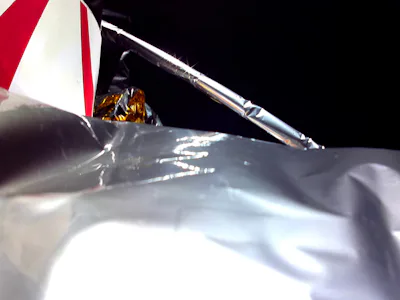
Close-up of a metallic surface with a partial view of a striped structure and a pole against a black...

A camera on Peregrine’s payload deck sent home this image on January 15.

Astrobotic’s Doomed Moon Lander Will Return To Earth In a Blaze of Glory

Instead of landing on the Moon, Peregrine is set to burn up in Earth's atmosphere later this week.

BY KIONA SMITH

Gene Roddenberry’s ashes are set to burn up in Earth’s atmosphere later this week, along with those of half the main cast of his original Star Trek series, as well as a lunar rover, a small flock of robots, and millions of dollars in scientific instruments, all of which were originally supposed to land on the Moon.

Astrobotic’s Peregrine One lander was originally scheduled to be in lunar orbit early next week, preparing for a landing on the Moon’s near side in late February. Instead, the spacecraft is now headed back to Earth, where it will disintegrate in Earth’s upper atmosphere – so at least it’s going out in a blaze of glory. Here’s everything you need to know about the doomed mission and what went wrong.

WHAT HAPPENS NOW?

As of this morning, January 16, the Peregrine Mission One spacecraft is on its way back to Earth after a 238,000-mile flight out to cross the path of the Moon’s orbit. The ill-fated spacecraft is scheduled to re-enter Earth’s atmosphere and disintegrate dozens of miles above the ground. Astrobotic says both the company and NASA are tracking the spacecraft’s path, and its re-entry won’t pose any safety risk to anyone on the ground.

The return to Earth is based on recommendations from NASA, other U.S. government agencies, and other members of “the space community” to prevent Peregrine from turning to a potentially hazardous piece of space debris orbiting the Moon or Earth, says Astrobotic in a recent update on its website.

“Ultimately, we must balance our own desire to extend Peregrine's life, operate payloads, and learn more about the spacecraft, with the risk that our damaged spacecraft could cause a problem in cislunar space,” the company says.

WHAT WENT WRONG?

Shortly after the mission’s launch from Cape Canaveral on January 8, things began to go wrong. It looks like a valve between the spacecraft’s oxidizer tank and a tank of high-pressure helium got stuck in the open position, according to Astrobotic. Here’s what that actually means:

It actually takes several ingredients to fuel a spacecraft. The stuff that actually burns, producing hot gas that gets pushed out the back end of the spaceship to create thrust, is called the propellant, and it’s usually something like liquid hydrogen, hydrazine, or even kerosene. But nothing burns without oxygen, so rocket engines need a second ingredient, called the oxidizer, to mix with the propellant so it can actually ignite.

Most of the time, the propellant and the oxidizer are stored in separate tanks, so they only combine when and where engineers want them to (most variations on that are catastrophically bad). Some spaceships – like Peregrine One – use pressurized helium to push the oxidizer and the propellant into the combustion chamber. Helium is a good choice because it won’t react with the oxidizer or the propellant.

But when the valve that’s supposed to push a small amount of helium into the oxidizer tank gets stuck, you end up with way too much helium in the tank – and like an overinflated balloon, the tank pops. Oxidizer goes everywhere except where the spaceship actually needs it to go, and suddenly, there’s not enough oxidizer to mix with the propellant to steer the spaceship to a safe landing on the Moon.

“While this is a working theory, a full analysis report will be produced by a formal review board made up of industry experts after the mission is complete,” says Astrobotic. “All available data is being downloaded from the lander to support this assessment.”

By January 14, the leak had started slowing down, and by January 15, Astrobotic reported, “The propellant leak caused by the anomaly has practically stopped.”

But by then, it was too late.

“Due to the anomaly, the fuel to oxidizer ratio is well outside of the normal operating range of the main engines, making long controlled burns impossible,” the company wrote in an update on its website.

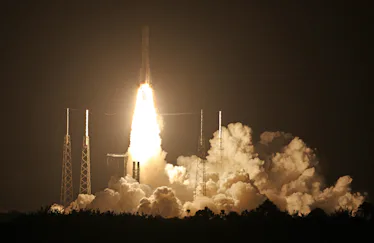
The brand new rocket, United Launch Alliance's (ULA) Vulcan Centaur, lifts off from Space Launch Com...

The brand new rocket, United Launch Alliance's (ULA) Vulcan Centaur, lifts off from Space Launch Complex 41d at Cape Canaveral Space Force Station in Cape Canaveral, Florida, on January 8, 2024, for its maiden voyage, carrying Astrobotic's Peregrine Lunar Lander. 

GREGG NEWTON/AFP/GETTY IMAGES

MOON LANDINGS ARE HARD

If it had succeeded, Peregrine would have been the first U.S.-based lander to reach the Moon since Apollo 17 visited in 1972, and the first private mission ever to pull it off.

The most recent successful Moon landing was India’s Chandrayaan-3, which touched down near the lunar south pole in August 2023. Just a few days earlier, Russia’s Luna-25 lander “ceased to exist as a result of a collision with the surface of the Moon” in the same region. Like the Peregrine lander for the U.S., Luna-25 would have been Russia’s first Moon landing in more than 50 years (or technically ever: the last Russian spacecraft to land on the Moon was actually built by the Soviet Union, not the modern Russian Federation).

India is now the fourth country ever to make a “soft landing” — as opposed to a crash, either accidental or on purpose — on the Moon, following the Soviet Union (but not post-Soviet Russia), the United States, and China. But nobody’s track record for Moon landings is perfect; India lost its Chandrayaan-2 lander in 2019 thanks to a software glitch.

An Israeli spacecraft also crashed on the Moon in 2019, spilling a payload of tardigrades and DNA onto the lunar surface. Oops.

WHAT’S BEING LOST?

Peregrine Mission One was originally meant to orbit the Moon for several weeks before landing on February 23. Its controversial payload of human remains and DNA made headlines, but the spacecraft is also carrying a payload of several instruments for NASA, a quintet of tiny robots for the National Autonomous University of Mexico (UNAM) and the Mexican space agency (AEM), a lunar rover from Carnegie Mellon University, and several other privately-funded instruments and experiments.

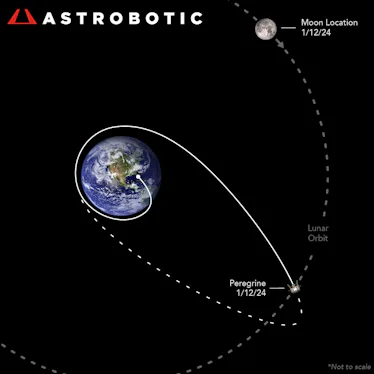
diagram showing a spacecraft's path into space, crossing the orbital path of the Moon, and back to E...

This diagram (not to scale) shows Peregrine’s new trajectory.

ASTROBOTIC

Several of those instruments managed to switch on and collect some data during the flight to lunar distance (meaning the distance at which the Moon orbits Earth, as opposed to “lunar orbit,” which would mean orbit around the Moon). Two NASA instruments successfully measured cosmic rays from deeper in our galaxy and space weather driven by our Sun’s activity.

“This data helps characterize the interplanetary radiation environment for humans and electronics,” says NASA in a statement.”

And although the five tiny robots from UNAM and AEM, called Colmena, didn’t get to trundle adorably around the lunar surface, they did get to power up and collect some data during the flight — making them the first Mexican instrument to operate in cislunar space.

Meanwhile, the doomed lander also carries the cremated remains of Star Trek creator Gene Roddenberry (mingled with those of his wife and son), Star Trek actors Nichelle Nichols, DeForest Kelley, and James Doohan, science fiction author Arthur C. Clarke, and others, along with DNA samples from several former U.S. presidents. Some of the ashes — a payload from “memorial spaceflight” company Celestis — were intended for interment on the lunar surface, while others were planned to carry on into deep space, but they will now return to Earth and burn up on re-entry later this week.

For Roddenberry, at least, Peregrine wasn’t his only memorial spaceflight. Other portions of the late screenwriter’s ashes traveled into space aboard the Space Shuttle Columbia in 1992 among the personal possessions of astronaut Jim Wetherbee, and aboard a Celestis orbital mission, which burned up during re-entry in 2002 (on purpose that time). Counting the Peregrine mission, Roddenberry’s remains have flown to space more times than many living astronauts.

{ https://www.inverse.com/ }

Hoe vind je dit bericht?
Geschreven door peter om 23:31 Stuur door

UFO sighting: US officials tried to stop Australians reporting chilling incident

UFO sighting: US officials tried to stop Australians reporting chilling incident
news.com.au

Australia has a long history of encounters with unexplained aerial objects, stretching from indigenous stories to modern mysteries. Are they aliens? Top-secret man-made machines? And why is discussion of UFOs seen as the preserve of crackpots and conspiracists? Celebrated journalist ROSS COULTHART probes the phenomenon both Down Under and overseas in his new book In Plain Sight – and in this edited extract demonstrates why it can be such a chilling topic.

Going way beyond conspiracy theories ... In Plain Sight by Ross Coulthart. Photo / Supplied Going way beyond conspiracy theories ... In Plain Sight by Ross Coulthart. Photo / Supplied

About 2.30 on a pitch-black morning on Australia's remote North West Cape, Annie Farinaccio walked out of a late-night party at the United States Naval Communication Station Harold E Holt.

It was late 1991, shortly before the US was due to hand over the site to Australia. The handover was happening amid mounting concern about the base's covert role as one of the cornerstones of America's submarine-launched nuclear missile defence. In the event of nuclear war, launch orders from the US would be sent out by the station's powerful transmitters to submarines across the adjacent Indian Ocean. Exmouth locals had no idea their sleepy town would likely be obliterated in a nuclear exchange; they just valued what the "Yanks" brought to the local economy in this isolated community and were sad to be seeing them go.

The party at the base that night was to farewell some American friends who were returning home because of the handover. But Annie had stayed too late and now, she realised, she had no way of getting home – the few local taxis in this remote part of Australia had stopped for the night. So when two Australian Federal Protective Service police officers, who she knew as Kevin and Alan, kindly offered to give her a ride back into Exmouth, 5km south, she gratefully accepted.

Credible witnesss. Annie Farinaccio describes to Ross Coulthart what she saw. Photo / Supplied
Credible witnesss. Annie Farinaccio describes to Ross Coulthart what she saw. Photo / Supplie

Annie squeezed in between the two men on the bench seat of their four-wheel Toyota drive security vehicle and the three set off for town.

A few minutes into the journey along the barren cape's empty coast road, Kevin looked up. "It's back. Grab the camera," Annie recalled him saying. Then Alan began to fire off photographs through the windscreen at something overhead that Annie could not yet see.

"Eventually, Kevin pulled my head forward. 'Look up!' he said. Then I saw it. A long diamond-shaped craft hovering overhead with the rear edge chopped off, rows of lights running towards the craft's tip. It was a dark grey colour but not as dark as the night sky. It was 100 feet above us at most. 'What the f**k is that?'" Annie asked.

The policemen told her they had no idea, but that the same object had followed them the previous night. The next minute, the craft shot straight up from the right-hand side of the moving vehicle, before dropping down almost instantaneously on the left hand-side of the car.

Annie screamed as they hurtled down the road, with the "craft" in apparent hot pursuit. It followed them along the road for 1km. Then it shot up into the sky and appeared to land in the scrub a few hundred metres off the road, a light now shining from underneath.

Kevin wanted to stop and take pictures of it on the ground, but, Annie says, "I was crying. 'This is crazy. Take me home'."

Scene of the mystery ... the area around Harold E. Holt base. Photo / Supplied Scene of the mystery ... the area around Harold E. Holt base. Photo / Supplied

The two police officers agreed and drove as fast as they could to the edge of Exmouth, where they dropped Annie off before rushing back to get their pictures.

"I ran to my home on the other side of town, and I ran into the house and locked the doors. I was so freaked."

Today, Annie is in no doubt that what was hovering above them that night was a craft moving at incomprehensible speed. She does not care if people think her account sounds crazy. "It moved so fast my eyes couldn't follow it," she says. "We were all freaking out."

Two days later, two American military policemen walked into Annie's workplace in town and asked her to come with them. Legally, the US had no jurisdiction, but she went with them anyway. "I didn't at that stage relate it to what we saw," she says. "I thought I was in trouble for being on the base drinking at night."

The taciturn policemen drove Annie straight into what she knew was the top-secret section of the US base. "I'm mouthing off at this stage, saying, 'I must have done something really bad,'" she laughs.

Once inside, they led Annie into a room. Sitting in front of a group of Americans in uniform were the two police officers, Alan and Kevin. Annie knew most of the Americans on base but here she recognised only one – the American commander. The others had clearly flown in from somewhere else. There were also three or four men in civilian suits.

"I laughed at that" ... Annie says what she saw was no weather balloon. Photo / Supplied "I laughed at that" ... Annie says what she saw was no weather balloon. Photo / Supplied

"I felt pissed off at this stage. One guy did the talking. He asked me, 'What did you see?' I said, 'I saw a UFO'. They got me to draw it and asked me more questions about it. 'You do realise that what you saw was a weather balloon?' I laughed at that," Annie said. As a child, Annie had lived on a station outside Exmouth and her father frequently launched weather balloons. "Weather balloons don't look like what I saw," she recalled telling the man. "Then one of the APS policemen sitting next to me – they both had their heads down – said: 'Please shut up … Shut up before you get us all killed'."

The interrogation went on for a few hours. It was clear the two Australian policemen had been there a lot longer – they appeared scared and dejected from the hours of questioning. Annie admits that she arced up at the Americans for trying to bully her into saying what they wanted her to say.

Annie is an intelligent university graduate who previously ran her own businesses. At the time of the sighting, she was working at the nearby Roebourne Regional Prison, counselling prisoners to help them find work. Fair to say, she was not easily rattled. "I said to them, 'I don't give a shit what you say. It wasn't a weather balloon. It was a UFO. I'm not saying what you want me to say. I know I saw a UFO'."

Looking for evidence ... well-known journalist Ross Coulthart comes to some fascinating conclusions about UFOs in his book, arguing that governments are reluctant to share the truth. Photo / Supplied Looking for evidence ... well-known journalist Ross Coulthart comes to some fascinating conclusions about UFOs in his book, arguing that governments are reluctant to share the truth. Photo / Supplied

The Americans clearly had no idea what to do with an uncooperative Australian local and, eventually, they took her home. The first thing Annie did was ring her cousin, who had long been inquisitive about what was really going on at the base. He drove to Exmouth and they both visited Alan at his home.

Alan admitted the photographs of "the craft" were printed at a printing shop inside the base and the two officers had shown them to colleagues. "Next thing, they were in custody. They searched the photo-machine, and they took his camera, the pics and the negatives," Annie says. Alan told her the photographs clearly showed an intelligently guided craft, not physically landed but hovering just above the ground. But, he said, every image he took was confiscated, along with his camera.

As Annie tells it, he was seriously rattled by the experience and told her and her cousin never to come back.

Annie's elderly mother in Exmouth also confirmed part of the story. She clearly remembers the two military policemen first came to the family home, so she directed them to Annie's workplace, where her colleagues watched her being escorted away.

Still no explanation ... this object was caught on camera by a Melbourne resident shortly before the mass sighting at Westall. Photo / Supplied Still no explanation ... this object was caught on camera by a Melbourne resident shortly before the mass sighting at Westall. Photo / Supplied

Annie knows her story sounds implausible, but she's adamant it's true. And she's not alone. Recorded sightings of strange objects in Antipodean skies can be found right back to the 19th-century period of early European settlement. For thousands of years before that, indigenous Australian Aboriginal rock art and dreamtime stories described the eerie alien faces of the Wandjina cloud and rain spirits, and also what are known today as the Min Min lights. Australia also has one of the most compelling UFO cases of all time, the Westall April 1966 mass UFO sighting, where more than 200 schoolchildren, teachers and locals in Victoria witnessed three metallic disc-shaped craft hovering over the school football field in broad daylight.

Witnesses to strange objects in our skies have told stories like Annie's for decades.

And yet they are rarely investigated or taken seriously by the press. The default position for mainstream media has long been to dismiss such accounts, even to ridicule them. After all, they sound wacky and, without official corroboration, such tales are most often spiked before the public gets to hear about them.

However, overwhelming evidence shows that many governments, including Australia's, take such unidentified aerial phenomena (UAP) sightings very seriously indeed. Across the world, declassified government reports and well-corroborated witness sightings show that military and intelligence services are well aware of a persistent pattern of strange unidentified objects seen at and around sensitive military facilities such as Australia's North West Cape naval communication station. Declassified files held in the Australian government's National Archives reveal that anomalous sightings of unexplained objects at North West Cape have been officially reported to the Australian Air Force for decades by soldiers, tourists, a senior American officer at the base, and a local fireman. Annette's disturbing sighting report is not an isolated incident at all. At the very least, it warrants further investigation.

But, as I have discovered, there is a huge disconnect between the public ridicule automatically directed at claims of unidentified aerial phenomena and the long-concealed secrets now emerging of a new reality.

More recent reports of UAP sightings are increasingly being verified on radar and other sensor systems, as well as photographed or videoed, and these events are often corroborated by multiple witnesses. The sightings also feature something that even the

US military now admits it cannot prosaically explain. In fact, US government and military insiders I have interviewed for this book admit they have knowledge of technology operating in our skies, oceans and orbit that far exceeds known human science. It often appears to be intelligently controlled, presenting to those who recorded it on video and tracked it on radar as a "craft" of some kind.

Like most journalists, I'm generally reluctant to believe in cover-ups or conspiracies. But I believe that governments are not telling the public the full story about UAPs. What are these "craft"? Is the extraterrestrial hypothesis, albeit confronting, even able to explain this high strangeness? And why are they hiding in plain sight?

Hoe vind je dit bericht?
Geschreven door peter om 23:15 Stuur door

CHANCES THAT ODD SOIL SAMPLES COLLECTED AT MARS’ JEZERO CRATER CONTAIN SIGNS OF ANCIENT LIFE JUST INCREASED DRAMATICALLY

R3gJ0u-q?format=jpg&name=900x900

Artist's concept of future Mars sample return campaign
(Credit: NASA/ESA/JPL-Caltech).

CHANCES THAT ODD SOIL SAMPLES COLLECTED AT MARS’ JEZERO CRATER CONTAIN SIGNS OF ANCIENT LIFE JUST INCREASED DRAMATICALLY

A new analysis of subsurface deposit and erosion patterns beneath the dry lakebed in Mars’ Jezero crater indicates the process took place over eons, dramatically improving the chances that soil samples collected at the site by NASA’s Perseverance could contain signs of ancient life.

Although the exact timeline for a joint European Space Agency/NASA mission to retrieve Perseverance’s soil samples has not yet been set, the fact that the lake in Jezero crater had existed across numerous geological phases significantly increases the odds of finding signs of ancient life within those samples.

RESEARCHERS HAVE LONG SUSPECTED DEEP SEDIMENTARY LAYERS LIE BENEATH JEZERO

Over the last few decades, images captured by satellites orbiting Mars have long hinted at the idea of eroded subsurface layers in the region. However, researchers knew that up close analysis by Perseverance’s ground penetrating radar was the only way to confirm those suspicions.

“From orbit, we can see a bunch of different deposits, but we can’t tell for sure if what we’re seeing is their original state or if we’re seeing the conclusion of a long geological story,” said David Paige, a UCLA professor of Earth, planetary and space sciences and first author of the paper detailing the findings. “To tell how these things formed, we need to see below the surface.”

Fortunately, Perseverance’s mission planners included the Radar Imager for Mars’ Subsurface Experiment, or RIMFAX, as one of the seven instruments on board the rover. Like ground penetrating radar used on Earth, the RIFMAX fires radar waves directly into the Mars surface, then reads their reflections as they bounce off different sedimentary layers.

GROUND PENETRATING RADAR CONFIRMS SATELLITE IMAGERY

To scan the floor of the river delta that once fed the Jezero crater, Perseverance used RIMFAX to fire radar pulses into the ground every 10 centimeters. When those pulses are reflected from as deep as 20 meters below the surface, the instrument captures that data. Given the prolonged usage of this system on Earth, scientists have figured out how to read the structure and composition of subsurface layers from those reflections.

“Some geologists say that the ability of radar to see under the surface is kind of like cheating,” said Paige, who is RIMFAX’s deputy principal investigator.

The process occurred between May and December of 2021, offering researchers a chance to collect data from a wide area within the delta. As the researchers reported in the latest edition of Science Advances, the radar revealed compelling evidence that the ancient lake in Jezero crater had made soil deposits and eroded over eons

Jezero crater, ancient life

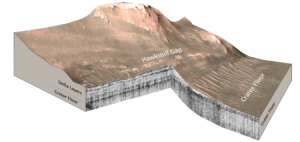
Mars Perseverance Rover RIMFAX ground penetrating radar measurements of the Hawksbill Gap region of the Jezero Crater Western Delta, Mars. Hawksbill Gap.

CREDIT: Svein-Erik Hamran, Tor Berger, David Paige, University of Oslo, UCLA, California Institute of Technology Jet Propulsion Laboratory, NASA

“The periods of deposition and erosion took place over eons of environmental changes, the radar indicates, confirming that inferences about the Jezero crater’s geologic history based on Mars images obtained from space are accurate,” the UCLA and the University of Oslo researchers explain,

FINDINGS INCREASE ODDS FOR SIGNS OF ANCIENT LIFE IN JEZERO SOIL SAMPLES

Although Perseverance has completed numerous missions and made countless significant findings about the red planet since its landing in February of 2021, few tasks undertaken by the SUV-sized rover have tantalized researchers and the public as much as the soil samples it collected and stored away for an eventual return to Earth. Not only did the original mission planners choose to study Jezero in hopes that there had been an ancient lake at the site, but the exact areas the vehicle has studied within the 30-mile wide crater were selected as the likeliest places to find signs of ancient life.

Furthermore, they chose specific sites within those study locations to select samples with the highest chances of life. So, the fact that the rover’s findings agree with the satellite imagery used by mission planners and confirm that they had indeed been chosen correctly should only increase the motivation to fund the sample return mission

“The changes we see preserved in the rock record are driven by large-scale changes in the Martian environment,” Paige said of the timescale revealed by the findings. “It’s cool that we can see so much evidence of change in such a small geographic area, which allows us [to] extend our findings to the scale of the entire crater.”

Ultimately, the sooner those samples can be returned to Earth, the sooner researchers can use the most advanced tools and techniques to analyze them. Given these latest findings, researchers may end up finding signs of ancient extraterrestrial life in the exact place they hoped to discover them.

“If life ever existed on Mars, the Perseverance rover’s verification of lake sediments at the base of the Jezero crater reinforces the hope that traces might be found in the crater,” the researchers explain.

  • Christopher Plain is a Science Fiction and Fantasy novelist and Head Science Writer at The Debrief. Follow and connect with him on X, learn about his books at plainfiction.com, or email him directly at christopher@thedebrief.org.

{ https://thedebrief.org/category/space/ }

Hoe vind je dit bericht?
Geschreven door peter om 22:52 Stuur door

Goed nieuws voor de zoektocht naar (dode) Marsmannetjes: ook de krater waarin Marswagentje Perseverance rondrijdt, was ooit gevuld met water

Goed nieuws voor de zoektocht naar (dode) Marsmannetjes: ook de krater waarin Marswagentje Perseverance rondrijdt, was ooit gevuld met water

c9c77c16-e3c3-5381-f4d6-fdf6b8615a77.jpg

Hele Marsmannetjes moet je niet verwachten, maar de hoop om sporen van leven te vinden op de rode planeet is wel weer opgelaaid. Nieuw onderzoek heeft namelijk aangetoond dat de krater waarin Marsrover Perseverance momenteel rondrijdt ooit gevuld was met water.

Toen het meer in deze Jezero-krater kromp, bleven er sedimenten achter op de bodem, maar ook in de rivieren die het water aanvoerden. Langzaam kwam de hele krater en het gebied eromheen droog te staan en ontstond een delta met de specifieke kenmerken die nu nog zichtbaar zijn.

Eindelijk bevestigd
De periodes waarin sedimentatie werd afgewisseld met erosie vonden plaats gedurende vele eeuwen waarin de omgeving steeds veranderde, zo blijkt uit radargegevens. Het maakt duidelijk dat de aannames, die op basis van beelden uit de ruimte zijn gedaan over de geschiedenis van de Jezero-krater, dus echt kloppen.

“Vanuit een baan om de aarde kunnen we een heleboel verschillende afzettingen zien, maar we kunnen niet met zekerheid zeggen of wat we bekijken de oorspronkelijke staat is, of dat we het slot zien van een lang geologisch verhaal”, zegt UCLA-professor David Paige. “Om echt te weten hoe deze dingen zijn ontstaan, moeten we onder het oppervlak kijken.”

Stukje volharding
Marsrover Perseverance doet zijn naam eer aan. Al sinds 2021 onderzoekt het ding, zo groot als een auto, minutieus de kraterbodem van 48 kilometer breed. Met maar liefst zeven wetenschappelijke instrumenten aan boord bestudeert hij de samenstelling van de grond, kijkt naar de atmosfeer en verzamelt monsters. De monsters moeten door een toekomstige expeditie terug naar de Aarde worden gebracht om ze te onderzoeken op sporen van leven.

Eerder al trad de Perseverance buiten de gebaande paden van de kraterbodem en bezocht de delta eromheen. Dit is een enorm uitgestrekt gebied met 3 miljard jaar oude sedimenten, die vanaf de ruimte lijken op de rivierdelta’s op Aarde. Een van de instrumenten van de Marsrover stuurde iedere 10 centimeter radargolven naar de bodem om zo tot 20 meter onder het oppervlak te kunnen kijken.

RIMFAX
Om met de radar echt iets te kunnen zeggen over de structuur en de samenstelling van de ondergrondse lagen is eerst op Aarde jarenlang onderzoek gedaan met het zogenoemde RIMFAX-instrument (afkorting van Radar Imager for Mars’ Subsurface Experiment). Het resultaat is indrukwekkend: de ondergrondse beelden tonen gesteentelagen die zich laten lezen als de dwarsdoorsnee van een snelweg. “Sommige geologen vinden dat het vermogen van de radar om onder het oppervlak te kijken een beetje op bedrog lijkt”, zegt onderzoeker Paige.

Een kijkje onder het oppervlak van Mars. Afbeelding: Svein-Erik Hamran, Tor Berger, David Paige, University of Oslo, UCLA, California Institute of Technology Jet Propulsion Laboratory, NASA

Mooi inkijkje
Maar wat kan het schelen als het zo’n mooi inkijkje oplevert in de Marsbodem. De radar wist twee periodes van sedimentafzettingen te onderscheiden, met daar tussenin twee periodes van erosie. Omdat de bodem onder de delta niet perfect vlak is, heeft er waarschijnlijk een periode van erosie plaatsgevonden voor de afzetting van de sedimenten. Die zijn overigens heel regelmatig en horizontaal van vorm, net als de sedimenten in meren op Aarde. In eerdere studies werd al gesuggereerd dat er sedimenten in het meer zouden zijn, maar dat is door dit onderzoek pas bevestigd.

Een tweede periode van afzettingen ontstond toen schommelingen in het waterpeil ervoor zorgden dat de rivier een veel bredere delta vormde. Ooit strekte die zich uit tot ver in het meer, maar door erosie is hij veel kleiner geworden. “De veranderingen die in het gesteente terug te vinden zijn, duiden op enorme wijzigingen in de omgeving op Mars”, zegt Paige. “Het is mooi dat we zoveel bewijs zien van veranderingen in zo’n klein gebied, waardoor we onze bevindingen kunnen uitbreiden naar de hele krater.

Bronmateriaal

{ https://scientias.nl/ }

Hoe vind je dit bericht?
Geschreven door peter om 22:40 Stuur door

MARS ROVER SPOTS MYSTERIOUS POLYGONS HIDDEN BENEATH THE RED PLANET’S SURFACE

GMQI-I1m?format=jpg&name=900x900

Mysterious polygons spotted by NASA in 2012.

Image Credit: NASA/JPL-Caltech/University of Arizona

MARS ROVER SPOTS MYSTERIOUS POLYGONS HIDDEN BENEATH THE RED PLANET’S SURFACE

Researchers operating China’s Zhurong rover say they have spotted a series of mysterious polygons hidden beneath the planet’s surface, similar to polygons NASA spotted on the surface of Mars in 2012. The newly discovered features, however, were detected more than 35 kilometers beneath the planet’s surface.

While researchers believe that these polygon structures could have formed due to extreme environmental shifts in Mars’ ancient past, their exact nature and formation remain a mystery.

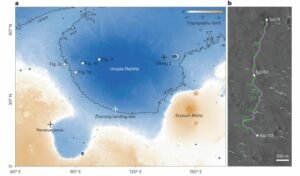
The discovery was initially made during the rover’s one-year mission, which lasted from May 2021 to May 2022, in the Utopia Planitia region. Described by researchers from the Institute of Geology and Geophysics under the Chinese Academy of Sciences as the largest impact crater in the entire solar system, the researchers behind this mysterious find say that Utopia Planitia “has both experienced and recorded variations of the Martian palaeoclimate.”

By using the rover’s ground penetrating radar, researchers scoured a 1.2-kilometer-wide area for various geological features. As a result, 16 mysterious polygons were spotted below a depth of 35 meters, meaning they were likely formed billions of years in the planet’s past.

mysterious polygons on Mars Zhurong rover landing site and images of polygonal terrain in Utopia Planitia. Image Credit NASA/Zhang et al.

Perhaps even more significant, the researchers say that the 16 polygons spotted by Zhurong could be evidence of a long, wet period on ancient Mars, which would dramatically increase the chances that life once existed on the red planet.

“[The] formation mechanism for the buried palaeo-polygonal terrain requires a cold environment and might be related to water/ice freeze–thaw processes in southern Utopia Planitia on early Mars,” the researchers explain in the journal Nature Astronomy. “The detected buried polygons, which indicate that freezing occurred at low-to-mid latitudes, require strong palaeoclimatic variability.”

NASA, who spotted similar features on Mars’ surface back in 2012, says they study the mysterious polygons “because the occurrence and physical characteristics of the polygons helps us understand the recent and past distribution of ice in the shallow subsurface [and] also provide clues about climate conditions.”

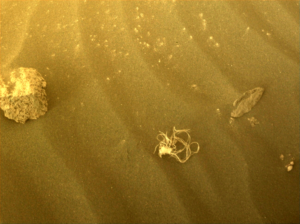
Of course, this is not the first time rovers have spotted something unusual on the red planet. For instance, a mysterious string was photographed by NASA’s Perseverance rover back in July 2022 before a photo taken four days later showed it had suddenly disappeared.

string on Mars

A mysterious string was spotted on the Martian surface.

Image credit: NASA

Rover operators have also spotted an unusual “flower” on Mars, a feature described as a “door,” and a number of pieces of debris left behind my previous missions. Just last October, rover operators even recorded a Martian whirlwind racing across the planet’s surface.

As for the recently discovered mysterious polygons hidden beneath the Martian surface, the researchers say they were potentially formed sometime between 3.7 and 2.9 billion years ago. While the exact process is unknown, the researchers say that their creation almost certainly involved large amounts of water, perhaps from water trapped underground that was pulled to the surface or even from ancient snowfall on the red planet.

“The possible presence of water and ice required for the freeze–thaw process in the wedges may have come from cryogenic suction-induced moisture migration from an underground aquifer on Mars, snowfall from the air, or vapor diffusion for pore ice deposition,” they explain.

While the Zhruong rover was decommissioned in 2022, the researcher note that the planet’s Utopia Planitia region is still one of the best places on the planet to search for signs of ancient water activity.

“The Zhurong landing site is thought to be one of the best places for detecting ground ice at low-to-mid latitudes on Mars25,” they write. “The GPR onboard Zhurong rover, thus, provides an unprecedented opportunity to illuminate subsurface structures and to investigate geological processes, particularly those associated with ancient or current water-related activities in southern Utopia Planitia.”

  • Christopher Plain is a Science Fiction and Fantasy novelist and Head Science Writer at The Debrief. Follow and connect with him on X, learn about his books at plainfiction.com, or email him directly at christopher@thedebrief.org

{ https://thedebrief.org/category/space/ }

Hoe vind je dit bericht?
Geschreven door peter om 20:42 Stuur door

Meer van UFO'S of UAP'S, ASTRONOMIE, RUIMTEVAART, ARCHEOLOGIE, OUDHEIDKUNDE, SF-SNUFJES EN ANDERE ESOTERISCHE WETENSCHAPPEN - DE ALLERLAATSTE NIEUWTJES

↑ Terug naar de berichten