Naar de inhoud

UFO'S of UAP'S, ASTRONOMIE, RUIMTEVAART, ARCHEOLOGIE, OUDHEIDKUNDE, SF-SNUFJES EN ANDERE ESOTERISCHE WETENSCHAPPEN - DE ALLERLAATSTE NIEUWTJES

UFO's of UAP'S in België en de rest van de wereld
akke.beakke.be
Ontdek de Fascinerende Wereld van UFO's en UAP's: Jouw Bron voor Onthullende Informatie! Ben jij ook gefascineerd door het onbekende? Wil je meer weten over UFO's en UAP's, niet alleen in België, maar over de hele wereld? Dan ben je op de juiste plek! België: Het Kloppend Hart van UFO-onderzoek In België is BUFON (Belgisch UFO-Netwerk) dé autoriteit op het gebied van UFO-onderzoek. Voor betrouwbare en objectieve informatie over deze intrigerende fenomenen, bezoek je zeker onze Facebook-pagina en deze blog. Maar dat is nog niet alles! Ontdek ook het Belgisch UFO-meldpunt en Caelestia, twee organisaties die diepgaand onderzoek verrichten, al zijn ze soms kritisch of sceptisch. Nederland: Een Schat aan Informatie Voor onze Nederlandse buren is er de schitterende website www.ufowijzer.nl, beheerd door Paul Harmans. Deze site biedt een schat aan informatie en artikelen die je niet wilt missen! Internationaal: MUFON - De Wereldwijde Autoriteit Neem ook een kijkje bij MUFON (Mutual UFO Network Inc.), een gerenommeerde Amerikaanse UFO-vereniging met afdelingen in de VS en wereldwijd. MUFON is toegewijd aan de wetenschappelijke en analytische studie van het UFO-fenomeen, en hun maandelijkse tijdschrift, The MUFON UFO-Journal, is een must-read voor elke UFO-enthousiasteling. Bezoek hun website op www.mufon.com voor meer informatie. Samenwerking en Toekomstvisie Sinds 1 februari 2020 is Pieter niet alleen ex-president van BUFON, maar ook de voormalige nationale directeur van MUFON in Vlaanderen en Nederland. Dit creëert een sterke samenwerking met de Franse MUFON Reseau MUFON/EUROP, wat ons in staat stelt om nog meer waardevolle inzichten te delen. Let op: Nepprofielen en Nieuwe Groeperingen Pas op voor een nieuwe groepering die zich ook BUFON noemt, maar geen enkele connectie heeft met onze gevestigde organisatie. Hoewel zij de naam geregistreerd hebben, kunnen ze het rijke verleden en de expertise van onze groep niet evenaren. We wensen hen veel succes, maar we blijven de autoriteit in UFO-onderzoek! Blijf Op De Hoogte! Wil jij de laatste nieuwtjes over UFO's, ruimtevaart, archeologie, en meer? Volg ons dan en duik samen met ons in de fascinerende wereld van het onbekende! Sluit je aan bij de gemeenschap van nieuwsgierige geesten die net als jij verlangen naar antwoorden en avonturen in de sterren! Heb je vragen of wil je meer weten? Aarzel dan niet om contact met ons op te nemen! Samen ontrafelen we het mysterie van de lucht en daarbuiten.

Archief

SpaceX's Dragon reentry and splashdown with Ax-2 astronauts looks amazing in these nighttime photos and videos

SpaceX's Dragon reentry and splashdown with Ax-2 astronauts looks amazing in these nighttime photos and videos

Hoe vind je dit bericht?
Geschreven door peter om 18:38 Stuur door

NASA STUDY TEAM ON UNIDENTIFIED ANOMALOUS PHENOMENA CALLS FOR BETTER DATA, ENDING HARASSMENT AND STIGMAS

HiT9XWH1?format=jpg&name=900x900

(NASA TV)

NASA STUDY TEAM ON UNIDENTIFIED ANOMALOUS PHENOMENA CALLS FOR BETTER DATA, ENDING HARASSMENT AND STIGMAS

On Wednesday, members of a NASA independent study team held a public briefing on its current efforts to categorize and evaluate data related to unidentified anomalous phenomena, or UAP, in a meeting that included participation from DoD and FAA officials involved in similar efforts.

According to NASA, UAP can be defined as “observations of events in the sky that cannot be identified as aircraft or known natural phenomena from a scientific perspective.”

During opening remarks at Wednesday’s event, Daniel Evans, assistant deputy associate administrator for research with NASA’s Science Mission Directorate, said that the team updated its terminology to convey that UAP represented all-domain “anomalous” phenomena rather than merely aerial observations. However, Evans clarified that most of the data NASA has currently evaluated as part of its independent study still involves observations of aerial phenomena.

During opening remarks, Evans also expressed his displeasure “that several of the study members “have been subjected to online abuse due to their decision to participate on this panel.” Evans added that NASA’s security team “is actively addressing this issue.”

Speaking after Evans, NASA Associate Administrator Nikola Fox also addressed the harassment that several of NASA’s independent study team members have faced.

“NASA stands behind all panelists,” Fox said, “and we don’t tolerate abuse. Harassment only leads to further stigmatization of the UAP field.”

Following Evans and Fox, David Spergel of the Simons Foundation and Chair of NASA’s UAP independent study team discussed the necessity for obtaining better quality data.

“We need high-quality data,” Spergel said, addressing the often-sporadic data collection methods used to collect information on UAP, adding that most of the data that has been reviewed by NASA’s independent study team have not been collected using properly calibrated scientific instruments.

“We design our telescopes to work at night,” Spergel said, noting visual anomalies that arise from reflections and other optical issues that cause what astronomers call “ghosting.”

“Those kinds of anomalies degrade the quality of the data,” Spergel added, emphasizing the need for utilizing properly calibrated instrumentation in efforts to collect data on UAP.

Following Spergel, Dr. Sean Kirkpatrick, director of the DoD’s All-domain Anomaly Resolution Office (AARO), gave a short presentation on his office’s findings, noting that AARO is proud to work alongside NASA and its independent study “as the U.S. government moves toward greater transparency on this issue.”

Kirkpatrick said that only a small number of UAP incidents include objects that demonstrate anomalous characteristics, noting there were “no maritime reports and no space reports” in the current data shared by AARO.

However, Kirkpatrick shared several slides that included updated versions of those previously shared during a Senate hearing earlier this year, which conveyed AARO’s latest data on typically reported characteristics of UAP, as well as recommendations for NASA’s independent study.
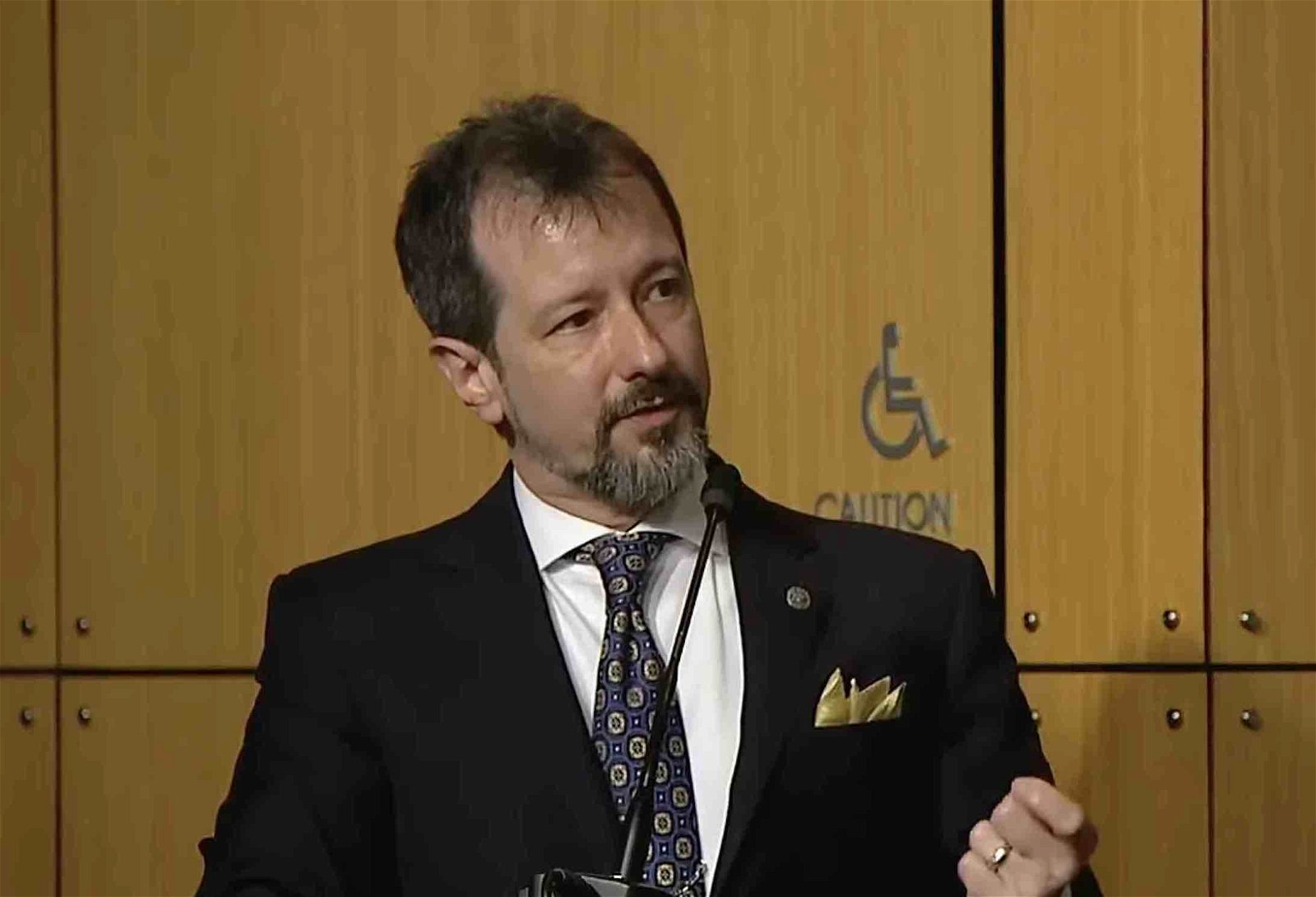
NASA UAP

Sean Kirkpatrick, director of the DoD’s All-domain Anomaly Resolution Office (AARO) speaking during Wednesday’s NASA event

(Credit: NASA TV).

Kirkpatrick also addressed a video depicting a metallic orb filmed over the Middle East that was first revealed during the Senate session several weeks ago, noting that similar objects have been seen “all over the world,” adding that “we see these making very interesting apparent maneuvers.”

Responding to a question from study member Nadia Drake about the number of reports currently in AARO’s collection, Kirkpatrick said, “We are now over 800,” noting that close to 100 new reports were obtained from recently acquired Federal Aviation Administration (FAA) data on UAP.

In 2021, The Debrief was the first to report that the FAA was actively collecting information on UAP, which it had been providing to AARO’s predecessor agency, the Unidentified Aerial Phenomena Task Force (UAPTF). It is unclear whether this data had been provided directly to AARO or if Kirkpatrick and his Office had been required to request it from the agency.

Kirkpatrick added that “less than single-digit percentages of the total dataset” comprised those objects which AARO deems to be “possibly really anomalous,” comprising maybe 2-5 percent of the total numbers collected. Kirkpatrick added that the next annual report produced by his office is currently being completed and prepared for release later this year.

Echoing earlier statements from NASA’s independent study team members, Kirkpatrick said he and AARO staff have also been subjected to harassment.

“My team and I have also been subjected to lots of harassment,” Kirkpatrick said, “especially coming out of my last [Senate] hearing because people don’t understand the scientific method.”

“People want answers now,” Kirkpatrick said, which he said feeds the negative stigmas against UAP reporting and studies, emphasizing the importance of NASA serving as a leader in public scientific discussion of the phenomenon.

“NASA should lead the scientific discourse [on UAP],” Kirkpatrick said, adding that it represents “a hard target problem.”

During his presentation, Kirkpatrick characterized anomalous phenomena as “anything that is not readily understandable by the operator or the sensor.”

Kirkpatrick said that within the last few days, the first “Five Eyes” meeting had been held with his Office on the topic, referencing cooperative efforts between the UK, Canada, Australia, New Zealand, and the United States on UAP studies.

Following Kirkpatrick’s presentation, Mike Freie, Technical Advisor at the Air Traffic Surveillance Services Office with the FAA, spoke about his agency’s mission and data related to UAP that it collects.

Freie discussed the various types of surveillance systems the FAA uses, which include Cooperative Surveillance and Non-Cooperative Surveillance systems, the latter comprising short and long-range radar, automatic dependent surveillance-broadcast (ADS-B), and surface surveillance systems used in coverage of surface on approach and departure paths of aircraft.

Freie emphasized that no classified DOD systems or other sensitive information were utilized in the data he shared.

“There is a process by which air traffic controllers can report UAP sightings or events,” Freie said. “Historically, those have been in the range of 3-5 reports per month,” Freie said, noting that Starlink launches appear to have caused a recent uptick in reports by pilots. A similar rise in reports followed the appearance of a Chinese surveillance balloon that passed over the U.S. earlier this year.

“That’s 3-5 reports per month across the entire 14,000 controllers per month,” Freie also clarified, noting it was a “very small percentage.”

Freie said that data on UAP is retained for an undefined period of several months, likely in an unprocessed form.

Following a break for lunch, team member and science journalist Nadia Drake addressed the number of credible UAP sightings in recent years while also emphasizing the need for applying science toward the issue.

“There is no conclusive evidence suggesting an extraterrestrial origin for UAP,” Drake said, citing the necessity for additional scientific data before UAP can be characterized and their origins can be determined.

“In science, skepticism is not a bias, nor is it a bad word,” Drake added.

Paula Bontempi, Dean of the Graduate School of Oceanography at the University of Rhode Island, spoke about NASA’s focus on transparency, and the availability of information the agency produces, adding that NASA’s experience with long-term missions makes it well-equipped to study UAP.
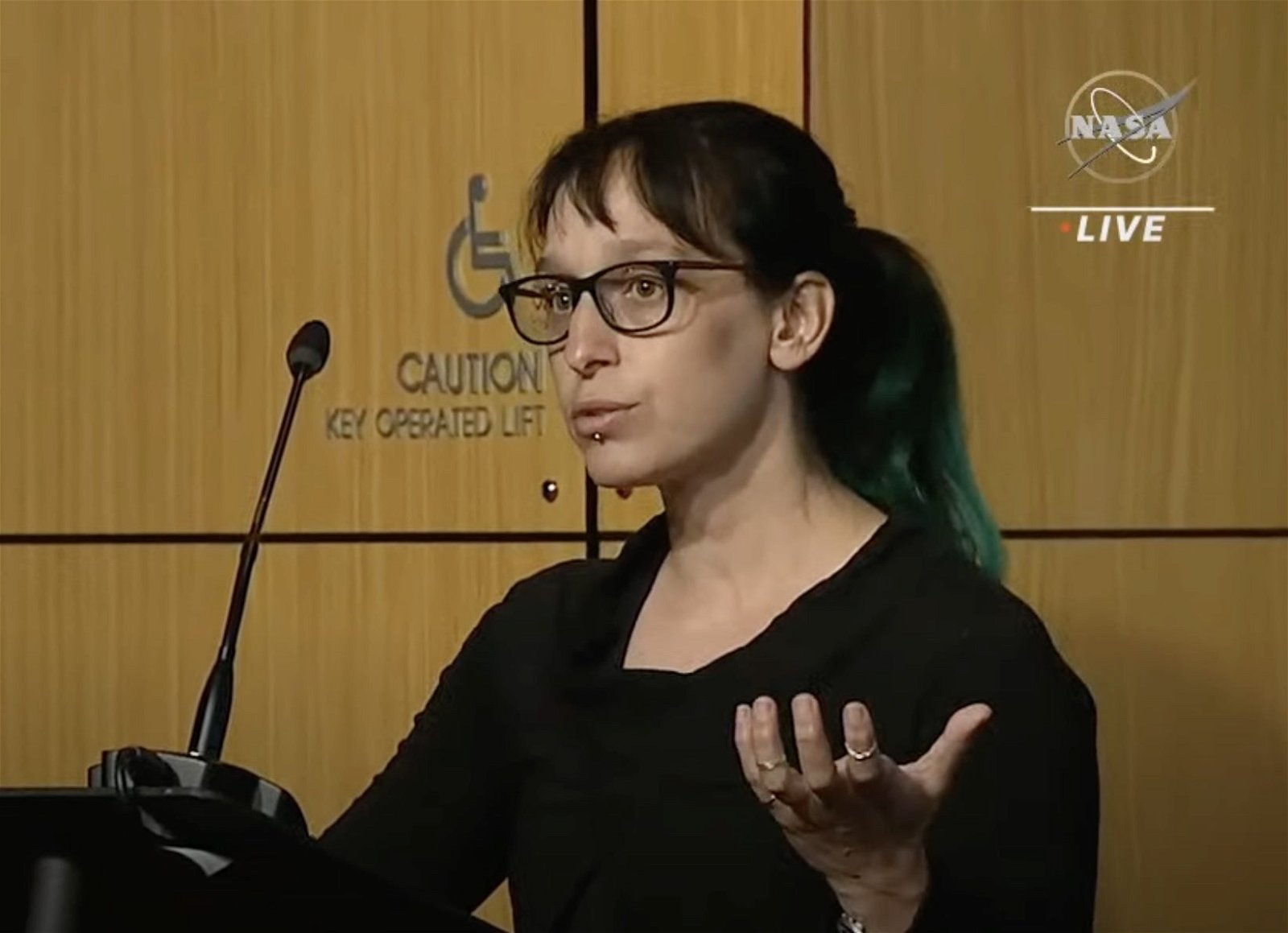
NASA UAP

Federica Bianco speaking during Wednesday’s live NASA event

(Credit: NASA TV).

Following Bontempi, Federica Bianco with the University of Delaware said that machine learning methods could be applied toward automation and retrieval of data to aid in the study of UAP.

“The current status of the UAP data… will make this really hard,” Bianco added while noting that NASA’s studies of UAP could nonetheless “be an opportunity to really increase the reach of science.”

David Grinspoon, Senior Scientist at the Planetary Science Institute, addressed the potential relevance of several existing NASA efforts to the study of UAP, despite there being no evidence study members had found that could positively link such aerial phenomena with extraterrestrial technologies.

“Within the scientific community, there is a widespread, but by no means universal belief that there are extraterrestrial civilizations,” Grinspoon said. “The same rationale which supports the idea that ET civilizations may exist and may be detectable also supports the idea that finding extraterrestrial artifacts in our own solar system is at least plausible.”

“NASA is the lead agency for solar system exploration,” Grinspoon said. “It already has an active program of detecting objects in our solar neighborhood, using both ground-based and space-based facilities, and it could leverage those capabilities to search for objects in space with anomalous motion, anomalous trajectories, unusual light curves, anomalous spectral signatures, or other characteristics.”

“Most of the solar system has not been searched for artifacts and anomalies,” Grinspoon added. “These modest data analysis efforts could potentially be applied to existing and planned planetary missions.”

“If NASA applies the same rigorous methodology toward UAPs that it applies to the study of possible life elsewhere, then we stand to learn something new and interesting.”

“Whatever the ultimate explanation is of those phenomena,” Grinspoon said.

Karlin Toner, Senior Advisor in Data Policy Integration with the FAA, mirroring the statements of earlier speakers, noted the apparent stigmas against “reporting or even researching such phenomena.”

“That said, by encouraging military aviators to disclose anomalies that they’ve seen or detected, the DoD is receiving many more reports,” noting Dr. Kirkpatrick’s earlier mention of close to 800 reports in AARO’s current holdings.

“I would propose to this panel that NASA can help make it safer for researchers to explore data in the civil aerospace domain simply by starting that work internally,” Toner said.

Following Toner’s remarks, Joshua Semeter, Director of the Center for Space Physics at Boston University, said that cases involving infrared and other sensory detections of UAP collected with advanced tracking systems in use by the U.S. military allow for direct calculations of parameters that include altitude and velocity.

“This multi-sensor approach is absolutely critical to charting a path forward for UAP investigation,” Semeter said.

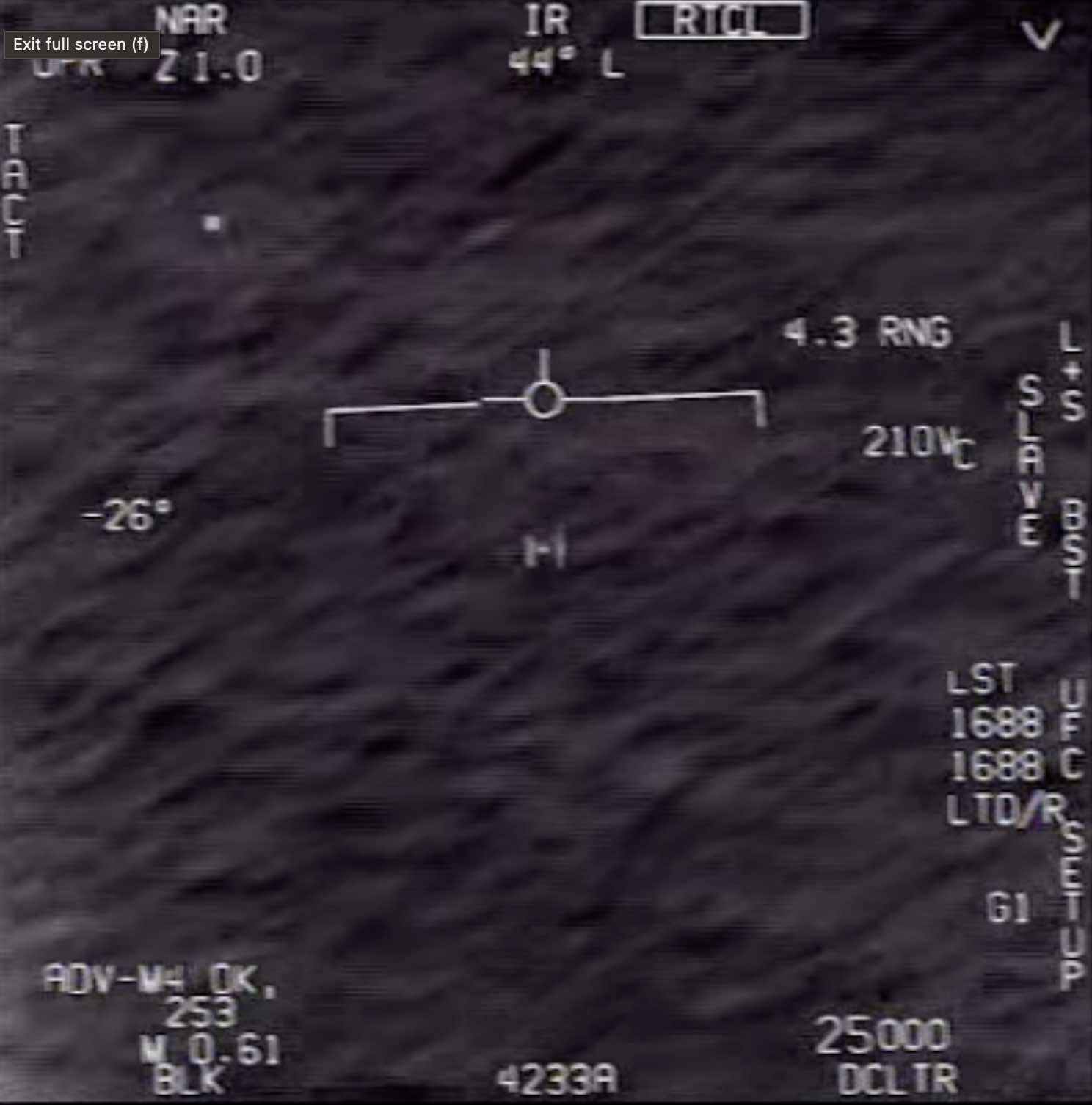
To illustrate this point, Semeter referenced one of three historic Navy UAP videos, popularly known as “Go Fast,” noting that information that included the elevation angle of the camera, azimuth angle, target range, and other relevant data are all featured on the screen. Based on such information, Semeter said the object in the footage was not moving as quickly as the footage seems to convey, a conclusion consistent with previous analysis of the footage that concluded the parallax effect could account for the apparent speed of the object.

Go Fast
Still frame from “Go Fast” footage, which conveys a slower-moving object which appears to be moving rapidly due to parallax effect
(Credit: DoD/US Navy).

Offering reflections from his experience in space, astronaut Scott Kelly noted that the space environment is “so conducive to optical illusions,” adding his own past experiences with observations that initially caused him to consider whether he had been observing unidentified objects.

Mike Gold, Former Associate Administrator for Space Policy and Partnerships, expressed his concerns about how NASA’s efforts to study UAP could be undermined if efforts to preserve the data it finds aren’t undertaken, despite the widespread public attention the subject receives.

“I’ve been a part of far too many panels and studies that end up sitting on the shelf,” Gold said.

“I don’t want this to be one of those exercises,” Gold added.

“I would call for and recommend a permanent office within NASA to support this activity, albeit likely a modest one, but to collate this information… to archive the information, and act as the open, forward-facing counterpart to Sean [Kirkpatrick] and AARO.”

“I don’t want all our work to end up being in vain,” Gold said.

In a portion of the session devoted to questions from the public, Daniel Evans addressed charges that NASA may not have been forthcoming with information it possessed about UAP and criticisms that included it may have “cut the feed” during live streams of space missions when unidentified objects appeared.

“I really want to assure the public that this agency is absolutely cast iron committed to openness and transparency and honesty,” Evans said. “And that commitment also extends to our live NASA TV feeds. They provide real-time footage from our various missions.”

“To my knowledge, NASA has never intentionally cut a live feed to hide anything, and that includes UAPs, of course. Sometimes there are interruptions to our feeds, but that is simply because space is a complex place. There’s a vast array of natural phenomena, human-made objects, and so forth.”

Evans called the agency’s commitment to openness and transparency “the hallmarks of NASA,” adding that such values are “why we’re here today in public, on TV. Because we want the public to have the opportunity to see the process of this committee doing its work in public.”

“It’s only right,” Evans said.

Asked if there had been any evidence NASA’s independent study had come across indicating that UAPs may result from non-human intelligence, Anamaria Berea, associate professor of Computational and Data Science at George Mason University, said that it was “not a question you can answer very quickly with yes or no.”

“As scientists, we follow the data; we formulate hypotheses; we test theories. We follow the scientific process. The role of this panel has been to create a roadmap and a framework for how all scientists that are interested in this phenomenon can further study,” Berea said.

“We cannot make that kind of extraordinary claim for any big subject in science,” she added. “This question of whether we are alone in the universe is probably one of the largest questions that we’ve had in our history of science [and] in our history of humanity. And it’s not one we can take lightly.”

“We hope that within our lifetime we will be able to answer this question of whether we are alone or not, and also to better characterize… UAP,” Berea said.

Building on Berea’s statements, as the Wednesday session concluded, David Spergel added that the question over the existence of extraterrestrial life strikes at the very core of NASA’s mission

“One of NASA’s big questions is, is there life out there?” Spergel said.

“A lot of what NASA is doing in its exploration of the solar system and beyond is focused on searching for life in any form.”

“Answering this question is one of the things that NASA as an agency is excited about,” Spergel said.

However, in summarizing Wednesday’s session, Spergel emphasized one overarching takeaway he has gleaned from the NASA independent UAP study team’s efforts.

“We need better data.”

A public report detailing the findings of NASA’s UAP study is expected to be made available by the end of July, Spergel said on Wednesday. Additional details about the study group’s efforts and its members can be found on its official page on NASA’s website.

{ https://thedebrief.org/category/aerospace/ }

Hoe vind je dit bericht?
Geschreven door peter om 18:15 Stuur door

Ex-NASA Employee Saw Hi-res UFO/Alien Craft Photos, Ready To Testify Before Congress

Afbeeldingsresultaten voor Ex-NASA Employee Saw Hi-res UFO/Alien Craft Photos, Ready To Testify Before Congress

Ex-NASA Employee Saw Hi-res UFO/Alien Craft Photos, Ready To Testify Before Congress

After the Pentagon‘s great UFO declassification and congressional hearings, NASA decided to hunt down the aliens. The agency possesses advanced technology on Planet Earth, exploring the possibility of transforming satellites into alien seekers to probe unexplained sightings without launching new equipment. The Galileo Project is designing a space mission to rendezvous with the next anomalous (Oumuamua-like) interstellar object that zooms into our solar system.

Is that the first time NASA became interested in alien civilizations? NASA whistleblowers, who claimed to have closely worked in some of the top missions, do not think so. Former NASA employee, Donna Hare reportedly saw a photo of a distinct UFO. Her colleague explained that it was his job to airbrush such evidence of UFOs out of photographs before they were released to the public.

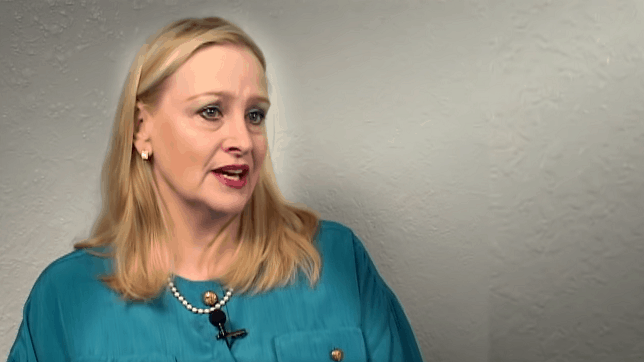
On May 9, 2001, over twenty military, intelligence, government, corporate and scientific witnesses came forward at the National Press Club in Washington, DC to establish the reality of UFOs or extraterrestrial vehicles, extraterrestrial life forms, and the resulting advanced energy and propulsion technologies. As part of the Disclosure Project, Donna Hare, a photographic scientist testified to have worked for NASA contactor Philco Ford in the early 1970s. She had a high-security clearance to walk in NASA’s photo lab and other departments.

During the Disclosure Project press conference, Hare revealed that NASA covered up and eliminated space anomalies such as UFOs from the satellite photos. Hare has got several awards in the space programs. She dedicated most of her time as a technical illustrator to space programs. She created lunar maps and landing slides and had been working for 15 years as a sub-contractor for NASA.

Donna Hare NASA UFO Photos

Donna Hare: Image credit: YouTube screencap

Hare claimed to have had access to a place known as “Building Eight,” from where she made contacts with high-ranking officials. Once, she walked into a restricted area which was NASA’s photo lab. She noticed the lab had photographs of the Moon taken from satellites. She was with a friend who pointed at one of the photographs and surprisingly, she saw a round white dot.

Read also:

Below is the transcript of Hare’s part in the Disclosure Program (Full Video link here):

“Good morning everyone! My name is Donna Hare, and I worked at Philco Ford aerospace from 1967 to 1981. During that time, I was a design illustrator draftsman. I did the launch slides, landing slides, and also projected plotting boards lunar maps for NASA. We were a contractor but most of the time, I worked in Building 8. I had the opportunity to do extra work during downtime which was between missions, and I walked into a photo lab which was the NASA lab across the hallway. I had a secret clearance which is not that high but I was able to go into restricted areas.

At the time, I was talking to one of the techs in there and he drew my attention to a NASA photograph. It had a “Dot” on it, and I asked what it was. Well, he drew my attention to it and I said is that a dot on the emulsion? He was smiling and he had his hands crossed… This was an aerial photograph of the Earth, I’m assuming the Earth because it had pine trees on it and the shadows of the craft or whatever it was were at the same angle as the trees and by its very nature, a UFO. And I wanted to clarify that to the gentleman that was talking to me… So, I did not know what this was but I realized at this point that it’s very secret.

I asked him what he was gonna do with this piece of information. He said they always airbrush these out before they sell them to the public, so they’re pissed pesky little creatures appearing on this photograph they wanted to get rid of. After that, I decided I would ask questions to other people that worked there (away from the site and not on site).

A guard told me that he was asked to burn some photographs and not to look at them, and there was another guard guarding him who was in green fatigues watching him burn the photographs and he said he was too tempted he looked at one.

I knew someone in quarantine with the Apollo astronauts he told me that the Apollo astronauts saw crap on the moon when we landed. He said that the astronauts are told to keep this quiet.”

Hare was told by one of the sources that during one of the moon landings, three UFOs had landed. Subsequently, there was a codeword “Santa Claus” for these crafts. She said she would be willing to testify before Congress. (Source)

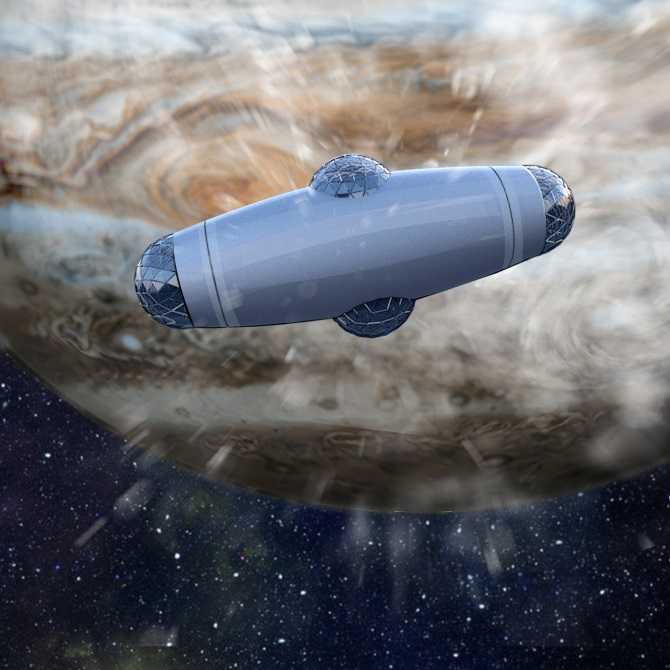
In 2000, Gary McKinnon, a British Hacker who got so fed up with the government hiding information related to UFOs and free energy that he decided to hack the most secured servers of NASA and the Pentagon. McKinnon said that he had seen real photographs of UFOs in computer files at the Johnson Space Center Building. He even took a screenshot of one of the cigar-shaped UFOs in-between space and the earth’s atmosphere. Unfortunately, it was removed from his computer after being seized.

Below is the recreation of the famous ‘NOT MAN MADE’ craft that was seen by McKinnon when he hacked & accessed NASA computers. (Source)

Donna Hare NASA UFO Photos Gary claims he discovered a satellite picture of a cigar-shaped alien craft with domes on the sides, like this artist’s impression credit: PROJECT8BALL

{ https://www.howandwhys.com/ }

Hoe vind je dit bericht?
Geschreven door peter om 17:51 Stuur door

MUGON - JANUARY 2024 UFO Sightings Statistical Report

MUGON - JANUARY 2024 UFO Sightings Statistical Report

JANUARY 2024 Sightings Statistical Report

NATIONS OF THE WORLD

UNITED STATES 334

UNITED KINGDOM 19

CANADA 17

FRANCE 17

AUSTRALIA 7

BRAZIL 7

NETHERLANDS 6

SPAIN 4

RUSSIAN FEDERATION 4

NEW ZEALAND 3

IRELAND 3

GERMANY 3

PORTUGAL 2

PUERTO RICO 2

ROMANIA 2

INDONESIA 2

SWITZERLAND 2

SOUTH AFRICA 2

SEYCHELLES 1

UNITED STATES MINOR OUTLYING ISLANDS 1 AUSTRIA 1

BULGARIA 1

THAILAND 1

SYRIA 1

DOMINICAN REPUBLIC 1

SINGAPORE 1

REUNION 1

AFGHANISTAN 1

HUNGARY 1

ITALY 1

INDIA 1   

TOTAL: 449

BY SHAPE

Circle 72

Sphere 54

Other 44

Unknown 30

Oval 29

Triangle 27

Disc 21

Star-like 20

Square/Rectangular 16

Cylinder 12

Tic Tac 12

Cigar 9

Boomerang 7

Fireball 6

Egg 5

Saturn-like 5

Diamond 4

N/A 3

Bullet/Missile 2

Flash 2

Blimp 2

Chevron 2

Teardrop 1

STATES OF THE USA

California 37

Florida 25

Texas 20

Colorado 16

Arizona 15

Ohio 14

Missouri 11

New York 11

Washington 10

Michigan 10

Arkansas 9

Pennsylvania 9

North Carolina 9

Alabama 8

Tennessee 8

Indiana 7

Illinois 7

Maryland 7

New Jersey 7

Louisiana 6

Oregon 5

Utah 5

Nebraska 5

Alaska 5

Georgia 5

Massachusetts 5

Wisconsin 4

Virginia 4

South Carolina 4

Mississippi 4

Iowa 3

Rhode Island 3

Idaho 3

Oklahoma 3

North Dakota 3

Kentucky 3

Maine 3

New Mexico 3

Nevada 3

New Hampshire 2

Hawaii 2

Vermont 2

Connecticut 2

West Virginia 2

Kansas 1

District of Columbia 1

Minnesota 1

Montana 1

DISTANCE FROM THE WITNESS

< 100 ft 49

101-500 ft 55

501 ft - 1 Mile 72

Over 1 Mile 82

Unknown 53

NO VALUE 16

Most impressively there were 15 Landings, Hovering, or Takeoffs reported and 34. Entities observed. Number of abduction (ERT) cases were 449.

{ https://mufon.com }

Hoe vind je dit bericht?
Geschreven door peter om 17:24 Stuur door

Wordt 2024 het jaar van verantwoorde AI?

Wordt 2024 het jaar van verantwoorde AI?

Wordt 2024 het jaar van verantwoorde AI?

Wordt 2024 het jaar van verantwoorde AI?
© Aangeboden door Business AM

Het begin van 2024 wordt gekenmerkt door een golf van voorspellingen over het traject van kunstmatige intelligentie, variërend van optimistisch tot voorzichtig. Toch is er een duidelijke consensus ontstaan: AI is de menselijke ervaring al aan het veranderen. Om bij te blijven moet de mensheid evolueren.

Voor iedereen die de opkomst van het internet en de sociale media heeft meegemaakt, kan de AI-revolutie een déjà vu-gevoel oproepen – en twee fundamentele vragen oproepen: Is het mogelijk om het huidige momentum vast te houden zonder de fouten uit het verleden te herhalen? En kunnen we een wereld creëren waarin iedereen, inclusief de 2,6 miljard mensen die offline blijven, zich kan ontplooien?

Om AI in te zetten voor een rechtvaardige en mensgerichte toekomst zijn nieuwe, inclusieve vormen van innovatie nodig. Maar drie veelbelovende trends bieden hoop voor het komende jaar.

Ten eerste blijft AI-regulering wereldwijd een topprioriteit. Van de AI-wet van de Europese Unie tot het uitvoerend bevel van oktober 2023 van president Joe Biden van de VS, hebben voorstanders van verantwoorde AI gereageerd op vrijwillige toezeggingen van Big Tech-bedrijven met beleidsvoorstellen die geworteld zijn in gelijkheid, rechtvaardigheid en democratische principes. De internationale gemeenschap, onder leiding van het onlangs opgerichte adviesorgaan op hoog niveau voor AI van de Verenigde Naties (waarvan een van ons, Dhar, lid is), is klaar om het komende jaar veel van deze initiatieven te bevorderen, te beginnen met het tussentijdse rapport over Governing AI for Humanity.

Proactieve maatregelen

Bovendien zou dit het jaar kunnen zijn waarin we de echokamers van de elite ontmantelen en een wereldwijd kader van ethische AI-professionals creëren. Door het bereik van initiatieven als de National Artificial Intelligence Research Resource Task Force – opgericht door de Amerikaanse 2020 AI Initiative Act – uit te breiden en implementatiestrategieën te lokaliseren met behulp van instrumenten als de UNESCO Readiness Assessment-methodologie, zouden wereldwijd inclusieve bestuurskaders vorm kunnen geven aan AI in 2024.

Op nationaal niveau zal de nadruk naar verwachting liggen op het reguleren van AI-gegenereerde inhoud en het in staat stellen van beleidsmakers en burgers om het hoofd te bieden aan AI-gedreven bedreigingen voor burgerparticipatie. Nu een groot aantal landen, die meer dan 40% van de wereldbevolking vertegenwoordigen, zich opmaken voor cruciale verkiezingen dit jaar, zullen er proactieve maatregelen nodig zijn om de dreigende golf van verkeerde en desinformatie te bestrijden. Dit omvat initiatieven om het publieke bewustzijn te vergroten, brede mediageletterdheid in verschillende leeftijdsgroepen te bevorderen en polarisatie aan te pakken door het belang van empathie en wederzijds leren te benadrukken.

Terwijl overheden debatteren over de rol van AI in de publieke sfeer, zullen verschuivingen in de regelgeving waarschijnlijk leiden tot hernieuwde discussies over het gebruik van opkomende technologieën om belangrijke beleidsdoelen te bereiken. India’s gebruik van AI om de efficiëntie van de spoorwegen te verbeteren en het door AI aangedreven digitale betaalsysteem van Brazilië zijn hier goede voorbeelden van.

Momentum van maatschappelijke organisaties

In 2024 zullen entiteiten zoals het VN-ontwikkelingsprogramma naar verwachting de integratie van AI-technologieën in digitale openbare infrastructuur (DPI) onderzoeken. Initiatieven voor het vaststellen van standaarden, zoals het aankomende Global Digital Compact van de VN, kunnen dienen als kaders voor meerdere belanghebbenden voor het ontwerpen van inclusieve DPI. Deze inspanningen moeten gericht zijn op het opbouwen van vertrouwen, prioriteit geven aan behoeften van de gemeenschap en eigenaarschap boven winst, en vasthouden aan “gedeelde principes voor een open, vrije en veilige digitale toekomst voor iedereen”.

Maatschappelijke groeperingen bouwen al voort op dit momentum en gebruiken de kracht van AI voor goede doeleinden. De non-profit Population Services International en de in Londen gevestigde start-up Babylon Health zijn bijvoorbeeld bezig met de uitrol van een AI-gestuurde symptoomchecker en zoekfunctie voor zorgverleners, waarmee ze laten zien dat AI gebruikers kan helpen bij het beheren van hun gezondheid. Ook organisaties als Polaris en Girl Effect werken aan het overwinnen van de barrières voor digitale transformatie binnen de non-profitsector en pakken problemen aan als dataprivacy en gebruikersveiligheid. Door gecentraliseerde financieringsmechanismen te ontwikkelen, internationale expertnetwerken op te zetten en bondgenootschap te omarmen, zouden filantropische stichtingen en openbare instellingen kunnen helpen dergelijke initiatieven op grotere schaal toe te passen.

Achterhaalde percepties

Nu non-profitorganisaties de overstap maken van het integreren van AI in hun werk naar het bouwen van nieuwe AI-producten, moet ons begrip van leiderschap en vertegenwoordiging in technologie ook veranderen. Door achterhaalde percepties van hoofdrolspelers in het huidige AI-ecosysteem uit te dagen, hebben we de kans om het ware, diverse gezicht van innovatie te vieren en baanbrekers van verschillende geslachten, rassen, culturen en regio’s te benadrukken, terwijl we de opzettelijke marginalisatie van minderheidsstemmen in de AI-sector erkennen.

Organisaties als het Hidden Genius Project, Indigenous in AI en Technovation bouwen al aan de “who’s who” van de toekomst, met speciale aandacht voor vrouwen en mensen van kleur. Door hun werk collectief te steunen, kunnen we ervoor zorgen dat zij een leidende rol spelen bij het vormgeven, inzetten en overzien van AI-technologieën in 2024 en daarna.

Leren van successen en mislukkingen

Debatten over wat het betekent om “mensgericht” te zijn en welke waarden onze samenlevingen moeten leiden, zullen onze betrokkenheid bij AI bepalen. Kaders met meerdere belanghebbenden, zoals de UNESCO-aanbeveling over de ethiek van kunstmatige intelligentie, kunnen een broodnodige leidraad vormen. Door zich te richten op gedeelde waarden zoals diversiteit, inclusiviteit en vrede, kunnen beleidsmakers en technologen principes schetsen voor het ontwerpen, ontwikkelen en inzetten van inclusieve AI-tools. Het integreren van deze waarden in onze strategieën vereist ook betrokkenheid bij gemeenschappen en een standvastige toewijding aan rechtvaardigheid en mensenrechten.

Aangezien AI hard op weg is om net zo alomtegenwoordig te worden als het internet, moeten we leren van de successen en mislukkingen van de digitale revolutie. Als we op de ingeslagen weg voortgaan, lopen we het risico dat we de wereldwijde welvaartskloof bestendigen of zelfs vergroten en kwetsbare gemeenschappen wereldwijd verder van ons vervreemden.

Maar door onze toewijding aan eerlijkheid, rechtvaardigheid en waardigheid te herbevestigen, kunnen we een nieuw mondiaal kader creëren dat elk individu in staat stelt de vruchten te plukken van technologische innovatie. We moeten het komende jaar gebruiken om partnerschappen met meerdere belanghebbenden te cultiveren en een toekomst te bevorderen waarin AI welvaart voor iedereen genereert.

De auteur Yolanda Botti-Lodovico is Policy and Advocacy Lead voor de Patrick J. McGovern Foundation. Vilas Dhar is voorzitter van de Patrick J. McGovern Foundation.

Copyright: Project Syndicate, 2024

{ https://businessam.be/ }

Hoe vind je dit bericht?
Geschreven door peter om 17:11 Stuur door

Marsrover vindt overblijfselen van een groot meer – is er misschien leven?

Marsrover vindt overblijfselen van een groot meer – is er misschien leven?

Geavanceerde ruimtetechnologie groef diep onder het oppervlak van Mars, en het gevonden materiaal heeft de vermoedens van veel wetenschappers bevestigd.

Op 18 februari 2021 rolde de NASA-rover Perseverance voor het eerst in de buurt van de Jezerokrater op Mars, die een diameter van 30 meter heeft en 250 meter diep is.

Zijn missie was duidelijk: Perseverance moest in de kleihoudende krater zoeken naar tekenen van leven.

De robot met zes wielen bevindt zich nog steeds op de rode planeet, en onlangs zorgde hij voor een nieuwe doorbraak.

Perseverance vuurde radargolven af om onder het oppervlak van Mars te kijken en vond daar duidelijk bewijs dat er ooit water stroomde door de Jezerokrater.

Ondergrond duidt op prehistorisch meer

Met zijn radarinstrument kon de rover 20 meter diep in de krater kijken. Hij zond met intervallen van 10 centimeter radargolven uit en mat daarna de pulsen die teruggekaatst werden.

Het instrument kan de structuur en samenstelling van de ondergrondse lagen in het sediment aflezen, en in de Jezerokrater waren duidelijke afzettingen in de lagen te zien.

De afzettingen beschrijven het proces waarbij eerder gevormde lagen grond of gesteente om verschillende redenen kunnen worden afgebroken. Het kan gaan om sediment dat is afgebroken en waarin zich mineralen, organisch materiaal of andere stoffen hebben opgehoopt.

Reis met Perseverance door de Jezerokrater:

Volgens de onderzoekers zijn de afzettingen het resultaat van een krater die ooit vol water zat – waarschijnlijk in de vorm van een groot meer.

Ze denken dat het meer langzaam kromp, waardoor een grote delta ontstond die later erodeerde en de geologische kenmerken vormde die nu aan het oppervlak zichtbaar zijn.

Natte planeet werd gevriesdroogd

Hoewel het water meermaals terugkeerde, eindigde Mars toch als een ijskoude woestenij. Op de lange termijn kon de planeet de verwarmende atmosfeer die nodig is voor vloeibaar water, niet vasthouden.

Dat is een belangrijke ontdekking, en het bevestigt de vermoedens dat hier ooit water stroomde.

‘De radarbeelden laten zien dat de sedimenten regelmatig en horizontaal zijn – net als sedimenten in meren op aarde,’ zei David Paige, professor aard-, planeet- en ruimtewetenschappen aan de UCLA en hoofdauteur van de studie, in een persbericht.

De resultaten ondersteunen de theorie die NASA-wetenschappers al lang aanhangen: dat het koude, droge, levenloze Mars ooit warm, nat – en misschien bewoonbaar – was.

Perseverance verzamelt nu zo snel als de technologie het toelaat monsters uit de Jezerokrater.

De bodem- en gesteentemonsters zullen uiteindelijk naar de aarde worden gestuurd, en de wetenschappers achter dit onderzoek hopen er sporen van leven in te vinden.

{ https://wibnet.nl/heelal }

Hoe vind je dit bericht?
Geschreven door peter om 16:55 Stuur door

Exploring the Unexplained: A New Era of UFO Sightings and Investigations

Exploring the Unexplained: A New Era of UFO Sightings and Investigations

flying-saucer

In recent times, the discourse surrounding Unidentified Flying Objects (UFOs), or as they are now more commonly referred to, Unidentified Aerial Phenomena (UAPs), has shifted dramatically. No longer relegated to the fringes of conspiracy theories and science fiction, the investigation into these mysterious occurrences has garnered serious attention from scientists, journalists, and government officials alike. This renewed interest marks a pivotal moment in our quest to understand the phenomena that have puzzled humanity for decades.

The Pentagon’s Renewed Focus on UAPs

The narrative surrounding UAP investigations reached a significant turning point with the resignation of Sean Kirkpatrick, the head of the Pentagon’s office dedicated to exploring these unexplained events. Citing harassment and a culture moving away from rational, evidence-based critical thinking, Kirkpatrick’s departure underscores the contentious atmosphere that envelops this field of study. Despite these challenges, the Pentagon’s continued interest in UAPs signifies a commitment to unraveling the mysteries that loom in our skies.

Harvard’s Astronomical Findings and the Quest for Extraterrestrial Technology

Compelling contributions to the UAP discourse also come from the academic realm, with Harvard astronomer Avi Loeb‘s intriguing discovery of metallic spherules in the Pacific Ocean. Suggesting these could be remnants of an extraterrestrial technological object, Loeb’s work exemplifies the scientific community’s growing willingness to explore theories that were once dismissed outright. This openness to considering non-human origins for unidentified aerial objects is a leap forward in the search for answers.

Eyewitness Accounts and Government Whistleblowers

The claims made by former intelligence officer David Grusch about the U.S. military’s possession of non-human technology add another layer of complexity to the ongoing investigations. Grusch’s assertions, though controversial, have reignited debates over the transparency and ethical considerations of withholding such potentially groundbreaking discoveries from the public. These revelations, coupled with congressional hearings on the matter, indicate a significant shift in how UAP sightings are perceived at the highest levels of government.

The Role of Journalists and the Media

Journalists like Leslie Kean have played a pivotal role in bringing UAP stories to the mainstream, challenging the stigma associated with UFO investigations. Through diligent reporting and collaboration with military and government insiders, Kean has helped pave the way for a more open dialogue about the phenomena, encouraging both skeptics and believers to engage in a more informed discussion.

 { https://www.latest-ufo-sightings.net/ }

Hoe vind je dit bericht?
Geschreven door peter om 16:43 Stuur door

This US Scientist Saw Roswell Alien Survivor Who Revealed They Live Underground

hIt6J_W-?format=jpg&name=900x900

This US Scientist Saw Roswell Alien Survivor Who Revealed They Live Underground

Could there be another civilization living among us? UFO expert Anna Whitty has put forth a theory suggesting that aliens have been residing in Earth’s oceans for protection and have always been present on our planet. Whitty’s claims are based on the official statement of Dr. Shirley Wright, who allegedly interviewed the only survivor of the Roswell crash in 1947.

A two-hour documentary called “Roswell 75: The Final Evidence” features Whitty along with other experts, discussing the UFO crash and the potential presence of advanced humanoid aliens on Earth. In the documentary, Dr. Wright mentioned that the aliens inquired about human exploration inside the ocean, they asked “how far into the ocean” the humans traveled.

Dr. Shirley Wright, a former colleague of Albert Einstein stated that she interviewed aliens found at the Roswell crash site in 1947. She noted that aliens are actually just humans, but an advanced form. She claimed to have been present when the US government interviewed an alien survivor from the Roswell crash. According to Dr. Wright, the alien said that not all of them live above the ground and that many reside underground on our planet.

In 1993, an interview with Dr. Shirley Wright was made public where she claims to have witnessed the examination of Roswell UFO crash debris and encountered nine alien bodies. The interview reveals detailed descriptions of the aliens’ physical characteristics, their suits, and their apparent ability to survive in Earth’s atmosphere, while also highlighting the limited information they were willing to disclose about their lifestyle and reproductive methods.

Dr. Shirley Wright Dr. Shirley Wright was a dedicated teacher and scientist, earning PhDs in Physical Chemistry and Physical Science. She was a chemistry professor at MDCC for over 50 years. She was a student of Dr. Albert Einstein at Princeton. Credit: legacy.com

According to Dr. Wright, while discussing her security clearance, she revealed: “The only reason we could go is that it’s a crack or did they deactivate it… after school, it was immediately deactivated.” This suggests that her access to the Roswell incident was facilitated by her clearance, which was granted specifically for the purpose of examining the extraterrestrial crash.

When asked about her encounter with the alien survivor, Dr. Wright admitted: “I was back at the motel in a city nearby, and I had been told that I would be able to keep the being alive.” This statement raises questions about the nature of her involvement and the significance of her role in handling and studying the extraterrestrial being.

Describing the appearance of the aliens, Dr. Wright vividly recalled: “They were very light, soft, a grayish-green, really. They had a slim, lean physique, no nose but markings where a nose opening would be, prominent eyes, and a mouth. They had no eyebrows, but they had ears and a very forked head.” These detailed descriptions paint a picture of the otherworldly beings she encountered during her extraordinary experience.

Additionally, Dr. Wright noted: “Their eyes were enormous, the most obvious thing you’d see on their face. They were almost brown-black, very dark.” This emphasizes the distinctiveness of the aliens’ eyes and adds to the mystique surrounding their appearance.

Regarding their attire, Dr. Wright observed: “They had suits on, very much like what we call suits. The fabric, however, was unfamiliar to me as a chemist. It didn’t resemble any fabric I recognized.” This intriguing detail raises questions about the technology and materials used by these extraterrestrial visitors.

Dr. Wright also touched upon the aliens’ apparent ability to adapt to Earth’s atmosphere, stating, “They could apparently survive in our atmosphere. They seemed to indicate that the atmosphere was quite similar, although not identical to ours.” This revelation hints at the remarkable adaptability of these beings and their advanced understanding of different planetary conditions.

In the realm of their lifestyle and reproductive methods, Dr. Wright admitted: “We tried to find that out, but we were very cautious not to antagonize them. They didn’t reveal much about it, but they mentioned living underground, in what we would call subterranean conditions.” This suggests a unique aspect of their civilization and their preference for dwelling beneath the surface.

Anna Whitty told the Daily Star that if whatever Wright had documented through her interview is correct, then it is more believable for the aliens to come from under the sea rather than from another planet. “If what Shirley said is right, it is more likely that aliens come from somewhere under the sea or caves or something like that, rather than another planet, it makes sense because there’s a lot of evidence on the planet that there has been a massive cataclysm every few thousand years,” Whitty said.

“If humans on the surface are being reset to the Stone Age every several thousands of years, and these people are somewhere where they are more protected because they are underground, then perhaps their development in technology and intelligence is continuing on an upwards trajectory whereas we’re reset. It’s also possible that maybe they aren’t beings at all, but they can make you think you’re seeing what you’re not seeing,” she added.

Read also:

Whitty’s theory of aliens being “underwater entities” is supported by several incidents and testimonies. One such incident occurred in July 2019 when footage filmed on the USS Omaha showed a UFO diving into the water off San Diego. No wreckage or recovered craft were found. Retired US Air Force Lt. Col. Richard French, who served as a lead investigator of Project Blue Book in the 1950s, claimed to have witnessed two aliens repairing their ship submerged underwater in Newfoundland.

French testified about his experiences in front of former members of Congress at the Citizen Hearing in 2013, stating that he saw the aliens and their crafts below the water surface. He described clear water that allowed him to observe the beings and their activities. Despite his role as a UFO debunker, French confirmed that it was a UFO sighting involving extraterrestrials.

Other accounts support the idea of extraterrestrial presence in the ocean. Former Gunner’s Mate John Baughman, stationed on the USS Carl Vinson in 2010, reported seeing a Tic Tac-shaped UFO underwater. He described a solid object that rapidly collapsed and disappeared as it descended into the depths.

There have also been encounters with unidentified submerged objects (USOs). The crew of a Soviet submarine witnessed six disc-like objects approaching their vessel at high speeds. Unable to escape, they were forced to surface. Through the periscope, they observed the objects emerging from the water and swiftly departing.

Classic alien abduction cases also involve encounters with underwater bases. Betty Andreasson Luca, a Massachusetts woman, experienced multiple abductions and recalled being taken to a spacecraft flying over the ocean. The craft submerged into the water, entering a tunnel illuminated by light. Filiberto Cardenas claimed to have been taken to a secret underwater hangar witnessed by his friend’s family. He described entering a tunnel at high speed underwater and arriving at a large hangar beneath the sea.

These incidents and testimonies provide evidence for the presence of extraterrestrial activity in the ocean and support Whitty’s theory of aliens as “underwater entities.”

{ https://www.howandwhys.com/ }

Hoe vind je dit bericht?
Geschreven door peter om 16:41 Stuur door

Atoombatterij zo klein als een muntje gaat 50 jaar mee zonder opladen

Atoombatterij zo klein als een muntje gaat 50 jaar mee zonder opladen

Dankzij atoombatterijen hoeven smartphones nooit meer opgeladen te worden en kunnen drones eeuwig in de lucht blijven, zo stelt de maker. Het kan echter nog wel even duren voordat we de batterij op de markt zien.

Het batterijtje bevat 63 nucleaire isotopen, die niet schadelijk zouden zijn voor het milieu en de mens. Hij kan 100 microwatt leveren bij 3 volt.

© Betavolt

Een batterij op kernenergie klinkt op het eerste gezicht misschien niet heel veilig.

Maar de technologie wordt al jaren gebruikt voor bijvoorbeeld ruimtemissies en onderzeeërs.

En onlangs heeft een grote batterijfabrikant een prototype uitgebracht van een atoombatterij, die een groot aantal kleine apparaten maar liefst 50 jaar van energie zou kunnen voorzien zonder te hoeven worden opgeladen.

Als het principe opgeschaald kan worden, kunnen we wellicht al onze laptop- en telefoonopladers weggooien.

Veel krachtiger dan traditionele batterijen

Het Chinese Betabolt heeft 63 atomaire isotopen in zijn nieuwe atoombatterij BV100 gepropt, en hij is kleiner dan een muntje.

Het batterijtje meet slechts 15 bij 15 bij 5 millimeter en kan tot 100 microwatt opwekken bij 3 volt.

Dankzij het kleine formaat kunnen meerdere eenheden in bijvoorbeeld een smartphone erop worden aangesloten, waardoor de efficiëntie toeneemt.

Deze batterij benut de energie die vrijkomt als radioactieve isotopen vervallen om elektriciteit op te wekken.

Dit doet denken aan de technologie in oudere pacemakers en ruimtevaartuigen.

De energiedichtheid van de batterij zou ruim 10 keer zo groot zijn als die van een conventionele lithiumionbatterij – een eigenschap die drones in staat zou kunnen stellen om eeuwig te vliegen zonder op te hoeven laden.

Fabrikant: Veilig en milieuvriendelijk

Bij kernenergie zijn straling en afval over het algemeen een probleem.

© Terry Papoulias/Shutterstock

Wat is een atoombatterij?

  • Een atoombatterij haalt energie uit een radioactieve bron en verschilt van traditionele batterijen qua prijs, levensduur, toepassingen en functie.
  • Traditionele batterijen gebruiken elektrochemische reacties als energiebron.
  • Atoombatterijen gebruiken energie uit het verval van radioactieve isotopen om elektriciteit op te wekken.
  • Uraniumisotopen worden veel gebruikt om elektriciteit op te wekken omdat ze al 60 jaar de primaire energiebron van kerncentrales zijn.
  • Omdat de elektriciteit afkomstig is van een constant verval van deeltjes, ontlaadt de batterij niet sneller bij toenemend gebruik.
  • Atoombatterijen worden al gebruikt in onder meer ruimtevaartuigen en satellieten – ze helpen zelfs de Marsrover Perseverance van energie te voorzien.

Atoombatterijen zijn nooit algemeen verkrijgbaar geweest, omdat radioactieve elementen als plutonium gevaarlijk waren.

Maar volgens Betavolt vormt de straling van de atoombatterij geen gevaar omdat de radioactiviteit zo miniem is.

De BV100 is zelfs milieuvriendelijk, volgens een persbericht van Betavolt.

Als de batterij bijna aan het eind van zijn levensduur is, worden de radioactieve stoffen omgezet in koper, dat niet radioactief is en geen bedreiging vormt voor het milieu.

Betavolt test de batterij op dit moment, en het bedrijf is van plan om het batterijtype in massaproductie te nemen voor telefoons, drones en andere kleinere apparaten.

Het is echter nog onduidelijk wanneer het zo ver kan zijn.

{https://wibnet.nl/techniek }

Hoe vind je dit bericht?
Geschreven door peter om 01:26 Stuur door

A Super-Earth (and Possible Earth-Sized) Exoplanet Found in the Habitable Zone

barnard-b-2000x1200.jpg

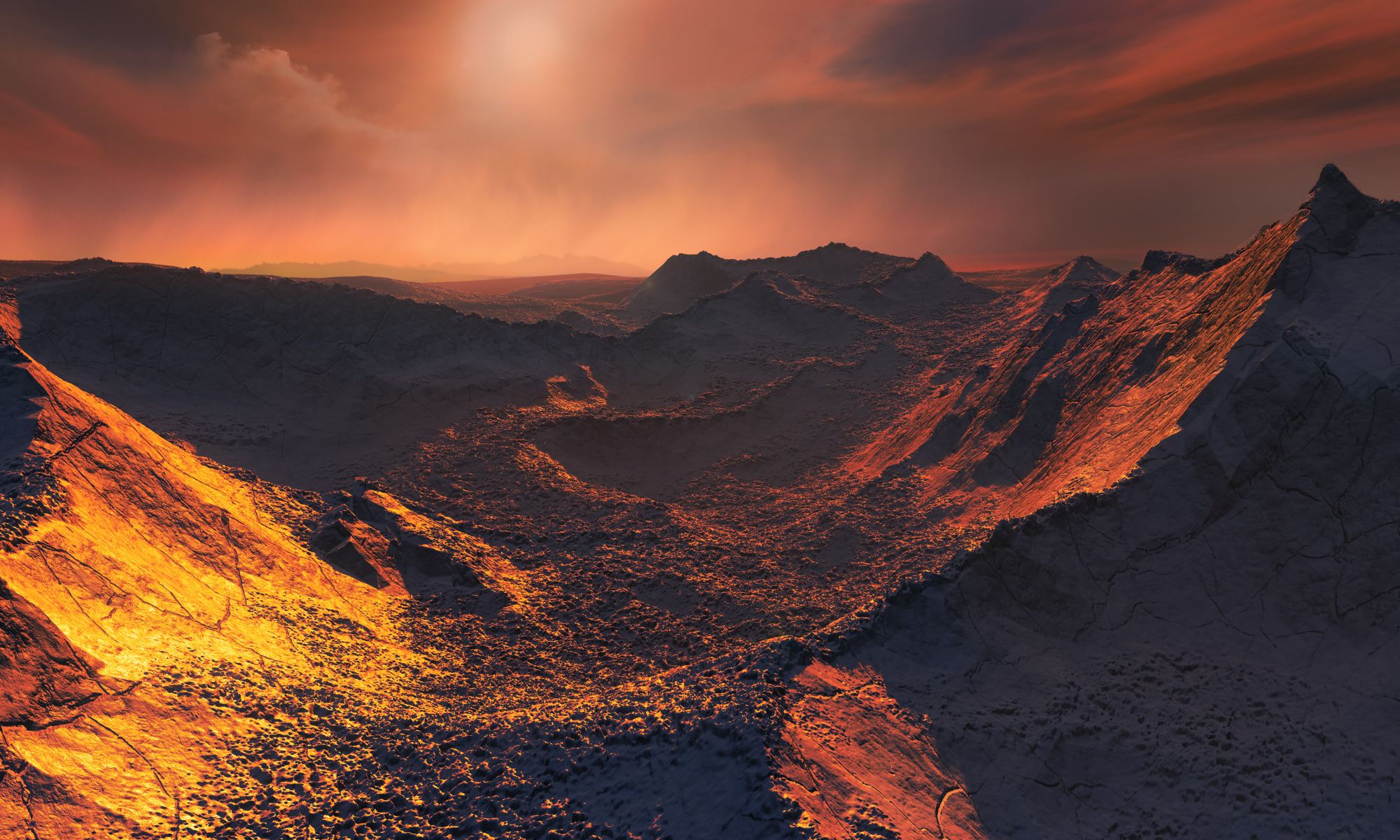
Artist depiction of the surface of a super-Earth orbiting a red dwarf. Credit: ESO/M. Kornmesser

A Super-Earth (and Possible Earth-Sized) Exoplanet Found in the Habitable Zone

Astronomers have found a new Super-Earth orbiting an M-dwarf (red dwarf) star about 137 light-years away. The planet is named TOI-715b, and it’s about 1.55 Earth’s radius and is inside the star’s habitable zone. There’s also another planetary candidate in the system. It’s Earth-sized, and if it’s confirmed, it will be the smallest habitable zone planet TESS has discovered so far.

TOI-715 is an average red dwarf. It’s about one-quarter the mass and about one-quarter the radius of our Sun. TOI-715b is close to the star, and its tight orbit takes only 19 days to complete one trip around the dwarf star. Since red dwarfs are much dimmer than the Sun, this puts the Super-Earth in the star’s conservative habitable zone.

New research published in the Monthly Notices of the Royal Astronomical Society presents the discovery. It’s titled “A 1.55 Earth-radius habitable-zone planet hosted by TOI-715, an M4 star near the ecliptic South Pole.” The lead author is Georgina Dransfield, from the School of Physics & Astronomy at the University of Birmingham.

The habitable zone is a rather crude way to identify planets that may have liquid water. Its boundaries are unclear and even contradictory since stellar spectral type, planetary albedo, mass, and even how cloudy its atmosphere is can determine if a planet has liquid water.

The idea of a conservative habitable zone (CHZ) is more helpful. It comes from a 2014 paper by Kopparapu et al. It’s a region around a star where a rocky planet receives between 0.42 and 0.842 as much solar insolation as Earth does. Any rocky planet receiving that much energy is in the CHZ, regardless of distance.

The graphic shows optimistic and conservative habitable zone boundaries around cool, low-mass stars. The numbers indicate the names of known Kepler planet candidates. Yellow represents candidates with less than 1.4 times Earth-radius. Green represents planet candidates between 1.4  and 2 Earth radius. Note: the newly discovered planets are not shown. Credit: Penn State. The graphic shows optimistic and conservative habitable zone boundaries around cool, low-mass stars. The numbers indicate the names of known Kepler planet candidates. Yellow represents candidates with less than 1.4 times Earth-radius. Green represents planet candidates between 1.4 and 2 Earth radius. Note: the newly discovered planets are not shown. Credit: Penn State.

Discovering a Super-Earth in a star’s CHZ is always exciting. It fuels our sense of wonder about other planets and the possibility that some may harbour other life. For that reason, they’re more intriguing than planets like Hot Jupiters for instance, which have zero possibility of hosting liquid water or life. Not even the hardiest extremophiles can survive a Hot Jupiter’s wicked environment.

But this discovery is also exciting for a couple of other reasons.

“At long last, the era of JWST has arrived, and with it, the age of detailed exoplanetary atmospheric characterization.”

From “A 1.55 Earth-radius habitable-zone planet hosted by TOI-715, an M4 star near the ecliptic South Pole.”

Now that we’ve discovered thousands of exoplanets, astronomers are seeing trends in the population. One of the things they noticed is a gap in the small planet population between 1.5 and 2 Earth radii. It’s known as the small planet radius gap or the sub-Neptune radius gap (also called the Fulton gap and the photoevaporation valley.) At 1.55 Earth radii, TOI-715b is inside the gap.

A histogram of planets with given radii from a sample of 900 Kepler systems. The decreased occurrence rate between 1.5 and 2.0 Earth radii is apparent. It's sometimes called the Fulton Gap because is comes from Fulton et al. 2017. Image Credit: Fulton et al. 2017. A histogram of planets with given radii from a sample of 900 Kepler systems. The decreased occurrence rate between 1.5 and 2.0 Earth radii is apparent. It’s sometimes called the Fulton Gap because it comes from Fulton et al. 2017. Image Credit: Fulton et al. 2017.

It’s extremely unlikely that no planets form in this radius gap. Planets must start out larger and lose mass to end up in the gap. So, the Fulton Gap tells us something about how some planets lose mass. Astronomers think that planets in the gap start out larger, but their stars strip away some of their mass by photoevaporation, shrinking them. That’s why it’s sometimes called the photoevaporation valley. There’s a lot of uncertainty around the valley and photoevaporation, and astronomers want to study planets in the valley to see what they can learn.

“The importance of the radius valley lies in its potential to teach us about planetary formation and post-formation evolution, and hence, planets inside this gap are crucial in furthering our understanding of the factors that sculpt it,” the authors explain.

There’s some uncertainty if this radius gap exists around M-dwarfs or not. It’s possible that M-dwarfs have a density gap rather than a radius gap. “A recent study by Luque & Pallé (2022), however, indicates that M-dwarf planets may have a density gap rather than a radius gap separating two populations of small planets (rocky and water worlds),” the authors write.

Whether it’s a radius gap or a density gap, TOI-715b should have something to tell us about exoplanets, photoevaporation, and the nature of exoplanet distribution around red dwarfs. But to discover what it has to tell us requires further, detailed observations. That’s the second reason why this Super-Earth is so intriguing.

Ever since we started finding exoplanets, scientists have looked forward to the day when the James Webb Space Telescope is operational. “At long last, the era of JWST has arrived, and with it, the age of detailed exoplanetary atmospheric characterization,” the authors write in their paper. The JWST has the ability to observe the spectra of exoplanet atmospheres and determine their constituents. But even though the JWST is enormously powerful, some targets present better opportunities for transmission spectroscopy than others.

The JWST hasn't studied TOI-715b yet, but it can measure an exoplanet's transit spectrum and its eclipse spectrum, as shown in this spectrum of the exoplanet WASP-80b. During a transit, the planet passes in front of the star, and in a transit spectrum, the presence of molecules makes the planet's atmosphere block more light at certain colours, causing a deeper dimming at those wavelengths. During an eclipse, the planet passes behind the star, and in this eclipse spectrum, molecules absorb some of the planet's emitted light at specific colours, leading to a smaller dip in brightness during the eclipse compared to a transit. Image Credit: BAERI/NASA/Taylor Bell. The JWST hasn’t studied TOI-715b yet, but it can measure an exoplanet’s transit spectrum and its eclipse spectrum, as shown in this spectrum of the exoplanet WASP-80b. During a transit, the planet passes in front of the star, and in a transit spectrum, the presence of molecules makes the planet’s atmosphere block more light at certain colours, causing a deeper dimming at those wavelengths. During an eclipse, the planet passes behind the star, and in this eclipse spectrum, molecules absorb some of the planet’s emitted light at specific colours, leading to a smaller dip in brightness during the eclipse compared to a transit. Image Credit: BAERI/NASA/Taylor Bell.

TOI-715b is a prime target because it’s close to its star. Since TOI-715 is a small red dwarf, and the planet orbits it every 19 days, the exoplanet’s transits in front of its star are deeper and more frequent. That means the JWST doesn’t need much time to observe the planet’s atmosphere, making it an efficient use of the space telescope’s time. “In the context of atmospheric characterization by transmission spectroscopy, bright, nearby M dwarfs are ideal planetary hosts as small temperate planets will transit frequently, enabling high signal-to-noise detections of atmospheric features with fewer hours of telescope time,” the authors explain.

This figure from the study shows the conservative habitable zone in blue. The y-axis shows the Transmission Spectroscopy Metric, a measure of how amenable a planet's atmosphere is to the JWST spectroscopic measurements. The x-axis shows stellar insolation. TOI-715b is shown in two instances: as a rocky world and as a water world. If it's a water world, it's more accessible to effective spectroscopy by the JWST. TOI-715's other planet candidate is shown in green. Other interesting exoplanets are also shown, including the TRAPPIST-1 planets in yellow. Image Credit: Dransfield et al. 2024. This figure from the study shows the conservative habitable zone in blue. The y-axis shows the Transmission Spectroscopy Metric, a measure of how amenable a planet’s atmosphere is to the JWST spectroscopic measurements. The x-axis shows stellar insolation. TOI-715b is shown in two instances: as a rocky world and as a water world. If it’s a water world, it’s more accessible to effective spectroscopy by the JWST. TOI-715’s other planet candidate is shown in green. Other interesting exoplanets are also shown, including the TRAPPIST-1 planets in yellow. Image Credit: Dransfield et al. 2024.

Can this Super-Earth be habitable? Lacking the JWST’s spectroscopy, we’re reduced to speculating. It’s in the conservative habitable zone, but that doesn’t get us very far. Still, there are some hopeful signs.

TOI-715 is a little older than our Sun at about 6.6 billion years old. The star shows a “low degree of magnetic activity,” according to the authors. That’s probably why the star shows an absence of flaring in the TESS light curves compared to younger M-dwarfs. Red dwarfs are known to exhibit extremely powerful flaring that can sterilize planets. They can also strip away atmospheres, which could be responsible for the exoplanet photoevaporation valley.

This artist's illustration shows a red dwarf star emitting a powerful flare. Red dwarf flaring can limit the habitability of planets in their habitable zones. Credits: NASA's Goddard Space Flight Center This artist’s illustration shows a red dwarf star emitting a powerful flare. Red dwarf flaring can limit the habitability of planets in their habitable zones. Credits: NASA’s Goddard Space Flight Center

Another planet may be orbiting TOI-715. It’s currently only a candidate named TIC 271971130.02, but if confirmed, it will be the smallest habitable zone planet TESS has ever found. But follow-up observations are needed to confirm it.

The TOI-715 system is a compelling target for further study. TOI-715b is waiting its turn, but eventually, the JWST will examine its atmosphere. If those results support habitability, astronomers’ excitement will only grow. At the same time, we may learn more about the radius or density gap, an obstacle to a more thorough understanding of exoplanets.

Add in the fact that the star may host another habitable zone planet, the smallest one found yet by TESS, and the TOI-715 system becomes even more importan

{ https://www.universetoday.com/ }

Hoe vind je dit bericht?
Geschreven door peter om 23:07 Stuur door

Meer van UFO'S of UAP'S, ASTRONOMIE, RUIMTEVAART, ARCHEOLOGIE, OUDHEIDKUNDE, SF-SNUFJES EN ANDERE ESOTERISCHE WETENSCHAPPEN - DE ALLERLAATSTE NIEUWTJES

↑ Terug naar de berichten