Naar de inhoud

UFO'S of UAP'S, ASTRONOMIE, RUIMTEVAART, ARCHEOLOGIE, OUDHEIDKUNDE, SF-SNUFJES EN ANDERE ESOTERISCHE WETENSCHAPPEN - DE ALLERLAATSTE NIEUWTJES

UFO's of UAP'S in België en de rest van de wereld
akke.beakke.be
Ontdek de Fascinerende Wereld van UFO's en UAP's: Jouw Bron voor Onthullende Informatie! Ben jij ook gefascineerd door het onbekende? Wil je meer weten over UFO's en UAP's, niet alleen in België, maar over de hele wereld? Dan ben je op de juiste plek! België: Het Kloppend Hart van UFO-onderzoek In België is BUFON (Belgisch UFO-Netwerk) dé autoriteit op het gebied van UFO-onderzoek. Voor betrouwbare en objectieve informatie over deze intrigerende fenomenen, bezoek je zeker onze Facebook-pagina en deze blog. Maar dat is nog niet alles! Ontdek ook het Belgisch UFO-meldpunt en Caelestia, twee organisaties die diepgaand onderzoek verrichten, al zijn ze soms kritisch of sceptisch. Nederland: Een Schat aan Informatie Voor onze Nederlandse buren is er de schitterende website www.ufowijzer.nl, beheerd door Paul Harmans. Deze site biedt een schat aan informatie en artikelen die je niet wilt missen! Internationaal: MUFON - De Wereldwijde Autoriteit Neem ook een kijkje bij MUFON (Mutual UFO Network Inc.), een gerenommeerde Amerikaanse UFO-vereniging met afdelingen in de VS en wereldwijd. MUFON is toegewijd aan de wetenschappelijke en analytische studie van het UFO-fenomeen, en hun maandelijkse tijdschrift, The MUFON UFO-Journal, is een must-read voor elke UFO-enthousiasteling. Bezoek hun website op www.mufon.com voor meer informatie. Samenwerking en Toekomstvisie Sinds 1 februari 2020 is Pieter niet alleen ex-president van BUFON, maar ook de voormalige nationale directeur van MUFON in Vlaanderen en Nederland. Dit creëert een sterke samenwerking met de Franse MUFON Reseau MUFON/EUROP, wat ons in staat stelt om nog meer waardevolle inzichten te delen. Let op: Nepprofielen en Nieuwe Groeperingen Pas op voor een nieuwe groepering die zich ook BUFON noemt, maar geen enkele connectie heeft met onze gevestigde organisatie. Hoewel zij de naam geregistreerd hebben, kunnen ze het rijke verleden en de expertise van onze groep niet evenaren. We wensen hen veel succes, maar we blijven de autoriteit in UFO-onderzoek! Blijf Op De Hoogte! Wil jij de laatste nieuwtjes over UFO's, ruimtevaart, archeologie, en meer? Volg ons dan en duik samen met ons in de fascinerende wereld van het onbekende! Sluit je aan bij de gemeenschap van nieuwsgierige geesten die net als jij verlangen naar antwoorden en avonturen in de sterren! Heb je vragen of wil je meer weten? Aarzel dan niet om contact met ons op te nemen! Samen ontrafelen we het mysterie van de lucht en daarbuiten.

Archief

Atoombatterij zo klein als een muntje gaat 50 jaar mee zonder opladen

Atoombatterij zo klein als een muntje gaat 50 jaar mee zonder opladen

Dankzij atoombatterijen hoeven smartphones nooit meer opgeladen te worden en kunnen drones eeuwig in de lucht blijven, zo stelt de maker. Het kan echter nog wel even duren voordat we de batterij op de markt zien.

Het batterijtje bevat 63 nucleaire isotopen, die niet schadelijk zouden zijn voor het milieu en de mens. Hij kan 100 microwatt leveren bij 3 volt.

© Betavolt

Een batterij op kernenergie klinkt op het eerste gezicht misschien niet heel veilig.

Maar de technologie wordt al jaren gebruikt voor bijvoorbeeld ruimtemissies en onderzeeërs.

En onlangs heeft een grote batterijfabrikant een prototype uitgebracht van een atoombatterij, die een groot aantal kleine apparaten maar liefst 50 jaar van energie zou kunnen voorzien zonder te hoeven worden opgeladen.

Als het principe opgeschaald kan worden, kunnen we wellicht al onze laptop- en telefoonopladers weggooien.

Veel krachtiger dan traditionele batterijen

Het Chinese Betabolt heeft 63 atomaire isotopen in zijn nieuwe atoombatterij BV100 gepropt, en hij is kleiner dan een muntje.

Het batterijtje meet slechts 15 bij 15 bij 5 millimeter en kan tot 100 microwatt opwekken bij 3 volt.

Dankzij het kleine formaat kunnen meerdere eenheden in bijvoorbeeld een smartphone erop worden aangesloten, waardoor de efficiëntie toeneemt.

Deze batterij benut de energie die vrijkomt als radioactieve isotopen vervallen om elektriciteit op te wekken.

Dit doet denken aan de technologie in oudere pacemakers en ruimtevaartuigen.

De energiedichtheid van de batterij zou ruim 10 keer zo groot zijn als die van een conventionele lithiumionbatterij – een eigenschap die drones in staat zou kunnen stellen om eeuwig te vliegen zonder op te hoeven laden.

Fabrikant: Veilig en milieuvriendelijk

Bij kernenergie zijn straling en afval over het algemeen een probleem.

© Terry Papoulias/Shutterstock

Wat is een atoombatterij?

  • Een atoombatterij haalt energie uit een radioactieve bron en verschilt van traditionele batterijen qua prijs, levensduur, toepassingen en functie.
  • Traditionele batterijen gebruiken elektrochemische reacties als energiebron.
  • Atoombatterijen gebruiken energie uit het verval van radioactieve isotopen om elektriciteit op te wekken.
  • Uraniumisotopen worden veel gebruikt om elektriciteit op te wekken omdat ze al 60 jaar de primaire energiebron van kerncentrales zijn.
  • Omdat de elektriciteit afkomstig is van een constant verval van deeltjes, ontlaadt de batterij niet sneller bij toenemend gebruik.
  • Atoombatterijen worden al gebruikt in onder meer ruimtevaartuigen en satellieten – ze helpen zelfs de Marsrover Perseverance van energie te voorzien.

Atoombatterijen zijn nooit algemeen verkrijgbaar geweest, omdat radioactieve elementen als plutonium gevaarlijk waren.

Maar volgens Betavolt vormt de straling van de atoombatterij geen gevaar omdat de radioactiviteit zo miniem is.

De BV100 is zelfs milieuvriendelijk, volgens een persbericht van Betavolt.

Als de batterij bijna aan het eind van zijn levensduur is, worden de radioactieve stoffen omgezet in koper, dat niet radioactief is en geen bedreiging vormt voor het milieu.

Betavolt test de batterij op dit moment, en het bedrijf is van plan om het batterijtype in massaproductie te nemen voor telefoons, drones en andere kleinere apparaten.

Het is echter nog onduidelijk wanneer het zo ver kan zijn.

{https://wibnet.nl/techniek }

Hoe vind je dit bericht?
Geschreven door peter om 01:26 Stuur door

A Super-Earth (and Possible Earth-Sized) Exoplanet Found in the Habitable Zone

barnard-b-2000x1200.jpg

Artist depiction of the surface of a super-Earth orbiting a red dwarf. Credit: ESO/M. Kornmesser

A Super-Earth (and Possible Earth-Sized) Exoplanet Found in the Habitable Zone

Astronomers have found a new Super-Earth orbiting an M-dwarf (red dwarf) star about 137 light-years away. The planet is named TOI-715b, and it’s about 1.55 Earth’s radius and is inside the star’s habitable zone. There’s also another planetary candidate in the system. It’s Earth-sized, and if it’s confirmed, it will be the smallest habitable zone planet TESS has discovered so far.

TOI-715 is an average red dwarf. It’s about one-quarter the mass and about one-quarter the radius of our Sun. TOI-715b is close to the star, and its tight orbit takes only 19 days to complete one trip around the dwarf star. Since red dwarfs are much dimmer than the Sun, this puts the Super-Earth in the star’s conservative habitable zone.

New research published in the Monthly Notices of the Royal Astronomical Society presents the discovery. It’s titled “A 1.55 Earth-radius habitable-zone planet hosted by TOI-715, an M4 star near the ecliptic South Pole.” The lead author is Georgina Dransfield, from the School of Physics & Astronomy at the University of Birmingham.

The habitable zone is a rather crude way to identify planets that may have liquid water. Its boundaries are unclear and even contradictory since stellar spectral type, planetary albedo, mass, and even how cloudy its atmosphere is can determine if a planet has liquid water.

The idea of a conservative habitable zone (CHZ) is more helpful. It comes from a 2014 paper by Kopparapu et al. It’s a region around a star where a rocky planet receives between 0.42 and 0.842 as much solar insolation as Earth does. Any rocky planet receiving that much energy is in the CHZ, regardless of distance.

The graphic shows optimistic and conservative habitable zone boundaries around cool, low-mass stars. The numbers indicate the names of known Kepler planet candidates. Yellow represents candidates with less than 1.4 times Earth-radius. Green represents planet candidates between 1.4  and 2 Earth radius. Note: the newly discovered planets are not shown. Credit: Penn State. The graphic shows optimistic and conservative habitable zone boundaries around cool, low-mass stars. The numbers indicate the names of known Kepler planet candidates. Yellow represents candidates with less than 1.4 times Earth-radius. Green represents planet candidates between 1.4 and 2 Earth radius. Note: the newly discovered planets are not shown. Credit: Penn State.

Discovering a Super-Earth in a star’s CHZ is always exciting. It fuels our sense of wonder about other planets and the possibility that some may harbour other life. For that reason, they’re more intriguing than planets like Hot Jupiters for instance, which have zero possibility of hosting liquid water or life. Not even the hardiest extremophiles can survive a Hot Jupiter’s wicked environment.

But this discovery is also exciting for a couple of other reasons.

“At long last, the era of JWST has arrived, and with it, the age of detailed exoplanetary atmospheric characterization.”

From “A 1.55 Earth-radius habitable-zone planet hosted by TOI-715, an M4 star near the ecliptic South Pole.”

Now that we’ve discovered thousands of exoplanets, astronomers are seeing trends in the population. One of the things they noticed is a gap in the small planet population between 1.5 and 2 Earth radii. It’s known as the small planet radius gap or the sub-Neptune radius gap (also called the Fulton gap and the photoevaporation valley.) At 1.55 Earth radii, TOI-715b is inside the gap.

A histogram of planets with given radii from a sample of 900 Kepler systems. The decreased occurrence rate between 1.5 and 2.0 Earth radii is apparent. It's sometimes called the Fulton Gap because is comes from Fulton et al. 2017. Image Credit: Fulton et al. 2017. A histogram of planets with given radii from a sample of 900 Kepler systems. The decreased occurrence rate between 1.5 and 2.0 Earth radii is apparent. It’s sometimes called the Fulton Gap because it comes from Fulton et al. 2017. Image Credit: Fulton et al. 2017.

It’s extremely unlikely that no planets form in this radius gap. Planets must start out larger and lose mass to end up in the gap. So, the Fulton Gap tells us something about how some planets lose mass. Astronomers think that planets in the gap start out larger, but their stars strip away some of their mass by photoevaporation, shrinking them. That’s why it’s sometimes called the photoevaporation valley. There’s a lot of uncertainty around the valley and photoevaporation, and astronomers want to study planets in the valley to see what they can learn.

“The importance of the radius valley lies in its potential to teach us about planetary formation and post-formation evolution, and hence, planets inside this gap are crucial in furthering our understanding of the factors that sculpt it,” the authors explain.

There’s some uncertainty if this radius gap exists around M-dwarfs or not. It’s possible that M-dwarfs have a density gap rather than a radius gap. “A recent study by Luque & Pallé (2022), however, indicates that M-dwarf planets may have a density gap rather than a radius gap separating two populations of small planets (rocky and water worlds),” the authors write.

Whether it’s a radius gap or a density gap, TOI-715b should have something to tell us about exoplanets, photoevaporation, and the nature of exoplanet distribution around red dwarfs. But to discover what it has to tell us requires further, detailed observations. That’s the second reason why this Super-Earth is so intriguing.

Ever since we started finding exoplanets, scientists have looked forward to the day when the James Webb Space Telescope is operational. “At long last, the era of JWST has arrived, and with it, the age of detailed exoplanetary atmospheric characterization,” the authors write in their paper. The JWST has the ability to observe the spectra of exoplanet atmospheres and determine their constituents. But even though the JWST is enormously powerful, some targets present better opportunities for transmission spectroscopy than others.

The JWST hasn't studied TOI-715b yet, but it can measure an exoplanet's transit spectrum and its eclipse spectrum, as shown in this spectrum of the exoplanet WASP-80b. During a transit, the planet passes in front of the star, and in a transit spectrum, the presence of molecules makes the planet's atmosphere block more light at certain colours, causing a deeper dimming at those wavelengths. During an eclipse, the planet passes behind the star, and in this eclipse spectrum, molecules absorb some of the planet's emitted light at specific colours, leading to a smaller dip in brightness during the eclipse compared to a transit. Image Credit: BAERI/NASA/Taylor Bell. The JWST hasn’t studied TOI-715b yet, but it can measure an exoplanet’s transit spectrum and its eclipse spectrum, as shown in this spectrum of the exoplanet WASP-80b. During a transit, the planet passes in front of the star, and in a transit spectrum, the presence of molecules makes the planet’s atmosphere block more light at certain colours, causing a deeper dimming at those wavelengths. During an eclipse, the planet passes behind the star, and in this eclipse spectrum, molecules absorb some of the planet’s emitted light at specific colours, leading to a smaller dip in brightness during the eclipse compared to a transit. Image Credit: BAERI/NASA/Taylor Bell.

TOI-715b is a prime target because it’s close to its star. Since TOI-715 is a small red dwarf, and the planet orbits it every 19 days, the exoplanet’s transits in front of its star are deeper and more frequent. That means the JWST doesn’t need much time to observe the planet’s atmosphere, making it an efficient use of the space telescope’s time. “In the context of atmospheric characterization by transmission spectroscopy, bright, nearby M dwarfs are ideal planetary hosts as small temperate planets will transit frequently, enabling high signal-to-noise detections of atmospheric features with fewer hours of telescope time,” the authors explain.

This figure from the study shows the conservative habitable zone in blue. The y-axis shows the Transmission Spectroscopy Metric, a measure of how amenable a planet's atmosphere is to the JWST spectroscopic measurements. The x-axis shows stellar insolation. TOI-715b is shown in two instances: as a rocky world and as a water world. If it's a water world, it's more accessible to effective spectroscopy by the JWST. TOI-715's other planet candidate is shown in green. Other interesting exoplanets are also shown, including the TRAPPIST-1 planets in yellow. Image Credit: Dransfield et al. 2024. This figure from the study shows the conservative habitable zone in blue. The y-axis shows the Transmission Spectroscopy Metric, a measure of how amenable a planet’s atmosphere is to the JWST spectroscopic measurements. The x-axis shows stellar insolation. TOI-715b is shown in two instances: as a rocky world and as a water world. If it’s a water world, it’s more accessible to effective spectroscopy by the JWST. TOI-715’s other planet candidate is shown in green. Other interesting exoplanets are also shown, including the TRAPPIST-1 planets in yellow. Image Credit: Dransfield et al. 2024.

Can this Super-Earth be habitable? Lacking the JWST’s spectroscopy, we’re reduced to speculating. It’s in the conservative habitable zone, but that doesn’t get us very far. Still, there are some hopeful signs.

TOI-715 is a little older than our Sun at about 6.6 billion years old. The star shows a “low degree of magnetic activity,” according to the authors. That’s probably why the star shows an absence of flaring in the TESS light curves compared to younger M-dwarfs. Red dwarfs are known to exhibit extremely powerful flaring that can sterilize planets. They can also strip away atmospheres, which could be responsible for the exoplanet photoevaporation valley.

This artist's illustration shows a red dwarf star emitting a powerful flare. Red dwarf flaring can limit the habitability of planets in their habitable zones. Credits: NASA's Goddard Space Flight Center This artist’s illustration shows a red dwarf star emitting a powerful flare. Red dwarf flaring can limit the habitability of planets in their habitable zones. Credits: NASA’s Goddard Space Flight Center

Another planet may be orbiting TOI-715. It’s currently only a candidate named TIC 271971130.02, but if confirmed, it will be the smallest habitable zone planet TESS has ever found. But follow-up observations are needed to confirm it.

The TOI-715 system is a compelling target for further study. TOI-715b is waiting its turn, but eventually, the JWST will examine its atmosphere. If those results support habitability, astronomers’ excitement will only grow. At the same time, we may learn more about the radius or density gap, an obstacle to a more thorough understanding of exoplanets.

Add in the fact that the star may host another habitable zone planet, the smallest one found yet by TESS, and the TOI-715 system becomes even more importan

{ https://www.universetoday.com/ }

Hoe vind je dit bericht?
Geschreven door peter om 23:07 Stuur door

Half the Entire Sky, Seen in X-Rays

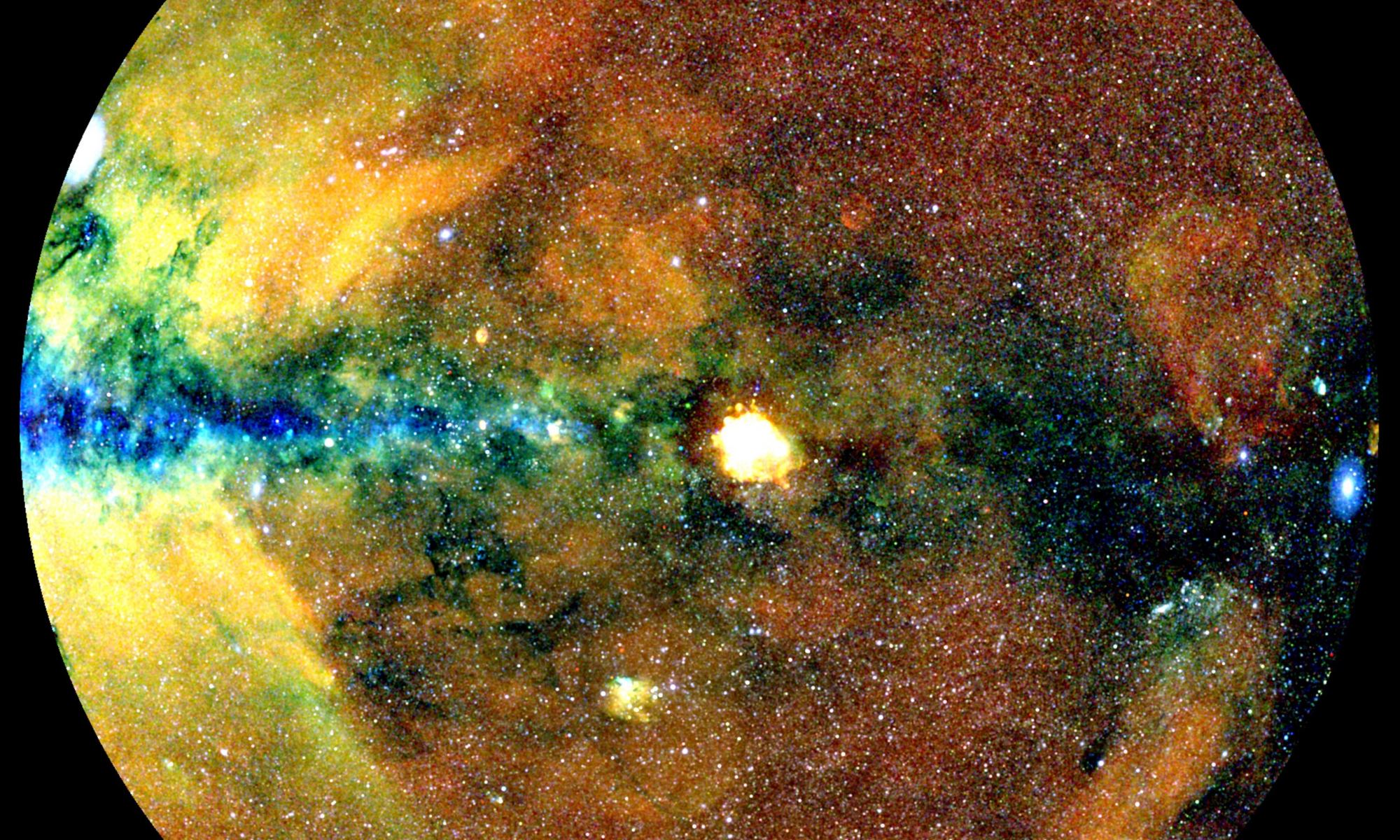
This image show half of the X-ray sky, projected onto a circle with the center of the Milky Way on the left and the galactic plane running horizontally. Photons have been colour-coded according to their energy (red for energies 0.3-0.6 keV, green for 0.6-1 keV, blue for 1-2.3 keV). Credit: MPE, J. Sanders for the eROSITA consortium

This image show half of the X-ray sky, projected onto a circle with the center of the Milky Way on the left and the galactic plane running horizontally. Photons have been colour-coded according to their energy (red for energies 0.3-0.6 keV, green for 0.6-1 keV, blue for 1-2.3 keV). Credit: MPE, J. Sanders for the eROSITA consortium

Half the Entire Sky, Seen in X-Rays

There’s an old trope in science fiction about someone suddenly getting X-ray vision and looking through solid objects. It turns out to be a physical impossibility with our Mark I eyeballs. However, astronomers have found a way around that challenge that lets us study the Universe with X-ray vision.

It’s called x-ray astronomy and it’s been around for 60 years. It reveals some of the most energetic and violent events and objects in the cosmos. Those include things like bright quasars, supernova explosions, streams of hot gas between galaxies, and hot, young stars.

Recently, astronomers in the eROSITA consortium at the Max Planck Institute for Extraterrestrial Physics announced the latest trove of X-ray data from the eROSITA survey. It covers half the X-ray sky and reveals information about 900,000 distinct X-ray sources. That’s more than all the ones ever detected in X-ray astronomy’s decades of history, including discoveries made with Chandra and other orbiting observatories.

About eROSITA

eROSITA is a soft x-ray imaging telescope aboard the Spectrum-RG satellite. Its first all-sky survey, called eRASS1, took place over 7 months beginning on December 12, 2019. At its most sensitive setting, the telescope detected 170 million X-ray photons. That allowed the cameras to measure their energies and arrival times.

The astronomy team, led by principal investigator Andrea Merloni, put together a first-release catalog of data. They also published more than 50 new science papers based on their findings. After finishing this first survey, the instrument carried out three more scans of the entire sky between June 2020 and February 2022. That huge treasuring of x-ray data will be released shortly. The video below explains more about the mission.

eROSITA’s Treasury of X-ray Sources

X-ray astronomy focuses on hot and energetic objects and events in the Universe. Those would be the cores of galaxies (where supermassive black holes lurk), supernova explosions, newborn stars, and other places where matter gets heated to high temperatures.

This preliminary data eRASS1 data set pinpoints about 710,000 supermassive black holes, 180,000 x-ray emitting stars in the Milky Way, and 12,000 clusters of galaxies. It also covers a small number of other exotic sources like X-ray-emitting binary stars, supernova remnants, pulsars, and other objects.

“These are mind-blowing numbers for X-ray astronomy,” says Andrea Merloni, eROSITA principal investigator and first author of the eROSITA catalog paper. “We’ve detected more sources in 6 months than the big flagship missions XMM-Newton and Chandra have done in nearly 25 years of operation.”

The eROSITA first data release is a rich, “multi-layered” look at the sky at several X-ray energies. Each energy level tells astronomers something about the objects and events emitting the X-rays. And, for each set of images and data, the consortium provides more information. There are lists of source classes, sky positions, energies, and precise arrival times of the photons to the instrument. “We’ve made a huge effort to release high-quality data and software,” added Miriam Ramos-Ceja, who leads the eROSITA Operations team. “We hope this will broaden the base of scientists worldwide working with high-energy data and help push the frontiers of X-ray astronomy.”

Zeroing in on Specific X-ray Objects

eROSITA’s science objectives are to use X-rays as a way to detect the hot intergalactic medium of 50 to 100,000 galaxy clusters and groups. It also looks at hot gas in filaments between them. Those filaments glow in X-rays. The instrument is also tasked with detecting accreting black holes hidden in galaxies. Finally, it studied the physics of galactic X-ray sources (which include pre-main-sequence stars, supernova remnants, and X-ray binaries).

eROSITA X-ray image with the newly discovered filament between two galaxy clusters. The distribution of galaxies (white contours, upper left), as seen from the Two Micron All Sky Survey, follows the structure of the filament. In the SLOW simulation, which is tailored to reproduce the main features of the Local Universe, this individual system with both clusters and the filament spine is reproduced as well.  Credit: Dietl et al. (2024) eROSITA X-ray image with the newly discovered filament between two galaxy clusters. The distribution of galaxies (white contours, upper left), as seen from the Two Micron All Sky Survey, follows the structure of the filament. In the SLOW simulation, which is tailored to reproduce the main features of the Local Universe, this individual system with both clusters and the filament spine is reproduced as well.
Credit: Dietl et al. (2024)

At least one of the papers released with the new survey data uses x-ray data to constrain cosmological models using clusters of galaxies. In one release image, we see a newly discovered filament of material. It stretches between one portion of the galaxy cluster Abell 3667 and the nearby cluster Abell 3651. This may help astronomers determine how much matter exists in the so-called “warm-hot intergalactic medium”. It gives insight into the formation of large-scale structures (like galaxy clusters) in the Universe.

This X-ray image shows the full extent of the Virgo Cluster. The bright white spot at the center is the central galaxy M87 The hazy white glow around M87 is the very hot gas between galaxies. It extends out more in some directions than others, and isn’t circular; this is evidence that the Virgo Cluster is still in the process of forming. The colorful stripe in the bottom left comes from foreground emission inside our galaxy and is known as one of the eROSITA bubbles. Credit: McCall al. (2024) This X-ray image shows the full extent of the Virgo Cluster in X-rays as seen by eROSITA. The bright white spot at the center is the central galaxy M87. The hazy white glow around M87 is the very hot gas between galaxies. It extends out more in some directions than others, and isn’t circular. This is evidence that the Virgo Cluster is still in the process of forming. Credit: McCall al. (2024)

The nearby Virgo Cluster of galaxies also shows up in the eRASS1 survey and provides a way to study large-scale filamentary structures. In particular, astronomers want to understand the physical effects operating in the outskirts of these massive galaxy clusters. Using the new survey data, plus other all-sky images, a science team explored the structure of the cluster’s outskirts. That included high-energy emissions around galaxies and groups within the cluster. They also studied a so-called 320-kiloparsec-long “x-ray extension” near the galaxy M49.

eROSITA’s Past Work and Future

eROSITA has enabled a huge leap forward in X-ray astronomy since its launch in June 2019. It began operations in October of that year, providing high-resolution X-ray vision of the cosmos. As it scanned the sky, it glimpsed changes in a distant quasar called SMSS J114447.77-430859.3. Those changes give some clues to the growth of the black hole at the heart of the quasar. It observed changes in the brightness variations at the heart of the quasar, indicating that the black hole swallows some of the material that strays into its event horizon. Other material escapes in the form of powerful winds.

The instrument has also detected a newly forming black hole in the early Universe and traced the existence of hot gas all around our own Milky Way Galaxy. The instrument had its first light on October 22, 2019. Currently, it’s in safe mode and technicians are assessing its health and status.

For More Information

{ https://www.universetoday.com/ }

Hoe vind je dit bericht?
Geschreven door peter om 22:54 Stuur door

Fishermen Spot Rare Clouds Off Key West That Look Like UFOs

Fishermen Spot Rare Clouds Off Key West That Look Like UFOs

BY CASS ANDERSON

rare hole punch clouds aka Fallstreak holes

ISTOCKPHOTO / MINDFUL SNAP

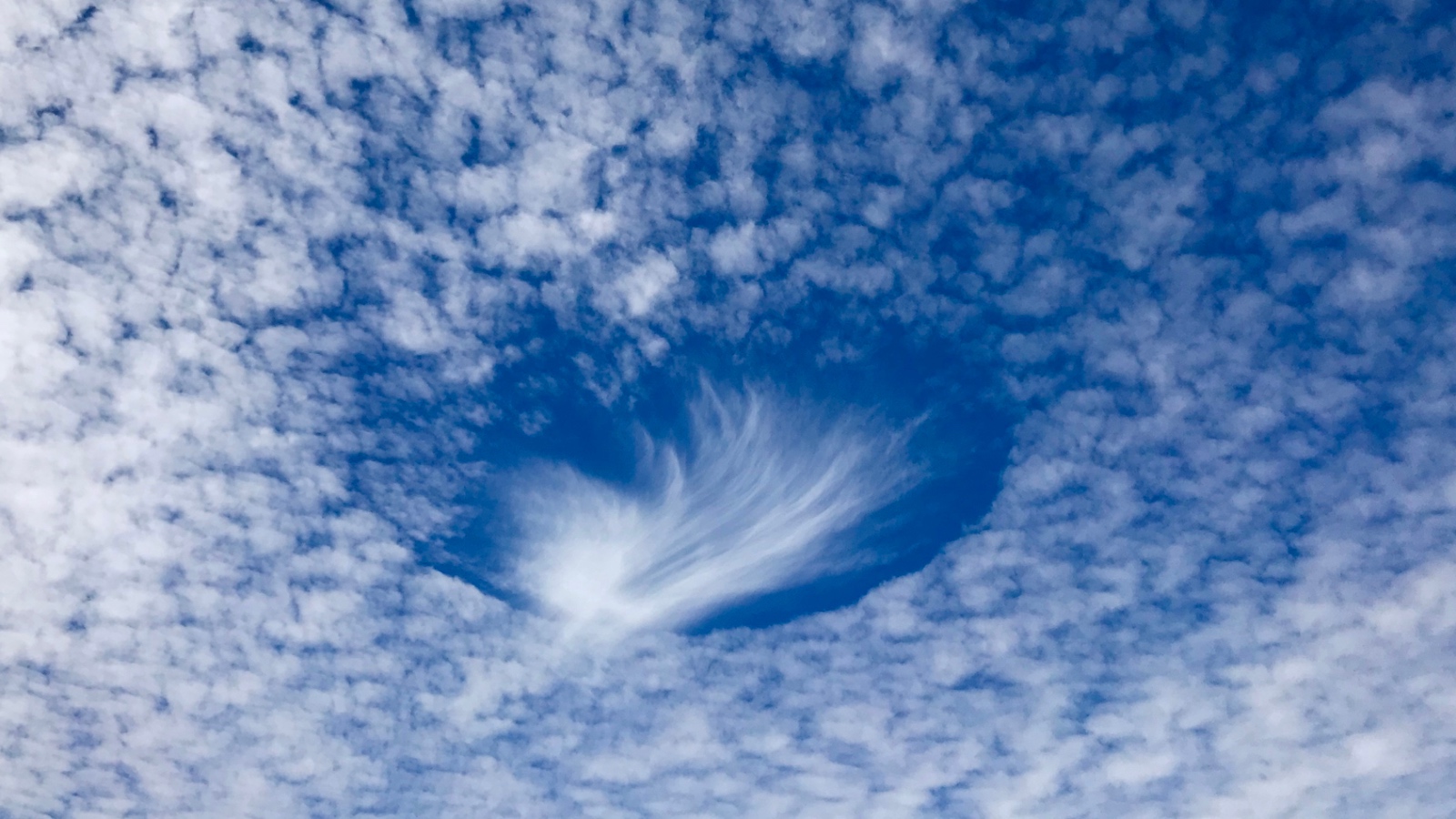
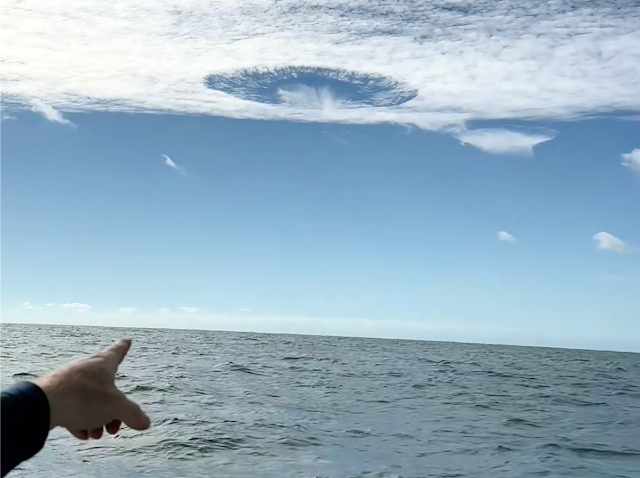
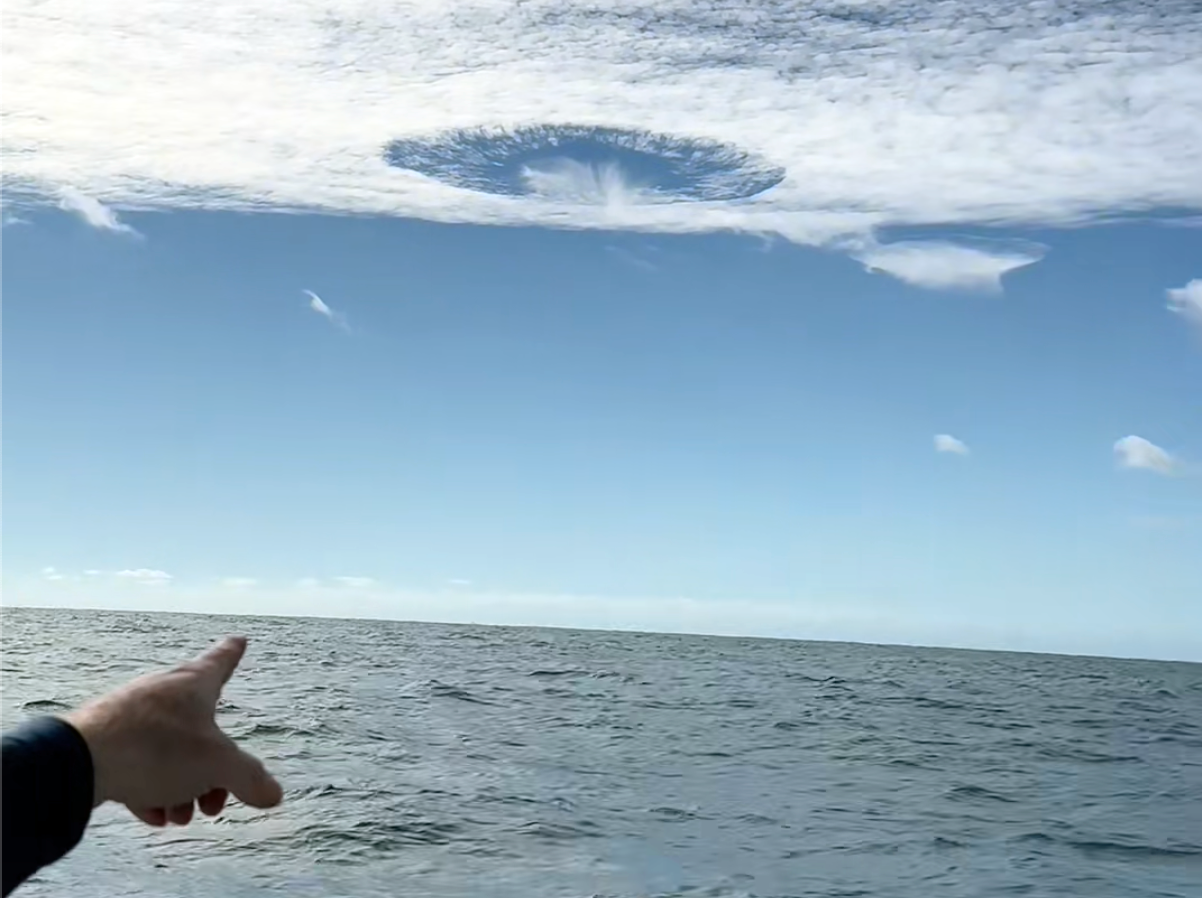
Fishermen off Key West, Florida looking up at the sky might’ve thought they were seeing the early stages of an alien invasion due to the rare hole punch clouds in the sky.

Josh Jorgensen from BlacktipH Fishing, one of the most popular fishing YouTube channels around, shared this clip from Key West, Florida and at first glance his followers were like ‘yup, those are aliens.’ After comments from crackpots, someone pointed out they were rare punch hole clouds, better known as fallstreak holes, which are created when supercooled water evaporates and leaves a large circular gap behind.

Who better to explain what Fallstreak Holes aka Hole Punch Clouds are than a website named ‘Cloud Appreciation Society’ who wrote an article about these rare clouds back in 2011, shortly after a recent study into the phenomenon had been published in Science Magazine.

That article states “for the hole to form, the droplets in the cloud layer need to be ‘supercooled’. This means that they are at a temperature below 0˚ Celsius, but have yet to frozen.” The 2011 research confirmed that aircraft play a role in the formation of these clouds with “expansion of the air as it passes over the aircraft wings and (for certain types of plane) over the blades of its propellers” causing the cooling which leads to the formation.

Here is another look at these rare clouds:

It has been quite cold here in Florida over the past week. While January ended 1-degree warmer than the historical average it seemed amiss to Floridians who felt like the first month of the year was particularly cold.

That’s because while the afternoon temperatures were cooler than Januarys past the actual ‘low’ temperatures overnight and in the early mornings in Florida were much higher than the historical averages. All of that is to say Florida has had some particularly cold weather recently which triggered this rare cloud formation off Key West seen by BlacktipH.

 { https://brobible.com/ }

Hoe vind je dit bericht?
Geschreven door peter om 22:34 Stuur door

Fishermen witness Fleet of UFOs Over Key West, Florida Ocean On Feb 1, 2024, Video, UFO Sighting News.

Fishermen witness Fleet of UFOs Over Key West, Florida Ocean On Feb 1, 2024, Video, UFO Sighting News.

ET,%20UFO,%20UFOs,%20sighting,%20sightings,%20alien,%20aliens,%20W56,%20SOHO,%20NASA,%20solar,%20LASCO,%20top%20secret,%20classified,%20ESA,%20UN,%20CNN,%20CNBC,%20.png

ovni,%20omni,MUFON,%20%E7%9B%AE%E6%92%83%E3%80%81%E3%82%A8%E3%82%A4%E3%83%AA%E3%82%A2%E3%83%B3,%20%20UFO,%20UFOs,%20sighting,%20sightings,%20alien,%20astrobiology,%20paleontology,%20waarneming,%20vreemdelinge,%20%20.png

Date of sighting: Feb 1, 2024
Location of sighting: Key West, Florida, USA
Source: 
Guys this is just amazing, remember that I mentioned that there is an alien base that is below part of Florida and extends out into the Florida Keys for 10 miles? Well here is more proof. More UFOs have been seen or at least, the imprint of the UAP disks have been seen which pressed into the clouds from above and created a bowl-like shape. This in not one, but a whole fleet of ships that came from outside our atmosphere and sat in the clouds until nightfall where they then lower down into the water to go down into the underground base, 5km below the ocean floor. 100% proof that alien try to outsmart us with making us second, third and fourth guess ourselves, when all along, there is only one explanation...aliens. 
 
Now in the 89 page MUFON UFO investigation paper on the O'Hare airport incident of 2006, they said the UFO seen by eyewitnesses at the airport hovered then shot off upward through the clouds fast, leaving a disk shaped hole in the cloud for 15 minutes! So yeah, UFOs make holes in clouds. The proof in documented. 
Scott C. Waring 
Hoe vind je dit bericht?
Geschreven door peter om 21:34 Stuur door

Alien Base Discovered In NASA Moon Photo, Apollo 11, 1969, UFO Sighting News.

Alien Base Discovered In NASA Moon Photo, Apollo 11, 1969, UFO Sighting News.

UAP,%20%E0%A4%89%E0%A4%AB%E0%A5%8C%20,%20%E0%A6%87%E0%A6%89%E0%A6%8F%E0%A6%AB%E0%A6%93,%20%C4%91i%CC%83a%20bay,%20MUFON,%20%E7%9B%AE%E6%92%83%E3%80%81%E3%82%A8%E3%82%A4%E3%83%AA%E3%82%A2%E3%83%B3,%20%20UFO,%20UFOs,%20%D0%9D%D0%9B%D0%9E%20,%20NLO,%20sighting,%20sightings,%20alien,%20aliens,%20ET,%20anomaly,%20anomalies,%20ancient,%20astrobiology,%20.png
Mission: Apollo 11, 1969 
Location of discovery: Earths Moon 
Photo at: 
NASA official site:
 
Guys check this out. There is a three mile long alien base on the moon and it's just mind boggling. The original source of the photo from NASA has been altered and diminished in quality. However there is another source of it at an Internet archive that saves websites across the net and its photo is the original photo before NASA changed it. The original photo has a more clear view of the alien base, allowing us to see its tube like detail and its circle centers. No I don't think NASA wants to come clean and tell the public the truth about aliens existing. If they did, they would have already done it. So it's up to us, job public to bring the evidence to light. 
Scott C. Waring 
 

{ https://www.ufosightingsdaily.com/ }

Hoe vind je dit bericht?
Geschreven door peter om 21:29 Stuur door

The Italian Ufologists’ Quest for Truth'

The Italian Ufologists’ Quest for Truth'

The Italian Ufologists

In the realm of the unexplained and the mysterious, UFO sightings have always captivated human imagination. Italy, with its rich history and cultural heritage, is no exception. A group of dedicated Italian researchers, known as ufologists, have delved deep into the enigma of unidentified flying objects, bringing to light the intriguing and often perplexing phenomena associated with these sightings.

The Heart of Italian Ufology

At the forefront of this exploration is a documentary titled “UFO Hunters: The Italian Ufologists,” directed by Stefania Grondona and featuring David White among its cast. The documentary embarks on a journey through Italy, unraveling mass UFO sightings, the study of clipeology (the study of objects in the sky throughout history), and real testimonies from those who have witnessed these unexplained phenomena.

A Notable Case: Mont Proa’s Unidentified Visitor

One of the most compelling cases highlighted in the documentary occurred in 1996 in Mont Proa, a town in the province of Naples. Researchers, including the ufologist team, personally visited the town to meet with witnesses Luigi Kti and his family. Their account of a UFO circling undisturbed over the town, defying the laws of gravity and leaving onlookers in awe, represents a significant moment in Italian ufology. The object, estimated to be about 30 meters in diameter, exhibited characteristics beyond conventional aircraft, including three spheres around a transparent central core.

The Role of Technology and the Challenge of Authenticity

The documentary delves into the challenges faced by ufologists in documenting and analyzing UFO sightings. With the advent of smartphones, the quality of captured images often does not meet the standards required for clear analysis. Additionally, the documentary points out the paradox of authenticity in the digital age, where advanced video editing tools have made it easier to create fake sightings, underscoring the importance of relying on credible UFO research centers.

The Psychological Aspect of UFO Sightings

An interesting facet of the documentary is its exploration of the psychological impact of UFO sightings on individuals. It discusses how the sudden encounter with the unknown triggers a range of emotional responses, from excitement to fear, affecting the witnesses’ ability to accurately describe their experiences. The documentary emphasizes the need for a multidisciplinary approach to understand these encounters, incorporating expertise from psychology, neurology, and other fields to assess the credibility of witnesses and the impact of these experiences on their psyche.

The Continuous Quest for Understanding

“UFO Hunters: The Italian Ufologists” not only presents specific cases of UFO sightings but also reflects on the broader implications of these encounters for society. The documentary explores how these unexplained phenomena challenge our understanding of the world and push the boundaries of conventional science and knowledge.

VIDEO:

  • UFO Hunters: The Italian Ufologists | Full Documentary

The dedication of Italian ufologists to unraveling the mysteries of UFO sightings offers a fascinating glimpse into a world that exists at the edges of our understanding. “UFO Hunters: The Italian Ufologists” stands as a testament to the human quest for knowledge and the unyielding curiosity that drives us to explore the unknown. Through meticulous research, analysis, and an open-minded approach, these researchers continue to seek answers, reminding us of the vastness of the universe and the potential for discoveries that lie beyond our current comprehension.

{ https://www.latest-ufo-sightings.net/ }

Hoe vind je dit bericht?
Geschreven door peter om 18:33 Stuur door

BRITSE WETENSCHAPPERS MAKEN PLANNEN OM BEWIJS VAN BUITENAARDS LEVEN TE PRESENTEREN

BRITSE WETENSCHAPPERS MAKEN PLANNEN OM BEWIJS VAN BUITENAARDS LEVEN TE PRESENTEREN

Britse wetenschappers hebben aangekondigd dat ze zich voorbereiden om bewijs te presenteren van buitenaards leven. Dit opwindende nieuws komt als een mijlpaal in de zoektocht naar leven buiten onze planeet en doet vragen rijzen over wat er precies ontdekt is en wanneer we de details kunnen verwachten. In dit artikel zullen we de aankondiging van deze wetenschappers nader onderzoeken en proberen te begrijpen wat deze onthulling voor de mensheid kan betekenen.

Bewijs van buitenaards leven

In een kort interview met Dr. Maggie Aderin-Pocock, een vooraanstaande astronoom, stelde journalist Holland de prangende vraag over haar verwachtingen voor het jaar 2024. Tot verrassing van velen gaf Dr. Aderin-Pocock een opmerkelijk openhartig antwoord: ‘Ik denk dat we buitenaards leven zullen ontdekken.’ Deze gewaagde uitspraak werd al snel ondersteund door andere prominente experts in de ruimtewetenschap, waaronder astrofysicus Becky Smethurst en astronaut Tim Peake. Beiden hintten naar het bestaan van sterke bewijzen voor een biosignatuur op een exoplaneet, dat wil zeggen, een planeet die om een andere ster dan onze zon draait. De opvallende overeenkomst tussen deze voorspellingen, afkomstig van Britse wetenschappers, doet vermoeden dat ze mogelijk wijzen naar hetzelfde wetenschappelijke artikel, wellicht van Britse origine. In dit artikel verkennen we deze opwindende voorspellingen en de mogelijke implicaties voor de zoektocht naar buitenaards leven in 2024.”

“Dit artikel werpt een boeiend licht op een mogelijk keerpunt in de zoektocht naar buitenaards leven. Er wordt gesuggereerd dat binnenkort overtuigend bewijs kan worden geleverd voor de aanwezigheid van buitenaards leven op een exoplaneet, gebaseerd op biosignaturen zoals gassen en chemicaliën in de atmosfeer die mogelijk afkomstig zijn van organische wezens. Deze recente uitspraken hebben de speculaties en discussies over buitenaards leven naar een nieuw hoogtepunt gebracht. Sommigen beweren zelfs dat dit het begin zou kunnen zijn van wat wordt genoemd ‘openbaarmaking’, waarbij de mensheid voorzichtig wordt ingelicht over de mogelijke aanwezigheid van buitenaards leven, zonder de wereld te destabiliseren. In dit artikel verkennen we de opwindende ontwikkelingen en wat ze zouden kunnen betekenen voor ons begrip van het universum.”

{ https://sgxl.nl/ }

Hoe vind je dit bericht?
Geschreven door peter om 18:19 Stuur door

CHINESE WETENSCHAPPERS ONTWIKKELEN MATERIAAL DAT JE ONZICHTBAAR MAAKT!

CHINESE WETENSCHAPPERS ONTWIKKELEN MATERIAAL DAT JE ONZICHTBAAR MAAKT!

Chinese Wetenschappers Creëren Materiaal dat Onzichtbaarheid Mogelijk Maakt!

Beeld: Weibo

John Cena wordt binnenkort, dus niet de enige die onzichtbaarheid is (haha). Heb je ooit van Chimera gehoord? Nee, niet het mythische wezen, maar de nieuwste doorbraak van Chinese wetenschappers! Materiaal dat onzichtbaarheid mogelijk maakt! Geïnspireerd door de natuurlijke eigenschappen van camouflagemeesters. Deze baanbrekende uitvinding, genaamd Chimera, zou wel eens een spelveranderaar kunnen zijn in zowel militaire als natuurbehoudtoepassingen. Laten we eens dieper duiken in deze fascinerende ontwikkeling die ons vermogen om te verbergen opnieuw definieert.

Chimera

Het concept van materiaal dat onzichtbaarheid mogelijk maakt, is even intrigerend als het klinkt. Deze vinding gebruikt verschillende soorten geavanceerde voorwerpen die licht– en warmtegolven op slimme wijze manipuleren, waardoor het objecten bijna volledig uit het zicht kan onttrekken. Het is alsof je een kameleon, glaskikker, en baardagaam samenbrengt in één supermateriaal, waarbij elk dier zijn unieke camouflagevermogen bijdraagt aan deze baanbrekende uitvinding.

Chinese Wetenschappers Creëren Materiaal dat Onzichtbaarheid Mogelijk Maakt!

Beeld: Pexels ego

Materiaal dat Onzichtbaarheid Mogelijk Maakt

Deze technologie, die bijna onzichtbaar is voor warmtecamera’s, zou een grote impact kunnen hebben op hoe we ons verbergen voor radar en camera’s. Het is alsof je je eigen onzichtbaarheidsmantel hebt, rechtstreeks uit de sciencefictionfilms! De mogelijkheden van Chimera zijn enorm. In een militaire context kan het worden gebruikt om uitrusting of zelfs personen aan het zicht te onttrekken. Maar het kan ook worden ingezet voor natuurbehoud, waardoor wetenschappers dieren kunnen observeren zonder hun natuurlijke gedrag te verstoren.

Uitvinding van Chinese wetenschappers

Chimera, de recente uitvinding van Chinese wetenschappers, opent een wereld van mogelijkheden in onzichtbaarheidstechnologie. Van het verbergen van militair materieel tot het onopvallend bestuderen van dieren in het wild, de toepassingen zijn net zo gevarieerd als ze indrukwekkend zijn. Deze ontwikkeling laat zien hoe ver we zijn gekomen in het nabootsen van de wonderen van de natuur en hoe we deze kunnen gebruiken voor onze technologische vooruitgang. Het materiaal dat onzichtbaarheid mogelijk maakt, is niet alleen een stap vooruit in de wetenschap, maar ook een fascinerend voorbeeld van hoe de natuur onze grootste inspiratiebron blijft.

Check ook:

{ https://sgxl.nl/ }

Hoe vind je dit bericht?
Geschreven door peter om 18:05 Stuur door

AMERIKAANSE EX-MILITAIR BEWEERT 92 DAGEN ONTVOERD TE ZIJN DOOR ALIENS

AMERIKAANSE EX-MILITAIR BEWEERT 92 DAGEN ONTVOERD TE ZIJN DOOR ALIENS

Buitenaardse Ontmoeting

Beeld: Pixabay 2857440

Buitenaardse ontmoeting?! Je speelt verstoppertje, valt in slaap, en wordt wakker in een buitenaards moederschip! Dit klinkt als het script voor een sciencefictionfilm, toch? Maar voor Alex Collier, een voormalige Amerikaanse legerhelikopterpiloot, was dit de realiteit – tenminste, dat beweert hij. Hij deelt een ongelooflijk verhaal over zijn ‘ontvoering’ door aliens, waarbij hij 92 dagen bij Andromedianen doorbracht, maar op aarde slechts 18 minuten vermist was. Klinkt bizar? Lees verder en oordeel zelf!

Een Onverwachte Reis naar de Sterren

Het avontuur van Alex begon toen hij als kind verstoppertje speelde in een maïsveld. Wat begon als een onschuldig spelletje, eindigde in een buitenaardse ontmoeting die de grenzen van onze verbeelding tart. Eenmaal aan boord van het Andromediaanse schip, kreeg Collier de kans om hun samenleving van dichtbij te observeren. Hij beschrijft het als een leerzame en unieke ervaring, bijna als een ‘vis in een kom’, waarbij hij net zo goed werd bestudeerd als dat hij zelf observeerde.

Buitenaardse Ontmoeting

Beeld: Pexels Stephen

De Complexiteit van Buitenaardse Technologie

Collier doet uit de doeken over de geavanceerde technologieën van het schip, die onze huidige wetenschappelijke kennis ver overstijgen. Hij beschrijft hoe de fysieke en dimensionale wetten veranderen zodra je het schip betreedt, iets wat voor ons, aardbewoners, bijna onmogelijk te bevatten is.

Buitenaardse Ontmoeting

De buitenaardse ontmoeting van Collier was niet alleen een culturele onderdompeling in een andere beschaving, maar ook een reis door de complexiteiten van tijd en ruimte. Hij ondervond fysieke veranderingen en tijdreizen, een concept dat onze aardse wetten tart. Volgens zijn verhaal stond één dag bij de Andromedianen gelijk aan 31 dagen op aarde. Deze verhouding in tijd zorgde voor een uniek perspectief, waarbij Collier ervaringen opdeed die een leven lang leken te duren in een fractie van de tijd zoals wij die kennen. Deze ongewone tijdsdynamiek op het buitenaardse schip bracht hem in een wereld waar seconden zich uitstrekten tot uren, en uren tot dagen, een fascinerende verstoring van onze normale tijdsperceptie.

Buitenaardse Ontmoeting

Beeld: Pexels meriam

Fascinerend

Alex Collier’s buitenaardse ontmoeting is niet iets wat je elke dag hoort. Zijn beweringen over een ontmoeting met buitenaardse wezens en een verblijf van 92 dagen op een moederschip, terwijl hij op aarde maar 18 minuten weg was, roepen veel vragen op. Zijn verhalen over tijdreizen, buitenaardse technologie en interdimensionale ervaringen klinken als iets uit een film, maar voor hem was dit een realiteit. Of je het nu gelooft of niet, het is een fascinerend verhaal dat de grenzen van onze verbeelding en ons begrip van het universum oprekt.

Check ook dit huiveringwekkende verhaal van een vrouw die door aliens zou zijn ontvoerd:

Check ook:

 { https://sgxl.nl/ }

Hoe vind je dit bericht?
Geschreven door peter om 17:56 Stuur door

Meer van UFO'S of UAP'S, ASTRONOMIE, RUIMTEVAART, ARCHEOLOGIE, OUDHEIDKUNDE, SF-SNUFJES EN ANDERE ESOTERISCHE WETENSCHAPPEN - DE ALLERLAATSTE NIEUWTJES

↑ Terug naar de berichten