Ontdek de Fascinerende Wereld van UFO's en UAP's: Jouw Bron voor Onthullende Informatie!
Ben jij ook gefascineerd door het onbekende? Wil je meer weten over UFO's en UAP's, niet alleen in België, maar over de hele wereld? Dan ben je op de juiste plek!
België: Het Kloppend Hart van UFO-onderzoek
In België is BUFON (Belgisch UFO-Netwerk) dé autoriteit op het gebied van UFO-onderzoek. Voor betrouwbare en objectieve informatie over deze intrigerende fenomenen, bezoek je zeker onze Facebook-pagina en deze blog. Maar dat is nog niet alles! Ontdek ook het Belgisch UFO-meldpunt en Caelestia, twee organisaties die diepgaand onderzoek verrichten, al zijn ze soms kritisch of sceptisch.
Nederland: Een Schat aan Informatie
Voor onze Nederlandse buren is er de schitterende website www.ufowijzer.nl, beheerd door Paul Harmans. Deze site biedt een schat aan informatie en artikelen die je niet wilt missen!
Internationaal: MUFON - De Wereldwijde Autoriteit
Neem ook een kijkje bij MUFON (Mutual UFO Network Inc.), een gerenommeerde Amerikaanse UFO-vereniging met afdelingen in de VS en wereldwijd. MUFON is toegewijd aan de wetenschappelijke en analytische studie van het UFO-fenomeen, en hun maandelijkse tijdschrift, The MUFON UFO-Journal, is een must-read voor elke UFO-enthousiasteling. Bezoek hun website op www.mufon.com voor meer informatie.
Samenwerking en Toekomstvisie
Sinds 1 februari 2020 is Pieter niet alleen ex-president van BUFON, maar ook de voormalige nationale directeur van MUFON in Vlaanderen en Nederland. Dit creëert een sterke samenwerking met de Franse MUFON Reseau MUFON/EUROP, wat ons in staat stelt om nog meer waardevolle inzichten te delen.
Let op: Nepprofielen en Nieuwe Groeperingen
Pas op voor een nieuwe groepering die zich ook BUFON noemt, maar geen enkele connectie heeft met onze gevestigde organisatie. Hoewel zij de naam geregistreerd hebben, kunnen ze het rijke verleden en de expertise van onze groep niet evenaren. We wensen hen veel succes, maar we blijven de autoriteit in UFO-onderzoek!
Blijf Op De Hoogte!
Wil jij de laatste nieuwtjes over UFO's, ruimtevaart, archeologie, en meer? Volg ons dan en duik samen met ons in de fascinerende wereld van het onbekende! Sluit je aan bij de gemeenschap van nieuwsgierige geesten die net als jij verlangen naar antwoorden en avonturen in de sterren!
Heb je vragen of wil je meer weten? Aarzel dan niet om contact met ons op te nemen! Samen ontrafelen we het mysterie van de lucht en daarbuiten.
On the night of March 13, 1997, the people of the United States witnessed one of the largest and best-known UFO sightings in history. The UAP phenomenon was observed in the skies over the southwestern states of Arizona and Nevada and the Mexican state of Sonora. According to a Rocky Mountain Poll conducted at the time, as well as the commotion that ensued, around 10% of Arizonans claimed to have witnessed the incident that is now known as “The Phoenix Lights.”
One of the eyewitnesses named Richard Curtis from Arizona, claiming to have solid evidence of the incident, contacted local Councilwoman Frances Barwood. He vanished following an encounter with MIB and a media revelation.
Frances Barwood, a member of the city council, opened an investigation into the incident. Since the military and local authorities had already managed to claim that the lights seen by the eyewitnesses were only flares, her coworkers thought her behavior was ludicrous.
Barwood received a call from Richard Curtis a few months later. He said right away that he had extremely detailed footage of the Phoenix Lights despite being an injured former soldier. He claimed that had personally captured them using high-quality equipment.
“He said you could see the shape. He said you could see how big it was in comparison to the surrounding buildings and everything. He described that the lights were gaseous. He was so excited that he had gotten all this on video,” Barwood recalled him telling her. Additionally, Curtis admitted to Barwood that he had no idea who else to call and that he trusted her.
A drawing of the object created by witness Tim Ley appeared in USA Today. Credit: Wikimedia Commons
Since the majority of the Phoenix Lights video footage up until this point had been merely specks of light on a dark background, Barwood was intrigued by this message. Curtis agreed to provide copies of the footage to Barwood’s office after she urged him to do so. However, days passed, and she did not receive films either by mail or by courier. “I thought he made this up. He didn’t have video, you know, all this stuff,” she said.
A week later, Curtis telephoned Barwood at her house and inquired about her thoughts on the films. Barwood informed him that she had not received them and expressed her amazement. Curtis continued by telling her that following their phone call, two men from her workplace stopped up at his home. The two “similar-looking” individuals were fully covered in black (three-piece black suits, black shoes, black hats, black suitcases, etc.). The men were not dressed in jackets or other gear, even though it was fairly chilly outside. It struck Curtis as weird.
Richard Curtis
He asked the men if they were from Barwood’s office and they confirmed it. Then they inquired about the Phoenix Lights videos, specifically to find out if Curtis had copied them. They responded that they would make copies for him themselves when he said he had not been able to. Curtis then handed them his videos and the two men left his house in a black sedan.
Barwood informed Curtis that she had no men in her office and that all of her staff were female. “I had no idea who these guys were. It sounds so bizarre. Nothing made sense to me,” Barwood recalled thinking. All of this infuriated Richard Curtis, who concluded that the authorities had misled him. In an interview with Phoenix TV, he discussed everything that had happened, including the “Men in Black” visit and that they took his videos.
And shortly after that, when Barwood tried to call Curtis, she discovered that he was not answering. When she got to his apartment, he was not there, but the neighbors informed her that Curtis had supposedly taken a faulty medication and had been transported by ambulance to the hospital. There were no records of Curtis ever being admitted to any Phoenix-area hospitals when Barwood started looking for him there.
Barwood made the decision to have her phone lines checked by a professional when she questioned how the odd men even knew about the tapes. He visited her house and conducted his tests there. After that, he went outdoors. “He wouldn’t come back in the house. He came to the backdoor and said, “No, I’m not coming in. Yes, your phone is tapped, it’s a government tap,” she said.
Phoenix city councilwoman Frances Emma Barwood sits in her north Phoenix home with a copy of The Arizona Republic which touts “UFO Mania” on its front page June 20, 1997. Barwood didn’t see the lights, but many people called her about them demanding an explanation. (AP Photo/Scott Troyanos, File)
Since the military and authorities insisted that the Phoenix Lights were nothing more than flares, Barwood was astounded to learn that someone in the US government had tapped her phones. Richard Curtis vanished without a trace.
It became a worldwide sensation throughout the course of the subsequent months. It was “the second biggest case in UFOlogy after Roswell,” according to the late Art Bell, host of the syndicated paranormal radio program Coast to Coast AM.
The bizarre light show, according to skeptics, was caused by man-made aircraft from Glendale’s Luke Air Force Base or other neighboring military installations conducting training drills. The Phoenix Lights, according to UFOlogists, were not of this world.
Below you can find a transcript from a FOX10 NEWS (Phoenix Lights) reported by Jim Schnabel: (Source)
Voiceover: Months after this (March 13) sighting there are many questions regarding the strange lights over Phoenix. Is this a solid craft, or merely lights in an empty sky? What could be the conclusive evidence is now mysteriously missing. Richard Curtis claims his home video is proof that this sighting was a huge flying craft. And he claims his video shows a solid object in the sky passing over his home.
Curtis: I saw the bottom part (of the craft) as it went over Phoenix, because the lights lit the bottom of it, and it partially blocked out the clouds and the stars. : voiceover: Curtis called city councilwoman Frances Emma Barwood, wanting to show her the footage. : (on screen: cut to a headshot of Barwood)
Barwood: He said he had it on two videotapes, and would I like them, so I said, “Of course I would.”, and could he give me copies of them. He said he would. I told him how to get them to my office and to mark them ‘personal and confidential’.
Voiceover:But before Curtis could send copies to Barwood, he’s paid a visit by two mysterious men in black. : Curtis:(voiced over MIB reenactments) They were dressed in black suits, with black hats and sunglasses. They asked me if I had tapes for councilwoman Barwood, and I said “Yah, they’re laying right here”. They said, “We’ve stopped by to pick them up.” So I said, “Great!” and just handed (the original tapes) to them.
Barwood: I didn’t get them, and I have no idea who these two men were since I have just females working in my office. It’s absolutely puzzling to me.
Voiceover:Did the tapes ever exist, and if so were they proof of more than “lights” in the sky? And who were these mysterious Men in Black who allegedly took them?
Curtis (voiced over): I think someone listened in on that phone call and wanted those tapes.
Barwood (voiced over): I can’t explain it. It’s just eerie. Voiceover: The mystery continues.
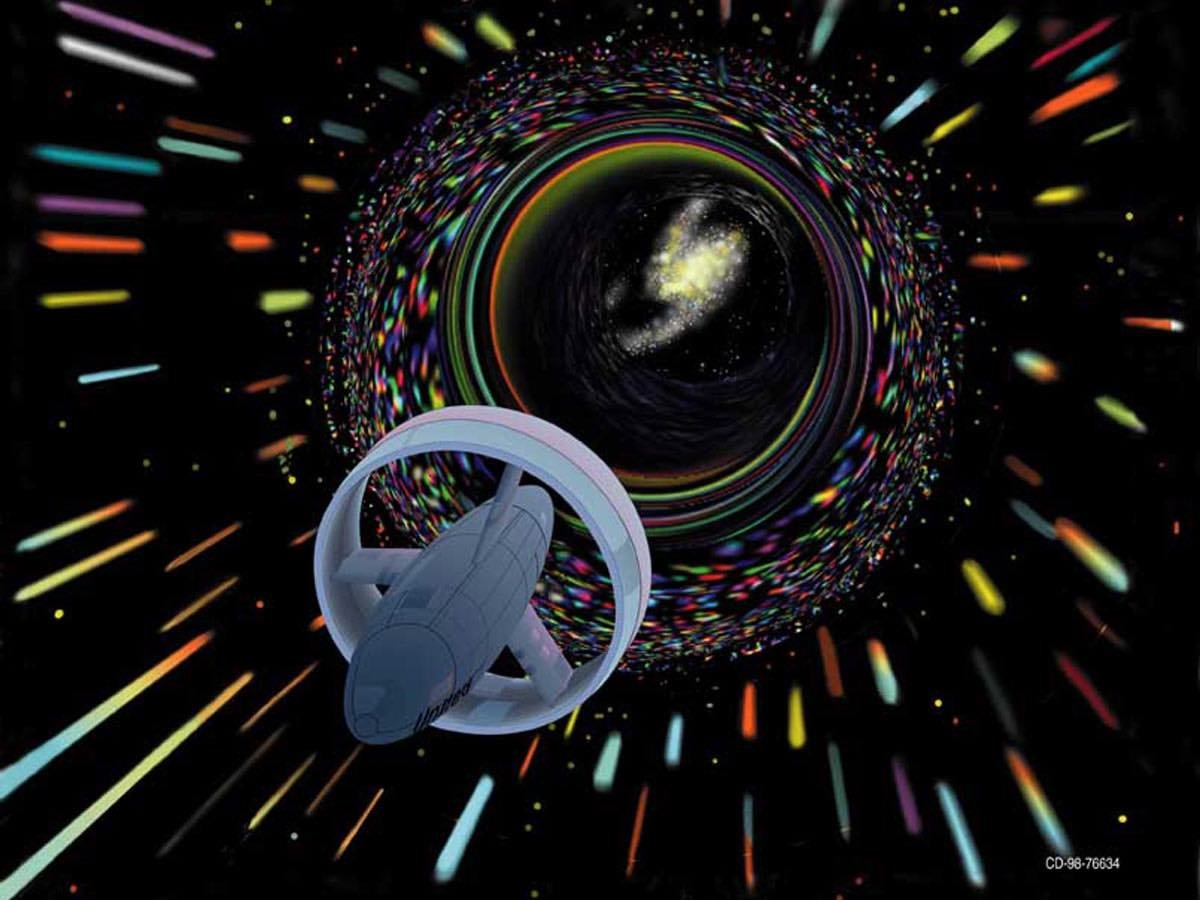
Since Captain Kirk first ordered the Starship Enterprise to engage the warp drive back in 1967, fans of science fiction have dreamed of traveling to the stars at warp speed. That idea remained in the realm of science fiction until 1994, when Mexican mathematician Miguel Alcubierre proposed a mathematically viable solution for building a real-world faster-than-light warp drive.
Since then, numerous scientists and engineers have taken a swing at their own version of a viable, real-world warp drive, including an attempt to patent one of these “out there” ideas.
Here, The Debrief looks at three of the past most promising warp drive models, along with one brand new physics concept called the “Tri-Space Model,” which may hold the key to making faster-than-light travel possible.
THE ORIGINAL: ALCUBIERRE/WHITE WARP DRIVE
While Alcubierre’s warp drive concept showed that traveling faster than light was mathematically possible, it was widely criticized for its massive power requirements and use of purely theoretical “exotic matter.” Still, many scientists and engineers were intrigued by his work, including former NASA engineer and physicist Dr. Harold G. “Sonny” White.
Hoping to move Alcubierre’s metric from theory into a published, canonical form, White first looked at the idea more closely in 2003.
“I started working in the (NASA) space program in 2000,” White told The Debrief in an interview. “While I was working in the space program, I was thinking about this Advanced Power propulsion. I was thinking about this Alcubierre Warp metric. You know, it was not published in its canonical form. And so, in 2003, I published a paper in the journal General Relativity and Gravitation.”
White immediately noted how Alcubierre’s math worked but also spotted areas he thought his own background in engineering and physics could improve the concept.
“Some things didn’t quite make sense to me, but by putting it into canonical form, helped me figure out ‘how does this concept really work?’, White told The Debrief. “From the process of not being at warp to being at warp… what would that look like when you look at the mathematics? And the only way I could see to answer the question is to put it in the canonical form in 2003, so that’s what I talked about in that paper.”
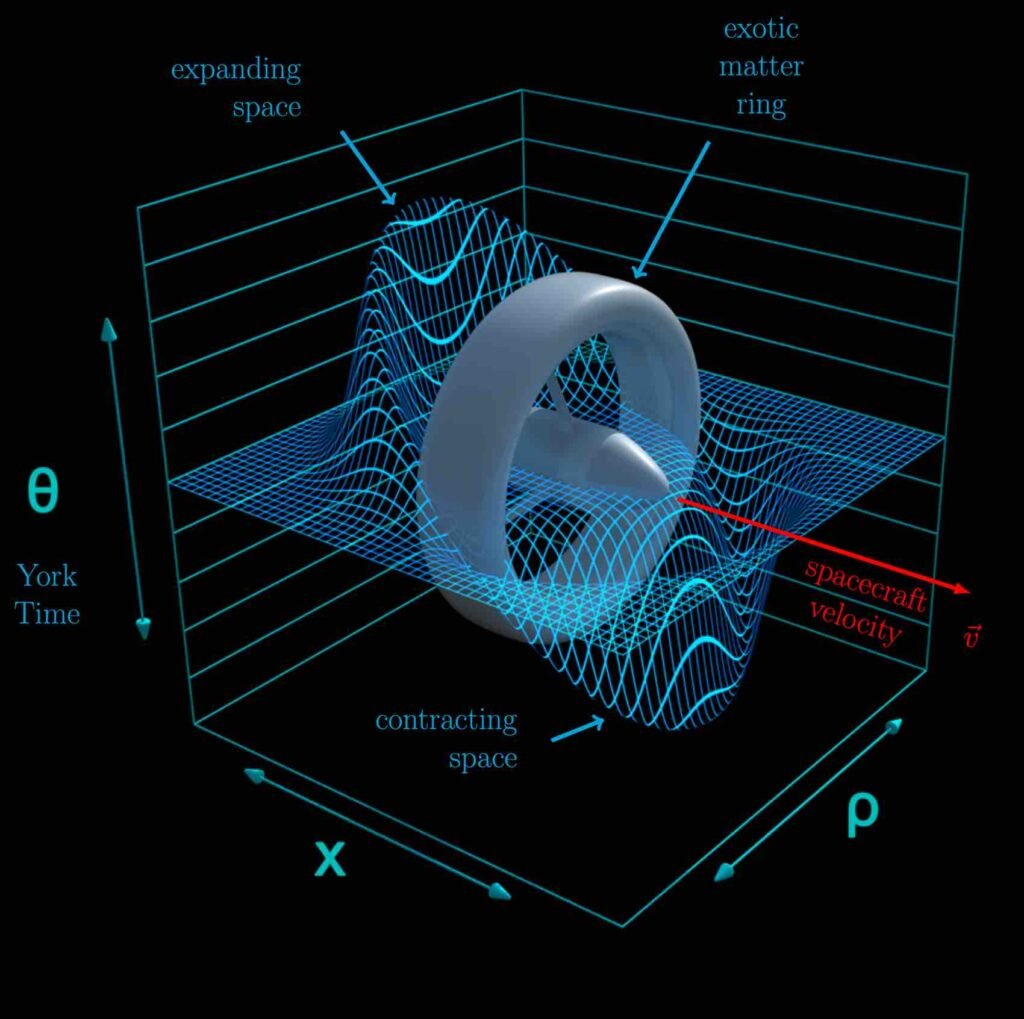
Theoretical Warp Bubble Structure
(Image Credit LSI)
Years later, White was asked by NASA to present his updated warp concept, leading to his 2011 paper and the warp drive concept now known as the “Acubierre/White Warp Drive.”
“I got asked to give a talk [about the warp drive] to DARPA and NASA at the DARPA 100-year Starship Symposium in 2011,” he told The Debrief. “I did a sensitivity study on the metric. I looked at what happens when you change the parameters and the mathematics.”
Specifically, White looked at the geometry of the classic warp drive model and found something that dramatically reduced the amount of energy required by Alcubierre.
“It basically comes down to how thick you make the toroidal ring and negative vacuum energy density,” he explained. “How thick or thin to make it, topologically? What does that do to the overall energy required? And so, during that work, I had no ‘objective’ objectives, per se, other than just to explore. In the process of doing that, I discovered that by making that ring a little thicker, instead of being like a wedding band wrapped around your finger, it’s a little bit more like a lifesaver, was key.”
In fact, White’s geometric adjustment to the classic model dramatically reduced the amount of exotic matter required to a much more manageable concept.
“By using that optimization technique, I was able to reduce the amount of exotic matter from a Jupiter-sized amount down to something about the size of the Voyager spacecraft,” said White. “So about two metric tons or just under two metric tons.”
As White notes, even a few tons of a theoretical substance like exotic matter is still unachievable by today’s scientists and engineers, but his changes definitely improved the ultimate viability of Alcubierre’s idea.
“Instead of just being mathematically possible in our work, we potentially move it into the category of maybe it’s plausible,” he noted with a lighthearted shrug. “There are now two metric tons of this stuff we’re not quite sure exactly how to make.”
White’s views about the feasibility of warp drives and their related effects have garnered a fair amount of attention from critics over the years. Among them is astrophysicist Ethan Siegel who, while remaining skeptical of White’s claims, has noted that the warp drive concept “remains an interesting possibility and one worthy of continued scientific investigation, but one that you should remain tremendously skeptical about given the current state of affairs.”
THE LENTZ DRIVE
A decade after White updated the original warp drive concept, reducing the need for exotic matter down from a Jupiter-sized amount to a few tons, another scientist named Dr. Eric W. Lentz decided to take a stab at his own warp drive concept. Published in 2021, his paper “Breaking the warp barrier: hyper-fast solitons in Einstein–Maxwell-plasma theory” lays out a whole new warp drive concept. And unlike Alcubierre and White, Lentz believed that his faster-than-light warp drive model could be accomplished in a completely new and different way.
“The Alcubierre solution provided an intuitive picture of what a warp drive would do: contract the space immediately in front of the central region containing the ship or transport, and expand the space immediately behind,” Dr. Lentz explained in an email to The Debrief. “This gives us the picture of the warp drive as a wave of curvature on which a ship will ride to its destination.”
However, Lentz explains, “this picture is not an essential feature of a warp drive.” Instead, he says, a solution proposed by physicist Jose Natario back in 2002 showed that the expansion and contraction weren’t necessary to transport the ship forward. That work, says Lentz, was critical to forming his own theory, one where a warp field could be created using only traditional matter and not exotic matter.
“[Natario] showed that the expansion could be trivial (zero) everywhere and still perform the same task of transporting a ship,” Lentz told The Debrief. This is a significant breakthrough, he says, because it means that exotic matter that warps the space in front of the theoretical passenger, as well as behind them (as depicted in nearly all theoretical warp drive solutions), is no longer needed to achieve faster-than-light travel.
Could dark matter allow physicists a path toward overcoming the challenges of faster-than-light travel?
(Credit: ESO)
“In the Alcubierre solution, the energy density and curvatures are maximally separated, with the energy being restricted to a small torus between the regions of high contraction and expansion,” Lentz told The Debrief, once again evoking the classic image of the Alcubierre Warp model. “The curvatures and sources in my proposal are instead highly correlated, with the regions of high energy density and high expansion and contraction overlapping almost exactly.”
As his published paper explains, “This is the first example of hyper-fast solitons resulting from known and familiar sources, reopening the discussion of superluminal mechanisms rooted in conventional physics.”
Lentz does freely admit that his theory is somewhat novel, even in this highly theoretical arena. “The expansion factor in my proposal is stranger still [than in Natario or Alcubierre], having regions of large expansion and contraction of space surrounding the central region containing a ship.”
Still, the issue of power requirements is not totally solved by Lentz, although he told The Debrief there is some hope in this area.
“There are a number of very effective energy-saving mechanisms for the Alcubierre drive described in the literature,” he explained. “The challenge would be to either modify these mechanisms to operate using only conventional sources, [like his proposed theory which does not require exotic matter] or to innovate novel energy saving techniques.”
In other words, if these proposed energy reduction techniques don’t work on his drive concept due to the lack of exotic matter, a legitimate concern, then an entirely new solution, the likes of which has not yet been proposed, would need to be found. Fortunately, Lentz says, his drive already accomplishes some of that goal since “not all the energy needs to come directly from the reactor, as we expect much of the energy sourcing the bubble to come from the particles’ rest masses.”
Those particles, known in physics as solitons, are at the heart of the Lentz solution to faster-than-light travel and, aside from any theoretical attempts to further reduce energy needs, are something he believes represents the most viable area for future, practical testing. Lentz told The Debrief he sees a handful of reasonable goals going forward, including zeroing in on a viable energy level for a real-world, testable drive concept using only current power generation technology.
“After the energy requirements are low enough and suitable means of creating such solitons has been found, I would want to have the existence of such solitons confirmed in a laboratory setting for a small (~1m radius), slow (~km/s speed), but detectable soliton,” he said. “The target energy level is where a bubble of radius ten meters moving at 1% of the speed of light could be powered by a modern-day fission reactor.”
Although he is obviously enthusiastic about his novel solution to faster-than-light travel without exotic matter, Lentz also told The Debrief he is excited about all of the new, innovative concepts being discussed.
“It has been exciting to see how much progress has been made in this field recently,” he said, “and I think there are many more advances ready to be made. I am looking forward to seeing what the next few years bring.”
APPLIED PHYSICS WARP CONCEPT
Sometimes slower is better, especially when you want to avoid using “exotic matter” to make your theory work. Enter the Applied Physics (APL) Group. Their designs were recently published in the peer-reviewed journal Classical and Quantum Gravity and represent the latest in an increasingly crowded field of warp proposals.
Unlike the Alcubierre and White designs, the APL team shuns exotic matter as a power source. However, sacrifices need to be made. The physical nature of APL’s design means it is constrained by Newtonian physics. In short, while their drive concept is indeed designed to transport humans across the galaxy, it is not capable of breaking the speed of light. Damn.
“There is a common misconception that interstellar travel has to be superluminal,” Gianni Martire told The Debrief last year, “it doesn’t. If we can send a probe to reach another star within ten years, it is still incredibly useful.”
And while Sci-fi fans have the itch to go fast, APL’s warp drive doesn’t have the same energy requirements and, therefore, radiation, which tends to be a massive problem in building a crewed warp-capable vessel. Basically, no one gets cooked to death when they hit Warp Factor 1.
“Before our paper,” Martire says, “saying such things [like warp] was nonsense sci-fi. Now it’s real science.We took a small step into the future, do you feel it?”
THE TRI-SPACE MODEL
It all began in college when a young science fiction buff, future engineer, and Senior Project Leader for The Aerospace Corporation, Gregory Meholic, stumbled upon a curious little pamphlet made by the RAND Corporation.
“It was on Tachyon particles and their potential for faster-than-light travel and motion,” Meholic explained to The Debrief. “And I mean, lots of science fiction uses tachyons as the go-to faster-than-light widget, right?”
That RAND pamphlet was an exploratory work in speculative physics written by Lt. Col. Edward Puscher for the United States Air Force in 1980. It explores the theory regarding a theoretical particle called a tachyon that may exist in a permanent faster-than-light state.
“Basically, it was an algebraic solution to the general and special relativity equations that govern motion near the speed of light,” Meholic explained.
A big kick in the FTL pants for any science fiction fan is Einstien’s Theory of Relativity. The closer you get to light speed, the more your mass increases. As you near the 300,000 kilometers per second mark (the speed of light), you require an infinite amount of energy to hit light speed.
“And this pamphlet basically was trying to show that, first, Tachyons can theoretically exist in a super-liminal realm,” says Meholic. “And second, it provided the logical algebraic follow-outs of special and general relativity to show their characteristics.”
After Meholic read the pamphlet, it tweaked his imagination.
“What occurred to me in reading this was that three possible velocities could be associated with any given point in space: sub-light, light speed, and superluminal travel,” he explained.
So, in a nutshell, Meholic’s Tri-Space Theory breaks up reality into three “realms” that coexist at any point in spacetime. The sub-light realm is everything that moves slower than the speed of light, like your old Honda Accord or that barista at your regular coffee shop. The light-speed realm is the world of the massless photon zipping around at the 300,000 kps speed limit. And then there is the superliminal realm where things like tachyons dwell. Once you go beyond the math curve that brings you to light speed, the math doubles back.
“So when I started to think about this ‘other side of the curve,’ so to speak, what happens in this superluminal realm is really interesting because when you take energy away from the system, you go faster,” says Meholic.
In our realm, sub-light, the more energy you put into travel, the faster you go. In the superliminal realm, beyond the algebraic curve, as Meholic says, the more energy you put into travel, the slower you go, eventually bumping into the crawling 300,000 kps limit, but from the topside. To slow down to the speed of light, a superliminal object would require an infinite amount of energy; almost like a backward theory of relativity.
“And this implies that the rest mass becomes imaginary, which is the whole square root negative one thing…And so, as long as you’re moving faster than light speed, this particular algebraic solution says that tachyon particles could have a real positive mass traveling at these superluminal speeds,” Meholic postulates.
And for science fiction fans who need their ship to get from Earth to Wolf 359 in a hurry, the idea that something can have mass and achieve faster-than-light travel solves the whole cosmic speed limit issue. The Tri-Space Model doesn’t violate the rules because the superliminal object exists outside the sub-light and light-speed realms. No causality issues. No weird time dilations. No accidental time travel. No infinite mass problems. Just open superliminal space.
Sounds fun, but it begs one big question: How?
For an object to exist in superliminal space, it must jump from this realm to the superliminal realm. The idea isn’t to speed up to superliminal speed but to pop into it. And the best way to do that is to convert ordinary dull sub-light matter into a version that can exist in the superliminal realm. So how does someone build the machine to make such a conversion possible? Zero clue.
While Meholic’s idea is still very much speculative, it is unique. It doesn’t require a warp in spacetime or a wormhole or much in the way of new math. It is very similar to dark matter and dark energy; the biggest challenge is that we cannot currently observe the superliminal, so to say a “superliminal realm” exists becomes a matter of theoretical physics.
In sum total, we are still a long way from making the concept of faster-than-light travel anything more than just an entertaining element of science fiction. However, with the work of scientists like these who remain dedicated to its study, this fictional form of travel may indeed one day make its way into the realm of science fact.
Follow and Connect with Christopher Plain on Twitter @plain_fiction.
An artificial black hole produced using sound waves and a dielectric medium has been created in the lab, according to researchers withan international think tank featuring more than 30 Ph.D. research scientistsfrom around the world.
The researchers say their discovery is significantly more cost-effective and efficient than current methods in use by researchers who want to simulate the effects of a black hole in a laboratory environment.
New York-based Applied Physics first achieved recognition with the 2021 publication of a peer-reviewed theoretical paper detailing the mathematics behind the construction of a physical warp drive. More recently, the organization published a method for using Cal Tech’s Laser Interferometer Gravitational-Wave Observatory (LIGO) to detect the use of warp drives in outer space, co-authored by Dr. Manfred Paulini, the Associate Dean of Physics at Carnegie Mellon University.
Now, the group says their peers working in the field warp field mechanics have a tool that didn’t exist previously or was simply too expensive and impractical to utilize. Their findings, published in the peer-reviewed journal Universe, are setting the pace for a small but growing community of researchers hoping to explore the mechanics of gravity and bring about humanity’s first real warp-drive spacecraft.
SOUND WAVES AND GLYCERIN PROVED TO BE THE KEY INGREDIENTS
To create their simulated black hole, the paper’s lead author, Dr. Edward Rietman, and his co-author, Dr. Brandon Melcher, filled a chamber with an everyday, non-toxic liquid. “The dielectric medium used was glycerin,” explained Rietman in an exclusive email to The Debrief. “It has the nice property of being optically transparent and dense, and its normal refractive index is 1.4768.”
Next, the researchers bombarded the dielectric medium with targeted sound waves. Once the waves were tuned correctly, Rietman and Melcher employed a Thorlabs FS30SMA-1550 fiber collimator to send the light into a Thorlabs CSS 100 series spectrometer, which confirmed the bending of light, exactly like a real black hole in space.
“The team induced a black hole by modulating acoustic waves in a dense fluid, building on recent research that explores the use of high-frequency acoustic waves for analog simulations of gravity and general relativity in the laboratory,” the Applied Physics team told The Debrief. “The acoustic waves alter the medium through which they travel, deflecting laser light in the lab similarly to how the gravitational pull of black holes bends the light of distant stars behind them.”
In other words, sound waves were focused into a thick fluid, causing light to bend around like they were close to a black hole. “This discovery provides a novel method to gain insight into the physics of black holes, all within the safety of a laboratory,” the team explained.
Also significant, the team says that their measurements of the degree to which bent light the artificial black hole bent light jibe perfectly with the real thing. “We show the calculations comparing our results with the Schwarzschild metric (in our paper),” Rietman told The Debrief.
“CHEAPER, BETTER, FASTER” BLACK HOLE OPENS UP GRAVITY RESEARCH TO EVERYONE
While simulated black holes are currently used in labs to explore a wide range of phenomena, the team at Applied Physics says their particular black hole is more accessible to operate than the alternatives and is markedly less expensive. This cost-benefit, they note, will allow the small but growing community of physicists and engineers trying to advance science toward the construction of a real warp drive to afford a highly-specialized tool that is critical to their work.
“A Bose-Einstein condensate requires liquid He (helium) temperatures plus a room full of costly equipment (that can total) over $1 million,” Gianni Martire, founder of Applied Physics, explained in a message to The Debrief, “whereas our system is truly benchtop, with total costs around $10k.”
“We couldn’t afford $1 million,” added Martire,” so we invented a cheaper, better, faster way simply out of need.”
ARTIFICIAL BLACK HOLE COULD ENABLE DEVELOPMENT OF A REAL WORLD WARP DRIVE SPACECRAFT
The researchers behind the artificial black hole caution that the first flight of a working warp drive spacecraft could still be decades away, or that such technology may simply be too complex to ever really come to fruition. However, they reiterate that their solution provides a new tool to like-minded researchers who are banking on the possibility that making warp drive a reality can be achieved.
“Nobody has used glycerin to create a black hole system in the lab,” Melcher told The Debrief. “We view this advance as offering another tool to analog system researchers. We view the pressure variations in glycerin as fertile soil for more complicated space/time possibilities.”
“We’re here to scale science,” the physicist added, “not conjecture, so measuring is important.”
When asked how their work can help facilitate advancements toward a working warp drive, Rietman was notably cautious, though still optimistic.
“This discovery demonstrates the exciting potential of analog systems for studying astrophysical and cosmological phenomena in the laboratory,” he told The Debrief. “With this innovation, we can better understand the effects of curved space/time and advance the future of warp drive research.”
“It is too early to answer clearly [how this will lead to a warp drive] as we need to publish more papers on work we’ve done,” he later added. “Science and technology advance one step at a time, so we can say it will, but going into the details is a deep science hole that will take away focus. We need this to measure and prove theories in warp [mechanics]. That’s the simple way to say it.”
Ultimately, the Applied Physics research team says their new tool is sorely needed by researchers like themselves who hope to advance humanity’s understanding of gravity. But they also point out that the top benefit of their new laboratory-created black hole may be its safety since creating an actual black hole here on earth could have catastrophic consequences.
“Just don’t leave your black hole unattended,” Martire joked before adding, “We should probably make that into a sign.”
Christopher Plain is a novelist, comedian, and Head Science Writer at The Debrief. Follow and connect with him on Twitter, learn about his books at plainfiction.com, or email him directly at christopher@thedebrief.org.
Are we alone in the universe? It’s one of the most compelling existential questions facing humanity. And the past half-century has witnessed a revolution in our ability to scan the cosmos in search of an answer. When I was a university student, the possibility of discovering, much less observing, planets in other star systems seemed like science fiction. But that has changed. Thanks to orbiting observatories such as the James Webb Space Telescope, and huge ground-based telescopes such as the Keck Observatory in Mauna Kea Hawaii, astronomers could be on the cusp of finding evidence for life around one or more of the thousands of extrasolar planets (also known as exoplanets) that have now been discovered.
And yet, even as new technology allows humanity to peer into distant galaxies and answer profound questions about the universe, some scientists working in this field are being hounded by colleagues more focused on leading terrestrial outrage mobs than finding new discoveries in the heavens.
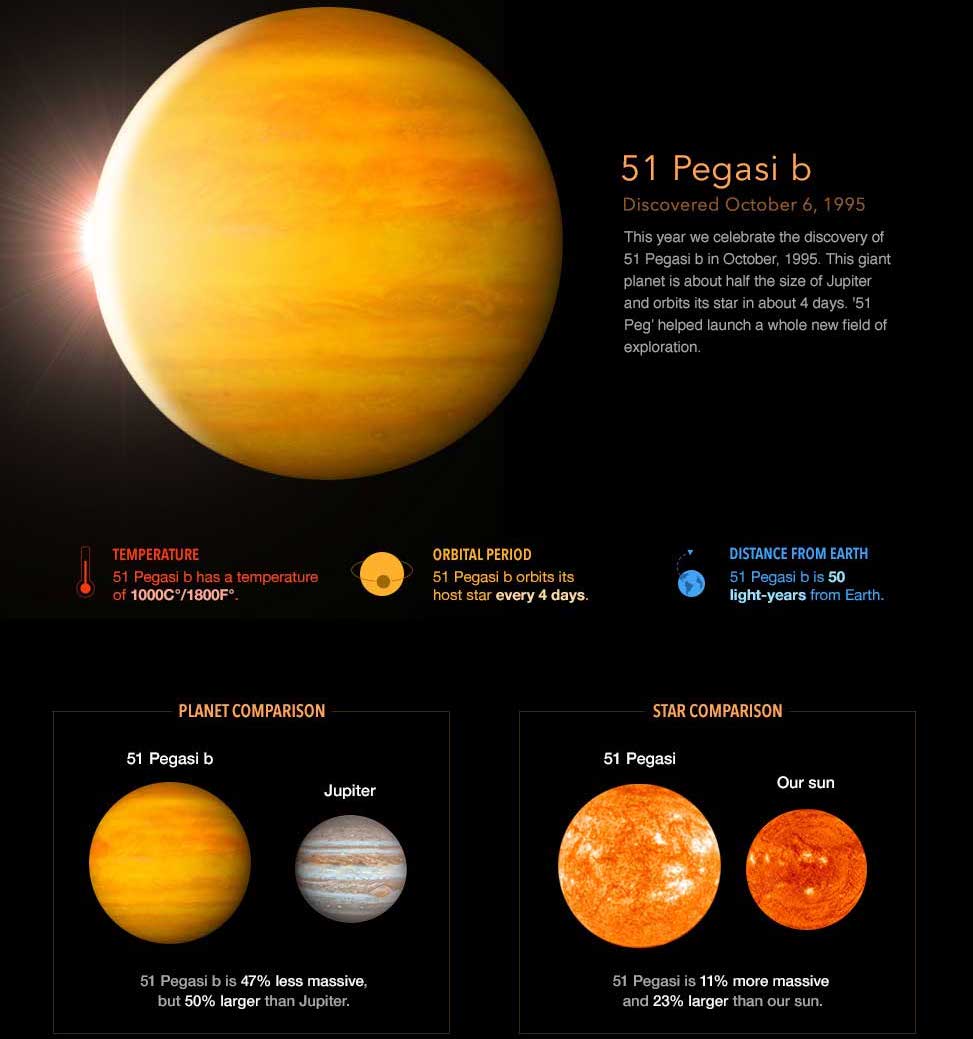
The existence of planets orbiting other main sequence stars (a category that includes about 90 percent of the stars in the universe) was first demonstrated in 1995, when Swiss astrophysicist Michel Mayor and Swiss astronomer Didier Queloz inferred the existence of a Jupiter-mass companion of the star 51 Pegasi, approximately 50 light years away from our own solar system. They did this by observing cyclic “wobbles” in the star’s path—tiny oscillatory movements whose maximum speed is about 70 meters per second, negligible in astronomical terms. These oscillations reflect the gravitational tug of 51 Pegasi’s planetary companion, which orbits the star once every four days, at a distance far closer than Mercury orbits our Sun.
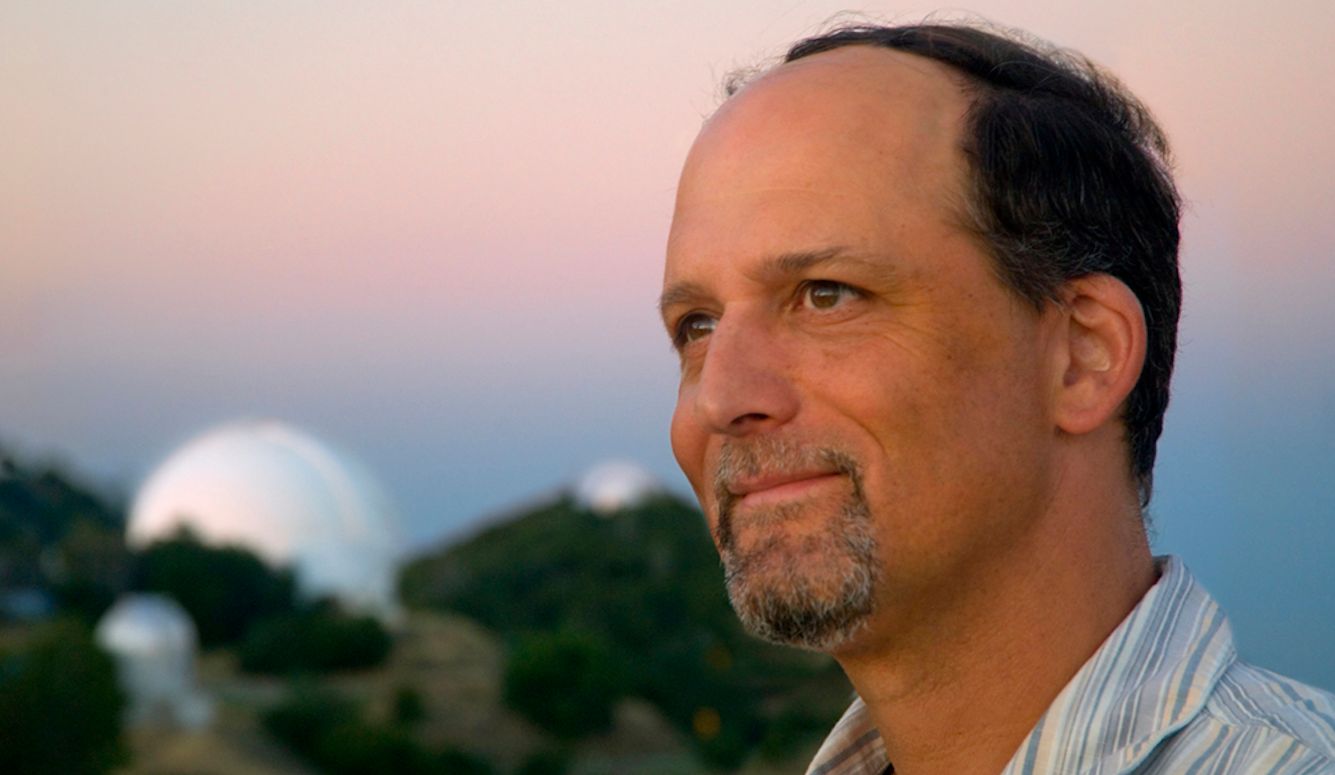
The discovery was accomplished using a technique that Mayor and Queloz spearheaded in parallel with similar work done by American astronomer Geoff Marcy. Both teams based their observations on the Doppler effect, the well-known phenomenon by which a wave’s apparent frequency will change depending on whether the observer is moving toward, or away from, the radiation source. (It’s similar to the principle that police use to measure your car’s speed with a radar gun.) To the extent that a star’s wobble aligns with the axis of observation, the frequency of its emitted light, as observed on Earth, would also vary, albeit by a minute amount.
The two teams used sensitive spectrometers that could measure such shifts. And within a month of Mayor and Queloz’s observations becoming known, their results were confirmed by Marcy and his own colleagues. Marcy’s team went on to identify 70 of the first 100 known exoplanets, including the first exoplanet located as far from its star as Jupiter is from the Sun. In 2005, Marcy and Mayor shared the prestigious Shaw Prize in Astronomy, awarded for outstanding contributions in the field.
Another planet-detecting technique—which I will admit to having previously dismissed as nearly impossible—was uncovered by Marcy’s group, working with Tennessee State University astronomer Greg Henry. Using this method, a planet’s existence is inferred from the fact that its associated star is dimmed (to a terrestrial observer) by a minute amount (less than one part in a thousand) when the planet passes in front of it. This “transit” technique of exoplanetary detection was used by NASA’s 2009 Kepler Mission, of which Marcy was a Science Team member, to discover approximately 4,000 planets. Many of these are the size of our Earth, and would seem to have surface temperatures conducive to biology (as we know it).
By now, we have discovered many systems with multiple planets orbiting a single star. And this naturally invites the question: Is the character of our own solar system, with large giant gas planets (Jupiter, Saturn, and Neptune) orbiting farther out, and smaller rocky planets (Mars, Earth, Venus, and Mercury) orbiting closer in (allowing the surface of at least one of these latter planets, Earth, to be sufficiently warm to host liquid water), a prerequisite for the development of life?
In March, a group of 16 authors—including Marcy; lead author Lauren Weiss, a junior faculty member in the astrophysics group at Notre Dame University, and a former PhD student of Marcy; and Caltech astronomer Andrew Howard, a former postdoctoral researcher who’s worked under Marcy’s direction—posted a paper entitled ‘The Kepler Giant Planet Search. I: A Decade of Kepler Planet Host Radial Velocities from W. M. Keck Observatory’ to arXiv, an archive for electronic preprints of scientific papers in certain fields. One of the authors’ purposes was to explore how the existence of Jupiter-size outer planets might correlate with the existence of smaller rocky inner planets. (A layperson might ask what the existence of a gas giant such a Jupiter has to do with the emergence of life on a rocky planet much closer to the sun. One answer is that—to take our own solar system as a representative example—Jupiter is believed to have absorbed or deflected large asteroids and comets from the outer solar system that otherwise would have vaporized Earth’s oceans, from which life first emerged.) Here is part of the abstract of that paper:
Despite the importance of Jupiter and Saturn to Earth’s formation and habitability, there has not yet been a comprehensive observational study of how giant exoplanets correlate with the architectural properties of close-in, sub-Neptune sized exoplanets. This is largely because transit surveys are particularly insensitive to planets [whose orbit radius is greater than that of Earth], and so their census of Jupiter-like planets is incomplete, inhibiting our study of the relationship between Jupiter-like planets and the small planets that do transit. To establish the relationship between small and giant planets, we conducted the Kepler Giant Planet Survey (KGPS). Using W. M. Keck Observatory HIRES [High Resolution Echelle Spectrometer], we spent over a decade collecting 2,858 [exoplanets detected using the Doppler wobble method] (2,181 of which are presented here for the first time) of 63 sun-like stars that host 157 transiting planets.
But if you visit arXiv to read the paper now, you can’t. It’s been withdrawn. Why? Was the data incorrect? Was the analysis conducted improperly? No. The problem was that Geoff Marcy’s name was on it.
Nine years ago, Marcy was investigated by his then-employer, the University of California, for behaviour that was described as sexual harassment. (You can read his take about the claims here, wherein he describes the infractions as resulting from him treating students as friends, hugging them or kissing them on the forehead if they related personal problems, and so forth.) It is worth adding that during his time at the University of California, Marcy also developed a record of working to promote a welcoming environment for women in science, advocating progressive university policies, and mentoring many female PhD students who subsequently went on to successful careers.
It is true that a University of California investigator decided in favour of Marcy’s complainants, albeit based on a (weak) preponderance-of-the-evidence standard. (And the low levels of due process that typify campus investigations of this type are well-known.) But even so, following the investigation, U.C. Berkeley recommended that Marcy should continue as a full professor, as he’d recently demonstrated five years of more careful behavior, which had elicited no further complaints.
Nevertheless, the online pressure against him became intolerable, and so Marcy eventually chose to leave his position voluntarily, so as to allow his colleagues and the department as a whole to get past the controversy surrounding his continued presence in the department. Grant sponsorship of his research ended, and he was removed from various collaborations. The Nobel Prize was awarded to Mayor and Queloz in 2019 for their work on exoplanets, but Marcy wasn’t included, in spite of the seminal role he and his group had played. In 2021, Marcy was ejected from the National Academy of Sciences, a shockingly severe response to behaviour that not only wasn’t criminal in nature, but which his university hadn’t even considered a firing offense. The pattern was clear: The imperatives of academic virtue signaling required individuals and institutions to publicly humiliate Marcy as a means to indicate their own moral bona fides.
Marcy’s name had been included in the authorship of ‘The Kepler Giant Planet Search’ on the basis of his long-standing contributions to the project therein discussed. He helped design, build, and even fund the Doppler system at the Keck Observatory; and he helped write the novel computer algorithm used to distill evidence of stellar wobbles from the background data.
One might imagine that the previous sanctions meted out to Marcy might have been enough. But not so: Once Astronomy Twitter discovered his name on the paper, a wave of outrage manifested itself. Many complained that it was wrong to have such a person’s work “promoted” in such a way—as if scientific publications were press releases. The pressure became so great that Weiss, the lead author, withdrew the paper from the arXiv altogether on April 7th, indicating, euphemistically, “It has come to my attention that there are significant concerns about the author list of this manuscript. It is very important to me that I honor everyone’s contribution to this work appropriately. Accordingly, I am revisiting the author list, with the goal of setting a standard for authorship that fairly acknowledges everyone’s contribution.” I have learned that, as a result of the social-media furor, several co-authors had requested their names be removed from the author list. As of now, the status of the paper is still in limbo.
In the style of a Soviet apparatchik announcing that one of his comrades had fallen from favour, the aforementioned Caltech astronomer and former Marcy-supervised post-doc, Andrew Howard, publicly assured everyone that Marcy, in a reporter’s words, “won’t co-author any papers the group publishes going forward.” These remarks were published in a May 16th Science hit piece on Marcy’s reputation, whose author appeared to agree with those seeking to bounce Marcy from the author list. The torqued title: “After outcry, disgraced sexual harasser removed from astronomy manuscript.”
A student who co-authored earlier publications as part of the same collaboration—in which Marcy’s name had appeared as co-author—now claims that having Marcy’s name on this new manuscript would be bad for her career. On what basis she made this claim is not clear. As noted above, Lauren Weiss, the lead author, is one of Marcy’s former students. Her name, like Howard’s, has appeared on numerous publications alongside Marcy’s. It appears that their association with the so-called “disgraced sexual harasser” helped, not hurt, their careers.
Another student, whose role on the project was confined to collecting data, complained that the appearance of Marcy’s name on the paper would somehow serve to “promote” Marcy at the expense of the student. Putting aside the respective importance of the contributions being made, the complaint reflects a fundamental misunderstanding of how scientific publication works. These articles are not press releases, and one’s appearance on an author list is not a form of “promotion.” Rather, it is meant to indicate one’s actual intellectual contribution to the design and implementation of a project—a form of recognition the lead author and other co-authors presumably agreed upon before the paper was submitted for publication.
The Science article also included a student’s extremely dubious claim that the presence of Marcy’s name on the author list would produce “potential psychological harm.” Specifically: “A lot of people in astronomy, especially a lot of women, are survivors of sexual assault and sexual harassment themselves, so seeing your name next to his—seeing his name at all—can be extremely triggering for a lot of people.” At the risk of appearing insensitive, anyone whose psychological trauma is so severe that it causes them to be emotionally triggered by the sight of someone’s name on a publication is in need of therapy. More importantly, such personal sensitivities should not serve to award individuals with veto power on the appearance of bylines in scientific publications.
Such is the (new) outcry over Marcy that the American Astronomical Society (AAS), a publisher of journals in which his name has appeared frequently, felt compelled to get in on the act. One might imagine that it would stand on the side of proper scholarship, asserting that author credits should reflect project contributions; which is to say that the only grounds for removing an author’s name should be a disclosure to the effect that he or she did not actually contribute to the underlying science, or that he or she was involved in falsifying or distorting data.
Instead, AAS President Kelsey Johnson publicly confirmed that the society’s ethics working group is now considering whether to classify “sexual harassment—and, indeed, all forms of harassment, discrimination, and bullying”—as grounds for restricting authorship. Under this standard, any number of people might have their names stripped from scientific papers, including, ironically, many of those same individuals now demanding that Marcy’s name be removed from ‘The Kepler Giant Planet Search.’ After all, how was lead author Weiss (a junior faculty member, it should be remembered) induced to withdraw the paper with its current author list except through mob bullying tactics?
Indeed, one of Marcy’s SETI collaborators, Nordic Institute of Theoretical Physics researcher Beatriz Villarroel, has filed harassment complaints on this very basis. Recently, she was blocked from presenting at an astrobiology conference at Penn State because of her collaboration with Marcy. She also had to withdraw an application to become an affiliate at the SETI institute in California after being instructed not to publish any papers, or apply for any grants, for a project involving Marcy.
The campaign against not only accused harassers, but also those who are accused of even dealing with accused harassers, including producing good science with them, is beginning to take on the flavour of anti-collaborator campaigns during wartime. Some organizations are even seeking to encode this mob logic in their formal rules, through codes of conduct that serve to punish those who collaborate with, or even cite the work of, those deemed to have committed harassment or offences against Diversity, Equity, and Inclusion (DEI).
In the current political environment, few are willing to stand against the pitchforks. Two senior female astronomers to whom I sent a draft of this piece for possible comment prior to publication indicated that they agreed with the expressed views, but would not be willing to say so publicly. One stated that she didn’t want her students and postdocs to have a supervisor who could be viewed as “guilty by association.” Shouldn’t the mob mentality that produces this kind of fear be deemed at least as worthy of condemnation by the scientific community?
Even the AAS leadership seems to have recognized the hypocrisy at play here, albeit grudgingly. A 2021 online note authored by the AAS’s then-President, University of Washington astronomer Paula Szkody (who herself co-authored a paper with Marcy in 2012), affirmed that the AAS ethics code states that “all persons who have made significant contributions to a work intended for publication should be offered the opportunity to be listed as authors” (a policy consistent with that of Springer, a major science publisher, which warns contributors that “it is dishonest to omit an author who has made significant contributions”). But in the same breath, she noted that the AAS anti-harassment policy “allow[s] for the denial of authorship privileges”—a provision that, when implemented, would plainly make nonsense of the idea that “all persons” who’d made “significant contributions to a work intended for publication” would be entitled to appear as listed authors. The two principles, the then-President acknowledged, “could be construed as being in potential conflict.” Could be?
The slippery slope here is very slippery indeed. In the future, will everyone who writes scientific papers first have to be vouched for by some social-justice tribunal that assesses their moral purity? And if so, using what criteria—and under what statute of limitations?
It has long been seen as a progressive habit of mind to understand that people can change, and that past sins do not inevitably define a human’s worth. There are famous examples of scientific papers being written from prison. And the same people baying for Marcy’s ongoing humiliation would likely be horrified to see the authorship of such then-incarcerated individuals stricken from the published record. Their puritanism is highly selective, in other words, being guided by the cyclic wobbles (to apply an astronomical metaphor) of political fashion.
Members of the anti-Marcy contingent might peer into their own closets, and remember that there are many ways that one can run afoul of online mobs. In recent years, it has become seen as normal for scientists to be required to put their signature to DEI pledges and anti-racism manifestos as a condition of academic employment. And the broad language in these documents leaves signatories vulnerable to all manner of accusations. Once we accept the principle that a scientist’s “significant contributions” to a project stop being significant simply because of his or her alleged moral defects, there is no particular reason to expect that such scrutiny won’t be extended to one’s political views, social-media posts, and even private conversations and jokes.
As Canadian science historian, Yves Gingras, put it in a thoughtful article last year, scientists are hardly immune from social panics. The Soviets were fond of judging science based on the politics of the men and women who conducted it, often denouncing the work of “bourgeois” scientists, whom they accused of being lackeys to Western imperialists. Google the name “Trofim Lysenko” to learn how that story ended. As Gingras stressed, “The road to hell is paved with good intentions.”
My wife recently reminded me of a quote from Henry Adams, which suggests, I think, an apt lesson to end on: “A teacher affects eternity: he can never tell where his influence stops.” The same principle applies to scientists. Members of the mob that came after Marcy won nothing for themselves but a brief spasm of schadenfreude. The consequences of this kind of precedent will last much, much longer.
Editor’s note:
On May 27, the text of this article was modified so as to clarify that Caltech astronomer Andrew Howard was not among those who had requested that his name be removed from the author list of The Kepler Giant Planet Search. Additionally, the article has been corrected in regard to the quoted text indicating that Geoff Marcy “won’t co-author any papers the group publishes going forward.” Due to an editing error, these words were originally attributed to Howard. In fact, they are properly attributed to a Science magazine writer who’d summarized Howard’s comments.
A newly released government UAP report details the latest findings in the Defense Department’s ongoing investigations into aerial incursions within military airspace, and other incidents involving objects the DOD now calls “unidentified anomalous phenomena.”
Although several weeks late on arrival, the report presents the latest findings on the efforts of the All-domain Anomaly Resolution Office (AARO), which the document characterizes as “the DoD focal point for UAP.”
According to the new assessment, 247 new reports, as well as 119 “that were either since discovered or reported after the preliminary assessment’s time period,” have been accumulated since the publication of the last report on UAP issued by the ODNI in June 2021, spanning a 17 year period.
“This totals 510 UAP reports as of 30 August 2022,” the report’s authors state. “Additional information is provided in the classified version of this report.” Most of the new reporting “originates from U.S. Navy and U.S. Air Force aviators and operators who witnessed UAP during the course of their operational duties,” the report adds.
“AARO and ODNI assess that the observed increase in the UAP reporting rate is partially due to a better understanding of the possible threats that UAP may represent,” the report states, “either as safety of flight hazards or as potential adversary collection platforms, and partially due to reduced stigma surrounding UAP reporting.”
“This increased reporting allows more opportunities to apply rigorous analysis and resolve events,” the report adds.
Although leaving open the possibility that irregularities in the detection capabilities of sensors and other errors in equipment function may account for some UAP reports, “ODNI and AARO operate under the assumption that UAP reports are derived from the observer’s accurate recollection of the event and/or sensors that generally operate correctly and capture enough real data to allow initial assessments,” the report states.
Based on AARO’s analysis and characterization of the 366 reports collected since the issuance of the last ODNI report, it says that “more than half” appear to exhibit “unremarkable characteristics,” with half a dozen attributed to aerial clutter, 26 believed to represent Unmanned Aircraft System (UAS) craft or “UAS-like entities,” and 163 determined as being representative of “balloon or balloon-like entities.”
The report states that such initial characterization of these events “does not mean positively resolved or unidentified” but is intended to enable AARO “to efficiently and effectively leverage resources against the remaining 171 uncharacterized and unattributed UAP reports.” The report also emphasized that “many reports lack enough detailed data to enable attribution of UAP with high certainty” despite the methods employed in collecting and reporting those incidents.
Mirroring themes from the 2021 report, flight safety challenges associated with the presence of UAP over the U.S. and in other airspace remains a concern, characterized as “a safety of flight and collision hazard to air assets” in Thursday’s report. However, the summary notes that AARO and its partner agencies have logged no known collisions with UAP.
New to the DOD’s assessment of concerns related to UAP is what the new report characterizes as potential “health implications” related to the phenomenon, although noting that presently, there are “no encounters with UAP confirmed to contribute directly to adverse health-related effects to the observer(s).”
“Acknowledging that health-related effects may appear at any time after an event occurs, AARO will track any reported health implications related to UAP should they emerge,” the report adds.
The report acknowledges that UAP reporting has increased since the issuance of the 2021 ODNI report, possibly due to the removal of stigmas associated with the topic in years past and the institution of new formalized methods of reporting by military personnel. Fundamentally, in addition to the potential hazards to flight safety that some UAP may represent, AARO is focused on assessing the possibility of adversary collection threats that could be related to many UAP incidents.
The report, an unclassified document based on a classified version that was originally set for arrival on October 31, 2022, was published on the ODNI website on Thursday, with a classified version delivered to Congress yesterday, according to a statement issued by Pentagon Press Secretary Air Force Brigadier General Pat Ryder. It is the second in an ongoing series of periodic updates in coordination with the Office of the Director of National Intelligence (ODNI) on findings related to what the DOD characterizes as unidentified anomalous phenomena.
“The safety of our service personnel, our bases and installations, and the protection of U.S. operations security on land, in the skies, seas, and space are paramount,” Ryder stated. “We take reports of incursions into our designated space, land, sea, or airspaces seriously and examine each one.”
“There is no single explanation that addresses the majority of UAP reports,” said Department of Defense spokesperson Sue Gough in a statement provided to The Debrief in response to queries about the report and the DOD’s position on current findings related to U.S. government UAP investigations.
“We are collecting as much data as we can, following the data where it leads, and will share our findings whenever possible,” Gough said, adding that the DOD would not rush to conclusions in its analysis of incidents involving unidentified phenomena.
“In many cases, observed phenomena are classified as ‘unidentified’ simply because sensors were not able to collect enough information to make a positive attribution,” Gough further clarified, adding that the DOD continues to improve its data collection capabilities in order to help ensure that “sufficient data for our analysis” can be collected when UAP events occur.
Similar inquiries were made with the Office of the Director of National Intelligence by The Debrief, although ODNI Spokesperson Jamie Mason conveyed that the Office could not offer any guidance or additional comments on the UAP report at that time.
In recent days, the National Defense Authorization Act (NDAA) for Fiscal Year (FY) 2023 was signed into law by President Biden. Included within the annual defense bill are provisions aimed at improving government transparency on the UAP issue by providing protections for whistleblowers, in addition to expanding the scope of current investigations by the DOD’s All-domain Anomaly Resolution Office (AARO).
Earlier in December, the Pentagon held a media roundtable that briefly addressed the findings of the DOD’s new All-domain Anomaly Resolution Office (AARO) in advance of the release of the report. In attendance were Ronald Moultrie, Under Secretary of Defense for Intelligence and Security, who also appeared at a Congressional hearing earlier this year that addressed the subject, and Dr. Sean Kirkpatrick, the director of AARO, whose participation marked his first public appearance since taking over the DOD’s new office.
“We have an important and yet challenging mission to lead an interagency effort to document, collect, analyze and when possible, resolve reports of any unidentified anomalous phenomena,” Kirkpatrick said during the briefing, adding that the DOD has “transferred the data and responsibilities from the previous Navy-led UAP task force, and disestablished it.”
“During that transition, we’ve taken the opportunity to expand and standardize and integrate UAP reporting and reevaluate the data we’ve collected,” Kirkpatrick added.
Moultrie also emphasized that the DOD “takes public interest in UAPs seriously,” adding that “we are fully committed to the principles of openness and accountability to the American people. We are committed to sharing as much detail with the public as we can.”
Last November, the DOD announced the establishment of what it then called the Airborne Object Identification and Management Group (AOIMSG), the mission for which had been limited primarily to incidents occurring within military airspace. The scope of the AOIMSG was later broadened in July 2022 following additional direction from Congress, as outlined in wording that appeared in the FY 2022 National Defense Authorization Act (NDAA).
“On July 15, 2022, Deputy Secretary of Defense Kathleen Hicks, in coordination with the Director of National Intelligence (DNI), amended her original direction to the Under Secretary of Defense for Intelligence & Security by renaming and expanding the scope of the Airborne Object Identification and Management Group (AOIMSG) to the All-domain Anomaly Resolution Office (AARO),” read a portion of a July 20, 2022, DOD release.
According to the DOD release, the FY 2022 NDAA “included a provision to establish an office, in coordination with DNI, with responsibilities that were broader than those originally assigned to the AOIMSG.”
Wording within the NDAA also required an annual report on the DOD’s latest findings on UAP to be delivered to Congress by no later than October 31.
Some have noted that the delivery date for the annual report, which according to last year’s NDAA was scheduled to coincide with Halloween, seemingly nods to the long-held flippant attitudes maintained by both the military, and the academic community, toward anomalous aerial phenomena.
Several weeks in advance of the report’s late arrival, an October 28 article by New York Times reporter Julian Barnes also seemingly downplayed the significance of unresolved incidents in the DOD’s current UAP dataset. Citing government officials familiar with the document and its findings who spoke on background, Barnes reported that “surveillance operations by foreign powers and weather balloons or other airborne clutter” could account for most UAP incidents investigated by the DOD in recent years, adding that such sightings have given weight to “theories about visiting space aliens” and espionage by adversaries like China and Russia.
The newly released report, by contrast, while noting that “more than half” of the UAP reports currently collected by AARO seem to display “unremarkable” behavior, nonetheless conveys that a significant number remain that do not appear to have such prosaic characteristics, and remain a focus of AARO’s further investigations.
In her statement provided to The Debrief, Department of Defense spokesperson Sue Gough emphasized that the Pentagon does not downplay UAP incidents and recognizes the current level of public interest in these events, as well as issues of transparency related to them, statements in-line with those expressed by Moultrie and Kirkpatrick earlier in December.
“DoD takes public interest in UAP seriously,” Gough told The Debrief, adding that the Department “is committed to the principles of openness and accountability to the American people which it must balance with its obligation to protect sensitive information, sources and methods.”
Micah Hanks is Editor-in-Chief and Co-Founder of The Debrief. Follow his work atmicahhanks.com and on Twitter:@MicahHanks.
By Pat Brennan, NASA's Exoplanet Exploration Program
Scientists explain how NASA's James Webb Space Telescope will investigate exoplanet clouds.
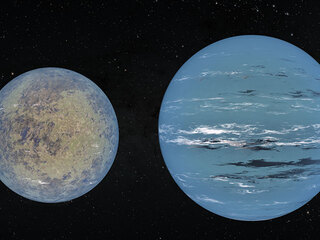
Clouds of vaporized rock, and perhaps even glittering gems, could fill the skies of some distant worlds. Add howling winds and broiling temperatures, and you begin to catch the first glimpse of wildly different environments on one of the many varieties of exoplanets – planets around other stars.
Exoplanet scientists are on the edge of their seats. NASA’s James Webb Space Telescope has begun to deliver its first science images and data. The targets for observations to come include the atmospheres of some of the strangest exoplanets found so far.
Among the best ways to understand these atmospheres, and even the planets themselves, will be the first-ever direct observations of clouds, however weird and exotic they might be.
“On Earth, a lot of these minerals are jewels,” said Tiffany Kataria, an exoplanet scientist at NASA’s Jet Propulsion Laboratory in Southern California. “A geologist would study them as rocks on Earth. But they can form clouds on exoplanets. That’s pretty wild.”
These planets – hot gas giants – are among many exoplanet types confirmed in the galaxy. They could have clouds of vaporized rock because they orbit so close to their stars, making their atmospheres ferociously hot.
And while clouds of rock, rubies, or sapphires might sound enchanting, actually detecting such minerals in an exoplanet atmosphere also would be a giant step forward in scientific knowledge.
“Clouds tell us a lot about the chemistry in the atmosphere,” Kataria said. “It then becomes a question of how the clouds formed, and the formation and evolution of the system as a whole.”
Exoplanets – planets beyond our solar system – are among the prime targets for NASA's James Webb Space Telescope. And Webb could reveal details of exoplanet clouds, providing further insights into the composition and structure of their atmospheres. Infographic: NASA/JPL-Caltech/Lizbeth B. De La Torre
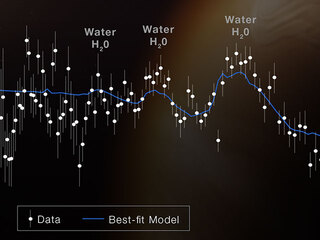
The Webb telescope's many capabilities include “spectroscopy” – splitting the light Webb receives from distant stars and planets into a spectrum, a bit like a rainbow. That would allow scientists to read the types of molecules present in an exoplanet atmosphere.
And that means Webb could detect specific types of minerals in clouds.
Detailed study of exoplanet clouds might even yield evidence of a habitable, potentially life-bearing planet – say on a small, rocky world like Earth.
“Clouds are an important feature on Earth, to regulate temperature,” Kataria said. “They’re an important consideration for Earth’s climate. It stands to reason that clouds could also be a vital component in the atmosphere of a habitable exoplanet. The more we understand how clouds form in general – as they have on Earth and other solar system planets – the more we understand how clouds evolved in more exotic environments.”
Probing the hearts of exoplanet clouds could bring together experts from many scientific fields as they seek to understand the origin, evolution, and environments of other planets in our galaxy.
“This further illustrates that exoplanets as a field really is interdisciplinary, borrowing lessons learned from astronomy, planetary science, geology, chemistry, and other areas of science,” Kataria said. “It’s so important to build these connections with scientists in all these different fields to better understand the many exotic worlds out there.”
The James Webb Space Telescope is the world's premier space science observatory. Webb will solve mysteries in our solar system, look beyond to distant worlds around other stars, and probe the mysterious structures and origins of our universe and our place in it. Webb is an international program led by NASA with its partners, ESA (European Space Agency) and the Canadian Space Agency.
For more information about Webb, visit www.nasa.gov/webb.
A metallic-looking rock that smashed through the roof of a residential home in New Jersey's Hopewell Township earlier this week is indeed a meteorite — a rare one about 4.6 billion years old, scientists confirmed on Thursday (May 11).
"It was obvious right away from looking at it that it was a meteorite in a class called stony chondrite," Nathan Magee, chair of the physics department at The College of New Jersey (TCNJ), whose office was contacted by the Hopewell Township police soon after the rock was found on Monday (May 8), told Space.com.
Chondrites are primitive rocks that make up 85% of meteorites found on Earth. Most chondrites found to date have been discovered in Antarctica; only rarely does one crash in populated areas.
This apparent meteorite struck a house in Hopewell Township, New Jersey on May 8, 2023. (Image credit: Hopewell Township Police Department)
The New Jersey rock, which is about 6 inches long by 4 inches wide (15 by 10 centimeters), is a notable exception. It slammed into the Hopewell Township house, dented the floorboard, punched two holes in the ceiling and was still warm when it was discovered by Suzy Kop in her father's bedroom around noon on Monday.
"I'm looking up on the ceiling and there's these two holes, and I'm like, 'What in the world has happened here?'" Kop told 6 ABC's Trish Hartman.
Once emergency responders cleared Kop, her family and their home of any harmful radioactive residues, Kop handed over the space rock to the nearby college for further inspection.
At TCNJ, Magee's team consulted Jerry Delaney, a retired meteorite expert who had worked on the meteorite collection at the American Museum of Natural History in New York. The team confirmed the space rock to be about 4.56 billion years old, which means it has been around since the beginning of our solar system and represents the leftover fragments from its creation.
Researchers at The College of New Jersey have confirmed that this rock, which struck a house in Hopewell Township, New Jersey on May 8, 2023, is a 4.6-billion-year-old meteorite. (Image credit: The College of New Jersey)
The 2.2-pound (0.9 kilograms) meteorite, which will likely be named Titusville, NJ — the postal address closest to its landing site — is "in excellent condition, and one of a very small number of similar witnessed chondrite falls known to science," Magee said in a statement on Thursday.
The top layer of the meteorite has a blackened crust a few millimeters thick from partially burning up in Earth's atmosphere. Using a hand lens designed to look at rocks closely, his team found that the meteroite's minerals are blue and gray in color, with a small amount of other metals mixed in, Magee told Space.com.
The team studied the rock's texture and composition by placing it inside a large chamber of a scanning electron microscope. Based on initial estimates, the meteorite is a chondrite of class LL-6, which has less iron than other members of its family and is at least 30 to 40% denser than the most common rocks on Earth, like slate or granite.
"So it was clear it was not an Earth rock," Magee told Space.com.
Even before the space rock had breached Earth's atmosphere, it was exposed to a lot of heat in outer space that had heavily altered its structure and composition, so much so that it is difficult to easily distinguish individual grains or chondrules that make up the meteorite, scientists shared in Thursday's update.
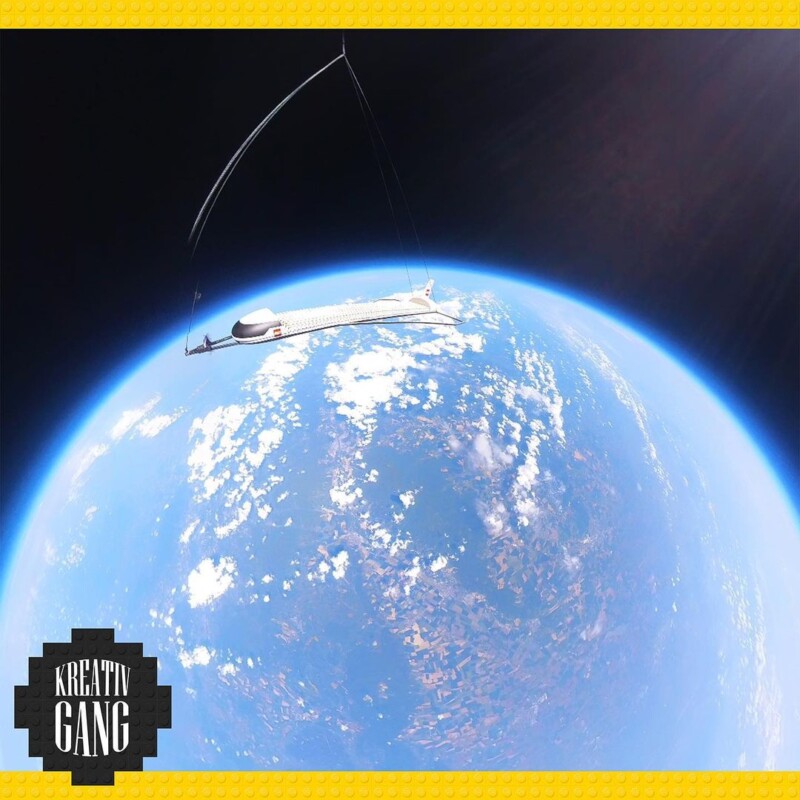
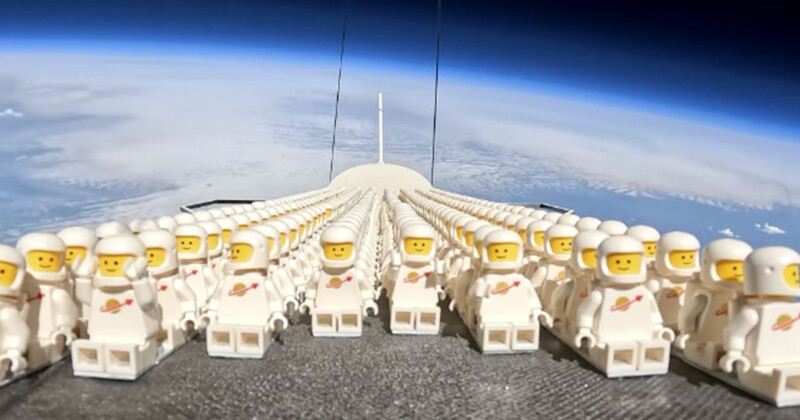
Two cameras captured 1,000 Lego astronauts flying to the edge of space on a 3D-printed mini space shuttle.
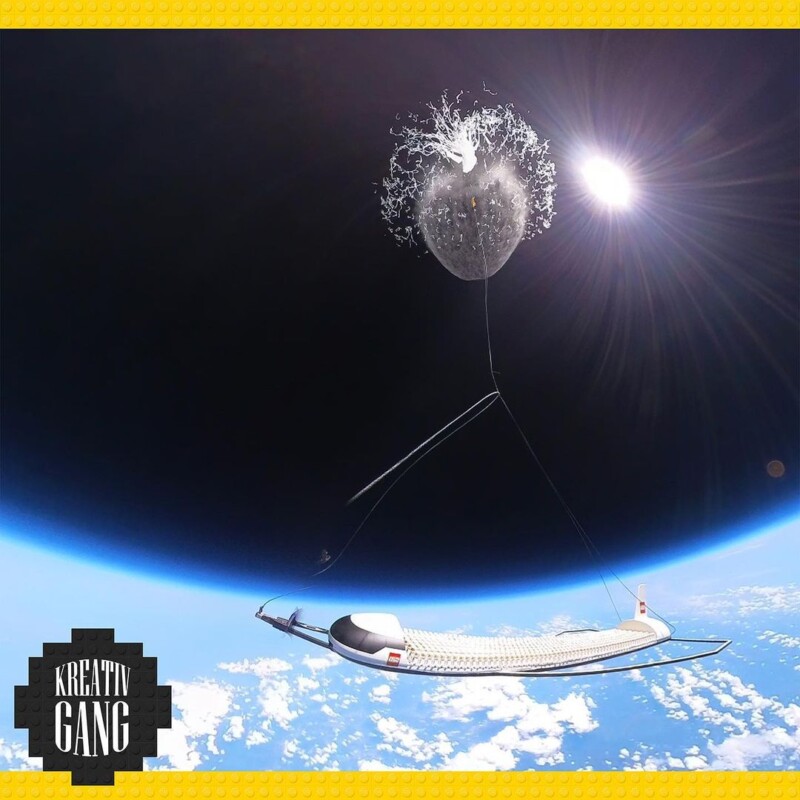
The voyage was powered by a stratospheric balloon that burst after taking the Legonauts 22 miles above the Earth’s surface when they safely landed back on terra firma with the help of a parachute.
Lego sent 1,000 mini-astronauts on a trip to near space.
(Image credit: LEGO/Kreativ Gang)
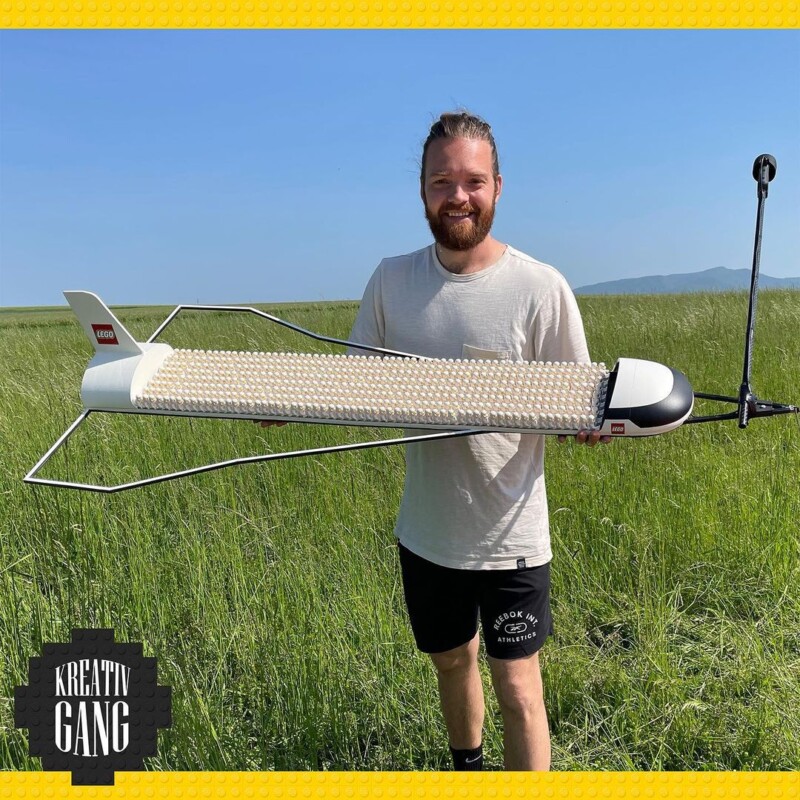
A Kreativ Gang team member with the 3D-printed space shuttle made for Legonauts.
The stratospheric balloon popping 21 miles above the Earth’s surface on the edge of space.
The 3D-printed space shuttle was made from a lightweight carbon composite material, built by a team of space architects and engineers from Slovakia and the Czech Republic.
There were three separate space flights with roughly 330 Legonauts going up each time and the team from Kreativ Gang, a marketing agency producing a Lego campaign, had to ensure none of the astronauts fell off the open-air shuttle.
The Legonauts being taken up to space by the stratospheric balloon.
“To make the figures stay on the space shuttle after the balloon burst was a major challenge,” says Dominik Matusinsky, an executive at Kreativ Gang, tells Space.com.
“We wanted the figures to be exposed directly to space, not to be stored inside anything. But during the free fall stage [before the parachute opened], they experienced speeds of up to 300 kilometers per hour [186 miles per hour], so that was a challenge.”
In an Instagram post, the Kreativ gang explained that the Legonauts flew from Malé Bielice Airport near Partizánské in Slovakia on Saturday, May 20 on a shuttle made of carbon fiber and 3D-printed stainless steel.
“They have landed in three different places and are ready to end their journey on your nightstand,” the team jokes.
“This space feat of ours was captured by two cameras during the entire ride. One monitored the space with the mini-crew from the cockpit, and the other, attached to the shoulder, took a view of the entire platform.
“In the photos and videos, you can see breathtaking shots of the Earth as well as figures who are fully enjoying their flight into space.”
The stunt was a promotional campaign for Lego. Anyone who buys a new Lego set and registers it could win the Lego astronauts as a prize. More details are avaialbe on Kreativ Gang’s website.
According to Dominik Matusinsky, an executive at marketing agency Kreativ Gang that produced the campaign for Lego, the team had to make sure that none of the astronauts fell off the open-air shuttle during the early stages of the platform's descent.
"To make the [Lego] figures stay on the space shuttle after the balloon burst was a major challenge," Matusinky told Space.com in an email. "We wanted [the figures] to be exposed directly to space, not to be stored inside anything. But during the free fall stage [before the parachute opened], they experienced speeds of up to 300 km/h [186 mph], so that was a challenge."
For the balloons to comfortably lift off, the whole platform including its passengers had to weigh no more than 6 pounds (2.7 kilograms).
"The challenge was to build the space shuttle as lightweight as possible," added Rousek. "We ended up making it from carbon fiber, 3D printed stainless steel and plastic."
Two cameras filmed the rides: One monitoring the crew compartment;, the other attached to a boom filming a view of the entire platform.
The Lego astronauts will now be put up as a prize in a drawing in the Czech Republic and Slovakia for anyone who buys and registers a new Lego set.
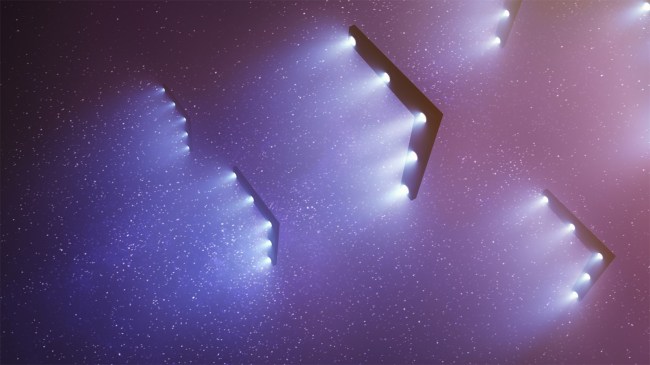
Several pilots recently reported seeing UFOs in Canada, describing “multiple lights sometimes in a triangle formation” to air traffic control.
“I’m certainly no expert, but they’re moving side-to-side and then going away from each other and then forming triangles. That doesn’t really seem like they’re in any type of orbit. But I mean, I’m no expert,” an Air Canada pilot from Seattle to Winnipeg said while flying over Saskatchewan in audio obtained by CTV News from two feeds at LiveATC.net.
“Yeah, it’s quite bizarre,” echoed a pilot on a Flair Airlines flight from Vancouver to Toronto. “There’s around six of them just randomly in formation flying at a high altitude at 12 o’clock.”
“Definitely not satellites,” said another pilot on a Morningstar Air Express cargo flight from Calgary to Toronto. “It’s unlike anything I’ve ever seen in the 15 years of night flying that I’ve done.”
“There’s no active airspace, military airspace, anything like that we’re aware of,” an air traffic controller told the pilots. “I honestly have no idea what that might be.”
The total audio of the conversations between the pilots and air traffic control in Canada discussing the mysterious lights was originally 2.5 hours long, but has been condensed down to a 13-minute video.
At least four different pilots reported seeing the strange lights of these UFOs on Jan. 19, with some appearing as high as 100,000 feet in the sky.
Daniel Otis, who reported about the UFO sightings for CTV News, also wrote on YouTube, “Their reports appeared in Transport Canada’s online aviation incident database on Jan. 23. NORAD was also notified of the incident, which occurred over Saskatchewan and Manitoba.”
The Canadian Air Defence was also notified about the UFOs, according to the Civil Aviation Daily Occurrence Reporting System (CADORS) report.
“Reports of unidentified objects can rarely be followed up on as they are as the title implies, unidentified,” a Transport Canada spokesperson told CTV News. “The department is reviewing the circumstances of this incident and will take appropriate action if non-compliance with the regulations is identified.”
A Canadian NORAD and Royal Canadian Air Force (RCAF) spokesperson told CTV News, “NORAD detects radar tracks and if required, provides a threat assessment of those tracks based on a variety of factors. For operational security reasons, we do not discuss how NORAD assesses threats.”
Before settling down at BroBible, Douglas Charles, a graduate of the University of Iowa (Go Hawks), owned and operated a wide assortment of websites. He is also one of the few White Sox fans out there and thinks Michael Jordan is, hands down, the GOAT.
Ufology: Why Scientists Are Finally Turning UFO Sightings Into Serious Research
For decades, academic researchers have dismissed the study of UFOs as pseudoscience. But as the evidence becomes harder and harder to ignore, some organizations are taking steps to make the field legitimate.
For as long as humans have claimed they’ve seen UFOs—and it’s been a long, long time—the established scientific community has more or less considered them to be nonsense. While that hasn’t changed much, even as we’re in the midst of a modern ufological renaissance, some renegade scientists are fighting to bring academic rigor toUFO research.
Take Richard Hoffman, an information technology expert with over 25 years of experience, formerly contracted with the U.S. Army’s Materiel Command at the Redstone Arsenal in Huntsville, Alabama. As a senior lead architect, he kept the Army’s digital infrastructure running and safe from attack.
He’s also a UFO researcher.
“The scientific community still has to deal with the decades of stigma associated with what they see as pseudoscience or fringe science,” Hoffman tells Popular Mechanics. “Many scientists do have interests in the phenomena, but are most often discouraged by others to embrace it so they hide it.”
Hoffman is one of three executive board members who run a nonprofit scientific organization known as the Scientific Coalition for UAP Studies (SCU).
✅ Unidentified anomalous phenomena (UAP) is the current rebranding of unidentified flying objects (UFO), a term that many believe to carry too much cultural baggage.
“There are very few UFO organizations remaining today,” Hoffman says. “Of the few that do remain, they each have their unique contributions to the phenomena, but most are in data collection roles versus long-term scientific study of cases.”
The difference with the SCU—and it’s a big one—is that it collects data that can be analyzed and studied by scientific experts, subsequently generating peer-reviewed papers published in journals and on websites, says Hoffman. The SCU doesn’t collect day-to-day UAP sighting reports, but rather digs into the more complex cases where multiple sensory data, like radar tracks and video, may exist.
Getty Images
An Objective of Legitimacy
The SCU played a significant role in studying the 2004 Nimitz UFO Encounter, when the organization released a nearly 300-page report on the incident. In 2017, the story hit the mainstream when the New York Times published a groundbreaking story about the Navy pilots who intercepted a strange object off the coast of San Diego in November 2004, and captured video of the object with their F-18’s gun camera.
In 2019, Popular Mechanics published a story about several other military personnel who also witnessed the Nimitz encounter on their radar systems and over their ship’s video system.
The SCU paper examined the available public data and testimony regarding the case, concluding that the “results suggest that given the available information, the AAV’s capabilities are beyond any known technology.”
To be clear, the SCU hasn’t concluded that some non-human intelligence is responsible. Fully aware of the significant gaps in data, the organization has suggested that “the public release of all Navy records associated with this incident to enable a full, scientific and open investigation is strongly recommended.”
The UFO research community is used to having scant data on UFO incidents; the vast majority of cases are purely anecdotal. When physical evidence or data is available, the well-established ufological conspiracy and myth-making machines begin to put that data into jeopardy.
“To date, there hasn’t been an extensive and well-funded scientific investigation of these phenomena using state-of-the-art investigative tools and a dedicated investigative team,” Robert Powell, an SCU executive board member and device physics expert, tells Popular Mechanics. The SCU is aiming to change that. Membership in the organization requires a resume submission, and a committee meets to thoroughly vet each new member.
So who makes up the 120+ members of the SCU, exactly? Mostly scientists, former military officers, and former law enforcement personnel with technical experience and investigative backgrounds, Powell says. While SCU encourages all UAP scientists to publish their work through peer-reviewed journals, and SCU members have been authors in peer-reviewed journals, a stigma still exists about UAP research. “This prevents quality papers from being published in mainstream journals simply because the topic is UAP. Therefore, SCU also provides a peer-review process for UAP papers submitted to SCU for publication,” Powell says.
To begin bridging the gap between the UFO research community and the scientific community, the SCU formed its own open-access peer-reviewed academic journal, Limina. “Anyone wishing to submit a paper to the journal should contact SCU,” Powell says.
Bettmann//Getty Images
Fighting the Stigma
Yet for all the promising progress, the SCU and similar organizations are still facing an uphill battle. The decades-long taboo surrounding UFOs and their study is thoroughly entrenched in established scientific and academic communities. They are, in essence, a dirty subject that can kill a professional career.
In 1953, the Robertson Panel was formed to look at UFO reports at the behest of the government due to a string of odd aerial objects being spotted over Washington, D.C. the previous year. The panel concluded in its classified report that UFOs posed no risk to national security, and proposed that the National Security Council actively debunk UFO reports with the intention to ideologically inoculate the public to ensure UFOs would become the subject of ridicule. The Panel even recommended that UFO investigative and research groups be monitored by intelligence agencies for subversive activity.
Seventeen years later, the infamous Condon Report, which was a product of the U.S. Air Force and the University of Colorado, was responsible for the death of the Air Force’s UFO study, Project Blue Book. The report became embroiled in controversy when a memorandum was released, explaining that the report itself had to “trick” the public into thinking the study was objective, but would ensure that the final and official position is that all UFO incidents were hoaxes, delusion, and human error.
“The wind is changing on this, just like it is on a lot of things.”
Officially, UFOs became the subject of ridicule. Tie that in with the rise of new-age UFO prophets and cults, stories of space men from Venus, alien bases in Antarctica, and the merging of UFO and conspiracy cultures, and those who used empirical data or maintained a rational and logical research approach became lumped into the same subculture as people claiming to be alien channelers or time-traveling alien ambassadors who often use people’s gullibility to earn a living.
It’s no wonder academics, professionals, and scientists publicly shy away from the subject. In research for this article, one physicist from a university in New York expressed their discomfort and asked that their name not be used because they were still trying to get tenure.
“I don’t get the sense the scientific community is any more interested or open than it was before,” Alexander Wendt, Ph.D., a political science professor at the Ohio State University, tells Popular Mechanics. “But what has changed, I think, is the politics. I think that the wind is changing on this, just like it is on a lot of things. And it’s probably young people in particular who are driving the change and are more open.”
Geography Photos//Getty Images
Forging a Scientific Future
Wendt, who has done academic work on the UFO question and presented a lecture at TEDx Columbus on the science of UFOs, sits on the board of UFOData, a project designed to create high-tech observation systems to monitor the skies and track anomalous phenomena. He knows that the taboo exists surrounding UFO research, and getting any grant money to study UFOs is still practically impossible. According to Wendt, neither the government nor any established scientific organizations are going to fund UFO research. The solution seems to be crowdfunding or finding private donors who will invest in these projects.
UFOData isn’t the only group engaged in observational studies. For three decades, Project Hessdalen, a small observatory station that monitors a valley in Norway subject to strange light phenomena, has been jointly funded by the Østfold University College and personal donations. Another organization, the UFO Data Acquisition Project (UFODAP), is also building small computer units designed to monitor and track aerial oddities. Using multiple sensors, the UFO Data Acquisition Unit is designed to record and track UAP, as well as provide metadata which can be analyzed.
Hoffman recognizes that contemporary ufology still makes academics and scientists nervous. Even with the 2019 Navy announcement that UAPs do violate American airspace and that the Pentagon was running the Advanced Aerospace Threat Identification Program, people are starting to ask more questions and some scientists are starting to participate.
“We are encouraged by this and believe it will continue to advance, however, the UFO community itself is composed of factions which continue to make scientists cringe,” Hoffman says. “SCU is attempting to support scientists and serious researchers by focusing on what science can do to advance their interests. They see us as being a safe place where conspiracy theories are non-existent and scientific methodologies win.”
So while the existence of UFOs is no longer up for debate, their source very much is. The UFO community has always been comprised of cultural and social renegades who haunt the fringes of mainstream culture, subjects of ridicule more than respect. While some still smirk at the thought of anomalous aerial objects occupying our skies, the information slowly coming out into the public domain is starting to prove that these objects may not be a laughing matter.
Whether the source of some of these data-rich UFO incidents is secret government technology, an alien nonhuman intelligence, or something fundamentally beyond our physical and philosophical understanding, we’re left to wonder, as countless thinkers and, yes, even scientists, have before: “What if?”
Editor’s Note: This story was originally published on July 2, 2020.
Meer van UFO'S of UAP'S, ASTRONOMIE, RUIMTEVAART, ARCHEOLOGIE, OUDHEIDKUNDE, SF-SNUFJES EN ANDERE ESOTERISCHE WETENSCHAPPEN - DE ALLERLAATSTE NIEUWTJES


 Arizona Man Filmed Huge Solid UFO In Phoenix Lights: MIB Took Video & Man Vanished