Naar de inhoud

UFO'S of UAP'S, ASTRONOMIE, RUIMTEVAART, ARCHEOLOGIE, OUDHEIDKUNDE, SF-SNUFJES EN ANDERE ESOTERISCHE WETENSCHAPPEN - DE ALLERLAATSTE NIEUWTJES

UFO's of UAP'S in België en de rest van de wereld
akke.beakke.be
Ontdek de Fascinerende Wereld van UFO's en UAP's: Jouw Bron voor Onthullende Informatie! Ben jij ook gefascineerd door het onbekende? Wil je meer weten over UFO's en UAP's, niet alleen in België, maar over de hele wereld? Dan ben je op de juiste plek! België: Het Kloppend Hart van UFO-onderzoek In België is BUFON (Belgisch UFO-Netwerk) dé autoriteit op het gebied van UFO-onderzoek. Voor betrouwbare en objectieve informatie over deze intrigerende fenomenen, bezoek je zeker onze Facebook-pagina en deze blog. Maar dat is nog niet alles! Ontdek ook het Belgisch UFO-meldpunt en Caelestia, twee organisaties die diepgaand onderzoek verrichten, al zijn ze soms kritisch of sceptisch. Nederland: Een Schat aan Informatie Voor onze Nederlandse buren is er de schitterende website www.ufowijzer.nl, beheerd door Paul Harmans. Deze site biedt een schat aan informatie en artikelen die je niet wilt missen! Internationaal: MUFON - De Wereldwijde Autoriteit Neem ook een kijkje bij MUFON (Mutual UFO Network Inc.), een gerenommeerde Amerikaanse UFO-vereniging met afdelingen in de VS en wereldwijd. MUFON is toegewijd aan de wetenschappelijke en analytische studie van het UFO-fenomeen, en hun maandelijkse tijdschrift, The MUFON UFO-Journal, is een must-read voor elke UFO-enthousiasteling. Bezoek hun website op www.mufon.com voor meer informatie. Samenwerking en Toekomstvisie Sinds 1 februari 2020 is Pieter niet alleen ex-president van BUFON, maar ook de voormalige nationale directeur van MUFON in Vlaanderen en Nederland. Dit creëert een sterke samenwerking met de Franse MUFON Reseau MUFON/EUROP, wat ons in staat stelt om nog meer waardevolle inzichten te delen. Let op: Nepprofielen en Nieuwe Groeperingen Pas op voor een nieuwe groepering die zich ook BUFON noemt, maar geen enkele connectie heeft met onze gevestigde organisatie. Hoewel zij de naam geregistreerd hebben, kunnen ze het rijke verleden en de expertise van onze groep niet evenaren. We wensen hen veel succes, maar we blijven de autoriteit in UFO-onderzoek! Blijf Op De Hoogte! Wil jij de laatste nieuwtjes over UFO's, ruimtevaart, archeologie, en meer? Volg ons dan en duik samen met ons in de fascinerende wereld van het onbekende! Sluit je aan bij de gemeenschap van nieuwsgierige geesten die net als jij verlangen naar antwoorden en avonturen in de sterren! Heb je vragen of wil je meer weten? Aarzel dan niet om contact met ons op te nemen! Samen ontrafelen we het mysterie van de lucht en daarbuiten.

Categorie: ASTRONOMIE / RUIMTEVAART

Aliens, Bigfoots, and Monsters… Remembering the Age of the Weirdumentary

Aliens, Bigfoots, and Monsters… Remembering the Age of the Weirdumentary

In the early '70s, Sunn Classic Pictures brought a whole new world to light for moviegoers.

Aliens, Bigfoots, and Monsters… Remembering the Age of the Weirdumentary - IGN Misc

By Max Evry 

Related reads:
“Scientists representing the world’s foremost research centers took part in the examination of the evidence. The facts that will be presented are true. This may be the most startling film you’ll ever see.”
-Peter Graves, The Mysterious Monsters (1975)

During the turbulent era of Vietnam and Watergate, the happy veneer of America in the 1950s and ‘60s gave way to the conspiracy-minded ‘70s. Dark revelations about the government, justice system, military, and police made the public begin to rethink their perceptions about a great many things. This led to renewed interest in occult matters like ESP, UFOs, and cryptozoology. These subjects, along with other pseudoscientific phenomena like near-death experiences or the Bermuda Triangle, became the bread and butter of a Utah-based production house called Sunn Classic Pictures. The company made a fortune releasing partially-dramatized “documentaries” that tantalized viewers with possibilities of what could be out there beyond the veil.

“I think it was people just questioning what the norm was… what is real, what isn't real,” James L. Conway, who worked as a writer/producer/director at Sunn Classic, tells IGN. “There were very few outlets back then to experience these things, very few TV channels. Through a theatrical window, we were able to make movies about these subjects. They were incredibly popular because there was no other place for people to get knowledge about this… no YouTube, no Wikipedia, no social media. If you wanted to see something that was on the unusual side, it was a theatrical motion picture.”

Conway was a college senior at the University of Denver around 1971 when he was in the Mass Communications Department and the phone rang. It was Charles E. Sellier Jr., who ran an industrial film and commercial company in Denver.

Continues Conway, “Chuck was looking for cheap labor to edit his industrial films. I said, ‘I'm your guy.’ While I finished college I worked for Chuck, and after about three months I said to him, ‘You know, I can direct these shows better than the people you're hiring.’ Total chutzpah. He gave me a shot, I did really well, and that began our relationship.”

After producing a western comedy called The Brothers O'Toole, Sellier connected with Sunn Classic Pictures, which at that point was a distribution outfit in Utah and a newly-founded division of the Schick razor company. They had made several well-attended hunting pictures like The Life and Times of Grizzly Adams, and decided their next avenue would be a series of pseudoscience documentaries kicked off by a re-edited and English dubbed version of the 1970 German doc Chariots of the Gods. Based on Erich von Däniken’s popular claptrap supposing celestial beings who seeded early humanity, in 1973 it grossed over $25M and was nominated for an Oscar.

  • 'From the late '60s we see a rise in interest in everything from occultism and psychic phenomena, new age philosophies, magic, astrology, paganism, life after death, anti-materialism, holistic medicine, reincarnation…'

Noted film scholar Dr. Gary D. Rhodes recently published a book titled Weirdumentary all about this era of strange docs throughout the ‘70s, of which he claims Chariots of the Gods is the urtext: “The fact that it was nominated for an Academy Award suggests how many more people were taking these ideas seriously. I hesitate to think a documentary on that subject now would get an Academy Award nomination. From the late ‘60s we see a rise in interest in everything from occultism and psychic phenomena, new age philosophies, magic, astrology, paganism, life after death, anti-materialism, holistic medicine, reincarnation… there's a desire to find alternate ways of examining our experiences that is unique to that era, including academia. You would not find many parapsychology departments in today's world.”

Once they found the winning formula, Sunn Classic released a wave of documentaries including 1975’s The Mysterious Monsters, where Mission: Impossible actor Peter Graves hosts a Whitman’s Sampler of cryptids.

“For me as a little kid, I certainly loved Mysterious Monsters the most of any of them because it was the era of fascination with Bigfoot, widespread belief that there might be such a creature,” says Rhodes. “There was equal interest in the Loch Ness monster and the Yeti. There were documentary films individually about all of those monsters, but here it was like the Universal monster rally films where you were getting all of them at once.”

The film was actually an amalgam of a few previously-released TV documentaries including CBS’ Monsters! Mystery or Myth, which helped popularize the supposed veracity of the Roger Patterson/Robert Gimlin footage of Bigfoot strolling through the woods. Narrates Graves, “If this film is legitimate, then there can no longer be any question about Bigfoot’s existence.”

Because Sunn Classic was a Mormon-run company, Rhodes says they “wanted to tap into films where everybody from a little kid to the grandparents could go and not feel out of place or offended.” Sellier himself called this demographic “the lost audience” who felt left behind by both the kiddie fare of Disney and the blood-and-nudity-soaked visions of New Hollywood auteurs (Taxi Driver, The Exorcist, etc.). Sunn’s product even included a few movies which attempted to present scientific evidence for aspects of the Christian faith. The most successful was In Search of Noah’s Ark, co-written and directed by Conway based on a book by Sellier and David W. Balsiger. It posits that (conveniently inaccessible) evidence exists that the remains of Noah's Ark lay on Turkey’s Mount Ararat. It includes several non-Russell Crowe re-enactments, as well as a supposed photograph that became the lynchpin for “proof.”

Intones narrator Brad Crandall, “The answer came in late September of 1974 when an expedition from the Holy Ground Mission in Frankston, Texas, scaled Mount Ararat, shooting across the Ahora Gorge with a 35MM Minolta camera. They took this picture that shows what looks like the fore part of a great vessel. The prow can be seen sticking out of the rocks 2000 feet above the location of the Eryl Cummings photo. When studied under photographic enlargement, the outline of the ship is not only clear but planking can actually be seen… the planking of Noah's Ark.”

aliens-bigfoots-and-monsters-remembering-the-age-of-the-weir_sekg.jpg

“We didn't doctor anything… we had a photo that had been in other pieces of research,” Conway explained to us. “In those days, every expert you go to has their own data to support what they believe. Whether it's pseudoscience or not, all these people had books or research they could point to proving their point. A lot of it is things people wanted to believe, and so they'll accept the research more readily than a scientist might. I actually just saw there was a report on the Today Show last week about how they found this thing near Mount Ararat that they think is Noah's Ark. It just never goes away.”

Adds Rhodes of the questionable flood geology, “There's something atop Mount Ararat, and we think it's wood, and then this one explorer went up and claims to have seen it, and another explorer got close, but he couldn't quite get there. For some people, that's still tantalizing.”

Sunn Classics had several innovations to make and market their movies. They would often spend tens of thousands doing market research on whether a subject was viable for public interest. Once a film was complete, they would circumvent Hollywood distribution through a practice known as four-walling.

  • They'd say, 'We're going to pay you $25 cash for Friday night, $25 cash for Saturday night. We control the box office. Everything that comes in is ours.'

Conway claims that when Sunn approached local theaters, “They’d say, ‘We're going to pay you $25 cash for Friday night, $25 cash for Saturday night. We control the box office. Everything that comes in is ours.’ Because it was four-walled we did very heavy television commercials. We would only have, let's say, 300 prints of the movie. It would go into a city like Chicago, play two nights at this one theater, three nights at a different theater, four nights at another theater, and the commercials would list all the different movie theaters it was going to be on each night. They were enormously successful. On In Search of Noah's Ark I think our budget was $600,000 and it grossed $55 million. It was the 9th highest grossing movie of 1976.”

“Four-walling was a brilliant strategy,” opines Rhodes. “Sunn Classic were, in some respects, using old tricks of the trade not unlike the roadshow cinema of the early 20th century. In other respects, they were way ahead of their time. They were using surveys, polling at shopping malls: ‘What kind of film do you want to watch?’ They would look at advance weather reports in tandem with four-walling to try and avoid a snowstorm in the weeks ahead.”

“It may start in the Bible Belt, but it was huge everywhere you went,” continues Conway. “It was a huge hit, quite remarkable. That taught us that if you have a great commercial hook you can get a great box office return. That's where a lot of the supernatural elements come in, because there was an appetite for it. It's very easy to do a 15- or 20-second hook in a commercial to get people's interests up. It was so successful that theater runners made us go back to the standard splitting the box office, which was bad for us, good for them.”

aliens-bigfoots-and-monsters-remembering-the-age-of-the-weir_mr64.jpg

Another “bad for us, good for them” was producer Alan Landsburg bringing the formula to television with an In Search of… docuseries hosted by Leonard Nimoy from 1976 to 1982. Landsburg helped popularize the style with the earlier docs In Search of Ancient Astronauts (1973), In Search of Ancient Mysteries (1974), and The Outer Space Connection (1975), the latter made and released by Sunn Classic. The show’s subjects (Extraterrestrials, Magic & Witchcraft, Missing Persons, Myths & Monsters, Lost Civilizations, Special Phenomena) were the same as Sunn’s, as was the format of a celebrity host. 

“He came after us with the In Search of… television series, basically ripped off our In Search of Historic Jesus and In Search of Noah's Ark,” says Conway. “He made it a TV series that was very successful, but that came after we had done our stuff.”

Many others were tapping into the same material, including the Oscar-winning insectsploitation doc The Hellstrom Chronicle (1971) and the Rod Serling-hosted UFOs: Past, Present, and Future (1974), but Rhodes says that “Sunn Classic was at the core of the weirdumentary.” The one defining aspect of all these sensational films was selling the audience on realms of existence which, whether truthful or not, absolutely fall into the category of “fun to believe.”

“Belief was not essential,” Conway says of his Sunn projects, which included The Lincoln Conspiracy (1977) and Beyond and Back (1978). “Some I believed in more than others. An example is Beyond and Back, which we did about life after death and near-death experiences. As I was interviewing all these different people, I became more of a believer in it. Some of the other things we did, the more people I talked to the less I might have actually believed it, but you still present it.”

aliens-bigfoots-and-monsters-remembering-the-age-of-the-weir_66er.jpg

Although Sunn had researchers on staff, the scientific accuracy of these movies was debatable. It seems the real science lay in how the movies were made, or – as Conway explains – edited: “We were one of the first people to do a lot of audience testing. We would make a film, and then we would screen it and people would have dials. If they like something they would go right, didn't like it, go left. We would actually adjust the editing based on if something just completely sucked.”

Much of the filmmaking in the dramatizations of Sunn movies is very effective, with Rhodes stating that “Beyond and Back shows the ingenuity of Conway because at times they were actually able to muster really good special effects on low budgets.” Another example is their take on Charles Berlitz’s wildly popular supermarket paperback The Bermuda Triangle (1979), where the famous disappearance of Flight 19 in 1945 – linked to UFOs – is told with eerie lighting and sound effects that transcend the cheapness. 

Still, critics were not typically kind, with Variety stating of The Bermuda Triangle, “As with the other Sunn films, recollections from people, both living and dead, who have experienced the phenomenon in question, are reenacted in a silly, unconvincing fashion. So-called experts with degrees and credentials are carted out in front of the camera to add weight to the arguments. Brad Crandall narrates, tying together the bits and pieces.” Yet as Rhodes writes in his Weirdumentary book, “To lesser men we leave these petty slights. As I see it, Sunn had perfected an art form, a very profitable art form, crystallizing a new genre for a new age.”

Eventually conspiracies and psychic phenomenon and weird creatures were no longer controversial, they were part of the norm… hence no longer a viable attraction for theaters. Big movies like Close Encounters of the Third Kind (which tied elements of Bermuda Triangle lore into UFO mythology), Carrie (telekinesis a-go-go), and The Amityville Horror (ghostly possession) made formerly exotic pseudoscience mainstream… and perhaps less exciting. Eventually Sunn and Conway moved on to fictional feature films like Hangar 18 or The Boogens before eventually being folded into the now-defunct Taft Entertainment, acquired by Aaron Spelling and finally Paramount.

  • 'Once Hollywood realized how popular these subjects were, they were suddenly everywhere.'

“Once Hollywood realized how popular these subjects were, they were suddenly everywhere,” said Conway. “They were TV movies, they were episodes. The Landsburg television show was on every week exploring another mystery from this, that, or the other. Once it became more easily available, there wasn't as much hoopla. When they first happened, they fed on each other… it gave you ink in magazines and newspapers. They kept feeding it and finally ran out of things to exploit. You can only do so many ghost stories, so many UFO things. The first time you're exposed to it, it's all fresh and fascinating and leads you down a lot of rabbit holes. Rabbit holes are much easier now than they used to be to go down.”

Even though we live in an information age, audiences continue to buy into the myths perpetuated during the Weirdumentary era, as exemplified by the continued popularity of such pseudoscience programs on Discovery or The History Channel, covering everything from UAPs to skinwalkers. There’s also a legion of podcasts and blogs which dedicate whole episodes to, say, disappearances in national parks or the history of ghost sex. Ancient aliens is a mini-industry unto itself, despite von Däniken’s work having long ago been exposed as fraudulent. Although it was thought to be a vanished victim of the Bermuda triangle, the SS Cotopaxi was eventually identified in January 2020 off the coast of St. Augustine, Florida. Even the famous Patterson-Gimlin footage of Bigfoot seen in The Mysterious Monsters has now been debunked in this year’s documentary Capturing Bigfoot, where verified rehearsal footage of their Bigfoot costume is revealed. For some, even this has not been enough to dissuade people from believing in the footage.

“Certainly as kids these subjects resonated because you are more naïve,” says Rhodes. “There's always one more piece of possible evidence to be tantalizing. ‘Even if one thing was faked, that doesn't mean it's all fake. What about these others?’ There is a kind of whataboutism. If some UFO footage was fake or a photograph was fake, now we have Air Force footage that's been released that looks – perhaps to some – compelling. We have new Bigfoot recordings, so even if Patterson-Gimlin faked it, that's just their footage. Some of the shows I've been on – Coast to Coast or whatever – the people that speak to me are more interested in the topics than the actual films as films, right?

“From a historical film perspective, these movies are fun,” concludes Rhodes. “There's a nostalgia factor. James Conway, Charles Sellier, Alan Landsburg, Wheeler Dixon… they're heroes to me. They made incredibly fun movies, even if I disbelieve the subjects. They're wonderful.”

{ https://pk.ign.com/ign-misc  }

Hoe vind je dit bericht?
Geschreven door peter om 20:25 Stuur door

This Ancient Meteorite Hints at Mars' Warm, Wet Past

This Ancient Meteorite Hints at Mars' Warm, Wet Past

This image shows a group of meteorite hunters in the Sahara Desert. Nomadic people from the region have become expert meteorite hunters, finding hundreds of them, which are typically recovered as groups of fragments. One found in Mali in 2022 has proven to be almost as old as Mars itself, one of the most ancient pieces of Mars ever recovered. Image Credit: University of New Mexico.

This image shows a group of meteorite hunters in the Sahara Desert. Nomadic people from the region have become expert meteorite hunters, finding hundreds of them, which are typically recovered as groups of fragments. One found in Mali in 2022 has proven to be almost as old as Mars itself, one of the most ancient pieces of Mars ever recovered.

Image Credit: University of New Mexico.

Mars is the subject of an ongoing, decades-long effort to understand its past. Its potential ancient habitability drives that effort. More than 20 missions have been sent to its surface (though many didn't survive the entry and landing). Two are operating there currently, Curiosity and Perserverance, and multiple orbiters scan the planet's surface from above.

Clues to Mars' past are in its rock, and the more ancient a piece of rock, the deeper the clues it can contain about the planet's ancient past. Visiting Mars with rovers is only one way to access the planet's rock. Fortunately, some chunks of Mars have been sent to Earth. Violent impacts have sent chunks of Mars rock into space, where they've eventually found their way to Earth as meteorites.

A Martian meteorite named Black Beauty set the standard for ancient meteorites from Mars when it was found in 2011. Most meteorites are found in deserts or in snowy/icy areas simply because they're more easily seen, and Black Beauty (Northwest Africa 7034, or NWA 7034) was found by nomads in the Western Sahara. Portions of it are about 4.43 billion years old, and Mars is about 4.5, maybe 4.6 billion years old. So Black Beauty is extremely ancient.

The Sahara Desert has yielded other ancient Martian meteorites, including Teghaza 001 (Teg 001), found in Mali in 2022. New research uncovered some unusual properties in Teg 001, and they're presented in new research.

The research is titled "A Martian meteorite that formed ≳4.1 billion years ago samples Mars’ early crust and mantle," and it's published in the journal Science. The lead author is Yang Liu from NASA's Jet Propulsion Laboratory at the California Institute of Technology. Scientist Carl Agee, director and curator at the University of New Mexico’s Institute of Meteoritics (IOM), also played a leading role in the work.

"This sample probably came from an environment on Mars that was more Earth-like." - Carl Agee, University of New Mexico.

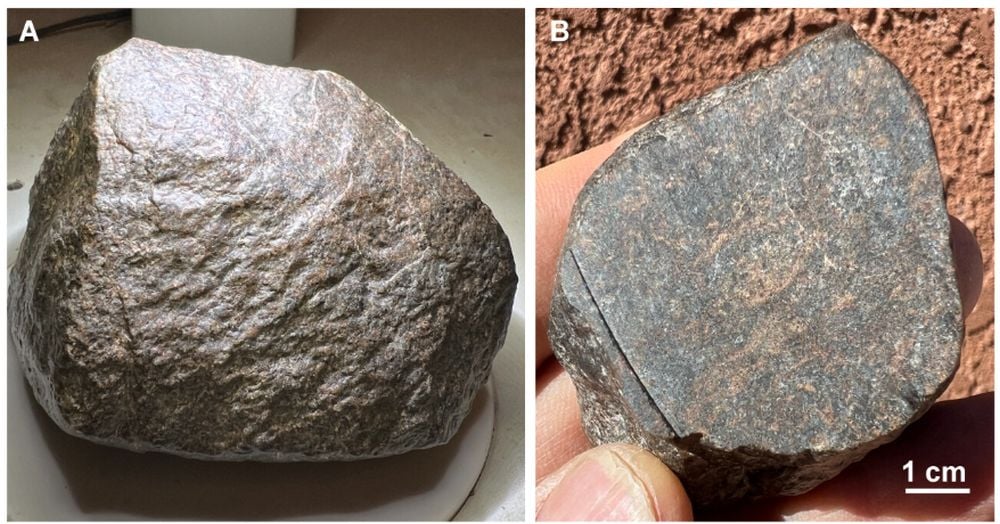
(A) shows the largest of the eight pieces of Teg001. (B) shows a cut section of a smaller chunk. Image Credit: Yang Liu et al., A Martian meteorite that formed ≳4.1 billion years ago samples Mars’ early crust and mantle. Science0,eadz5646DOI:10.1126/science.adz5646

(A) shows the largest of the eight pieces of Teg001. (B) shows a cut section of a smaller chunk. Image Credit: Yang Liu et al., A Martian meteorite that formed ≳4.1 billion years ago samples Mars’ early crust and mantle.

Science0,eadz5646DOI:10.1126/science.adz5646

Ancient meteorites are rare finds and they're extremely valuable scientifically.

"Martian meteorites provide a record of the planet’s geological history," the authors explain in their research. "However, most are geologically young samples that are not representative of Mars’ surface, which is dominated by ancient rocks."

Most meteorites are young just because of selection effects. Meteorites are launched into space by impacts, and that favours young rocks, which are stronger. So meteorites tend to come from younger, basaltic volcanic rocks. More ancient parts of Mars crust are weaker because they're fractured and brecciated by impacts. Some ancient rocks are also sedimentary or clay-bearing rock. These rocks are weaker and much less likely to survive an impact that can launch them into space.

Teghaza is one of the rare ancient Martian meteorites.

"We describe the Martian meteorite Teghaza 001 (Teg 001), a slowly cooled igneous rock that formed at least 4.1 billion years ago," the authors write. "Its composition, mineralogy, and texture are distinct from other Martian meteorites." Distinct from other Martian meteorites, but also similar to likewise ancient Black Beauty.

“I realized that this one was a little bit like Black Beauty, not exactly, but it resembled it in the oxygen isotope values,” Agee said in a press release. "I looked at it microscopically and found domains within it that had high levels of manganese oxide, a compound being looked for on Mars by the rovers as an indicator of environments conducive to life.”

MSL Curiosity found rock fractures in Gale Crater that were filled with material rich in MnO. It suggests, but doesn't prove, that the planet's atmosphere once had free oxygen and oxygen-rich groundwater. That's still being debated.

Lead author Yang Liu and other Caltech scientists used a dating technique to find the age of tiny zircon crystals in Teg 001. Zircon crystals are important finding the age of ancient rocks because they can survive geological processes. They also contain trace amounts of elements with long half-lives. This is how Liu determined that Teg 001 is 4.1 billion years old. "We conducted ten measurements of U and Pb isotopes, in six shocked zircon grains with different morphologies, to determine their U-Pb and Pb-Pb ages," the authors explain.

Though Black Beauty is also ancient, the pair of meteorites are quite different from one another.

“There are a few parts to Black Beauty that are around that age, but that whole meteorite itself is a conglomeration of many different rock types. Teghaza 001 is just one unadulterated rock type, and it's 4.1 billion years or older, so that was a big surprise,” said Agee. “It's the oldest Martian igneous rock ever found by a huge margin, but in addition to that, it seemed to have these clues in its composition that suggested it had been in an environment that had fluids and water coursing through it.”

Teghaza 001 was found in several chunks adding up to almost 800 grams. Unlike Black Beauty, which is a congolomeration of different chunks, Teg 001 is a single rock type. Image Credit: UNM.

Teghaza 001 was found in several chunks adding up to almost 800 grams. Unlike Black Beauty, which is a congolomeration of different chunks, Teg 001 is a single rock type.

Image Credit: UNM.

The isotope Oxygen-18 indicated that it had interacted with water in the past, most likely on the Martian surface. "The high δ 18O value of Teg 001 probably reflects assimilation of δ18O-rich crustal material that had interacted with surficial fluids, or direct reaction of the magma with high-δ18O fluids," the authors write. That finding supports the hypothesis that Mars was once warm and wet, a hypothesis supported by a growing body of evidence.

“We also had these anomalous oxygen isotopes, and these domains that had high manganese levels, Agee said. "All of that was consistent with it being from a time on Mars, from the very, very beginning when the Martian environment was different from the time in which most of the Martian meteorites that we see were formed and erupted a few 100 million years ago when Mars was a dry desert, just like it is now. This sample probably came from an environment on Mars that was more Earth-like.”

This image shows a cut section of Teg001, with some of its features and contents labelled. Pigeonite (PgT) is particularly relevant, because it hosts fluid-altered Magnesium. "The Mg-rich interiors of pigeonite have been heavily altered by reactions with a fluid phase," the authors write. Image Credit: Yang Liu et al., A Martian meteorite that formed ≳4.1 billion years ago samples Mars’ early crust and mantle. Science0,eadz5646DOI:10.1126/science.adz5646

This image shows a cut section of Teg001, with some of its features and contents labelled. Pigeonite (PgT) is particularly relevant, because it hosts fluid-altered Magnesium. "The Mg-rich interiors of pigeonite have been heavily altered by reactions with a fluid phase," the authors write. Image Credit: Yang Liu et al., A Martian meteorite that formed ≳4.1 billion years ago samples Mars’ early crust and mantle.

Science0,eadz5646DOI:10.1126/science.adz5646

Mars' early, potentially more Earth-like time period is called the Pre-Noachian period. Planetary scientists struggle to paint a clear picture of the Pre-Noachian because it was so long ago, and geologica processes and weathering have erased much of the ancient. Some research shows that Mars may have had global oceans during this period, a stunning difference from the frigid, dessicated planet it is today.

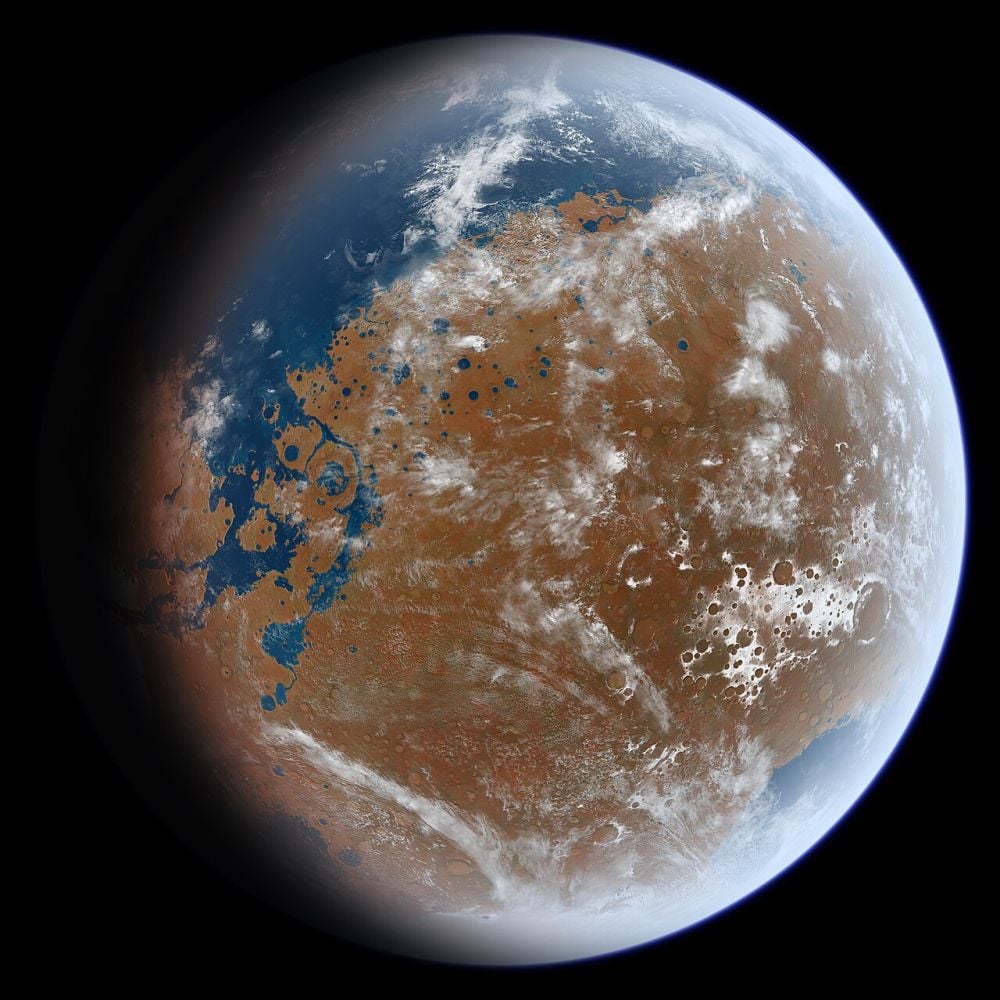
It's possible that billions of years ago, Mars had a global ocean, as shown in this illustration. That could explain the aqueous alteration in Teg001. Image Credit: By Ittiz - Own work, CC BY-SA 3.0, https://commons.wikimedia.org/w/index.php?curid=7861829

It's possible that billions of years ago, Mars had a global ocean, as shown in this illustration. That could explain the aqueous alteration in Teg001.

Image Credit: By Ittiz - Own work, CC BY-SA 3.0, https://commons.wikimedia.org/w/index.php?curid=7861829

It's possible that Mars still has some simple, extant life. If it does, that life is hiding somewhere underground where the last of the planet's ancient water might be sequestered, away from the harsh radiation on the surface. But if the emerging picture of an ancient, warm and wet Mars is true, that would be the Pre-Noachian.

“If there was ever abundant life on Mars, on the surface, not sequestered away in some subsurface, that would be the time that you would be looking at, the Pre-Noachian period,” said Agee. “It's the very earliest time, and that was when maybe Mars still had a magnetic field, and it was shielded from radiation, and there were surface waters. There was a denser atmosphere. If primitive life was abundant in Mars. That is the time that is most likely for it to have happened.”

Most Martian meteorites are much younger than Teg001, only a few hundred million years old. It likely came from a place no rover has visited, possibly from Mars' southern highlands. Remote sensing shows that that ancient region has a similar composition to Teg001.

“This is just one single meteorite. It's like going out, going back in time and chipping off a hunk of an outcrop, 4 billion years ago on Mars, and then we have this example of what was actually happening,” said Agee. “That is why it's such a valuable sample. We’ve never found one like this before. The most exciting part about this find is its age, plus the alteration in the meteorite that indicates it has been in what I would call an Earth-like environment, with fluids coursing over the surface and volcanoes creating hydrothermal systems. There are surface waters and so on. And that's all reflected in the way that the meteorite has been sort of altered from its original state.”

"The presence of aqueously altered minerals, combined with bulk and mineral-specific oxygen isotope measurements, indicate that Teg 001 experienced reactions with fluids enriched in 18O, before ejection into space by an impact," the authors summarize in their paper.

RELATED

How Scientists Proved These Rocks Came From Mars.

{https://www.universetoday.com/ }

Hoe vind je dit bericht?
Geschreven door peter om 17:47 Stuur door

Examining the Cat's Head Nebula with the Hubble and JWST

Examining the Cat's Head Nebula with the Hubble and JWST

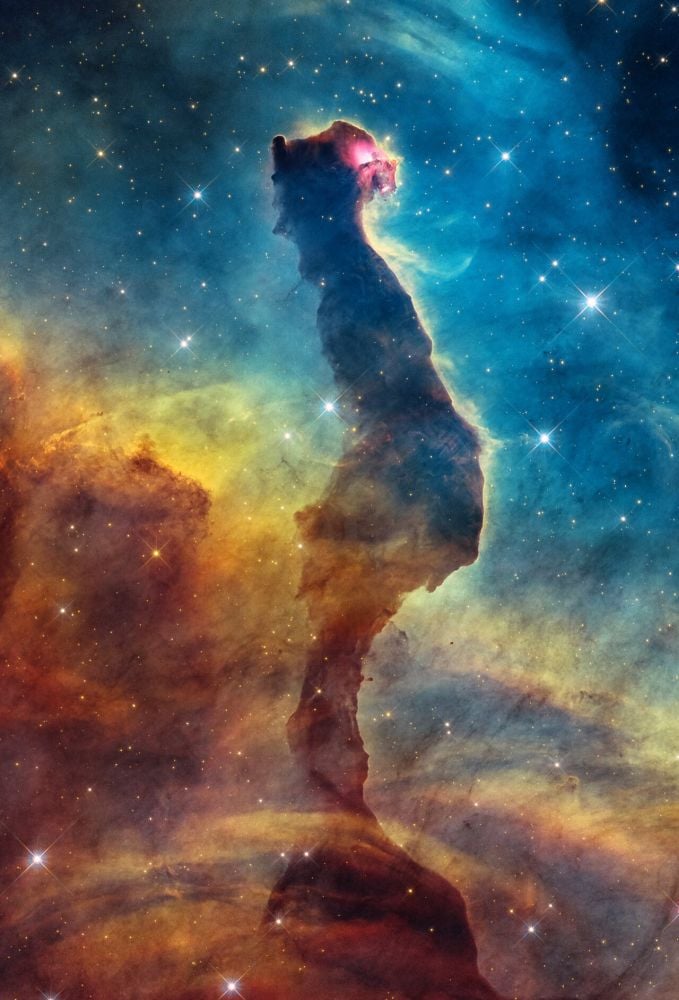
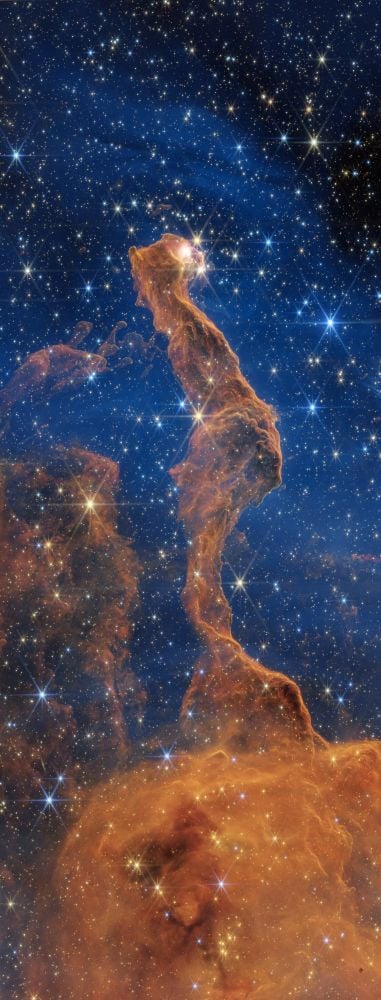
The Cat's Head Nebula proudly rises in this Hubble Space Telescope image. It's a star-forming region within the larger Carina Nebula, an even larger star-forming region. Recently, both the Hubble and the JWST imaged the Cat's Head as part of the ongoing scientific effort to understand the complex process of star formation. Image Credit: NASA, ESA, STScI. Image Processing: J. Depasquale (STScI).

The Cat's Head Nebula proudly rises in this Hubble Space Telescope image. It's a star-forming region within the larger Carina Nebula, an even larger star-forming region. Recently, both the Hubble and the JWST imaged the Cat's Head as part of the ongoing scientific effort to understand the complex process of star formation.

Image Credit: NASA, ESA, STScI. Image Processing: J. Depasquale (STScI).

The Cat's Head nebula gets its name from its appearance: it looks like a cat sitting so that it's facing away from the viewer, with its head turned around on the top of its neck, highlighted by a star that looks like a glowing eye. The unusual shape is made of gas and dust carved and formed by the radiation of young stars.

It's a small part of the larger Carina Nebula, a complex star-forming region about 7,500 light years away. Recently, both the Hubble and the JWST cast their gaze on the Cat's Head in an effort to learn more about star formation, a constant research subject in astronomy.

The Carina Nebula hosts some of the most massive stars in the entire Milky Way in its Carina OB1 assocation. Of particular interest is Eta Carinae, a stellar system that hosts many stars, two of which have a combined luminosity more than 5 million times greater than the Sun. Eta Carinae is also known for being at the heart of the eerily creepy Homunculous Nebula, not visible in these images. Massive stars like the ones in Eta Carinae and their powerful radiation have a pronounced effect on the region, and on star formation itself.

Hubble's image of the Cat's Head is in visible light, while the JWST imaged it in both near and mid-infrared. Each of the images shows a different aspect of the Cat's Head.

The pillar that makes the Cat's Head is composed of thick, dark dust, so far resisting the onslaught of stellar wind and radiation from massive stars. The yellow outline on its right side is likely where photoevaporation is taking place, driven by the same powerful stars. The UV radiation is ionizing the gas on the rim, and will eventually evaporate it completely.

In astronomy images like these, different filters isolate different chemicals like sulphur, oxygen, and hydrogen. The ionization level of the chemicals, along with how highly they're energized and how much dust is present, all affect the colours. Whether we know which colours represent which chemicals or not, these images are awe-inspiring.

The massive stars in the region are also responsible for the arcs and shoals in the images, again caused by their powerful radiation and stellar winds.

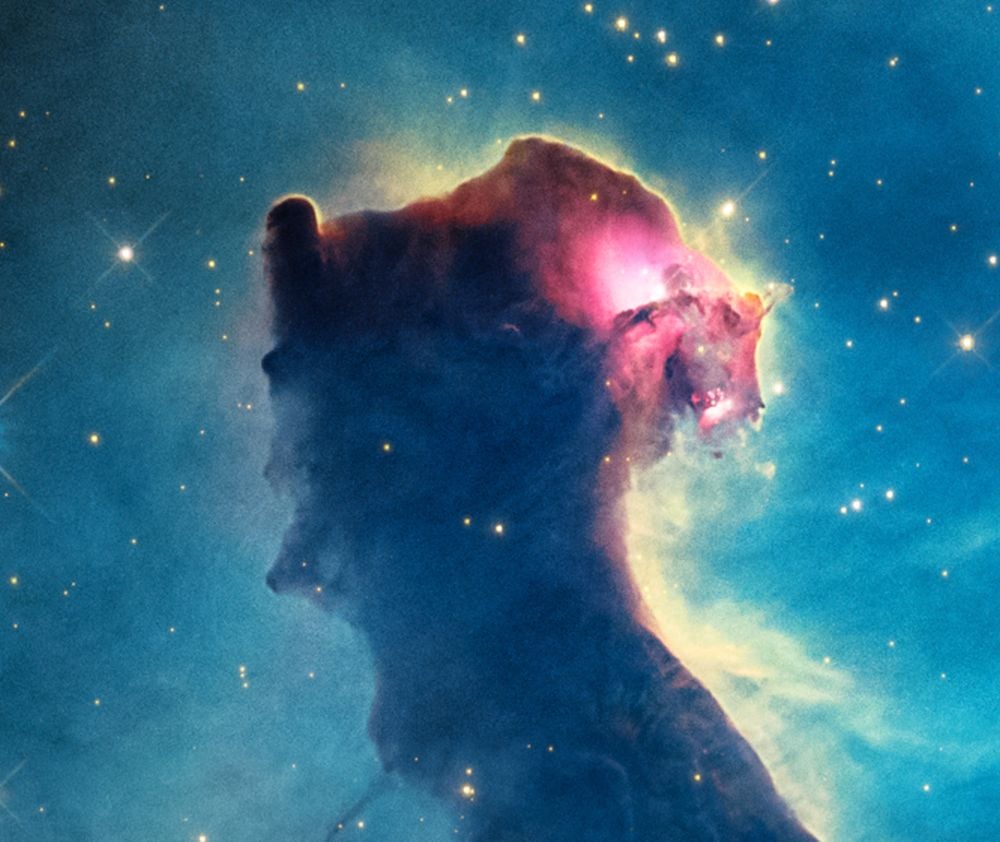
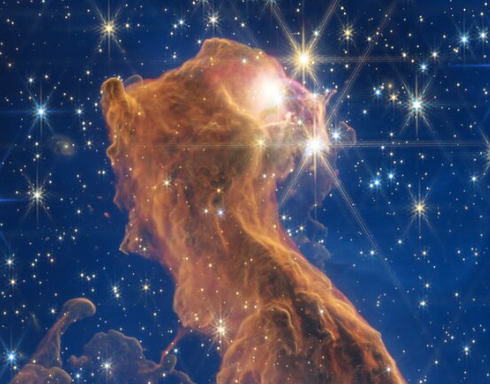
This zoomed-in portion of the Hubble's image highlights the "eyeball", likely a star in just the right position. Image Credit: NASA, ESA, STScI. Image Processing: J. Depasquale (STScI).

This zoomed-in portion of the Hubble's image highlights the "eyeball", likely a star in just the right position.

Image Credit: NASA, ESA, STScI. Image Processing: J. Depasquale (STScI).

The JWST, as an infrared telescope, presents different, yet no less gorgeous, images of the Cat's Head. It's infrared instruments see things differently than the Hubble does. This gives the Cat's Head—already ethereal in the Hubble image—an even more ghostly, almost unreal appearance. Some parts of the Cat's Head in the JWST images appear to be only half-there, with background stars shining brightly through them.

weic2622c_20261029_192815.jpg

The JWST's near-infrared image doesn't show different chemical elements the same way the Hubble image does. Instead, it shows more of the stars themselves. Even background galaxies are visible beyond the Cat's Head, along with the black background of space. The JWST also shows how massive stars are shaping the region, with the wispy filaments on the images left side.

Image Credit: NASA, ESA, CSA, STScI. Image Processing: J. Depasquale (STScI)

Some of the turbulence in the gas, driven by the massive stars, appears more substantial in the JWST image. The star that makes the Cat's Eye is also brighter, with less of its light blocked by dust in infrared.

A zoomed-in JWST NIR image of the head in the Cat's Head Nebula. Image Credit: NASA, ESA, CSA, STScI. Image Processing: J. Depasquale (STScI)

A zoomed-in JWST NIR image of the head in the Cat's Head Nebula.

Image Credit: NASA, ESA, CSA, STScI. Image Processing: J. Depasquale (STScI)

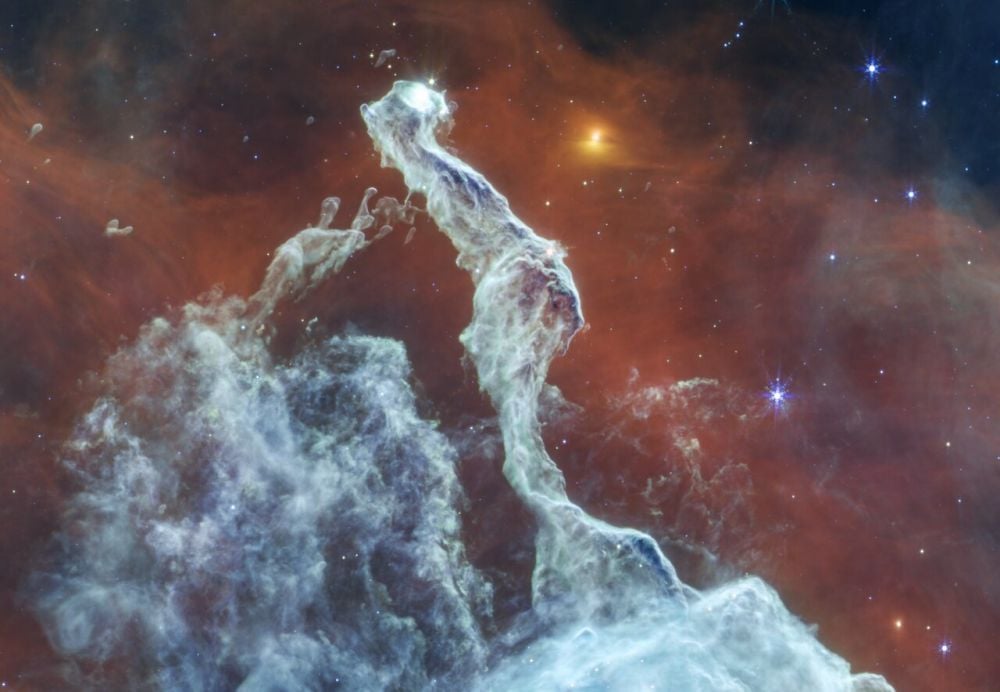
In the JWST's mid-infrared image, the Cat's Head Nebula is transformed yet again. It's muted and ghost-sheet white, surrounded by pastel gas clouds punctuated with stars. The clouds look almost Earth-like in their white colour. This time, it's carbon molecules and warm dust emissions that take the stage. What is most likely an infant star pops into view in this image, embedded in thick dust that it's yet to dissipate, to the right of the head itself.

The white colour of the gas in this mid-infrared JWST image makes it look like Earthly clouds. Fewer stars are visible in the background, their light blocked out by the gas, which appears thicker. In the gas to the left, finer detail is visible in the gas clouds. Image Credit: NASA, ESA, CSA, STScI. Image Processing: J. Depasquale (STScI).

The white colour of the gas in this mid-infrared JWST image makes it look like Earthly clouds. Fewer stars are visible in the background, their light blocked out by the gas, which appears thicker. In the gas to the left, finer detail is visible in the gas clouds.

Image Credit: NASA, ESA, CSA, STScI. Image Processing: J. Depasquale (STScI).

The head itself is muted in the MIR image, along with the rest of the nebula. It's eye, almost malevolent in the other images, blends in with the gas and is less striking.

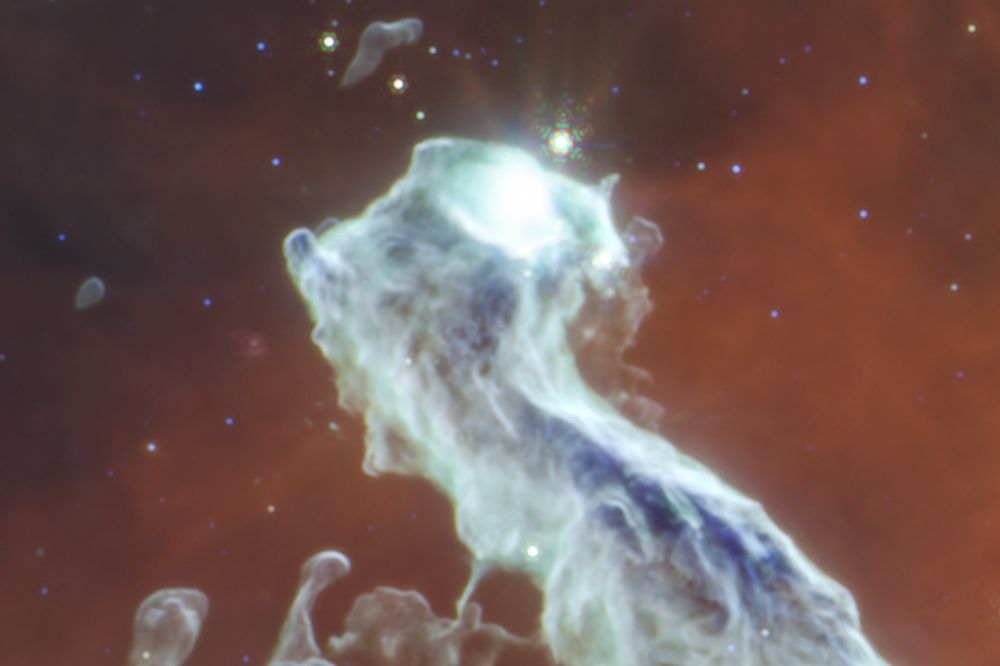
In this zoom-in of the MIR image, the edges are softened, and so are the colours. The star that makes they eye blends in with the gas in gradients of white. Globules below the head look like they're reaching for the head, rather than being blown back by stellar wind and radiation. The blackness of space is visible in the upper right, and a little in the upper left. Image Credit: NASA, ESA, CSA, STScI. Image Processing: J. Depasquale (STScI).

In this zoom-in of the MIR image, the edges are softened, and so are the colours. The star that makes they eye blends in with the gas in gradients of white. Globules below the head look like they're reaching for the head, rather than being blown back by stellar wind and radiation. The blackness of space is visible in the upper right, and a little in the upper left. I

mage Credit: NASA, ESA, CSA, STScI. Image Processing: J. Depasquale (STScI).

Though these images are easy to appreciate by almost anyone, their primary purpose is scientific. By emphasizing and de-emphasizing different aspects of the Cat's Head nebula, astronomers can see stars more clearly, along with the dust, the gas, and the chemistry. Together, they help researchers see the effects of stellar radiation and wind, called stellar feedback, on the ongoing process of star formation.

Stellar feedback can both encourage and stifle star formation, depending on circumstances. It's complicated, and it's an ongoing topic of astronomical study. One of the JWST's main, defining science themes is star formation, and images like these are one of the reasons it was built. The Hubble helps too, and illustrates how the gas, the dust, the metallicity, and the stars of different sizes and ages, all play a role. Those factors all interact in different ways, making it difficult to come up with concrete theories of how it all works.

These gorgeous images are more than eye candy to astronomers. They're working hard on understanding a process fundamental to the cosmos. Wrapped up in all this visual chaos and beauty, Nature's laws are defining how stars form. Astronomers' mission is to decipher it all.

Enjoying these images on their visual merit alone is our mission, if we accept it.

{https://www.universetoday.com/ }

Hoe vind je dit bericht?
Geschreven door peter om 17:23 Stuur door

Roman Space Telescopes: Which Observatories Will Uncover the Universe’s Next Mysteries?

Roman Space Telescopes: Which Observatories Will Uncover the Universe’s Next Mysteries?

Humanity has never had more powerful tools for space exploration. The Hubble Space Telescope has revealed remarkable details of distant galaxies, the James Webb Space Telescope has enabled us to observe the early universe, and the upcoming Nancy Grace Roman Space Telescope mission is set to produce one of the most comprehensive maps of the cosmos. Given these advances, what more could astronomers possibly need?

Indeed, the most significant discoveries may still lie ahead. NASA, ESA, and other space agencies are developing a new generation of observatories designed to search for life on other planets, investigate previously unexplored regions of space, and look back toward the earliest moments of the universe.
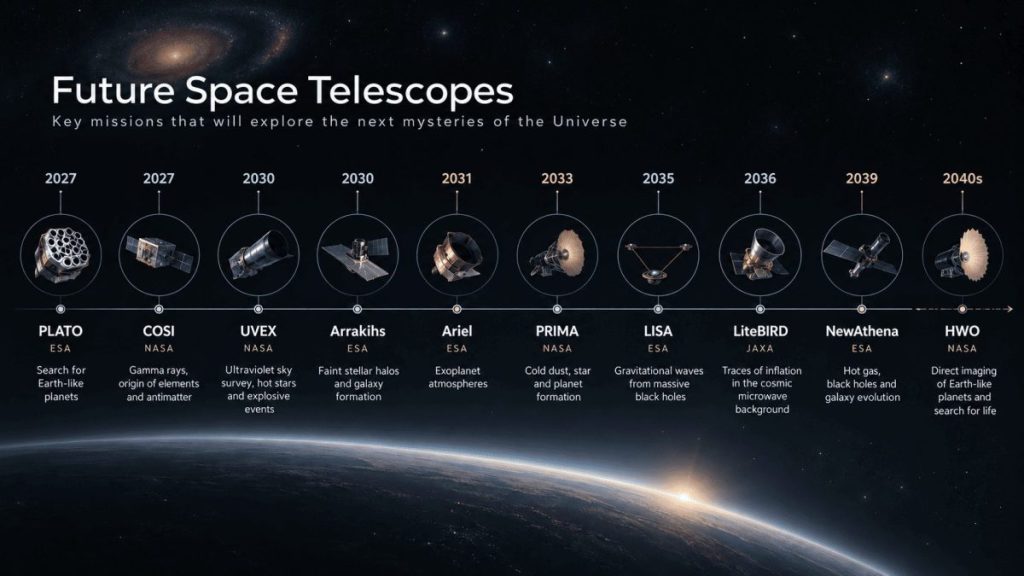
eng-1-1024x576.jpg

A timeline of planned space telescope launches by NASA, ESA, and JAXA from 2027 through the 2040s. The infographic outlines the primary scientific objectives of these future observatories, including the search for Earth-like planets and the study of black holes, gravitational waves, and the early universe.

Source: UST

Why are even the most powerful telescopes insufficient?

On August 30, 2026, NASA launched the Nancy Grace Roman Space Telescope. Its primary mission extends beyond capturing striking images of distant galaxies; it is designed to survey the universe on an unprecedented scale. With its wide field of view, the telescope will be able to observe hundreds of millions of galaxies, search for exoplanets, and study the distribution of dark matter.

However, even Roman, James Webb, and Hubble, collectively, cannot answer all of astronomy’s fundamental questions.
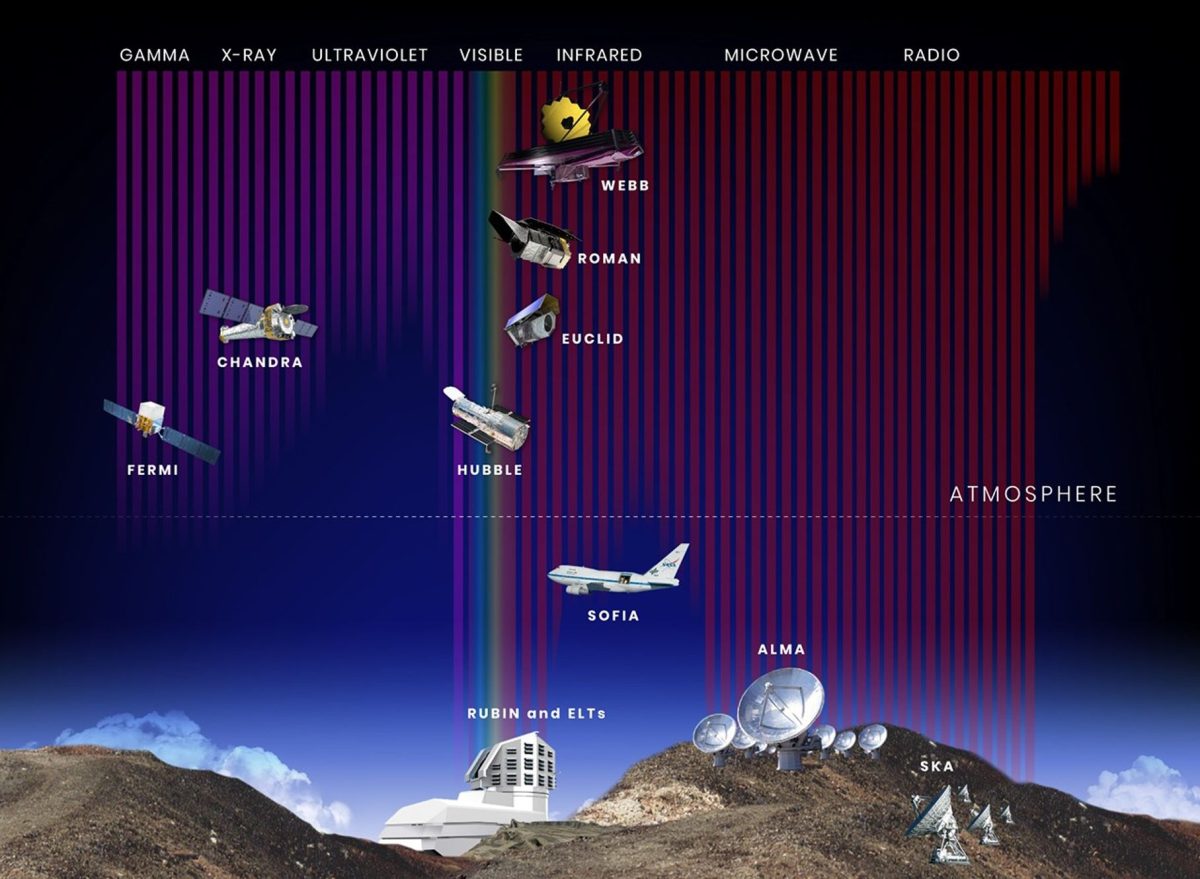
stsci-01febr8scwtrv07xv8we8a9aqb.jpg

The infographic presents the ranges of the electromagnetic spectrum in which various astronomical observatories operate, from gamma-ray and X-ray radiation to infrared light and radio waves. It also illustrates which types of radiation are absorbed by Earth’s atmosphere and explains why some telescopes must be launched into space to study them.

Source: NASA

The issue is not solely the size of the mirrors or the sensitivity of the cameras. The universe emits information across various bands of the electromagnetic spectrum, while the human eye can perceive only a limited portion of it: visible light. Infrared telescopes can detect cooler objects and observe through some cosmic dust; ultraviolet telescopes can study hot stars; and X-ray telescopes can observe extremely high-energy processes near black holes.

Each of these instruments has inherent physical limitations. Accordingly, the next stage in the development of astronomy will depend less on creating a single, universal, ultra-powerful telescope and more on establishing an integrated network of specialized observatories.

  • The first major challenge facing this system is connected to a question that has captivated humanity for millennia: Are we alone in the universe?

PLATO: The Search for Earth-Like Planets [2027]

Astronomers have now identified thousands of planets beyond the Solar System. However, most differ substantially from Earth. Many are gas giants, extremely hot worlds, or planets that orbit very close to their stars. Identifying a genuinely Earth-like planet is considerably more challenging.

One of the most effective methods for detecting exoplanets is the transit method. When a planet passes in front of its star, it blocks a small fraction of the star’s light. A telescope can detect a brief decrease in brightness, which may indicate the presence of a planet. However, Earth blocks only about 0.0084% of the Sun’s light. This illustrates the precision required to measure the brightness of a distant star and detect such a subtle change.

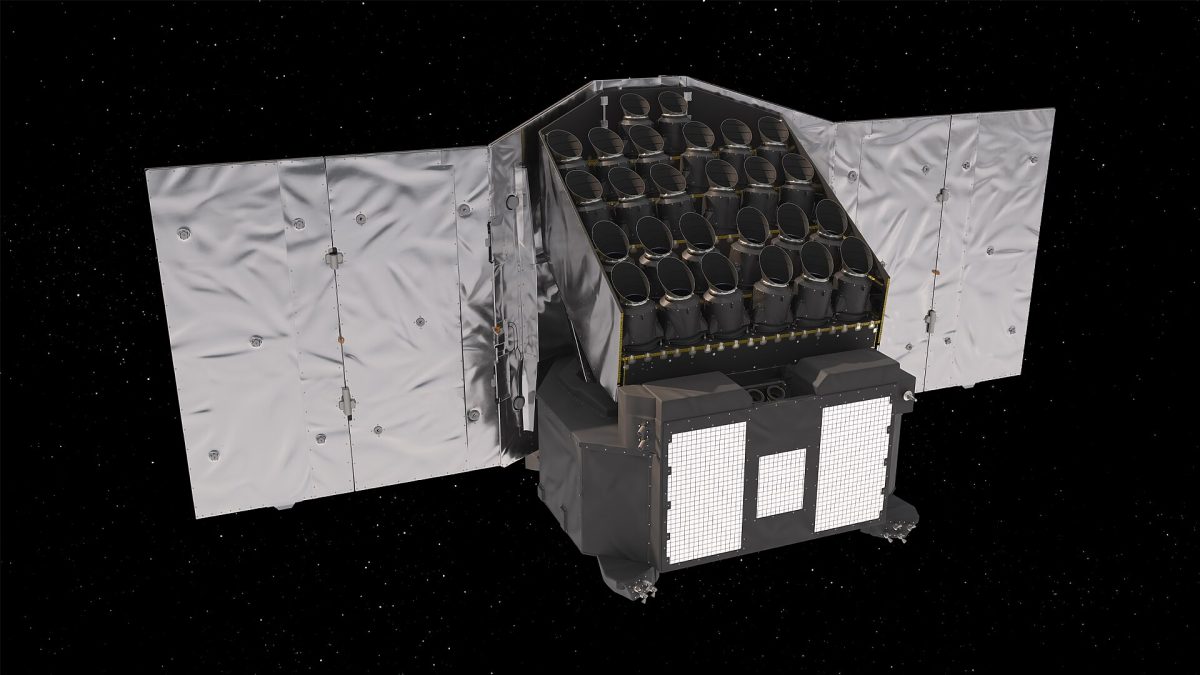
A further challenge is that Earth completes one orbit around the Sun each year. To reliably detect a comparable planet, it is best to observe several of its transits, which requires monitoring the same star for years. The European Space Agency developed the PLATO telescope specifically for this purpose, and it is scheduled to launch in March 2027.
1920px-artists_impression_of_plato.jpg

The European Space Agency’s (ESA) PLATO space telescope is equipped with 26 cameras, enabling it to observe thousands of stars simultaneously. Its primary mission is to search for Earth-like exoplanets, particularly in regions where liquid water may be present.

Source: ESA

Unlike traditional telescopes equipped with a single primary camera, PLATO will utilize 26 separate cameras. Together, these cameras will observe a vast number of stars, monitoring them for characteristic changes in brightness. However, the mission’s objectives extend beyond the discovery of planets. PLATO will also study the subtle fluctuations within the stars themselves. By analyzing these oscillations, astronomers will be able to determine the stars’ sizes, masses, and ages with greater accuracy. In combination with ground-based observations, this information will help assess the properties of the discovered planets.

As a result, we will gain not only a list of new worlds but also a substantially clearer understanding of how frequently rocky planets form around Sun-like stars.

  • This raises the following question: Even if we identify a planet the size of Earth, how can we determine whether it is habitable?

Ariel: What Are the Atmospheres of Other Worlds Composed Of? [2031]

Two planets may be nearly identical in size yet exhibit markedly different surface conditions. The Solar System provides a clear example: Earth and Venus are similar in size, but Venus’s dense atmosphere generates an exceptionally strong greenhouse effect. Consequently, its surface temperature is significantly higher than Earth’s.

Therefore, understanding the planet’s dimensions alone is insufficient; its atmosphere must also be studied. To this end, ESA is developing the Ariel space telescope, which is currently scheduled to launch in 2031.
aryel-2.jpg

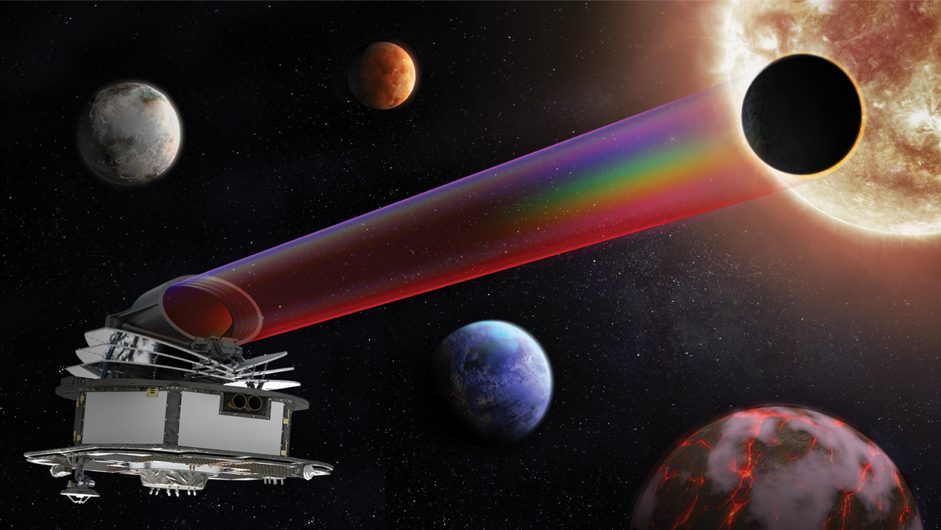
An artist’s rendering of the European Space Agency’s (ESA) Ariel space telescope. By analyzing starlight as it passes through an exoplanet’s atmosphere during transit, the telescope will detect the presence of water vapor, methane, and other gases.
Source: ESA

Its primary instrument will be spectroscopy. When a planet transits its host star, a small fraction of the star’s light passes through the planet’s atmosphere. Molecules of various substances absorb light at characteristic wavelengths, producing distinctive chemical signatures in the spectrum. These signatures enable astronomers to detect water vapor, carbon dioxide, methane, and other atmospheric components.

The James Webb Space Telescope is already employing similar methods; however, Ariel is being developed to systematically study approximately one thousand exoplanets. This will enable comparisons of the atmospheres of planets with different sizes, temperatures, and ages.

The primary objective is to understand the patterns underlying their formation and evolution.

  • However, Ariel will primarily study relatively warm planets with atmospheres suitable for spectroscopic measurements. Searching for potential signs of life on truly Earth-like planets will require an even more sophisticated instrument.

Habitable Worlds Observatory: A Telescope That Will Search for Life (~2040)

Imagine attempting to observe a firefly beside a powerful spotlight located many kilometers away. This is approximately what it is like to photograph an Earth-like planet directly near another star.

In visible light, Earth is approximately ten billion times fainter than the Sun. Consequently, even when a telescope can detect the planet’s light, the star’s radiation overwhelms it. One potential solution is a coronagraph, an optical instrument that suppresses the star’s bright light, enabling the detection of much fainter light from a nearby planet. An experimental coronagraph has already been installed on Roman; however, its capabilities are insufficient for studying Earth-like worlds.

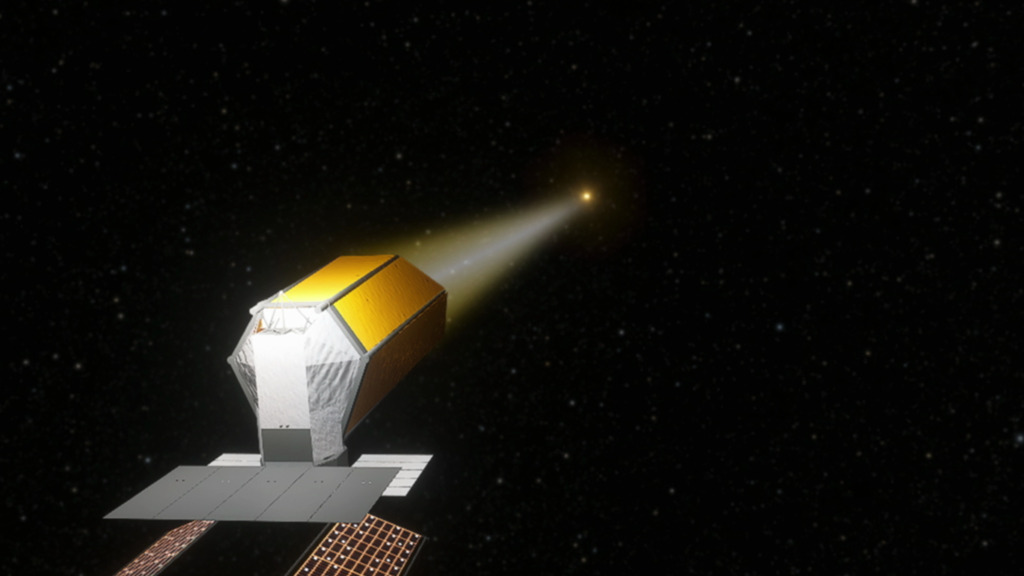
For this reason, NASA is developing the Habitable Worlds Observatory (HWO) concept — a future space observatory specifically designed to search for and study planets that may be capable of supporting life. Its optical system must maintain exceptional image stability. Even microscopic mirror deformations or structural vibrations can generate stray light that obscures the planet’s signal.
habitable_worlds_observatory_ultra-stable_telescope_svs20400_-_ultrastabletelescope_prores_00877_print.jpg

An artist’s rendering of NASA’s future Habitable Worlds Observatory (HWO). With its high-precision optics and ability to block the bright light emitted by stars, the telescope will be capable of directly observing Earth-like exoplanets and studying their atmospheres for potential signs of life.

Source: habitableworldsobservatory

Therefore, engineers must integrate high-precision optics, active wavefront control, and highly sensitive detectors. If the technology performs as intended, the HWO will be capable of directly observing rocky planets and analyzing the composition of their atmospheres. Oxygen, ozone, methane, and other substances that may, under certain conditions, be associated with biological processes will be of particular interest. However, detecting oxygen alone will not provide definitive evidence of life, as some chemical substances can form in the absence of living organisms. Accordingly, astronomers will need to assess the full range of atmospheric conditions.

HWO remains in the conceptual design and key technology development phase. It may be launched in the 2040s; however, no date has been set.

At the same time, the ground-based Extremely Large Telescope is expected to help address several of these complex challenges in the coming years. Its primary mirror, measuring 39 meters (128 feet) in diameter, will comprise 798 segments designed to function as a single optical surface. An adaptive optics system will compensate for atmospheric distortion by adjusting the shape of a specialized mirror approximately one thousand times per second.

The ELT’s initial scientific observations are expected to commence in late 2030. It will be capable of studying individual planets and their atmospheres in detail, thereby complementing the capabilities of space-based observatories.

  • However, to determine how common habitable worlds are, we must answer one additional question: where does the material from which they are formed originate?

PRIMA: An Overview of the Birthplaces of Stars and Planets [~2033]

Stars and planets form within vast clouds of gas and dust. However, the dust itself often hinders astronomers’ ability to observe these processes. Dust particles absorb visible light and re-emit the absorbed energy in the infrared spectrum. Consequently, a region that appears nearly black in a conventional photograph may appear bright when viewed through an infrared telescope.

The James Webb Space Telescope has already provided a glimpse into many such regions. But even it does not cover the entire infrared spectrum. The coldest dust clouds emit a significant portion of their energy in the far-infrared range, which is beyond the reach of Webb’s instruments. This is where a significant gap exists between the capabilities of modern infrared and radio observatories.

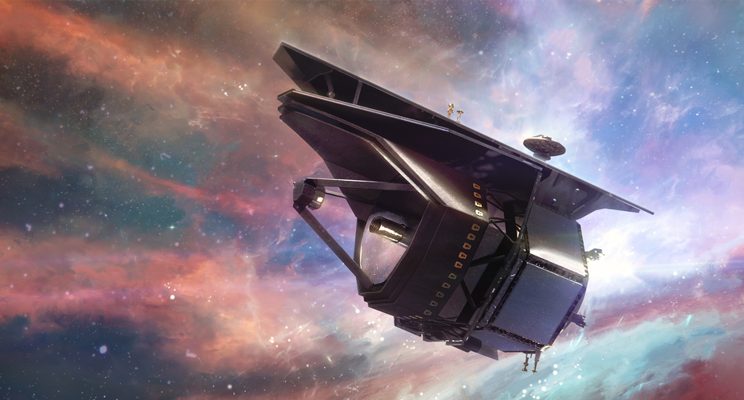
To address this, NASA is developing PRIMA, the PRobe far-Infrared Mission for Astrophysics.
prima.jpg

An artist’s rendering of NASA’s planned PRIMA (Probe Far-Infrared Mission for Astrophysics) space observatory. The telescope will explore the universe in the far-infrared spectrum, enabling the study of cold gas and dust clouds where stars and planets form, as well as regions of galaxies obscured by dust.

Source: PRIMA

In September 2026, the agency selected this mission to proceed to the next phase of design. Subject to further approval, the project is tentatively scheduled for launch in 2033. The telescope, equipped with a mirror approximately 1.8 meters (5.9 feet) in diameter, will study cold dust, gas, and obscured regions of galaxies. This research will help advance our understanding of how new stars form from interstellar matter, how protoplanetary disks evolve, and the role that water and complex chemical compounds play in the early stages of planet formation.

However, temperature is not the sole reason celestial objects remain invisible. Conversely, certain processes are so energetic that they emit light beyond the detection capabilities of optical and infrared telescopes.

COSI and UVEX: Observing Invisible Cosmic Explosions [2027 and 2030]

Not all cosmic processes are observable in visible or infrared light. For instance, hot stars and the early stages of supernova explosions are especially luminous in the ultraviolet spectrum. To study these phenomena, NASA plans to launch the UVEX (UltraViolet EXplorer) telescope in 2030. The telescope will survey the ultraviolet sky and rapidly reorient itself in response to transient cosmic events, including the aftermath of neutron star mergers.

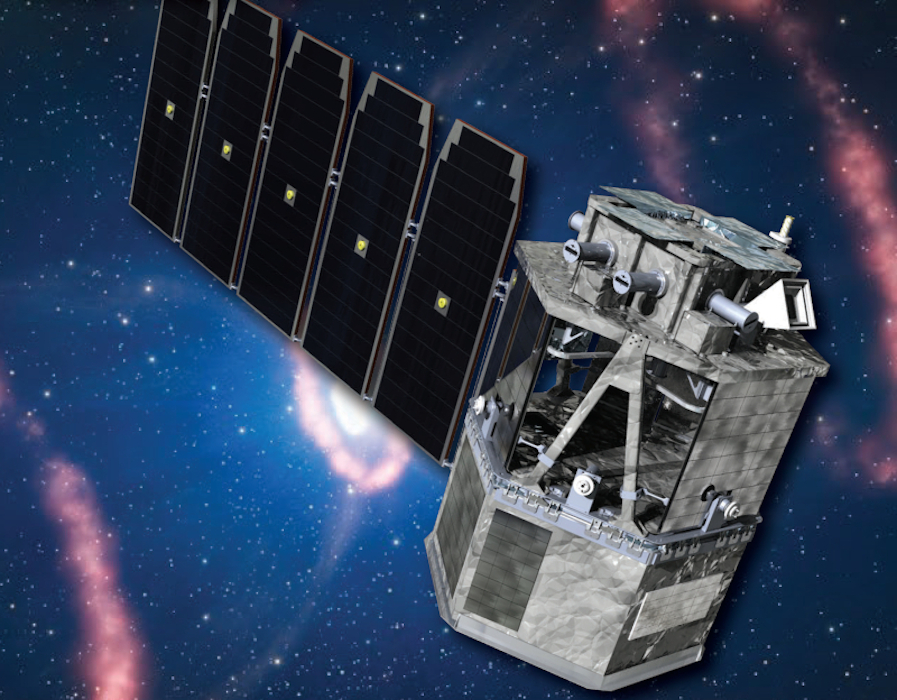
Even higher-energy radiation will be studied by COSI (the Compton Spectrometer and Imager), which is scheduled for launch in 2027. This gamma-ray telescope will help determine where certain chemical elements form in the Galaxy and the origins of positrons — the antiparticles of electrons. When a positron encounters an electron, they annihilate, producing gamma rays that COSI can detect.
cosi_higher_quality.jpg

An artist’s rendering of NASA’s COSI (Compton Spectrometer and Imager) space-based gamma-ray telescope. The observatory will study gamma-ray radiation to determine where certain chemical elements form in the Milky Way and the origins of cosmic antimatter.

Source: COSI

Together, these observatories will enable the study of high-energy processes that are beyond the capabilities of conventional telescopes. However, another challenge remains equally important: detecting the extremely faint matter surrounding galaxies.

Arrakihs and NewAthena: Hidden Features Beyond the Galaxies [2030 and 2039]

Even the most detailed images of galaxies reveal only a portion of their structure. Nearly invisible halos — comprising diffuse gas, dark matter, and faint stellar streams — extend beyond the luminous stellar disks. These halos preserve evidence of ancient collisions and the accretion of smaller galaxies.

To investigate these structures, ESA plans to launch the Arrakihs telescope in 2030. The mission will examine the stellar halos of neighboring galaxies, helping researchers reconstruct their formation histories and test models of dark matter distribution. These observations will complement the large-scale surveys conducted by Roman and Euclid.

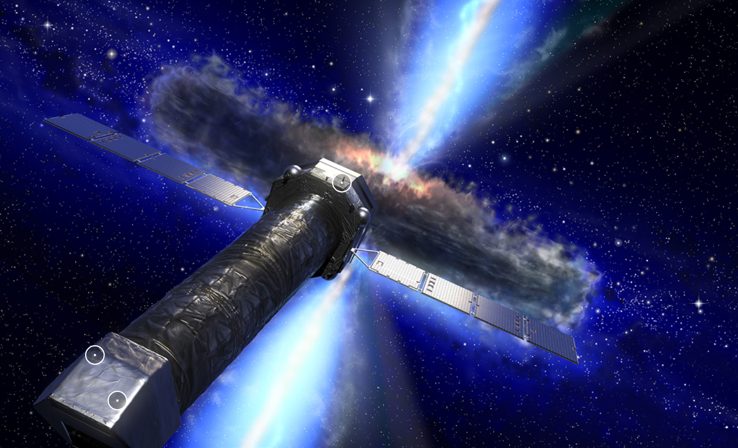
However, some ordinary matter exists in a form so hot that it is best observed in the X-ray range. This is precisely what NewAthena — ESA’s future X-ray observatory, scheduled for launch in 2039 — will study. It will investigate gas in galaxy clusters, the growth of black holes, and their effects on the surrounding environment.
newathena.jpg

An artist’s rendering of the European Space Agency’s (ESA) future NewAthena X-ray observatory. The telescope will study hot gas in galaxy clusters and powerful radiation near black holes, contributing to a better understanding of how they grow and influence the evolution of galaxies.

 Source: ESA

However, the most powerful events involving black holes leave traces not only in radiation but also in the very fabric of spacetime.

LISA: Observing the Collision of Black Holes [2035]

In 2015, the LIGO detectors observed gravitational waves from a black hole merger for the first time. These waves are disturbances in spacetime that propagate at the speed of light. However, ground-based facilities cannot effectively detect the lowest frequencies of these oscillations because of terrestrial noise and the interferometers’ size limitations.

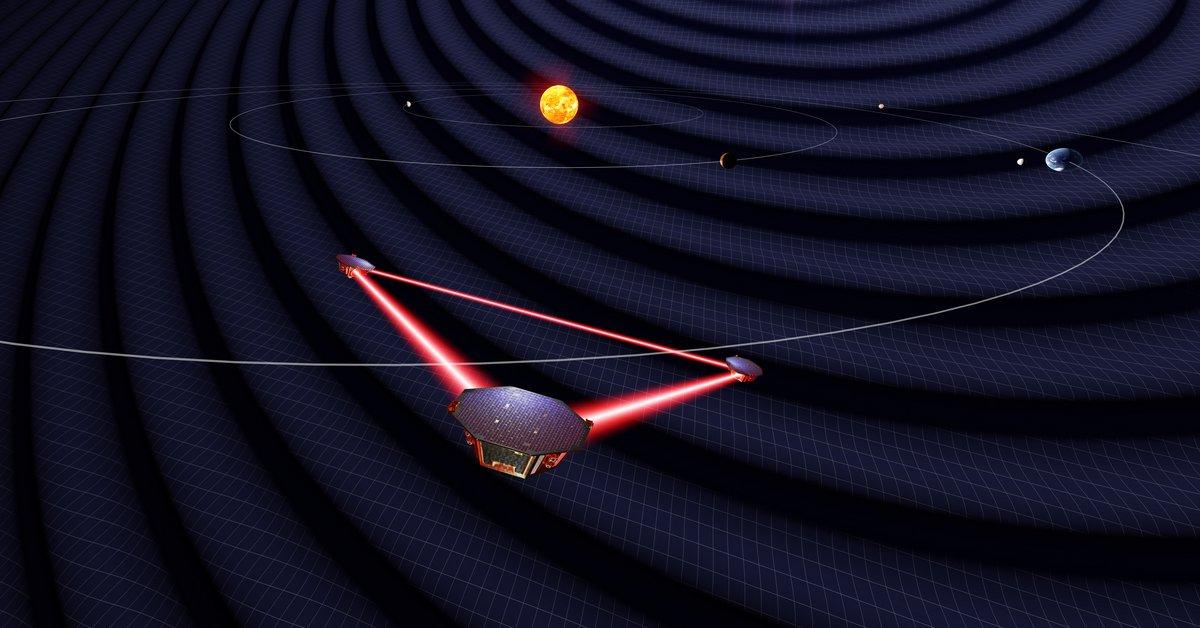
To investigate these phenomena, ESA is developing LISA — the Laser Interferometer  Space Antenna — which is scheduled for launch in 2035. The mission will comprise three spacecraft arranged in a triangle, with sides approximately 2.5 million km (1.55 million miles) in length. By exchanging laser beams, the spacecraft will measure minute changes in distance caused by the passage of gravitational waves.
sk22qxfulovbxxonhfbwfxeo2cz08_hhjtw2jgse66xanzn4w9yvxl_0g9srypiisxeaafjolqfepk0jqgtksm8qjberqzvrvzgqwn7d8_kpxixyswrc2v8nuwushvu_rg68-dvq_xofxasbsx-m99tpy_npp-recrgsbiowxz9trb3r-sfkrrdw7ogfnjp.jpg

An artist’s rendering of the European Space Agency’s (ESA) Laser Interferometer Space Antenna (LISA), a space-based gravitational-wave observatory. Three spacecraft, linked by laser beams and positioned 2.5 million kilometers apart, will detect extremely faint ripples in spacetime caused, in particular, by the mergers of massive black holes.

Source: ESA

LISA’s primary targets will be mergers of supermassive black holes at the centers of galaxies. Combined with X-ray observations from NewAthena, these observations will help us understand how black holes have grown throughout the history of the universe.

However, to study an era in which neither galaxies nor black holes yet existed, we will need entirely different kinds of instruments.

LiteBIRD: Evidence of the Universe’s Origins [2036]

According to one of the leading hypotheses in cosmology, during the earliest moments of its existence, the universe underwent inflation — an exceptionally rapid expansion of space. Although no direct evidence of this process has yet been identified, potential traces may have been preserved in the cosmic microwave background, the oldest light observable to us.

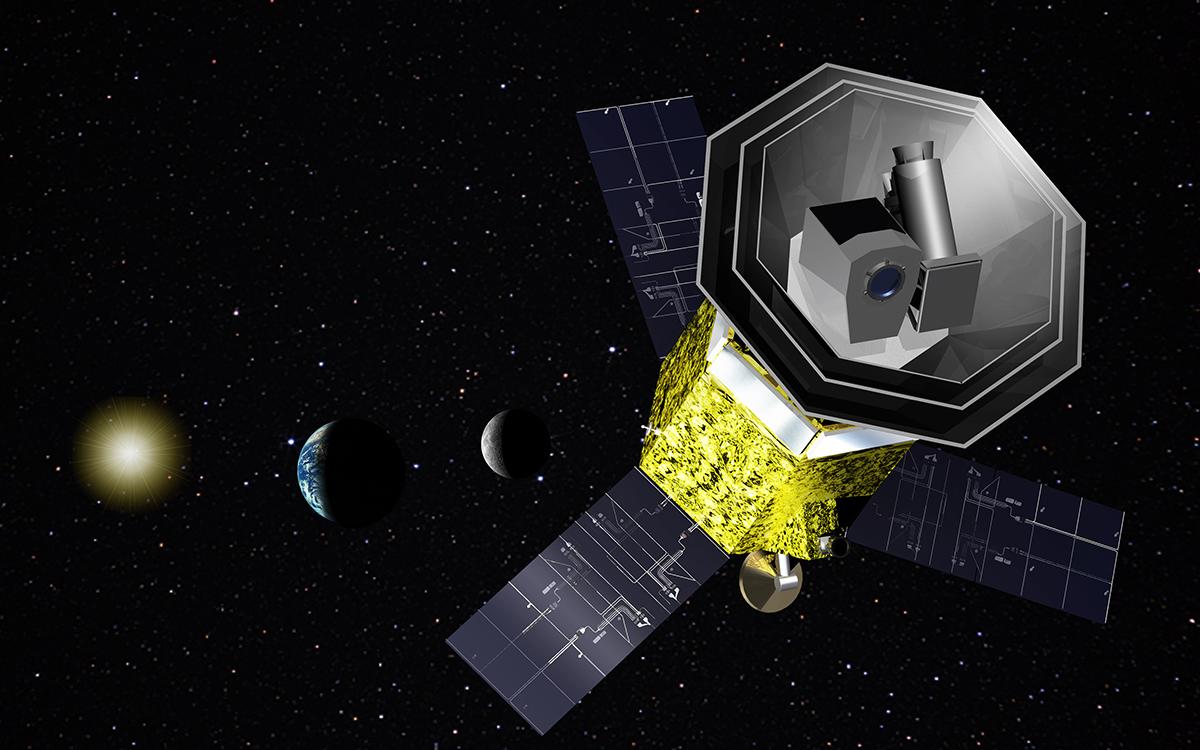
These are precisely the phenomena that the Japanese LiteBIRD observatory, scheduled to launch around 2036, will seek to detect. The observatory will measure the polarization of the cosmic microwave background radiation in an effort to identify a specific pattern: primordial B-modes, which may have been generated by gravitational waves during the inflationary era.
litebird.jpg

An artist’s rendering of the LiteBIRD space observatory, which JAXA is developing to study the polarization of the cosmic microwave background. The telescope will search for extremely faint signals from the early universe that may preserve traces of cosmic inflation — the rapid expansion of space during the first moments after the Big Bang.

Source: JAXA

The expected signal is extremely weak, and radiation from galactic dust may obscure it. Accordingly, LiteBIRD will use measurements across multiple frequencies to distinguish the cosmological signal from nearby sources.

The detection of primordial B-modes could provide significant evidence for inflation. However, observations of the cosmic microwave background allow us to directly study the universe only as it existed approximately 380,000 years after the Big Bang. The subsequent stage in its history — the formation of the first stars and galaxies — will be investigated using radio telescopes.

SKA: The Universe Before the Formation of the First Galaxies [2027]

After the universe became transparent to light, the cosmic dark ages commenced. Although atoms had already formed, the first stars had yet to emerge. The Square Kilometre Array (SKA) — a large network of radio telescopes currently under construction in Australia and South Africa — will help researchers investigate this relatively understudied period.

Thousands of antennas will operate together as a single instrument, detecting exceptionally faint radio emissions. Of particular interest is the signal from neutral hydrogen, which can be used to trace how the first stars gradually transformed the surrounding gas.
at_jodrell_bank_observatory_2018_040.jpg

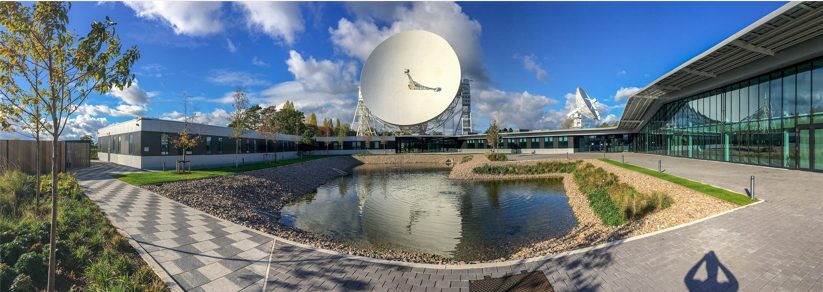
The headquarters of the Square Kilometre Array Observatory (SKAO), an international radio astronomy observatory, is located in the United Kingdom. The renowned Lovell Radio Telescope is visible in the background. The SKA radio telescopes are being constructed in Australia and South Africa and will contribute to the study of the early universe, particularly the period before the first stars and galaxies formed.

Photo: Mike Peel

The SKA will be commissioned in phases as its systems become operational. Together with LiteBIRD, it will help investigate the early history of the universe from two perspectives: possible traces of primordial physical processes and the emergence of the first luminous objects.

Thus, future observatories will progressively address gaps in our observations, and their combined findings will enable us to develop a more comprehensive understanding of the universe’s evolution.

The future of astronomy depends not on a single telescope, but on an integrated system

The future of astronomy depends not on the development of a single, exceptionally powerful telescope, but on a comprehensive network of specialized observatories. Some will search for Earth-like planets, while others will investigate their atmospheres, observe black holes, or seek evidence of the universe’s earliest processes.

The primary advantage of this approach is the ability to study the same objects using different methods. For example, one telescope may detect an exoplanet, another may help determine its mass, and a third may analyze its atmosphere. By combining these data, we can assess how closely this world resembles Earth and whether conditions suitable for life may exist there.

Certainly, no single mission can provide definitive answers to questions concerning the nature of dark matter, the origins of the universe, or the existence of extraterrestrial life. However, each mission will gradually help address gaps in our knowledge.

Hubble has enabled us to observe the universe in remarkable detail; the James Webb  Space Telescope has allowed us to explore much deeper; and the Nancy Grace Roman Space Telescope is poised to create a large-scale map of the cosmos. The next generation of observatories will seek to answer the questions raised by these discoveries.

Perhaps the most significant outcome will not be another photograph of a distant galaxy, but rather the first compelling evidence of life beyond Earth or the discovery of traces of physical processes that occurred long before the first stars formed.

  • It will then become evident that all previous space telescopes represented only the beginning of our exploration of the universe.

{ https://universemagazine.com/en/articles-en/ }

Hoe vind je dit bericht?
Geschreven door peter om 21:45 Stuur door

US Government Reportedly Plotted to Harness Dark Energy for Star Trek-Style Warp Drives to Hunt Aliens

US Government Reportedly Plotted to Harness Dark Energy for Star Trek-Style Warp Drives to Hunt Aliens

Theoretical research based on Alcubierre's model did not demonstrate that faster-than-light travel is technologically feasible or that a warp spacecraft was developed

Aliens

A 2010 US defence study explored dark energy and warp drives, while physicist Katy Clough highlighted practical obstacles to faster-than-light travel By MjolnirPants - Own work,

CC  PHOTO BY-SA 4.0/Wikimedia Commons

The US government reportedly examined dark energy as a possible means of enabling Star Trek-style warp drives in a 2010 defence study later released alongside records concerning UFOs and possible extraterrestrial life.

The study was produced under the Defense Intelligence Agency's Advanced Aerospace Weapon System Applications programme, commonly known as AAWSAP. It considered whether faster-than-light travel could be possible, drawing on a mathematical framework proposed by physicist Miguel Alcubierre in 1994.

The quoted passages concern theoretical propulsion. They do not establish that the government approved an alien-search mission or developed technology capable of carrying astronauts faster than light.

The Energy Barrier to Warp Drives

The proposed system would alter space around a spacecraft. The study states, 'The basic idea is to create an asymmetric bubble of space that is contracting in front of the spacecraft while expanding behind it.

'Using this form of locomotion, the spacecraft remains stationary inside this 'warp bubble' and the movement of space itself facilitates the relative motion of the spacecraft.'

Energy was a central obstacle to translating those calculations into useful travel. Creating the bubble appeared to require far more energy than humanity could supply, leaving a substantial gap between the mathematical proposal and a functioning spacecraft.

Under one set of assumptions, the study calculated a warp-bubble speed of just 5.16 micrometres per second. 'Garden snails can crawl faster than this,' the authors wrote.

The paper explored whether harnessing dark energy could overcome that constraint and make the proposed drive suitable for space travel. Dark energy is associated with the Universe's expansion, but its nature remains poorly understood.

Warp Drives Raise Questions About Cause and Effect

Katy Clough, of Queen Mary University of London, told The Times that the paper made theoretical sense but remained highly speculative. She described using dark energy to build warp drives as a 'common crackpot notion'.

Clough said discussions about warp drives quickly enter the 'realm of bonkers', with numerous practical obstacles standing between the calculations and actual space travel.

Although faster-than-light travel could shorten journeys, she warned that it might also 'break causality and change the past', raising questions beyond whether enough energy could ever be supplied.

Her concern extended beyond propulsion technology to the possibility that such travel could challenge the established relationship between cause and effect.

NASA-Backed Nuclear Rocket Would Not Deliver Warp Drives

A separate propulsion concept, the Pulsed Plasma Rocket, or PPR, was described as a way to shorten journeys to Mars without reaching warp speed. US company Howe Industries was developing the system.

The rocket would obtain energy through fission, the controlled splitting of atoms, to generate thrust. That is a different proposal from the expanding and contracting space described in the warp-drive study.

NASA stated in its May 2024 project description that 'The PPR enables a whole new era in space exploration.' It also projected that the proposed system's efficiency could allow crewed missions to reach Mars within two months.

The two-month journey remained a projection for the proposed technology. NASA said the system could alternatively transport heavier spacecraft equipped with additional shielding against galactic cosmic rays, potentially reducing crew exposure.

{ https://www.ibtimes.co.uk/science }

Hoe vind je dit bericht?
Geschreven door peter om 17:30 Stuur door

A Massive New Object Has Been Discovered Beyond Pluto—Could It Be a Dwarf Planet?

rubin-observatory-reve-360x240.jpg

A Massive New Object Has Been Discovered Beyond Pluto—Could It Be a Dwarf Planet?

A potential new dwarf planet has been discovered beyond Pluto, offering astronomers a glimpse of a distant world that may be among the largest objects identified in the outer solar system in decades.

Using observations from the NSF–DOE Vera C. Rubin Observatory, researchers identified the object, provisionally designated 2026 ED138, and estimated that it measures between 600 and 1,500 kilometers (370 and 930 miles) across.

On October 13, astrophysicist Matthew Holman of the Center for Astrophysics, Harvard & Smithsonian, identified the object while analyzing data collected by Rubin earlier this year. Its unusual brightness and distance suggested that it could be large enough to qualify as a dwarf planet.

If confirmed, ED138 could join Pluto, Ceres, Eris, Haumea, and Makemake as one of the five dwarf planets officially recognized by the International Astronomical Union (IAU).

“If confirmed as a dwarf planet, ED138 would join a very small family of worlds,” Holman said in a statement. “Rubin will image the whole southern sky again and again for 10 years, so any others hiding in the places earlier surveys skipped are now within reach.”

Holman and Mario Jurić, a University of Washington professor of astronomy and Rubin’s solar system lead scientist, presented the findings at a press conference during the 58th Annual Division for Planetary Sciences meeting in Spokane, Washington.

A hidden new world 

“Finding an object this big, roughly 1,000 kilometers (620 miles) across, is something that happens maybe once in a generation,” Jurić said. “It’s the largest trans-Neptunian object found in about 20 years, and Rubin turned it up while we were still commissioning the telescope.”

ED138 is 46 times farther away from the Sun than Earth, and currently sits  46 astronomical units (AU) from our star than Earth. By contrast, Pluto’s orbital distance is 40 AU.

The newfound object belongs to a population of distant bodies known as trans-Neptunian objects (TNOs), which orbit the Sun beyond Neptune. These objects offer important clues about the solar system’s early history, including how giant planets moved and how gravitational interactions scattered objects to the farthest reaches of our cosmic neighborhood. 

Qualifications for being a dwarf planet 

Under the International Astronomical Union’s definition, a dwarf planet must orbit the Sun, possess enough mass for its gravity to pull it into a nearly round shape, and not have cleared its orbital neighborhood of other objects. It also cannot be a satellite.

Reviewing the newly obtained data, astronomers found that, based on the object’s brightness, distance, and estimated surface reflectivity, the object could be between 600 and 1,500 kilometers across. However, more observations are needed to understand its dimensions. 

“My first reaction was one of excited disbelief,” Holman said. “Objects like this are very rare, so I immediately started checking whether I or the code had done something wrong.”

How the object was found 

Holman identified ED138 using a computer algorithm developed with fellow astrophysicist Kevin Napier. The software searches through billions of detections, comparing observations of moving objects to determine which measurements correspond to the same celestial body.

After the initial discovery on October 13, researchers began searching existing observations to confirm the object’s identity and better understand its orbit. Jurić searched Rubin’s archival data and image catalogs to help verify the discovery, uncovering 20 more images dating back to March 2026 that helped correlate their findings. 

In total, Rubin’s Simonyi Survey Telescope had observed ED138 30 times across 20 nights between March 4 and July 11.

“Rubin is giving us an unprecedented capacity to explore the sky through a combination of speed, depth and precision,” Jurić said. “And the discovery is just the beginning: Once we identify a new object, we can search back months, and sometimes even decades, finding it in images where nobody knew to look.

“This ability to both discover and ‘precover’ objects is transforming how quickly and accurately we can determine their orbits and understand the distant solar system,” Jurić added.

RELATED

Astronomers Find Mysterious Object Beyond Pluto, Possible Dwarf Planet | Gravitas
A New Dwarf Planet Beyond Pluto?
Did We Just Discover a New Dwarf Planet? The Mystery Beyond Neptune | Planet Nine
Another Planet Found Beyond Pluto — And It Changes Everything | Space Documentary 2026

{ https://thedebrief.org/category/space/ }

Hoe vind je dit bericht?
Geschreven door peter om 16:29 Stuur door

Astronomers Solve the Mystery of the Sun’s Spinning Plasma Jets

Astronomers Solve the Mystery of the Sun’s Spinning Plasma Jets

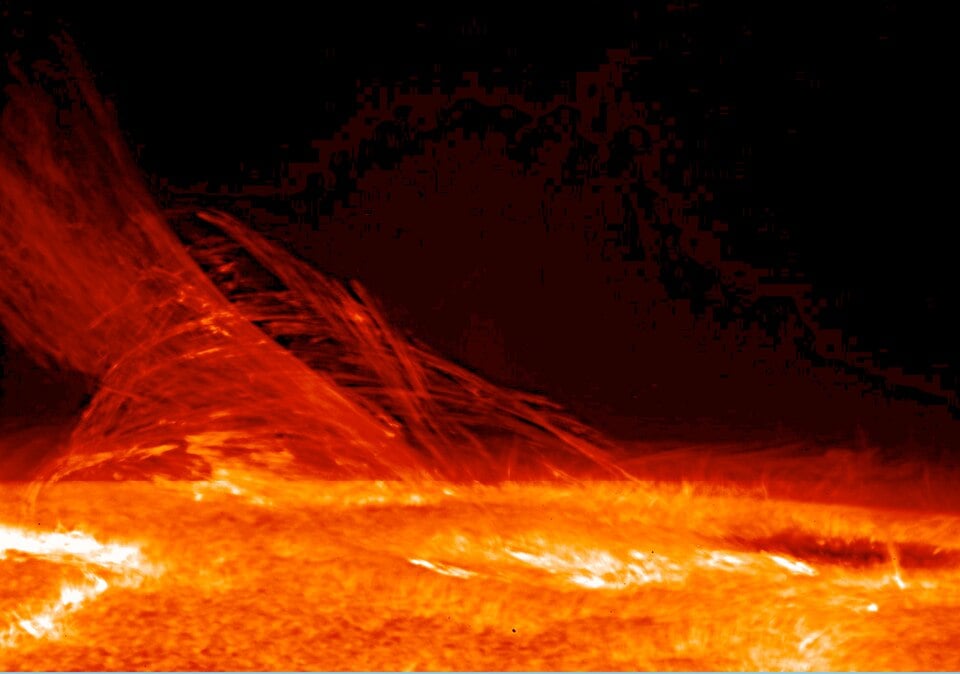
Image of a limb flare from Hinode. Credit - Hinode JAXA/NASA

7Image of a limb flare from Hinode. 

Credit - Hinode JAXA/NASA

The torrent of corona related discoveries keeps coming. Lately we’ve covered a variety of potential solutions to the “coronal heating problem” - why the Sun’s corona is so much hotter than its surface. Now, a paper led by a team of researchers from the University of Newcastle, Indian Institute for Astrophysics, and University of Sheffield, offers another answer - that we’ve been viewing the “spicules” that form in the lower solar atmosphere all wrong.

Spicules are spike-like geysers of plasma that shoot up into the solar atmosphere at tens of kilometers per second, eventually collapsing back down towards the surface after a few minutes. There are thought to be tens of thousands of these along the solar edge, and potentially millions of them at any given time across the entire surface of the Sun. Scientists have always treated them like miniature plasma tornados, with each individual “spike” acting as an individual.

The paper calls that into question. Instead of two dimensional spikes, it provides evidence that spicules might actually be an optical illusion created by complex three dimension “curtains” of plasma. They don’t operate as individual cylinders - they are in fact part of a rippling and folded magnetic sheet that acts like a vast atmospheric drape. From our perspective - which is essentially a two dimensional one only at the edge of the Sun, the overlapping folds create the illusion of a series of discrete, spinning jets.

Fraser talks about the highest ever resolution image taken of the Sun.

Unlike many of the other spicule-related discoveries we’ve reported on recently, this one didn’t come from new data from a new spacecraft, like Solar Orbiter or the Parker Solar Probe - it came from a simulation. The researchers used a computer simulation tool called Pencil Code to model the magnetohydrodynamics of the convection zone beneath the solar surface all the way up through the lower corona. One of the most notable features of that environment was the acoustic pounding, almost like a drum, that the churning granules of plasma beneath the Sun’s surface delivers to its atmosphere.

That pounding launches the equivalent of sound waves up into the atmosphere itself - though in this case, they are magnetohydrodynamic waves that directly follow magnetic field lines. As they travel higher, the gas surrounding them gets thinner, and they grow into huge bow shocks. When they eventually break, those shock waves blast part of the atmosphere upward, creating giant “curtains” of plasma thousands of kilometers into the Sun’s atmosphere.

Which all sounds very similar to what other research has already said about this process. This obviously wasn’t the first time someone has tried to model the connection between the Sun’s surface and atmosphere. One of the paper’s key findings was modeling what space observatories would actually see. From a top-down perspective, the plasma that was blasted up by these waves looks like a sheet arranged into accordion-like folds. But, if a telescope was looking at the edge of the Sun, the integration of those folds made it appear like a single line - a spicule. The spicules “movements” could even be understood as the curtains swaying and curling over time.

Video showing solar spicules, as seen by Hinode in 2007.
Credit - WebMaster Hinode YouTube Channel

Luckily, there was some real data that could back up these modeled findings. Instead of one of the newer spacecraft, the researchers turned to the Interface Region Imaging Spectrograph (IRIS) and the Hinode satellite, originally launched in 2013 and 2006 respectively. Data from both had shown spicules undergoing some bizarre motions. But when the data was lined up with simulated data from the model, those bizarre motions matched well with a curving, twisting curtain. It appeared that the vertical straws of the spicules could instead be a projection of a rumpled curtain.

But perhaps the more interesting discovery was of something that sounds very like spicules, but are actually a different phenomenon altogether. The researchers used automated vortex-detection algorithms on their model and found giant columns of rotating plasma that could stretch all the way out to the corona. However, unlike spicules, these are huge whirlpools hundreds of kilometers across, rotating at up to twenty kilometers per second. The scientists named them Coronal Swirling Conduits, or CoSCos.

CoSCos appear to come in two different types. One is created when magnetic field lines snap and break in the solar atmosphere. That snapping and breaking is a primary suspect in the coronal heating mystery, but obviously has a major impact on the surrounding Sun’s environment too. A second creation path is tied to the edges of the spicule curtains - they are much denser than the “void” that makes up most of the rest of the corona, causing huge pressure and density differences along their edges. That mismatch generates something called baroclinic vorticity - on Earth it’s equivalent to how ocean breezes colliding with warm air from farther inland can stir up coastal weather systems. But in fact, as the spicule curtains themselves begin to lose energy and float back down to the surface, the massive tornadoes they kicked up will actually pull them back up into the corona.

That is the pathway by which these spicule sheets contribute to the coronal heating problem. CoSCos pull spicular sheet plasma back up from the surface into the corona, powering the solar wind and providing energy that heats the area. Or at least that’s how it works in theory. Observations of rotating bunches of spicules from instruments like Hinode and IRIS affirm where CoSCos exist, showing that rotating spicules mark regions where these theoretical giant plasma tornadoes transport energy into the solar atmosphere. But there’s still a lot we don’t know about this process - maybe we’ll get some more insight from all of the fancy new solar observation equipment that is currently looking at our beloved star.

Learn More:

Watch the video to learn how scientists used a combination of computer simulations and observations to determine how spicules form.
Credits: NASA’s Goddard Space Flight Center/Joy Ng, producer
Download this video in HD formats from NASA Goddard’s Scientific Visualization Studio

{ https://www.universetoday.com/ }

Hoe vind je dit bericht?
Geschreven door peter om 13:49 Stuur door

US intelligence report offers first clear glimpse at top–secret Chinese spaceplane accused of releasing mysterious objects above Earth

US intelligence report offers first clear glimpse at top–secret Chinese spaceplane accused of releasing mysterious objects above Earth

A US intelligence report has offered the first clear glimpse at China's top–secret spaceplane.

The robotic Shenlong, or 'divine dragon' spacecraft has previously been seen releasing mysterious objects in Low–Earth Orbit (LEO).

Since its first mission in 2020, the mysterious plane has been the subject of intense observation by governments, space agencies and private companies.

However, until now, no one has seen more than a blurry photo of the light reflecting off its panels.

This first high–resolution image was released in the Defence Intelligence Agency's (DIA) latest Challenges to Security in Space report.

Buried in the 130–page document was a previously unseen image of the plane captured by Maxar Technologies, now Vantor, in 2024.

The report simply captions the image as a 'PRC [People's Republic of China] Spaceplane', adding that 'spaceplanes can launch into orbit to place objects in space or even test them and return to Earth'.

Oddly, neither the report nor caption mentioned that this was the first image of its kind or that it was previously classified, raising questions about why this image has now been revealed.

A US intelligence report has offered the first clear glimpse of China's top–secret Shelong, or 'divine dragon', spaceplane (pictured)

A US intelligence report has offered the first clear glimpse of China's top–secret Shelong, or 'divine dragon', spaceplane (pictured)

The image was captured by the intelligence company Vantor in 2024. It shows that the craft's payload doors are open and that it is docked with a secondary satellite

The image was captured by the intelligence company Vantor in 2024. It shows that the craft's payload doors are open and that it is docked with a secondary satellite 

Much like the American space shuttle, the Shenlong spaceplane is launched from Earth aboard a rocket, before entering orbit and landing like a plane. 

Its most recent mission began on February 7 this year, after it took off on a Long March 2F rocket from China's Jiuquan Satellite Launch Center.

However, China has remained exceptionally secretive about its experimental spaceplane and has not even released an official photo of the spacecraft.

This means this image is the first time the public has had a good chance to examine Shenlong and learn more about its potential capabilities.

Vantor, in an update on X, said: 'The report documents China’s expanding presence in space, including reusable space systems, and features Vantor’s WorldView Space imagery of a Chinese spaceplane in orbit in 2024.'

The company's annotated version of the photo describes the craft as PRC Test Spacecraft 3 and notes that it is 26ft long (8m).

The image also highlights that the payload bay doors are visible as partly open and that there is a secondary satellite docked on the rear.

This 32ft–wide (10m) satellite is likely to be a 'service module', a type of satellite that connects with spacecraft to provide them with additional power, propulsion or support systems.

Importantly, this photo also reveals what many experts had already anticipated: Shenlong is nearly identical to the US Space Force's own robotic spaceplane.

Originally developed as a NASA research project before being taken over by the Department of Defence, the US X–37 spaceplane is a remarkably similar reusable craft.

Previously, the best images of the mysterious plane have been blurry reflections from its panel. However, radar tracking has shown the plane releasing several mysterious objects in orbit

Previously, the best images of the mysterious plane have been blurry reflections from its panel. However, radar tracking has shown the plane releasing several mysterious objects in orbit  

What do we know about China's Shenlong spaceplane?

First launched: 2020

Number of orbital missions: 4

Total days in space: Over 800

Length: 26ft (8m)

Weight: Unknown

Payload capacity: Unknown  

Known capabilities: Docking with satellites, releasing payloads, and potentially collecting satellites. 

Since 2010, X–37B has flown seven missions and spent more than 2,000 days in space conducting secret missions.

Officially, X–37B is an 'experimental test program to demonstrate technologies for a reliable, reusable, uncrewed space test platform for the U.S. Air Force,' but its specific purposes are unknown.

However, what is now abundantly clear is the remarkable similarity between the older American spaceplane and its new Chinese counterpart.

Professor Jonathan McDowell, a satellite tracking expert from Durham University Space Research Centre, told the Daily Mail: 'The Chinese spaceplane is very similar to the X–37B, with a payload bay in the middle and a jettisonable service module with solar arrays at the back.

'The wings are slightly different, but the overall layout, down to the tilted rear fins, says to me that some important official in China went to the space folks with a picture of the X–37B and said, "build me one of these".'

However, despite these new images, many of the details concerning Shenlong and its functions remain unclear.

As the report notes, China has two named spaceplanes, Shenlong and Tengyun, meaning 'cloud rider', and it isn't necessarily clear which this image shows.

Likewise, the DIA simply noted that China has launched three spaceplane missions, one in 2020, the second in 2022, and a third beginning in 2023.

Experts say that the Shenlong spaceplane is extremely similar in design to the US Space Force's own robotic spaceplane, the X-38B (pictured)

Experts say that the Shenlong spaceplane is extremely similar in design to the US Space Force's own robotic spaceplane, the X–38B (pictured)

US-based space tracking firm Leo Labs previously spotted 'an unknown object in the vicinity of the Chinese Shenlong reusable spaceplane', suggesting that it may be releasing small satellites in Low Earth Orbit

US–based space tracking firm Leo Labs previously spotted 'an unknown object in the vicinity of the Chinese Shenlong reusable spaceplane', suggesting that it may be releasing small satellites in Low Earth Orbit 

We do not yet know whether these were all conducted by the same plane or whether China has multiple operational spaceplanes in orbit.

Most importantly, the DIA has not yet publicly speculated on what Shenlong has been doing in LEO over these years.

Previous radar tracking has captured Shenlong releasing nine unidentified payloads around Earth.

It is believed that these are small, simple satellites called cubesats, but their function remains unclear.

In 2026, Professor McDowell also observed that Shenlong appeared to release a satellite into orbit before returning to retrieve it several months later.

The new report also notes that, during its second mission in November 2022, the spaceplane came within 330ft (100m) of a smaller spacecraft, potentially capturing and re–releasing it.

'I suspect the vehicle also has a robot arm for deploying and retrieving satellites, but that is not visible on the photo,' Professor McDowell explains.

However, despite the alarm this incident caused, Professor McDowell believes the spaceplanes' function is simply to 'show they [China] can do a robotic mini shuttle'.

Experts suggest that the Shenlong spaceplane is designed to demonstrate China's capability to launch a robotic shuttle and to test technology in orbit. Pictured: An artistic render of the spaceplane

Experts suggest that the Shenlong spaceplane is designed to demonstrate China's capability to launch a robotic shuttle and to test technology in orbit. Pictured: An artistic render of the spaceplane

He adds that it would be 'good for testing new equipment in orbit and then returning it to Earth intact for refurbishment and reuse'.

These findings come as the US warns of a rapid growth in capabilities within China's military and civilian space program. 
Besides Shenlong, China has also revealed images of a planned cargo spaceplane called Haolong, set to serve the Tiangong Space Station.

Haolong is known to weigh around 7,000 kilograms, with a length of 32ft (10m) and a width of 24ft (8m) with its wings unfolded.

The DIA now warns that China's 'rapidly expanding space program' is second only to America's own in size and ability.

Since 2016, the number of space launches taking place each year has more than tripled from 22 to 93, and Beijing has started deploying nine times more satellites per year. 

Most worryingly, the NIA's report warns that China sees space as a 'strategic priority for military dominance'.
The report says: 'China has developed and will continue to advance weapons for use against satellites in orbit to disrupt, damage, and destroy other nations’ space capabilities.

China has also revealed plans for a commercial cargo spaceplane, dubbed Haolong, set to supply the Tiangong Space Station

China has also revealed plans for a commercial cargo spaceplane, dubbed Haolong, set to supply the Tiangong Space Station 

'China continues to research, develop, test, and deploy multiple types of counterspace weapons, including ground-based ASAT missile systems capable of destroying satellites.'

Despite decades of international consensus that space was off limits for direct military action, multiple nations are now aiming to weaponise Earth's orbit.

In September, US Air Force Secretary Troy Meink confirmed that the United States has 'on-orbit space control weapons capable of defending the Joint Force against hostile adversary action.'

This was the first time that the US has ever confirmed it has weapons stationed in space, raising concerns over a new space arms race. 

RELATED

China’s top secret space plane revealed in rare unclassified image
China's Super Secret Spaceplane Finally Revealed

{ https://www.dailymail.com/sciencetech/index.html }

Hoe vind je dit bericht?
Geschreven door peter om 12:54 Stuur door

Ancient Comets Carried Organic Compounds, But They Didn't Survive Crashing Into Earth

Ancient Comets Carried Organic Compounds, But They Didn't Survive Crashing Into Earth

This artist's illustration shows an ancient comet smashing into the ancient Earth. Scientists have wondered if comets could have delivered life's essential building blocks to our young planet, since we now know that comets carry organic molecules important for prebiotic chemistry. But new research says this picture is unlikely. Image Credit: Scarlett White This artist's illustration shows an ancient comet smashing into the ancient Earth. Scientists have wondered if comets could have delivered life's essential building blocks to our young planet, since we now know that comets carry organic molecules important for prebiotic chemistry. But new research says this picture is unlikely. Image Credit: Scarlett White The appearance of life on Earth is still a mystery. It's constrained by a few factors; for instance, the Earth had to have cooled before life could get started, and there had to be some liquid water, the right chemicals, and an energy source. But most of the details are hidden in the deep past.

As science has progressed and our observing power has advanced, some pieces of evidence have emerged that carry tantalizing hints at the bigger picture of life appearing on Earth. Scientists have found that comets carry important organic compounds. That has led to the hypothesis that comets could have seeded Earth with chemistry that led to abiogenesis. These include the amino acid glycine, phosphorous, and hydrogen cyanide (HCN), a chemical compound of particular importance.

The ESA's Rosetta mission, which included the Philae Lander, visited the comet 67P/Churyumov–Gerasimenko in 2014 and detected glycine, an amino acid, and phosphorous, an organic chemical. Phosphorous is an important element in all living things, and is a critical part of DNA and RNA. These findings helped generate the idea that comets played a role in seeding the early Earth with the chemistry necessary for life. Image Credit: Spacecraft: ESA/ATG medialab; Comet: ESA/Rosetta/NavCam – CC BY-SA IGO 3.0; data: Altwegg et al. (2016). LICENCE: ESA Standard Licence

The ESA's Rosetta mission, which included the Philae Lander, visited the comet 67P/Churyumov–Gerasimenko in 2014 and detected glycine, an amino acid, and phosphorous, an organic chemical. Phosphorous is an important element in all living things, and is a critical part of DNA and RNA. These findings helped generate the idea that comets played a role in seeding the early Earth with the chemistry necessary for life.

 Image Credit: Spacecraft: ESA/ATG medialab; Comet: ESA/Rosetta/NavCam – CC BY-SA IGO 3.0; data: Altwegg et al. (2016). LICENCE: ESA Standard Licence

This hypothesis is not widely-accepted, but hasn't been conclusively disproven, either. We're in the early stages. But new research shows that it is unlikely that comets seeded Earth with the chemistry that led to life.

The research is titled "Cometary impacts an unlikely pathway towards the origins of life on Earth," and it's published in the journal Scientific Reports. The lead author is Dr. Richard Anslow from University of Cambridge’s Institute of Astronomy.

“It’s kind of a romantic idea, but our results suggest it’s highly unlikely.” - Dr. Richard Anslow, Institute of Astronomy, University of Cambridge.

"An early period of cometary bombardment has long been speculated to provide an important source of prebiotic feedstock molecules, required for the origins of life on Earth," the authors write. "In support of this interpretation, comets boast a rich diversity of volatile organic molecules, with many thought to be limiting for prebiotic chemistry."

"The origin of life on Earth presumably resulted from prebiotic chemistry, the synthesis of key molecular building blocks from an initial reservoir of reactive bioessential feedstock molecules," they continue. "Hydrogen cyanide (HCN) has emerged as a key feedstock molecule..." they state. HCN can drive high-energy reactions central to prebiotic synthesis.

But just because comets carry these molecules, and just because comets crashed into Earth, it doesn't follow that they were able to deliver organic molecules intact. Comet impacts are very energetic events that generate high temperatures. "Modelling studies suggest, however, that a significant proportion of these molecules will be destroyed during hypervelocity impact," the researchers write.

The researchers worked with simulations of comet impacts, discoveries about how comets interact with atmospheres, and dynamic modelling showing where short-period comets originate and how they evolve. They focused on HCN, since it plays such a critical role. The results do not support the cometary delivery idea.

The researchers say that the cometary bombardment didn't last long enough, and also that if any molecules did survive, there weren't enough of them.

"Taken together, the rapid decline in Earth’s cometary impact bombardment and the efficient destruction of fragile cometary organics indicate that the successful delivery of prebiotic feedstock molecules was an exceedingly rare event," the authors write.

“Historically, scientists thought that comets were important for the origin of life on Earth, because they carried carbon- and nitrogen-bearing molecules, so these giant space snowballs were almost like a ‘get out of jail free card’ that brought all the molecules a planet would need to seed life,” said lead author Anslow . “It’s kind of a romantic idea, but our results suggest it’s highly unlikely.”

The destruction of organic compounds in the impacts themselves the authors left to previous researchers. Previous work shows that the survivability of HCN has been overestimated. For example, a 2020 paper points out that only "the most favorable impacts (low impact angle, low velocity, small radius)" would not breach the temperature threshold that destroys HCN. Were there enough of those?

In this work the researchers focused on short-period comets. Not because long-period comets don't also carry the chemicals in question, but because short-period comets have substantially lower velocities, increasing the odds of the chemical surviving the impacts with Earth.

Their analysis showed that size matters. Smaller comets are likely to be torn apart as they enter the inner Solar System. The torque generated by their off-gassing introduces rotational istability that tears many of them apart. That reduces the overall number of comets that struck the ancient Earth.

Comets can break apart in spectacular displays as they approach the Sun, as shown in these Hubble images of Comet 73P/Schwassmann-Wachmann 3. Tidal forces can rip them apart, rapid rotation can destroy their nuclei, out-gassing can destroy them with eruptions, and thermal stresses can also cause their demise. Image Credit: NASA, ESA, H. Weaver (APL/JHU), M. Mutchler and Z. Levay (STScI). LICENCE: ESA Standard Licence

Comets can break apart in spectacular displays as they approach the Sun, as shown in these Hubble images of Comet 73P/Schwassmann-Wachmann 3. Tidal forces can rip them apart, rapid rotation can destroy their nuclei, out-gassing can destroy them with eruptions, and thermal stresses can also cause their demise.

Image Credit: NASA, ESA, H. Weaver (APL/JHU), M. Mutchler and Z. Levay (STScI). LICENCE: ESA Standard Licence

They also point out that many of the comets would've been destroyed after entering Earth's atmosphere, and never even reached the planet's surface. "The low density (i.e., high porosity) and weak mechanical strength of comets combine such that comets are particularly vulnerable to destruction during atmospheric passage," the authors explain. "Earth’s atmosphere therefore acts as a filter—preferentially destroying small and oblique comets—and thus, biasing the population of comets able to deliver prebiotic feedstock molecules to local surficial environments."

The cometary bombardment of Earth slowed to a crawl after about the first 500 million years of the planet's history, reflective of the fewer number of bodies travelling around in the chaotic young Solar System. Overall, this work shows that there were most likely only a handful of comets that could have delivered any HCN to Earth.

"On a global scale we find, in agreement with the results of Todd & Öberg, that comets are unable to deliver a prebiotically relevant concentration of HCN to the early Earth," the authors write. It takes more than a small amount of HCN to be relevant.

One idea says that comets not only delivered the critical HCN, but that the impacts created subterranean hydrothermal systems that could have brought HCN into an environment already conducive to abiogenesis.

This graphic shows how impacts can generate a hydrothermal system with conditions conducive to the appearance of life. If cometary HCN was delivered in sufficient quantities, it may have played a role in life appearing in these environments. Image Credit: Journal of Marine Science and Engineering (2026). DOI: 10.3390/jmse14050486

This graphic shows how impacts can generate a hydrothermal system with conditions conducive to the appearance of life. If cometary HCN was delivered in sufficient quantities, it may have played a role in life appearing in these environments.

Image Credit: Journal of Marine Science and Engineering (2026). DOI: 10.3390/jmse14050486

But Anslow and his co-researchers also discount that based on the rapid flow of water into the environment. "A salient outcome of high-velocity cometary impacts, irrespective of the delivery of HCN, is thus the rapid influx of local groundwater into the newly-formed crater-lake, rapidly diluting surviving cometary HCN below prebiotically relevant concentrations," they write.

So it doesn't look good for the cometary-delivery hypothesis.

“It would really have to be a one-in-a-million occurrence, because not only would you need an impact at just the right speed and just the right angle, you would also need everything to happen after that point, in terms of the concentration and the speed at which the chemical origins of life got going,” Anslow said in a press release. “We can’t rule out for certain that it happened that way. But it seems to be a really rare occurrence – at best, a one-off fluke.”

The researchers also examined if the same limitation for cometary delivery were true for Mars, which may have hosted life in the distant past.

"We find that cometary delivery is far more effective onto Mars," the authors write, despite a smaller number of impacts. "This efficiency is driven primarily by lower cometary impact velocities—a consequence of Mars’ lower escape velocity and larger semi-major axis—and Mars’ tenuous atmosphere," they explain. More smaller comets would survive compared to Earth, meaning a larger delivery of HCN. In fact, the rate of surviving comets at Mars is five times higher than for Earth.

"This simple comparison between the Solar System’s terrestrial planets suggests that, all else being equal, Mars would have been the more favourable target for the cometary delivery of prebiotic feedstock molecules, and if cometary delivery is an important prerequisite step for prebiotic chemistry, strengthens the possibility that life could have emerged on Mars," the authors write. But they caution that this is a best case scenario, and there are a host of other considerations that weaken the idea.

“This is not to say it definitely happened on Mars, of course, but suggests it would be unlikely if it happened on Earth and didn’t happen on Mars,” Anslow said. “Or the other, perhaps more likely, alternative, is that it didn’t happen on either planet.”

This is comet 67P/Churyumov–Gerasimenko, visited by the ESA's Rosetta mission and its Philae lander in 2015. It was taken from a distance of 86.6 km, only a few days before a much closer flyby. The Philae lander's COSAC and Ptolemy instruments detected sixteen organics on the comet's surface, including HCN and the amino acid glycine. Unfortunately, it's a big leap from finding these chemicals on a comet and them being delivered to Earth in enough quantities to contribute to the appearance of life. Image Credit: ESA/Rosetta/NavCam – CC BY-SA IGO 3.0. LICENCE: ESA Standard Licence

This is comet 67P/Churyumov–Gerasimenko, visited by the ESA's Rosetta mission and its Philae lander in 2015. It was taken from a distance of 86.6 km, only a few days before a much closer flyby. The Philae lander's COSAC and Ptolemy instruments detected sixteen organics on the comet's surface, including HCN and the amino acid glycine. Unfortunately, it's a big leap from finding these chemicals on a comet and them being delivered to Earth in enough quantities to contribute to the appearance of life.

Image Credit: ESA/Rosetta/NavCam – CC BY-SA IGO 3.0. LICENCE: ESA Standard Licence

There's no question that comets carry important organics in high enough concentrations to matter, but the successful delivery to Earth, at the right time, in the right concentrations, and in the right locations, is far more complicated. Many factors contribute to the unsuccessful delivery of cometary HCN to Earth.

"Although Solar System comets boast a rich diversity of volatile organic species—including crucially many prebiotic feedstock molecules in high concentration—we have shown via Monte Carlo simulation of Earth’s cometary bombardment that these comets were, on the whole, unable to deliver these fragile organic molecules to Earth’s surface intact," the researchers write.

So the mystery of how life started on Earth endures, and despite finding important chemicals like HCN on comets, and despite the tantalizing idea that they could have delivered it to Earth, detailed modelling shows how unlikely that was.

"To summarise, our results demonstrate that Earth’s cometary bombardment was unable to provide the concentrated reservoir of bioessential feedstock molecules required for synthetic prebiotic chemistry, challenging the long-held suggestion that cometary impacts may plausibly have played an important role in the origins of life on Earth," the researchers conclude.

RELATED

2000 Pound Rare Meteorite That Crashed Into New Jersey Home Reveals ‘Secrets of Life’s Origins’ |4K
12 Terrifying Things Scientists Found Hiding Inside Comets

{ https://www.universetoday.com/ }

Hoe vind je dit bericht?
Geschreven door peter om 22:43 Stuur door

Where did Earth's water come from? Scientists make major breakthrough as they find our planet was completely DRY when it formed

Where did Earth's water come from? Scientists make major breakthrough as they find our planet was completely DRY when it formed

Scientists have made a major breakthrough in the search for the origin of Earth's water.

Earth's oceans are unique in the solar system and essential for life, but experts say that our planet wasn't always so blue.

In fact, researchers from the University of New Mexico say that the Earth may have been completely dry when it formed.

However, in a surprising new suggestion, the scientists claim our planet may have formed all the water we see today directly out of its rocky raw materials.

They suggest that rocky pebbles rained down from the sky during the young planet's early formation, reacting with the hydrogen–rich atmosphere.

Iron oxide in these rocks reacted with hydrogen under extreme heat to create water and pure iron that would go on to form the planet's metal core.

Based on the results of laboratory experiments, the researchers suggest that hundreds of oceans' worth of water could have been created in this way.

Co–author Professor Zachary Sharp, a planetary scientist from the University of New Mexico, says: 'Looking out over a large body of water, it is hard to imagine that that water may have been produced 4.5 billion years ago in a hell–like atmosphere, but it very well may have.'

Researchers say that Earth was once completely dry, but created its own water supply through the reactions between its hot atmosphere and falling 'pebbles' (artist's impression)

Researchers say that Earth was once completely dry, but created its own water supply through the reactions between its hot atmosphere and falling 'pebbles' (artist's impression) 

The fact that Earth is abundant in liquid water is hardly a novel observation, but it does raise a perplexing problem for astronomers.

Scientists believe Earth, and all the other planets in the solar system, formed out of a swirling ring of dust and rock called the protoplanetary disc.

Near to the centre of the disc, where the inner planets are today, the radiation from the sun was so powerful that water molecules would have mostly been blasted back into hydrogen and oxygen.

However, since water clearly does exist on Earth today, the puzzle is explaining where it came from.

'Previous ideas about the source of water to Earth rely on an external source, such as comets or meteorites,' says Professor Sharp.

These so–called 'icy pebbles' would have formed far out in the colder reaches of the solar system, and only came inwards towards Earth later on.

However, this would require Earth to be hit by an enormous number of comets in its early formation, which some experts find unlikely.

Instead, Professor Sharp and his co–authors propose that most of Earth's water was made on the planet itself out of rocky minerals and hydrogen.

As Earth formed, rocky silicate pebbles fell through a hot, hydrogen-rich atmosphere. The iron oxide contained inside these rocks reacted with the hydrogen to create water and pure metallic iron, which formed the planet's core (illustrated)

As Earth formed, rocky silicate pebbles fell through a hot, hydrogen–rich atmosphere. The iron oxide contained inside these rocks reacted with the hydrogen to create water and pure metallic iron, which formed the planet's core (illustrated) 

Many scientists now believe that the planet formed as small, rocky pebbles accumulated to form a larger planetary body – a process known as pebble accretion.

When the planet became big enough, it developed a hot, high–pressure hydrogen atmosphere that could react with iron oxide in the falling pebbles to make water.

To test this theory, the researchers heated rock samples at temperatures between 1,200°C and 1,400°C (2,190–2,550°F) in streams of hydrogen and, for comparison, helium.

In their paper, published in Nature Geoscience, they found that 80 per cent of the iron oxide in the samples held under a stream of hydrogen was converted into metallic iron, producing water within minutes.

No such reaction occurred in the samples held under helium, showing that the hot hydrogen atmosphere is key.

Professor Sharp says: 'We had suspected and hoped that we would produce iron metal and water in our reduction experiments, but we really had no way of knowing how fast and how much.

'We were quite surprised to find that extrapolation of our work suggests that hundreds of oceans' worth of water were likely produced in this way.'

This suggests that the 'pebble rain' could have been critical to the formation of life–giving oceans in Earth's early history.

To test this theory, scientists heated different silicate mineral samples to extreme temperatures and recorded whether they reacted to produce iron and water. Pictured: Rock samples seen under a scanning electron microscope after heating

To test this theory, scientists heated different silicate mineral samples to extreme temperatures and recorded whether they reacted to produce iron and water. Pictured: Rock samples seen under a scanning electron microscope after heating

However, it also has some big consequences for the search for alien life out among the stars.

Scientists think that many rocky planets formed via pebble accretion, meaning they would have the chance to undergo those same water–producing reactions.

Rather than waiting for water to arrive by chance in ice or water–rich minerals from space, a growing planet could simply generate its own oceans directly.

That means many more rocky, Earth–sized planets could have abundant liquid water than had previously been suspected.

'The idea of pebble accretion is still relatively new. It's only been around for the last decade. But it seems to solve many problems that exist with the existing paradigm for planet formation,' says Professor Sharp.

'And now we see that it also can explain why our planet is habitable. By extension, it is reasonable to expect that other Earth–sized bodies circling other stars would also have water and possibly life.'

KEY DISCOVERIES IN HUMANITY'S SEARCH FOR ALIEN LIFE

Discovery of pulsars

British astronomer Dame Jocelyn Bell Burnell was the first person to discover a pulsar in 1967 when she spotted a radio pulsar.

Since then other types of pulsars that emit X-rays and gamma rays have also been spotted.

Pulsars are essentially rotating, highly magnetised neutron stars but when they were first discovered it was believed they could have come from aliens.

'Wow!' radio signal

In 1977, an astronomer looking for alien life in the night sky above Ohio spotted a radio signal so powerful that he excitedly wrote 'Wow!' next to his data.

In 1977, an astronomer looking for alien life in the night sky above Ohio spotted a radio signal so powerful that he excitedly wrote 'Wow!' next to his data

In 1977, an astronomer looking for alien life in the night sky above Ohio spotted a radio signal so powerful that he excitedly wrote 'Wow!' next to his data

The 72-second blast, spotted by Dr Jerry Ehman through a radio telescope, came from Sagittarius but matched no known celestial object.

Conspiracy theorists have since claimed that the 'Wow! signal', which was 30 times stronger than background radiation, was a message from intelligent extraterrestrials.

Fossilised Martian microbes

In 1996 Nasa and the White House made the explosive announcement that the rock contained traces of Martian bugs.

The meteorite, catalogued as Allen Hills (ALH) 84001, crashed onto the frozen wastes of Antarctica 13,000 years ago and was recovered in 1984. 

Photographs were released showing elongated segmented objects that appeared strikingly lifelike.

Photographs were released showing elongated segmented objects that appeared strikingly lifelike (pictured)

Photographs were released showing elongated segmented objects that appeared strikingly lifelike (pictured)

However, the excitement did not last long. Other scientists questioned whether the meteorite samples were contaminated. 

They also argued that heat generated when the rock was blasted into space may have created mineral structures that could be mistaken for microfossils. 

Behaviour of Tabby's Star in 2005 

The star, otherwise known as KIC 8462852, is located 1,400 light years away and has baffled astronomers since being discovered in 2015.

It dims at a much faster rate than other stars, which some experts have suggested is a sign of aliens harnessing the energy of a star.

The star, otherwise known as KIC 8462852, is located 1,400 light years away and has baffled astonomers since being discovered in 2015 (artist's impression)

The star, otherwise known as KIC 8462852, is located 1,400 light years away and has baffled astonomers since being discovered in 2015 (artist's impression)

Recent studies have 'eliminated the possibility of an alien megastructure', and instead, suggests that a ring of dust could be causing the strange signals.

Exoplanets in the Goldilocks zone in 2017 

In February 2017 astronomers announced they had spotted a star system with planets that could support life just 39 light years away.

Seven Earth-like planets were discovered orbiting nearby dwarf star 'Trappist-1', and all of them could have water at their surface, one of the key components of life.

Three of the planets have such good conditions, that scientists say life may have already evolved on them. 

Researchers claim that they will know whether or not there is life on any of the planets within a decade, and said: 'This is just the beginning.' 

RELATED

Where Did Earth’s Water Come From? The Cosmic Journey of Our Oceans
Where Did Earth’s Water Really Come From?

{ https://www.dailymail.com/sciencetech/index.html }

Hoe vind je dit bericht?
Geschreven door peter om 21:22 Stuur door

Meer van UFO'S of UAP'S, ASTRONOMIE, RUIMTEVAART, ARCHEOLOGIE, OUDHEIDKUNDE, SF-SNUFJES EN ANDERE ESOTERISCHE WETENSCHAPPEN - DE ALLERLAATSTE NIEUWTJES

↑ Terug naar de berichten