Naar de inhoud

UFO'S of UAP'S, ASTRONOMIE, RUIMTEVAART, ARCHEOLOGIE, OUDHEIDKUNDE, SF-SNUFJES EN ANDERE ESOTERISCHE WETENSCHAPPEN - DE ALLERLAATSTE NIEUWTJES

UFO's of UAP'S in België en de rest van de wereld
akke.beakke.be
Ontdek de Fascinerende Wereld van UFO's en UAP's: Jouw Bron voor Onthullende Informatie! Ben jij ook gefascineerd door het onbekende? Wil je meer weten over UFO's en UAP's, niet alleen in België, maar over de hele wereld? Dan ben je op de juiste plek! België: Het Kloppend Hart van UFO-onderzoek In België is BUFON (Belgisch UFO-Netwerk) dé autoriteit op het gebied van UFO-onderzoek. Voor betrouwbare en objectieve informatie over deze intrigerende fenomenen, bezoek je zeker onze Facebook-pagina en deze blog. Maar dat is nog niet alles! Ontdek ook het Belgisch UFO-meldpunt en Caelestia, twee organisaties die diepgaand onderzoek verrichten, al zijn ze soms kritisch of sceptisch. Nederland: Een Schat aan Informatie Voor onze Nederlandse buren is er de schitterende website www.ufowijzer.nl, beheerd door Paul Harmans. Deze site biedt een schat aan informatie en artikelen die je niet wilt missen! Internationaal: MUFON - De Wereldwijde Autoriteit Neem ook een kijkje bij MUFON (Mutual UFO Network Inc.), een gerenommeerde Amerikaanse UFO-vereniging met afdelingen in de VS en wereldwijd. MUFON is toegewijd aan de wetenschappelijke en analytische studie van het UFO-fenomeen, en hun maandelijkse tijdschrift, The MUFON UFO-Journal, is een must-read voor elke UFO-enthousiasteling. Bezoek hun website op www.mufon.com voor meer informatie. Samenwerking en Toekomstvisie Sinds 1 februari 2020 is Pieter niet alleen ex-president van BUFON, maar ook de voormalige nationale directeur van MUFON in Vlaanderen en Nederland. Dit creëert een sterke samenwerking met de Franse MUFON Reseau MUFON/EUROP, wat ons in staat stelt om nog meer waardevolle inzichten te delen. Let op: Nepprofielen en Nieuwe Groeperingen Pas op voor een nieuwe groepering die zich ook BUFON noemt, maar geen enkele connectie heeft met onze gevestigde organisatie. Hoewel zij de naam geregistreerd hebben, kunnen ze het rijke verleden en de expertise van onze groep niet evenaren. We wensen hen veel succes, maar we blijven de autoriteit in UFO-onderzoek! Blijf Op De Hoogte! Wil jij de laatste nieuwtjes over UFO's, ruimtevaart, archeologie, en meer? Volg ons dan en duik samen met ons in de fascinerende wereld van het onbekende! Sluit je aan bij de gemeenschap van nieuwsgierige geesten die net als jij verlangen naar antwoorden en avonturen in de sterren! Heb je vragen of wil je meer weten? Aarzel dan niet om contact met ons op te nemen! Samen ontrafelen we het mysterie van de lucht en daarbuiten.

Categorie: André's Hoekje (ENG)

A Secret Near-Space Operation Was Begun 3 Years Ago

A Secret Near-Space Operation Was Begun 3 Years Ago

http://www.nytimes.com/2014/10/25/science/alan-eustace-jumps-from-stratosphere-breaking-felix-baumgartners-world-record.html?_r=0

google-space-jump-videoSixteenByNine1050-v2.jpg

ROSWELL, N.M. —  A well-known computer scientist parachuted from a balloon near the top of the stratosphere on Friday, falling faster than the speed of sound and breaking the world altitude record set just two years ago.

The jump was made by Alan Eustace, 57, a senior vice president of Google. At dawn he was lifted from an abandoned runway at the airport here by a balloon filled with 35,000 cubic feet of helium.

For a little over two hours, the balloon ascended at speeds up to 1,600 feet per minute to an altitude of more than 25 miles. Mr. Eustace dangled underneath in a specially designed spacesuit with an elaborate life-support system. He returned to earth just 15 minutes after starting his fall.

“It was amazing,” he said. “It was beautiful. You could see the darkness of space and you could see the layers of atmosphere, which I had never seen before.”

Mr. Eustace cut himself loose from the balloon with the aid of a small explosive device and plummeted toward the earth at speeds that peaked at 822 miles per hour, setting off a small sonic boom heard by people on the ground.

Photo    
                
Alan Eustace ascending to 135,890 feet on Friday. He later plummeted to earth at speeds reaching 822 miles per hour, setting off a small sonic boom heard by people on the ground.                         Credit            J. Martin Harris Photography/Paragon Space Development Corporation                    

“It was a wild, wild ride,” he said. “I hugged on to the equipment module and tucked my legs and I held my heading.”

He did not feel or hear the boom as he passed the speed of sound, he said. He performed two slow backflips before a small parachute righted him.

His technical team had designed a carbon-fiber attachment that kept him from becoming entangled in the main parachute before it opened. About four-and-a-half minutes into his flight, he opened the main parachute and glided to a landing 70 miles from the launch site.

“To break an aviation record is incredibly significant,” said Mark Kelly, the former astronaut, who viewed Mr. Eustace’s ascent. “There is an incredible amount of risk. To do it safely is a testament to the people involved.”

Mr. Eustace’s maximum altitude was initially reported as 135,908 feet. Based on information from two data loggers, the final number being submitted to the World Air Sports Federation is 135,890 feet.

The previous altitude record was set by the Austrian daredevil Felix Baumgartner, who jumped from 128,100 feet on Oct. 14, 2012.

Photo    
                
Mr. Eustace                         Credit            Fred Prouser/Reuters                    

Mr. Eustace was carried aloft without the aid of the sophisticated capsule used by Mr. Baumgartner or millions of dollars in sponsorship money. Instead, Mr. Eustace planned his jump in secrecy, working for almost three years with a small group of technologists skilled in spacesuit design, life-support systems, and parachute and balloon technology.

He carried modest GoPro cameras aloft, connected to his ground-control center by an off-the-shelf radio.

Although Mr. Baumgartner was widely known for death-defying feats, Mr. Eustace describes himself as an engineer first with a deep commitment to teamwork. He pilots his own Cessna twin-engine jet and has a reputation in Silicon Valley for thrill-seeking.

“Alan is a risk-taker with a passion for details,” said Brian Reid, a computer network specialist who has worked with Mr. Eustace.

After he decided to pursue the project in 2011, Mr. Eustace was introduced to Taber MacCallum, one of the founding members of the Biosphere 2 project, an artificial closed ecosystem built to explore concepts such as space colonization. Mr. Eustace had decided to pursue a simpler approach than Mr. Baumgartner’s.

He asked Mr. MacCallum’s company, Paragon Space Development Corporation, to create a life-support system to make it possible for him to breathe pure oxygen in a pressure suit during his ascent and fall.

Photo    
                
Mr. Eustace landing. He wore a specially designed spacesuit with a life-support system.                         Credit            Paragon Space Development Corporation                    

Mr. Eustace said Google had been willing to help with the project, but he declined company support, worried that his jump would become a marketing event.

James Hayhurst, director of competition at the United States Parachute Association, who verified the record, described the venture as “legitimate science.”

“I think they’re putting a little lookout tower at the edge of space that the common man can share,” he said.

Mr. Eustace said he gained a love of space and spaceflight while growing up in Orlando, Fla., during the 1960s and 1970s. His family crowded into a station wagon to watch every launch from Cape Canaveral (known as Cape Kennedy during some of that time). A veteran aircraft pilot and parachutist, he worked as a computer hardware designer at Digital Equipment Corporation for 15 years before moving to Google in 2002.

Mr. Eustace said that his technical team designed and redesigned many of the components of his parachute and life-support system during the three-year development phase. Many of the redesigns were the result of technical surprises.

For example, he discovered that in order to control his suit, he was required to make movements that were exactly the opposite of the control motions made by a conventional parachutist. Left movements must be made for rightward motion, for instance, and upward movements for downward motion.

The stratosphere becomes warmer at higher elevations, and the suit designers had to figure out how to keep Mr. Eustace sufficiently cool at the top of the stratosphere, because there is no atmosphere to remove the heat.  His suit did not have a cooling system, so it was necessary to make elaborate design modifications to keep dry air in his helmet so that his face plate did not fog.

In order to keep from overheating, Mr. Eustace kept his motions to a minimum during his ascent, including avoiding moving his arm to toggle a radio microphone. Instead, he responded to ground controllers watching him from a camera rigged above his suit by slightly moving one leg to acknowledge their communications.

Correction: October 24, 2014

An earlier version of this article misstated the relationship of temperature to elevation in the stratosphere. In the upper layers of the stratosphere, temperatures increase with altitude, not decrease.

Hoe vind je dit bericht?
Geschreven door peter om 00:58 Stuur door

Here Is Your Speech, President Obama!

Here Is Your Speech, President Obama

Roger Wescott, Roscoe Hillenkoetter and MJ-12

Roger Wescott, Roscoe Hillenkoetter and MJ-12

Kevin+Randle+(His+Preferred+sml+50+px).jpg By Kevin Randle
A Different Perspective
10-19-14

      Although I really don’t have time for this, meaning more nonsense about MJ-12, Stan Friedman has complained that I, and Barry Greenwood and Robert Hastings, have ignored the report by Dr. Roger Wescott, who examined the Eisenhower Briefing Document to determine if it had been written by Rear Admiral Roscoe Hillenkoetter. There is nothing to say that he had been the author, no real reason to assume that he was, except that he had been the Director, Central Intelligence Agency, but this seems to be the belief.
To me this is a ridiculous exercise simply because, without additional information, that question cannot be answered.
Here’s what we know. Wescott was a linguistics professor at Drew University and Stan wanted him to try to determine if Hillenkoetter had written the EBD. Along with the EBD, he gave Wescott some twenty-seven samples of what he believed to be Hillenkoetter’s writings. I’ll explain that “believed to be” in a moment.

Wescott, in his first analysis said, “In my opinion, there is no compelling reason to regard any of these communications as fraudulent or to believe that any of them were written by anyone other than Hillenkoetter himself.”

Okay, not exactly a ringing endorsement, but certainly doesn’t eliminate Hillenkoetter as the author. But then, in his book on MJ-12 (oh, I suppose I could be petty and not mention the title… Top Secret/Majic) Stan wrote, “Some people are upset that Dr. Wescott didn’t make a positive statement that his work proves Hillenkoetter wrote the briefing. Obviously, no such statement could be made.
Somebody working for the CIA, for example, could have read Hillenkoetter’s papers and simulated his style.”

Seriously? You’re saying that someone could have simulated Hillenkoetter’s style? You’re saying that no matter how valuable Wescott’s analysis might be, it would never prove that Hillenkoetter wrote the EBD… then what is the point of even bringing him in to the discussion in the first place?

Wescott, in a letter in the July/August 1988 International UFO Reporter, wrote, “First, it’s clear that I’ve stepped into a hornet’s nest of controversy. Since I have no strong conviction favoring either rather polarized position in the matter, I may have been a bit rash to become involved, even as a somewhat detached consultant, in what amounts to an adversary procedure. On behalf of those who support the authenticity of the memo, I wrote that I thought its fraudulence unproved. On behalf of its critics,
I could equally well have maintained that its authenticity is unproved. Whatever the probabilities of the issue, inconclusiveness seems to be of its essence.”

There is an additional problem here. Wescott was a NICAP special advisor in the late 1960s. He was familiar with the world of the UFO. It might be suggested that his analysis wasn’t that of a disinterested third party, and while he might not have had a dog in the MJ-12 fight, he knew something about UFOs.

Wescott’s analyses are not all that impressive. They are best described as he said himself as “inconclusive,” which means that Wescott’s analyses proved nothing and certainly are not supportive of the conclusion that Hillenkoetter wrote the EBD.

Now, here’s what I meant by those documents were “believed to be” written by Hillenkoetter. At the time the EBD was written, Hillenkoetter was a high-ranking military officer in a position of great responsibility. Are we to believe that he actually wrote all these sample documents himself, or is it more likely he turned to an aide, a secretary, a staff officer to actually write the various documents? In other words, Hillenkoetter said, “I need a briefing (or whatever, just insert your own sort of document in here) on (insert the situation here) and have it to me by Friday.”

This means that while Hillenkoetter might have provided the initial information, would have reviewed and edited the document, he didn’t actually write it. I can’t tell you how many times I was given information and told to put it together for a report or briefing for a higher ranking officer.
While in Iraq, I was involved in a white paper in which I interviewed a number of generals, took documents created by operations officers and combat commanders, to create a single document which was authored by that higher ranking officer. Or, to put it bluntly, there were so many of us involved that no one author’s voice came through.

Sure, you all are thinking that MJ-12 was classified much higher and access to the information would have been available to far fewer people. But the overall concept still holds.
Hillenkoetter would have assigned the initial work to some other officer, and while it might only have been one or two others, the point is, those one or two others would have been responsible for the first draft of the paper.
Hillenkoetter would have reviewed it, and knowing how these things work, would
have made alterations to it, but the overall voice would not have been his.

And before I have to hear that this was so highly classified, that there just wouldn’t have been those others involved, are we really supposed to believe that Hillenkoetter typed the thing himself. Regardless of the classification, there would have been underlings involved in the process. Think of the Manhattan Project here. Weren’t there many involved who weren’t physicists or scientists who took care of all the various documents that were created in the process of making an atomic bomb? They might not have had access to everything, but in each compartment, they would have been those responsible for all the paperwork.

So, even if you stipulate that Hillenkoetter is the author of the EBD, he probably wasn’t the writer. That was done by someone else (and let’s not forget about all those tabs which would not have been written by Hillenkoetter but by others considered experts in those specific topics).

This explains why I, and most of the rest of us, ignore what Wescott had to say. First, he suggested his analysis was inconclusive. Second, even though there were all those samples offered of Hillenkoetter’s writing style, they were probably written by someone else. And third, the same can be said of the EBD. The initial drafts probably weren’t written by Hillenkoetter, but probably by someone at a lower level which would have altered the “voice” and made it impossible to determine if Hillenkoetter was the author.

Or, to be blunt, all of this is an exercise in futility. None of it proves anything and our best course is to just ignore it as one more failed proof that MJ-12 is authentic.

And before anyone asks, there is no evidence that the EBD is anything other than a fraud, written by someone who had a specific agenda, and that agenda was not to brief Eisenhower.

Hoe vind je dit bericht?
Geschreven door peter om 01:06 Stuur door

Rendlesham Dramatized

Rendlesham Dramatized

New film about the infamous UFO mystery in Rendlesham Forest

Since the night of 26th December 1980 Rendlesham Forest in Suffolk is synonymous with strange lights in the sky and unexplained alien activity.

Numerous USAF personnel claim to have seen extra terrestrial aircraft and mysterious lights at East Gate in the forest, close to the USAF bases Woodbridge and Bentwaters.

And tonight a film, based on the events of three days in December, premieres at the Colchester Film Festival. Written and directed by Daniel Simpson (Spiderhole, H) it tells the story of three UFO investigators plunging deep into Rendlesham Forest over three days

Daniel spent nearly four years filming on handheld cameras and created thespecial effects himself. He says the experience of talking to eye witnesses from the events of 1980 has made him change his opinion.

  • "I've looked into it endlessly and I've looked into the faces and eyes of people telling the story and i just have to believe them, that's what you have to go on. I believe something happened that we will never know what it was, but I believe people do know"µ
    Daniel Simpson, Director

The film, entitled 'Rendlesham UFO Incident', will be on general release in the UK in February 2015. It'll be released in America and Japan later in 2014 under the title 'Hangar 10'

Last updated Wed 22 Oct 2014

Hoe vind je dit bericht?
Geschreven door peter om 20:29 Stuur door

The Enemies Within … Divide & Rule!

The Enemies Within … Divide & Rule!

Frank Thayer / MJ-12

“The Greatest Enemy of The UFO Community is The UFO Community” | MJ-12


By Frank Thayer
The UFO Chronicles
10-19-14


    The greatest enemy of the UFO community is…the UFO community. Such has been said by many, most lately by Scott Ramsey, of prominence in The Aztec Incident. The useful debate in “The UFO Chronicles” including contributions by Alejandro Rojas, Kevin Randle, Stanton Friedman, Barry Greenwood et al., perhaps misses a major point.
First of all, Friedman did the most thorough forensic examination and research into the photographs of the MJ-12 documents, just as he studied the Special Operations Manual SOM1-01. The disinformation question is not whether a particular document is genuine, but rather why these documents came into public view in the first place. Genuine documents are very valuable in promoting disinformation.
Because I teach propaganda, I emphasize that disinformation is a category of the propaganda mission with a specific purpose.
Disinformation is designed to create confusion and to reduce certainty. The original discovery of the MJ-12 documents as a roll of undeveloped black and white film, now connected to AFOSI agent Richard Doty, and received by William Moore and Jaime Shandera must be studied in light of the motives of the government. There was a need to create public uncertainty after Friedman first interviewed Jesse Marcel and the Roswell Incident overcame decades of government suppression to become a reality firmly lodged in modern public
awareness.
Good disinformation requires information credibility and source deniability. So why fabricate information that will easily be disproved over time? The ludicrous crash dummy story about Roswell is one of those, and Donald Menzel’s books on flying saucers, such as Flying Saucers—Myth—Truth—History, are another. The MJ-12 documents, however, and the special operations manual on the other hand “have legs,” in that they continue to persuade students of flying saucer reality and to spark debate.

If the MJ-12 documents or SOM1–1 (the latter proved by Friedman not to have been set in a computer type font) are fake, they required highly placed sources to create them and the deep pocket resources available only to the Intelligence community in order to make the documents credible. It is very expensive to set type and print a manual identical to the military manuals of the day printed by the U.S. Government’s printing office. Disinformation goals could be achieved by supplying carefully chosen original documents and photos of a real secret government publication. Without a pre-emptive strike, eventually MJ-12, by whatever name it was known, would have surfaced, so the back door release of selected documents could muddy the flying saucer water permanently.
Some would say that Doty was a whistleblower trying to alert the public to the reality of flying saucer reality, but experience leads us to believe that he was just doing his job for AFOSI. After all, Phillip Klass, Karl Pflock, Joe Nickell, James McGaha, Michael Shermer, and a coterie of others, have or had a military or intelligence background. Some of their publications are likely, but not proved, to be supported by government funds. Thus, the disinformation function is well staffed and well supported in the United States.

As for AFOSI, The Aztec Incident: Recovery at Hart Canyon (see the entire interrogation of AFOSI with Denver radio station advertising executive George Koehler) shows how seriously the Air Force was in tracking down the leaks of the Aztec flying disc recovery. Even today’s current tracking of Ebola contagion is not as thorough as the Air Force was in 1949–1950 in covering the tracks leading from Aztec. However the disinformation masterpiece was in discrediting Silas Newton and Leo GeBauer in an irrelevant business deal gone bad, and using a Denver courtroom to destroy the credibility of the first published story of a flying saucer recovery.
The MJ-12 documents were not released to the New York Times, as would befit a “Three Days of the Condor” type mission, starring Robert Redford. After all, that would never promulgate such documents, and the Associated Press by policy will not put UFO stories on the wire in most cases. Thus, the release of documents through an ambivalent source was far more successful. The real and the false are carefully blended to reduce certainty. This may be harmless, but in the Paul Bennewitz case, it proved devastating to a man’s life. In this latter case, Richard Doty may have been the agent who helped destroy Bennewitz’s well being, all through AFOSI disinformation.
The argument over MJ-12 will never be concluded, and a large segment of those who study flying saucers will continue to accept the scholarship of Stanton Friedman whose scholarship creates high confidence in the reality of the documents. Most of the naysayers fall back on ad hominem attacks that are the last resort of those who have lost the factual argument.

The character or credibility of Richard Doty, William Moore, Jaime Shandera is of minor importance. The essential reality of the documents, though they are only photographs of documents, must be the only focus of the research, and Stanton Friedman is the only researcher who thoroughly and minutely examined all of the data available in those black and white images. Both the MJ-12 papers and SOM1–1 remain today as credible evidence—and the arguments against them will be advanced as well, even on this even-handed forum. The UFO community, for its part, will continue to ravage its own members and eat its young.

* Frank Thayer is the co-author The Aztec Incident: Recovery at Hart Canyon
Hoe vind je dit bericht?
Geschreven door peter om 11:50 Stuur door

Lockheed announces major breakthrough in nuclear fusion

Lockheed announces major breakthrough in nuclear fusion             

Screenshot from YouTube user LockheedMartinVideos

Screenshot from YouTube user LockheedMartinVideos

  Lockheed Martin said in a statement released on Wednesday this  week that its secretive Skunk Works division — the unit  responsible for the U-2 spy plane and F-117 stealth jet — has  already applied for several patents related to the high-tech  reactor it has in the works, and expects it to be deployed during  the next decade if interested industry and government partners  sign on to help starting soon.

“Our compact fusion concept combines several alternative  magnetic confinement approaches, taking the best parts of each,  and offers a 90 percent size reduction over previous  concepts,” Tom McGuire, the compact fusion lead for the  Skunk Works’ Revolutionary Technology Programs, said in a  statement. “The smaller size will allow us to design, build  and test the CFR in less than a year.”

According to an article published by Reuters on Wednesday, McGuire told reporters  that Skunk Works has already successfully shown the company can  build a 100-megawatt reactor that measures seven by 10 feet, or  around 10 times smaller than what is currently available. Next,  the Lockheed division wants to have a prototype ready within five  years and then, within ten years, have the unit ready to be  deployed.

“A small reactor could power a US Navy warship,” Andrea  Shalal wrote for Reuters, “and eliminate the need for other  fuel sources that pose logistical challenges.”

The energy created through nuclear fusion can be up to four-times  more powerful that the energy released by fission, Lockheed  claims on its website, and a small-enough reactor like the  one being developed now by Skunk Works could provide enough power  for a town of 100,000 people, according to the contractor.

Screenshot from YouTube user LockheedMartinVideos

Screenshot from YouTube user LockheedMartinVideos

“To mimic the energy created by the sun and control it here  on earth, we’re creating a concept that can be contained using a  magnetic bottle. The bottle is able to handle extremely hot  temperatures, reaching hundreds of millions of degrees. By  containing this reaction, we can release it in a controlled  fashion to create energy we can use,” Lockheed explains on  its own site. “The heat energy created using this compact  fusion reactor will drive turbine generators by replacing the  combustion chambers with simple heat exchangers. In turn, the  turbines will then generate electricity or the propulsive power  for a number of applications.”

If successful, Lockheed’s latest effort “could change  civilization as we know it,” Gizmodo predicted on Wednesday, by giving the world a  portable power source unlike anything already available.

“It’s one of the reasons we think it is feasible for  development and future economics,” Skunk Work’s McGuire told     Aviation Week recently with regards to the reactor’s size.   “Ten times smaller is the key. But on the physics side, it  still has to work, and one of the reasons we think our physics  will work is that we’ve been able to make an inherently stable  configuration.”

{http://rt.com/uàsa/196276-lockheed-nuclear-fusiàon-reactor/}

Hoe vind je dit bericht?
Geschreven door peter om 20:21 Stuur door

This Will Put A Smile On Stan's Face!

This Will Put A Smile On Stan's Face!

"Of considerably greater interest from a long-term viewpoint would be fusion propulsion. Fusion is the nuclear process involving the combining of light nuclei to make heavier nuclei and, as in fission, convert a small amount of mass into a huge amount of energy. It is the primary process by which energy is produced in most stars and in so-called hydrogen bombs. Every civilization—even on distant stars—would become aware of the fusion process as it reached a minimal level of scientific maturity. There are many different reactions and processes which can be used in both fission and fusion devices. One of the most attractive for a space-propulsion system would be to cause the reaction of just those particles which, when made to fuse, produce only charged rather than neutral particles. These very high-energy particles then could be directed out the back of the rocket, using appropriate electric and magnetic fields. Neutral particles come off in all directions and cannot be directed or controlled, only slowed down and their heat absorbed . . . a very inefficient process. Using the right reactions in the right way, a space fusion-propulsion system could be
designed to exhaust light ions having more than ten million times as much energy per particle as they can receive in a chemical rocket. A second advantage of considerable interest is that the fuel or propellant for a fusion rocket would be isotopes of hydrogen and helium, which are not only the lightest elements but are also by far the most abundant in the universe. Thus one could be certain of finding the raw materials for a fusion fuel stockpile in any star system to which one traveled."
Hoe vind je dit bericht?
Geschreven door peter om 20:20 Stuur door

In That Case, I Would Prefer Aliens

In That Case, I Would Prefer Aliens

Roswell was not aliens - it was the Nazis, according to a German
documentary

German Documentary claims Roswell incident was Nazis

The Roswell Incident was reported on July 8 1947 in the town of the same name
in New Mexico.

Initially thought to be the crash landing of a flying saucer, military authorities later said it was a downed weather balloon, but conspiracy theorists down the years have always insisted that the military was covering up an alien
visitation. 

But now a documentary entitled 'UFOs in the Third Reich' claims the incident was linked to testing of the 'Bell,' a copper coloured aircraft three metres in diameter, the core of which was a futuristic propulsion unit using electric particles. 

The documentary screened on the N24 channel claims the craft was the forerunner of the Stealth fighter of today and was crafted by scores of V2 rocket experts who were spirited to America at the end of the war to give the USA the edge over the Soviet Union in rocket technology. 

One of them was allegedly a mass Nazi killer, S.S. general Hans Kammler was head of construction and defence projects´in the Third Reich and as such planned the forced labour factories at Auschwitz and the secret V-2 rocket plants inside Germany. 

The German documentary draws on a vast wealth of archival material. One of the experts is Igor Witkowski, a Polish former journalist and historian of military and aerospace technology. 

In his book, 'Prawda O Wunderwaffe' in 2000, he wrote extensively of the "bell-shaped craft" that was being created by the Nazis, and that Hitler wanted the best scientists and engineers at his disposal. 

German engineer Georg Klein claimed that such designs had been developed uring the Third Reich.

Klein, who went on to have a distinguished postwar career as an aeronautical engineer, said; "I don't consider myself a crackpot or eccentric or someone given to fantasies. 

"This is what I saw, with my own eyes; a Nazi UFO." 

British and American bomber crews, who ranged free in the skies over Germany towards the end of the war to deliver their lethal cargoes, also reported strange sightings over enemy territory when  debriefed back at their bases - now thought to have been test flights of the Bell. 

The programme explores the possibility that the Roswell Incident may have been the crash of another Nazi-era flying saucer known the Schriever-Habermohl model.

Rudolf Schriever was an engineer and test pilot, Otto Habermohl an engineer.

This project was centred in Prague between 1941 and 1943, but the plans for it was taken to America at war's end.

Initially a Luftwaffe project, it eventually fell under the auspices of armaments minister Albert Speer before being taken over once again in 1944 by Kammler.
Hoe vind je dit bericht?
Geschreven door peter om 21:46 Stuur door

The Trents … Finally Busted? Dream On!

The Trents … Finally Busted? Dream On!

Special Report: The Trent UFO Photos - the "Best" of All Time - Finally Busted?

Once again, farmer Paul Trent's famous UFO photos from McMinnville, Oregon are a hot topic in UFOlogy. Kevin Randle discussed the photos on his Blog A Different Perspective, and a torrent of comments from researchers followed. Not just frothy opinion, but highly detailed, meticulous comments about the camera angle and position, the weight and size of the hypothetical model, the load on the wires and a possible bend in them, etc. Ultimately this is important, but such matters are unlikely to give us a final answer. There is one thing about this case that everyone can probably agree with: as Randle says, "there are only two conclusions to be drawn about the pictures taken in McMinnville, Oregon.
They either show a craft from another world, or they are a hoax. I do not see a
third possibility."

1950: The Origin of the Photos

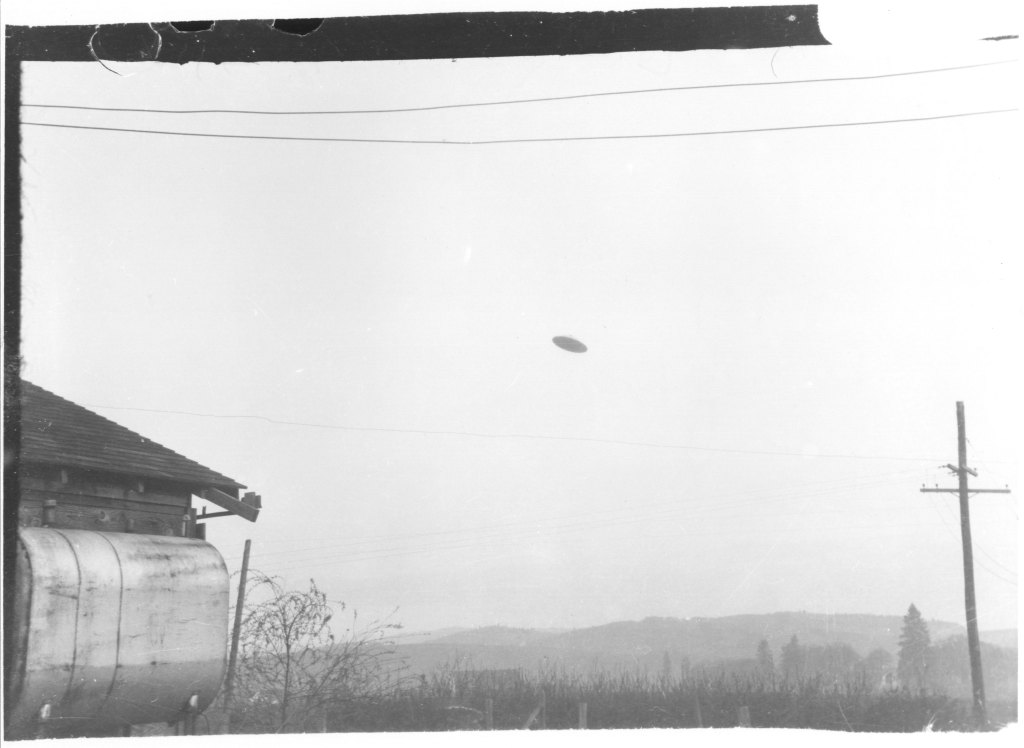
On May 11, 1950, farmer Paul Trent of McMinnville, Oregon snapped two photos of an object that he claimed was a flying saucer (the term "UFO" hadn't been invented yet).  There are inconsistencies in Mrs. Trent's accounts of where her husband was when the object was first spotted, and who went inside to get the camera. They did not immediately tell anyone about the photos, or rush them off to be developed. Instead, the film containing the invaluable flying saucer photos was left in the camera until Mother's Day, so that a few unexposed frames would not be wasted. More general information on the photos is on my web page http://debunker.com/trent.html .

Trent1_Full.jpg
Trent Photo #1 (scan of first-generation print)

After the photos had been developed, a reported who came to interview the Trents found the irreplaceable negatives lying "on the floor under the davenport, where the Trent children had been playing with them."

Trent2_Full.jpg
Trent Photo #2 (scan of first-generation print)

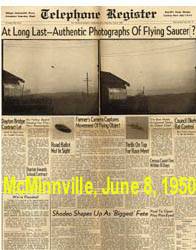
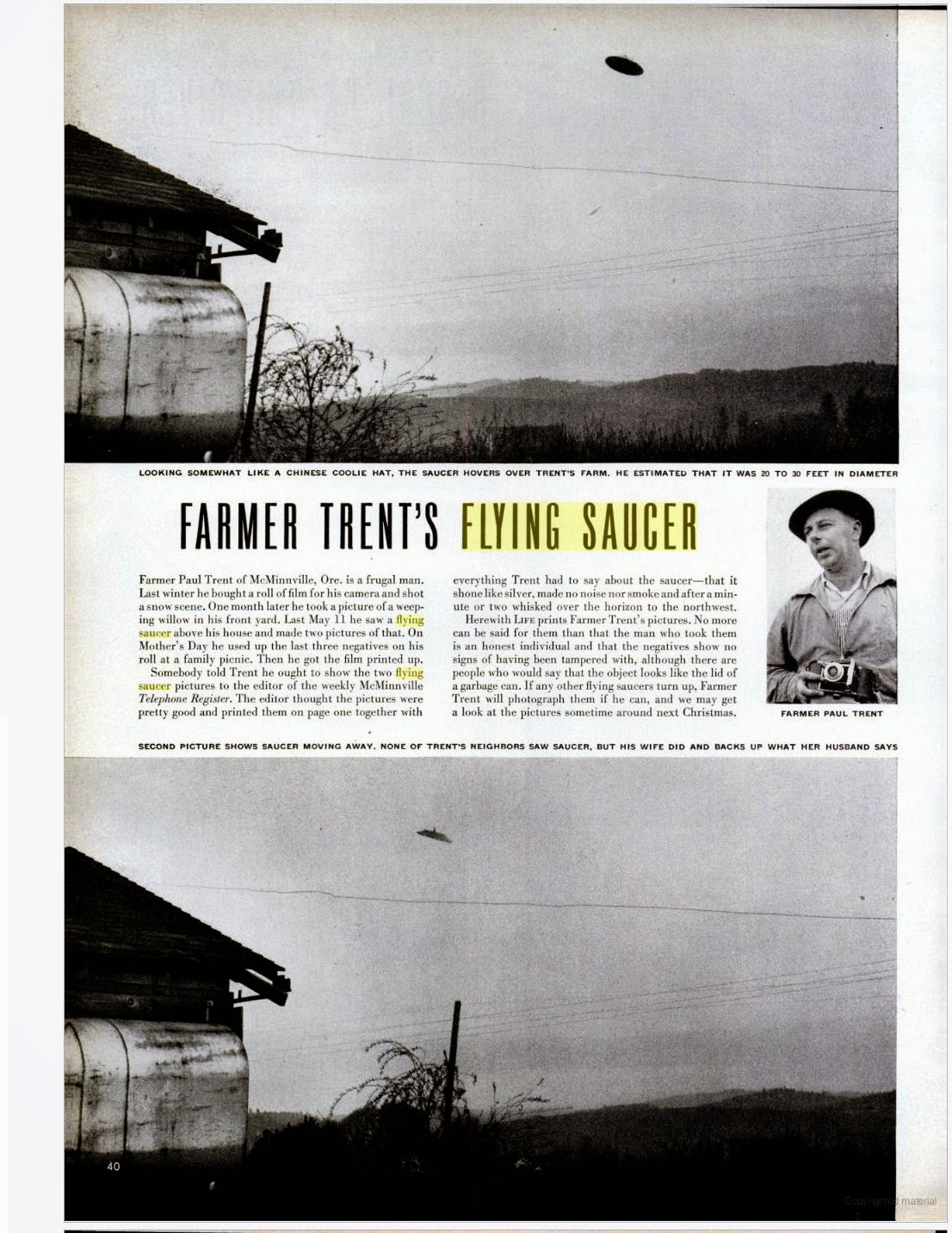
TrentNewspaper.jpgThe story first appeared in the local newspaper the Telephone-Register. This led to a sensational national story in the June 26, 1950 issue of Life Magazine, then one the largest-circulation magazines in America.
LIFE_June_26_1950.jpg
Life Magazine article. Photos are cropped, removing wires.


William K. Hartmann and the Condon Report, 1968

This analysis attracted a lot of attention from UFOlogists, particularly because of Hartmann's conclusion that 

This is one of the few UFO reports in which all factors investigated, geometric, psychological, and physical appear to be consistent with the assertion that an extraordinary flying object, silvery, metallic, disk-shaped, tens of meters in diameter, and evidently artificial, flew within sight of two witnesses. It cannot be said that the evidence positively rules out a fabrication, although there are some physical factors such as the accuracy of certain photometric measures of the original negatives which argue against a fabrication. 

Hartmann acknowledges, however, that a fabrication is possible:

The object appears beneath a pair of wires, as is seen in Plates 23 and 24.
We may question, therefore, whether it could have been a model suspended from one of the wires. This possibility is strengthened by the observation that the object appears beneath roughly the same point in the two photos, in spite of their having been taken from two positions. This can be determined from irregularities, or "kinks," in the wires. The wires pass between the camera positions and the garage (left). We know from the change in orientation of the object that it moved, or was re-oriented by hand, between exposures. The possibility that it is a model hanging beneath a point on the wire suggests a further test: Is the change in distance of the object in Plates 23 and 24 equal to the change in distance from the wires? Measures of the disk indicate that it is about 8% further away in Plate 24. Measures of the irregularities in the wires indicate that they are further away from the camera in Plate 24. The amount of the latter increase from the wires (measured by the separation of rather ill-defined "kinks") is less certain than the distance increase from the disk, but it is measured to be about 10%. These tests do not rule out the possibility that the object was a small model suspended from the nearby wire by an unresolved thread.
Given the foregoing analysis, one must choose between an asymmetric model suspended from the overhead wire, and an extraordinary flying object

The sole factor suggesting that the object is distant is a measured anomalous brightness on the underside of the object in Photo 1, compared with the brightness of the shaded underside of the oil tank. The assumption is that, in the case of a model, the two shaded regions ought to have about the same brightness. Since the underside of the object is brighter than the underside of the tank, the assumption is that atmospheric scattering is the cause, and hence the object is at a significant distance from the camera

When I read this, I immediately thought of at least one other possible explanation for the anomalous brightness. When observing bright stars or planets in telescopes, we invariably see light scattered by the optical system from
bright objects into adjacent dark areas. The same thing happens in cameras. The technical term for this is veiling glare. The cheaper the optical system, the more light that tends to get scattered, and Trent's camera was a budget model, not professional quality. This is especially troublesome when fingerprints or other smudges accidentally get onto the lens, which certainly happens to me, and probably to most other people.

The significance of this is that while the dark underside of the object is immediately adjacent to the bright sky, the bottom of the tank is in a large, dark area of the photo. Hence one would expect more light from the surroundings to spill over into the bottom of the "UFO" than into the bottom of the oil tank.

I was an undergraduate at Northwestern at this time. I decided to test this hypothesis by photographing a concrete light pole in the daylight, with the top of the pole surrounded by bright sky, while its bottom was against a much darker background. I found a professor who had a densitometer in his lab, and would show me how to use it. I measured a series of photos and, while the top of the pole was only a little brighter than its bottom with a clean optical system, the addition of just a little petroleum jelly to degrade the optical system greatly increased the amount of veiling glare - spilled-over light - in the photos.
UFO researcher Bruce Maccabee has measured the original Trent negatives. He argues that, while veiling glare is indeed present, it isn't enough to account for the anomalous brightness. But even if that conclusion is correct, if any of Hartmann's assumptions are incorrect, the photometry results are meaningless. Among the possible violations of those assumptions:
  • If the object is translucent, allowing light from the sky to pass through.
  • the object has a mirror surface at the bottom, thus we are seeing a reflection of the bright ground, and not a shaded surface.
  • If the underside of an object suspended several feet above the ground from the wires receives much more illumination than that of a tank near the ground, next  to a wall. (I would expect this to be true.)

  • ShadowsOnly2.jpg
    Very sharply defined shadows in both photos - obviously cast by sun.

There are very distinct shadows on the garage in both photos, although the Trents claimed that the photos were taken around sunset. The problem is that the wall faces east, and the sun is in that position (about 90 degrees azimuth) about 8:20 AM PDT. If the photos were actually taken in the morning, then the Trents were lying about the circumstances of the incident. I found that, measuring the shadows, we can greatly restrict the size of the object casting the shadows. In fact, it is so small that it is almost certainly less than one degree

The angle abc above represents the radius of the illuminating body.
Assuming these measurements, it is the arctangent of .004, which is 0.229 degrees. This matches extremely well with the known average apparent radius of the sun, which is approximately .25 degrees. Even an undetected reduction of 20% in the size of the shadows in the photo, which is highly unlikely, allows the radius of the illuminating body to be no larger than 0.46 degrees (diameter 0.92).
The maximum possible diameter of the illuminating body is thus shown to be less than one degree, and is probably closer to one-half degree. The area of a one-degree circle is less than 0.025% (1/4,000) that of the quarter sky facing the garage wall.

A bright cloud in full sunlight is only about 10 times the surface brightness of the sky surrounding it.[3] Furthermore, during and after sunset, the sunlight in the landscape has traveled a very long path through the atmosphere, and has thus been very evenly scattered and diffused. According to the astronomer M. Minnaert, by about 10 minutes after sunset, the sky and landscape in the east is dull and of uniform hue. Even a half-hour before sunset, clouds in the east assume a dull red color.[4] To attribute the illumination in the photos to a bright cloud, or to a bright hole in the cloud cover, especially after sunset, would require a surface brightness of these remarkable clouds on the order of magnitude of thousands of times that of the surrounding sky, which is inconceivable. It is particularly implausible that such illumination could exist around the time of sunset.

Conclusion: Because of the small maximum angular size of the illumination body and its intense brilliance, there can be no doubt whatsoever that the shadows in the Trent photographs are cast directly by the sun.
Maccabee still maintains that the shadows on the garage were cast by a bright sunset cloud, even though the McMinnville weather station recorded perfectly clear skies at 7:00 PM on May 11, 1950 (the last observation of the day). His illustration of that argument is below. I have seen and photographed such clouds myself, I am not saying that they do not exist. However, look at the board Maccabee sets up to try to replicate the shadow of the eaves on the Trent garage. The board casts a decent shadow for a few inches below the point where it touches the wall, then as the board moves slightly farther from the wall, the shadow quickly fades to invisibility. At the point where the shadow disappears, at the top of the support pillar, the board is only 8 inches or so from its shadow. The end of the eaves on Trent's garage were approximately twenty inches from the wall (I measured this on a building of similar construction), yet the shadows are still sharp and distinct. This is because they were cast by the sun, small and very bright, not a large, diffuse cloud. If Maccabee can find a sunset cloud that can cast sharp shadows of such boards at twenty inches, then I might be prepared to accept his argument.

trntcf2_fig_04.gif
Maccabee's illustration of a bright cloud casting a shadow at sunset. But
the shadow is too diffuse to allow it to be seen when the board casting it is
some twenty inches from the wall.

Trent1b.jpgmir7lgcu.jpg
Carpenter's truck mirror, and Trent #2

In 2004, researcher Joel Carpenter (1959-2014) created a website on thMcMinnville photos, making a very good case that the object was directly beneath the overhead wires, and close to the camera. He suggests that the object was a mirror from an old truck. I have restored Joel Carpenter's original McMinnville photos website (fixing only the links), and placed it on the Internet Archive.
One of Carpenter's findings is that Trent's camera was surprisingly close to the ground when the photos were taken. For some bizarre reason, Trent did not stand up but instead crouched down to photograph his UFO. Carpenter explains,

Instead of moving toward the object and shooting the photos from eye level in the unobstructed front yard, he shot the two photos up, from a very low level, from the back yard. For reasons explained above, it seems likely that he actually used the viewfinder on the body of the camera while kneeling. The overall geometry of the positions and the attributes of the camera suggest that he was attempting to frame a nearby object in such a way as to maximize the amount of sky around it and enhance its apparent altitude.
In other words, Trent walked away from where the UFO was supposed to be, and instead walked toward where the presumed model was hanging from the wires, and crouched down close to the ground to make his "UFO" appear distant.
 Since the camera moved a significant distance between Photo 1 and Photo 2, can the two Trent photos possibly be viewed as a stereo pair, to reveal the object's distance? In 2010 an anonymous researcher calling himself Blue Shift did so on Above Top Secret. He writes,

This is another cross-eyed stereo pair. That means you need to back away from the monitor a little bit, cross your eyes, and try to line elements up in each picture until you get them together and in focus. Try it first with the oil tank. That has been shrunk to size and aligned to make it a little easier.
Unfortunately, the two photos were taken some distance apart and with the photo on the right a few steps forward. So it'll take a little practice for you to line up some of the other elements, like the bush by the driveway, the telephone post, and maybe even the far away ridge...
Now just for the hell of it, line up the saucer. It won't be exact, because they're at a different tilt in each photo, but do what you can. Got it?
Now "look up" at the overhead wires. Curiously enough, they line up at the same relative distance as the saucer! That's interesting, don't you think? And if you look around the image, as well as the other available images of the yard -- the ones with the ladder -- the wires are not far away at all, but are actually closer to the camera than the oil tank. So if the UFO saucer lines up at that point, then there's a pretty good chance that the UFO is actually pretty close to the camera, also.
Well, certainly the UFO could have moved and somehow by pure chance managed to get a stereo separation of exactly the same distance and at the same relative angle as the overhead wires. That would be amazingly coincidental, wouldn't it?

Trent_Stereo_Pair_Blue_Shift_ATS.jpg
The Trent photos as a stereo pair, by "Blue Shift" on ATS. The "UFO" is seen
to be small, and relatively close.


In 2013 a group of French skeptics (IPACO) did an in-depth investigation of the McMinnville photos. They began with the usual description of the line of sight to the object in each photo, presumed suspension methods, etc. They concluded that the object is a small model.

More interesting is the second part of the report, completed two months after the first part: Evidence of a Suspension Thread (page 29).
They do not claim to detect the suspension thread directly, but instead statistically:

The basic idea is that if there are traces of a thread in a picture’s pixels, above an object hanging from this thread, and if this trace is « buried in noise » within the sky’s background (noise due to atmospheric diffusion and/or to the digitizing process), it should be possible to increase the signal-to-noise ratio thus uncovering the thread, by summing pixels along columns parallel to the thread.
They concluded, "For the TRNT1 picture, the presence of a negative peak (thread darker than the sky) was clearly observed which matched exactly to the supposed attachment point, with a significant difference of 2,38 sigma, for a tilt angle equal to -11°.... Application of the same method to the second picture TRNT2 provided comparable results, with a tilt angle of -10.29 ° and results of over 2.5 sigma."

 Bruce Maccabee and Brad Sparks have written responses to the French report. Maccabee objects that "Regarding the photogrammetric analysis,  I showed that the sighting lines did not cross under the wires and they did not refute this." This comment is a bit odd, because:
A) nearly everybody else who has investigated the question has come to the opposite conclusion, including William K. Hartmann and Claude Poher. The IPACO report says "The relative position may obviously be considered as nearly constant, which can only be explained, from a geometric point of view, if the object was effectively hanging from the wire OR if its movement between both shots was following precisely its sighting line."

B) The IPACO report based their measurements largely on a map provided by Maccabee.

Sparks objects that 

"These French debunkers have incomprehensibly asserted that the UFO and wires are "black bodies" to which they apply "radiometry" -- which is the science of measurement of heat.  They claim to derive an estimate of distance from this. They apparently have no idea what they are talking about.... They have confused photometry (light measurements) with radiometry (heat measurements from black body heat radiation, thermal emissions)." 
Technically, he is correct.  However Sparks does not consider the possibility that the problem is simply the result of a bad translation from the original French. If you read the paper, it is obvious that they are using the word "radiometric" to mean the brightness of the pixels, and not any supposed heat emitted by the object. Their measuring technique is valid, even though the English description of it isn't. If the "French Debunkers" had substituted the proper word  "densitometric"  for "radiometric", and "dark bodies" (meaning, opaque and not self-luminous) for "black bodies" (which has a very specific meaning in physics), the objection vanishes.

Now, another researcher has weighed in. Jay J. Walter of Phoenix, Arizona, the author of the suspense horror novel Blood Tree, did his own investigation. Working from high-resolution scans of first-generation prints that I sent him (scans now posted on the Internet Archives for anyone to research), he did his own photo enhancement using the venerable program ArtGem. He said that even using a 4.2ghz quad core 64bit processor with 8 gigs of system RAM, he was still getting "out of memory" errors. However, he persevered, and produced the following photos, appearing to detect portions of a suspension thread above the object in both photos. The purported string cannot be seen across its entire length, which is consistent with the French skeptics only being able to detect it statistically. It is significant that Walter and the French team were working with different scans.

Trent1string_JJ_Walter.jpg
Jay J. Walter's possible detection of a suspension string in the first Trent
photo, its position illustrated by the drawn-in string in the bottom
photo.

Trent2string_JJ_Walter.jpg
Walter's suggestion of a string in the second Trent photo. I had to convert
these photos from TIFF to JPG format in order to post them, which loses some
details.

String.jpg
Walter's apparent string seen in its proper
orientation.
Another of Walter's purported discoveries is what he calls a "logo," an apparently flat area with two holes, where it appears a logo plate might be attached, or possibly even a handle. Is this real, or is it simply  "pareidolia" - seeing a pattern where none exists? Confirmation is needed.

Trent2_UFO_Logo_1200dpi.jpg
Did something once attach here to the object in Trent photo
#2?

Walter suggests that the object in question is an appliance motor shroud, approximately eight inches in diameter. "I think Trent walked to the garage one evening, tied a string to an appliance motor shroud via an old bolt, tossed theshroud over a wire and tied the other end of the string to an anchor near the ground, then took the two pictures.  Logical, practical, and so much less effort for him than other theories.  People just do what they do and Trent wasn't going to go to too much effort just to fool his banker buddy."

But wait - there's more! In the words of UFO researcher Martin Shough on UFO Updates, "I am hearing rumours that certain researchers, one of whom is no stranger to this List, are on the brink of publishing an analysis which they believe is proof of a hoax. I have it on the authority of a third party - a 'usually reliable source'
- that cunning digital enhancement has revealed the presence of a string or wire
support."

I have been in contact with this Mystery Researcher, who has not authorized me or anyone else to reveal his findings. He was planning to write a book exposing three major UFO photo cases as hoaxes, one of course being Trent. However, he says this plan has been abandoned, and he is  uncommunicative about the details of his work. I do not have proof of what he says about the string. However from the seriousness with which he has undertaken other investigations, I am inclined to believe that he has indeed found it.

Do these new findings finally debunk the Trent photos? They would, provided they can be independently confirmed by other researchers, using other high-resolution scans from first-generation prints, or else the original negatives. Until then, people will continue to argue about such matters as the gauge of the wires, and whether the model, if it were a model, would have to be five or six inches in diameter.
Hoe vind je dit bericht?
Geschreven door peter om 14:34 Stuur door

Did This Former Intelligence Analyst Analyze The Intelligence Properly?

Did This Former Intelligence Analyst Analyze The Intelligence Properly

Considerations of the Work of James Carrion


Considerations of the Work of James Carrion


Jack Brewer By Jack Brewer
The UFO Trail
10-3-14

     James Carrion is a writer, researcher and former intelligence analyst. No stranger to the UFO phenomenon, for a while he occupied the hot seat at the Mutual UFO Network. In his latest blog post, he identified what he termed "the smoking gun" of an intelligence operation theorized in his book, 'The Rosetta Deception', available for free on Carrion's blog site of the same name. He recently launched the Rosetta Deception Forum, a message board where you can post questions, discuss the book and share related research.

Ghost Rocket
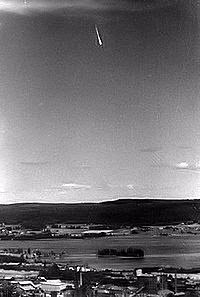
Possible "ghost rocket" depicted in a photo widely
circulated and originally released by Swedish Army, according to
Wikipedia
'The Rosetta Deception' contains a substantial amount of cited research focusing upon parts of 1946 and 1947. A series of well sourced events and circumstances are presented that suggest the "ghost rocket" reported sightings over Europe were the results of a U.S.-led deception operation. I suspect Carrion's interpretation is extremely likely to be accurate.
Carrion suggested in his book that motives for the operation included building global distrust for the Soviet Union while the world was speculating who was testing missiles over Europe. The primary objective, however, may have been to crack the Russian diplomatic code. This would have been accomplished in part through a method known as gardening, which involves creating circumstances of interest to enemy spies so that specific key words can be expected to be prevalent in coded messages, thus increasing opportunities to break the code. More complete understandings and context can be gained by taking other relevant circumstances of the era into account, many of which are specifically presented and sourced in the book.
In his latest blog post, Carrion outlined some particular points of his theory and added what he referred to as the smoking gun: A 1946 NYC-initiated strike of communications employees which significantly decreased available methods for Soviet intelligence agents located in the States to send messages safely to Moscow. Carrion reports that a resulting bottleneck of information flow created optimum conditions for American agents to gain access to encrypted Soviet messages. There are specific circumstances presented in 'The Rosetta Deception' in support of the likelihood, including the established and substantial presence at the time of the U.S. allied intelligence community in Stateside media and communications corporations, the very outfits which would have been relied upon.
Those who wish to debate Carrion's perspectives on the ghost rockets were invited to do so. Read more about his challenge, including definitions of standards of evidence and the requirement that an actual theory must be put forth, in his related blog post.

Objectives of Deception
Perhaps the biggest hurdle to accurately understanding intelligence operations, and particularly those that overlap with the UFO community, would be the failure to consider there is no all inclusive explanation. There is more than one reason the IC manipulated circumstances commonly perceived as related to UFOs. The purposes and objectives change from one specific circumstance to the next and cannot be discussed effectively in an overly generalized manner. Particular eras and specific cases should be considered independently of one another.
Consider, for example, a now declassified 1954 CIA memo in which agents were instructed to contemplate fabricating a sensational UFO story. The purpose of the potential fabrication was not in and of itself to deceive the public. The objective, according to the memo, was to divert public attention from Agency involvement in a Guatemalan coup.
If we neglect to seek such documents, we fail ourselves as researchers. We also fail as interested members of the public searching for accurate information.
If we perpetually subscribe to extreme beliefs, to either side of center, we increase the likelihood we are missing important data. That would be the case in arguing the IC was never involved in ufology, as well as limiting our perspectives to the incorrect assumptions that the only objectives must have involved either covering up an alien presence or the polar opposite of deceiving the public into believing aliens are among us. As Carrion suggests in his work and the 1954 CIA memo demonstrates, there are many potential objectives for UFO-related deception operations. Their intricacy would be par for the course, not the exception to the rule.
It appears to this writer that UFO-related deception operations conducted by the IC are reasonably a given.
Their extents, specific circumstances and objectives are yet to be conclusively determined - not their existence.
It is important to understand that we must demand verifiable information in order to draw conclusions. Such conclusions cannot be found in passionate opinions or baseless arguments that go in circles but never reach resolution as is all too often the case within ufology.

We Have Seen the Enemy...
It has been said that propaganda is sometimes aimed at the media with the ultimate intention of influencing politicians and global leaders. If taken from that perspective, confused and misinformed members of the public might be viewed as little more than relatively inconsequential byproducts of some deception operations, at least to the powers that be.
Another way of looking at that would be to consider the IC may not be as responsible for the runaway beliefs attached to UFOs as much as the UFO community sometimes took a nudge and did the rest largely on its own. Among our biggest challenges as a community in search of accurate answers continues to be ourselves, or at least a segment of our community.
There is a leading segment of the UFO community that chronically seeks to perpetuate mysteries rather than solve them. They seek no prosaic explanations, and scrupulously avert from them at virtually all costs to logic and rationality.
Some of the mysteries that find their ways into UFO circles may indeed one day prove to be groundbreaking and of great interest. The vast majority will most certainly not.
It was not the IC that single handedly turned the "ghost rockets" into a supposedly alien-related cultural phenomenon that became perpetuated for over half a century. Neither was a Pentagon think tank solely responsible for such a large number of questionable UFO stories evolving into never ending sagas of mythical proportion. We did that on our own.
I recommend checking out the work of James Carrion. I think it is worth the time and attention. He operates the blogs 'The Rosetta Deception' and 'Follow the Magic Thread'.
Join and participate at his recently launched message board at Rosetta Deception Forum.

Hoe vind je dit bericht?
Geschreven door peter om 22:42 Stuur door

Meer van UFO'S of UAP'S, ASTRONOMIE, RUIMTEVAART, ARCHEOLOGIE, OUDHEIDKUNDE, SF-SNUFJES EN ANDERE ESOTERISCHE WETENSCHAPPEN - DE ALLERLAATSTE NIEUWTJES

↑ Terug naar de berichten